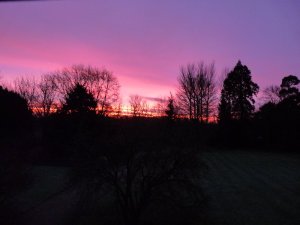
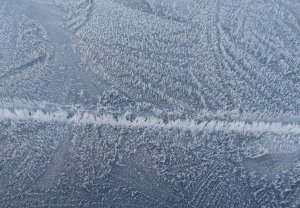
Winter has arrived. It’s taken its time. We’ve been accustomed to mildness, and lots of mud. Suddenly though, sunrise has been that rich blazing orangey-red, with vibrant yellow, that seems to arrive only on very cold days. And Jack Frost has been amusing himself by designing complicated patterns on car windscreens, making sure they’re good and hard to scrape off by a would-be early driver.
Our iced-up car windscreen.
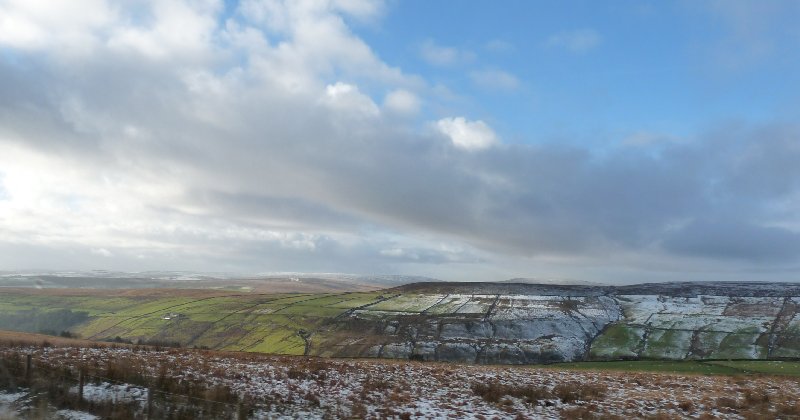
Last Friday, we travelled over the Pennines to Bolton. The hills were, for the first time this year, covered with snow. We even had the mini-adventure of battling through a mini-blizzard. And the next day, we travelled back. Cars slithering and careering wildly, or worse, along icy roads, closed our usual road home: instead we diverted across bleak moorland via Todmorden, Mytholmroyd, Hebden Bridge, Howarth and Keighley – a real Wuthering Heights landscape, meeting only very hardy sheep for much of the way. These were the views.
I’ve never been one for an evening down at the pub. When I was younger, I hated going out to meet friends there, for all it was a rite of passage and part of growing up. The smell of cigarette smoke, mixed with that of alcohol and under-ventilated space was the first downer, and then there was the problem that I didn’t – and still don’t – like beer. If weaker, to me it tastes of soap, and if stronger, of iron filings. What, really, was the point?
Over the last few years, pubs have had to re-invent themselves. Now that beer is cheap(ish) and cheerful at the supermarket, and now that people can relax at home in front of ever larger TV screens, fewer and fewer people want to dig themselves out of their cosy homes simply to go to their ‘local’ and have a drink with friends. So some offer Quiz Nights, or the chance to watch the Big Match on the Big Screen. Many many more have given up the unequal struggle and simply closed for ever.
Some though are doing well because they’ve chosen to offer good food, and those are the ones we like these days. The area we’ve chosen to live has more great pubs than seems entirely necessary. There are at least four within very easy reach. Get talking about matters of food when you’re out with your friends, and everyone will have yet another favourite haunt which they’ll insist you should try. What all these pubs have in common is cosiness. They’re warm and welcoming: muted colours and old oak furnishings, and often a slightly idiosyncratic lay-out which guarantees you a degree of privacy whilst also enabling you to people-watch . At this time of year, there’s sure to be a log fire flickering in the corner. Cheerful young staff will whisk you to a table as you arrive and summarise the ‘daily specials’. These pubs tend to have a limited range of dishes on offer, but that’s because the menu is designed round what’s available on the day, for that day.
There’s beer to drink – of course there is, it’s a pub after all – but these days there’s a decent wine list too, although the mark-up’s way beyond what we got used to in France.
So we’ve traded treating ourselves to a ‘formule’ at some local French restaurant, sitting outside and relaxing under the welcome shade of a large umbrella in favour of a cosy hour or two over a meal in front of the fire in an English pub. And do you know – they both have their special charms.
Here we are today at the Freemasons Arms in Nosterfield. Not a bad way to spend a Sunday.
A quiet drink, watching others having …. a quiet drink
Since we Yorkshire folk are from the Pennines rather than the Pyrenees, we’re inclined to make more of a fuss about steeply climbing roads. The main road from Thirsk to Helmsley is the notorious A70 via Sutton Bank, and no sooner have you left Thirsk than the warnings start:
25% gradient ahead.
This way for the alternative route for caravans.
Last year, 74 HGVs marooned themselves on the slopes… and so on, and so on.
Certainly, it is a dizzying climb, with the patchwork fields of the Vale of York laid out far below. Then suddenly, you’re at the top. You’d have to be in a real hurry not to park and get out for a while to enjoy the view, as we did twice today, once on the way out, and once on the way back. It’s winter now – not long to the shortest day – so these sunset scenes were taken at just after 3.00 p.m., a mere three hours after we’d climbed upwards, only shortly before midday.
Today was indeed a misty morning. Ripon has no fewer than three rivers in town, and a canal too, and one of those three rivers, the Ure, passes our back door. So it’s no surprise that we do ‘misty-moisty’ mornings, evenings and nights on a regular basis.
But mistiness is no excuse not to walk the mile and a half along the Ure to visit the village shop at West Tanfield to buy a Sunday paper. Here’s my journey:
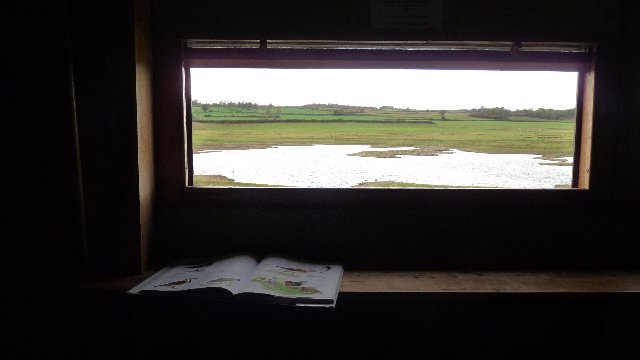
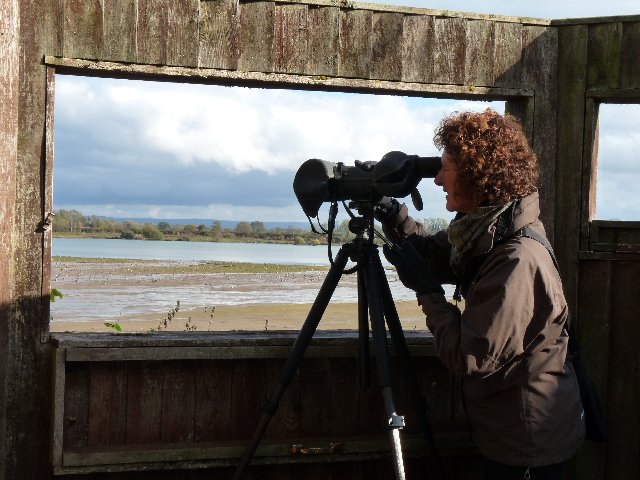
A comfortable hide at Nosterfield: sheepskin covered seats, and lots of birdbooks to refer to come as standard
We spent yesterday at Nosterfield Nature Reserve , a mere couple of miles from here. There’s no point in having a bird reserve almost in your back garden if you don’t know a wigeon from a pochard, or if you confuse a rail with a dunlin. It’s even worse if you’ve heard of none of the above. We signed up to ‘Start Birding’, and birding’s what we did, for the whole of a bright and sunny Friday.
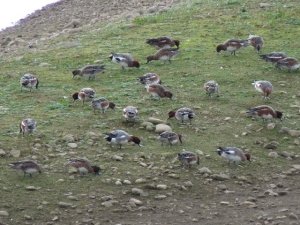
Wigeon feeding
Pochard
Water rail
Dunlin
Linda, our teacher, was infectiously enthusiastic. She lent out decent pairs of binoculars, and made sure we knew how to use them. She helped us observe birds for their silhouettes, colouring, flight patterns, so we could begin to identify the hundreds of birds who regard Nosterfield as home, a holiday resort, or a stop-over on a long voyage from the Arctic to – who knows? Southern Europe or even Africa.
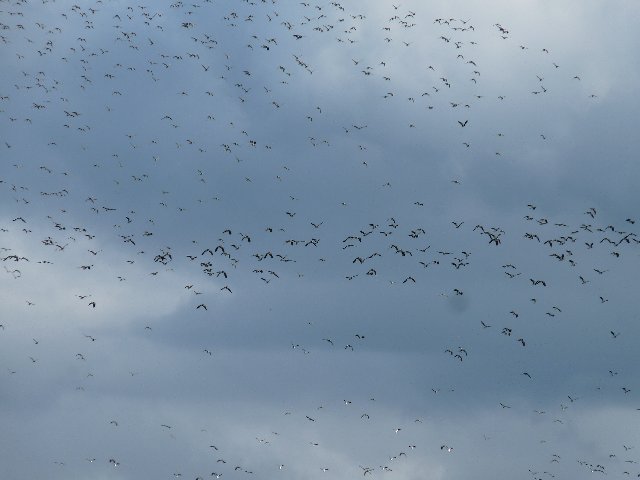
And we hadn’t been there long before she saw drama begin to unfold. We saw no drama. Oh yes, we could see that birds who had been feeding in scrubland, and waterfowl who’d been serenely gliding in the shallows all flew skywards, all started wheeling and turning, circling the area they’d come from time and time again, in some agitation. But, well, birds do that, don’t they?
Bird panic
Linda knew better. She knew they’d all spotted something we couldn’t see. We all used our binoculars and her super-powerful telescope to scan the sky. It was more than 5 minutes before she saw, high above, a peregrine falcon. He rose high on the thermals, looking down on all his possible prey, all flying close together for their mutual protection.
And suddenly, talons extended, he dropped. Only Linda and Dianne spotted the moment when he scooped up a lapwing, and plummeted swiftly to earth to despatch the bird and inspect his catch. He didn’t get much chance. A small gang of carrion crows moved in. They wanted the falcon to open his prey up, then they planned to steal it.
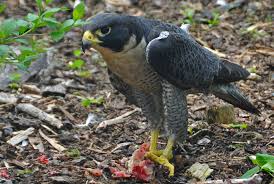
Peregrine falcon feeding
The peregrine wasn’t having that. He grabbed his lapwing, flew off, and came down again, this time where Linda was able to train her telescope so we could get grandstand views of what happened next. The crows reappeared too, but knew there was no food for them while the lapwing’s corpse remained intact: their beaks are not designed to pierce outer skin. By determined, measured stabbing, the falcon started to open his prey up. White downy chest feathers flew, as he discarded these in search of the flesh beneath. The crows pranced round. They snapped at the falcon’s tail, they tried to provoke and hustle him into abandoning his catch. They even ventured to pluck at the lapwing feathers themselves. But though irritated, the falcon carried on, ripping away at the flesh with his super-strong beak. As the crows took occasional chances to dart close and grab a mouthful, they were rebuffed by the falcon’s impressive skills as a sentry: and no doubt from the fear of that beak too.
Little by little, the falcon ingested his meal. That may be his diet sorted for the next day or two. He even left the carrion crows the bones to pick clean. They too wouldn’t have gone away entirely hungry.
Those are lapwings in the foreground. Behind are golden plovers.
And after that, we had a day of lapwings and golden plovers, and cormorants, and rails and wigeons and pochards and shovellers and Barnacle geese and Canada geese, a kestrel or two, and goldfinch and twites and great tits, and many many more. We can confidently identify many of them, and now have the tools to gain in confidence and knowledge every time we go out with our eyes wide open and our senses tuned in. Even without the blockbuster tale of savage death at the lakeside, Friday would have been a fantastic day.
If you live in Yorkshire, within reach of Leeds, and would like to know more about birds, do follow the link to the ‘Start Birding’ site and see what’s on offer. This is an unsolicited testimonial to Linda Jenkinson, Top Twitcher!
Linda focussing one just one of those birds.
I was too busy on Friday to take many photos, so the ‘bird portraits’ are courtesy of Wikimedia Commons.
‘I’ll bet’, ventured a friend the other week, ‘that the last few of those yellow bicycles don’t disappear from sight until round about Christmas’. I didn’t take her on. My own bet is that just a few of those yellow bikes, which so many people put outside their homes to celebrate the Tour de France in early July, will still be around many years from now . Most have gone of course.
Little by little, in the weeks after the Tour, the bunting came down, then those miles and miles of hand-knitted jerseys, then the yellow bikes. Now that Autumn winds are kicking in, all the bright yellow floral displays, often cascading from the panniers of those yellow bikes, are finally being grubbed up too.
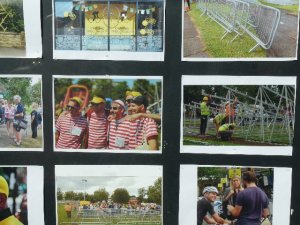
A few of the photos of the pre-Tour preparations
As far as Harrogate was concerned, the Tour de France Swan Song took place last week, in the form of an exhibition mounted by the Harrogate Photographic Society, ‘Le Tour in Harrogate’. It took over the town. The ‘hub’ – a term borrowed from the Tour itself to indicate where the main action was to be found – was in the exhibition space of town centre Saint Peter’s Church. But there were satellite exhibits in a local café, an optician’s shop, and in the windows of a recently closed department store.
When we visited last Sunday, we found ourselves in company with dozens of others, poring over the images, sharing memories, exclaiming over forgotten moments of the preparations for the race in the days and weeks before, and its aftermath, as well as the days of the Race itself. There were pictures of old gnarled hands knitting away industriously to produce those yellow-jersey banners, of hi-viz-clothed teams of men road-mending late into the night beneath the glare of floodlights. Here were the gardeners making sure Harrogate’s famous floral displays were at their best, or French members of the huge Tour de France preparation team taking time out to link arms, laugh and pose for pictures. My favourite shot, taken on race-day itself was of two young men perched high on a chimney-stack looking down on the race far below them. And then there were the scenes of riders disappearing from view, only seconds after they’d first come into sight.
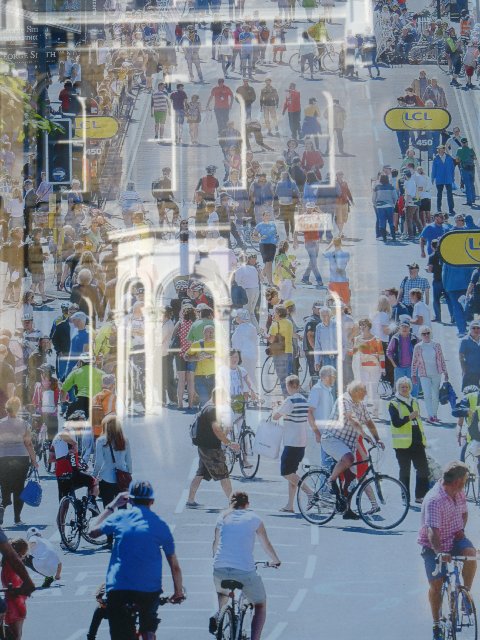
Tour street scene in Harrogate
A new use for a bus shelter on race day
As it happens, Harrogate’s official vehicles’ livery is yellow. Street cleaning lorries wait to go into action.
I’ve taken my own photos of the photos. Perhaps that’s a bit like the video which was said to have been offered for sale a few years ago by a dodgy salesman operating from a battered old suitcase at the corner of the market place. It was ‘Jurassic Park’, filmed in a darkened cinema on a hand-held camcorder. But these pictures shown here are just souvenirs. If you want to see these wonderful images in all their glory, you’ll have to contact the Photographic Society, who have produced a fully illustrated souvenir catalogue. We’ve ordered a copy.
A shot of the crowds enjoying the party atmosphere before the riders arrived. Just as visible is a Harrogate streetscape, reflected in the shop-window where this picture was exhibited
I haven’t been able to credit individual images shown here as the photographers weren’t identified in this particular display. These aren’t however so much reproductions of their work as impressions. The photos themselves are well worth seeing in their original form.
Seasonal walnuts and chestnuts on a greengrocery stall
Sheepskin slippers for winter.
One of the bread stalls ar St. Girons.
A busy Saturday in St. Girons.
We’ve just come back from a Saturday morning strolling round Richmond market. It’s a pity for Richmond that our most recent Saturday-strolling-round-market experiences date from our days in the Ariège. The Saturday morning market in Saint Girons is an incomparable experience which Richmond couldn’t match.
Saint Girons has fewer than 7000 residents, but it’s the administrative centre of the Couserans, and the centre of gravity not only for its own inhabitants, but for townspeople, villagers and farmers for miles around. Saturday is the day they come to stock up on fresh fruits and vegetables, charcuterie, cheeses, dried fruits, hardware and haberdashery, plants for the potager, and to link up with friends and neighbours over a coffee or a beer in a local bar. Saturday is a day when they might themselves be stallholders. Among the joys of the market is the pleasure of finding small stalls selling just a small selection of say, goats’ cheeses, produced that very week by a ‘petit producteur’, or asparagus picked no more than 24 hours before, and only available for a few short weeks in April or early May, or home-produced charcuterie, or mushrooms and fungi foraged from the woodlands and meadows round and about. There’ll usually be a crowd surrounding these specialised stalls, which may not be there every week, or in every season, because they can only put in an appearance when they have enough good things to sell. And the market sprawls between two squares, along the banks of the river, and up a couple of other streets. You won’t get away in a hurry.
Compare Richmond in Yorkshire. It too is the main town in its region, Richmondshire, and only a little larger than Saint Girons: it has somewhat more than 8000 inhabitants. But its market barely extends beyond the handsome market square. There are several good greengrocery stalls, an excellent fish stall, which is well-known throughout the region, others selling home-produced sausages and other prepared meat products, and plant stalls with herbs, bedding plants, bulbs and seeds. Best of all is the wonderful cheese van, ‘The Cheesey Grin’, whose knowledgeable, enthusiastic and cheerful owner has the best variety of cheeses from Britain and Europe, from small producers, brought out for sale when at its very best, that we’ve seen in quite a long time. But that’s all. You can be done and dusted in 15 minutes. I fear that markets, or at least the ones local to us, are in decline. Ripon too has noticeably fewer stalls of any kind than was the case only a very few years ago, and a smaller number of stalls selling well-produced or sourced local food. Still, small shops selling these things seem slowly to be on the way up, so perhaps we’re exchanging one kind of market for another. Perhaps it’s not a death knell. As a French friend of ours said recently, ‘I don’t hope so.’
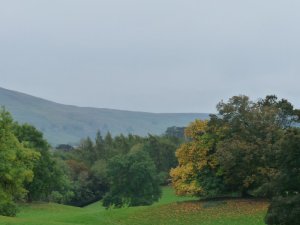
We travelled the road to our last walk in thick white mist, fearing a dank and gloomy day. But the higher we climbed, the more the mist fell away, and the brighter the sun shone.
Looking down over Wensleydale from Castle Bolton.
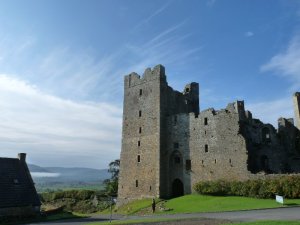
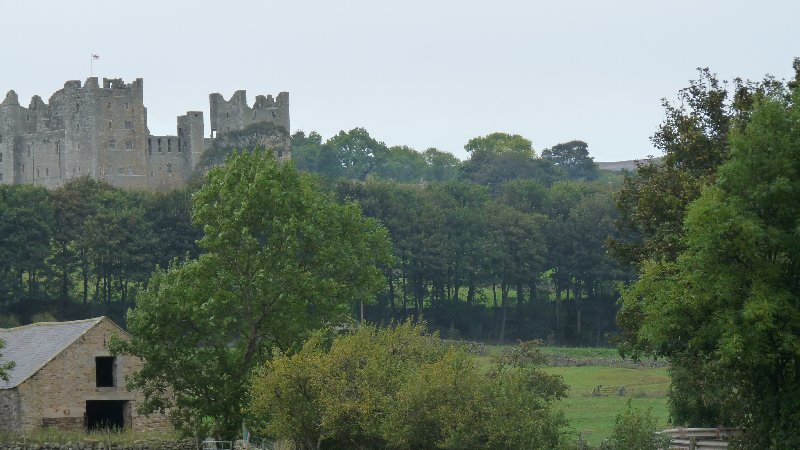
This was the scene as we arrived at Castle Bolton, the village where you’ll find Bolton Castle:
And as we began walking, Daphne shared some of the castle’s history with us. It has belonged to the Scrope family since the time it was built in the 14th century, and has always been admired for its high walls. It’s a proper castle, looking exactly like the ones you will have drawn when you were eight years old.
Bolton Castle
But that’s not why it secured its place in the history books.
Tudor history is largely about the constant religious and temporal battles between the Catholic and the Protestant church, which Henry VIII had made the Established Church, with the king as its head: the Fidei Defensor – Defender of the Faith (unbelievably, Henry hung onto this title, awarded him in his pre-Protestant days by Pope Leo X, in recognition of his book Assertio Septem Sactramentorum which defends the supremacy of the pope). His son Edward briefly succeeded him, and then his daughter Elizabeth, and both were Protestants.
But Elizabeth’s rule was threatened by the Catholic Mary Queen of Scots, and she was held captive first at Carlisle Castle, then at Bolton. Here she was attended by 51 knights, servants and ladies-in-waiting, not all of whom could be accommodated in the castle itself. She also had cooks, grooms, a hairdresser, an embroiderer, an apothecary, a physician and a surgeon, while furnishings fit for a queen were borrowed from nearby Barnard Castle. She went hunting, learnt English – for she spoke only French, Scots and Latin – and spent time with local Catholics. She made an unsuccessful bid to escape from captivity. It’s said she climbed from an upstairs window in the castle, and fled on horseback past the nearby market town of Leyburn. It’s here she dropped her shawl and so was discovered and recaptured. And that is why, so they say, the long escarpment above the town, nowadays a playground for walkers and sightseers, is still called ‘The Shawl’.
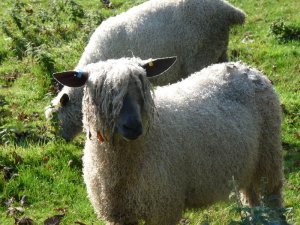
As we enjoyed our history lesson, we passed a field of Wensleydale sheep. We very much admired their sultry fringes.
Wensleydale sheep
And onwards. Autumn colours.
A completely pointless stile in the middle of a meadow.
Then Aysgarth Falls. What a wonderful lunch spot. The crashing waters made conversation quite impossible, but we sat enjoying the surging waters, the coppery leaves above our heads, and the all-encompassing percussion of the tumbling River Ure.
And then it was time to turn round and head back by a different route. Another great day’s walking, with an added history lesson.
We’ve been back in the UK from France six months now, so this seems a good moment to take stock.
Did we do the right thing in coming back to England to live? Absolutely no question: we’re so happy to be here, and nearer to most of the family. There are things we miss about our lives in France though: of course there are. It was tough to leave friends behind, and we continue to miss them. Still, three have visited already, and there are more scheduled to come and see us here. And it’s sad no longer having the Pyrenees as the backdrop to our lives. Though North Yorkshire’s scenery brings its own pleasures.
Still, it’s wonderful not to have to tussle with language on a day-to-day basis. Our French was pretty good, but it was generally a bit of a challenge to talk in any kind of nuanced way about the more serious things in life. Now I feel I’ve freed up enough head-space to revise my very rusty Italian, and to learn enough Spanish to get by when we visit Emily in Spain.
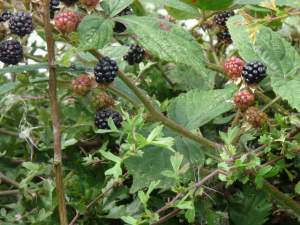
Many of our regrets or rediscovered delights centre on food. This summer, we’ve gorged ourselves on the soft fruits that the British Isles grow so well: particularly raspberries, gooseberries and blackberries. Oh, they exist in southern France, but they’re wretched, puny little things, with no lively acidic tang like those of their British cousins. In a straight choice between raspberries and peaches, raspberries win every time (though of course, it’s even better not to have to choose).
Blackberrying near Harewood.
I miss, though, the choice we used to have in France of four or five different kinds of fresh, dewy whole lettuce available on market stalls every single week of the year. It’s flat, cos or little gem here, or those depressing bags of washed mixed leaves, and I find myself longing for the choices I used to have of crunchy, curly, bitter, blanched or soft leaves in various shades of green or even red. On the other hand, we do have tangy watercress here. And crisp crunchy apples, and Bramley cooking apples…..
And whereas in France there were always French cheeses on offer, and jolly good too, that was all there was, apart from the odd bit of shrink-wrapped Cheddar or waxy Edam. Here we can have English AND French (and Dutch and so on): decent French cheese too, unpasteurised, from small suppliers.
And what about eating out? Surely that’s better in France? Those copious home-cooked midday ‘formules’ – often a starter, main course, pudding AND wine, preferably eaten in the open air shaded by some nearby plane trees bring back such happy memories. But, but…. the menus were entirely predictable, and were dishes that had stood the test of time over the decades. After a few years, we wouldn’t have objected to a few surprises. Whereas back in Britain, most places seem to have upped their game considerably over the last few years. Local restaurants, pubs and cafés offer interesting menus, often based on what’s available that day, at fair prices. We’ve had some great meals since our return, and we’ve hardly started to get to know the area’s food map yet. And for Malcolm, there’s the constant possibility of slipping into a tea room to assess the quality of their coffee and walnut cake. This may be the main reason why he’s come back.
All the same, we can’t eat outside quite so often, particularly in the evening. And our fellow walkers have yet to be convinced of the pleasures of the shared picnic with home-made cakes and a bottle of wine: we’re working on them. Nor have we yet had a community meal, with long tables set out in the square as old friends and new share fun together over a leisurely meal.
Like most people who return from France, we find the crowded motorways unpleasant. But it is nice not to be followed at a distance of only a few inches by the cars behind us.
We’re struggling to shake off French bureaucracy too. Tax offices and banks over there continue to ignore our letters pointing out we no longer live there, continue to demand paperwork they’ve already seen, continue to ignore requests. And as we can no longer pop into the local office to sort things out, the problems just go on and on.
Something we’re enjoying here too is the possibility of being involved in volunteering. It’s something that exists in France of course: Secours Populaire and similar organisations couldn’t function without local help. But the French in general believe the state should provide, and the enriching possibilities for everyone concerned that volunteering in England can offer simply don’t exist. We already help at a community bakery, but I’m currently mulling over whether I should find out more about the local sheltered gardening scheme for people with learning disabilities, or about working with groups of children at Ripon Museums, or simply go into the local Council for Voluntary Service and find out what other opportunities exist.
Six months in, we’ve spent more time with our families, re-established old friendships, begun to make new ones. We’re happy in our new village home, and the slightly different centre-of-gravity we now have. Poor Malcolm’s waiting longer than he would have had to in France for a minor but necessary operation, but despite that, life’s good. We’re back in England to stay.
On Saturday we called in, far too briefly, at the annual Masham Sheep Fair. This is the place to go if you believe a sheep looks just like this.
Saturday was the day a whole lot of sheep judging was going on in the market square. Here are a few of the not-at-all identical candidates. And yet they are only a few of the many breeds in England, and in the world. There are 32 distinct breeds commonly seen in different parts of the UK, and many more half-breeds. I was going to identify the ones I’m showing you, but have decided that with one or two exceptions (I know a Swaledale, a Blue-faced Leicester or a Jacobs when I see one), I’d get them wrong. So this is simply a Beauty Pageant for Masham and District sheep.
And if you thought wool was just wool, these pictures may be even more surprising. Who knew that sheep are not simply…. just sheep?
You must be logged in to post a comment.