Ripon Cathedral – viewed from High St Agnesgate (geograph.org.uk)
One of the bells of Ripon Cathedral sounded this morning: sonorous, measured and slow. The pancake bell. It’s rung out every Shrove Tuesday for centuries now, just like other bells in other churches, countrywide. It reminds good Christian folk to come to church and confess their sins, before Ash Wednesday. Some also believe it was to remind thrifty housewives to use up their eggs, butter and milk before fasting during Lent.
Gentlemen of the press outside the cathedral to record the action.
Nowadays it’s a signal to gather outside the cathedral and have a bit of fun. Somebody has already cooked a pile of pancakes. No point in making lacy delicate crepes. These pancakes are in for a tough time as props in the annual pancake race. Contestants have to run from the Cathedral, down Kirkgate, pan in hand, tossing as they go …. onto the pavement, as often as not.
I watched teams from the Rotary Club, from local primary schools, from the Italian restaurant down the road.
The lads from Valentino’s Italian Restaurant arrive to run in style.
Sadly though I missed seeing the clergy do their bit: things to do, places to go. It all seemed amiably uncompetitive. Just a chance to chat to the Hornblower (who keeps us safe through the night here in Ripon), to friends, and to take a few snapshots of this happy little Shrove Tuesday tradition.
David from the Rotary Club gets a bit of practice in.
The Ripon Hornblower keeps a friendly eye on the proceedings.
Children from Holy Trinity School tussle it out.
Later, much later, Malcolm and I had pancakes too, delicate lacey ones, served with lots of sugar and lemon juice. We tossed them of course. But we didn’t run down the street with them.
Now let’s see. Did we go to Burton Constable or Constable Burton the other day?
Oh, do keep up. Burton Constable is a stately home in Yorkshire, whereas Constable Burton is … a stately home in Yorkshire. And they have nothing whatever to do with one another.
Let’s start again. Constable Burton Hall is a fine country house not far from us in North Yorkshire. It’s not open to the public, though its wonderful gardens are.
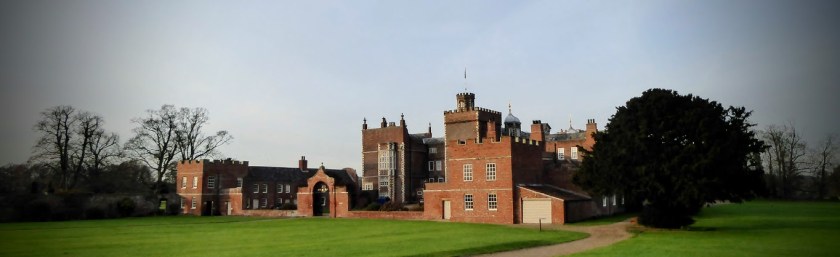
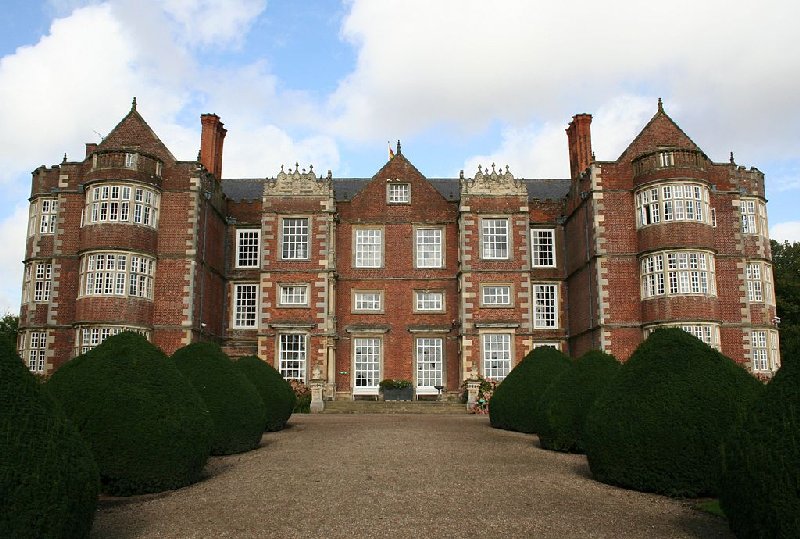
This is Burton Constable
Burton Constable Hall is a fine country house hidden away not far from the city of Hull in East Yorkshire. This is a town whose dismal reputation may be salvaged next year when it becomes the UK City of Culture.
‘From Hull Hell and Halifax may the good Lord deliver us’. In mediaeval times, this was the Yorkshire thieves’ litany. Nobody wanted hell; nor Halifax with its unique gibbet, a savage early guillotine; nor Hull, with its notorious gaol. People unfairly use the prayer to this day, even if they don’t expect to suffer or die there, though neither city deserves it. We’re bound to make a trip or two to Hull next year, so I’ll tell you all about it, then.
And this is its facade.
Meanwhile. Burton Constable. It has a long and complicated history dating far further back than the Elizabethan exterior which you first see suggests. The oldest part of the house dates back to the 12th century, when a pele tower was built to protect the inhabitants of the village of Constable Burton during the lawless reign of King Stephen. Remodelled in Elizabethan times, it had several further makeovers, and its interior has a lovely 16th and 17th century Long Gallery – for strolling through. Then in the 18th century the interior was largely brought up to date with the latest designs and plasterwork from the likes of top-flight names such as Robert Adam and Giuseppe Cortese. Capability Brown – who else? – landscaped the grounds.
It’s fallen on hard times though. Imagine the expense of keeping such a property in good order. The whole estate and grounds are now managed by a charitable trust while the family lives in an apartment in one of the wings. Repairs and restoration are slow and on-going.
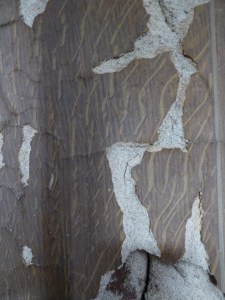
Behind the scenes. Imitation woodwork in need of restoration.
I’ll just give you a taste of some of the charms of the place:
A Cabinet of Curiosities, with imperfectly stuffed creatures such armadillos; scientific instruments; fossils and other curios.
Spot the armadillo
A desk full,of curiosities.
The cabinet includes some of the collections of Ralph Thoresby. We know about Ralph Thoresby if we’ve lived in Leeds
A 19th century Chinese room, inspired by the Brighton Pavilion. Here be dragons.
Pure silk wall covering.
Elegant displays of Chinese porcelain.
There’s simpler, more rustic Chinese ware on display too.
The Long Gallery with its specially designed bookcases.
Just the place for a stroll – the Long Gallery.
The house joiner made these made-to-measure bookcases during the Jacobean period
And oddly, in the Great Barn, the skeleton of a whale washed up in nearby Holderness, which inspired Herman Melville to write ‘Moby Dick’.
The back end of Moby Dick.
With a succession of fine rooms – from the Blue Drawing Room to the Gold bedroom, and tantalising glimpses of life below stairs, this is a place to spend the entire day. The staff love an interested visitor, and repay your interest with history and gossip from the glory-days of the house.
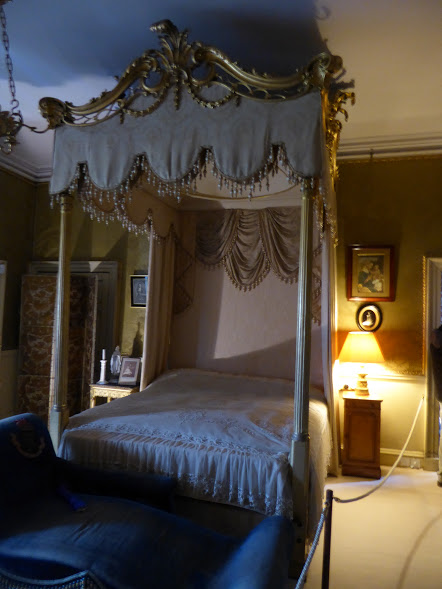
The Gold Bedroom.
Rules below stairs.
The back stairs don’t need to be elegant.
A working kitchen.
We’ll be back in the summer, to join one of the tours to explore the hidden secrets of this place.
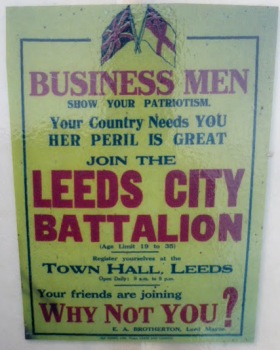
At the outbreak of the First World War, a top-level decision was made to recruit men to the Army by encouraging friends, neighbours and colleagues to volunteer together as locals, to fight shoulder to shoulder for the honour of Britain and the credit of their home town.
The men of Leeds answered the call. Carpenters, foundrymen, businessmen, men from the crowded streets of back-to-backs, men from the suburbs all joined up, bringing with them their brothers, their cousins, their neighbours and the men who worked alongside them .
They became the 15th Batallion of the West Yorkshire Regiment, commonly known as the Leeds Pals.
And they were sent up here to Colsterdale to train. There was a whole village waiting for them: a village that had been hastily built at the turn of the century to house the workers who’d been hired to construct the Colsterdale and Leighton Reservoirs, together with their families. At Breary Banks there were huts, shops, chapels – everything they needed for day-to-day life. Although the Colsterdale Reservoir had been abandoned in 1911, workers were still employed at Leighton and at first labourers and soldiers lived side-by-side.
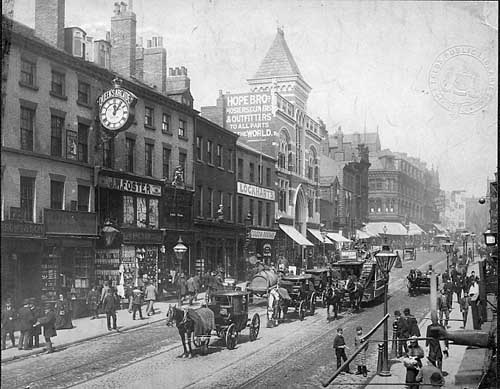
Briggate Leeds in the early 1900s (Leodis.net)
Leeds was a vast industrial conurbation. It was noisy, dirty, grimy, smoggy. Trams and those new-fangled trolley buses clanked and clattered their way round the streets. Arriving by train in Masham, the new recruits had no alternative but to march the six miles to Breary Banks, passing nothing but clean quiet villages, stock-filled fields with woodland, then heathery moorside beyond.
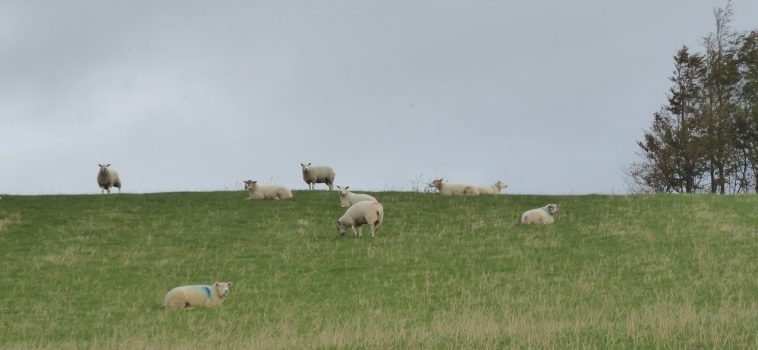
Sheep in Colsterdale
For many of these recruits, the time that they spent at Breary Banks was the best time of their lives. They had a regular routine, good food, good company and decent accommodation. They dug trenches and learned the weaponry skills it was thought they’d need when finally deployed in France.
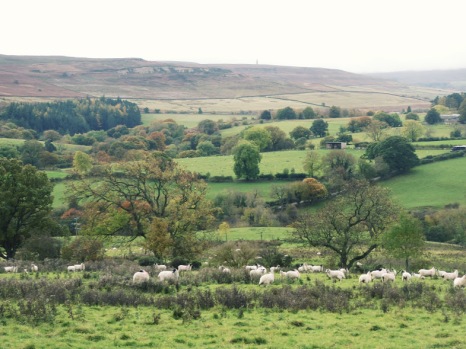
Colsterdale
In fact they first saw active service in 1915 and 1916 in Egypt and Gallipolli. Few of them were involved in direct action, and by early 1916, most of them embarked on troopships to the real focus of the war, France.
After further training behind the lines they were sent to the front, in readiness for the battle that was intended to change Allied fortunes, the Battle of the Somme.
And that is when parents, children, neighbours and work mates left behind in Leeds discovered what a truly terrible idea it had been to send whole communities into the same battle at the same moment.
‘It was the most ambitious attack of the war and they were among hundreds of thousands of Allied troops massed for the battle.
Their coats were mud-sodden, their legs were protected only by the inadequate cloth wrappings of the soldier’s uniform. In their hands they clutched rifles they would never use, for in moments a storm of bullets had cut through their soft clothes and weary bodies, and they were dead.
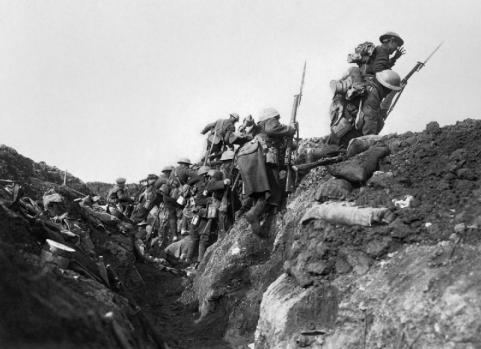
Going over the top, Battle of the Somme (Ivor Castle, Imperial War Museum, via Wikimedia Commons)
Our young Leeds men were not so much beaten as wiped out. At 7.20 am with fearful, pounding hearts, they began to run blindly at their enemy. By 7.30 am a city of mothers had lost their sons, wives were widows and children fatherless.
It was one of the bloodiest battles of the First World War. As the men surged over the top into no-man’s land they faced a murderous storm of artillery and machine gun fire directed against them with pitiless accuracy by German guns. It cut through them, they fell into the mud in waves.
Yet those in charge had expected it to be easy. In the days before the battle of the Somme, more than a million rounds had rained down on the German positions all the way along the front.
By the time it was over, the Allies believed that no-one could have survived such a bombardment. The men from Leeds, and all the places beyond, were meant to stroll across no-man’s land.
Not only did that not happen but the casualties are so great as to not really make sense. The first day’s slaughter claimed around 20,000 English and French lives, and almost 40,00 were wounded.
Yet the carnage was repeated the next day, and the next, and for every day after that until four mad months had passed.
The cost in lives has never been fully accounted, but of the more than 900 men recruited from Leeds, it is believed 750 died that day.’
Jayne Dawson, Yorkshire Evening Post, 11th November 2013
This is Private Pearson of the Leeds Pals’ own epitaph for his friends and colleagues:
‘We were two years in the making and ten minutes in the destroying.’
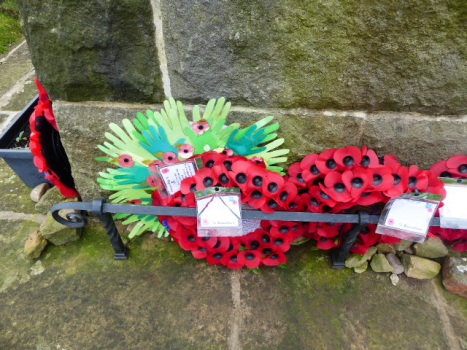
Poppies, always poppies at the foot of the memorial to Leeds Pals at Breary Banks, Colsterdale.
No, it’s Not Vital to visit the Yorkshire Sculpture Park on a perfect Autumn day, when the trees are at their burnished best, flaunting their chromatic colours just before the November squalls tug down their rusty leaves. It’s Not Vital at all. But it’s a brilliant way to spend a Sunday.
Once, the Yorkshire Sculpture Park was a stately home – the 18th century Bretton Hall – belonging to the Wentworth family. Just after the war it became a teacher training college specialising in the arts, until it was taken over by the University of Leeds. During those final years, The Yorkshire Sculpture Park was founded in the college parkland by Bretton Hall lecturer Peter Murray. When the college closed, Yorkshire Sculpture Park took over the estate grounds and lakes.
Bretton Hall and its surrounding parkland.
Some exhibits – particularly by those two sculptors who grew up so near to Bretton Hall, Henry Moore and Barbara Hepworth, are semi permanent. But most artists shown there exhibit for a season or so, and you’ll find their works placed all over the extensive parkland: on the lawns, overlooking the lakes, waiting to be discovered on a woodland walk. Art appreciation combines with views across the distant Pennines, and a good healthy work-out across shady woods, formal lawns, lakes, pastureland and country bridle paths.
Henry Moore’s ‘Draped Seated Woman’ looks down over the distant wooded lake.
And I’ve been teasing you. Not Vital is the name of one of those sculptors exhibiting at the moment. It’s his work ‘Pelvis’ that greeted us as we came into the park.
He was raised in a remote part of the Swiss Alps, and developed a strong affinity with nature. Much of his life has been nomadic, and he engages with the artisans he meets on his travels to create works from local materials, pushing known technologies to the limits.
Here’s The Moon, a highly polished stainless steel sphere which reflects the environment it’s placed in. Those craters are based on photos of the moon, and individually produced by Beijing craftsmen.
Not Vital: ‘The Moon’.
And here’s Hanging and Weighting, an unsettling plaster and steel construction that surely, surely is about to slide to the floor?
Not Vital: ‘Hanging and Weighting’.
I wish I’d taken more photos of his arresting and thought-provoking works – such as his self-portrait as a North Korean peasant, which is blank and faceless.
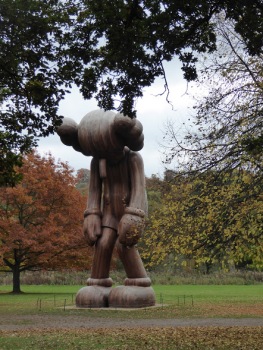
A taster of more on offer yesterday. Here’sKAWS‘Small Lie, a dramatic and monumental wooden sculpture of Pinocchio.
KAWS’ ‘Small Lie’.
Here’s Richard Long’sRed Slate Line, marching us inexorably forward – into the lake….
Richard Long’s ‘Red Slate Line’.
….. that’s if we haven’t tripped over Hemali Bhuta’sSpeed Breakers – bronze tree roots conceived to be stumbled upon as we explore the woods.
Hemali Bhuta’s ‘Speed Breakers’.
Come and have a virtual tour of the park. And if you get the chance, visit the real thing.
Julian Opie’s LED ‘Galloping Horse’.
David Nash’s ’71 Steps’.
A fungus-colonised tree near the lake.
A woodland path.
A view of Emley Moor transmitting tower from the woods.
Here in England, we’ve got a bit of a thing about images of a white horse cut into the hillside. There are well over 20 of them, from the South Downs to Wiltshire, via Leicestershire and even as far north as Tyneside. We like to think many of them are pretty ancient, like this one, the Uffington White Horse, first carved into the hillside chalk of Oxfordshire: probably in the Iron Age, possibly as long ago as 800 BC. But they’re not. Most of them date from the 17th, 18th and 19th centuries.
Uffington White Horse (Wikimedia Commons)
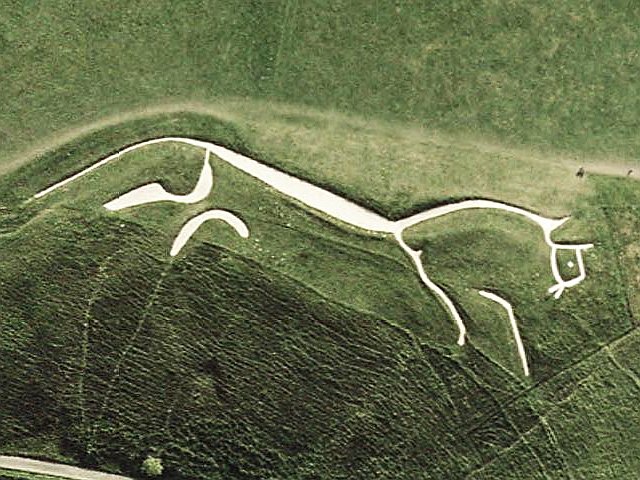
We’ve got our own white horse here in North Yorkshire, near Kilburn. It’s really rather modern. Back in 1857, a Kilburn-born man, Thomas Taylor, who’d become a provision merchant down in London thought that his home village should have its very own version of the Uffington White Horse. He got John Hodgson, who was the local schoolmaster, together with the schoolchildren and a band of volunteers to cut a horse shape from the turf to reveal the sandstone beneath. Six tons of lime were used to whiten the image, which can be seen from many vantage points in North Yorkshire, and on a clear day, from as far away as Leeds, 45 miles away, and even North Lincolnshire.
Kilburn White Horse (Wikimedia Commons)
And that’s where we went yesterday for an energetic nine mile walk. Our path took us along scenic Beacon Banks. Once it had a beacon at its summit to alert the country when danger threatened. It warned of the approach of the Spanish Armada in 1588. It was a watching point for the Home Guard during World War II. Now it’s simply a lovely place from which to survey the countryside. Our route took us past three of the prettiest villages in this part of the world – Coxwold, Husthwaite and Kilburn – through woodland, through farmland with views across to the Vale of York, the Hambleton Hills and North York Moors, passing ancient Norman churches we couldn’t call into because it was Sunday. And the White Horse – often there as a backdrop to the scenery. Here are some picture postcards of our day.
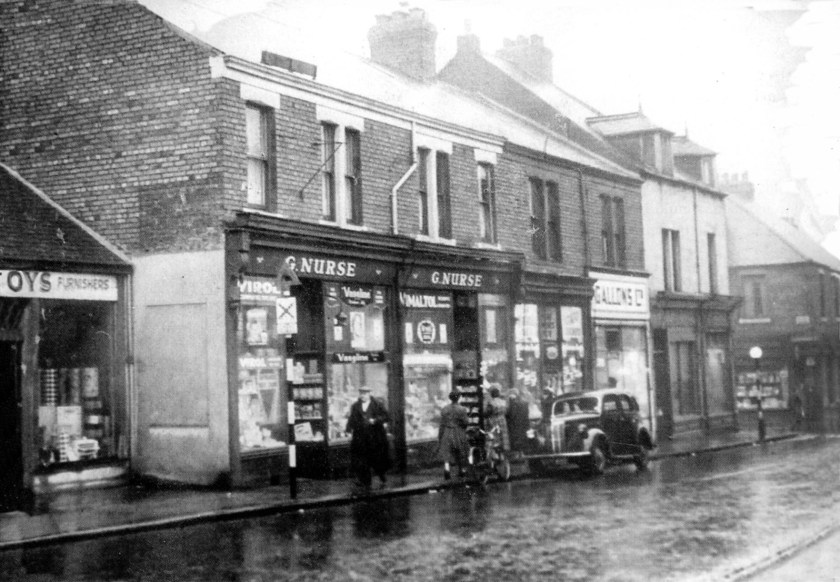
Old Grange Road, Jarrow, c. 19502(?) (geordstoree.com)
What image comes into your head when you think of Jarrow? If, like me, you’ve only really heard of it in the context of the Jarrow March, it may be a depressing one. Grimy desolate streets, a down-trodden and abandoned population, with little hope of change for the better maybe.
Well, Robert Colls, who walked with us on our Jarrow March Mark 2 for ‘Ramblings’ won’t entertain such images He’s irritated by those commentators, often from the south, who see nothing but the negative. He could do without the likes of George Orwell painting such depressing, hopeless images about the Industrial North. He was raised in nearby South Shields. His memories of the town are of a place that was gritty, maybe dingy, but where there was a rich cultural life, and a warm and supportive community where it was good to grow up.
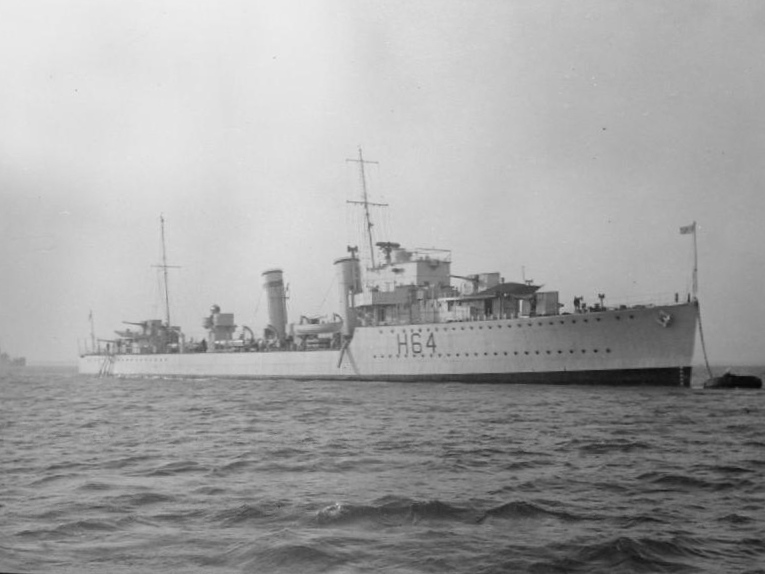
Jarrow, in the North East of England, had been dependant on shipbuilding since the 1850s, but demand for ships fell throughout the 1920s and became worse during the 1930s. The main shipyard, Palmers, once the source of Jarrow’s prosperity, closed in 1934 after years of steady decline . By 1936, there was 70% unemployment in the town.
HMS Duchess, the last ship to be launched from Palmer’s shipyard, July 1932 (Imperial War Museum)
Town councillors planned a march to London to present a petition to Parliament highlighting the desperate conditions in Jarrow and towns like it. They secured cross-party support. They involved local churches and the business community. They fund-raised. Socialist medical students volunteered to work as medical attendants along the route. Nobody in town wanted yet another communist-inspired ‘hunger march’. No, Jarrow people planned a respectable event, one that would win widespread support.
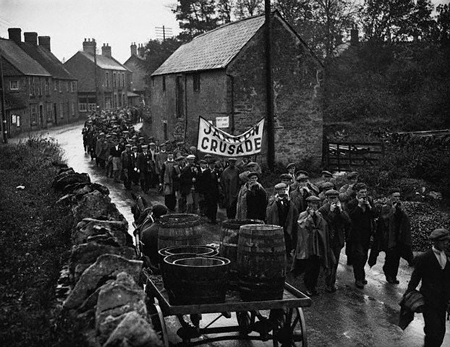
It rained on and off the day we walked last week. I suggested to Robert that those marchers, with shabby, worn-out clothes would have had a thin time of it. I was wrong. The organisers insisted the men who were chosen to march – and yes, they were chosen – should wear their ‘Sunday best’, look smart and conduct themselves well. They had medicals, and only the 200 fittest men were chosen to march, accompanied by a second-hand bus carrying cooking equipment and ground sheets. A successful fund-raising campaign ensured the march was well-prepared and equipped, and that the men had a little pocket-money.
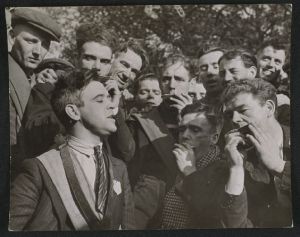
They started marching at 8.30 each morning of their 25-day journey (with Sundays as rest days). Many marched army style – 50 minutes to the hour with 10 minutes’ rest. A mouth organ band was a great success, ‘keeping the men swinging along all the time’, according to a report in the Shields Gazette, and there was singing – led sometimes by Ellen Wilkinson. Local papers apart, the only national paper to give the Jarrow Crusade wide coverage was The Manchester Guardian. Copy was supplied by the journalist Peter Richie-Calder, who walked much of the way with them.
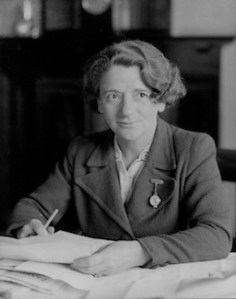
Photograph of J McCauley, a Jarrow marcher, singing to his co-marchers on their walk to London, taken in October 1936 by Edward G Malindine for the Daily Herald. The caption read ”Croonin’ J McCauley, who helps to keep his co-marchers’ spirits high, has been out of work for 5 years’ (National Media Museum)Ellen Wilkinson, by Elliott & Fry, 4 June 1940 (Wikimedia Commons)
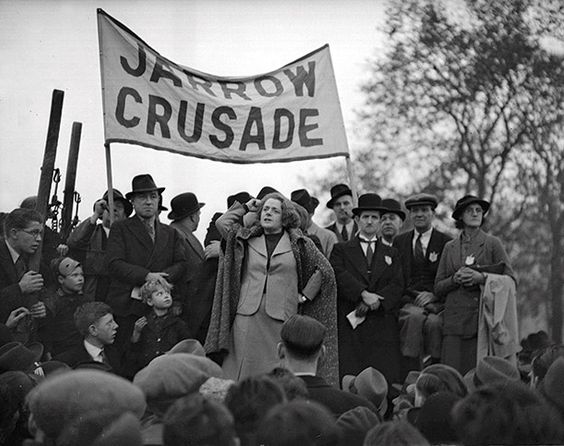
Ellen Wilkinson was one of only four women MPs at the time, and she represented Jarrow. Though from a poor background, she was well-educated – she won a scholarship to Manchester University – and built up an impressive career both in the unions and in parliament. By the age of 24 she was already National Women’s Organiser for the Cooperative Employees union, and only nine years later, an MP – one of only four women in parliament. She was a terrific orator, she was passionate, and she believed in the Jarrow marchers and their cause. She walked with them whenever she could, distinctive with her fiery red hair. Towards the end of the march, Ellen broke away in order to address the Labour party conference and, with tears streaming down her face, exhorted delegates to ‘…tell the government our people shall not starve!’ She failed, however, to win special attention for her cause.
Ellen Wilkinson addresses the Jarrow Marchers (History Today)
The lack of political affiliation helped those marchers. They were fed and watered and given places to sleep all along their route. Harrogate, for instance, just south of Ripley, then as now is a true blue and prosperous sort of place. But the civic authorities greeted them warmly, the Rotary Club fed them, and they were given sleeping quarters by the Territorial Army.
Jarrow March (BBC)
I depend on good boots when I’m walking and wondered about how the marchers were shod. They had decent shoes, Robert said. And what’s more, when they arrived in Leicester, the Cooperative Society’s bootmakers stayed up all night to repair all their by now thin-soled shoes, and did so without pay. The story of the Jarrow march is peppered with such examples of support and kindness.
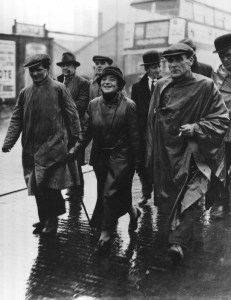
Ellen Wilkinson marches with the men (Fox Photos)
They arrived in London. They presented their petition in Parliament, the petition that had 11,00 signatures. It prompted only the briefest and most complacent of discussions. And that was that. The disillusioned marchers returned to Jarrow by train, their fares paid by benefactors.
Astonishingly, many men finished the march healthier than when they had started. Boosted by regular exercise – and the decent food and accommodation they had received along the route – many put on weight. This was just as well. For the duration of the march, their unemployment benefit had been suspended as they were ‘unavailable for work’.
A few modest attempts to bring work to the town resulted in jobs for a few hundred people, but only with the start of World War II did work once more surge back into the shipyards and factories of Jarrow. For the duration only.
Ellen Wilkinson continue to be a thorn in the side of the Labour party, though she worked tirelessly at home and abroad against fascism. Perhaps her greatest achievement was in 1945, when as Minister for Education in the Labour Government, she was instrumental in having the school-leaving age raised to 15. No wonder Helen is an enthusiast for this most dynamic, charismatic and troublesome woman.
So there we are. One – no two – history lessons, all parcelled up in an agreeable package of a long country walk, following, if not exactly by the same route, in the footsteps of those Jarrow Marchers.
Clare Balding, Lucy Lunt, Helen Antrobus and Robert Colls in the steps of the Jarrow Marchers.
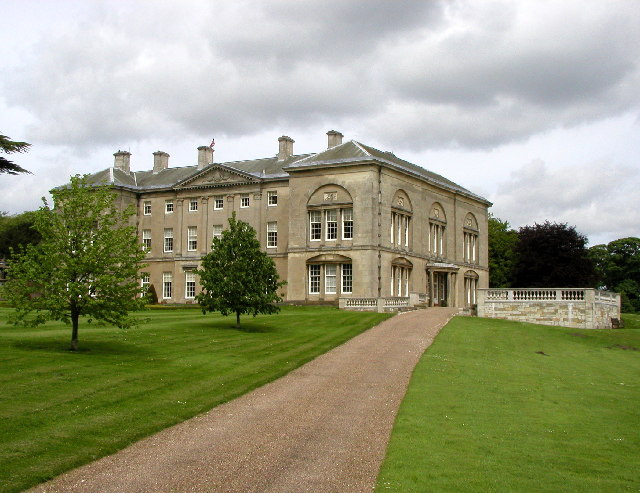
It was our Works Outing, our Grand Day Out, our Jolly. It was a day we volunteers at the National Trust’s Fountains Abbey and Studley Royal had been waiting for: our reward (though not entirely free) for good behaviour over the past few months. A coach would collect us and deliver us to spend time at two destinations well worth visiting over in East Yorkshire: Sledmere, and Burton Agnes.
Both places belong to – no, not a rival organisation: everyone concerned’s aim is to preserve and enhance our heritage for us, and for future generations – but a different one, the Historic Houses Association. Both places are visited as much for their gardens as the houses themselves.
Well, just look at this. This is the view from the coach window.
A very British view.
So much for the gardens then. A real shame. Sledmere‘s grounds are extensive, and offer cunningly tweaked panoramas of the surrounding countryside. They were developed in the late 18th century by Capability Brown, then at the height of his popularity. Apparently unending vistas of manicured countryside, easy on the eye, were what was required. The local village got in the way of the view? Easy. Move it and re-build it. The villagers will get used to it.
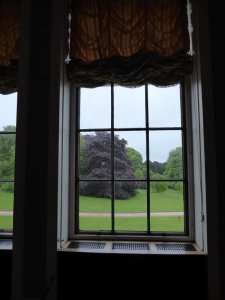
A quick glance at the grounds from the library.
We were able to admire the grounds from the protection of the house, but not so the planted areas, in particular the walled gardens. We favoured a nice cup of coffee and a home-made cake in the cafe instead. We’ll want to go back when the sun is shining.
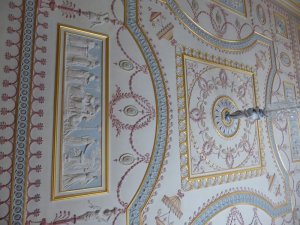
Sir Christopher busied himself in having his house as well as his garden improved. The plaster work designed by the celebrated Joseph Rose is said to be the finest in England.
Plasterwork ceiling.
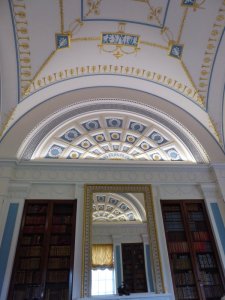
As is the Long Library, extending the length of the building, a long, light-filled and elegant space.
The library.
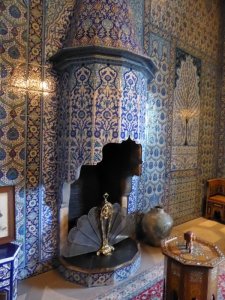
There are curiosities too, such as the Turkish room designed for Sir Mark, 6th Baronet in 1913. Every surface here is covered in specially designed Armenian tiles.
The Turkish room.
The house might have disappeared from view in 1911 though. A catastrophic fire broke out while the 5th Baronet, Sir Tatton Sykes, was dining. He insisted on staying to finish his pudding. But estate workers, farm hands, villagers, children from the local school, anyone and everyone else turned to and dragged out furnishings, pictures, statues, china, carpets, even doors and banisters. As muscular estate workers struggled out with the monstrously heavy copy of the Belvedere Apollo, the ceiling fell. And since then, thanks to the detailed plan which survived, the whole thing has been meticulously restored. You can read all about it here.
Off to Burton Agnes then. This Tudor Renaissance hall was built between 1590 and 1610, and has remained within the same family for more than 400 years: the original Manor house was built as long ago as 1173.
Burton Agnes (Wikimedia Commons)
It’s a family home, albeit a privileged one. It’s a home which has been filled with everything from magnificent Jacobean carvings, Impressionist paintings, and more recent artworks. This is a home that is lived in and loved. Here’s a quick glimpse of what the visitor can see. As to the award-winning walled garden, the woodland gardens … well, we didn’t visit those on this particularly soggy day. We might be British, but we’re not that daft. The house offered sufficient enjoyment, and the gardens will be there another day.
Wise and foolish virgins adorn a Jacobean hearth…..
…….and here are the wise virgins.
Carved wooden fire surround with music and dancing.
A view of the (also Jacobean) gatehouse from the Hall.
A glimpse at the gardens.
Bedroom.
Plasterwork.
Another glance at the garden, with willow-woven geese.
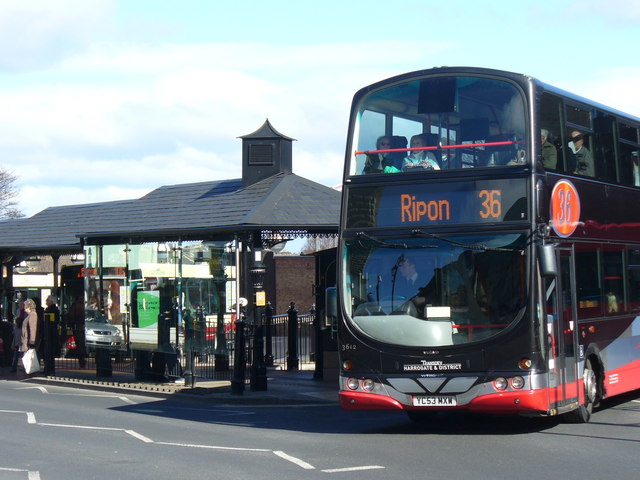
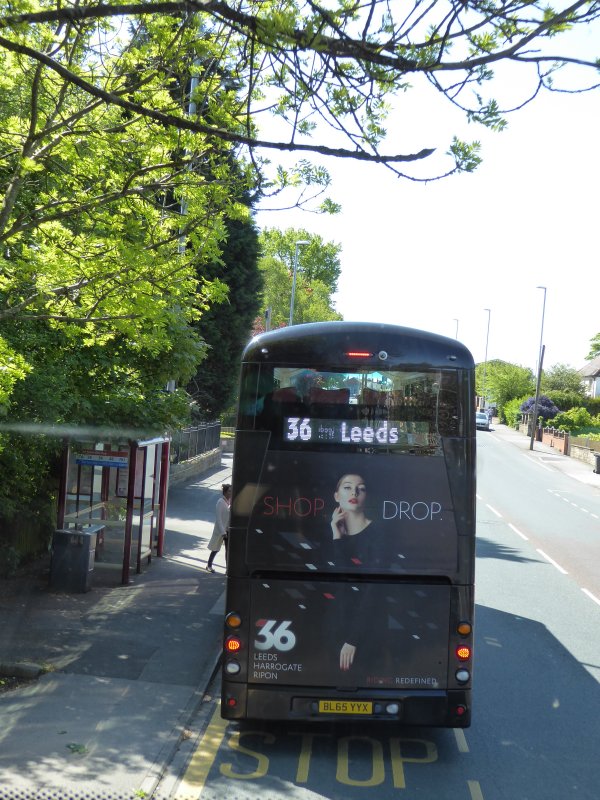
The 36 bus leaving Leeds for Ripon (Wikimedia Commons)
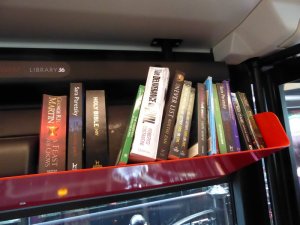
Everyone loves the 36 bus. It’s the one that takes us from out in the sticks of Ripon, via Harrogate to Leeds. It’s the one with plush leather seats, 4G wi-fi, USB points at every seat. It’s the one with a book-swap shelf where I always hope to find a new title to enjoy, while bringing in one of my own to swap. And best of all, we old fogeys travel for free on the 66 mile round trip.
The book-swap shelf wasn’t very exciting today. But I found a Fred Vargas to read.
Best get to the terminus early though. Everyone’s jockeying for the best seats, the ones at the front of the top deck, where you can watch as the bus drives through the gentle countryside separating Ripon from Harrogate, via Ripley, a village which the 19th century Ingleby family remodelled in the style of an Alsatian village, complete with hôtel de ville. After the elegance of Harrogate and its Stray, there’s Harewood House – shall we spot any deer today? Then shortly after, the suburbs of The Big City, which gradually give way to the mixture of Victorian and super-modern which characterises 21st century Leeds.
We had lots to do in Leeds today (more of that later, much later) and had a very good time being busy there. But much of our fun for the day came from sitting high up in that 36 bus, watching the world go by. For free.
Seats on the top deck secured.
Ripon to Harrogate.
You can’t see Ripley for the trees.
The message board keeps us in touch with waht’s going on.
Hurtling towards a roundabout in Harrogate.
‘Fashionable South side’ is what the estate agents call this part of Harrogate.
Harewood village.
Arriving in Leeds city centre.
That’s the town hall in the distance.
On the way home, rows of Leeds suburban semis.
This pub’s still preserving memories of the Tour de France in 2014.
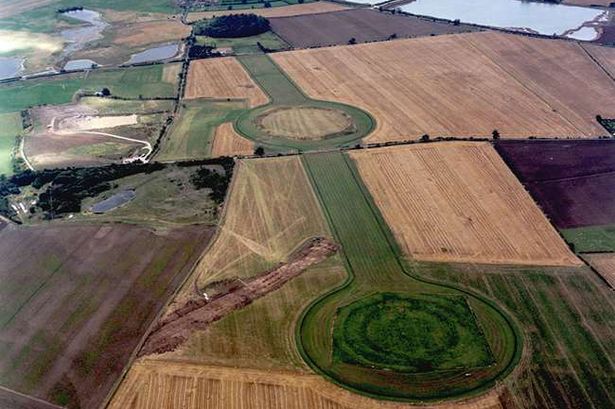
Not much further than a mile from us as the crow flies, lies Thornborough Henge. It’s a prehistoric monument consisting of three giant circular earthworks. Constructed 5000 years ago by the first neolithic (new stone age) farmers, it was probably an enclosure for their ritual gatherings. The Henge became an important centre in Britain for pilgrimage and trade, although its exact purpose still remains a mystery.
It sends shivers down my spine to think that this ancient piece of our history lies just a short walk from our home.
An ariel view of Thornborough Henges (photo courtesy of Historic England)
We can visit it any time we choose, simply to tramp round and try to imagine it in its heyday, and we’ll have the place to ourselves. Not on May-day though. Today is the Gaelic feast of Beltane, half way between the spring and summer solstices. It’s a day to mark the beginning of summer. Sadly, today is very cold, rather windy and a bit wet.
Back in pre-historic times, rituals were held on this day to protect the cattle, crops and people, and to encourage growth. Bonfires, deemed to have protective powers, were lit. For many centuries these practices died out. But nowadays, at sites like Thornborough, pagans, Wiccans, New-Agers and lovers of history and tradition gather once more to celebrate the renewal of life and growth.
Today I was there too. For an hour at least, for the opening ceremony. Brrr! It was cold.
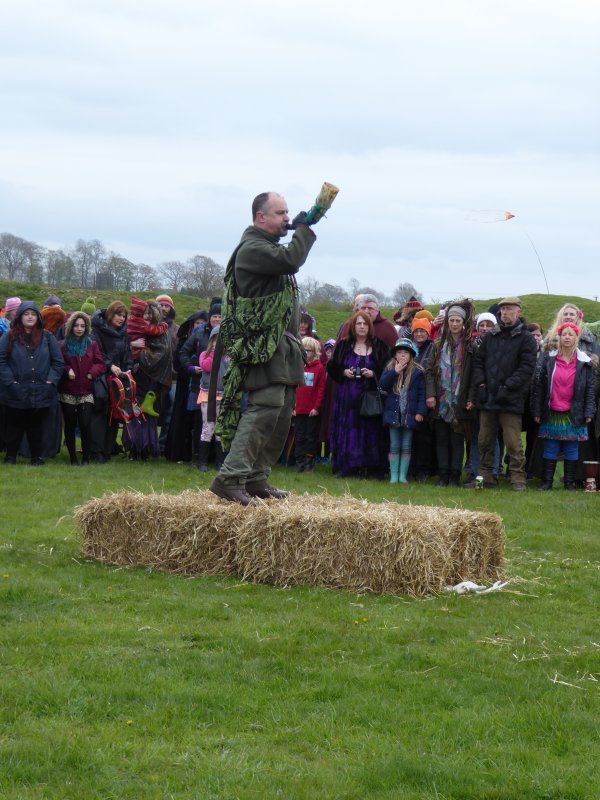
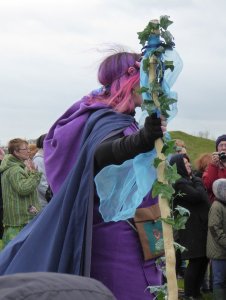
The Green Man and his horn.
I was strangely moved. The Green Man, representing rebirth and the cycle of growth was our Master of Ceremonies. He invited us all to join hands, whether friends or strangers, in fellowship, and shout out three times the invocation to new life. We hailed Brigantia, Celtic goddess of Northern England. Then at his bidding and as he sounded his horn, we turned to the east and welcomed the summer rains. We turned south to welcome the sun (who was coyly absent today), to the west to welcome summer winds, and to the north where the wolves apparently are.
Welcoming the West Wind.
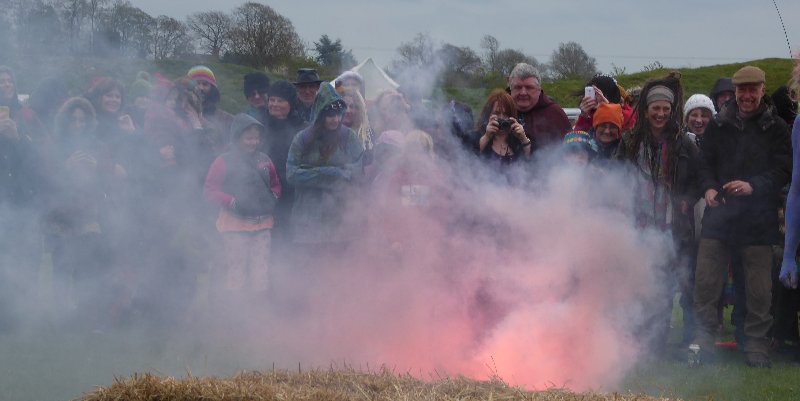
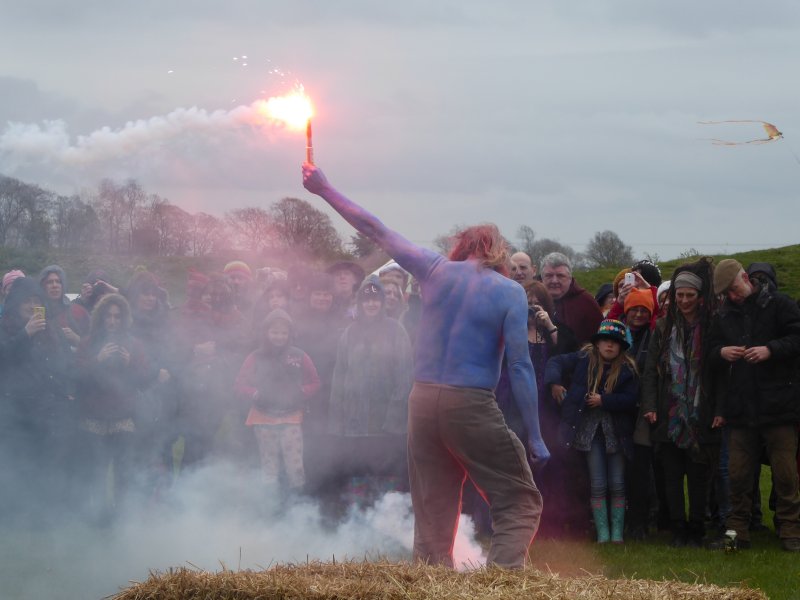
Then a man, naked from the waist upwards save for his covering of woad-coloured paint, leapt among us bearing the flaming torches which would offer us all protection over the coming months.
Protective flames.
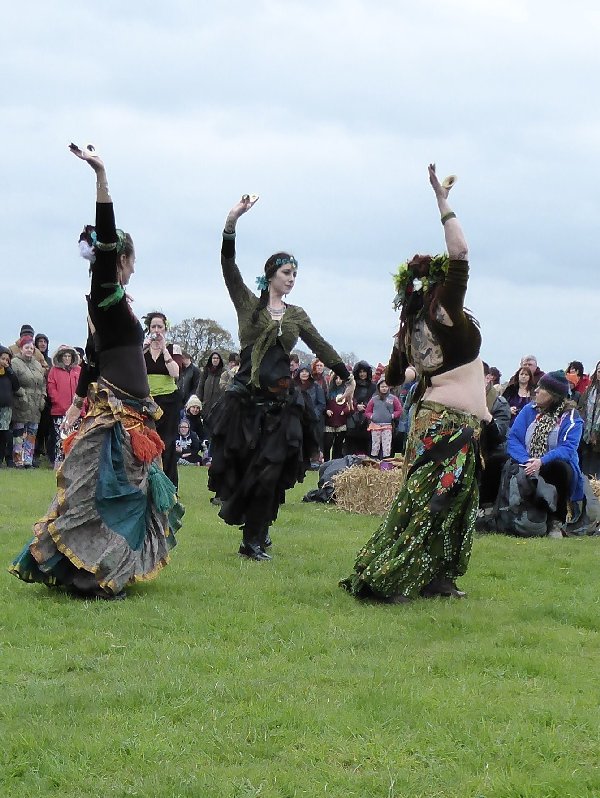
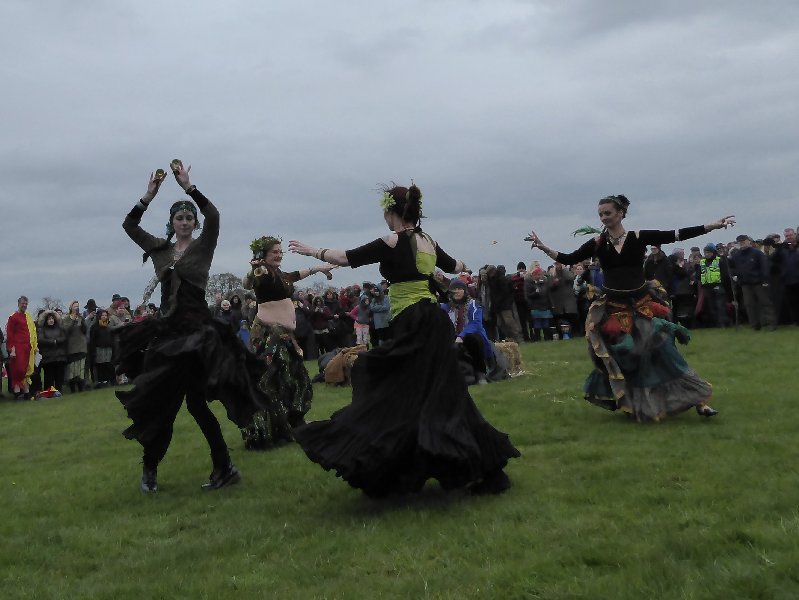
And that was the ceremony over. Dancers entertained us. They seemed to me to owe much to flamenco and to middle-eastern belly dancing traditions, but we all cheered them on with enthusiasm.
I shan’t be there this year for the closing ceremony. I’m still thawing out. But weather permitting, I’ll certainly go along next year. Will you come along too?
You’ll know that we waved ‘Goodbye’ to Emily this week. She’s arrived in South Korea, jet-lagged and exhausted, but not so much that she can’t send snippets of up-beat information about her new life as Emily-in-Busan.
While she was with us, Emily-in-Barcelona briefly became Emily-in-London, Emily-in-Bolton, and Emily-in-Yorkshire. And while she was with us, Boyfriend-from-Barcelona came to visit. What should we show someone from a vibrantly busy city, one of whose attractions is several kilometres of golden, sunny, sandy beaches? Well, on a frosty, gusty February day, with more than a threat of snow in the air, what could be better than a day beside the seaside?
Whitby: the view anyone who’s been there would recognise.
Whitby seemed to fit the bill. Picturesque fishermen’s cottages huddled round the quay. A clutter of narrow cobbled shopping lanes – a tourist mecca to rival Las Ramblas. A sandy beach with donkey-rides, and the chance to find fossil remains etched into the cliffs or a morsel of jet washing about on the sands. A ruined Benedictine Abbey high above the town, the inspiration for Bram Stoker’s ‘Dracula’, and the focus of a twice-yearly Goth music festival. And fish and chips. Always fish and chips at an English seaside destination. Emily and Miquel explored the lot.
Whitby Abbey.
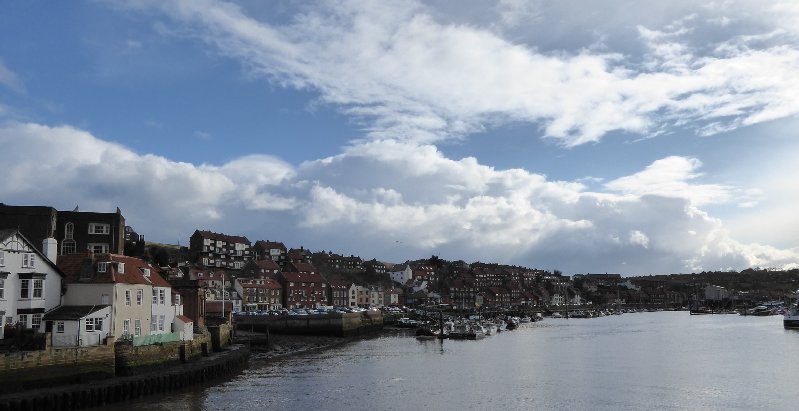
Whitby seen from St. Mary’s Church, next to the Abbey.
The old town.
The abbey and church seen from a ginnel.
The beach.
The beach.
The beach – again.
A close view of those cliffs.
One of the hundreds of gulls, thousands of gulls, reasy to steal your fish and chips with no warning.
And just before we left … a little bit of rainbow.
And Miquel, windblown and chilled to his fingertips, declared that it had been a fine day out, with the added bonus of being firmly inside the car when we journeyed home across the North York Moors as the snow began to fall.
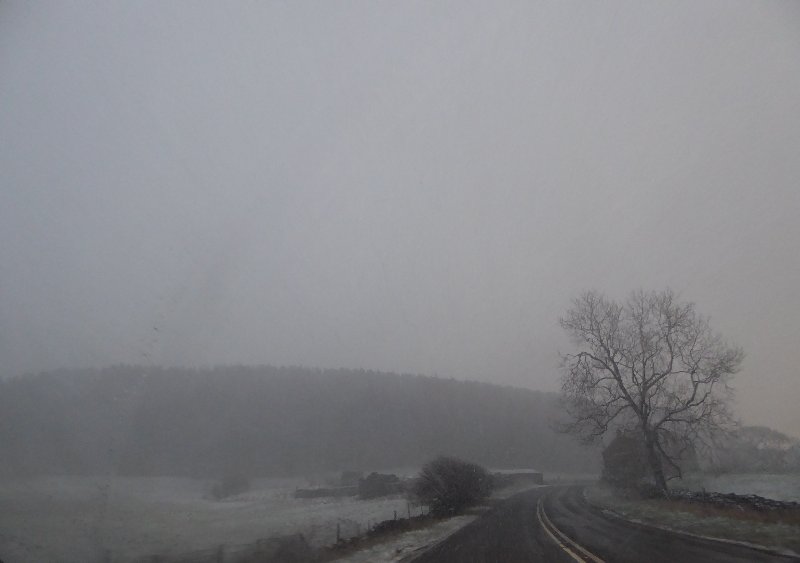
Best to be back in the car when the weather’s like this.























 From Pyrenees to Pennines
You must be logged in to post a comment.