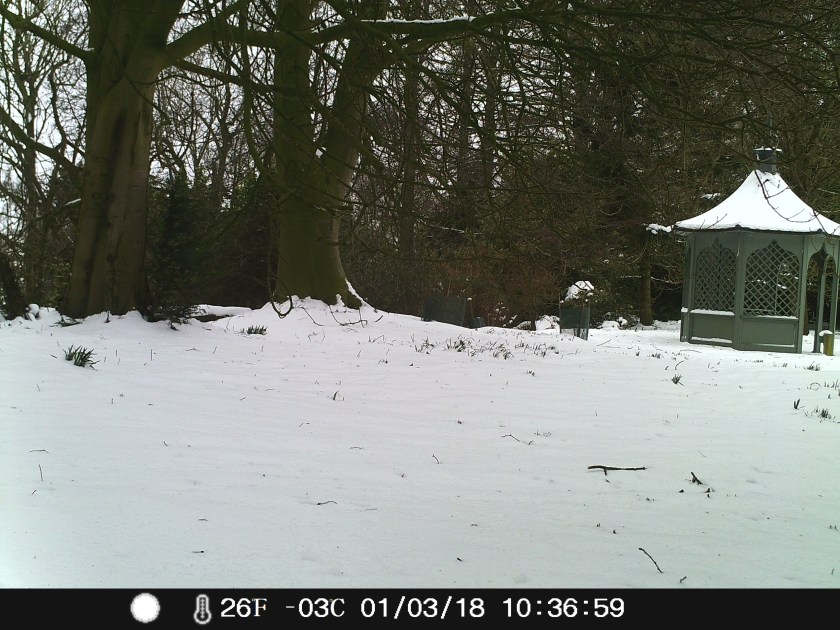
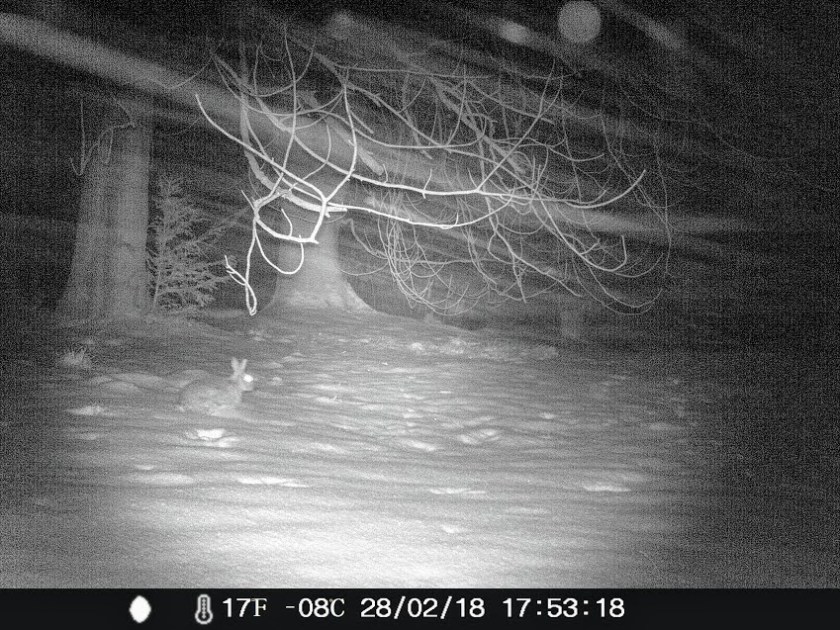
For comparison purposes, here is the garden by day. In a moment, you and the rabbit will see it by night.
At Christmas, Tom & Sarah gave us a night camera, so we could see what went on in the garden after dark. So far no bears, wolves or lynx have revealed themselves. Sadly, no foxes, badgers or deer either, though we know they’re there: we just have to find the right spot.
This week however, with all the snow, the garden took on an other-worldly aspect. And the rabbits came out as little as possible. But here’s one who braved the cold. Please note the temperature.
Rabbit in a hurry.
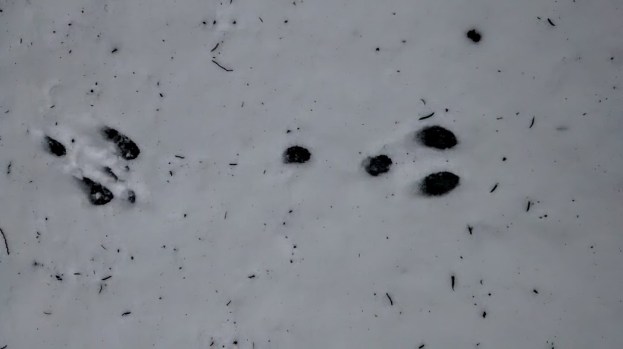
And in the morning, as short periods of sunshine briefly melted the snow, we spotted, apart from rabbit prints…
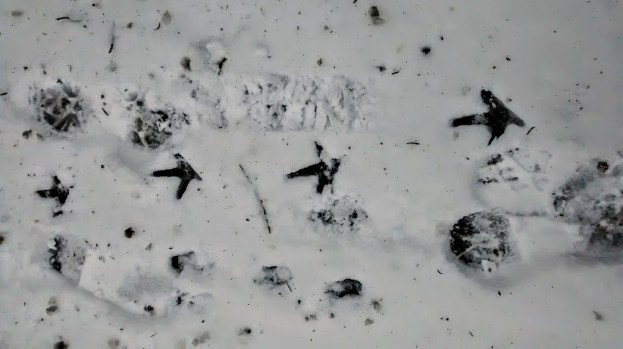
…. and pheasant prints …..
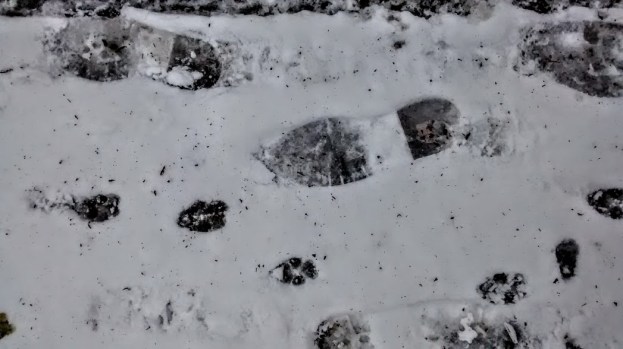
….. human bootprints too.
Although I rather liked these ghostly negative image prints. I thought they looked out of this world.
William began his day yesterday by lining up his extensive collection of dinosaurs (thank you, Ben and Alex). Please note the previously unrecorded vaccosaurus right in the middle there.
We had to visit the new Butterfly House, so William could show it to me.
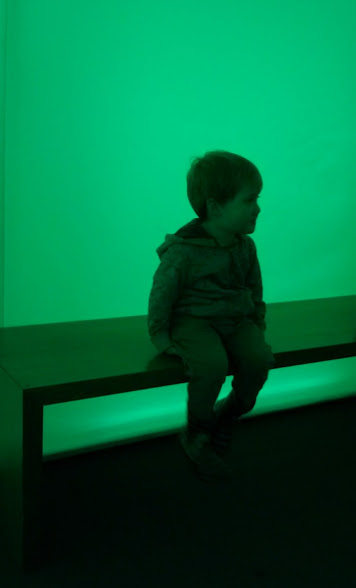
And we had to visit the new exhibition about colour, The Rainbow Revealed. Here’s William, sitting in the light tent, soothed by the calming green light that followed the vigorous energizing magenta.
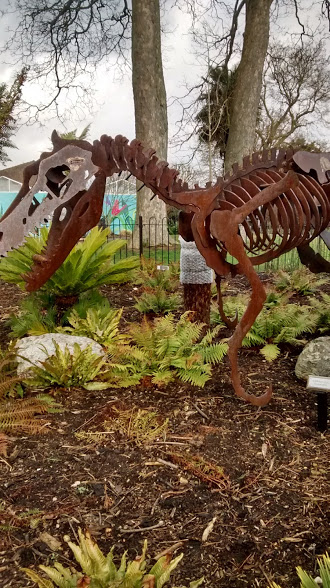
Just before home time, we came upon this dinosaur. He lives out his days in the primaeval forest created in the Horniman Museum Gardens. The primaeval plants are currently protected from the winter storms by very unprimaeval plastic, which slightly spoils the effect.
A fine day.
Click on any image to see it full size. These are smart phone photos. Not so smart really.
Winter’s not been around in recent years, not really. Those crisp snowy days we all seem to remember from our childhood, those snowball fights, those Jack Frost patterns etched our bedroom windows, those chilblains – all seem to be ancient history.
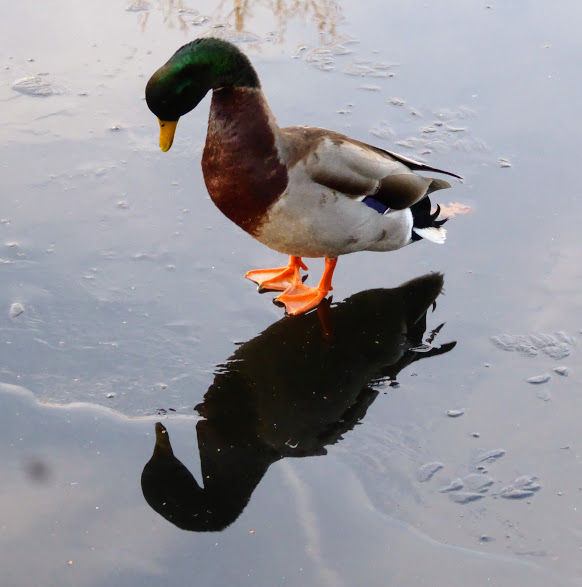
This week in London, where we had an early unofficial Christmas with William and family, winter arrived for one day only before becoming sunny and mild again. Look at these ducks and gulls in the local park, standing in puzzled uncertainty or ineptly skating on a frozen pond. One day only was quite enough for them.
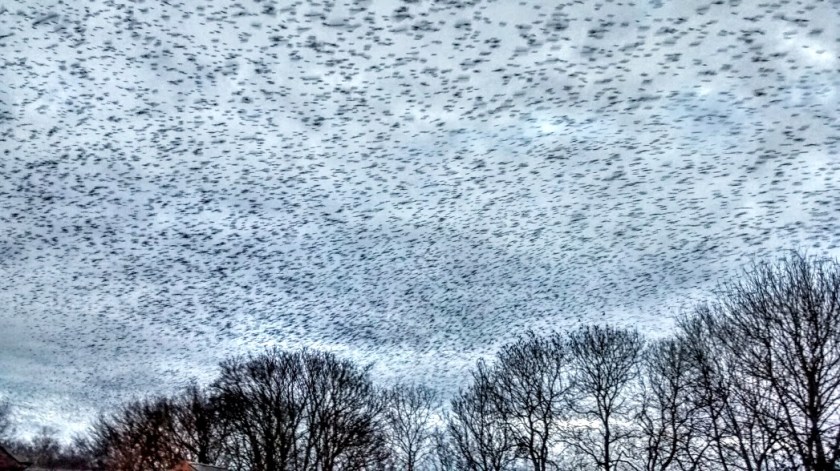
For a few weeks now, we’ve been watching the geese. At first just a few, but in the last week or so, huge skeins of them in groups of V formations take over the sky, honking as they fly, at about half past eight in the morning.
Saturday was The Big One. Two thousand or more birds invaded the sky above. And somehow, though we were looking out for them, we missed them. These are the birds, far fewer, that flew over yesterday.
I’ve spent time on the net, trying to find out more about where they’re coming from, or going to. All I know is that while they’re here, they enjoy scavenging in the recently harvested fields, and Mecca, for them is the wetlands of the former quarries at Nosterfield. And I also know that their massed flights mean that summer is over.
We’re migrating too, albeit temporarily. We’re off to Poland, my father’s country of birth. If I can I’ll do a daily post while I’m there.
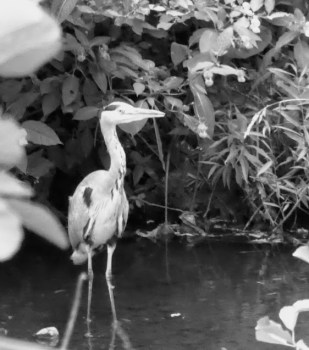
Waiting. That’s what herons do. Ever patient, they stand in the shallows, or on a handy rock: maybe even in the low branches of a sturdy riverside tree. Immobile unless frightened by the sight of a human passing too nearby, they’ll stand and stand until suddenly …..stab! That long spear of a beak plunges down and secures a fish dinner.
Here’s one we spotted on the River Wharfe near Grassington a few months ago.
A heron fishing on the River Wharfe.
This second photo is a bit out of focus, but I like it anyway. I took it only about a fortnight ago, walking along the River Skell one evening. The heron cocked his head and regarded us with some interest. He didn’t fly away, but looked at us looking at him. That’s quite unusual. In the end he flew off, empty-beaked. Perhaps he hadn’t picked a good spot.
This week’s WordPress Photo Challenge invites us to share images of those things that distract us from the important business of Getting On With Daily Life.
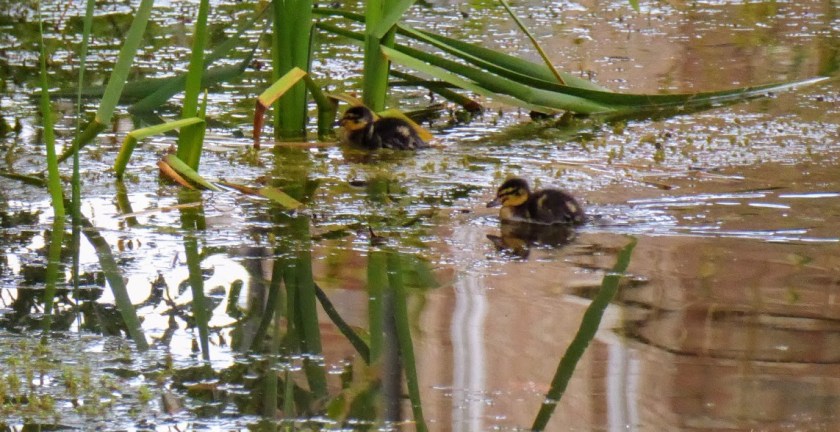
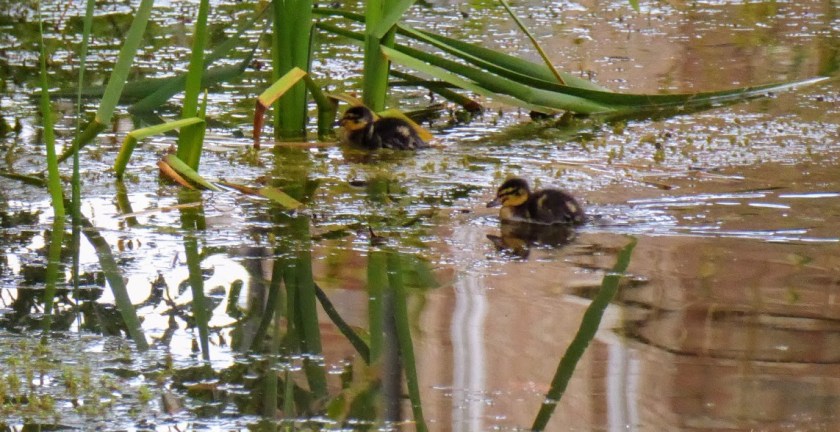
This is an easy one. Since about Easter, here in our village, the distraction has been ducklings. Sweet little balls of fluff that appeared at Easter, rapidly matured towards lankier childhood then … oh! …. vanished. A jealous mallard? A fox? Who knows? Another brood appeared soon after. Here are two of them.
Ducklings on a sparkling pond.
This time, they’ve managed to grow up. They sit around the pond in bored huddles in the manner of teenagers everywhere. They’re still charming enough to be distracting when they put their minds to it though.
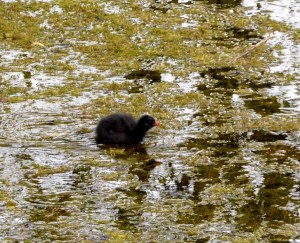
But those moorhens who moved in. They’ve been nothing but a worry. One day, a chick broke its foot, and distressed us all by somehow rolling and dragging itself forward across the grass as its mother looked on with apparent indifference. Since that day, we’ve had occasional sightings of a lone parent, a lone chick. But the family seems to have scattered. This has been distracting too. But not in a good way.
Is this the moorhen chick who broke its foot? We’ll never know.
Mother and babies on Good Friday. Yes, I know you can only see seven. There’s always one off exploring ….
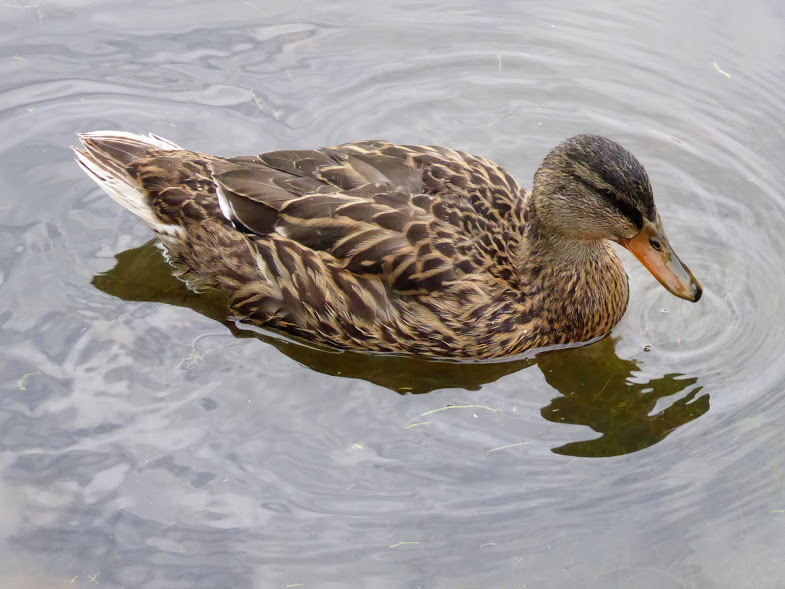
It was a couple of days before Good Friday when we first saw them. Mrs. Mallard swimming on the village pond with her eight tiny ducklings. We kept a proprietorial interest in them, and were dismayed when over the next few weeks they became seven, then five …. then only two balls of fluff. These two kept growing until they were, in duckling terms, almost teenagers. Then they too vanished.
No more ducklings on our pond. Just a single baby coot.
This was the baby coot on Good Friday. Now he’s almost adult – long legs, huge feet, and camera-shy.
Last week though, walking along to a friend’s house, I spotted them. Mrs. Mallard had hatched another brood. Seven this time. I wonder whether this little lot will make it? It seems as if there have to be an awful lot of ducklings put upon this earth even to maintain the population at replacement level. Both male and female mallards will attack and kill ducklings who are not their own.
Two of the latest ducklings, spotted yesterday evening.
It’s eleven weeks since we first saw those baby ducklings. Mrs. Mallard is still no nearer to successfully rearing the next generation of mallards to replace her. In some ways, time has stood still.
This isn’t mum. She was in the reeds, chivvying her babies into safety.
WordPress Photo challenge: Delta. For this week’s photo challenge, share a picture that symbolizes transitions, change, and the passing of time.
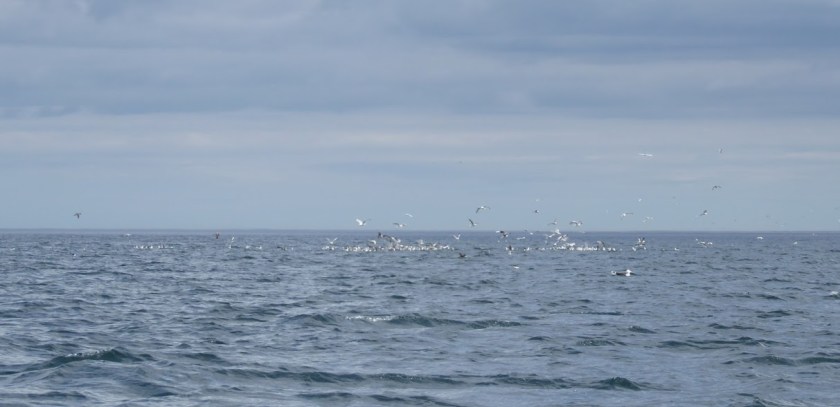
Following the fish, birds feeding off the Farne Islands.
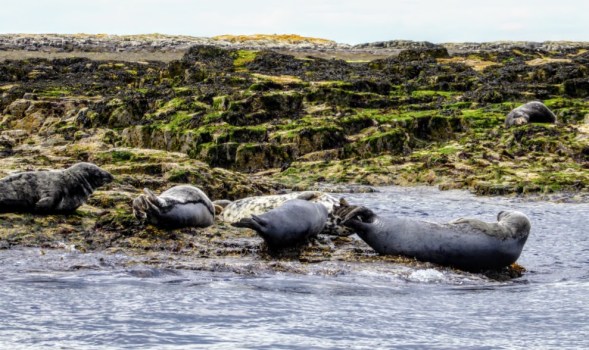
Here’s our journey, courtesy of Billy Shiel’s boat. We pass one of the most densely populated housing estates in Europe – but despite having to jostle for a tiny space to call home, this community is not socially well-integrated . Kittiwakes don’t live with puffins. Cormorants won’t talk to guillemots. Grey seals loll indolently beneath the cliffs, doing as little as possible till hunger forces them into the sea to hunt. The stench is intolerable.
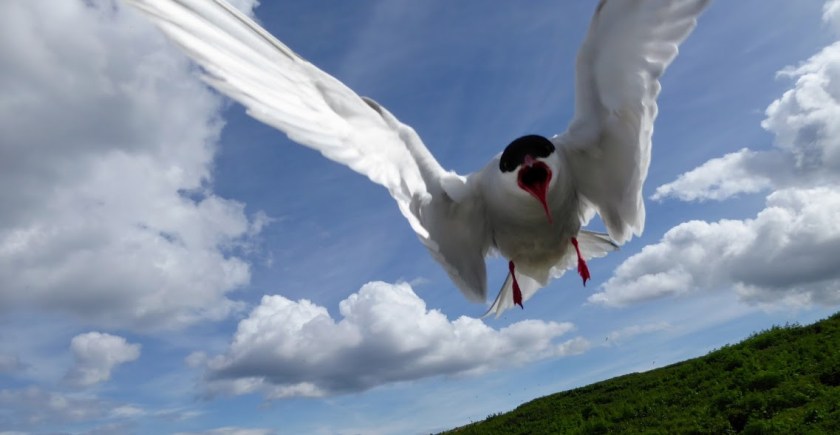
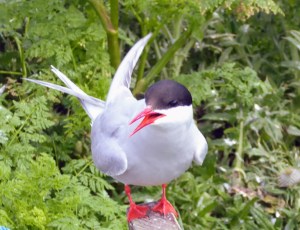
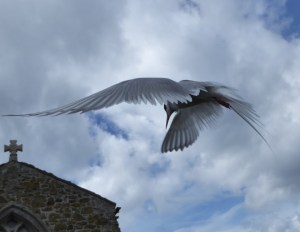
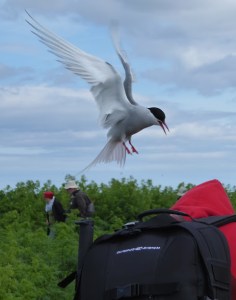
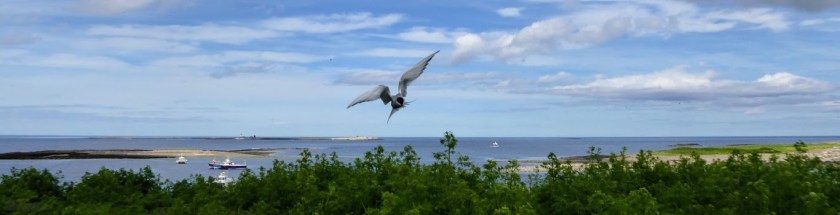
We land on Inner Farne, taking our hats as per instructions. This is why. Arctic terns nest all over the island and they have young to protect. We are the enemy, as they make clear, as they hurtle towards us, piercing our hats and hands with their dagger-like beaks. I nurse a war-wound on my finger.
A wary arctic tern .Ready to attack.Preparing to strike.Warning me off.
We decide puffins are less bellicose. They waddle about among the undergrowth, occasionally pottering down into their burrows.
Puffin at rest.
Exercising wings
Watching from a burrow
Then it’s time to explore further. The cliffs are cordoned off, but there, immediately beyond the fencing are birds in their hundreds, caring for their young. They’re close enough to touch. We don’t though. Being so close we can see every detail of their (usually ramshackle) nests, their plumage, the young unfledged birds, and this is privilege enough.
Eider ducklings.
A cormorant and young.
An adult cormorant spreads its glossy wings
You can’t spot the kittiwake young in this shot, but they’re tucked underneath, honest.
A razorbill protects her young.
A cormorant nest – with lots of other nests nearby.
With thanks to Maureen and Andrew for organising this trip for volunteers at NT Fountains Abbey and Studley Royal, and to the volunteer rangers at NT Farne Islands for managing this special place, despite irreparable damage to their hats.
I’ve been enjoying a brilliant book, ‘The Moth Snowstorm’, by Michael McCarthy. Thanks Penny, for suggesting it.
It’s part nature writing, part memoire, part polemic, and a powerful and affecting read about McCarthy and his relationship with the natural world. A constant theme though, is ‘joy’.
The book first got under my skin when defining ‘joy’, which is perhaps summed up as a moment of true happiness, with a spiritual, selfless, outward looking dimension. McCarthy’s first experience of joy was as a boy, learning to love the landscape and wildlife of the Dee Estuary. Later, it was bluebell woods, chalkland streams … and so on. Most of his joyful moments happen when he’s alone and surrounded by the natural world: though he acknowledges that our children, our grandchildren also bring us moments of undiluted joy.
What in the natural world brings me joy? Nothing original.
The first snowdrops edging through the earth while winter is still bitter, dark and long.
Snowdrops at Sleningford, February 2017
Bluebells, with their sweet cool scent, apparently hovering in an unending hazy carpet across a woodland floor.
Bluebells at Ripley, May 2017
Lying in bed early, very early on a springtime morning, and hearing the very first bird as it calls out to orchestrate the morning concert which is the Dawn Chorus.
A rare sight in England now, but fields scarlet with swaying poppies.
Poppies: Grain field with Field Poppies in Schermen, Möser, Landkreis Jerichower Land, Germany. J.-H. Janßen ( Wikimedia Commons)
Waves crashing on a beach, as a chilly wind whips sand across my face and into my eyes.
Haeundae Beach, Busan, South Korea
What brings joy to your soul?
Afterword: Some of you have asked to be reminded when BBC Radio 4’s ‘Ramblings’ series about the Nidderdale Way is being broadcast. The first of six programmes will be on air this Thursday, 18th May at 3.00. ‘Our’ episode will be the sixth and final one, on June 22nd. Podcast available.
Walking the Nidderdale Way is pretty damn’ joyous, actually.
You must be logged in to post a comment.