I’ve been enjoying a brilliant book, ‘The Moth Snowstorm’, by Michael McCarthy. Thanks Penny, for suggesting it.
It’s part nature writing, part memoire, part polemic, and a powerful and affecting read about McCarthy and his relationship with the natural world. A constant theme though, is ‘joy’.
The book first got under my skin when defining ‘joy’, which is perhaps summed up as a moment of true happiness, with a spiritual, selfless, outward looking dimension. McCarthy’s first experience of joy was as a boy, learning to love the landscape and wildlife of the Dee Estuary. Later, it was bluebell woods, chalkland streams … and so on. Most of his joyful moments happen when he’s alone and surrounded by the natural world: though he acknowledges that our children, our grandchildren also bring us moments of undiluted joy.
What in the natural world brings me joy? Nothing original.
The first snowdrops edging through the earth while winter is still bitter, dark and long.
Snowdrops at Sleningford, February 2017
Bluebells, with their sweet cool scent, apparently hovering in an unending hazy carpet across a woodland floor.
Bluebells at Ripley, May 2017
Lying in bed early, very early on a springtime morning, and hearing the very first bird as it calls out to orchestrate the morning concert which is the Dawn Chorus.
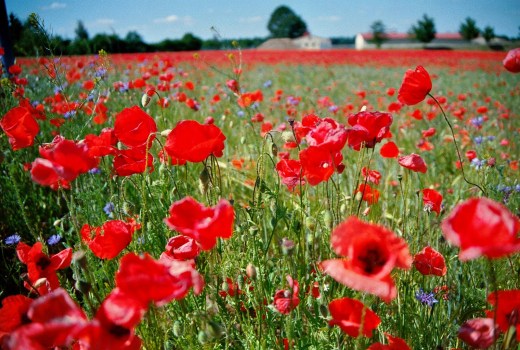
A rare sight in England now, but fields scarlet with swaying poppies.
Poppies: Grain field with Field Poppies in Schermen, Möser, Landkreis Jerichower Land, Germany. J.-H. Janßen ( Wikimedia Commons)
Waves crashing on a beach, as a chilly wind whips sand across my face and into my eyes.
Haeundae Beach, Busan, South Korea
What brings joy to your soul?
Afterword: Some of you have asked to be reminded when BBC Radio 4’s ‘Ramblings’ series about the Nidderdale Way is being broadcast. The first of six programmes will be on air this Thursday, 18th May at 3.00. ‘Our’ episode will be the sixth and final one, on June 22nd. Podcast available.
Walking the Nidderdale Way is pretty damn’ joyous, actually.
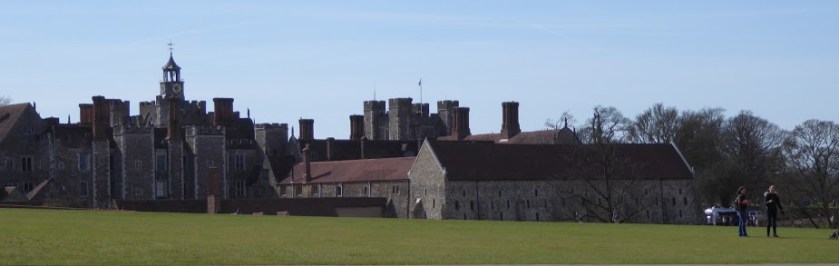
We went to Knole on Sunday: I was with Tom, Sarah and William. Here is a house with 500 years of history set into a mediaeval deer park of 1000 acres.
The house turned out to be off-limits. Only when we got home did we find out that with an over-booked Children’s Book Festival in full swing, other visitors were being urged to stay away.
It didn’t matter. A 1000 acre deer park simply never gets crowded, and the weather was sunny and bright. William rushed about the unending open space and we all helped him spot distant deer.
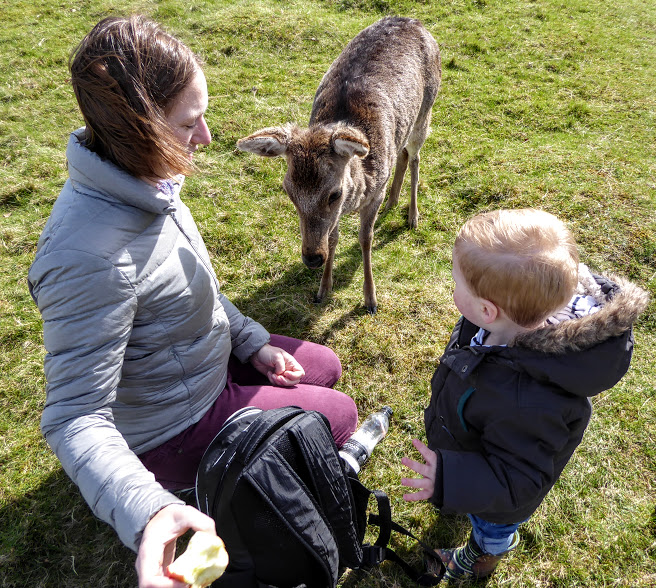
What we didn’t expect was that the deer were rather more interested in spotting us, and not staying at a distance at all. They’d developed a formula which goes something like this: ‘people = rucksacks = picnics = free food’.
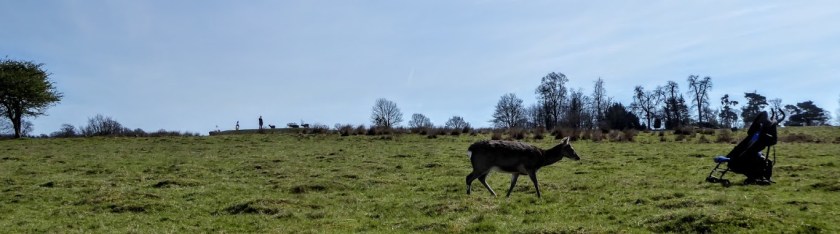
Deer on a food recce.
We knew it wasn’t a good idea. We know that deer are wild creatures, sometimes unpredictable and that they can host ticks and other unwelcome creepy-crawlies. It was a treat to be able to see them grazing nearby.
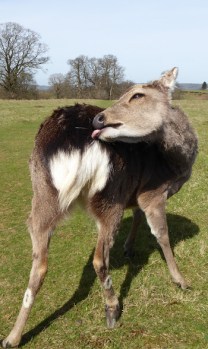
A spot of grooming.
The deer had other ideas. They found a neighbouring toddler’s empty push chair and nuzzled around it for treats. Then they spotted William. He had an apple. The young sika deer thought that William’s apple might make a nice change from grazing for young grass.
Apple core thief.
It was treat for William of course, to get so close to these wild creatures. And it was a treat for us too. But we were wary, and did what we could to discourage our marauder. Once he ‘d snaffled the apple core, we made our excuses and left.
We’ll go back to Knole of course, to explore the house. But we may leave our picnic at home.
The bush telegraph was busy. It’s that time of year, and starlings are murmurating. Spotted south of Ripon, they’d also been seen at Nosterfield, only a couple of miles from us.
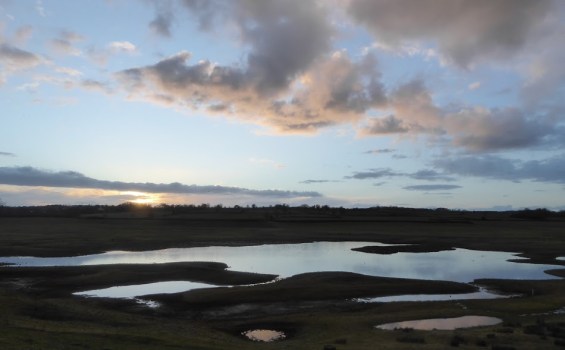
Sunset over Nosterfield Nature Reserve.
Down at the nature reserve, just at sunset, cars gathered. Their occupants waited, enjoying the spectacle of the nightly sunset. Then most of the cars just – went. What did they know that we didn’t? Then Malcolm spotted what we’d come to see, over there in the north.
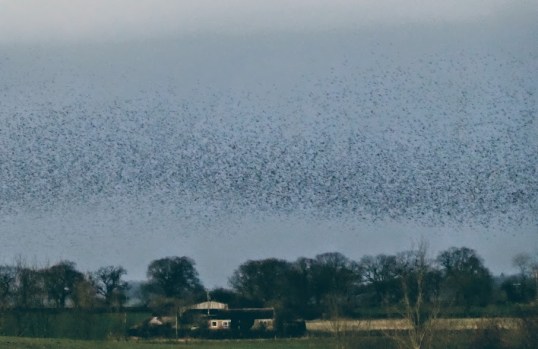
The starlings gather.
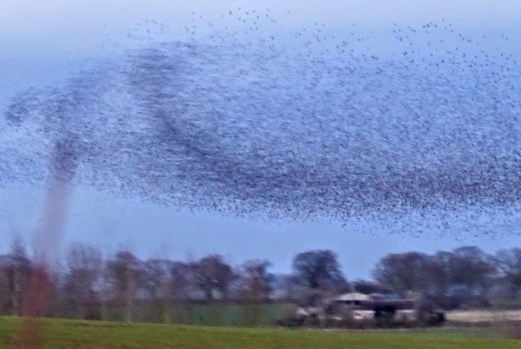
Thousands upon thousands of starlings in a dense cloud that spread, re-gathered, swooped, dived and soared like one of those unending computer-graphic screen savers that used to be all the rage.
We left too, We needed to be nearer. And sure enough, there in a lay-by near Nosterfield village we re-grouped, our binoculars to the ready. The starlings formed an immense cloud, sometimes dispersing to blend in with the grey cloud behind, sometimes wheeling together in sinuous black streaks of snake-like movement. For half an hour we watched.
Then this impressive partnership of birds pulsed lower, then lower, then dropped out of sight. They’d finished their performance for the night.
During the 19th century, travelling botanists brought seeds of all kinds back from their exotic travels and often gave them to curious gardeners, who would try out these novelties as fashion-statements. In 1839, Himalayan Balsam was introduced and became Quite The Thing. It was so invasive (yes, we know) that it was great for making a huge and spectacular pink display at the back of the garden.
Then there was a certain Miss Welch, who in 1948 was so enamoured of the plant that she took seeds from her home in Sheffield and scattered them all over the place on the Isle of Wight. Or Mrs Norris of Camberley in Surrey who broadcast seeds far and wide, not only in Surrey, but in Ireland, France and Spain, and offered seeds to anyone who would accept them.
Himalayan Balsam (Wikimedia Commons)
Now, apart from a few bee-keepers who recognise that their bees adore its nectar, nobody has a good word for this wretched plant. It marches along river banks and masses into surrounding woodland. It smothers any other species it meets on its relentless progress. It projects its seeds (800 per plant) by entertainingly popping open its seed pods and projecting them several metres away. It’s a bully.
And bullies have to be stopped in their tracks. All over England and beyond at this time of year you’ll find bands of Army Cadets, boy scouts, environmental groups, country lovers and villagers gathering in their local Himalayan Balsam Problem Spot to do battle with this tyrannical species.
We were part of one such band this morning. Our local nature reserve, High Batts, is practically our backyard. It’s a fantastically diverse small habitat for a whole range of birds, plants and other wildlife, and the River Ure courses through it. To the delight of Himalayan Balsam, which chokes the river banks before trying to spread itself all over the reserve. Today, a gang of us got on our dirtiest clothes, found protective gloves, and marched off to show the stuff we meant business. One of our number strimmed the worst affected areas, and the rest of us pulled out plant after plant after plant by its roots, until our hands were sore and our backs ached. I used to think breaking the flower heads off was enough. But no. These plants are many-headed hydras. Wound them and they’ll simply sprout forth ever stronger.
Colin gives a few tips on Himalayan Balsam Management.
Strimming the stuff.
Hard at work uprooting balsam.
Army cadets and other volunteers had worked hard before us. Others will need to continue another day. But we did a pretty good job. And we were rewarded with elevenses of pork pie and three kinds of home-made cake, and the sight of those exclusively pink-flowered zones restored to satisfying diversity . Definitely worthwhile then.
The best Himalayan Balsam is dead Himalayan Balsam.
There I was, in the middle of the morning, chatting on the ‘phone and idly staring out of the window, across the lawn and the newly-bare winter trees.
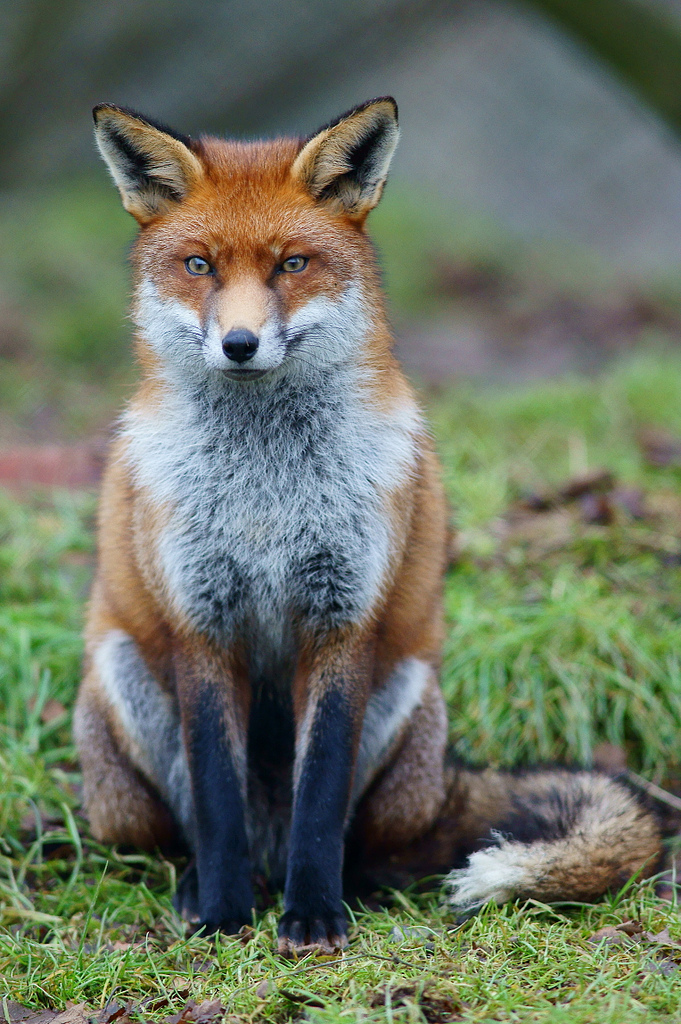
A fox appeared. He walked under the mulberry tree, across the grass, and disappeared into the undergrowth some distance away. He was magnificent. As large as a labrador, with a sleek tawny-red coat, he was very fine as he strolled the full length of the garden, some small item of prey wedged between his jaws.
He was so very different from the urban foxes we see when we go to stay with my son and his family in London. After dark, we enjoy peeping through the curtains, watching them as they prowl up and down the street and stop to examine that unfamiliar car – ours. Compared with our country fox, these urban types are small, with duller coats that are ochre-red, rather mangy and bald in places. But look at what they eat. Our fellow will have feasted on a plentiful diet of rabbits and pheasants. Town fox investigates dustbins and fast-food litter, looking for the remains of a greasy, salty fried chicken meal, or a few crusts of pizza. He won’t starve, but he’ll be pretty ill-nourished.
An urban fox. Wikimedia Commons.
We always enjoy our glimpses of those town foxes in London. But how much more excited I was yesterday when I saw the beast who, unhurried, stepped regally past.
And no. I haven’t got a photo of him. I’d have had to leave the window and miss those few special moments.
I haven’t been on a ‘proper’ walk yet this year. First it was the ‘flu, and its aftermath. Then it was rain or snow on the days when I might have been free to get out for a blow in the breezy cold. And finally it’s the mud. Mud’s the one that gets me every time, despite having been given a wonderfully efficient pair of walking gaiters among my Christmas presents. I find it frustrating, pulling my boots from an oozing, slippery, sticky slick of mud only as a preparation for sliding into the next soupy puddle . It makes for slow walking on days when briskly striding out is what’s needed to combat the cold.
So today, keen to get out for at least an hour or so, and equally keen to avoid That Mud, I ended up on a star-shaped walk. I turned back down every path I started, and ended up doing a zig-zag circuit beyond the edges of the village.
Young kestrel feeding
I started off by looking for the young kestrel I’ve come across on a couple of days this week. I had first spotted him in a field near our house, dismembering and eating some small creature just 6 feet away from where I stood staring at him. He flapped off crossly to a nearby wall when he considered I’d got too close, and it was on this wall I saw him the next day too. Today he wasn’t there. I think there were too many dogs out walking their owners.
Beatswell Woods with extra water.
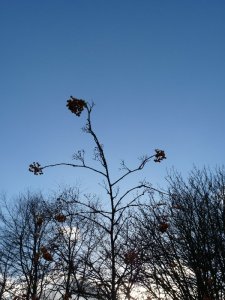
Then I went down into Beatswell Woods. I hoped for buds on the trees, or a few early flowers, but it was wet and wintry still. Then I walked to the fields, thinking I’d choose one of the paths there to take me in a big sweep round the edge of the village. No go. All the paths were muddy, and the horse I stopped to chat to had pretty filthy socks too. Though there was this rowan, with golden honey coloured berries instead of the more usual red.
Rowan berries against a chilly blue sky.
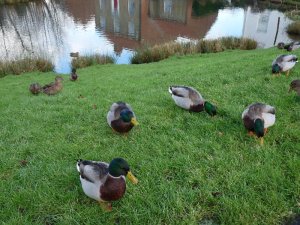
At the village ponds, the drakes and ducks ran fussily up to greet me, hoping for crusts. When they saw I had nothing, the drakes returned, like a bunch of fourth formers, to teasing and irritating the only couple of females in the group.
Drakes and ducks hoping for crusts.
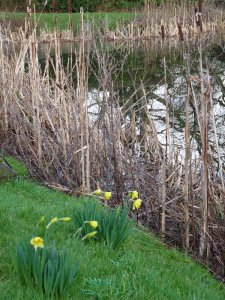
But it was near the ponds that I had my second sighting of daffodils this year, so very early. Surely they should wait until the crocuses have put themselves about? But the crocuses are only just poking the tips of their leaves above the soil, and don’t plan on coming out yet.
Daffodils by the pond.
Returning to the woods, I saw the snowdrops. Isolated patches a couple of weeks ago, now they’re in magnificent great white drifts climbing the hillsides, nestling under trees, even risking everything by straggling across the (muddy) paths.
Drifts of snowdrops in the woods.
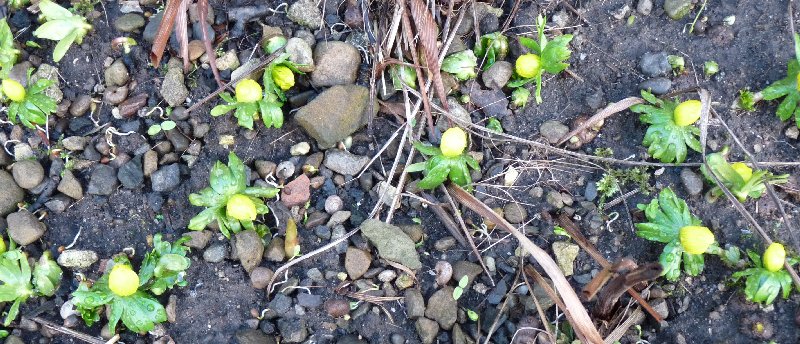
A bit of a curate’s egg of a walk then. A few frustrations, quite a few pleasures, but a healthy glow on my cheeks, and, just before I came into the house, another treat. All these aconites, pushing up their bright yellow faces through the soil, bringing with them hopes of Spring.
Today, I rejoined the human race. For the first time since before Christmas, I got up, got dressed, looked out of the window – and wanted to be out there, in the bright and frosty sunlight. Malcolm’s recovery is a good day or two behind mine, but I hope that he too is on the way up.
An early morning frozen pond
The first snowdrops
Frosty thistles
The promise of daffodils
Eleven o’clock shadow
Blue sky January
The sky reflected in the River Ure
Frosted leaves
Those Jacob sheep supervise me home every single walk.
I wasn’t up to a hike. I wasn’t even up to a stroll to the village shop, only a mile and a half away in West Tanfield. But I was up to a riverside amble, particularly when it meant coming upon little clumps of snowdrops on the woodland floor, already unsheathing their white faces to greet the winter sun.
Snowdrops push above the leaf mould
If the snowdrops are out and about, truly, all’s right with the world.
Ever since our friend Micheline had a nasty fall on a walk, three and a half years ago, and had to be air-lifted to hospital, I’ve been slightly wary of walking alone in the countryside.
But sometimes, only solitary will do. Never more than 4 miles from a village, always with a farm somewhere not too far away, I set off for a solo walk this morning, even before all the Grammar School pupils had got on their bus to whisk them off to school in Ripon.
From your point of view, as you look at these photos, you may feel it was all just a repeat of my Sunday morning stroll. But it wasn’t at all, not for me. My path drew me in a big eight mile circle to the west of our village. It took me past a working quarry: always good to watch men at work. It took me past ancient trees: our home patch is particularly good at oak trees which are very old indeed. As I was passing through a wood, an anxious Wensleydale sheep cantered up to greet me. I saw why she was worried. There wasn’t another sheep like her in sight anywhere – she was lost. But I never found anyone I could report her to. I hope she’s alright. There were fungi. There were delicate and skeletal winter seed heads. I saw a pint of milk delivered to someone’s gate, and took a picture of it. Home milk delivery’s getting scarcer here now than it was in my childhood, but I’ve never seen milkmen in other countries I’ve visited. I saw Autumn leaves still clinging to the trees, and plenty more in vibrantly coloured heaps at the base of trees.
Best of all – and I have no photo to prove it – shortly before the end of my walk, as I was climbing steeply through woods with the River Ure below me, three white-rumped deer leapt out of a clearing, and with three rapid yet elegant and beautifully choreographed bounds, disappeared from view, only to re-appear and disappear for good, moments later.
All in all, a pretty good use of a Friday morning, I thought.
Winter birds
Leaving home under the watchful eye of the Jacob sheep
An early morning sky
Big machinery at the quarry.
An ancient oak
This woodland will be deep in bluebells next April
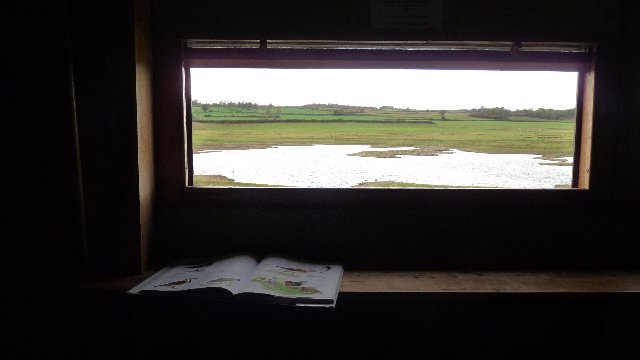
A comfortable hide at Nosterfield: sheepskin covered seats, and lots of birdbooks to refer to come as standard
We spent yesterday at Nosterfield Nature Reserve , a mere couple of miles from here. There’s no point in having a bird reserve almost in your back garden if you don’t know a wigeon from a pochard, or if you confuse a rail with a dunlin. It’s even worse if you’ve heard of none of the above. We signed up to ‘Start Birding’, and birding’s what we did, for the whole of a bright and sunny Friday.
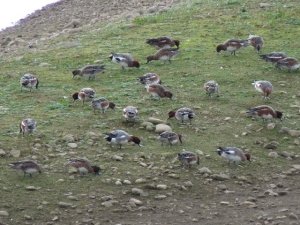
Wigeon feeding
Pochard
Water rail
Dunlin
Linda, our teacher, was infectiously enthusiastic. She lent out decent pairs of binoculars, and made sure we knew how to use them. She helped us observe birds for their silhouettes, colouring, flight patterns, so we could begin to identify the hundreds of birds who regard Nosterfield as home, a holiday resort, or a stop-over on a long voyage from the Arctic to – who knows? Southern Europe or even Africa.
And we hadn’t been there long before she saw drama begin to unfold. We saw no drama. Oh yes, we could see that birds who had been feeding in scrubland, and waterfowl who’d been serenely gliding in the shallows all flew skywards, all started wheeling and turning, circling the area they’d come from time and time again, in some agitation. But, well, birds do that, don’t they?
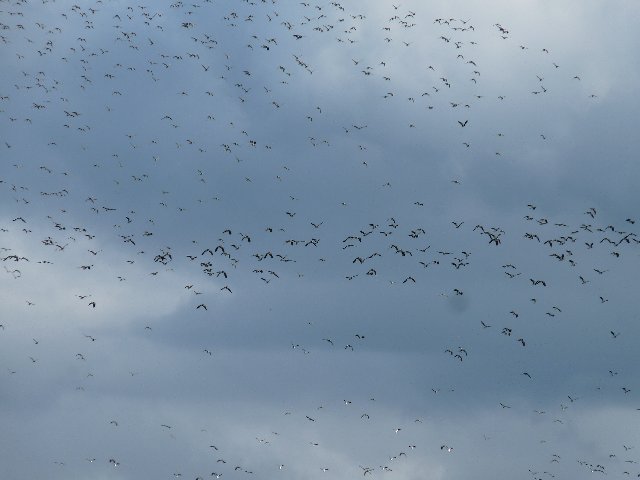
Bird panic
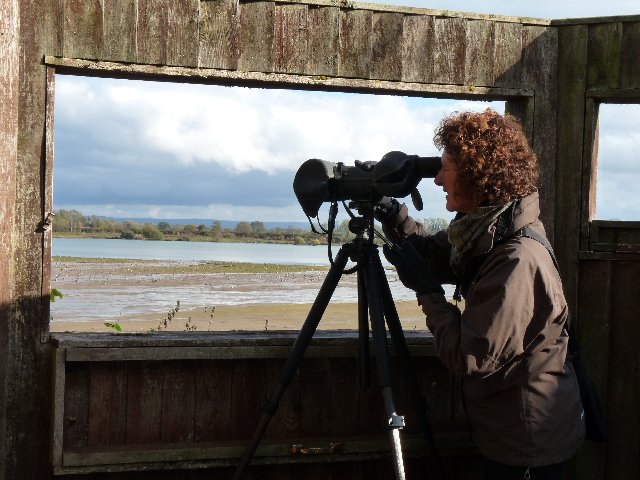
Linda knew better. She knew they’d all spotted something we couldn’t see. We all used our binoculars and her super-powerful telescope to scan the sky. It was more than 5 minutes before she saw, high above, a peregrine falcon. He rose high on the thermals, looking down on all his possible prey, all flying close together for their mutual protection.
And suddenly, talons extended, he dropped. Only Linda and Dianne spotted the moment when he scooped up a lapwing, and plummeted swiftly to earth to despatch the bird and inspect his catch. He didn’t get much chance. A small gang of carrion crows moved in. They wanted the falcon to open his prey up, then they planned to steal it.
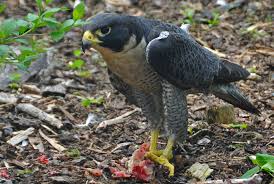
Peregrine falcon feeding
The peregrine wasn’t having that. He grabbed his lapwing, flew off, and came down again, this time where Linda was able to train her telescope so we could get grandstand views of what happened next. The crows reappeared too, but knew there was no food for them while the lapwing’s corpse remained intact: their beaks are not designed to pierce outer skin. By determined, measured stabbing, the falcon started to open his prey up. White downy chest feathers flew, as he discarded these in search of the flesh beneath. The crows pranced round. They snapped at the falcon’s tail, they tried to provoke and hustle him into abandoning his catch. They even ventured to pluck at the lapwing feathers themselves. But though irritated, the falcon carried on, ripping away at the flesh with his super-strong beak. As the crows took occasional chances to dart close and grab a mouthful, they were rebuffed by the falcon’s impressive skills as a sentry: and no doubt from the fear of that beak too.
Little by little, the falcon ingested his meal. That may be his diet sorted for the next day or two. He even left the carrion crows the bones to pick clean. They too wouldn’t have gone away entirely hungry.
Those are lapwings in the foreground. Behind are golden plovers.
And after that, we had a day of lapwings and golden plovers, and cormorants, and rails and wigeons and pochards and shovellers and Barnacle geese and Canada geese, a kestrel or two, and goldfinch and twites and great tits, and many many more. We can confidently identify many of them, and now have the tools to gain in confidence and knowledge every time we go out with our eyes wide open and our senses tuned in. Even without the blockbuster tale of savage death at the lakeside, Friday would have been a fantastic day.
If you live in Yorkshire, within reach of Leeds, and would like to know more about birds, do follow the link to the ‘Start Birding’ site and see what’s on offer. This is an unsolicited testimonial to Linda Jenkinson, Top Twitcher!
Linda focussing one just one of those birds.
I was too busy on Friday to take many photos, so the ‘bird portraits’ are courtesy of Wikimedia Commons.
We had such a good time wildlife watching in Wales. At first it was all simple wonder and enjoyment : ‘Look – there’s a…….’. But soon it all got quite competitive. Sarah bought an ‘I-Spy’ book – remember those? It was birds she decided to hunt for, and we all got involved in deciding whether it was guillemots, Manx shearwaters, or simple herring gulls that we’d just seen. And look! There’s a cormorant on that rock over there! And three choughs sitting on a wall! And over in those bushes – surely that’s a willow warbler?
Herring gulls taking a break
This cormorant almost got away before I got my camera out.
Choughs on a rock.
The day that we were in no doubt at all about the quantity of our wildlife sightings was the Sunday when we took a boat trip round Ramsay Island. There were indeed birds (but no puffins: it’s off-season for them): but what we relished seeing in huge numbers were seals, swimming in the coves, basking on the shore, or in the case of the white new-born pups, beached high up on some sheltered spot away from in-coming tides.
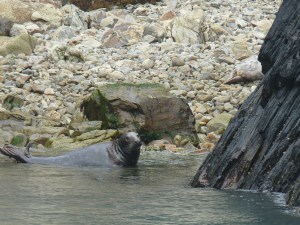
Grey seal on a beach at Ramsay Island
Ramsay Island’s a splendid place. These days it’s an RSPB bird reserve, and there were seabirds of course: not so many at the moment as the breeding season is over. Easy to see though where they nested – very precariously – on the rock faces which are heavily stained with guano. Sucked along by powerful tides, we plunged into sea caves, rode close to the shore squeezed between deep rock gorges as the cliffs soared high above us. We’re fairly sure we saw porpoises clipping along at speed just as we were turning for the mainland once more.
Grey seal swimming near our boat.
A beach full of seals.
A seal pup, easily identified by its white spotty coat.
Herring gull on Ramsay Island.
Empty sea bird nursery.
Sea bird settlement on the island
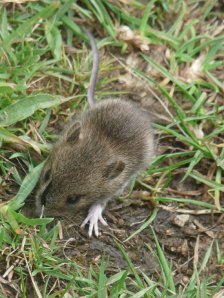
Every time we went walking we came to expect to engage in bird and seal spotting. But on Saturday, as we strode the cliffs of the coastal path, we came across this vole, and his (her?) two companions. The image you can see on your screen is almost certainly larger than the real thing. We were so lucky to have seen such a tiny creature, and so clearly.
One of the voles we spotted on our walk.
A few minutes later, I was the only one to spot a lizard: my first sighting since leaving France.
And then there was the evening when we went for a walk, and found ourselves accompanied by a whole troupe of friendly steers, who wanted nothing more than to follow us home, and to help us along with our map-reading….
We’re being followed…..
Not wildlife exactly: but these young steers were awfully keen to help Sarah and Brian out with the map-reading.
























You must be logged in to post a comment.