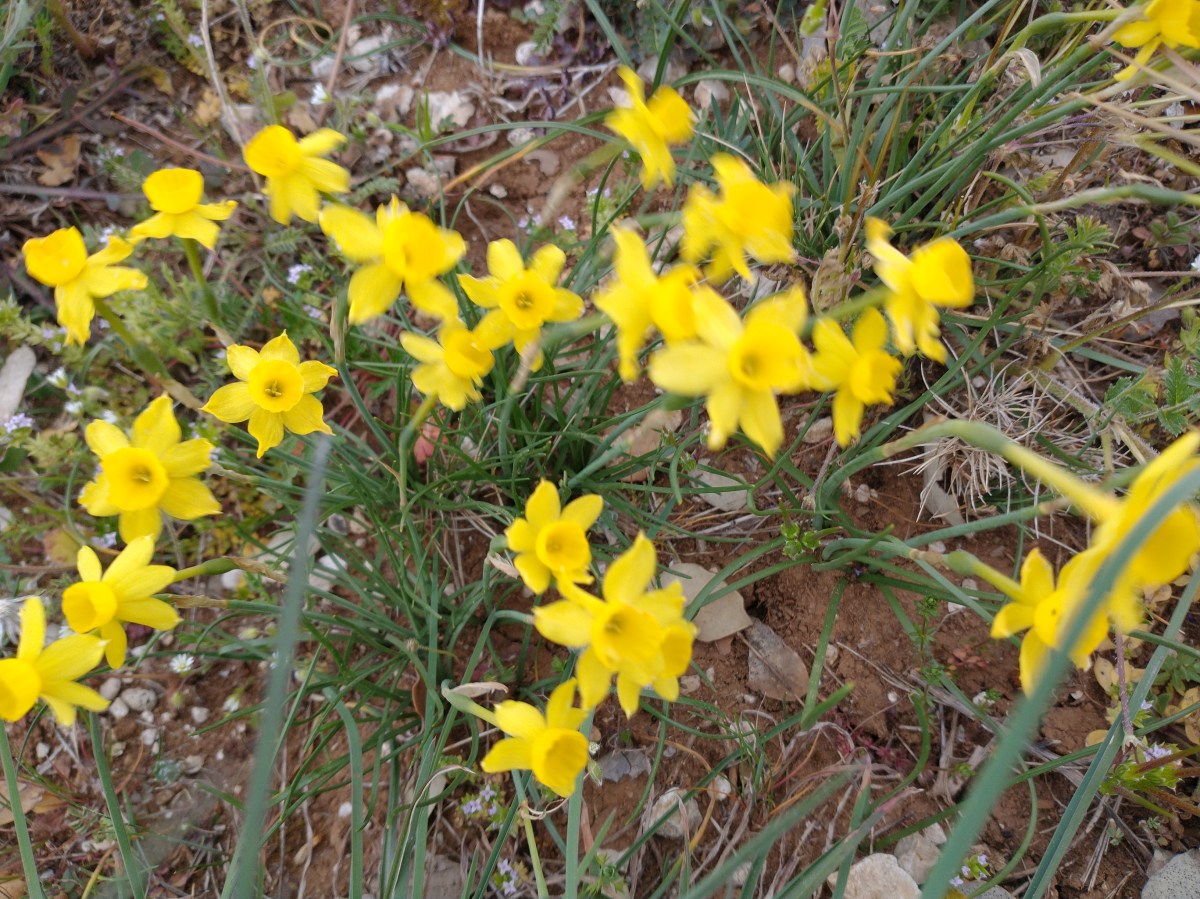
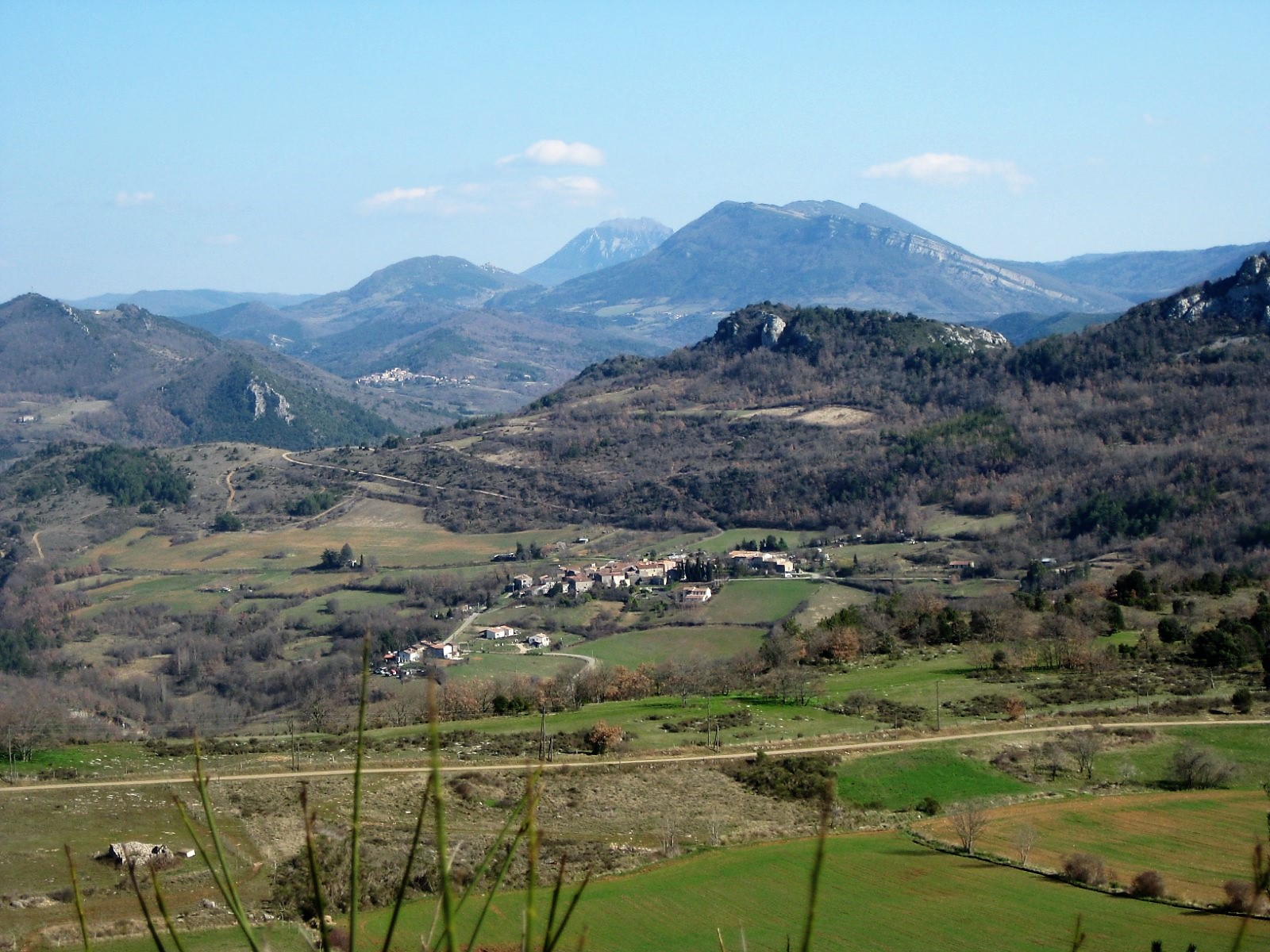
The landscape near Minerve, and out in the midst of it wild daffodils, a mere eight centimetres high. Blurry photos? Windy day.
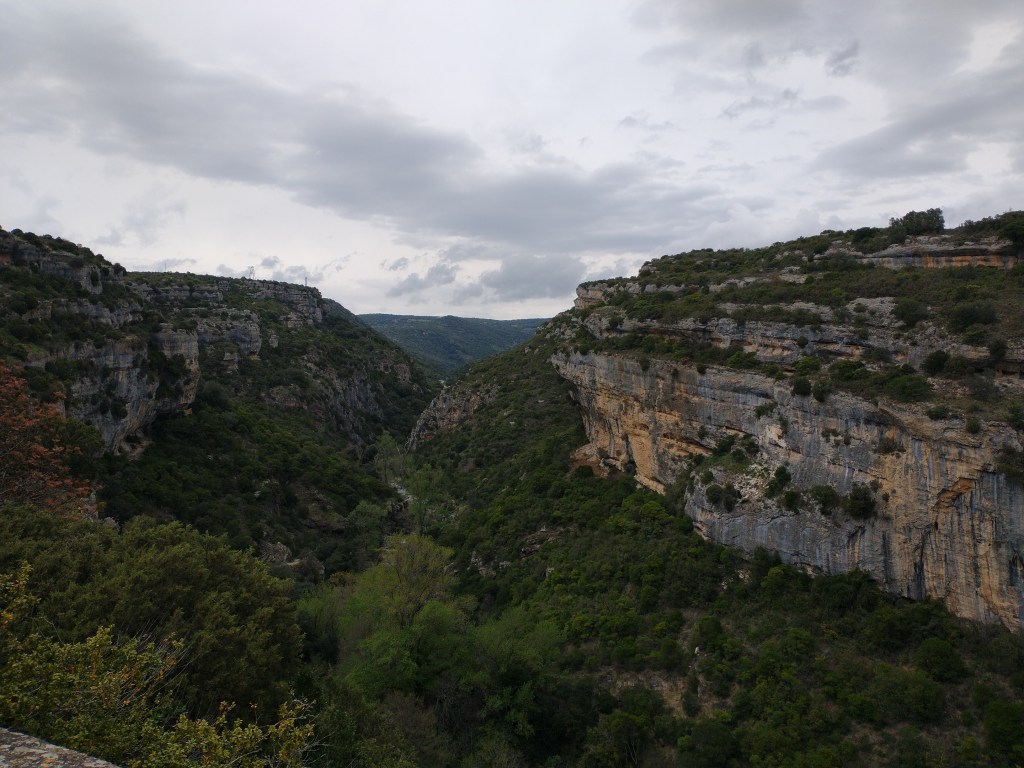
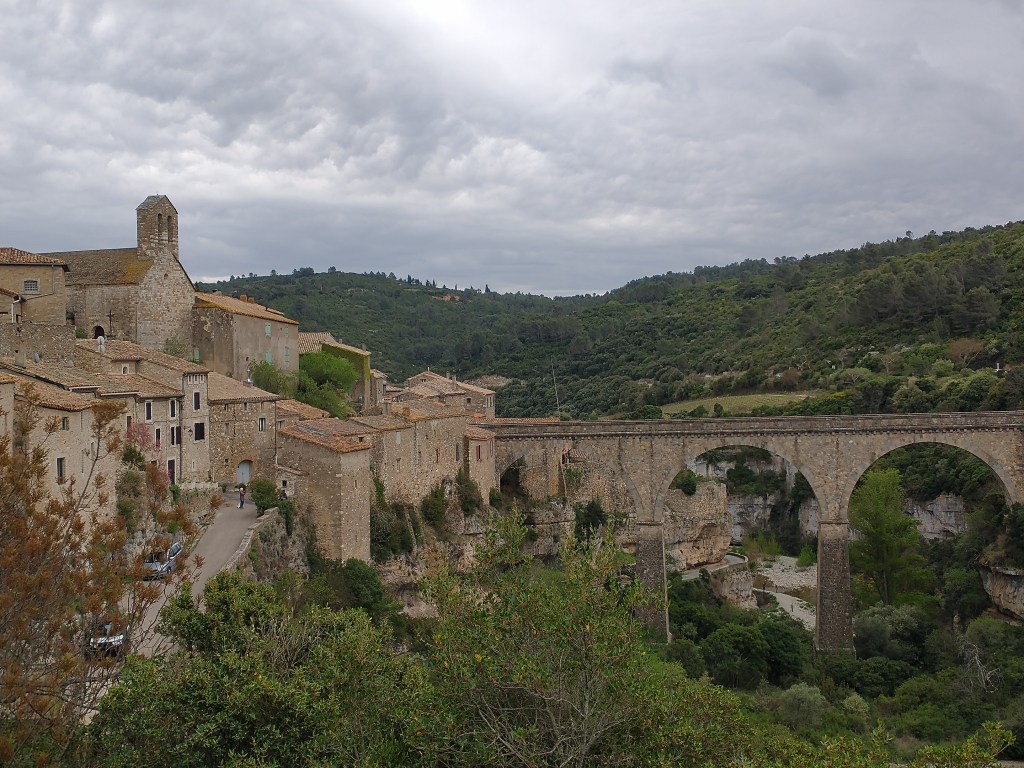
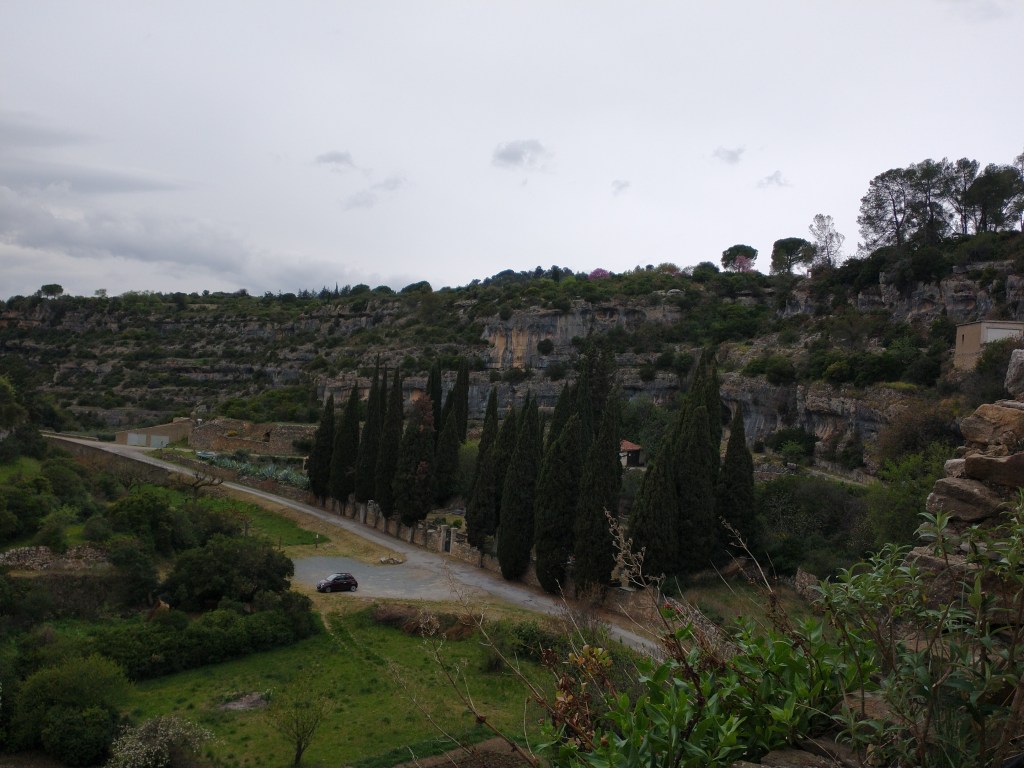
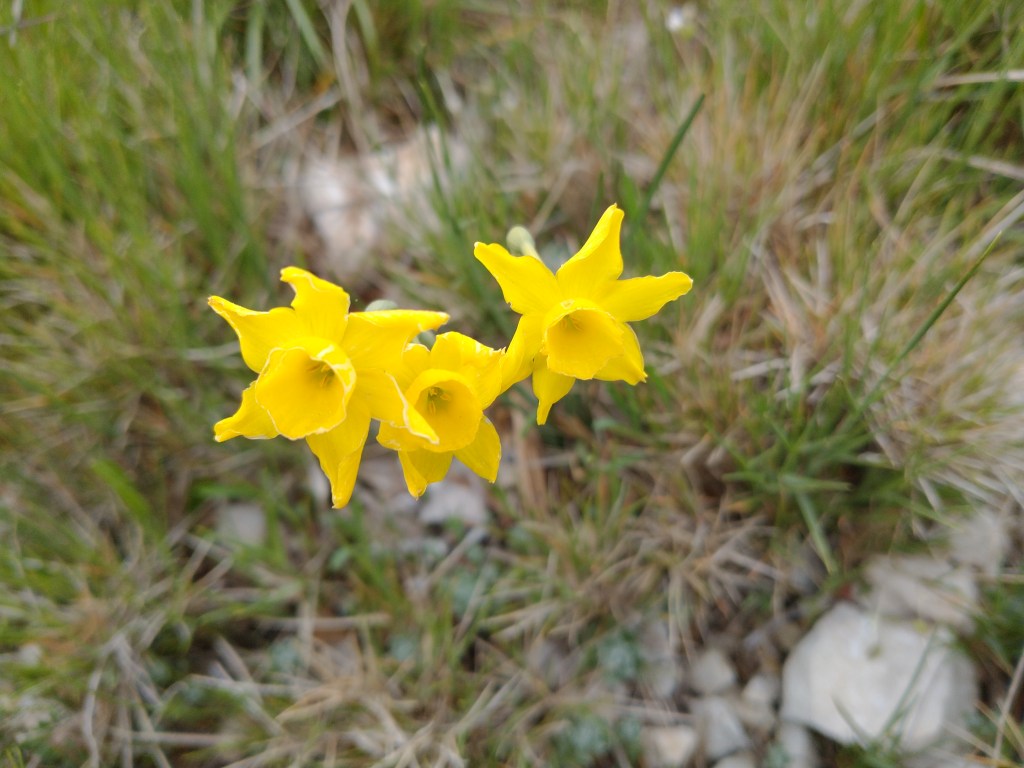
The landscape near Minerve, and out in the midst of it wild daffodils, a mere eight centimetres high. Blurry photos? Windy day.
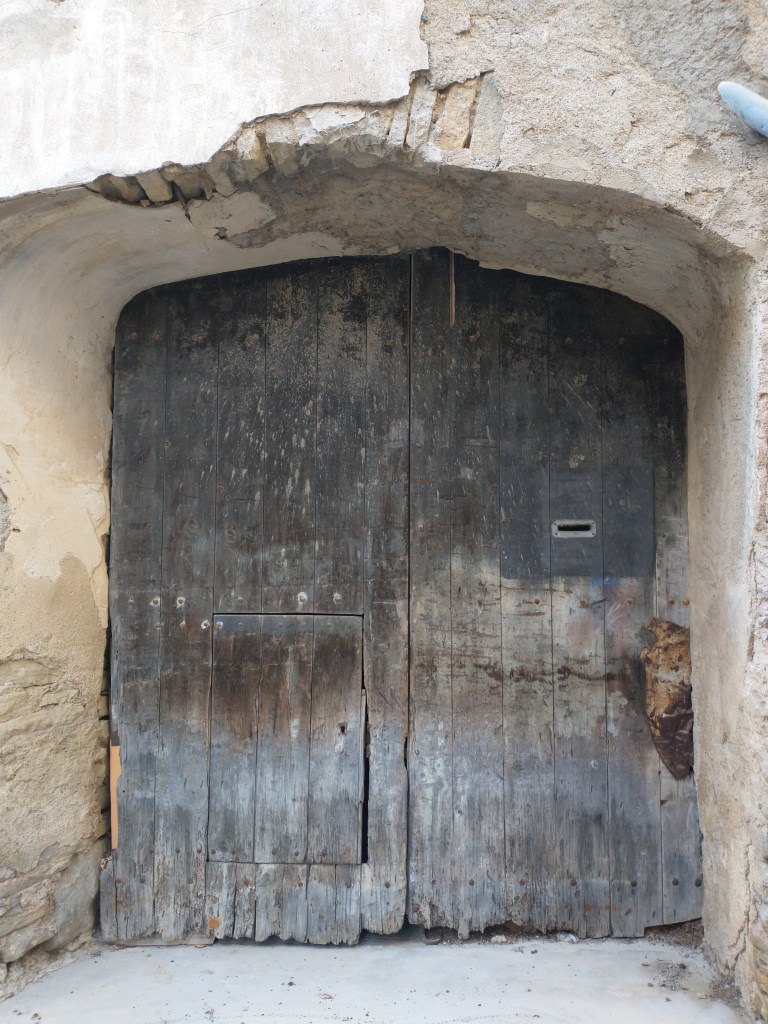
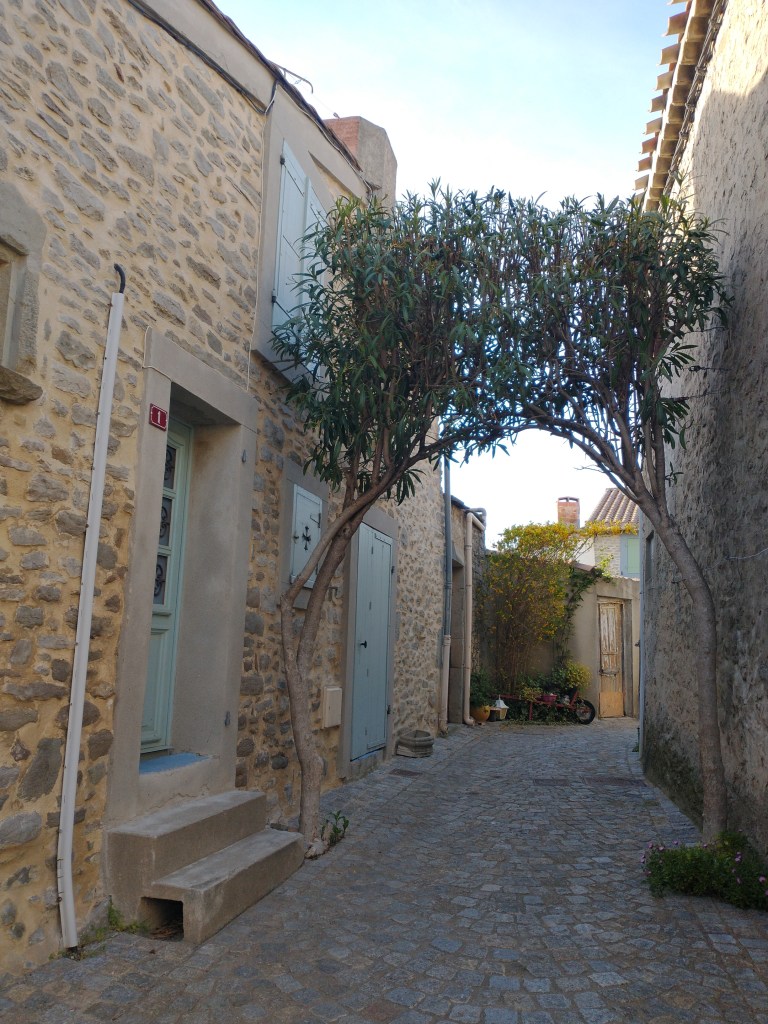
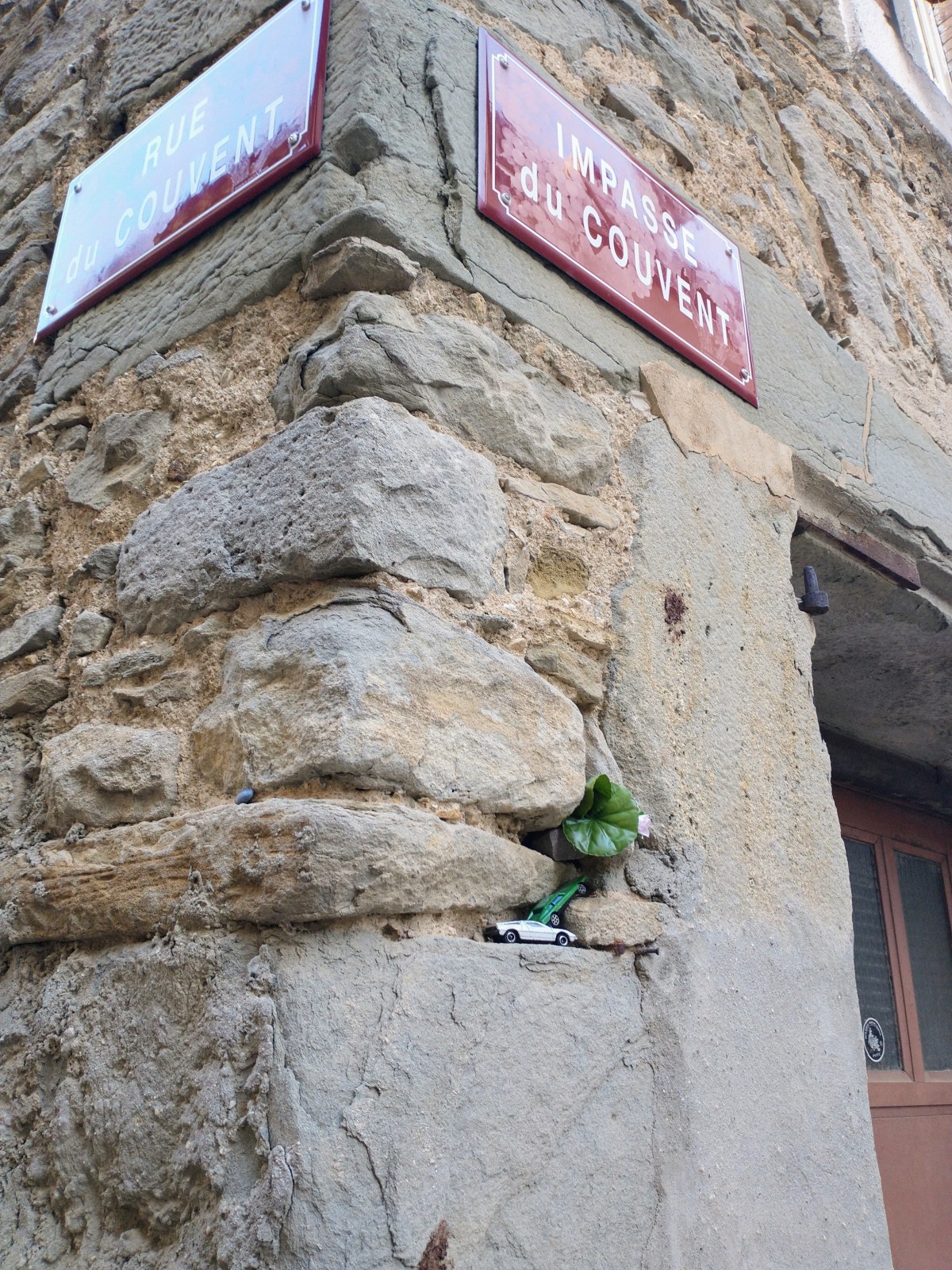
Can you spot the secret garage?


From the wonders of nine hundred year old man-made cathedrals…
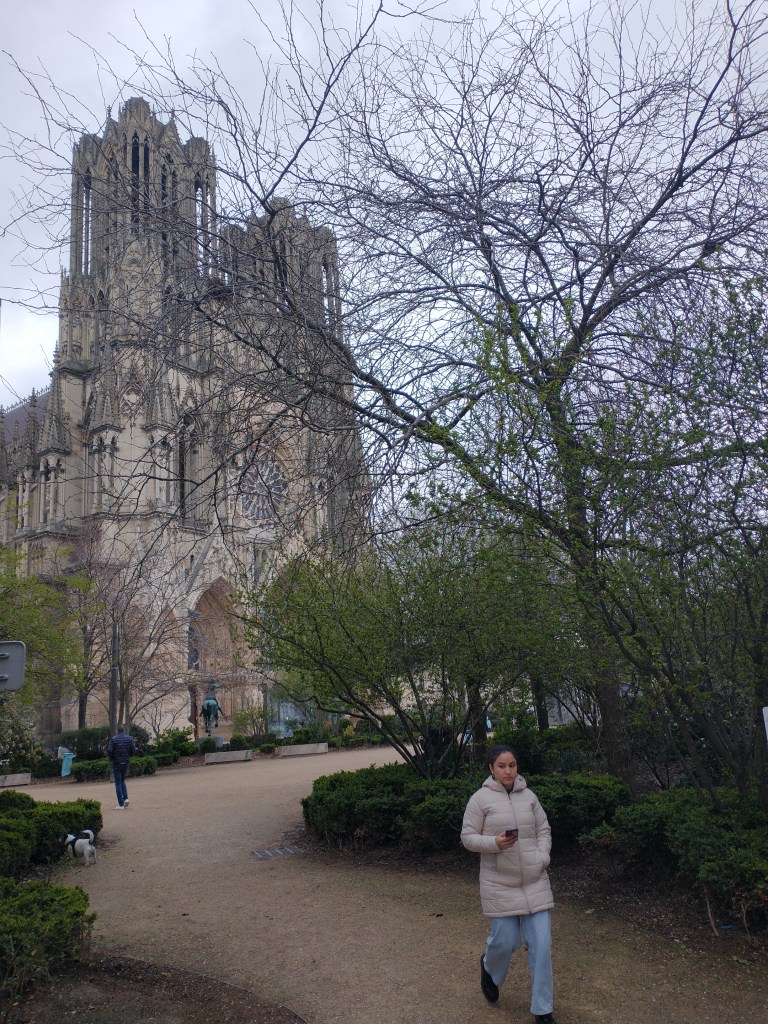
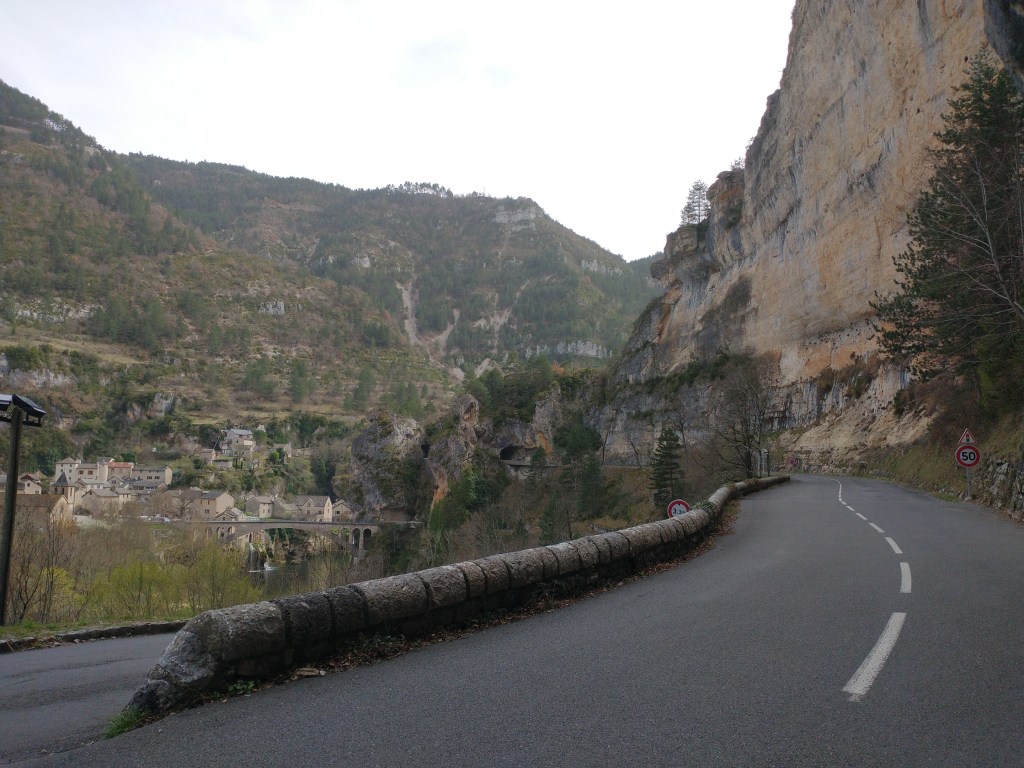
… to the perhaps two hundred and fifty million year old natural wonder which is the Gorges du Tarn (better photos later, I hope. My phone-camera was over-awed) …
… to the twenty year old wonder which is the Millau Viaduct.

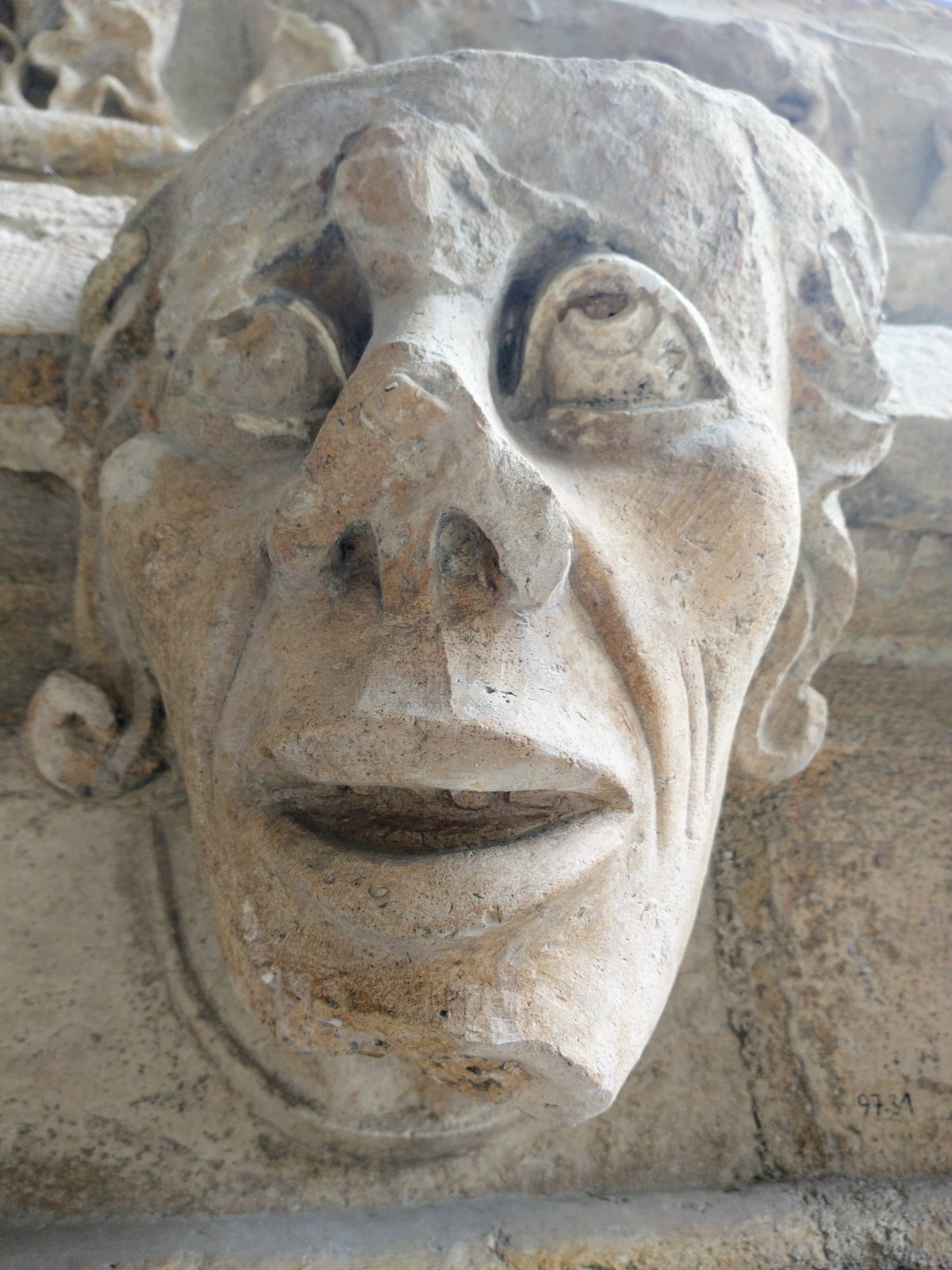
The featured photo shows a spot of shock and awe from a weathered statue stacked outside Reims Cathedral and awaiting restoration.
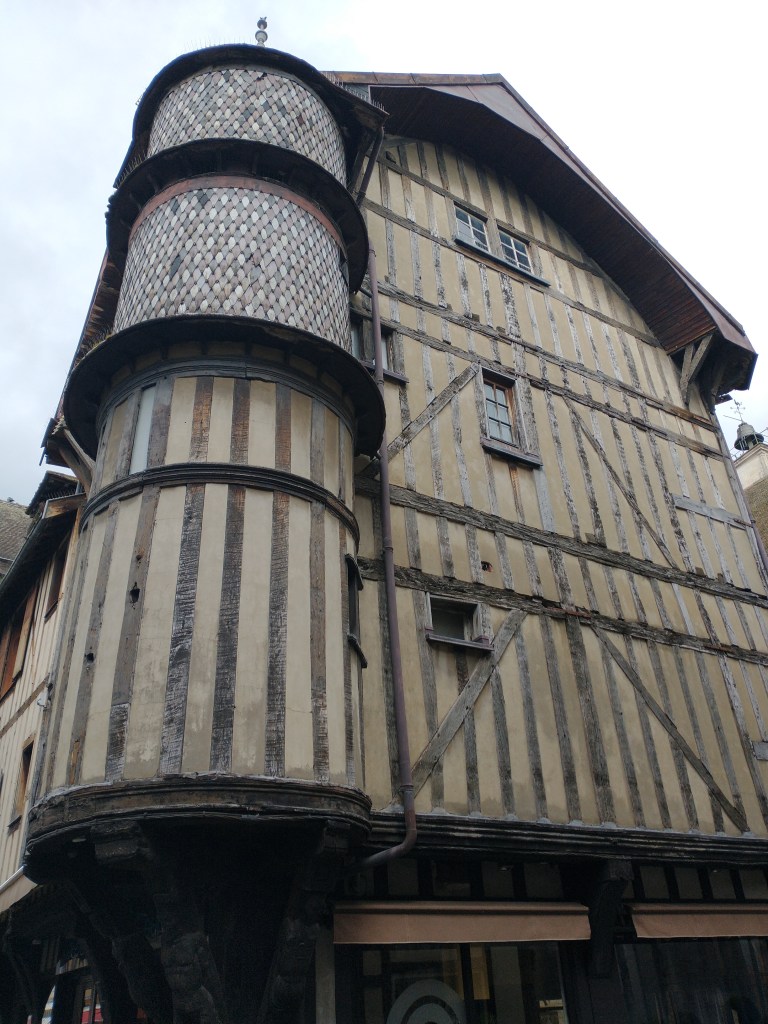
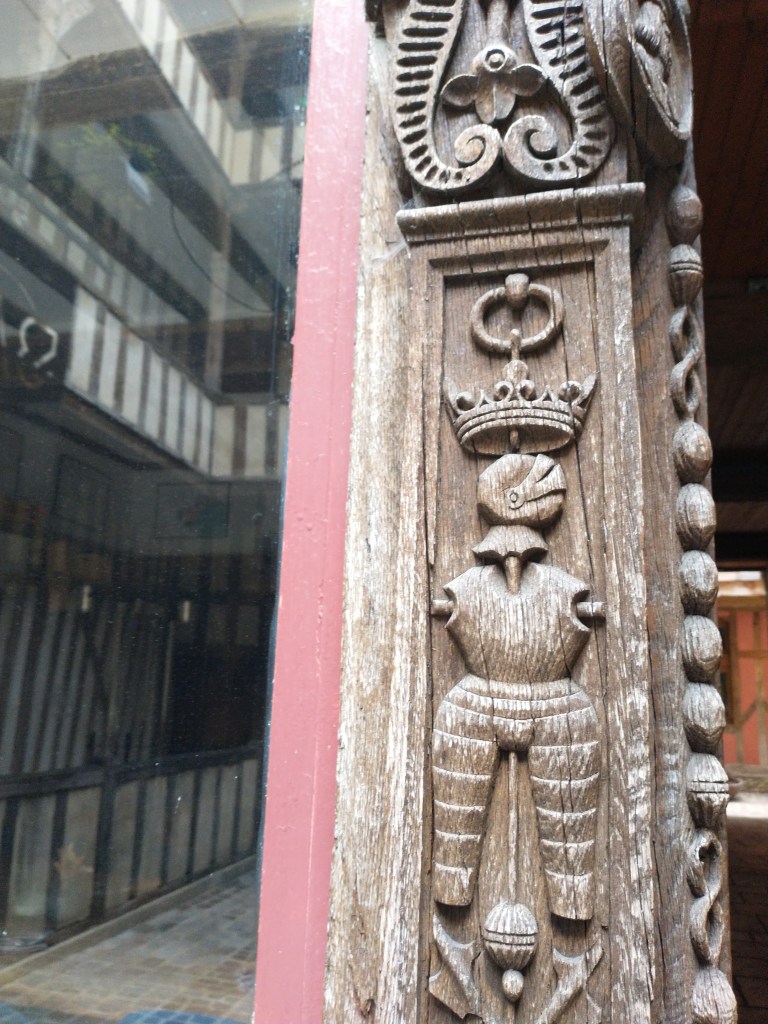
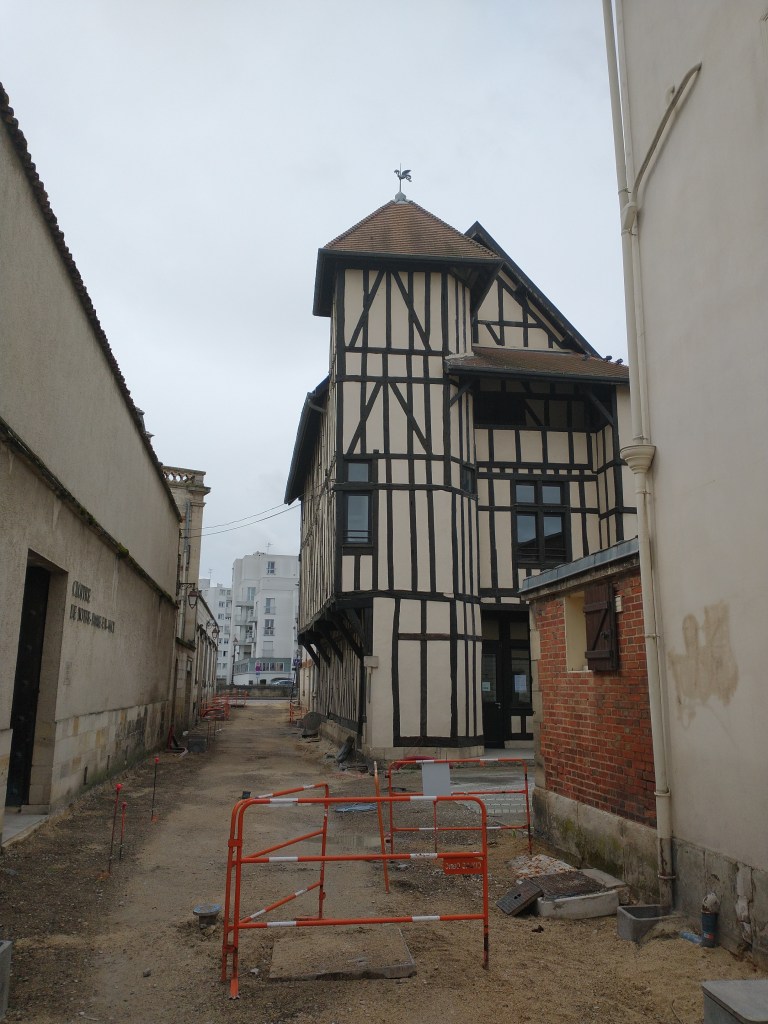
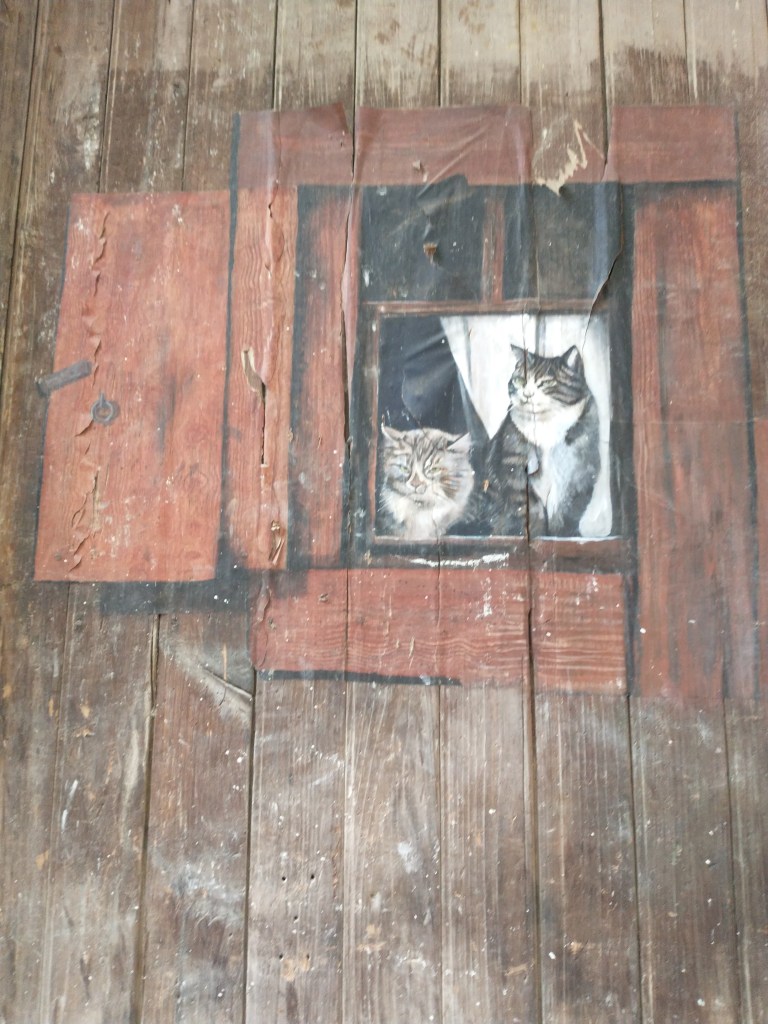
We’re on our way to Spain to see daughter and family, trundling down through eastern France. Now we’re in the Aube, in Troyes. It’s been a successful city since Roman times, but what you see now is a place that still has hundreds of half-timbered houses. Still lived in, still used as shops and business-places. A few are in bad nick. Some are being renovated. Some lean at impossibly drunken angles. Most are well cared for and entirely habitable, just getting on with life, as they have been for centuries. And a few of them provide a convenient surface for discreet pieces of street art.


As you read this post, we’re on the road, heading for France, then Spain to see the Spanish branch of the family, and even to attend a wedding. Please expect little in the way of responses to comments, whether on your own blog or this one for the duration. But nine years ago, on 20th March, we were leaving our home in Laroque for the very last time…
23rd March 2014
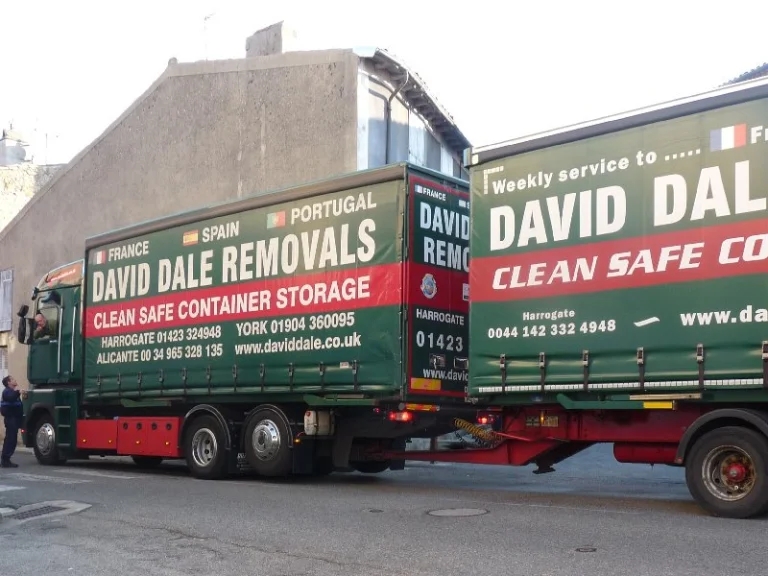
You’re making your last visit to Laroque today, for the time being. We left 3 days ago, and now we’re in Ripon. Those last days were a furore of packing, cleaning, ‘goodbyes’ (though never, never final farewells), and two visits from the removal firm, who couldn’t fit everything in, first time round. At this moment, perhaps, the person who bought our house is planning his own removal to Laroque.
I never told you, probably out of sheer superstition, the story of the house sale. The housing market’s incredibly tough in the Ariège just now. House prices have tumbled 25% since 2008. Properties remain unsold for one, two, three years, as unhappy owners reduce the price of their homes in hopes of at last attracting a buyer.
Whereas we had nothing but luck. A man from near Paris, house-hunting here, in the area where he’d grown up, saw our house, arranged to view, and said he liked it. A week later he came again, showing his ‘coup de cœur’ off to his mum and dad. He made a low-price offer, as you do. We refused it, as you do. But we offered him our non-attached garden, being sold separately, at a generous discount, and said we’d include some of the furniture in the house sale. Reader, he offered full price, and the rest is history. Vue-vendue.
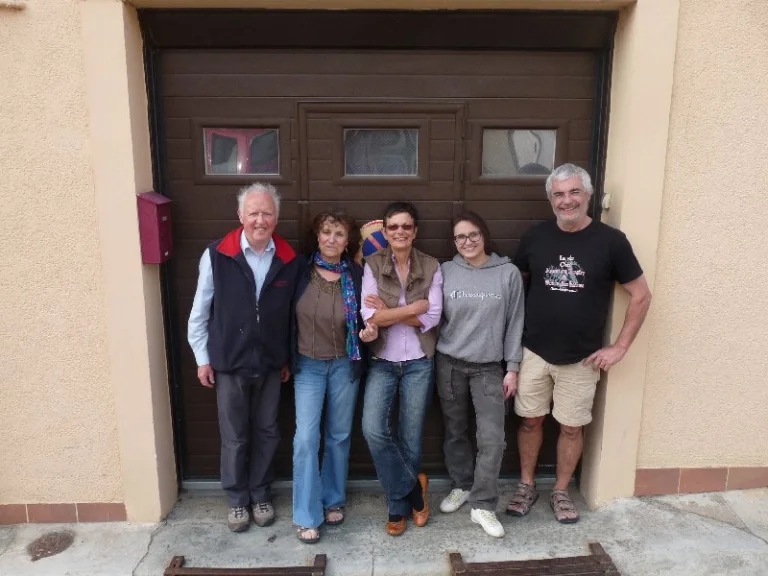
We’d just locked the door for the last time. And helping us wave ‘Goodbye’ are Martine, Francis and Anaïs, almost the very first friends we made when we arrived. Nine years on, we have a granddaughter called Anaïs.
So here we are in Ripon, ready to house hunt and begin our new lives here. Oh, and there’s the Tour de France starting in Yorkshire too, in a couple of months. We’ll keep you posted.
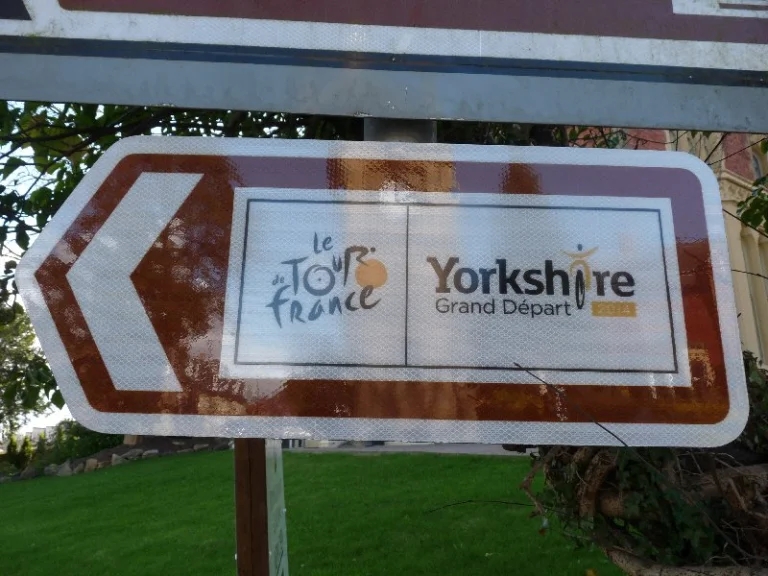
Our luck continued here in England. The very first property we viewed to rent – as a temporary measure while we house-hunted for somewhere suitable – was the house we are still living in nine years on, with no intentions whatever of leaving.
It was twelve years ago this weekend that I realised that even ordinary-seeming mishaps on country walks can have very unfortunate consequences …
March 20th, 2011
Poor Micheline. Her pain, her distress was our Sunday Soap Opera.
We’d gone walking with our Rando del’Aubo friends, near Nébias again. We’d yomped up a mountainside, two hours of it, and were looking forward to lunch in – oooh, maybe ten minutes. That’s when Micheline fell over a tree root.
It was bad. Very bad. Broken ankle? Knee? We still don’t know. Anny, who has GPS, ran off to find some kind of reception for her mobile, so she could ring emergency services, and give them our exact reference.
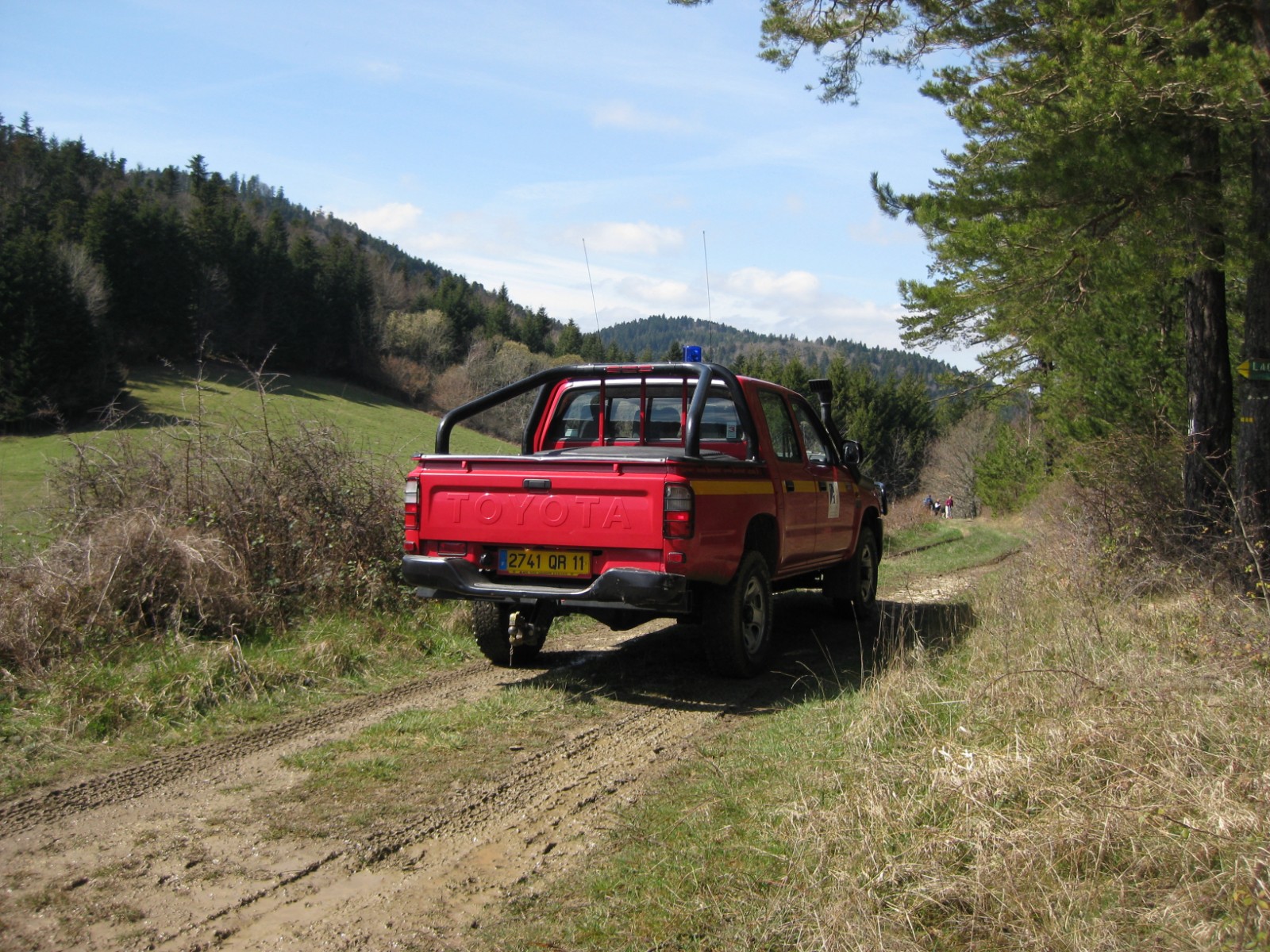
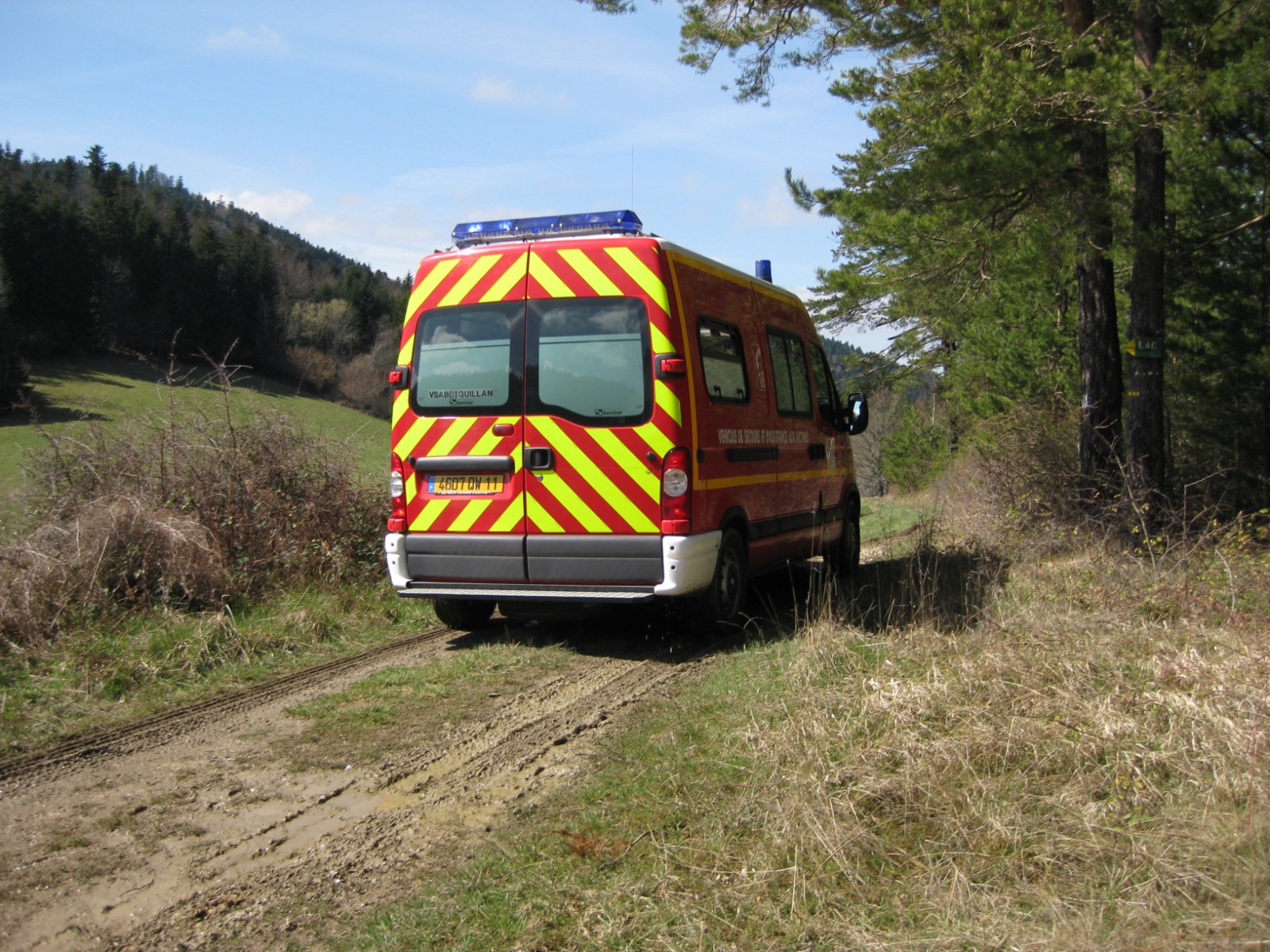
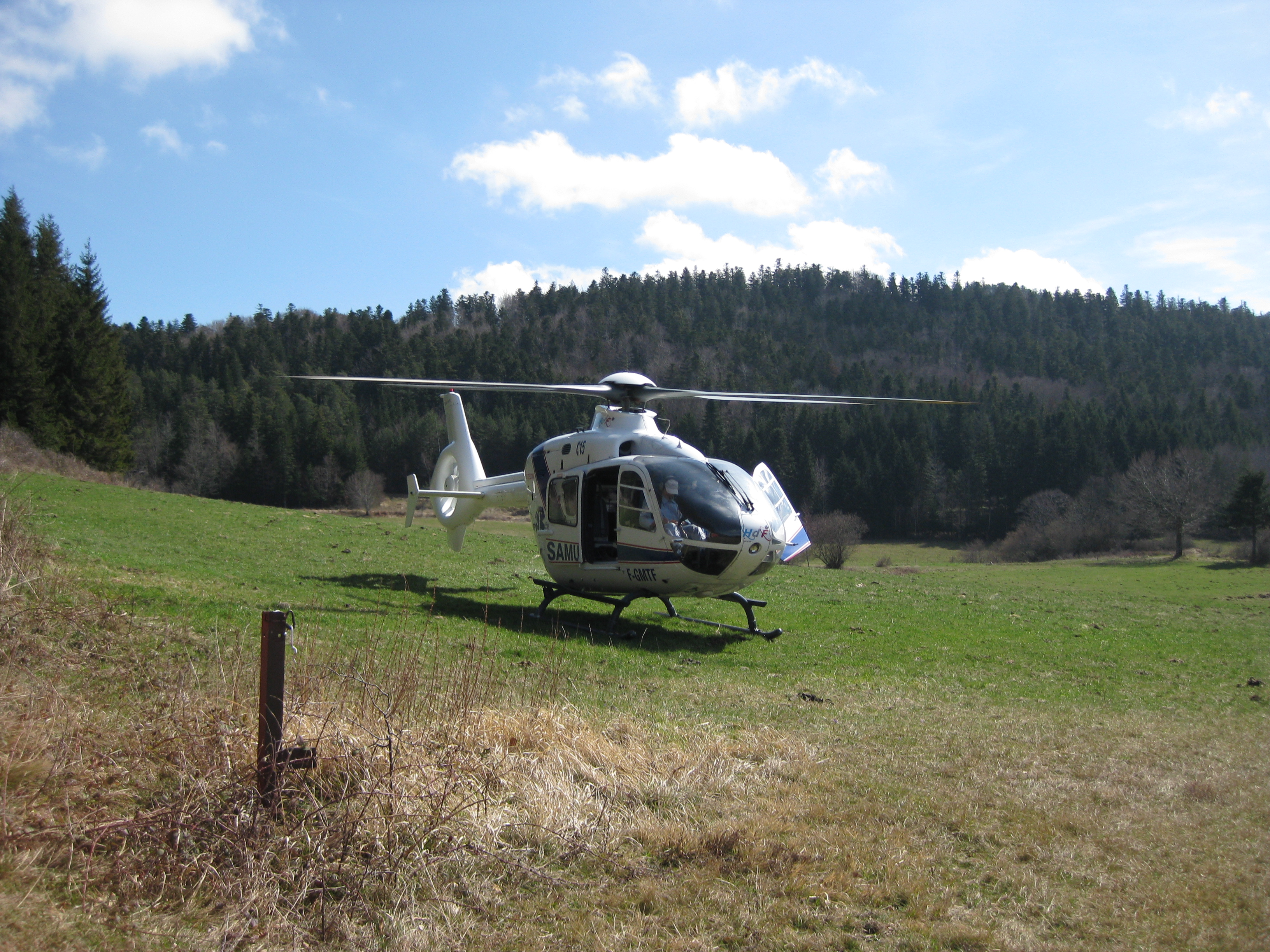
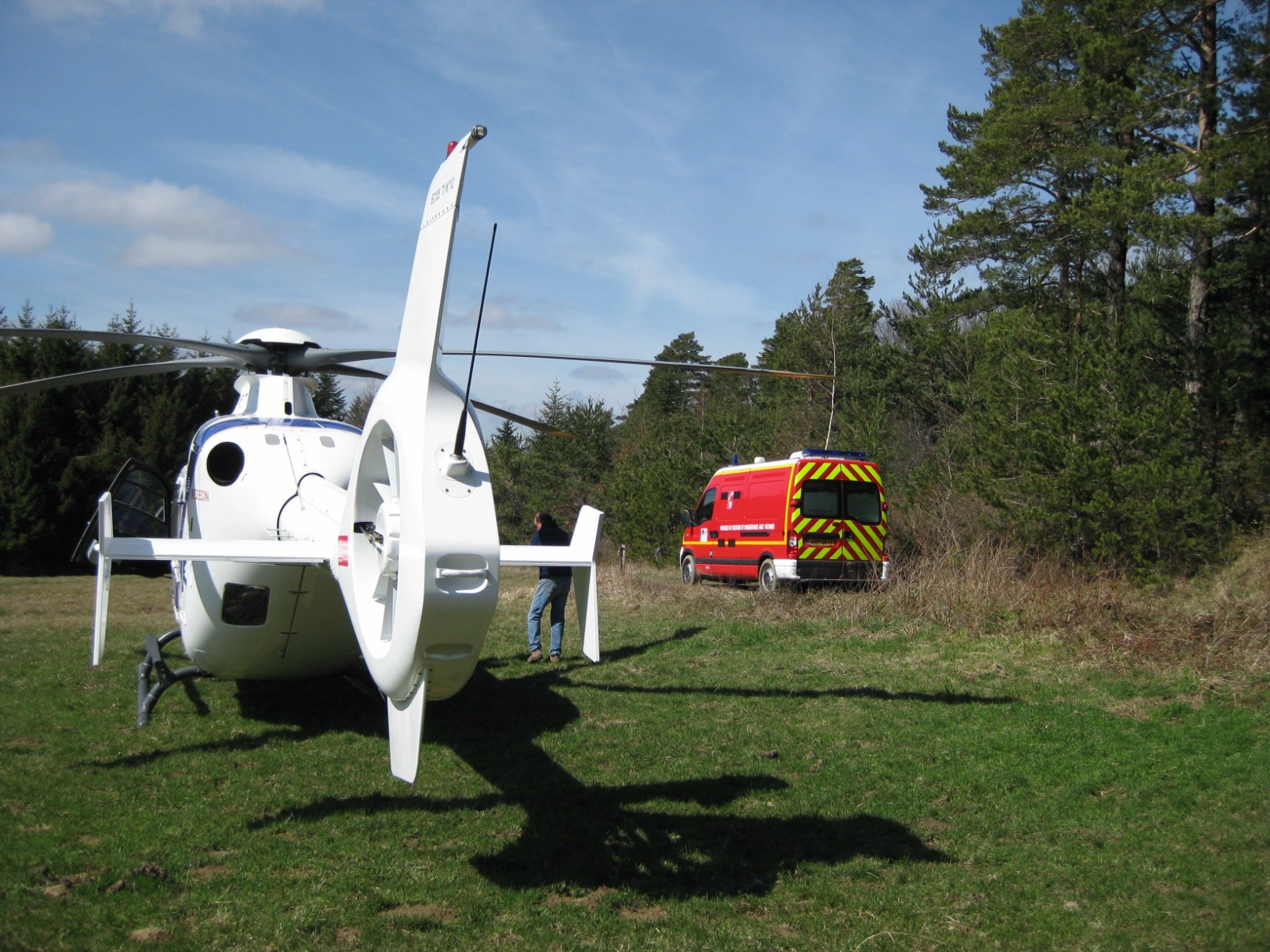
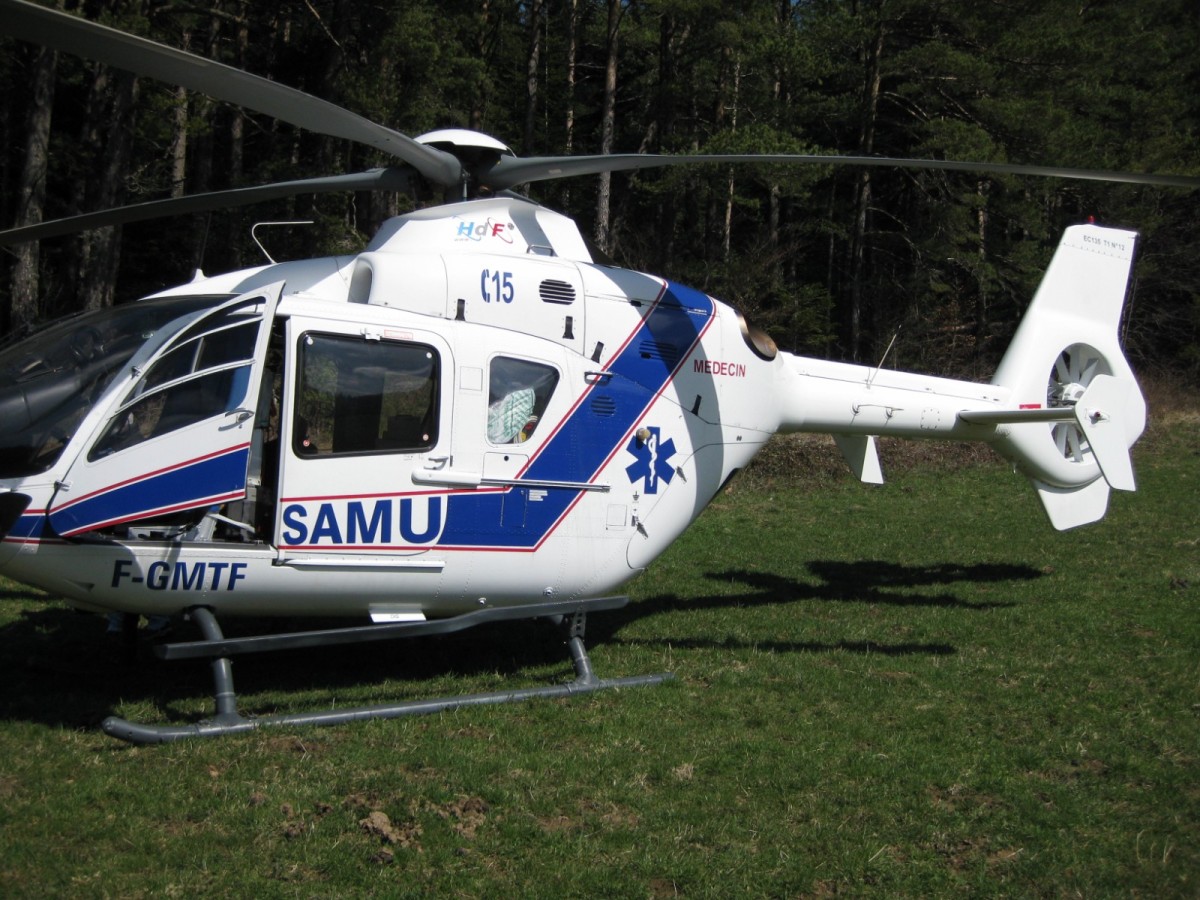
Pretty quickly, it became exciting. We were fairly inaccessible, though not as badly so as we might have been, considering we were almost at the top of a (smallish) mountain: because there was, for the first time that morning, open land nearby. A bright red ambulance service 4×4 came into view, then an ambulance, tossing about on the rutted track. The sapeurs pompiers had to walk down into the woods, carrying all their equipment and a stretcher, to see Micheline, who was now in quite a lot of pain. Then – wow! A helicopter air ambulance hovered overhead, looking for a landing spot.
The pictures show the efficient and organised crew. (11 of them, sapeurs pompiers, nurses, pilot) doing what they had to do in muddy, dirty conditions to get Micheline sedated and sorted and ready to be air-lifted to Carcassonne Hospital. They don’t show the 4×4 being ignominiously towed out of the mud by a local farmer.
Despite our compassion for Micheline and the acute pain and discomfort she was in, we were quietly excited to be part of such a drama, the first apparently, in Rando del’Aubo’s long history of weekend walks. No news from Micheline yet: but she won’t be at work tomorrow.
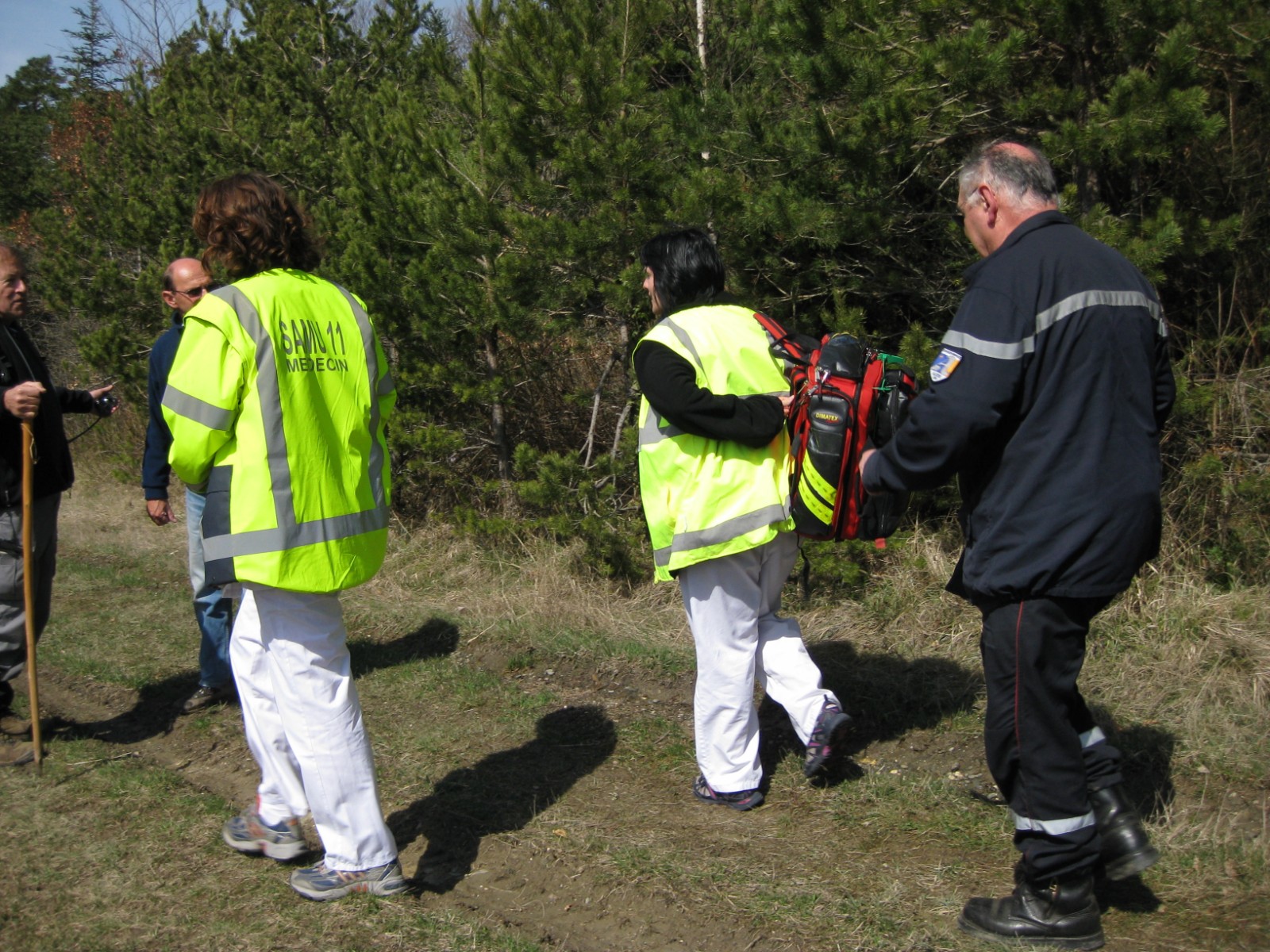
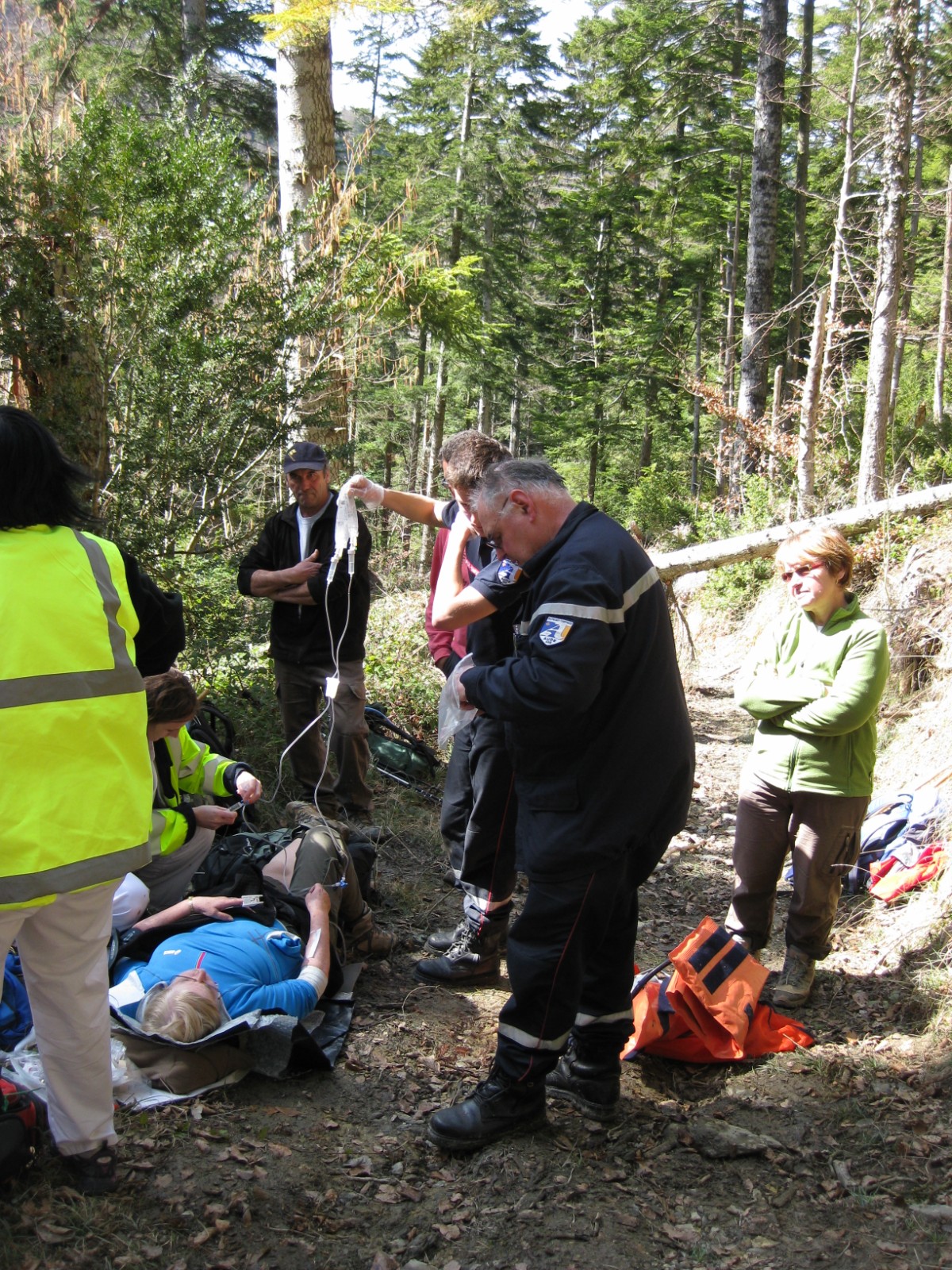
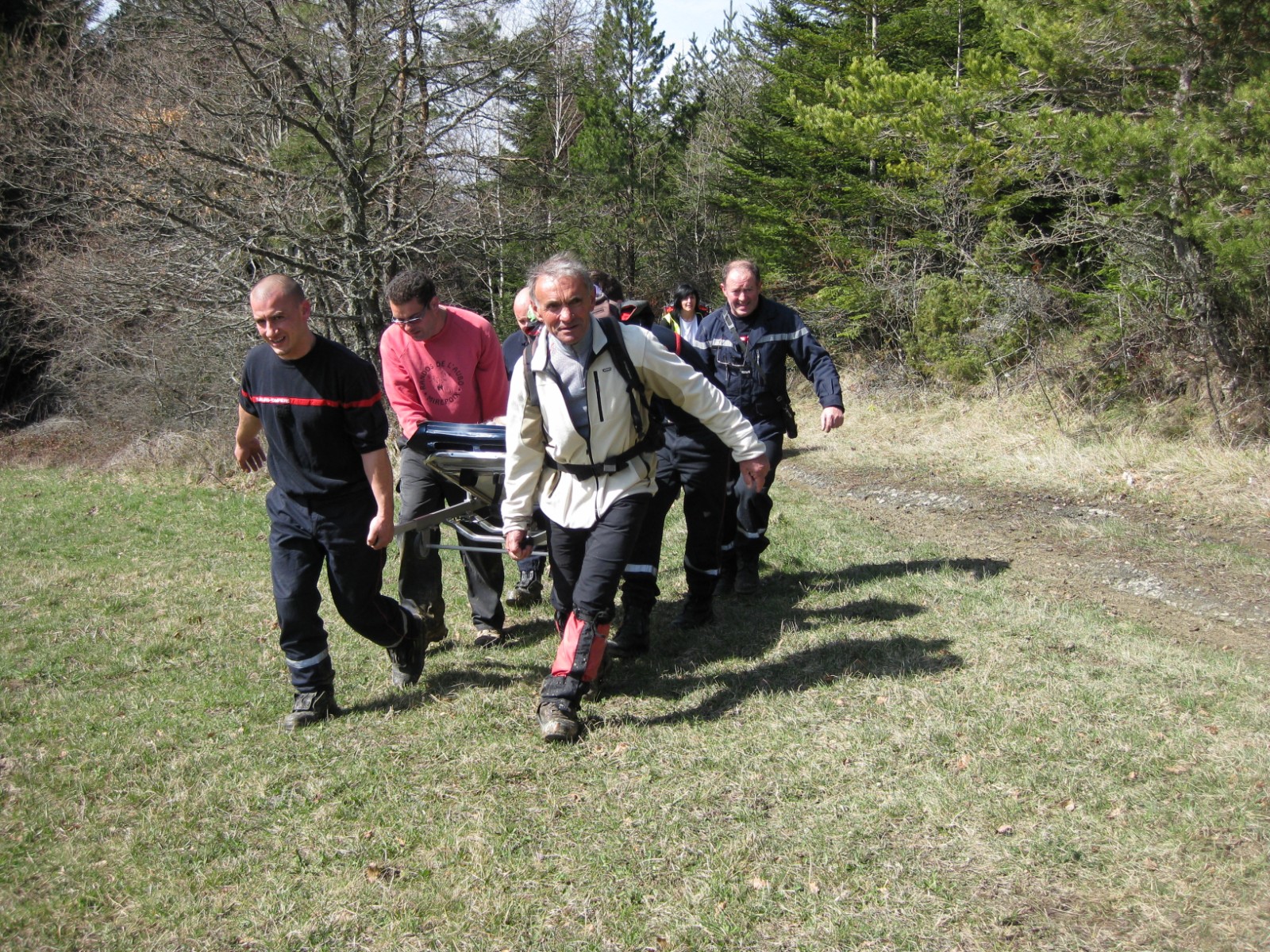
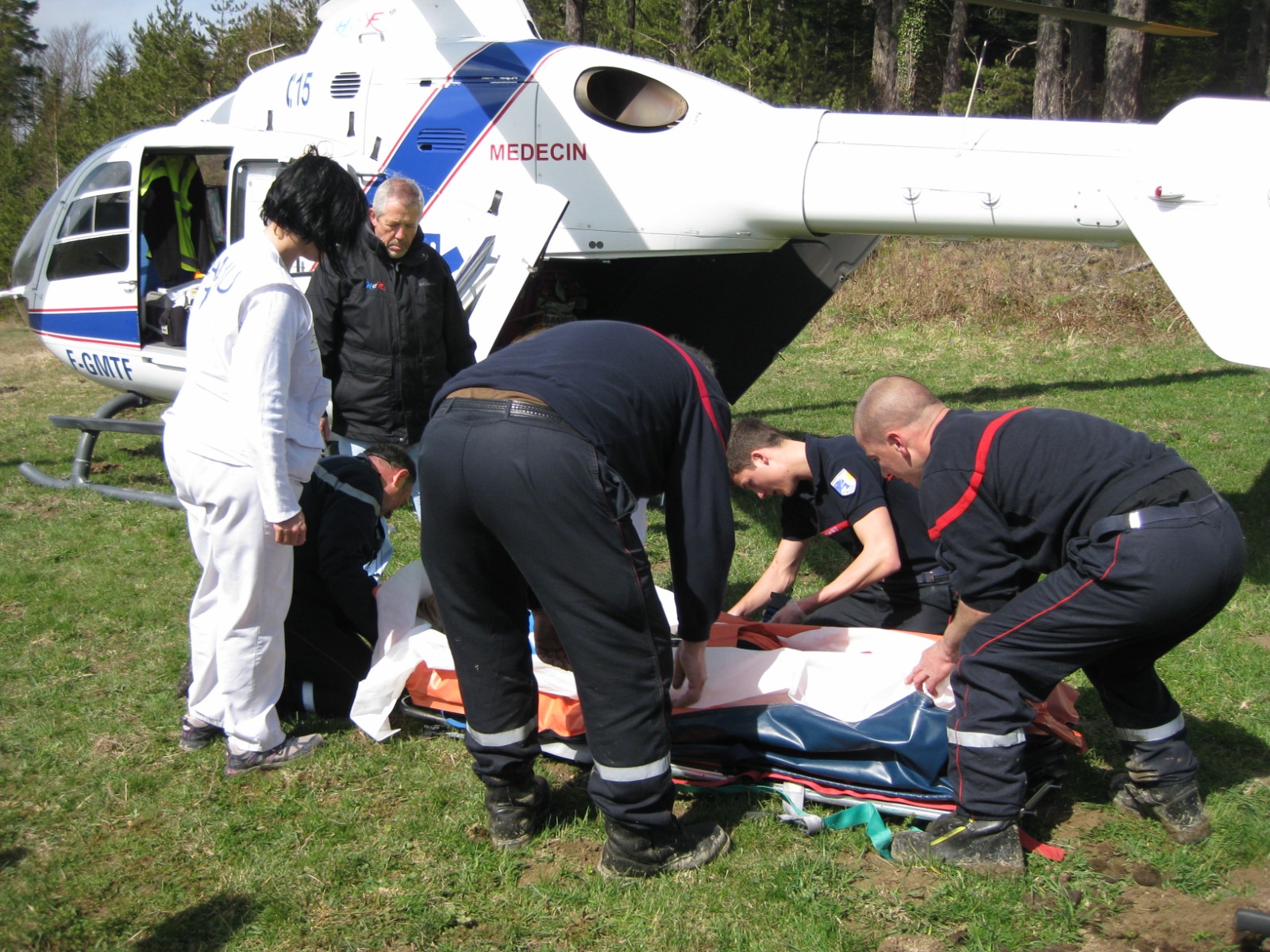
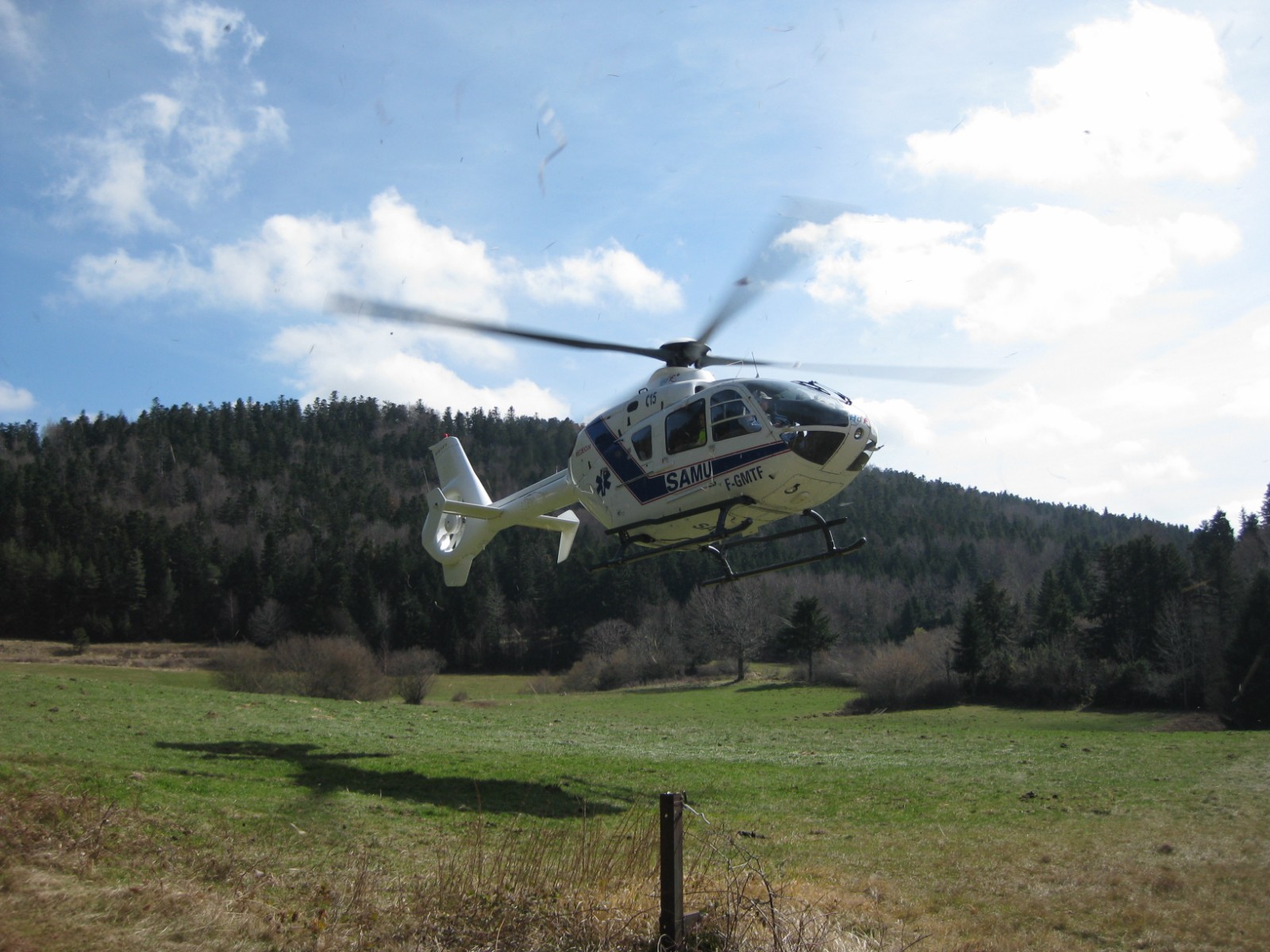
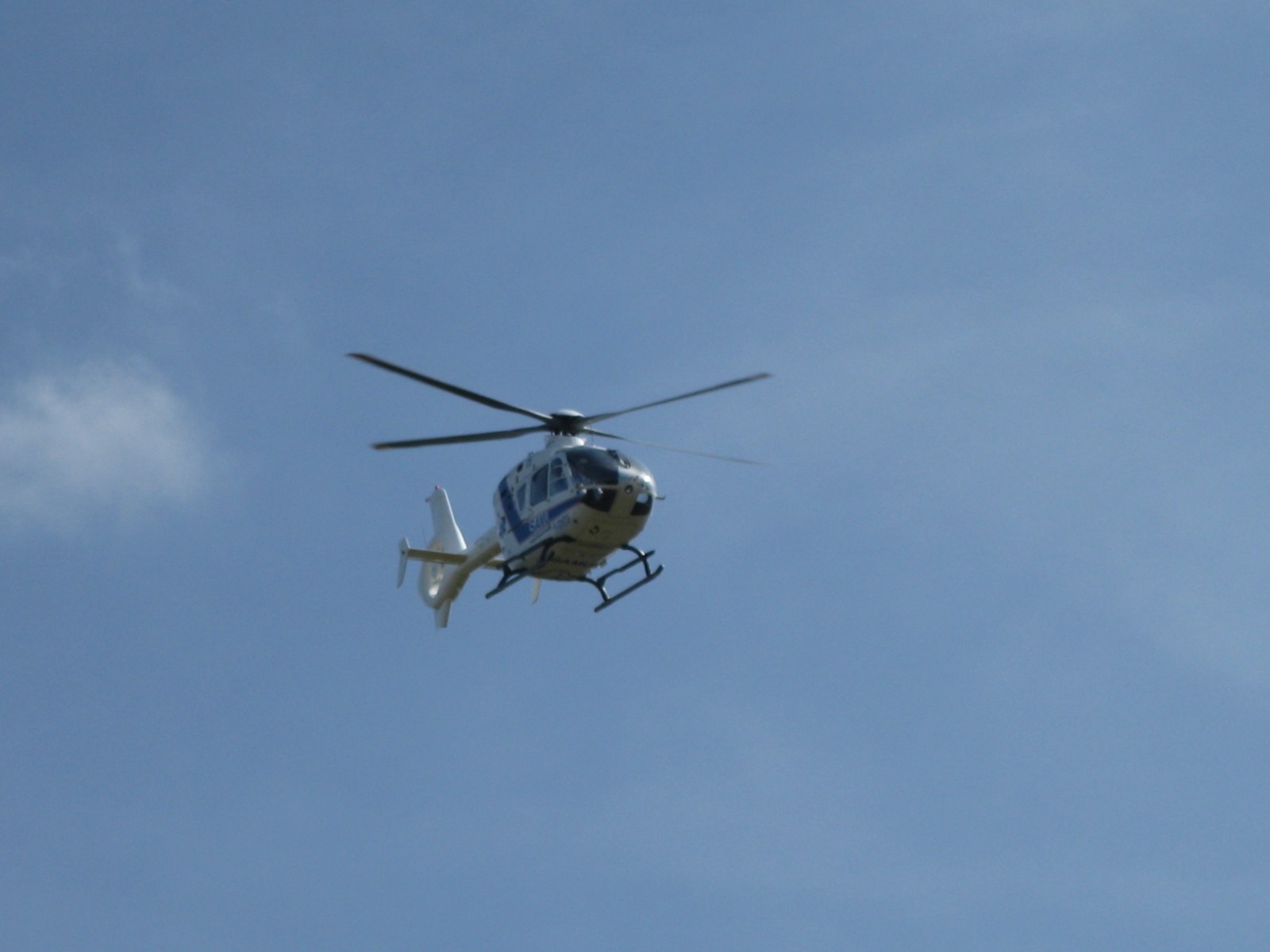
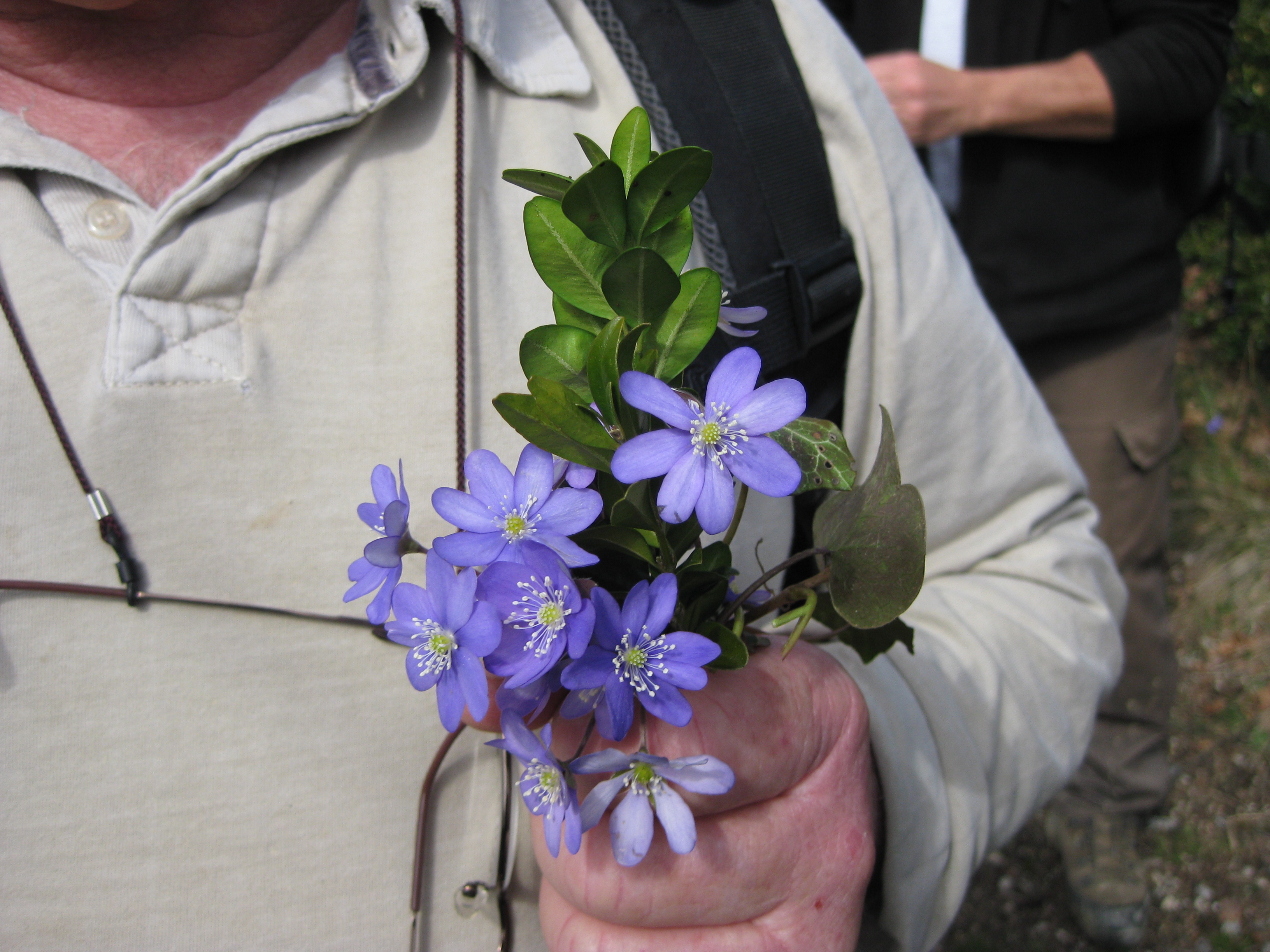
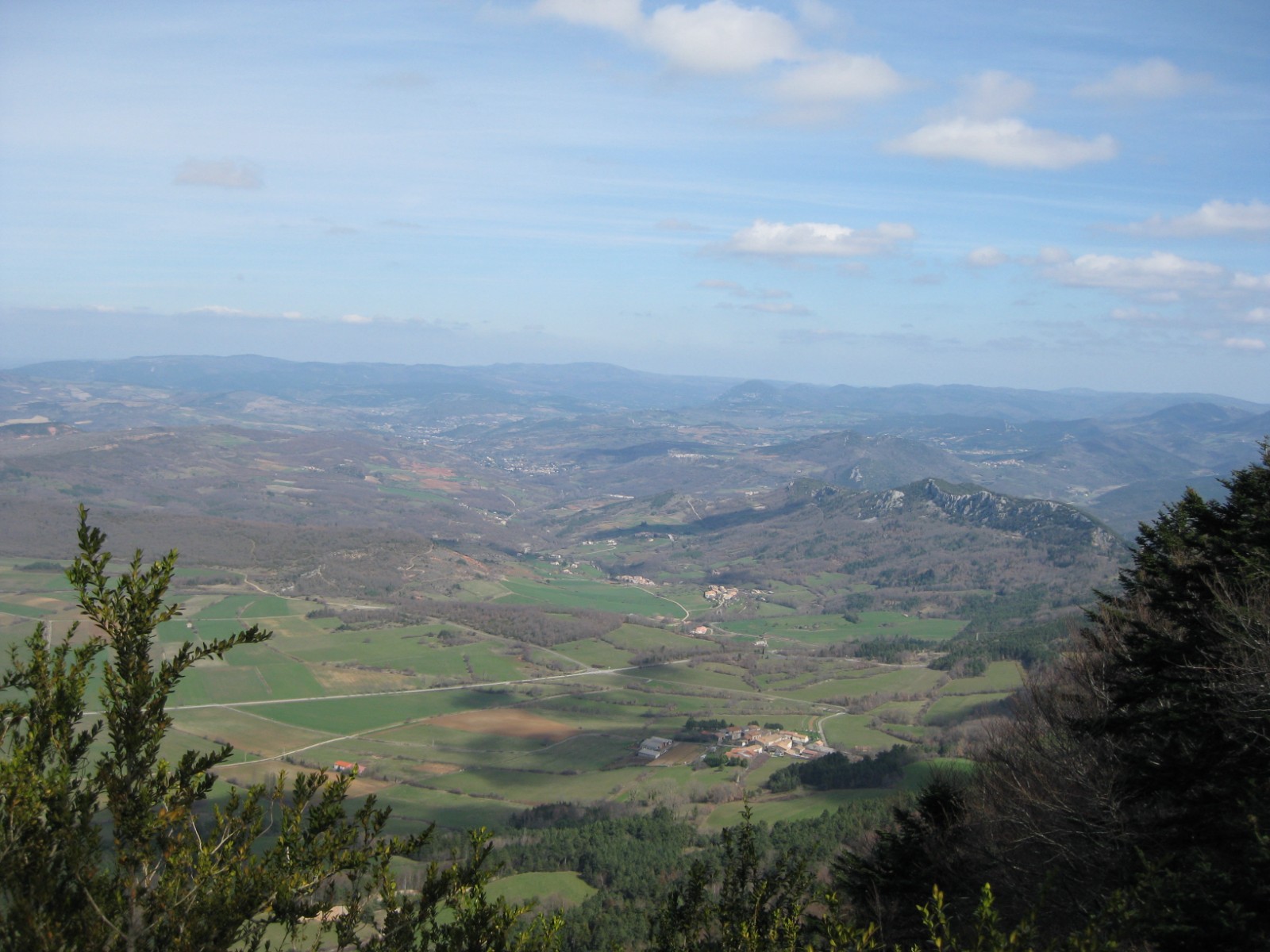
That was all I wrote in the immediate aftermath of the accident. In fact, Micheline -who worked in a shop – was never fit enough to return to an on-your-feet-all-day job. The French Ramblers’ Association argued for months about whose insurance should pick up the tab for the helicopter call-out. It was all a sorry mess, and I’ve thought twice since then about venturing to out-of-the-way places for a solitary walk.
The other day, I wrote about the rather mysterious and enchanting places which are Britain’s temperate rainforests. I’m not sure if France’s Labyrinthe Verte also qualifies, but it’s a very promising candidate. Here’s a post I wrote some eleven years ago, after we’d walked there.
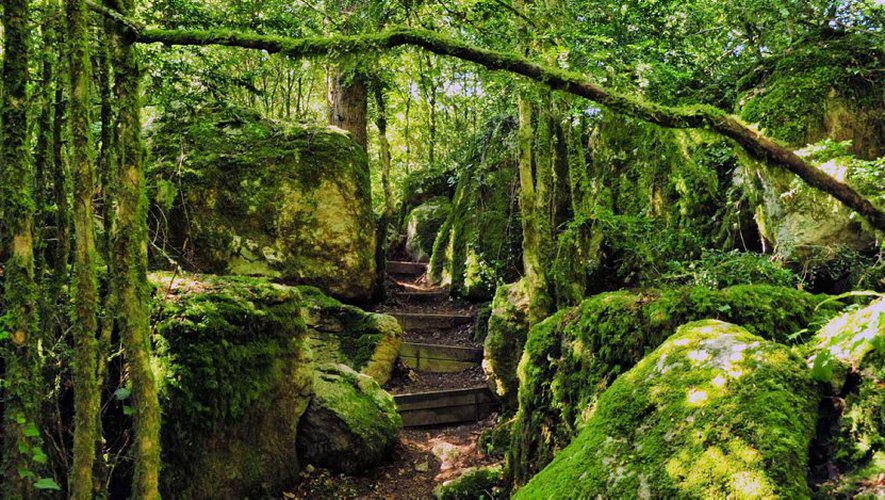
Sunday. We went to Nébias in the Aude. Just outside the village, you’ll find the Labyrinthe Verte, a natural maze, with winding pathways through a forest, where rocks and plants have created a bewildering array of natural passageways which are both beautiful and fun to explore. These paths are cut deep through limestone, often at shoulder height. Somehow, we’d never visited. But today, thanks to the Rando del’Aubo, our walking group, we did.
It’s been a lovely bright spring day today, but the forested labyrinth is never really sunny. Trees, their trunks and branches bearded with feathery fronds of moss and lichen, crowd the limestone crags and fissured passageways. Deprived of light and space, they assume crippled and fanciful shapes, or else aim straight for the sun, their thin trunks competing with each other for a place to establish their roots. It’s not eerie however. On this warm March day, we wouldn’t have been surprised to meet an ethereal band of fairies whirling through the dampened glades: on a bad night in November, perhaps a gnarled and wicked hag from the tales of the Brothers Grimm.
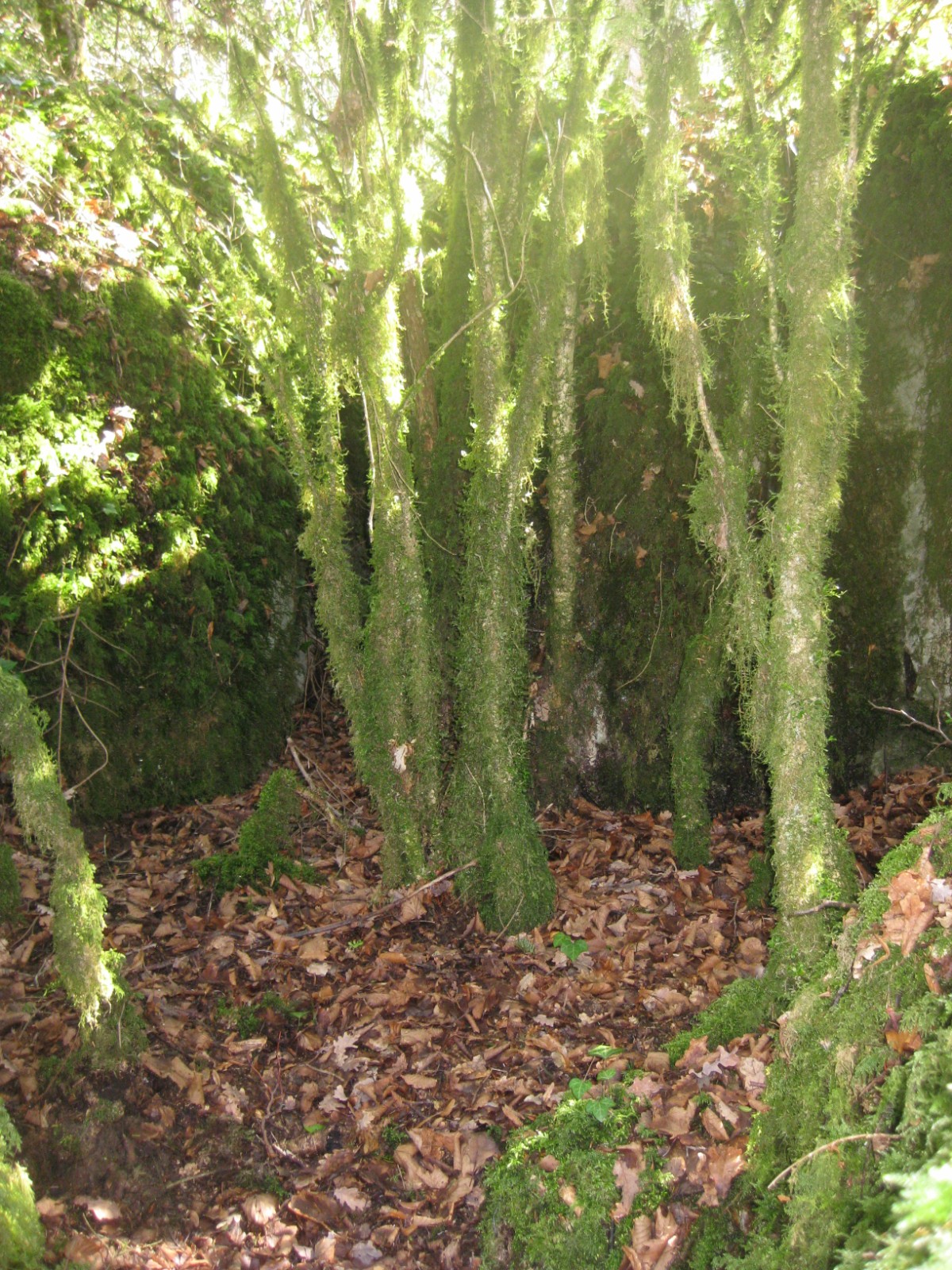
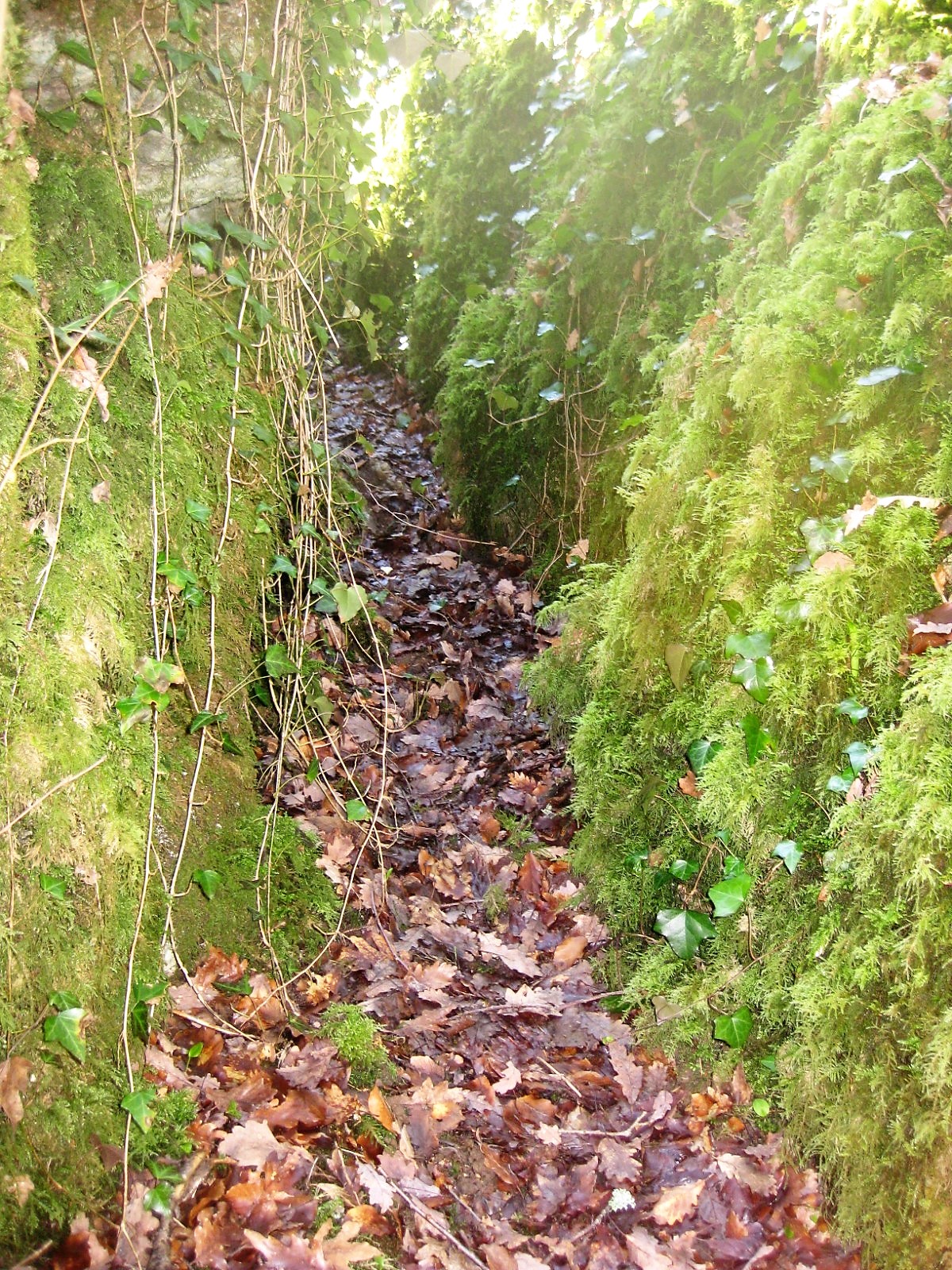
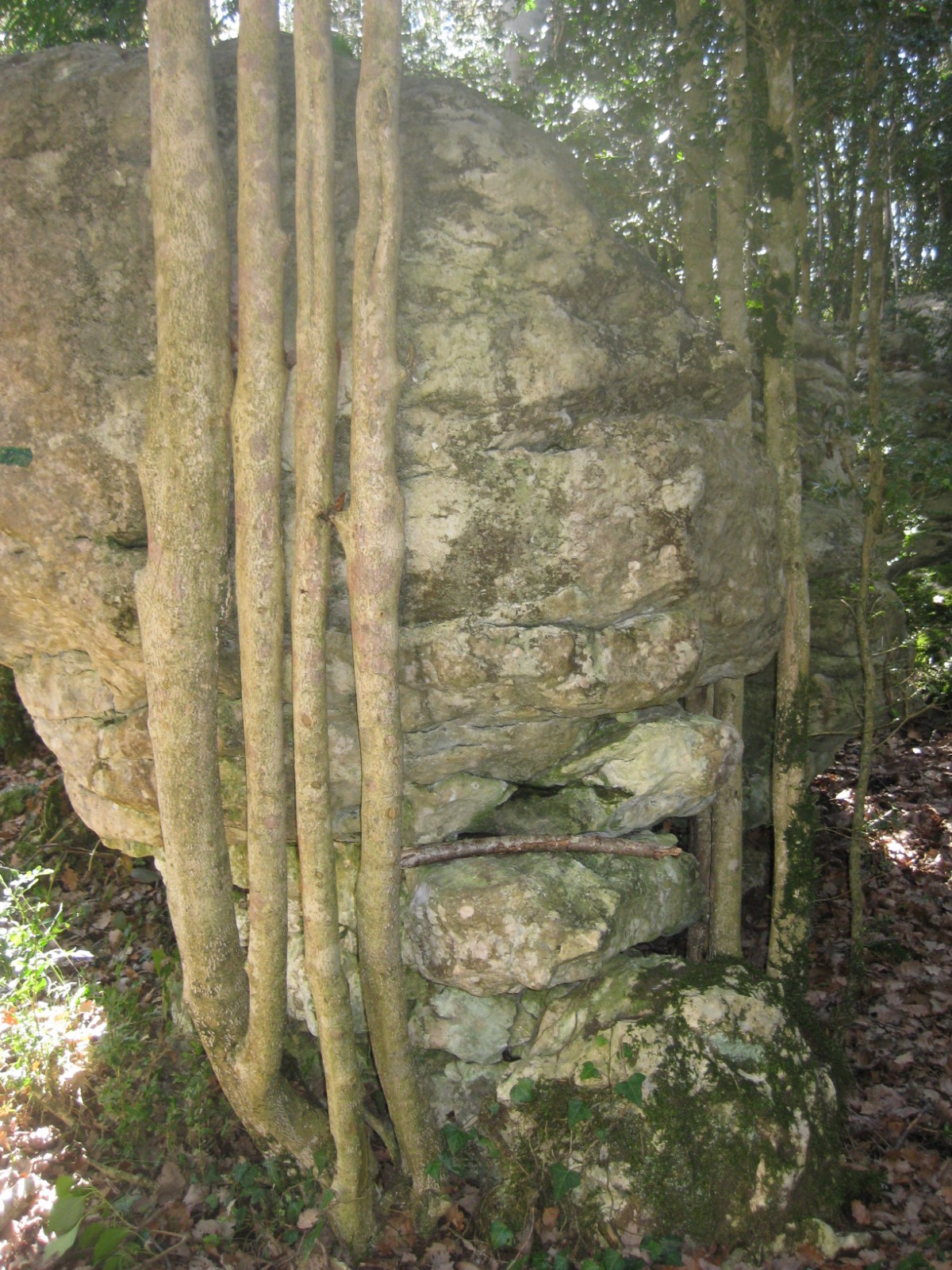
Every time of year has its own magic apparently. On the coldest days of winter, the mosses and lichens are white and crisp with frost, making the forest fit for a Snow Queen.
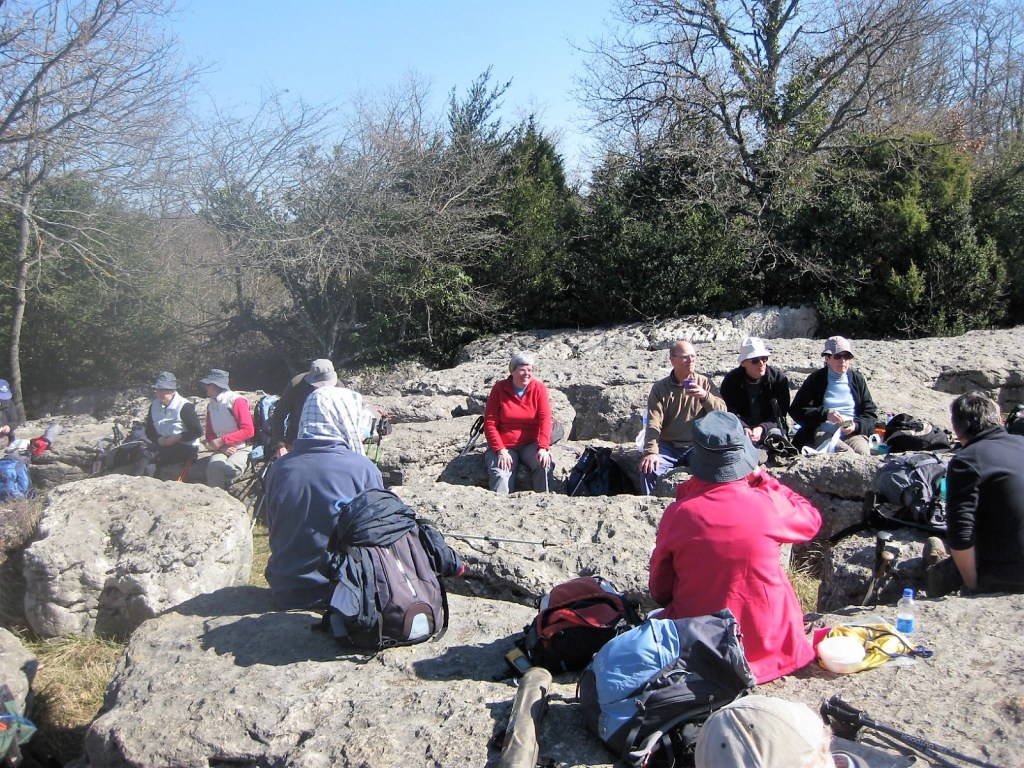
At lunch time, since we were in France and eating’s important, the darkened passages unexpectedly cleared. Suddenly, beneath blue skies and bright sunshine there was a fissured limestone pavement, providing surfaces and seating for our lunchtime picnic. Which Malcolm had somehow left behind. The members of the group magicked their very own version of Stone Soup for him. Do you know this tale?
Once upon a time, there was great famine throughout the land. Villagers squirrelled away any tiny amounts of food that they had. One day, a soldier came by, asking for a place to sleep for the night, and perhaps a meal. The villagers explained there was no food. ‘That’s alright, I have plenty. I have a magic stone that cooks delicious soup for me every night’. And he hauled a great cauldron from his pack, set a fire, filled his pot with water, and reverently placed a stone – also in his pack – into the water. Eventually the water simmered. The soldier tasted it. ‘Delicious!’ he pronounced. ‘Now, if anyone happened to have a carrot to add, it would be even better’. A woman in the crowd hurried home and found – two. The soldier declared the soup even tastier, but if anyone had some cabbage…? Then …. an onion? …some celery? … potato? The butcher found some scraps of pork and everything went into the pot. Before long, the soup was delicious indeed, and everyone filled their bellies. But the soldier wouldn’t sell his stone: no, not for any money.
On this occasion, within half a minute Malcolm had more food then the rest of the group put together. A mustardy ham baguette, some home cured sausage, a chunk of bread, a chocolate pudding, and apple…. The power of working together!
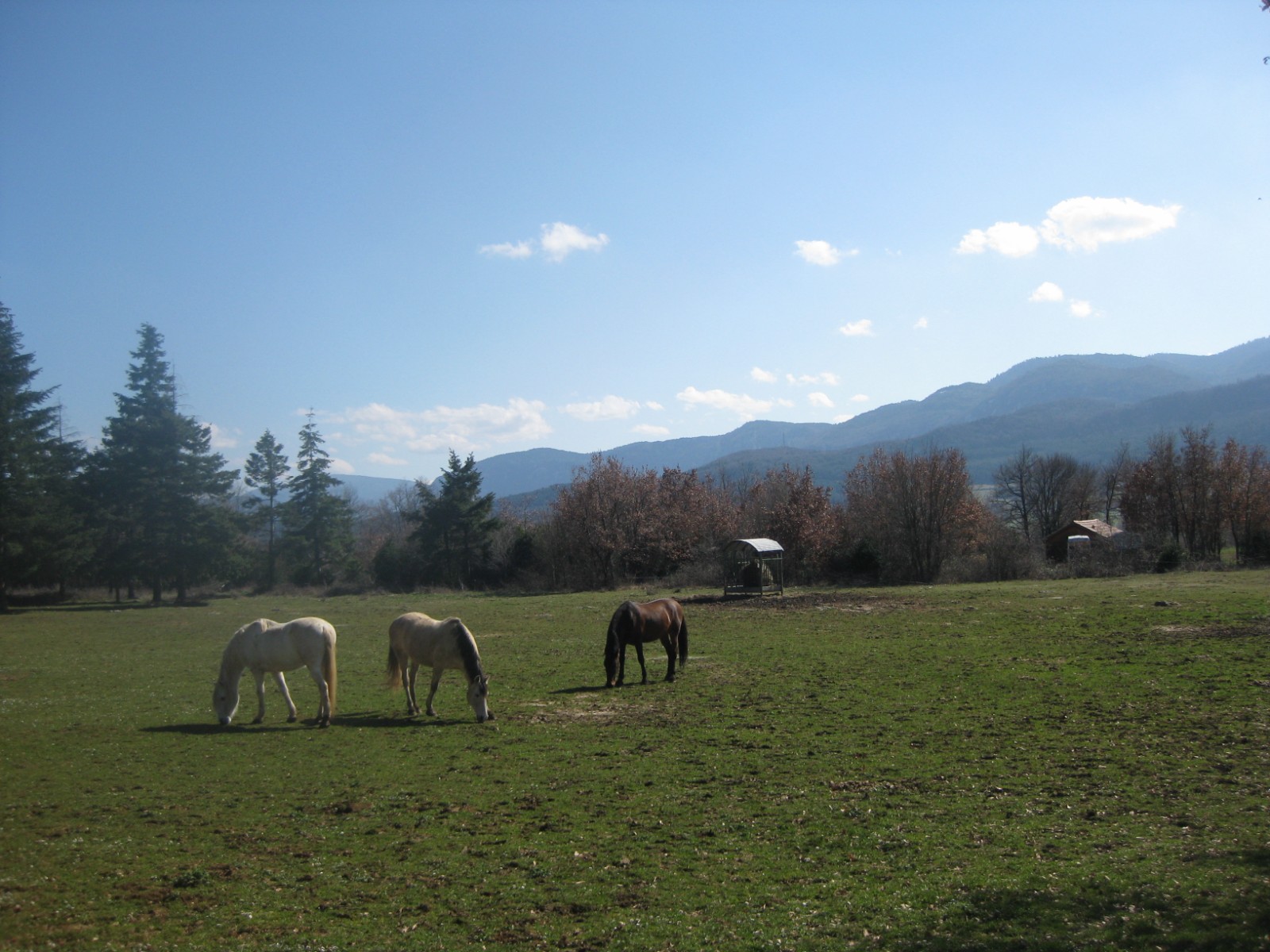
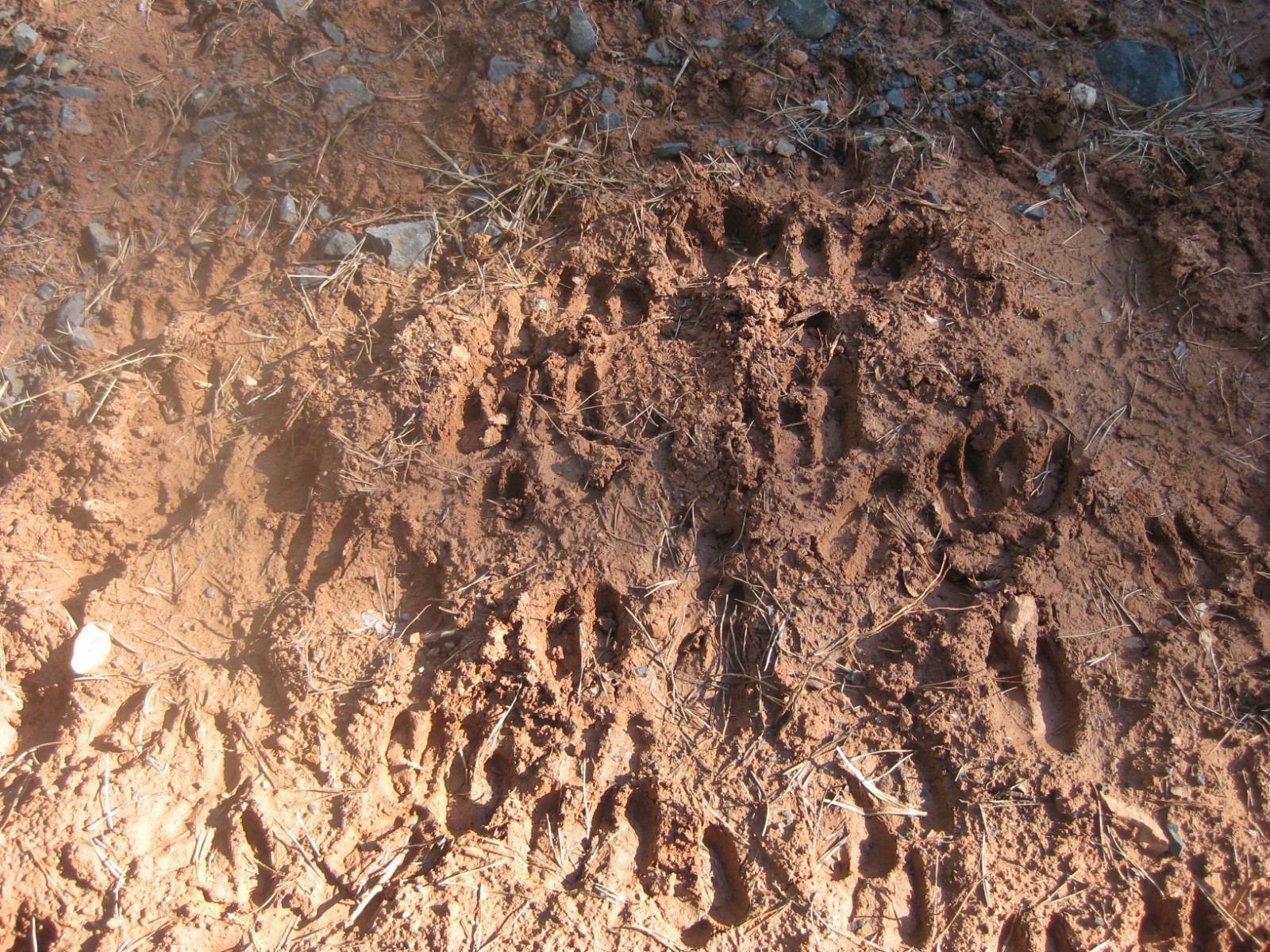
The afternoon was different. Walking away from the enchanting and enchanted labyrinth, we came to more open country, where we passed first farmland, then the edges of forest with tracks showing where wild boar and deer had recently passed. Finally, we climbed, and had views across to the mountains and the walks we’ve enjoyed there on other Sunday rambles, finishing up listening to the lively splashing of a waterfall.
7th March 2011
The featured image is from the archive of La Dépêche du Midi, our local paper when we lived in France.
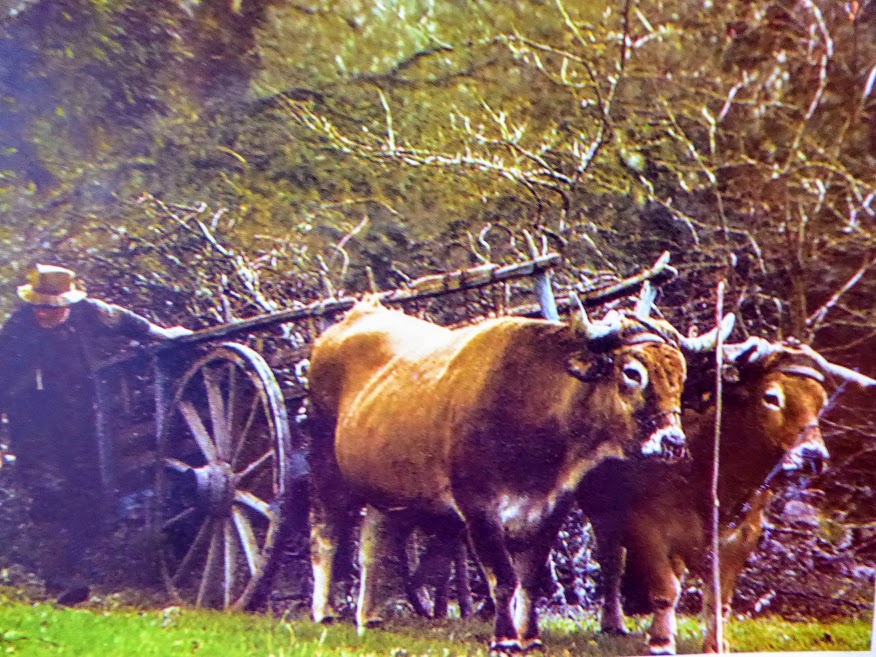
This shot was taken in the Corrèze, a rural part of France where the cow is – er – queen. The header photos shows that within living memory, oxen were still used as tractors. This area still has the feel of somewhere that time has forgotten. Happy souvenirs of a wonderful holiday of walking in gentle countryside with the ancient town of Corrèze as our backdrop.

I dedicate this post to Becky, for her Walking Squares, and to Brian of Bushboy’s World, who’s rather fond of cows.

The best way of travelling hopefully? Let’s see.
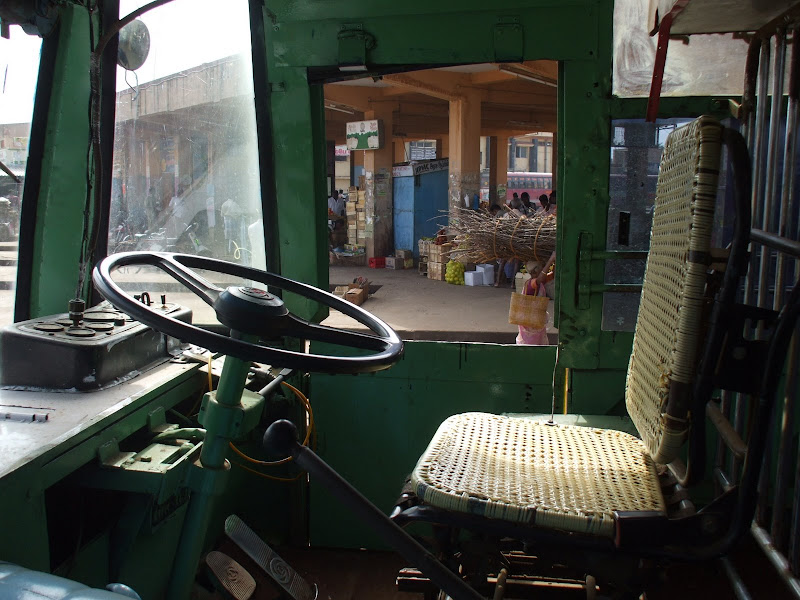
A bus can be fun, but that’s strictly for local exploring. Unless you can get yourself to India and hitch a lift in God’s Own Palace … Though you’re much more likely to be catching the long-distance bus whose driving seat I feature here …
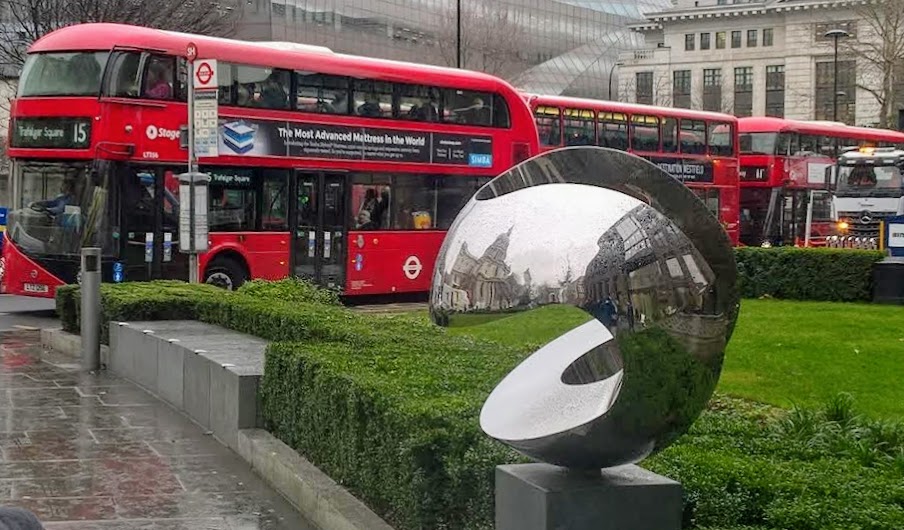

Air travel has lost its sheen, since Airport Security and Queuing became a A Thing, not to mention those CO2 emissions of which we’re now so horribly aware. Even so, there is something thrilling about watching the changing landscapes of the earth far below, and cloud formations too.

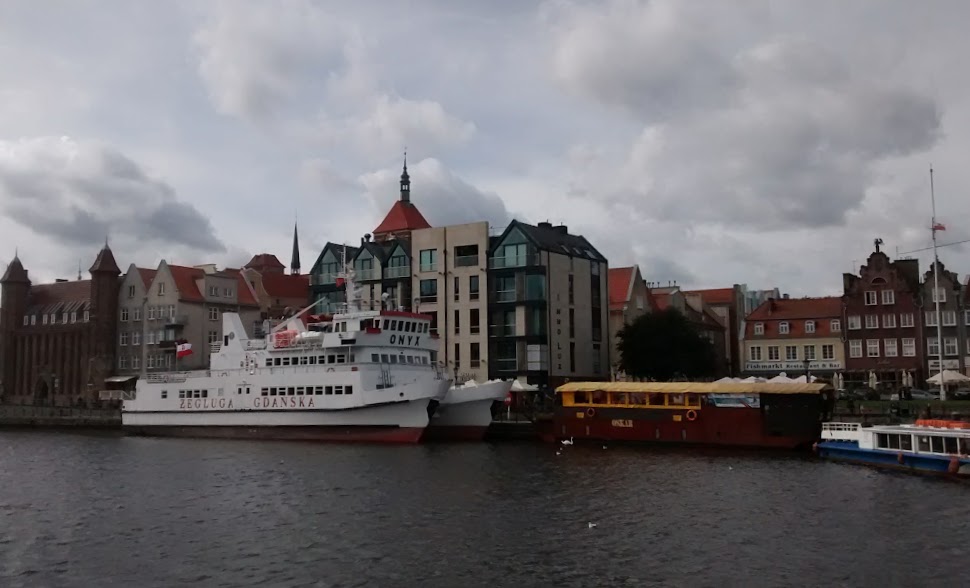
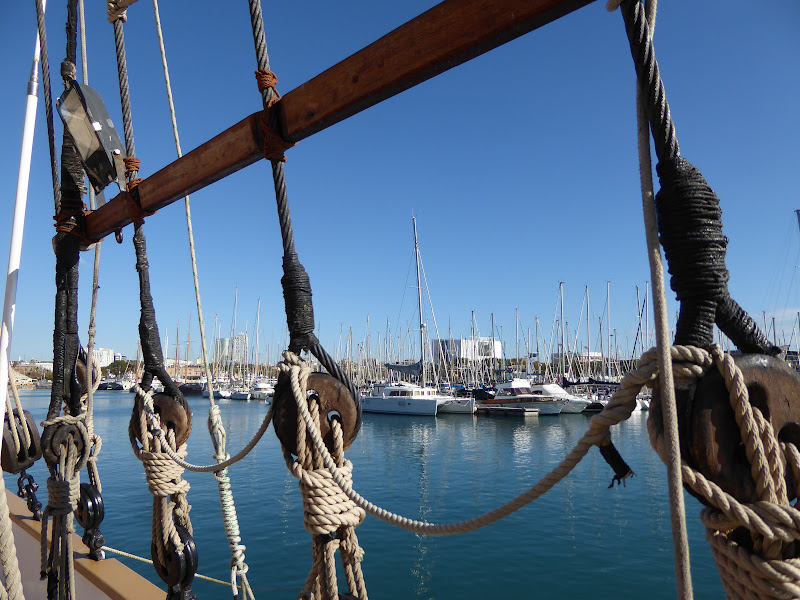
You could take to the water, and sail to your destination near or far…

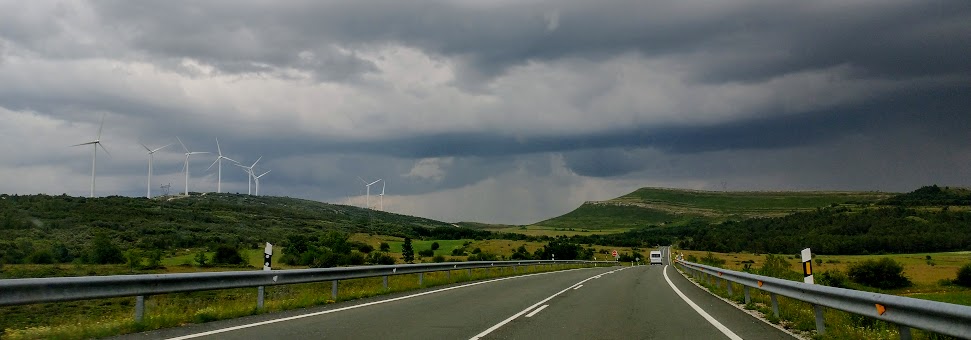
Car travel gives you the opportunity to please yourselves and follow your noses, and even to get off the beaten track, but again … all those emissions.
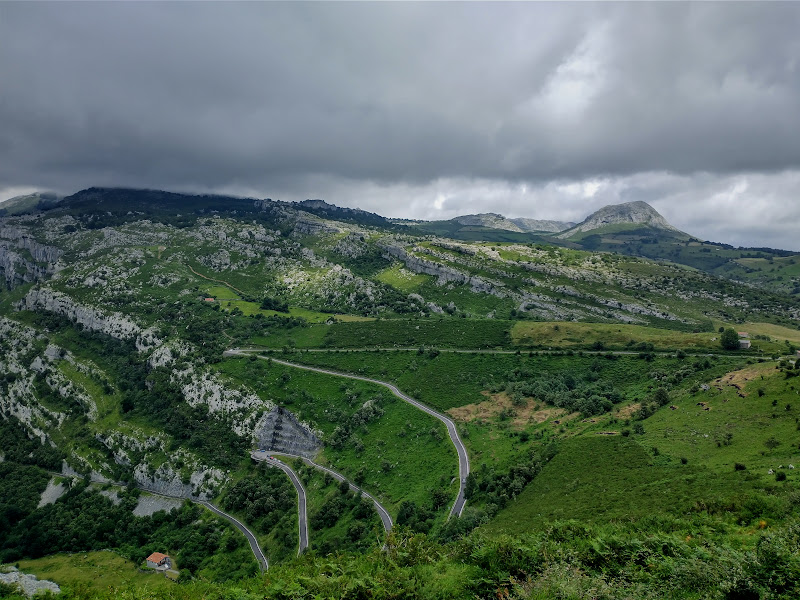
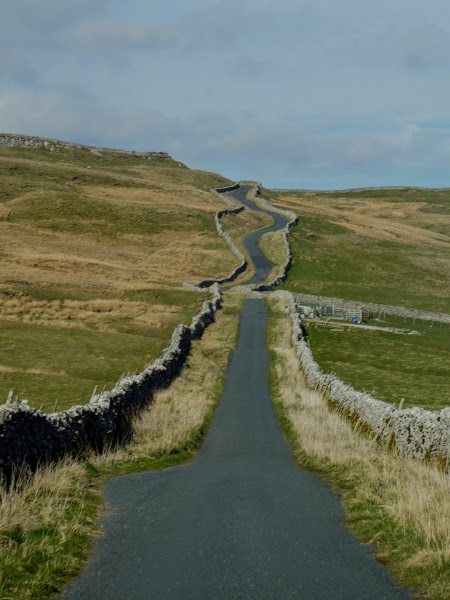
My own favourite way to get from A to a distant B is by train. I sit, I watch the world go by. I read. If I’m lucky, there may be coffee on offer. And the journey eases the transition from home to away by gradually introducing fresh landscapes, fresh outlooks. There’s something discombobulating about leaving – say – foggy England by plane and arriving two hours later – say – in sunny Spain. Here’s the TGV from Barcelona to Paris. It says it all …
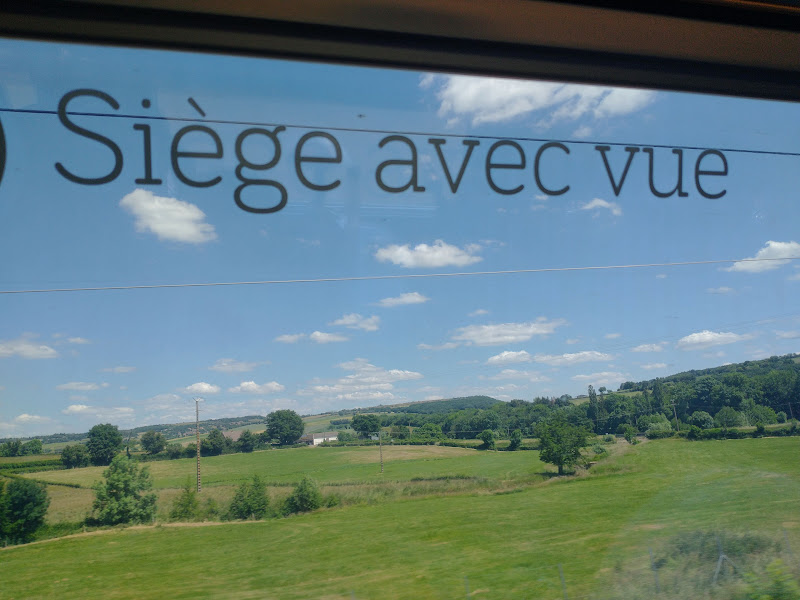
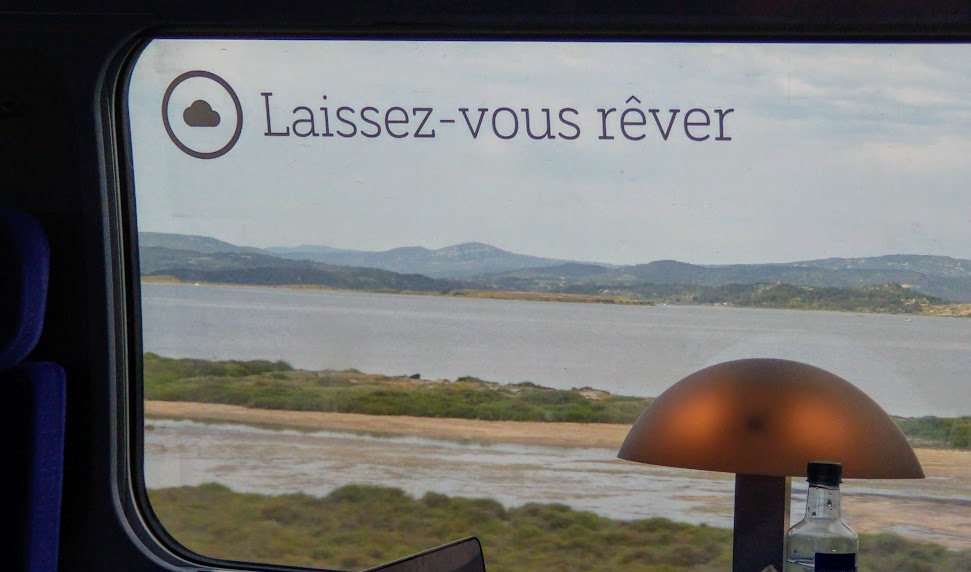
Station architecture may be inspired, whether from the Golden Age of Steam, or assertively twenty first century.
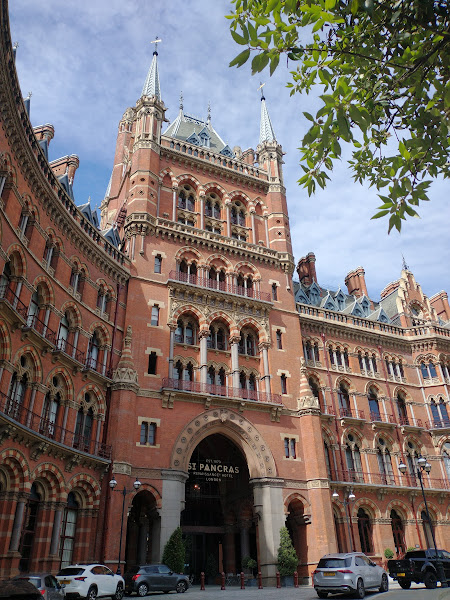
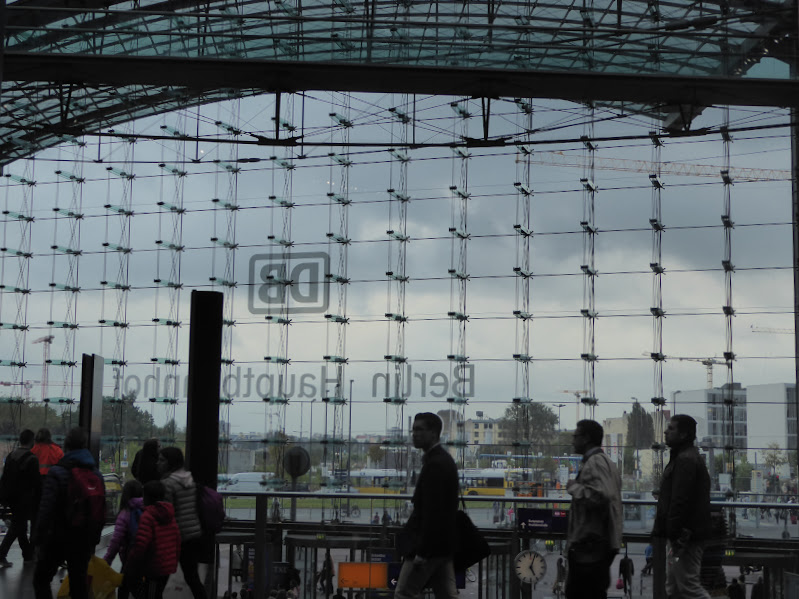
All things considered, I can’t agree with the disconsolate boredom of this particular passenger. By the way, you, get your feet off the seat!

Or … there’s always the motorbike … as spotted in their dozens and dozens outside Mysore Station.
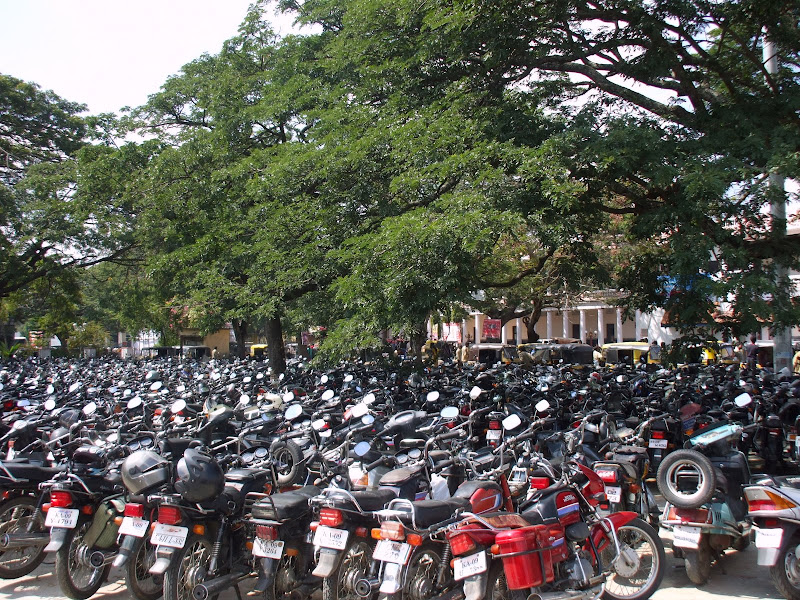
All the same, modern travel with all its advantages can seem busy, stressful. Sometimes, we might just want to exchange the traffic jam for something rather simpler.

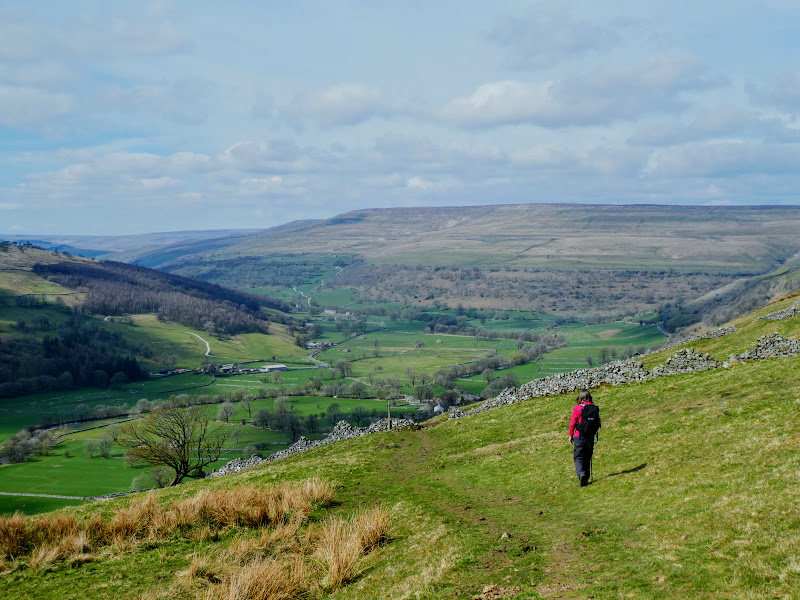
John has provided this week’s LENS-ARTISTS CHALLENGE #215 – Planes, Trains, and Automobiles, and the places they take you.
This week, Ann-Christine is urging us, in Lens-Artists Challenge #214 to indulge ourselves and our readers with Favourite Finds in our collections of photos. Well. Where to start? What to choose? I’ve settled on those things that we sometimes notice as we glance up above, or find ourselves gazing at, such as drainpipes or old walls in city streets: we’ll see everything from … well, let’s have a look …
Click on the image to discover where to find it.
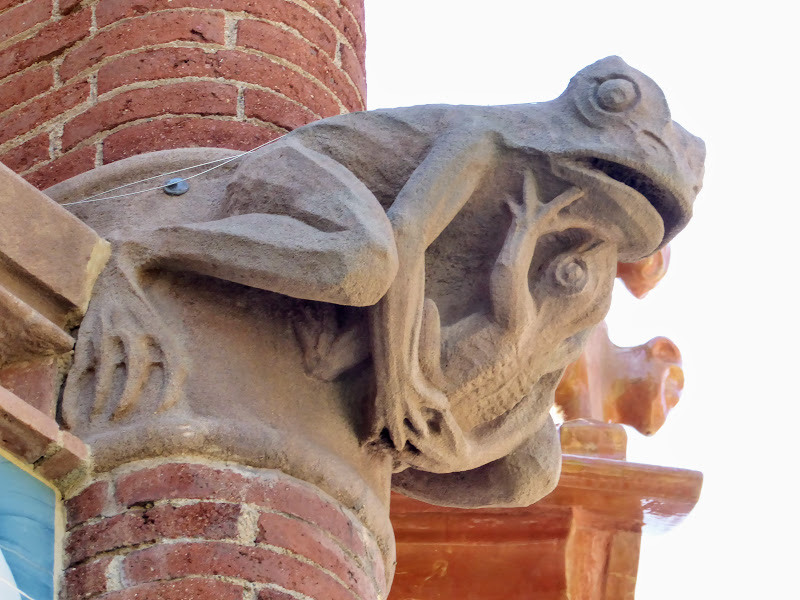

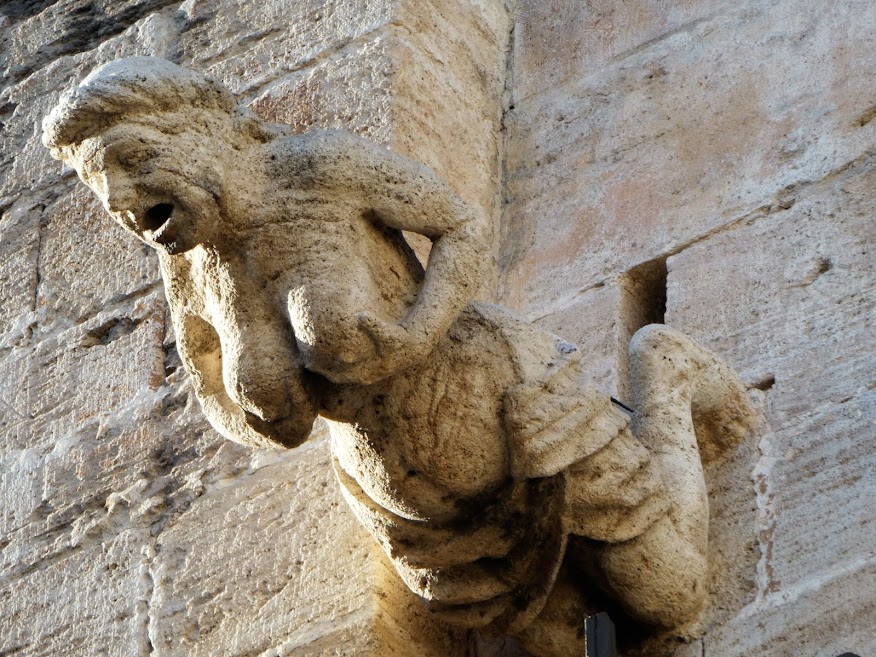
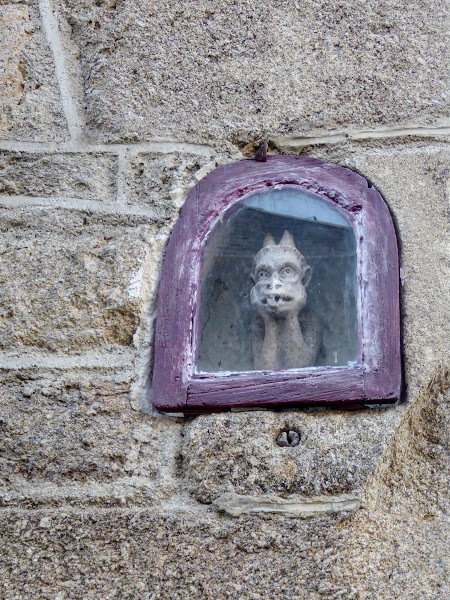
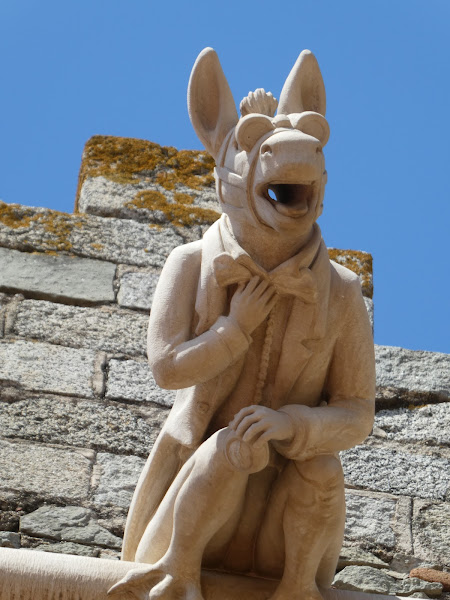
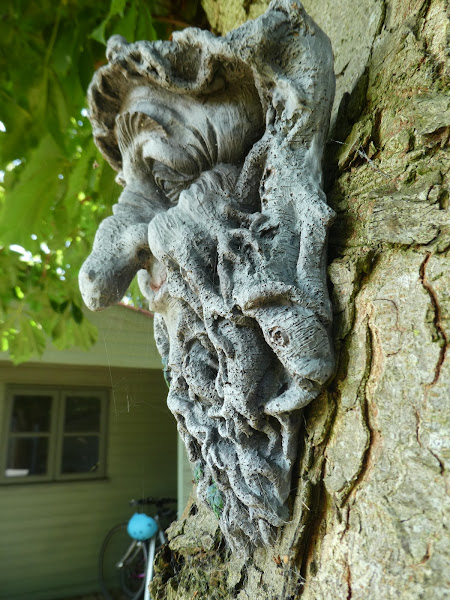
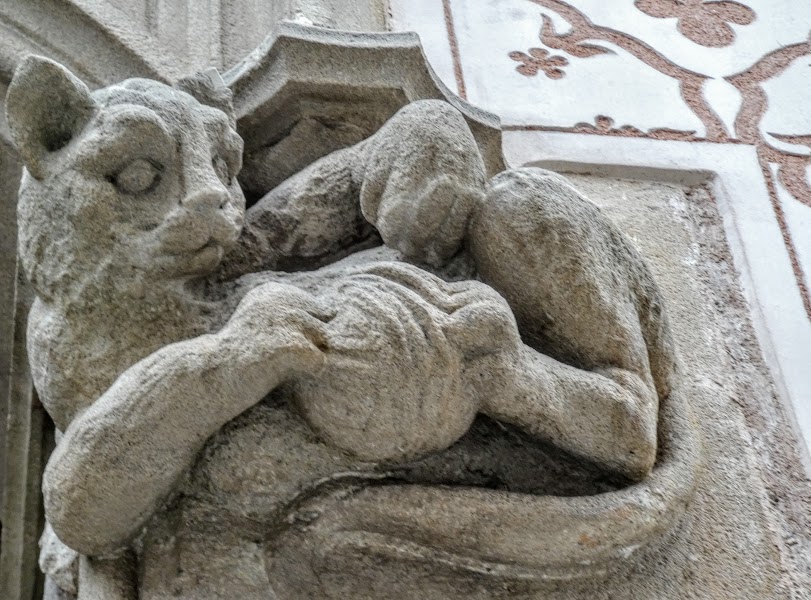
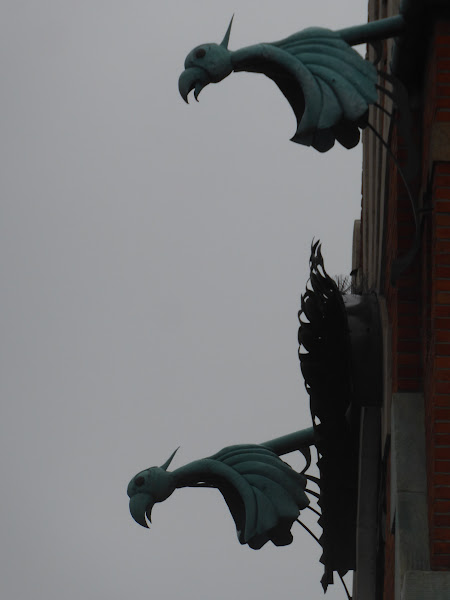
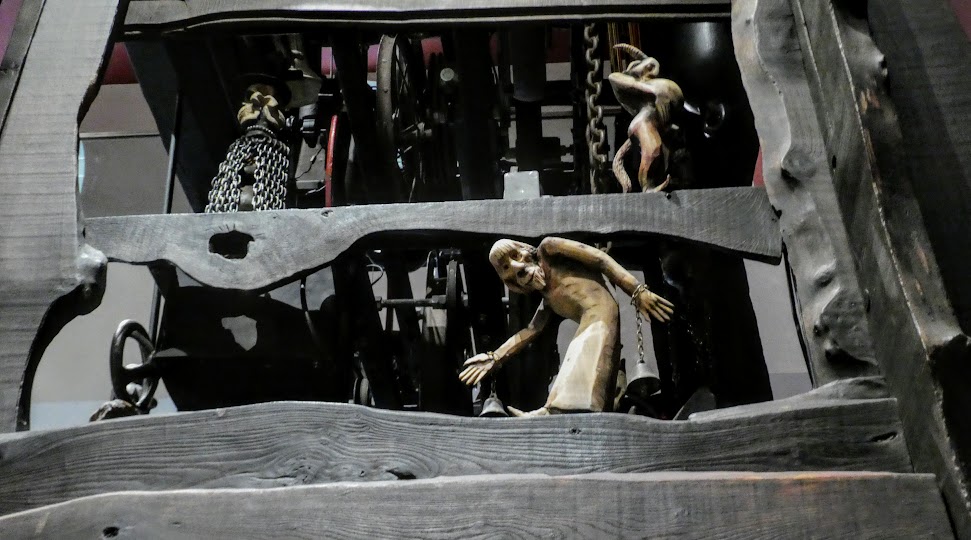
The featured image is from the Millennium Clock in the National Museum of Scotland, Edinburgh




You must be logged in to post a comment.