It’s time for Flashback Friday again, and as butterflies have so far been in fairly short supply this year, I thought I’d return to a happy moment in France, in August 2013, when we had friends from England to stay …
Butterflies III: Half an Hour of My Life
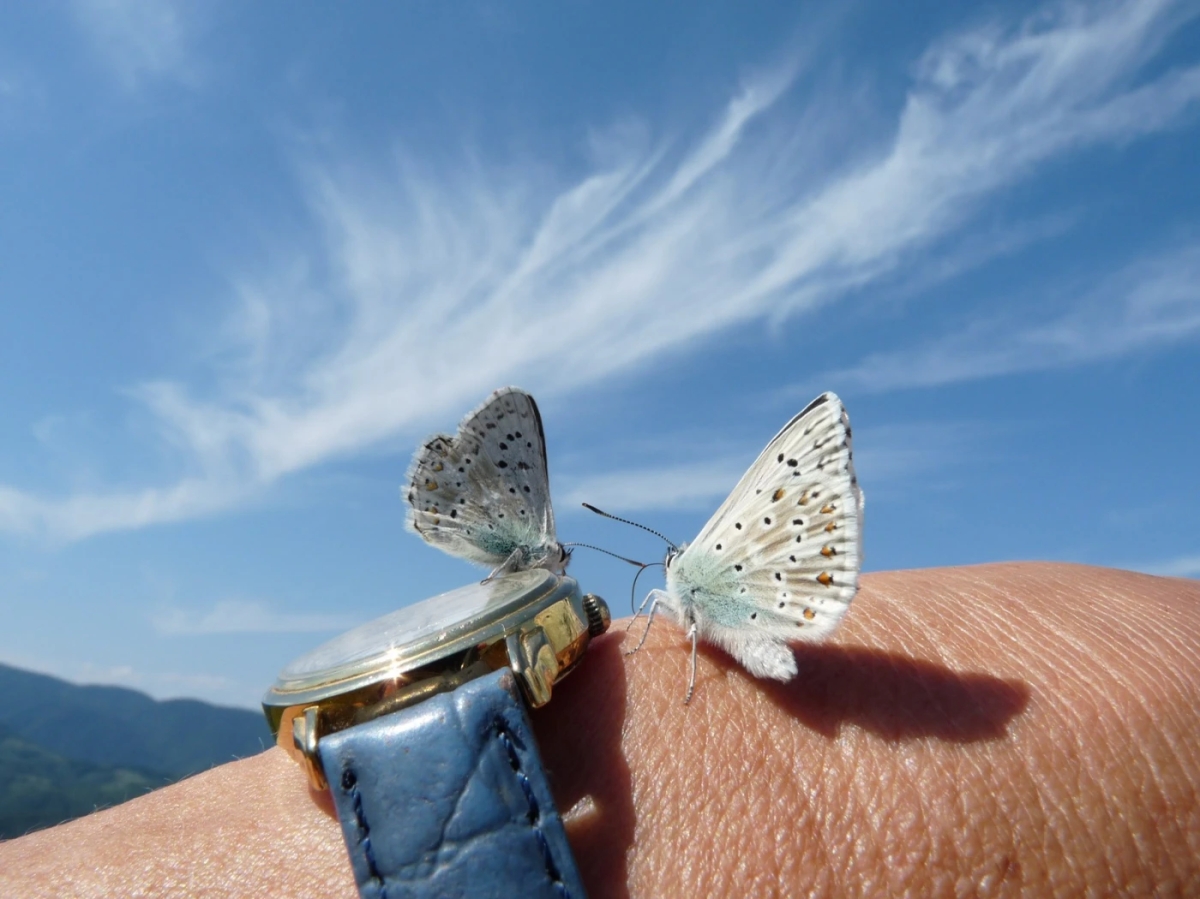
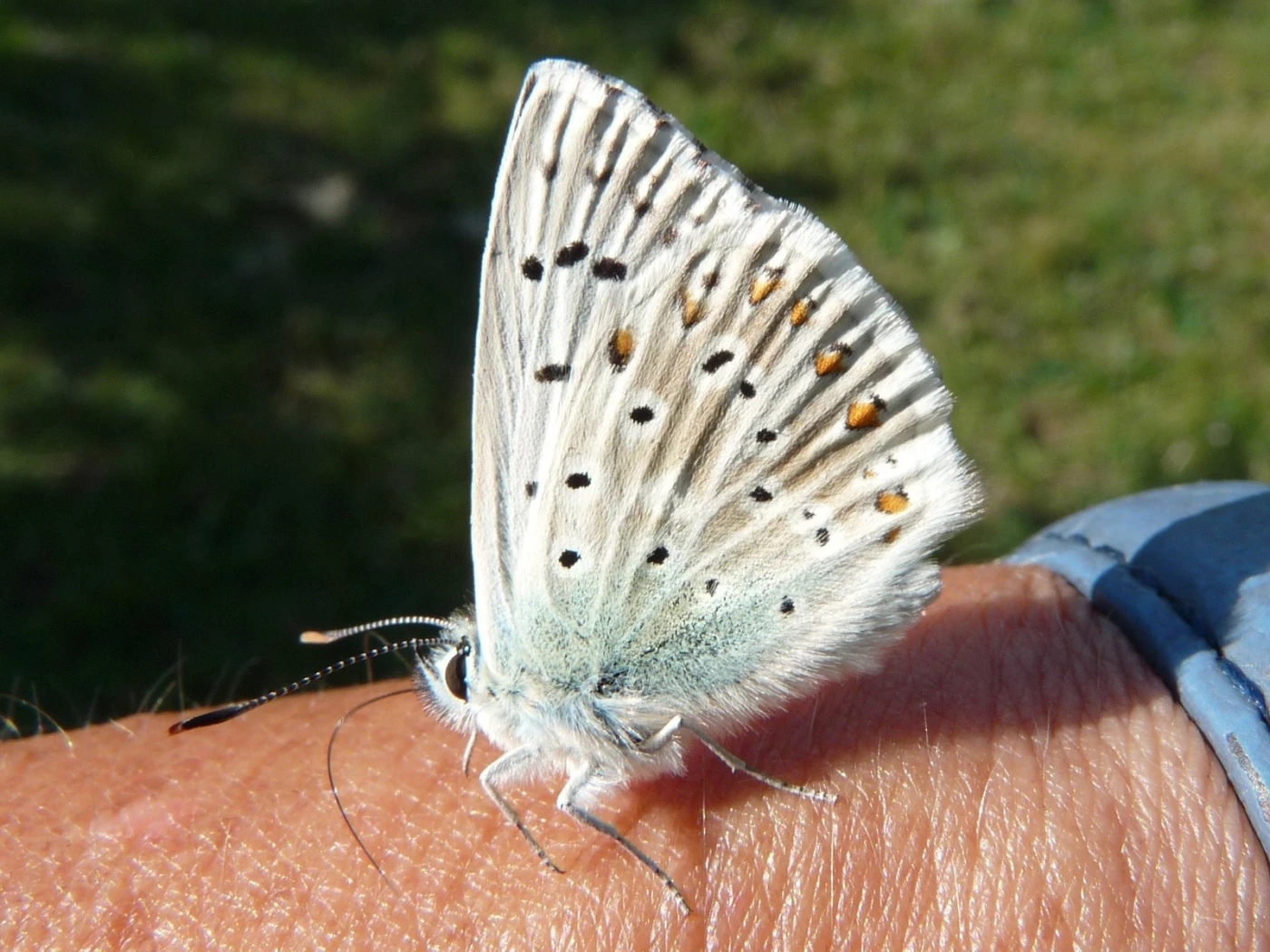
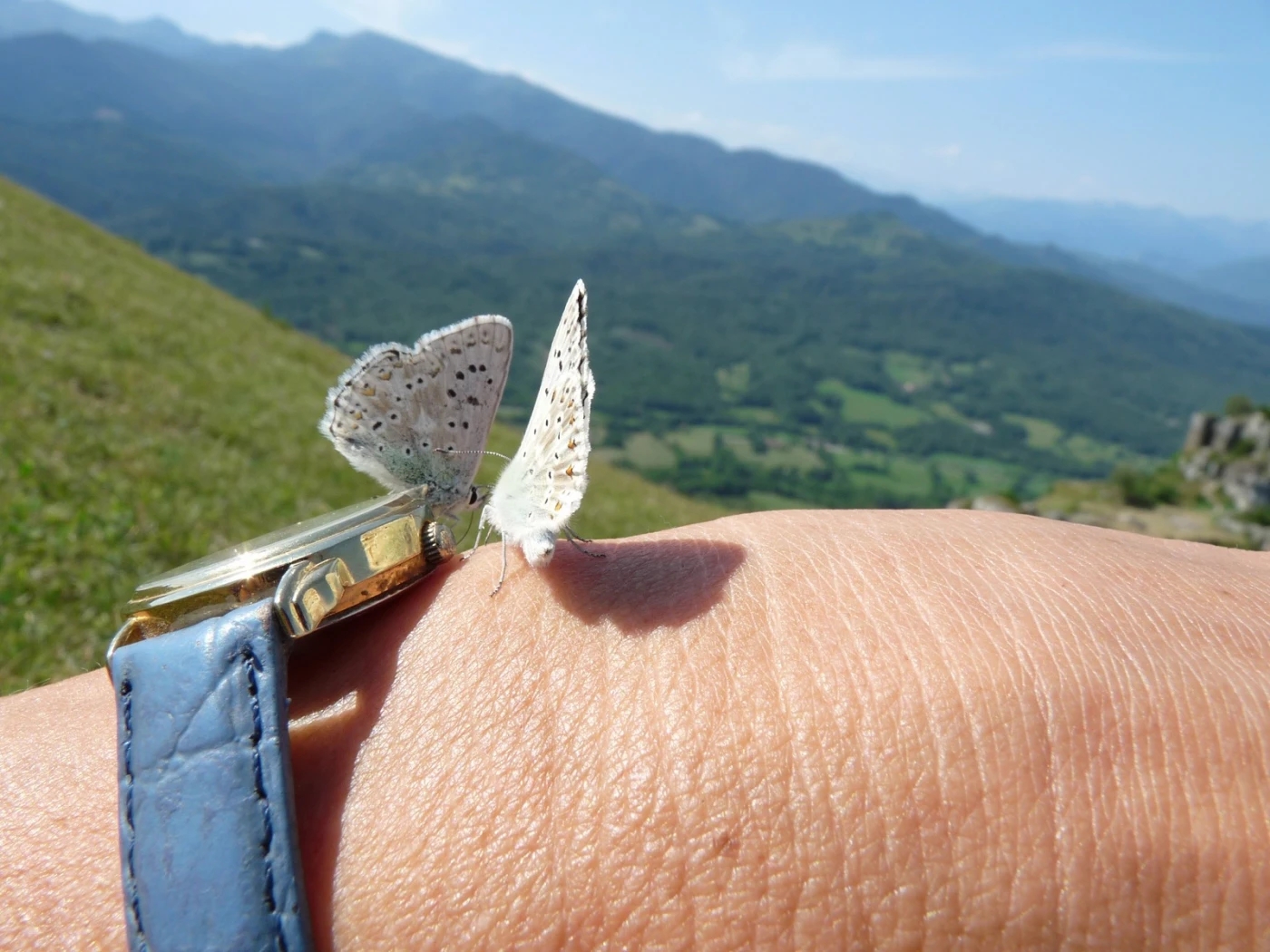
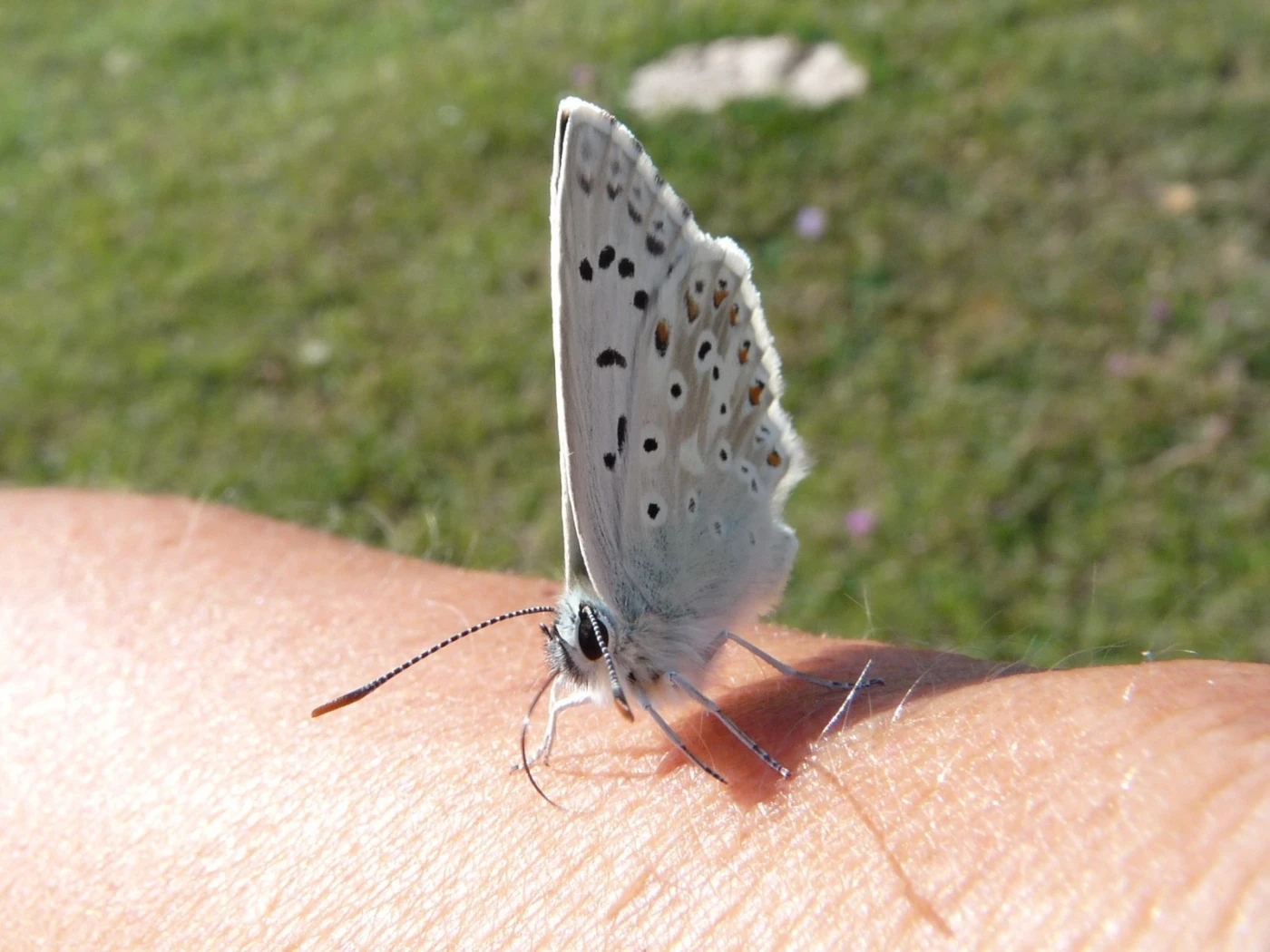
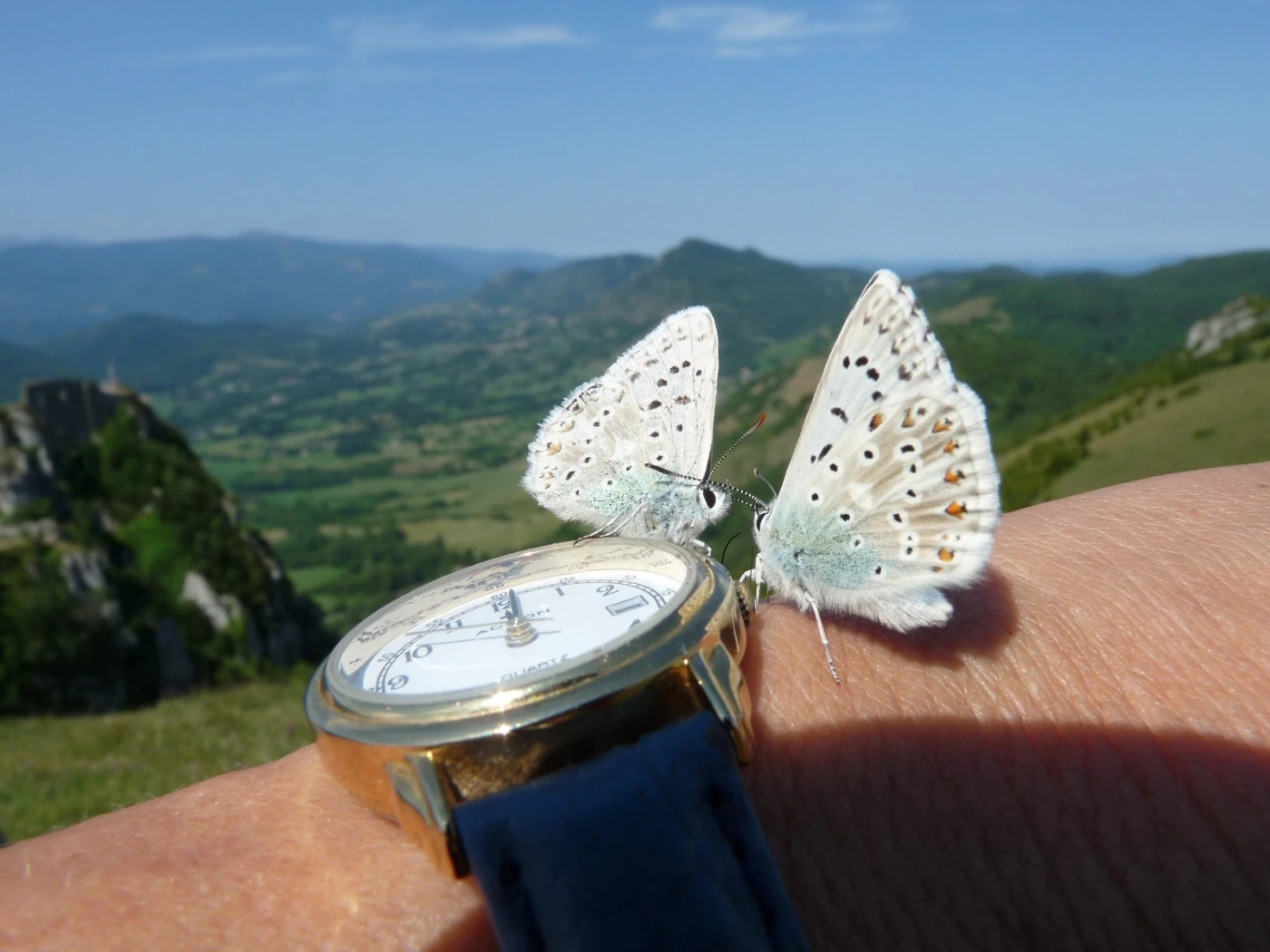
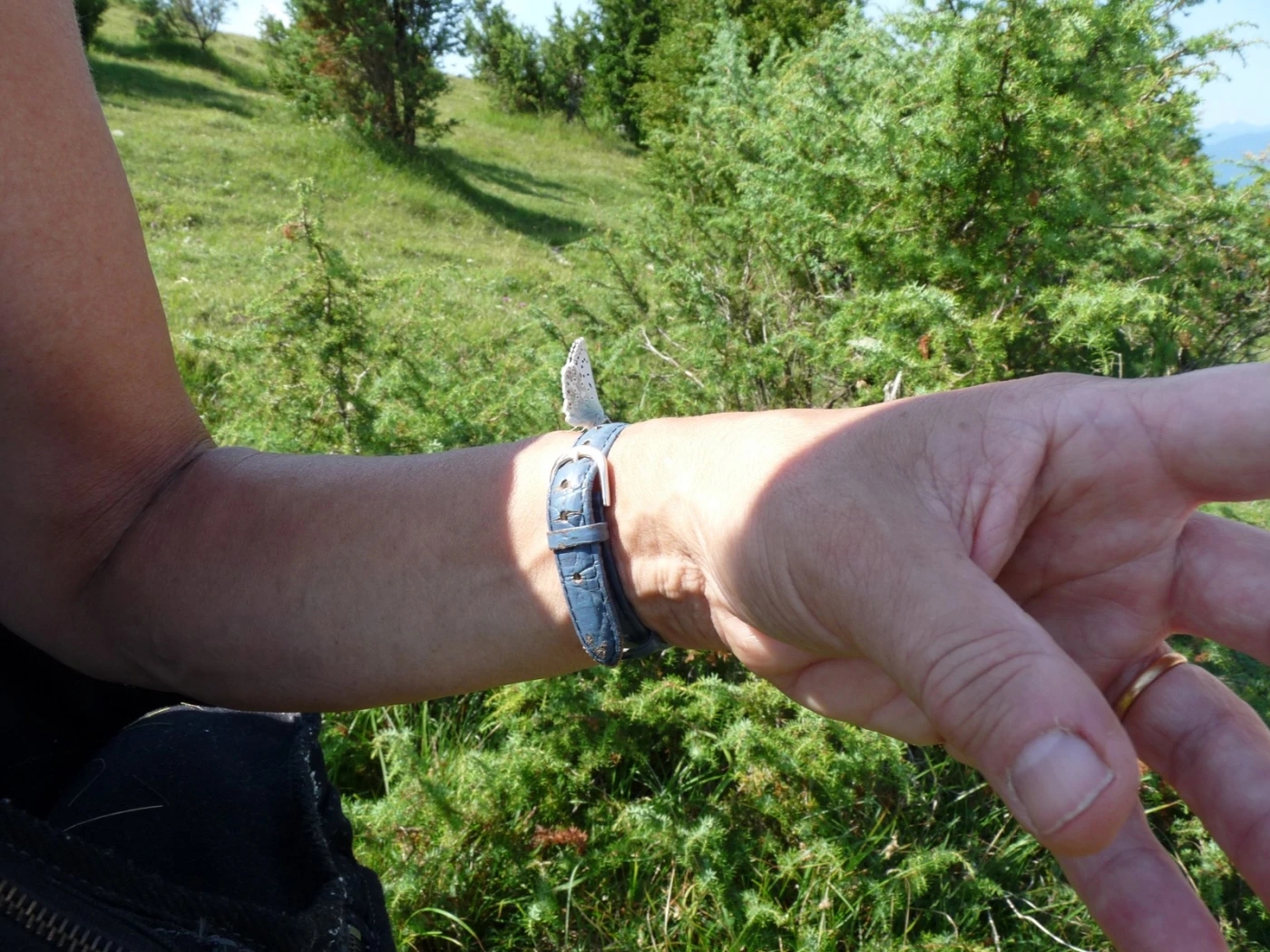
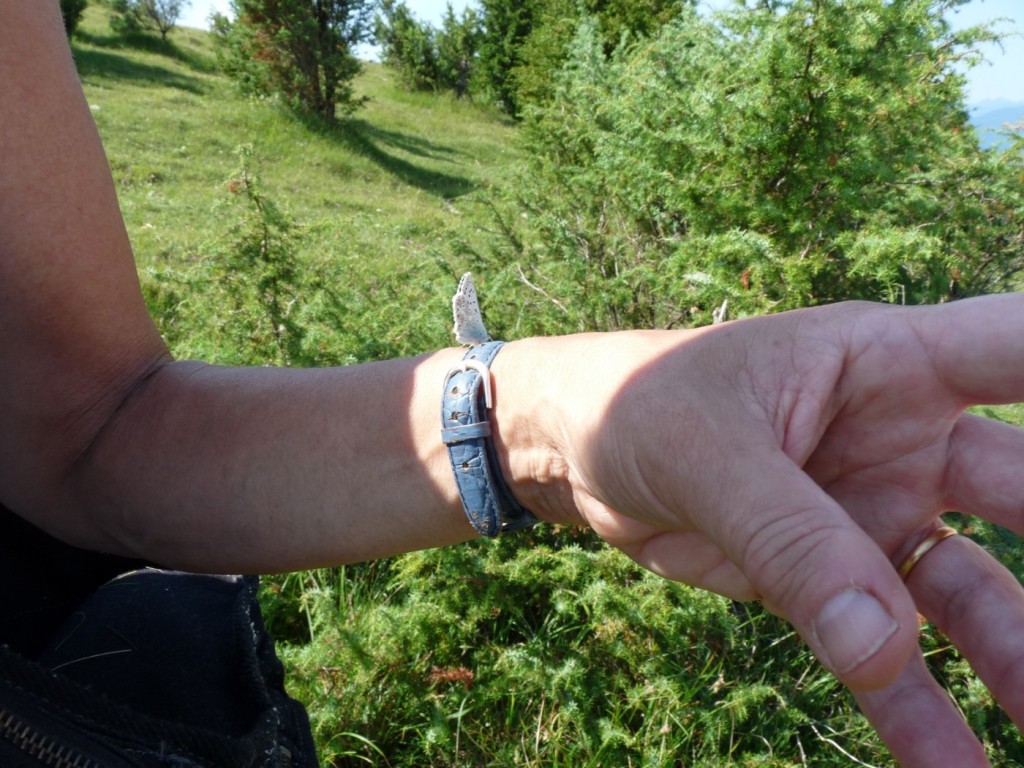
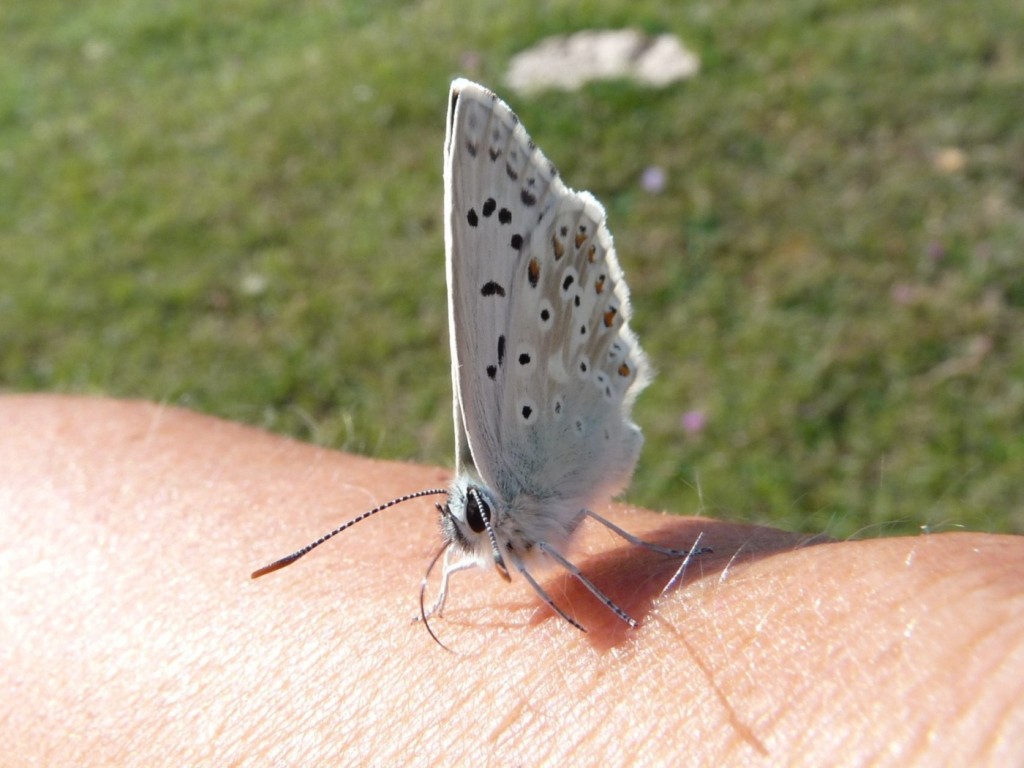
There we were at Roquefixade, showing our favourite walking destination off to two of our Harrogate friends, when a butterfly discovered me. Then another. These two creatures played round my wrist for more than half an hour before finally dancing off into the sunshine. They made our day.
I’m thinking they’re the Common Blue (Polyommatus icarus). Any dissenters?
And if you’re wondering why this post is called Butterflies III, here’s why …
It’s time for Fandango’s Flashback Friday. I’m taking you to France, to a gloriously sunny day – 20th August 2013. Happy Memories.
Butterflies: Half an Hour of my Life
August 20th 2013
There we were at Roquefixade, showing our favourite walking destination off to two of our Harrogate friends, when a butterfly discovered me. Then another. These two creatures played round my wrist for more than half an hour before finally dancing off into the sunshine. They made our day.
He found Chris first …
… then abandoned her for my wrist.
Then there were two.
I’m thinking they’re the Common Blue (Polyommatus icarus). Any dissenters?
This hasn’t been a week for writing for fun, as while I was having a good day in London on Monday, Malcolm ended up dialling 999, and is now in Harrogate Hospital after a heart attack. I wasn’t told until well on the way home, which may have been as well, as there was nothing I could have done. He’s awaiting transfer to the much bigger James Cook Hospital in Middlesbrough. But there’s every reason to assume that all will be well.
So I’ve picked out this post from six years ago, from our days in the French Pyrenees to re-blog. Who doesn’t love a good yarn, spring flowers and spectacular views? It cheered me up, anyway.
April 2013
Les demoiselles de Caraybat, daffodils and gentians
Once upon a time long ago in Caraybat, when times were hard, the men of this small village had to look far afield for work. And they went to Spain, for the hay-making season. Hawkers came to the village, and pedlars. They found a village with no men. They took advantage. So did the women.
When the hay-making season was over, the men returned, and the women spied them returning over the distant mountains. Suddenly ashamed and frightened, they fled to the hills. God, in vengeful and Old Testament mood, was displeased. As the women reached the summit, he turned each one of them to stone. And there they are to this day, les demoiselles de Caraybat, a petrified reminder of a summer of sin.
A few of those demoiselles hide themselves behind the woodland trees
We remembered this legend yesterday when I took our Laroquais walking friends to Caraybat and the dolomies to discover those daffodils I’d been shown on Thursday. I was quite chuffed that not a single one of them had previously known this special spot, and we had a pleasant hour up on the rocks, picnicking and enjoying the last days of the daffodil season.
We followed the walk I’d learnt about on Thursday, and then we finished our day by going to the plateau above Roquefixade to see the gentians there.
Gentians above Roquefixade
Sadly, it was by then rather cold and windy, and most of the gentians had sensibly folded their indigo skirts about their faces and tucked themselves away to wait for a sunny day. We’ll wait too. And when the sun comes out properly, we’ll be back.
I can’t get to the bottom of why this photo gallery’s not displaying properly. But click on any image, or partial image, and you’ll be able to see the photos.
It’s not a bad walk either. Would you like it for one of your Monday walks, Jo? And on the theme of challenges, today’s Ragtag Prompt is April. These are pictures taken on a glorious walk in April, so fit the bill.
Our new friend Jenny-from-Bilbao came for a flying visit late last week, so we did a quick Cook’s Tour of some of our favourite spots. Roquefixade, of course, Montségur: and then on a bright Autumnal Saturday morning, we finished off by a quick look at our local lake, Montbel. It’s a man-made reservoir, actually, but it looks as though it’s been there forever, and fish, herons and humans all appreciate its cool expanse of water as a change from all those hills, mountains, rivers and streams.
Those herons
What a difference a day makes. Sunday sulked. It rained in the night, it rained in the morning, grudgingly cleared up, then spent the rest of the day teasing us with odd showers which never quite decided whether to go for a full-blown drenching, or merely hang around as damp atmosphere, cloaking the landscape with fog.
View down over Laroque
How did that get there?
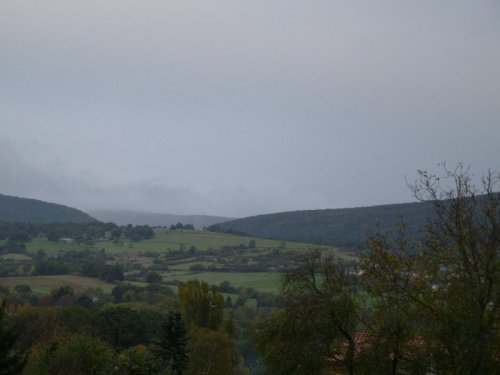
Misty view over the Douctouyre valley
Copse along the ridge
Out of the woods once more
… but not for long.
This young lady welcomed us as we passed her farm
Autumn colours
And some more
Autumn leaves
Our misty wooded path
The view’s largely obscured now
Last lap. Civilisation approaches….
Almost home. This farm’s for sale. Any takers?
Tamed trees. The edge of Laroque
So our planned walk from Croquié, with its promise of stunning views as our reward for a stiff climb was abandoned. Instead we met at 1.00, we hardy types, and Jean-Charles proposed what I thought was little more than a walk round the block. ‘Just up to Tabre, along the ridge and back’ he said. Well, Tabre is the next village along, Mirepoix direction, so that sounded easy enough. So off we went, along a bosky path, through Tabre, up a hilly climb to great views back to Laroque. A long and often muddy forest track took us past further views, over the Douctouyre valley, and circled us over and past the next village along from Tabre, Aigues-Vives. Down we climbed again, and took paths through fields back to Laroque. A fabulous walk, all 15 km or so of it, and almost every step of it previously unknown to us. And we pride ourselves on having got to know our patch pretty well. Thank goodness for local friends who carry on helping us to discover even more.
There we were at Roquefixade, showing our favourite walking destination off to two of our Harrogate friends, when a butterfly discovered me. Then another. These two creatures played round my wrist for more than half an hour before finally dancing off into the sunshine. They made our day.
He found Chris first……
… then abandoned her for my wrist.
Then there were two.
I’m thinking they’re the Common Blue (Polyommatus icarus). Any dissenters?
On Sundays we walk, with our friends from Laroque. This time though, Malcolm and I were cramming in something else too: an afternoon birthday party right at the other end of the Ariège.
This was the plan. Walking Party A (which included me) set off at 8.00 a.m. to do a walk from Lieurac to Roquefort-les-Cascades, where we were to meet Party B (including Malcolm) for lunch. Party B consisted of the temporarily halt and lame, as well as Marcel, whose bread hadn’t finished baking by the time we left. ETA for us all, 11.30. At which point M & I would have made our excuses and left for the birthday party.
We did fine, we keenies in Walking Party A. We walked past Rapy, Ilhat, Tanière, glad of the frequently wooded and well-signposted paths, and all went well till Bac d’en Haut. There was a choice of routes which we discussed at length as we studied the map and made our choice, though we agreed it was an obvious one.
View towards Rapy
In due course it became clear that it was not obvious at all. Instead of climbing up about 250m, then descending, we went on up…. and up… and up. We’d been due to meet Party B at about 11.30, but midday came and went, 12.20, 12.30, 12.40… and then we came out of the woods to be confronted by a sight just behind us to the right. Roquefixade, a beauty spot really rather a long way from Roquefort-les Cascades. Even if you’re a crow. But if you use the paths, or even worse the roads, it’s absolute miles (19 km. actually. It involves doing the two longer sides of a triangle). We rang every member of group B who had a mobile. Nobody responded. We concluded there was ‘pas de reseau’ but wondered why at least one of them didn’t get into a reception area and ring us.
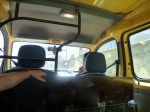
My view from the back of the van.
In the end, one of our group rang her husband, and he came to take some to Laroque to collect a rescue car, and others of us on to Roquefort. He didn’t drive a comfortable family saloon. Oh no. Our walking companion Corinne had that. He had the bright yellow van he uses for hunting. Behind the front seats was a compartment prickly with fresh straw where he and his fellow-hunters accommodate any wild boar they succeed in catching. I was one of the ones who … er …. drew the short straw and travelled in the wild boar compartment.
By the time we climbed aboard it was…. 1.40. By the time we reached Roquefort, it was well after 2.00. By the time the rescue car arrived with the remaining walkers, it was well after 2.30.
Meanwhile I rang our hostess and warned her we might not be able to get to the party. It didn’t take too long for ‘might not’ to become ‘can’t’. Hot, sweaty, and with no time to go home for a shower, I don’t think we’d have been entirely welcome.
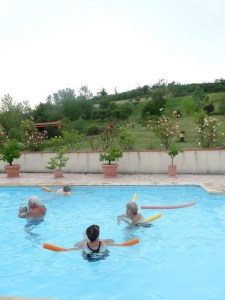
So we stayed with our friends from Laroque. A picnic lunch, then home for that shower, before going round to the home of Michel and Annick, who have a pool.
A refreshing swim, an ‘auberge espagnole’ (pot luck supper) and a glass or two of wine soon helped us reframe our day of not-very-brilliant navigating skills into a yarn that will no doubt go down in the annals of the group. It was just a shame about that party.
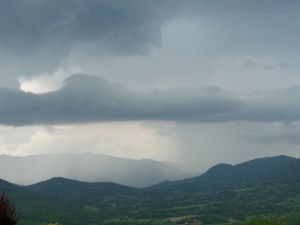
We’ve all had it. Months and months of horrible weather. Especially rain. Even now, when things are slowly picking up here, we expect to have all kinds of weather within a single day. Beautifully hot skin-warming sun may be followed by lashing winds, summer showers, or deluging heavy downpours. Glance up at the sky, and it will be in turn a cloudless azure, or bright blue patched with blowsy puffs of white cumulus. Or it may be grey, or even black. If the clouds aren’t coursing lazily across the heavens, they may be tearing across the sky so swiftly that they’ll have disappeared from view if you glance away only for a few moments. The rivers are still full to overflowing.
June sky from Roquefixade
Farmers are in a mess. They’ve only just begun to cut their hay, when normally they’d be onto their second harvest. Seeds have failed to germinate in the cold and wet. Often they haven’t been planted at all in the sodden and waterlogged fields. Preparations to take cattle and sheep up into the highland summer pastures have had to be postponed, with snow still on the ground at higher levels.
At last though, we walkers are once more getting out and about. We choose our routes with care, because thick sticky mud has made some of our favourite walks unuseable. Where we can walk though, spring has at last sprung. Familiar paths have become narrow passages edged by massed armies of knee-high grasses, shocking in their vibrant greenness. And our favourite spring flowers that by now should be sun-shrivelled and long past their best romp across meadows and pastureland, and spread across their favourite sun-warmed stones. Here are a few that we’ve enjoyed finding in the last days and weeks.
A springtime meadow
Can anybody tell me what these purple rock-clinging pom-poms are called?
Is this an Alpine aven? Anybody?
An Englishman in quest of that perfect flower portait. Tim did get some great shots on his visit.
I believe this to be a type of gentian, more delicate and solitary than its earlier gaudy cousins
A lesser butterfly orchid – I think.
A delicate potentilla.
Alpine willowherb – maybe?
I was practising with my zoom: this was yards above us – a type of campanula?
A type of saxifrage?
A flower-strewn meadow to you is a tasty salad to a sheep.
What a find in June! A daffodil, still fresh and bright.
UPDATE: After she’d read this post, a kind friend, AnnA, wrote to a botanist friend of hers enlisting help in identifying the flowers I’ve shown. Here’s some of what she said. Reading from the top, left to right:
3. Hélianthème – Helianthemum Alpestre (Alpine rock rose)
5. Perhaps from the Linacée family. She needs a photo of the leaves. Watch this space
6. Céphalanthère à longues feuilles – Cephalanthera longifolia (Sword-leaved Helleborine)
8. Oeillet – Dianthus – (Dianthus). She needs more info. to help her be more precise.
She’s asked to see more of the leaves, and to be told as well where the flowers were found and at what altitude. There’s such a lot to it. I had no idea and am so grateful for all this help.
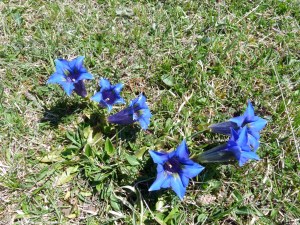
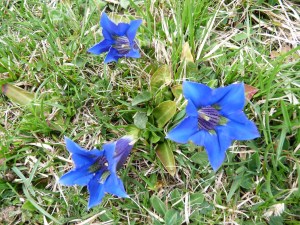
May Day here in France is the day when the French like to offer lilies of the valley. It’s been so cold and wet these last few days that ours in the garden are still tightly in bud. But the other day, we did see gentians. Turning their vivid blue faces to the sun, they were marching up the sunny sides of the slope at Roquefixade. I’d like to share some with you.
Once upon a time long ago in Caraybat, when times were hard, the men of this small village had to look far afield for work. And they went to Spain, for the hay-making season. Hawkers came to the village, and peddlers. They found a village with no men. They took advantage. So did the women.
When the hay-making season was over, the men returned, and the women spied them returning over the distant mountains. Suddenly ashamed and frightened, they fled to the hills. God, in vengeful and Old Testament mood, was displeased. As the women reached the summit, he turned each one of them to stone. And there they are to this day, les demoiselles de Caraybat, a petrified reminder of a summer of sin.
A few of those demoiselles hide themselves behind the woodland trees
We remembered this legend yesterday when I took our Laroquais walking friends to Caraybat and the dolomies to discover those daffodils I’d been shown on Thursday. I was quite chuffed that not a single one of them had previously known this special spot, and we had a pleasant hour up on the rocks, picnicking and enjoying the last days of the daffodil season.
We followed the walk I’d learnt about on Thursday, and then we finished our day by going to the plateau above Roquefixade to see the gentians there.
Gentians above Roquefixade
Sadly, it was by then rather cold and windy, and most of the gentians had sensibly folded their indigo skirts about their faces and tucked themselves away to wait for a sunny day. We’ll wait too. And when the sun comes out properly, we’ll be back.
Unlike our walk on Thursday, early morning was bright and clear.
The distant Pyrenees, just visible betwen two of those demoiselles.
A clump of pale and delicate woodland daffodils.
Daffodils on the windswept hillside.
The view from our picnic spot.
And another view.
A bank of spring flowers.
Our daffodils were there, up on the top.
Traditional pebble paving in front of a village house.
And the cock, keeping guard at the same house.
Magnolia in the village square at Soula.
A nut tree of some kind comes to life after winter.
More spring flowers.
Château de Roquefixade: we’re looking for gentians on the plateau.
When guests come to stay, Malcolm and I often pore over maps looking for some unexplored – by us – corner of our patch. But in the end, what’s the point? Our visitors aren’t sickly pale wraiths whose jaded walking appetites have to be tempted by novelty. They’re happy with the solid day-to-day fare just a mile or two down the road. To them, in any case, everything is new.
We too are happy to revisit favourite walks. They’re never the same. The changing seasons bring different flowers, different cloud formations. Mountains which perhaps were sparkling bluish-white last time we visited, turn green and purple towards summertime with just the odd small patch of snow near their summits.
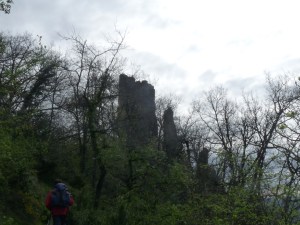
Today, then, we went with Christine to visit our old friend Roquefixade, just a few miles away. A steady climb through the juniper-scented woods and along a rocky ridge leads to a ruined château, once far above us, now somewhat below. Here it is. Enjoy the views. We did.
The village of Roquefixade far below. We were there half an hour ago.
The gently clanking bells on the Gascon cattle joined the birdsong as our accompaniment
First view from our walk of the Château of Roquefixade
Castellated rocky crags complement the ruined château
View through the castle wallls
The 11th century château may have had a 17th century makeover
View from the château
..and another one
Wind and rain have sculpted these ruined limestone archways
Conquering the castle and raising the Occitan flag
Flowers by the flagpole
Walking back towards the village, the château above us once more

















 From Pyrenees to Pennines
You must be logged in to post a comment.