‘Our favourite walks’: a nomination

The walk begins.  St. Julien de Gras Capou
The walk begins. St. Julien de Gras Capou

We keep a mental list of the walks we’ve particularly enjoyed.  Walks we’ve treasured for the views, the flowers, the butterflies, the skyscapes, the lunchspot – all sorts of reasons.  The only problem is that the walk at the top of the list tends to be the one we did last.  There’s no such thing as a duff hike round here.

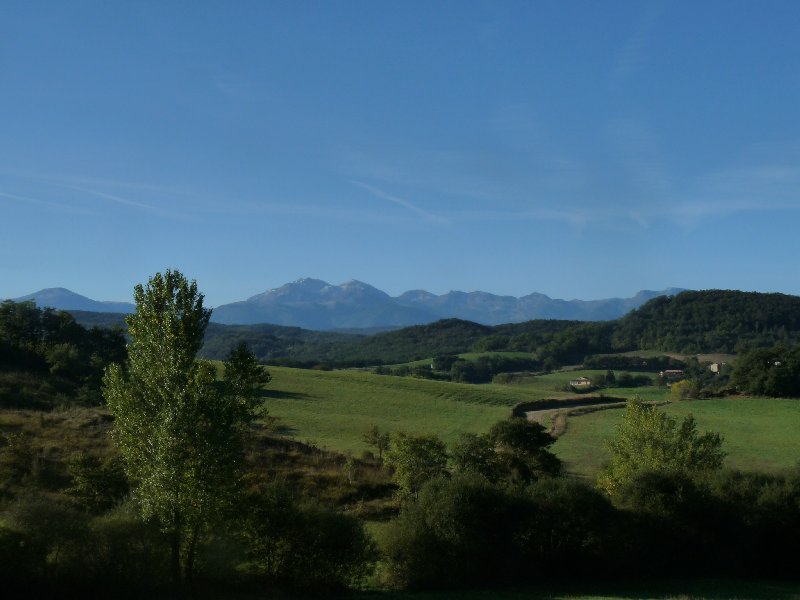
But last Sunday’s walk is assured a place of honour on this list.  It’s one we’ll want to share with you if you come to stay, and we’re keen to do it again ourselves, at every season of the year.

If you drive from here to Mirepoix, you’ll pass through a village called la Bastide de Bousignac.  Just after that there’s a road off to the left, signposted to Saint Julien de Gras Capou.  Take it.  It’ll wind upwards between grassy pastures, home to sheep and cattle and not much else, and finally deposit you in the main street of the village – current population 62.  Park near the church, lace up your walking boots, grab your rucksack with its all-important picnic, find the first yellow waymark – and set off.

The village is so-called because back in the 12th and 13th centuries, it had acquired a reputation as being the place where fine fat capons were raised to feed fine people: that’s the ‘gras capou’ bit.  I don’t know where St. Julien comes into it.  There are hens here still, and in so many ways, the village is perhaps little changed.  It’s a peaceful, rather isolated place, despite being so near to Mirepoix and one of the main roads in the Ariège.

Our walk took us along farm and forest tracks, through fields and woodland still splashed with colour from flowers and late butterflies.  It was an easy route, rising only gently, passing the tiny hamlet of Montcabirol towards the village of Besset.  Shortly after that though, we found we did have a short sharp climb, through the woods, to reach the Pic d’Estelle.

Wow.  It was worth it.  From here, we had a 360 degree panorama.  The chain of the Pyrenees marched across our horizon, its peaks already dusted with snow, or even quite thickly covered in the case of the higher summits.  As we turned in other directions, we could see Mirepoix, immediately recognisable from its distinctive cathedral spire, and the Montagne Noir beyond.  There are foothills nearby too, across which pilgrims on the Chemin de Saint Jacques de Compostelle still travel: and other sights too – the ruined Château de Lagarde, and its near neighbour the Château de Sibra.  We stayed a long time, simply relishing these views, the sky, the silence and peace at what seemed to us, at that moment, the top of the world.

When we finally shrugged on our rucksacks once more, we only had three or four more kilometres to go, along more unpeopled pathways.  After negotiating the only obstacle of the afternoon, a group of cows supervised by a bull – we let them get well ahead of us – we were soon back at base.  It was good, very good.  I just wish my camera could do justice to those peaks.  But we’ll be back, in winter, when they’re truly thick with snow

Butterfly bonanza

I’ve never been all that good at butterfly spotting.  Back in the UK, I could manage my red admirals, peacock butterflies and cabbage whites.  Oh yes, I could certainly identify those pesky cabbage whites.  Their eggs were usually plastered over the undersides of nearly every vegetable I had on my allotment.

On Sunday though, we had a real butterfly bonanza.  We had a perfect day’s walking on the nearby Plateau de Sault, near Belcaire.  It was perfect because the scenery was friendly: gently rising and falling lightly forested slopes offered distant panoramas of the Pyrenees.  The wonderful weather was bright and sunny, without being too hot. The walk offered challenges but no real difficulty; good companionship too.  What made this Sunday memorable though were the butterflies.  At this altitude – about 1000 metres – the summer flowers were still bright and fresh, and the butterflies couldn’t leave them alone.  They fluttered ahead of us every step of the way, and we finally gave up exclaiming over their delicate beauty.

What we couldn’t do was identify them.  This evening I’ve pored over sites on the internet.  I’ve excitedly identified a specimen.  Then I’ve looked at the next image… and the next… and realised that my confident identification isn’t at all secure.  Tentatively, then, I’ve named my photos.  But I rely on you, dear reader, to put me right about the undoubted mistakes I’ve made.

In the end though, whether I’ve been able to name them or not, I carry with me the memory of a summer’s day made extra special by the presence of those butterflies  wheeling, turning, diving and fluttering, rarely still, but constantly engaging our admiration and attention

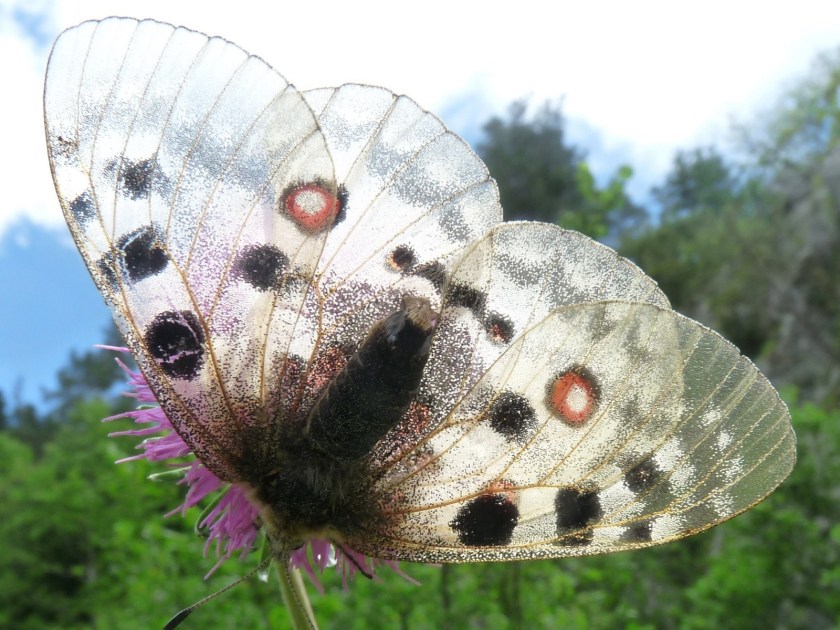
Mountain Apollo

P1050895

I just want to share a photo I took on our walk on Sunday, when we went to the Gorges de la Frau.  This butterfly seduced us all with its distinctive spots and white grisaille wings.  It turns out to be rare, a protected species, and known only in mountain regions, mainly in Southern Europe.  The French know it as Apollon, and its Latin name is Parnassius Apollo.  If your French is up to it, you can read about it here.  

And here’s a small taste of the Gorges de la Frau, only a few miles from our house.

The comb

There’s an industry that’s had something of a walk-on part in this part of the Ariège for well over 300 years.  Against all the odds, it’s somehow clinging on.  It’s comb-making.  Specifically, combs made from horn.

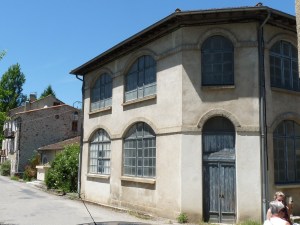
Today, we went to find out more, courtesy of a visit organised by  ‘Pays d’art et d’histoire des Pyrénées Cathares’.  There are two ‘peignes en corne’ factories within just a very few miles of each other, and of our house too.  Each used to be the size of a hamlet, with separate buildings for all the different parts of the fabrication process.  Now, both firms conduct operations each from a single building.  We went to ‘Azema-Bigou’, in Campredon.

Azema-Bigou factory
Azema-Bigou factory

I’d always imagined the industry had developed as part of a waste-not-want-not mentality, using the horns from local sheep and cattle.  Not at all.

Our part of France has always been rather anti-establishment, in religion as in much else.  In the 16th and 17th centuries, when much of Europe was in religious turmoil, Protestants locally were persecuted.  Many fled, some to Switzerland.  And there they learnt a new skill, unknown to them before: comb making.

Following the 1598 Edict of Nantes, assuring greater religious freedom, many Protestants returned to their homes here, and wanted to continue the trade they’d learnt in exile.  But did they use local materials?  They did not.  Local cattle worked hard , ploughing and generally earning their keep.  They ended up with chipped, worn horns.  Over the years, the comb-makers developed markets with ports such as le Havre, Marseilles, London and Liverpool, and imported good quality horn fom Hungary, Turkey, and by the 19th century, Argentina.

Horns awaiting transformation into combs

Although in the early days, the trade was conducted on a domestic scale, with each worker capable of producing 10-15 combs per day, perhaps after a day in the fields, by the 1850’s the process was industrialised – with machinery imported from England.  Men women and children were all employed.  Men earned 2 francs a day, women 1.25, and children 1….. .  No wonder women in particular preferred to be paid for piece work: that way they too might get 2 francs daily.  The busy industry grew and thrived until more or less the second world war when plastic combs started to take over.  The factory of Azema-Bigou, in the hands of the same family for 5 generations, employs three people these days, though in its hey-day there were 180.

But these workers will tell you, as will many local people , that it’s well worth investing in a horn comb.  Like your hair, the comb is rich in keratin, and will treat your hair gently without generating static electricity.  Several of my friends have had the same comb since childhood and would never be happy to replace it with some cheap piece of plastic.

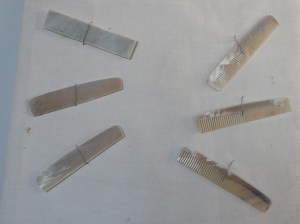
A selection of combs.

Apparently horn has to be soaked for up to a year before it becomes useable, and then it is forced through heavy rollers to make useable sheets.  There are some 15 different processes involved in producing the finished comb.  No wonder it costs rather more than its plastic poor relation.

I can’t tell you very much more.  Unusually, this event was not up to snuff. We were shown no artefacts, heard no tales from former workers in the industry.  So I don’t know what it felt like to work 11 hours a day in an atmosphere where horn dust hung heavy in the air cloaking  lungs and coating every surface in thick grey cushions. I don’t really understand what’s involved in transforming a rough, thick horn into a polished and handsome comb.   But I do know that  the waste and dust swirling round the factory got – and gets – used. The tiny fragments of waste used to be made into filaments in a factory here in Laroque, mixed with horn dust and sold as a fertiliser for vines.  Even now, you can buy bags of horn-waste fertiliser for your garden from the two comb factories.  Waste-not-want-not gets its moment after all.

A walk gone wrong

This slideshow requires JavaScript.

Yesterday was gorgeous.  Hot and sunny until long into the evening.  We ate outside and stayed on the roof terrace till 10 o’clock.  Today seemed to promise more of the same.  We should know better.  This year, getting even two days on the trot where the weather is hot and clear all day is asking a bit much.

And so it proved.  Today, our walking group met to share lifts to where our walk was to begin.  We set off in the sunshine, watching our in-car thermometers climb steadily to 27 degrees as we drove ever upwards, beyond Villeneuve d’Olmes, beyond Montferrier, up a road which became narrower and less well maintained, to Frémis, a tiny hamlet.  We parked there, in a flower-spangled meadow offered by a local farmer.  We peeled off our fleeces, applied suncream and set off towards the peak, Coulobre. Sometimes the upward-going was tough and quite a scramble, but we were encouraged by looking across to the still snow-capped tops, and the thought that we’d be having our picnic at the top there,  the Ariège spread below us with views, views and more views.  We met a herd of black Mérens horses sheltering in a copse from the already-hot sun.   A donkey befriended us.  And still we climbed.

Towards midday, walking through the forest, we suddenly realised things were changing.  Didn’t it suddenly feel cooler?  And weren’t those little scraps of mist swirling round those peaks?  Apparently yes.  The mist descended.  The ‘cool’ became ‘chilly’.  With 20 minutes to go to arrive at our lunch spot, Micheline, who had developed a gammy knee, announced she could go no further.  It didn’t take much for us to decide that it was not only friendly to remain with her and have our lunch, it made sense.  The mist was swirling around us, the views up there wouldn’t be up to much, and it was obvious that rain or worse was on its way.

We found logs to sit on, got our fleeces out again, ate our lunch with little ceremony, and scuttled down.  The climb up had taken nearly three hours. Scurrying down took not much more than an hour.  And as we reached Frémis, the rain started.  It’s not stopped since.  And those in-car thermometers on the way home? 15 degrees.

The Château at Lagarde

Draw a square.  Now draw another one surrounding it, with a nice big border.  Now do it again.  Now draw a big rectangle alongside one of the sides, as wide as one of the sides of the square, and maybe 3 times as long.  There.  You’ve just given yourself a brief history of the Château de Lagarde.

We had a better history lesson, because we were there, in cold gusty conditions, being introduced to the site by Fabrice Chambon, as part of the series of events organised as part of this season’s Laissez-vous conter le Pays des Pyrenees Cathares.

Lagarde is a ruined castle, an imposing and dramatic addition to the skyline hereabouts.  We always assumed it was medieval, destroyed in one of the many wars that characterised that stormy period of history.

And certainly it was first constructed in the 11th century, by Ramire de Navarre, King of Navarre and Count of Barcelona.  During the crusades against the Cathars, it came into the possession of Simon de Montfort, who always gets a look in round here to any story from that time.  He gave it to his lieutenant, Guy de Lévis, and this is the family to whom it’s mainly belonged over the centuries.  They owned châteaux everywhere in the area:  Léran, Montségur, Terrefort – all within easy distance of Lagarde.  It was a fortress, a castle, and occupied that inner square you drew.

By the late 15th – 16th centuries, defensive castles were so last year.  Jean V de Lévis-Mirepoix had the money and the leisure to go travelling, and admired all those famous Châteaux of the Loire: Azay -le- Rideau, Chambord and so on.  He liked what he saw and had his own château remodelled with some of the features he had so admired, and windows piercing the original solid medieval masonry.  The finest feature may have been a splendid staircase with wide shallow steps curving upwards through the central tower: it was said that it was possible for horses to mount these stairs.  It was a fine Renaissance palace, and extended to fill that second square, because it included space to accommodate his artillery forces and a large dry moat.  Of course by the time the work was done, the style he’d copied had also become so last year.

By the time of Louis XIV, the château had become a fine palace.  The site had been considerably extended (to fill that third square!), and copied aspects of Versailles.  Think of Versailles, and it’s the formal gardens that come to mind, and the Hall of Mirrors.  That’s what Lagarde should bring to mind too.  But the vast and elegant formal gardens no longer exist: even the land on which they were constructed is no longer part of the site.  It had a Hall of Mirrors too, which though inevitably on a smaller scale than that at Versailles, was said to be magnificent.

Then came the French Revolution.  Lagarde escaped destruction, despite an order to knock it down in April 1794.  But its glory days were over.  It became an arsenal, a stables, an immense barn, a munitions factory and a bit of a ruin, until in 1805 it became once more the property of the Lévis-Mirepoix family.  These days a variety of charitable and national associations are working to restore the site and make it, at the least safe to visit, and at best a place where its glorious past will be explored and celebrated.

The photos I took are all of the exterior of the site, as it’s too dangerous still to penetrate the inner courtyards, much less the interior of the building.  Nor can I show you pictures of the château in its Renaissance glory days, nor of its time as a palace with formal gardens.

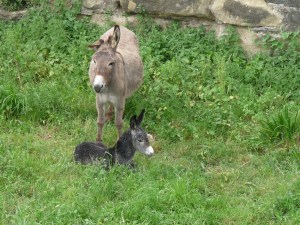
Sadly, because of the poor weather , the pictures I took yesterday weren’t up to much, so I’m mainly using some others I took recently. I can show you the ruins.  And I can show you the castle’s lawnmowers: an inquisitive and friendly herd of donkeys with their charming foals.

Mother-and-baby down in the dry moat.

UPDATE:  May 2nd 2013

Château de Lagarde
Château de Lagarde

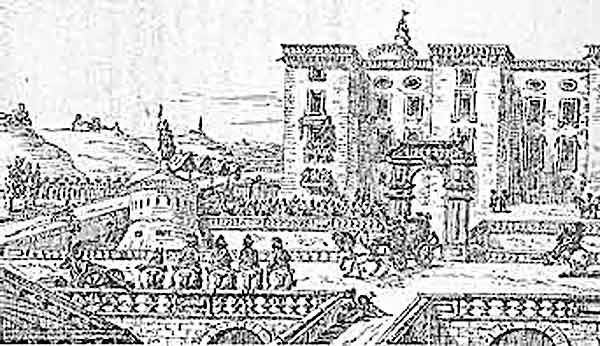
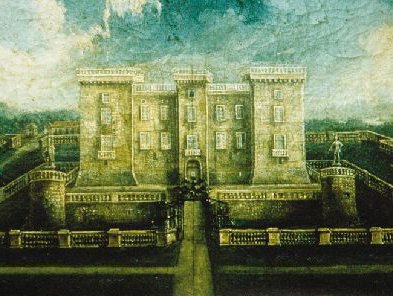
Thanks to local historian Martine Rouche, I can now show you some images of Lagarde as it was in its final most glorious days before the Revolution.

Look at the statues in the colour picture . One was taken to Mirepoix during the Revolution and  ” turned ” into Goddess Reason. Then it disappeared. Never to return. A few years ago, a man who was vaguely in charge of the grounds and ruins, found lots of things, including a foot of one of the statues. Nobody knows where that foot is now. It is a pity because it gave a precise idea of the size of the statue and showed those statues were made of brick, covered in some sort of white enamel. 
Anyway, enjoy these pictures, which certainly make it easier to imagine what the castle must once have been like than gazing at those ruins, however romantic they may be.
Château de Lagarde
Château de Lagarde


Snowshoes III: The very last episode

I’m not doing raquettes (snowshoes) ever again.  Never.  If I ever show signs of changing my mind, lead me into a darkened room, talk kindly to me, and sit with me till the feeling passes.

I have no idea how I got through yesterday.  I must have done though, because every move I make causes some protesting and unhappy muscle to complain vigorously at the pain it endured on our expedition, and is still enduring now.  Five hours walking, with half an hour off for lunch.  Something over 600 metres up, 600 metres down – that’s nearly 1900 feet each way in old money.

I said last week’s sortie was tough.  Compared with yesterday’s, it was a stroll in the park.  I said last week’s was ‘an upward slog: unremitting, tough’.  Yesterday’s was a vertical slog: unending, unforgiving.  Last week, the snow had been deep and crisp and even, and easy to walk on.  We had crunched satisfyingly upwards through the forest, and our descent had been a brisk and easy downward march.

Yesterday, following a warm and sunny week, the snow was soft and our snowshoes sank deep.  Bad enough on the upward route march, but coming down, we all skidded, slipped and lost grip of our poles as they plunged into unseen cavities.  I made landing smack on my back and descending bumpily downwards, legs waving helplessly in the air my personal speciality.

Still, it was good to see Montségur, looming above us at our starting point, providing points of reference throughout the day.  Soon after we started, we were level with the castle at its summit, then it was below us, and disappeared for a while as we plodded upwards through a stretch of forest.  At lunchtime it was impossibly far below.  As we ate, we enjoyed plotting the landscape for other landmarks: Lavelanet and Laroque of course, the lac de Montbel, and far north of us, the Montagne Noire.

Best of all were the cloudscapes: massed plump white cushions of cumulus with wispy brushes of cirrus above, turning a more characterful and moody grey in the afternoon, foreshadowing the evening’s expected rain.  We were just back at the cars when the rain arrived a little ahead of schedule, with a brief hailstorm of pencil-point-sharp hailstones to encourage us on our way.  We didn’t need telling twice.  Home comforts have never seemed more inviting.

Snow Shoes II, The Sequel

We walkers of Laroque got our snowshoes out again today (well, in my case, I borrowed some), and went for a much more local sortie, just above Montferrier and en route for the local skiers’ playground, Mont d’Olmes.

How different from our last walk.  Instead of wide open snowfields with distant views, we had woodland walking and bright sunlight casting blue shadows across our path.

Instead of gentle slopes rising and falling before us, we had an upward slog; unremitting, tough.  Micheline and I, discouraged and tired, failed to reach the top, and missed the prize: a frozen lake with snow-clad views in every direction.  Most of the party stayed with us and kept us company.  Though our views were less exciting than those of the intrepid climbers, our picnic was the better one.  We low-achievers had wine, home-made cakes and hot coffee with us to supplement our bread and cheese.

And the journey down was completed in record time.  We arrived home as our gardens were gently baking in the last of the hot afternoon sun.  More of the same is forecast for several days: there won’t be much snow left this time next week.

Snow shoes at Scaramus

It’s 7 o’clock.  I can’t see me having a late night.  We’ve had a day of ‘raquettes’ – snow shoes.  Gosh it’s exhausting.  You strap great oval saucers of plastic, webbing, and toothed metal to your feet and spend some minutes feeling like an ungainly baby taking its first uncertain footsteps across the endless wastes of the living room carpet.

Booted and spurred
Booted and spurred

But equilibrium returns, and without these cumbersome contraptions, how else would you walk across the undulating white snowfields of the Plateau de Sault, with views of snow-sculpted hillsides nearby, jagged snow-crusted peaks beyond?  How else could you enjoy the sound of the satisfying crunch and crack as feet break through the crisp crust of the surface snow.  Thank goodness for that icy layer.  We found our 5’ long batons, plunged deep below the surface, wouldn’t touch the frozen ground beneath.

And with a bright blue sky, a hot sun enabling us to walk wearing T shirts and summer hats, what better way to spend a February Sunday?

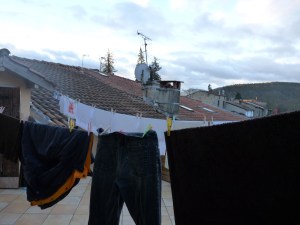
A view from the washing line

Out on the roof terrace

There’s a blog I read.  Its author is a writer, a teacher, a mother, probably not in that order.  She loves people, words, conversations.  She’s enthusiastic, encouraging, and loves life.  She might be exhausting to live with: she’s exhausting to follow, because she’s constantly throwing out challenges.  What, she mused recently, makes you joyful?  Well, Renée Schulz-Jacobson, this is what.

It’s hanging out the washing.  And bringing it in at the end of the day.  How sad is that?

All hung out for the day

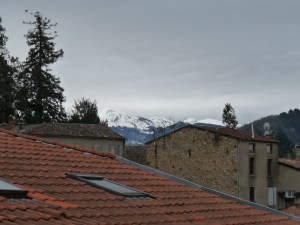
Every day, these simple acts raise my spirits.  We dry our washing out on our roof terrace.  From here, we can see the nearby peaks of the Pyrenees, covered in crystal white snow for half the year.

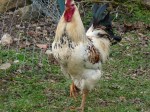
Zooming in on the cock  over the water
Zooming in on the cock over the water

Across the river just beyond our house, a neighbour keeps hens, and I enjoy watching them fossicking about for grubs and cabbage stalks.  Sometimes the heron swoops along the river while I’m there, and lands near the weir to look for breakfast or supper.  The morning air is cold, fresh and energising.  Actually, at this time of year it can be ****** freezing, in which case I’ll run down and warm myself afterwards by the wood burning stove.

It’s the evening though, when the washing is dry, sweet-smelling and ready for folding and hanging (carefully done, so there’s no need for any ironing) that I’m happiest here.  I’ll listen to the birds chattering and singing.  I’ll check up on those hens again.  But best of all, I’ll watch the sun setting.

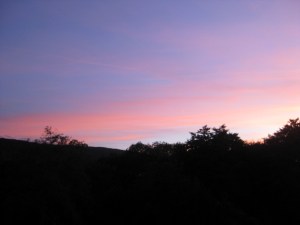
A subtle sunset
A subtle sunset

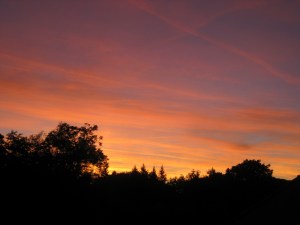
The sky will turn from vivid blue, through rusted orange and citrus yellow, to navy blues and bruised purples.  The snow on the mountains will change from sparkling white to ice-blue and then the subtlest shade of grey.  Suddenly, the sun will drop from sight behind the trees, and for a few minutes longer the palette of colours becomes moodier before giving over to shadowy moleskin grey.  Then the stars appear and later, the swooping, chirruping bats.  I’ll be back indoors by then, my mood invariably lifted by the simple pleasure of watching as the sun puts on its daily and ever-changing show.

Nearly gone, the sun

.