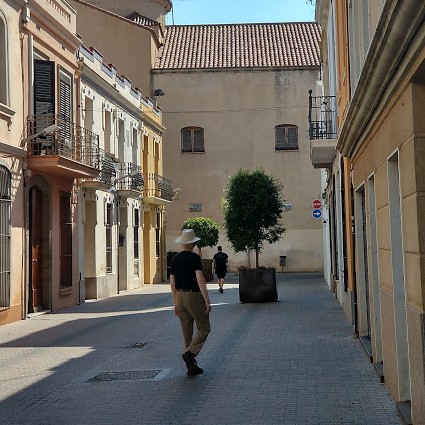
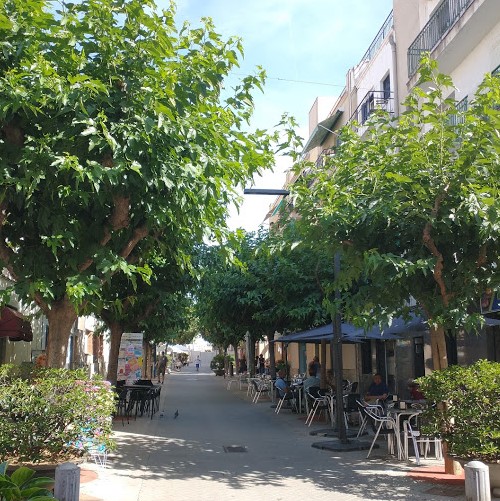
The barri antic – old town centre – of Premià de Mar is terraced by rows of what were once fishermen’s cottages, mainly dating from the 18th century, and known as lescases decós. Their inhabitants divided their time between two occupations – fishing – and market gardening in their long narrow back gardens. The featured image shows a typical street, with awnings stretched across to shelter passers-by from the summer heat.
There aren’t many trees, so these days the town council has placed some in tubs along the pedestrianised streets.
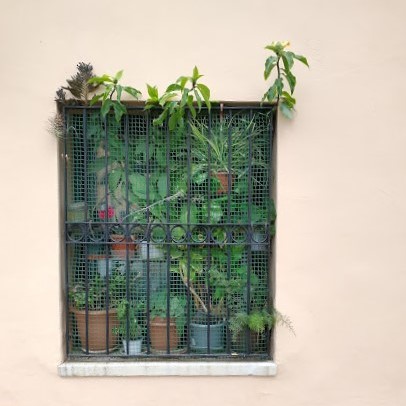
With not many trees about, some residents cram their windows with cooling plants:
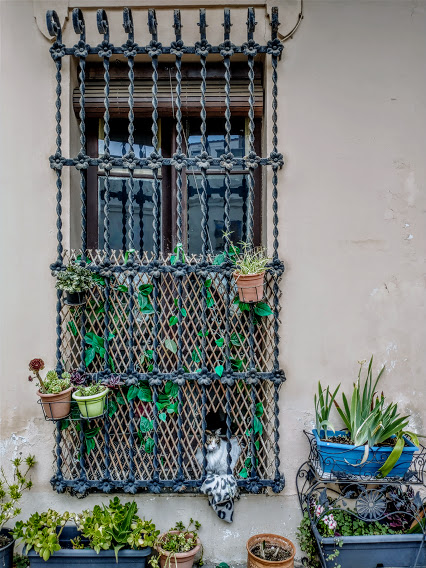
Although one careful resident has thoughtfully left a cat-sized gap at the bottom of his plant-friendly window.
The railway line linking Barcelona to Mataró, 34 miles up the coast, was opened in 1847. The line divorced every town on its route, including Premià de Mar, from the seashore by hugging the coast. Nowadays a busy main road also runs alongside.
But the railway brought advantages too, by bringing raw materials (coal from England for the gasworks!) to agricultural and manufacturing industries, and by taking produce (fruit and vegetables, textiles) to their markets further afield.
Still, those early trains were regarded with deep suspicion, as evil and malevolent. Early travellers took no chances. They would make their wills before embarking on their journey. Market gardeners were convinced the smoke from the engines would harm the crops and they would become bankrupt. And steam engines require axle grease. Where could that fat come from? Weren’t there reports of babies and children going missing in Barcelona? Hmm?
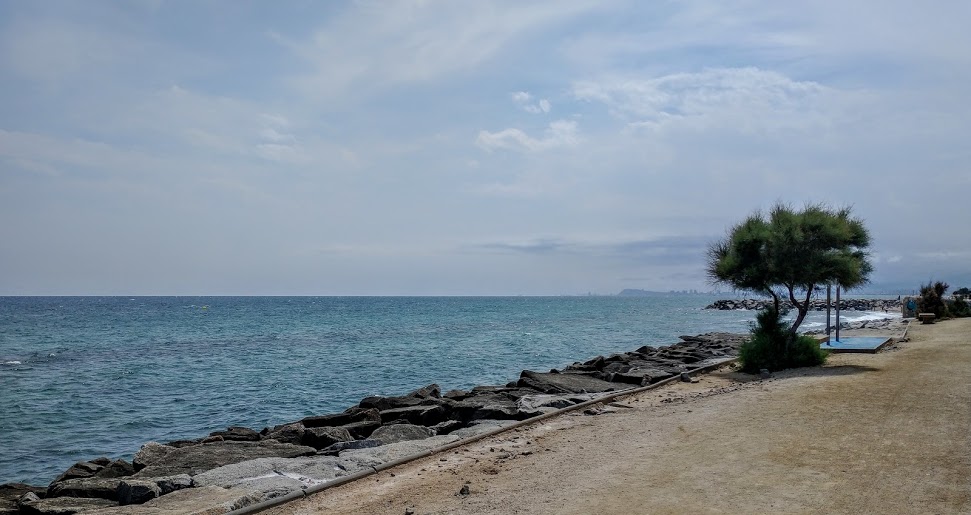
Nowadays, this is the scene from the goods yard, now known as Descarroga beach – ‘decarrogar‘ is ‘to unload‘ in Catalan. The train line still exists, but silent electric rolling stock dependably transports commuters, but no freight, to and from Barcelona.
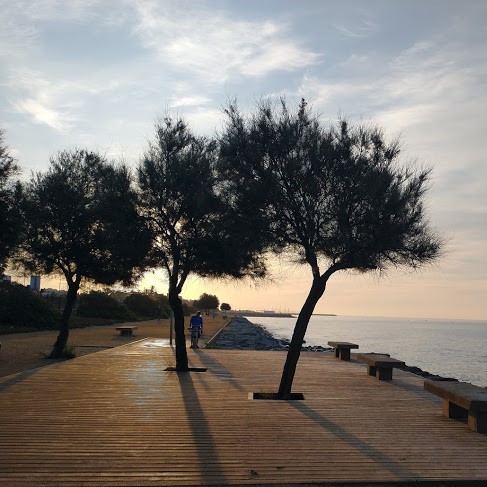
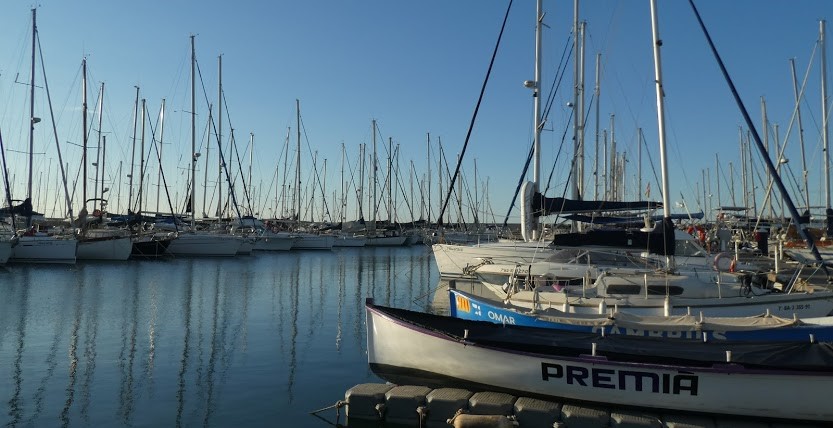
El Llano de Los – or the Plain of the Bone. That’s today’s photo. It’s hard to believe, but back in 1900, here was Premiá de Mar’s newly-built shipyard, with carpenters busily engaged in crafting boats and ships, mainly for the fishing industry. Onlookers jeered. ‘Lazy lot, those boatmen. They’ve got a bone in their back that doesn’t let them work.’ With a great deal more justification, the carpenters hurled the insult back at the idlers watching them. So there we have it: the Plain of the Bone. Now all of us who enjoy a quiet moment here are idling away a few minutes during a pleasant stroll along the seashore, towards the port that these days is full of pleasure-craft – not a fishing boat in sight.
And … we’re back from a more-or-less internet-free month in Spain. We’ve been with my daughter and partner, who five months ago became parents. This had been the first window of opportunity to get there, what with Covid travel restrictions.
We got to know and love Anaïs, as she mastered rolling over, sitting up, and enjoying English nursery rhymes to complement the Catalan ones her other yaya (granny) sings with her.
And we got to know and feel quite at home in the seaside town that Emily and Miquel moved to just before Anaïs was born. Only 12 miles from Barcelona, it’s assertively un-touristy – no hotels, AirB&B, catch-penny souvenir shops or menus in several languages.
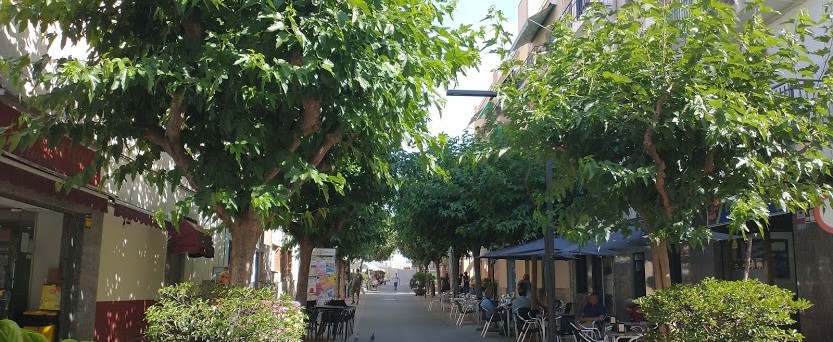
So let’s start off with what the Spanish do best, and enjoy a drink in a bar shaded by the trees that line the streets.
Casting around for suitable ideas for Jude’s Life in Colour – White – challenge, I remembered a post I’d written two years ago. Not only does it work for Jude (up to a point) but it fits the bill for Fandango’s Flashback Friday. Here it is:
IDENTICAL?
I’ve never been much good at twiddling with the controls on my camera. I even joined a photography course recently, in an effort to get to grips with apertures, shutter speeds and ISO controls. But it just made my head hurt, and I reverted to ‘Automatic’ as my default modus operandi. I decided I’m a snaphot-ist, not a photographer.
Yesterday however, just for a bit of fun, and having an hour to spare, I turned to the ‘palette’ settings and took an identical shot using every single one. Though I forgot to take one on ‘Automatic’, so the tale isn’t quite complete. Can’t do it now. This little twig of blossom (cherry?), a chance discovery found in the road, wilted in the night.
Which do you like best? As ever, click on any image to see it full size. They’re in strict alphabetical order – no favouritism here.
Bleach by-pass
Cross process
Dynamic monochrome
Expressive
Fantasy
High-dynamic
High key
Impressive -art
Low-key
Miniature effect
Monochrome
Old-days
One point colour
Retro
Rough monochrome
Sepia
Silky-monochrome
Soft-focus
Star-filter
Sunshine
Toy-effect
Toy-pop
Three posts in three days. That’s a bit much. But I’ve pushed out all my last thoughts before taking a blogging break. I just might post the odd thing – such as Six Degrees of Separation at the start of next month – but so total will be my break that – sorry – I may not even read your offerings, fellow bloggers.
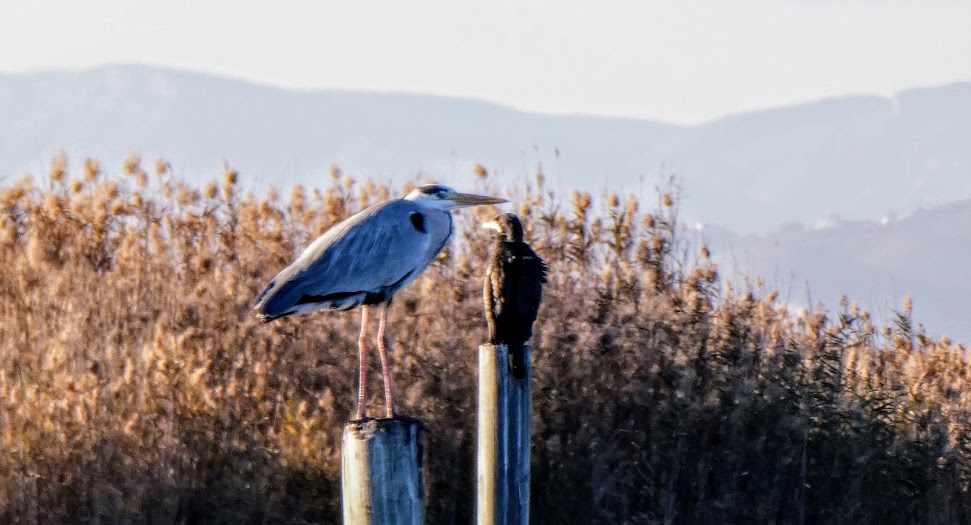
I was quite amused a while back while at our local nature reserve, watching an egret and a heron occupying the same patch of shallow water. They were both fossicking about feeding in a desultory sort of way, and they simply didn’t seem to see one another. They passed so close to each other from time to time that a cursory glance might have seemed in order. Nothing. Here they are:
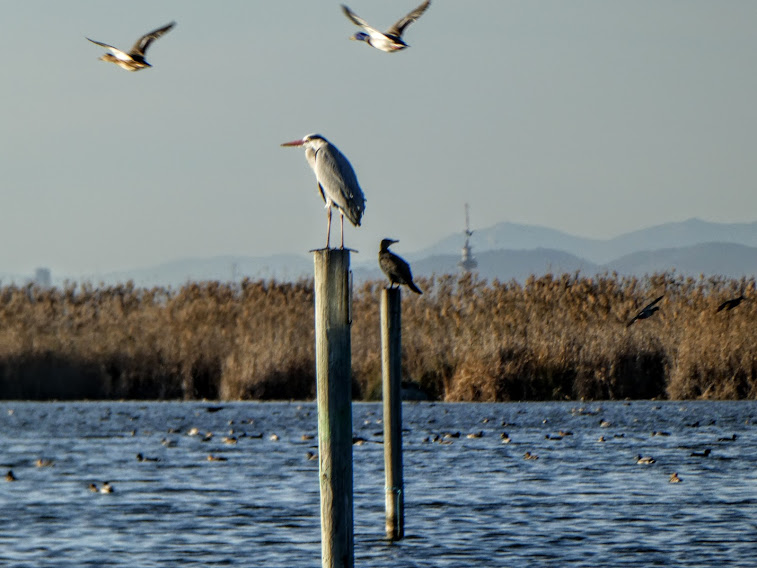
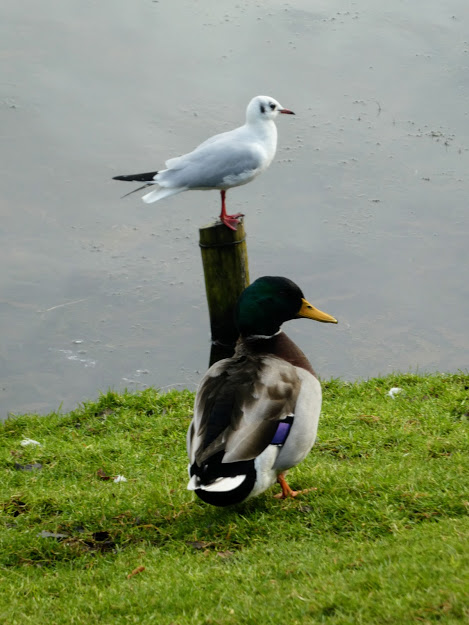
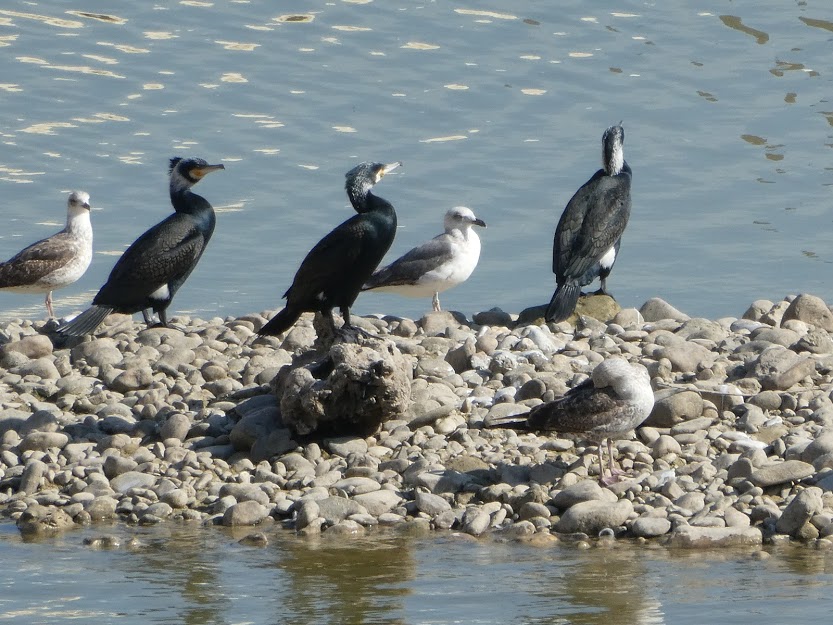
Here are a few more unrelated birds showing they really have no interest in each other at all.
Another heron, and a cormorant, at L’Albufera near Valencia
Same place, different view.
A herring gull and a mallard ignore each other at Studley Royal
We have a friend whom we’d never have met if she hadn’t started following and commenting on my blog, years ago when Malcolm and I were in France. But we’d never visited her home in London. The other week, with our London family in school, nursery or at work, we put that right and travelled to Ladbroke Grove, where we had an interest -packed day illustrating so well why while I no longer wish to live in London, it’ll always be a city I love.
Take her street for example. It was built in the late 19th century by speculative builders hoping to sell to the monied middle classes who could afford live-in servants. There were gardens, front and back, and both had one or more carefully chosen trees, which gave a pleasing unity to the street. Trees grow, as we know, and now the roots of many of them are presenting problems.
Almost every other builder in some parts of London was in on the speculative building, so the houses failed to sell. They were carved up in different ways into apartments, right from Day One. They found a ready market following the building of the Hammersmith and City Tube line, which first went from Farringdon to Paddington but then was extended both east and west. This created an immediate client base in urgent need of somewhere to live. These were workers in the City, clerks mostly, on relatively lowly salaries, some single and some with families, who could for the first time take cheap and reliable public transport into the City rather than walking. So the houses were hastily subdivided into flats and rooms, where the tenants probably shared the bathrooms that were originally built for the house as a whole, usually two per house. The subdivisions were probably very basic, maybe with curtains sometimes rather than walls. Now the street has spacious and gracious apartments in the main but there’s a real social mix. Apartments can change hands for over £1 million, while other buildings belong to Housing Associations who let out their premises on more modest rents.
Street view from our friend’s window
The whole area reflects this trend. From her bedroom window, our friend can see the shell of the notorious Grenfell Tower, scene of the disastrous fire of June 2017 in which 72 people died. The residents of 129 flats lost everything and were rendered homeless and deeply traumatised. We left her flat and began our walk on the social housing estate it formed part of, Lancaster West.
Grenfell Tower
Discreetly sleeved as investigations continue, it overshadows the area, actually and metaphorically. Tributes, graffiti – the angry, the political, spiritual – seem to gather in certain spots: in a memorial garden; under a flyover; round closed-because-of-Covid small workshops.
A small part of a memorial graden
Almost randomly, a few rows of once-humble terraced housing remain: no longer humble, but commanding large prices: perhaps because they’re traditionally built, with a small garden on an individual, human scale.
We were on our way to once notorious areas of poverty – the Piggeries and the Potteries. Well, the Piggeries are no longer there – they’ve been flattened to make an attractive urban park. The Potteries are represented by one single remaining pottery kiln, which used to turn out the simplest of wares for the working population. Here it is:
And it’s close by something else that no longer exists: the Hippodrome Racecourse. Built in 1836, it was intended to rival Ascot or Epsom. But what with its crossing old-established rights of way, the heavy clay ground being prone to water-logging for much of the year, and any number of smaller disputes, the last race was run in 1841 and the owner declared bankrupt. All that is left to commemorate it are a couple of street names: Hippodrome Mews and Hippodrome Place. These have very narrow pavements. Best that way – the area was notorious for pick-pockets, so squeezing them out seemed a good idea.
Cheek by jowl are houses that were and are intended for the well off. Through the gates of one, we glimpsed a quirky statue. Then on again, past graceful terraces, This part of the neighbourhood has a few shops, but ones more likely to sell must-have accessories for dogs than a late night pint of milk and pack of digestives.
An intruder? No, this figure has definitely been invited.
We were off now to the market areas – Portobello Road has long been famous, but a victim of its own success, is something of a tourist trap, so we passed it by in favour of Golborne Road. On the way we passed a former monastery, now the Instituto Español Vicente Cañada Blanch, an international school using the Spanish curriculum for children from 5 – 19. The Portuguese, among many other nationalities, have also colonised this area, and we wanted to lunch at the Lisboa Patisserie for a slice of Portugal in London. No luck. Already too full, under Covid regulations. Instead we went to Café O’Porto, also Portuguese, but full of Moroccan customers. Toasted sandwiches had of course to be followed by pastéis de nata.
As we walked homewards after lunch, we had a glimpse of Ernö Goldfinger’s 31-storey Trellick Tower, built as social housing in the style of Le Corbusier’s Unité d’Habitation, is a well-known and well-documented brutalist building, and loved and loathed in equal measure since it was built in 1972.
Trellick Tower
And that was almost that. Time for home. There was just time to take in a little street art. This:
And the featured photo shows – not actually street art, but a work composed entirely of bottle tops – which we saw earlier in the day.
And this, by Josephine Hicks, aka Hixxy. It was painted for the London Street Art Festival, and features Claudia Jones, founder of the West Indian Gazette, London’s first major Black newspaper.
I haven’t done justice to our friend’s tour of her own neighbourhood, partly because I was still lacking my camera, and my phone battery seemed unreliable. But this post is written for me as much as for my audience, to preserve memories of a rather special day.
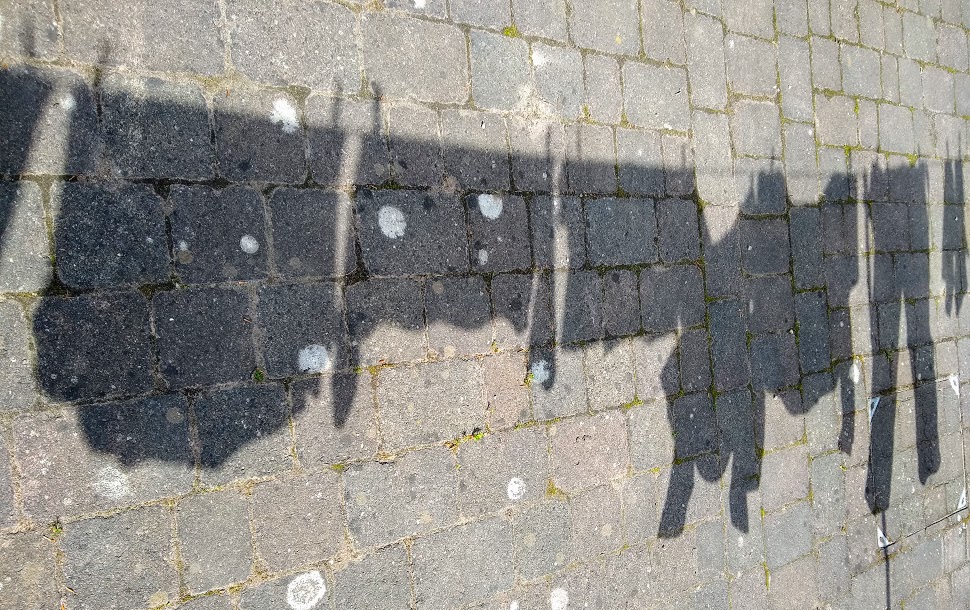
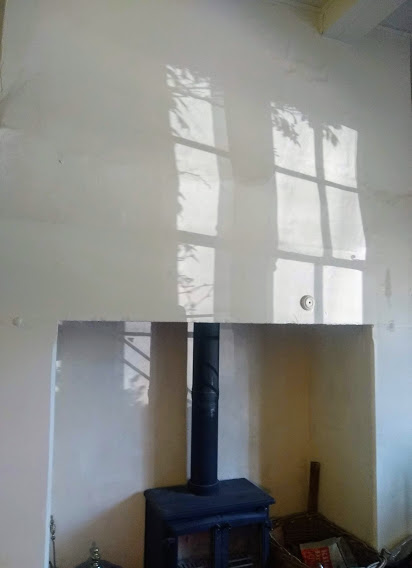
Poor old window. Poor old washing line. They each wanted their five minutes of fame as a Monday Window, and as a Monday Washing Line. And instead their shadows grab the limelight.
If you want to know why the window seems a bit curvy, that’s because the wall it’s projected on is pretty old. Vestiges remain from the days when it was first built, in the 15th century, for lay brothers from Fountains Abbey who lived and farmed here.
‘On the first Saturday of every month, a book is chosen as a starting point and linked to six other books to form a chain. Readers and bloggers are invited to join in by creating their own ‘chain’ leading from the selected book’.
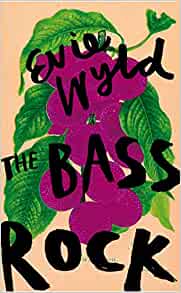
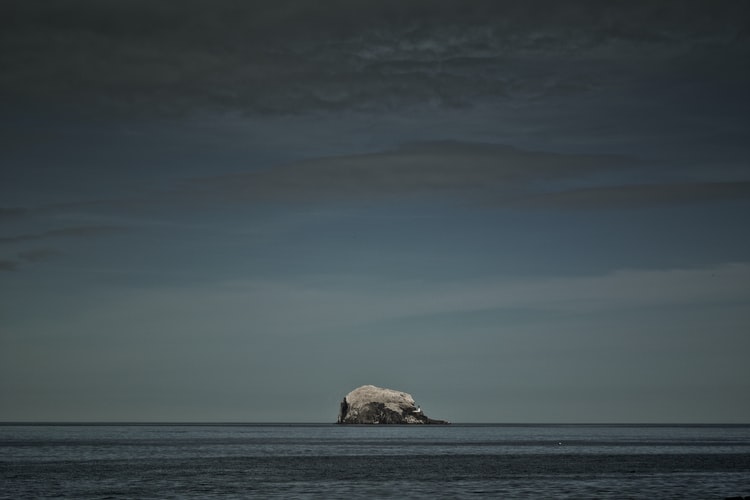
Bass Rock by Evie Wyld is the starting point this month. And, despite all the rave reviews, I’ve abandoned it for the time being – though not for ever, I hope. It’s about sisterhood, about survival. But it’s also about how women’s lives can be circumscribed, in ways big and small, by the men who seek to control them. And this is the link I chose to begin my chain.
Bass Rock: Chris Flixen, Unsplash
Jill Dawson‘s The Language of Birds is a fictionalised account of a family nanny, murdered by Lord Lucan, a story that ignited the British press for months in 1974. Fictionalised, apparently, to protect the many characters in this story who are still alive. This book is a page turner. Mandy the nanny comes across as a warm, likeable person, despite the very difficult circumstances of her childhood, teenage years and young adulthood. Her friend Rosemary, who plays the part of slightly unreliable narrator for part of the story is the vehicle for recurring imagery about birds and the freedom they seem to enjoy.
There’s much to savour here about the portrayal of 1970s England, about class, about mental illness and domestic violence. It’s worth reading for this alone.
Lord and Lady Lucan: the Independent
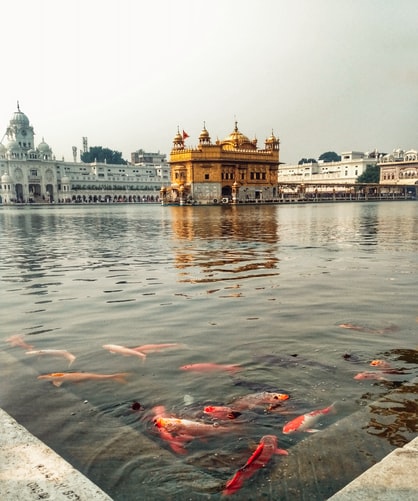
The next link is not a murder, it’s a massacre. And it’s a true story: The Patient Assassin, by Anita Anand. This book has as its core the shocking 1919 Amritsar Massacre, which saw hundreds of innocent Indian families shot at and killed or injured at the behest of Sir Michael O’Dwyer. Twenty years later, in a shooting that had been all those years in the planning, he himself was shot and killed by Udham Singh.
This is the story of that massacre, and of these two men. It’s meticulously researched and involvingly told, and gives a vivid and unappealing picture of the British occupation of India, as well as of the lives of Indians who had gone to America, and specifically England, in search of a better life. This book does much to explain the wider history of the period, and it’s one I’m glad to have read.
Prerna Sharma: Amritsar, Unsplash
We’ll stick with death, but lighten the mood. Mrs.Death misses Death by Salena Godden. An allegory, a story, an anthology of poems – this book is all those things. Mrs Death is an unnoticed (of course unnoticed!) black woman, by turns a bag lady or a charismatic starlet. Wolf is also black, a lad who lost his mum in a Grenfell Tower- like fire. This young man is the person to whom Mrs. Death transmits her stories of heroes, historical figures, ordinary people, whole swathes damaged by war and famine. But death has to happen so life can go on. Lyrical, poetic, sometimes funny, this is a book impossible to categorise, but it’s life affirming too, and ultimately optimistic.
The fire at Grenfell Tower, Natalie Oxford, Wikimedia Commons
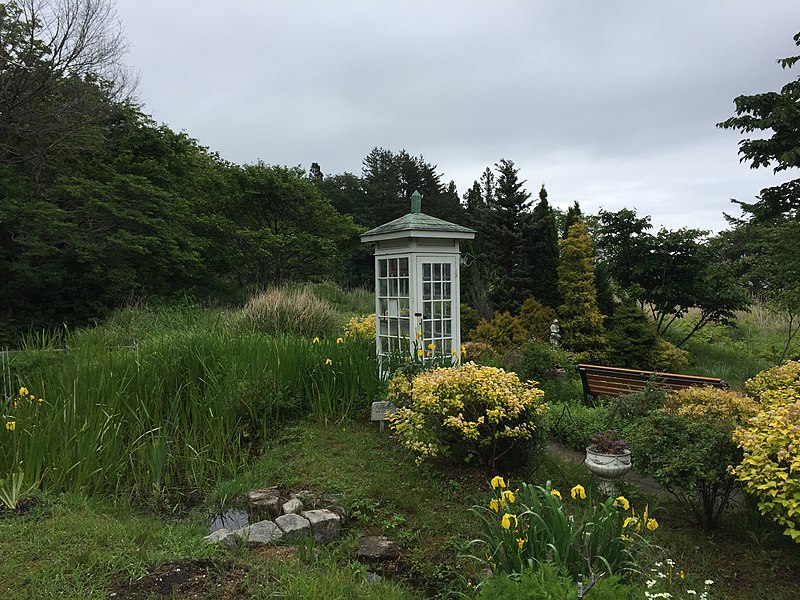
And – oh dear, death again, but this book is like the last, ultimately uplifting. Laura Imai Messina‘s The Phone Box at the Edge of the World. Here, in a garden in a remote spot in Japan, a disconnected phone allows the grief-stricken to send their voices into the wind as they talk to those they have lost. Yui lost her mother and daughter in the 2011 tsunami. Tasheki’s wife is also dead. Slowly, gently, these two forge a relationship, and begin their journey of healing together. Each chapter is interspersed with random fragmented memories, which enrich the story and ground it in reality, giving just a little grit to a tale that might otherwise be just a little too other-worldly. And apparently, this phone box really does exist.
Matthew Komatsu, Wikipedia
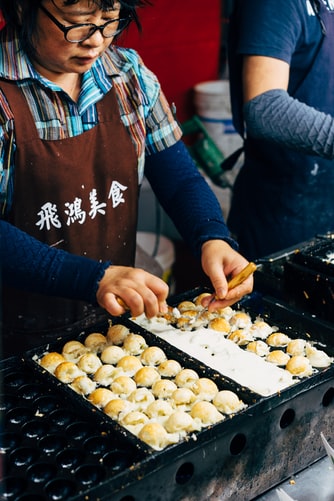
That’s enough of death. But we could stay in Japan perhaps? Sweet Bean Paste by Durian Sukegawa. Meet Sentaro, a bit of a loser who has a humdrum existence making and selling sweet bean dorayaki for his snack-shack. They’re not the best – he cuts corners. Then along comes Tokue, a spectacularly ugly old woman who begs him for a job, and finally he gives in. She introduces him to her highly superior sweet bean paste, and business looks up. He learns that she had been incarcerated in a leper colony for much of her life- hence her deformities – though she is no longer infectious. This is their story – one of confronting prejudice and your own demons, and in which they come to learn that being a useful member of society is not the be-all and end-all. A charming and lyrically written story, if perhaps a little sentimental for hard-bitten English sensibilities.
Japanese Cook, Markus Winkler, Unsplash
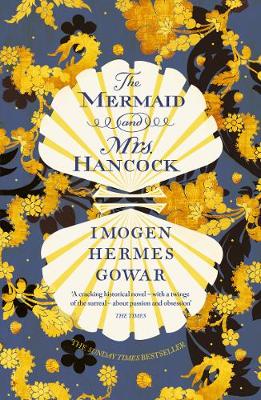
Here’s another book about a meeting between two people who ordinarily would never meet. The Mermaid and Mrs. Hancock by Imogen Hermes Gowar. What a romp! I galloped through this story set in eighteenth century London, in which a decent-but-dull merchant – a widower, meets an indecent-but-colourful high-end courtesan. They’re connected by a ‘mermaid’, which was brought back on one of the merchant’s ships and is exciting the curiosity of Londoners. Gowar has done her homework, and the language, the scene-setting all ring true. This is a totally implausible narrative which I swallowed cheerfully and willingly. The perfect antidote to pandemic routine, despite shades of dark intruding towards the end.
London Mews: Bruno Martins, Unsplash
I’ve just noticed another link in this chain. All the authors are women. No. That’s not true. Durian Sukegawa isn’t. But his translator is. Without Alison Watts’ efforts, I could never have read this book .
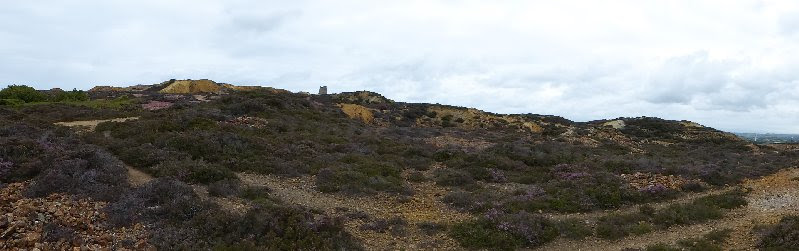
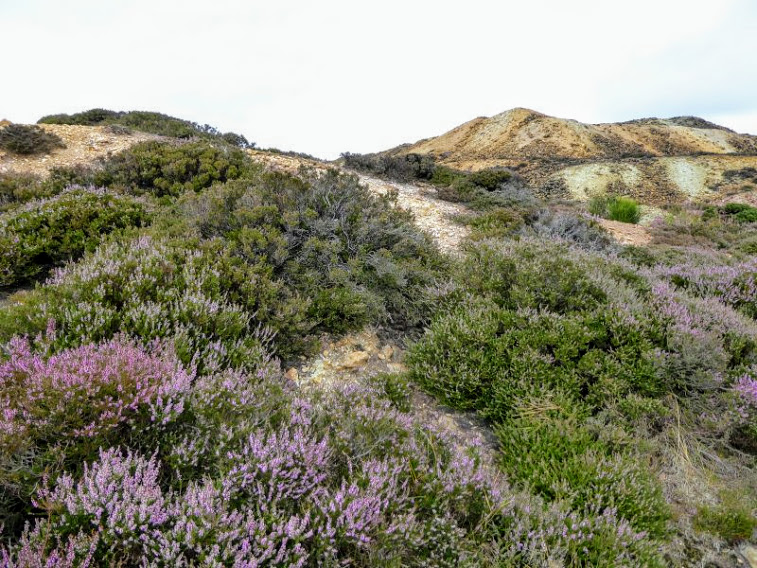
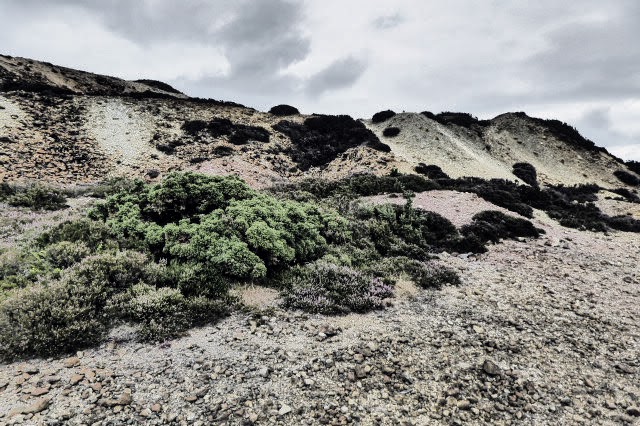
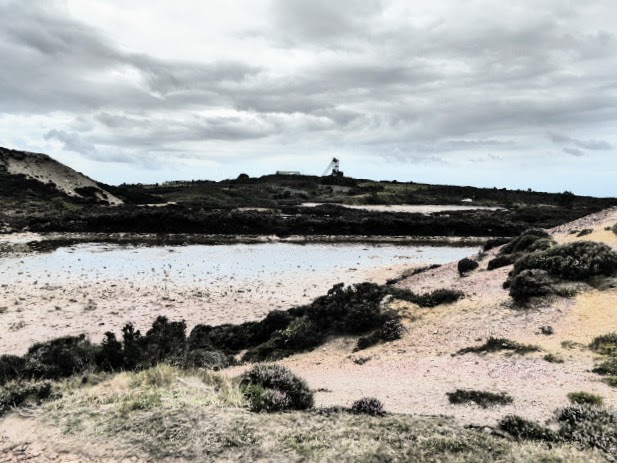
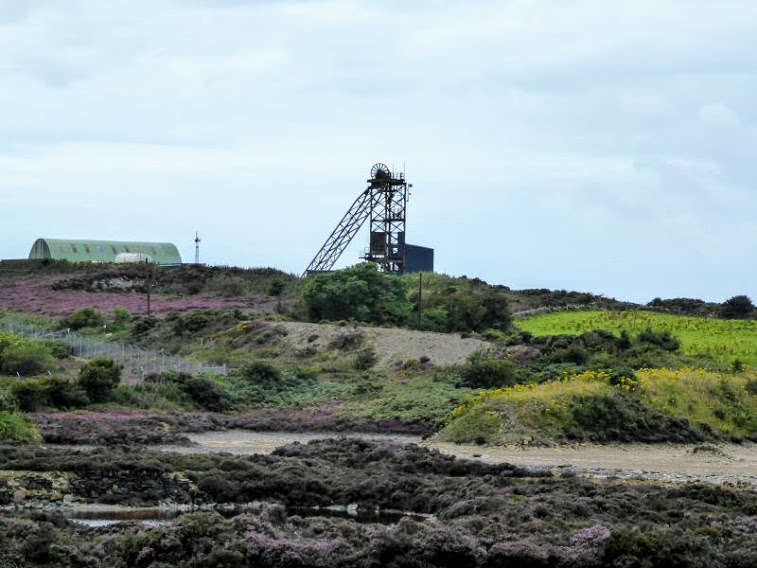
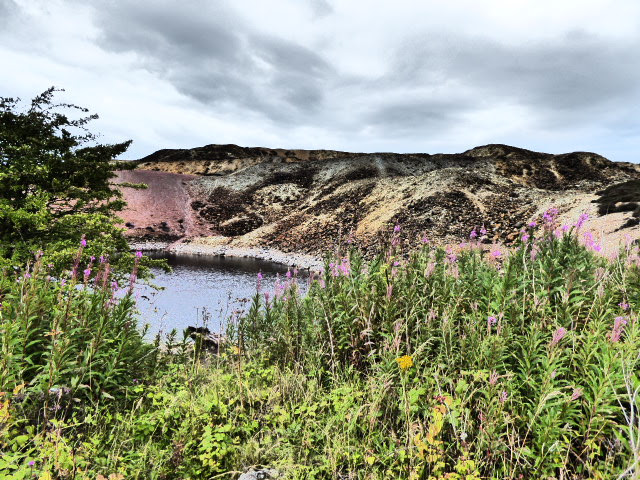
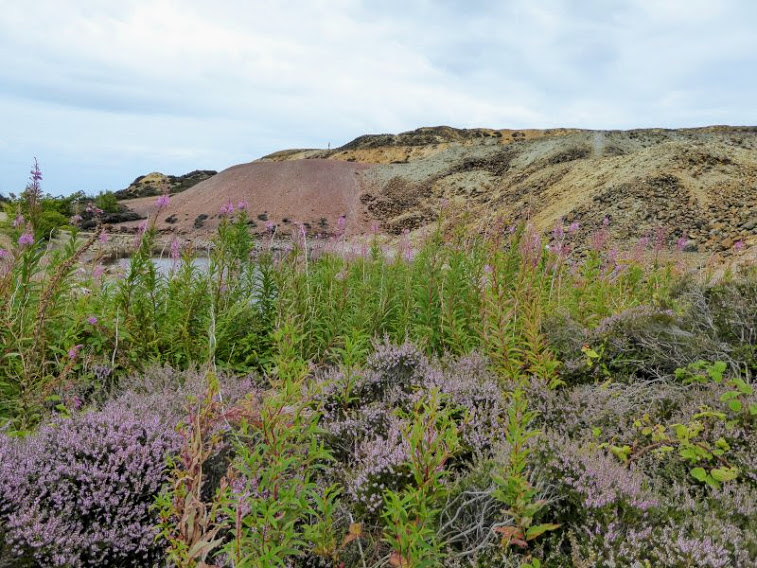
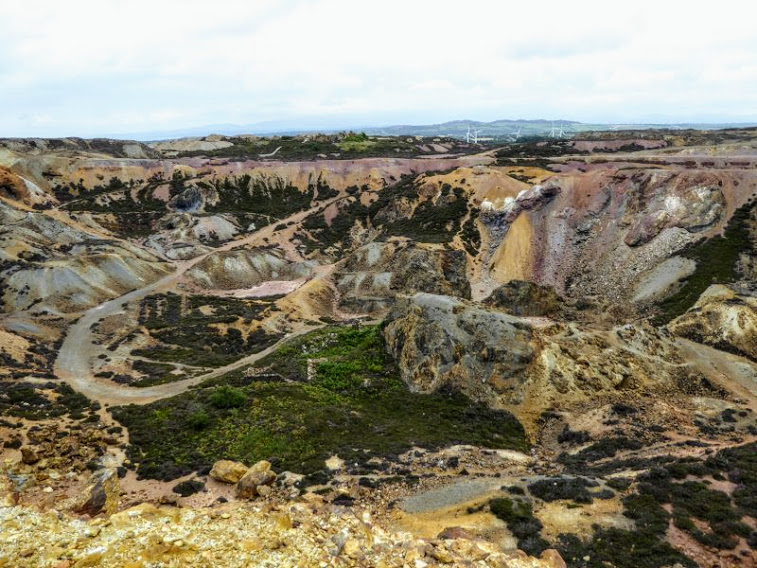
The Lens-Artists Photo Challenge this week invites us to consider wild landscapes, untouched and unspoilt by the hand of man. I’m going to break the rules (no change there then). I thought a lot about what to showcase, but suddenly had a Eureka moment, and remembered a holiday in Anglesey, off the coast of Wales, some years ago. Anglesey is bucolic, pretty, with mighty seascapes as well. But in the far north of the island is something else, Parys Mountain.
Once, a century ago, Parys Mountain was alive with people: men, women and children hacking deep clefts and canyons into the earth, in search of copper-bearing rock. Now the area is bleak, desolate, abandoned. The poisoned sulphurous soil supports little but odd clumps of hardy heather. Yet this large site, with just a single set of abandoned winding gear, a single ruined mill is strangely beautiful, elemental, and we fell under its atmospheric spell.


























You must be logged in to post a comment.