We’re in England. We’ve been here nearly three weeks, and so busy catching up with Those Twins in Bolton and friends in Yorkshire that blogging has quite simply not been on my agenda. But here we are in South Gloucestershire with daughter-in-law’s parents: there should be a name for this particularly satisfying relationship as it’s one we enjoy and appreciate.
On Friday they took us to Westonbirt Arboretum. If you’re spending a few days round Bristol and Bath there’s no better place to recharge your batteries. You could pass the morning in the Old Arboretum, a carefully designed landscape dating from the 1850’s. There are something like two and a half thousand varieties of tree – 16,000 specimens in all, from all over the world, planted according to ‘picturesque’ principles of the 18th and 19th centuries, offering beautiful vistas, enchanted glades and stately avenues. After a light lunch in the on-site restaurant you could go on to explore the Silk Woods an ancient, semi-natural woodland, or the grassy meadows of the Downs
It was Robert Holford who designed and encouraged the planting of the Arboretum, back in the mid 19th century. This was a period when plant-hunters were bringing new and exotic species back from their world-wide travels. Holford was able to finance some of these expeditions, and the Arboretum contains many of the specimens his scientific adventurers brought back.
Truly, it’s a magical place. We arrived, let out a collective sigh, and simply allowed stress and worry to fall away. Strolling about, we gazed upwards at trees whose end-of-summer leaves seemed to be fingering the clouds, into copses where we could glimpse others already turning to the ochres and russets of Autumn, and then closely at the trees themselves. It was the bark that caught our attention close up. Smooth and silvery, brown and knobbly, grey and wrinkled, the variety astonished us. Take a look at these. And if you get a chance to visit this Arboretum, at any time of year, then take it.
I’ve got a large collection of recipe books. Despite regular and judicious weeding, the shelves get heavier with every passing year. You know me well enough to realise that Nigel Slater gets a shelf all to himself, which he shares with my latest new cooking best-friend, Diana Henry.
In among are certain stand-alone favourites: Denis Cotter’s ‘Paradiso seasons’ – stylish vegetarian recipes from an Irish restaurateur: Pushpesh Pant’s encyclopaedic ‘India cookbook‘: a reliable guide to quick and easy suppers from Sandeep Chatterjee’s ‘Indian Vegetarian Cookery’: and ‘Persia in Peckham’ by Sally Butcher, a great book to browse through and read, as well as to cook from.
Yet for all that, I find myself increasingly visiting the internet when hunting for new ideas. Any page that is immediately greyed-out by a superimposed advert is banished without further ado. So is any recipe that comes expressed in the cups so beloved of Americans and Australians (A tablespoon of butter? Oh, please no.)
I’m likely to find what I want among the pages of my favourite food bloggers. And here they are, in no particular order. What they can all do is write, and communicate their pleasure in the dishes they make with me, their reader. Perhaps you’ll come to enjoy them too.
Once upon a time, just after I’d left school, I worked in Italy, in Florence. As an au pair living en famille, I had no need to cook, but I remember those intriguing food shops; corn-yellow chickens, feathered heads intact, hanging in long lines from hooks above the counter; vast wheels of parmesan, fragrant hard flakes dusting the counter from the last-cut slice; the salumeria, with dusky cured meats and salamis suspended from the ceiling, and piled into baskets. I remember thick soups of fagioli ad’oglio and the excitement of first eating such simple dishes as soft cushions of mozzarella dressed with tomatoes, olive oil and pepper. Mainstream now, but so exciting back in the 60’s. Rachel’s blog puts me back in touch with those days.
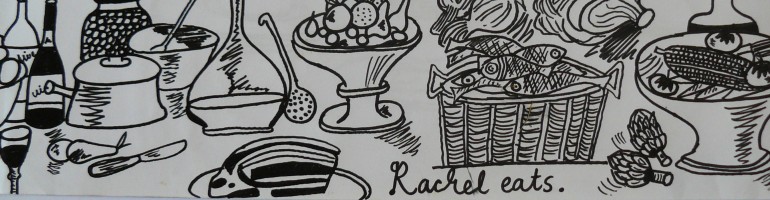
Rachel is a young English woman living with her small son Luca in the Testaccio district of Rome. I think perhaps she chooses to lives there, in Testaccio, as much as anything because of its busy daily market, with its stalls of just-picked vegetables and fruits, its fresh local cheeses and cured meats all sold by the people who’ve grown and produced these goods. Back home, she transforms what she’s just bought into simple tasty and achievable recipes which I always want to cook the second I’ve read about them. If ‘slow food’ is the motto you live by, Rachel’s your woman, because she’ll always point out that so many of the dishes she enjoys require time to develop a range of complex flavours, though otherwise not too much effort. Here’s the last dish of hers we enjoyed.
I think that Kath is the less-than-ordinary cook I aspire to be. Like me, she learnt from her mother – my earliest cooking memories are of helping to chop up candied lemon and orange peel for the Christmas cake, aged about 4. Like me, her cooking school was family life. Like me, she enjoys it when her children cook with her. Unlike me, she seems to be able to get away with cooking a lot of cakes and puddings: I like to make them, but taking 2 slices out of a whole cake before it goes stale isn’t a great idea. Kath is always keen to try things she’s never embarked on before, such as making her own butter. Any woman who provides a recipe for damson ice cream gets my vote. She’ll tweak a standard favourite and make it into something new: gooseberry and elderflower cheesecake comes to mind. There’s a lot of baking, but also plenty of ideas for inexpensive tasty main meals such as chorizo, lentil and bean stew. Good stuff.
Vegetarianism is by no means mainstream here in France. It’s seen as cranky, even. Outside the big cities, you’ll struggle to find a restaurant offering meat and fish-free main dishes (so take a bow, le Rendez-vous at Léran, for your daily vegetarian choice). On a domestic level, the vegetarian diet here tends to be … well …. brown. ’70’s retro, really. Lentils and chick peas, tasty items in themselves, tend to be offered without the revitalising additions of brightly coloured vegetables or zingy spices. How I long to thrust Natalie Ward’s blog in front of French vegetarian cooks. Here is what she says on her ‘About…’ page:
‘This blog is to share our enthusiasm for fantastic food with a world flavour. Using seasonal produce, grown locally where possible, we aim to excite with global vegetarian cuisine . Our inspiration comes from what fruit & vegetables we see growing while walking the dog in the “campo” in the morning and we hope to share some of the beauty of Andalucia in the process.’
She succeeds alright. She favours fresh, bright yet often quite complex flavours that excite the palate. Almost every recipe of hers that I have cooked has become part of my repertoire. It’s the sort of food I can make for non-vegetarians, who will have cleared the plate and asked for more even before they’ve realised that there’s not a mouthful of meat on offer.
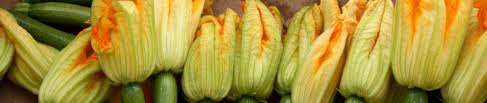
I offer this recipe to those of you who despair over what to do with yet another mound of courgettes from the kitchen garden.
I love London. Why wouldn’t I ? Visiting gives me the chance to stay with my son and daughter-in-law. It gives me chances to expose myself to ‘culture’ with big and small ‘c’s’ of all kinds. And I love shopping there. No not THAT kind of shopping. Food shopping.
Rachel Kelly? Or Marmaduke Scarlet?
I love to nosey round Lewisham, maybe beginning with a rich dark espresso at the noisy and friendly Italian delicatessen, crowded with members of the local Italian community; going on to the Turkish shop; the Polish and Latvian stores; the Caribbean stalls on the market. Then there are Indian stores, various kinds of African ……
Rachel Kelly, aka Marmaduke Scarlet enjoys London too. She lives there. Having a metropolitan address doesn’t stop Rachel from eating seasonally, from locally sourced ingredients, including the wild leeks from her own garden. She celebrates the cultural diversity of London, using ingredients which we poor provincials sometimes struggle to find. She asks herself why some things work best one way rather than another, and wonders how to be creative with those leftovers. She tells a good story. She loves Nigel Slater. She makes me feel hungry as I read her latest post. Really, what’s not to like? You could try this one, maybe.
I hardly seem to need to recommend this. I note that half the blogs I read already have him on their blog roll. A professional American cook and baker living in Paris, he writes wittily about his life in the city and as he travels Europe and the world. I wouldn’t think of visiting Paris now without checking first on the various food shops, bars and restaurants he recommends, and his recipes are worth a go too. Those Whole Lemon Bars: once tasted, never forgotten.
When I was at school, my French text books were peopled by characters such as Jean-Claude, Jean-Charles, Jean-Paul, Jacques and Georges. There were Marie, Marie-France, Marianne, Jeanne and Jeanette.
My own classmates answered to names such as Valerie, Jean, Judith, Janet and Mary while the boys’ school along the road had types like Alan, Norman, Brian, Keith, and inevitably, John.
These names identify us firmly as children of the 1940’s and ’50’s.
So over the last week, on our journey through France, I’ve had fun looking for evidence of the latest trends in French first names, via Coca-cola’s latest marketing scheme of personalising drinks bottles with the current most popular given-names.
Le Jardin Extraordinaire is always comfortingly familiar, yet always surprising. If you’ve been once, you’ll go again, on this one weekend of the year, to enjoy strolling round this very special wild, yet bewitchingly tamed garden. The members and volunteers of Artchoum have been working for months to create this space, just for your pleasure. You’ll want to explore the riverside walk and exclaim at the enchanted place they’ve created with stones, trees and flower petals. You’ll go on to wander through the leafy tunnels and arches tumbling with gourds. Then you’ll amble off into the woods, where more fantastical experiences await you. People come from miles around to explore, smile and wonder at this very special place. But although you won’t be alone, there’s a relaxing feeling of space and of peace too. You’ll go away refreshed, invigorated and joyful.
To see the pictures as a slideshow, click on the first photo to enlarge it and start the show
We were walking in the Aude today, and with every step we took, we realised that harvest season is well on its way.
Sorghum grains for animal feed swelled in fields where last year sunflowers had grown. A few seeds had escaped the Autumn harvest, and so this year a few cheeky sunflowers raised their heads above the more lowly winter feed.
Sunflowers among the sorghum.
Grapes cluster on the vine. They’ve grown almost as much as they intend, but they still have work to do. Most are still a bright acidic green. A few are starting to blush a bruised pink. Some have even achieved a classic purple: but they’re not ripe yet. We know. We tried one or two.
Grren grapes
Pink grapes
Purple grapes
And those fields of sunflowers, Apart from one field’s worth, they no longer look like those cheerful images you see on postcards from our region. Their bright sunny faces no longer track the movement of the sun as it travels across the sky. Instead, they’ve developed a hang-dog look as the weight of their maturing seeds pulls their heads earthwards.
Then there were almonds. We found a few had fallen already, so made a handful of creamy nuts into a small 11 o’clock treat. Walnuts are a different matter. They’re still heavily enclosed in their thick green fleshy coats. It’ll be a few weeks before this protection dries and splits to reveal the ripened nuts within.
A solitary almond
Ripening walnuts
Blackberries in the breeze
Apples? Yes, a few, but they’re still green, with white flesh that browns as soon as it’s bitten into. Blackberries? Hardly any have turned black. They’re still very small and green, or rather small and pink. We’ll have to wait.
So far then, only the hay bales sit plumply at the edges of the fields, ready for winter. The other crops soak up the remaining summer sunshine, fatten, ripen, and wait for the moment when they too will be gathered in.
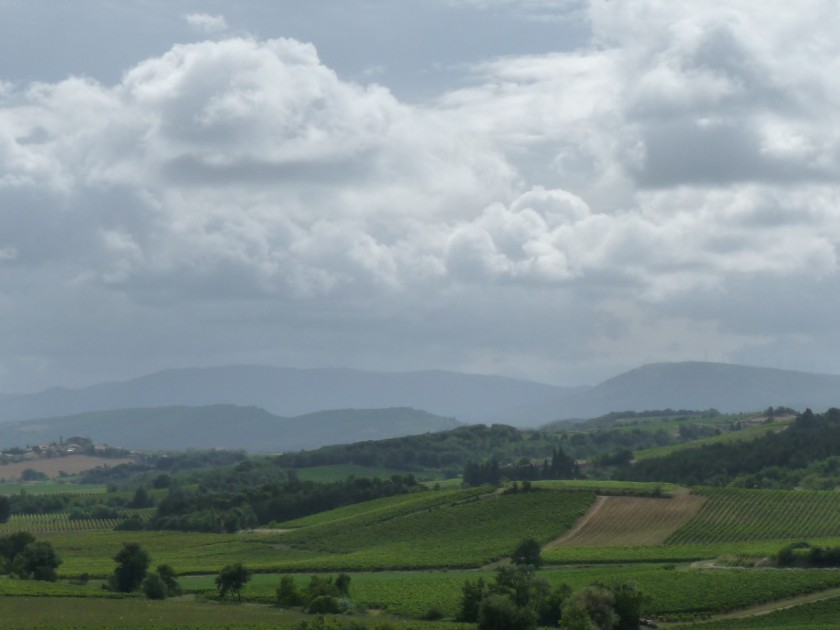
Fields of vines and sunflowers near Villelongue d’Aude
There we were at Roquefixade, showing our favourite walking destination off to two of our Harrogate friends, when a butterfly discovered me. Then another. These two creatures played round my wrist for more than half an hour before finally dancing off into the sunshine. They made our day.
He found Chris first……
… then abandoned her for my wrist.
Then there were two.
I’m thinking they’re the Common Blue (Polyommatus icarus). Any dissenters?
Green-veined white – Artogeia napi? I don’t really think so
Some kind of admiral?
..and another view.
Chalk-hill blue – Lysandra coridon. Or is it?
Their wings seem to get so ragged. They love to gather in their hundreds in damp spaces
So hard to pin down: they were never still for a moment
I’ve never been all that good at butterfly spotting. Back in the UK, I could manage my red admirals, peacock butterflies and cabbage whites. Oh yes, I could certainly identify those pesky cabbage whites. Their eggs were usually plastered over the undersides of nearly every vegetable I had on my allotment.
On Sunday though, we had a real butterfly bonanza. We had a perfect day’s walking on the nearby Plateau de Sault, near Belcaire. It was perfect because the scenery was friendly: gently rising and falling lightly forested slopes offered distant panoramas of the Pyrenees. The wonderful weather was bright and sunny, without being too hot. The walk offered challenges but no real difficulty; good companionship too. What made this Sunday memorable though were the butterflies. At this altitude – about 1000 metres – the summer flowers were still bright and fresh, and the butterflies couldn’t leave them alone. They fluttered ahead of us every step of the way, and we finally gave up exclaiming over their delicate beauty.
What we couldn’t do was identify them. This evening I’ve pored over sites on the internet. I’ve excitedly identified a specimen. Then I’ve looked at the next image… and the next… and realised that my confident identification isn’t at all secure. Tentatively, then, I’ve named my photos. But I rely on you, dear reader, to put me right about the undoubted mistakes I’ve made.
Not a butterfly at all: a Six-spot Burnet, Zygaena filipendulae, a day-flying moth
In the end though, whether I’ve been able to name them or not, I carry with me the memory of a summer’s day made extra special by the presence of those butterflies wheeling, turning, diving and fluttering, rarely still, but constantly engaging our admiration and attention
It’s five years since we were last up there, and it shows. That roof of ours needs a good clean-up, just as much as any other part of the house, because if we don’t…. it leaks. You’d think that a good coat of grime and lichens, with a thick crust of moss nudging at the edges of the tiles would provide a nice impenetrable and insulating covering to help the roof in its task. But no. Rain soaks into the moss, and wiggles its way into the roof space and then our attic. It’s not managed to break through yet, but time is not on our side.
We have a routine. An early breakfast, so we can get as much done as we can before the sun gets too hot. By quarter to 8, we’ve rounded up old pointy knives, wire brushes, lengths of thick wire, softer brushes, knee pads, kneelers, a bottle of drink: and up we climb onto the roof, via our roof terrace.
We’re neither of us wild about heights, me especially. But it’s not quite as scary as it looks. The pitch of our roof is quite gentle, and we can move about more safely than you’d think, though at considerable damage to our knees. We try to divide the roof into work zones and fail. It’s easy to go off piste when one tile looks so much like another. But we both scrape and scratch and pry away at springy cushions of moss, yellow puddles of lichen, odd tile chippings.
A couple of hours on, one of us will say: ‘It’s getting hot. Had enough?’ Neither of us needs asking twice. We each sweep our section of roof carefully, round up our tools and put them away, ease our aching bodies into the shower….. and flop, fit for nothing much at all, at least until lunchtime. Malcolm at least is allowed this luxury. He’s 73, long past the age at which most roofers begin their careers.
We’ve had three sessions already. Might a fourth see the job done?
There’s a series on BBC Radio 4 that somehow I’ve never caught up with on i-player. It’s called ‘What’s the point of….?’ and examines a whole range of British institutions, from the Tate Gallery at the more serious end of the spectrum, to lawns and pubs at the other. Though some right-thinking Englishmen might argue that nothing could be more important than a well-kept lawn and a drink in your local after you’ve finished mowing same.
I have a suggestion for a programme, though the subject that interests me isn’t a British institution. But I really need to know.
What’s the point of horse flies?
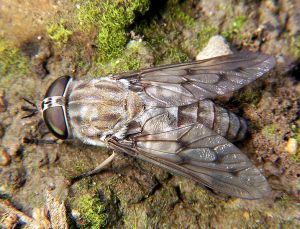
Thanks to Dennis Ray and Wikimedia Commons for this graphic image of a happy horsefly
Out walking at this time of year, some – but not all of us – have come to dread being near horses, cattle or still water. Because when we’re near any of them, we’re likely suddenly to feel a sharp piercing of our skin, as a horse fly eagerly pumps poison into our flesh whilst sucking our blood. It’s not easily brushed away. In the hours that follow, our skin swells, and for several nights, sleep will elude us as we scratch frantically at our fiery, itchy, tightly inflamed skin. These nasty creatures are pretty immune to any repellents, though a cocktail of essential oils such as lavender, melissa and tea-tree sometimes helps. Nor have I found any remedy soothing after the event.
So what are they for? It’s bad enough for us humans, but cattle and horses seem truly to suffer all summer long, as flies of all kinds cluster round their eyes and mouths, resisting all attempts to flick them away.
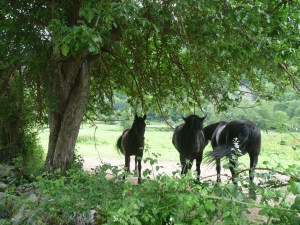
Here be horseflies….
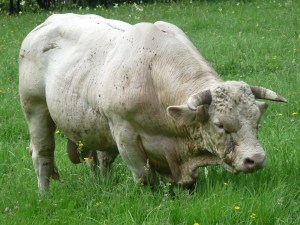
…. and here be horse flies
Apparently they make a tasty snack for a swallow or a frog. I’m sorry, that’s no good. There are plenty of other insects about, so their having a place in the food chain simply isn’t justification enough.
And while we’re about it, what’s the point of ticks? And mosquitos? And another thing. Why do I get so many bites from all of the above while Malcolm, and so many of my other friends, are blissfully immune?










You must be logged in to post a comment.