I think we’ve had enough. When I last posted – three days ago – we’d already had a week of rain. It’s barely stopped since. During the night, we can hear dull thudding as the roof tiles take another sodden pounding. We get up in the morning, raise the shutters, and immediately the rain batters the windows. Going for the breakfast loaf, usually a good way to begin the day, seems unattractive. We make a comforting pan of porridge instead. And so the day wears on. We go out when we have to, but there’s no pleasure to be had in scurrying down the street, heads down, coats spattered by any passing car. And I don’t know when we’ll ever have a country walk again. The fields are waterlogged, the paths sticky and slippery with thick deep mud.
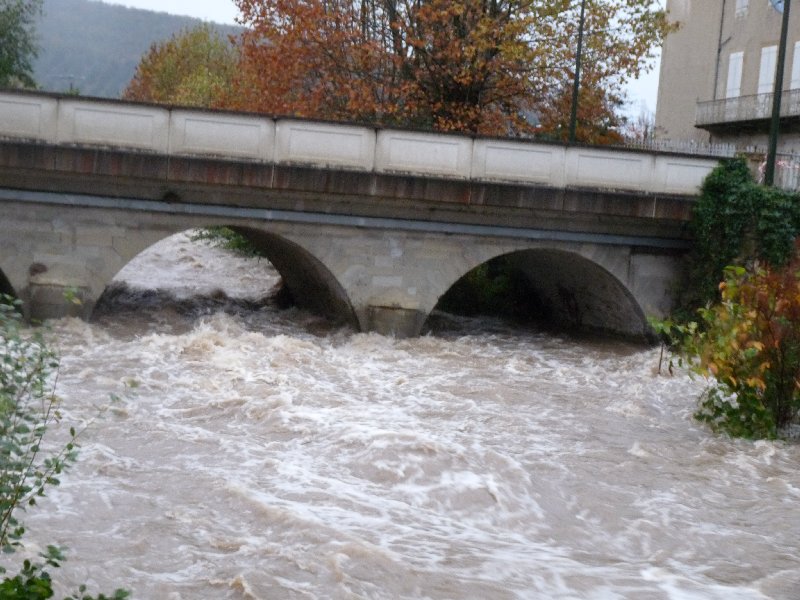
This was the River Touyre this morning at 9 o’clock. In summer it’s a mere stream, idly meandering over the pebbles and stones which line its route. In spring and autumn it’s hardly any deeper, but we’ll spend languid moments watching the trout as they glide serenely in the clear water , constantly on the look out for their next snack.
Today the water was brown, angry, tearing rapidly over the stones which we could hear clattering beneath. It had risen about three feet, covering the grassy banks and invading the garden of the hens who live opposite. They cowered indignantly beside their huts, unwilling to get their feet wet or risk being swept away.
Eight days ago: lunch outside in thin tee shirts: a garden umbrella protected us from the bright hot sun.
Seven, six, five, four, three, two, days ago. Rain. Rain. More rain. Heavy, chilly gusts choking the streets and drains with fallen leaves. More rain.
One day ago. Snow. The first snow – and in advance of the first winter frost too. Not a lot, but enough to rest heavily on fading garden plants, weighing down leaves and bowing stems.
This morning, we knew we’d need to get out early to beat the rain, which was threatening yet again. I didn’t take my camera because I thought the mountains would be shrouded in foggy mist. They weren’t. The lower peaks, and even the much lower hills of the Plantaurel peeked through a thin layer of snow that dusted trees and painted the rocky and grassy slopes a severe white. I dashed back for my camera. Five minutes? Ten? Long enough for the misty clouds to drop down and dump themselves on the snowy hilltops like squashy berets, hiding them from view.
And then, straight away, the rain again. That’s what we’ve had all day, streaming along the gutters, making splashy garden puddles, dripping incessantly from the trees and down our necks as we walk underneath. I continued my early morning walk regardless though, and caught what may be the last few days of Autumn colour, though little enough of the snow, which is there somewhere, under those bonnets of mist and cloud.
Snow on the Plantaurel behind Laroque.
A wet cow: a local cow, a Gascon. They’re used to it.
Mist over the Plantaurel
A neapolitan slice of snow, evergreens, autumnal trees and grass
Those cauliflowers with their crisp, bright creamy curds look so enticing on the market stall at this time of year. They beg to be bought and transformed into something both appetising and full of goodness.
So often they disappoint . That bright white face displayed among all the cheery autumn colours of carrots and pumpkins, and the deep forest green of spinach and cabbage turns a sullen shade of oatmeal the second it’s introduced to a pan of boiling water. Leave it there a moment too long and it’s watery, tasteless and almost slimy.
But there are recipes in which it shines. On a miserable winter’s day after a few hours out in the cold, you can’t beat a plateful of good old cauliflower cheese made with lots of decent sharp-flavoured cheddar. You can get away with Cantal Entre Deux, but not the ready-grated Emmenthal that seems to be the default cooking cheese round here.
My next favourite is Rose Elliot‘s cashew nut korma – very mild indeed as far as curries go, but tasty and more-ish. I’ll adapt the vegetables to what I have in the house, but I’m always sure to include cauliflower. It’s a recipe I try to make a day ahead, because that way, the ingredients sit together in the pan and get very well acquainted overnight. By the time we eat them, they’ve become good and harmonious friends. And I get to use two of the chillies I’ve been carefully growing all summer.
There’s a bit of a theme emerging here: it’s all about comfort food. Perhaps because this week’s been unremittingly horrible. It’s rained and rained, the wind has blown, and then it’s rained some more. A fresh crunchy salad involving fine slices of cauliflower, enlivened by finely chopped herbs and a bright dressing simply wouldn’t hit the spot. Here’s the last suggestion, from Nigel Slater’s Tender, Volume one.
A mildly spiced supper of cauliflower and potatoes
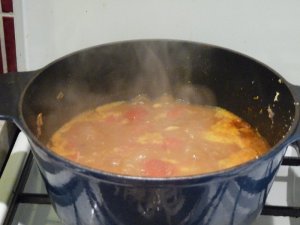
That potato and cauliflower dish bubbling away
Serves 4
Ingredients:
3 large onions
Rapeseed oil
4 cloves garlic
Ginger: a thumb-sized lump
1 tbsp. ground coriander-a tablespoon
2 tsp. ground cumin
1/2 tsp.cayenne
1/2 tsp. ground turmeric
3 tomatoes (or 1/2 tin)
600 ml. water
3 medium potatoes
a large cauliflower
Handful unroasted cashew nuts
6 green cardamom pods
1 tbsp. garam masala-a tablespoon
150- 200 ml. crème fraîche
coriander-a small bunch
Peel the onions, chop one of them roughly, then let it soften with a tablespoon or two of oil in a deep pan over a moderate heat.
Halve and thinly slice the others and set aside. peel the garlic cloves, slice them thinly then stir into the softening onion. Continue cooking, without browning either the onion or the garlic.
Grate the ginger. These days I freeze ginger when I buy it, and grate from frozen. It’s so easy to deal with this way. Add to the onion and garlic.
Stir the ground coriander, cumin, cayenne and turmeric into the onion. Let them fry for a minute or two, then roughly chop the tomatoes and add them to the pan.
Add the water and bring to the boil.
Season with salt and a generous grind of black pepper.
Cut the potatoes into large pieces (as if for boiling) and add them to the pan. lower the heat and leave to simmer for fifteen minutes before breaking the cauliflower into florets and adding to the sauce.
Quickly toast the cashew nuts in a small non-stick frying pan until golden, tip them into the pot, cover with a lid and continue to simmer for fifteen to twenty minutes.
Meanwhile, fry the reserved onions in a little oil in a shallow pan till deep, nutty gold.
Whilst they are cooking, crack the cardamom pods, scrape out the seeds, crush lightly and add to the onions.
Continue cooking for five minutes or so, then, when all is gold and fragrant, remove and place on kitchen paper.
When the cauliflower and potatoes are tender to the point of a knife, stir in the garam masala (the spices in it are already roasted, so it needs very little cooking) and the crème fraîche. Simmer for a minute, then serve topped with the reserved onions and the roughly chopped or torn coriander leaves.
Jean Philippe Turpin and his stall at Mirepoix market last week.
About a year ago, I was doing my regular shopping in Lavelanet market when I saw a new stall. An amazing stall, jewelled with the bright crimsons, scarlets, yellows, greens, purples and blacks of an array of a score or more of varieties of chilli.
It wasn’t busy. The stall holder was holding court to nobody at all till I came along, so we got talking. Mr. Chilli (Jean Philippe Turpin) would have as his mission statement if he went in for such things, ‘passionate about chillies’. He was selling the harvest he had been carefully husbanding all season: mild chillies, warmly scented chillies, chillies with a kick, chillies with a punch, and killer chillies. Nobody was interested.
He knew he had a chance with me, because I’m English. The French, famously, do not like hot spices. Without English customers – not many of us in Lavelanet, but rather more in Mirepoix – he would have had no business at all. I bought quite a selection from him, carefully trying to memorise the properties of each variety, and froze them. They lasted me all winter.
In the spring, he appeared again. This time he was selling chilli seedlings. The varieties were coded from 1 to 10, with 1 being mildest-of-the-mild, to 10: blows your brains out . He had one or two specimens even I wouldn’t touch – 10 + 6. Together with two English fellow aficionados and gardeners, I’d pop to see him most weeks – maybe to buy another plant, maybe only for a few handy hints. He never seemed to mind if we didn’t buy: our enthusiasm won him over and he would spend ages patiently explaining how to get the best out of our precious seedlings.
The season wore on. The seedlings became plants, then fruiting specimens. Now we’ve come full circle. The stall is crammed again with baskets of chillies in every shape and size and colour. Some look like crinkled Chinese lanterns, some like cherry tomatoes, some like tiny black bilberries, while many of course are the familiar long pointed droplet. Now he’s busy producing chilli oil, chilli paste, chilli condiments of every kind to sell throughout the year.
Banner above Mr. Chilli’s stall
He used to live in Paris, but it’s not the kind of place, or the kind of climate, where chillies can thrive. Not in the kind of quantities he was growing them. Even back in those days he had getting on for 50 varieties. So a couple of years ago he looked for a space and a place in the sun, and ended up in a village near here, Saint-Quentin la Tour. He decided to turn his obsession into a business: I think a man who eats chillies for breakfast can fairly be described as obsessed. Mr. Chilli has few rivals. To his knowledge, there is only one other chilli producer in the whole of France, near Béziers. If you visit his garden, with its views over the Pyrenees, you’ll see row upon row of chillies, chillies and more chillies. They are protected from frying in too much sun by a system of canopies, staked to keep them posture-perfect, and generally treated to a firm-but-fair regime designed to encourage self-reliant, hearty, healthy and productive plants. He’ll have harvested the lot by now.
Hundreds and thousands of chillies
Chillies protected from the sun – and storms
So from now on he has a busy period when he’ll swap his outdoor work for indoor activity. He’ll be air-drying chillies for the winter, turning others into chilli-based products, always choosing the best and most appropriate variety for the job in hand.
And the last two times I’ve visited him, I’ve had to wait my turn. Curious customers and would-be customers crowd round his stall, examining all those different varieties, asking questions, making tentative purchases . They’re all French. Mr. Chilli knew he was in for the long game. Perhaps he’s beginning to win.
Our new friend Jenny-from-Bilbao came for a flying visit late last week, so we did a quick Cook’s Tour of some of our favourite spots. Roquefixade, of course, Montségur: and then on a bright Autumnal Saturday morning, we finished off by a quick look at our local lake, Montbel. It’s a man-made reservoir, actually, but it looks as though it’s been there forever, and fish, herons and humans all appreciate its cool expanse of water as a change from all those hills, mountains, rivers and streams.
Those herons
What a difference a day makes. Sunday sulked. It rained in the night, it rained in the morning, grudgingly cleared up, then spent the rest of the day teasing us with odd showers which never quite decided whether to go for a full-blown drenching, or merely hang around as damp atmosphere, cloaking the landscape with fog.
View down over Laroque
How did that get there?
Misty view over the Douctouyre valley
Copse along the ridge
Out of the woods once more
… but not for long.
This young lady welcomed us as we passed her farm
Autumn colours
And some more
Autumn leaves
Our misty wooded path
The view’s largely obscured now
Last lap. Civilisation approaches….
Almost home. This farm’s for sale. Any takers?
Tamed trees. The edge of Laroque
So our planned walk from Croquié, with its promise of stunning views as our reward for a stiff climb was abandoned. Instead we met at 1.00, we hardy types, and Jean-Charles proposed what I thought was little more than a walk round the block. ‘Just up to Tabre, along the ridge and back’ he said. Well, Tabre is the next village along, Mirepoix direction, so that sounded easy enough. So off we went, along a bosky path, through Tabre, up a hilly climb to great views back to Laroque. A long and often muddy forest track took us past further views, over the Douctouyre valley, and circled us over and past the next village along from Tabre, Aigues-Vives. Down we climbed again, and took paths through fields back to Laroque. A fabulous walk, all 15 km or so of it, and almost every step of it previously unknown to us. And we pride ourselves on having got to know our patch pretty well. Thank goodness for local friends who carry on helping us to discover even more.
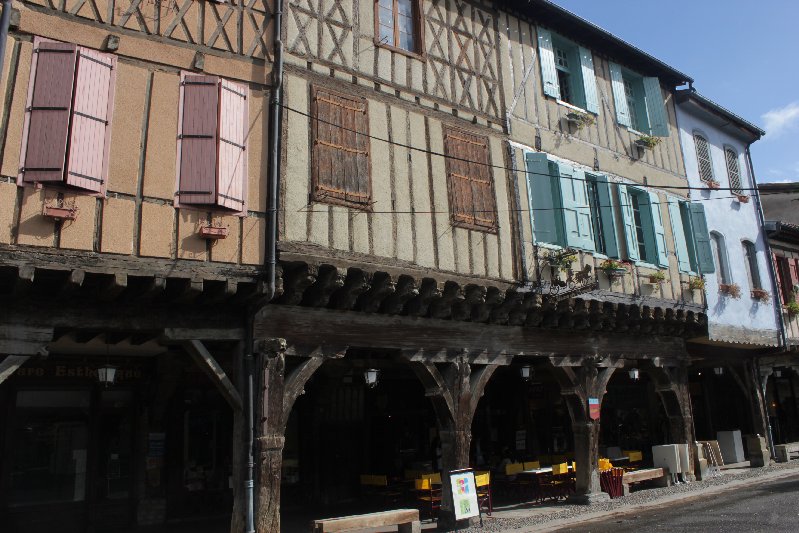
Along the road from us is Mirepoix: the pretty town, the one with the half-timbered houses set round a central square, where it’s good to sit outside with a nice cool beer of a summer evening surveying several centuries of history. A bit of a contrast with shabby old Laroque. It’s something of a Mecca for both locals and tourists, as it has a busy programme of festivals throughout the year, celebrating everything from Jazz and Swing to the apple harvest.
There was new one the other week, La Fête de la Gastronomie. We missed most of the talks, walks, demonstrations and foodie events, what with being in Bilbao. But we did get back just in time to catch the visit to a tiny church in the tiny nearby hamlet of Mazerettes. This was no church guided tour however. We’d come to hear Martine Rouche talk about the fresco there, depicting the feast of Herod during which the head of John the Baptist was dished up. No, it wasn’t an art history lecture either, nor a biblical exposition. Martine Rouche has researched this fresco – one of several recently restored in the church – to help us understand dining and feasting in this part of 16th century France.
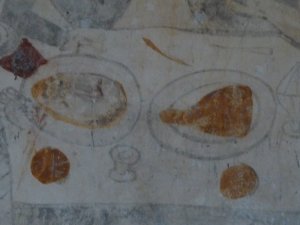
The fresco is dated 1533, so Herod’s feast reflects the customs in use at that date. At that time, there was no special room designated for dining. The host had the table arranged wherever it suited him best, whether it was the main hall or a bed-chamber. In contrast with the fine elaborate costumes worn by the guests, the table itself is quite simply and starkly dressed. Not so many years before, food had been served on ‘tranchoirs‘, thick solid slices of bread. Now, simple round plates were provided.
There weren’t many glasses on the table either. These were expensive rare items still, so guests expected to share . Servants would hover, ready to refill glasses as required, and everyone would drink from the glass nearest them. Glasses didn’t come as a matching set: there were as many designs as there were drinking vessels.
Besides these, there were drageoires of crystal, designed to hold sugar and spices, which guests would nibble at throughout the meal. This fashion for having these expensive and elegant tit-bits spread from Italy through southern France and Lyon , eventually reaching this area.
A drageoire
There were knives. These were personal property. You’d take your own with you and use it both to cut food, and as a means of conveying it to your mouth: no forks yet. Then you’d take it home with you again.
And this curved implement is a furgeoir. You may not want to have one at table yourself. The pointed end is a toothpick, but you’d have used the spoon-like end to scoop out earwax when the fancy took you.
A furgeoir and a couple of plates
Under the table is a nef. Though this one isn’t, such containers were often in the shape of a nautilus shell. The principal guest at a banquet might have one as a sort of superior picnic hamper. He’d use it to keep his knife, his napkin, maybe some spices, and some anti-poison specifics. Later, the nef was replaced by the cadena, which might have several different compartments.
As to the food served, there are few clues here. Apart from the head of John the Baptist, which was not intended to be eaten, there were some sides of ham and other fairly unidentifiable items. More information comes from contemporary receipt books. Local grandee Phillippe de Lévis, who was responsible for commissioning the frescos in the church, also hired patissiers, who of course submitted detailed bills . These confirm what we already know: that the church calendar ruled. Periods of plenty (‘régimes gras’) were interspersed with simpler and restricted ‘régimes maigres‘. Every Friday, Lent and Advent among others were ‘maigres‘ . Meat and dairy products were avoided in favour of simpler, less rich foods. Fish was generally allowed, but for the wealthy, this was scarcely a privation. The River Hers was rich in salmon, and would be prepared with fine and not-at-all-simple spices: cinnamon, ginger, pepper, cloves – and sugar. Even certain water fowl, such as the moorhen – ‘poule d’eau’ – were considered honorary fish.
But outside those periods of abstinence, what feasting took place! A meal might begin with individual tarts, and go on to several courses of salads, fruits, boiled meats, roast meats, sauced meats. From our point of view, the courses differed little from one another. Our clear expectations of the kind of things that might appear as an entrée, a main course and a desert did not hold good back in the 16th century.
It all sounded pretty unappetising. What with sharing glasses, enduring course after course of rich and highly spiced food, it would probably have been a relief to go home . The men at least had opportunities with hunting and other manly pusuits to burn off a few calories. Not quite so easy for the women, I think.
And thank you, Martine Rouche, for a fascinating and entertaining afternoon.
What is there to write about the Guggenheim Museum in Bilbao that hasn’t already been written? What photos haven’t already been taken? Images of this extraordinary site are so widely available that you’re bound to have seen dozens already. We certainly had. Nevertheless, we were unprepared for the impact this quite extraordinary building, surrounded as it is by a giant bridge and dozens of skyscrapers, had on us as we first spotted its titanium hulk shimmering on the other side of the River Nervion.
We spent the day there on Thursday. And partly because photography isn’t permitted within the building , partly because the architecture itself is what we’d gone to see, that’s what I’ll focus on here. That and those few monumental works which are outside the building. It was the Basque government itself that proposed to the Guggenheim Foundation that it would fund a building to be built in Bilbao’s decrepit port area. In exchange, the Foundation agreed to manage the institution, rotate parts of its permanent collection through the Bilbao museum and organize temporary exhibitions. This astonishing investment has paid off, as the museum is in many ways responsible for Bilbao’s presence on the tourist map, and its economic success in difficult times.
Frank Gehry, a Canadian-American was appointed architect. He said ‘So I started drawing fish in my sketchbook, and then I started to realize that there was something in it’. Indeed. Besides the fish – scintillating , titanium-cloaked fish – the building seems like a fantastical ship, or even a fleet of ships. Within, however, the building is organised like a flower, with galleries as petals developing from a central atrium. Bowing over the Nervion, it seems to link itself first to the river, then to the city opposite.
There are a few works outside. There’s Anish Kapoor‘s ‘Tall Tree and the Eye’, mirrored orbs which reflect and dissolve images of the river, the city and the museum itself. There’s Jeff Koons‘ playful, pansy-planted, monumental in scale West Highland terrier ‘Puppy’, a well as his stainless steel multi-coloured ‘Tulips’, buoyant and colourful. Louise Bourgeois’ ‘Maman’ is in fact a mammoth spider on extended, delicate legs. She’s powerful but vulnerable, strong and yet fragile, just like, apparently, Bougeois’ mother. Only Fujiko Nakaya‘s ‘Fog sculpture’ puffing out swathes of mist over the small lake outside the museum did little for us.
If you’ve not been here yourself, Google will put you in the way of anything you could possibly want to know. Here are some of the dozens of photos we took. Click on any image you’d like to see enlarged.
As you walk from the town centre, this is the view you’ll see
Early last Sunday, we were contemplating the week ahead. We expected a pleasant enough few days, entirely devoid of incident.
By late lunchtime, we’d planned the makings of an adventure to Bilbao.
There’s a local information exchange service here for English-speaking residents of the area, and last Sunday, looking through emails, one from the group caught my eye. A woman called Jenny, going to a conference in Bilbao, found that at the eleventh hour, her friend and co-delegate was unable to go. Would anybody like to share her car journey and a small flat in Bilbao for the duration? Well, why not? An email or two, a few phone calls, and the deal was done. Monday morning saw our journey begin with a quick stop-over in the French Basque country.
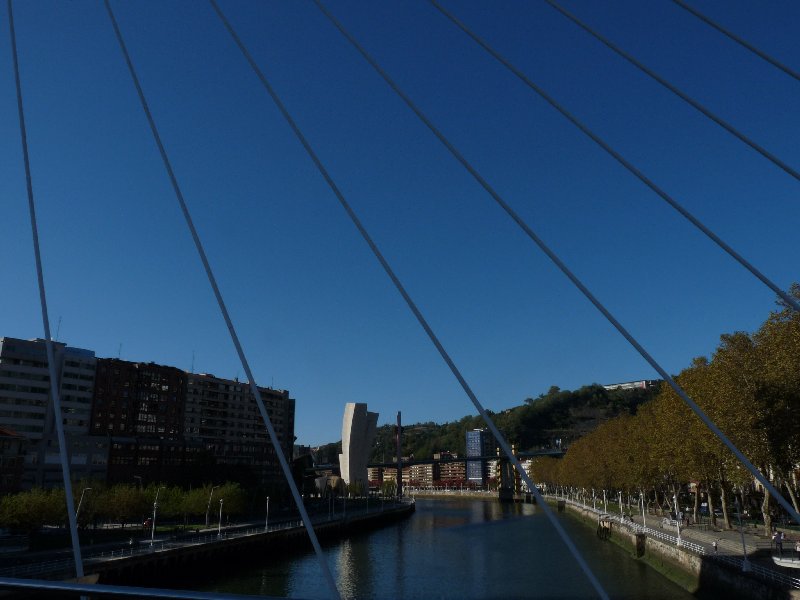
A view of the Guggenheim Museum from the Puente Zubi Zuri
We hit it off with Jenny from the first, and whenever she wasn’t out at her conference we loved spending time with her. The events there enabled her to meet fellow professionals throughout Europe, as she develops her own future plans here in France. Everyone there was enthusiastic to use woods and forests as an educational resource (such as this one that Jenny’s still involved with back in the UK): but it didn’t give her much time in Bilbao itself. So Jenny, these postcards are for you. If others enjoy looking at them too, so much the better.
Bilbao’s a large city, and quite confusing to get into by car. Its history as a port soon becomes clear, though it went through many years as a heavily industrialised city, attracting workers from throughout Spain, thanks to the locally available iron ore. As in so many other steel-making towns of the western world, those days are largely over. Partly thanks to the Guggenheim Museum, of which more in a later blog, and partly thanks to a burgeoning service industry, Bilbao is reinventing itself.
This slideshow requires JavaScript.
The Basque alphabet: thanks to Wikipedia
We were happy to stroll round the centre in the warm sunshine, soaking up the sights and helplessly trying to decode any signs and posters we saw in – to us – unintelligible Euskara, the Basque language. There were the old narrow streets of the Casco Viejo: though the 19th century is represented too, in the elegant square courtyard which is the Plaza Nueva. We enjoyed the later developments along the river and on the other side of the original town. Our flat was on the same bank as the old centre, but so steep are the streets there that we needed the frequent travellators and escalators to help with the climb. Best of all was our journey up on the funicular: a 750 m, but almost vertical-seeming three-minute journey way above the city, to enjoy the views over Bilbao and surrounding countryside.
Journey up on the funicular railway
Don’t look down!
We’ve arrived at the top.
View over the city in bright sunlight.
Another view…..
….. and another
It’s the Alhóndiga I particularly want to share with you though.
Outside the Alhóndiga
Built in 1909 as a wine warehouse, it fell out of use in the 1970’s. Eventually, Philippe Starck was charged with its re-invention. Wow. The interior has been transformed into an atmospheric, dynamic and exciting space. An internal building, almost Romanesque in its severe simplicity houses, amongst other things, a mediatheque and a sports complex. That’s on the top floor. Glance upwards and you can see the eerie outlines of the swimmers ploughing up and down the pool. This interior edifice is supported by 43 squat columns, each different from the other: some are decorative, others reminiscent of ceramic vases, others of Gothic churches… and so on. You’ll want to examine each one. And then enjoy a meal at the restaurant. High quality cooking at modest prices in a cheerful and slightly quirky environment is a fine way to finish your tour.
Entering the Alhóndiga
Pillars
Pillars again
And more….
Look up …. to see the swimming pool
The mediatheque
A reading area in the mediatheque
The restaurant
Anglepoise lamps light the area
Bilbao seems to be a confident city, proud of what it offers. Street and park cleaners (goodness, they even wash the bus shelters) work far into the evening to keep the streets tidy and smart. As night falls, you’ll want to join the locals strolling the streets, stopping at some cheerful bar for a drink and a selection of pintxos (tapas). And eventually you’ll drift off to bed, to sleep off the effects of your busy day and recharge your batteries for the next
Bilbao by night
The station by night
By day, a busy roundabout outside the Alhóndiga. By night, a peaceful place to relax.
A busy bar, a busy street.
Another river view.
Our street at night, the travellator easing the upward journey
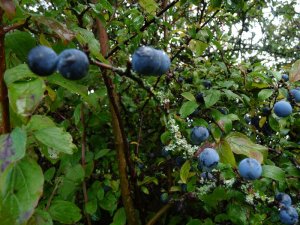
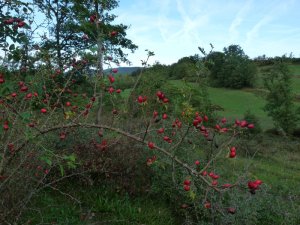
… which are, being translated, sloes, rosehips and mushrooms. But it sounds rather more poetic in French, non? Even if you take into account that ‘gratte-cul‘ translates as ‘scratch-bum‘, because as every naughty school child knows, rosehips seeds are distressingly itchy when shoved down against the skin.
Chapelle Saint Roch
Anyway, I went off by myself for a walk the other day, starting by the ancient and slightly isolated Chapelle Saint Roch. There’s still a pilgrimage there every year, because he’s the patron saint of plague victims, and well, you never know, do you?
I’d got several ‘au casoù‘ bags, ‘just in case’ I found sloes, rosehips and mushrooms. It wasn’t ‘just in case’ really though. I know exactly where to look for the juiciest sloes, the thorniest rosehips, and even a decent clutch of field mushrooms. Finding mushrooms before the French get to them counts as a real achievement for me.
It pays to have tough clothes when you hunt among the scratchy brambles for the sloes and hips nearby
Here are my sloes, destined not for sloe gin this year: we seem to have such a lot left from the last few years. No, this year I’m making a richly flavoured jelly with the fruit I picked that morning and a few windfalls.
Sloes waiting to be picked
And here are the rosehips. It’s a syrup for those, I think.
Rosehips with thorns ready for the attack
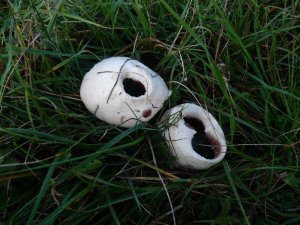
But the mushrooms…… Someone got there before me. And it wasn’t a Frenchman . Grrr.
We keep a mental list of the walks we’ve particularly enjoyed. Walks we’ve treasured for the views, the flowers, the butterflies, the skyscapes, the lunchspot – all sorts of reasons. The only problem is that the walk at the top of the list tends to be the one we did last. There’s no such thing as a duff hike round here.
But last Sunday’s walk is assured a place of honour on this list. It’s one we’ll want to share with you if you come to stay, and we’re keen to do it again ourselves, at every season of the year.
If you drive from here to Mirepoix, you’ll pass through a village called la Bastide de Bousignac. Just after that there’s a road off to the left, signposted to Saint Julien de Gras Capou. Take it. It’ll wind upwards between grassy pastures, home to sheep and cattle and not much else, and finally deposit you in the main street of the village – current population 62. Park near the church, lace up your walking boots, grab your rucksack with its all-important picnic, find the first yellow waymark – and set off.
The village is so-called because back in the 12th and 13th centuries, it had acquired a reputation as being the place where fine fat capons were raised to feed fine people: that’s the ‘gras capou’ bit. I don’t know where St. Julien comes into it. There are hens here still, and in so many ways, the village is perhaps little changed. It’s a peaceful, rather isolated place, despite being so near to Mirepoix and one of the main roads in the Ariège.
Our walk took us along farm and forest tracks, through fields and woodland still splashed with colour from flowers and late butterflies. It was an easy route, rising only gently, passing the tiny hamlet of Montcabirol towards the village of Besset. Shortly after that though, we found we did have a short sharp climb, through the woods, to reach the Pic d’Estelle.
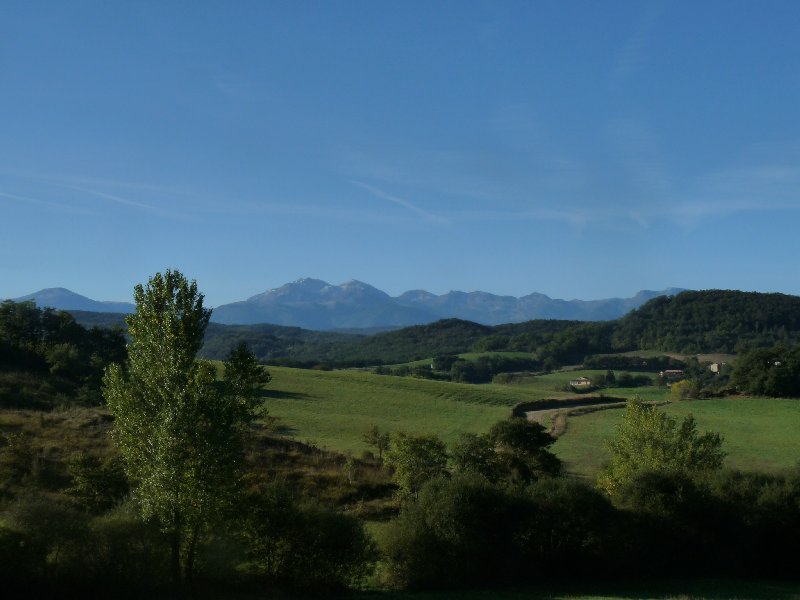
Wow. It was worth it. From here, we had a 360 degree panorama. The chain of the Pyrenees marched across our horizon, its peaks already dusted with snow, or even quite thickly covered in the case of the higher summits. As we turned in other directions, we could see Mirepoix, immediately recognisable from its distinctive cathedral spire, and the Montagne Noir beyond. There are foothills nearby too, across which pilgrims on the Chemin de Saint Jacques de Compostelle still travel: and other sights too – the ruined Château de Lagarde, and its near neighbour the Château de Sibra. We stayed a long time, simply relishing these views, the sky, the silence and peace at what seemed to us, at that moment, the top of the world.
When we finally shrugged on our rucksacks once more, we only had three or four more kilometres to go, along more unpeopled pathways. After negotiating the only obstacle of the afternoon, a group of cows supervised by a bull – we let them get well ahead of us – we were soon back at base. It was good, very good. I just wish my camera could do justice to those peaks. But we’ll be back, in winter, when they’re truly thick with snow
The walk begins
We passd a few fords: here’s a puddle
And here’s what we spotted at the isolated hamlet of Montcabirol
















 From Pyrenees to Pennines
You must be logged in to post a comment.