Eighteen days to go, and entirely typically, I haven’t started my Christmas shopping. I have made the cake, the puddings and the mincemeat though. And today, we made some Christmas presents too. I can’t recommend this panforte recipe too highly: It’s quite hard to make yourself give it away. If you decide to make some for your nearest and dearest, they’ll love you forever. The halva’s pretty good too.
When we first made this recipe, we were in France, hiding from the snow. Now we’re in England, hiding from the rain. You’ll know about the devastating floods that have hit Cumbria. We too have flooding, but nothing like so serious. Closed roads, large lakes where there ought to be farmers’ fields, and mud, mud, everywhere. Just the weather for licking the bowl out after a serious session in the kitchen.
I’m getting a bad case of cabin fever at the moment. The snow is turning to hard packed ice and/or slush and is not much fun to walk on. We’re not getting out much. So I’ve turned to comfort cooking.
About a week ago, my favourite food blogger, David Lebovitz wrote about his take on that wonderfully decadent Italian treat, Panforte. Two days after that, Kalba’s blog dropped into my in-box. She’d been tweaking his recipe whilst hiding from the snow on her side of the Ariège. Today it was my turn- and here’s my tweaked recipe
40g unsweetened cocoa powder, plus extra for dusting the tin
200g chopped toasted nuts- I used the hazelnuts I gathered with some friends early last Autumn, and the last of my walnuts
There I was, in the middle of the morning, chatting on the ‘phone and idly staring out of the window, across the lawn and the newly-bare winter trees.
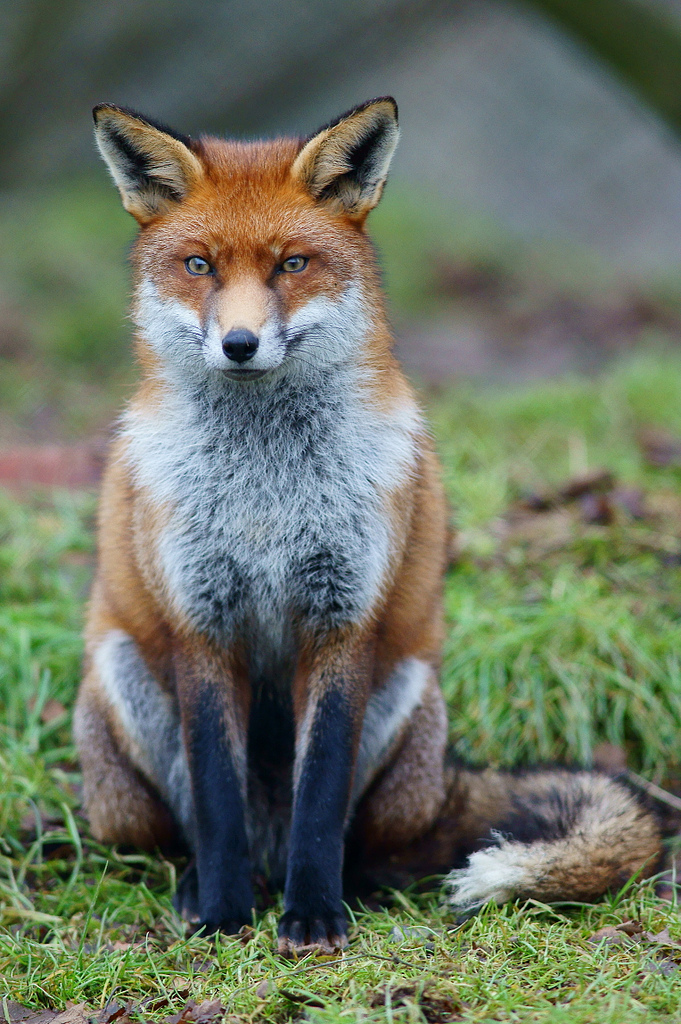
A fox appeared. He walked under the mulberry tree, across the grass, and disappeared into the undergrowth some distance away. He was magnificent. As large as a labrador, with a sleek tawny-red coat, he was very fine as he strolled the full length of the garden, some small item of prey wedged between his jaws.
He was so very different from the urban foxes we see when we go to stay with my son and his family in London. After dark, we enjoy peeping through the curtains, watching them as they prowl up and down the street and stop to examine that unfamiliar car – ours. Compared with our country fox, these urban types are small, with duller coats that are ochre-red, rather mangy and bald in places. But look at what they eat. Our fellow will have feasted on a plentiful diet of rabbits and pheasants. Town fox investigates dustbins and fast-food litter, looking for the remains of a greasy, salty fried chicken meal, or a few crusts of pizza. He won’t starve, but he’ll be pretty ill-nourished.
An urban fox. Wikimedia Commons.
We always enjoy our glimpses of those town foxes in London. But how much more excited I was yesterday when I saw the beast who, unhurried, stepped regally past.
And no. I haven’t got a photo of him. I’d have had to leave the window and miss those few special moments.
I don’t really do dogs. There. I’ve just lost more than half my readership, just like that.
It’s not that I don’t like them though. I can think of few greater pleasures than a tramp over the hills on a cold and frosty morning with a cheerful dog bounding ahead, truffling around the undergrowth and enjoying all the sights and sounds and experiences of a fresh new day.
It’s just that hell can be not other people, but other people’s dogs. You know the sort. The ones that leap up and knock you sideways, muddying your nice clean jumper in the process. They’re the ones whose owners smile indulgently. ‘He’s just being friendly’, they explain. These are the very dogs that may also try to lick your face. Then there are the ones that are left alone and bark, bark, bark, as the dog-next-door in France did. Or the ones that bare their teeth and frighten me half to death. Or the smelly ones.
I think there’s a pattern here. It’s not the dogs. It’s the owners. And I seem to have raised three children who apparently think much the same as I do on the dog question.
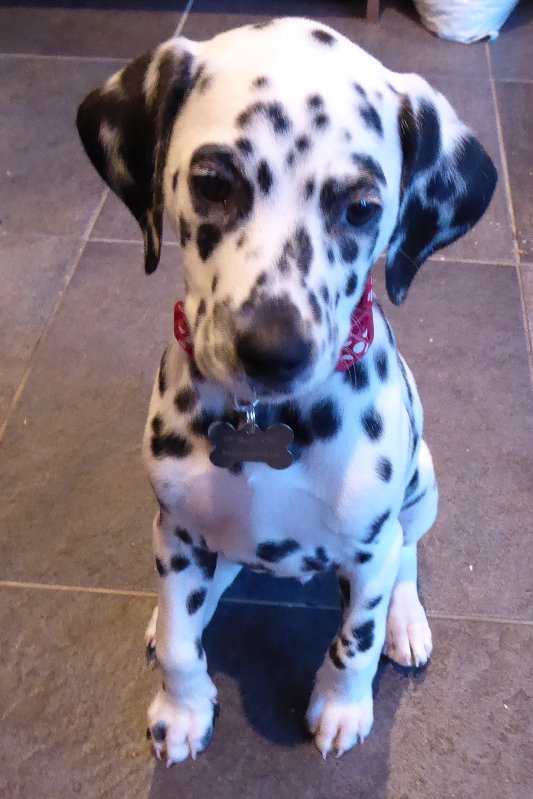
And then, the other week, Daughter Number One announced they’d decided to get a dog. Not just any dog. But a puppy. One that would become a big (ish) dog. An active dog. A feisty dog. A dalmatian. Ellie’s is a family of two busy working adults and ten-year-old twin sons with the sort of after-school schedule for which you need a very large calendar, and a smart phone that reminds you at frequent intervals who has to be where when, with whom, and wearing what kind of kit.
They did their research. They chose and visited a breeder and looked at a litter of ten newly-born pups. And they chose Brian. He’s been living with them for ten days now. This week, we went to stay, and we met him.
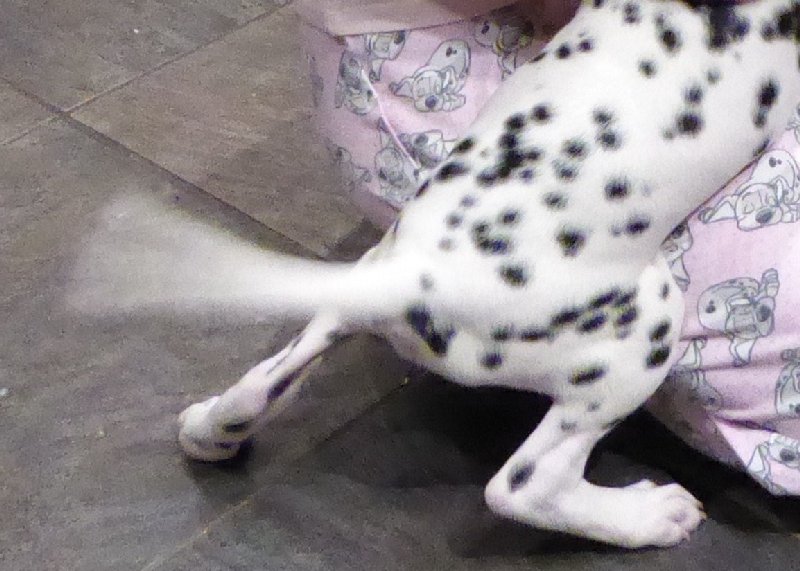
We’re converted. I’ve never in all my life been greeted with such enthusiasm as I was by Brian when I turned up in the kitchen the other morning to get some breakfast. Look at this wagging tail. I remind myself he’d probably have greeted a burglar with equal joy …. but still.
Brian’s so pleased to see everyone in the morning.
He’s charmed us all. But he’s not going to get away with simply being charming. Right from day one, training began. No leaping up on furniture. No leaping up at people. No shoe-savaging. He learned immediately to ‘sit’ on command, and Alex’s first party trick was to teach him to shake a paw. We’re all busy keeping him entertained in these slightly restrictive weeks when he can’t go out and about because he hasn’t had all his jabs yet. But everyday pleasures are enough for this young chap. There’s a garden to explore. Rotting leaves and springy grass. Rustling dried-up autumn plants. Tantalising glimpses of birds. Misty-moisty autumn smells. And there’s a whole tick-box in the training manual to worry about. Checklist: he must meet a baby (no), children of various ages (tick), the elderly (tick), someone in glasses (tick), someone bearded (no), someone in uniform (no), and so on, and so on.
Project Exhaust-a-pup bears fruit.
Dog-training proper starts next week. And then before long he’ll be a dog-teenager. And then an adult, prepared to offer many years of companionship and pleasure to Ellie & Co. and who knows? Maybe to us too.
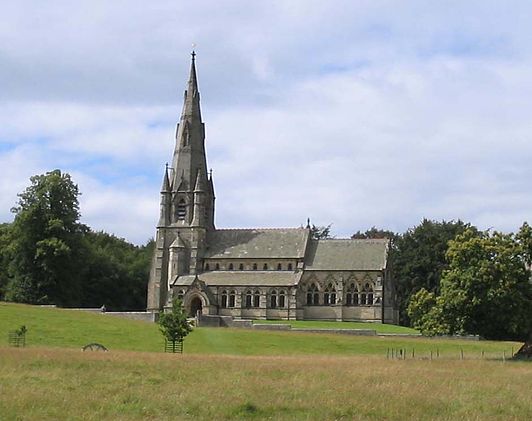
St. Mary’s Church, Studley Royal (Wikimedia Commons)
When I started out as a National Trust volunteer, when I began as an Information Assistant at St.Mary’s Church, Studley Royal, I didn’t expect to sort out a little mystery that’s continued to exercise my brain from time to time, ever since my first and only visit to India, 8 years ago.
Let’s begin there, back in 2007. It was my first day, all by myself, after a night flight into Bangalore. I was far too excited to sleep, and already over-stimulated by a city, busy since well before 6.00 a.m., alive with cows, horses, donkeys, sheep, chipmunks, dogs by the thousand, monkeys, parakeets, eagles …. and auto-rickshaws, always auto-rickshaws, and the unending sound of motorhorns constantly in use on every car and lorry. I’d already allowed an amiable rickshaw driver, who could doubtless see ‘arrived this morning’ tattooed across my forehead, to take me on a conducted tour of the city. We served each other’s purpose. I got a decent sit down and a running commentary in broken English on the city sights. He was probably paid over the odds by a very appreciative customer who knew a decent bargain when she saw one. When I left him, after a thoroughly entertaining morning, I found myself wandering towards London Road. And then Robinson Street. Robinson Street? Who could Mr. Robinson be? I finally found out ….. the other week. If only I’d wandered just a little further on that first day in Bangalore, I’d have been offered a clue. I’d have found ‘Ripon Street’.
My first friend in Bangalore: the rickshaw driver who took me on a tour of the city
Eagles fly above Bangalore
Bangalore street scene.
Fast forward to an early session at St. Mary’s Church, Studley Royal just a few months ago. My fellow-volunteer Frances was taking some visitors round. I tagged along, because Frances has an apparently bottomless fund of knowledge, and a way of engaging her willing listeners’ attention. She’d already told them that the church was the design of a noted exponent of Gothic Revival architecture, William Burges. She’d pointed out several examples of its inventive design, of its richly coloured decorative detail, of its religious symbolism.
Burges famously loved animals. There are 16 of thse parrots.
First glimpse of the richly coloured interior
Starting outside the church…..
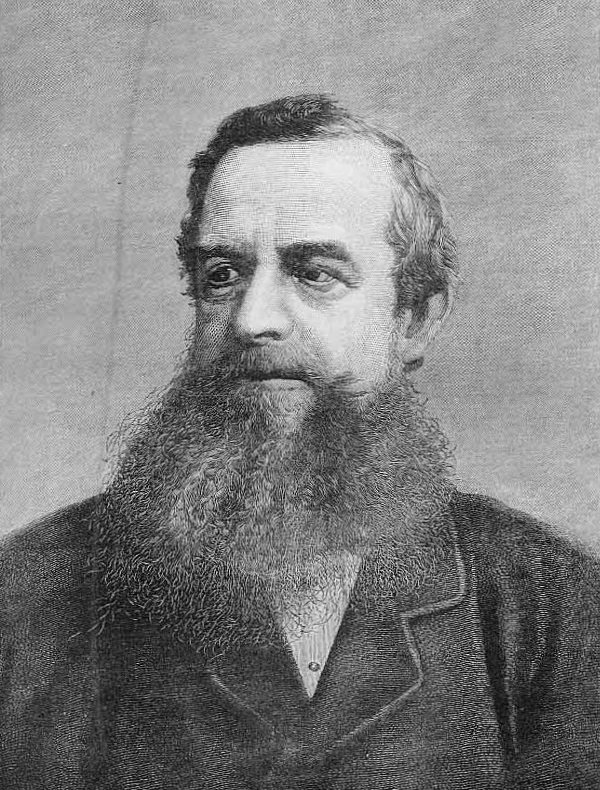
Now she was telling us that it was commissioned in 1870 by the deeply religious Marchioness of Ripon, and her husband, the Marquess. His full name and title was George Frederick Samuel Robinson, 1st Marquess of Ripon, 2nd Earl of Ripon. She thought we might like to know his story. She was right.
The Marquess of Ripon had an impeccable pedigree. He was born in No. 10 Downing Street, and as an adult, served as an MP in various northern constituencies. Shortly after succeeding to the title of Earl of Ripon in 1859, he became first Undersecretary to India, and later Secretary of State for India. From 1868 he was highly valuable in a variety of roles in William Gladstone’s government.
Then, in 1874, he converted to Roman Catholicism. His strong sense of duty prevented him from continuing to serve in government. The Church of England (the Established Church) and state are linked in the United Kingdom. He withdrew from public life.
However, in 1880, Gladstone persuaded him to take the post of Viceroy of India. The Indians grew to honour him: the British rather less so. Here’s why.
He expanded the powers of locally elected Indian governments, and liberalised internal administration. He lowered the salt tax. He gave local language newspapers the same freedoms as English ones, and enacted some improvements in labour conditions. He allowed Indian judges the same rights as European ones when handling European defendants. And he achieved all this in only four years. No wonder Indians felt the least they could do was name a few roads after him.
George Frederick Samuel Robinson, 1st Marquess of Ripon (Wikimedia Commons)
He went on to serve in other capacities before becoming leader of the Liberals in the House of Lords, and died in Ripon in 1909.
So – thank you St. Mary’s, Studley Royal. And thank you Frances, National Trust volunteer. An eight year old mystery is solved.
I’ve loved the Horniman Museum since I was a small child. We would make the long and slightly awkward bus journey there from our home in Victoria, over the Thames at Vauxhall Bridge, through dingy Brixton and elegant and well-heeled Dulwich to spend the day at this special place.
I can’t remember those visits in detail really. I’ve got memories of awe-inspiring and crowded cabinets of strange birds and unfamiliar animals, collected and stuffed many years before: of colourful displays of traditional costumes and artefacts from Africa. Somewhere or another I probably still have the odd sepia-and-white postcard, bought as a souvenir of our day out.
And now it’s set to be a go-to destination for new grandson William. He too will be able to enjoy the bus journey there and back, and a Grand Day Out, as we all did last Sunday.
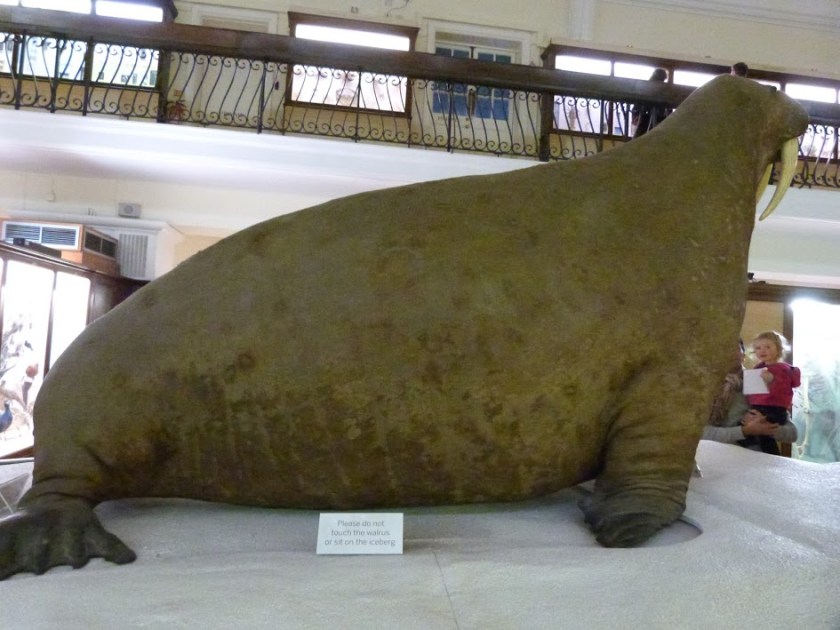
The museum is so much more than I remember from those days in the 1950s. Those collections – and more – are still there. They’re still arranged, particularly the Natural History collection, with a nod to the days when simply everything was displayed, all the better to fascinate you. There’s that wonderful walrus, stuffed by a Victorian taxidermist who hadn’t had the benefit of watching David Attenborough’s wildlife programmes. He filled out the creature full to bursting, not a wrinkle in sight. Everyone loves him.
One very generously stuffed walrus.
But the African Worlds gallery reflects more modern ideas of interpretation. You’ll find, alongside objects from traditional African cultures, more modern artefacts from countries strongly influenced by the African populations that arrived there during the years of slavery, such as Brazil and Trinidad.
A colourful collection of parakeets.
We were keen to see the griffon vulture because we’d seen so many in la Rioja, in Spain.
Ijele: masquerade of the Igbo
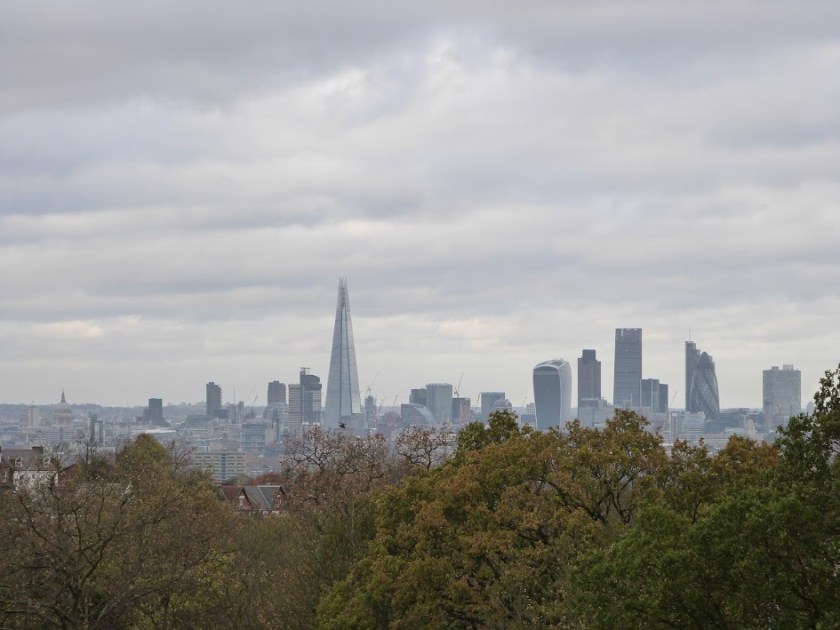
Surely that aquarium wasn’t there 50 years ago? And all those wonderful things happening in the gardens – I can’t even remember any gardens. I can’t remember the spectacular views across London. Even if I could, I wouldn’t remember this view. Look.
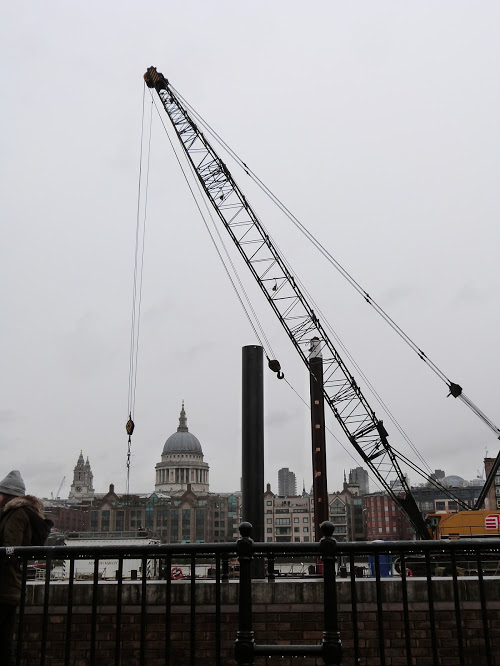
London skyline. If you try really hard, you can find St. Paul’s Cathedral.
I’m sure there wasn’t an Animal Walk. This is where William got the chance to come face to face with an extremely short-legged goat, a large and very industrious white rabbit, a couple of hens and an alpaca. Now there are flower beds showing plants that give us dyes for cloth. There’s an exciting space full of – are they sculptures? No, we can all go and make music there, strumming, pounding, plucking, experimenting. And so much more …. so much more. I’d happily go and explore this wonderful outdoor and indoor site every time we go and visit… and I know William will want to come too, when he’s old enough to have an opinion.
Wandering round the Horniman Gardens.
Music-maker with a view.
Autumn’s not a tidy season. But this is an oasis opf peace in London.
‘Even in 1215 London was an independent sort of a place: rich, well-connected and hard to govern. With nearly 15,000 residents it was already the largest city north of the Alps. Its merchants were organising a mediæval commune to protect themselves against pillaging barons and a taxing King, and its diverse trading population had strong connections to Europe and Scandinavia.
Meanwhile, bad King John was in trouble. He was retreating in France, running out of money and losing control of his Barons. Discontent was turning into open revolt and the King was very short of allies.
In 1215 the King was persuaded to issue a Royal Charter that allowed the City of London to elect its own Mayor. We presume that he gave his blessing to the commune in order to keep the City on his side, but there was an important condition. Every year the newly elected Mayor must leave the safety of the City, travel upriver to the small town of Westminster and swear loyalty to the Crown. The Lord Mayor has now made that journey for 800 years, despite plagues and fires and countless wars and pledged his (and her) loyalty to 34 kings and queens of England.’
That’s a quotation from the official site of the Lord Mayor’s Show. This is not so much a show as a procession that over the centuries recognised the Lord Mayor of London as one of the most powerful men in the country. This may no longer be the case, but in its day the procession was one of the greatest spectacles in the country, worth a mention by the likes of Shakespeare and Samuel Pepys. It’s still the occasion when the new Lord Mayor travels in a splendid coach which, were it to be built today, might cost some £2,000,000 to build.
The new Lord Mayor bravely sticks his head out into the pouring rain to wave at the crowds.
You’ll see city businesses, Livery companies, charities, the armed forces, police, Londoners from every walk of life, marching or on floats reminding us of the complex and varied history of the City of London, a small square mile area at the centre of the now enormous wider city, which is some 607 square miles in area. London has its own Mayor, an elected politician (currently Boris Johnson): please don’t confuse the two offices!
We were in London for a couple of days. Son Tom was singing in a concert with his Choral Society on Saturday evening, and for the rest of the weekend, the five of us, including four-month old William, became tourists. Four month old babies have a habit of imposing their own daily rhythms on the day, so we didn’t arrive for the start of the procession, or in time to secure a very good vantage point. But there were highlights, the last of which was the appearance of the Lord Mayor himself in that magnificent coach, accompanied by halberdiers in their ancient uniforms. Before that we’d seen horseguards, and representatives of some of the great Livery Companies. These were ancient trade and craft guilds. They existed all over Europe as Trading Standards organisations, as trade unions, as philanthropic organisations helping members in times of sickness and infirmity, but those remaining in London are unique in their survival, number and diversity.
The Royal Horse Guards wait patiently to take their place in the procession.
The Honourable Company of Air Pilots.
Not a Worshipful Company.
The Worshipful Company of World Traders.
We have no idea how Yorkshire muscled in.
A splendid coach. But not as splendid as the Lord Mayor’s.
Another splendid coach,
Haberdiers accompany the Lord Mayor.
Avery British sight. An elderly woman waits patiently for the Lord Mayor’s procession to wend its way past her again in …. oh, maybe an hour or so
These days we are charmed by the names of the more ancient Guilds: the Watermen and Lightermen; the Tallow Chandlers; the Spectacle Makers; the Painter-Stainers, the Merchant Taylors: we saw none of those, though they still exist. More recent additions are the Air Pilots, the Environmental Cleaners and so on, and we saw representatives of the Guild of Human Resources Practitioners and of the World Traders. What would Dick Whittington, the 14th century rags-to-riches thrice times Lord Mayor of London, more commonly these days seen in Pantomime have made of them, I wonder?
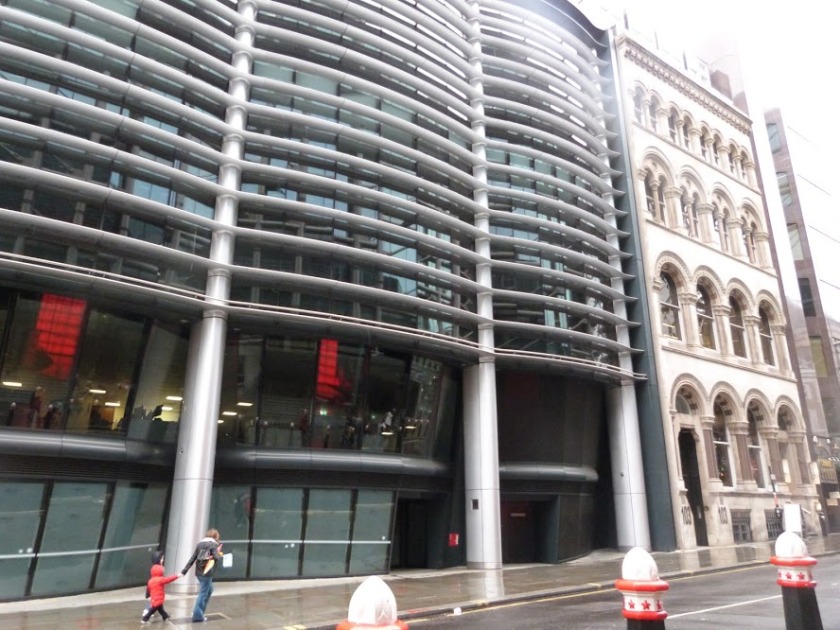
The City of London old and new, seen through the windows of Leon, a natural fast-food restaurant.
I love the City of London. Despite its being home to the Tower of London, to some 4 dozen Wren churches including St Paul’s and a host of other sites; despite its wonderful street names (‘Hanging Sword Alley’, ‘Gutter Lane’, ‘Wardrobe Terrace’), it’s a surprisingly people-free zone at the weekend. I love the dissonant notes as delicate, ancient buidings and churches butt up against stark modern constructions. I love it that these modern flights of fancy in glass and steel are obliged to squeeze themselves into street patterns established in the middle ages, and unchanged even after London’s famous Great Fire of 1666. There’s a surprise around every corner.
New city, old city.
And afterwards, a stroll along the Thames, to see more evidence of London old, London new.
I was out walking near Ripon this morning. For once it’s not raining – and it has been, more often than not, for days and days. But the river, viewed on a gusty but mild Autumnal morning, offered proof of all that recent rain. The Ure raged and surged at the bridges. Every bank had been breached, and trees were paddling in several feet of water. Impromptu lakes formed in fields and too-close-for-comfort to urban streets. Riverside paths, usually solid affairs of beaten earth, were slick and slippery with sludge: or worse, deeply hidden under soft ribbons of oozy mud. How very like an English November, I thought.
But then I remembered a November in France, only two years ago. It made our current Autumn weather look rather OK, especially as it’s unseasonably mild: 16 degrees today. Nobody’s talking about snow …… yet.
I think we’ve had enough. When I last posted – three days ago – we’d already had a week of rain. It’s barely stopped since. During the night, we can hear dull thudding as the roof tiles take another sodden pounding. We get up in the morning, raise the shutters, and immediately the rain batters the windows. Going for the breakfast loaf, usually a good way to begin the day, seems unattractive. We make a comforting pan of porridge instead. And so the day wears on. We go out when we have to, but there’s no pleasure to be had in scurrying down the street, heads down, coats spattered by any passing car. And I don’t know when we’ll ever have a country walk again. The fields are waterlogged, the paths sticky and slippery with thick deep mud.
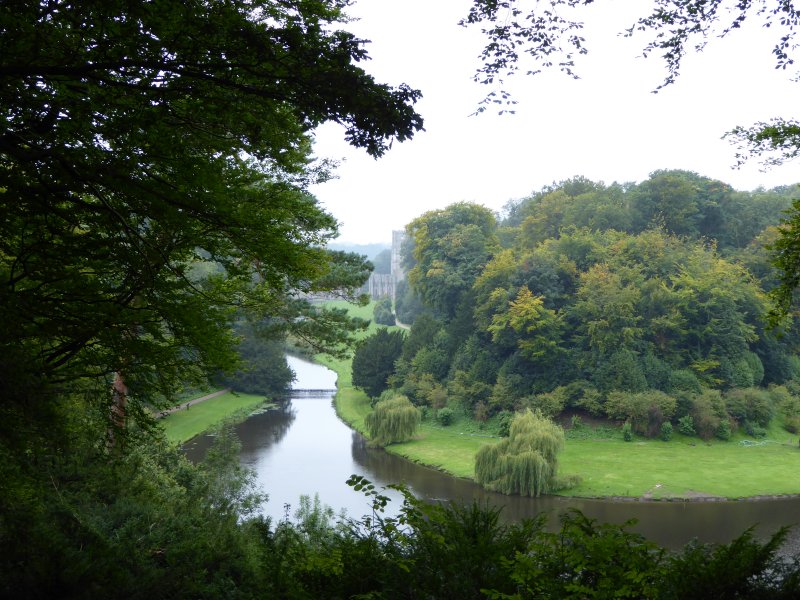
Walk round the grounds of Studley Royal, and this will be your first sighting of Fountains Abbey.
A few months ago, I got a job. Not for the pin-money, because I’m not paid a penny. But I’m richly rewarded. I signed up to be a volunteer for the National Trust, at the property nearest our home, Fountains Abbey and Studley Royal. Cistercian Abbey, Georgian water garden and mediaeval deer park…. no wonder it’s a UNESCO World Heritage Site.
Since we moved to Ripon, we’d loved spending time there, so I got to wondering….what would it be like to volunteer there? What could I do? What might be involved?
The answer turned out to be…almost anything you want There are dozens of different roles, from gardening to guiding. You could drive the mini-bus or form part of the archaeological monitoring team. You could work in the shop, or in the admissions areas. Badged up, you could wander the grounds, being alert to the needs of visitors who’d like a potted history lesson or to find their way to the toilets. You could work in the wildlife team, helping look after and monitor all those ancient trees, or the herds of deer. You could turn to when there’s a special event, and put out chairs. And you’re quite entitled, over the years, to change your mind and try something else.
I for instance, started out as a visitor assistant at the Victorian High Gothic Church of Saint Mary’s in Studley Royal Park. It’s a real masterpiece of Victorian architect William Burges, but it turned out not to be ‘me’. I admire the building hugely, but it doesn’t involve me at an emotional level as the ruined abbey does. So I quit. No hard feelings
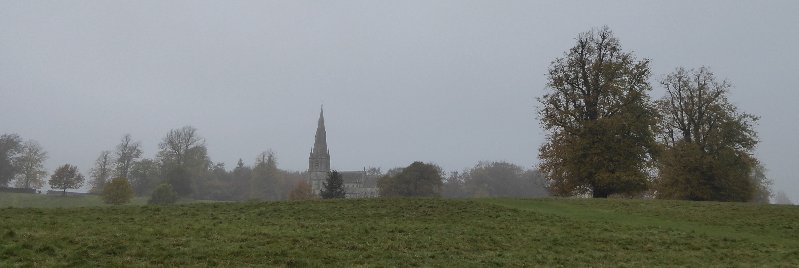
Looking across at St.Mary’s from the Deer Park.
But I shan’t be quitting the Learning Team. Our bread-and-butter is sharing a Day In the Life of a Monk with schoolchildren. The children dress up in monk-style habits, and tour the site getting in touch with the brothers’ silent and family-free routines, led by one of the team. We examine the roofless, windowless Abbey and try to picture the church back in its prime. We imagine the vast space, illuminated only by candles, as the monks worshipped there eight times a day, from 2.00 a.m. onwards. We visit the refectory where the monks dined, in silence, once a day. Did those monks eat meat? What about potatoes? No? Why not? We visit the Warming Room and imagine having just four baths a year, shaving our tonsures with oyster shells. We discuss bloodletting. We talk about all the daily routines. Maybe the children remember only a few of the facts later, But we hope they are moved by these atmospheric ruins, and return later with their families.
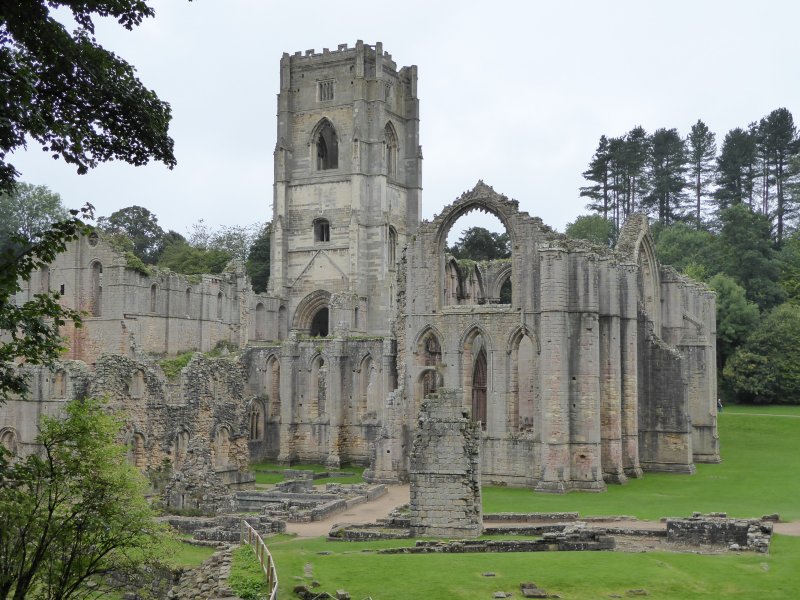
Fountains Abbey.
They might come though, to experience the natural environment of the grounds: they might go pond dipping, or on a walk where they try to use all their senses by listening, touching , seeing, smelling and so on. Or make mosaics based on what they’ve observed. Or go den-building in the woods. They’re as sure of a grand day out as are the volunteers in the team.
I’ve ended up doing all sorts of stuff I’d never have thought of attempting. Car park attendant on Bank Holidays? I didn’t think so. But it turns out to be fun togging up in a hi-viz jacket, barking out radio messages on the walkie-talkie system, getting in touch with your inner traffic cop, and generally being a welcome face to visitors as you help them manouevre themselves into the busy car park.
And some things are quite simply, a privilege. I wish you could have joined me on Sunday evening. After dark, the site was opened to less mobile visitors. For one night only, cars were welcome on site, to be driven s-l-o-w-l-y past the floodlit Abbey buildings. The evening was cold, misty, moody, atmospheric. Night birds swirled above the trees, dampness dripped from the trees, and monks could clearly be heard from within the abbey, chanting their plainsong (a recording, actually, but none the worse for that). I talked to some of the visitors, often very elderly, as their cars and drivers made their stately way through the grounds. Their appreciation of the staff and volunteers who were there helping the evening to go smoothly, though nice to hear, was quite unnecessary. I wouldn’t have missed this experience for anything. A special evening indeed.
And there are other perks. A couple of times a year there’s a ‘works outing’, when volunteers can take a trip to properties in other parts of the country. Here’s one. There are winter lectures for those who want them, to widen and deepen their knowledge of the history of the place There are times to socialise – a barbecue, a quiz night, meals. We’re very well supported, properly trained, and appreciated by the regular paid staff. I look forward to every single thing I do as a volunteer at Fountains Abbey and Studley Royal. I feel very lucky.
It’s half term this week. It seems to have become a bit of a tradition to have the twin grandsons – now ten – over for a few days. This time though, all plans got thwarted by almost a week of constant unremitting rain. No fresh air and fun for us this time.
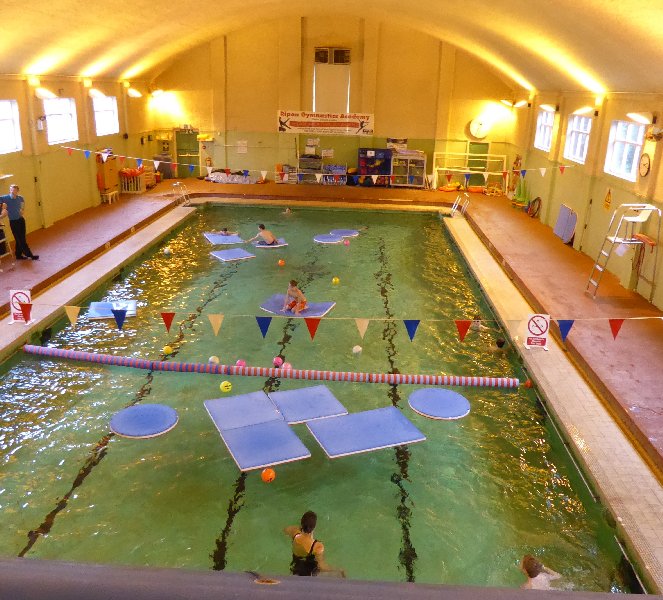
An hour or two at the local adventure playground was rejected in favour of a visit to the local swimming pool.
The boys were charmed by the antiquity of Ripon Baths – built 1903.
We spent hours playing old-fashioned board games like ‘Go for Broke’. This involves trying to lose the million pounds with which you started the game. In ‘The London Game’, you have to blunder round London’s Underground system whilst your opponents do their best to prevent you reaching your destination. ‘Stone Soup’ means lying through your teeth about the cards you’ve just placed, face down on the table. All useful worthwhile life lessons, I’m sure you’ll agree.
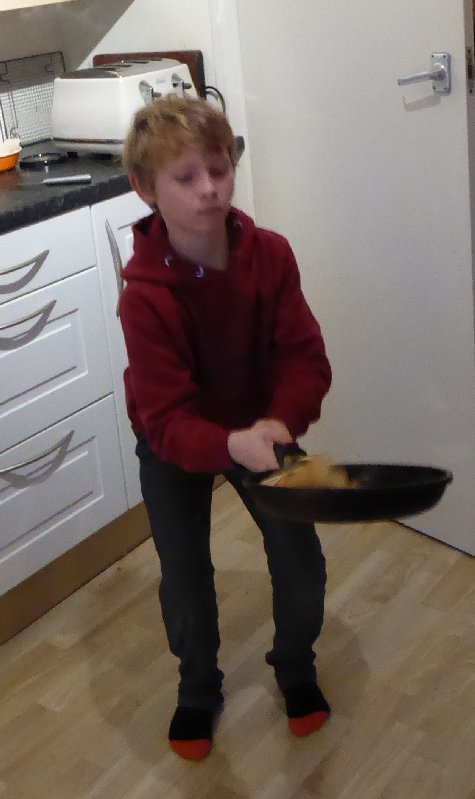
It’s a tradition that breakfasts have to involve ‘Grancakes’ – pancakes to you. Here’s a shot of Ben tossing his – and that one didn’t end up on the kitchen floor.
Well caught, Ben!
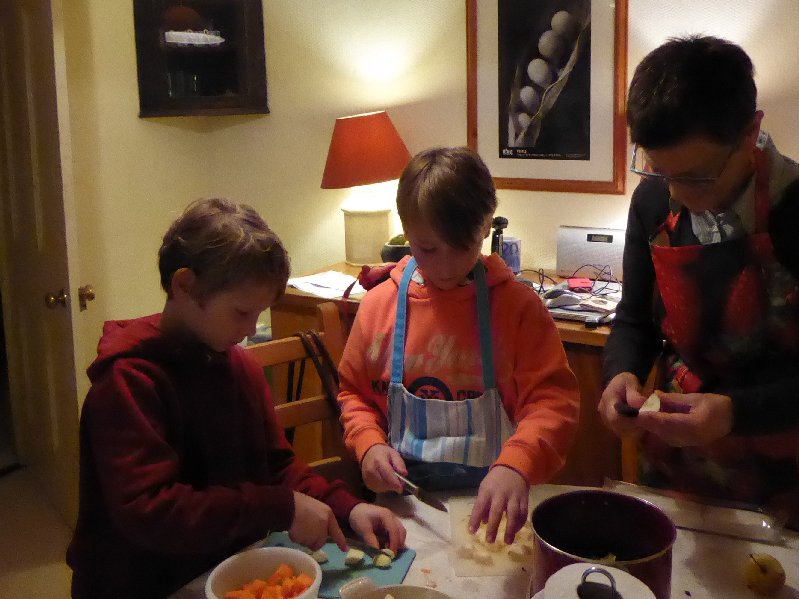
A more recent tradition insists that during every stay, a traditional English Roast Dinner has to make an appearance, and the twins have to do much of the hard labour: roast chicken, roast potatoes, Yorkshire pudding, carrots, broccoli…and the all-important gravy. I find the timing of all this a bit stressful. No wonder roasts don’t make a frequent appearance in this house.
Spud and carrrot peeling.
And of course, we had to have a Grand Day Out. Malcolm had communed with timetables to plan our journey by train and bus: public transport’s a rare treat for these young twins. But the weather on the day was so evil, we abandoned the idea. Walking through town to stand in the rain waiting for a bus that would almost certainly be late suddenly didn’t seem that exciting. So we took the car to Elvington, home of the Yorkshire Air Museum. It was a Bomber Command Station during World War II, and was also the only base used by French heavy bomber squadrons. With one twin passionately knowledgeable about planes – his future career as a pilot is already mapped out – and the other fascinated by World War II, we thought we had a hit on our hands. We did. They clambered in and out of uncomfortably chilly, uninsulated, uncomfortable and draughty cockpits, trying to imagine how it would feel flying long hours through winter skies to the industrial heartlands of Germany, always on the look out for enemy craft, fearful of being shot down in enemy territory. We remembered that only half of all pilots survived the war. We looked round workshops and period displays. And we watched a few films, moving accounts of the lives of those young men who gave their youth, their normal careers and loves and often their lives to the war effort. Lunch at the NAAFI however raised our mood. We were glad not to be placed on wartime rations.
That night, Ben slept for 12 hours straight, and Alex managed 10. Result.
So that was Project Exhaust-a-Gran (& Grandad). No, wait……. it was meant to be called ‘Exhaust-a-Twin’.
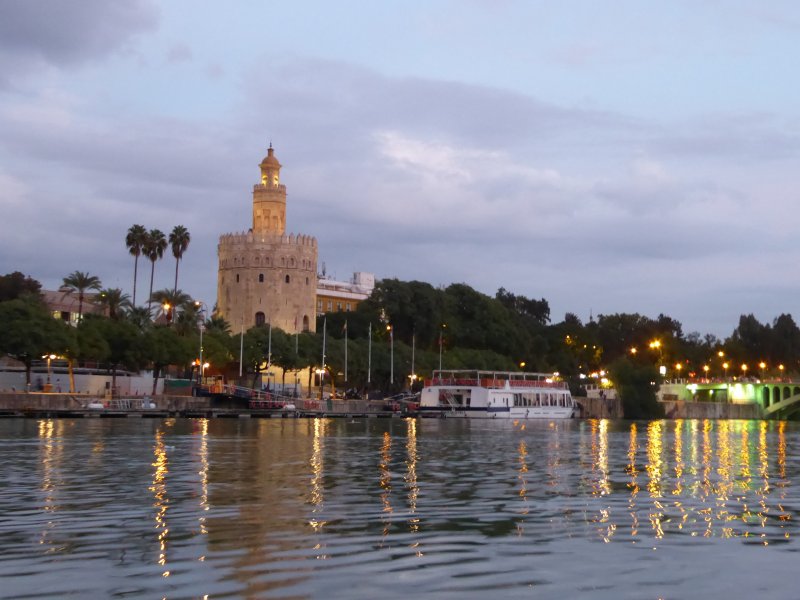
Torre del Oro by night: or Seville as not seen by Columbus.
‘In fourteen hundred and ninety two
Columbus sailed the ocean blue’……
….as any English school child of my generation will tell you. Well, he actually set sail from Palos, not too far away from the city of Seville: soon it became the gateway to the New World. Ships returned here laden with silver bullion from Bolivia, Peru and Mexico. And before that, in the 12th century, Seville had been the capital of the Almohad Moorish dynasty. So it’s had a splendid past, and has still scores of magnificent buildings from those glittering periods in its history. Seville is famous for its fiestas, its party-going spirit, its bullfights even, and as the home of the tapas, those delicious snacks made the more enjoyable for always being shared with friends. What’s kept us from visiting it until now, I ask myself?
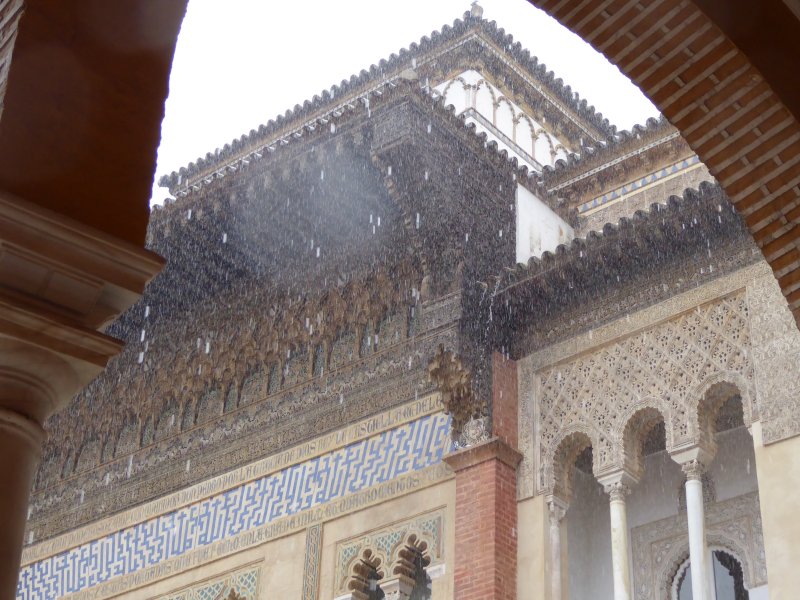
We spent a week there. In mid-October it should have been as warm as an English summer’s day. But in true English style, it rained, deluged, bucketed down for the whole of our first two days. So we’ll draw a veil over the soggy sights we saw then. I won’t tell you about the wonderful cathedral and its Moorish tower, la Giralda , or about the palaces of Real Alcázar: you can read about those elsewhere.
Real Alcazar in the rain.
Let’s talk instead about other highlights: Pilate’s house, for instance. It’s sometimes called the poor man’s Real Alcazar, but for us it was magnificent. A mixture of Gothic, Renaissance and Mudéjar styles, it’s a visual feast of elegant and beautiful tiling of the kind even the meanest back street in Seville will produce a dozen examples. It was the then Mayor of Seville who started to have this house built following his pilgrimage to Jerusalem in 1519. He discovered that the distance from Golgotha to Pontius Pilate’s house was the same as the distance between his planned new home and a Sevillian temple known as Cruz del Campo…. so Pilate’s house it was. Here are some photos.
The historic centre of Seville is a warren of tiny streets, some barely longer than a garden path, no wider than a single car. How does anyone become familiar with them? We didn’t. Once, Malcolm decided to explore what he thought was the parallel street to mine and meet me on the corner. We didn’t see each other again for an hour, not till we’d both abandoned meeting again and each returned to the hotel. On the way of course, we both got waylaid by splendid ceramic tiles in entrance halls, over doorways and climbing up facades. Every stroll through the town was an act of discovery.
Glancing through a perfectly ordinary front door.
Even the undersides of balconies are decoratively tiled.
And street names – often with a strongly Catholic flavour – are always shown in ceramic tiles.
Here’s an old fire insurance sign: ceramic of course.
A favourite: this frieze runs the whole width of the building on both sides.
A narrow street by night.
No cars here, please.
A particularly fine terrace just near where we were staying.
We had a special evening on the Guadalquivir river, seeing the city by night.
I went to a truly wonderful concert, ‘In-vocazione’, that I spotted advertised in a craft-makers cooperative. Sixty singers from Seville, from Italy, and a Franco-Russian-Spanish(??) group sang together, plundering mainly from the folk traditions of southern and Eastern Europe, of Iran, of India,. At the beginning, a single male voice was joined by other men, then by women singing from the balconies. As one group moved down to join the men, more sang from the balconies and others, joyfully, among the audience. They inhabited and involved the architecture of the building as much as they did us, their audience. At the end, as part of their encore, they taught all of us there to join in one of my own choir’s standards, ‘Belle mama’. Singing ‘our’ song with these astonishing choirs was one of the most moving moments of my life.
The women start to sing.
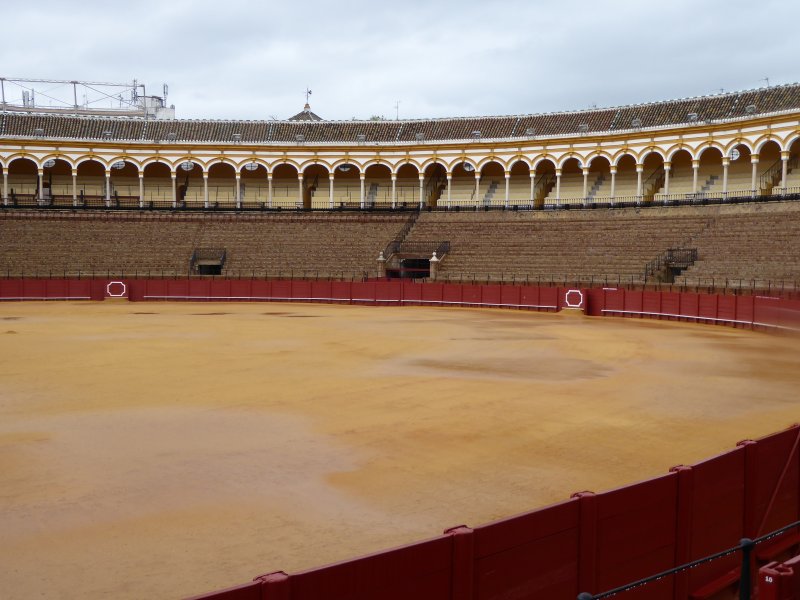
We didn’t expect to enjoy visiting the Bullfighting Museum. But we did. Who knew that bullfighting was devised not as a spectator sport, but as a means of teaching the soldiers of the nobility how to go to war with the enemy? Or that Spain’s youngest bullfighter in recent times was merely nine years old? Or that tickets on the black market to a specially anticipated fight can cost as much as three thousand euros? No wonder we don’t plan to go.
Plaza de Toros de la Maestranza: not a bull in sight today.
And tapas. We ate somewhere new every day. We ate different dishes every day. The variety of foods on offer is quite extraordinary, from refined and elegant to rib-sticking and peasanty, with fish very often being star of the show. Here’s a picture of a DIY dish. Bake your own chorizo over a little bonfire of alcohol. Delicious.
Cook your own tapa.
Let’s end on a popular, un-cultural note. Here’s a sequence of decorated garage doors and graffiti that made us smile as we mooched round the city.
This slideshow requires JavaScript.
Do you fancy going to Seville soon? I certainly do.
A view of Plaza de España, and the popular horse-drawn carriages of Seville, seen reflected in the windows of the public toilets.


















You must be logged in to post a comment.