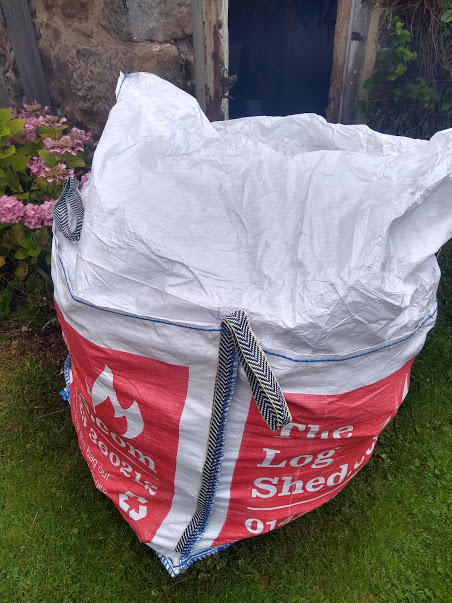
…. ere the winter storms begin’*. Farmers round these parts worry about getting the harvest in at this time of year. Malcolm and I worry about getting wood for winter, for the log burner. So we ordered some and it came this week.
From this, three large bags of it ….
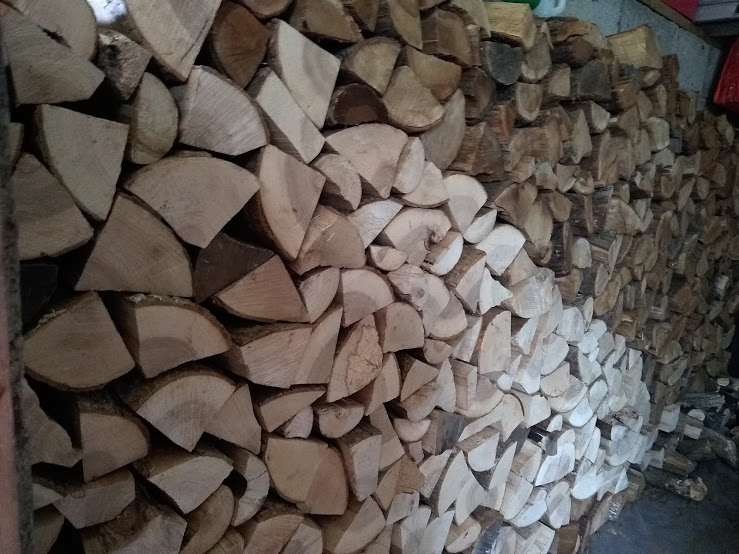
to this … in two long, sweaty and back-breaking shifts, warming us every bit as much as a blazing winter fire does. Unpack the bags, and neatly stack every single log in tidy tall rows in the shed.
You’re meant to be impressed at our hard work.
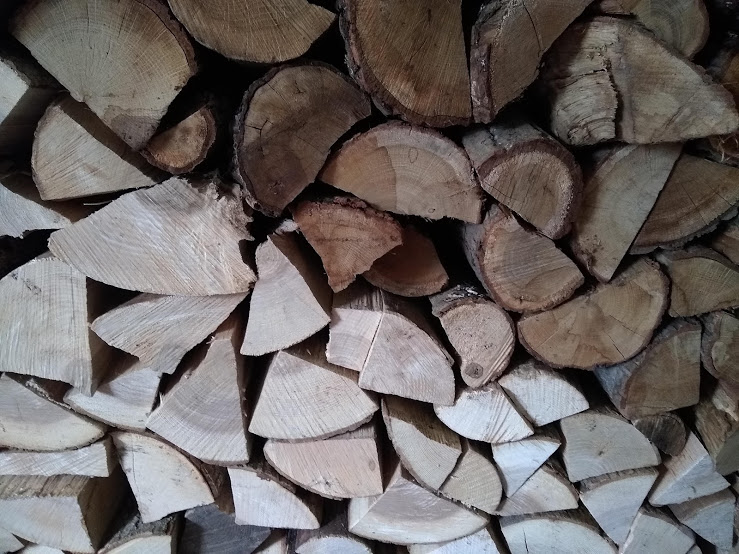
We’ve got ash, valued for its steady heat output and bright flame: and oak, a dense, long-burning wood with a small flame. We’ve stacked them so we can access either. Can you spot the difference?
Summer used to be a time for postcards. Sending them. Receiving them. Receiving was better. What to say to your friends and relations with only such a small space to play with? ‘Wish you were here’ maybe?
The views were standard, wherever they came from. The castle. The cathedral. The fisherman’s cove. The crowded beach.
Today I’m reviving the tradition, but with a different angle on the standard shots.
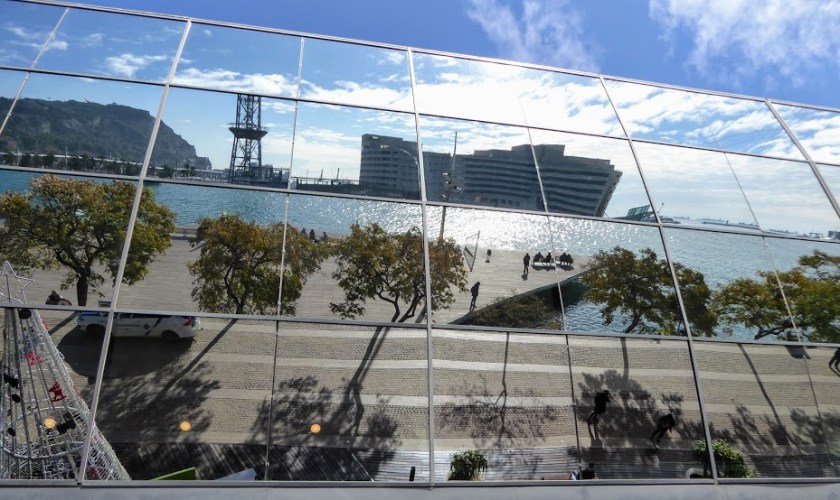
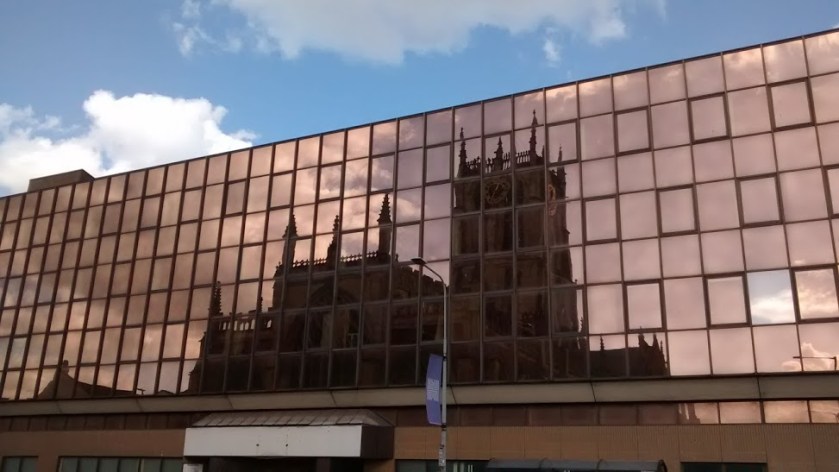
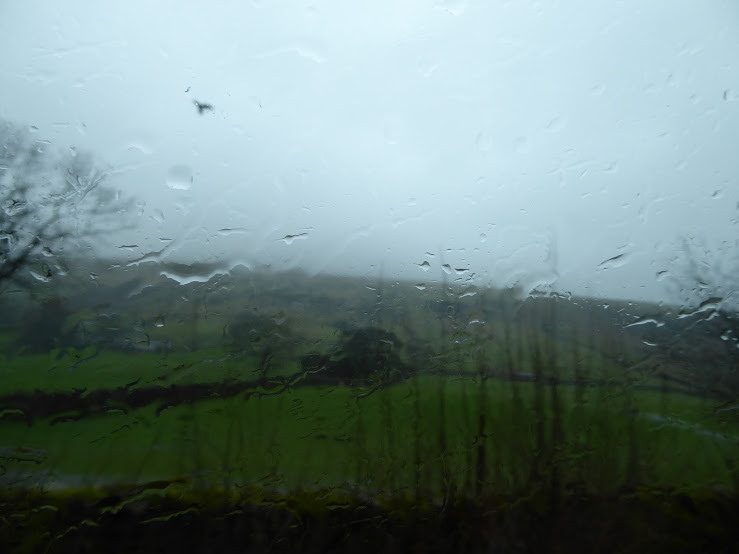
St. Paul’s Cathedral, seen reflected in Angel’s Wing (2000) by Thomas Heatherwick, Paternoster Square, London.The Leeds-Liverpool Canal passing under a bridge near Gargrave.The Port Olímpic area of Barcelona seafront, reflected in nearby buildings.Hull Minster, as seen in a nearby office building.An honest view of a British holiday? The countryside near Penrith on a soggy Sunday.
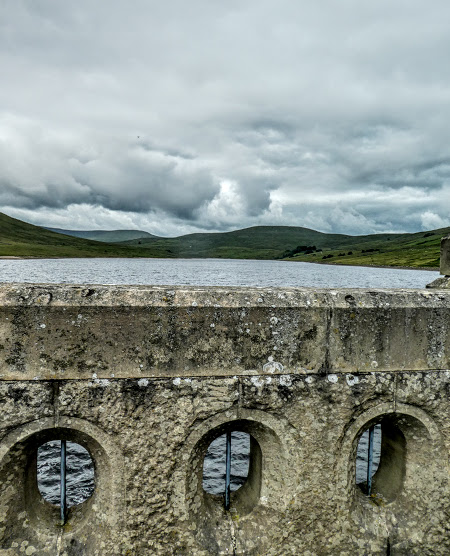
You don’t have to go very far in Yorkshire to feel remote. You don’t even have to get beyond the reach of the man-made. Those adjacent reservoirs in Nidderdale for instance, Angram and Scar House, both built to supply the City of Bradford with fresh water: Angram in the 1890s, Scar House in the 1920s. They’re off the beaten track, isolated. You’d never guess that when they were being built construction workers had their families with them on site: a shop, a place of worship, a school, all built for their use.
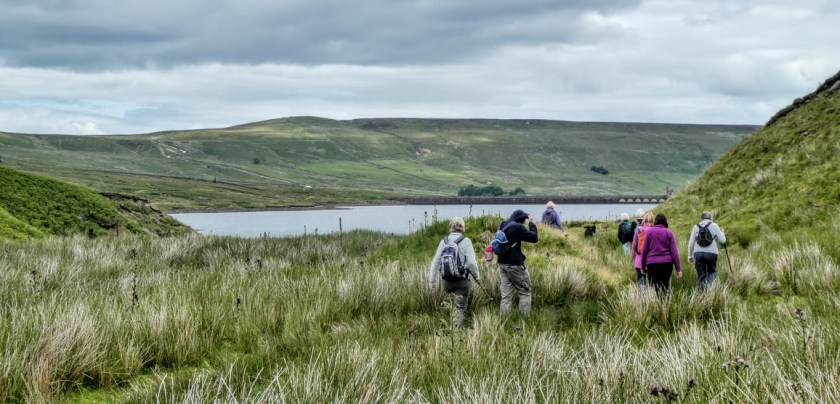
Now the construction workers are long gone, and their community too. Only the odd foundation stone remains. The area feels remote, reached only after a long drive down a narrow B road and one belonging to Yorkshire Water. It’s home to a rich variety of wild life. Walkers love to tramp its walking routes, relishing the emptiness, the silence, the bleak beauty of this spot.
Walking by Angram Reservoir, Even the distant view of the dam doesn’t change the feeling of remoteness.
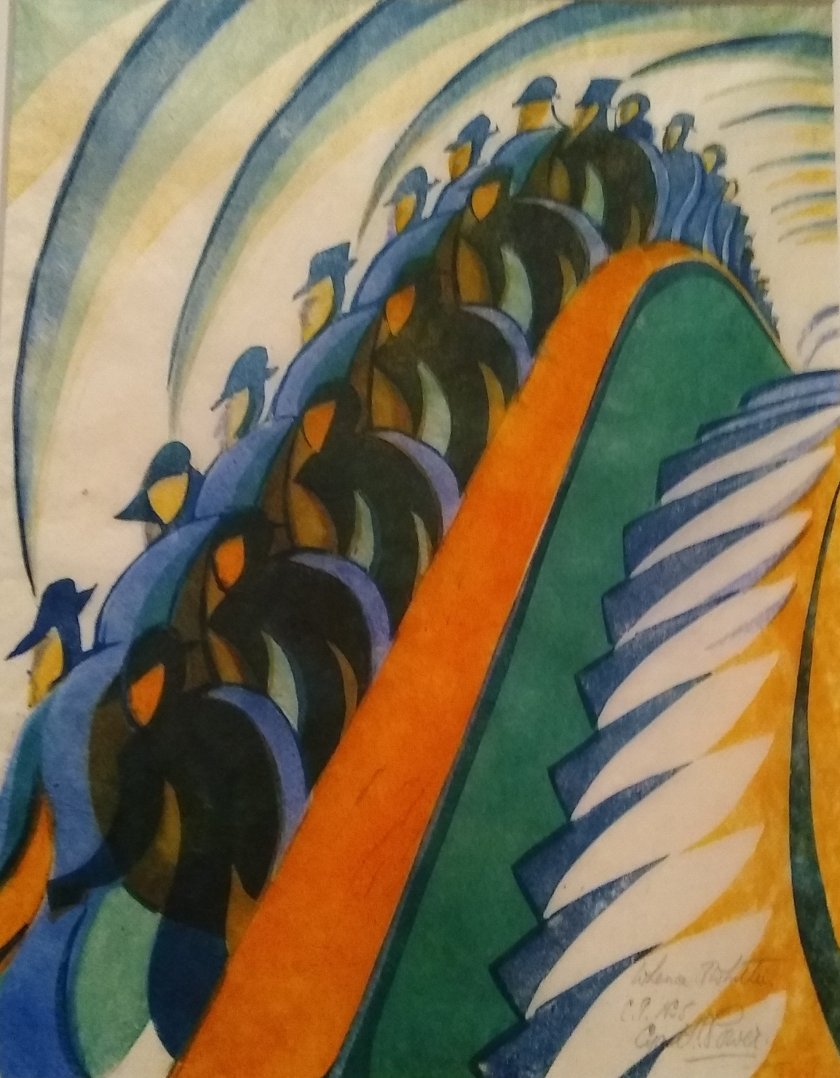
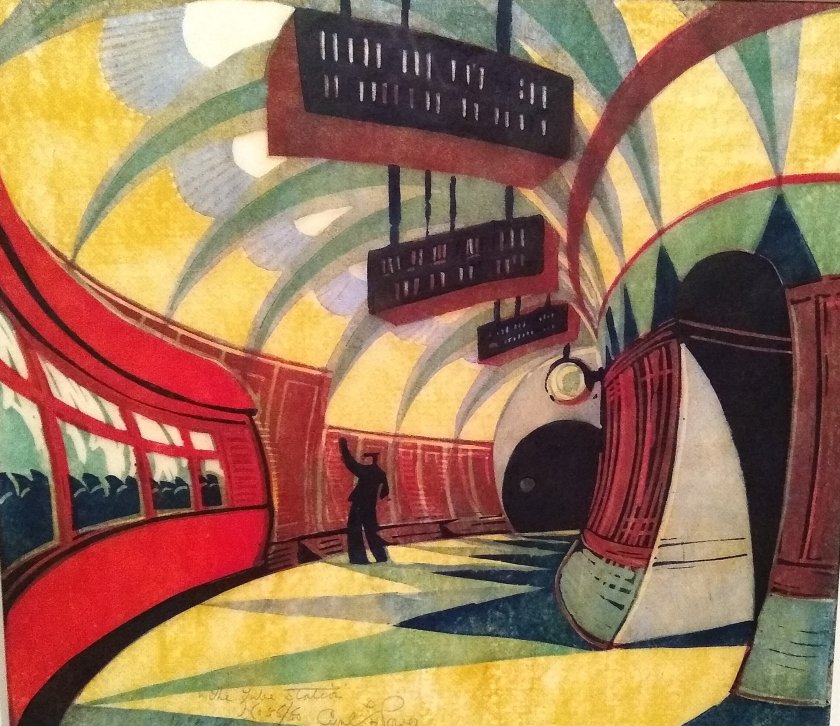
Today I went to Dulwich Picture Gallery, with a friend I’d never have met except through my blog. We wanted to see Cutting Edge: Modernist British Printmaking. We weren’t disappointed. Dynamic and vibrant, these block-printed images, mainly linocuts, celebrate the everyday. I thought I’d use some of them, photographed there and then, on my phone of course, to illustrate aspects of my own life. I’ve mainly chosen female printmakers whom I know little about. I want to know them better now.
Just now, we’re all contending with Weather. Rain.
EthelSpowers. Wetafternoon. Linocut1929 – 30.
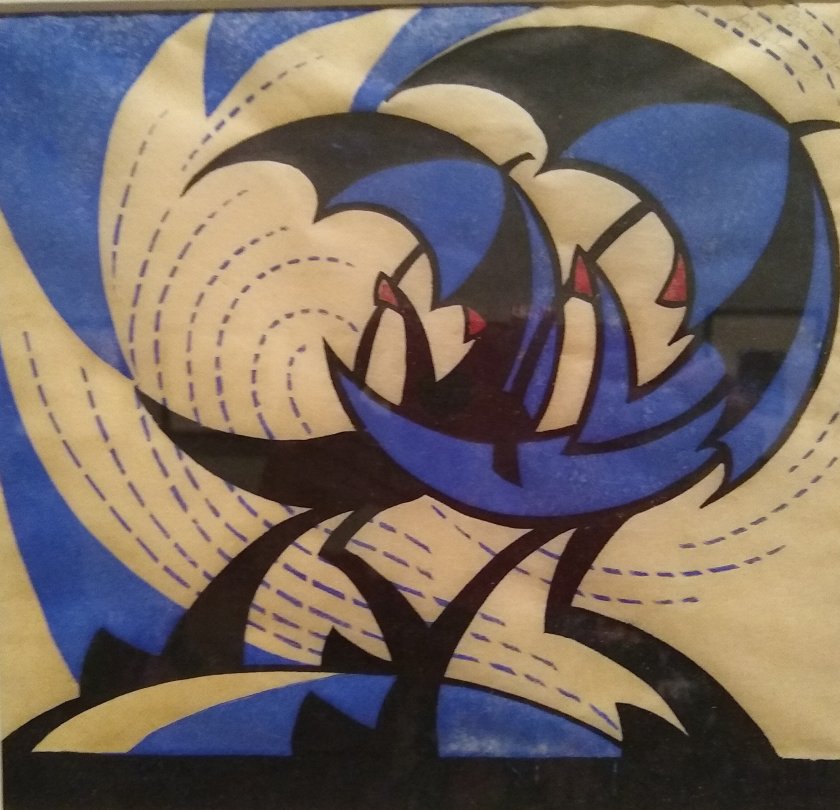
And Weather. Wind.
SybilAndrews. TheGale. Linocut. 1930.
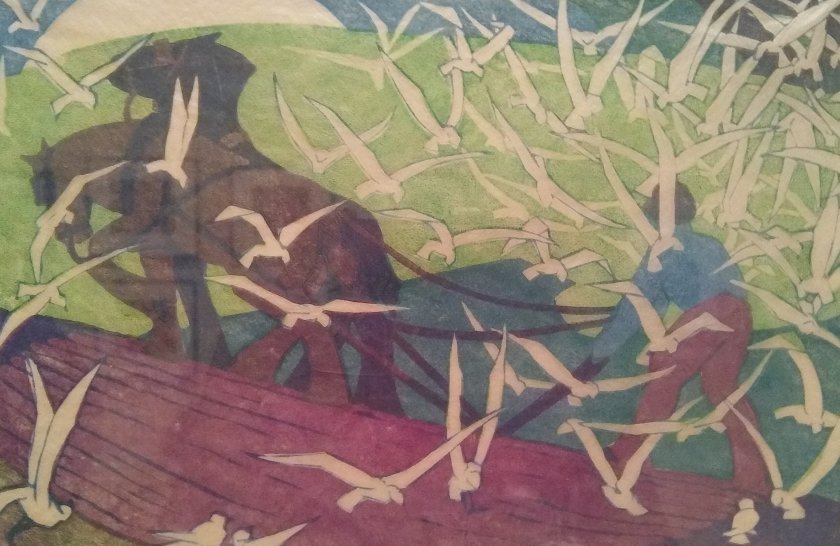
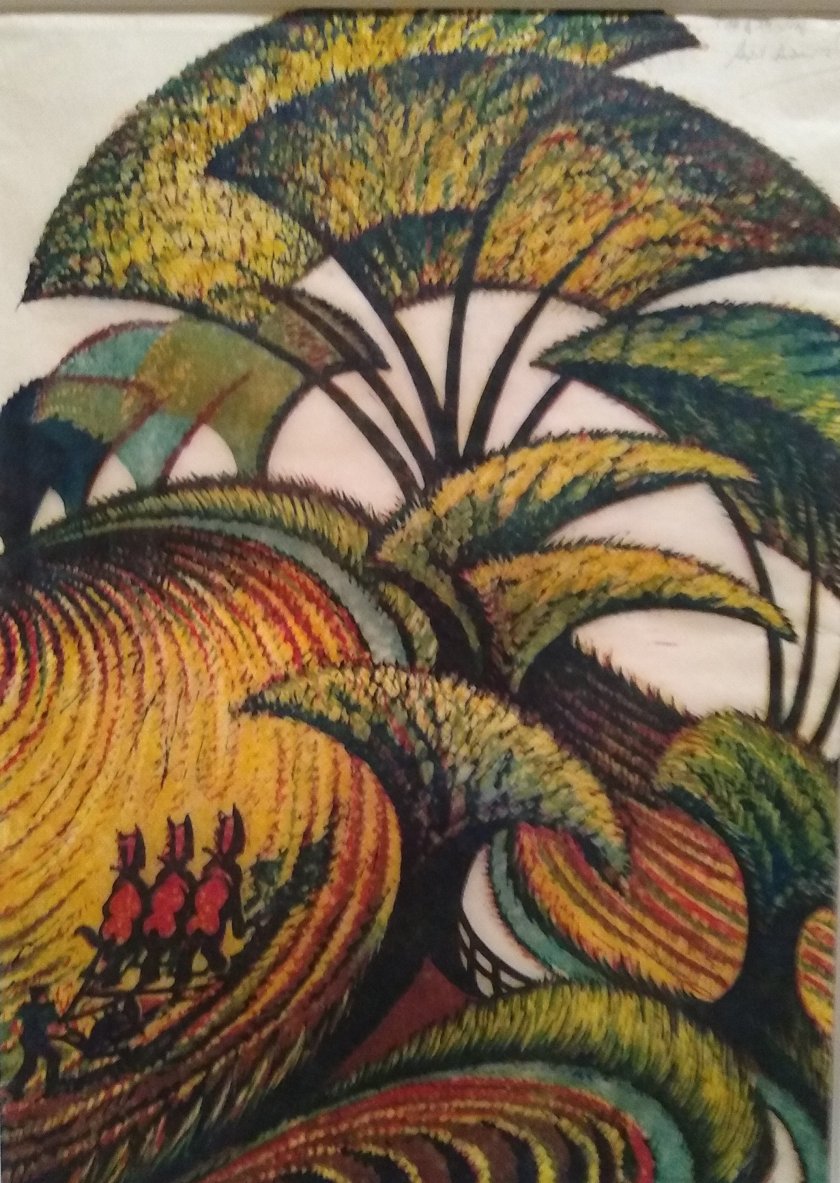
And the life of a Country Mouse was well-represented.
EthelSpowers. ThePlough. Linocut. 1928.
SybilAndrews. Thefalloftheleaf. Linocut. 1934.
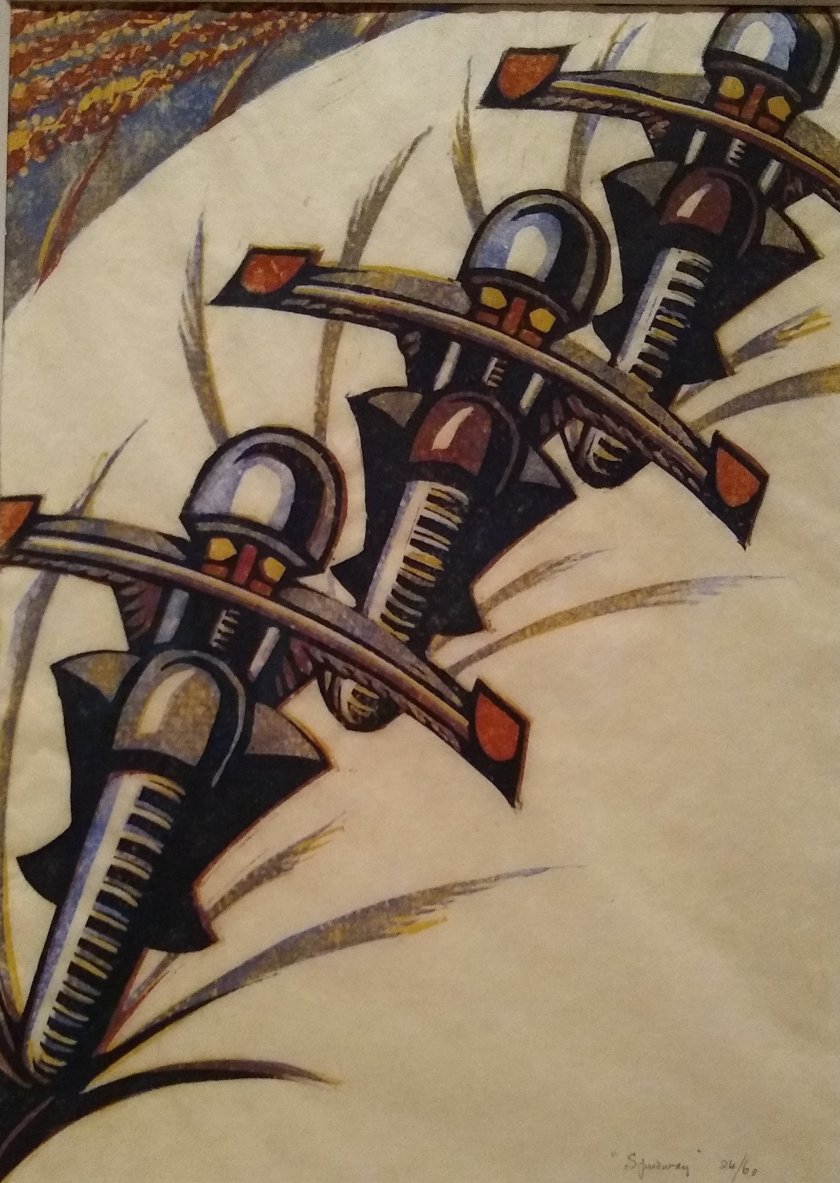
And Sunday mornings on the main roads into the Yorkshire Dales. Motorbike Central.
SybilAndrews. Speedway. Linocut. 1934.
And my trips into London.
CyrilPower. Not female! Whence andwhither. Linocut. c.1930.
CyrilPower. TheTubestation. Linocut. c.1932.
If you’re in London before 8th September, it’s worth a visit.
Country Mouse, Country Mouse from Yorkshire ventures south this week, to The Great Wen, the Smoke – that’s London to you.
We Yorkshire Country Mice like to put it about that we are friendly, neighbourly, affable. That them southerners on the other hand, are not. London folk, we opine, don’t know their neighbours, wouldn’t lend you a cup of sugar, and Keep Themselves to Themselves.
That’s never been my experience of London.
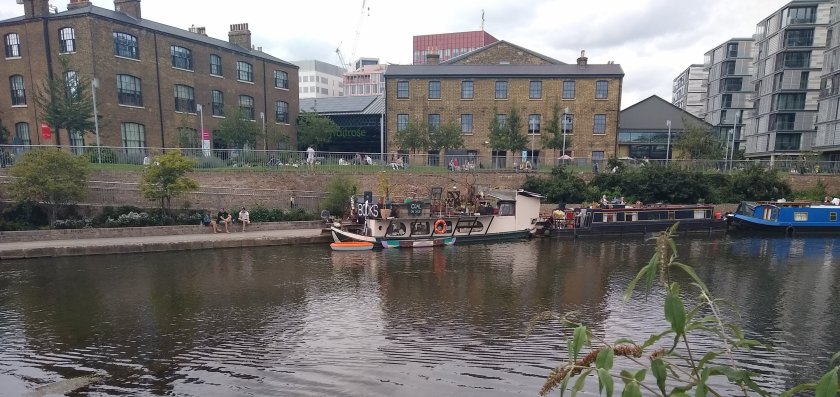
And here’s the proof. I stepped off the train and headed for Coal Drops Yard. You need a bob or two to live or shop in this newly gentrified area.
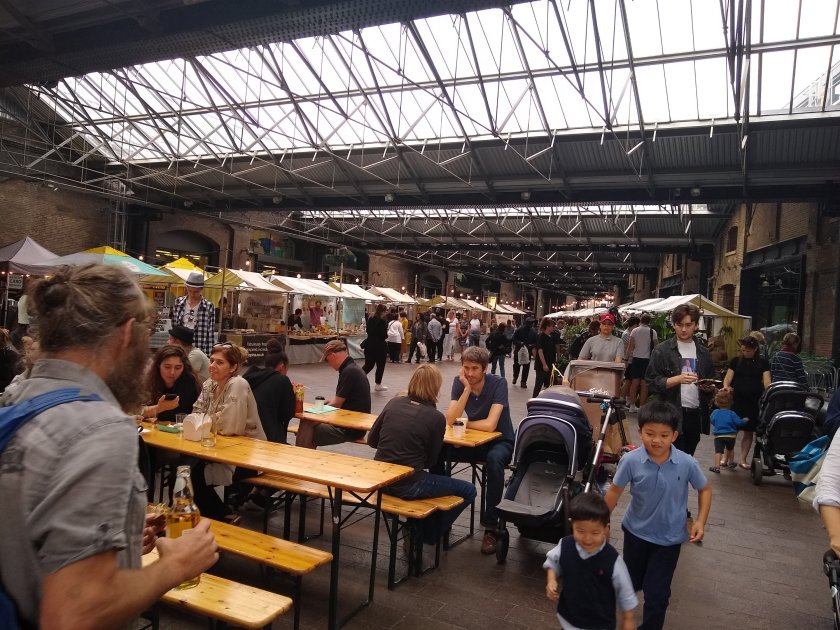
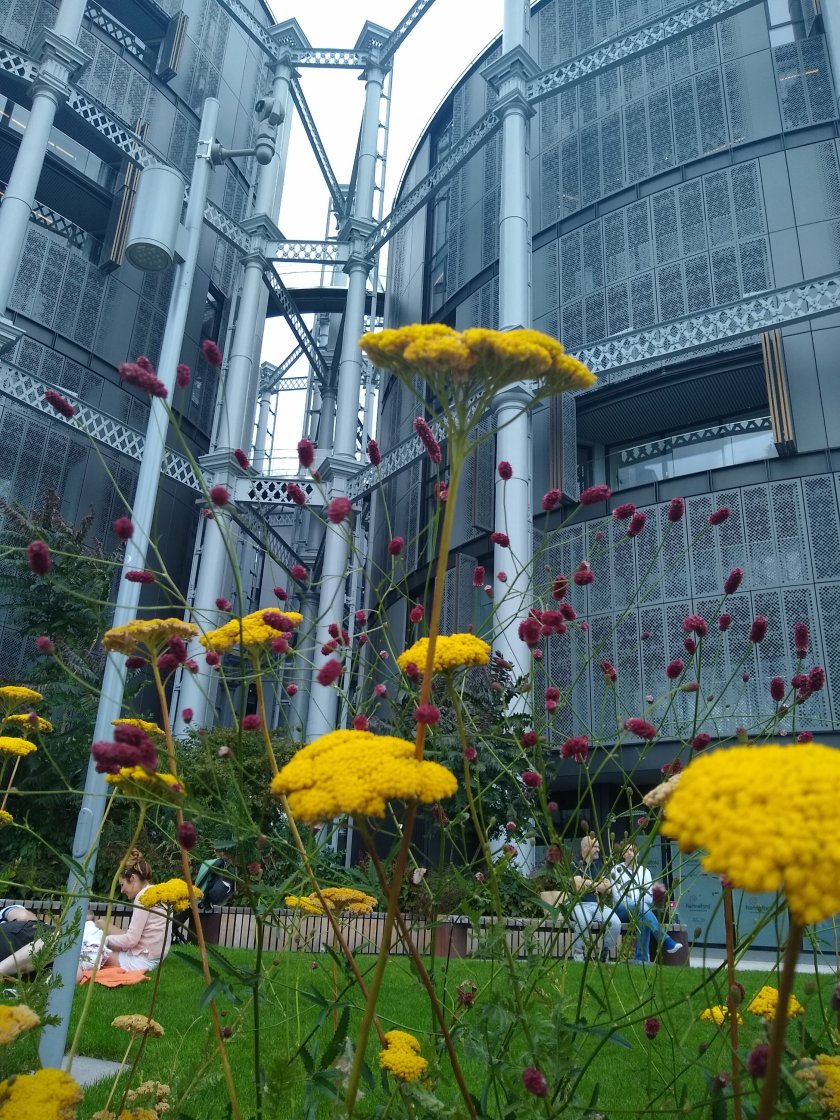
But anyone at all can and does enjoy the public spaces here: the canal side, the water play in the large open squares, the markets.
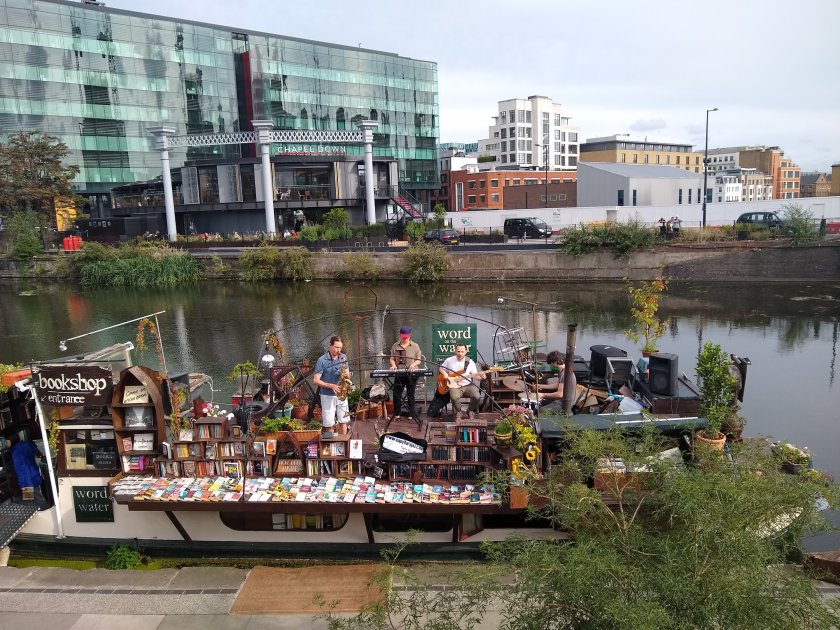
Families, tourists, couples, youngsters all amble happily, taking advantage of the open spaces, an impromptu jazz band playing on a barge (aka a second hand bookshop), and children playing in the water fountains.
My photos haven’t really captured street life. I simply can’t see what I’m taking on my phone, and my camera is in Intensive Care (the bill will be expensive: no NHS for photographic equipment). But enjoy strolling round this area, a mere five minutes from Kings Cross and Saint Pancras Stations. You’ll be in friendly company.
Gurukula is a special place. For the last forty years it’s been a sanctuary for the rain forest which has suffered massive deforestation in the Western Ghats, causing almost irreparable damage to the habitat of thousand of plants and animals, and to our own ecosystem. I urge you to follow this link to read all about it.
Our few days in Gurukula were special too. We wandered freely in the lush grounds, and when nature called, we found a quiet corner- toilets were deliberately under-provided so we all took a part in fertilising the soil. Meals were taken communally: we all shared the cooking, the washing up, the tidying.
We explored the rain forest, an almost meditative experience with the sounds of water, forest creatures – macaques in the trees, rufous eagles above the canopy. What wasn’t meditative was the strangler fig. It grows up its host tree, those climbing tendrils thickening into sturdy sinuous branches, which strangle and kills the tree beneath which gave it life, becoming an extraordinary hollow tracery.
We explored the surrounding communities. During the 1940s, communist Kerala obliged landowners to sell their land cheaply, so all citizens were entitled to buy at a price they could afford. At first this worked well. Families worked the land in a diverse way, growing a variety of crops for their own use and selling the rest. These days – or when we were there anyway – there is a monoculture, with families taking whatever subsidy is on offer to grow the latest crop – till the price plummets. Tea, coffee, rubber, bitter gourds, bananas have all had their moments of glory before a crash. Families no longer grow the rich variety that kept them so well-nourished. 90% literacy means people are leaving the land to get work in the cities – call centres and so on. It doesn’t sound a success story.
The highlight of every day was sunset. We climbed a vertical and rather scary ladder on the water tower near the house, and then…. simply sat. We watched enchanted as the sun set over the Western Ghats. As the moon rose, the sky darkened and the stars emerged. Silence fell. And then, distantly, we heard two mullahs from two different distant mosques chanting their call to prayer – admittedly amplified by megaphones. This, together with a cascade of shooting stars, provided one of the most magical experiences of my life.
Young vanilla pods
Potting shed at Gurukula
Sandy plans his climb of the strangler fig
Umbrellas waiting for the monsoon
Bamboo plants
Latex sheets drying outside a cottage
A farmer demonstrates his Communist allegiance
Swimming water snake.
Six Word Saturday: a series of six words before I gave in and wrote …. rather more.
“To travel is to discover that everyone is wrong about other countries.”
Aldous Huxley
To travel is certainly to discover. If I told you that we were off to start the day at an animal sanctuary, followed by a picnic, followed by a spot of local shopping, you might imagine our spending an hour or two with distressed dogs or donkeys, maybe some homeless hedgehogs. Then you’d picture us with a pack of sandwiches, maybe sharing a bag of crisps and some Jammie Dodgers, perhaps on a park bench, or dodging the cow pats in a country field. Then you’d suppose we’d nipped into Sainbury or Tesco on the way home.
But this is my Indian Adventure, so you would be wrong. Our animal sanctuary was Dubare Elephant Camp. This is where elephants who’ve had a long career working transporting logs for the Karnataka Forest Department go to live out their retirement years.
We watched them enjoying their daily bath in the River Cauvery. One elephant needs maybe three young men to bathe them: good tough scrubbing brushes required to give that hard leathery skin a good old scratch.
Look for the trunk poking above the water!
We were in time for their breakfast. There was a cookhouse where an appetising mixture of jaggery (a dark brown palm sugar), millet and vegetation was boiled up and formed into giant balls of nourishment. Just because they ate it daily didn’t stop them finding it delicious.
Making breakfast for the elephants
That was it really. But we had to set off for our picnic in any case. With some difficulty, we waded through paddy fields, where the young rice plants were an impossibly citric green, vivid and vibrant. And there, at the end of our walk, was the River Cauvery: a perfect scene from a travel documentary: tall palm trees, knotted and intricate tree roots, little islands among the fast-flowing waters.
Off for a picnic
Paddy fields
The walk back home
River Cauvery
We were glad to climb into our costumes and plunge into the river – muddy, but otherwise clean. There was quite a current, and I wasn’t strong enough to swim the width of the wide river, so stayed close in to the banks.
Simon swimming
And then it was time for our picnic: something special, this. Staff from our host’s residence clanked down the hill with great metal cans yoked over their shoulders: rice; sambal; a wonderful bitter curry made out of some dark green leaf also used to de-worm children; chicken curry; a sour and bitter sticky chutney; curds; and a gorgeous buttered cabbage curry. It truly was a memorable feast.
The picnic arrives
On our way home, we stopped off at our local town, Madikeri, to do some bits and bobs of shopping – get our photos onto CDs in the days when memory cards didn’t have much capacity, buy sandals, that sort of thing.
Oddly, I took few photos here, but I’ve used others from later in the trip, because with their rows of tiny shops, Indian shopping streets are standard in their own way. No M&S, Boots and Costa certainly, but there’s still a certain uniformity in the small shop fronts with goods stacked and hanging outside, and pedestrians, bullocks and auto rickshaws all jockeying for position in the crowded streets. Here’s the auto rickshaw that four of us (and our driver of course) contrived to travel home in after our trip…
The rickshaw that somehow got four passengers and a driver back home on a ten mile journey on a bumpy road.
I wasn’t so much wrong about India as didn’t have a clue.
My contribution to Debbie’s challenge, inspired by the quotation at the beginning.
You’ve had a taste of my long-gone-month-long stay in India. From here to here. But I’ve not been entirely honest with you. I told you it was a holiday I took alone. That’s largely true. But for just over a week, right at the beginning, I was part of a small experimental tour put together by my ex-brother-in-law Simon. An Organic Adventure. About eight of us travelled through rural Karnataka and Kerala, looking at local ventures into organic and sustainable agriculture. If that sounds dull … well, you can’t have been there.
I have stories to tell. But it was the wildlife that always remains in my mind … even urban wildlife is so very different from good old English pigeons and magpies. In Bangalore it was wheeling and circling eagles. In Mysore it was enormous fruit bats coming out at nightfall, to find food; and by day there were the gossiping bovva- boy hornbills.
And in rural Karnataka it was frogs. We could see them constantly in the ponds near our lodgings, burping away by day and by night . The only thing that shifted them one morning was a rat snake, slithering around and looking for breakfast .
I used to go outside as darkness fell at 6 o’clock and listen. A complex symphony played out. First, a group of frogs would start their chorus, the noise intensifying until gradually becoming quieter again: then others would take over with their own ever-swelling sound. Crescendo … diminuendo. All through the night. Quite wonderful.
One day at a tea plantation at the edge of the woods (another story for another day) we suddenly – and I do mean quite suddenly – heard cicadas in the trees. From low beginnings the sound grew and grew, peaking at a crescendo so loud we had to raise our voices to make ourselves heard.. Then, just as suddenly , it died smoothly away to nothing.
My favourite sound? This. Every morning. Just as dawn broke, a whistling thrush – just the one – broke into song. It sounded just like some contented man, hands in pockets, ambling slowly down the street, whistling happily and aimlessly. And it made me happy too, every time.
And on our very first night in the rainforest, as I was unpacking, a whirring, clattering clockwork toy appeared from behind my rucksack. Only it wasn’t a clockwork toy. It was a very cross hawkmoth, complaining vociferously about being disturbed.
The cross and out-of-focus hawkmoth who chattered and clattered round our room.
Then there was our stop off in Nagarhole National Park with its snowy-headed Brahminy kites, its kingfishers and eagles: its bison, its warthogs, its spotted deer, its mongooses and – of course – its elephants.
But more than these I remember the simpler pleasures: watching cattle egrets on the backs of cattle, benefitting from the insect life that definitely did not benefit the cattle. Glimpsing a water snake surging across a placid pond. Going on a trek across the empty paths of the Western Ghats, spotting vine snakes, parakeets, macaques, rufous-bellied eagles…. and for some of our unfortunate team – not me for some reason – leeches, which left angry red welts behind when they’d loosened their grip.
No hornbill was going to wait around for me to take a snapshot. I saw no cicadas. I wasn’t clever enough to snap a Brahminy kite or an eagle. So my pictures don’t match the text. It’s just too bad. I can enjoy both and I hope you can too: souvenirs of memorable rural India. Tales of what we actually did there are for another day.
Eagles fly above Bangalore
Rainforest
Caterpillar
Millipede
More spider’s webs
Sunset by the river
The only gecko I ever saw in India
The Western Ghats
Frog
The strangler fig climbs up the host tree: then strangles the tree to death.
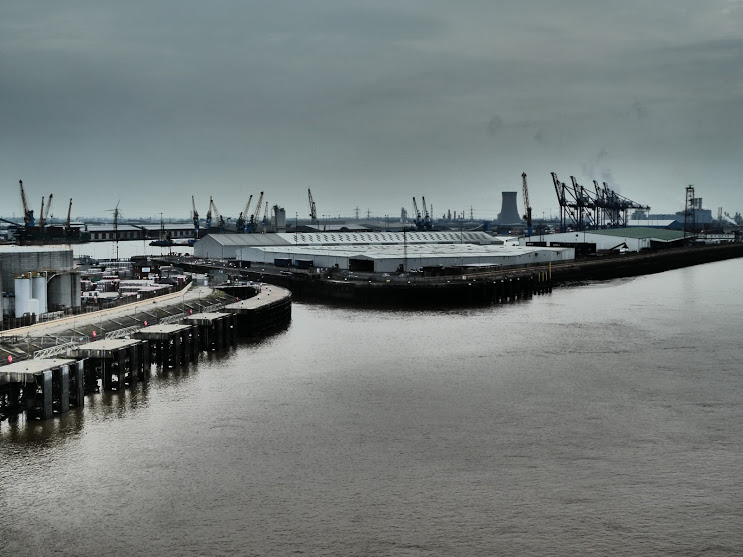
Travelling from Rotterdam to Hull the other week, on a grey and breezy North Sea crossing, I spent hours on deck, enjoying the busyness of the cargo vessels puttering back and forth, back and forth across the steel-grey waters. I was reminded on John Masefield’s ‘Cargoes’ – the last verse of it anyway:
Dirty British coaster with a salt-caked smoke stack Butting through the Channel in the mad March days, With a cargo of Tyne coal, Road-rail, pig-lead, Firewood, iron-ware, and cheap tin trays.
My memories of our trip are of grey seas, grey skies, grey industrial coastal landscapes, grey wind turbines. With red highlights – those busy ships: the cargo of lorries on our ferry: and an almost lurid sunset.
Click on any image to view full size.
Linked to Debbie’s Six Word Saturday, which I’ve been following for a while. Time to join in!
We’ve just come back from a long weekend in Gloucestershire. The highlight was to spend time with William, Zoë and their parents at the home of Sarah (daughter-in-law)’s parents, who had invited us all: the highlight of this particular highlight was watching Zoë discover strawberries…
Another highlight was to visit Slimbridge, the Wildlife and Wetlands Trust site founded and developed by Sir Peter Scott.
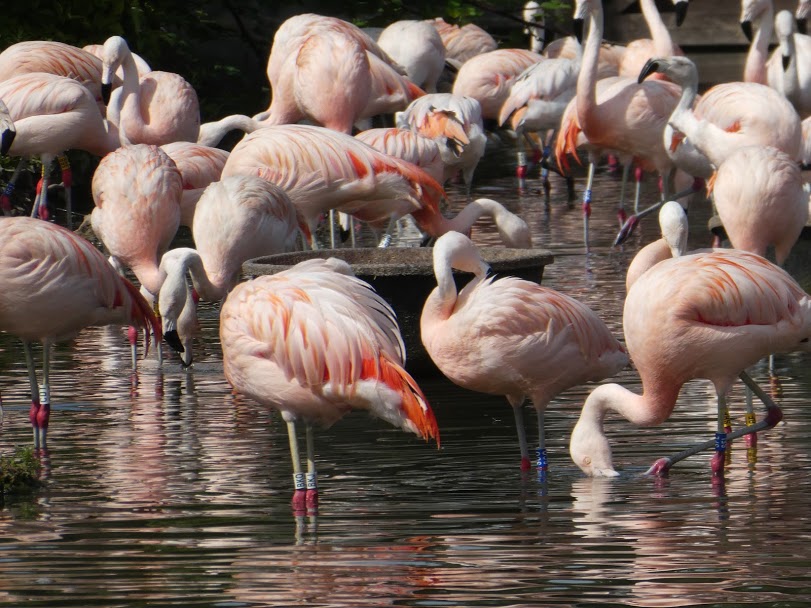
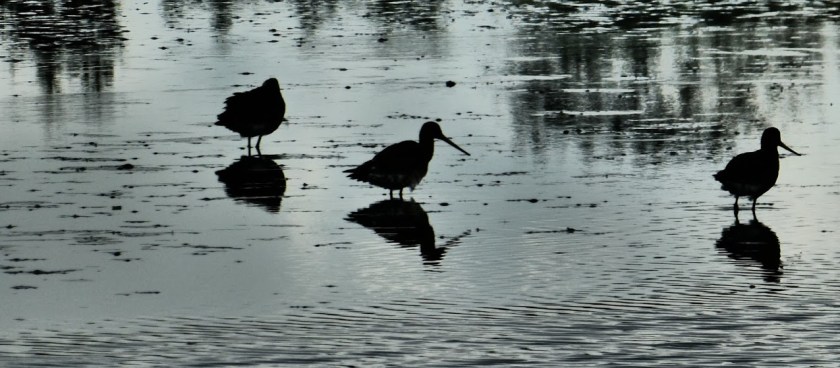
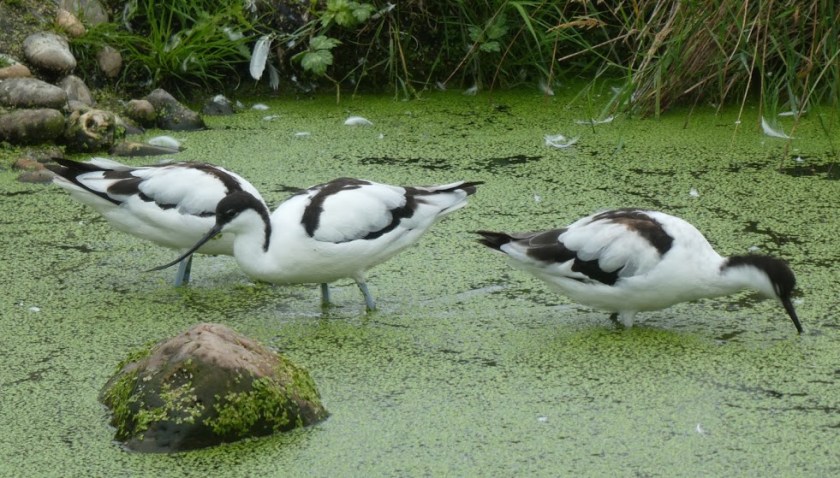
So much to see: water birds of every kind. But I’ve come away with memories of three in particular: three species of wading bird who spend much of their lives fossicking in the shallows for the small creatures on which they depend for their diet.
All three of the birds that so engaged me shared similar characteristics. Impossibly long, fragile-looking legs, giving them a delicate and graceful appearance: impossibly long, unmissable beaks.
Ladies and gentlemen, I present to you various varieties of flamingo….. Who can fail to be entranced by their pink plumage, sometimes almost embarrassingly vivid, at other times delicately pale?





















 From Pyrenees to Pennines
You must be logged in to post a comment.