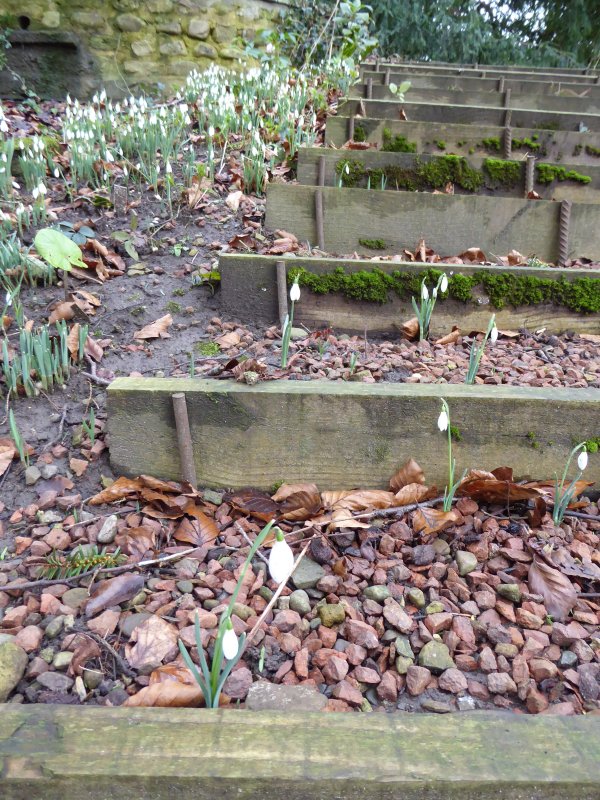
Step out into the garden, and the countryside beyond at the moment, and you’ll find snowdrops doing what they do best in January – piercing the barren earth, colonising grassy patches, nestling under trees and marching across gladed hillsides. Untroubled by unseasonal weather, their inner clocks direct them to grow, multiply, and cheer us all up in an otherwise gloomy, un-festive sort of month. That’s Nature for you: ordered, seasonal and predictable.
A farmer’s field? Or Sleningford-by-the-sea?
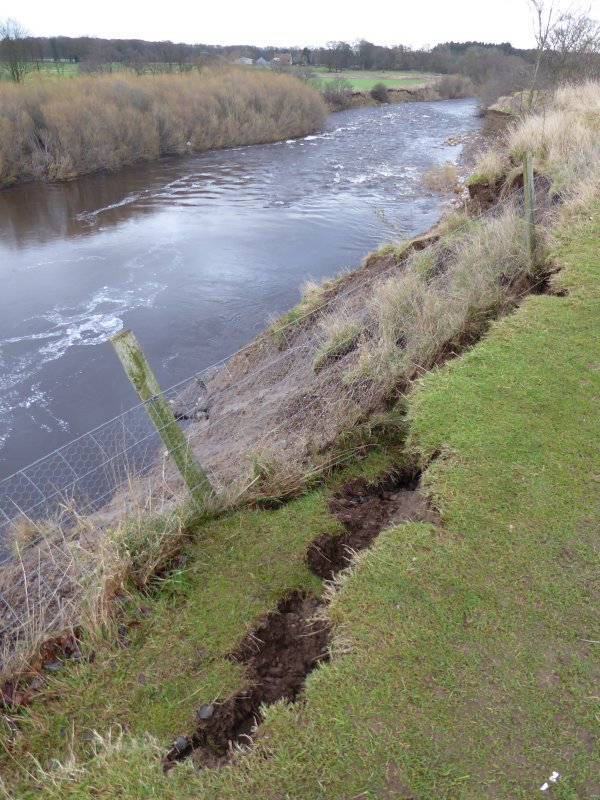
But Nature has another face. Come with me beyond the garden, past the fields slickly shimmering with surface water, to the banks of the River Ure. Just two minutes walk from here, it makes a wide sweeping curve away from its route from West Tanfield, and (normally) meanders gently into Ripon. That was before this winter, this rain, this unending water.
Once the rains came, and once it reached town, the River Ure rather wanted to swamp people’s gardens and make a bid to enter their houses. Recently-built flood defences put paid to that idea. The River Ure took its revenge on us, or more specifically, on the farmer whose fields adjoin us. Up in the hills, waters from streams and rivulets in the Dales cascaded into the Ure, which gushed and surged along its course, rising higher and higher, tearing at the banks, ingesting great clods of earth and forcing them downstream. The water levels are falling now. The damage remains.
The River Ure seizes the land.
Look. Here’s a chain link fence which marks a pathway running along the edge of the farmer’s field. It should be on terra firma, with a nice grassy margin between the fence itself and the river bank. Now it has nothing to hold onto. The bank has been snatched away, and the fence is hanging crazily and directly over the swelling waters below. The earth has slipped, and continues to slip. The farmer is losing his field, and the river is changing course. There’s not much anybody can do about it.
We’ll watch the water awhile, and frighten ourselves witless at the prospect of falling in and being swept mercilessly away. Then we’ll wander back though the woods, and enjoy the snowdrops and aconites once more. Nature takes its course.
My goodness. What a can of worms I opened when I decided to research a bit of family history. Originally, I simply planned to gather together all the stories, legends, bits of fact and fiction that all families accrue around themselves and record them in my new blog ‘Notes on a family’. But then, you can get a free trial period of a fortnight on Ancestry UK, so why not take things a little further?
I think the site may have sucked me in, just as it wanted to. Sleuthing around, tracking my family through the generations has been quite a lot of (frustrating) fun. But all that’s for the other blog. Here’s where I wanted to tell you about some of the incidental stuff I’ve found.
Did you know, for instance, that the census recorders used to have to note anybody they found who could be described as:
Deaf and dumb
Blind.
Lunatic
Imbecile, feeble minded.
I remember that my mother told me that when she was a child, the use of such terms as ‘moron’, ‘imbecile’ and ‘idiot’ was quite normal and not necessarily offensive, while my father, never known for his political correctness, had no problem in winding down his car window to yell ‘cretin’ at any passing jay-walker.
One of the shocks is just how large my ‘family’ is, potentially. My grandfather was one of ten, his father one of nine. Add in their spouses, their children, and their children’s spouses and children, and sudenly you’re wondering if the person you hold a door open for at the library might be your seventh cousin, five times removed.
And then all those wonderful occupations. My grandmother’s family came from the textile districts of Yorkshire and Lancashire, so whole streets full of people worked at the busy mills. But nothing as dull as ‘Mill worker‘ will do as a job description. Try these: *‘worsted spinner’; ‘overlooker, stuff factory’; ‘stuff weaver’; ‘scribbling overlooker’ (what?), ‘woollen piecer’. An entire road’s worth of houses were inhabited by people had jobs such as these. Just occasionally, someone else got thrown into the mix. ‘Lamplighter’; ‘washerwoman’; ‘Roman Catholic priest’, as well as the odd ‘domestic servant‘, a young girl of 15 to 20, usually.
I couldn’t think how to illustrate this piece. Then I remembered a couple of old family albums, full of photos I have no possible means of identifying. Let’s give them their last outing.
Here I am, still slaving away at Blogging 101, the University of Blogging. I’m beginning to get a bit on edge when I fire up the laptop in the morning, because I know Senior Lecturer and Course Director Michelle W will have sent out yet another assignment requiring us to tweak and tinker with our blogs, and generally bring them up to scratch. I even played hooky the day before yesterday, and the day before that. Doesn’t she know I have a LIFE to lead?
However, here I am again, back in the University Libary (aka our study). Today we have to write a post. And it’s to be inspired by a blog we found yesterday, a blog new to us, which we felt moved to comment on.
I discovered Katherine Price. She can write in a way that takes me to her world, her street, her little stretch of the Thames and help me to savour with her the local trees and the daily rhythms of the birds, whether a clamour of rooks, or a solitary kingfisher streaking past. The first post I read was a bit of a hymn to staying put and not moving on, a hymn to her home in suburbia.
And it got me thinking about where I live now, and where I used to live… and the time before that… and the time before that. It reminded me of a post I wrote almost 5 years ago, and I thought it was maybe time to revisit it and re-work it.
I spent my childhood in London: population 8.5 million.
Then I went to University in Manchester: population 2.5 million.
A few years later I was living in Leeds: population 751,000.
And then we moved to Harrogate: population 76,000.
Then we went to France and I started a blog. We lived in Laroque d’Olmes with about 2,500 other people.
And now we’ve come back to England, and we live in North Stainley. This is a village whose population is about 730.
Can you see a pattern here?
Everwhere I’ve lived has seemed special at the time. I used to relish all that a big city could offer, whether the museums, cinemas, or the huge choice of shops. As I moved onwards and downwards, I remembered instead and with some horror the crowds, the dirt, the general busy-ness of the place before. Good heavens, even Laroque, not big enough to support a range of shops, much less a cinema or a swimming pool seems rather exotic compared with the facilities in North Stainley (a village hall, a church, and a pub, to be re-opened in early spring). We’ve traded cinemas for a film on Saturdays once every 6 weeks in the village hall, and shops for the chance to buy eggs from the farm not far from here. And this blog is where I often report on what we discover as we explore our local countryside .
I’ll leave you with a quiz: can you identify each of the places I’ve lived in from these images?
‘A minster is a church that was established during Anglo-Saxon times as a missionary teaching church, or a church attached to a monastery. A cathedral is the seat of a bishop (his seat, or throne, is called a cathedra).’
So that sorts that one out. We’ve been wondering what makes York and Beverley minsters, when one is in effect a cathedral, and the other a parish church: both are equally magnificent.
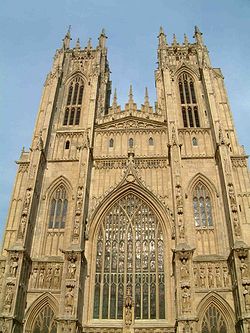
West Towers, Beverley Minster: Wikimedia Commons
Over the years, we’ve visited York Minster many times. But Beverley, tucked away in the East Riding of Yorkshire, in the flatlands of the Wolds, was unknown to us both. An outing organised for some National Trust volunteers at Fountains Abbey & Studley Royal put that right this week.
Beverley itself is a lovely town, founded way back in the 700s by St. John of Beverley, who was a scholar, a healer and a holy man. He built the monastery which became the nucleus of the town, and indeed of the minster. Even by the 1100s this church had been rebult several times, especially after a serious fire in 1188. Then it was all to do again in 1213: the tower they had built was too ambitiously large, and collapsed. But later, the building was yet again in a bad way:
‘The Minster as we have it today owes much to the work of the great 18th Century church architect Nicholas Hawksmoor. By the early 18th century the church was in a bad state – decaying and neglected. Worse, the north wall of the north transept – built on a marsh, don’t forget – was listing badly: it had actually leaned four feet into the street.
Hawksmoor was called in to advise how to save the building. The roof of the north transept was removed, and a wooden cradle, designed by York joiner William Thornton, was fixed around the wall. Then, over a period of 11 days, using ropes and pulleys, the entire wall – 200 tonnes of stone – was pulled back upright.’.
Do follow the link to the article in The York Press from which this quotation is taken. It’ll give you an excellent potted history of this wonderful building. And it’ll introduce you too to the Minster’s very special tower. Toil up the 113-stepped spiral staircase and you’ll find a Georgian treadmill, used to open up a ceiling boss over the nave to enable workmen to haul materials into the roof area. You’ll find graffiti, some more than 200 years old, scratched into the plain glass of the rose windowsby the men who’ve worked up here over the centuries.
The treadmill used to lift the ceiling boss
View once the ceiling boss is lifted.
Lifting the ceiling boss.
Graffiti
More recent graffiti.
Ancient beams in the Minster.
So here is a serene and beautiful building which has so much to offer: a fascinating ecclesiastical and architectural history, wonderful stonework and stained glass, misericords to investigate.
The Minster could keep you happily exploring all day. But Beverley has another church, St. Mary’s, which is one of the great parish churches of England, and it too provides a lesson in mediaeval church architecture.
Monarchs of England.
There are traces of its early years, when it was first built in 1120, but wander round, and you can see how the nave, side aisles and chancel date from the 13th century, the truly wonderful west front from the 14th century, the glorious painted wooden roof, and the choir stalls with their misericords from 1445. You don’t know what a misericord is? It’s a ledge projecting from the underside of a hinged seat in a choir stall, which when turned up, gives support to someone standing through the long, long moments of a mediaeval church service. Not normally on public display, they’re often whimsical, drawing on folk traditions, or slightly imperfect knowledge of exotic beasts. Here’s an elephant from St. Mary’s. And here are minstrels atop a carved pillar. And a 13th century rabbit, thought to be the inspiration for Tenniel’s illustration of the White Rabbit in Alice in Wonderland.
After all that, there was no time left to explore Beverley. We’ve decided that’s a pity. We’ll be back. But however much time we spend in the town, we’ll be sure to revisit both the Minster and St. Mary’s: both are very special places
According to my daughter and son-in-law, there’s an old Chinese proverb that says that guests, like fish, begin to smell after three days.
According to our friend Kalba, it’s Benjamin Franklin who coined exactly the same phrase.
Either way, received wisdom is that nobody can put up with house guests for more than a very few days without losing their patience, their good humour, and the friendship.
Our Ariegeois friends have just proved all that wrong. They stayed ten days, and it was wonderful. Though pretty exhausting, it was nothing but pleasure to spend an extended period with friends whom we value, but see far too little, and a fantastic chance to showcase Yorkshire – or a tiny portion of it anyway.
In my last post, I did a whistle-stop tour of our first few days together. Here’s how the rest of the holiday went….
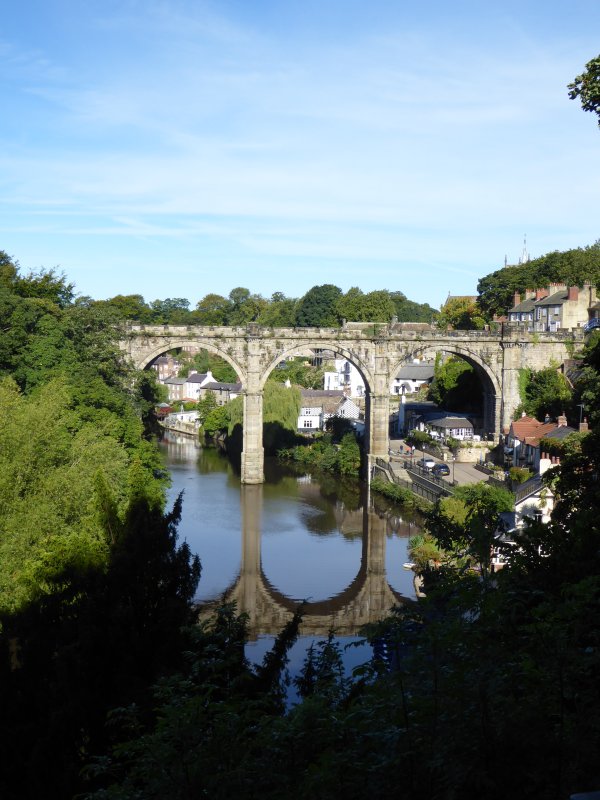
Knaresborough, with its wonderful 19th century railway viaduct spanning the River Nidd…
Knaresborough Viaduct.
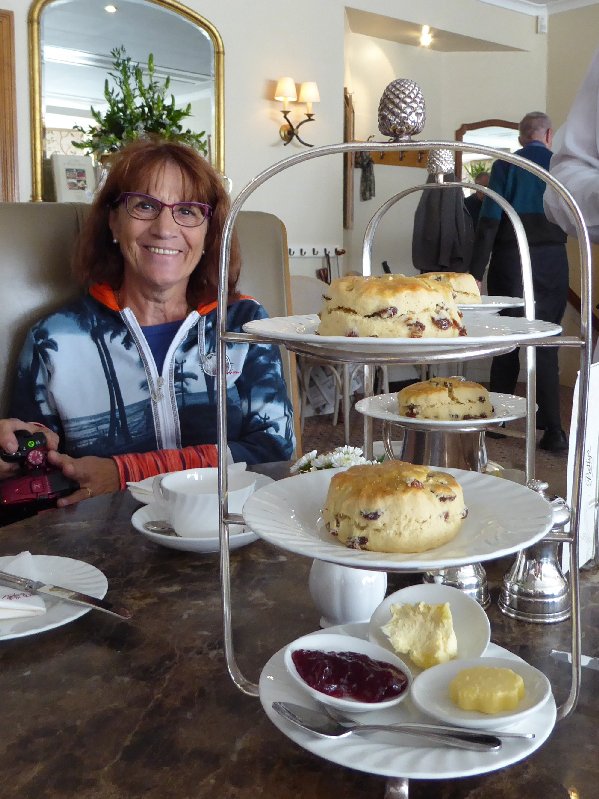
An obligatory coffee-stop at Betty’s, Yorkshire’s most famous tea room…..
Christine and a plate of Betty’s scones.
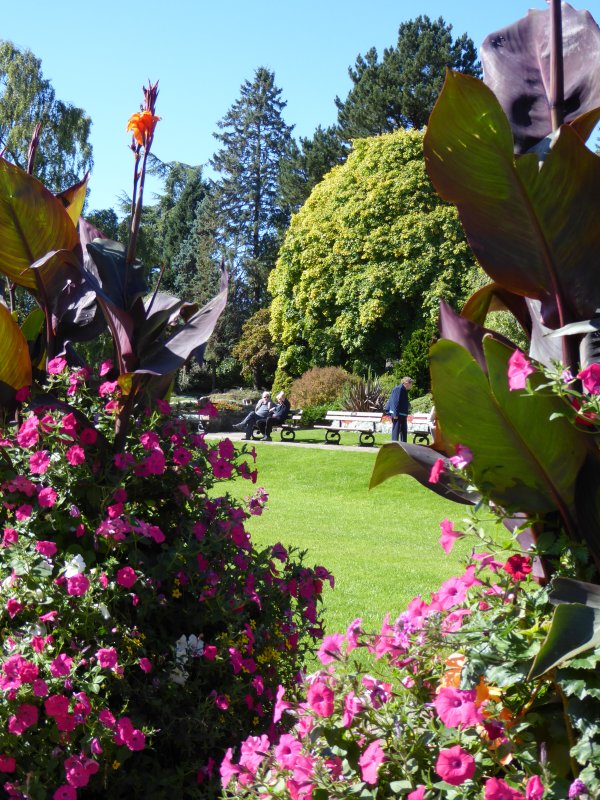
A meander round the Valley Gardens in Harrogate…..
The Valley Gardens
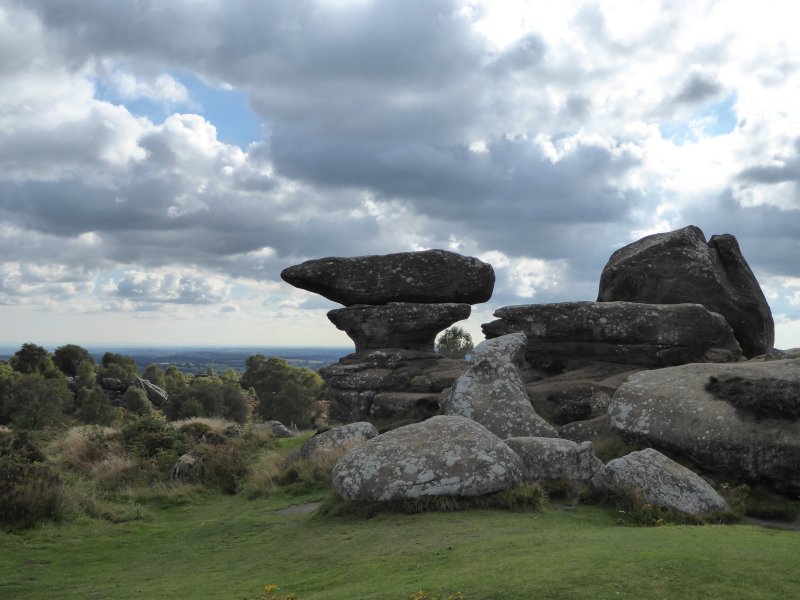
A trip to the fantastic geological outcrops of Brimham Rocks…
Brimham Rocks.
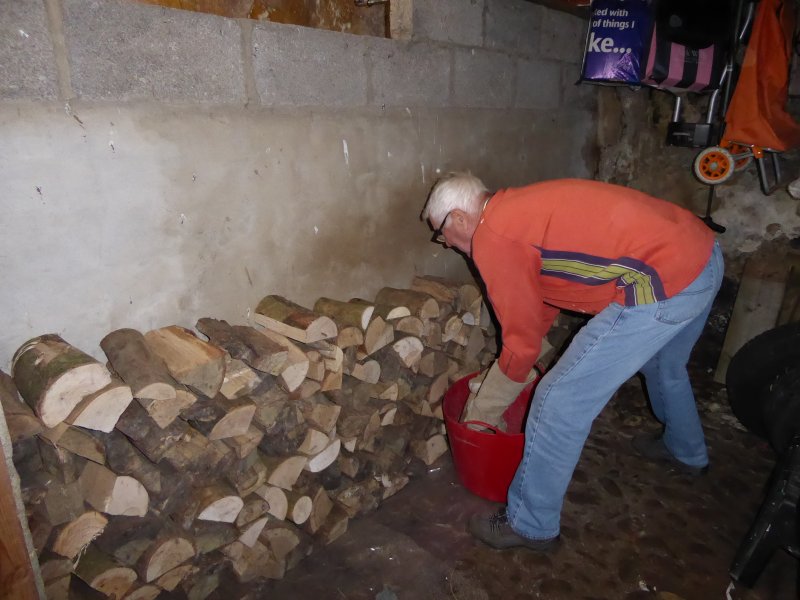
A day when our friends more than paid for their board by taking charge and getting our wood delivery for the winter shifted and sorted……
Max making a fine job of stacking the wood.
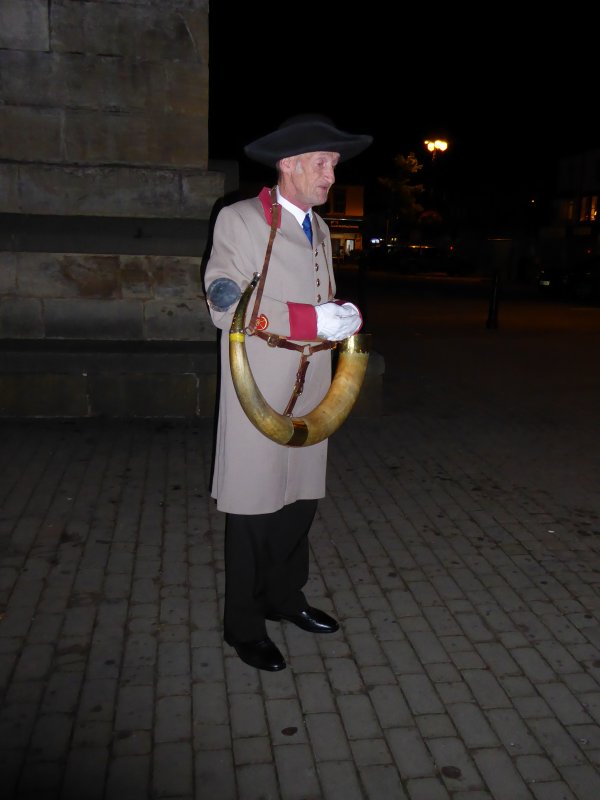
An evening with Ripon’s Wakeman, who since AD 886, has ‘set the watch’ to guard the citizens, sounding his horn at 9.00 p.m. every evening – every single day, whatever the weather, whatever the circumstances…..
The Wakeman and his horn.
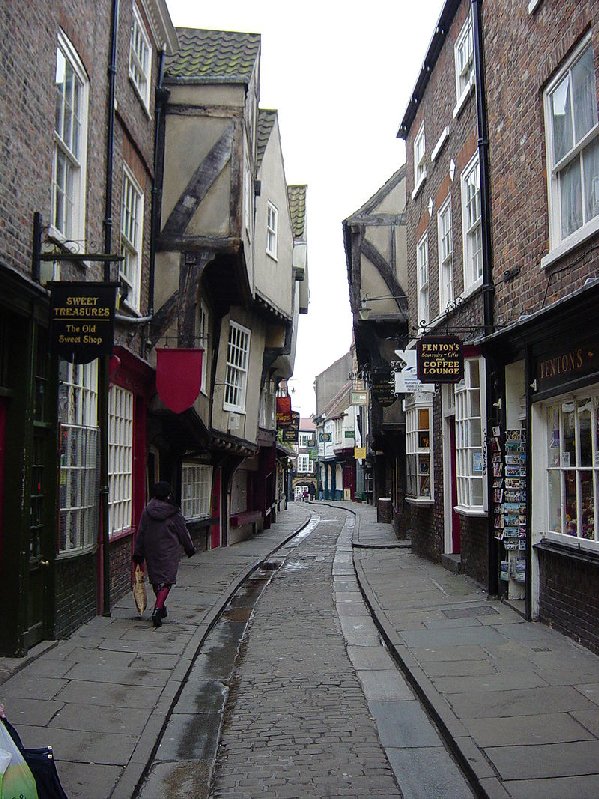
A trip to York…..
The Shambles, once the street where all the butchers were, now a tourist Mecca. Wikimedia Commons.
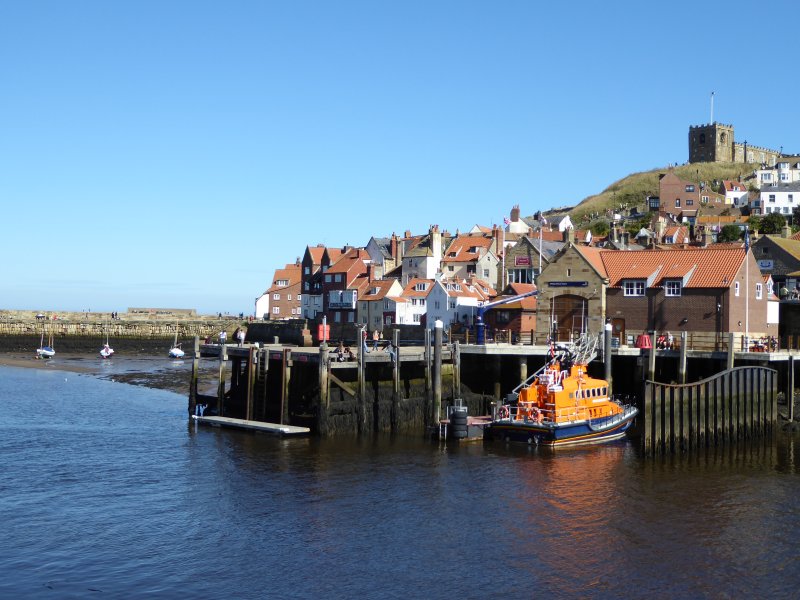
A day in Whitby, fishing port, tourist destination, jet-mining town, and home of Dracula’s author, Bram Stoker…… Oh, and we ate fish and chips. Of course.
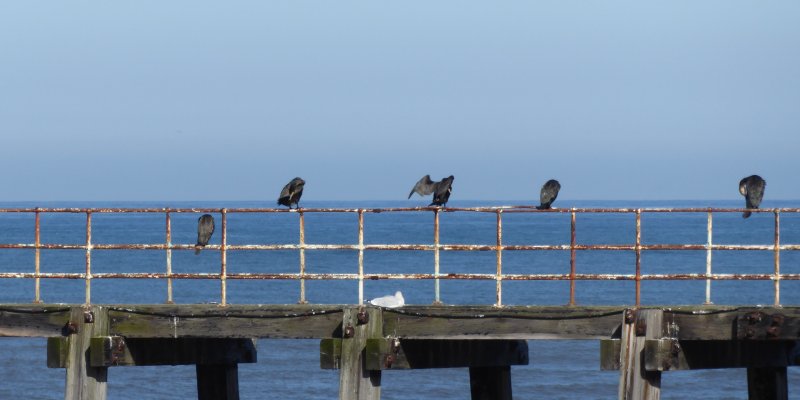
The harbour at Whitby……….. and a line of cormorants.
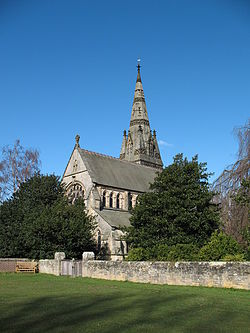
Christ the Consoler, Skelton-on-Ure. Wikimedia Commons
Here is a tale of a murder. A murder which led to the building of a very fine church not many miles from here.
In 1870, Frederick Vyner, son of the Marquess of Ripon and Lady Mary Vyner, travelled to Greece with a small band of English and Italian friends and servants. They were set upon by brigands who had probably been tipped off, and who demanded a huge ransom: £50,000. Women, children and servants in the party were regarded as useless bargaining tools by the brigands. They were released. But five men remained captive, including Frederick. The money was found to pay off the ransom, but before it could be delivered, the Greeks sent in the army, and in the resulting battle, soldiers, brigands and four of the hostages were killed, among them Frederick Vyner.
Vyner’s mother, Lady Mary, determined that she would build a church in her son’s memory on the Newby Hall estate which was their home. Her sister, Lady Ripon, was at the same time engaged in a project to build a church at Studley Royal, Fountains Abbey, Ripon. William Burges , noted Victorian architect, obtained the commissions for both churches in 1870.
I’m going to get to know St. Mary’s Church, and the work of William Burges very well over the weeks and months to come, as I have just been accepted as a volunteer for the National Trust at Fountains Abbey, where one of my duties will be as an Information Assistant at the church. Yesterday though, as part of our training, we were taken to see the church at Newby, which was until the 1990’s, the parish church of the village of Skelton-on-Ure.
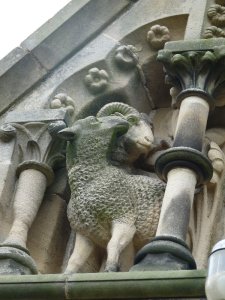
It’s clearly Saint Mary’s sister church, yet more stolid, more weighty in appearance. Originally to have been called St. Michael and All Angels, the church has a unique dedication – to Christ the Consoler. Wander round the outside, and you’ll see over the door Christ the good shepherd with some of his ovine flock: a complement to the sheep in the field beyond, at the moment nursing their young lambs.
Christ’s flock above the church door.
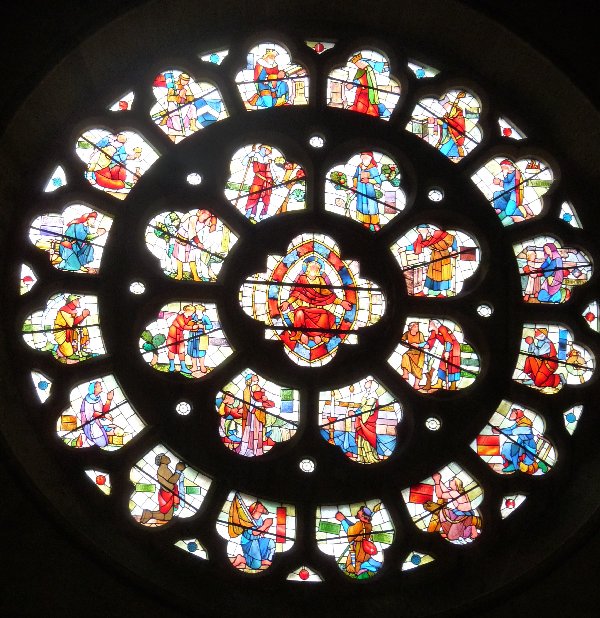
Within and outside the church Christ is omnipresent, perhaps most spectacularly in the rose window which portrays Him at its centre. The several ages of man are illustrated on an inner wheel of glass, and the various occupations and conditions of man on an outer wheel: noblemen at the top, working types below. Curiously, being ‘negro’, seems to be a job in itself. All turn their gaze upon the risen Christ the Consoler as they go about their business. It’s easy to imagine this spectacular window being a teaching aid to any cleric needing material for his sermon.
The rose window.
Christ the consoler
Infancy.
A fisherman and a hunter.
A negro.
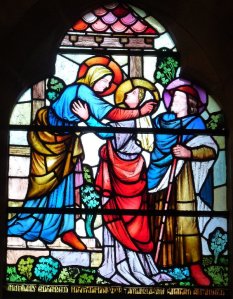
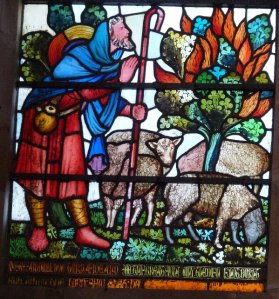
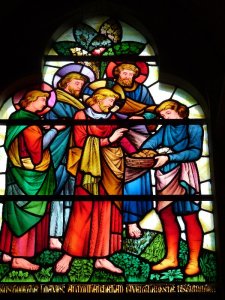
Walk down the nave and you’ll witness the miracles of Christ on one side, his parables on the other, each complemented by the event from the Old Testament which is traditionally held to be the precursor of that in the New Testament. This one was my particular favourite: the Annunciation, whose forerunner was the story of Moses and the burning bush.
The Annunciation.Moses and the Burning Bush.
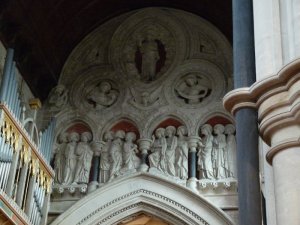
The dominating view as you enter the church is an almost overwhelming sculpture above the entrance to the chancel. Here is Christ’s Ascension with a crowd of 12 looking on. These are the disciples of course: but not Judas. His place is taken by Mary: a very mediaeval take on the event.
The Annunciation.
The chancel itself forms an intimate place for the Vyner family. Heraldic misericords record the arms of close and more distant branches of the family, all surrounding as if to embrace the memorial to the murdered young Frederick in a private and understated way. It’s decorated, as is St. Mary’s, with columns in Irish marble: dark green, plum red, greyish-white. More stained glass windows of Christ carrying his cross, then crucified, each with a number of Old Testament precursors.
Detail from the organ housing.
Angels rise above the chancel.
There’s more. There’s a glittering reredos with the Magi. There’s a spectacular organ casing set before the chancel. There’s detail to keep you happily busy and exploring for hours. Newby Hall and its gardens ought to be on your tourist map if you explore our area. Don’t leave the church out of your itinerary.
The miracle of the loaves and fishes.
As for William Burges, and the story of the two churches he built here near Ripon… well, there’s plenty here for another day
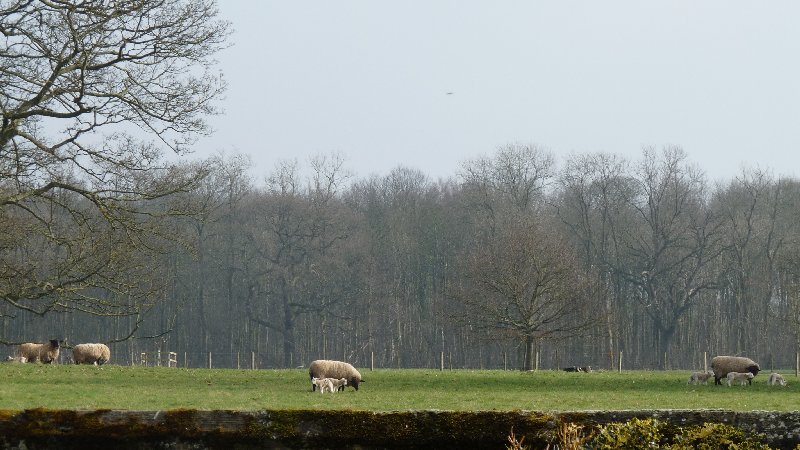
The sheep and lambs of Newby Hall, glimpsed from the churchyard.
Up betimes, in order to be at Harrogate Hospital by 7.30 a.m. Yesterday was a day of white-coat-syndrome-induced high blood pressure, insensibility whilst under the knife, and not a little discomfort for Malcolm. He’s been waiting for months for some minor surgery, and now he’s had it, his life should get a lot more comfortable.
I, meanwhile, had to spend the day in Harrogate waiting for the call to go and collect him. I had quite a few errands to run in any case, and after that it wouldn’t have been worth traipsing back and forth from North Stainley.
So I did my jobs, and then had plenty of chance to loaf about. I’m not the world’s keenest shopper, but I do have a favourite charity shop in Cold Bath Road. Our friend Jonet volunteers there, sifting through and sorting donated books. I love the serendipity of looking along the shelves crowded with fiction old, new, English and foreign, next to an eclectic collection of non-fiction. As usual I left the shop with a satisfyingly large pile of reading, and this time, a new-to-me summer dress.
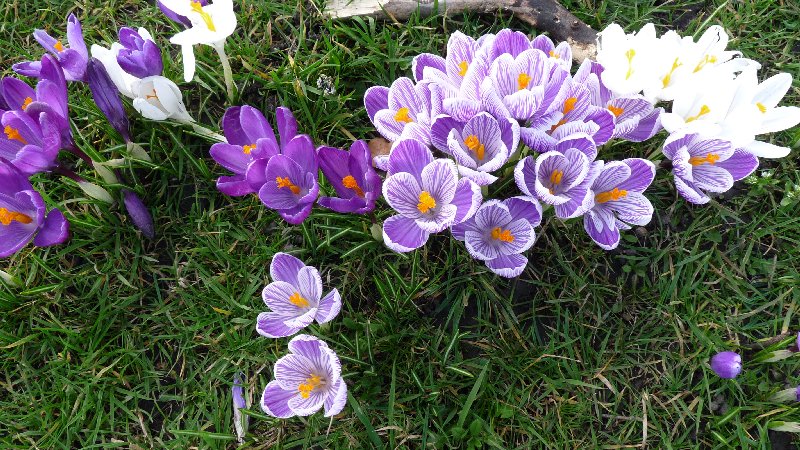
Then I headed for green space. What makes Harrogate a special town is its area of open parkland in the centre of the town – the Stray. It was created from common pastureland in 1778 to link most of Harrogate’s springs (it’s a spa town after all) and an Act of Parliament preserved its size at 200 acres. Even now, if part of its area is lost due to, for example, road widening, it must be replaced elsewhere. It’s pretty unique to be able to step directly from busy shopping streets straight onto a vast green area unbounded by railings or fences. Paths and roads will lead you through this green space to other parts of town. Like me, you could walk across the Stray to get to the hospital, or to reach the community round Cold Bath Road with its neighbourhood shops and Victorian housing. And yesterday, you could enjoy, as I did, the crocuses which have burst forth in their hundreds and thousands in glorious lakes of colour – purple, mauve, sunshine yellow and white. They’ll be followed in a week or so by an equal multitude of daffodils, and then avenues of cherries will blossom in all their pink finery. Here’s a few shots of Harrogate Stray on the warmest day of the year so far.
Walking on the Stray
View from the Stray to Harrogate.
Easter eggs on display at Betty’s, Harrogate’s Top Caff.
I know grey squirrels are no better than rats with tails, but they still cheer me up as they scurry up and down trees.
A sunny morning on the River Ure, just before we reached the Canal.
We went for a walk along the Ripon Canal the other day, starting from the point where it meets the River Ure. Back in its heyday during the Industrial Revolution, busy as it was then, the rural towpath we walked along might not have looked so very different. Back in its heyday, keels would have hauled coal northwards from the Yorkshire coalfields, and lead and agricultural products southwards. The canals were the freight-haulage routes of their age, and even though they were busy thoroughfares, the whole business of passing vessels through the three locks in one direction at a time limited the flow traffic to levels well below what those of us who’ve ever been stuck in a bad-tempered rush hour traffic jam on the M1 have experienced.
Ripon Canal is not one of the country’s great canals. There are water super-highways such as the Grand Union Canal linking London with Birmingham. That’s 137 miles long. There’s the Leeds-Liverpool Canal. That’s 127 miles long. The Ripon Canal runs for just two miles, from Ripon to Oxclose Lock, where it links with the River Ure. Like many of the country’s canals, it was built in the latter part of the 18th century, between 1767 and 1783, opening up water traffic between Ripon and York, and it eventually put the products of the Durham coalfields within Ripon’s reach.
The railways proved to be the death of canals all over England. Ripon’s withstood the opening of the Darlington to York railway in 1841, but the Leeds and Thirsk Railway finished it off. The railway company actually bought the waterway, to ensure local support , but they then neglected it, failing to dredge it, so that it became less and less useable. The canal was abandoned as a waterway in 1906.
But its fortunes have changed again. No longer a tool of the industrial revolution, the canal has become a playground for people who like ‘messing about in boats‘*. The Ripon Canal Trust spearheaded its restoration from the 1960s, and now the whole thing is managed by the Canal and River Trust. So whether you like boats, barges, or a stroll along a quiet backwater near town, Ripon Canal’s worth a visit.
Barges on the canal.
The towpath again.
One of the canal bridges.
Walking the towpath
*That’s what Ratty used to like to do in Kenneth Grahame’s ‘The Wind in the Willows’
I lived in Wakefield for a few years, in the 1970s. Back then, it was a gritty industrial town, surrounded by pit villages such as Crofton, Sharlston and Lofthouse. It was the home of Double Two shirts, and the administrative capital of the now-defunct West Riding. You’ll still find Wakefield Prison here, the largest high-security prison in Western Europe. And Wakefield is still part of the unique ‘Rhubarb Triangle’, an area between Wakefield, Morley and Rothwell where, in the cold early months of every year, delicate pink forced rhubarb is grown in darkened sheds for a public still eager to buy.
Wakefield had its elegant quarters too, largely built round the Georgian St. John’s Church, and there was a decent market as well, and a good Art Gallery and Museum.
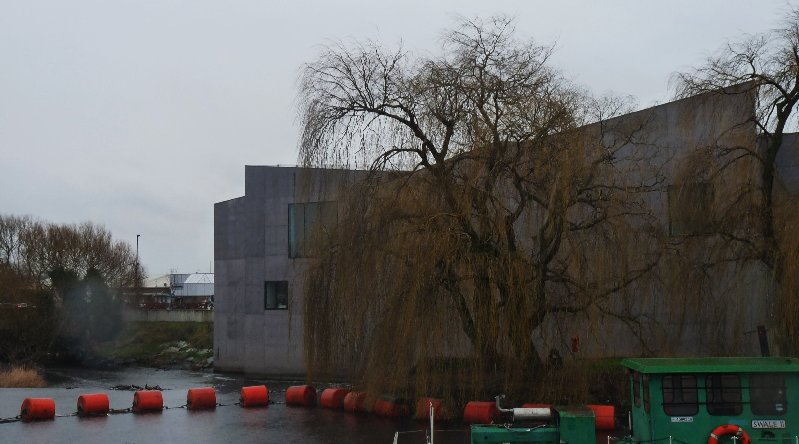
What it didn’t have in those days was the Hepworth Gallery. So we paid it a visit on Sunday. It’s on an unpromising site by a fairly unlovely stretch of the River Calder, alongside a busy dual carriageway and various semi-industrial sites. But with its austere pigmented concrete facade, the building itself rises energetically and imaginatively from the midst of the industrial landscape in which it’s situated. We went inside, to a cool, clean and calm space. With an excellent café. This did seem promising.
The Hepworth Gallery.
Houseboats on the river.
A worker’s cottage? Or trompe-l’œil?
Rain on the outside walls.
Neither of us liked the current exhibition showcasing Lynda Benglis. But we’d really come to see Barbara Hepworth’s work. She was a Wakefield lass, a contemporary, friend and colleague of Henry Moore. I’ve known and admired her work for much of my life, but most enjoyed it when visiting St. Ives some years ago. Hepworth lived there from the 1950s till her death, and much of her work is exhibited at the Tate Barbara Hepworth Museum and Sculpture Garden. It was the sculpture garden that did it for us then: plants and sculpture co-exist in intimate harmony, each enhancing the other in ways that have stayed with us in the years since we were able to spend time there.
The time we spent with her work in the Gallery was enhanced by glimpses of her working life: the tough and workmanlike bench with its tools laid ready for use; the videos showing her working, or her pieces being prepared for casting in bronze in busy foundries.
Hepworth’s workbench.
What makes this exhibition interesting is that most of these works are full-size prototypes, in plaster or aluminium of works that would later be realised in bronze. It’s clear that she needed to work even at an early stage on the same scale as she would on the finished article. What could she gain by trying her ideas out in miniature?
These pieces are reminiscent of the rolling character of the Yorkshire landscape round Wakefield. To achieve them, Hepworth chipped, carved, smoothed and worked away at her pieces: it was solid manual labour, not so very far removed from the labour of the miners and workers who also lived in the community where she grew up. It’s a man’s world, and Hepworth was extraordinary not only for being a woman studying sculpture, but for reviving the art of carving her own work. In the Edwardian age, sculptors had merely moulded their maquettes and left masons to do the hard graft.
I love this juxtaposition of the Hepworth sculpture with the Euan Uglow portrait behind.
Yet her work is sensual and invites contemplation. I relished the chance to do so in this light and airy gallery, with its backdrop of the city of Wakefield seen through the vast windows, allowing the daylight to illuminate her work.
Wakefield from the windows of the Hepworth Gallery.
The days are short The sun a spark Hung thin between The dark and dark. John Updike, “January,”A Child’s Calendar
A bright winter’s afternoon. Just time, before the evening cold sets in, to get out for a couple of hours of brisk walking: 5 miles or so along familiar paths. So familiar that this time, I focus on the sky: changeable, unpredictable.
Sometimes it’s moody, sometimes cheerful, sometimes simply rather grey and colourless, at other times dramatic, particularly towards sunset. Come and walk with me to watch the clouds.
















 From Pyrenees to Pennines
You must be logged in to post a comment.