Spring: red, yellow, white or green?

I’m now on Day Nine of The Great British Coughing Virus, and as you may be unlucky enough to know, it ain’t fun. I’ve done nothing worth writing about, and my creativity quotient is at an all-time-low.  Instead, I thought I’d share with you the piece I wrote for my U3A Writing Group the other week, following the prompt ‘red’.

Spring: Red, yellow, white or green?

Spring is not red.  Spring is white, as the late snowdrops poke their heads above the frosty soil.  It’s yellow with primroses, daffodils and aconites: and later, laburnum and dandelions.  It’s fresh citrus green, with young tender grass and unfurling leaves.


Summer is red.  Summer is scarlet strawberries, velvet raspberries and glossy cherries.  It’s poppies among fields of wheat. It’s glowing noses and peeling shoulders on a crowded beach.  It’s roses and nasturtiums and salvia and geranium vying for space in the summer flower bed.

Autumn is red.  In autumn, leaves drop from the trees, turning from green to yellow and then to russet red as they reach the ground.  Crab apples glow on trees, and foragers like me gather them, and tumble them into a pan to simmer with sugar and spices to make a translucent ruby jelly for spreading on toast through the bleak winter months.  

Winter is red.  Bright berries poke out from beneath the sleek green leaves of the holly. Vermilion rose hips stand starkly on black branches, cheerfully  transforming barren twigs and colouring the winter landscape. There’s little Robin Redbreast, perching on a scarlet pillar box, and all those gaudy Christmas decorations.

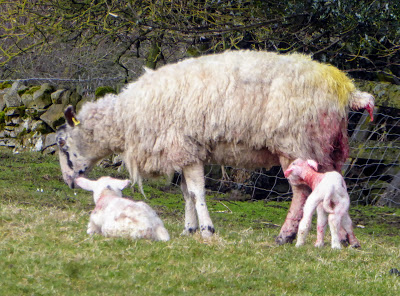
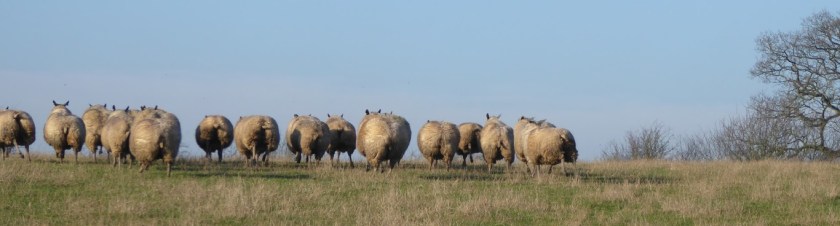
Spring is not red.  Or at least I didn’t think so, not until last week.  Here’s what I found on a walk across a Daleside farmland: a ewe, with two only-just-born lambs. Her babies were stained bright red with her blood, as she licked them clean.  Spring that day was a Red Letter Day, celebrating new life.
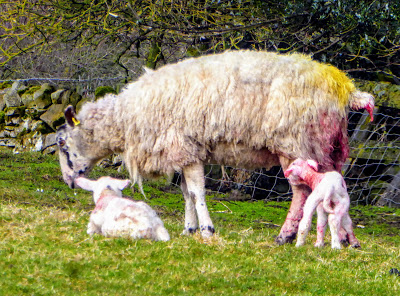
A ewe and her new lambs near West Witton, Wensleydale.

Forces of Nature

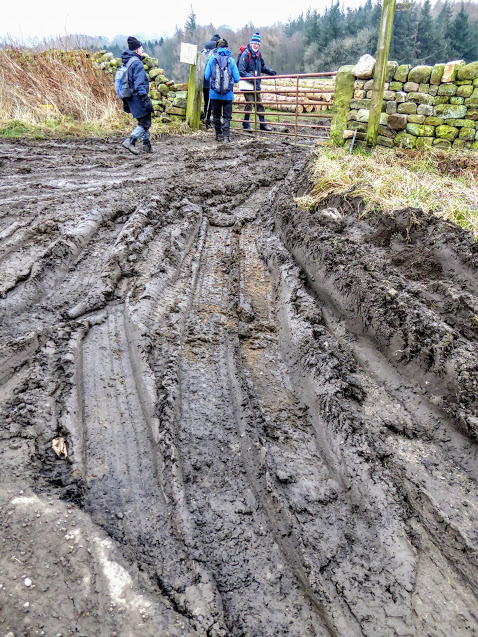
Nature has had the upper hand lately. Snow, and plenty of it, disrupted our daily rhythms a few times in recent weeks. Rain, and plenty of it, has swamped fields and tracks, making a walk in the country an utterly unreasonable pastime.
The other day though, cabin fever got the better of us, and we made a break for the countryside near West Witton, reasoning that some of the tracks there would be more or less passable. They were. More or less.

But Nature made its presence felt in full force. Here was almost our very first sight on our walk – a mother ewe with twin lambs so very newly born that she was still calmly licking them clean as they tottered beside her, looking for their very first feed of milk.

The weather was mild. Surely the snow would be long gone? Not up here. Bitter howling winds a week ago had snatched the snow into deep drifts at the edges of fields, or pounded it into hillside crevices.

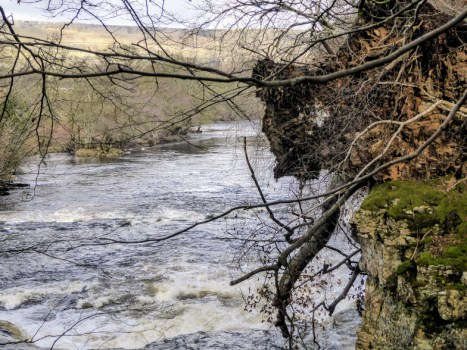
Redmire Force lived up to its name. Look at the waters swirling, frothing and plunging over the boulders in the River Ure. Look at the tree torn from its cliff side, now hanging precariously over the river.

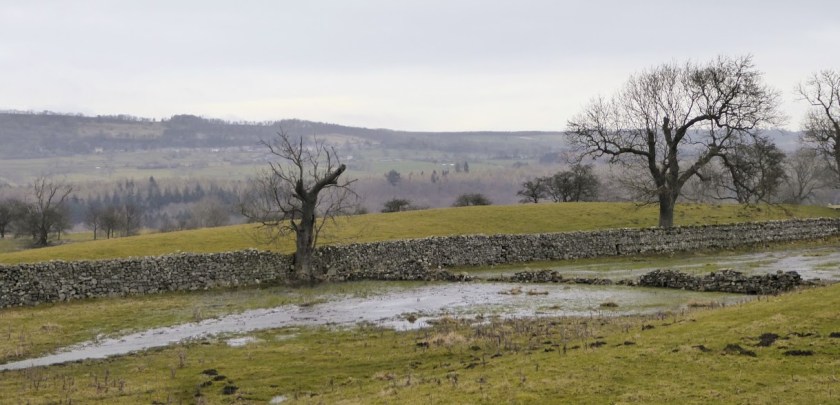
And as we came to the end of our walk – look! Is this a river, or is this a field, unusable by the sheep who normally graze here, but forming a stopping off point for the occasional passing water bird?

We’re not quite as in charge as we like to think.

Click on any image to view it full size.

Snapshot Saturday: from Pyrenees to Pennines via books, a cup of coffee,a skein of geese …. and an elephant

The WordPress photo challenge this week is ‘Beloved’.

I don’t think the humans in my life whom I love would be happy for me to plaster their images all over the blogosphere.  I have no pets, beloved or otherwise.  So I’ll have to look a little further.

Here’s a little miscellany of images, beloved images:

  • The Yorkshire Dales, whose rolling hills, bisected by ancient drystone  walls I missed so much during our years in France.
  • The Pyrenees, from their richly flowered springtime meadows through to winter, when their rocky slopes are covered in deep snow, and which I now miss every single day.  I’ll miss the shared picnics on our walks together, when our French friends pooled resources, and we ate everybody’s offerings of home-cured sausage, local cheeses, bread, home-baked cakes together with wine and somebody’s grandfather’s very special eau de vie.
  • Springtime daffodils.  Every year I go into deep mourning when they wither, die and finally become untidy heaps of dying leaves.  I’m happier now as they thrust their sheathed stems through the hard soil, promising to flower soon- but not quite yet.
  • There are books: I need a pile beside my bed to get me through the night.
  • A single, perfect cup of coffee from Bean and Bud in Harrogate.
  • Skeins of geese flying overhead mark the seasons here, and I love their haunting, raucous cries.
  • And so on….

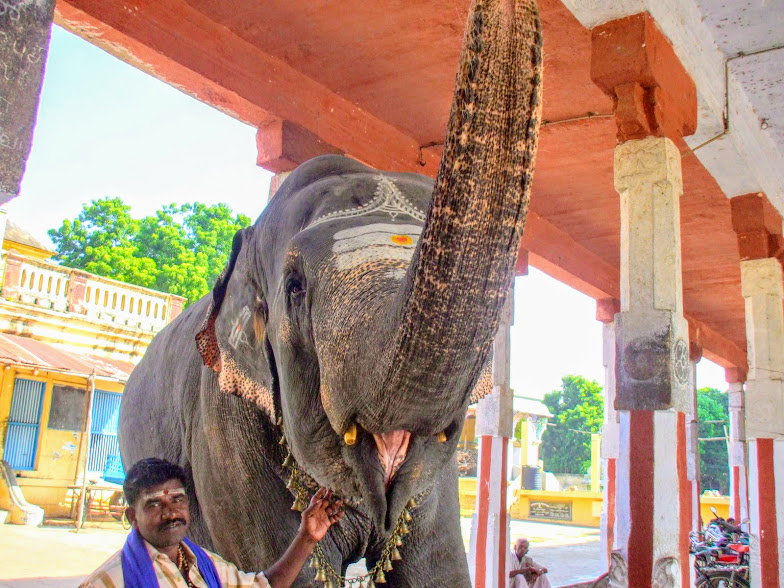
I’ll end though with this.  I wasn’t beloved of this elephant in Kumbakonam,  Tamil Nadu, who was only doing his job when I visited him ten years ago on my Indian Adventure.  But I felt beloved and very special when he raised his trunk and brought it down upon my shoulder – his very distinctive way of blessing me.

Elephant in the temple of Adi Kumbeswarar, Kumbakonam, ready to give me his blessing.

Click on any image to see a slideshow of the photos, full-size.

Snapshot Saturday: a wintry walk

For the last WordPress Photo Challenge of the year, we’ve been bidden to come up with our favourite shot of 2017.  How to choose?

I was thinking of maybe reviewing the year, one month at a time: family moments, walks in the Dales, trips to Poland, Germany, France and Spain.  Nope, it wasn’t working .

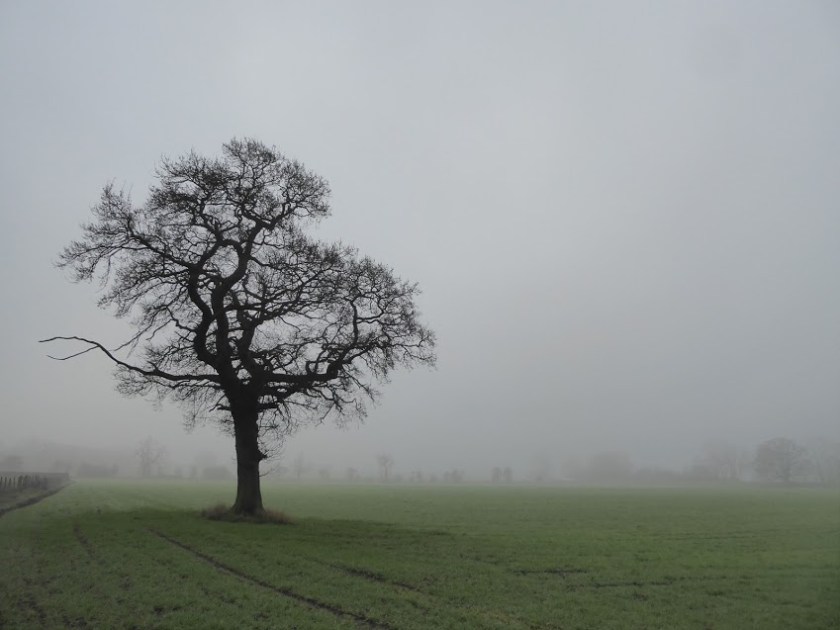
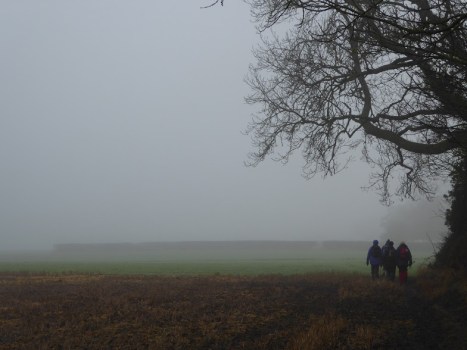
The shot that I found kept presenting itself was this one, taken on a chilly walk not so far from here almost a year ago.  It chimes in with my somewhat gloomy feelings about the future: political uncertainty here, in Catalonia, in America, to name just three.

Not all was gloom though.  Look!  We were walking with friends.  And in the end, the sun came out, and we were able to turn our backs on the damp unfriendly fog.

If only politics were so simple.  Happy Christmas everyone.

Snapshot Saturday: up – and down – in the Yorkshire Dales

If you go walking in the Yorkshire Dales, you won’t avoid a few ups and downs.  And not just the hills either.  There’s a small matter of stiles to be climbed to get over all those drystone walls.

Near Kettlewell, Yorkshire.

This post is in response to this weeks WordPress Photo Challenge: Ascend

The multi-tasking Handlebards

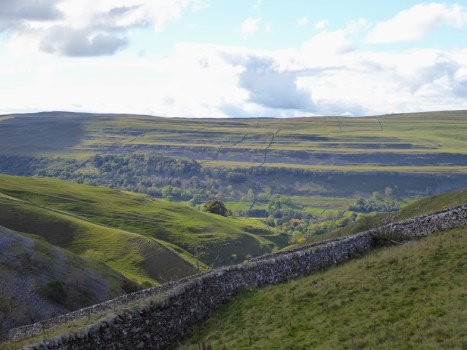
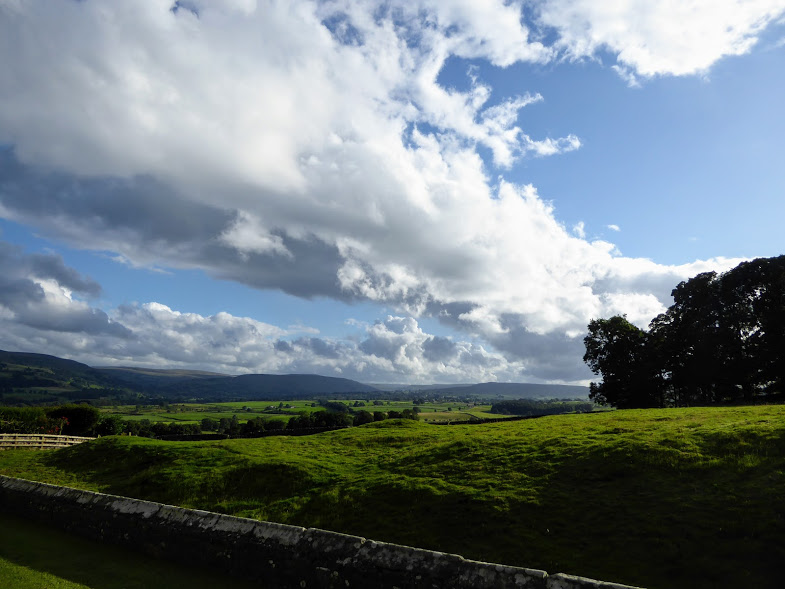
This is the scenery near Leyburn in Wensleydale. This is Bolton Castle.

Bolton Castle, Wensleydale.

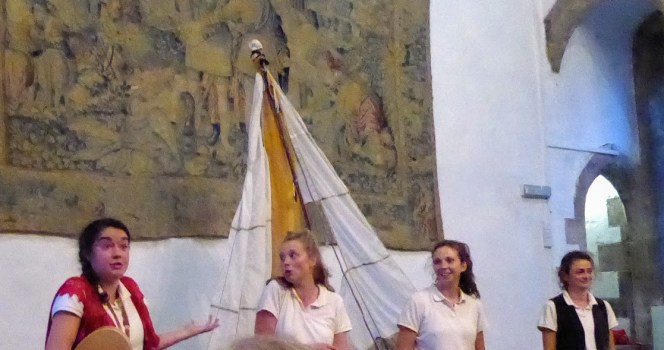
Imagine sitting in the grounds of this 14th century castle as evening draws in, a picnic beside you, to watch The Handlebards’ version of Shakespeare’s  ‘As You Like It’.  You know this will be no ordinary performance.  The Handlebards are four female actors who cycle the length and breadth of the kingdom, with all they need for the tour crammed into two bicycle carriers. At each performance, they take every part in Shakespeare’s comedy of bizarre mistaken identity, family breakdown, love and lust.

So far so good.  But this is England in July.  We’d had two days of almost incessant rain.  In a downpour, the Handlebards cycled the 26 (mainly uphill) miles from Ripon, where they’d performed at the Workhouse Museum.

The Castle has a Great Hall.  Performing here rather than on a soggy greensward seemed a better idea in the circumstances.  And it was.  During the evening it rained.  And then rained again.  The audience never noticed a thing.  We were too busy admiring the way four women became twenty or more people.

A simple, but infinitely adaptable stage set.

To become a man, all they had to do was don a codpiece adorned with a tennis or cricket ball.  A selection of hats served to distinguish one character from another.  Bicycle handlebars identified the wearers as sheep. Your character needs to disappear stage right to enter stage left as someone else?  Easy.  Leave the person whom you were addressing in charge of your hat, and s/he will continue to talk to it.  With the flourish of a stick, a youth became faithful, ancient Adam.  Orlando and his family were all twoubled by an inability to pwonounce the letter ‘r’.  And so it went on, as one inventive twist or piece of slapstick followed another.  Shakespeare would have loved it.

This is the only photo I have of the Handlebards, and it’s out of focus at that. They take a bow as we give them a more than enthusiastic standing ovation.

I’m now a Handlebards groupie.  And the fun doesn’t end here.  In other venues, having travelled there on other bicycles, a troupe of male actors is giving similarly irreverent treatment to ‘A Midsummer Night’s Dream’.  We’re on the mailing list.

The rain let up a bit in the interval. Here’s the view.

Taking tea on the train

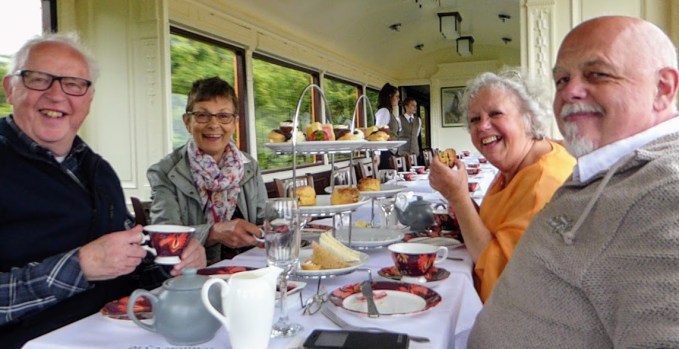
‘Everything stops for tea’.  Not if you take it on the train it doesn’t.  Just imagine.  You and your fellow guests are seated at an elegantly appointed table covered with a damask cloth.  Here are china cups and saucers, heavy cloth napkins, weighty cutlery. Before you, a Proper Cake Stand, prettily stacked with sandwiches (cucumber, of course, but also egg mayonnaise, ham and chutney and so on), two kinds of scone with clotted cream and strawberry jam on the side, and properly English cakes: chocolate cake, sponge cake, cream-filled meringues, tiny eclairs.  Attentive and charming service.  Unlimited pots of tea, of course too .

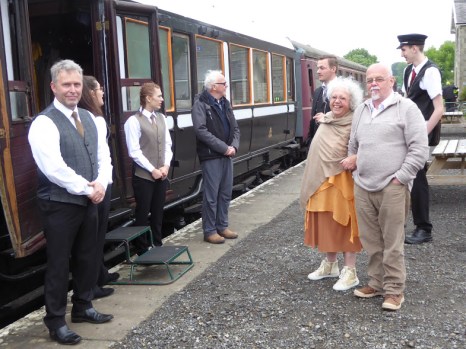
This was the scene that greeted us as we climbed aboard. The cucumber sandwiches have yet to arrive.

We were on the Wensleydale Railway, at the invitation of Susie and Pete, old friends from France and currently visiting England.

This is a heritage railway, staffed by volunteer enthusiasts, with engines and rolling stock from earlier times.  Our carriage had been built in about 1913, at the behest of the infamous director of the Titanic who dressed himself as a woman in order to make his escape from the sinking vessel in a lifeboat.  Our tea time experience was masterminded by the Institution at Bedale.

Here we are, enjoying our feast

Our tables were ranged down the middle of the carriage, enabling us all to have views of Wensleydale as we sat enjoying our tea.  The train chugged steadily along the track, offering views quite different from those available to us as we travel by road, or walk along country footpaths.  We were in another less hurried age, and enjoyed passing through little stations, past signal boxes pressed into service once more when trains like ours are on the move.

A level crossing, a signal box: just as I remember from childhood.

At Redmire, we had to dismount as the engine chugged away to turn round and pull us back once more to Bedale.  We had time to admire the rolling stock.

This was afternoon tea at its finest: a leisurely experience enabling us to put present worries aside, just for a couple of hours.

The Himalayan Gardens

Even better than the fact that Himalayan gardens exist here, and just eight miles from our house, is the fact that they’re next to the village of Grewelthorpe.  And if that isn’t the best village name in England, I don’t know what is.

All the same, what are Himalayan Gardens, complete with a sculpture park doing in North Yorkshire?

Twenty years ago, Peter and Caroline Roberts bought a twenty acre woodland garden.  It wasn’t up to much really.  Coppiced hazel, an infestation of Japanese knotweed, dense dark Sitka spruce woods.  Its redeeming feature was a drive of rhododendrons, and this gave Peter Roberts his idea.  He looked at other rhododendron collections at Castle Howard, at Bodnant, at Muncaster Castle, and was inspired.

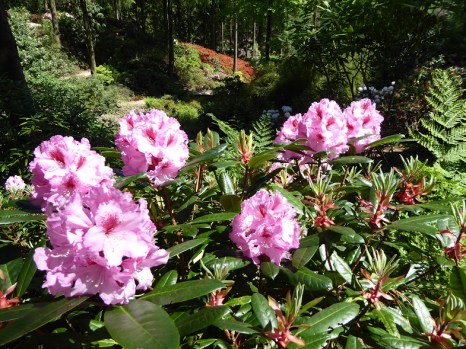
Rhododendrons such as these must have inspired Peter Roberts. Can you spot the drift of red specimens in the background?

Alan Clark, rhododendron guru and Himalayan plant hunter, told him that both site and soil were ideal: ‘I was intrigued by the idea of creating a Himalayan garden from scratch and decided to give it a go!’

Clark helped him with early specimens, Roberts supported plant-hunting trips to the sino-himalayan area … and the gardens began.

You won’t just find rhododendrons and azaleas though.  There are massed plants that you’ll find in many well-stocked British gardens.  There are drifts of narcissus in the spring.  There are carpets of bluebells.  There are several lakes on site.  Word has got round the bird and insect community that this is a fine place to live, and any birdwatcher or entomologist could have a busy time here. As could visitors who enjoy coming across an eclectic mix of sculptures during their walk.

My photos have disappointed me.  They give little impression of the rich feast of colour provided by hillsides covered in an ever-changing pageant of different varieties of rhododendron and azalea.

Nor can you see that this is a work in progress.  Peter and Caroline Roberts are constantly developing the site, planting and extending the collection.  On Saturday, just after our visit, a new arboretum opened.

Go while you can.  This special place is open for two months only every spring, and for a further couple of weeks in the autumn. It’s worth a detour (Susan Rushton, I’m looking at you).

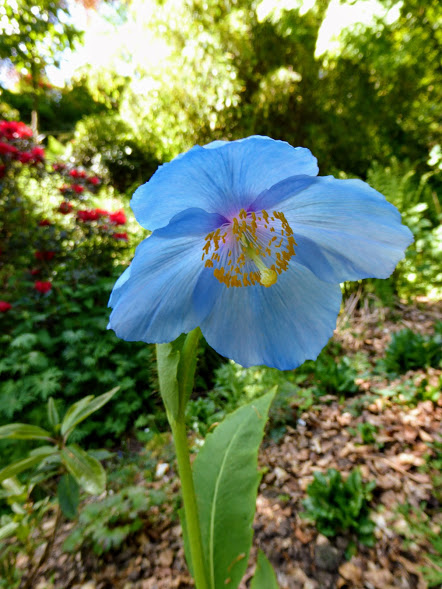
The Himalayan blue poppy makes its striking appearance throughout the gardens

Snapshot Saturday: From World Heritage to heritage at home.

Fountain’s Abbey seen from a hillside walk last Autumn.

In 1132, thirteen Benedictine monks from York fetched up in a wild and isolated place we now know as the manicured and lovely parkland setting of Fountains Abbey and Studley Royal.  The Archbishop of York had offered them the land so they could establish a pious community based on silence, prayer and simplicity.

Over the years – over the next four centuries – they built a community with all the trappings of a large village: sleeping, living and working quarters, an infirmary, guest accommodation, a mill, a tannery, quarrying, as well as the daily focus of their lives, the Abbey church itself, where they worshipped eight times a day.

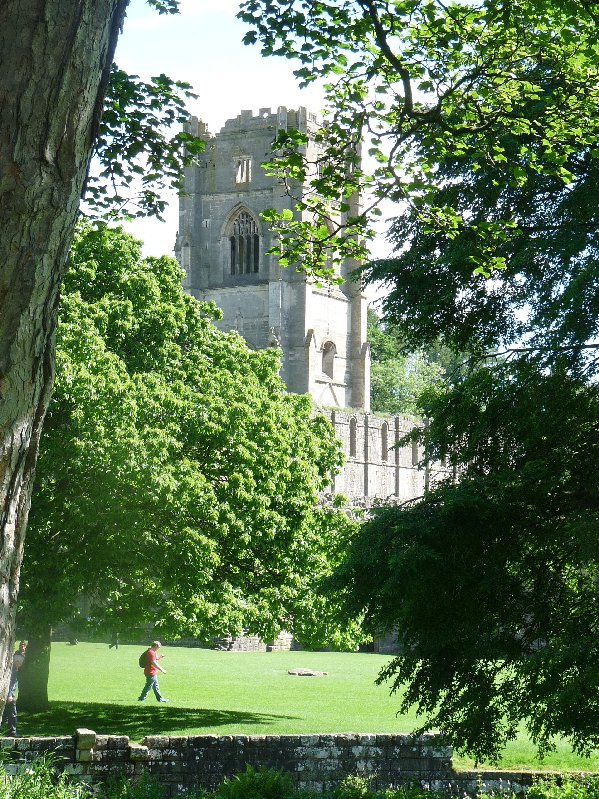
Huby’s Tower at Fountain’s Abbey, built not many years before the Dissolution of the Monasteries

Their principal source of income was from sheep, whose wool came to be valued at home and abroad.  Merchants from all over Europe to buy and trade.

The Abbey site could not sustain enough sheep for this thriving business. Lay brothers (the manual workers of the monastic world) were sent further and further afield to establish small working sheep farms – granges.  During the 15th century they came here, and built the house in which we now live.

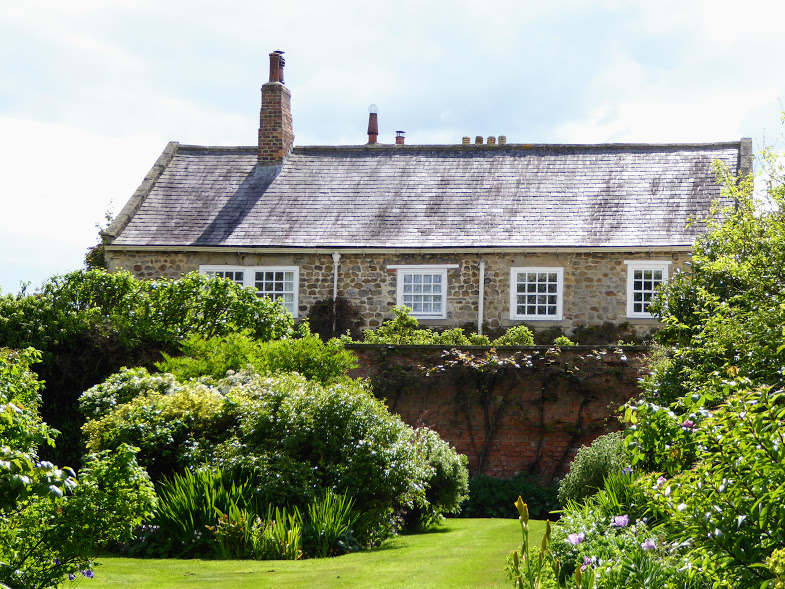
The first floor was once the lay brothers’ dormitory. Now it’s our flat. I bet those monks didn’t look out over this lovely walled garden.

It’s changed a bit of course.  Who knows how much of the house is truly original, though the stone-built walls are a traditional, sturdy and strong build?  We no longer live in an upstairs dormitory, as the lay brothers did.

The Victorians divided the place into rooms for the servants of the country house which was built and attached to the grange in the 18th century.  The animals and working quarters are no longer downstairs, though the old, spacious and business like kitchen hearth still exists.

As I make the eight mile journey from here to Fountains Abbey I like to think of the heritage our home shares with this wonderful UNESCO World Heritage site.  Aren’t we lucky?

The Old Grange is attached to the fine 18th century house next door. We seem to have access to their wisteria.

This post is in response to the WordPress weekly photo challenge: ‘Heritage’