In which Saint Swithin fails to keep his promise.

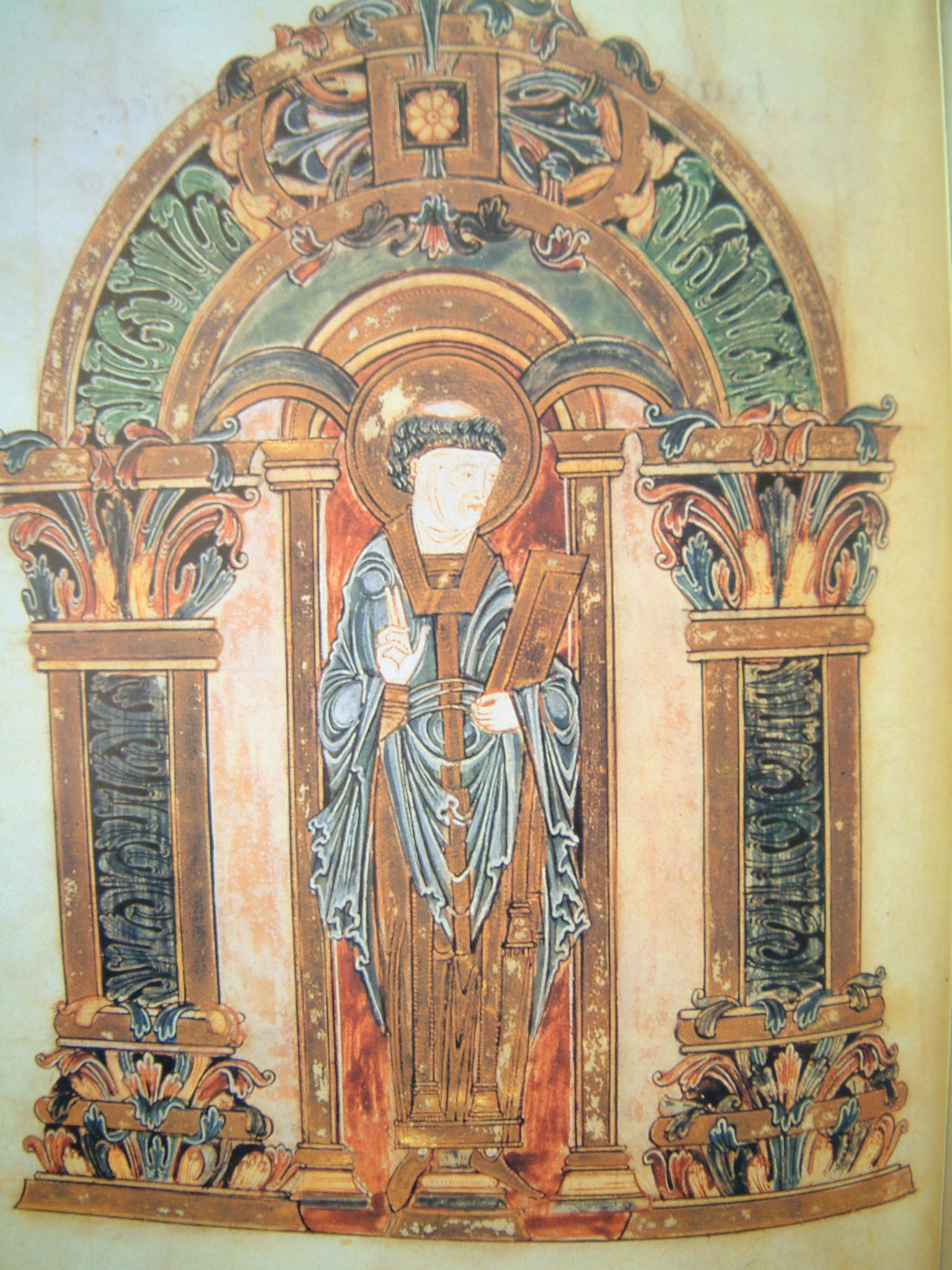
Swithun, Benedictional of St. Æthelwold, Winchester, 10th century, British Library (Wikimedia Commons)
Swithin, Benedictional of St. Æthelwold, Winchester, 10th century, British Library (Wikimedia Commons)

It was Saint Swithin’s Day last Wednesday (15th July).  I thought everyone knew that.  But when I mentioned it to a group of younger people I was chatting with that morning, they looked at me with blank incomprehension.

St Swithin’s day if thou dost rain

For forty days it will remain

St Swithin’s day if thou be fair

For forty days ’twill rain nae mare

Yes, apparently the weather we get on Saint Swithin’s day is the weather we can expect for the next forty days.  Nobody really knows why this blameless 9th century Bishop of Winchester is responsible for his apparent hold over the climate in high summer. He seems to have been a nice chap.  He held banquets to which he invited the poor, not the rich.  He miraculously restored a basket of eggs that workmen has maliciously broken.  He asked that on his death, he should be buried outside the cathedral, rather than inside, so that passers-by would tread on his grave, and so that it should be regularly watered from the skies. But in 971, he was moved to a new indoor shrine.  And lo!  The heavens opened.  Perhaps this is where the legend originated.

But it has a measure of truth. Round about mid July, the jet stream settles into a pattern that holds good until round about the end of August.

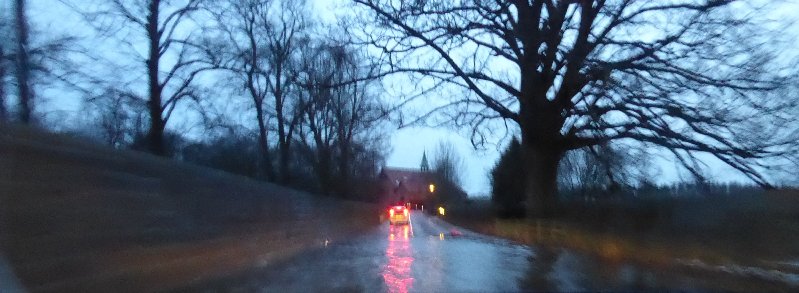
Not this year.  Saint Swithin’s day was pretty good: warm, fresh and sunny.  Since then though, we’ve had cold days, hot days, or like this morning, woken up to driving rain. As this picture sort of shows.

Looking out of the window at breakfast time today.

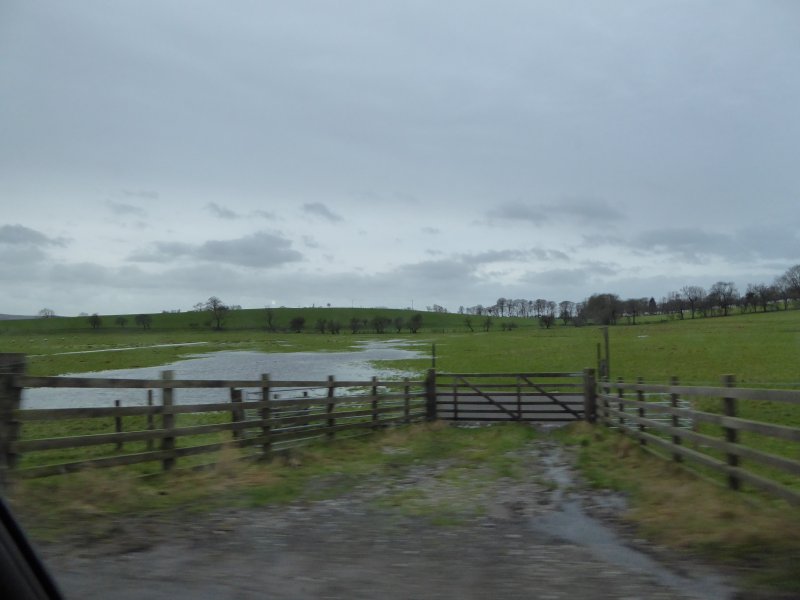
Here are some pictures of a walk I took yesterday, a day on which Saint Swithin kept his promise made on Wednesday.  It was a day of high summer, with the crops ripening fatly in the fields, the verges crammed with tall plants that often obscured the view, and a warm refreshing breeze in the air.  That’s what Saint Swithin is supposed to deliver. He’s got some 36 days left to remember to keep his promise – every day.

Life on the Ocean Wave?

We’ve just come back from a fortnight or so in England – To Be Continued in our Next.  I just need to get our journey off my chest.

We generally cross the Channel by ferry.  Neither of us is keen on the Tunnel, and a nice breezy trip on a boat always seems a cheery, day-out-by-the-seaside way of travelling between England and France.

Not that Dover’s much fun.  Despite having some elegant and interesting buildings, Dover always seems a dingy, down at heel and down-on-its-luck sort of place. And this time, it looked as if we’d have longer than usual time to kill there, because LD lines sent a late text saying our ferry would have to leave at 1.30 p.m., not midday, and we’d arrived in town just before 10.00

Why not go down to the port, then, and see if the ship before had been delayed, and whether it could perhaps squeeze us in?  Down at the booking office, the news was that because of atrocious weather, the 6.30 a.m. sailing still hadn’t been able to leave.  But it was loading, but if we hurried, we could go too.

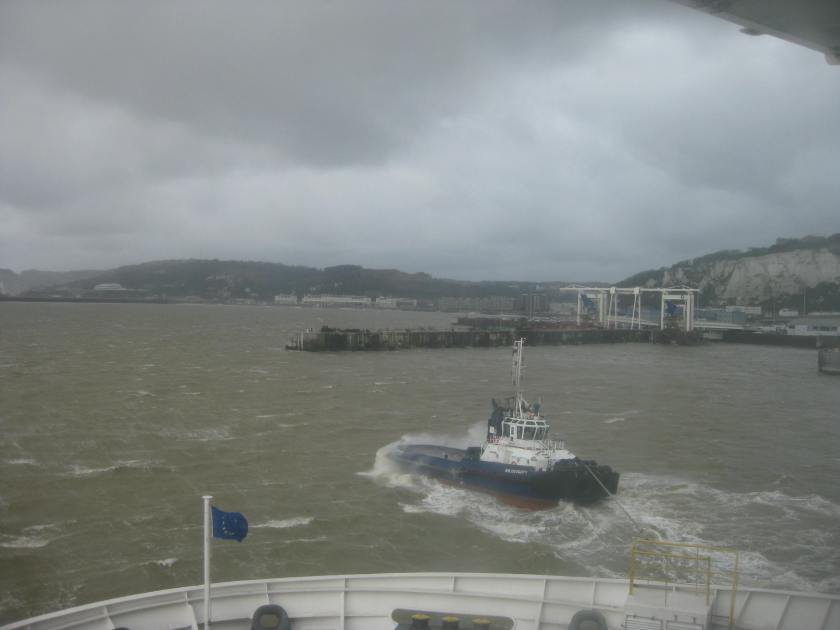
We hurried.  We caught the ferry.  We regretted it.  Even behind the harbour walls, the ship was pitching and tossing.  As we started our voyage, the well-named tug DHB Doughty struggled to keep us on some kind of suitable path between the harbour walls.  Out among the waves and spray of the open sea, the ship immediately started to lunge, roll, and sway, and kept up this uneasy surging throughout the trip.

I’ve always been a rotten sailor, but told myself firmly that this time it would be different: it was just a case of mind over matter.  Less than 10 minutes later I was sick for the first time.

Nearly an hour and a half into our hour and a half journey, the French coast was nowhere near.  Then the captain announced that some cargo had come adrift, and we’d have to stop till it was sorted out.  Half an hour passed.  Then yet again it was Our Captain Speaking.  There was, he said, a Force 10 gale going on.  He didn’t propose to risk getting into the harbour in Boulogne in these conditions.  We’d just have to sit it out.  I went green.  I went yellow.  I went glassy eyed. I used up several sick bags.  So did half the passengers.  The other half (including Malcolm) only had boredom and ailing partners to contend with, but they weren’t having a lot of fun either.  Malcolm struggled off to find water for me, and found broken crockery all over the cafeteria, books and souvenirs strewn over the shop floor, and the toilets awash.  He lurched back empty handed, though stewards came round with water and sympathy later on

And we sat, hunched miserably in our seats, until finally, the captain reckoned there was a slight change in the weather. At last the French tug Obstiné brought us into port .  Those tugs with those inspired names were the cheeriest things about the whole journey.

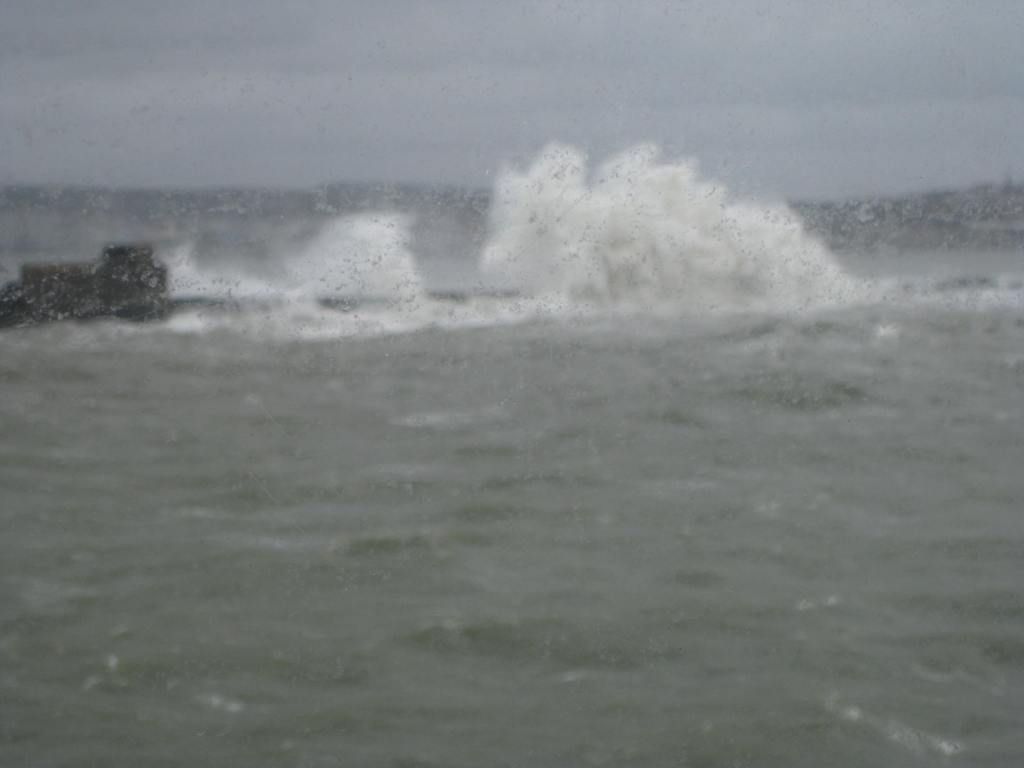
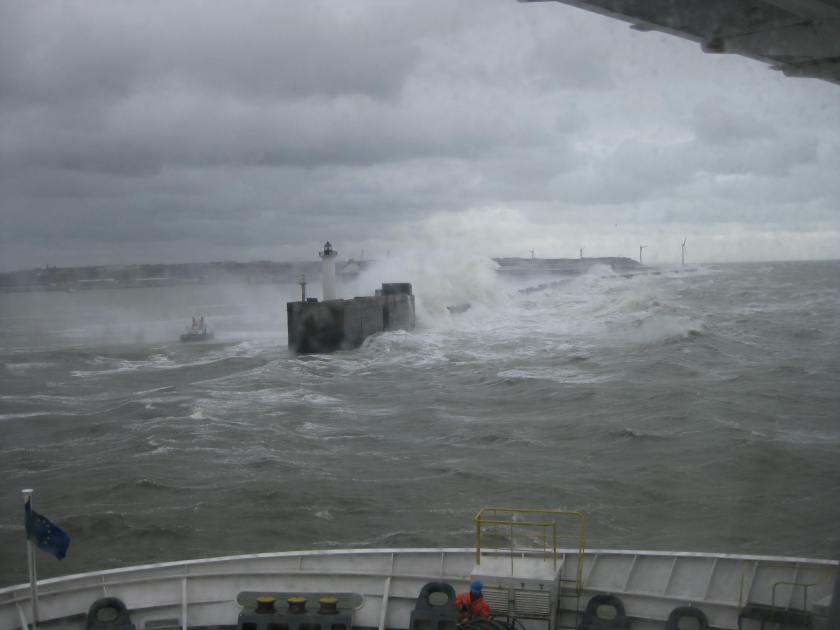
The photos show the sea hitting the harbour in Boulogne.  That’s the sea as it lost power and hit the coast, not the raging sea we’d been putting up with in what felt like mid ocean.  For six long hours.

Next time there’s a storm, I ain’t sailing.  I’ll just sit it out on dry land.