Striding into the new year

I’ve been in a difficult mood all week.  This down-sizing malarkey isn’t suiting me at all.  Though I haven’t been down to the tip yet to excavate for my lost goods, it can only be a matter of time.  I gave some books to a friend this morning, books dating from my student days, then took them back from him.  ‘I will give them to you’, I promised, ‘but I just need a bit more time’.  I haven’t read those books in 40 years.  But I might.

So to distract myself, every afternoon this week I’ve set off on my self-imposed challenge.  I want to see how many more short walks, each lasting two to three hours I can discover setting off from the house.  We know such a lot already: at least four different ways to get to and from Léran, two to La Bastide sur l’Hers and several other shorter ones in the same direction.  Walks to and from Dreuilhe, Lavelanet, Regat, Tabre, Aigues-Vives, Campredon, Patato (yes, really), Fajou…..

The area we’ve explored least lies westwards from Laroque.  There’s a small and charming village called Esclagne about two and a half kilometres away as the crow flies.  I reckoned I could find any number of ways to get there and back, and so far this week I’ve come up with three – and that’s not counting the road, obviously.

French maps (I need to whisper this, in case anybody French is listening) are not a patch on our UK Ordnance Survey maps, mainly because they’re hopelessly out of date. Paths peter out, if you can find them in the first place, because as in England, not all farmers welcome ramblers.  Yesterday I scrambled under several barbed wire fences, and several more electric ones.  Waymarking tends to be unreliable too.  The path along the ridge leading from Laroque to la Bastide offers no possibility of going wrong.  There’s a cliff-edge on one side, and thick woodland on the other.  Nevertheless, it has trusty yellow waymarks painted on trees or rocks every few yards.  But get yourself into territory where there are multiple five-lane-ends, or a couple of tracks that might or might not have been made by resident deer, boar and badgers, and you’re abandoned to your fate.

Still, Esclagne is mounted  attractively on a hill top.  You can see it once you’re in the area, and if you haven’t managed to track down a suitable path, all you have to do is choose fields with not-too-cruel fencing, not too boggy, no bulls in sight, and walk.  It’s a chance to come upon herons startled from their familiar deserted feeding ground, make friends with affectionate donkeys, or simply enjoy the views.

Esclagne has some 115 inhabitants.    Even such a tiny village qualifies for a mayor and town council, a town hall, and a community notice board filled with all kinds of official pronouncements.  The inhabitants are no longer dominated by farmers and agricultural labourers, but townies looking for a peaceful retirement.  Unlike their British counterparts, they are not resented.  They haven’t priced the country folk out of suitable housing.  There’s been enough and to spare since the first world war, which emptied the villages of their menfolk.  Those who weren’t killed often didn’t return, preferring to make an easier living up in the more prosperous north.  Still, it’s not a lively village.  There are almost no children living here.  I did spot a traffic hazard though: a busy group of hens all foraging around the traffic signs warning of (a) a 30 k.p.h speed limit and (b) speed bumps.

So that was Esclagne.  I consulted the map, found yet another path worth exploring, and after 10 minutes or so found myself dumped once more at the edge of a wire-fenced stubbly field.  Never mind. I could see Laroque ahead of me at the bottom of the hill.  Just point myself in the right general direction and head home.  Another successful walk.

The morning after the night before.

I don’t celebrate the winter solstice.  From my point of view, what’s to celebrate on the shortest day of the year – and the longest night?  But the day after: that’s a different story.  Now the days get just a little bit longer, the nights a little bit shorter, every single day till the middle of next June.  So today was the day to jump cheerfully out of bed and enjoy the clear bright sunshine, lasting a whole 5 seconds longer than yesterday.  Come and join us on a brisk morning walk.

We’ll start from the Lac de Montbel, walk along the water’s edge to the hamlet of Les Baylards, and then climb up to the ridge that leads through the woods, overlooking the Plantaurel and the more distant Pyrenees, towards Mireval.  Back down the hill through Villaret.  This is a tiny hamlet on a single track road, but it charms me every time with its old blue enamel sign, ‘Poids Lourds’ – ‘HGV this way’.   Back to the car, and we’ll be home in time for lunch, with an afternoon’s sunshine still ahead of us.

The winter playground up the road

Our Thursday walking friends opted for a day with raquettes today: snowshoes.  Earlier this year, I’d vowed never to indulge in this particular form of masochism again.  So we didn’t.

But the idea of walking near crisp white snow, with views from the clear air of a mountain top across to wooded slopes cloaked in snow, and as-yet uncloaked valley bottoms, appealed.  We’d pop up to Mont d’Olmes.  That would do the trick.  It’s the nearest place round here for winter sports, so maybe we could watch some of the action, and sit down for a bit clutching a strong shot of coffee or a mug of hot chocolate.

That was the theory.  We always forget how far away our friendly neighbourhood mountain really is.  Once you turn off the main drag to follow the road that goes only to Mont d’Olmes, you still have 8 miles of climbing to do.  Soon the sides of the road were boundaried by walls of snow, while the rocky mountain sides to which the road clings were home to packs of giant icicles and glassy pillars of ice, and still we drove on upwards.

And then we dumped the car.  As discussed, we weren’t equipped with snow shoes,  so we chose to finish our climb using the road.  We passed the chalets hired out to holiday-makers, all clearly shut up, the stairways to their doors still buried deep in the snow.  The only people we saw were tradesman in the area to do running repairs or make improvements for the hardly-started season.

And then there we were.  Mont d’Olmes The Resort.  Like most ski stations that aren’t really up and running, it was just a bit depressing.  It’s focussed on a few shops and a hotel that look exactly like a suburban ’60’s shopping centre.  And nothing was open: not even a single bar.  A few snow buggies were zipping around, their drivers busy with routine cleaning and maintenance.  The slopes themselves were scoured with the tracks left by weekend skiers.  There even were a couple of skiers.  But they had to manage without benefit of ski-lifts or any of the other infrastructure that would have made their day out less labour intensive.

Great views though.  White sparkling mountain sides above, more sparsely covered rocky crags below, and a shockingly blue sky.  And we had the place almost to ourselves.  It’ll be a different story at the weekend.  The car parks will be full, the bars, shops and restaurants busy, and above all the slopes will be crowded with hundreds of locals enjoying their very own neighbourhood winter playground.  Unlike us, they’ll be joining traffic jams on the way both up and down the mountains.  We got what we needed.  A decent walk in the sharp cold air, some deep-and-crisp-and-uneven snow, snowy peaks outlined against a clear sky, and a bit of peace.

It’s not about the view…..

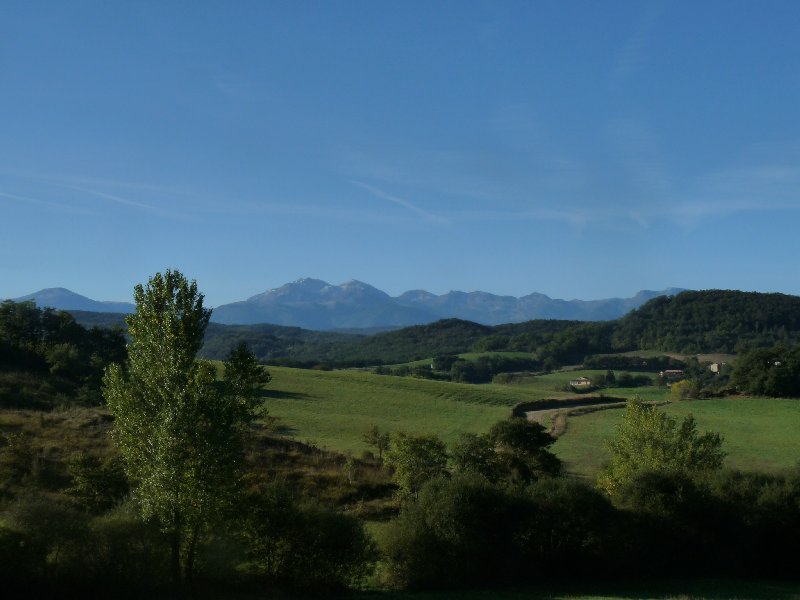
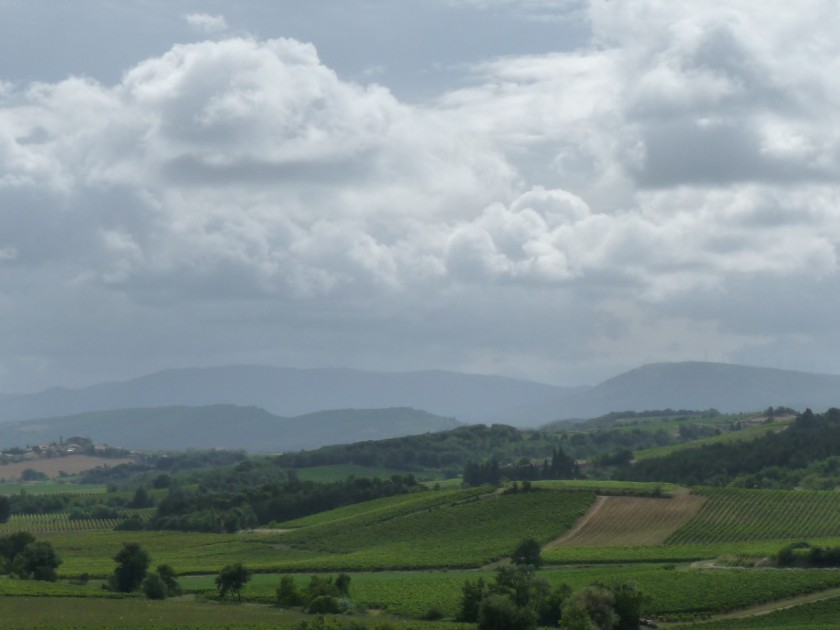
Well, not much anyway.  You can’t go walking in that patch of the Aude near la Digne d’Amont and not enjoy looking at those vineyards marching across to the snow-covered Pyrenees one way, and the equally distant (and almost equally snow-covered) Montagne Noir the other.

This slideshow requires JavaScript.

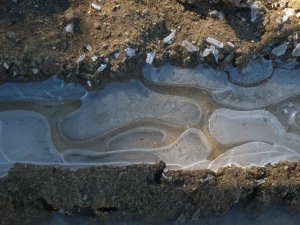
Today though, let’s not have a travelogue.  Let’s look at one or two of the other things that caught our eye on today’s walk, sunny but oh-so-cold.  We began walking in temperatures of not much more than minus 5 degrees. There was the ice itself, underfoot.  The cold froze the mud and made it good and hard to walk on.

P1090230

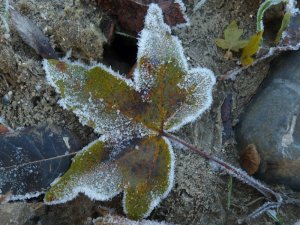
There were the frost-framed leaves mulching the ground.

P1090236

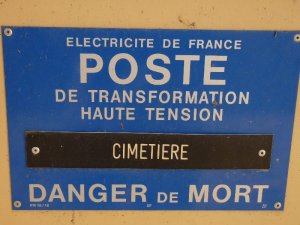
There was a giggle-worthy notice on an electricity sub-station.

P1090245

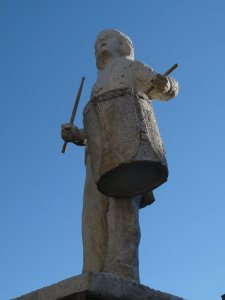
And in  the tiny village of Toureilles (population 143), there was a statue to its most famous son.  Pierre Bayle (1783-1794) was the youngest soldier ever to die for France.  A drummer boy in the Republican Army, he was engaged in the campaign to prevent the Spanish invade Roussillon, and died in battle at Figueres, aged 11.

P1090262

As we left Toureilles, along a single track road , we came upon a rather fine, wide, but very short stretch of road, with a fine stretch of car park along its length.  It led only to a dusty track.If we didn’t know why it was there, neither did the villagers.  Here’s what they thought of it.
Back in Digne d’Amont, the municipal notice board had news of an evening’s Bingo (Loto) on – shucks, we’ve missed it – 16th November.  Prizes?  Two loads of wood for burning,  a whole pig (dead, of course) and a hamper of beef as well as other smaller prizes.

P1090298

And at the end, Gilbert produced a cake for us to eat,  formerly much enjoyed locally and which he’d managed to find out about: amazérat, a pastry with a solid bite to it and strongly flavoured with aniseed.

Gilbert's amazérat
Gilbert’s amazérat

Cabin fever.

The rainy season still hasn’t stopped. It’s rained every day for over a fortnight now, except for one.  That was Friday, the day it snowed.  I had to come back from nearby Villeneuve d’Olmes at nearly midnight that day, driving at a stately 12 miles an hour along newly – and deeply – snow-covered roads.  The last bit was easy enough though.  I followed a snow plough.

So Sunday’s all-day walk was abandoned yet again.  There was heavy rain again this morning.  Nobody was leaving home except to collect the daily bread.  We had a back-up plan, we members of the walking group,  to begin walking at 1 o’clock if the morning’s weather was poor.  By 11.45, with the skies still black and full of rain we were all ‘phoning each other to say ‘No thanks.  Count me out’.

Except that at quarter to one, it stopped raining.  I decided after all to make a break for it (Malcolm stayed in front of the fire).  Maryse arrived at the usual rendezvous too, then Annick and Michel turned up.  Then Jean-Charles, Danielle and Marcel.  We’d all got cabin fever and we’d walk come what may.  We had three rain-free hours.  No country paths for us today: all sodden.  Strictly road-walking.  Snowy fields, snowy views across to the Plantaurel, a small lake, forest paths.  We had our ‘pause café’ at Fajou, with its 400 year old oak, and an apple tree just waiting for us to collect its windfalls.  Still no rain.  Still an hour’s walk to do though, so we didn’t stop for long, and continued onwards, enjoying the familiar landscape in its new white winter clothing

Back home, refreshed after a shower and a cup of tea, I leaned over to draw the curtains.  Of course I glanced out of the window.  You’ve guessed.  It was raining again

‘Our favourite walks’: a nomination

The walk begins.  St. Julien de Gras Capou
The walk begins. St. Julien de Gras Capou

We keep a mental list of the walks we’ve particularly enjoyed.  Walks we’ve treasured for the views, the flowers, the butterflies, the skyscapes, the lunchspot – all sorts of reasons.  The only problem is that the walk at the top of the list tends to be the one we did last.  There’s no such thing as a duff hike round here.

But last Sunday’s walk is assured a place of honour on this list.  It’s one we’ll want to share with you if you come to stay, and we’re keen to do it again ourselves, at every season of the year.

If you drive from here to Mirepoix, you’ll pass through a village called la Bastide de Bousignac.  Just after that there’s a road off to the left, signposted to Saint Julien de Gras Capou.  Take it.  It’ll wind upwards between grassy pastures, home to sheep and cattle and not much else, and finally deposit you in the main street of the village – current population 62.  Park near the church, lace up your walking boots, grab your rucksack with its all-important picnic, find the first yellow waymark – and set off.
The village is so-called because back in the 12th and 13th centuries, it had acquired a reputation as being the place where fine fat capons were raised to feed fine people: that’s the ‘gras capou’ bit.  I don’t know where St. Julien comes into it.  There are hens here still, and in so many ways, the village is perhaps little changed.  It’s a peaceful, rather isolated place, despite being so near to Mirepoix and one of the main roads in the Ariège.
Our walk took us along farm and forest tracks, through fields and woodland still splashed with colour from flowers and late butterflies.  It was an easy route, rising only gently, passing the tiny hamlet of Montcabirol towards the village of Besset.  Shortly after that though, we found we did have a short sharp climb, through the woods, to reach the Pic d’Estelle.

Wow.  It was worth it.  From here, we had a 360 degree panorama.  The chain of the Pyrenees marched across our horizon, its peaks already dusted with snow, or even quite thickly covered in the case of the higher summits.  As we turned in other directions, we could see Mirepoix, immediately recognisable from its distinctive cathedral spire, and the Montagne Noir beyond.  There are foothills nearby too, across which pilgrims on the Chemin de Saint Jacques de Compostelle still travel: and other sights too – the ruined Château de Lagarde, and its near neighbour the Château de Sibra.  We stayed a long time, simply relishing these views, the sky, the silence and peace at what seemed to us, at that moment, the top of the world.

When we finally shrugged on our rucksacks once more, we only had three or four more kilometres to go, along more unpeopled pathways.  After negotiating the only obstacle of the afternoon, a group of cows supervised by a bull – we let them get well ahead of us – we were soon back at base.  It was good, very good.  I just wish my camera could do justice to those peaks.  But we’ll be back, in winter, when they’re truly thick with snow

Le Jardin Extraordinaire est mort. Vive le Jardin Extraordinaire.

Gosh.  Was it really only five weeks ago that we were there?  Was it only 5 weeks ago that we togged ourselves in skimpy sun gear, floppy hats and clodhopping sensible shoes to make our annual pilgrimage to Le Jardin Extraordinaire?  If you’ve been following our story of our life in France you may remember the photos of this joyful, playful, meditative, exuberant, and quite lovely space which so many of us come to explore and relax in for the one weekend only, in very early September (follow the link above).

The meadow at the Jardin Extraordinaire today

Today we wanted a walk: it’s not high summer any more, but the sky was very blue, the sun was pretty hot, the morning mists had burnt off and who knows if tomorrow it may rain?  We wanted to take bags and a bucket and see if there were a few late blackberries (there were), a few sloes (there weren’t) and a few early walnuts (there were) to make our sortie near Lieurac worthwhile.

That was the entrance, a few weeks ago.

Our path took us past the site of Le Jardin Extraordinaire.  It’s not normally a public space, so we couldn’t wander down to the river, or scramble up the hillside.  But we could walk by the meadow which had greeted us at our last visit, and we could see the tunnels and bowers of gourds.  Autumn has struck.  The bright fleshy stems and leaves of the gourds and sunflowers have changed into gnarled and bony twigs.  The pumpkins which once peeped from beneath their leafy green sunhats are now exposed on bare earth, those leaves crisp and brown like curls of tobacco.  The sunflowers still rear their tall heads over the scene, but they too are blackened and dry.

It’s still lovely though.  This is no cemetery.  The seed pods, the gourds, the berries are all ripe now, They’re ready for the next stage: marauding animals may eat them, humans too, or else they’ll seed themselves, so that early next year, the garden can begin to grow again, and be transformed by the creative artists and gardeners of Artchoum.

Rosehips along our walk

And we too marauded today.  We came back after our walk with full bags, muddy shoes, and that feeling of well-being that comes from a peaceful and productive afternoon  out in the countryside in the bright Autumn sunshine

P1070802

Harvest home…..

Fields near Villelongue.  A grey summer's morning.
Fields near Villelongue. A grey summer’s morning.

….. next month.

We were walking in the Aude today, and with every step we took, we realised that harvest season is well on its way.
Sorghum grains for animal feed swelled in fields where last year sunflowers had grown.  A few seeds had escaped the Autumn harvest, and so this year a few cheeky sunflowers raised their heads above the more lowly winter feed.
Sunflowers among the sorghum.
Grapes cluster  on the vine. They’ve grown almost as much as they intend, but they still have work to do.  Most are still a bright acidic green.  A few are starting to blush a bruised pink.  Some have even achieved a classic purple: but they’re not ripe yet.  We know.  We tried one or two.
And those fields of sunflowers,  Apart from one field’s worth, they no longer look like those cheerful images you see on postcards from our region.  Their bright sunny faces no longer track the movement of the sun as it travels across the sky.  Instead, they’ve developed a hang-dog look as the weight of their maturing seeds pulls their heads earthwards.
Then there were almonds.  We found a few had fallen already, so made a handful of creamy nuts into a small 11 o’clock treat.  Walnuts are a different matter. They’re still heavily enclosed in their thick green fleshy coats.  It’ll be a few weeks before this protection dries and splits to reveal the ripened nuts within.
Apples?  Yes, a few, but they’re still green, with white flesh that browns as soon as it’s bitten into.  Blackberries?  Hardly any have turned black.  They’re still very small and green, or rather small and pink.  We’ll have to wait.
P1060669
So far then, only the hay bales sit plumply at the edges of the fields, ready for winter. The other crops soak up the remaining summer sunshine, fatten, ripen, and wait for the moment when they too will be gathered in.
Fields of vines and sunflowers near Villelongue d'Aude
Fields of vines and sunflowers near Villelongue d’Aude

Butterfly bonanza

I’ve never been all that good at butterfly spotting.  Back in the UK, I could manage my red admirals, peacock butterflies and cabbage whites.  Oh yes, I could certainly identify those pesky cabbage whites.  Their eggs were usually plastered over the undersides of nearly every vegetable I had on my allotment.

On Sunday though, we had a real butterfly bonanza.  We had a perfect day’s walking on the nearby Plateau de Sault, near Belcaire.  It was perfect because the scenery was friendly: gently rising and falling lightly forested slopes offered distant panoramas of the Pyrenees.  The wonderful weather was bright and sunny, without being too hot. The walk offered challenges but no real difficulty; good companionship too.  What made this Sunday memorable though were the butterflies.  At this altitude – about 1000 metres – the summer flowers were still bright and fresh, and the butterflies couldn’t leave them alone.  They fluttered ahead of us every step of the way, and we finally gave up exclaiming over their delicate beauty.

What we couldn’t do was identify them.  This evening I’ve pored over sites on the internet.  I’ve excitedly identified a specimen.  Then I’ve looked at the next image… and the next… and realised that my confident identification isn’t at all secure.  Tentatively, then, I’ve named my photos.  But I rely on you, dear reader, to put me right about the undoubted mistakes I’ve made.

In the end though, whether I’ve been able to name them or not, I carry with me the memory of a summer’s day made extra special by the presence of those butterflies  wheeling, turning, diving and fluttering, rarely still, but constantly engaging our admiration and attention

What’s the point of horse flies?

There’s a series on BBC Radio 4 that somehow I’ve never caught up with on i-player.  It’s called ‘What’s the point of….? and examines a whole range of British institutions, from the Tate Gallery at the more serious end of the spectrum, to lawns and pubs at the other.  Though some right-thinking Englishmen might argue that nothing could be more important than a well-kept lawn and a drink in your local after you’ve finished mowing same.

I have a suggestion for a programme, though the subject that interests me isn’t a British institution. But I really need to know.

What’s the point of horse flies?

Thanks to Dennis Ray and Wikimedia Commons for this graphic image of a happy horsefly

Out walking at this time of year, some – but not all of us – have come to dread being near horses, cattle or still water.  Because when we’re near any of them, we’re likely suddenly to feel a sharp piercing of our skin, as a horse fly eagerly pumps poison into our flesh whilst sucking our blood.  It’s not easily brushed away.  In the hours that follow, our skin swells, and for several nights, sleep will elude us as we scratch frantically at our fiery, itchy, tightly inflamed skin.  These nasty creatures are pretty immune to any repellents, though a cocktail of essential oils such as lavender, melissa and tea-tree sometimes helps.  Nor have I found any remedy soothing after the event.

So what are they for?  It’s bad enough for us humans, but cattle and horses seem truly to suffer all summer long, as flies of all kinds cluster round their eyes and mouths, resisting all attempts to flick them away.

Here be horseflies....
Here be horseflies….


.... and here be horse flies
…. and here be horse flies

Apparently they make a tasty snack for a swallow or a frog.  I’m sorry, that’s no good.  There are plenty of other insects about, so their having a place in the food chain simply isn’t justification enough.

And while we’re about it, what’s the point of ticks?  And mosquitos?  And another thing.  Why do I get so many bites from all of the above while Malcolm, and so many of my other friends, are blissfully immune?