Paula, who blogs at Lost in Translation, offers each month a different set of five words to illustrate. Look at this month’s: sabulous; brimming; guarding; berthing and bight. Interesting, aren’t they? I bet you had to haul the dictionary out for one, maybe two of them.
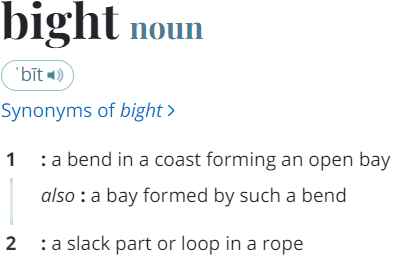
It was bight that caught my eye. It actually means …
But it doesn’t mean that to me. Like so many Brits, I’m a devotee of the Shipping Forecast, that four-times-daily forecast to anyone out at sea within reach of the British coast. The coastal waters are divided into zones, each evocatively named.
I’m not out at sea, dicing with the elements: I’m a rotten sailor anyway. But I can be soothed by the predictable poetic rhythms of the regular broadcast. Do watch this explanatory video. It’ll take up under two minutes of your life.
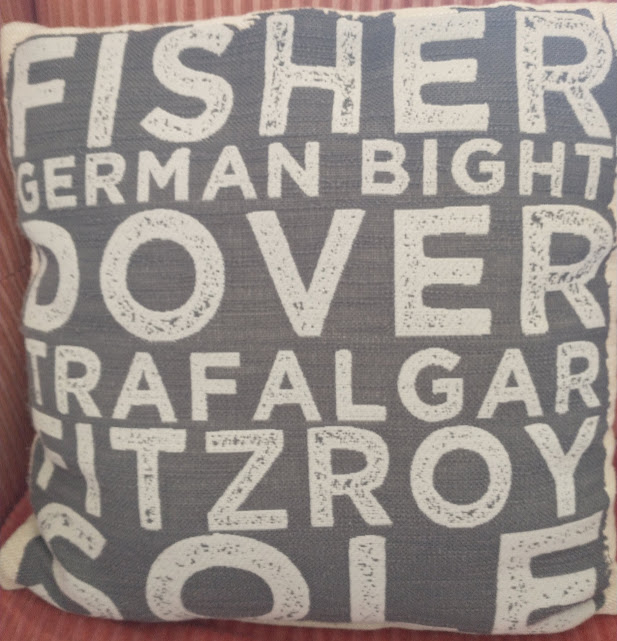
It’s so much a part of my life, I even have a cushion showing many of the much-loved names.
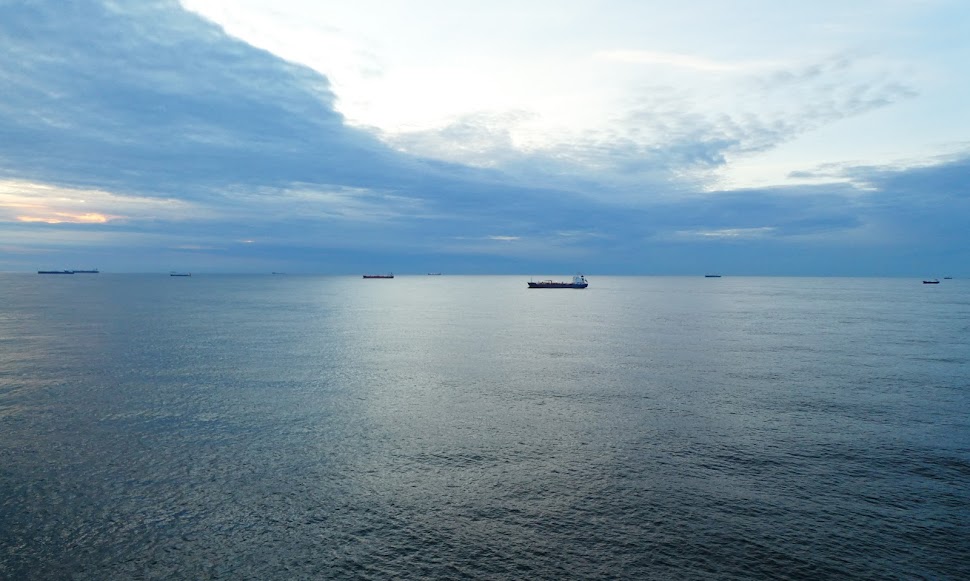
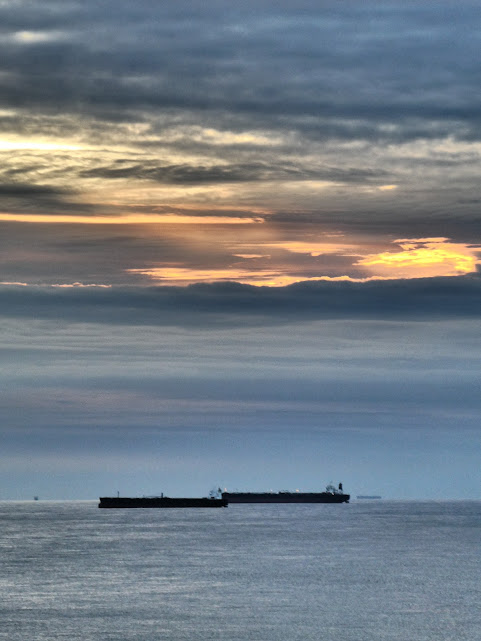
… and there you’ll have spotted it. German Bight. So that’s what Bight means to me. Ships at sea, their crew always ready, four times a day, to tune into that most necessary programme.
It seems only right then, that my four remaining photos should have been taken on the sea, or at any rate by the sea. Here they are …
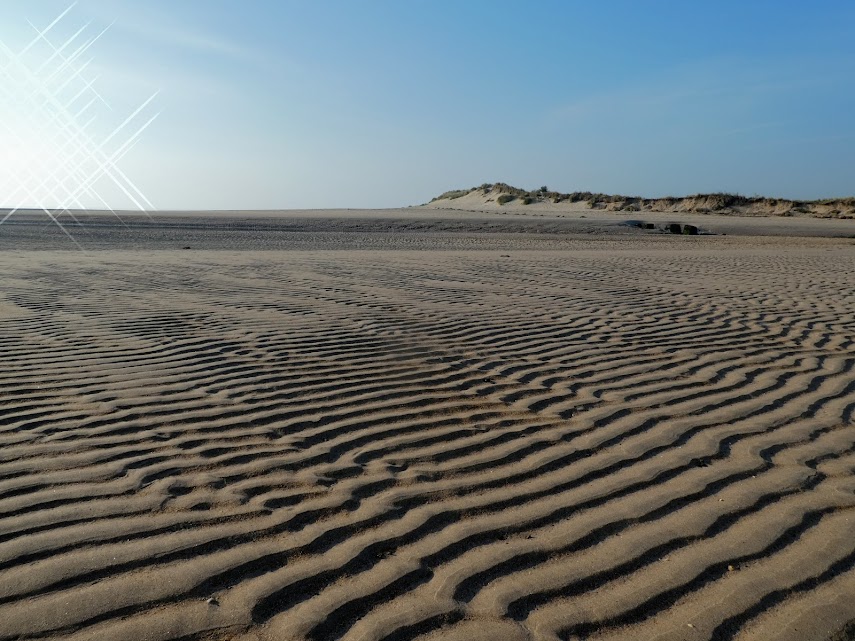
This beach at Alnmouth, Northumberland is pretty sabulous, I’d say.
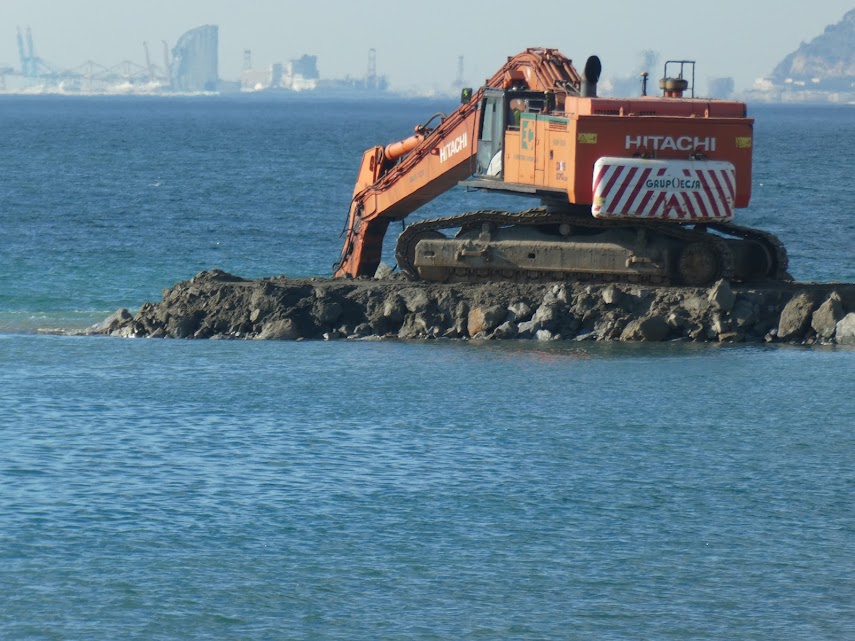
The Mediterranean is brimming at the moment: so much so that it’s slopped over the sands and is stealing the beaches of the Maresme coast in Catalonia. Diggers and excavators are fighting back, building groynes to inhibit the relentless march of the sea.
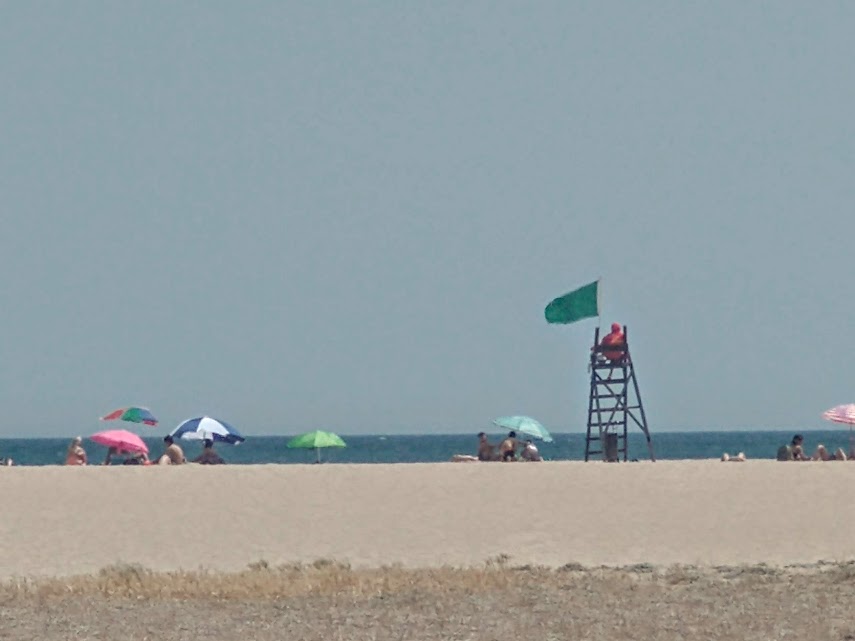
Just another day at work for this lifeguard, guarding the safety of Sunday swimmers at Premià de Mar.
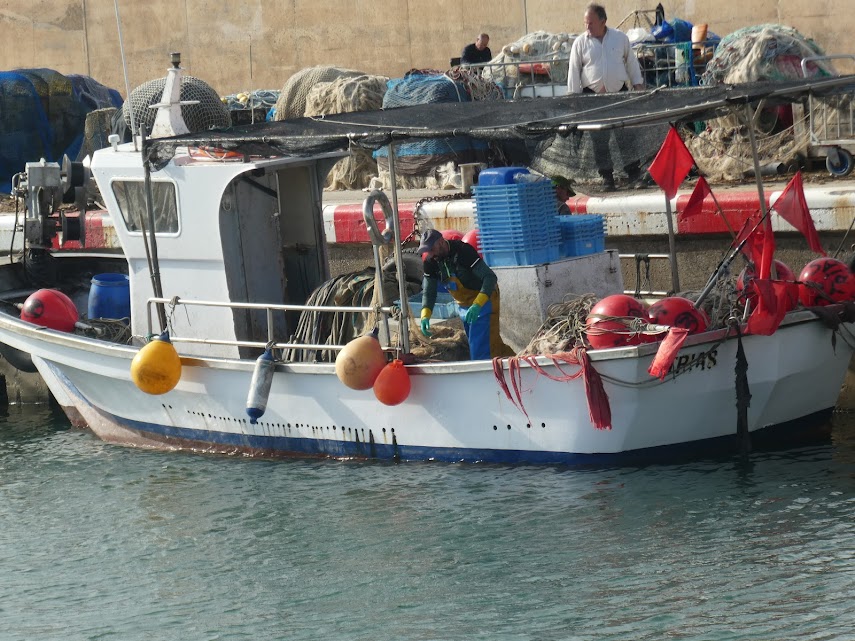
Berthing at the fishing port of Arenys de Mar, Catalonia, before another night of fishing at sea.
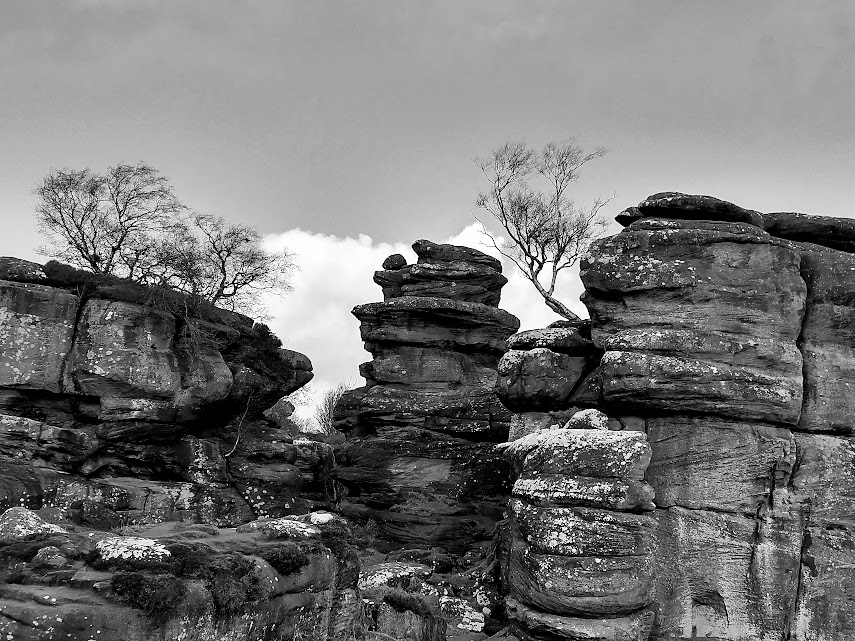
This week, Donna’s Lens Artist Challenge invites us to celebrate rocks, their geology, and what they have meant to humankind. Bloggers have responded with hosts of natural wonders: extravagant, bizarre, subtly beautiful and all extraordinary. I had planned to respond in kind, by showcasing – as I have in my feature photo – our nearby geological extravaganza which is Brimham Rocks. But I already have several times– here – here and here – to name but a few.
Instead, I’ve chosen to show rocks in the service of mankind. Brimham Rocks even fit in here. These days they’re our very best local playground.
The grandchildren are king and queen of the castle.
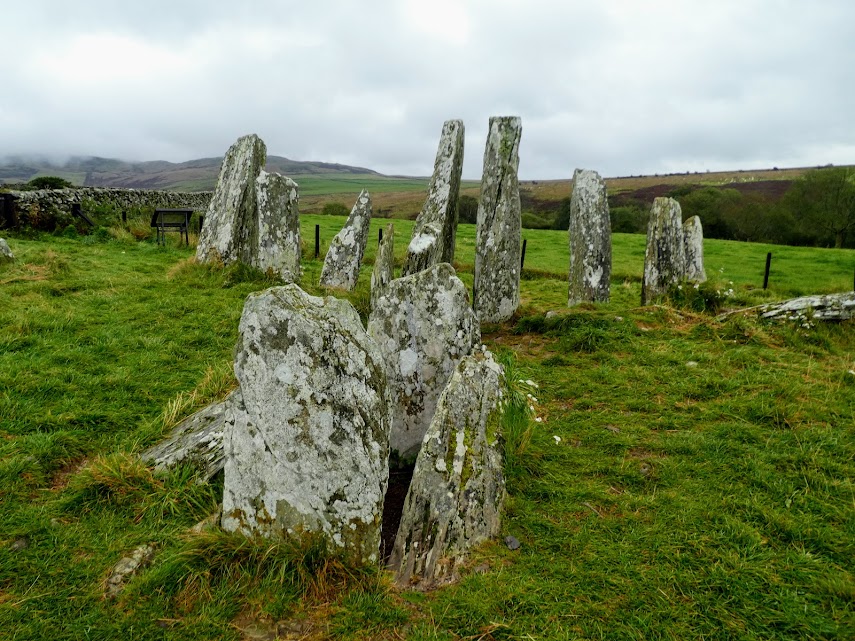
But rocks have been pressed into service since prehistoric times. Here is Cairn Holy in Dumfries and Galloway. It’s a Neolithic burial site – perhaps that of Galdus, a Scottish king. But perhaps not: he’s thought to be mythical.
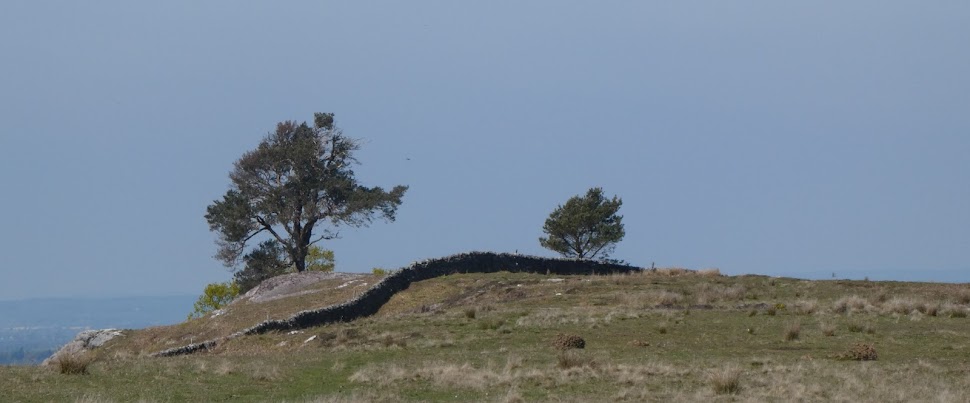
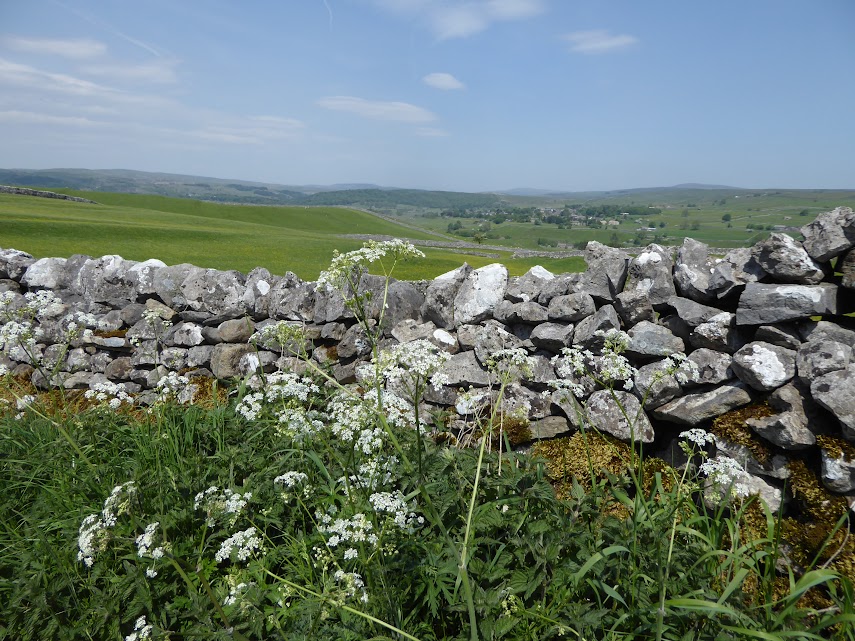
Farmers have divided their land up into fields for almost as long. Drystone walls march across the rural landscape here, particularly in the north of England.
And where would our churches, our cathedrals be without a ready supply of local rock and stone?
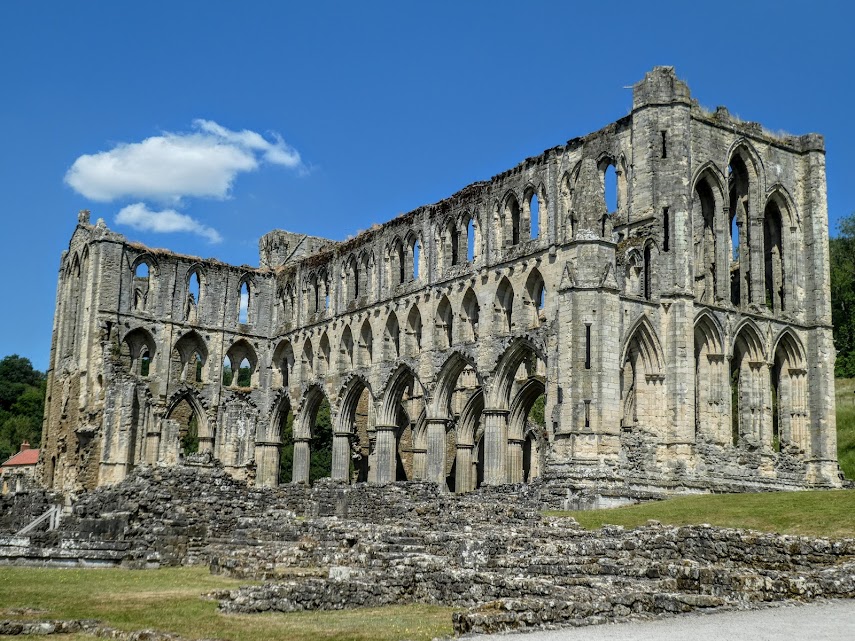
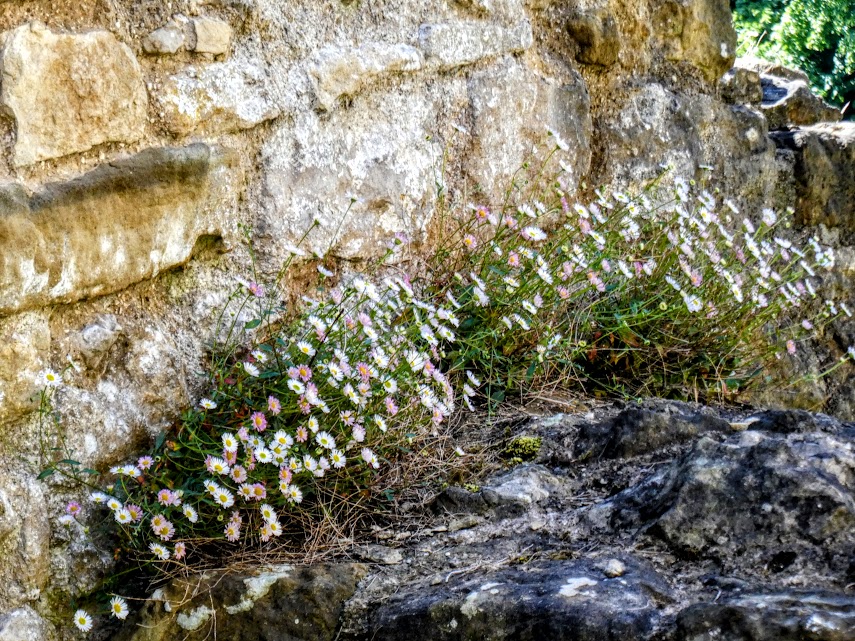
Rievaulx Abbey, North Yorkshire, in ruins since Henry VIII’s Dissolution of the Monasteries in 1536Rievaulx’s walls continue to provide shelter and nourishment for local flora.
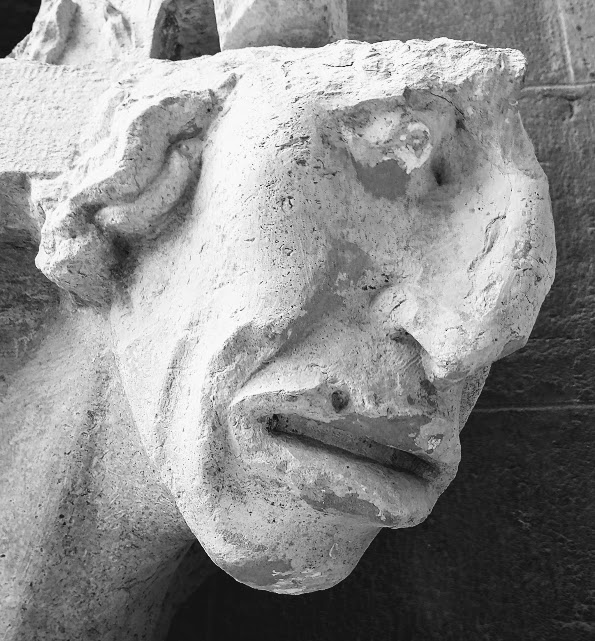
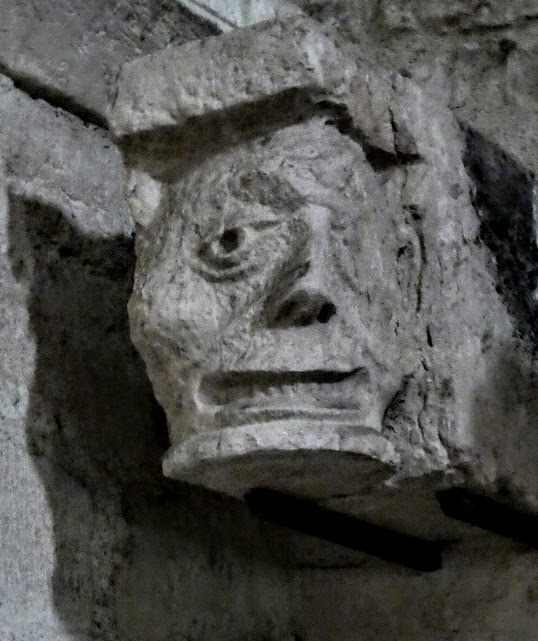
Scuplture too. I’ve chosen a few pieces that have weathered over the centuries, to reveal the underlying rock that the original sculptor had chiselled to the form that he, not nature had decided on.
Nature too can be a sculptor. This rock, hauled from the sea on the Spanish coast, has been transformed by – what? Underwater snail trails?
At the port, Arenys de Mar
Nature doesn’t need any help from man when it comes to artistic expression. I’ll conclude with an image of rock at its most painterly, in the Gorges du Tarn in France.
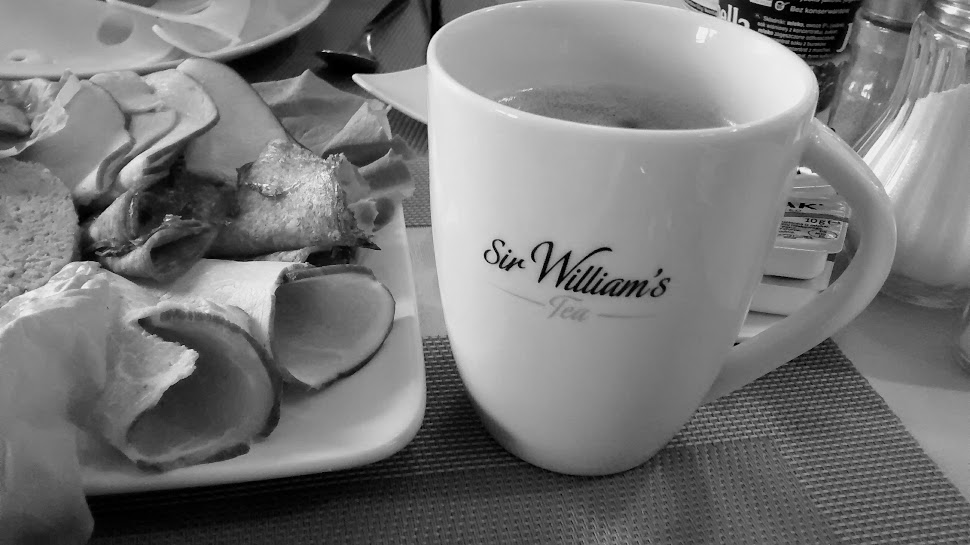
Monochrome Madness this week has us hunting down everyday objects. I thought it might be fun to showcase some of the teacups and coffee cups I have met round and about. I’ll start off with my feature photo. Once, in Granada, at a bar with a friend, we found our different choices meant that we were served our coffee in the manner of the Three Bears -Baby Bear, Mummy Bear, and Daddy Bear.
Poland next, and our breakfast in Gdansk. Sir William gets himself about, all over Europe. But not as far as I know, in the UK.
Granddaughter-in-Spain is too young for coffee. Hot chocolate is her tipple of choice. With predictable results.
After a busy morning of child care, let’s go for something more elegant. A good olden-days afternoon tea, courtesy of the Wensleydale Railway. Trundle in a leisurely fashion through the North Yorkshire countryside whilst enjoying tea elegantly served with dainty scones and cakes on a tiered cake stand. Earl Grey or Darjeeling, Madam?
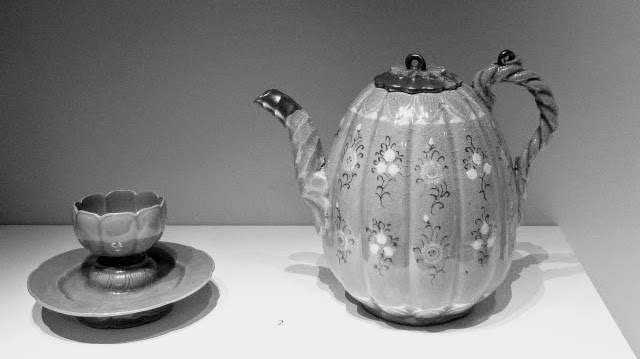
If fine china is your thing, you should visit the National Museum of Korea in Seoul. Here you can find delicate tableware like this – extraordinarily from the 12th Century – getting on for 1000 years ago …
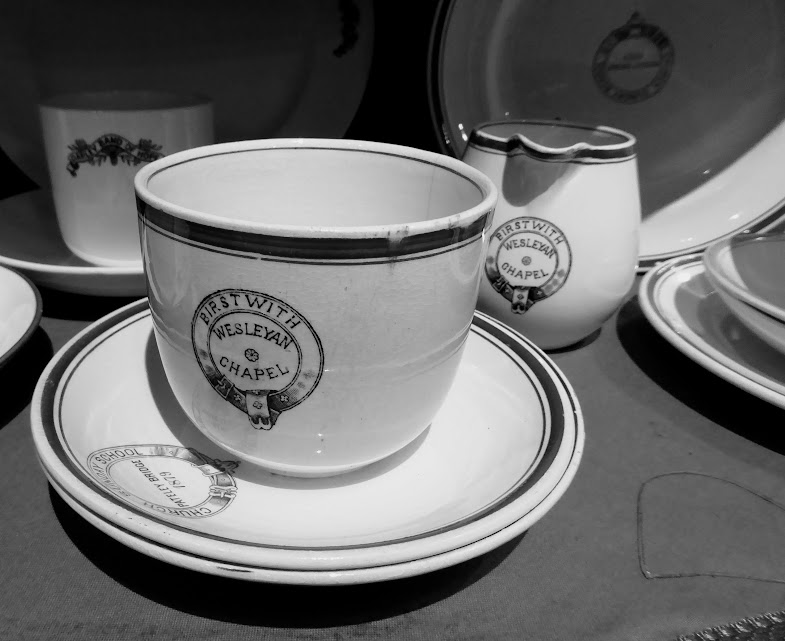
And if museums are your thing, you should visit the much more homely Nidderdale Museum in Pateley Bridge. Here you’ll find tableware from local churches. Yes, almost every church used to have their very own tea and dinner services for those all-important social gatherings.
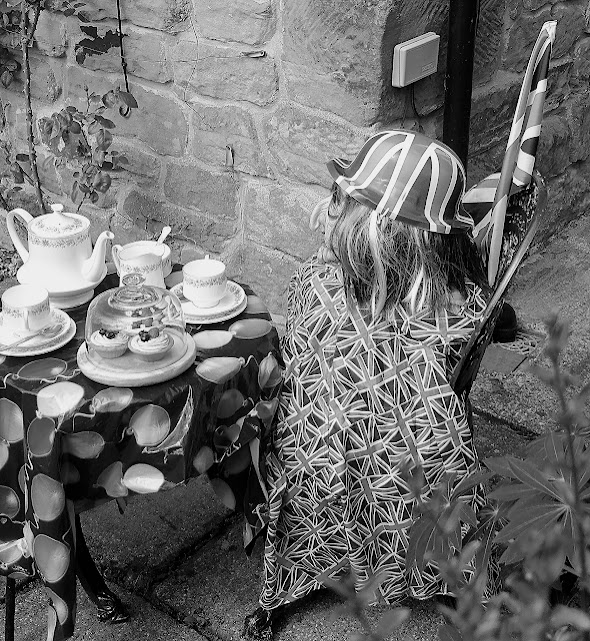
Finally, that newly-so-British tradition of the Scarecrow Festival. This one’s from last year’s village fete at Kirkby Malzeard, our village-next-door.
So, Sarah of Travels with Me, who’s prompted this week’s challenge for Leanne’s Monochrome Madness: here’s a slice of life from those so-important moments of down-time. No high class photos here. Quite simply high-class memories.
There are dozens of quotations about shopping, and most of them don’t fit me. I can’t agree with Marilyn Monroe – ‘Happiness is not in money, but in shopping.’ nor with the words from a film I haven’t seen, Confessions of a Shopaholic: ‘When I shop, the world gets better.’ I’m more with Franklin Jones: ‘A bargain is something you can’t use at a price you can’t resist.’ My title quotation is by AJ Lee.
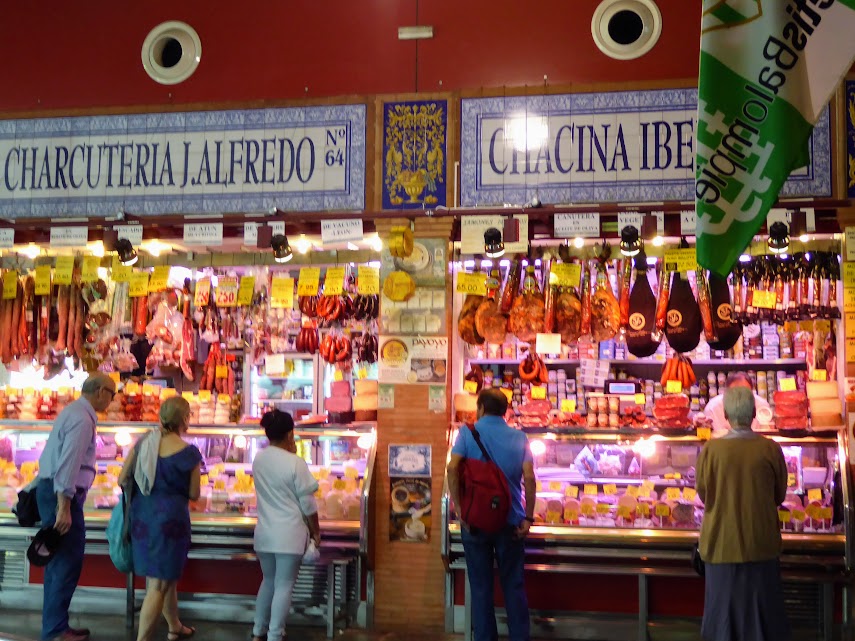
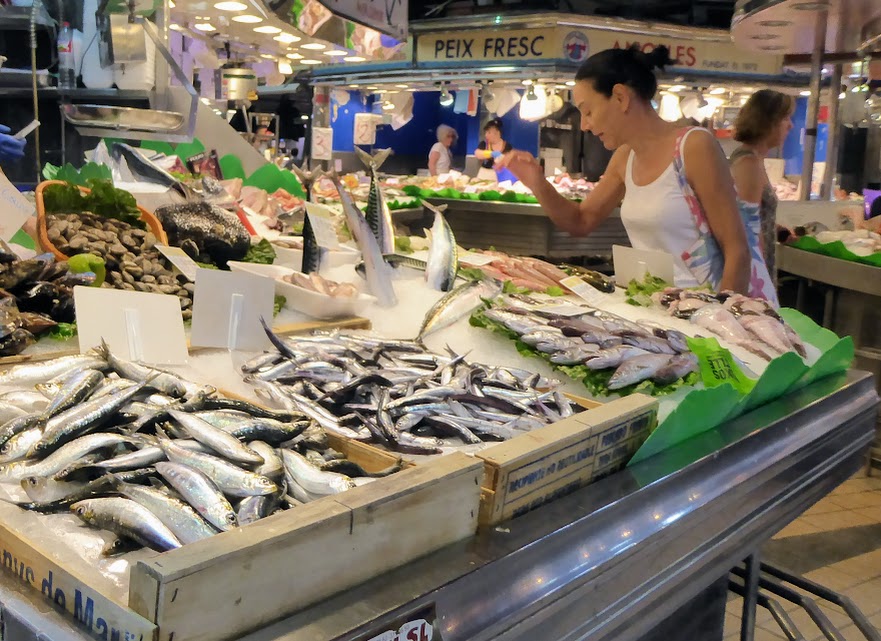
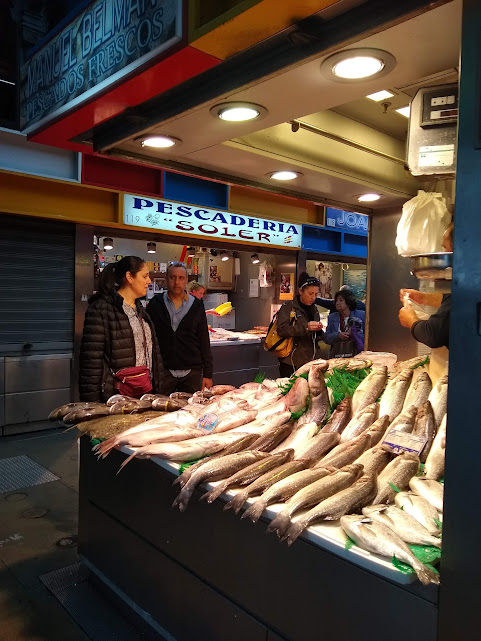
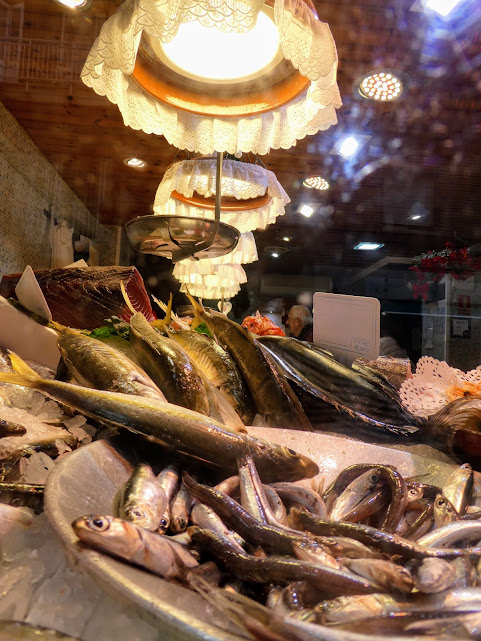
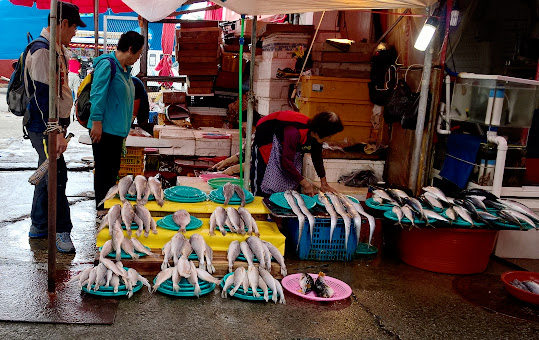
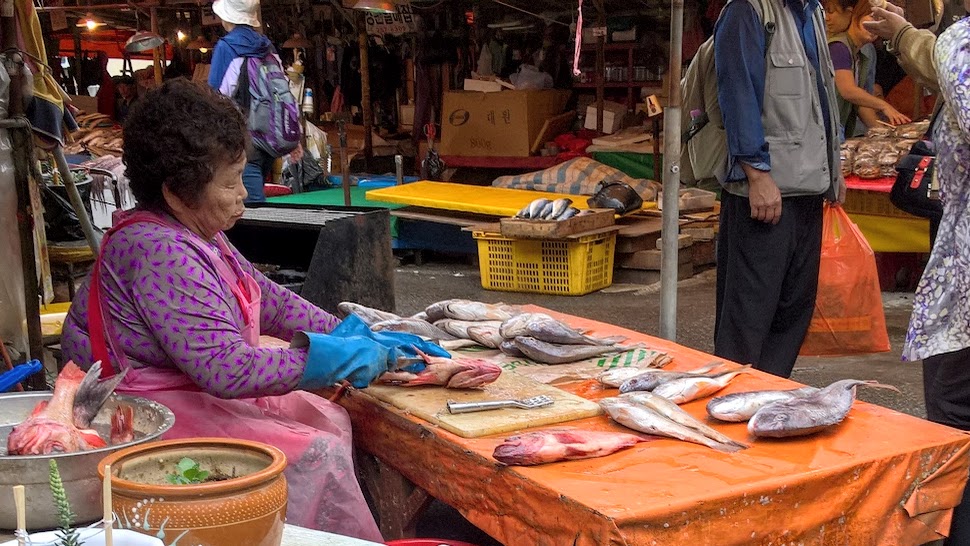
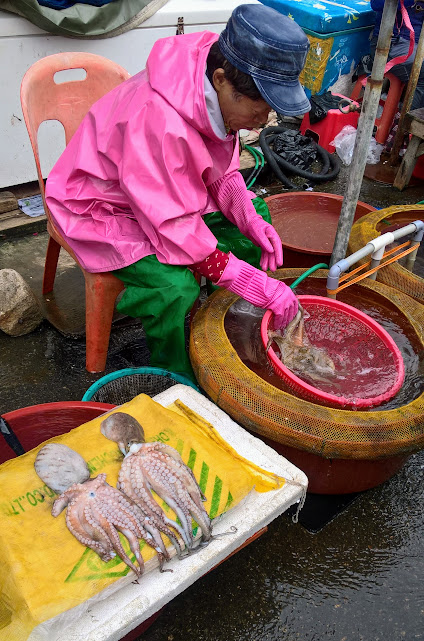
I make an exception though with food shopping- especially abroad, and especially in markets. And even more especially in fish markets. In this country, we seem hardly to extend our reach beyond cod, plaice and haddock, with tuna and salmon as well these days – and even those may be tinned . So a visit to a fish market in Europe or Asia is a revelation. Here are some shots taken in Spain and South Korea, where they seem to catch enough daily to empty the oceans.
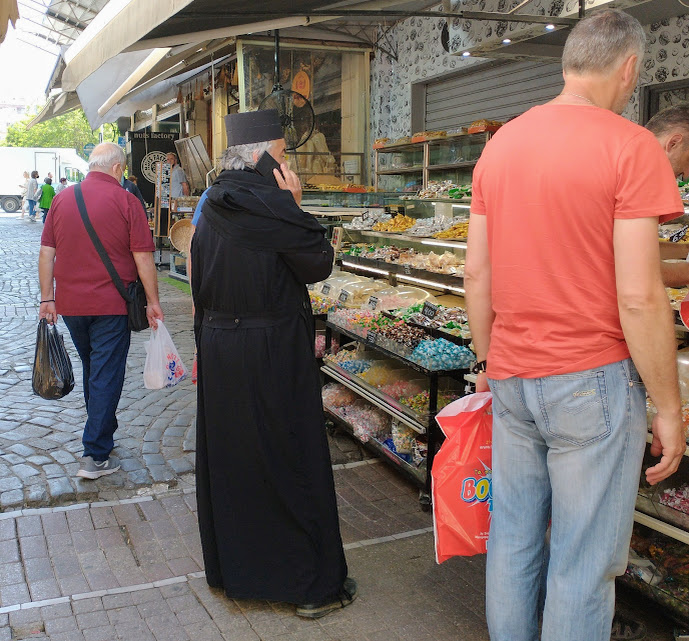
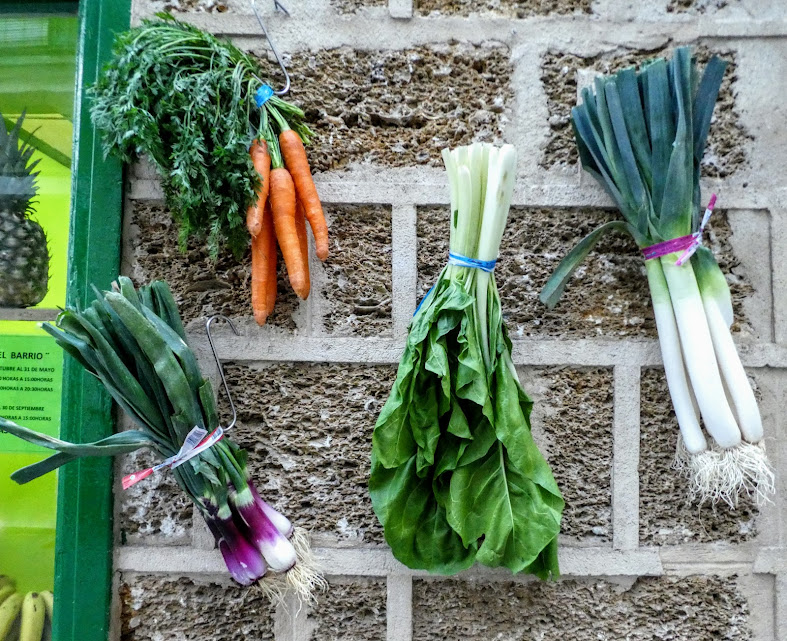
Fruit and veg and groceries seem more interesting in a sunny spot: especially if a fellow customer in Thessaloniki is a Greek Orthodox priest busy on his mobile phone.
Or if the shopkeeper has made a point of announcing his wares in a very original way, as here in Cádiz.
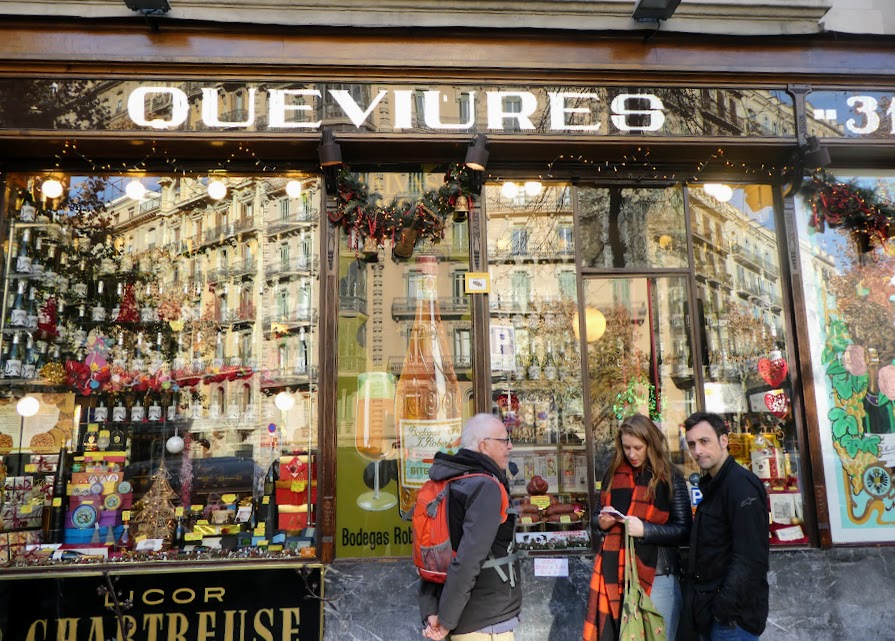
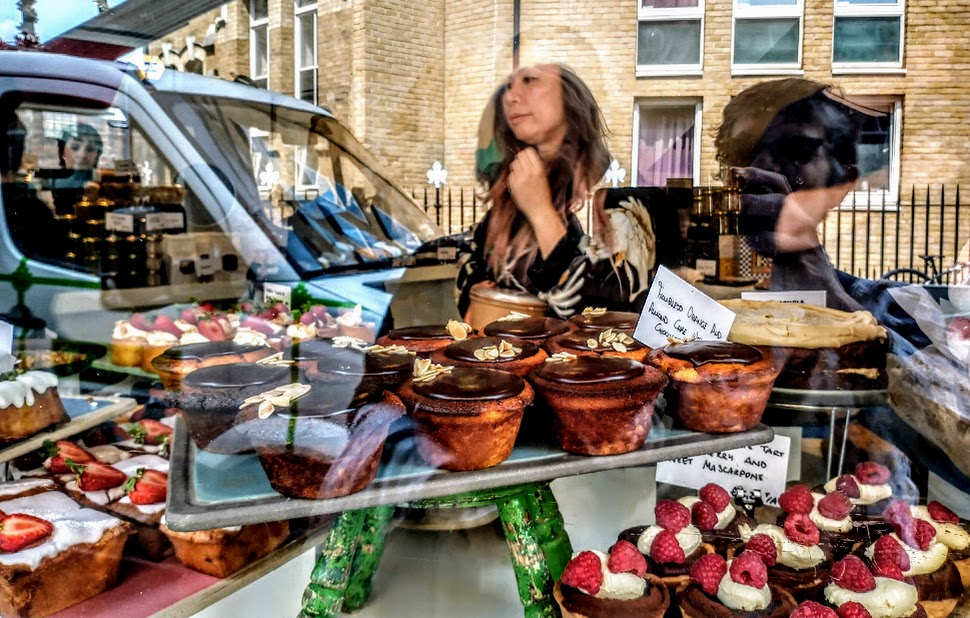
Some shops are so handsome they simply invite browsing. This shop in Barcelona, Queviures, is thinking of charging an entrance fee to those who mumble ‘just looking‘. And look – you get a view of the street behind in the window reflections – for free.
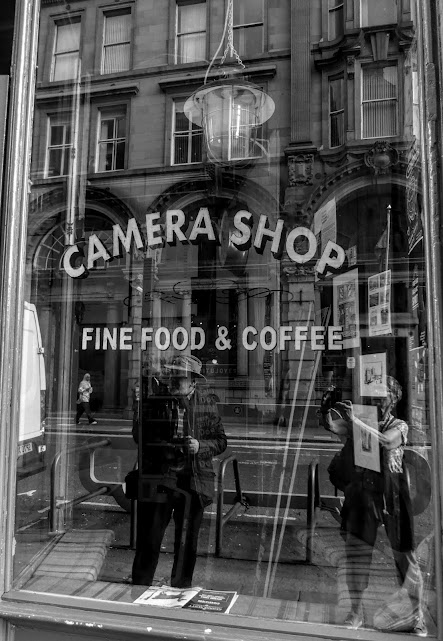
Here’s another – in Newcastle this time – also providing a view of the street it was in.
It’s no longer a camera shop. But that day, it wasn’t selling fine food and coffee either. But we had fun photographing it for free.
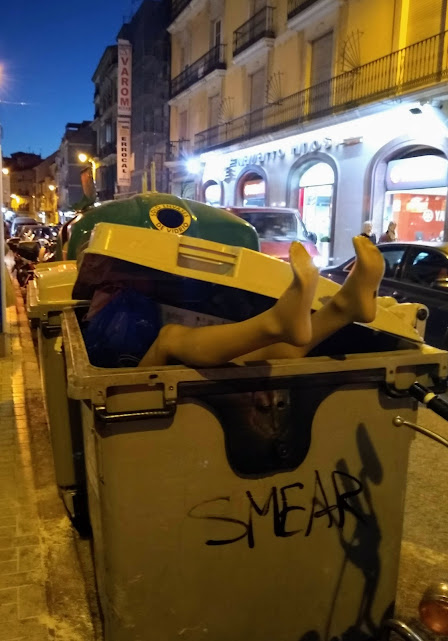
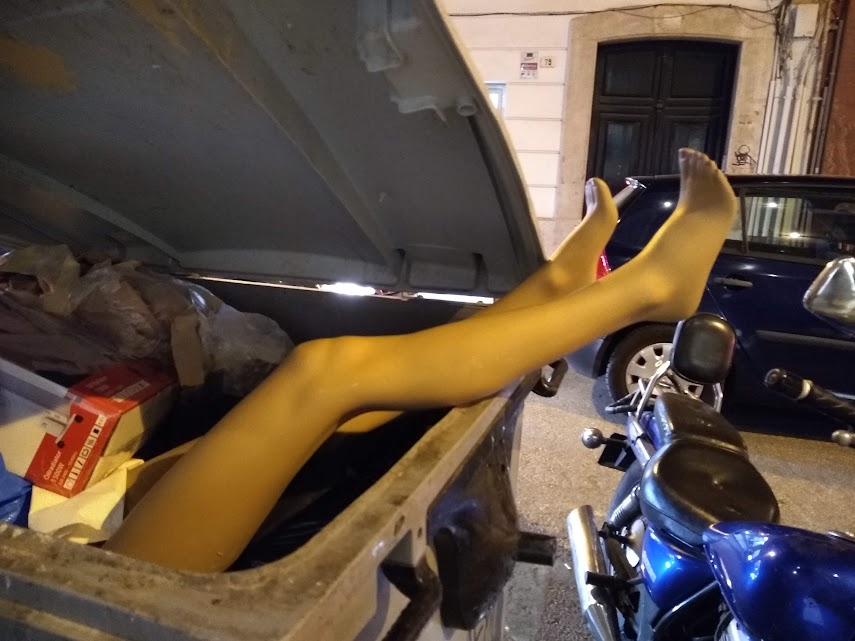
No clothes shops here. I’ve shopped for clothing exclusively in charity shops for five or six years now – yes, even for my outfit as mother-of-the-bride. And I didn’t look like a bag lady. So I’ve been told. I therefore have no shots of elegant and fashionable clothes emporia. Just this. Once upon a time, this mannequin was the clothes horse for many a stylish window display in Málaga. Her glory days are over.
Despite my lack of enthusiasm for retail therapy, I’ve thoroughly enjoyed strolling round markets and shops at home and abroad for Ritva’s Lens-Artist Challenge #288. I’ll never be keen to shop-till-I-drop, but ‘you can always find something you want‘ (Sophie Amurosa). Especially if it’s edible.
My featured photo is from the indoor market in Seville.
Most of us living in Britain know something about the model villages built by philanthropic industrialists in the 19th century. With the advent of the Industrial Revolution, workers poured in from the countryside to a filthy urban environment. They found, alongside work for long hours in the newly-established factories, hastily built, crowded, poor quality housing with no facilities.
Some philanthropic factory owners decided to do things differently. Robert Owen built New Lanark for his miners. Titus Salt built Saltaire near Bradford for his textile workers. William Lever, 1st Viscount Leverhulme built Port Sunlight for his soap workers. And so on. All these communities offered decent, usually terraced housing with a small amount of outside space. There was a shop, a school, an institute for adult learners, a health-care facility of some kind, certainly a church. There was not however, a pub, or anywhere where alcohol was sold. Workers at the time often drowned out the reality of their miserable lives by drinking, and those philanthropists wanted a different life for their workers, whether they liked it or not.
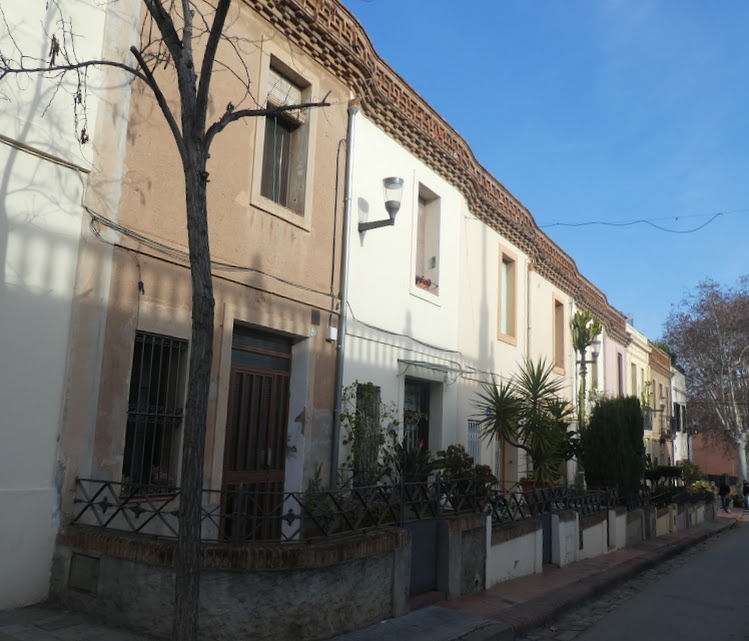
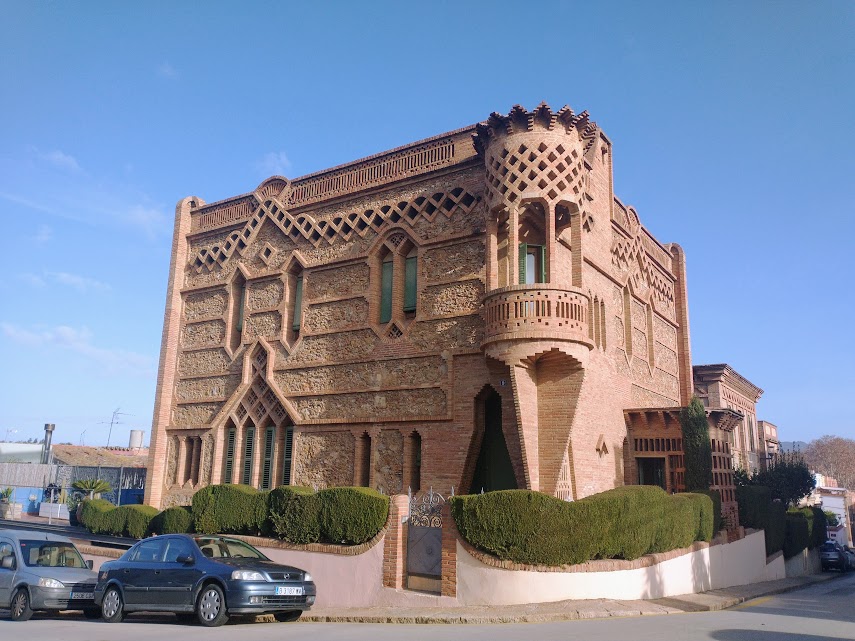
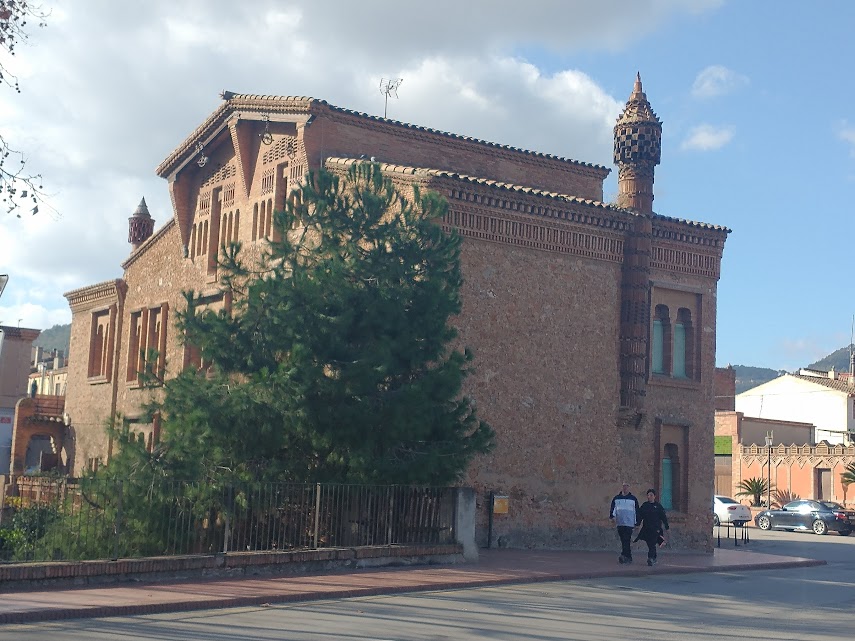
So we were interested to visit Colonia Güell when we found out about it. It’s a similar set up in a manufacturing area, Santa Coloma de Cervelló, just outside Barcelona. Spain’s industrial revolution came later than ours: but in 1890, industrialist Eusebio Güell realised that if he wanted to attract workers from Barcelona to the factory he was building on his country estate – an essentially rural area – he would have to provide housing. And like his British counterparts, he wanted to do The Right Thing.
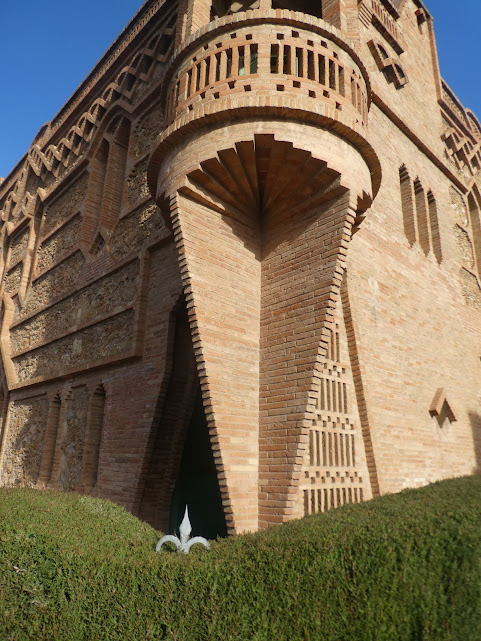
Eusebio Güell didn’t just want to have any old housing. He sought out the best architects of the day, disciples of the Modernista movement: the ideas behind Art Nouveau found particularly vibrant expression in Catalonia. More details here.
He provided decent housing for both workers and professionals in spacious streets, the factory itself of course, a theatre, a doctor’s surgery, a school. The school however was for boys only. In many ways it was progressive, teaching foreign languages as well as the three Rs. But girls had to make do with being taught embroidery and other manual skills that would make them dextrous with machinery when they went to work later on. Nuns at the convent taught them, and also provided a nursery so that mothers could return to work soon after they had given birth.
Ca l’Espinal, the Factory Manager’s HouseA detail from Ca l’EspinalThe schoolhouse, linked by an aerial tunnel to the schoolmaster’s quartersCa Ordal: three farming families lived here, supplying much of the fresh food needed in the community
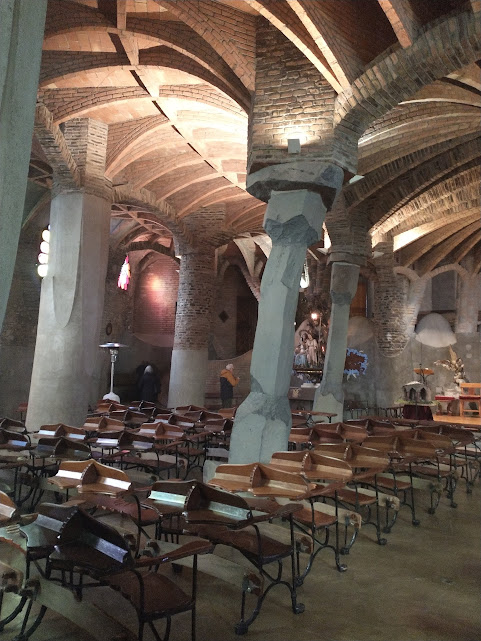
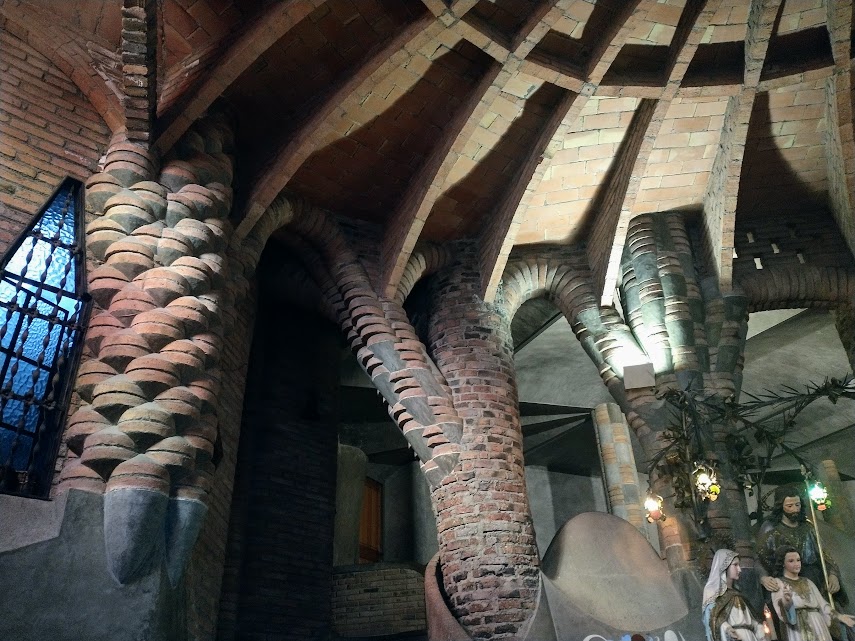
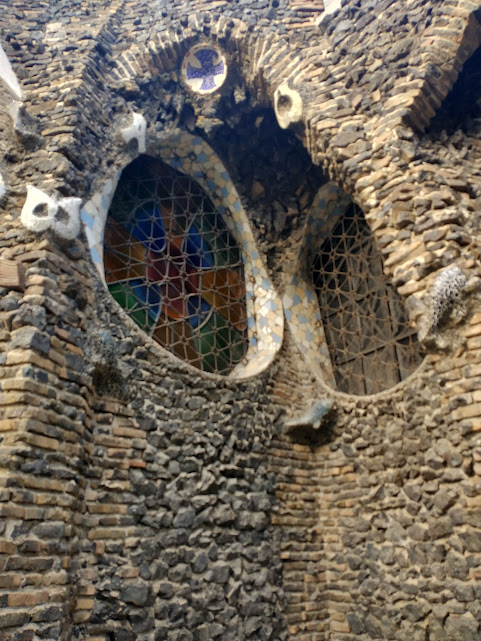
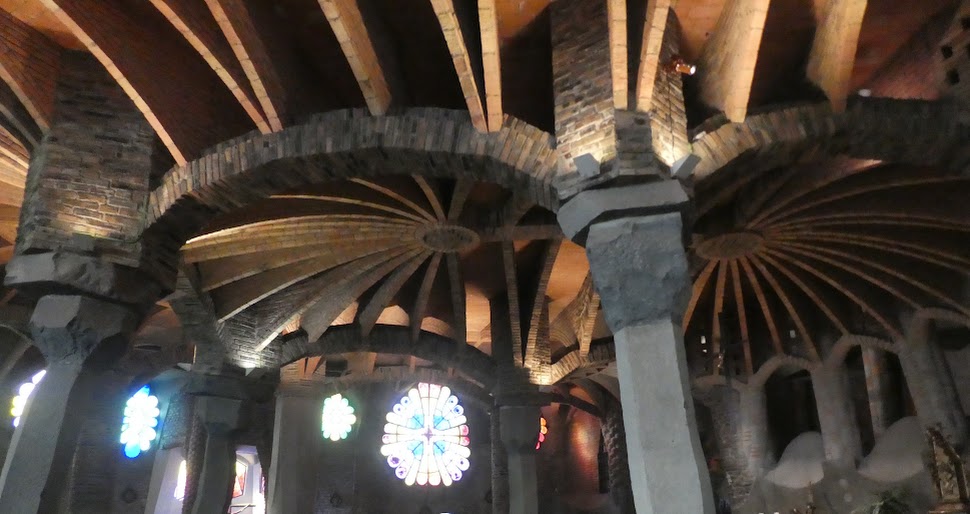
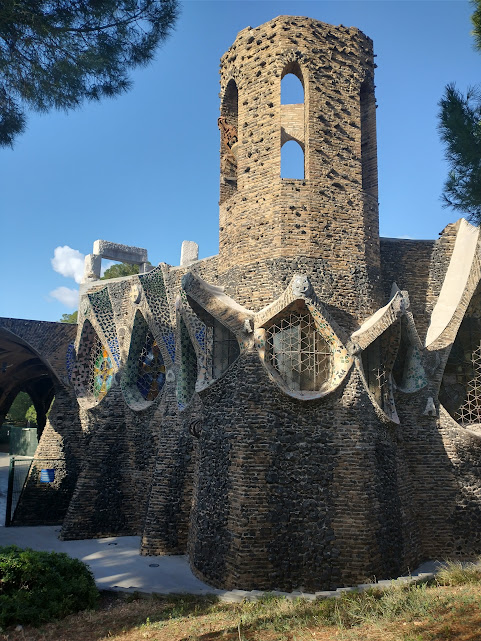
Of course there was a church. And in 1898 Eusebio Güell commissioned the young Antonio Gaudí to design and build it. Had it been finished, this church would have been as ambitious a project as Gaudí ‘s still not quite finished Sagrada Familia. Two naves, lower and upper! Towers! A central 40 foot dome!
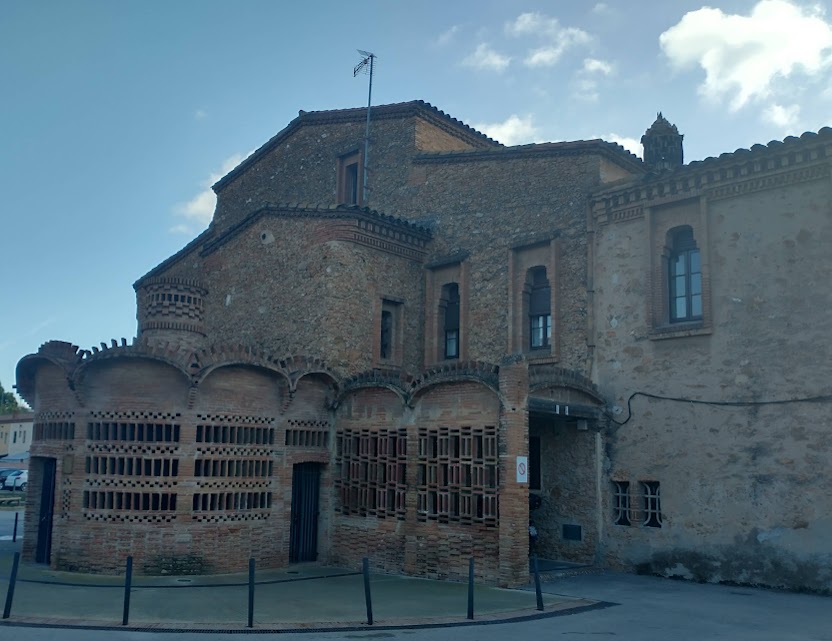
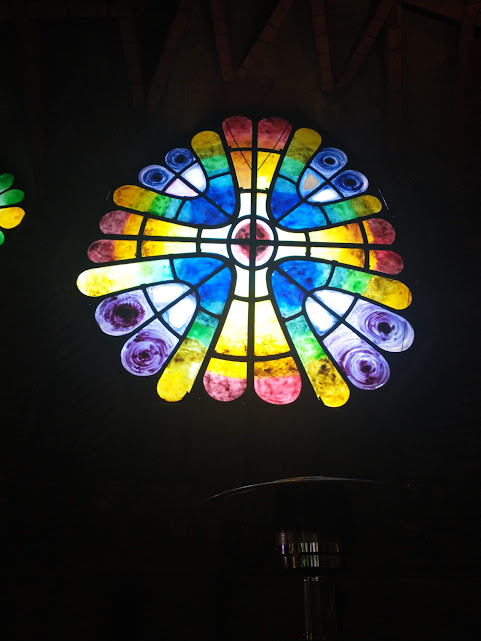
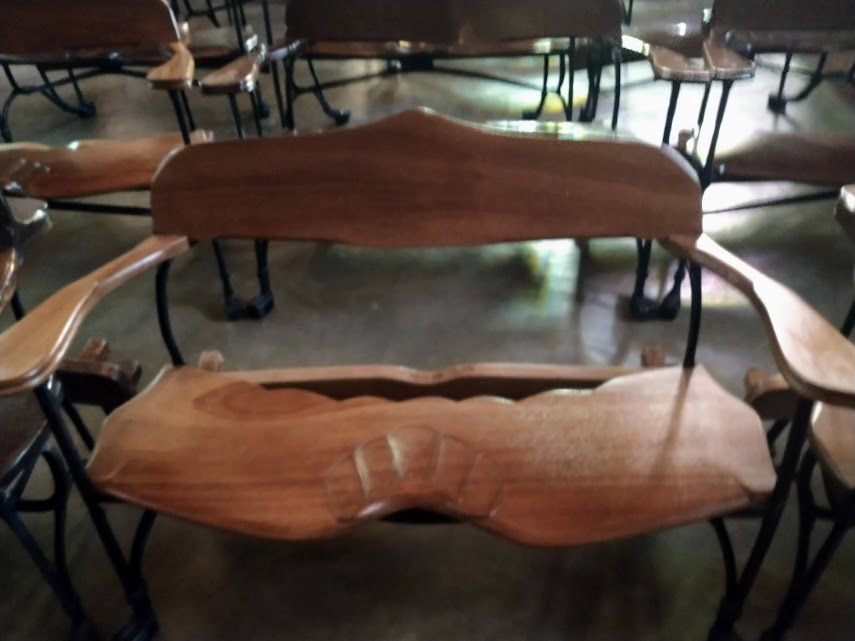
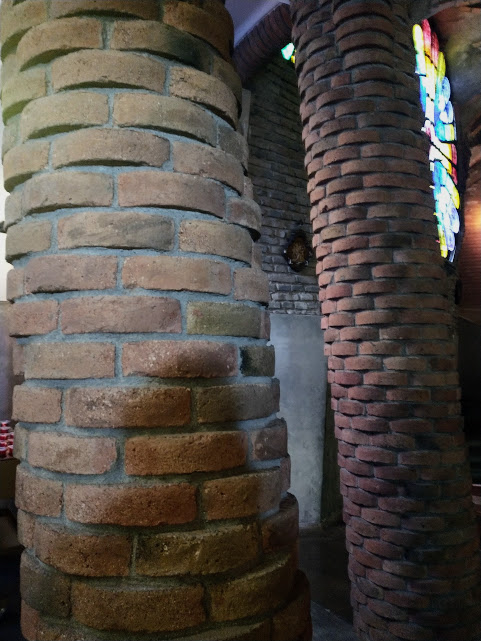
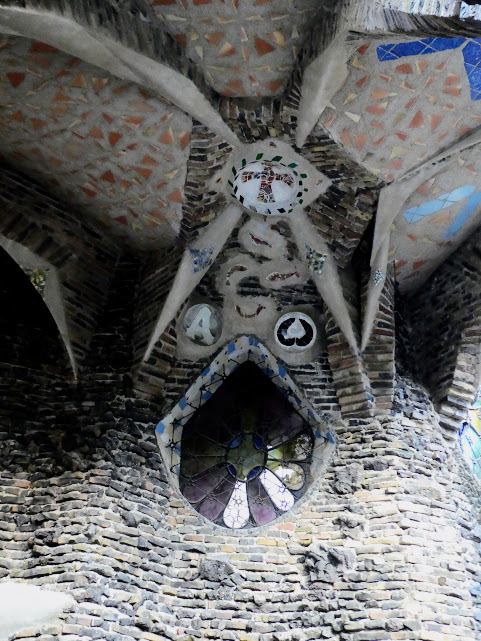
The building was begun, but in 1914 the Güell family decided to stop funding the project and Gaudí turned his back on it with only the lower nave completed, now known as the crypt. It was consecrated in 1915. I found it difficult to photograph, but here is a miscellany of shots from the inside and outside of an astonishing building.
During the Spanish Civil War, the mill was collectivised and run by its workers. After the war it was sold back to the Güell family, who sold it on again. Its days were numbered. The textile industry in Europe was collapsing and the factory ceased production in 1973. The factory itself was sold off piecemeal, and the houses to their residents. The settlement was in danger of losing its identity. But in 1990 the Colonia Güell was declared a ‘Heritage of Cultural Interest’ by the Spanish government and the protection of some of its most relevant buildings was established. Nowadays it’s an ordinary working community with an extraordinary history.
We enjoyed walking round and exploring. Sadly, we couldn’t see the factory. On Sunday its current many and various component businesses are shut, the gate to the site barred.
It’s not the easiest place to reach from Barcelona without a car, and as these things are apt to change, I won’t include public transport options. But we’re so glad to have visited, and will go again.
I haven’t done the Lens Artist Challenge for weeks, what with the busyness of being a granny to the latest granddaughter near Barcelona. But this week, Egidio proposes Warm Colours.
Well, Barcelona is warm at the moment. Here is a photo I snatched on 26th January – January! – of a young girl perfectly adequately dressed for the season.
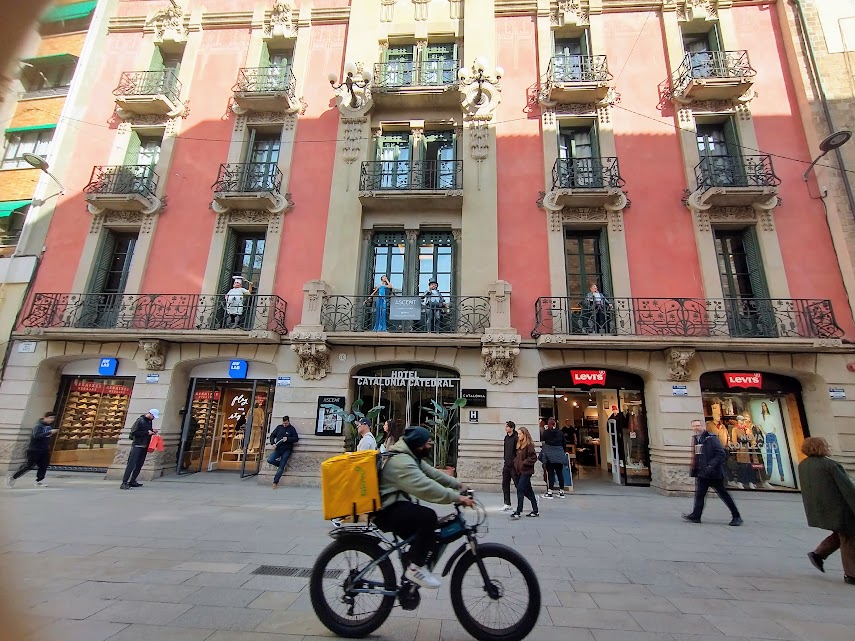
And of course the weather is not what this challenge is necessarily about. But maybe a bit of fun played out against a hotel wall painted a vibrant shade of coral, on a balmy winter’s day, will not be too much of a cop-out.
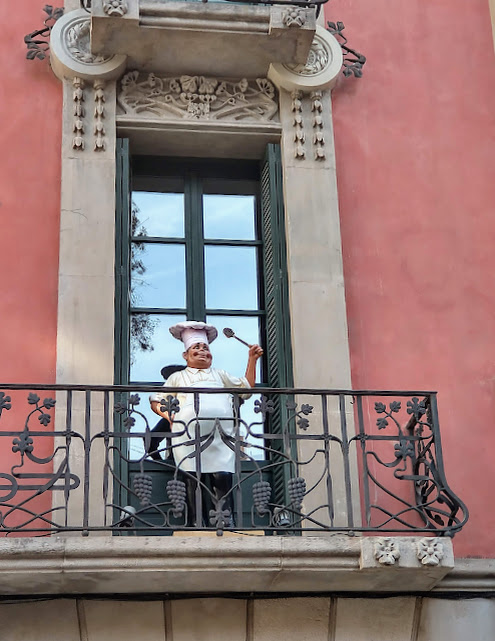
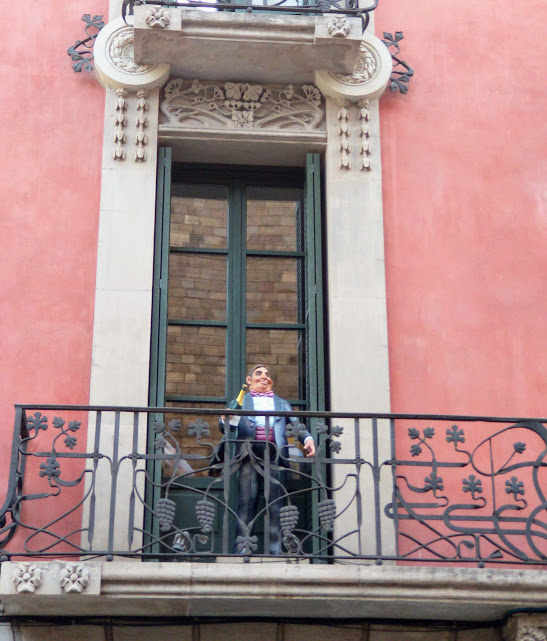
Here are vignettes of three snippets of lives lived on the balcony of Hotel Catalonia Catedral, near – of course – the cathedral in Barcelona.
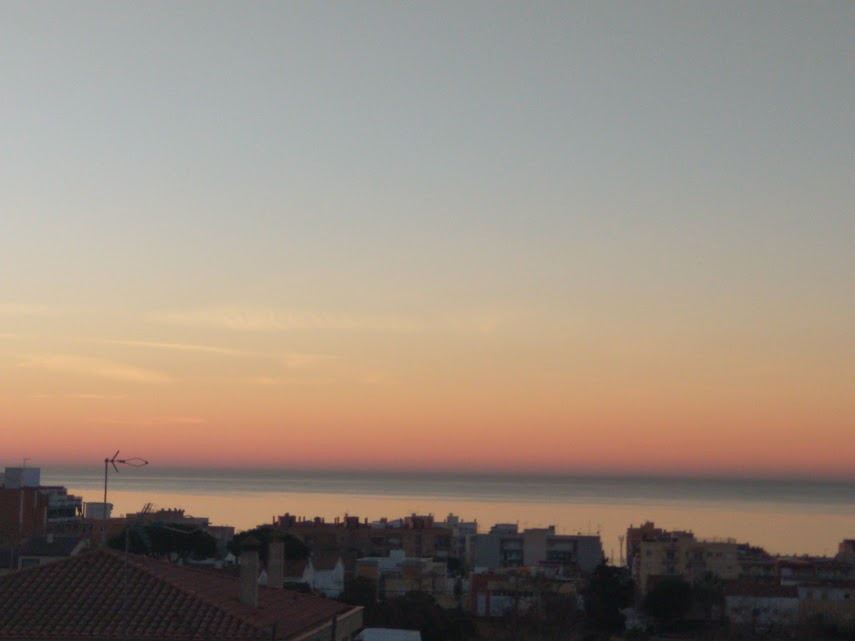
And here is a scene from our bedroom, taken at the beginning – or the end – of the day. Which? Only you can decide.
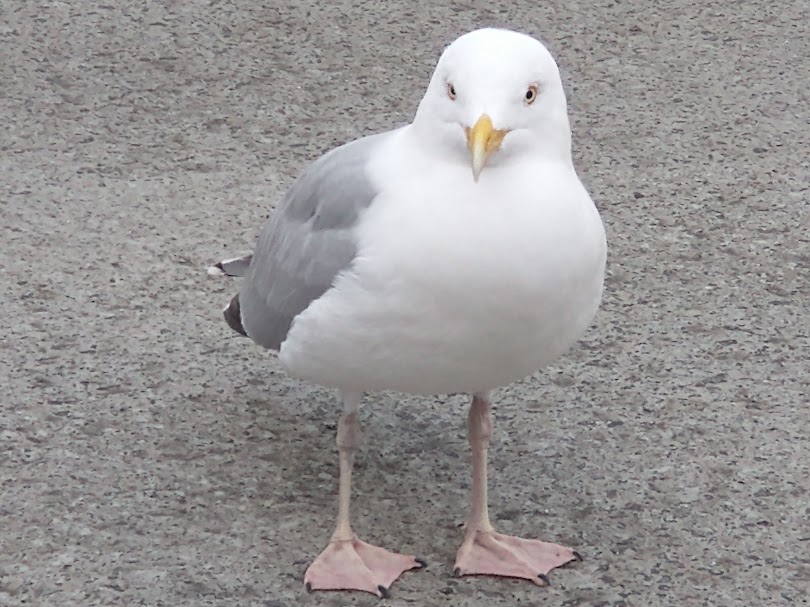
The featured image is of a herring gull who paraded obstreperously outside our car – only our car – as we waited to board the ferry at Dover. It was elevenses time-ish, but we displayed no evidence of snacking, so I don’t know what it was all about.
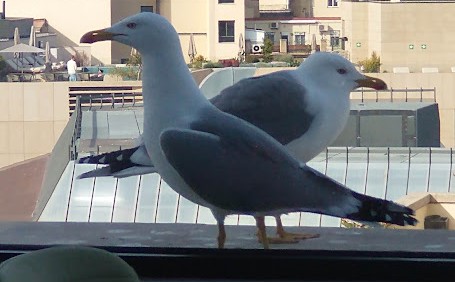
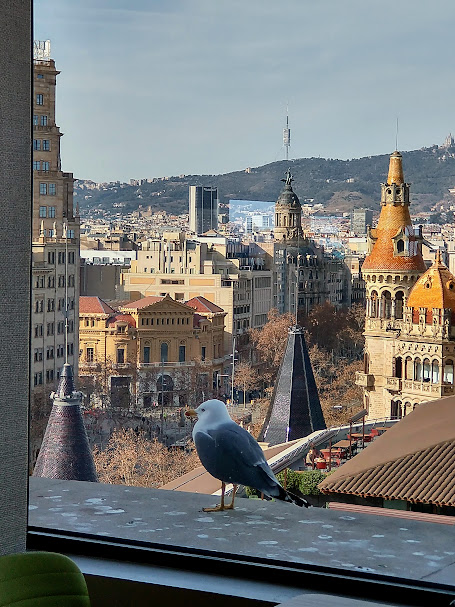
These other gulls are, according to Google Lens, yellow-legged gulls, and closely related to the herring gull. These specimens were loitering on the window ledge of the roof top café from which we were enjoying the view in the centre of Barcelona.
Thank you, everybody who identified last week’s creature as an Egyptian Grasshopper. It is good to know what this impressive creature is.
Here is a red (well, reddish) sunrise, seen from our bedroom in our daughter’s family’s house, and looking over at Barcelona in the distance. We’re leaving today, and will miss everything about being here.
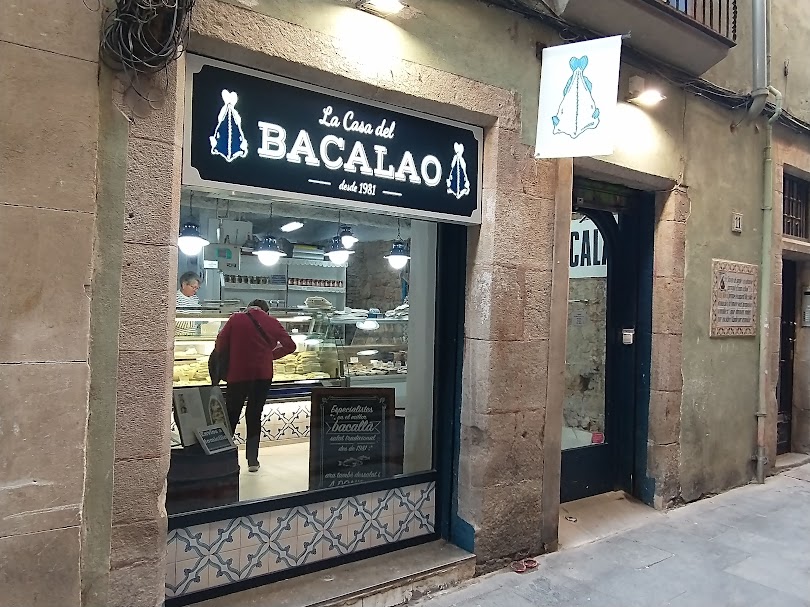
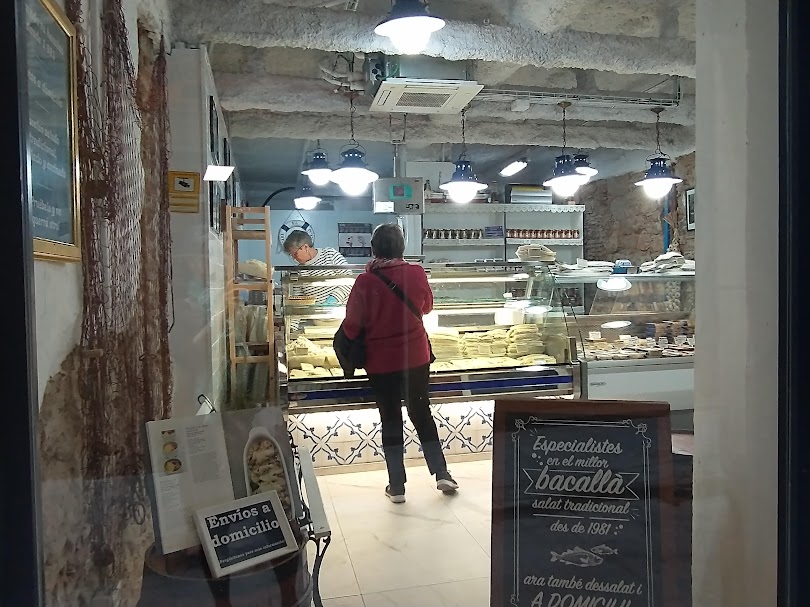
In a city centre back street in Barcelona, somewhere near Las Ramblas, we found this shop. It sells one thing only: blocks of dried salt cod: bacallà (Catalan) bacalau (Spanish). Salting and drying cod changes and deepens the flavour, and means it will keep for a very long time if necessary. Soak it to remove much of the salt and to soften it, and use in your favourite recipe!
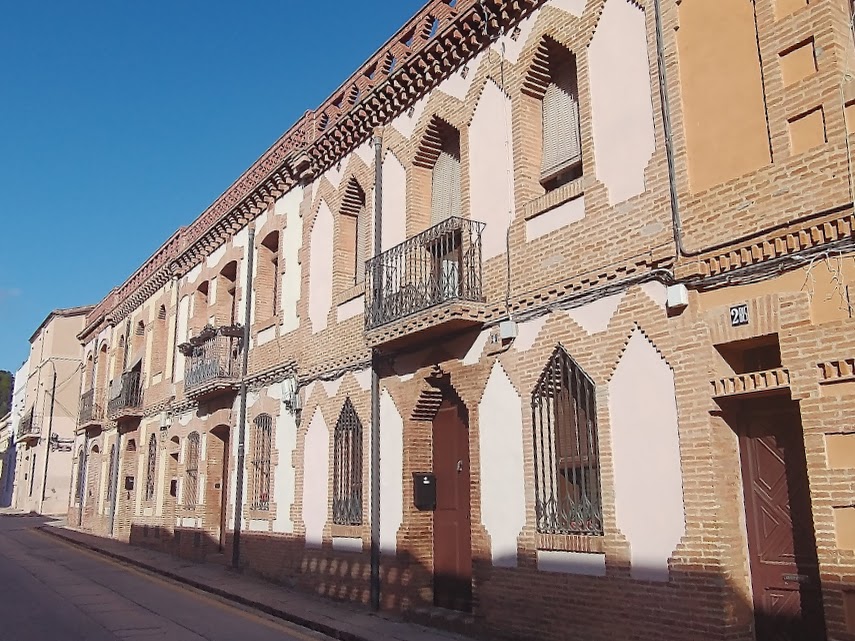
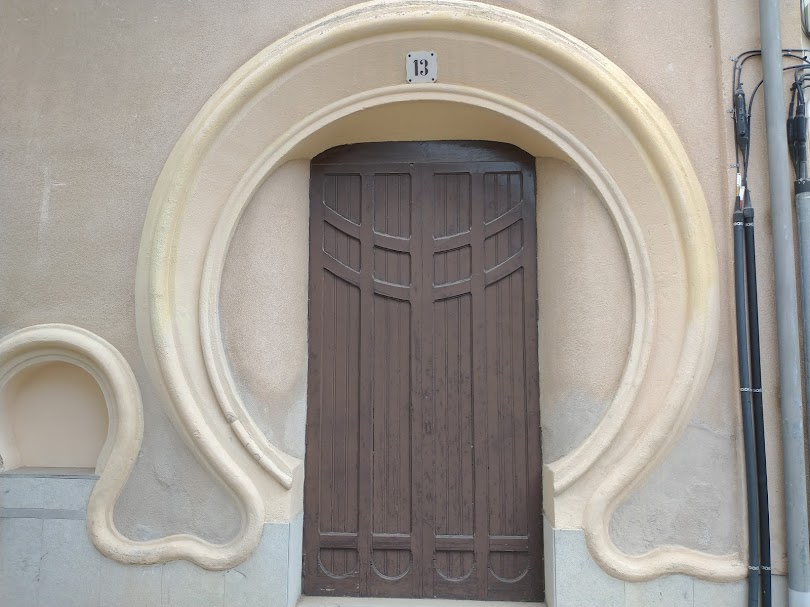
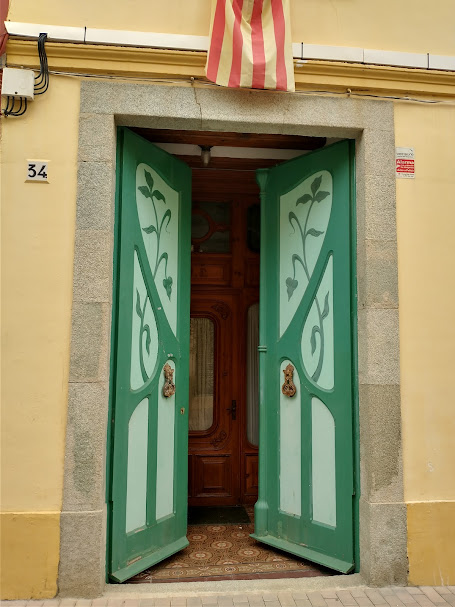
The featured photo is of definitely my favourite door in Premià de Mar. It’s part of an otherwise plain but elegant building whose history I haven’t been able to discover.


















 From Pyrenees to Pennines
You must be logged in to post a comment.