The story is – there is no story to tell about our walk near East Witton.
It was cold, frosty but bright so we stepped out energetically. The day went on to be warm, breezy and sunny. There was only one stile to climb over. The ground was firm and frosty, but neither icy nor muddy. Nobody slipped or fell over or got injured.
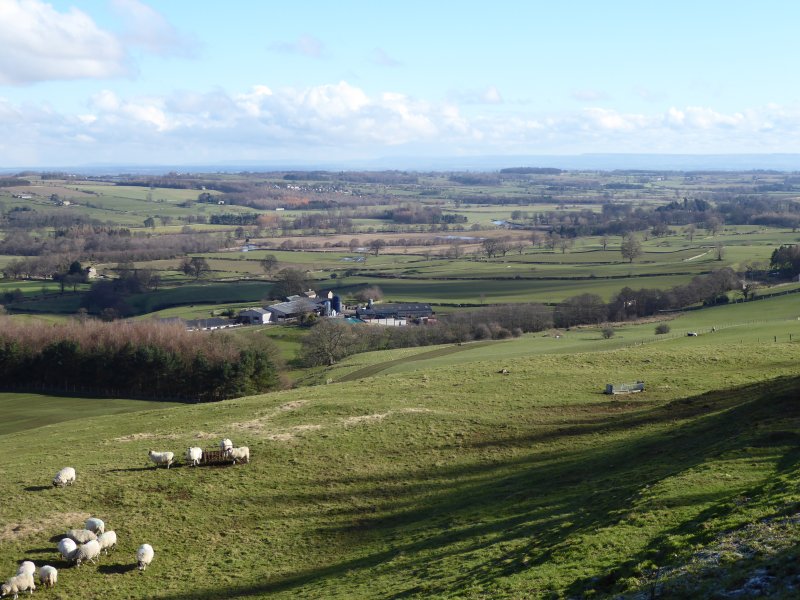
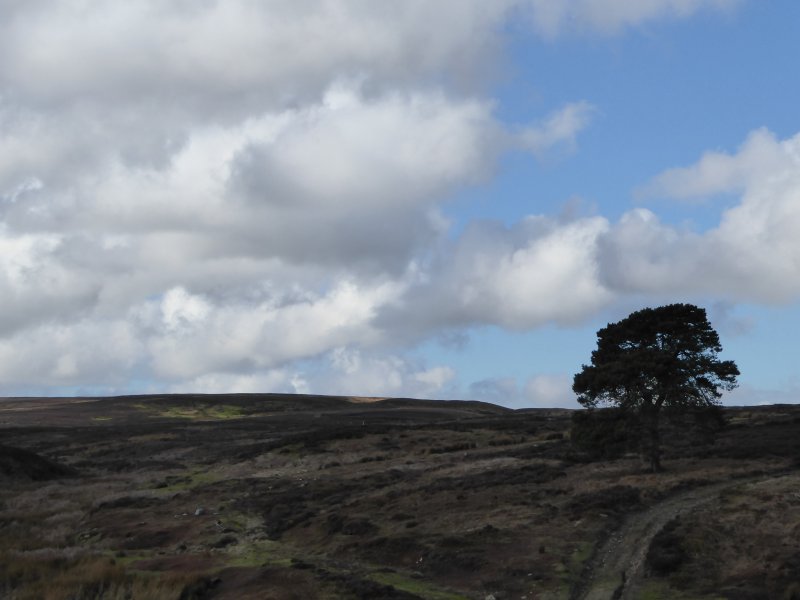
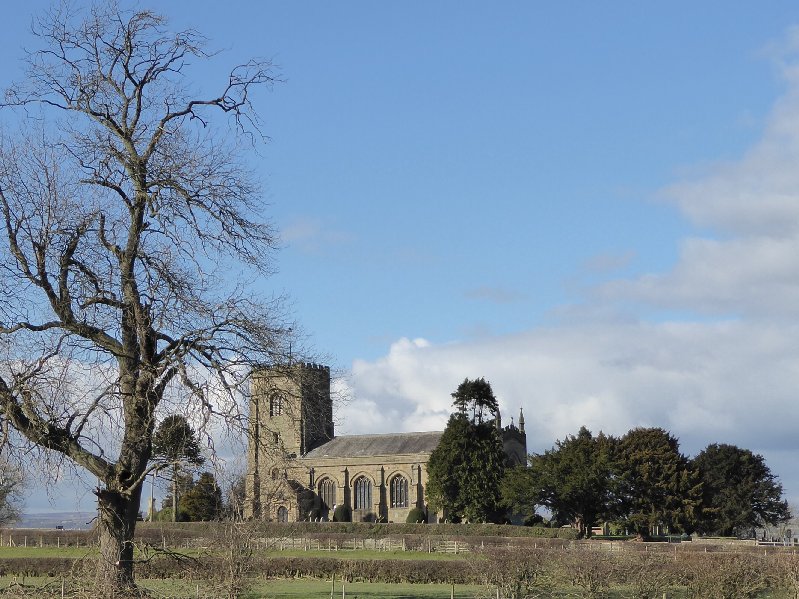
The landscape was just right. The gently undulating farmland of the Yorkshire Dales gave way to moorland whose picturesque bleakness was enhanced by the occasional lonely tree. We’d pause to take in the long-distance views across the Dales. And as we returned through woodland to East Witton once more, there was a proper English parish church just asking to be photographed. Nobody was displeased by the views.
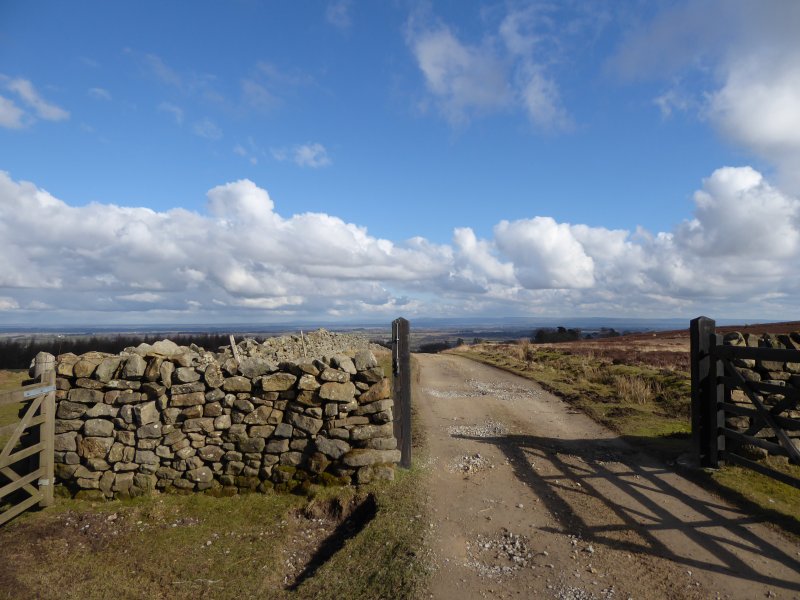
Our two pauses were ideal. Mid morning, we had picture-postcard moorland views in front of us, and the solid protection of a sturdy drystone wall behind. We ate our lunchtime sandwiches in sheltered bosky woodland, with convenient benches in the form of tree trunks. Nobody got cold, or wet, or lost their sandwiches.
The energetic uphill stretches were all before lunch. Our path afterwards returned us gently to the valley floor. So we got back to base after a gently-challenging workout. Nobody was exhausted or fed up.
So there’s nothing at all to tell you.
Oh hang on. This will have to serve as our banner news headline. ‘Hiker loses gloves on Wensleydale walk’. That was me. First one glove vanished, then the other. But as anyone who knows me will tell you, this is not news at all. It’s what I do most weeks during the winter.
You’ll know that we waved ‘Goodbye’ to Emily this week. She’s arrived in South Korea, jet-lagged and exhausted, but not so much that she can’t send snippets of up-beat information about her new life as Emily-in-Busan.
While she was with us, Emily-in-Barcelona briefly became Emily-in-London, Emily-in-Bolton, and Emily-in-Yorkshire. And while she was with us, Boyfriend-from-Barcelona came to visit. What should we show someone from a vibrantly busy city, one of whose attractions is several kilometres of golden, sunny, sandy beaches? Well, on a frosty, gusty February day, with more than a threat of snow in the air, what could be better than a day beside the seaside?
Whitby: the view anyone who’s been there would recognise.
Whitby seemed to fit the bill. Picturesque fishermen’s cottages huddled round the quay. A clutter of narrow cobbled shopping lanes – a tourist mecca to rival Las Ramblas. A sandy beach with donkey-rides, and the chance to find fossil remains etched into the cliffs or a morsel of jet washing about on the sands. A ruined Benedictine Abbey high above the town, the inspiration for Bram Stoker’s ‘Dracula’, and the focus of a twice-yearly Goth music festival. And fish and chips. Always fish and chips at an English seaside destination. Emily and Miquel explored the lot.
Whitby Abbey.
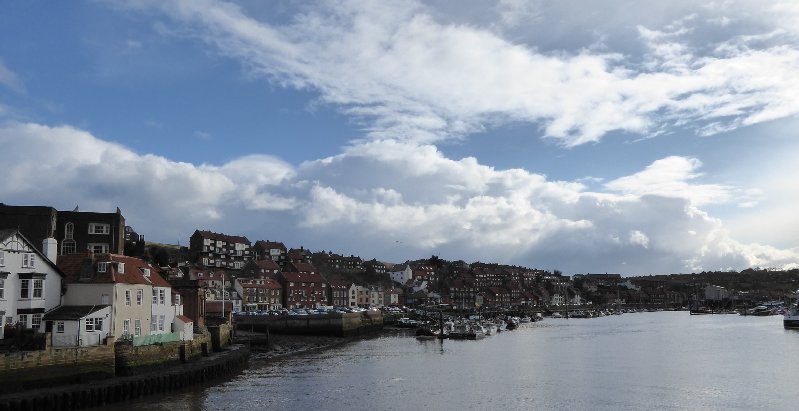
Whitby seen from St. Mary’s Church, next to the Abbey.
The old town.
The abbey and church seen from a ginnel.
The beach.
The beach.
The beach – again.
A close view of those cliffs.
One of the hundreds of gulls, thousands of gulls, reasy to steal your fish and chips with no warning.
And just before we left … a little bit of rainbow.
And Miquel, windblown and chilled to his fingertips, declared that it had been a fine day out, with the added bonus of being firmly inside the car when we journeyed home across the North York Moors as the snow began to fall.
Best to be back in the car when the weather’s like this.
I first walked from Jervaulx to Jervaulx last April, and wrote about it here. However, I failed to lead my fellow ramblers along the same route later that month as I’d said I would, because it rained…. and rained. I’d promised them the walk though, and today was the day: bright, sunny, blustery – a perfect winter hike. Except for one thing. Those floods that have dominated British news this winter are still making their presence felt.
The ruins of Jervaulx.
Our route today didn’t take us through pastureland. Sheep aren’t very good at being knee-deep in mud. It took us through soggy fields, and past lake after lake after lake: waters that simply were not there last time I took this route. It was all very pretty. Less pretty was the scene at stiles. Look at us skidding and sliding, trying to pick the shallower puddles as we waited out turn to get from one field to another.
We’re British though, always plucky in adversity. We soldiered on, sometimes a little weary of heaving mud-crusted boots along sticky, sludgy paths. But nobody fell over, nobody lost their sandwiches in the mud. Everybody enjoyed those vistas over the Dales, the starkly beautiful skeletal outlines of winter trees, the blue skies, dappled with characterful cloud. Were we glad to have made the effort? Well, I was, and I think my steadfast and dependable companions were too.
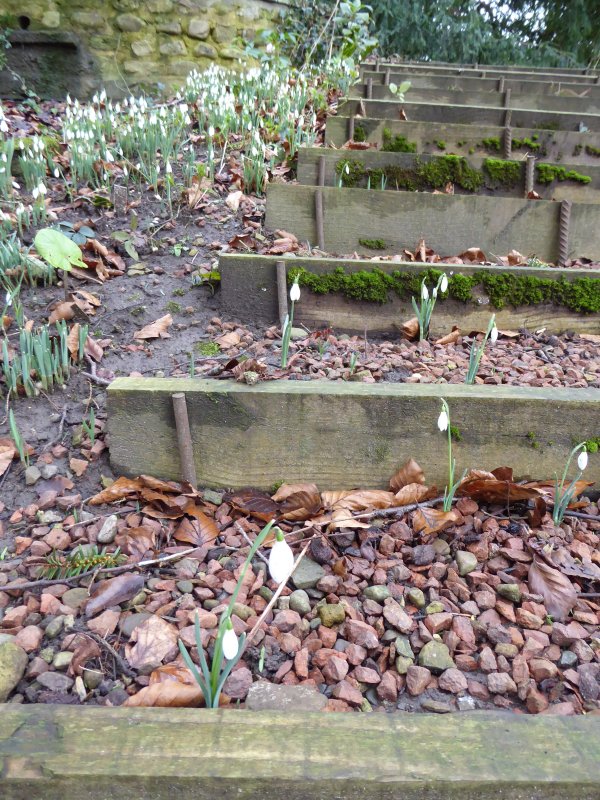
Step out into the garden, and the countryside beyond at the moment, and you’ll find snowdrops doing what they do best in January – piercing the barren earth, colonising grassy patches, nestling under trees and marching across gladed hillsides. Untroubled by unseasonal weather, their inner clocks direct them to grow, multiply, and cheer us all up in an otherwise gloomy, un-festive sort of month. That’s Nature for you: ordered, seasonal and predictable.
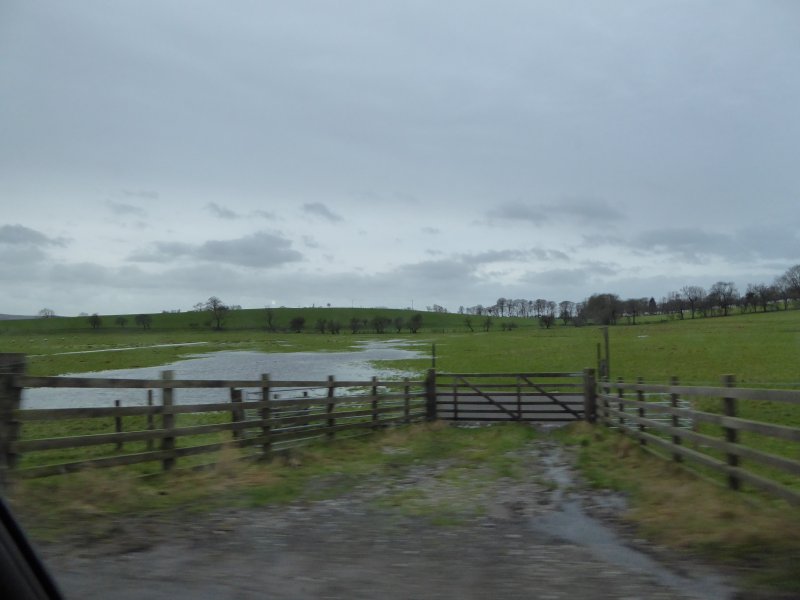
A farmer’s field? Or Sleningford-by-the-sea?
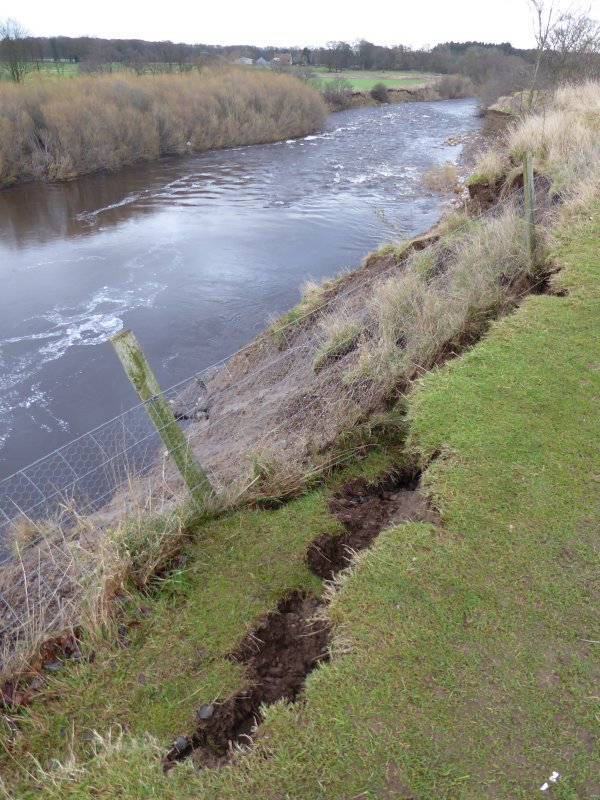
But Nature has another face. Come with me beyond the garden, past the fields slickly shimmering with surface water, to the banks of the River Ure. Just two minutes walk from here, it makes a wide sweeping curve away from its route from West Tanfield, and (normally) meanders gently into Ripon. That was before this winter, this rain, this unending water.
Once the rains came, and once it reached town, the River Ure rather wanted to swamp people’s gardens and make a bid to enter their houses. Recently-built flood defences put paid to that idea. The River Ure took its revenge on us, or more specifically, on the farmer whose fields adjoin us. Up in the hills, waters from streams and rivulets in the Dales cascaded into the Ure, which gushed and surged along its course, rising higher and higher, tearing at the banks, ingesting great clods of earth and forcing them downstream. The water levels are falling now. The damage remains.
The River Ure seizes the land.
Look. Here’s a chain link fence which marks a pathway running along the edge of the farmer’s field. It should be on terra firma, with a nice grassy margin between the fence itself and the river bank. Now it has nothing to hold onto. The bank has been snatched away, and the fence is hanging crazily and directly over the swelling waters below. The earth has slipped, and continues to slip. The farmer is losing his field, and the river is changing course. There’s not much anybody can do about it.
We’ll watch the water awhile, and frighten ourselves witless at the prospect of falling in and being swept mercilessly away. Then we’ll wander back though the woods, and enjoy the snowdrops and aconites once more. Nature takes its course.
I’m at university this week. The University of Blogging. This seat of learning, which has no rector, no library and confers no degrees, runs a programme regularly hosted by WordPress,and aims to bring together people who from all over the world, keen to hone their writing and presentation skills, and to help each other to Write a Better Blog.
Today’s assignment:
Publish a post you’d like your ideal audience member to read.
I’ve chosen to write for one of you. We haven’t met. We don’t live on the same continent. But we’re ‘blogging friends’ who enjoy one another’s posts and often say so. You say you like the posts I write about walking in the Yorkshire Dales. I like the posts in which you too describe your walks, often more extensive than mine, taking place over several days. You stride beside me – virtually of course – as I tramp along the leaf mould paths of a dappled English woodland. I stop to gaze across the green and undulating hills at the lattice work of ancient fields, divided by drystone walls, and share the view with you courtesy of my camera.
Except… I haven’t. Not lately. Those floods I wrote about a couple of weeks ago are an ever-present danger to some. And even for those who haven’t had flooded homes to contend with, the weekly rhythm has changed. Walking is quite simply not on. The other day, fed up with the lack of exercise, I took myself off to walk along country roads instead. I’d not been going ten minutes when I met a deep trough as wide as the road, as deep as my ankles, and as long as… well, I don’t know. It went beyond the next bend, anyhow, and I went home. The fields are home to seagulls who bob about on the choppy waters. The paths are streams. The streams are rivers. And the rivers are seas.
Quiz question. Which is the path, and which the brook?
A path through the woods.
Brian can’t wait to get home.
i) Quiz question: which is the path, and which the brook?
ii) This, I’m afraid, is a path.
iii) Brian-from-Bolton simply can’t stand getting his paws muddy. He’s urging me home – NOW.
But I’m keen to get out and about again as soon as I can. And I hope you’ll come with me, in a virtual sort of way, when I report back.
December in the north of England has been the month of the flood. Until Boxing Day, it was Cumbria that saw all the action, with some communities flooded out not once, not twice, but three times. They were told to stand by for more on Boxing Day. They readied themselves…. and nothing happened, because the torrential rains prophesied swept south and east of them, firstly into Lancashire, and then Yorkshire
We were staying with my daughter’s family in that part of Greater Manchester that used to be in Lancashire. They live near a Nature Reserve through which Bradshaw Brook passes. I’d say ‘flows’, but such a phrase is normally far too active a description for this narrow little watercourse.
This was Bradshaw Brook yesterday.
Bradshaw Brook, Boxing Day 2015
We were due to travel home from their house to ours, in Yorkshire. Highways England, the BBC, and motoring organisations all had conflicting information on their websites. But they all agreed that our usual route, a scenic drive over the Pennines, was largely impassable.
It would have to be the motorway. Longer, duller, but surer. We’d not long been travelling when we noticed that traffic on the other carriageway was at a complete standstill, for miles…and miles. It was only when we got home that we found out that a 20′ sinkhole had opened up near Rochdale. So much for safer-by-motorway…..
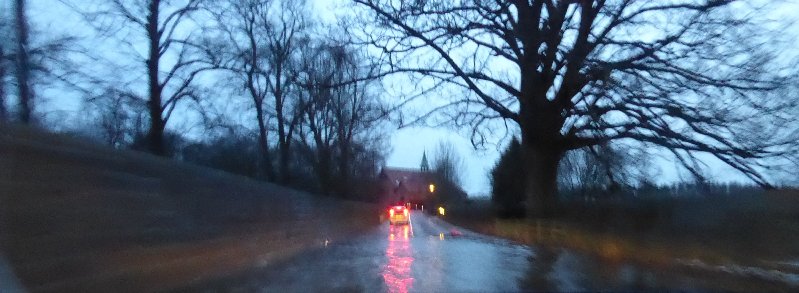
Where to leave the motorway though, for the final few miles home? There were floods in Leeds, floods near Harrogate – there were sure to be floods in Boroughbridge too. What about Knaresborough? It turned out there were floods near there too, as we discovered when warning notices turned us back on the road we’d come on, and sent us back by several miles to look for another route. Familiar fields had turned into lakes, deep and almost unfordable road-side puddles were unavoidable.
This doesn’t look too bad. Trust me. It’s deep.
We’re lucky. We were flood-tourists on our journey home, gawping at rivers-become-seas, and roads-become-rivers. Our home wasn’t flooded, nor will it be. Others aren’t so fortunate. They’re either contemplating the devastation of their own home or business – or both, or anxiously shoring up the front door with as many sandbags as they can lay their hands on, in anticipation of the days ahead, when the forecast continues to be grim. We could all do with a bit of an old-fashioned winter cold snap, with a touch of frost, but positively no rain.
You see that bridge, centre left? That’s a bridge over the River Ure, in Ripon. This lake in the foreground is not a lake, but open ground at the edge of the city, favoured by dog-walkers and children.
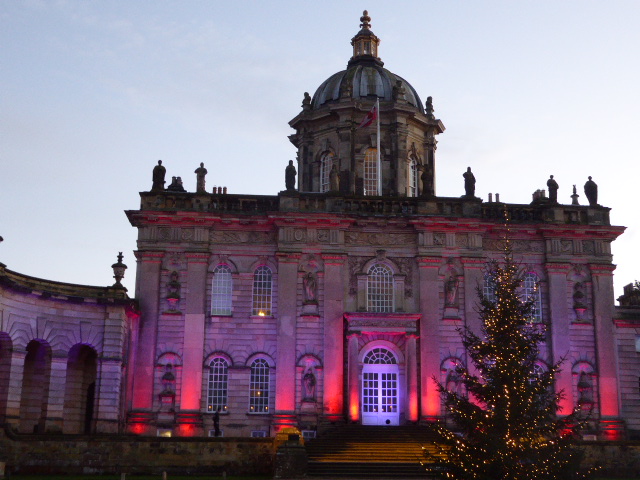
You all know Castle Howard, that magnificent 18th century stately home, and one of Yorkshire’s treasures. I’ve even blogged about it. It provides the backdrops in endless films and TV dramas.
This time, though, as it’s Christmas, I just want to show you how its been decorated for the season. A few weeks ago they shut the doors for a whole fortnight, and everyone from groundsmen and gardeners to guides and caretaking staff turned to and spent their time dragging trees into place, painting, placing baubles, candles and foliage, gilding, and generally making the place festive. Then they re-opened. We came away from our afternoon there, admiring everyone’s hard work and enthusiasm, feeling Christmassy for the first time this year. Happy Christmas everyone!
If the National Trust property where you volunteer has an abbey on site, albeit a ruined one, that’s where a good few of the Christmas celebrations need to take place.It’s fair to say that there are many people locally who regard a chance to hear singing from a local choir at one of the ‘Music and Lights’ events, or at the carol service here, as one of the focal points of their pre-Christmas celebrations.
The Abbey hasn’t had a roof since Henry VIII’s men came and removed it. Only the cellarium, which the monks used for storage, specifically for vast quantities of valuable woollen fleeces, is still under cover. It’s a little draughty too, as the windows remain unglazed, but the acoustics are amazing. The monks who used to call the abbey home might be rather surprised to find that their storage facility is nowadays, from time to time, a concert hall.
Picture the scene before the service began. Here’s the cellarium at 1.30 p.m.
The cellarium, empty at 1.30 p.m.
For two hours after that, though, there was a batallion of volunteers, with a couple of members of staff cheerfully mucking in to transform the place. Some of us hauled ranks and ranks of folding chairs out from storage and arranged them neatly. Some protected scores of candles with little cardboard collars so nobody would be burnt by molten wax when the time came to light them during the service. Others uncoiled lengthy snakes of cable for the sound and lighting systems. And the largest team of all arranged the refreshments: coffee, tea, hot chocolate, mulled wine.
By 3 o’clock. members of the public were already choosing their seats, and the refreshment stand was very much in business. ‘One coffee, two teas and four mulled wines please!’ ‘Two hot chocolates, a mulled wine and a coffee’. On and on we worked. Suddenly, someone said she thought she could hear ‘Oh come all ye faithful’ in the distance. The service had long since begun, and we’d been too busy to notice.
The carol service continued, service of refreshments continued. By half past 4, things finally started to quieten down as the event drew to a close. Time for the team to snatch a refreshment break, and do a little accounting. We’d sold far more than £1000 worth of hot drinks, including 66 bottles-worth of mulled wine. Not bad for a couple of hours’ hard graft. And as the congregation proved willing to do a whole lot of chair shifting, clearing up didn’t take too long.
Even if we didn’t hear many carols, we felt we’d had a good start to the Christmas season. It hadn’t been very peaceful, but there had been plenty of cheerful good will from staff, volunteers and visitors alike.
And meanwhile, up at the entrance to Fountains Abbey & Studley Royal, two other volunteers had been busy. Here’s Sharon, Volunteer Elf, welcoming visitors to meet Father Christmas – a volunteer, of course.
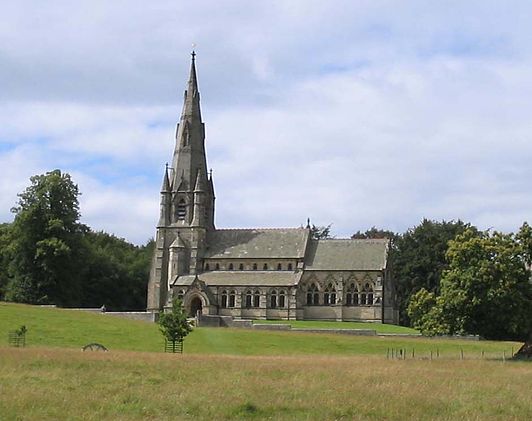
St. Mary’s Church, Studley Royal (Wikimedia Commons)
When I started out as a National Trust volunteer, when I began as an Information Assistant at St.Mary’s Church, Studley Royal, I didn’t expect to sort out a little mystery that’s continued to exercise my brain from time to time, ever since my first and only visit to India, 8 years ago.
Let’s begin there, back in 2007. It was my first day, all by myself, after a night flight into Bangalore. I was far too excited to sleep, and already over-stimulated by a city, busy since well before 6.00 a.m., alive with cows, horses, donkeys, sheep, chipmunks, dogs by the thousand, monkeys, parakeets, eagles …. and auto-rickshaws, always auto-rickshaws, and the unending sound of motorhorns constantly in use on every car and lorry. I’d already allowed an amiable rickshaw driver, who could doubtless see ‘arrived this morning’ tattooed across my forehead, to take me on a conducted tour of the city. We served each other’s purpose. I got a decent sit down and a running commentary in broken English on the city sights. He was probably paid over the odds by a very appreciative customer who knew a decent bargain when she saw one. When I left him, after a thoroughly entertaining morning, I found myself wandering towards London Road. And then Robinson Street. Robinson Street? Who could Mr. Robinson be? I finally found out ….. the other week. If only I’d wandered just a little further on that first day in Bangalore, I’d have been offered a clue. I’d have found ‘Ripon Street’.
My first friend in Bangalore: the rickshaw driver who took me on a tour of the city
Eagles fly above Bangalore
Bangalore street scene.
Fast forward to an early session at St. Mary’s Church, Studley Royal just a few months ago. My fellow-volunteer Frances was taking some visitors round. I tagged along, because Frances has an apparently bottomless fund of knowledge, and a way of engaging her willing listeners’ attention. She’d already told them that the church was the design of a noted exponent of Gothic Revival architecture, William Burges. She’d pointed out several examples of its inventive design, of its richly coloured decorative detail, of its religious symbolism.
First glimpse of the richly coloured interior
Starting outside the church…..
Burges famously loved animals. There are 16 of thse parrots.
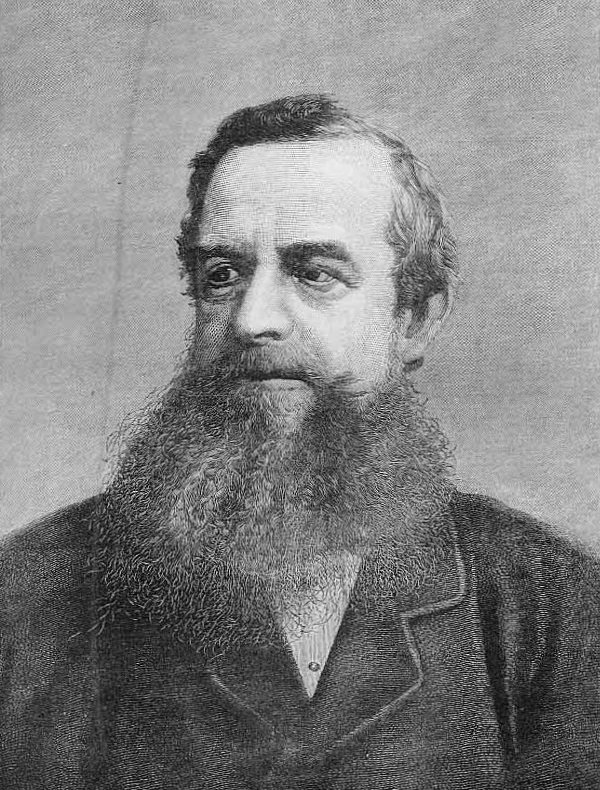
Now she was telling us that it was commissioned in 1870 by the deeply religious Marchioness of Ripon, and her husband, the Marquess. His full name and title was George Frederick Samuel Robinson, 1st Marquess of Ripon, 2nd Earl of Ripon. She thought we might like to know his story. She was right.
The Marquess of Ripon had an impeccable pedigree. He was born in No. 10 Downing Street, and as an adult, served as an MP in various northern constituencies. Shortly after succeeding to the title of Earl of Ripon in 1859, he became first Undersecretary to India, and later Secretary of State for India. From 1868 he was highly valuable in a variety of roles in William Gladstone’s government.
Then, in 1874, he converted to Roman Catholicism. His strong sense of duty prevented him from continuing to serve in government. The Church of England (the Established Church) and state are linked in the United Kingdom. He withdrew from public life.
However, in 1880, Gladstone persuaded him to take the post of Viceroy of India. The Indians grew to honour him: the British rather less so. Here’s why.
He expanded the powers of locally elected Indian governments, and liberalised internal administration. He lowered the salt tax. He gave local language newspapers the same freedoms as English ones, and enacted some improvements in labour conditions. He allowed Indian judges the same rights as European ones when handling European defendants. And he achieved all this in only four years. No wonder Indians felt the least they could do was name a few roads after him.
George Frederick Samuel Robinson, 1st Marquess of Ripon (Wikimedia Commons)
He went on to serve in other capacities before becoming leader of the Liberals in the House of Lords, and died in Ripon in 1909.
So – thank you St. Mary’s, Studley Royal. And thank you Frances, National Trust volunteer. An eight year old mystery is solved.
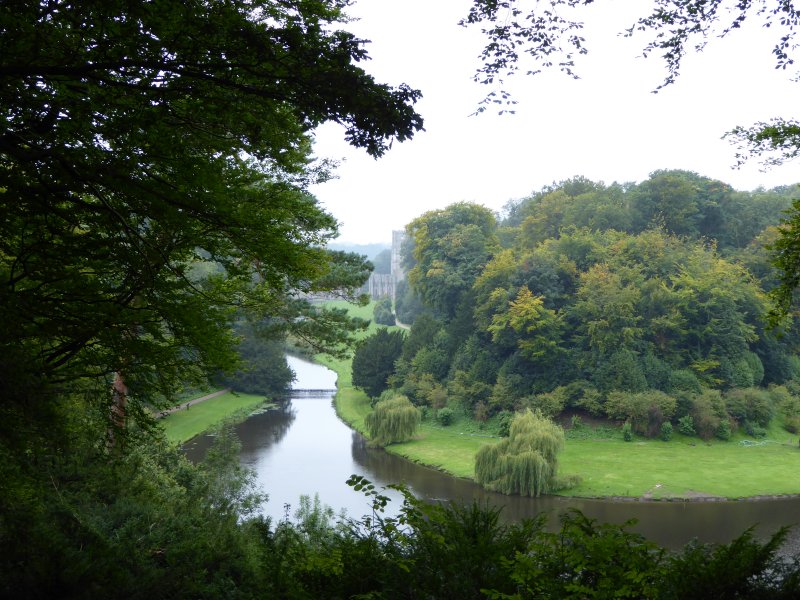
Walk round the grounds of Studley Royal, and this will be your first sighting of Fountains Abbey.
A few months ago, I got a job. Not for the pin-money, because I’m not paid a penny. But I’m richly rewarded. I signed up to be a volunteer for the National Trust, at the property nearest our home, Fountains Abbey and Studley Royal. Cistercian Abbey, Georgian water garden and mediaeval deer park…. no wonder it’s a UNESCO World Heritage Site.
Since we moved to Ripon, we’d loved spending time there, so I got to wondering….what would it be like to volunteer there? What could I do? What might be involved?
The answer turned out to be…almost anything you want There are dozens of different roles, from gardening to guiding. You could drive the mini-bus or form part of the archaeological monitoring team. You could work in the shop, or in the admissions areas. Badged up, you could wander the grounds, being alert to the needs of visitors who’d like a potted history lesson or to find their way to the toilets. You could work in the wildlife team, helping look after and monitor all those ancient trees, or the herds of deer. You could turn to when there’s a special event, and put out chairs. And you’re quite entitled, over the years, to change your mind and try something else.
I for instance, started out as a visitor assistant at the Victorian High Gothic Church of Saint Mary’s in Studley Royal Park. It’s a real masterpiece of Victorian architect William Burges, but it turned out not to be ‘me’. I admire the building hugely, but it doesn’t involve me at an emotional level as the ruined abbey does. So I quit. No hard feelings
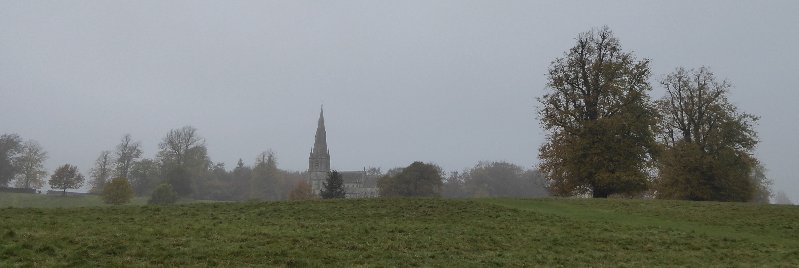
Looking across at St.Mary’s from the Deer Park.
But I shan’t be quitting the Learning Team. Our bread-and-butter is sharing a Day In the Life of a Monk with schoolchildren. The children dress up in monk-style habits, and tour the site getting in touch with the brothers’ silent and family-free routines, led by one of the team. We examine the roofless, windowless Abbey and try to picture the church back in its prime. We imagine the vast space, illuminated only by candles, as the monks worshipped there eight times a day, from 2.00 a.m. onwards. We visit the refectory where the monks dined, in silence, once a day. Did those monks eat meat? What about potatoes? No? Why not? We visit the Warming Room and imagine having just four baths a year, shaving our tonsures with oyster shells. We discuss bloodletting. We talk about all the daily routines. Maybe the children remember only a few of the facts later, But we hope they are moved by these atmospheric ruins, and return later with their families.
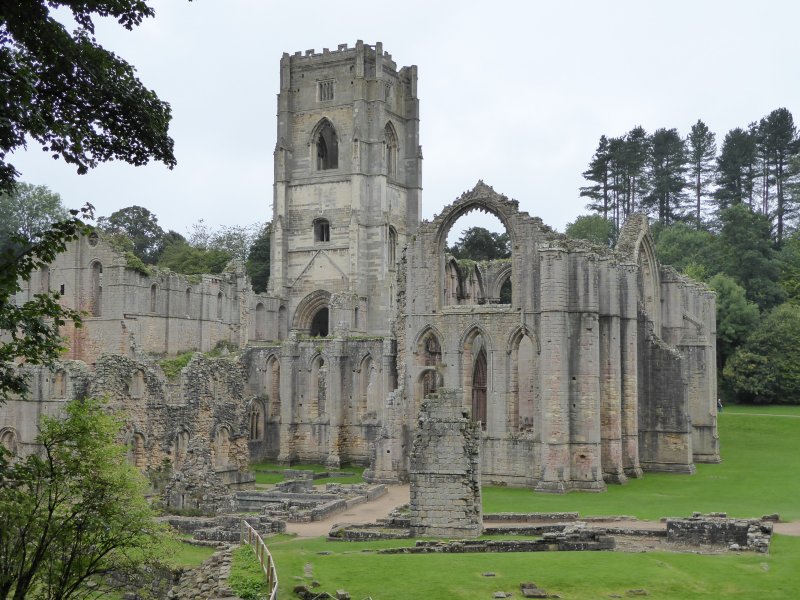
Fountains Abbey.
They might come though, to experience the natural environment of the grounds: they might go pond dipping, or on a walk where they try to use all their senses by listening, touching , seeing, smelling and so on. Or make mosaics based on what they’ve observed. Or go den-building in the woods. They’re as sure of a grand day out as are the volunteers in the team.
I’ve ended up doing all sorts of stuff I’d never have thought of attempting. Car park attendant on Bank Holidays? I didn’t think so. But it turns out to be fun togging up in a hi-viz jacket, barking out radio messages on the walkie-talkie system, getting in touch with your inner traffic cop, and generally being a welcome face to visitors as you help them manouevre themselves into the busy car park.
And some things are quite simply, a privilege. I wish you could have joined me on Sunday evening. After dark, the site was opened to less mobile visitors. For one night only, cars were welcome on site, to be driven s-l-o-w-l-y past the floodlit Abbey buildings. The evening was cold, misty, moody, atmospheric. Night birds swirled above the trees, dampness dripped from the trees, and monks could clearly be heard from within the abbey, chanting their plainsong (a recording, actually, but none the worse for that). I talked to some of the visitors, often very elderly, as their cars and drivers made their stately way through the grounds. Their appreciation of the staff and volunteers who were there helping the evening to go smoothly, though nice to hear, was quite unnecessary. I wouldn’t have missed this experience for anything. A special evening indeed.
And there are other perks. A couple of times a year there’s a ‘works outing’, when volunteers can take a trip to properties in other parts of the country. Here’s one. There are winter lectures for those who want them, to widen and deepen their knowledge of the history of the place There are times to socialise – a barbecue, a quiz night, meals. We’re very well supported, properly trained, and appreciated by the regular paid staff. I look forward to every single thing I do as a volunteer at Fountains Abbey and Studley Royal. I feel very lucky.


















 From Pyrenees to Pennines
You must be logged in to post a comment.