We travelled to London for Christmas quite late in the day on the 22nd. The moon was all-but full as it rose, at first barely peeking over the tree tops before eventually soaring high above us, in a clear black sky. I tracked its progress. Only my phone was to hand, but rather than lamenting the poor quality of these images, I liked the somewhat abstract quality they had. Here they are.
Then the next day, off we went, with Tom, Sarah, William and Zöe, to the Natural History Museum. More fool us for assuming it would be nearly empty so near to Christmas time. Outside though, was a man with a bucket of soapy water, and a couple of sticks linked with string, intent on play. He made bubbles. Lots of bubbles. I loved the abstract play of soft pinks and blues and sinuous curves set against the clean lines of the museum buildings beyond.
Here then is my contribution to today’s Ragtag Challenge: Abstract.
My grandfather Charles Barton is a shadowy figure: someone I can’t really flesh out into a real person. Partly it’s because he died sixteen years before I was born. Partly it’s because my mother beatified him and painted an unrealistic picture of a man who was beyond criticism.
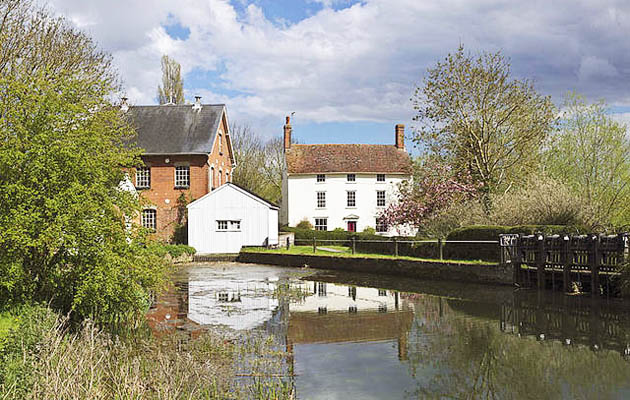
Charles was a second generation Londoner. His own father Joshua had been born in Suffolk in a village called Layham. So had all his relatives before him on his father’s side: I’ve plotted them back to the 1600s. Every single man had been an agricultural labourer. Some of them had wonderful names like Shadrack or Meshack: but not, apparently Abednego.
Layham may not have been so idyllic when endless generations of Bartons lived here (Image from Country House magazine)
Joshua was born at a time when a series of bad harvests had made a tough country life even tougher. As a young man he took his chance, went to London and became – who knows how – a wine cooper. He married a local girl, Maria, and they had ten children.
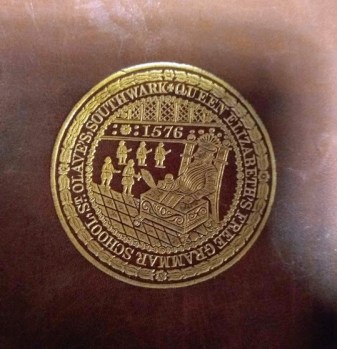
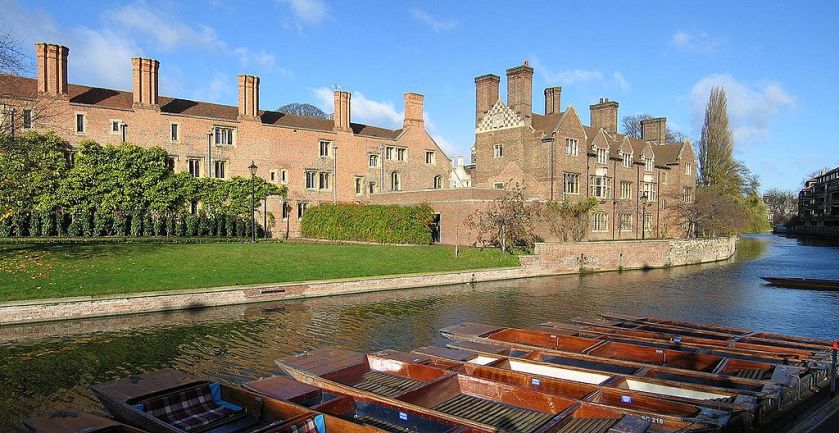
The family was probably what Theresa May patronisingly calls Just About Managing. The children grew up to become gardeners, coachmen, clerks, seamstresses. All except Charles and Harry, sons numbers two and three. I’ll never know the story of how they got places at Saint Olave’s Grammar School and then won scholarships to Cambridge University. I still have books that Charles won as prizes at school, and while studying at Magdalene College. I wonder how two working class boys from a relatively poor background enjoyed their experiences in these privileged environments?
This is a prize from school: Sophocles, the Plays and Fragments. It’s in the original classical greek.Magdalene College Cambridge (Wikimedia Commons)
Harry became a schoolmaster but Charles felt called to be a priest. He worked in a succession of grubby industrial or manufacturing Yorkshire parishes: Hanging Heaton, where he met and married my grandmother Annie; then mining village Sharlston where my mother was born.
Charles and Annie’s wedding in 1910: from a family album.
The marriage of Charles and Annie announced in the local paper.
St. Luke’s Sharlston. (geograph.org.uk)
Charles taught my mother Betty at home in his new parish in Roberttown until she was eight, and then when she started school pushed and pushed her to achieve academically. Younger brother Arthur, who was less bright wasn’t given this hothouse treatment.
Charles acquired a reputation for injecting vigour into failing parishes. It was a full time calling. No days off for him. Ever. Yet parish magazines and local papers at the time give a picture of a lively parish life: plays, bazaars, meetings, fundraising schemes, discussion groups, clubs all flourished in St Peters Morley when he was rector there, and he was clearly liked and respected.
Then, in 1931, he fell ill, aged only 56. My mother was in the throes of applying for a place at Oxford University: still quite an unusual goal for a young woman in those days. He lived to know that she had been accepted. When he died my grandmother refused to let my mother take her place up. She was needed at home. My mother raged and stormed and so did her school. Annie stood firm. Or almost. Eventually, she agreed that if Leeds University would have her, Betty could be a day student there. And that is what happened.
My mother never forgave Annie. I didn’t ever meet my grandmother, who lived until I was about 14. In my mother’s eyes she was the sinner, Charles the saint.
Last time, we had to get to York to catch the coach to London. This time, York had two coaches stuffed with its own. Harrogate and Ripon had two, up from zero. And Leeds had upped its game from two to five.
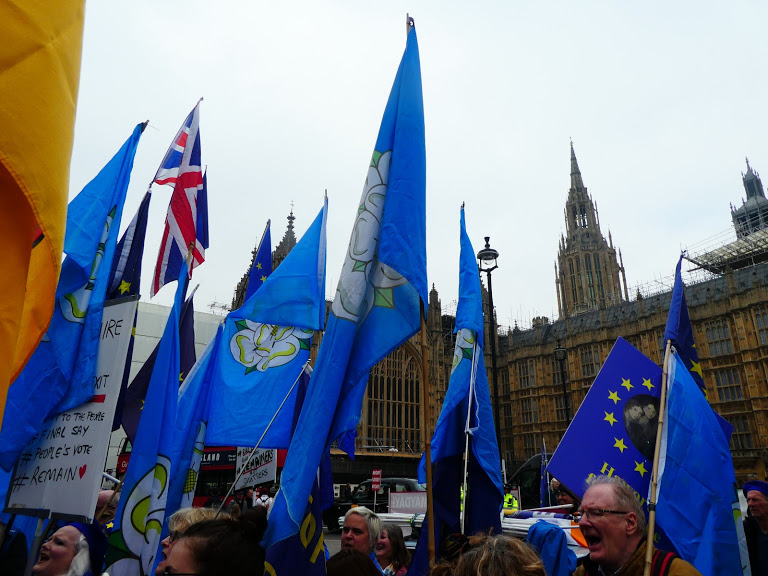
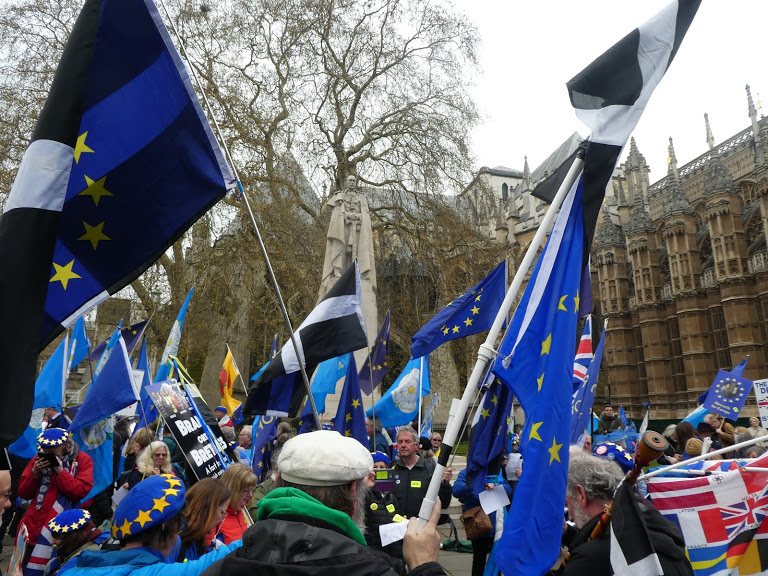
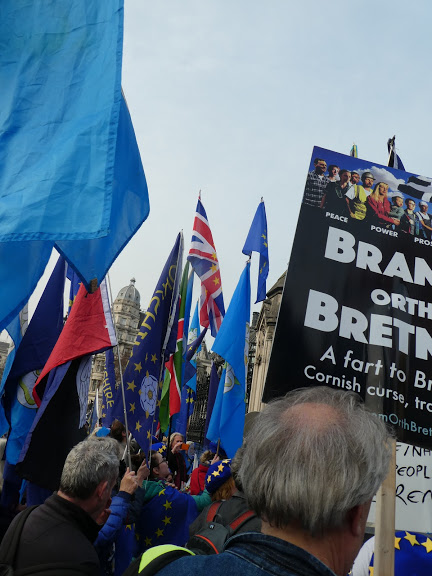
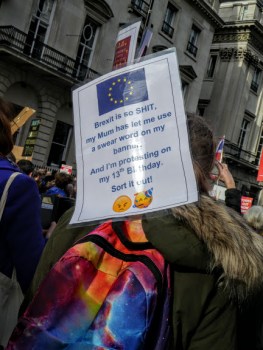
Coach to London? Yes, to support the March for the People’s Vote. You’ll know there were about 700,000 of us. You’ll know the arguments. So let’s just talk about a fun day.

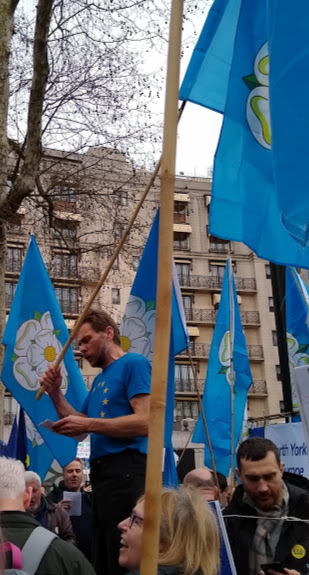
A day in which I could take few photos, because I was on Team North Yorkshire, and often doing duty carrying one end of our banner. We did sing though. All the Yorkshire marchers who could be found as we passed the Grosvenor Hotel were rounded up for a photo call. A passing marching band (there were musicians….) struck up with ‘On Ilkley Moor baht’at‘ and all right-thinking Yorkshire folk joined in with lots of enthusiasm but little melody.
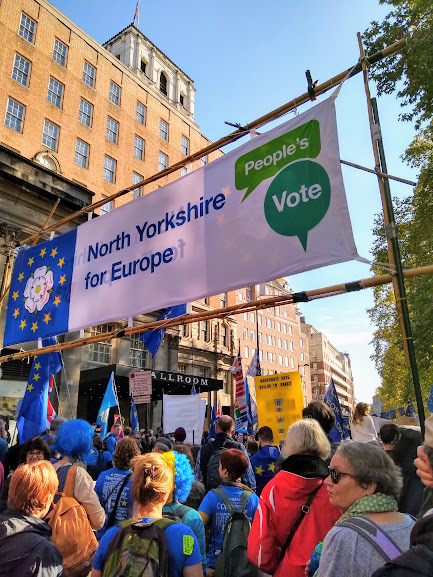
We talked. How we talked. We made common cause with voters from Jeremy Corbyn’s constituency, from Devon, from Northumberland, from Leicestershire – the banners proved that no part of the nation was unrepresented.
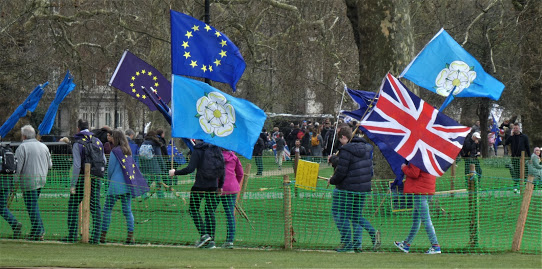
And we carried flags. EU flags, Union Jacks, Yorkshire flags, Italian flags. Progress was slow. We snuck off to coffee shops (staffed by Italians) and pubs (staffed by any and every nation) for a quick breather and still easily regained our places.
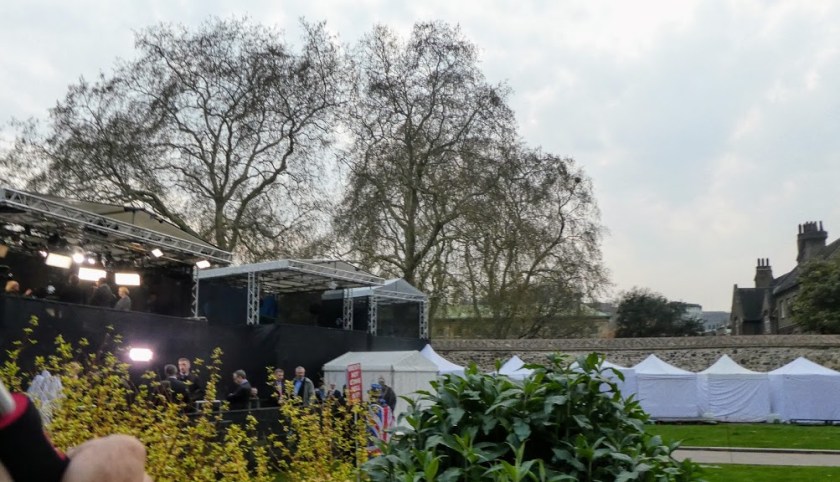
Have you ever tried to fit 700,000 people into Parliament Square? No, can’t happen. In any case, thousands and thousands of us were still marching as the speeches started, as they continued, and after they had finished. That was disappointing, as last time, I’d been inspired and energised by so many fired up and dynamic contributions.
Instead we got street theatre. Anarchists on wildly decorated bicycles, a Boris Johnson look-alike, a tricycle. It was, despite our serious purpose, lots of fun. And tiring.
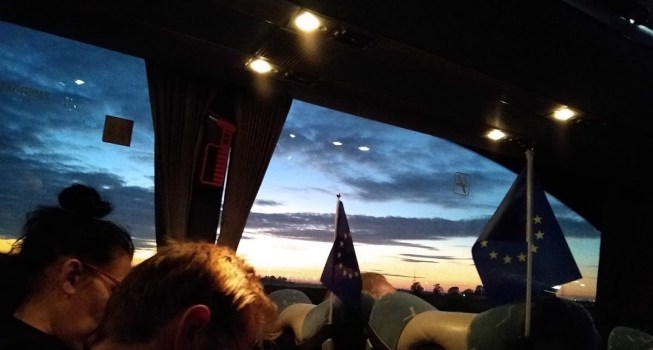
Look. This is us on the coach home. Our flags are still in place.
But I’ll end on this story, which makes me in equal measure sad and angry.
On the bus down, a French woman who has lived in the UK for 32 years told us that she no longer feels welcome in the UK, has suffered abuse, and has been told to ‘go home’. She’d always previously loved Britain’s diversity and felt us to be accepting and tolerant.
And sadly, after two years of this different treatment, she’s decided she and her British husband have had enough and they’re moving to France. Even though she has considered Yorkshire her home for over 30 years. This is not the first time I’ve heard tales like this.
It’s no secret that I voted Remain. But nobody, however they voted, seems happy with how things are going. If you believe that, having been given the chance to vote on continued EU membership, we should now be given the opportunity to vote on the Final Deal (including an option to remain), please write to your MP. Here’s how.
This Country Mouse, this bumpkin, loves a trip to London. I love visiting my family above all, especially William and little Zoë (who’s doing alright. She’s been moved from Intensive Care to High Dependency and back to Intensive Care: out of, and now back into an incubator. These set backs are not unexpected in such tiny babies, but the staff are confident that she’s basically doing well. Slowly she’s learning to breastfeed).
Zoë during her brief time out of an incubator.
I love the neighbourhood shopping streets. They’re often, and depressingly, a bit grubby and litter-strewn. But they’re full of life. Turkish, Lebanese, Italian, Chinese and East Asian, English, Syrian, French, Ethiopian, Eastern European, Caribbean shops, take-aways and restaurants rub along together. There are barbers and hairdressers, some specialising in working with the tight curls of the local black population. They may not open early, but they’re busy until late. Markets sell fruit and veg. by the bowlful, and the fish stalls are an education in unfamiliar marine life. No pictures – sorry. When I take William to the park, I may find myself making common cause with grannies from Poland, France or Thailand.
I love the happenstance of walking the backstreets almost anywhere in central London. When I have to get to King’s Cross Station, I often get off the tube at some station beforehand and complete my journey on foot. That’s how I found myself in Smithfield Market, England’s largest wholesale meat market, trading in meat sales as it has been for over 800 years. Then nearby is the church of Saint Bartholomew the Great. It ought to be twinned with Fountains Abbey. One was founded in 1123, the other in 1132.
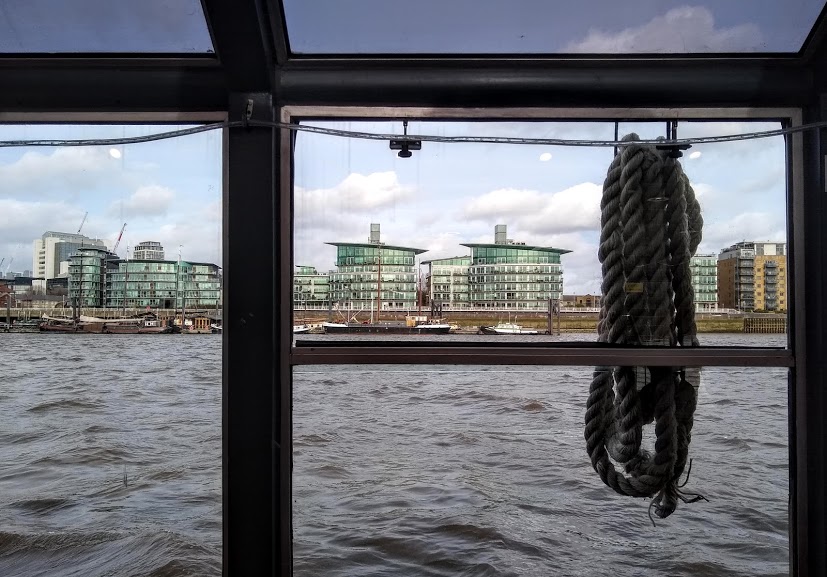
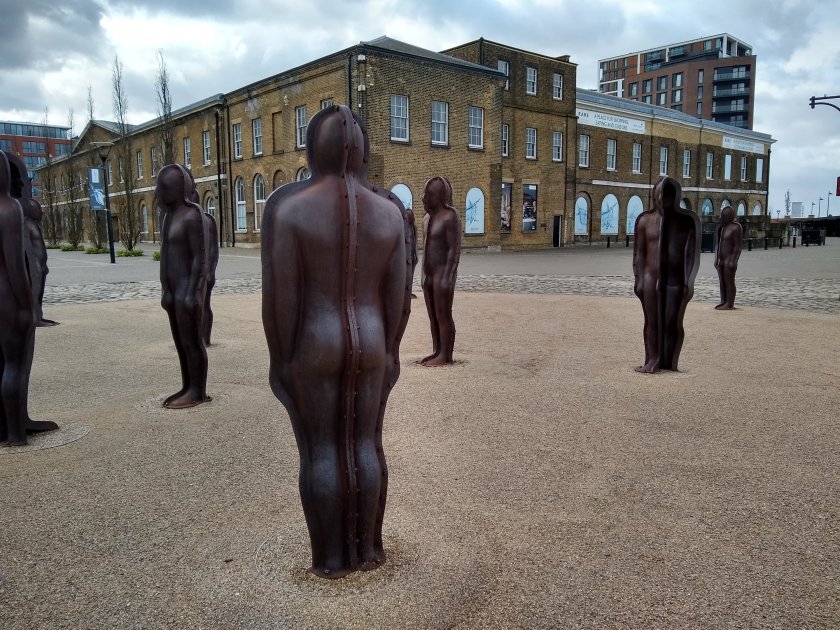
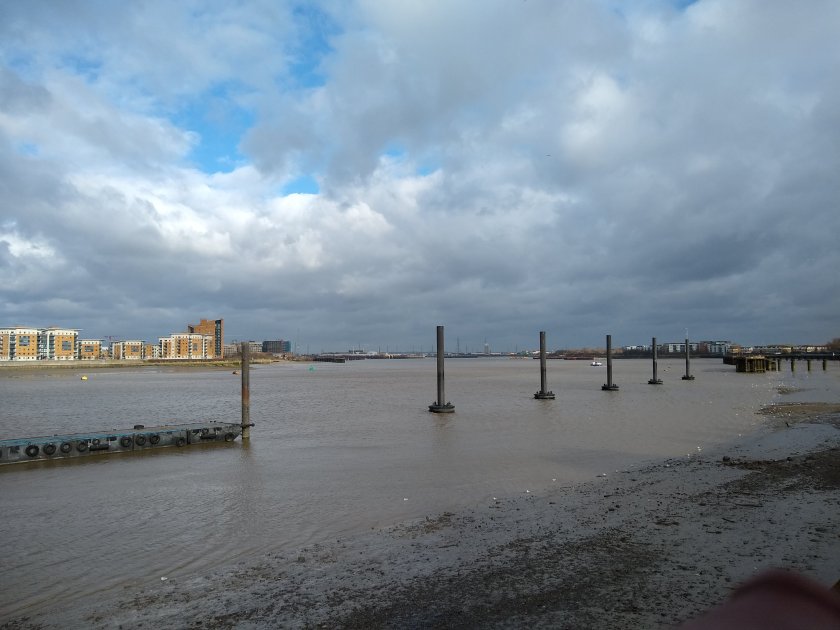
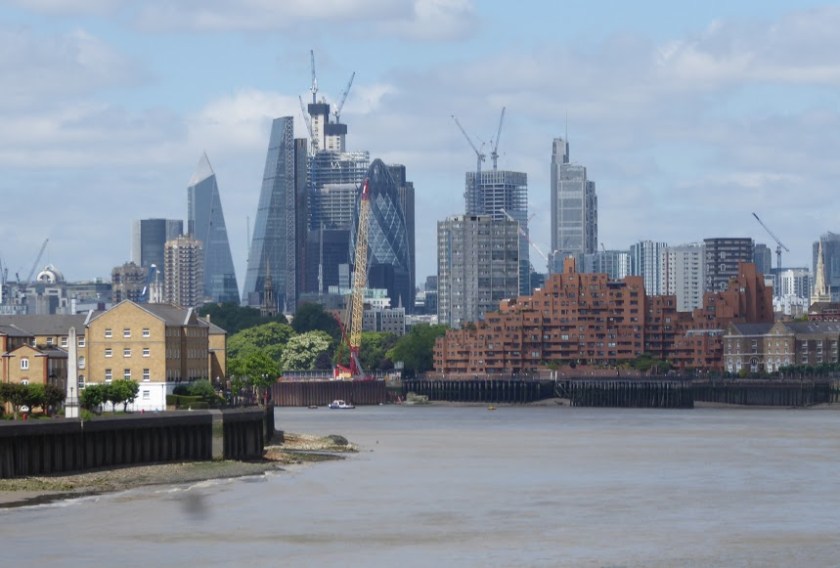
Go to the Museum of London Docklands, to explore London as a sea-trading city from Roman times onwards, and you’re rubbing shoulders with the high-rise financial quarter, seen here from the Thames.
I’m energised by my visits to London. I love exploring, and discovering London’s secret corners. It’s an interesting combination. London gives me renewed energy as willingly as it tires me out.
William’s parents were expecting a baby. We were all looking forward to meeting her sometime in late October. But things suddenly got dramatic, Sarah got whipped into hospital, and the focus changed to keeping Sarah and the baby stable for – please – just a few more weeks. Or failing that, a few more days.
But the baby was born on 7th August, at only 28 weeks old. She weighed 1.19 kg. (that’s 2 lb. 10 oz. in old money). And so far, all is well, with both mother and baby. I went to meet Zoë (for such is the baby’s name) today.
I was a little wary to tell you the truth. What would I feel about this little scrap, wired up and screened from us in her little plastic incubator, surrounded by a phalanx of monitors, recording graphs and banks of numbers?
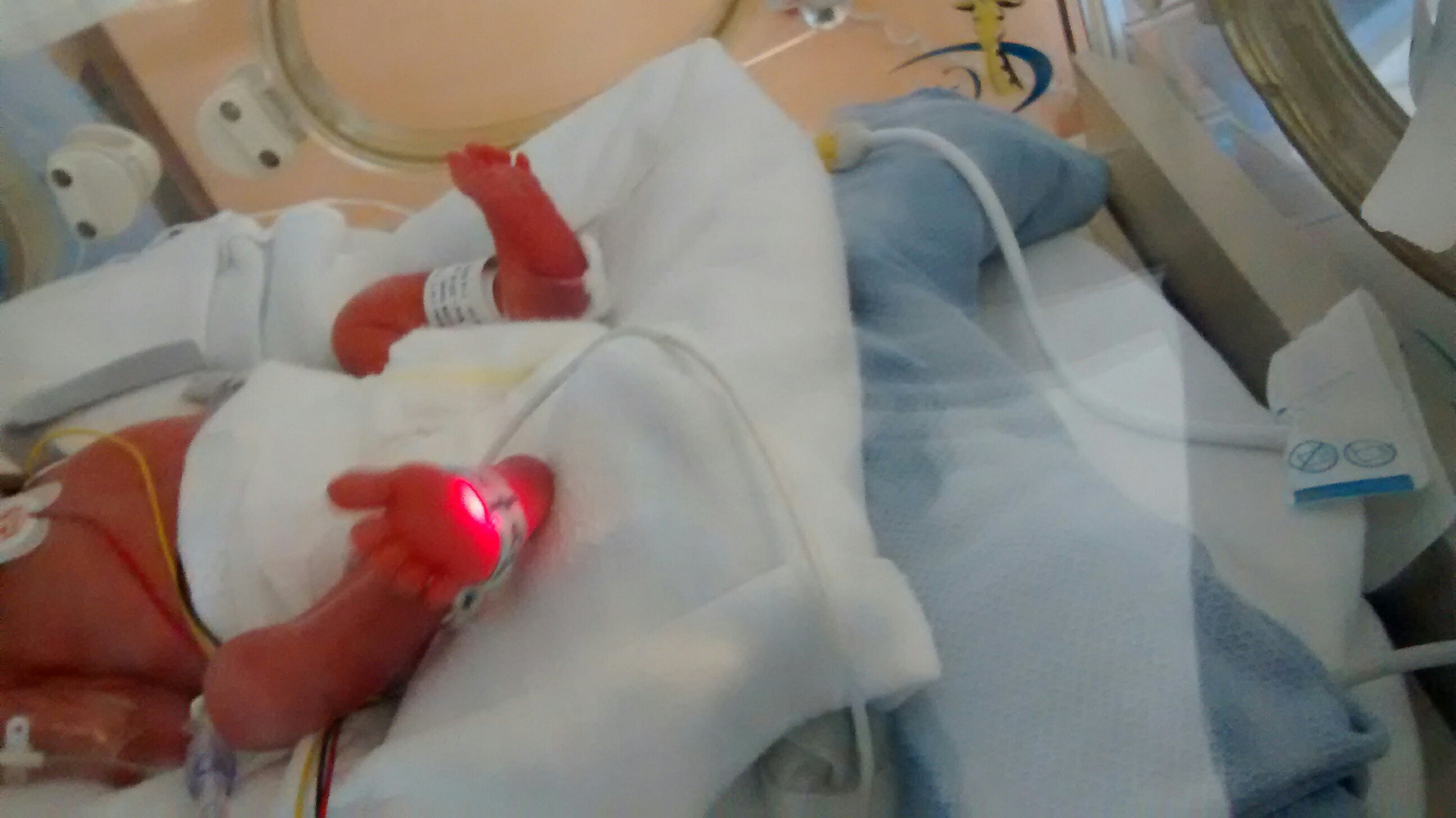
It was easy. I fell for her, instantly. Those delicate attenuated toes with their tiny nails! Those gently waving arms! Those slowly blinking, unfocussed blue eyes! She’s a proper little person. We can’t wait to get to know her.
And hooray for the NHS. Between Ellie and this little baby, our family has had its money’s worth.
Diaphanous sugar-pink wraiths trailing long floating tendrils pulsated gently round their royal blue tank: hypnotic: mesmerising. They neither paused nor hurried. They simply oscillated, surged, ebbed, flowed. These ethereal creatures didn’t merit their prosaic name of Black Star Northern Sea Nettle. Who dreamed that one up?
When we finally left them to it, we discovered we hadn’t finished with pulsing creatures. Here was a Blue Spotted Ribbon-Tail Ray. He gently wove round the tank, his flat body slowly rippling to the rhythm of his inner pulse.
William helpfully points out the Blue-spotted Ribbon Tail Ray.
Then there were the frogs. Look at these two Amazon Milk Frogs. They had nothing to do but regard us without interest, as their chests swelled and deflated – pulse, pulse.
Two Amazon Milk Frogs, so called from the sticky white substance they secrete through their skin when threatened.
One of the minor pleasures of being in London is seeing its architecture and street life reflected in its many and varied plate glass windows.
The journey from Kings Cross to William-and-parents’-house starts as I take the Docklands Light Railway from Bank to Lewisham. I pass the busy financial area of Canary Wharf with its skyscrapers and waterside plazas and docklands. Here are reflections a-plenty: even, as we travel through a tunnel, the passengers in our own carriage reflected in the window of the next.
Travelling on the Docklands Light Railway.
The skyscrapers of Canary Wharf as spotted from the station.
Office buildings along the DLR route.
On my way home, I might pass through the City of London, as I did the other day when visiting the Mithraeum. I didn’t call into St. Stephen Walbrook this time. I confined myself to admiring its exterior as reflected in the new office buildings which surround it.
An office building and St. Stephen Walbrook.
A skyscape wth reflections.
Another view of St. Stephen Walbrook’s spire.
And city life continues at ground level too.
This week’s Tuesday Ragtag Challenge is Reflection.
In the city of London, wedged between Cannon Street and Bank stations, is hidden the London Mithraeum, or Temple of Mithras.
The modern and ancient cities of London meet at the London Mithraeum.
These days, the site is more easily identified as belonging to the financial company Bloomberg, but enter their building to be directed downstairs, and there you’ll find the temple, dating from the last days of the Romans in Britain – maybe from about AD 410.
It was first discovered in the 1950s, during post-war reconstruction of the heavily blitzed City of London. The remains of the temple were dismantled and reconstructed elsewhere in the 1960s, but its inaccuracies were widely criticised, so when Bloomberg acquired the site they worked with conservation specialist to dismantle and then reassemble and partially reconstruct the temple closer to its original position, and with a fuller understanding of the materials used and its original structure.
The deity Mithras is a mystery. He was worshipped by men only. There are images of him killing a bull in temples dedicated to him found throughout the territory of the Roman Empire. Perhaps this is part of a creation or fertility myth: nobody knows for sure.
Head of Mithras.
Here in London, we can visit the foundations of the temple, and witness an evocation of the kind of ceremonies that might have taken place there: chanting, hazy light, an aura of religious fervour. We can imagine the congregation seated in the two side aisles, looking into the central nave of a windowless building, lit by lamps and torches, and gazing at the statue of Mithras housed in the apse – now only the head remains.
The remains of the Temple of Mithras.
Reconstructed stonework of the apse.
On the ground floor above the temple remains is evidence of the prosperous London community where the temple was situated. Here is a display of combs; keys; drinking vessels; leather shoes and boots; bracelets; glass phials; pewter vessels. They tell a story of a busy commercial quarter, crammed with small workshops and dwellings built on ground reclaimed from the marshy land surrounding the river Walbrook.
A display wall of Roman London life.
This slice of Roman London life is so well interpreted. There is plenty of time to explore the temple site, and to examine at your leisure (with the help of freely provided inter-active tablets) the hundreds of artefacts recovered nearby. And as you enter the space, you’ll find ‘London in its Original Splendour’, an installation by Paolo Bronstein which envelops the gallery in a complex and decorative ‘wallpaper’, rich in Renaissance and Classical architectural detail – a homage to the likes of Christopher Wren and John Soane who were themselves indebted to the architectural legacy of the classical past.
Exploring this site takes about an hour, but the impression it leaves of life in Roman London will last far longer. And it’s free.
On Saturday morning, we got up at 4.30 a.m. and didn’t get to bed again till 12.30 on Sunday morning. In between, we drove to York; forked out £60 for tickets and travelled in a coach to London where we spent the day marching, before reversing the procedure in the early evening. At our ages – we’re both long past retirement age – you don’t do things like that unless it’s for something really important.
It is. For us, and on behalf of our children and grandchildren, this Brexit Business matters more than almost anything else.
We are members of North Yorkshire for Europe, and joined for the day with York for Europe. We came to London to march and campaign for a People’s Vote on the Brexit deal.
York and North Yorkshire organise themselves.
Don’t talk to us about the Referendum being the last word on The Will of the People (a barely more than 50% of those who voted changing the course of a nation’s history?). Don’t tell us what The People voted for – nobody exactly knows. Don’t tell us that when companies like Airbus and Siemens warn they may have to leave the UK in the event of a no-deal, that they are simply part of an irresponsible Project Fear. Yes, we are fearful of Brexit: for us, for our families, for those in insecure employment, for those European citizens now resident here who had considered the UK their home.
On arrival in central London, we joined 100, 000 others on a slow two hour march down Pall Mall to Trafalgar Square and Whitehall and into Parliament Square, which completely failed to accommodate us all.
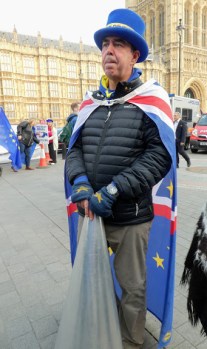
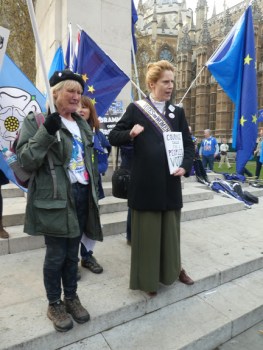
Despite our serious purpose, we had fun. Look at the banners, the flags, the posters, the facepaint and wigs; the young, the old: marching, hobbling, manoeuvring wheelchairs and buggies – you’ll even spot one fellow being carried by Donald Trump (as if …). We enjoyed Mexican cheers (the vocal version of a Mexican wave), bouts of chanting (‘What do we want?’ ‘A People’s Vote!’ ‘When do we want it?’ ‘Now!’). We chatted with marchers from Wales, Devon, Germany, Reading, France, Lambeth, Scotland…..
Then speeches. Rousing, energising speeches from the likes of Caroline Lucas MP, Tony Robinson, Vince Cable MP, David Lammy MP. Passionate speeches from a hospital consultant, from the young people of OFOC (Our Future, Our Choice). Video contributions from a WWII veteran and from Chuka Umunna MP. We cheered them all, and at the end, especially the courageous Tory MP Anna Soubry.
OFOC speak …..
… and David Lammy MP ….
…. and finally Anna Soubry MP.
What we want is a People’s Vote on the final Brexit deal, because apart from a principled few, most MPs are obeying the Whips and toeing the party line, regardless of either their own beliefs, or those of their constituents. If you voted for Brexit, and the government comes up with a good deal for the British people, you have nothing to fear from a People’s Vote. The government will win the day, and we Remoaners will have to shut up.
If you think that, having learned the terms of the Final Deal, the people should have the Final Say, please sign the petition for The People’s Vote. It’s here.
PS. The Daily Express front page on the day of the march….. there are no words…. don’t they read the news?
I was in London yesterday, but due to travel back to Yorkshire from King’s Cross when Judith’s blog Beyond the Window Box tumbled into my in-box. She’d been exploring the area round the station, just alongside Regent’s Canal, and found some gasholders…..
As a child, these fascinated me. Those circular cast iron skeletons, housing storage cylinders which telescoped up and down depending on how much gas they contained were a source of wonder to me. Though assertively industrial, they were graceful too, rising above the narrow terraced houses and the factories and trades which grew up alongside them. But ‘Gasworks Street’ was nobody’s idea of a smart address.
The King’s Cross gasholders in their workaday world.
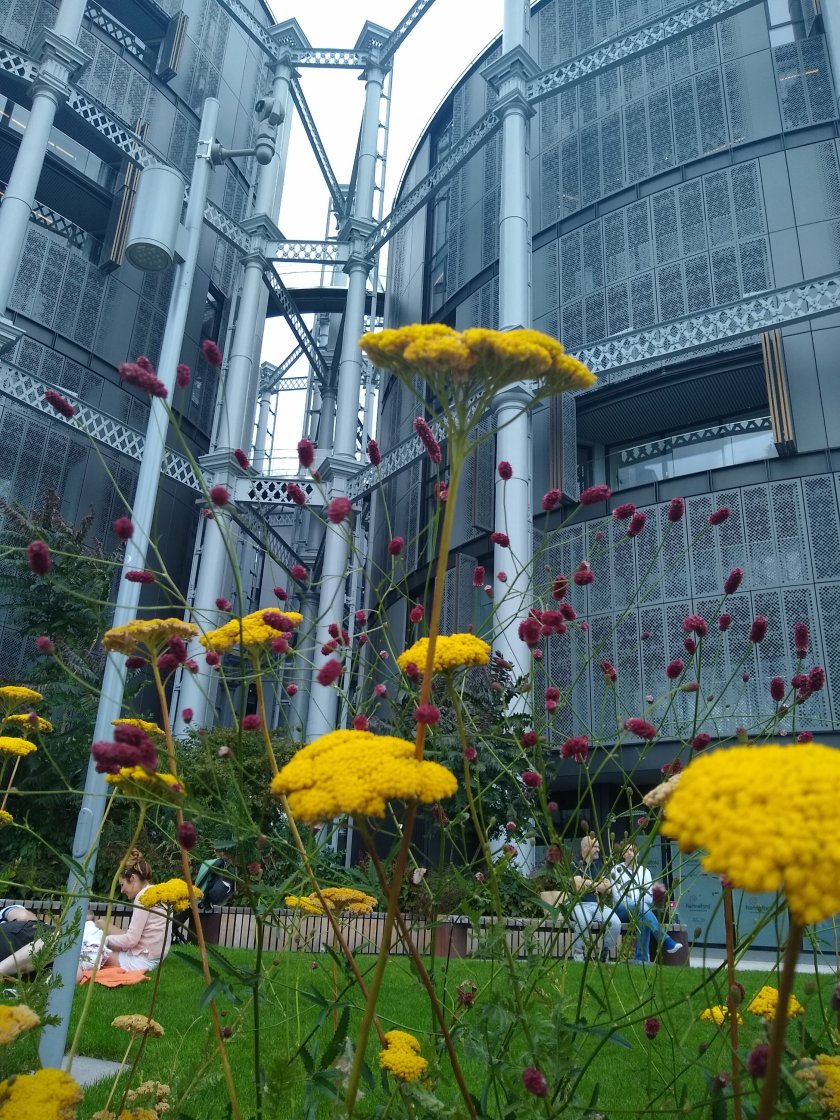
How things change. Gasholders London is a site transformed from its dirty, workaday past into a smart desirable residential quarter. All but one of the gasholders now contain not gas cylinders, but luxury apartments. The remaining one has become a small park with a gleaming reflective canopy with grass beneath.
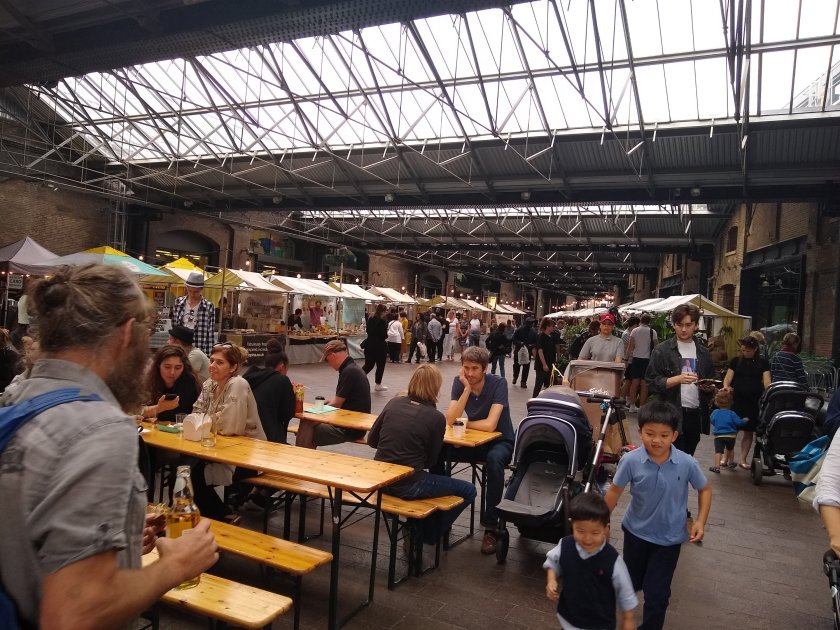
Nobody seems to want to hide the area’s busy industrial past. The über-smart shopping quarter, just being developed on the site of the cobbled streets and railway sidings where coal from the North of England was received and sorted is called Coal Drops Yard.
Gasholders London, seen from the Regent’s Canal.
Round here, if you need to know the price, you can’t afford it. A hundred and fifty years of dramatic social change.
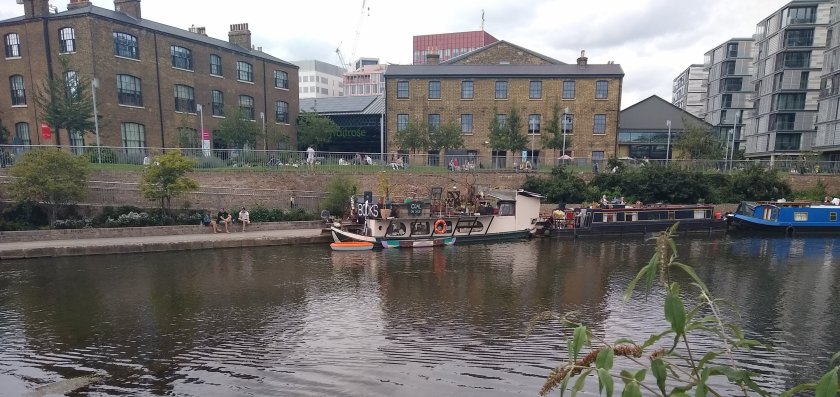
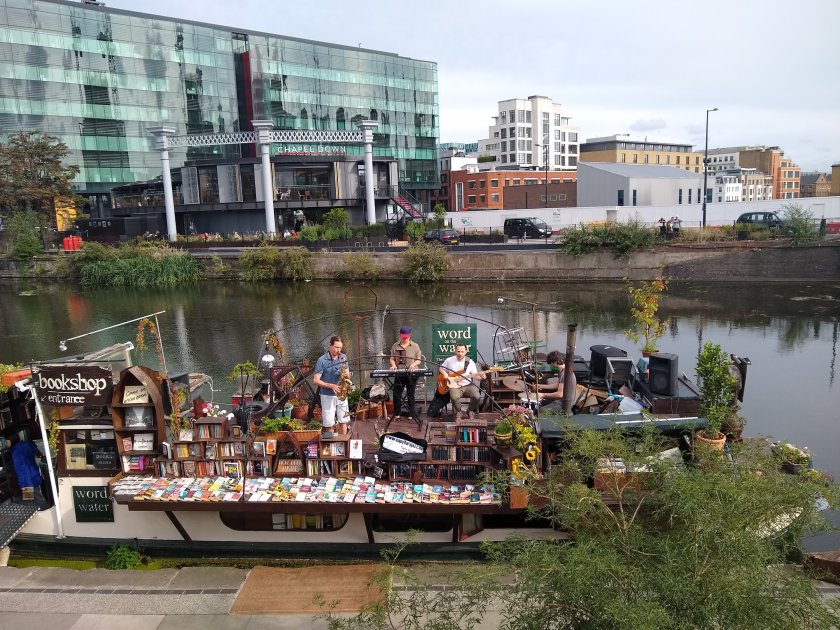
Canal boats and houseboats are part of the local scene.
Day to day life goes on. Here’s a bike park round the corner from Gasholders London. It’s next to the local primary school.
You must be logged in to post a comment.