One of the minor pleasures of being in London is seeing its architecture and street life reflected in its many and varied plate glass windows.
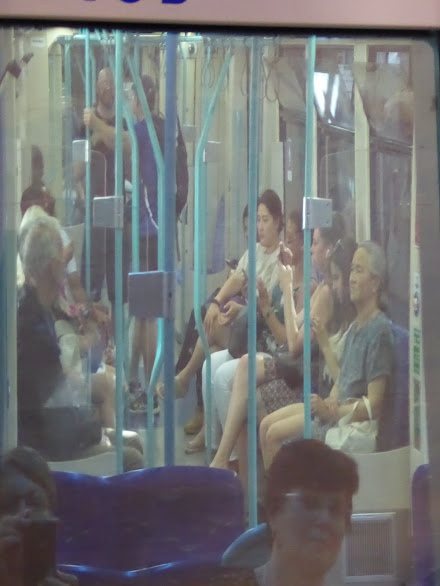
The journey from Kings Cross to William-and-parents’-house starts as I take the Docklands Light Railway from Bank to Lewisham. I pass the busy financial area of Canary Wharf with its skyscrapers and waterside plazas and docklands. Here are reflections a-plenty: even, as we travel through a tunnel, the passengers in our own carriage reflected in the window of the next.
Travelling on the Docklands Light Railway.
The skyscrapers of Canary Wharf as spotted from the station.
Office buildings along the DLR route.
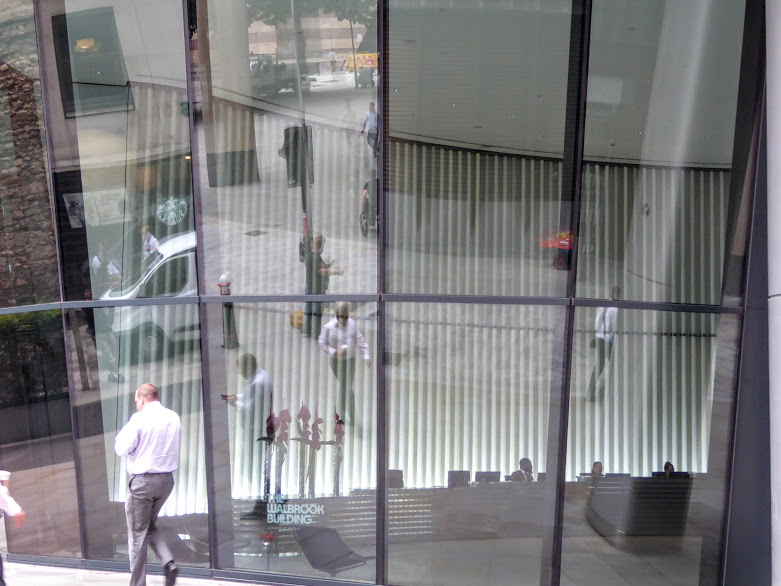
On my way home, I might pass through the City of London, as I did the other day when visiting the Mithraeum. I didn’t call into St. Stephen Walbrook this time. I confined myself to admiring its exterior as reflected in the new office buildings which surround it.
An office building and St. Stephen Walbrook.
A skyscape wth reflections.
Another view of St. Stephen Walbrook’s spire.
And city life continues at ground level too.
This week’s Tuesday Ragtag Challenge is Reflection.
In the city of London, wedged between Cannon Street and Bank stations, is hidden the London Mithraeum, or Temple of Mithras.
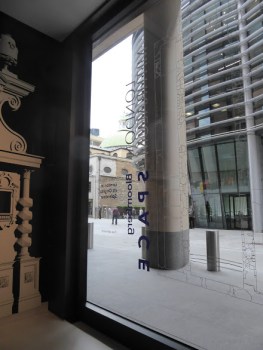
The modern and ancient cities of London meet at the London Mithraeum.
These days, the site is more easily identified as belonging to the financial company Bloomberg, but enter their building to be directed downstairs, and there you’ll find the temple, dating from the last days of the Romans in Britain – maybe from about AD 410.
It was first discovered in the 1950s, during post-war reconstruction of the heavily blitzed City of London. The remains of the temple were dismantled and reconstructed elsewhere in the 1960s, but its inaccuracies were widely criticised, so when Bloomberg acquired the site they worked with conservation specialist to dismantle and then reassemble and partially reconstruct the temple closer to its original position, and with a fuller understanding of the materials used and its original structure.
The deity Mithras is a mystery. He was worshipped by men only. There are images of him killing a bull in temples dedicated to him found throughout the territory of the Roman Empire. Perhaps this is part of a creation or fertility myth: nobody knows for sure.
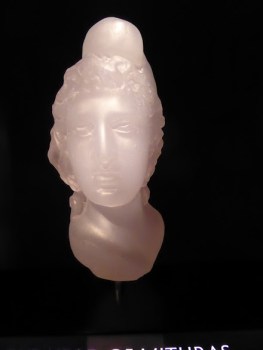
Head of Mithras.
Here in London, we can visit the foundations of the temple, and witness an evocation of the kind of ceremonies that might have taken place there: chanting, hazy light, an aura of religious fervour. We can imagine the congregation seated in the two side aisles, looking into the central nave of a windowless building, lit by lamps and torches, and gazing at the statue of Mithras housed in the apse – now only the head remains.
The remains of the Temple of Mithras.
Reconstructed stonework of the apse.
On the ground floor above the temple remains is evidence of the prosperous London community where the temple was situated. Here is a display of combs; keys; drinking vessels; leather shoes and boots; bracelets; glass phials; pewter vessels. They tell a story of a busy commercial quarter, crammed with small workshops and dwellings built on ground reclaimed from the marshy land surrounding the river Walbrook.
A display wall of Roman London life.
This slice of Roman London life is so well interpreted. There is plenty of time to explore the temple site, and to examine at your leisure (with the help of freely provided inter-active tablets) the hundreds of artefacts recovered nearby. And as you enter the space, you’ll find ‘London in its Original Splendour’, an installation by Paolo Bronstein which envelops the gallery in a complex and decorative ‘wallpaper’, rich in Renaissance and Classical architectural detail – a homage to the likes of Christopher Wren and John Soane who were themselves indebted to the architectural legacy of the classical past.
Exploring this site takes about an hour, but the impression it leaves of life in Roman London will last far longer. And it’s free.
On Saturday morning, we got up at 4.30 a.m. and didn’t get to bed again till 12.30 on Sunday morning. In between, we drove to York; forked out £60 for tickets and travelled in a coach to London where we spent the day marching, before reversing the procedure in the early evening. At our ages – we’re both long past retirement age – you don’t do things like that unless it’s for something really important.
It is. For us, and on behalf of our children and grandchildren, this Brexit Business matters more than almost anything else.
We are members of North Yorkshire for Europe, and joined for the day with York for Europe. We came to London to march and campaign for a People’s Vote on the Brexit deal.
York and North Yorkshire organise themselves.
Don’t talk to us about the Referendum being the last word on The Will of the People (a barely more than 50% of those who voted changing the course of a nation’s history?). Don’t tell us what The People voted for – nobody exactly knows. Don’t tell us that when companies like Airbus and Siemens warn they may have to leave the UK in the event of a no-deal, that they are simply part of an irresponsible Project Fear. Yes, we are fearful of Brexit: for us, for our families, for those in insecure employment, for those European citizens now resident here who had considered the UK their home.
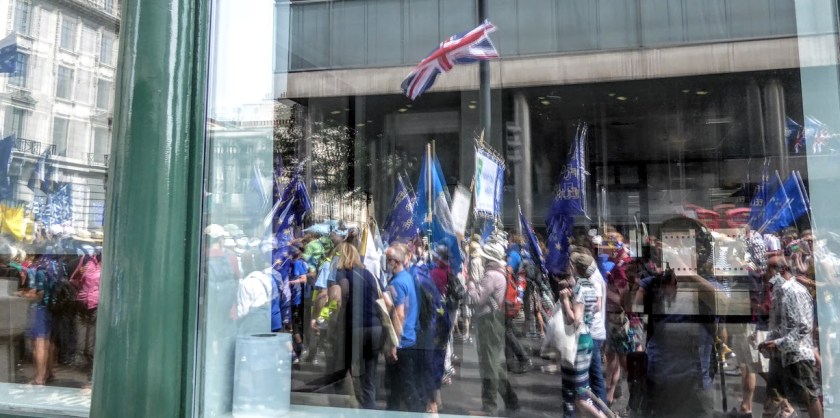
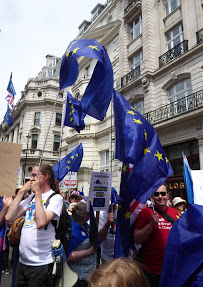
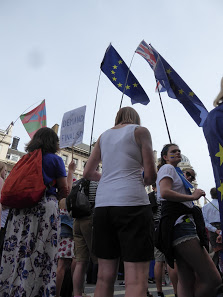
On arrival in central London, we joined 100, 000 others on a slow two hour march down Pall Mall to Trafalgar Square and Whitehall and into Parliament Square, which completely failed to accommodate us all.
Despite our serious purpose, we had fun. Look at the banners, the flags, the posters, the facepaint and wigs; the young, the old: marching, hobbling, manoeuvring wheelchairs and buggies – you’ll even spot one fellow being carried by Donald Trump (as if …). We enjoyed Mexican cheers (the vocal version of a Mexican wave), bouts of chanting (‘What do we want?’ ‘A People’s Vote!’ ‘When do we want it?’ ‘Now!’). We chatted with marchers from Wales, Devon, Germany, Reading, France, Lambeth, Scotland…..
Then speeches. Rousing, energising speeches from the likes of Caroline Lucas MP, Tony Robinson, Vince Cable MP, David Lammy MP. Passionate speeches from a hospital consultant, from the young people of OFOC (Our Future, Our Choice). Video contributions from a WWII veteran and from Chuka Umunna MP. We cheered them all, and at the end, especially the courageous Tory MP Anna Soubry.
OFOC speak …..
… and David Lammy MP ….
…. and finally Anna Soubry MP.
What we want is a People’s Vote on the final Brexit deal, because apart from a principled few, most MPs are obeying the Whips and toeing the party line, regardless of either their own beliefs, or those of their constituents. If you voted for Brexit, and the government comes up with a good deal for the British people, you have nothing to fear from a People’s Vote. The government will win the day, and we Remoaners will have to shut up.
If you think that, having learned the terms of the Final Deal, the people should have the Final Say, please sign the petition for The People’s Vote. It’s here.
PS. The Daily Express front page on the day of the march….. there are no words…. don’t they read the news?
I was in London yesterday, but due to travel back to Yorkshire from King’s Cross when Judith’s blog Beyond the Window Box tumbled into my in-box. She’d been exploring the area round the station, just alongside Regent’s Canal, and found some gasholders…..
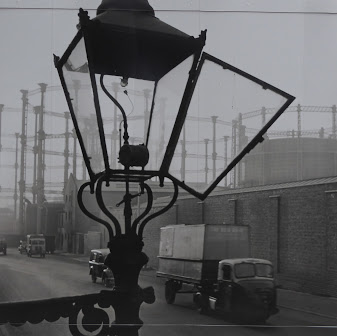
As a child, these fascinated me. Those circular cast iron skeletons, housing storage cylinders which telescoped up and down depending on how much gas they contained were a source of wonder to me. Though assertively industrial, they were graceful too, rising above the narrow terraced houses and the factories and trades which grew up alongside them. But ‘Gasworks Street’ was nobody’s idea of a smart address.
The King’s Cross gasholders in their workaday world.
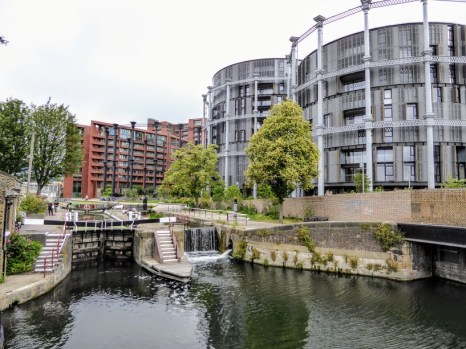
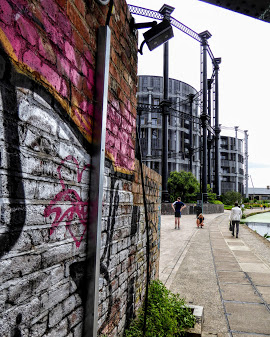
How things change. Gasholders London is a site transformed from its dirty, workaday past into a smart desirable residential quarter. All but one of the gasholders now contain not gas cylinders, but luxury apartments. The remaining one has become a small park with a gleaming reflective canopy with grass beneath.
Nobody seems to want to hide the area’s busy industrial past. The über-smart shopping quarter, just being developed on the site of the cobbled streets and railway sidings where coal from the North of England was received and sorted is called Coal Drops Yard.
Gasholders London, seen from the Regent’s Canal.
Round here, if you need to know the price, you can’t afford it. A hundred and fifty years of dramatic social change.
Canal boats and houseboats are part of the local scene.
Day to day life goes on. Here’s a bike park round the corner from Gasholders London. It’s next to the local primary school.
When I take William to the park, the playground, a museum, the library or the shops, there’s always a grandparent or two like me, doing their share of childminding.
Not today. Sarah’s friends recommended the new adventure play at a local leisure centre as a good place to spend the morning. I’d be able to relax while William let off steam.
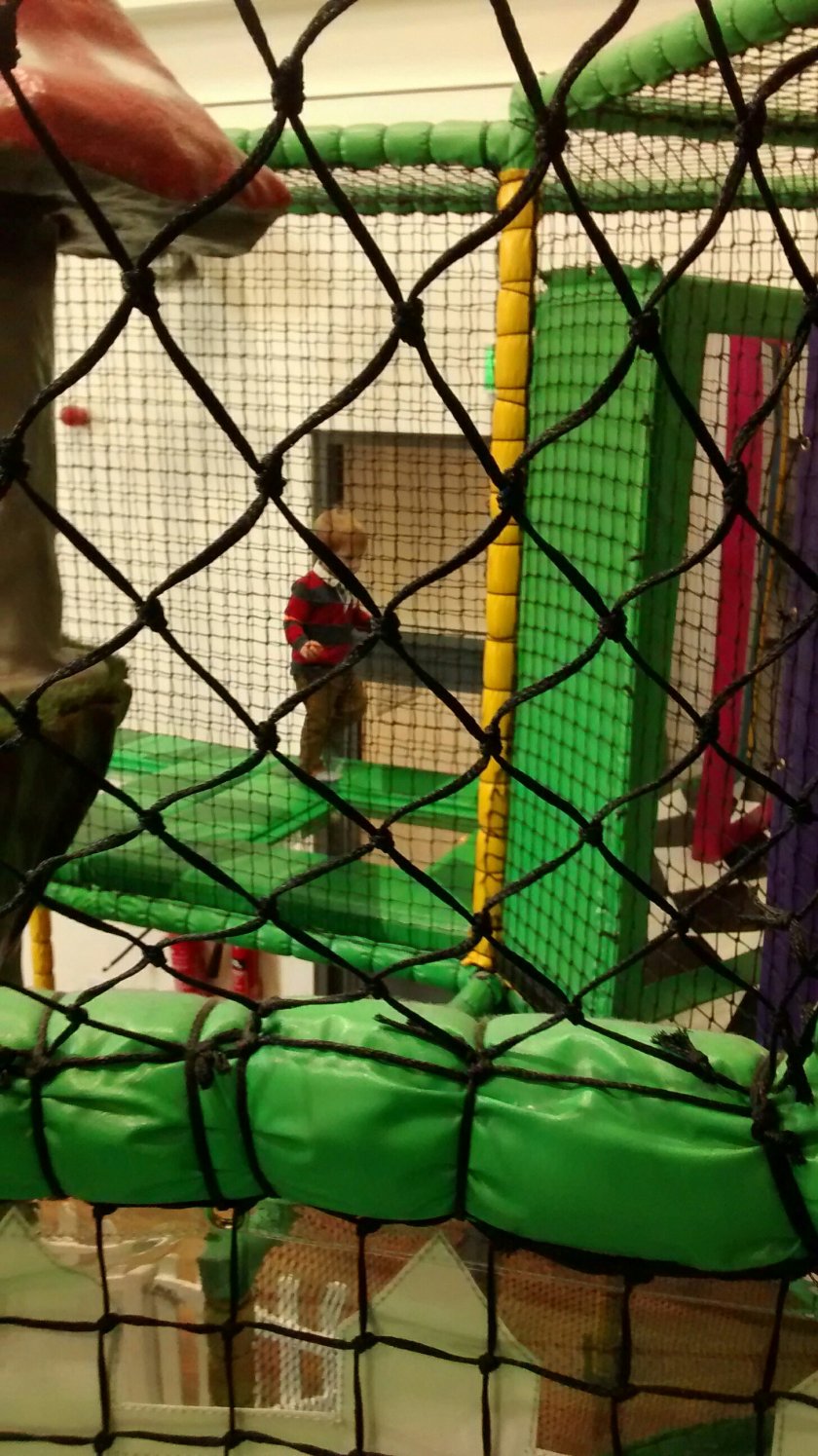
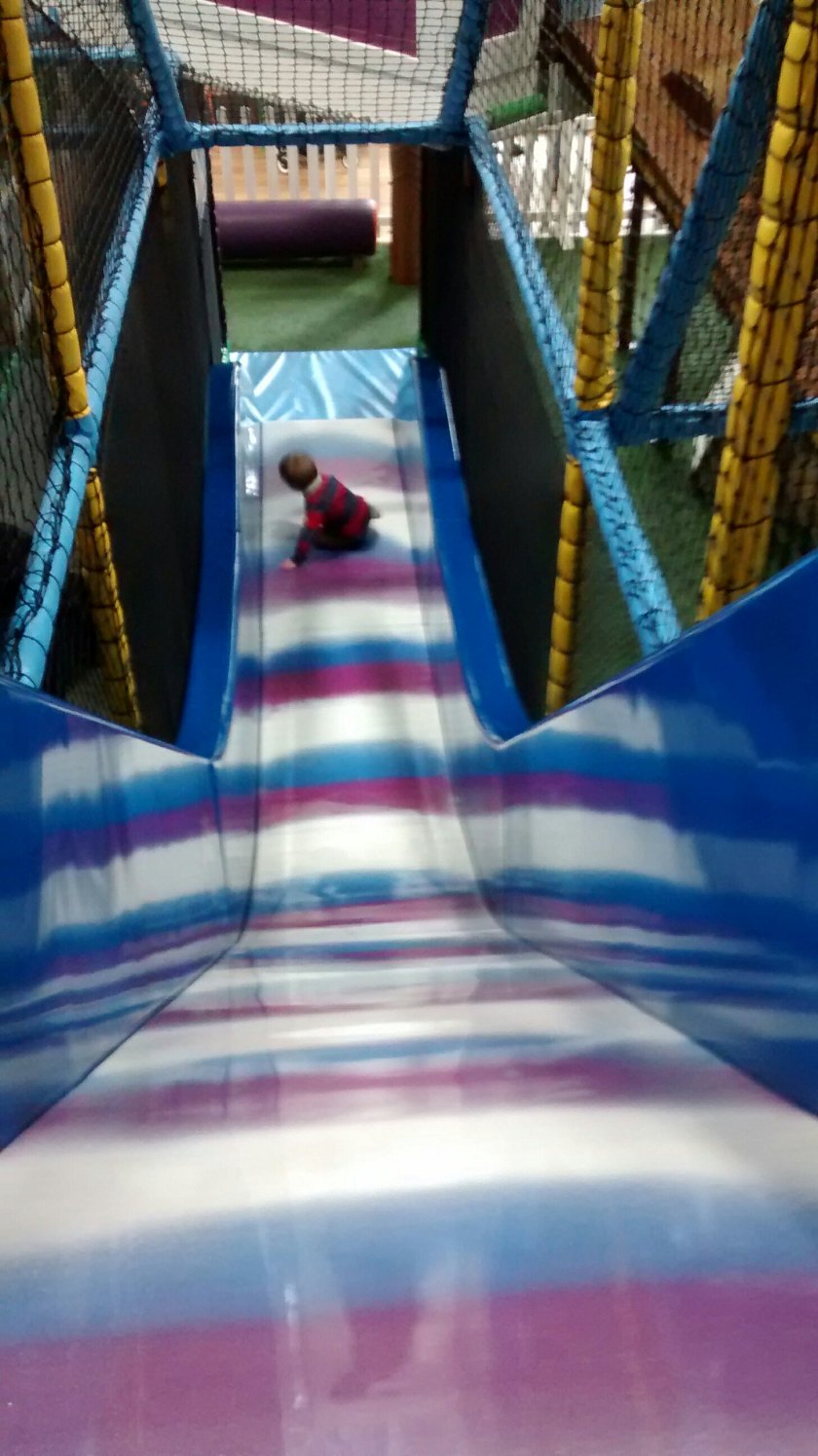
It didn’t work out like that. Towers, tunnels, trampolines and slides went from ground to way above our heads. Daunting at first if you’re only two. ‘Granny come too’.
Which is all very well, but safety netting was at small-child-head-height. We scrambled up padded stairways; inserted ourselves into cylindrical tunnels; dropped through chutes to the floor below, and zipped down slides that, were they removed to a domestic setting, would have to be sited leaving from the bedroom window.
At this point I noticed that I was easily twice the age of the next oldest carer. Just now, sore and creaky, I feel at least four times older.
William began his day yesterday by lining up his extensive collection of dinosaurs (thank you, Ben and Alex). Please note the previously unrecorded vaccosaurus right in the middle there.
We had to visit the new Butterfly House, so William could show it to me.
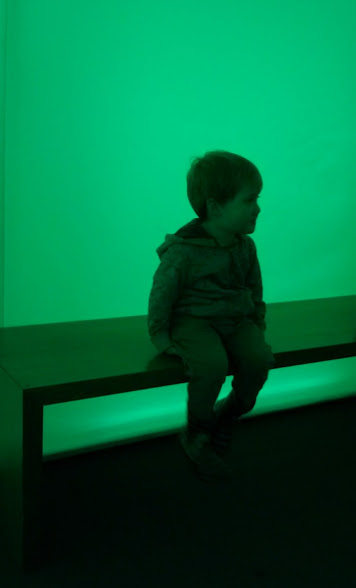
And we had to visit the new exhibition about colour, The Rainbow Revealed. Here’s William, sitting in the light tent, soothed by the calming green light that followed the vigorous energizing magenta.
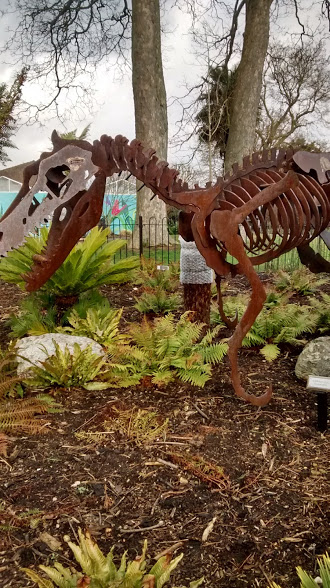
Just before home time, we came upon this dinosaur. He lives out his days in the primaeval forest created in the Horniman Museum Gardens. The primaeval plants are currently protected from the winter storms by very unprimaeval plastic, which slightly spoils the effect.
A fine day.
Click on any image to see it full size. These are smart phone photos. Not so smart really.
Winter’s not been around in recent years, not really. Those crisp snowy days we all seem to remember from our childhood, those snowball fights, those Jack Frost patterns etched our bedroom windows, those chilblains – all seem to be ancient history.
This week in London, where we had an early unofficial Christmas with William and family, winter arrived for one day only before becoming sunny and mild again. Look at these ducks and gulls in the local park, standing in puzzled uncertainty or ineptly skating on a frozen pond. One day only was quite enough for them.
If you go to London, and if you go to the Victoria and Albert Museum some time before next February, don’t miss a rather special temporary exhibition I saw there this week.
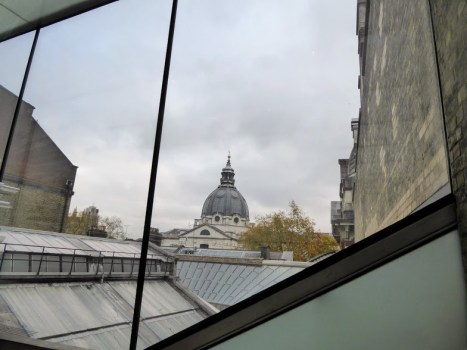
Find the glass lift, and allow it to sweep you upwards to the sixth floor. Here, from this light and airy vantage point, you can enjoy views over the museum and beyond.
Contemporary Korean ceramics. That’s what you’re looking for. There are glossy ceramic tiles, reinterpreting Korea’s exquisite porcelain from the Joseon dynasty (you can see examples of these down on the first floor). There are wonderfully lustrous translucent vases, in luminous reds, yellows and blues. Oh wait …. they’re carved from soap.
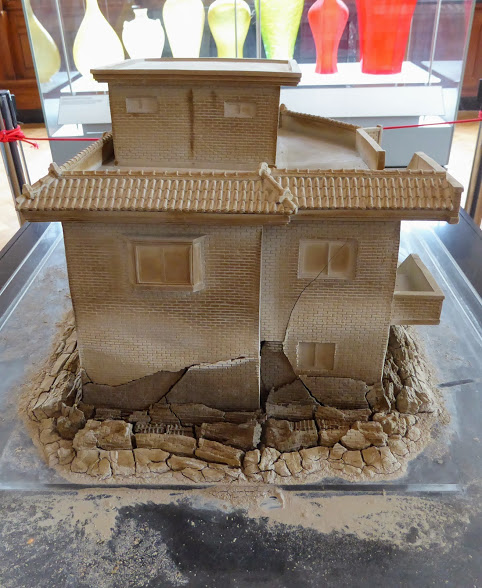
But what drew me back, several times, was this house.
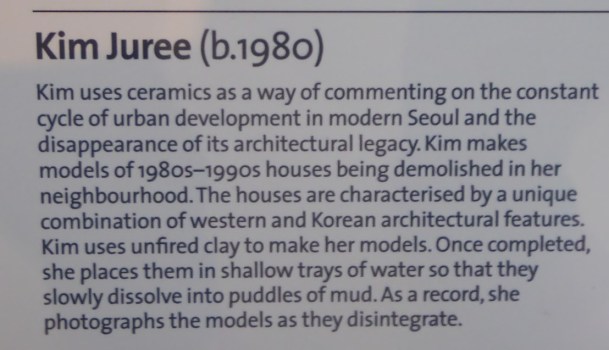
Here’s what its creator Kim Juree has to say about this, and the many houses she has created in the same idiom.
So what you’ll see if you visit won’t be what I saw. Don’t wait too long. This temporary structure isn’t long for this world.
If you peer behind the house, you’ll see a few of those vases carved from soap.
I’m in London, doing a spot of childminding for two-year old William. But after all that city living in Poland and Berlin, my inner Country Mouse needed some attention.
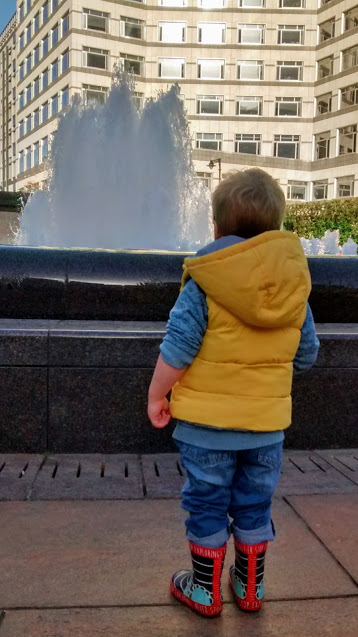
A city farm then. This turned out to be a Good Idea. It involved an exciting trip through the waterways and futuristic high-rise building sites on the route of the Docklands Light Railway. It involved, in the smart business district of Canary Wharf, an exciting intermittent fountain that commanded William’s rapt attention for many minutes.
William and the fountain at Canary Wharf.
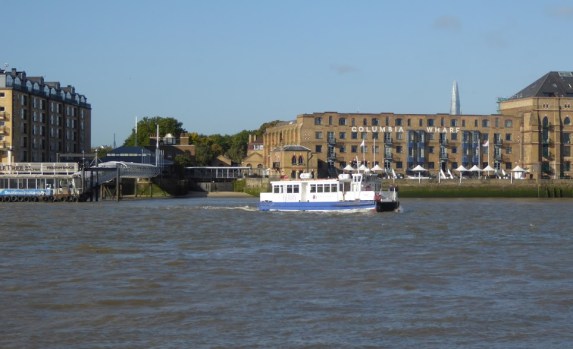
It involved a ferry crossing to get us from one side of the Thames to the other. ‘Did you see the seal?’ said one of the crew. No, we didn’t, but it turns out they’re rather common.
The ferry goes from Canary Wharf to the far side, back and forth, all day.
And it involved a saunter along the Thames views. Then we arrived. Surrey Docks City Farm. Path, through parkland and with riverside.
The view from Surrey Docks Farm.
It’s a farm, but not as we know farms here in North Yorkshire. The animals are behind fences, and the crops are in beds rather than fields. But it’s nicely ramshackle, in a good way, and a real piece of countryside among the high-rise. William and I befriended sheep: monster woolly breeds from the South Downs and from Oxford, quite unlike their rangier northern cousins. Donkeys requested loving pats on the back. Here was the biggest sow ever. Ducks were a-dabbling, up tails all. Goats played King of the Castle to increasingly complicated rules, jostling each other off the heights: and hens busied themselves policing the entire site.
A few goats having fun.
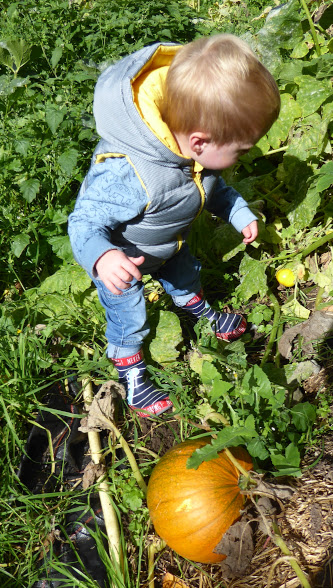
William was, if anything, even more interested in the vegetables. Those gourds! They were long, thin, and taller than him. Those pumpkins! So big, so h-e-a-v-y. And the long leaves of the cavolo nero! So tough, so leathery, and such an intense shade of dark green.
William holds a pumpkin inspection.
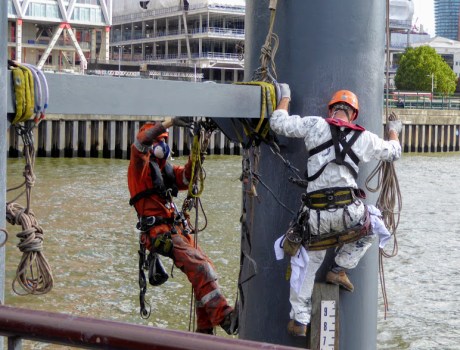
Everything in the cafe is home-made. So we had lunch there – an enormous lunch – before retracing our steps. The ferry was still as exciting, and there were workmen hanging off the gangway onto the boat, doing unimaginably interesting things.
Maintenance work on the jetty.
The fountain as entrancing as first time round. By the time our train journey was over, William was fast asleep.
I’ve been in London this week, spending each day with William, now almost two.
One of the things I love about being with The London Branch is the real connection with nature that’s to be had in Hither Green, part of busy multicultural Lewisham.
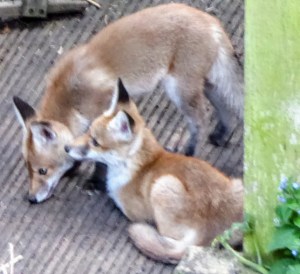
We’ve spent happy moments peeking out of the window watching the fox cubs playing and relaxing in the garden next door.
Virtually every day we go to one of the parks near their house. And the day before yesterday, this is what we saw. A juvenile heron doing what herons have to do. Fishing.
I saw this heron as a friend, a link with my more rural day-to-day life. You might think that’s a bit of a stretch, but perhaps he, like me, is a fellow country bumpkin among all these townies.






















 From Pyrenees to Pennines
You must be logged in to post a comment.