Tabariane: New Light on the Dark Ages revisited

Which of my posts about our time in France to re-blog this month?  In the end, it was easy.  I fell to thinking about all the wonderful trips we had learning about the history of the area we’d chosen as our home, courtesy of  Pays d’art et d’histoire des Pyrénées Cathares.  Here’s a memorable day from July six years ago…

July 13th 2013

Tabariane: new light on the Dark Ages

When I was at school (back in the Dark Ages), we learnt in history that the Romans came after the Greeks.  They left us a legacy of Romance languages, our alphabet, Roman law, neo-Classical architecture, impossibly straight roads and under floor central heating.  As the empire crumbled, so we were told, the continent descended into the Dark Ages.  Barbarians, Vandals, and unpleasantly savage descendants of Asterix the Gaul ravaged Europe, raping, pillaging and generally leaving little time for culture and a settled everyday life.

I think we all knew it was a bit less straightforward than that.  The Frankish Germanic tribes entering the late Roman empire had a very different culture from that developed by the Romans, and it’s been much harder to research systematically because there are few contemporary written records.

This week though, we went to visit a Merovingian site, Tabariane, recently excavated and interpreted near Teilhet, not far from Mirepoix.  The Merovingians were an early Frankish dynasty established by Clovis, and they ruled an area roughly equivalent to much of France and Germany from the 5th to the 8th centuries, and are the kind of tribe that was dismissed as one of those from the very heart of the Dark Ages.

It was a burial site we’d come to see.  It has first been discovered in the very early 20th century by Captain Henri Maurel, and had been partly excavated according to the fairly invasive practices of the period.  War and economic upheaval meant the site became first neglected, and then entirely forgotten about until recently.

Recent research lead by Nicolas Portet has meant that the burial ground, now carefully excavated, is now, as it almost certainly was then, a burial garden.  It’s a large site, on a hillside overlooking the site of the now disappeared Merovingian settlement  on the opposite side of the valley.  The 166 tombs seem to have been arranged in ‘clans’: loose arrangements of extended families and friends, over a long period of time.  It seems to have been a burial ground which held a place in the life of the community for many years, rather than being a cemetery developed as a result of tragedy – war or plague say.  Most of the bodies were laid with their heads to the west, their feet to the east.  Originally they were clothed, but little remained apart from metal objects: belt buckles, brooches, jewellery and, with some of the men, weapons.

This is where ideas have changed. Early 20th century archaeologists sent excavated objects to museums far and wide, even to America: modern practice which encourages an area’s ‘patrimoine’ (heritage) to remain as far as possible intact did not then exist, but you can find examples of objects found here in the Museum at Mazères, and in Saint Raymond de Toulouse.

Now as then, the tombs are planted with local flowering plants: lavenders, marguerites, herbs.  It’s thought that locals would have visited the grounds with their families, spent time there, as we might in a modern park.  So it was important to both the living and the dead to make it a pleasant, calm place to be.  The burial ground overlooked the village. The village overlooked the burial ground.  Each had an interest in the other.  Each could intercede for the other.

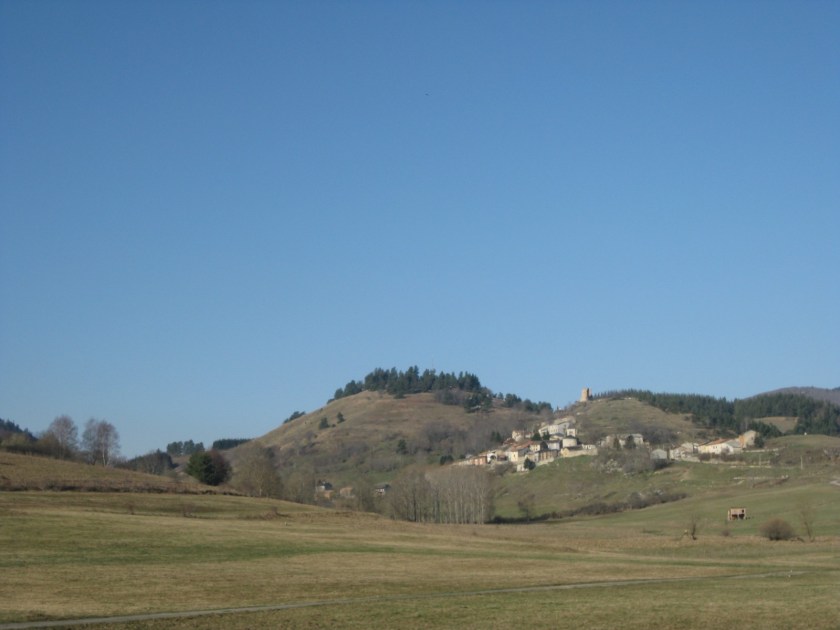
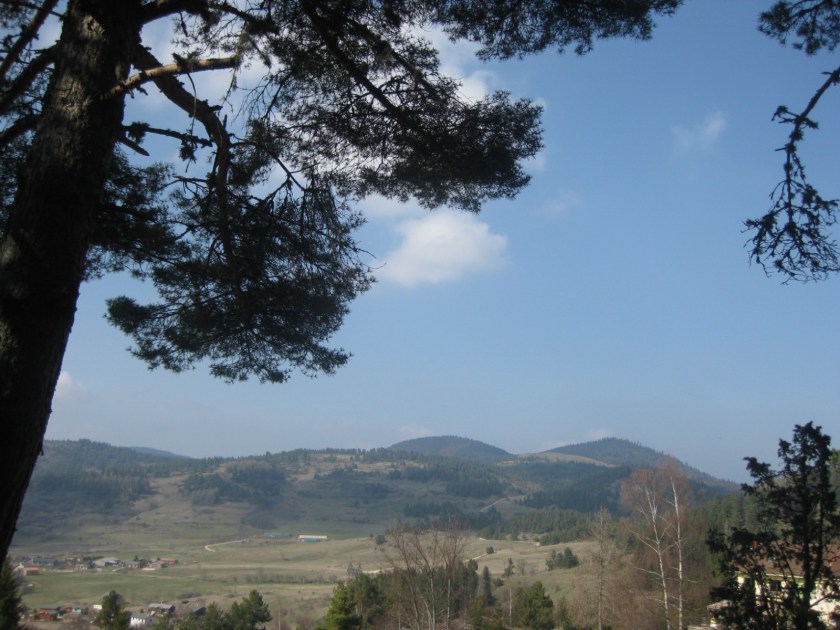
It’s a tranquil, special place, surrounded by meadows and hilly countryside.  A circular walk of some two and a half kilometres , starting and ending in the village of Teilhet gives you a chance to spend a peaceful  hour or two exploring scenery that may not be so very different from the way it was when the Merovingian villagers first laid out their burial ground, some 800 years ago.  Excellent information boards will help you understand a little more about those Merovingian people who made their lives in this still rural area.

While you’re there, make time to enjoy the facade of the 14th century church at Teilhet.  Here are some pictures to whet your appetite.


A bonus post for the Summer Solstice

Generally, we don’t make much of a thing of the Summer Solstice: we simply mourn that the day after, the days start getting shorter again.

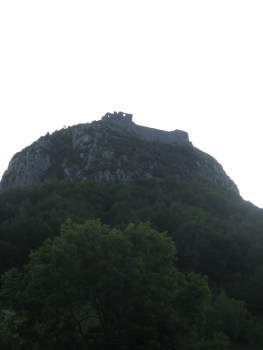
But when I was looking for a post-from-the-past to reblog for June, I came across this one, and was reminded of a Special Summer Solstice.  Montségur, for the uninitiated, is a startling tump of a mountain celebrated as one of the last strongholds of the Cathars, a mediaeval Christian sect.  It’s a potent landmark in the Ariège.

June 21st, 2011

Summer solstice, Montségur

All this time we’ve been here, we’ve not seen the sunrise over Montségur.  Today, midsummer day, I decided to change all that.  Me and 99 others……

I arrived at the car park just after 5 o’clock,  at the same moment as a hare which had for at least two frantic minutes been trying to out-run me.  And I realised I was not alone.  It was still dark, and quite a difficult business to trek up a steep, slippery rocky path.  Other more provident people had torches, and everybody helped one another.

The route to the top. Still pretty dark.

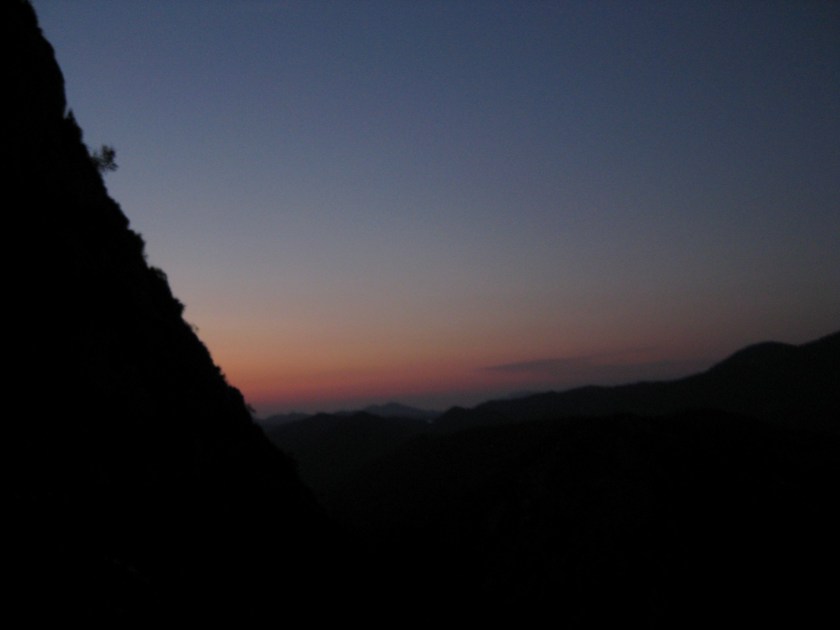
Towards the top, the night sky was slowly washed from inky blue to delicate blues, pinks and greens by the sun which was still well below the horizon.

I found a couple of friends there, and a vantage point relatively distant from the crowd crammed into the castle ruins.  They had come to see something special – the rays of the sun as they poured through the ruined windows.  I decided it was too packed with people to feel special in there.  I’ll come back another day soon, to see for myself.

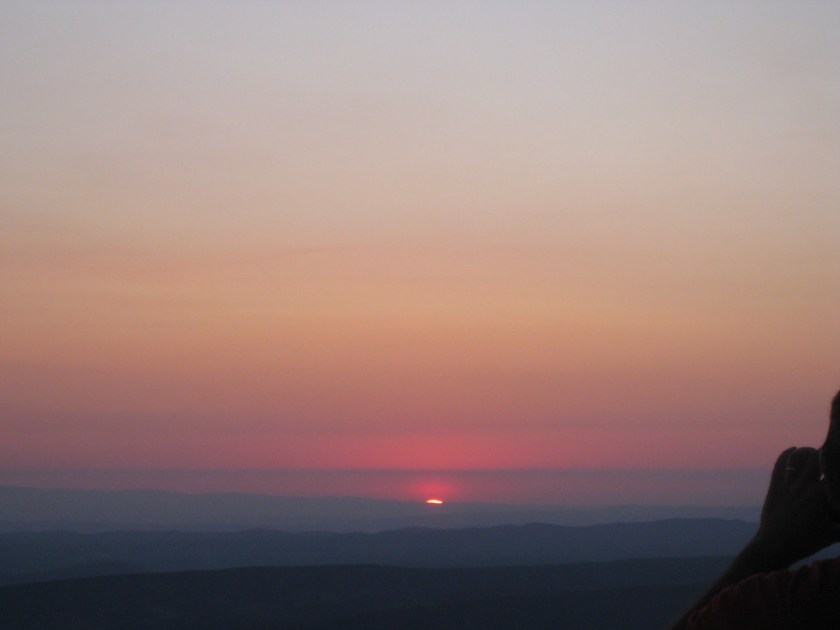
What I saw was quite wonderful enough: a rich copper disk slowly mounted above the line of mountains in the distance,  tinting the sky ochre, rusty-red, sugar-pink, finally emerging so fiery bright I could no longer look at it.  Some locals burst – quite beautifully – into song.   Occitan/Ariègeois stalwarts, ‘Quand lo Boièr ven de laurar…’ and, inevitably, ‘Se Canto’.

Gradually the whole sky lightened and brightened, turning the entire landscape crisply clear.  I strolled round the summit – it was surprisingly easy to get-away-from-it-all, before skidding and climbing my way down to the car park again….

Montségur casts a shadow on the hillsides beyond. The car park’s still full.

….and there were my companions who’d provided torchlight.  They were hitching, because their car had failed to start.  We journeyed back to civilisation together, ready to resume normal service.  It was 7.30 a.m.

Almost deserted again, Montségur in the early morning light

Revisiting our Lizards

It’s that time of the month: the time when I reblog a post from our years in France.  This time, I’m celebrating our much-missed garden friends the lizards. I do wish they’d consider a move to North Yorkshire, if only because back in 2012, I had nowhere near mastered the art of getting a decent photo of them.

June 27th 2012

‘I am the lizard king. I can do anything.’ *

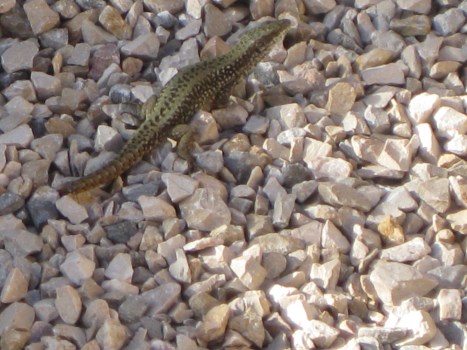
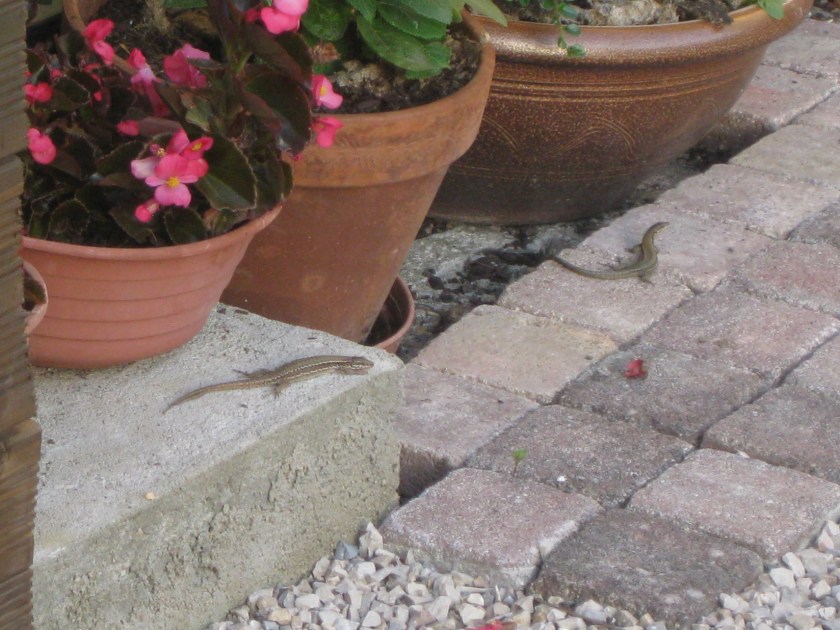
Summer’s arrived: well, this week anyway.  So from before breakfast until long after the evening meal we’re spending as much time as we can out in the garden.  And we have plenty of company.  Lizards.  Common wall lizards, podarcis muralis.  They are indeed spectacularly common here.  We have no idea exactly where they live, but there are plenty who call our garden ‘home’.  We’re beginning to get to know a few.

Easily the most identifiable is Ms. Forktail, she of the two tails.  She’s the only one we’ve been able to sex conclusively as well, because we caught her ‘in flagrante’ with Mr. Big behind the gas bottles recently.  And then the next day she was making eyes at a younger, lither specimen, and the day after that it was someone else.  She’s lowering the moral tone of our back yard.

Then there’s Longstump, who’s lost a tiny portion of tail, and Mr. Stumpy, who hasn’t got one at all, though it seems not to bother him.  Redthroat has a patch of crimson under her chin.  There are several youngsters who zip around with enthusiasm and incredible speed.

Longstump

In fact they all divide their time between sitting motionless for many minutes on end, and suddenly accelerating, at top speed and usually for no apparent reason, from one end of the garden to the other, or vertically up the wall that supports our young wisteria. On hot days like this  (36 degrees and counting) they’ll seem to be waving at us.  Really they’re just cooling a foot, sizzled on the hot wood or concrete.  Sometimes you’ll see them chomping their way through some insect they’ve hunted, but often they’ll step carelessly and without interest over an ant or other miniature creepy-crawly in their path.

Mainly they ignore one another, but sometimes there are tussles.  These may end with an uneasy standoff, or with the two concerned knotted briefly together in what could scarcely be described as an act of love.

Happy hour for Longstump

We could spend hours watching them, and sometimes we do.  But there is still a bathroom to build, a workroom to fit out, and a pergola to design.  The kings and queens of the yard have no such worries.  They can do anything: they choose not to.

‘Our’ lizards on their personal sunloungers.

*Jim Morrison, 2008

On the path of Cathar shepherds – revisited

This is the last entry in my re-blogging season.  I’ve enjoyed browsing through my memories: this was why I created my blog in the first place – as a diary and travel journal.  I think that I’ll continue to re-post, maybe once a month, to allow memories to resurface, and perhaps give them a fresh audience.

This particular walk is one we’ll never forget, ever.

2nd April 2012

On the path of Cathar shepherds

Yesterday we walked through Montaillou.  It might seem a tiny and unremarkable village now, but it’s the place that’s maybe done most to contribute to our understanding of turn-of-the-14th century village life in the Languedoc when religious strife between the Catholics and the Cathars was at its height.  This is a big subject: it deserves more than passing mention: a future blog maybe.

I’d read le Roy Ladurie’s book on Montaillou more than 30 years ago,and never dreamed that I might one day live in what the tourist offices are pleased to call ‘Cathar Country’.  So it was the shepherds of Montaillou I was thinking of as we began our Sunday walk.  They would come to the annual fair at Laroque d’Olmes, a good 40 km from where they lived.  They would drive their flocks long distances for good pasture, and as national boundaries meant little in these mountain zones, their fellow shepherds whom they met in their travels would sometimes be Spanish.

First view of Montaillou.

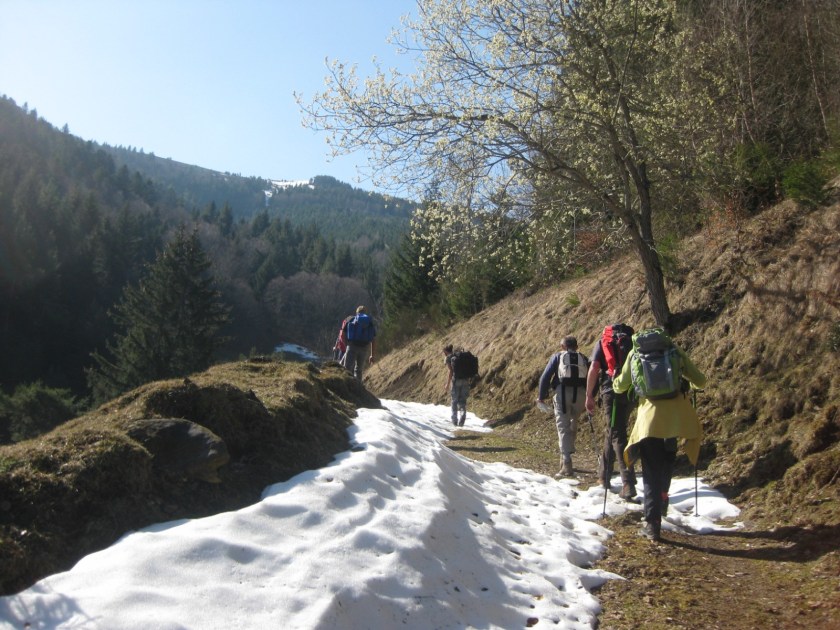
We too were climbing out of Montaillou.  The paths seemed unchanged through the centuries – short springy turf with early spring flowers pushing through. Pale pink and white blossoms busting open.  Narrow streams cutting deep channels through the turf.  Thick forest climbing the slopes.  Patches of snow made the going a bit tough from time to time.  It was warm and sunny, the slopes were steep and sometimes hard-going.

Ever upwards…and the snow’s still on the ground.

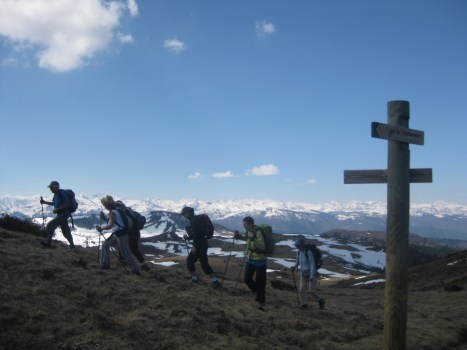
Then suddenly…suddenly, and so unexpectedly, we reached the top of our first climb.  Around us, to east, south and west were the snow-covered peaks of the Pyrenees, glistening white against the blue sky.  Above us, skylarks called and swooped.

Later, Danielle remarked that she felt as if at that moment she’d received a special gift: that perfect view, the clean clear air, the singing birds which were the only sounds.  She voiced, I think, what we all felt.

We hadn’t reached our highest point: we climbed onwards, always with those snow-capped mountains at our side.  And then we were on top: handy rocks provided seats and shelves and we unwrapped and shared our lunches, lingering in the sun, drinking in the views for well over an hour.

The perfect picnic spot.


Ready to start walking again.

Soon after lunch, we turned our back on the snowy mountains.  As we faced the hotter, drier Pyrénées Orientales, the equally high peaks there weren’t covered in white.  Our path was downwards now, and soon we had to pass the ski station above Camurac.  Built long after those years when snow could be relied upon throughout the winter, it was an area of scalped earth, snow machines and all-but-redundant chair lifts.  My Montaillou shepherds certainly wouldn’t have recognised it.

The walk draws to a close.

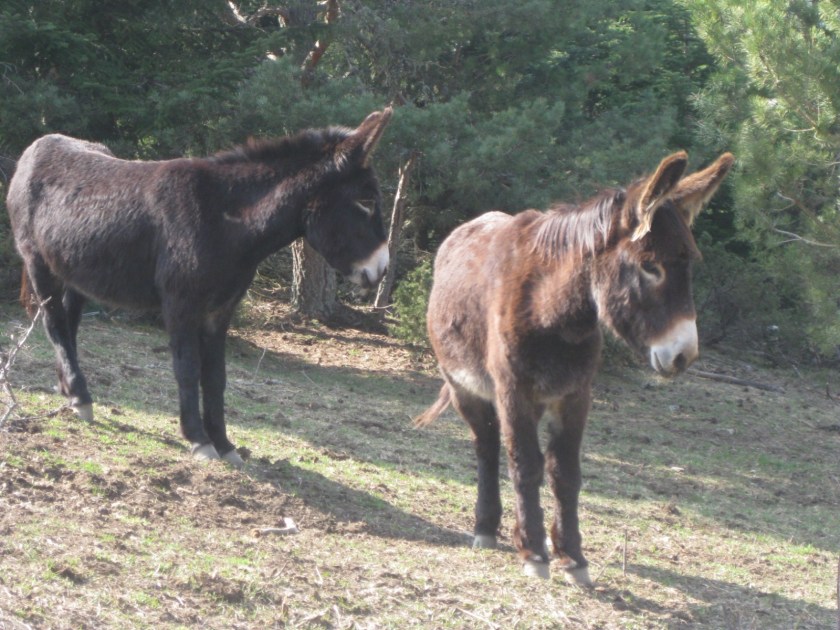
But then it was forested paths again, open pasture and spring flowers.  We finished the walk passing a collection of horses, Thelwell style ponies, and appropriately for Palm Sunday, a couple of friendly donkeys.  A good day.

Friendly donkeys.

Omelette de Pâques revisited

It’s Easter weekend.  For my continuing re-blogging festival, an Easter themed post seems in order.  Let’s try this one from 2010…..

April 2010

Omelette de Pâques

Come to the Ariège on Easter Monday, and you won’t be too far from a community omelette. Communes and clubs all over the department seek out their biggest frying pan, get hold of dozens of eggs, sugar and rum, to make this sweet confection to round off, with any luck, the first barbecue of the season. Why? Nobody in our walking group could tell me, and Google wasn’t much help, but it does seem to be an ancient tradition dating back to….ooh, 1973 at least.

Anyway, the Rando del’Aubo have made this an annual event for some years now. For the last couple, it’s been rainy and cold. Not this year though. Down at the bottom of the page, you’ll find a few pictures of our walk between La Pène, an Audois hamlet on a delightful small lake, and Monthaut, which is a hill….higher up. It was a great way to work up an appetite.

Because the weather was warm, sunny and spring-like, we relaxed at the lakeside after our walk, chatting and enjoying those woodsmokey smells of a barbecue coming to life. Apéros first: Muscat, suze, pernod, whisky…all the usual French tipples, with nibbles to stem our hunger. Then grilled pork, grilled Toulouse sausage, bread (and wine of course), Coulommiers cheese, vanilla or chocolate pudding. And then we still had to find room for the all-important omelette.

Since the beginning of time, it’s been Marie-Therèse’s ‘job’ (good French word, that) to make the omelette, and of course it all ended in noisy recriminations because there were too many cooks all muscling in, breaking eggs, beating eggs, heating the pan, greasing the pan, measuring the rum. Half the raw egg mixture tipped out onto the grass, and Etienne and Danielle dashed off to every farm they could find to buy another….. 4 dozen.

Finally, it was done. Really, this omelette is scrambled egg with lots of sugar chucked in at the end, and flambéed with rum. Once a year is quite enough.

It wasn’t the end of the party though. Oh no. We couldn’t go before downing glasses of Blanquette de Limoux, an Alpine eau-de-vie, then cups of coffee (with madeleines, in case we were still hungry). And as a final touch, Easter eggs.

We came away suntanned and rather full, at the end of an Easter Monday that was one of the first really hot and sunny days of the year. A taste of things to come?


My contribution to today’s Ragtag Challenge: egg.

And a Malcolm update:  He’s out of hospital now with lots of medication and check-up appointments.  Looking good!

Les demoiselles de Caraybat, daffodils and gentians: revisited

This hasn’t been a week for writing for fun, as while I was having a good day in London on Monday, Malcolm ended up dialling 999, and is now in Harrogate Hospital after a heart attack. I wasn’t told until well on the way home, which may have been as well, as there was nothing I could have done. He’s awaiting transfer to the much bigger James Cook Hospital in Middlesbrough. But there’s every reason to assume that all will be well.

So I’ve picked out this post from six years ago, from our days in the French Pyrenees to re-blog. Who doesn’t love a good yarn, spring flowers and spectacular views? It cheered me up, anyway.

April 2013

Les demoiselles de Caraybat, daffodils and gentians

Once upon a time long ago in Caraybat, when times were hard, the men of this small village had to look far afield for work.  And they went to Spain, for the hay-making season.  Hawkers came to the village, and pedlars.  They found a village with no men.  They took advantage.  So did the women.

When the hay-making season was over, the men returned, and the women spied them returning over the distant mountains.  Suddenly ashamed and frightened, they fled to the hills.  God, in vengeful and Old Testament mood, was displeased.  As the women reached the summit, he turned each one of them to stone.  And there they are to this day, les demoiselles de Caraybat, a petrified reminder of a summer of sin.

A few of those demoiselles hide themselves behind the woodland trees

We remembered this legend yesterday when I took our Laroquais walking friends to Caraybat and the dolomies to discover those daffodils I’d been shown on Thursday.  I was quite chuffed that not a single one of them had previously known this special spot, and we had a pleasant hour up on the rocks, picnicking and enjoying the last days of the daffodil season.

We followed the walk I’d learnt about on Thursday, and then we finished our day by going to the plateau above Roquefixade to see the gentians there.

Gentians above Roquefixade

Sadly, it was by then rather cold and windy, and most of the gentians had sensibly folded their indigo skirts about their faces and tucked themselves away to wait for a sunny day.  We’ll wait too.  And when the sun comes out properly, we’ll be back.

Snow shoes at Scaramus revisited

I wrote this post six years ago, when we still lived in France.  Winters were winters there, as what follows testifies …. though there too, they’re no longer the affairs they once were when our Ariègeois friends were small, when schoolchildren marched to school down head-high channels excavated into the snow.  This winter here in England, we’ve celebrated the occasional crisp frost, and a couple of days of snow, quickly melted.

This is the Real Thing.

Scaramus, Plateau de Sault, Aude: February 17th, 2013

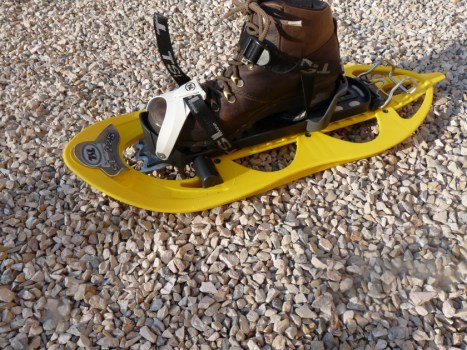
It’s only 7 o’clock, but  I can’t see me having a late night.  We’ve had a day of ‘raquettes’ – snow shoes.  Gosh it’s exhausting.  You strap great oval saucers of plastic, webbing, and toothed metal to your feet and spend some minutes feeling like an ungainly baby taking its first uncertain footsteps across the endless wastes of the living room carpet.

Booted and spurred.

But equilibrium returns, and without these cumbersome contraptions, how else would you walk across the undulating white snowfields of the Plateau de Sault, with views of snow-sculpted hillsides nearby, jagged snow-crusted peaks beyond?  How else could you enjoy the sound of the satisfying crunch and crack as feet break through the crisp crust of the surface snow?  Thank goodness for that icy layer.  We found our 5’ long batons, plunged deep below the surface, wouldn’t touch the frozen ground beneath.

And with a bright blue sky, a hot sun enabling us to walk wearing T shirts and summer hats, what better way to spend a February Sunday?

Click on any image to see it full size.

Little Donkey: an Everyday Story of Country Folk

Goodness.  Who’d be a British citizen at the moment? We’re in need of good cheer.  And I’ve found some, in a post I wrote from Laroque in November, seven years ago.  Times were much simpler then …. read on.


Little Donkey:  An Everyday Story of Country Folk: November 26th 2011

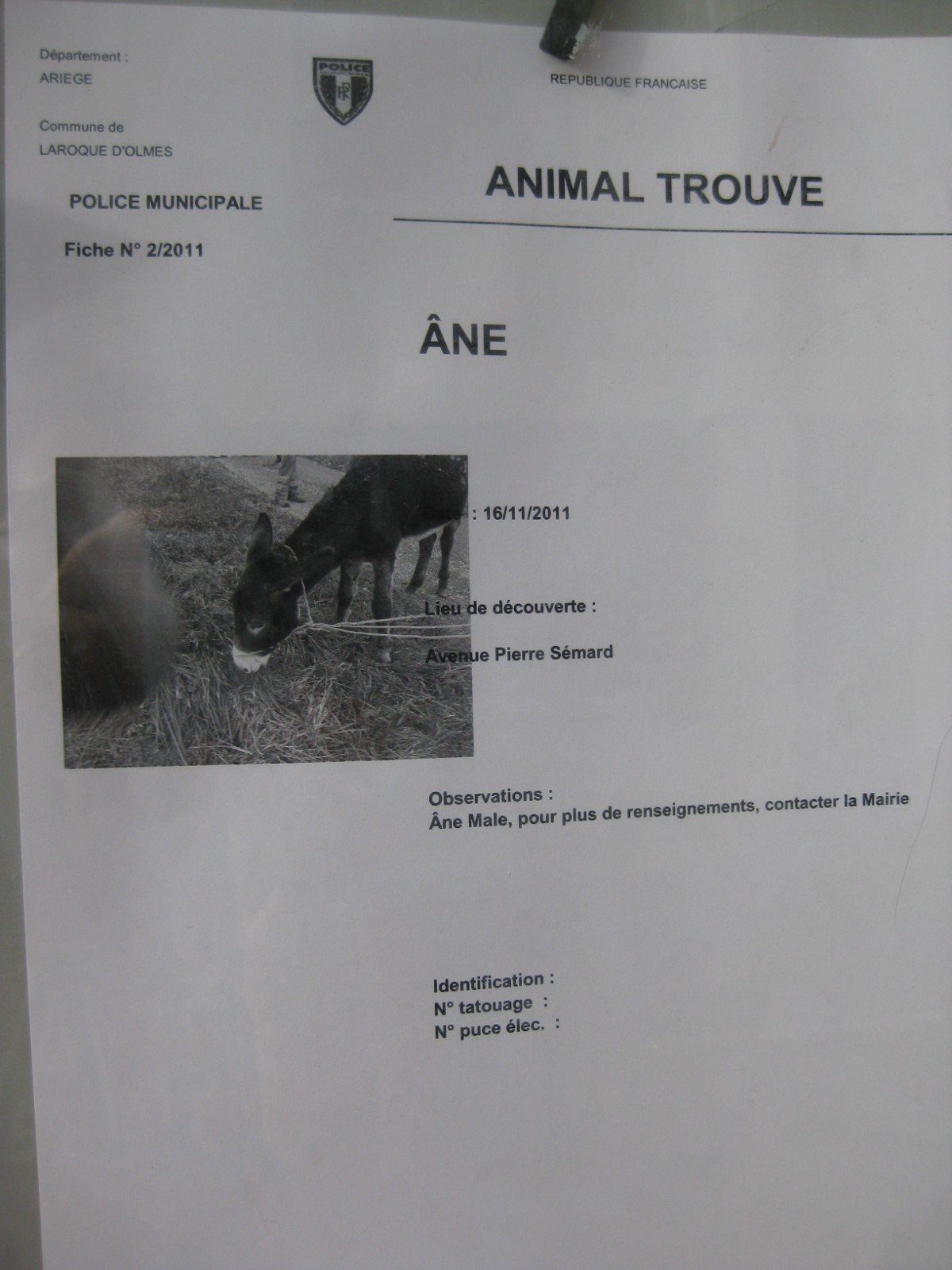
Every now and then, in among all the banns of marriage and planning notices on the information board at the town hall here in Laroque, there’s a poster about a stray dog that’s been found.  Not cats or hamsters. Just dogs.

Last week, though, my eye was caught by this:How does anyone lose a donkey?  And what do you do with it whilst you put out an appeal for the owner?  ‘Oh he’s fine’, said Thierry, our Community Copper, ‘We’ve put him to work in the office in the Mairie’.  I decided against saying the obvious, that he would be bound to be doing a far better job than the Mayor.

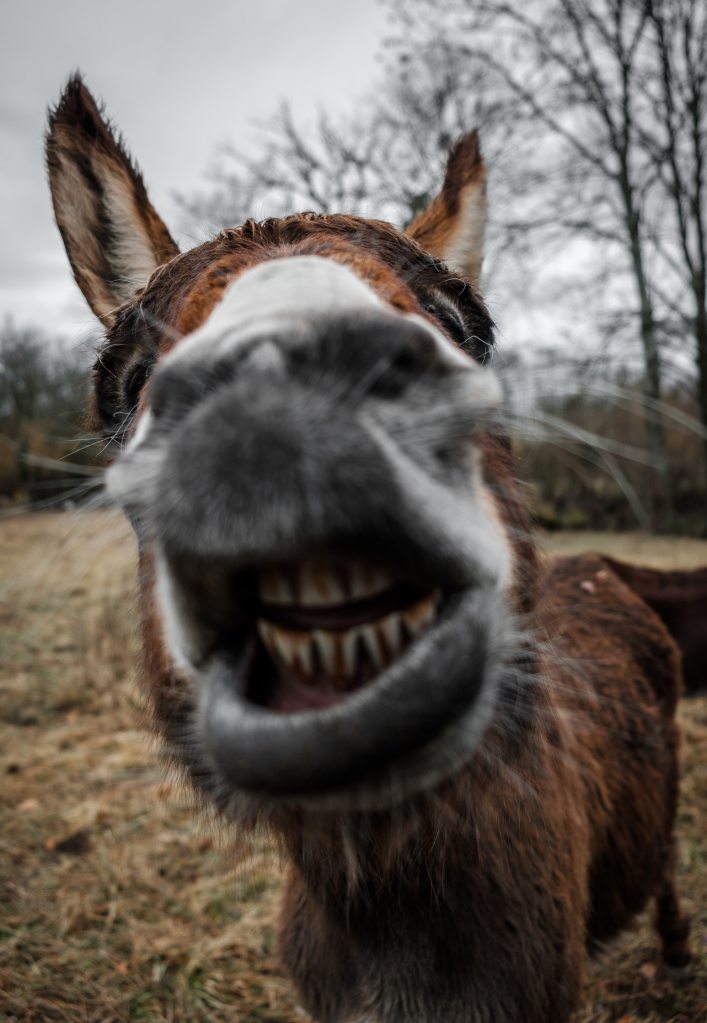
Image from Unsplash.

It took a week for his owner to show up.  He – the donkey that is – had an exciting time.  First of all he was rounded up by the three blokes who first spotted him in the road just outside town, but who had no idea how to set about the job.  Then he was frisked for tattoos or identity chips.  None.  Next he was sent to stay with our friend Henri’s donkeys (Thierry was fibbing about the office work).  That had to stop when Henri’s female donkey got all excited at the new arrival and came on heat.  Then he went to stay with the vet’s partner.  He escaped.  Amateur detectives all over Laroque and Lavelanet tried to find out where he came from.  Eventually, after a week, his owner showed up, really rather cross.  ‘Why didn’t anyone think to get in touch with me?’

There we are.  That’s our excitement for November over.

Image from Unsplash.

For non-British readers: Little Donkey is a Christmas song much favoured by UK muzak producers at this time of year.  One reason to avoid shopping there during November and December.  Whereas ‘an everyday day story of country folk’ is ‘The Archers’, a daily radio soap opera full of story lines such as the one above.  It’s been a permanent part of the BBC schedules since 1951.  You could join the fan club.

Getting in touch with my inner French paysanne

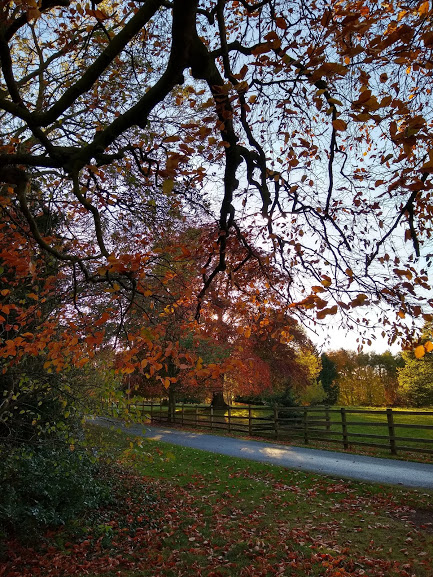
Beatswell Wood.

I was walking back from my friend Claire’s through Beatswell Wood the other day when I noticed it.  A fallen branch.  A nicely rotting fallen branch.  Then smaller branches, conveniently broken into wood-burning-stove like lengths.  My inner French peasant knocked urgently at my brain. ‘You can’t leave those!’ she said, in perfect English. ‘Fuel for free!  Whaddya mean you’ve got no bag?  What are arms for?  Get on with it!’

And it’s true.  No self-respecting French country person – man or woman – would think of leaving for a walk without a just-in-case (‘au cas où’) bag.  Here’s an account of what we used to do in France, especially in autumn.

Yesterday we were better prepared.  We both set forth, equipped with large strong bags, just big enough to collect stove-length pieces of wood, or ones dried out enough to break in two.  A stout thick branch each – to be sawn up later – completed our haul.  Kindling sorted.  A day or two’s heat sorted.  Well, you know what they say about wood, and about how it heats you several times?  We aren’t woodcutters.  But we do gather it, then stack it, then burn it.  That’s three times.  That’s good value.

The path to the woods.

Click on any image to see it full size.

Ragtag Tuesday: Rugged rocks

We both had an affair on holiday. It was a delight while it lasted, and when it ended, as it had to, there were no hard feelings. We’d like to do it again.

We both fell in love with the Corrèze in the Limousin. As far as the eye could see there were majestic rolling hills: forested, green, largely uninhabited other than by the occasional herd of Limousin cattle. Settlements were well-ordered and charming towns and villages, often demonstrating a history dating back to the Middle Ages and beyond. Of course we were smitten.

Then we continued on to our old stamping ground in the Ariège. Not all of this département is actually in the Pyrenees, but the mountains are always visible. And as soon as we saw them again, we knew our affair was over.

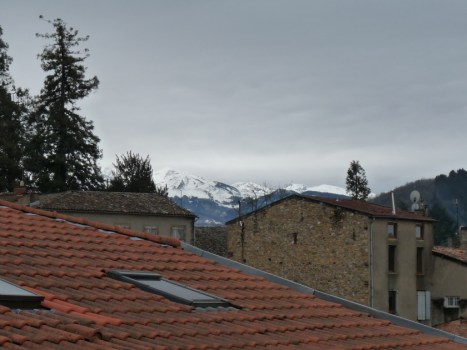
The foothills of the Pyrenees – the Plantaurel – from our friends’ house in Laroque.

The Pyrenees tug at our hearts like no other landscape. The gentle foothills are given added character by the backdrop of the mountains. We used to watch for the first flurries of snow on the peaks, maybe in September, while we were still in t-shirts.

When we lived in Laroque, this was our view from our roof terrace, and my daily joy as I hung out the washing there.

Anyone living in the Ariège could name the peaks, count them as their friends – Le pic de Saint-Barthélemy, le Pic des Trois Seigneurs, Montségur. Locals would tell you, every spring, exactly how little snow should remain on the high slopes before you could plant your spuds and beans. They would be the ones to relish the mountains in every way. They’d grab their snowshoes as the snow deepened to enjoy a silent walk in the crisp, cold empty landscape.

No snowshoes here. Just a rugged, snowy walk near Montaillou.

They’d know where to look for alpine strawberries in summer, and have secret places that they wouldn’t tell their closest friends about where they’d gather mushrooms in autumn.

They loved the rugged beauty of the mountains as we did, from the majesty of the snow-covered peaks, to the riot of wild daffodils, then gentians in spring, to the muted soft green palette of the hillsides at dusk on a summer’s evening, to the rich russets and golds of the autumn woodland.

I can’t visit the mountains though without being aware they demand our respect. They’re mighty, rugged and visually stunning. As we gaze at lines of rock, crumpled in geological eras long past, as we look at tumbled boulders lining the valley floor, or delicate but dangerous sheets of scree, they remind us that, compared with them, we are here on earth for a very short space of time. They have witnessed civilisations and religions rise and fall, harboured refugees from war and conflict, provided impenetrable barriers to would-be conquerors and generally put us in our place. It’s this combination of love and respect for them that draws me and moors me to them. Mere hills and plains simply can’t compete.

Today’s Ragtag Daily Prompt is ‘Rugged’.

Click on any image to view full size.