Snowshoes III: The very last episode

I’m not doing raquettes (snowshoes) ever again.  Never.  If I ever show signs of changing my mind, lead me into a darkened room, talk kindly to me, and sit with me till the feeling passes.

I have no idea how I got through yesterday.  I must have done though, because every move I make causes some protesting and unhappy muscle to complain vigorously at the pain it endured on our expedition, and is still enduring now.  Five hours walking, with half an hour off for lunch.  Something over 600 metres up, 600 metres down – that’s nearly 1900 feet each way in old money.

I said last week’s sortie was tough.  Compared with yesterday’s, it was a stroll in the park.  I said last week’s was ‘an upward slog: unremitting, tough’.  Yesterday’s was a vertical slog: unending, unforgiving.  Last week, the snow had been deep and crisp and even, and easy to walk on.  We had crunched satisfyingly upwards through the forest, and our descent had been a brisk and easy downward march.

Yesterday, following a warm and sunny week, the snow was soft and our snowshoes sank deep.  Bad enough on the upward route march, but coming down, we all skidded, slipped and lost grip of our poles as they plunged into unseen cavities.  I made landing smack on my back and descending bumpily downwards, legs waving helplessly in the air my personal speciality.

Still, it was good to see Montségur, looming above us at our starting point, providing points of reference throughout the day.  Soon after we started, we were level with the castle at its summit, then it was below us, and disappeared for a while as we plodded upwards through a stretch of forest.  At lunchtime it was impossibly far below.  As we ate, we enjoyed plotting the landscape for other landmarks: Lavelanet and Laroque of course, the lac de Montbel, and far north of us, the Montagne Noire.

Best of all were the cloudscapes: massed plump white cushions of cumulus with wispy brushes of cirrus above, turning a more characterful and moody grey in the afternoon, foreshadowing the evening’s expected rain.  We were just back at the cars when the rain arrived a little ahead of schedule, with a brief hailstorm of pencil-point-sharp hailstones to encourage us on our way.  We didn’t need telling twice.  Home comforts have never seemed more inviting.

Snow Shoes II, The Sequel

We walkers of Laroque got our snowshoes out again today (well, in my case, I borrowed some), and went for a much more local sortie, just above Montferrier and en route for the local skiers’ playground, Mont d’Olmes.

How different from our last walk.  Instead of wide open snowfields with distant views, we had woodland walking and bright sunlight casting blue shadows across our path.

Instead of gentle slopes rising and falling before us, we had an upward slog; unremitting, tough.  Micheline and I, discouraged and tired, failed to reach the top, and missed the prize: a frozen lake with snow-clad views in every direction.  Most of the party stayed with us and kept us company.  Though our views were less exciting than those of the intrepid climbers, our picnic was the better one.  We low-achievers had wine, home-made cakes and hot coffee with us to supplement our bread and cheese.

And the journey down was completed in record time.  We arrived home as our gardens were gently baking in the last of the hot afternoon sun.  More of the same is forecast for several days: there won’t be much snow left this time next week.

Data unprotected

Annuaire pages blanches_18672

Arrive home to find that you’ve missed a call on the phone from an unfamiliar number?  No problem.  Just turn to the Pages Blanches (phone book) on the net and tap the number into the Annuaire inversé.  Your caller’s details will be revealed.  Try the same thing in the UK, and you’re up against data protection legislation. Although that always seems odd to me.  If you’d been in to take the call, you’d have known who it was ringing you.  Which is clearly the view they take in France.

Because Data Protection is clearly not big news here.

Recently, Malcolm and I went for blood tests.  A few days later I popped into our local surgery for a repeat prescription, and our doctor spotted me in the reception area.

‘Morning!  Have you a few moments?  I’ve got your blood test results here. Shall I go over them with you?’

‘No’ was not the right answer.  So she went though the lot, right there in the public area. Unluckily for the captive audience waiting to see one or other of the doctors, my results were very dull – nothing gossip-worthy there at all.

‘And since you’re here’ she continued, ‘I might as well tell you your husband’s results’.  And she did.  Malcolm’s results were dull too.  In fact I had the utmost difficulty in reporting back to him, because I forgot most of what she told me.

I’d barely recovered from the shock of that blatant disregard of data protection when I needed to visit the mairie, the town hall. Having done what I needed to do, I chatted idly to the official I’d gone to see.  Who told me, apropos nothing at all, that someone living fairly nearby had been admitted to a psychiatric ward.  I simply didn’t need to know.  In fact the person concerned was completely unknown to me at that time.  This time, I wasn’t so much shocked as scandalised.   I don’t expect to go to the mairie every time I want a good gossip.  I don’t expect to have to wonder whether our own lives are part of the common currency of official chit-chat.

Life in France?  Or just small town life?  I’ve done a bit of Googling, and data protection legislation certainly exists in France: just not so much down here, in the fin fond de l’Ariège.


Snow shoes at Scaramus

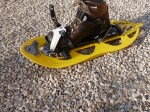
It’s 7 o’clock.  I can’t see me having a late night.  We’ve had a day of ‘raquettes’ – snow shoes.  Gosh it’s exhausting.  You strap great oval saucers of plastic, webbing, and toothed metal to your feet and spend some minutes feeling like an ungainly baby taking its first uncertain footsteps across the endless wastes of the living room carpet.

Booted and spurred
Booted and spurred

But equilibrium returns, and without these cumbersome contraptions, how else would you walk across the undulating white snowfields of the Plateau de Sault, with views of snow-sculpted hillsides nearby, jagged snow-crusted peaks beyond?  How else could you enjoy the sound of the satisfying crunch and crack as feet break through the crisp crust of the surface snow.  Thank goodness for that icy layer.  We found our 5’ long batons, plunged deep below the surface, wouldn’t touch the frozen ground beneath.

And with a bright blue sky, a hot sun enabling us to walk wearing T shirts and summer hats, what better way to spend a February Sunday?

A view from the washing line

Out on the roof terrace

There’s a blog I read.  Its author is a writer, a teacher, a mother, probably not in that order.  She loves people, words, conversations.  She’s enthusiastic, encouraging, and loves life.  She might be exhausting to live with: she’s exhausting to follow, because she’s constantly throwing out challenges.  What, she mused recently, makes you joyful?  Well, Renée Schulz-Jacobson, this is what.

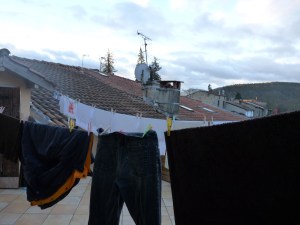
It’s hanging out the washing.  And bringing it in at the end of the day.  How sad is that?

All hung out for the day

Every day, these simple acts raise my spirits.  We dry our washing out on our roof terrace.  From here, we can see the nearby peaks of the Pyrenees, covered in crystal white snow for half the year.

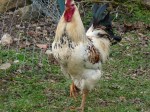
Zooming in on the cock  over the water
Zooming in on the cock over the water

Across the river just beyond our house, a neighbour keeps hens, and I enjoy watching them fossicking about for grubs and cabbage stalks.  Sometimes the heron swoops along the river while I’m there, and lands near the weir to look for breakfast or supper.  The morning air is cold, fresh and energising.  Actually, at this time of year it can be ****** freezing, in which case I’ll run down and warm myself afterwards by the wood burning stove.

It’s the evening though, when the washing is dry, sweet-smelling and ready for folding and hanging (carefully done, so there’s no need for any ironing) that I’m happiest here.  I’ll listen to the birds chattering and singing.  I’ll check up on those hens again.  But best of all, I’ll watch the sun setting.

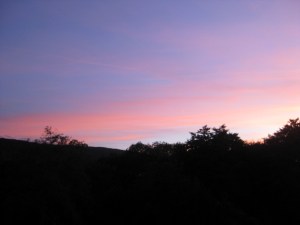
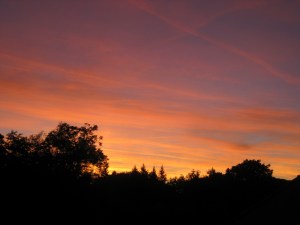
A subtle sunset
A subtle sunset

The sky will turn from vivid blue, through rusted orange and citrus yellow, to navy blues and bruised purples.  The snow on the mountains will change from sparkling white to ice-blue and then the subtlest shade of grey.  Suddenly, the sun will drop from sight behind the trees, and for a few minutes longer the palette of colours becomes moodier before giving over to shadowy moleskin grey.  Then the stars appear and later, the swooping, chirruping bats.  I’ll be back indoors by then, my mood invariably lifted by the simple pleasure of watching as the sun puts on its daily and ever-changing show.

Nearly gone, the sun

.

Rain, rain…….

The banner headline on this morning’s regional paper, La Dépêche du Midi, told us what we already knew.  There’s been twice as much rain this month as is usual.  Of snow, we’ve seen hardly a flake.

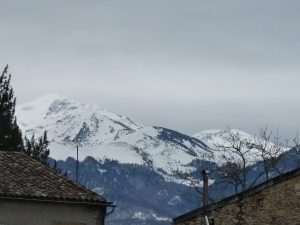
Driving back from Foix yesterday, we saw meadows that have become mini- lakes.  Even more fields glistened with water as the water table has risen to the very surface of the soil. It’s made the month a somewhat gloomy one, even though the days have been pretty mild.  The mountain peaks are snow-capped, as expected, but the white stuff barely creeps down the mountainside and with all the low cloud and zilch visibility, it’s sometimes hard to know where the Pyrenees have disappeared off to.

Our regular yomps into the countryside have been a bit curtailed.  Walk after walk has been rained off, and when we do go, we choose our routes with care.  If we don’t, we’ll be lugging kilos and kilos of glutinous heavy clay with us as it clings to our boots and the bottom of our trousers.
 

Boots - with added mud
Boots – with added mud

Roll on the 2nd of February, Chandeleur (Candlemas), the day when Winter decides whether to stick around or push off.  Last year, it was icily cold, and Winter stayed and made his presence felt with several weeks of constant snow, ice and bitter cold.  This year, he‘s looking much more half-hearted about it all.  We blame ourselves. We invested in snow-tyres and snow chains for the car.  We clothed our olive tree and a few other plants in white dresses of horticultural fleece.

Our olive tree all wrapped up for winter

So Winter laughed in our face.  We daren’t change the tyres or undress the tree though.  We all know what will happen if we do.

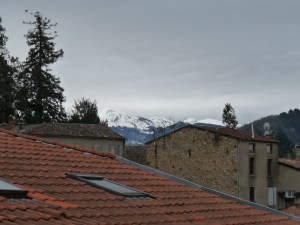
There's snow on them there 'ills: but not a lot.  As seen from our roof terrace
There’s snow on them there ‘ills: but not a lot. As seen from our roof terrace

French as she is spoke

Did you do French at school?  Probably, if you’re English.  You had all that stuff to learn about not usually pronouncing the final letter, that ‘choux’ (cabbages) is pronounced ‘shoe’.  Perhaps you battled to remember when to use accents, and whether they should be grave (`) or acute (´) or circumflex (ˆ)?  With any luck, you learnt some everyday phrases to use on everyday occasions.

And that was fine for the school trip to Paris and later, that nice holiday in Normandy.

Where you’ll come unstuck though, is down here, and across wide swathes of the southern parts of France.

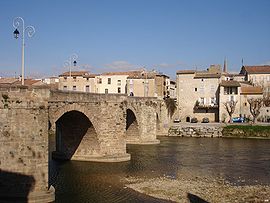
You’ll be OK if you visit an attractive town some 25 miles from here, Limoux.  It’s pronounced just as you’d expect, to rhyme with ‘choux’.

Limoux, Pont Neuf
Limoux, Pont Neuf

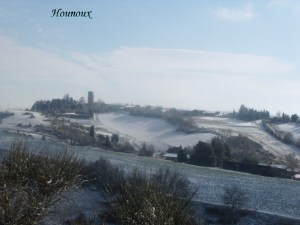
But last week, we went walking near a little village a few miles north, Hounoux.  It doesn’t rhyme with ‘choux’.  No, you must pronounce every letter – sort of ‘Hoonoox’.

A snowy day near Hounoux: Thanks Anny, for this photo

Driving there, we passed very near another village, Roumengoux.  It doesn’t rhyme with ‘choux’ and ‘Limoux’.  It doesn’t rhyme with ‘Hounoux’ either.  Instead, the locals call it ‘Roumengousse’.panneau-roumengoux.

Here, we spend our daily round with people who don’t talk standard French, as taught in all good GCSE textbooks.  They’ll go to the baker’s tomorrow (demeng) morning (matteng), to buy their bread (peng).  Then later they may work in their garden (jardeng).  In the evening, perhaps the Music Centre will put on a concert, with one of the local ensembles (angsambles) centre stage.  Très bien! (byeng).

There’s a sort of energy and vigour in the local speech patterns I find very attractive, as local people give full weight to every syllable in a word.  So rather than Laroque, it’s Laroqu-e.  I’m quite relieved it’s nothing more complicated than that, and that in any case, everyone round here is quite prepared to listen to standard French, or even Franglais.

‘Just what is it that makes today’s homes so different, so appealing?’

Take a look here at Richard Hamilton’s iconic 1956 work whose title I’ve taken for this post.  You’ll see it wasn’t our home he had in mind.

We love our house.  No architect ever had a hand in its creation.  Rather, it’s evolved as the needs of its various owners changed.

Colombages on the top floor still awaiting attention

Oddly, the top of the house shows clear evidence of being over 200 years old, with its ‘colombages’ (lath and plaster) construction, whereas other parts lower down are clearly more recent.

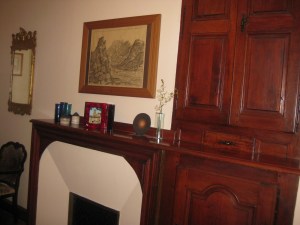
One of the guest bedrooms with original woodwork intact

Walls sometimes up to sixteen inches thick break drills and the will-power of anyone who tries to get through them.  No wall is perpendicular, no door standard size, and when we once tried to draw a ground plan of the house, we realised we were creating a work of fiction.

On and off, we’ve been ‘doing’ the bathroom for months.

Persuading the bathroom walls to be vaguely vertical

The tiles were solidly concreted on maybe in the mid 20th century, and nearly reduced us to despair when we tried to remove them. But now we’re doing 21st century tiling. The walls aren’t straight in any direction.  There’s no such thing as a right angle.  Even erecting plaster board walls within the bathroom can’t compensate for the room’s wilful disregard for symmetry.  Construct a wall that is truly vertical from top to bottom, and you loose several inches of space at floor level. Even measuring up, or drawing lines that are both horizontal AND parallel with the floor are almost impossible tasks.

...but we are getting there.
…but we are getting there.

In a despairing moment last week, I found myself observing that never had buying a house on a lotissement seemed more appealing.

I don’t mean it.  Not for one second.

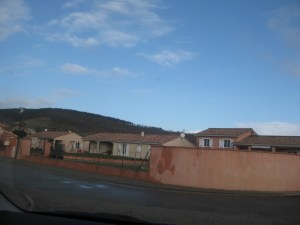
Lotissements are the French answer to the housing estate.  Areas of land, usually at the edges of villages or towns are divided into plots that are sold for development.  You buy your plot.  You choose a house off plan, and you get it built.  Or you build it yourself.  Or, as is more likely, you go for a mixture of the two.  You’d be a fool not to.  Deposits are lower on new build homes, as are legal costs.  You plan your home according to your budget, and once it’s completed, there you are with your modern, low-maintenance home.  There are thousands of them, all over France, and they all look much the same.  Only the roof-pitch flattens out the further south you come.

Part of a lotissement in a nearby village

Whereas we who buy old houses tend to buy problems: the roof that leaks, the wallpaper that shrieks ‘France, 1960!’ at you, the impractical kitchen (so-called American kitchens have arrived late in France), and the bathroom which, like ours, requires re-modelling.

Why on earth do we do it?  Perhaps because we like being part of the town community.  Perhaps because the house, for all its disadvantages, has charmed its way into our hearts.  We recognise the character it’s acquired over the years, and enjoy the stories we hear from other who knew the house once-upon-a-time.

We look askance at the concrete boxes surrounded by grass and chain-link fencing.  We resent it that when land is sold off for housing, we lose open countryside, farmland and much-loved landscapes in exchange for sprawling village ‘suburbs’ with no community features: no shop, school, church or bar. But in every village and town centre there are increasing numbers of empty and hard-to-sell houses, many with long years of useful service left in them.  We wonder why it’s made so easy and cost-effective for those who choose to buy new, and made so difficult for those of us who decide to renovate, restore and give new life to old houses.

Anyway, I can’t sit here moaning.  There’s grouting to be done, then the painting, and then…. and then…..Cake and yard July 2011 031

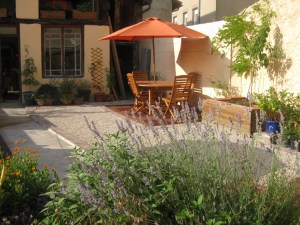
…and then it’s payback time in the summer, when we get to relax in our wonderfully hidden back yard.

Charity (shopping) begins in Laroque

Charity shops.  Staple of the British High Street, and a really important source of revenue for many charities.  Some parts of English towns seem to have few other shops these days, and on my visits back to Harrogate and Ripon, that’s where you’ll find me,  stocking up on piles of second-hand books at bargain-basement prices.  And not just books.  I have a classic lovat green Loden coat, much admired by whoever sees it, current selling price anything up to £500, which I found in St. Michael’ Hospice Shop in Harrogate for £10.

So here in France, I miss charity shops.  Emmaüs, the international charity focussing on poverty and homelessness concentrates in its large, warehouse-like shops on quantities of furniture and household goods, and a bit of everything else too, but they’re often away from the town centre.  Our local one in Lavelanet is daunting in size, shabby and a little unappetising.

logo_secours_populaire.jpg 1Secours Populaire here in Laroque, as in many towns, provides a lifeline for families in difficulty. It sells donated clothes and other goods, but it doesn’t advertise itself, and is mainly appreciated by those whom it sets out directly to help.  The branch here is in an upstairs room, and is staffed for one afternoon a week only by a cheery team of volunteers who see no need to market the service they provide to a wider constituency, or to go in for careful artistic displays of the goods on offer.  It’s clearly not a shop in the ordinary everyday sense.

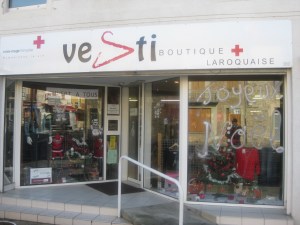
It was a bit of a shock then to realise a few months ago that the shop that was being refurbished up near the cross roads was going to be a Red Cross Charity Shop,  ‘Vestiboutique’.  It opened with a ceremony reported in the local press, and has been trading on 4 afternoons a week.

logo-croix-rougeIt’s a great place.  As in England, there’s a mixture of donated goods, and ends-of-line donated by clothing manufacturers.  As in England, the shop window and the stock within have been displayed with taste and care.  In the backroom, donations are mended, cleaned and pressed if necessary, before being put on sale.  Everything second-hand is either one or two euros, the ends-of-line goods very little more.  The day I first went, I found some cheerful trousers, an elegant high-quality pair of ankle boots probably worn only once by their first owner, and a new fleecy hat for winter walks: I parted with 7 euros.

The two members of staff were happy to talk. They’re not volunteers, though they’re not paid much.  They were excited to be part of this new development.  This shop is the only one in the region, and was sited in Laroque to provide a service in an area of economic difficulty.  Trade was brisk they said, and already the shop was much appreciated locally.  I told them about the huge variety of English charity shops, from international charities like theirs, to shops for charities seeking to combat disease or support animals, to hospice shops.  They were astonished, and couldn’t really imagine the picture I was trying to paint in their minds.  Though there are parts of France – Paris for instance – where you’ll find more shops like this, there are no streets like say, Commercial Street in Harrogate, where about a third of the shops now seem to be charity shops.  Vestiboutique, for the time being, is unique in the Pays d’Olmes.

Vestiboutique just before Christmas.

If Heath Robinson* only knew

Over in a tiny village in the Couserans today for a huge lunch – Azinat – with friends, we came across this sight:

It’s an alambic – well two alambics actually.  We knew that, because we’ve seen plenty of these historic pieces of machinery on display in villages throughout the area.  We even know what they’re for: every autumn, villagers still look forward to the annual visit of the alambic man whom they pay to transform the juices from their apples, plums or whatever into the most potent hooch you can imagine: up to 50% proof.  These alambics  showed signs of having been recently used: the tractor next to them still had its engine running.

We retired to our restaurant for lunch.

Three and a half hours later, the meal over, we sauntered over to where we’d spotted the alambics: huge copper contraptions encased in a battered wooden frame.  They were functioning!  Three large rubicund men, the types you can meet in the countryside anywhere, any country, were supervising hooch production, and were very happy to explain everything.

Checking everything’s fine

Well, I can’t be sure I’ve got this right.  It’s something like this though.

A fire under the first cylinder heats the juices that are poured into it.

The all-important fire. Note the wheels on which the machine originally travelled

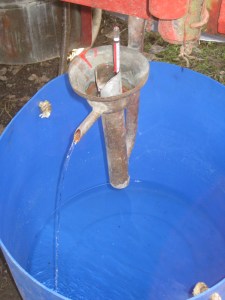
The resultant steam is forced up through pipes, which are cooled by water.  The vapour condenses into alcoholic liquid.  That doesn’t sound quite right to me: I never was any good at science.

Copper lid – parked for the moment.

Anyway, it’s the result that counts.  We met a Dutch couple who’d brought along their plum juice to be processed.  135 litres of juice.  And their eau de vie was now almost ready for them to pay for and take away.  Their 135 litres had become …. 10 litres.

Here’s the hooch

They didn’t yet know what they were going to be charged.  But they had been told they’d have to fill in a lengthy document for the tax office, and pay a suitable levy for this astonishingly potent product.  We know for a fact it’s strong stuff.  There were the dregs in a large plastic container.  They invited us all to dip a finger in and taste it.  We did.  And I promise you – just licking a fingerful probably put us over the limit.

We felt as if we’d witnessed a real piece of history.  When these men retire, are there young people around who will follow in their footsteps?

This alambic’s probably good for very many more years

* And if you don’t know Heath Robinson, click the link