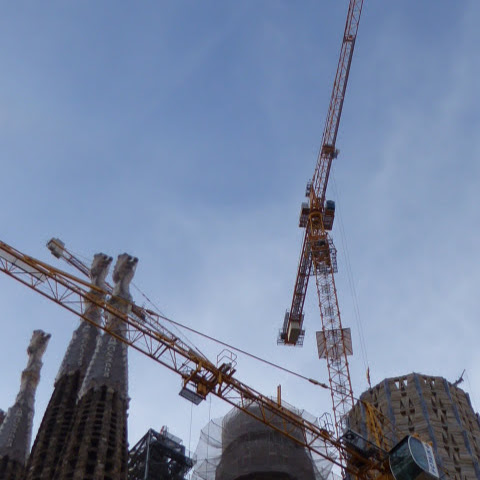
Monday Window Puzzle: a Brief Answer

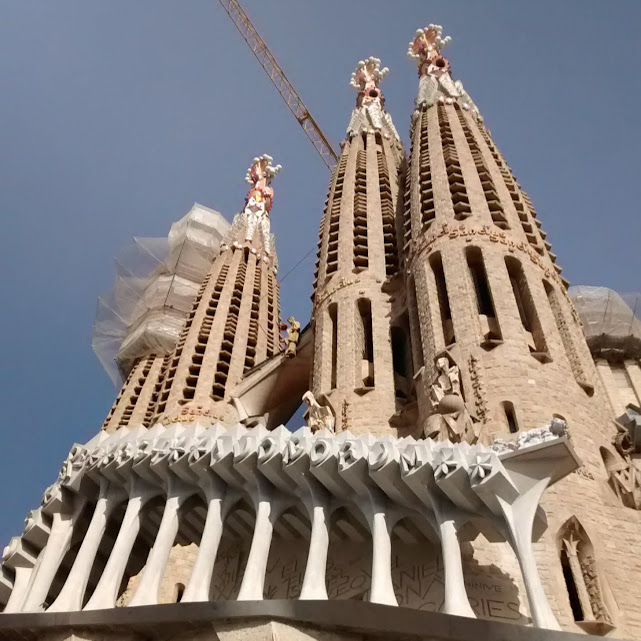
I showed you three images on Monday.

- Yes, they're of a church.
- You should have stuck to your guns: they're the work of Antoni Gaudí.
- It's an early work of his, and unfinished.
- And it was built as the place of worship for the textile manufacturing area, just outside Barcelona, of Santa Coloma de Cervelló .
- This community is now known as Colònia Güell. It's a worker's colony that was commissioned as a model town by Count Eusebi de Güell in 1898.

It’s a fascinating story and an interesting place. But telling it to you will have to wait till I’m back in England and have the time to do it justice. I’ll try to whet your appetite with just a few random images from the town.

A Monday Window Puzzle

I am going to set you a puzzle today. I’m showing a few teaser photos of somewhere that deserves a post of its own, but now’s not the time: that new baby, that newly-three toddler are both more important. So – what can you tell me about it? Do you know – or can you guess, what kind of building this is, who designed it, or where it is? I’ll give brief answers in a couple of days in the comments. The full story will have to wait.

For Ludwig’s Monday Window.

An Orange Walk Home from School

Five o’clock. Time to collect Anaïs from nursery school. Off to the shops first, walking along a street planted with Seville orange trees. The bitter fruits don’t tempt anybody to steal one for a snack. But I’m tempted by windfalls. We collect all we can find so that later, we can scrub them clean and make marmalade.

Up the hill, on the way back, here’s a street still with a few papery autumn leaves …

… and a house with a orange tree: sweet oranges this time, and ready to eat.

We turn left, and walk towards the sunset.

Then - finally – home at last …

For Debbie’s Six Word Saturday.

Doors in Mataró 

We’ve travelled almost the length of England, almost the length of France and through half of Catalonia to arrive in Premiá de Mar​​. It’s here that we’ve met our new granddaughter Olivia, exactly three weeks old today. And we’ve celebrated the birthday of her elder sister Anaïs, three years old on Tuesday.

Unsurprisingly, we haven’t been out and about much yet. But yesterday, Olivia, her mum, Malcolm and I ventured to Mataró, capital of the Maresme, for a little light mooching.

Here are two doors we mooched past.

For Dan’s Thursday Doors.

The Tale of an Industrious Mouse

Many of us – in the UK at least -have seen the video of the hard-working, meticulous mouse who has every night been busily tidying up the workbench in a garden shed. Being Country Mice ourselves, we get field mice here in the house from time to time. Not one of them has ever offered to tidy up. Where have we gone wrong?

We all need a bit of feel-good in January. So here he (she?) is:

You can read all about it here. 

I’m going to be an intermittent presence on the blogosphere for the rest of the month, both in the posting and the reading of the posts of others. We’re off to Spain to meet our latest granddaughter.

Six Degrees of Separation: from Tomorrow and Tomorrow and Tomorrow to Nine Lessons

On the first Saturday of every month, a book is chosen as a starting point and linked to six other books to form a chain. Readers and bloggers are invited to join in by creating their own ‘chain’ leading from the selected book.

Kate: Books are my favourite and best

This month’s starter book is Tomorrow and Tomorrow and Tomorrow by Gabrielle Zevin. I understand it’s a saga spanning thirty years in the lives of two friends who design video games, so doesn’t appeal to me. So I’ll go with the saga aspect of this book to find my first link.

It’s Bournville, by Jonathan Coe. Here is a state-of-the-nation novel, a family saga centring on the matriarch of the family, Mary, whom we meet as a child celebrating VE day and drop in on over the years until her death – alone – from an aneurism during the Covid pandemic. Her close relations – and other characters too – drop in and out of this novel. Families, Brexit, racism, attitudes to homosexuality all feature. So many threads, almost as if Coe were ticking off ‘issues’ to incorporate into his story. Nevertheless, this is an involving and enjoyable read.

Bournville begins on VE day, so I’ve chosen a book which focusses on the latter part of WWI in the UK, Lissa EvansV for Victory. It’s a witty and engaging war time yarn. I gather this is a follow up to an earlier book, but that fact I hadn’t read it – or even heard of it – didn’t matter at all, as the characters were fully fleshed out. There are two strands to this story. One follows Winnie, ARP warden, who’s plump, sensible, with a husband who’s away fighting the war, and a glamorous twin sister who is neither plump nor sensible. The other follows Vee, who keeps herself solvent by running a boarding house whilst also raising her 15 year old orphaned nephew, that it turns out is not her nephew. This is a book that brings the sheer boredom, drudgery and beigeness of the last year of the war to life: a period when it looked as though the war MIGHT end, but with no real signs in everyday life of its doing so – especially as bombs continued to do their worst in London. Nevertheless, it’s an easily read and involving novel.

These Days by Lucy Caldwell is another war time book. I raced through it. It’s an engaging story about a middle class Belfast story dealing with WWII, recently and shockingly arrived in their home city. Audrey is a clever office worker, walking out with a young GP. Lucy, slightly younger, is an a Air Warden, awash with emotions over a first love affair that must of necessity stay secret. We meet their parents and kid brother Paul, and become as consumed as they do by the four days of unrelenting bombardment of their home city. Involving, nuanced and thoroughly well told, this is a book I couldn’t put down.

A change of mood, and a change of war – WWI. Held, by Anne Michaels. I’ve not long finished this, and it’s far too early for me to have digested this book and taken from it what it has to offer. This is a poetic, evanescent story. Well, stories. It begins with John, lying wounded on a WWI battlefield. Then memories and thoughts take us to his first meeting Helen, his wife: and to their love, their struggles and to some of his career as a photographer. We move many times in this book – not just geographically, but in time. It’s a bit of a kaleidoscope: an image realised quickly disappears to be replaced by another. All seem to be linked by trauma, by pain, because being in war zones is a common thread throughout the book – the book is held together by recurring motifs. This book is fluid, luminous, and I’ll need to read it again to begin to understand it properly. And I want to.

Held was a homogenous whole, whilst being a collection of vignettes. Roman Stories, by Jhumpa Lahiri is a set of stories of people unconnected to one another, though all focussed on the city of Rome. Not the tourist hot-spots, but the less-regarded areas where people actually live. Often people with difficult back-stories, or whose origins are not in Italy. None of the characters described here feels completely at home. Their difficulties in being assimilated and accepted are both hinted at and described. All her characters seem to be in some measure of mental pain. Lahiri is an American academic who loves Rome. She now writes in Italian and self-translates. I wonder if this is what gives these stories a somewhat detached air? I ended the book feeling somewhat uncomfortable. Is this what Lahiri intended? Probably, yes.

I’ll conclude my chain with a story that links a group of people who had all gone their separate ways having been students, many years ago, at Cambridge University. Nine Lessons, by Nicola Upson. This is the first book I have read in this detective series following DI Archie Penrose and Josephine Tey as they collaborate in a spot of crime-solving. I have not yet read any of Tey’s work, though now I feel encouraged to do so. Nor have I read any MR James, yet he is central to the book’s plot. Many years ago, a group of his students at Cambridge used to gather to enjoy his readings from his own ghost stories. Now, slowly but surely, the members of the group are being killed off – and in each case, a clue from the stories provides the key to solving the mystery. Cleverly constructed, with well-realised characters, this is a series to relish.

And this final book, whilst not being a saga, connects characters over a period of many decades. And therefore conveniently links back to the starter in this chain.

Next month, we’re invited to start our chain with our last book of this month, or with the last book we’ve read. Why not join in?

Photo Credits:
Bournville: Adam Jones, Unsplash
V for Victory: GetArchive
These Days: Wikimedia Commons
Held: Julia Pure, Unsplash
Roman Stories: Anton Fineas, Unsplash
Nine Lessons: Bogdan Todoran, Unsplash

Springtime is i-cumen in

I went down to fetch the paper yesterday morning, and what should I see but … snowdrops, as shown in the featured photo.

Spring, and after that sumer is i-cumen in, as we’ve known since the 13th century at least. Our choir loves to sing about this – and no, the video below is not our band of singers.

And if snowdrops are here, can daffodils be far behind?