Donkey Derby

We were walking yesterday in glorious spring weather near a little village called Unac, quite near the winter sports area of Ax-les-Thermes.  Just outside the village, we spotted donkeys: eight of them.  They spotted us too.  They came to say ‘hello’.  And then they followed us.

Every field for miles about was theirs by the looks of things, because every time we rounded a corner, or scrambled higher up the craggy path, thinking we’d at last said our ‘goodbyes’ to them, there they were again, peering over the fence and hoping for carrots, which we failed to offer.

Someone remembered that they must come from La ferme aux ânes, in which case their job is to carry the baggage of any hikers who care to hire them.  But they weren’t working then.  Like us, they were enjoying the first day of spring.  They cheered our afternoon along no end.

A morning with Saint Pierre: two versions

Once there was a fine Roman city, Tolosa, and just outside its walls was a temple to one of their gods.  Over the centuries, the city became Toulouse, and where there was once a temple, there’s now a concert hall.  The building that was once outside the city walls is now quite definitely part of central Toulouse.  What happened in all those years in between?

The first thing was that in the 4th century the Romans left Tolosa, pursued by the Visigoths.  And Visigoth Christians (who resembled Cathars more than they did the official Catholic variety) used the temple site to build a simple church.  You can still see and visit its foundations today, and its ancient sarcophagi holding the bones of the long-dead.

This church building served its purpose for many years, until the 10th century, when the count of Toulouse gave it over to the Benedictine order whose most important monastery in the area was at Moissac.  And they built and extended the church which was and is known as Saint Pierre des Cuisines.  Nothing to do with kitchens.  The word is a corruption of the word ‘coquinis’ – artisans, of whom there were many in the busy streets nearby.

Over the years, the church became more important as a parish church to the local population, rather than as a centre of worship for the Benedictines, so in the 16th century, the church became the property of the silent order of Cistercians.  18 monks had the use of the church and surrounding land and buildings.  Their simple uncluttered contemplative life was in stark contrast to that of the nearby citizens of Toulouse, crammed into the narrow overcrowded streets where they lived and worked.

The church continued to be used as a religious building until the Revolution.  Then, as for so many other churches, another secular use had to be found for it.  And one was.  The nearby arsenal was the local home of the army, and they took over the building to use it for … cannon ball manufacture.  When this slightly inglorious use for the building came to an end, it remained unused until the University of Toulouse took it over during the 20th century.  Eventually the funds were found to restore it, and the building is now a concert hall with magnificent acoustics.  So it’s now an established asset of the conservatoire, and part of that area of the university campus still known as the ‘arsenal’, in memory of its history.

It’s a beautiful and austerely simple building from the Romanesque and early Gothic periods, and a contrast with the other church we went to see just round the corner.  This church, Saint Pierre des Chartreux was begun in 1612 to meet the needs of the Cistercians who had moved to the site.  It has a very unusual feature.  The high altar is right in the middle of the nave.  Why?  So the parishioners could worship at one end of the church without being able to see the contemplative Cistercians at the other end of the building.  Much of the church is decorated in restrained grey and white stucco work, though there are stained glass windows by Louis-Victor Gesta, whose work is in several city churches, and ancient hammered ironwork.

Whilst in the area, walk round the corner and see the remains of the old Cistercian cloisters. Little is left, but there’s enough to show that a meditating monk would get a decent work-out by doing a single circuit.

And now it’s time to wander off and explore the little streets nearby: you’re never far from a lunch-spot in Toulouse.

This slideshow requires JavaScript.

We discovered these monuments and learnt their story courtesy of Elyse Rivin and one of her Toulouse Guided Walks.  

Laroque: a town tour

Laroque: a roofscape.

Here you are reading my blog: and the chances are that you’ve never visited Laroque.

Let’s go for a stroll then, and get to know the place a bit.  You may think, when you’ve seen the photos, that the town is quite shabby-chic.  It’s not.  For the most part, Laroque is just plain shabby.  It’s going through tough times, and it shows.  Underneath it all, though, are characterful buildings, streets with a story, and even places that are enjoying a prosperous renaissance.  Let’s set off from our house at the edge of the old town, and walk up Rue de la Joie……

Snowshoes III: The very last episode

I’m not doing raquettes (snowshoes) ever again.  Never.  If I ever show signs of changing my mind, lead me into a darkened room, talk kindly to me, and sit with me till the feeling passes.

I have no idea how I got through yesterday.  I must have done though, because every move I make causes some protesting and unhappy muscle to complain vigorously at the pain it endured on our expedition, and is still enduring now.  Five hours walking, with half an hour off for lunch.  Something over 600 metres up, 600 metres down – that’s nearly 1900 feet each way in old money.

I said last week’s sortie was tough.  Compared with yesterday’s, it was a stroll in the park.  I said last week’s was ‘an upward slog: unremitting, tough’.  Yesterday’s was a vertical slog: unending, unforgiving.  Last week, the snow had been deep and crisp and even, and easy to walk on.  We had crunched satisfyingly upwards through the forest, and our descent had been a brisk and easy downward march.

Yesterday, following a warm and sunny week, the snow was soft and our snowshoes sank deep.  Bad enough on the upward route march, but coming down, we all skidded, slipped and lost grip of our poles as they plunged into unseen cavities.  I made landing smack on my back and descending bumpily downwards, legs waving helplessly in the air my personal speciality.

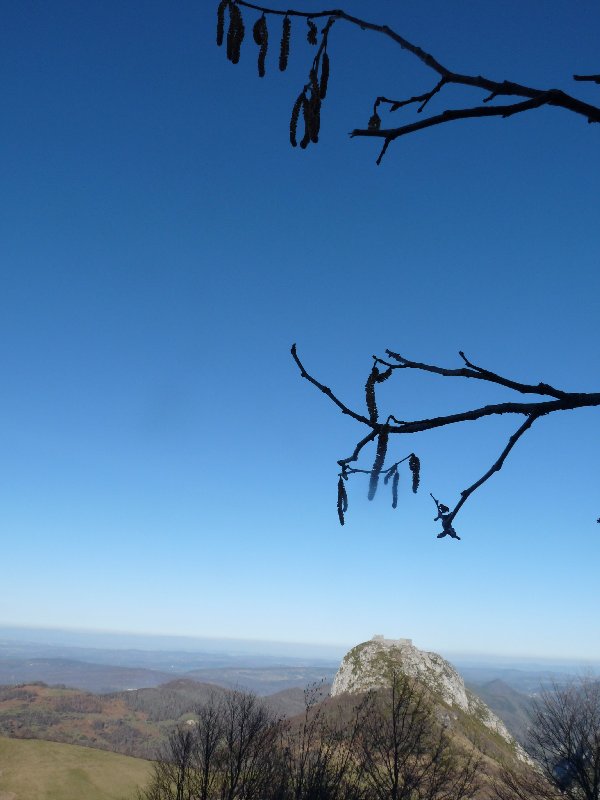
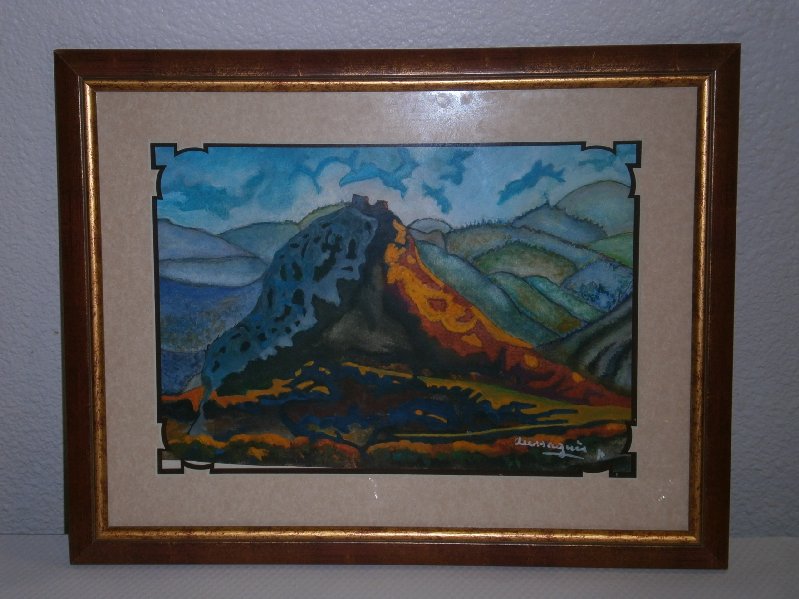
Still, it was good to see Montségur, looming above us at our starting point, providing points of reference throughout the day.  Soon after we started, we were level with the castle at its summit, then it was below us, and disappeared for a while as we plodded upwards through a stretch of forest.  At lunchtime it was impossibly far below.  As we ate, we enjoyed plotting the landscape for other landmarks: Lavelanet and Laroque of course, the lac de Montbel, and far north of us, the Montagne Noire.

Best of all were the cloudscapes: massed plump white cushions of cumulus with wispy brushes of cirrus above, turning a more characterful and moody grey in the afternoon, foreshadowing the evening’s expected rain.  We were just back at the cars when the rain arrived a little ahead of schedule, with a brief hailstorm of pencil-point-sharp hailstones to encourage us on our way.  We didn’t need telling twice.  Home comforts have never seemed more inviting.

World Book Day…. UK version

Today’s World Book Day.  I couldn’t understand why there seemed to be no sight of it here in France.  It turns out we Brits are out of step.  Celebrations in the UK are over a month ahead of everyone else’s.  April 23rd may be World Book day for everyone else, but it’s also Saint George’s day, and he’s England’s patron saint.  Apparently he does dragons, not books.

It was the Spanish who first decided to celebrate books and reading on April 23rd, as a way of honouring Miguel de Cervantes, who died on that day.  UNESCO made the connection that Shakespeare, as well as other writers, died or were born on the same day as Cervantes, and a world-wide festival was born.

Children have the most fun on World Book Day, whenever it’s held. Here are my grandchildren off to school this morning.  They had to turn up as a character in a book….. so please meet Harry Potter, and Mr. Willy Wonka.

Ben and Alex in character for the day

Books are often centre-stage in school all day and there are free books to be had for most lucky children

So many of my best memories of the children’s childhood centre round the books they enjoyed.  That first winter of my daughter Elinor’s life was one of those once-in-a decade toughies.  We were marooned in our house up an icy and snow-covered steep slope on one of Sheffield’s seven hills (‘just like Rome’). It was unthinkable to set foot outside with an unwieldy pram and a tottering toddler. But unable to do the daily round, or see friends, my then two year old son Thomas, my new baby and I simply cuddled up on the sofa. I read with him, and breast fed my daughter for hours at a time. I’d never have chosen such a harsh winter with all its limitations, but it remains one of the golden periods of my life.

Then, as now, the books we favoured had the rhythms and cadences, the witty and lively illustrations of authors like Quentin Blake.

Blake’s Mr Magnolia remained a family friend from the day his story was published in 1980 through the pre-school years of all three of my children.  Any of us will recite his story to you at the least provocation.

Meet Mr. Magnolia.  See?  He has only one boot.
Meet Mr. Magnolia. See? He has only one boot.

‘Mr. Magnolia has only one boot.

He has an old trumpet that goes rooty-toot

And two lovely sisters who play on the flute,

But Mr. Magnolia has only one boot.

In his pond live a frog and a toad and a newt……’

Young children now are privileged to have world-class illustrators and fine writers available to them for the price of a paperback, or the use of a library ticket.  I’ve just had a high old time remembering old favourites loved by the whole family– Shirley Hughes’ Alfie, Rosemary Wells’ Noisy Norah, Nita Sowter’s Maisie Middleton, Roald Dahl’s heroes (Charlie of Chocolate factory fame) and anti-heroes (The Enormous Crocodile and of course the Twits).  Make friends with any of these characters by the time you’re three years old, and with any luck, you’re hooked on reading for life.  That’s what World Book Day’s for.

Alfie, his friend Bernard and a good book

Snow Shoes II, The Sequel

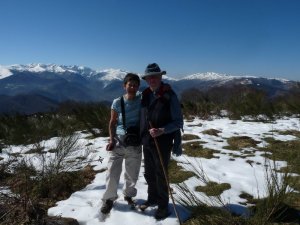
We walkers of Laroque got our snowshoes out again today (well, in my case, I borrowed some), and went for a much more local sortie, just above Montferrier and en route for the local skiers’ playground, Mont d’Olmes.

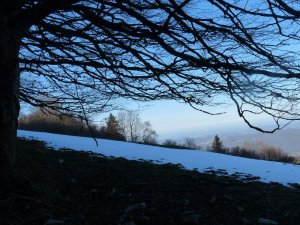
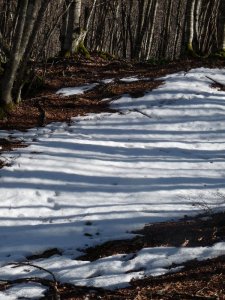
How different from our last walk.  Instead of wide open snowfields with distant views, we had woodland walking and bright sunlight casting blue shadows across our path.

Instead of gentle slopes rising and falling before us, we had an upward slog; unremitting, tough.  Micheline and I, discouraged and tired, failed to reach the top, and missed the prize: a frozen lake with snow-clad views in every direction.  Most of the party stayed with us and kept us company.  Though our views were less exciting than those of the intrepid climbers, our picnic was the better one.  We low-achievers had wine, home-made cakes and hot coffee with us to supplement our bread and cheese.

And the journey down was completed in record time.  We arrived home as our gardens were gently baking in the last of the hot afternoon sun.  More of the same is forecast for several days: there won’t be much snow left this time next week.

Data unprotected

Annuaire pages blanches_18672

Arrive home to find that you’ve missed a call on the phone from an unfamiliar number?  No problem.  Just turn to the Pages Blanches (phone book) on the net and tap the number into the Annuaire inversé.  Your caller’s details will be revealed.  Try the same thing in the UK, and you’re up against data protection legislation. Although that always seems odd to me.  If you’d been in to take the call, you’d have known who it was ringing you.  Which is clearly the view they take in France.

Because Data Protection is clearly not big news here.

Recently, Malcolm and I went for blood tests.  A few days later I popped into our local surgery for a repeat prescription, and our doctor spotted me in the reception area.

‘Morning!  Have you a few moments?  I’ve got your blood test results here. Shall I go over them with you?’

‘No’ was not the right answer.  So she went though the lot, right there in the public area. Unluckily for the captive audience waiting to see one or other of the doctors, my results were very dull – nothing gossip-worthy there at all.

‘And since you’re here’ she continued, ‘I might as well tell you your husband’s results’.  And she did.  Malcolm’s results were dull too.  In fact I had the utmost difficulty in reporting back to him, because I forgot most of what she told me.

I’d barely recovered from the shock of that blatant disregard of data protection when I needed to visit the mairie, the town hall. Having done what I needed to do, I chatted idly to the official I’d gone to see.  Who told me, apropos nothing at all, that someone living fairly nearby had been admitted to a psychiatric ward.  I simply didn’t need to know.  In fact the person concerned was completely unknown to me at that time.  This time, I wasn’t so much shocked as scandalised.   I don’t expect to go to the mairie every time I want a good gossip.  I don’t expect to have to wonder whether our own lives are part of the common currency of official chit-chat.

Life in France?  Or just small town life?  I’ve done a bit of Googling, and data protection legislation certainly exists in France: just not so much down here, in the fin fond de l’Ariège.


The healer

Malcolm’s had a rotten week.  Shingles.  It sounds such a jolly complaint, doesn’t it?  But it’s not.  It began last Saturday with a sore area at the back of his neck.  A couple of hours later, he retired to bed, his whole head a boiled orange-red and covered in flattish blisters.  The caricature Englishman who fell asleep on the beach for several hours at Costa del Something never looked this bad. He ate nothing – not a morsel – for two whole days, and was prey to dismal and depressing thoughts and feelings whenever he wasn’t asleep.

On Monday I called the doctor.  But as the news of his illness got out, the emails and phone calls started to tumble in. ’He must see a healer’, our French friends insisted.  When ill themselves, some of these friends choose the kind of alternative therapies that make homeopathy seem mainstream, while other scurry down to the surgery demanding packs of pills at the first hint of a sneeze.  Whatever their usual preference, they were united in believing that only a healer could help.  And the doctor had admitted he could do little for Malcolm.

One friend came up with a specific suggestion.  The mother of her childhood friend is a healer of shingles sufferers, and so successful that doctors often send their patients to her.  Malcolm had nothing to lose, so he got in touch.  Every evening for 3 days he’s been at her house at 6.00 for a short session.  She’s rubbed hard at his troubled skin with one hand, while making sweeping movements with her other.  Sessions last 10 minutes or less, but even after the first time, the improvement was noticeable and swift.  Now, after the third, his skin is almost normal and he feels fine,  but she’s expecting him to treat himself for a few days with poultices of olive oil, or olive oil, egg yolk and lemon juice.

Healers turn out to be very common indeed here.  They have the gift of treating a single complaint, and they receive this gift of healing from another practitioner. They often work in very different ways .  The mother of a friend worked in a way Malcolm wouldn’t have recognised. At sundown, she would briefly carry the sufferer on her back, back-to-back, whilst saying prayers in her Béarnaise dialect.  She had received her gift when she herself was suffering from shingles, and having treated her, the healer passed on his skills.

What unites all these people – men, women, young, old, garage hands, housewives, teachers, highly educated or largely untaught –  is their sincerity, and their real ability to effect change for the better in the sufferer.  A true healer will not ask for payment, but most grateful sufferers offer a gift, which could well be money. It’s not necessary for the sufferer to have faith that the treatment will work, merely a willingness to be open-minded and give it a go.

We’ve both been astonished by the huge fan-base for healing in a country where patients routinely expect doctors to prescribe medication for any complaint, however trivial.  At choir last night, discussing Malcolm’s experience with everyone there, they all nodded sagely and encouragingly.   ‘Il n’y a rien que ça’.  And it’s true.  Doctors seem to have little joy treating shingles, which seems to persist for weeks in the unfortunate sufferer’s body despite antibiotics and other potions.  Healers seem to deliver on their promise to have the thing sorted in under a week

Snow shoes at Scaramus

It’s 7 o’clock.  I can’t see me having a late night.  We’ve had a day of ‘raquettes’ – snow shoes.  Gosh it’s exhausting.  You strap great oval saucers of plastic, webbing, and toothed metal to your feet and spend some minutes feeling like an ungainly baby taking its first uncertain footsteps across the endless wastes of the living room carpet.

Booted and spurred
Booted and spurred

But equilibrium returns, and without these cumbersome contraptions, how else would you walk across the undulating white snowfields of the Plateau de Sault, with views of snow-sculpted hillsides nearby, jagged snow-crusted peaks beyond?  How else could you enjoy the sound of the satisfying crunch and crack as feet break through the crisp crust of the surface snow.  Thank goodness for that icy layer.  We found our 5’ long batons, plunged deep below the surface, wouldn’t touch the frozen ground beneath.

And with a bright blue sky, a hot sun enabling us to walk wearing T shirts and summer hats, what better way to spend a February Sunday?

The loto evening

APEM posterNot getting out enough?  Bored by those long winter evenings at home?  Do like the French.  Go out to a loto evening.

Loto – bingo or lotto to you – is the astonishingly popular pastime of seemingly half the local population.  Last weekend we could have gone on Friday to a session at the next door village of Aigues-Vives, stayed in Laroque for more of the same on Saturday, and then gone to Lavelanet on Sunday afternoon for yet another action-packed few hours.

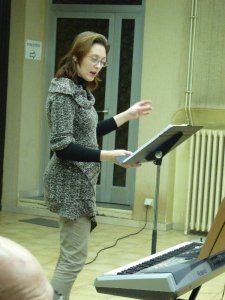
Somehow, we’d so far managed to avoid being roped in.  Until last Saturday.  Well, the Loto in Laroque was to fundraise for the Ecole de Musique, and the organ teacher Vanessa’s Organ fund.

So what’s an evening at the Loto actually like?

You’ll arrive to find ranks and ranks of tables set out.  You’ll need to buy your Loto cards – and spend hours choosing your lucky set.  First mistake: we just took the top few.  If you know what you’re doing  – we didn’t – you’ll have brought a bag of counters with you to cover the called-out numbers.  Settle down with your friends and family, buy some crêpes or a slice or two of home-made cake to pass the time, and wait for the action.

And at 9 o’clock, it all begins.  Nearly four hours of heads-down, as the loto numbers are called out.  What you’re aiming for at different points in the evening is a full line (‘quine’) or a full card (‘carton plein’).  And if you achieve one of these feats, the winnings are worth having.  A microwave.  An i-pad.  A SatNav.  A flat-screen TV. A food processor. Half a pig.  Several ducks (To cook.  Not to take home and rear in your back yard).  A weekly-shop’s worth of vouchers to spend in a local shop.  A free meal in a local restaurant.  A hairdo.  Local businesses are incredibly generous with their donations – more so when you consider how very often they must be asked.  Yet our Asso. also invested about 800 euros in the judicious purchase over many months, of high-end prizes.  Only decent makes need apply.  No dubious bits of equipment from some unknown factory in China.  To make good money on these evenings, the organisers have to spend, spend, spend.
Naturally, Malcolm and I won nothing, so time hung a bit heavy: we had to concentrate to be sure of filling our cards correctly (‘soixante quatorze: quatre vingt dix: soixante dix-neuf’.  No ‘Clickety-click, 66, Two fat ladies 88’ to help us out here).  Chatting the night away not an option – this is serious stuff.  The friends we were with were no more enthusiastic than we were.  We’d all come to support the cause.

At about 12.45, the very last numbers were called.  Nobody, not elderly inhabitants, not young parents, nor their – often tiny – children, had pushed off early.  But one lucky group of women trundled home with some difficulty: they’d won four major prizes.  But they wouldn’t have got lost on the way home.  One of their prizes was a SatNav.