Christmas is coming. How do I know? Not from the Christmas decorations or shops full of Yuletide Cheer, although that’s beginning, a bit. No, here the first sign of the impending end-of-year festivities is the appearance of The Calendar.
The other day in Laroque you’d have passed two volunteer sapeurs pompiers (Fire and Rescue service) in full uniform, trudging door-to-door with a pile of calendars. They need us all to make a donation in exchange for one. I wouldn’t dare not.
....and January.
They don’t expect very much money: the loose change in your purse is fine. After all the calendars are entirely paid for by the adverts inside and all the rest is profit. But you’ll get a receipt, your first Christmas card, and your first calendar, with each month illustrated by some thrilling event in the life of our local stations. Photos of the local crew too. Though not the sort of hunky photos you sometimes see in England, with Mr. Universe types stripped to the waist the better to display their tanned and rippling muscles. These men and women are all the guys-next-door.
Anyway, don’t think that this purchase represents the end of calendar-buying for this year. Any day now it’ll be the Majorettes, and after that….who knows? But there will be others. And we’ll have to buy from all of them.
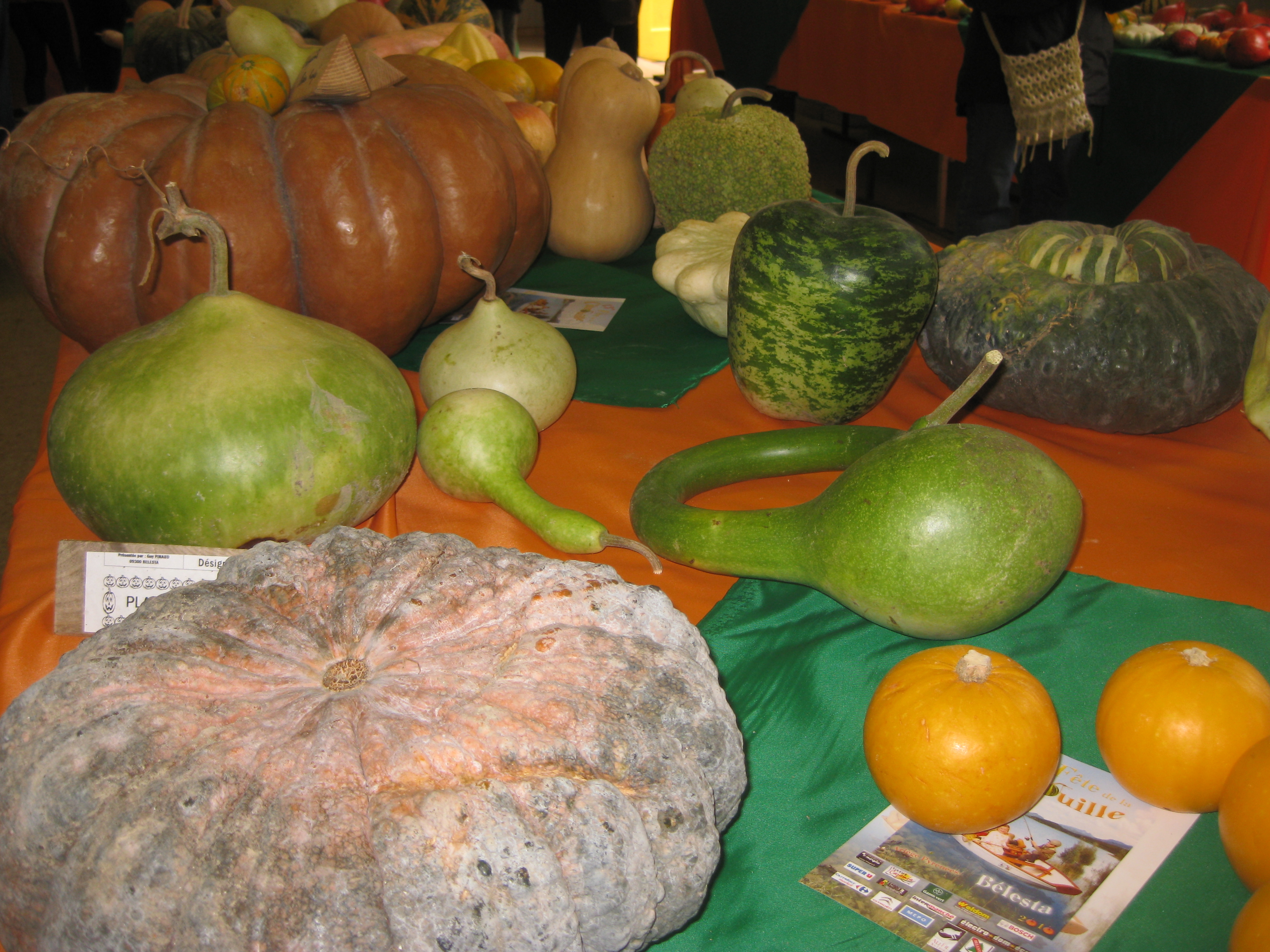
A few pumpkins on display last year at Belesta’s annual Fête de la Citrouille
Go to any veg. stall on a French market just now, and there’ll be at least one giant pumpkin. The stall holder will sell you a portion if you like, using a hefty cleaver to wrest a kilo or so of orange flesh from this magnificent vegetable. The market’s probably got at least one stall devoted to nothing but pumpkins: Turk’s head, musque de Provence, butternut, red kuri, rouge vif d’Etampes………
It’s not so very long ago in England that I’d be doing the rounds of all the supermarkets, the day after Hallowe’en, gathering up the last few Jack o’Lantern pumpkins at bargain-basement prices.
Jack o’Lantern dressed up for Hallowe’en
They’d been stocked for everyone to make their scarey Hallowe’en pumpkin faces with and that was all.
Hardly anybody used them to cook with (presumably not even the many Americans who live in Harrogate, with their apparent love of pumpkin pie), and Hallowe’en over, the unsold ones would be junked.
Hugh Fearnley-Whittingstall et al have put paid to that, and now the English love pumpkins as much as the French always have.
Here’s an easy and long-established soupy stew from round these parts (though I learned about it from Nigel Slater) to warm you up after a chilly day in the Great Winter Outdoors.
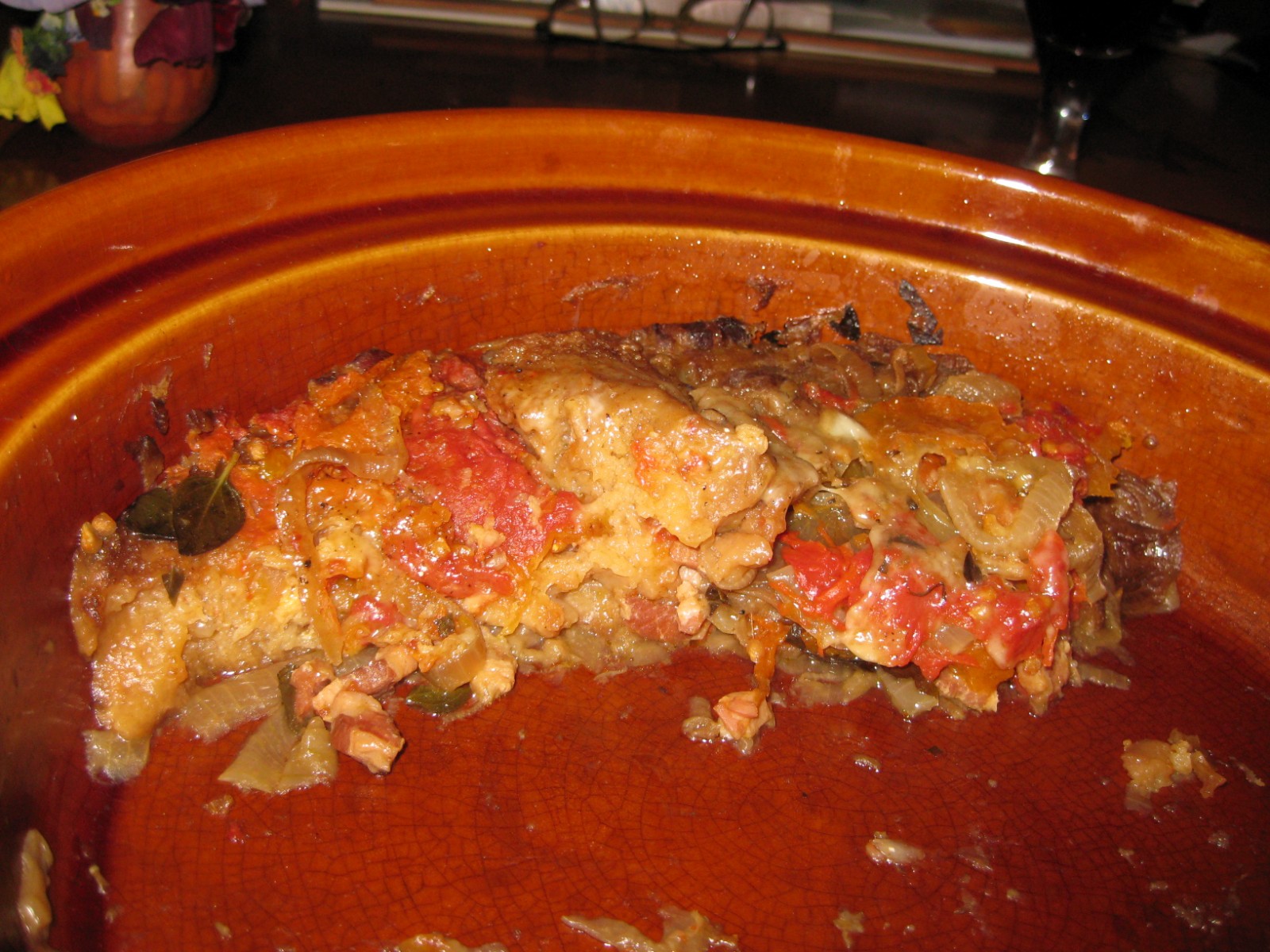
Hmm. We made short work of that.
When we first tasted it, we thought it nice enough, not earth-shattering though. It’s grown on us, and now we think it’s comfort food par excellence: especially those pillows of bread, soaked in scalding hot flavoursome juices.
Garbure Catalane
Toast thick slices of bread- preferably sourdough, and layer them up in a casserole or slow cooker with fried onions, garlic, marjoram, sliced skinned tomatoes, and thin slices of pumpkin. Top the dish up with seasoned water and olive oil and bake for an hour or two in a slow oven (or most of the day in a slow cooker). Take the lid off the dish for the last half hour or so and return to the oven with a crust of grated cheeses (parmesan is good to include in the mix, as it provides a welcome crispiness) for the last half hour or so. Or grill for a few minutes if you’ve been using a slow cooker.
Well, our French friends have been and gone. It was a busy week full of discovery for us all. Despite the almost unrelievedly awful weather, Yorkshire’s sights, both rural and urban, gave a good account of themselves. But here are one or two of the more unexpected discoveries our friends made.
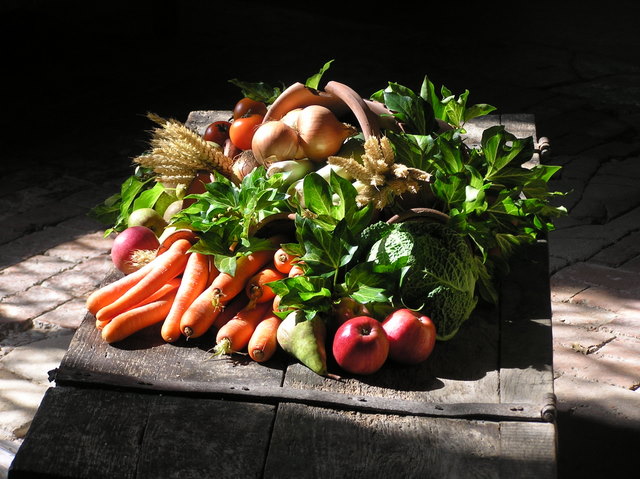
Harvest Festival. Saturday evening found us in church for a very special concert by the St. Paulinus Singers, a Ripon Chamber choir. As we entered, our friends were struck by the celebratory pile of pumpkins, cabbages, carrots and Autumn fruits assembled for harvest-time celebrations in church. They’d never heard of such a thing. Oh, and the concert began dead on time too. Another first for them.
Harvest Festival
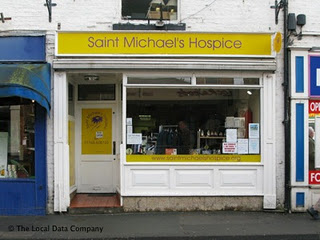
Charity shops. The French have little other than away-from-town-centre large warehouses given over to the sale of donated goods and run by Emmaus. The often carefully dressed shops we’re so accustomed to on the British high street are unknown to them.
St. Michael’s Hospice shop, Ripon
Closed for business: open for business. As we know, shops here tend to be open through the day. But what a surprise for our French friends to see them closing for the day at 5.30 p.m. rather than around 7.00 p.m! To find supermarkets open in some cases 24/7 was even more astonishing.
Closed at the moment
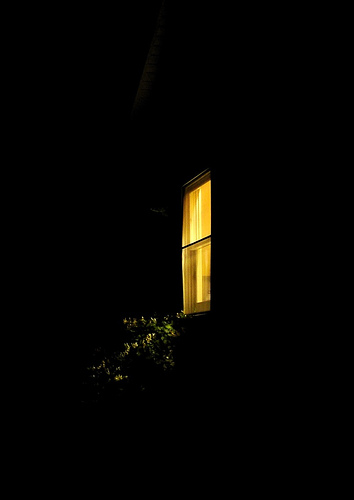
Houses without shutters. Evenings walking round town fascinated them. Instead of shutters there were curtains, which might or might not be drawn. How exciting to have glimpses of another set of lives! This is denied to them in France as shutters are usually firmly closed there as night falls.
A night-time window
Buttered bread. As born-and-bred Ariègeoises, our guests were unused to the idea of having butter AND cheese or ham or whatever on their bread. They rather felt it was gilding the lily. But they weren’t keen on the fact that bread is not produced routinely at the average British dinner table. It’s odd, we too have come to expect bread as part of a meal in France, but never in the UK
Milky coffee and tea. The default position for both in France is black (strong coffee, weak tea)
At the butcher’s. Of course our guests wanted to cook a slap-up meal for us. We all struggled a bit with this one, as French and English butchers cut their beasts up in different ways. As a recently-lapsed vegetarian, I’m re-learning slowly all I ever thought I knew, and starting at page 1 in French butcher’s shops.
A Friesian: until recently, these were the cows I most frequently saw in England
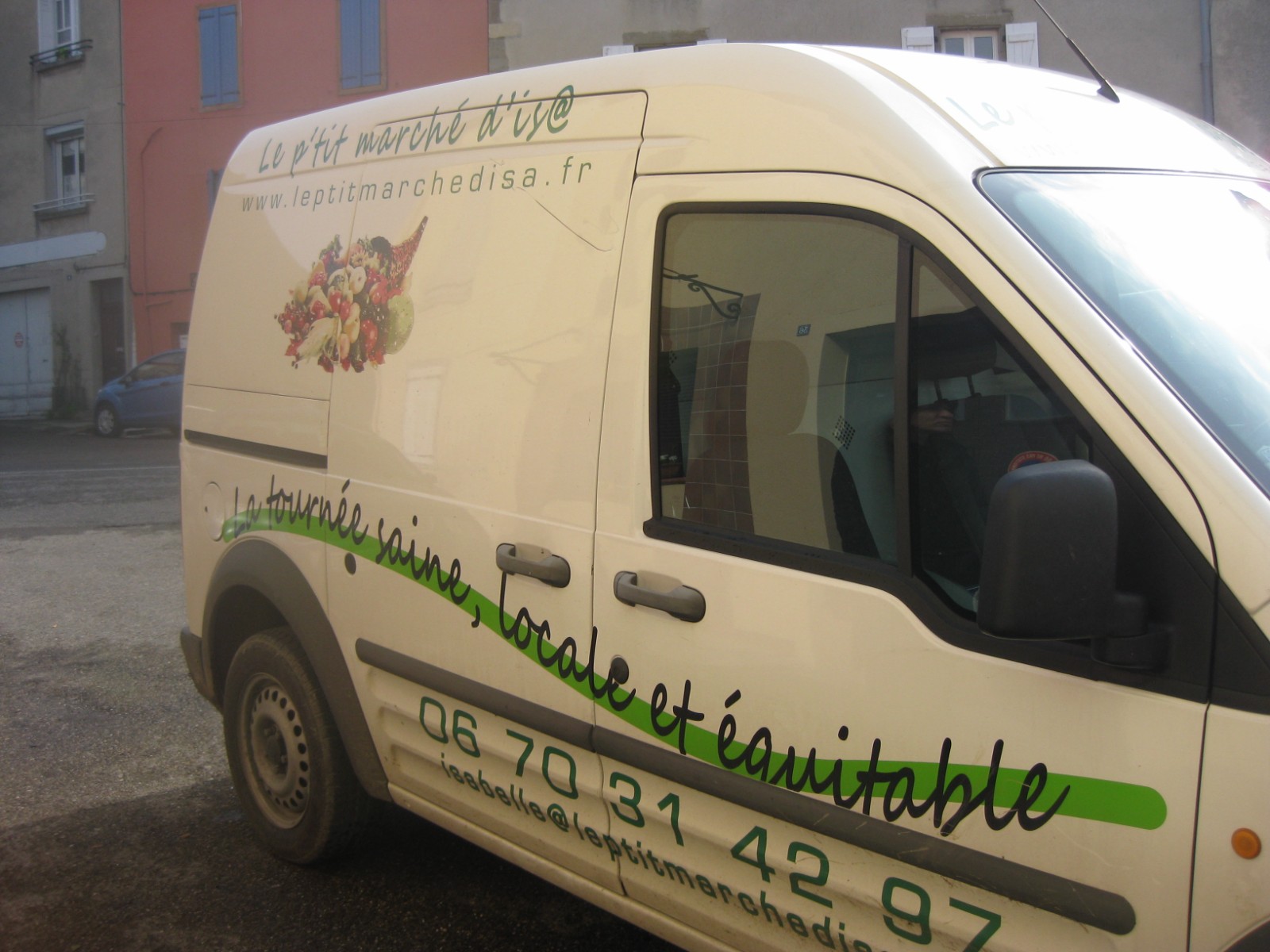
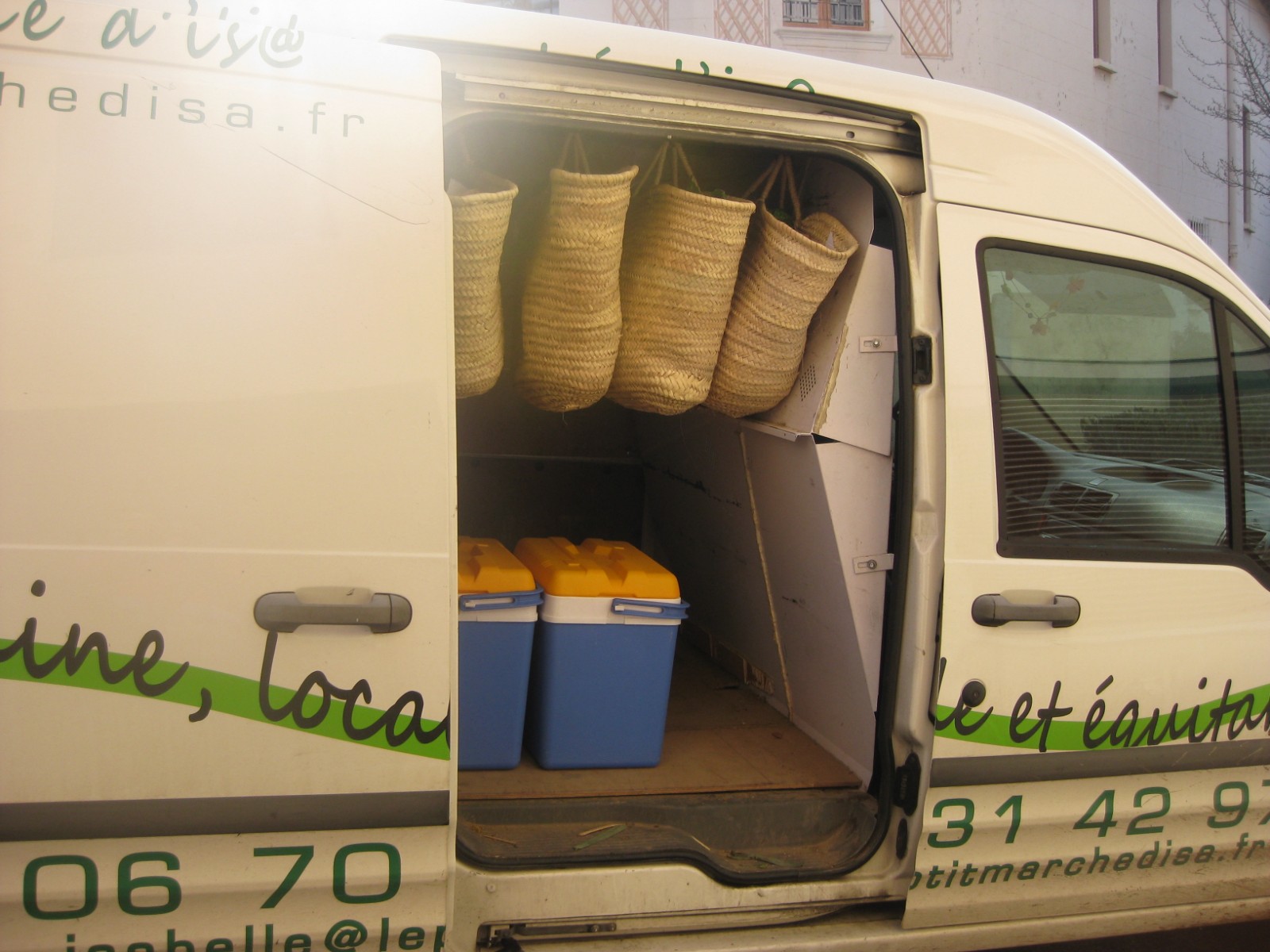
If you live within the long oval that has Mirepoix at the top, and Tarascon at the bottom, you might be lucky enough to get your fruit and veg. from Le P’tit Marché d’Is@ – Isabelle’s Little Market.
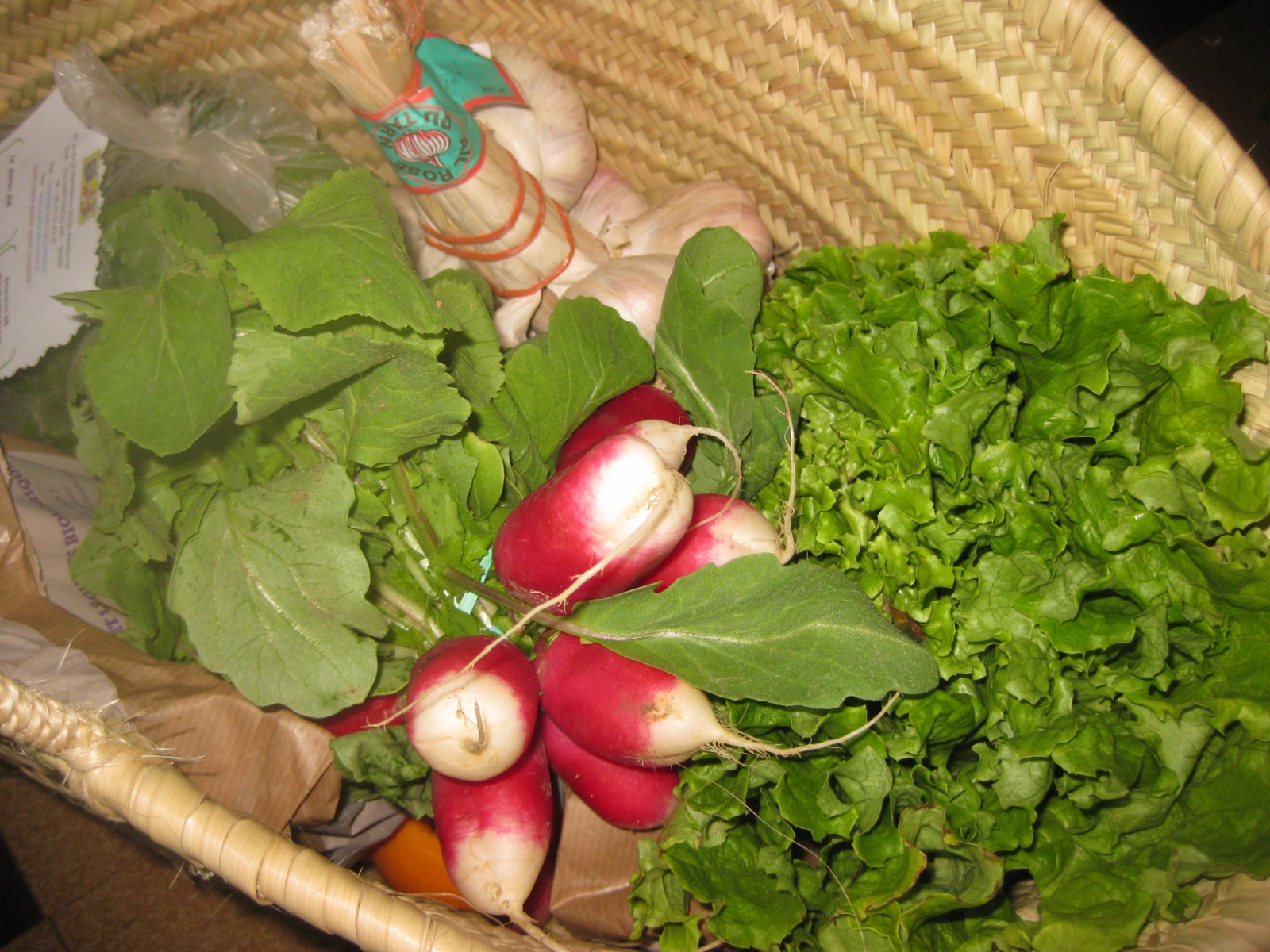
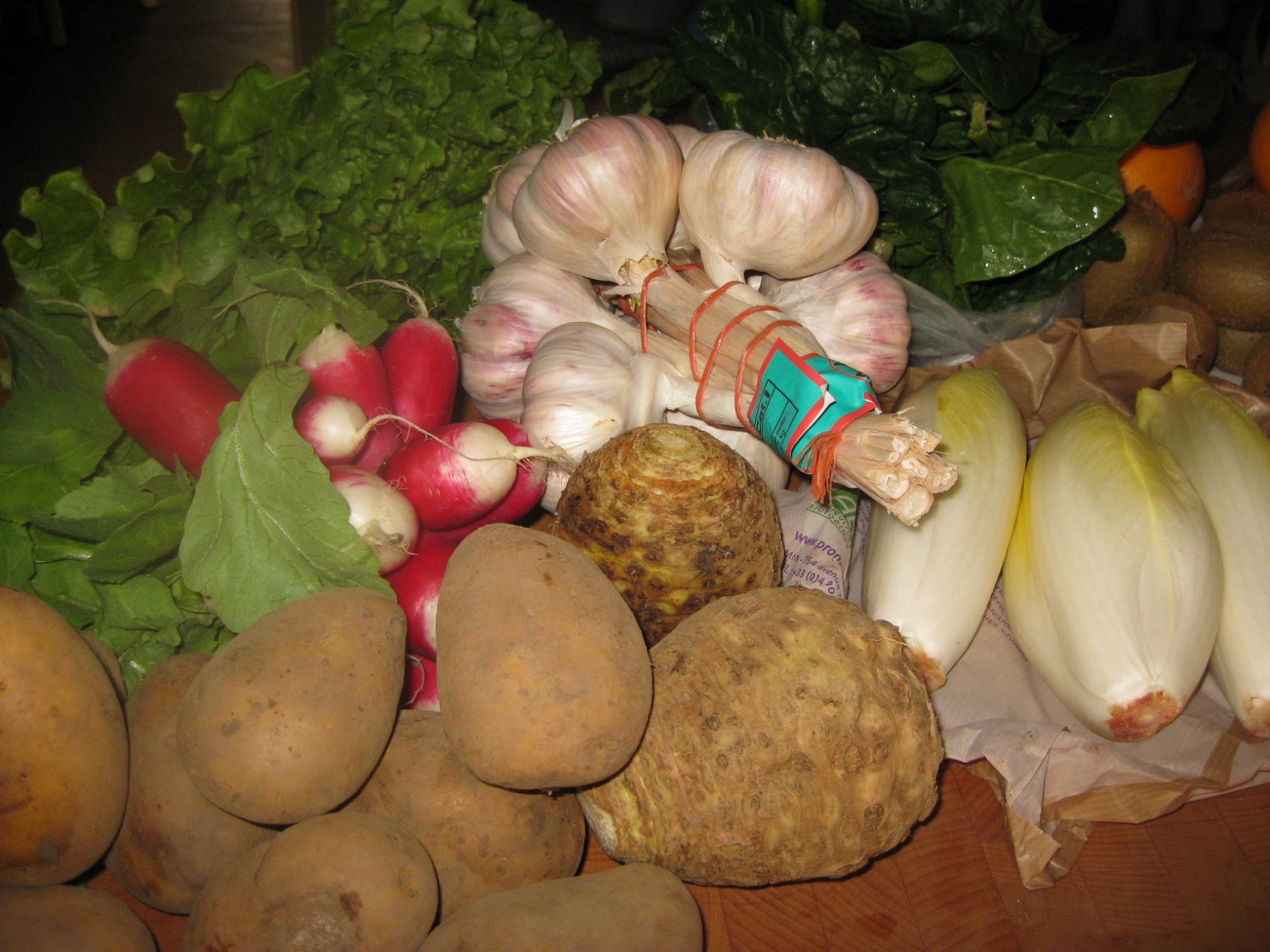
This isn’t like that. Her fruit and vegetables are organic or Agriculture Raisonnée, (limited use of drugs, fertilisers etc. permitted, within strict guidelines) all locally sourced: this week’s panier included potatoes, carrots, radish, celeriac, cabbage, spinach, chicory, lettuce, kiwi fruit, oranges and apples, all organic, and squeaky fresh. Last week’s, apart from the basics of potatoes, carrots and apples, was quite different.
Sorting out the shopping
Besides this, she’ll sell individual quantities of various fruit and veg , and she also has other lines. Poultry, pork, dairy products including various Ariégeois cheeses and yoghourts, all from farms no more than a few miles away. Groceries include wonderful organic flour from a mill near here, pasta, beers, and from slightly farther afield in the Pyrénées Orientales, oils, dried fruits, nuts,tapenades etc.
Just arrived and ready to deliver
It’s very simple: you order by Monday midday for delivery later in the week.
Now I really look forward to 11 o’clock on Thursday mornings when her little white van swings into the parking space outside our house, and she cheerily hands over her bulging panier of shopping for us to unpack and plan the menus for the next few days (she even has a recipe idea or two tucked in the bottom of the basket). It even beats market shopping. AND it’s made me feel not quite so unhappy about deciding not to grow my own vegetables this year.
Christmas markets always used to be a German thing. They still are, I think: they do sound rather special. It’s many years now that Leeds has had its own German Christmas Market, though I’ve always wondered what would bring German stall holders across the channel to pitch their stalls. Just as I’ve wondered what the attraction is for the hundreds and hundreds of French market traders who regularly fetch up in the UK for the popular French markets, where the prices are inevitably sky high.
But Christmas markets, where you can look for all your presents, made by local craftspeople and artisans, or in sweatshops in China are everywhere. The difference is that in the UK, they began in November and are now largely over. Here they’re just beginning, and will go on in some cases, like Toulouse, until after Christmas.
Depending on your point of view, it was either Napoleon or Adam Smith who first called England ‘a Nation of Shopkeepers’
But it was only after I came to settle here in France that I started to think of shopkeeping and market trading as skilled occupations, and realised just what is involved in keeping the customer happy.
It’s probably because it’s just so much easier, where we live in England, to nip down to the supermarket. There weren’t too many independent shops on our daily round: so much for a nation of shopkeepers. Mind you, we loved it when Emily was a Saturday girl at the French patissier who was then in Harrogate, Dumouchel. She would often be sent home with a couple of unsold petits gateaux for us to enjoy, or some slowly-fermented sourdough bread. It was small shop, and quite expensive, so she learnt quickly to value customers and to treat them well, so they’d come back. She learnt too that while most of the people she served were friendly and appreciative, customers could be curmudgeonly too.
The baker’s – busy at lunchtime
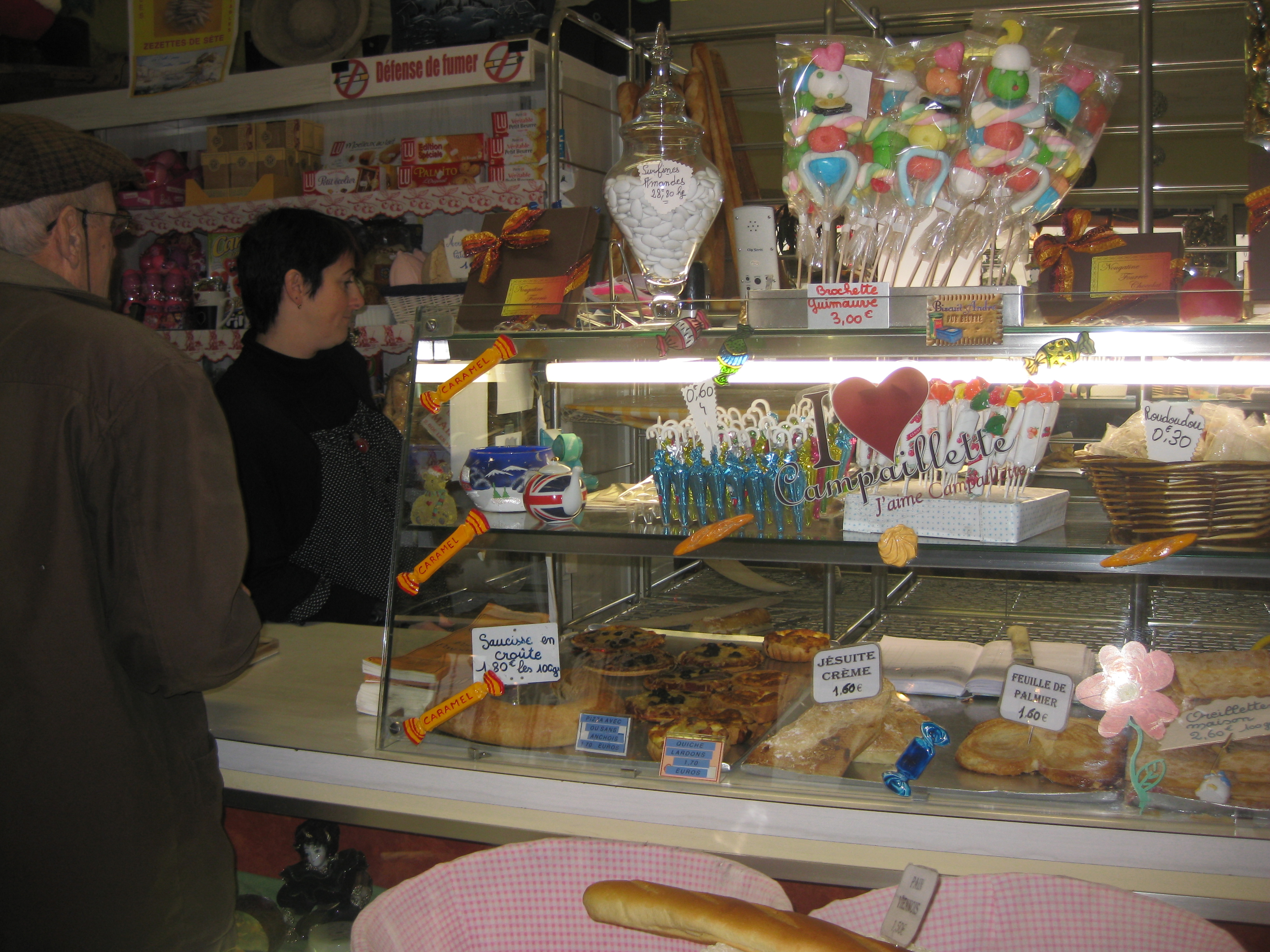
So who are the good commerçants here? Well, down at the bakers, they’ll often put aside our much-loved pain noir without being asked if I’m not in bright and early, knowing we’d be disappointed if they sold out.
Buying cheese at the market
Today at the market, madame who runs the cheese and charcuterie stall had printed off some recipes specially for me, because she knew I might enjoy trying them out.
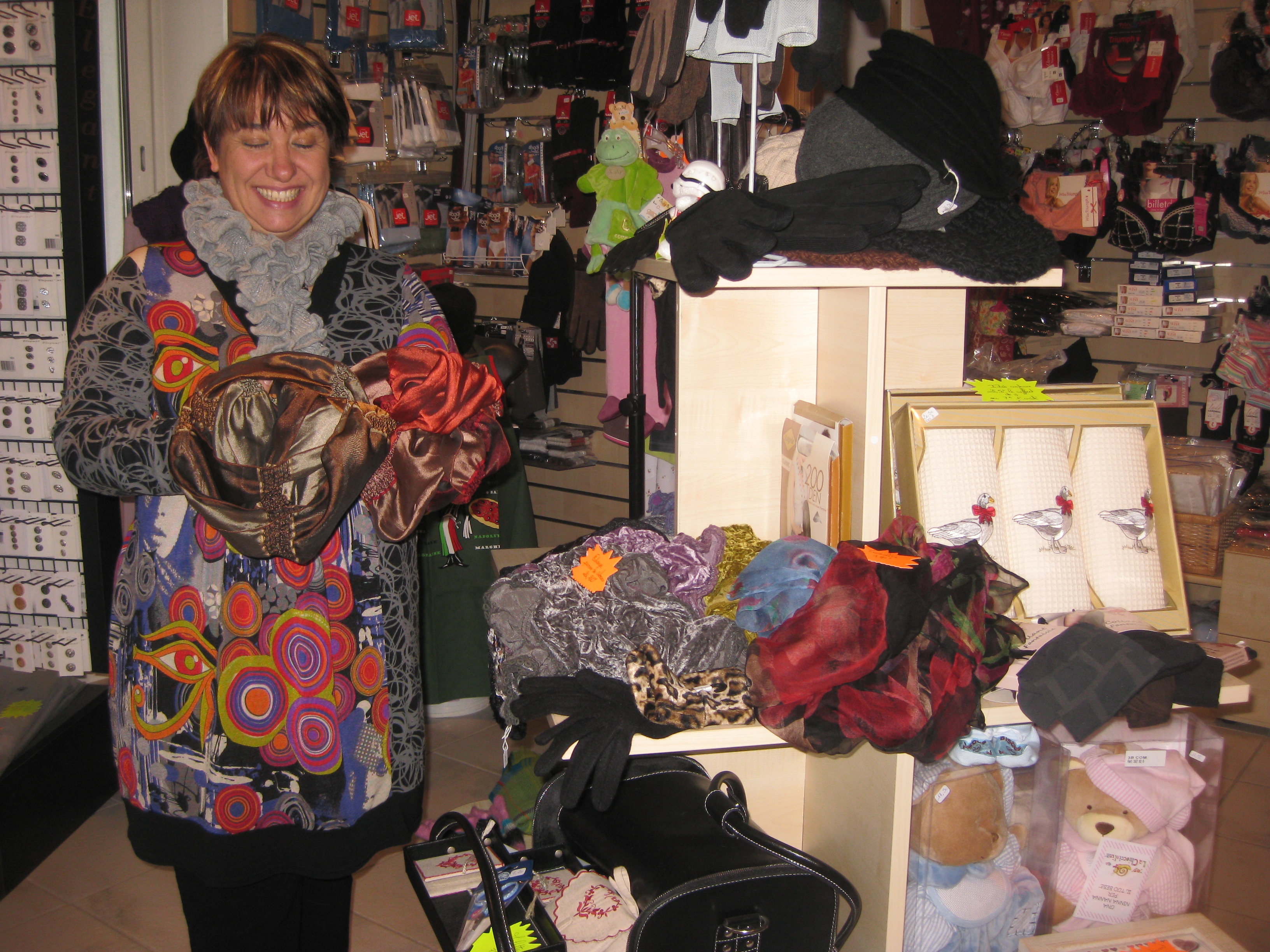
Down at Bobines et Fantaisies, she goes to Toulouse most weeks to seek out unusual scarves and accessories, so there’s always something new and worth trying at her tiny shop. ‘Let her try it on. If she doesn’t like it, bring it back!’, she’ll insist, as you dither between a bracelet, a couple of scarves and a chic but cosy winter hat. These shopkeepers remember us, our tastes, our whims and foibles. They welcome us, and chat cheerfully with us, even if we leave the shop empty-handed.
Madame at Bobines et Fantasies helps me choose a few presents
There’s just one shop here that doesn’t cut the mustard. ‘Il n’est pas commerçant’ we all grumble. Those of us outside the select band are routinely ignored, and as we feel our custom isn’t valued, some of us now go elsewhere.
But not to the supermarket. Oh no. Yesterday we DID pop into one, but as the muzak system was belting out a schmaltzy version of ‘Auld lang syne’ in what passed for English, we very soon shot out again. Small Shops Rule OK.
Tell most Ariegeois that you’re going to Andorra, and they’ll assume you’re popping over to stock up on hooch, cigarettes, cosmetics and cleaning products, then fill the car with as much petrol or diesel as it’ll hold.
The Principat de les Valles de Andorra is a little historical oddity. It’s a Catalan speaking independent country, only 468 square km., slap in the midst of the Pyrénées between France and Spain. It was, since 1278, co-ruled by the President of France (as the Count of Foix is no more) and the Bishop of La Seu d’Urgell in Cataluña. In odd numbered years, France receives tribute money, and in even-numbered years, the Spanish bishop calls in 900 pesetas (or the euro equivalent, I suppose), 12 chickens, 6 hams and 12 cheeses. 1n 1993, the Andorrans voted for democracy and a constitution- but those tributes still get paid.
What makes Andorra popular, here in the Ariège as elsewhere in France, is its lack of taxes. Petrol therefore costs something like 40 cents a litre less than in neighbouring France, and you can buy 3 new car tyres for the cost of two here. And so on. So Andorra’s border towns are nothing more than huge unpleasant shopping malls, blighting the slopes of the wilderness Pyrénées on which they’re situated. The capital city, Andorra le Velle, and the surrounding towns which have become its suburbs, are given over to little other than retail therapy.
In other words, not really our cup of tea.
Andorra, though, offers so much more. Zig-zag up the narrow mountain roads only a few kilometres away from the capital, and you’ll be alone amongst grand peaks, dense forest and craggy paths. Apparently, the further you travel from the capital, the wilder and more spectacular the scenery becomes. Tiny villages remain undefended by castles: the circumstances of its past government meant castles were forbidden. But charming Romanesque churches, often with original frescoes, are common throughout the country.
Henri and Brigitte invited his cousin and wife and us, to join them on a mid-week break at an Andorran hotel they’d chanced upon a few months ago. Henri doesn’t do bargain basement, so we were surprised when he told us that full board at this 3 star hotel was 51 euros each.
Hostal La Font is in a tiny village, Os de Civis, clinging to the mountain side not, as it turned out, in Andorra at all. It’s in Spain. But it might as well not be. The one road serving the community connects the village to Andorra la Velle and to nowhere whatsoever in Spain. Out of season, 20 people live there.
It was busy when we checked in to the hotel though, just in time for lunch. Vegetarians need not apply. Before the meal, tomatoes, garlic, olive oil, dried sausage, olives all appeared on the table. Then a hearty meatball-cabbage-chickpea-potato soup arrived. Then a selection of salads and charcuterie. Full yet? I hope not. There’s grilled lamb and 3 different sorts of grilled sausage with baked potato, and a large choice of puddings to come. The secret of course is to help yourself to tiny portions of everything offered: that’s what I did anyway, because I knew there would be a 3 course meal in the evening, and Henri has a way of making sure that nobody does their own thing by skipping dinner – or even a course.
Anyway, after lunch, we all chose to stride forth into the mountains. Henri’s cousin, Jean-Claude, has been a lifelong farmer, and made a great walking companion. We learnt from him the grasses that any discerning sheep chooses, given half a chance. He showed us how the local cows, a Swiss grey breed, have narrow agile hooves and legs to enable them to cope with climbing up and down the steep slopes of their summer pasture. And he told us tales of transhumance: the days in spring and autumn when cows and sheep are taken up to high pastures for the summer, and down again in winter: for his sheep, each journey took three days.
Later, we explored the village. Just as well the streets are equipped with handrails. Steepest village I’ve met. The dark local stone is the picturesque material both houses and streets are built from. It might look pretty in the September sun, but life looks tough here, and I’m not surprised the village all but closes once the tourists go.
We’ll be back. A walking week or so in these wild and empty mountains is a must, and hotels are affordable. Anyway, the car needed 2 new tyres, and the money we saved by buying in Andorra all but paid for the holiday.
Back in the UK, I’ve noticed that in the media, topics, like buses, come in threes. For instance, I’d flick through an article in the second section of the Guardian: maybe about female circumcision, education-other-than-at-school, or some other equally right-on Guardian topic. Two or three days later, listening to say Women’s Hour on Radio 4, they’d be discussing exactly the same subject, with exactly the same slant. Then the following week, maybe on Channel 4, it would appear yet again.
Recipe from Kalba's blog. Recommended.
And so it has been in the world of blogging. On April 24th, Kalba’s blog dropped into my in-box. I complained immediately. It was about asparagus, and I could have written it myself. Not all of it. I’ve never run a restaurant, and I’ve never lived in Norfolk. But like her, I do like green asparagus, the thinner the better: I don’t like the blanched, thick white spears favoured by the French and throughout most of mainland Europe.
Then on the 30th April, Bloggerboy, the writer of my other favourite blog, Welcome Visitor, pitched in with an account of the German love of asparagus. He even convinced me to have another go with the white stuff.
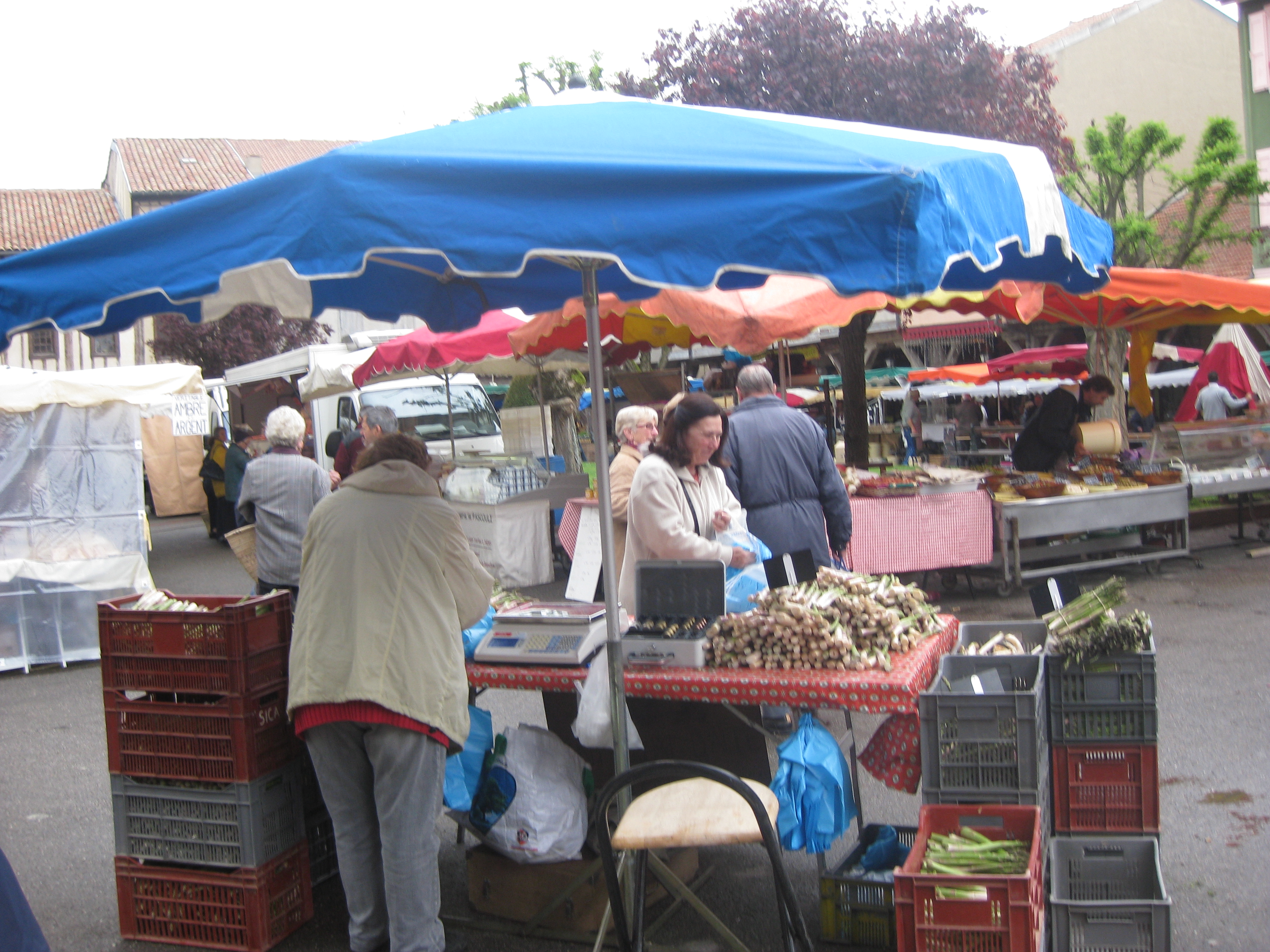
An asparagus stall at Mirepoix
So now it’s my turn to write an asparagus blog. In Mirepoix market yesterday morning there were quite a few asparagus stalls, and I picked the one where I could buy thin and thick green spears, and white too. ‘I’m not too keen on the white spears’, I confided to the stall holder, ‘but I’m sure I must be wrong when you all seem to like them so. How do you like to cook them?’. If I’d expected to have my hand wrung in gratitude at my acknowledgement of his expertise: if I’d expected him to call over his wife to share her culinary tips, I would have been disappointed. What I got was a Gallic shrug. He was mystified by the stupidity of my question. ‘Well, you could use them in tarts, or omelettes. Whatever you like really’. I realised our conversation was at an end.
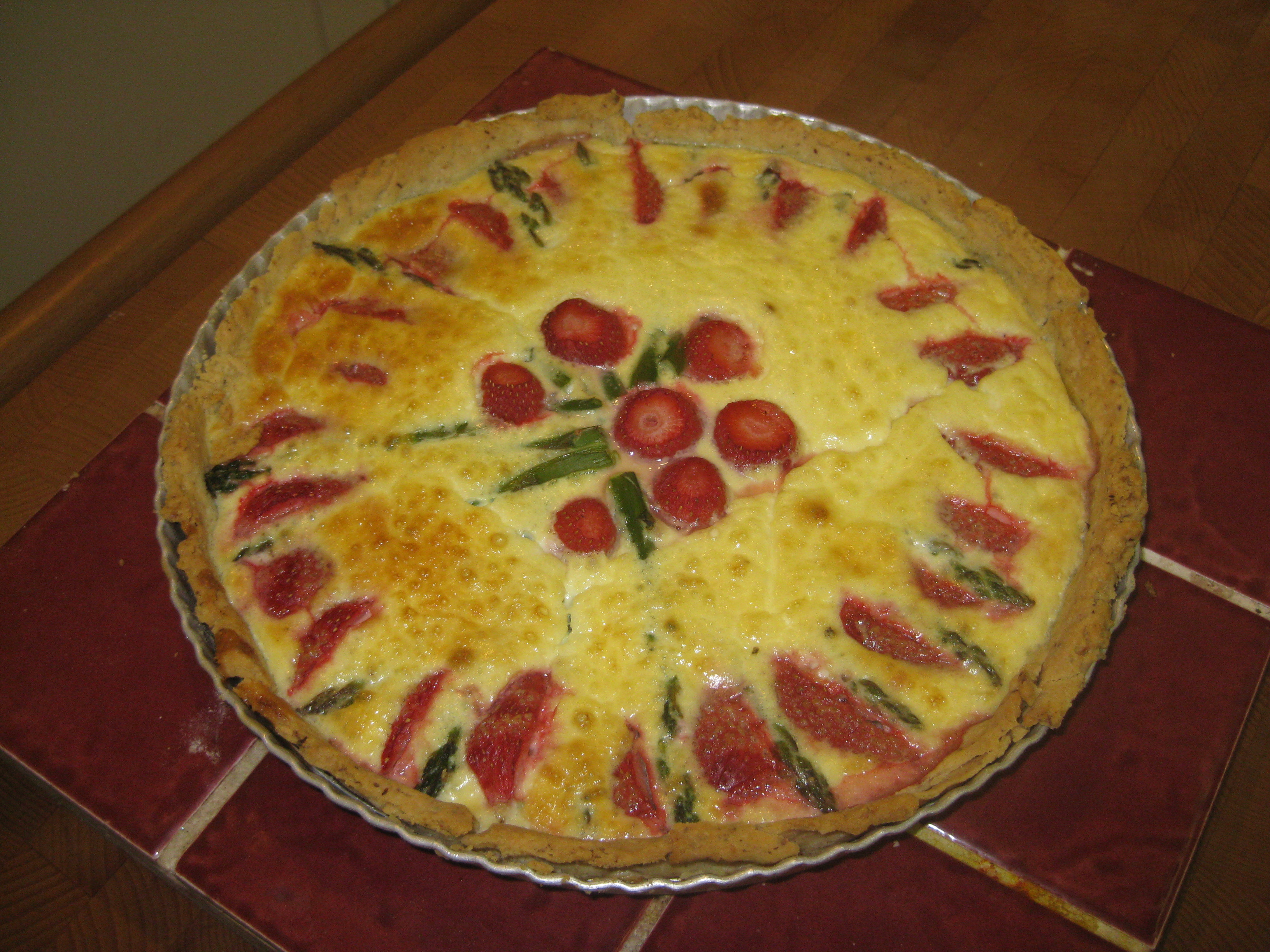
Asparagus & strawberry tart
Luckily, there are recipe books, and there are other blogs. I’ve just tried a suggestion from another blog I enjoy, ‘Chocolate and Zucchini’, which is available in English and French. Asparagus and strawberry tart. A very odd idea indeed, but it works. In fact it was memorably good.
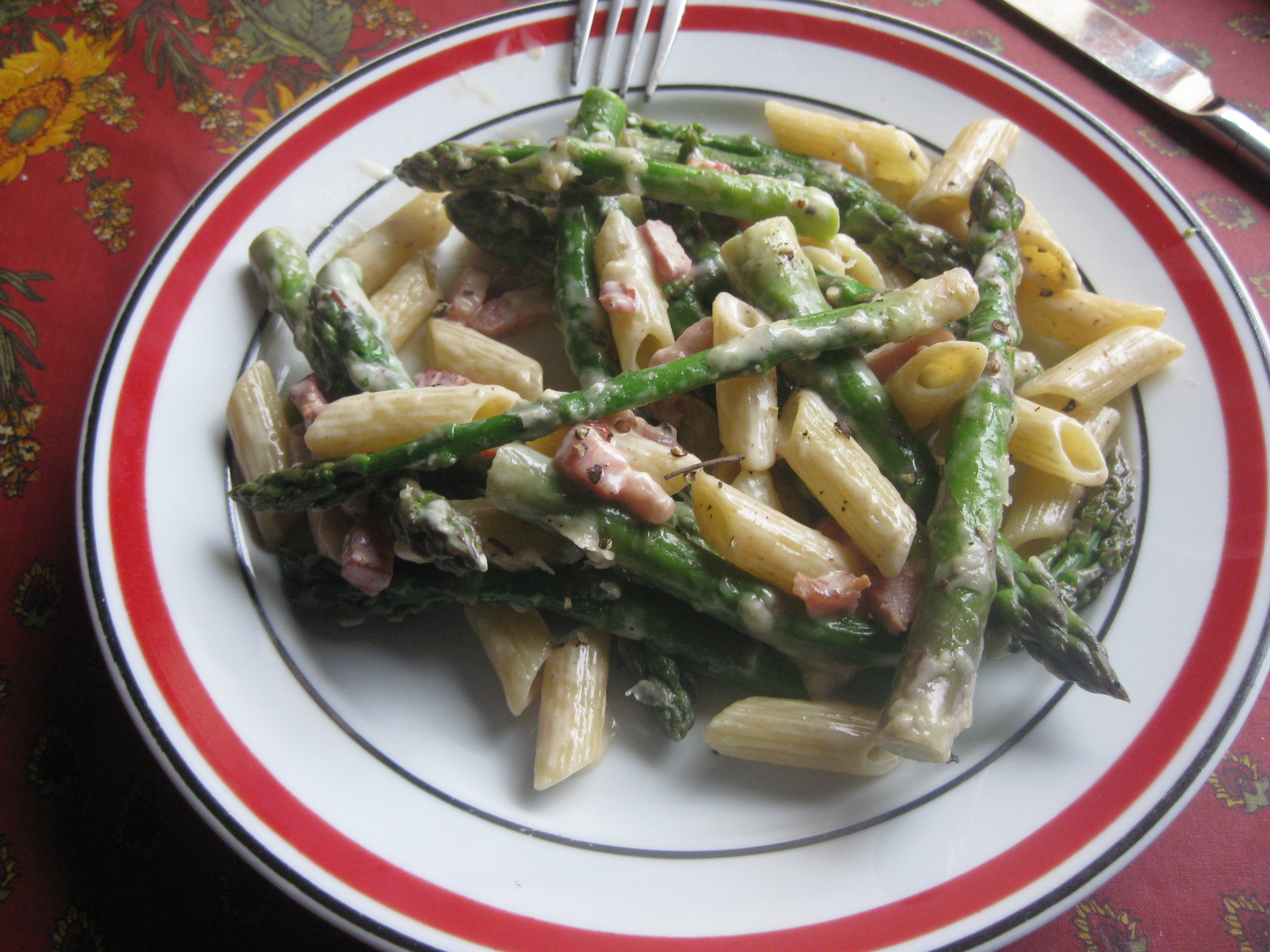
This is what we ate yesterday evening, from Denis Cotter’s wonderful vegetarian book, ‘Paradiso seasons’.
Gratin of Asparagus, Roasted Tomatoes and Gabriel Cheese with Chive and Mustard Cream.
Ingredients – for 2
4 -5 large tomatoes
Salt and pepper, to season
Drizzle of olive oil.
40g. fine breadcrumbs
40 g. Gabriel cheese, finely grated. I can’t get this, unsurprisingly, and maybe you can’t either. Settle for a hard, densely textured cheese.
1 sprig thyme
I tablespoon butter, melted
30 ml. vegetable stock
30 ml. white wine
150 ml. cream
Small bunch of chives, chopped
½ tsp. hot mustard
16 asparagus spears
Heat oven to 190 degrees. Cut tomatoes into 3-4 thick slices each. Place on oven trays lined with baking parchment, season and drizzle with olive oil. Roast until lightly browned and semi-dried – you may need to turn them once.
Mix the breadcrumbs with the thyme, the butter, and most of the cheese. Season.
Boil the stock and the wine until reduced by half. Add the cream and mustard, bring it back to the boil and simmer for 2 – 3 minutes until pouring consistency.
During this time, briefly cook the asparagus.
Heat a grill. On each plate, place 6 slices of tomato, lined up 3 x 2, and cover with 5 asparagus spears. Place a single line of tomatoes on top, then 3 more asparagus spears on top. Spoon a little mustard cream over the top, then finish with a generous sprinkling of the crumble. Cook under a hot grill for 2 – 3 minutes until the cream is bubbling, and the top is crisp and brown. Put remaining cream back on the stove, whisk in the rest of the cheese and chives, and pour round the finished gratins.
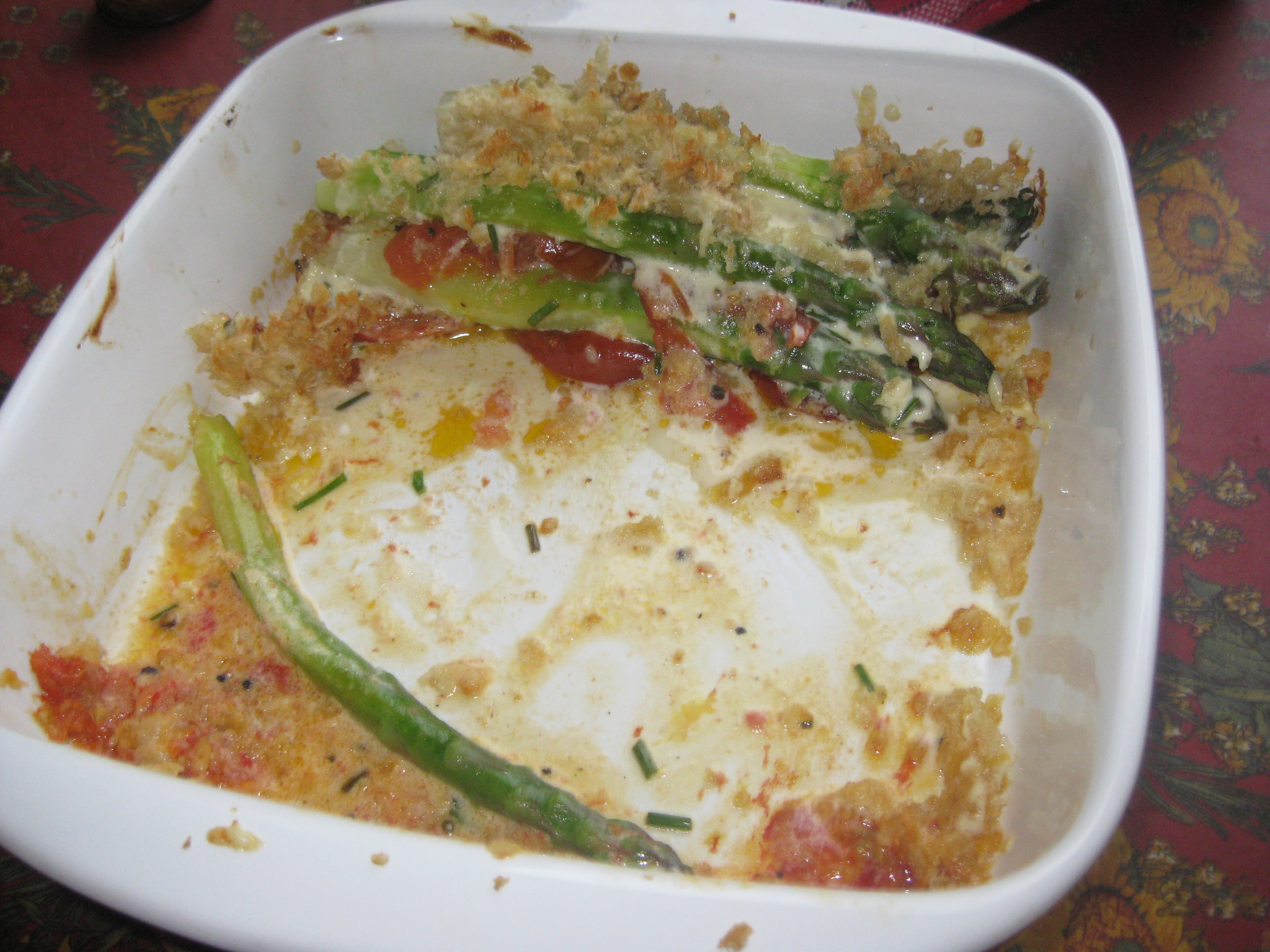
Just enough for a second helping?
Alternatively (and this is more my style), arrange the ingredients in an oven dish instead of individual plates, and bake for 10 minutes until the cream is bubbling and the top is crisped and brown.
This too is a really tasty simple dish, well worth adding to the regular asparagus repertoire.
Um, have you noticed, I still haven’t got round to thinking about those wretched white spears?
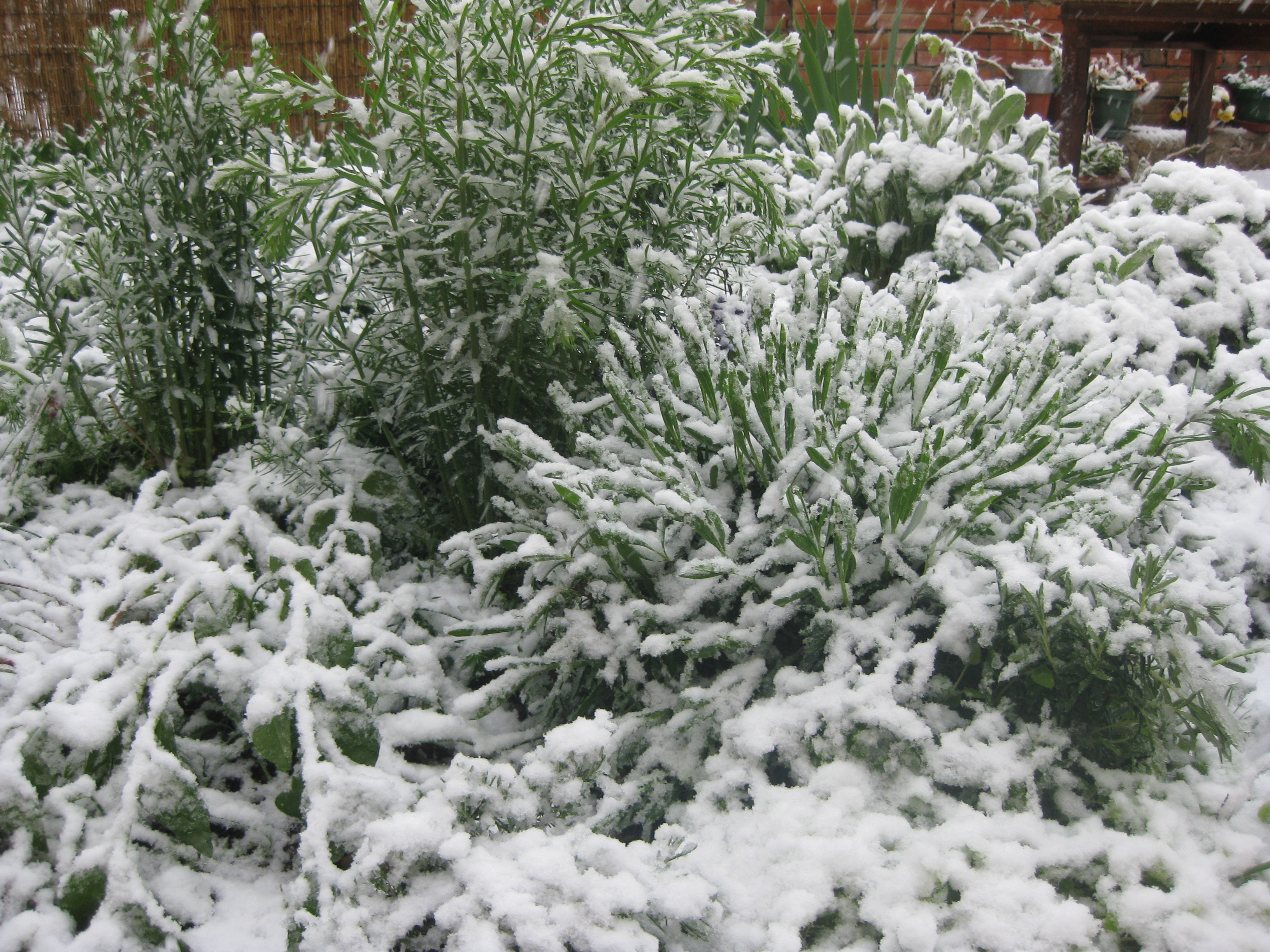
Nothing to do with asparagus. Our garden, south of France, 4th May 2010
How could they? I mean, what ARE they playing at? All last week, and most of this, the baker’s shop down the road has been closed. Instead of rising at 2.00 a.m. to get busy making baguettes, flutes, ficelles, baguettes a l’ancienne, flutes tradition, pain noir, chocolatines, croissants and so on and so on, our bakers have chosen to lie in till – ooh, 7 o’clock perhaps – and then spend the day catching up with their families – the children are on half term.
It’s a family business, our baker’s shop. M & Mme Fonquernie owned it, and now, although officially they’ve retired, they help out all the time .M. Fonquernie is the one who drives his little white van round the local villages which have no shops, selling bread. Their two sons have now taken over the day-to-day baking. One is responsible for all those loaves, while the other specialises in patisserie. Their wives divide the work of running the shop between them with Mme Fonquernie Senior’s help.
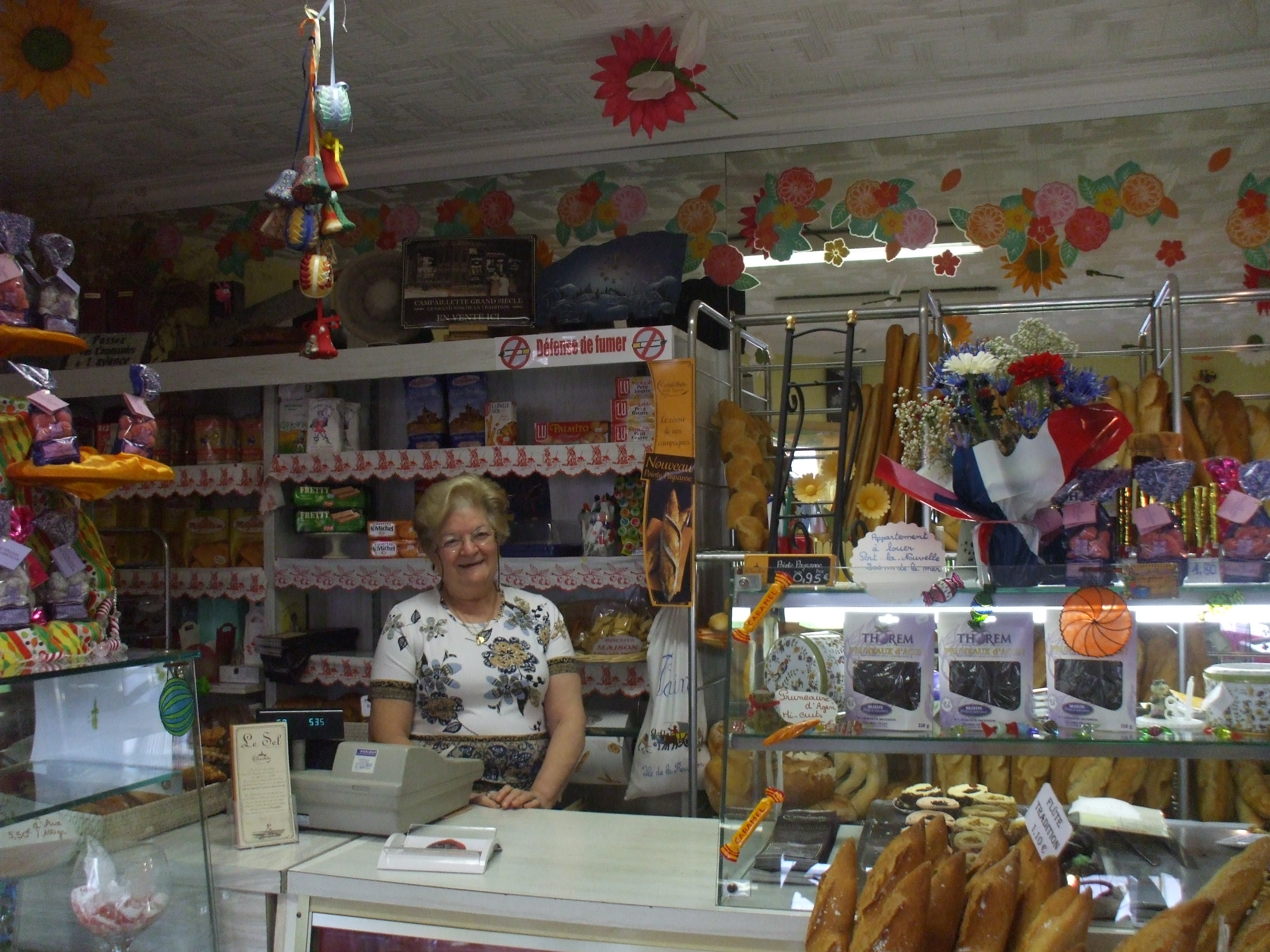
Mme. Fonquernie, Mater Familias
So our morning routine has been disrupted. First thing each day, one of us usually walks down the road to get our favourite pain noir, hot and crisp still from the oven. The other day, the baker forgot the salt. The bread wasn’t half so nice, but I rather liked this very human error. It proved that our loaves are still ‘artisanale’, rather than being churned out by some computer-assisted machine. There’s usually someone in the shop to chat to, or to walk back along the street with, and so neither of us looks on getting the bread in as a chore.
We’re lucky, I suppose, that there are three bakers in town. Last week, we went to the shops at Castellanes to the baker there. No pain noir at this shop, so we chose their unbleached white. The small one’s a slender baguette shape – an Ariegeoise – but buy the larger butch version, and you must ask for an Ariegeois.
But then what happened? A notice appeared in the shop: from Sunday, they too would be closed for a holiday. So for a few days this week, we have to patronise shop number three. Everybody moans ‘C’est pain industriel ça’. It’s true. It comes all the way from Lavelanet, from a bakery which has three shops. That’s mass production, and it shows. Roll on Thursday, when the Fonquernie family re-opens its shop doors
I suspect you can identify with one of the following:
1. You’ve bought, written and probably sent your cards, the presents are organised, and wrapped and sent if they need posting. Wrapping paper’s sorted, the food for the holiday’s under control
OR
2. You’re in panic mode because you’ve only done some, or worse, none of the above.
Consider this.
Mirepoix market, Monday December 7th. I met an acquaintance, a young French guy. I explained that I’d come, although it’s a market I don’t usually visit, to do some Christmas shopping, but I wasn’t being very lucky. ‘Ooh, it’s a bit early yet’, he said. ‘Don’t you think? I expect there’ll be more stuff next week.’
And he could be right. The street decorations might be switched on in the evening too. Just.
It does seem a better way. I really appreciate visiting shops that not only fail to play Jingle-Bells-Dreaming-of-a-White-Christmas on a never-ending loop, but get through the day with no musak at all. Energised by the lack of pre-Christmas stress, I’m actually looking forward to the festival.





 From Pyrenees to Pennines
You must be logged in to post a comment.