Something old, something new

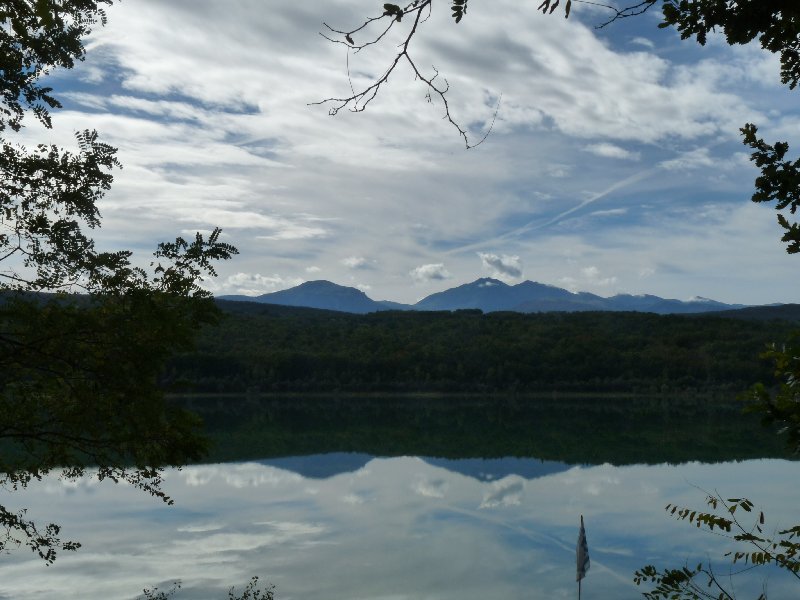
Lac de Montbel from La Régate

Our new friend Jenny-from-Bilbao came for a flying visit late last week, so we did a quick Cook’s Tour of some of our favourite spots.  Roquefixade, of course, Montségur: and then on a bright Autumnal Saturday morning, we finished off by a quick look at our local lake, Montbel.  It’s a man-made reservoir, actually, but it looks as though it’s been there forever, and fish, herons and humans all appreciate its cool expanse of water as a change from all those hills, mountains, rivers and streams.

What a difference a day makes.  Sunday sulked.  It rained in the night, it rained in the morning, grudgingly cleared up, then spent the rest of the day teasing us with odd showers which never quite decided whether to go for a full-blown drenching, or merely hang around as damp atmosphere, cloaking the landscape with fog.

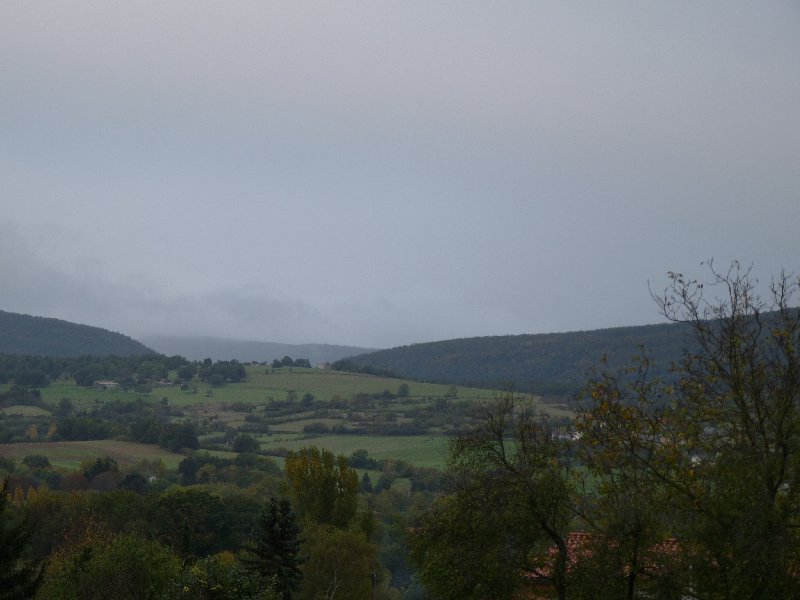
So our planned walk from Croquié, with its promise of stunning views as our reward for a stiff climb was abandoned.  Instead we met at 1.00, we hardy types, and Jean-Charles proposed what I thought was little more than a walk round the block.  ‘Just up to Tabre, along the ridge and back’ he said.  Well, Tabre is the next village along, Mirepoix direction, so that sounded easy enough.  So off we went, along a bosky path, through Tabre, up a hilly climb to great views back to Laroque.  A long and often muddy forest track took us past further views, over the Douctouyre valley, and circled us over and past the next village along from Tabre, Aigues-Vives.  Down we climbed again, and took paths through fields back to Laroque.  A fabulous walk, all 15 km or so of it, and almost every step of it previously unknown to us.  And we pride ourselves on having got to know our patch pretty well.  Thank goodness for local friends who carry on helping us to discover even more.

The path home from Tabre

Prunelles, gratte-culs et champignons…

…  which are, being translated, sloes, rosehips and mushrooms.  But it sounds rather more poetic in French, non?  Even if you take into account that ‘gratte-cul‘ translates as ‘scratch-bum‘, because as every naughty school child knows, rosehips seeds are distressingly itchy when shoved down against the skin.

Chapelle Saint Roch
Chapelle Saint Roch

Anyway, I went off by myself for a walk the other day, starting by the ancient and slightly isolated Chapelle Saint Roch.  There’s still a pilgrimage there every year, because he’s the patron saint of plague victims, and well, you never know, do you?

I’d got several ‘au cas ‘ bags, ‘just in case’ I found sloes, rosehips and mushrooms.  It wasn’t ‘just in case’ really though.  I know exactly where to look for the juiciest sloes, the thorniest rosehips, and even a decent clutch of field mushrooms.  Finding mushrooms before the French get to them counts as a real achievement for me.

It pays to have tough clothes when you hunt among the scratchy brambles for the sloes and hips nearby

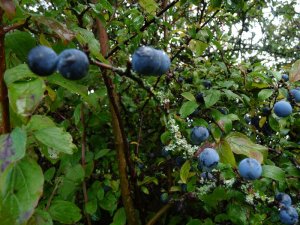
Here are my sloes, destined not for sloe gin this year: we seem to have such a lot left from the last few years.  No, this year I’m making  a richly flavoured jelly with the fruit I picked that morning and a few windfalls.

Sloes waiting to be picked

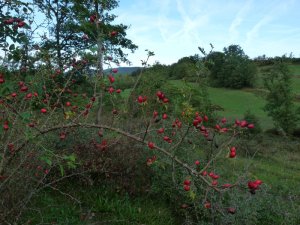
And here are the rosehips.  It’s a syrup for those, I think.

Rosehips with thorns ready for the attack

But the mushrooms……  Someone got there before me.  And it wasn’t a Frenchman .  Grrr.

I didn't know slugs ate mushrooms
I didn’t know slugs ate mushrooms

‘Not all those who wander are lost.’* But we were….

On Sundays we walk, with our friends from Laroque.  This time though, Malcolm and I were cramming in something else too: an afternoon birthday party right at the other end of the Ariège.

This was the plan. Walking Party A (which included me) set off at 8.00 a.m. to do a walk from Lieurac to Roquefort-les-Cascades, where we were to meet Party B (including Malcolm) for lunch. Party B consisted of the temporarily halt and lame, as well as Marcel, whose bread hadn’t finished baking by the time we left.  ETA for us all, 11.30.  At which point M & I would have made our excuses and left for the birthday party.

We did fine, we keenies in Walking Party A.  We walked past Rapy, Ilhat, Tanière, glad of the frequently wooded and well-signposted paths, and all went well till Bac d’en Haut.  There was a choice of routes which we discussed at length as we studied the map and made our choice, though we agreed it was an obvious one.

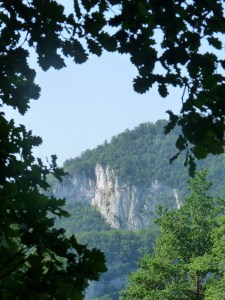
View towards Rapy
View towards Rapy

In due course it became clear that it was not obvious at all.  Instead of climbing up about 250m, then descending, we went on up…. and up… and up.  We’d been due to meet Party B at about 11.30, but midday came and went, 12.20, 12.30, 12.40… and then we came out of the woods to be confronted by a sight just behind us to the right. Roquefixade, a beauty spot really rather a long way from Roquefort-les Cascades.  Even if you’re a crow.  But if you use the paths, or even worse the roads, it’s absolute miles (19 km. actually.  It involves doing the two longer sides of a triangle).  We rang every member of group B who had a mobile.  Nobody responded.  We concluded there was ‘pas de reseau’ but wondered why at least one of them didn’t get into a reception area and ring us.

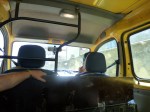
My view from the back of the van.

In the end, one of our group rang her husband, and he came to take some to Laroque to collect a rescue car, and others of us on to Roquefort. He didn’t drive a comfortable family saloon.  Oh no.  Our walking companion Corinne had that.  He had the bright yellow van he uses for hunting.  Behind the front seats was a compartment prickly with fresh straw where he and his fellow-hunters accommodate any wild boar they succeed in catching.  I was one of the ones who … er …. drew the short straw and travelled in the wild boar compartment.

By the time we climbed aboard it was…. 1.40.  By the time we reached Roquefort, it was well after 2.00.  By the time the rescue car arrived with the remaining walkers, it was well after 2.30.

Meanwhile I rang our hostess and warned her we might not be able to get to the party.  It didn’t take too long for ‘might not’ to become ‘can’t’.  Hot, sweaty, and with no time to go home for a shower, I don’t think we’d have been entirely welcome.

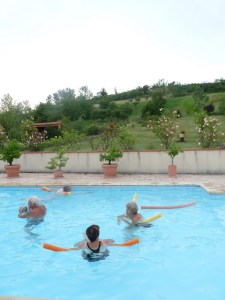
So we stayed with our friends from Laroque.  A picnic lunch, then home for that shower, before going round to the home of Michel and Annick, who have a pool.

P1050494

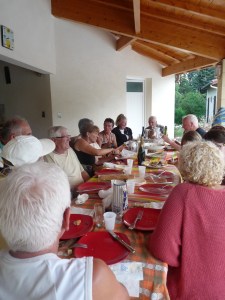
A refreshing swim, an ‘auberge espagnole’ (pot luck supper) and a glass or two of wine soon helped us reframe our day of not-very-brilliant navigating skills into a yarn that will no doubt go down in the annals of the group. It was just a shame about that party.

'Auberge espagnole'
‘Auberge espagnole’

*JRR Tolkein: ‘The Fellowship of the Ring’

Monks, marble, and a look-alike church

This slideshow requires JavaScript.

Here in Laroque , we have a Commission du Patrimoine, attached to the town council.  It has many enthusiastic and knowledgeable members who seek to preserve, restore and celebrate certain historic buildings, who manage the municipal archives, who research (for instance) the history of the area’s farms and who organise exhibitions.  It has other members who are like me, frankly, free-loaders.  We trot along to meetings but have little expertise to offer.  But we were all in favour of the day out organised last Saturday.

We started off in Caunes-Minervois, a small town in the Aude.  Most of us associate the Minervois with wine production, and we’re not wrong.    I didn’t know though that near Caunes Minervois there are important marble quarries, worked since Roman times.  It seems half the important buildings in Paris sourced their marble there … the Louvre, les Invalides, l’Opéra…. and then there are Fontainebleu and Versailles too.   It rivals Carrara in importance and marble is quarried here still: many colours, but mainly a rather plummy pink.

We came though to visit the Benedictine Abbey.  There’s been an abbey here since 790, and though the Carolingian buildings have long gone, the crypt, with early sarcophagi, remains beneath the present church.  It’s a rotten site  for a church in many ways, prone to an excess of water immediately below ground, so the four Christian martyrs whose relics are venerated here are targets for prayer that drought should not strike.  Have devotees been praying just a little too fervently this year?

The Abbey has had a long and complex religious and political history which you can read about here. We started by visiting the 17th century cloisters, austere and simple, as befits a building used by the Benedictine order. Then there’s another vaulted room in the complex with an interesting feature. Stand in a corner and whisper your confession, and the sound will travel up to the roof, over and down the other side into the ear of the listening priest.  He will be able to offer you absolution by whispering from his corner, in the knowledge that if you are carrying the plague, or some other contagious disease he’s at a safe distance from you.  We all tried it.  It works – the whispering that is.

The abbey became simply a parish church at the time of the French Revolution. From outside, it’s a fine Romanesque and early Gothic building, in a spacious uncluttered setting – the buildings that used to huddle up to it have been removed.  Within, it’s a temple to the local marble, and to that of Carrara: there are even Italian statues owing something to the school of Michelangelo.  Much of the former monastery is now used as space for art exhibitions.

Then it was off to lunch.  Another treat.  Not far from the village is another small  church, Notre Dame du Cros.  It’s in a splendid setting, in a gorge surrounded by craggy rocks.  Stone tables and benches were there beneath the shady plane trees and we had one of those shared picnics the French do so well: home made apéritifs, home cured sausage, home made pies and cakes, home grown fruit, wine…..

And then it was time for the look-alike church.  Still in the Minervois, there’s another village, Puicheric.  Its parish church bears a remarkable resemblance to ours here in Laroque.  Hence our visit.  Puicheric’s church, though, has a more intimate, homely feel.  This turns out to be because during the 19th century, those responsible for the church at Laroque had delusions of grandeur, encouraged by the likes of Viollet-le-Duc who promoted Gothic architecture in buildings where such features had never previously existed.  The roof height was raised, at vast expense, to create a more ‘Gothic’ feel to the building.

Nevertheless, Notre-Dame de Puicheric has a claim to fame as a place of pilgrimage.  Back in 1700 a marble staue of the Madonna was being shipped from Italy along the Canal du Midi, past Puicheric, bound for some fine church in Aquitaine.  Once in Puicheric, the barge could go no further, detained by some irresistible force.  The statue was taken to the church, and there it remains to this day, an object of veneration.

And then there’s the château.  Laroque had a castle once too, and we still have the odd remaining bit of wall.  Simon de Montfort saw that off, as so many other things round here.  Puicheric’s still looks very imposing – from round the back.  From the other side, what you get is a rather splendid chambres d’hôtes.  It had an aristocratic past, though much of the original site was destroyed by our very own Black Prince in 1355.  It housed the nobility until the French Revolution and then passed into the hands of a family with whom it remained until 1990.  Now it’s the home and business of Dominica and Phillippe Gouze, who aim to offer modern hospitality whilst retaining all those elements from the 16th, 17th and 18th centuries and long before that which inform its character.  We were seduced by the garden, the views, the ancient tower with a faded fresco of someone doing something dreadful to a dragon, and by the story-telling powers of our host.

While we were there, we could have seen so much more, as clicking through the links would reveal.  But that will have to be for another day ….  or two ….. or three.

To view any of the pictures in a larger format, simply click on the image.
The house in Laroque, 10 years on

I was going to post some photos of the bathroom, now it’s done.  But I seem to be unable to take good shots – not only of the bathroom, but of any room in the house.  Whether it’s the gloomy weather, or the fact that I have taken on the local failure to offer convincing visual ‘marketing’ of any house advertised courtesy of an estate agent I don’t know.  The fact remains I’m not pleased with a single shot.

Inadequate as they are, however, I’ll post a few, together with a selection of photos taken in the very early days of our ownership.  We bought this house exactly 10 years ago, though we’ve lived here only six.  When you look at the ‘before’ shots, you’ll wonder why we ever bought it.

It was, quite simply, a ‘coup de cœur’.  We loved the old woodwork, the spacious rooms, and the way the house had evolved, higgledy-piggledy, over the years as the needs of its owners changed.

And you may understand why getting to the ‘after’ has taken so very long.  We do have more photos of the really bad old days.  I’ll  dig them out and post them one day soon.  They may horrify you.

But back to the  bathroom again.  It’s maybe 5 years since we enlisted the help of a local plumber to get the ancient cast-iron bath out.  As he chipped and broke tiling in a whole lot of places besides the bathroom, he’s not been asked back.  Getting off tiling that had been cemented to the walls was a whole other saga.  So was straightening the walls.  So was dealing with the fact that the ancient steel pipework was deeply – deeply – embedded in inches of concrete that several friends and two different sets of plumbers, all with heavy-duty drills, failed to excavate.  Continuing to use it was not an option, as it had got lined with decades of detritus, and emptying so much as a washbasin could take an hour or more.  Eventually, we had new piping constructed alongside, and had to box it in.

One way or another, as real life got in the way, there were long pauses between each phase of bathroom construction, and it’s only today we can finally declare it officially open (though in the manner of all such official openings, we’ve actually been using it for some weeks, slightly unfinished).

In among we: refurbished 4 bedrooms and the living room; made a study from a lumber room with rough-plastered walls that had never been used as living space; made a shower room from a nasty corridor housing a museum-piece toilet; refurbished a kitchen; arted up the atelier; knocked down storage huts in the yard and created a ‘relaxing outdoor living environment’, as a certain Harrogate estate agent prefers to call a garden; made the roof terrace another pleasant place to idle away an afternoon or evening; made two storage rooms from the old shop cold rooms; smartened up the garage: re-worked the downstairs washroom – all with or without the great help of friends, neighbours, professionals.

Time for a rest then?  Nope.  Games room next, we think.  Unless it’s time really to get to grips with the atelier.

Café society

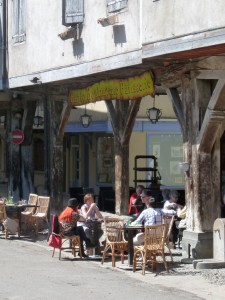
A table in the sun, a moment shared with friends... French café life in the traditional style.
A table in the sun, a moment shared with friends… French café life in the traditional style.

Think of your last holiday in France, and it’ll probably include memories of a morning coffee and croissant in a cosy little bar, or of relaxing and people-watching with an evening pastis, sitting outside a café in some pretty sunlit square.   Hang on to those memories.

In 1960, France had 200,000 cafés and bars. Now there are fewer than 40,000.  Those characterful smoky rooms with dark wooden furnishings, and solitary men sitting at the bar nursing an early morning brandy are an endangered species.  All over France, cafés are closing at the rate of about 10 a week.  Blame TV, blame the smoking ban, , blame ‘la crise’, blame readily available alcohol in the supermarket.  Whatever the reason, many cafés can no longer make a go of it.

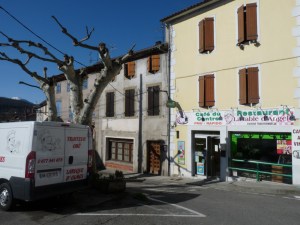
Take Laroque.  Our town of 2000 or so used to support more than half a dozen bars.  Now there are three, and they struggle.  Obé – that’s what everyone calls our Obelix look-alike – can’t make a living from half a dozen elderly men who come in most afternoons to nurse a single beer while they watch the afternoon’s horse racing.  But he can cook, so he’s reinvented the bar as Table d’Angèle, a successful lunch-time restaurant serving home-cooking, mainly to tradesmen looking for a once-a-week treat to break up a day’s plumbing, building or electrical work.

There we are.  That's Table d’Angèle.  And there's Obé's van.  He needs to offer outside catering too to bring home the bacon.
There we are. That’s Table d’Angèle. And there’s Obé’s van. He needs to offer outside catering too to bring home the bacon.

Down at Le Lounge, the owners have had to have a different strategy: food didn’t work for them.  They tried a traditional menu.  No good.  Then they had a go at offering an eat-all-you-can buffet.  When that failed, they tried Italian food.  Now there’s no lunch-time menu at all.  They make do with weekend trade, when sparkly lights and disco music attract the young people of the area before they head off for the Orient Express, the out-of-town nightclub at the once-upon-a-time station.

The Jingo’s still looking just about OK.  It’s on the main road and seems to get a steady enough stream of customers.  It may outlive the rest.

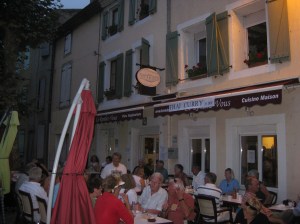
But bars can rise as well as fall.  When le Rendez-Vous in Léran, the village next door, came up for sale a few years back it was a hopeless case: dingy, unpopular and seemingly beyond rescue.  But an English couple who’d never run a bar in their lives bought it and made it the hub of village life.  Shirley cooks with imagination and flair – she even has that unknown round here menu item, the vegetarian dish.  Marek’s a cheerful and extremely hard-working host who’s always pleased to see you.  Quiz nights, open mic nights, a big screen to watch the rugby, a cosy corner with books to read and exchange….  It’s a winning formula, and both French and English from the village and beyond ensure the bar’s kept busy late into the evening, especially in the summer.

Le Rendez-Vous one busy evening in mid-summer.  There's an evening market in town too.
Le Rendez-Vous one busy evening in mid-summer. There’s an evening market in town too.

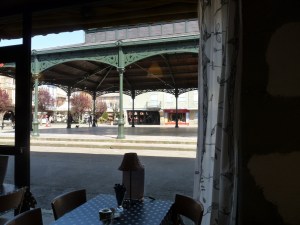
And over in Mirepoix, there’s another new café.  The Mad Hatter isn’t just another bar.  It’s hoping to cash in on the French love affair with things ‘so British’.  A nice cup of tea with a scone or slice of ginger cake might not be traditional French fare.  But it’s a welcome addition to café society, and yet another way in which the traditional French bar has to change, or sink without trace.

A welcome moment of calm, gazing out of the window over a cup of Earl Grey at The Mad Hatter, Mirepoix.

Laroque: a town tour

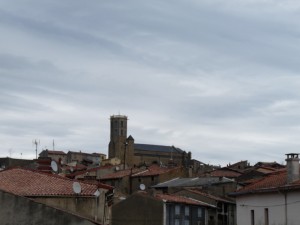
Laroque: a roofscape.

Here you are reading my blog: and the chances are that you’ve never visited Laroque.

Let’s go for a stroll then, and get to know the place a bit.  You may think, when you’ve seen the photos, that the town is quite shabby-chic.  It’s not.  For the most part, Laroque is just plain shabby.  It’s going through tough times, and it shows.  Underneath it all, though, are characterful buildings, streets with a story, and even places that are enjoying a prosperous renaissance.  Let’s set off from our house at the edge of the old town, and walk up Rue de la Joie……

The loto evening

APEM posterNot getting out enough?  Bored by those long winter evenings at home?  Do like the French.  Go out to a loto evening.

Loto – bingo or lotto to you – is the astonishingly popular pastime of seemingly half the local population.  Last weekend we could have gone on Friday to a session at the next door village of Aigues-Vives, stayed in Laroque for more of the same on Saturday, and then gone to Lavelanet on Sunday afternoon for yet another action-packed few hours.

Somehow, we’d so far managed to avoid being roped in.  Until last Saturday.  Well, the Loto in Laroque was to fundraise for the Ecole de Musique, and the organ teacher Vanessa’s Organ fund.

So what’s an evening at the Loto actually like?

You’ll arrive to find ranks and ranks of tables set out.  You’ll need to buy your Loto cards – and spend hours choosing your lucky set.  First mistake: we just took the top few.  If you know what you’re doing  – we didn’t – you’ll have brought a bag of counters with you to cover the called-out numbers.  Settle down with your friends and family, buy some crêpes or a slice or two of home-made cake to pass the time, and wait for the action.

And at 9 o’clock, it all begins.  Nearly four hours of heads-down, as the loto numbers are called out.  What you’re aiming for at different points in the evening is a full line (‘quine’) or a full card (‘carton plein’).  And if you achieve one of these feats, the winnings are worth having.  A microwave.  An i-pad.  A SatNav.  A flat-screen TV. A food processor. Half a pig.  Several ducks (To cook.  Not to take home and rear in your back yard).  A weekly-shop’s worth of vouchers to spend in a local shop.  A free meal in a local restaurant.  A hairdo.  Local businesses are incredibly generous with their donations – more so when you consider how very often they must be asked.  Yet our Asso. also invested about 800 euros in the judicious purchase over many months, of high-end prizes.  Only decent makes need apply.  No dubious bits of equipment from some unknown factory in China.  To make good money on these evenings, the organisers have to spend, spend, spend.

Naturally, Malcolm and I won nothing, so time hung a bit heavy: we had to concentrate to be sure of filling our cards correctly (‘soixante quatorze: quatre vingt dix: soixante dix-neuf’.  No ‘Clickety-click, 66, Two fat ladies 88’ to help us out here).  Chatting the night away not an option – this is serious stuff.  The friends we were with were no more enthusiastic than we were.  We’d all come to support the cause.

At about 12.45, the very last numbers were called.  Nobody, not elderly inhabitants, not young parents, nor their – often tiny – children, had pushed off early.  But one lucky group of women trundled home with some difficulty: they’d won four major prizes.  But they wouldn’t have got lost on the way home.  One of their prizes was a SatNav.

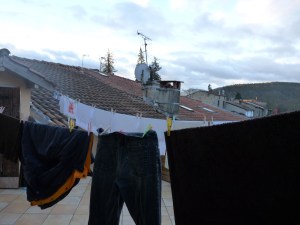
A view from the washing line

Out on the roof terrace

There’s a blog I read.  Its author is a writer, a teacher, a mother, probably not in that order.  She loves people, words, conversations.  She’s enthusiastic, encouraging, and loves life.  She might be exhausting to live with: she’s exhausting to follow, because she’s constantly throwing out challenges.  What, she mused recently, makes you joyful?  Well, Renée Schulz-Jacobson, this is what.

It’s hanging out the washing.  And bringing it in at the end of the day.  How sad is that?

All hung out for the day

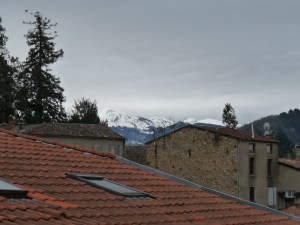
Every day, these simple acts raise my spirits.  We dry our washing out on our roof terrace.  From here, we can see the nearby peaks of the Pyrenees, covered in crystal white snow for half the year.

Zooming in on the cock  over the water
Zooming in on the cock over the water

Across the river just beyond our house, a neighbour keeps hens, and I enjoy watching them fossicking about for grubs and cabbage stalks.  Sometimes the heron swoops along the river while I’m there, and lands near the weir to look for breakfast or supper.  The morning air is cold, fresh and energising.  Actually, at this time of year it can be ****** freezing, in which case I’ll run down and warm myself afterwards by the wood burning stove.

It’s the evening though, when the washing is dry, sweet-smelling and ready for folding and hanging (carefully done, so there’s no need for any ironing) that I’m happiest here.  I’ll listen to the birds chattering and singing.  I’ll check up on those hens again.  But best of all, I’ll watch the sun setting.

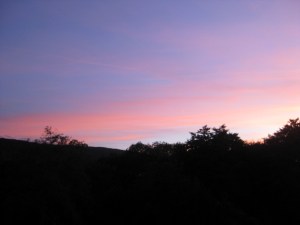
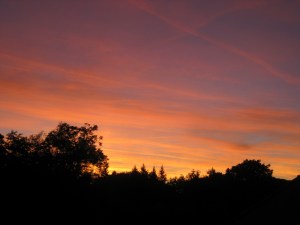
A subtle sunset
A subtle sunset

The sky will turn from vivid blue, through rusted orange and citrus yellow, to navy blues and bruised purples.  The snow on the mountains will change from sparkling white to ice-blue and then the subtlest shade of grey.  Suddenly, the sun will drop from sight behind the trees, and for a few minutes longer the palette of colours becomes moodier before giving over to shadowy moleskin grey.  Then the stars appear and later, the swooping, chirruping bats.  I’ll be back indoors by then, my mood invariably lifted by the simple pleasure of watching as the sun puts on its daily and ever-changing show.

Nearly gone, the sun

.

Charity (shopping) begins in Laroque

Charity shops.  Staple of the British High Street, and a really important source of revenue for many charities.  Some parts of English towns seem to have few other shops these days, and on my visits back to Harrogate and Ripon, that’s where you’ll find me,  stocking up on piles of second-hand books at bargain-basement prices.  And not just books.  I have a classic lovat green Loden coat, much admired by whoever sees it, current selling price anything up to £500, which I found in St. Michael’ Hospice Shop in Harrogate for £10.

So here in France, I miss charity shops.  Emmaüs, the international charity focussing on poverty and homelessness concentrates in its large, warehouse-like shops on quantities of furniture and household goods, and a bit of everything else too, but they’re often away from the town centre.  Our local one in Lavelanet is daunting in size, shabby and a little unappetising.

logo_secours_populaire.jpg 1Secours Populaire here in Laroque, as in many towns, provides a lifeline for families in difficulty. It sells donated clothes and other goods, but it doesn’t advertise itself, and is mainly appreciated by those whom it sets out directly to help.  The branch here is in an upstairs room, and is staffed for one afternoon a week only by a cheery team of volunteers who see no need to market the service they provide to a wider constituency, or to go in for careful artistic displays of the goods on offer.  It’s clearly not a shop in the ordinary everyday sense.

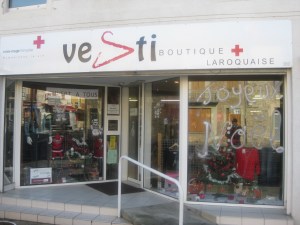
It was a bit of a shock then to realise a few months ago that the shop that was being refurbished up near the cross roads was going to be a Red Cross Charity Shop,  ‘Vestiboutique’.  It opened with a ceremony reported in the local press, and has been trading on 4 afternoons a week.

logo-croix-rougeIt’s a great place.  As in England, there’s a mixture of donated goods, and ends-of-line donated by clothing manufacturers.  As in England, the shop window and the stock within have been displayed with taste and care.  In the backroom, donations are mended, cleaned and pressed if necessary, before being put on sale.  Everything second-hand is either one or two euros, the ends-of-line goods very little more.  The day I first went, I found some cheerful trousers, an elegant high-quality pair of ankle boots probably worn only once by their first owner, and a new fleecy hat for winter walks: I parted with 7 euros.

The two members of staff were happy to talk. They’re not volunteers, though they’re not paid much.  They were excited to be part of this new development.  This shop is the only one in the region, and was sited in Laroque to provide a service in an area of economic difficulty.  Trade was brisk they said, and already the shop was much appreciated locally.  I told them about the huge variety of English charity shops, from international charities like theirs, to shops for charities seeking to combat disease or support animals, to hospice shops.  They were astonished, and couldn’t really imagine the picture I was trying to paint in their minds.  Though there are parts of France – Paris for instance – where you’ll find more shops like this, there are no streets like say, Commercial Street in Harrogate, where about a third of the shops now seem to be charity shops.  Vestiboutique, for the time being, is unique in the Pays d’Olmes.

Vestiboutique just before Christmas.