We look forward to Wednesdays. It’s the day when our local shop gets in a delivery of fresh fish. And if you think that getting excited about fish is terminally sad, you haven’t met our friends who live in a hamlet in the Charente. The high spot of their week is the day the rubbish lorry comes.
Still, back to that fish. Generally, I keep things simple with such good quality fresh ingredients. But there are days when only spicy will do. This recipe by Atol Kochhar always hits the spot. Though you may prefer to use only half the chilli paste if you don’t want numbed lips for several hours….It really IS very hot.
When we first understood that Laroque is twinned with Melgven in Brittany, we were nonplussed. Surely twinning arrangements are with England, Germany, Spain – or anywhere abroad. What’s the point in twinning with a town in your own country?
Well, quite a lot as it turns out. As part of the twinning arrangements, citizens from Melgven come for a long weekend here in Laroque , while Laroquais have the chance of a few days’ stay there in May. This year, we signed up for the 10 hour mini-bus trip to Finistère
Straight away, we began to see the differences. As we arrived, we were welcomed to enjoy poking round their fundraising ‘Troc et puces’ fair in the Sports hall. The Bretons are a Celtic race, and it shows in their physical appearance. Meanwhile, down here, there’s a long tradition of Spanish immigration, most recently in the Spanish Civil War, and the Second World War, so many locals here are olive-skinned and not very tall. A tannoyed announcement for M. Garcia and M. Sanchez to report to the desk in a public hall somewhere near here would have nearly half the room scurrying to reception.
And then there’s the food. Brittany, like Britain, favours butter, and unlike the rest of France, the salted variety. Out to a meal on Saturday, the lunchtime bread came with pats of butter, something that never happens down south. In the Ariège, cooking’s done in duck fat, and more recently, olive oil. No part of Finistère is very far from the sea, so fish and seafood are an important part of the diet. Down here, duck in all forms is king. But pork, lamb, game, beef are all welcome on the dinner plate. If it moves, eat it.
When we looked round a market in Concarneau on Saturday, we were struck that there was little charcuterie or cheese on sale, and what there was came from elsewhere. It seems as if every other stall in our local Ariègois markets is one selling cheese and charcuterie, much of it from just a few miles away.
Brittany – cider and beer. Southern France – wine. As part of our welcome apéro, we were served kir made with cassis and cider. After sipping it suspiciously, we accepted refills with enthusiasm.
So…what were the highlights?
The welcome. Of course. Some Laroquais have been going on these exchanges for several years, and the warmth of the relationships forged is clear to see.
A change of scene: the countryside. Our host, Albert, took us on several walks, and we were struck with how very British this part of Brittany looks: softly rolling hillsides, woodland and meadows. We traded orchid spotting in the Ariège for enjoying the swathes of bluebell glades in the woods.
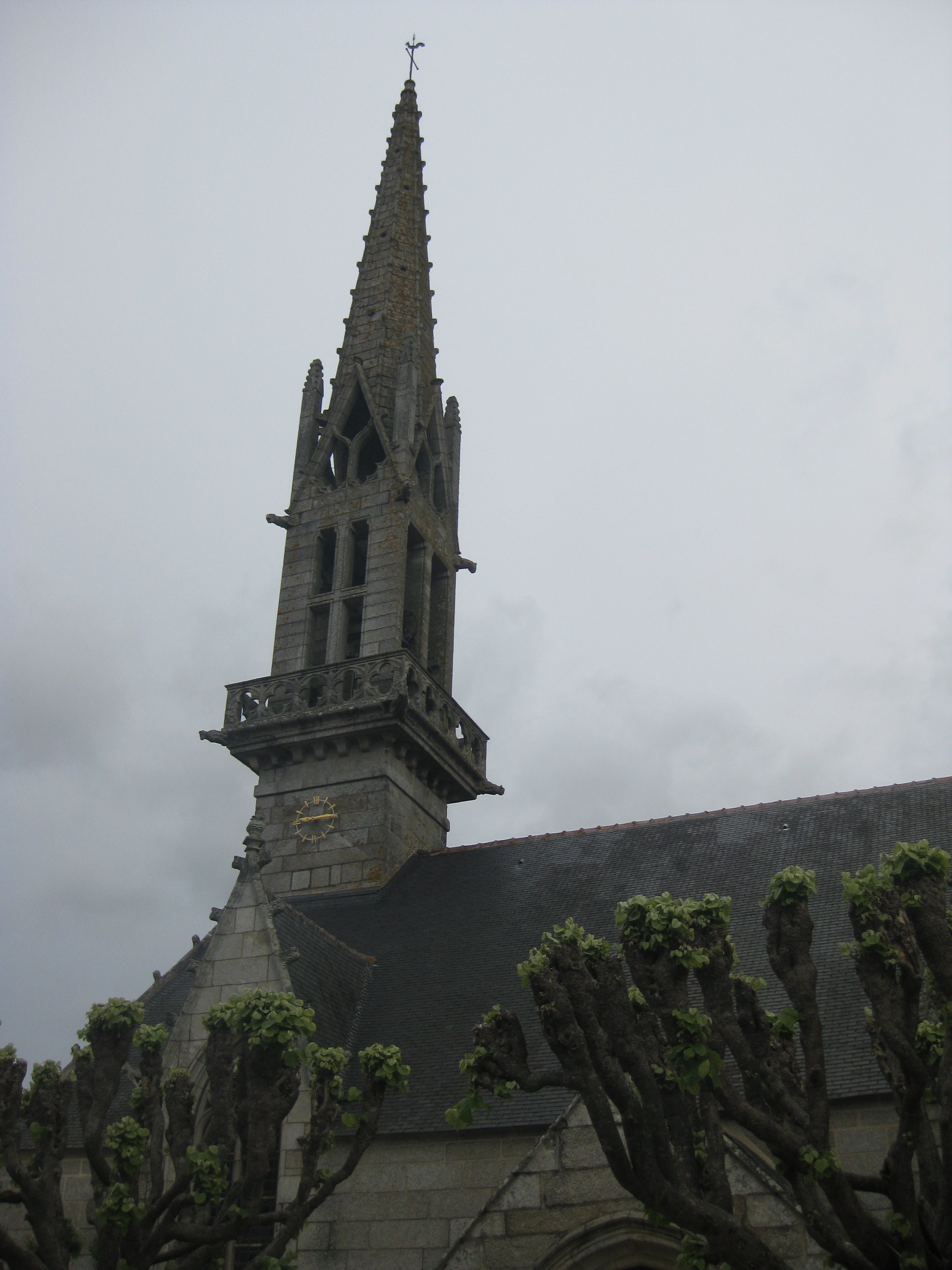
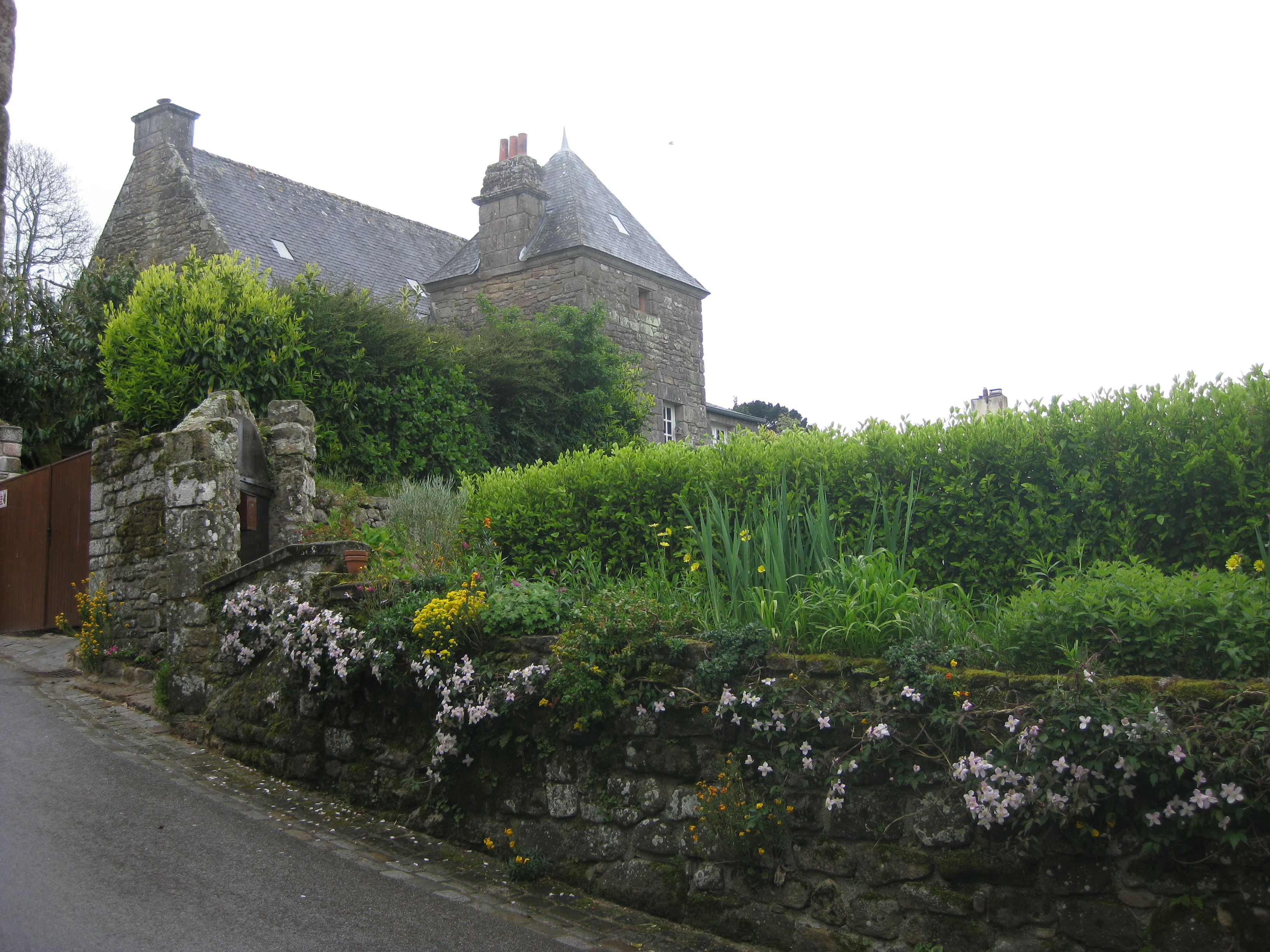
A change of scene: the town. We exchanged the shallow-roofed, unpainted or pastel coloured houses of the south for the tall white narrow pitched roofs of Brittany. Down here, we’re used to our towns and villages being shabby. Brittany’s are clean, sparklingly so, with flower boxes, neat gardens, and a general air of pride in the community. And then there are the churches. No clochers-murs in Brittany, but rather complicated steeples instead.
The seaside. Concarneau was at its sparkling best, with breezes tugging at the flags, clouds pluming across the sky, an early pre-season freshness to the narrow streets of the historic quarter. Their fishing museum there shows all too graphically just how very tough the life of the fisherman was – and is. But it’s a picturesque sight for the tourist
Sightseeing: Our first treat was to visit Locronan, a beautifully preserved granite built 16th & 17th century village, with a mighty central church, and a small chapel at the end of a charming walk.
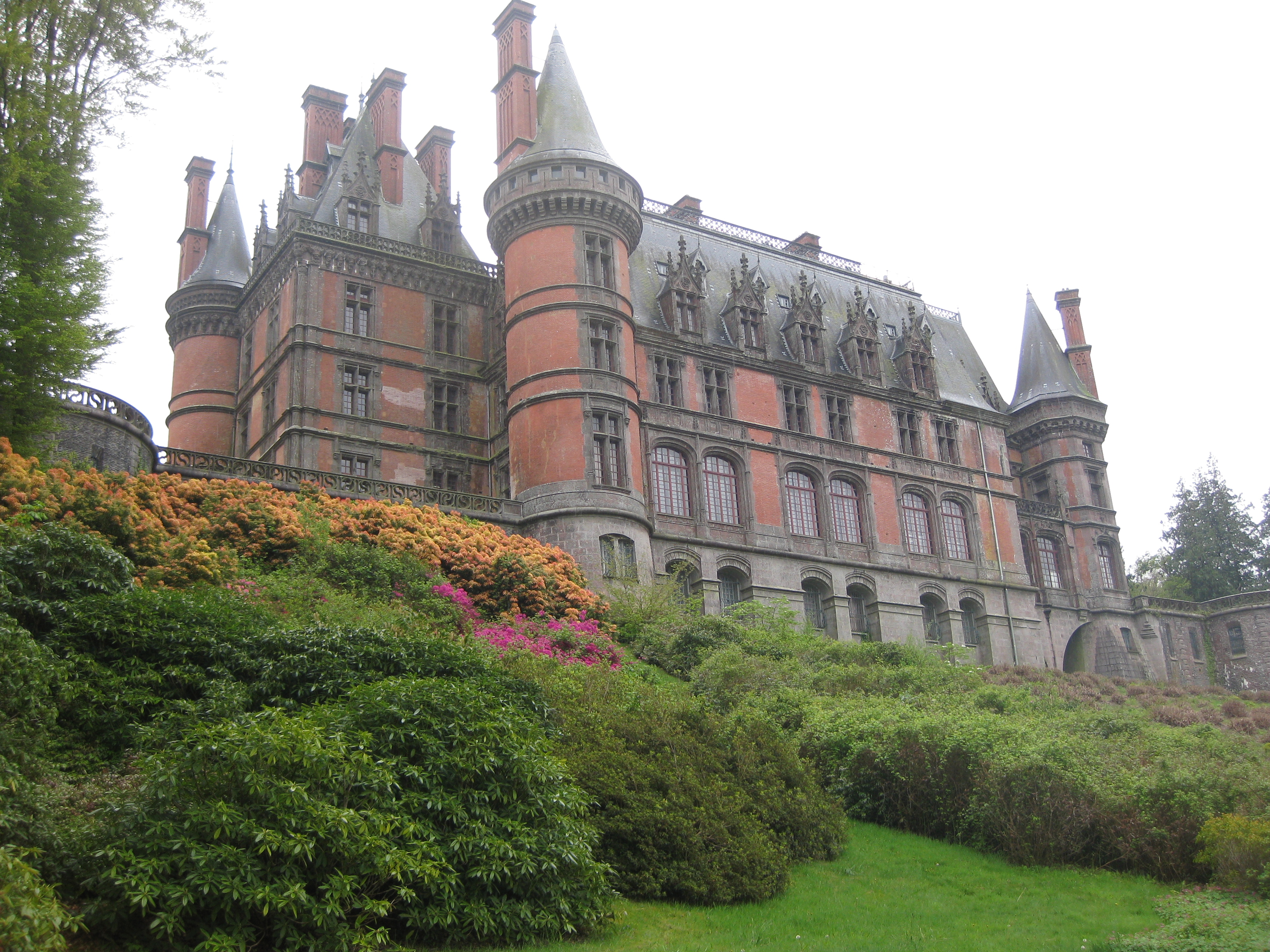
Next was Trévarez, a chateau that might look Gothic, but is in fact a 19th and 20th century construction. Its brickwork gives it the name “château rose”. We spent more time in the gardens though. Apart from a formal area near the house itself, the garden is informal in the style we’re so used to from English stately homes, and glorious at the moment with azaleas and rhododendrons
Celtic music: Friday night was concert night: the chance to listen to an hour or two of traditional Breton music. Malcolm and I particularly enjoyed hearing those favourite Welsh hymns – Land of my Fathers, Cwm Rhondda in Breton– they sounded very different, but just as good
Story telling: Such a treat. Michel Sevellec enchants audiences in Finistère and beyond with his tales drawn from many traditions. On Saturday, as part of a local festival, we joined local children to hear his interpretation of Native American and other stories. Can’t wait for him to come to Laroque in a fortnight!
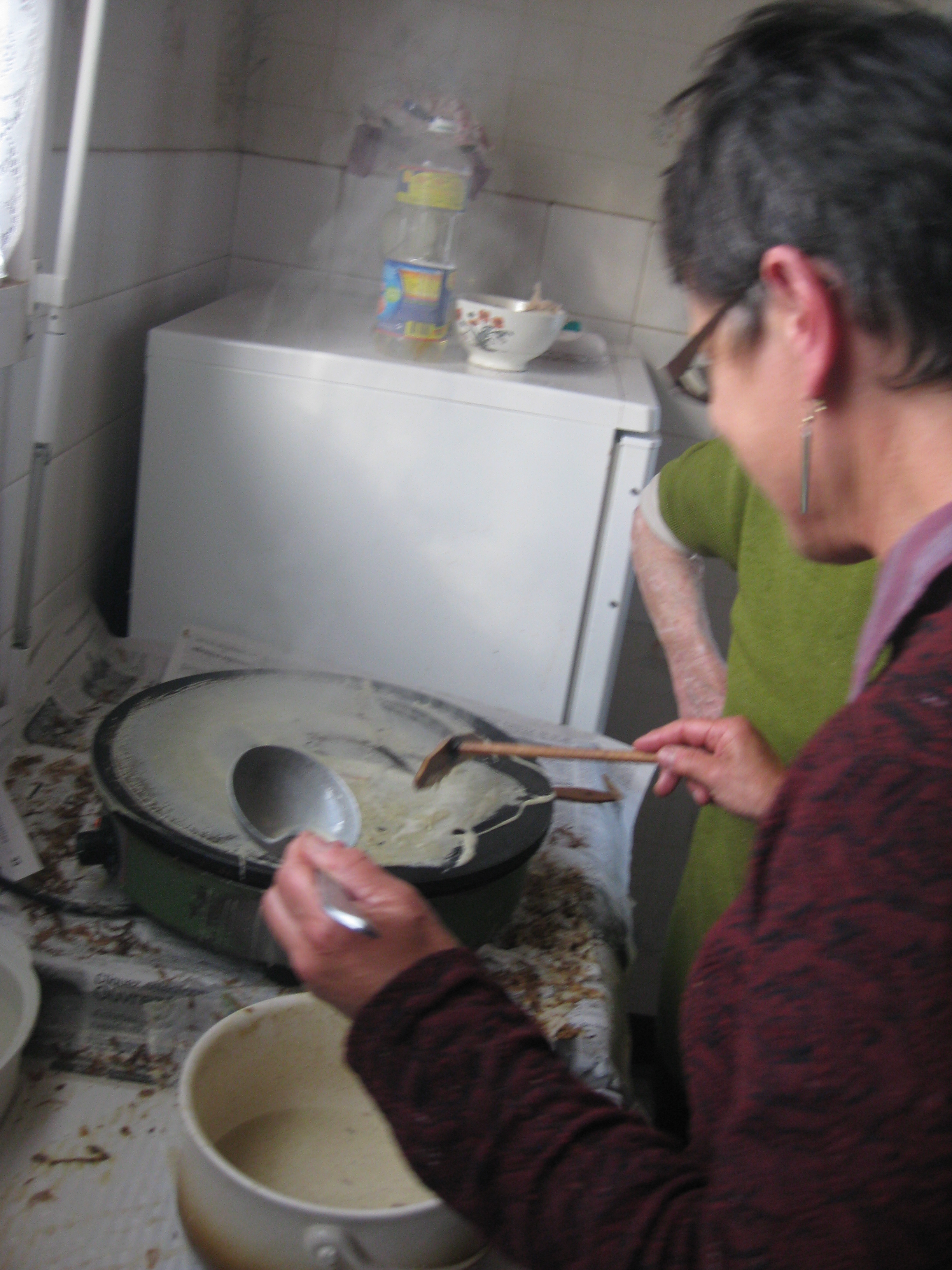
Crêpes:Everyone knows they make crêpes in Brittany. Lots of us have watched them being turned out on those special round hotplates. I always assumed it was easy-peasy. Until we went to eat crêpes at Albert’s mum’s house and she let me have a go. First, carefully pour the batter with your left hand while equally carefully drawing the batter round the plate with a special wooden spatula – not too fast & not too slow, not too thin & not too thick.
Expert at work
Then flip the delicate creation, so thin you could read a newspaper through it, over onto its other side to finish cooking. It was lucky there were hungry dogs to eat all my cast-offs. Lucky for us too perhaps: we’d still be eating them now. Malcolm and I thought 6 crêpes each ought to have been enough for anybody. Our hostess disagreed.
So….we discovered in Brittany an area very different from our own in languages, customs and appearance, and had a chance to be more than simply tourists. We now have new friends in Melgven but also in Laroque as a direct result of this weekend. A good experience.
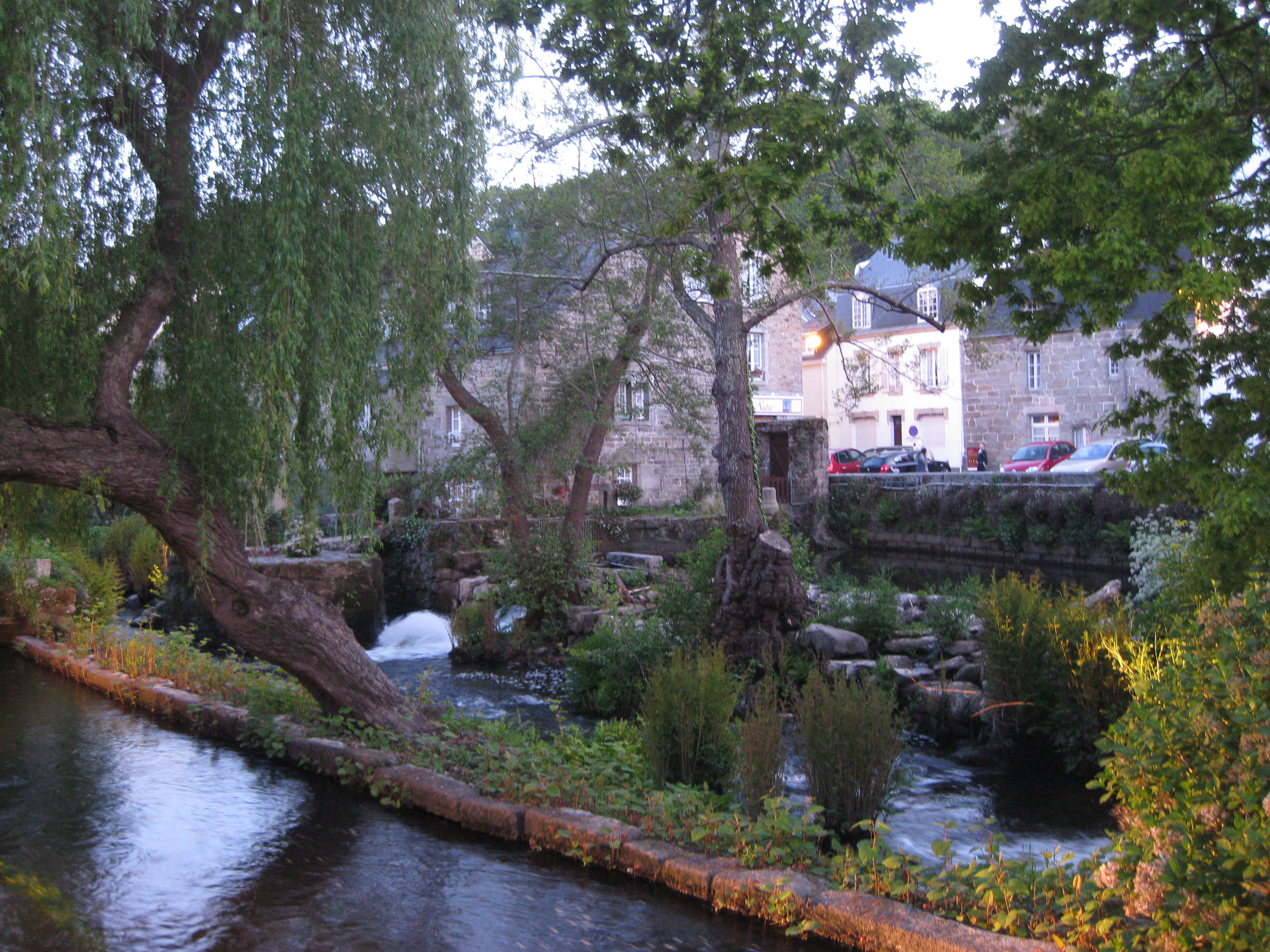
Pont Aven: I didn’t even mention this lovely little town, did I?
Back in the UK, I’ve noticed that in the media, topics, like buses, come in threes. For instance, I’d flick through an article in the second section of the Guardian: maybe about female circumcision, education-other-than-at-school, or some other equally right-on Guardian topic. Two or three days later, listening to say Women’s Hour on Radio 4, they’d be discussing exactly the same subject, with exactly the same slant. Then the following week, maybe on Channel 4, it would appear yet again.
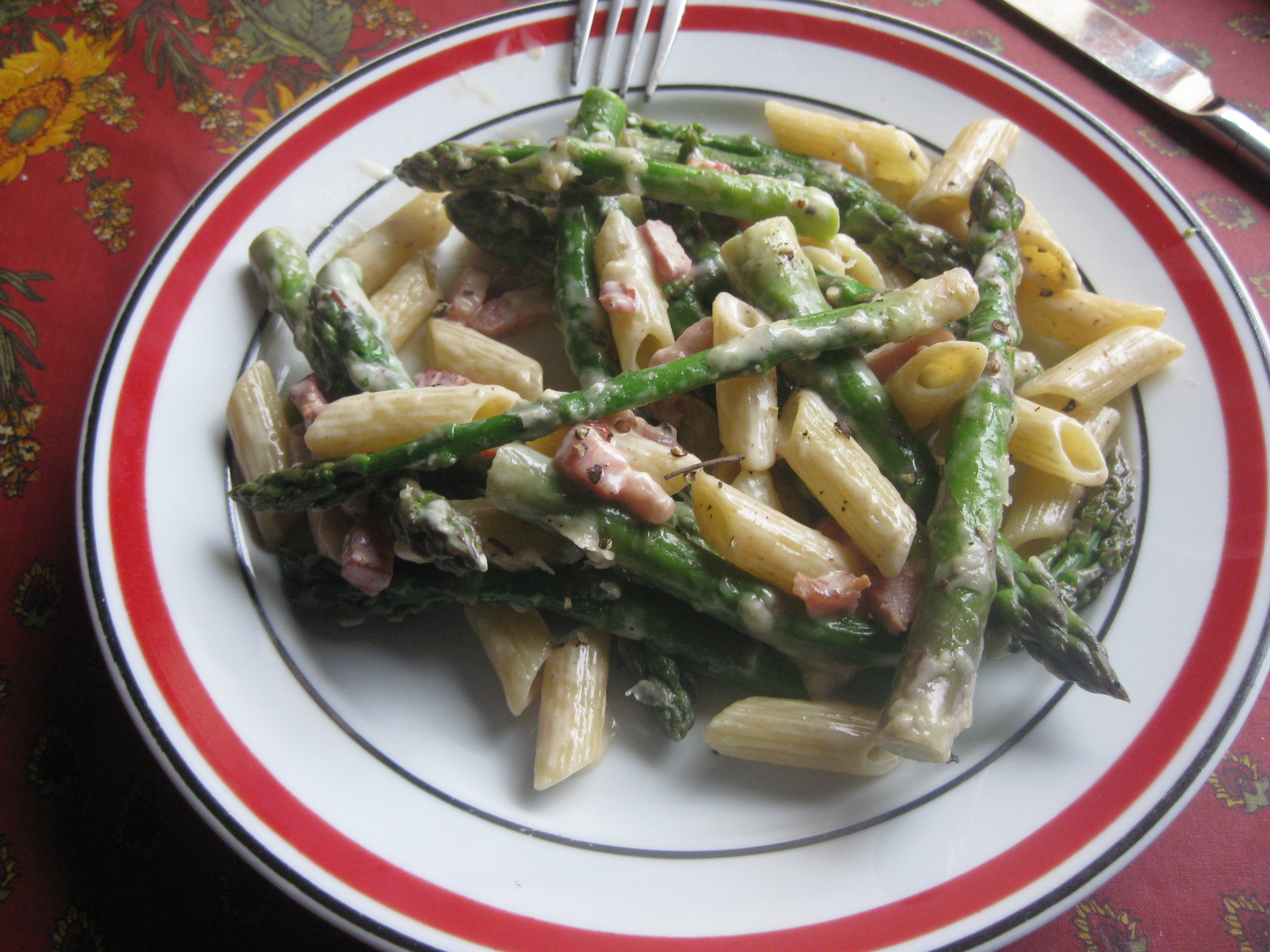
Recipe from Kalba's blog. Recommended.
And so it has been in the world of blogging. On April 24th, Kalba’s blog dropped into my in-box. I complained immediately. It was about asparagus, and I could have written it myself. Not all of it. I’ve never run a restaurant, and I’ve never lived in Norfolk. But like her, I do like green asparagus, the thinner the better: I don’t like the blanched, thick white spears favoured by the French and throughout most of mainland Europe.
Then on the 30th April, Bloggerboy, the writer of my other favourite blog, Welcome Visitor, pitched in with an account of the German love of asparagus. He even convinced me to have another go with the white stuff.
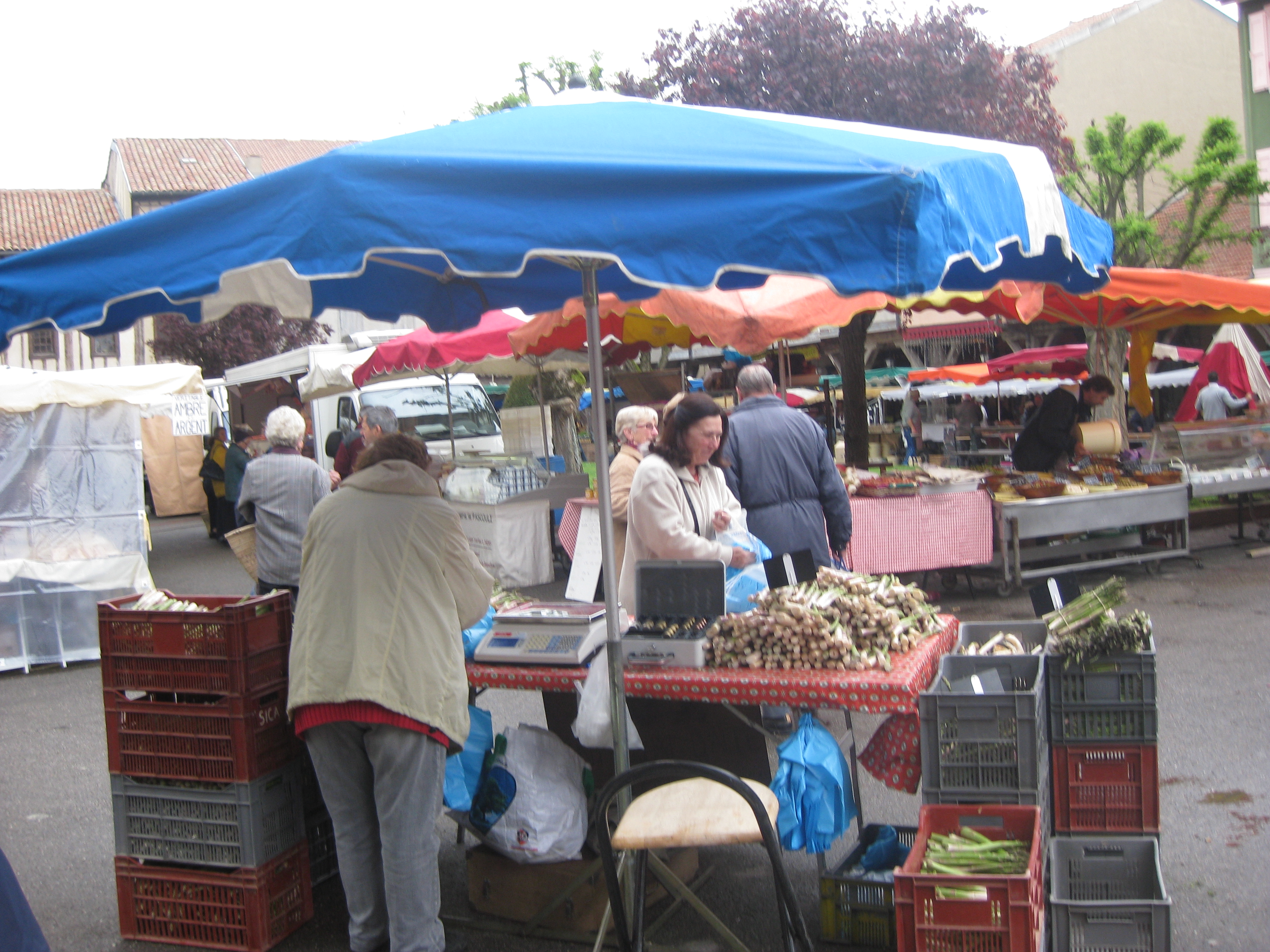
An asparagus stall at Mirepoix
So now it’s my turn to write an asparagus blog. In Mirepoix market yesterday morning there were quite a few asparagus stalls, and I picked the one where I could buy thin and thick green spears, and white too. ‘I’m not too keen on the white spears’, I confided to the stall holder, ‘but I’m sure I must be wrong when you all seem to like them so. How do you like to cook them?’. If I’d expected to have my hand wrung in gratitude at my acknowledgement of his expertise: if I’d expected him to call over his wife to share her culinary tips, I would have been disappointed. What I got was a Gallic shrug. He was mystified by the stupidity of my question. ‘Well, you could use them in tarts, or omelettes. Whatever you like really’. I realised our conversation was at an end.
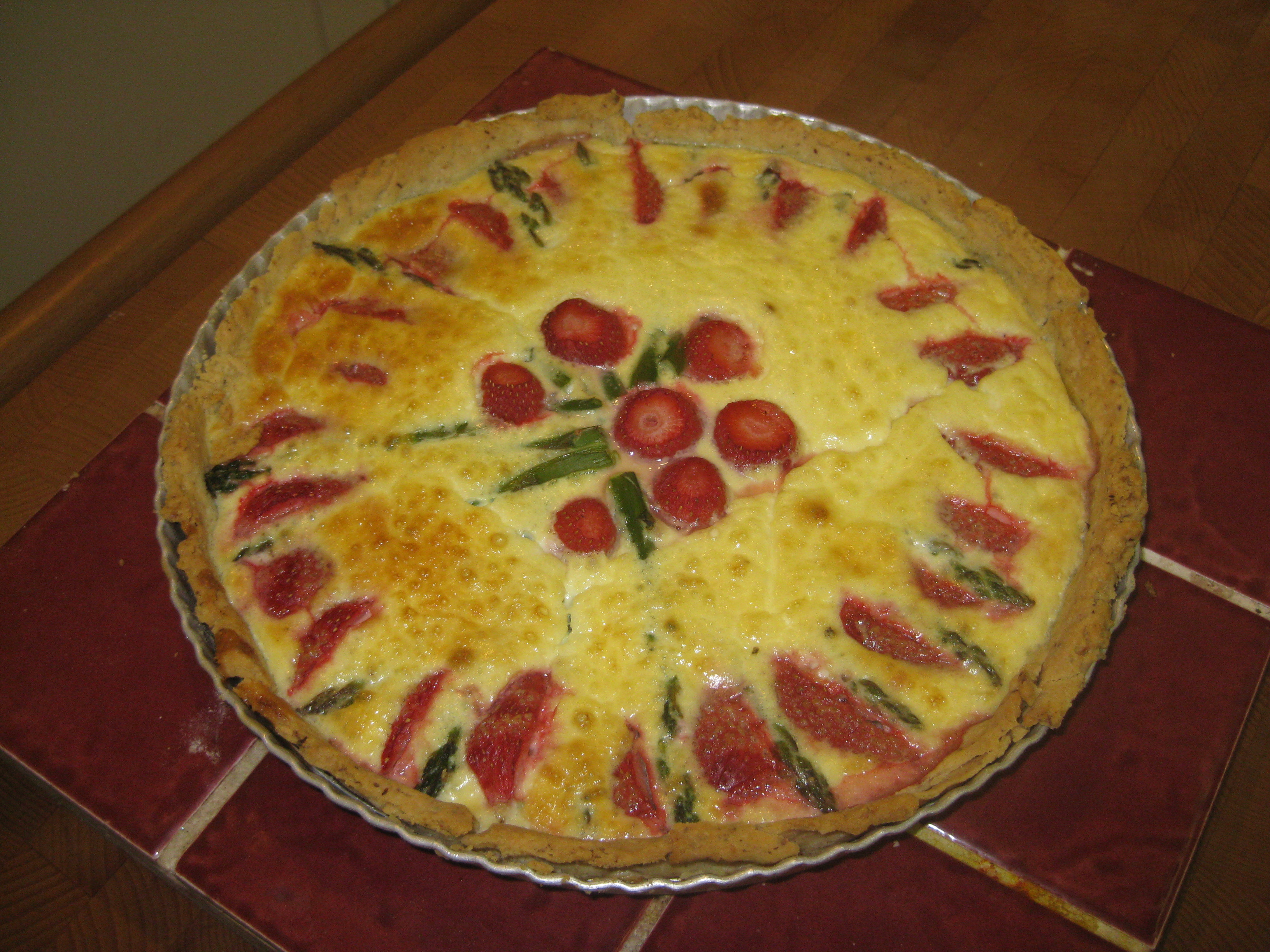
Asparagus & strawberry tart
Luckily, there are recipe books, and there are other blogs. I’ve just tried a suggestion from another blog I enjoy, ‘Chocolate and Zucchini’, which is available in English and French. Asparagus and strawberry tart. A very odd idea indeed, but it works. In fact it was memorably good.
This is what we ate yesterday evening, from Denis Cotter’s wonderful vegetarian book, ‘Paradiso seasons’.
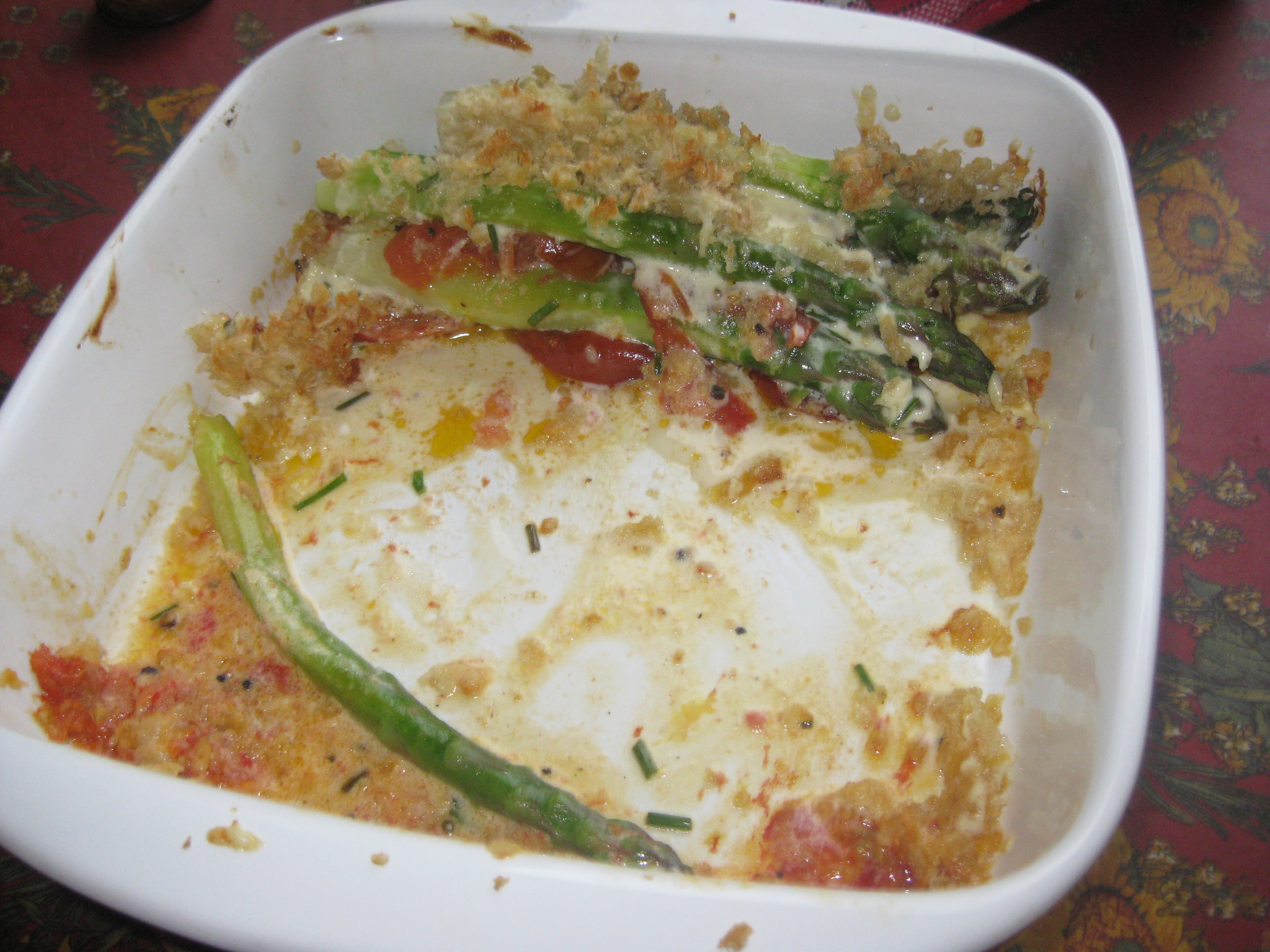
Gratin of Asparagus, Roasted Tomatoes and Gabriel Cheese with Chive and Mustard Cream.
Ingredients – for 2
4 -5 large tomatoes
Salt and pepper, to season
Drizzle of olive oil.
40g. fine breadcrumbs
40 g. Gabriel cheese, finely grated. I can’t get this, unsurprisingly, and maybe you can’t either. Settle for a hard, densely textured cheese.
1 sprig thyme
I tablespoon butter, melted
30 ml. vegetable stock
30 ml. white wine
150 ml. cream
Small bunch of chives, chopped
½ tsp. hot mustard
16 asparagus spears
Heat oven to 190 degrees. Cut tomatoes into 3-4 thick slices each. Place on oven trays lined with baking parchment, season and drizzle with olive oil. Roast until lightly browned and semi-dried – you may need to turn them once.
Mix the breadcrumbs with the thyme, the butter, and most of the cheese. Season.
Boil the stock and the wine until reduced by half. Add the cream and mustard, bring it back to the boil and simmer for 2 – 3 minutes until pouring consistency.
During this time, briefly cook the asparagus.
Heat a grill. On each plate, place 6 slices of tomato, lined up 3 x 2, and cover with 5 asparagus spears. Place a single line of tomatoes on top, then 3 more asparagus spears on top. Spoon a little mustard cream over the top, then finish with a generous sprinkling of the crumble. Cook under a hot grill for 2 – 3 minutes until the cream is bubbling, and the top is crisp and brown. Put remaining cream back on the stove, whisk in the rest of the cheese and chives, and pour round the finished gratins.
Just enough for a second helping?
Alternatively (and this is more my style), arrange the ingredients in an oven dish instead of individual plates, and bake for 10 minutes until the cream is bubbling and the top is crisped and brown.
This too is a really tasty simple dish, well worth adding to the regular asparagus repertoire.
Um, have you noticed, I still haven’t got round to thinking about those wretched white spears?
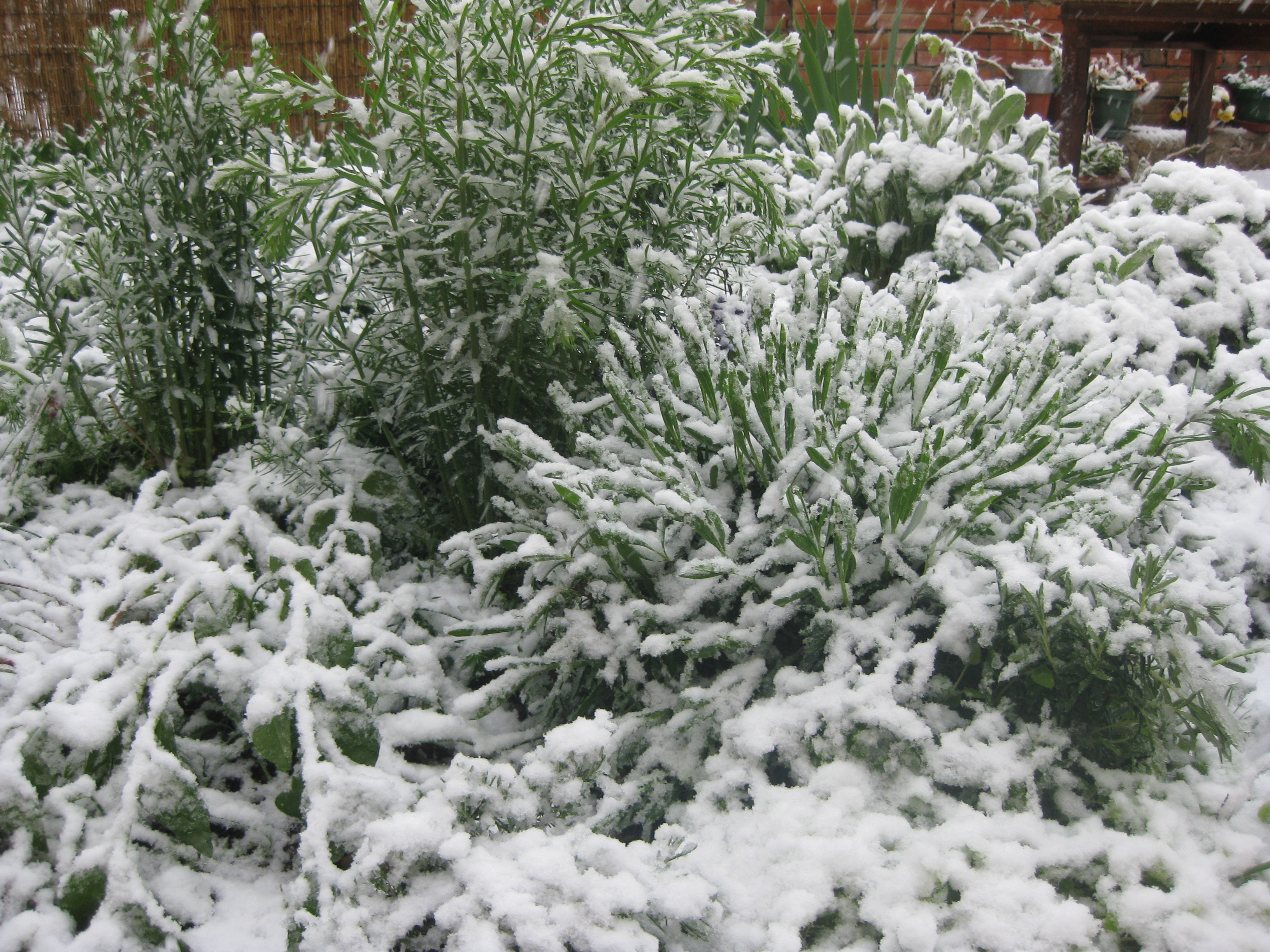
Nothing to do with asparagus. Our garden, south of France, 4th May 2010
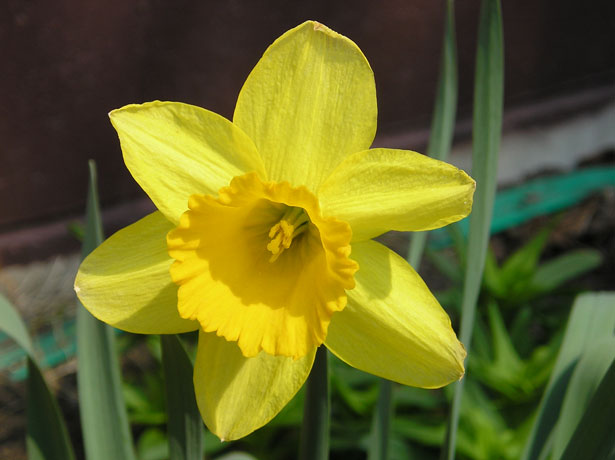
There are two things I especially love about early spring. Daffodils. Purple sprouting broccoli. The French don’t really do either.
Well, that’s not fair. In the woods near here, in a few weeks, there’ll be swathes of delicate, rather pale and lovely daffodils blooming. At weekends, people will go and pick enormous basketsful of them. They’ll take them home and stick the flowers in vases, where they’ll last only a day or two before wilting in the indoor heat. But the civic displays which for me are one of the glories of the UK simply hardly exist here. No dual carriageways are planted with unreasonable quantities of brilliant yellow daffs announcing to every passing motorist ‘Spring is here!’ There are no newspaper headlines ‘Daffodils on the Stray’, featuring a couple of four year olds gambolling among the flowers. No florists or supermarkets here have buckets of blooms ‘3 bunches for £1’. I probably won’t buy any here if I can find them, as they’ll already be open and the joy of watching them unfurl won’t be an option.
Purple sprouting broccoli’s even more unknown. I haven’t even found an exact translation. Like other English here, if I want to eat it, I have to grow it myself, with seed brought over from England. For 9 months of the year, the large ungainly plants occupy more than their fair share of the vegetable plot, and really, half the time I wonder whether it’s worth it. Well, it is. Today, I picked the very first handful of tightly closed purple heads, enclosed in a collar of dark frilly leaves. And now I know that there’ll be enough and to spare for several weeks to come.
Such a special vegetable deserves to be more than a bit part, one of two veg. playing second fiddle to a plate of meat. This is the meal we cooked this evening, thanks to Nigel Slater and his newest book ‘Tender’ (Read it, even if you don’t cook much. It’s as good as a bedtime story, though it WILL make you greedily hungry)
Pasta with Sprouting Broccoli & Cream
250g. sprouting broccoli
250 g. orechiette or fusilli
30g. butter
2 cloves garlic, thinly sliced
4 chopped anchovy fillets
250 g. crème fraîche
170 g. crumbled gorgonzola (well, we used Roquefort – you would round here)
Put 2 pans of boiling salted water on the stove. Drop the pasta into one, and the trimmed broccoli into the other. As soon as the broccoli’s tender – 3 or 4 minutes- drain it, wipe the pan, and return it to the heat with the butter, garlic and anchovies. Let them cook slowly for a minute or two before adding the crème fraîche and cheese. Bring to the boil and turn down the heat. Add the broccoli, season with black pepper, and then add the drained pasta.
Cheap, quick, delicious, and a real celebration of early spring
How could they? I mean, what ARE they playing at? All last week, and most of this, the baker’s shop down the road has been closed. Instead of rising at 2.00 a.m. to get busy making baguettes, flutes, ficelles, baguettes a l’ancienne, flutes tradition, pain noir, chocolatines, croissants and so on and so on, our bakers have chosen to lie in till – ooh, 7 o’clock perhaps – and then spend the day catching up with their families – the children are on half term.
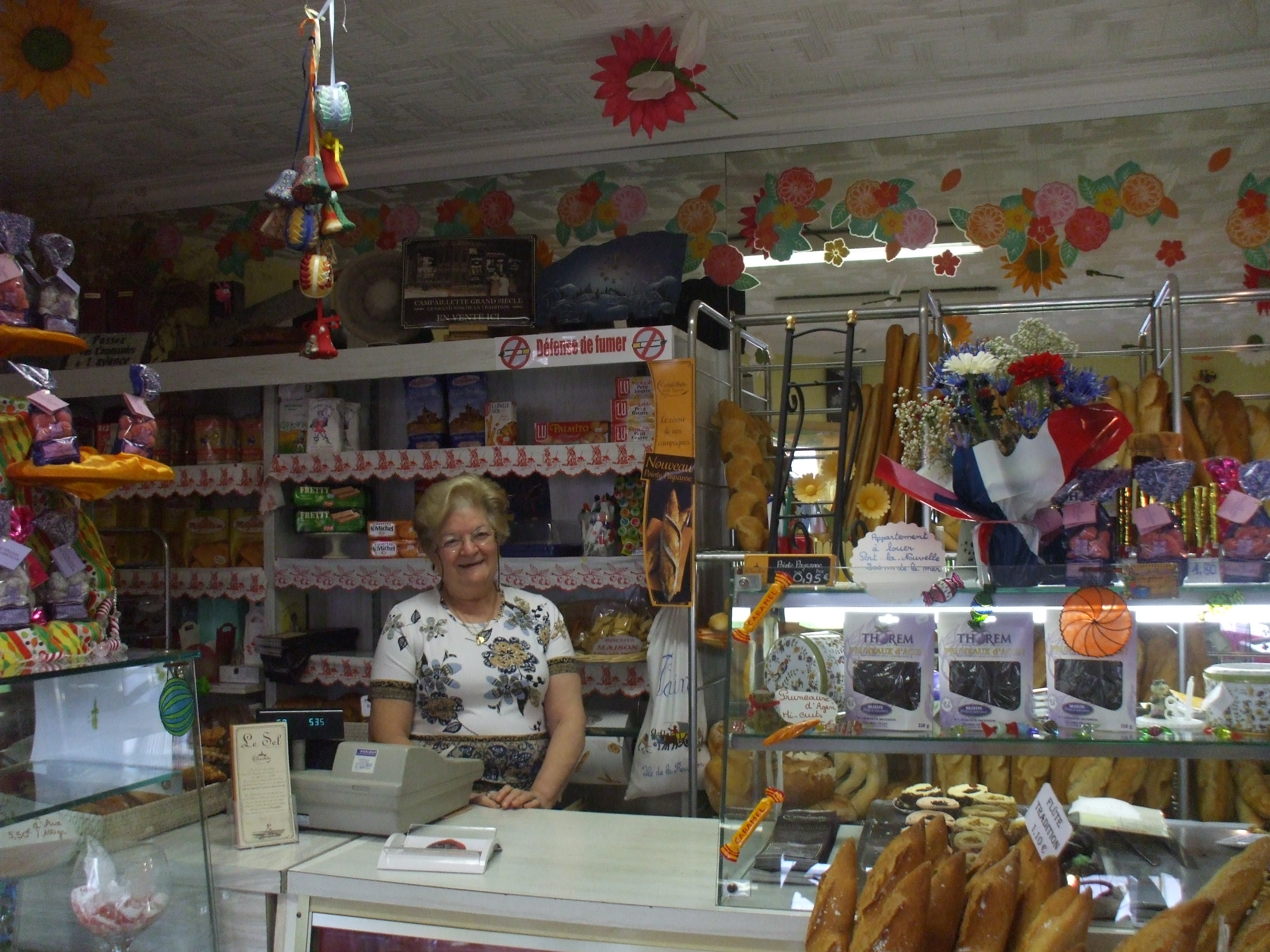
It’s a family business, our baker’s shop. M & Mme Fonquernie owned it, and now, although officially they’ve retired, they help out all the time .M. Fonquernie is the one who drives his little white van round the local villages which have no shops, selling bread. Their two sons have now taken over the day-to-day baking. One is responsible for all those loaves, while the other specialises in patisserie. Their wives divide the work of running the shop between them with Mme Fonquernie Senior’s help.
Mme. Fonquernie, Mater Familias
So our morning routine has been disrupted. First thing each day, one of us usually walks down the road to get our favourite pain noir, hot and crisp still from the oven. The other day, the baker forgot the salt. The bread wasn’t half so nice, but I rather liked this very human error. It proved that our loaves are still ‘artisanale’, rather than being churned out by some computer-assisted machine. There’s usually someone in the shop to chat to, or to walk back along the street with, and so neither of us looks on getting the bread in as a chore.
We’re lucky, I suppose, that there are three bakers in town. Last week, we went to the shops at Castellanes to the baker there. No pain noir at this shop, so we chose their unbleached white. The small one’s a slender baguette shape – an Ariegeoise – but buy the larger butch version, and you must ask for an Ariegeois.
But then what happened? A notice appeared in the shop: from Sunday, they too would be closed for a holiday. So for a few days this week, we have to patronise shop number three. Everybody moans ‘C’est pain industriel ça’. It’s true. It comes all the way from Lavelanet, from a bakery which has three shops. That’s mass production, and it shows. Roll on Thursday, when the Fonquernie family re-opens its shop doors
Once upon a time – though not very long ago, Laroque, population more or less 2000, had dozens of shops. You could live your life here without ever needing to leave town, and many people did just that.
Now we have three butchers, three bakers, and three – no, not candlestick makers – hairdressers. We have one épicerie left, 2 tabacs, a flower shop, and a new haberdashery store. There are six bars, restaurants and take-aways, and you can still buy paint, bikes, second-hand books, even a washing machine in town. Greater mobility and the rise of the supermarket have put paid to the habits of the old days, and we’re lucky to have as many shops as this left. But so many are no longer open for business, and our home is one of them.
From the early years of the 20th century until about 25 years ago, our house was Paul Vergé’s butcher’s shop, as well his family’s home – people here still refer to it as ‘l’ancienne boucherie’. Passers by, workmen who come to the house, delivery staff – all of whom remember coming to the shop as children, or working there as part time or weekend staff – have told us tales about the old shop, and the house itself is giving up some of its secrets…….
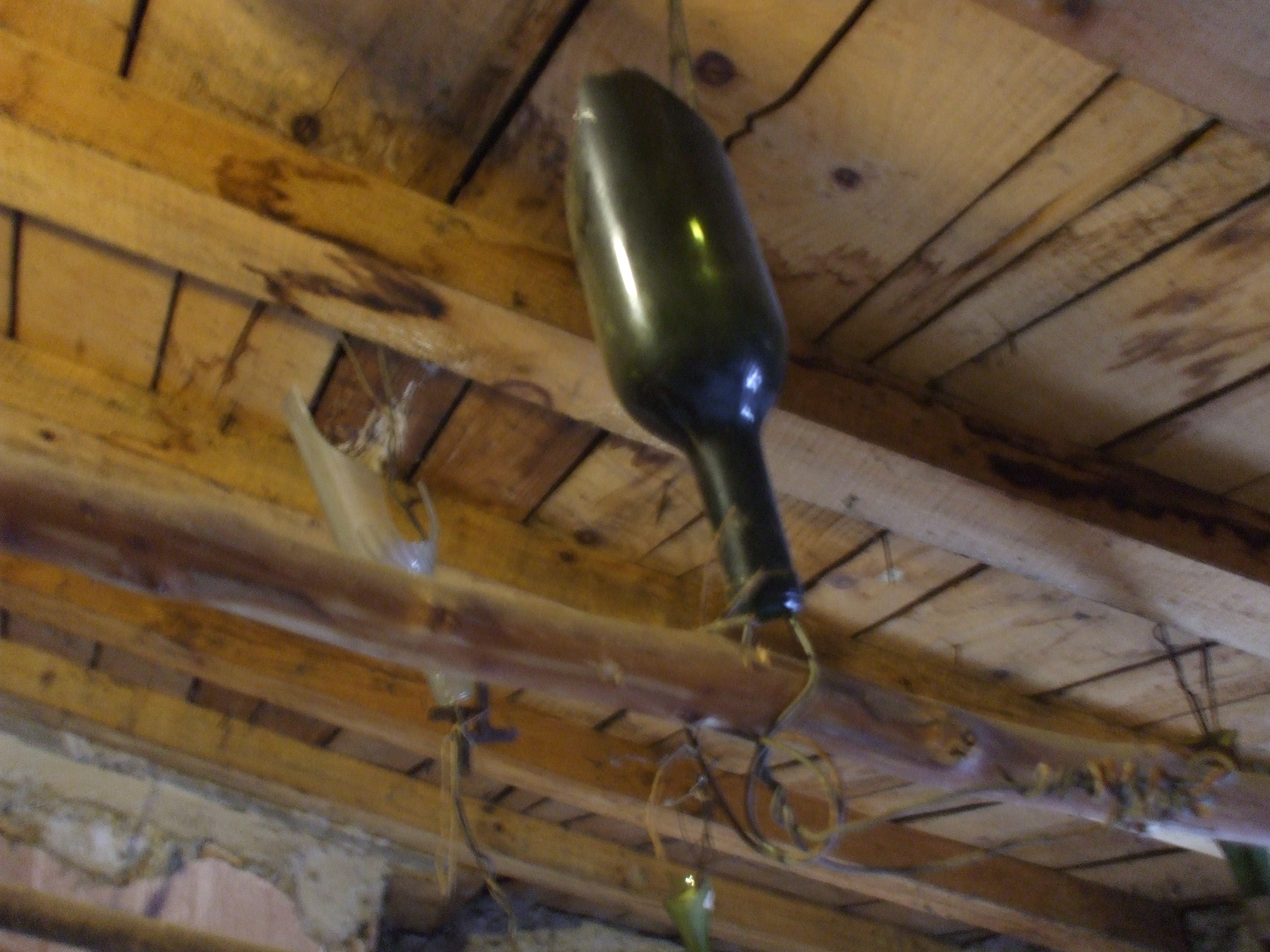
The butchery business must have been back-breakingly hard. After we’d moved in, we soon realised that carcasses were hauled up through the house to the top (or second) floor up a now filled-in shaft, where they hung from racks like clothes on an airer. We wondered why broken bottles were suspended above these rails, upside down. Answer: to prevent rats and mice running down onto the meat…
Anti-mice device
This floor of the house, without insulation, was bitingly cold in winter, but suffocatingly hot on summer days. People have told us that their memories of the shop include seeing these same carcasses, after they’d been hauled down again from the attic, hanging outside the shop door, crawling with flies, just waiting for customers to come and buy…..
The attic also has an area that was used as a smoke room for smoking cuts of meat. Hard to imagine that the pungent smells didn’t penetrate the rest of the house.
Our garage, next to what was originally the shop, has quite a few sturdy metal rings set into the walls. Animals were tied to these, prior to being shot and butchered by Mr. Vergé himself. Occasionally, a terrified beast would get away, and charge up the hill to Place de la Cabanette, where with any luck it would be rounded up by the sapeurs pompiers (fire and rescue service). An early job, when we moved here, was to line and paint the garage ceiling – to eliminate all the blood stains from this domestic abattoir.
We still have 2 enormous ex-cold rooms just off the shop. One of these is now a tool storage area, one a larder. We haven’t parted yet with the big old scales which were part of everyday life in the shop.
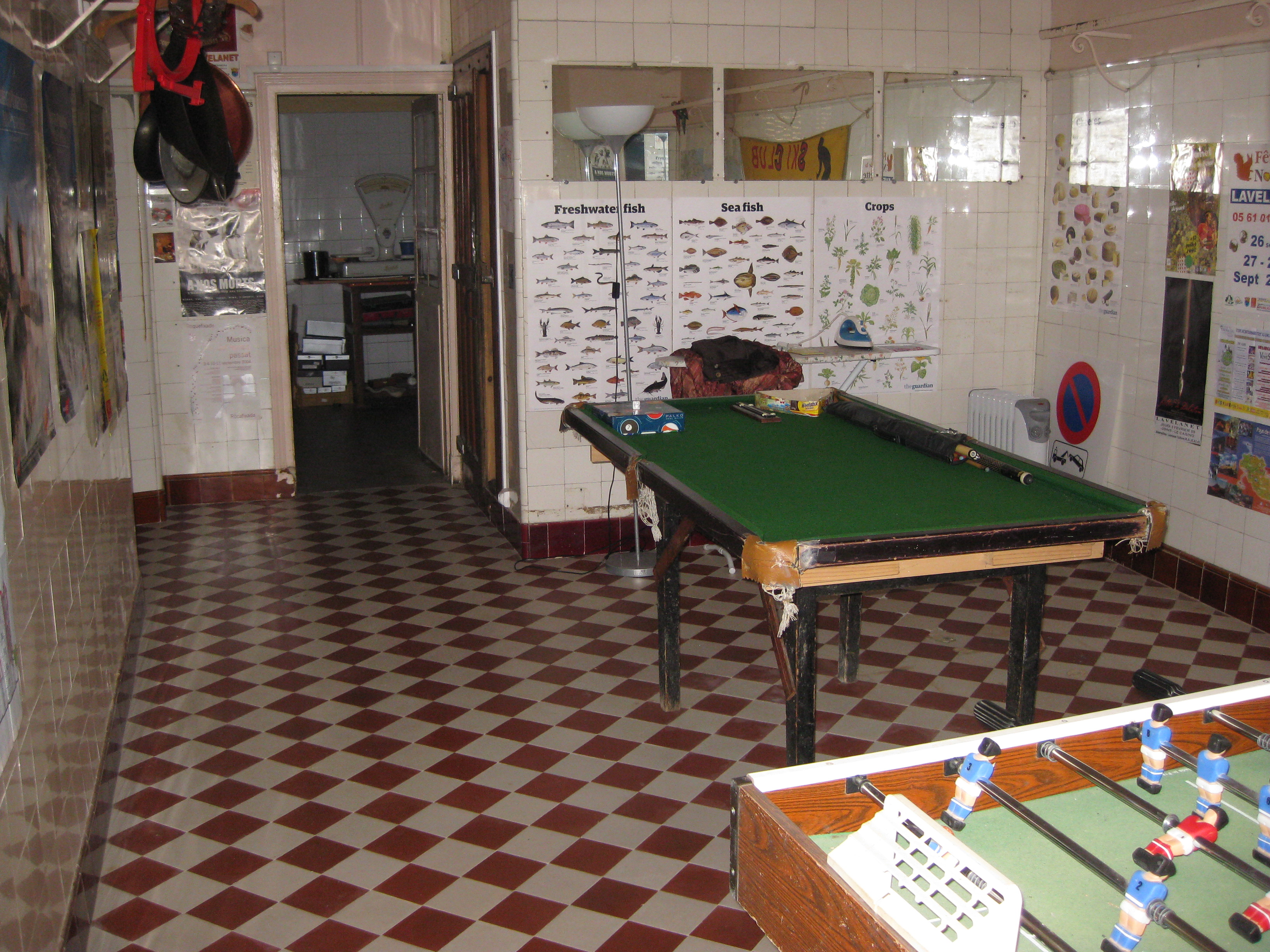
Then: butcher’s shop. Now: games room
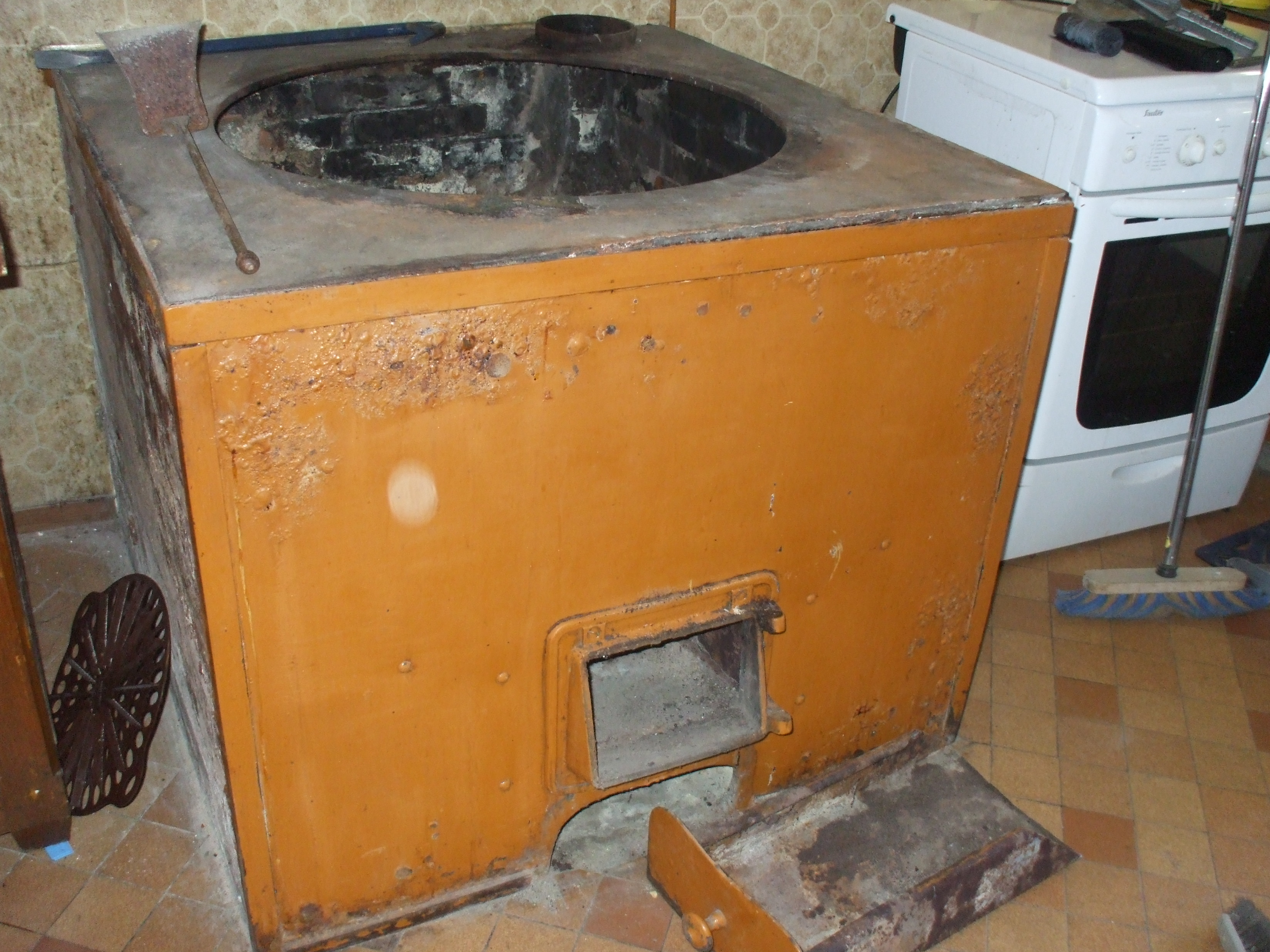
And then there’s the white-tiled shop, now a games room. The Vergés,in common with most shopkeepers, provided a few hard chairs for the comfort of those waiting or gossiping in the shop. Mr. Vergé was convivial, a lady’s man who enjoyed chatting to his female customers. Madame Vergé was busy in her little booth (remember those?) accepting payments and keeping the books. Her responsibilities didn’t end there. In the immense boiler in the kitchen, she made and canned patés of pork, duck and goose liver, rabbit, game; cassoulets; jarret de porc, for sale in the shop, day after day after day. We still have boxes of unused labels lurking in boxes in the workshop.
Mme. Vergé’s big old meat boiler: now defunct
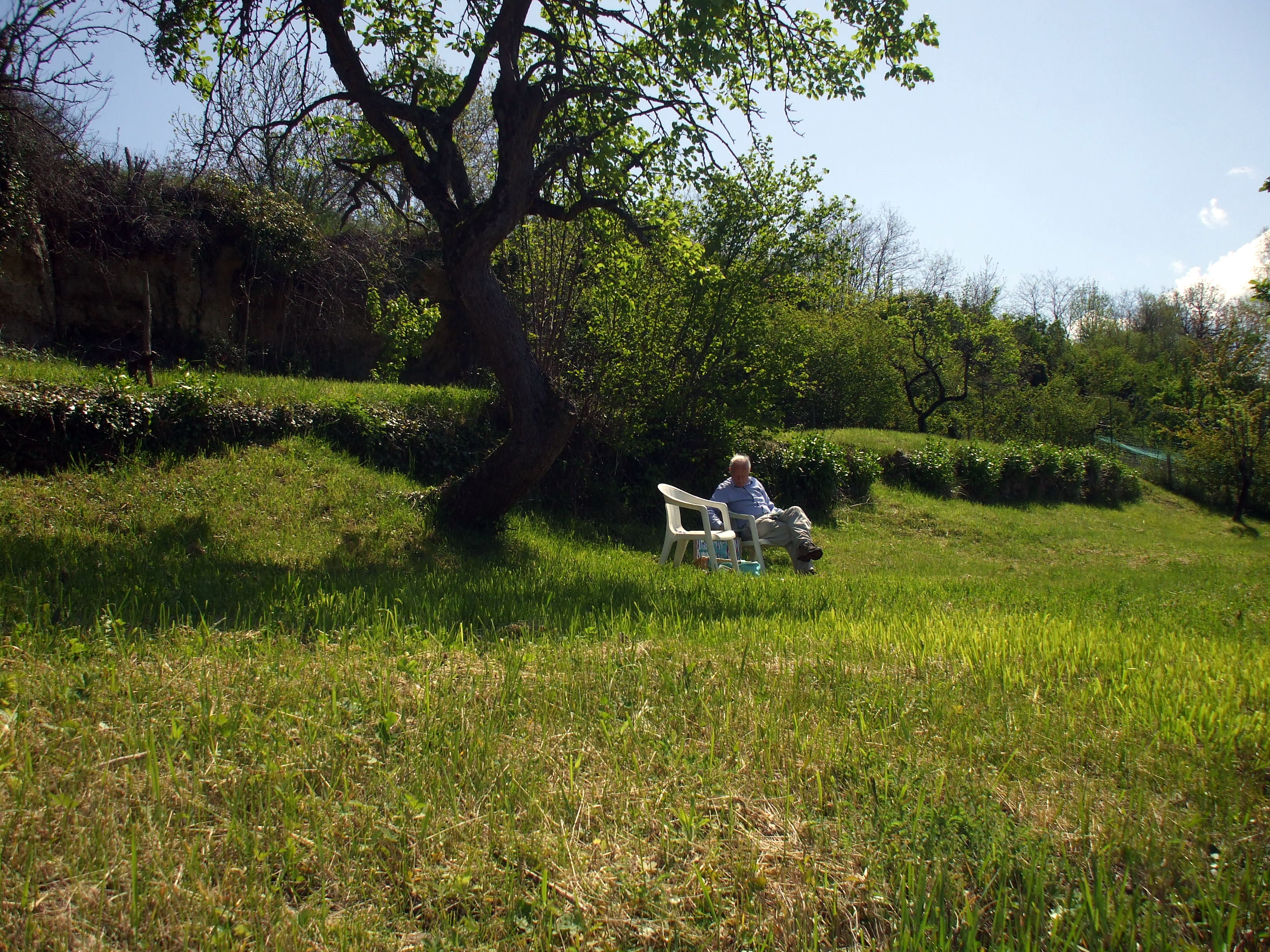
Besides all this, they found time to look after the garden, 2 minutes walk from our house. Just as they did, I grow vegetables: like them, I use the cherries, plums, apricots, figs, grapes from the trees there. Unlike them, I can take my time to enjoy digging, planting, harvesting, bottling, preserving, cooking. Frankly, I’m playing at it. For them, the hard work of looking after a plot so much larger than a couple of allotments was something that had to be fitted in after they’d slaved away at the butchery business. And they had a family….
The good and the bad. Good news first. The birds have discovered there’s more to be had here than yesterday’s bread. At bird mealtimes, which are not quite the same as ours, though much more frequent, they’re here vying over the nuts, the seeds, the fat, the mealworms, though still the stale soaked bread is best of all. It must be the fat I mix in with it.
There’s an addition they’ve not yet come to terms with. Henri arrived the other day with a large bag filled with sheets of suety fat that he’d cadged from his butcher. Slabs like these hang in his garden, and the birds have pecked away at them so much that they look like fine and delicate antique lace tablecloths swaying gently in the breeze. Our birds are still sticking to what they know. Though one or two have been eying up the new additions
The marmalade? Well, last Friday I was in Lavelanet market with a big shopping bag so I could clear the stock of Seville oranges from the one trader who’d had then the week before. ‘Oh, those’, he said. ‘I couldn’t sell them, so I’m not getting any more’. I’ve pleaded with him to bring me some, but I’m not too hopeful. All I have is the little cache of marmalade we made last week. Now that IS bad news.
PS. More bad news. I left my camera in England, so the only shots I can use here are those that friends let me use, my own recycled from last year, or royalty free photos on the net
This afternoon, my friend Léonce and I made marmalade.
When Malcolm and I were in England over Christmas and New Year, battling with the Infamous Snow, one of the big questions was – ‘Will we be able to get Seville oranges before we have to leave?’, because the French don’t usually sell them.
Well, I DID manage to buy them in the UK, and now we’re back……..they were in Lavelanet market last week at 2.50 euros a kilo. What are Seville oranges doing on Lavelanet market? I’d love to know. The French, when they make marmalade at all, tend to use ordinary oranges, and they don’t seem to have any particular tradition of using this wonderfully bitter fruit.
But my oranges travelled from Spain to Harrogate in England, and then all the way back to southern France where yesterday, we transformed them into bright jewelled pots of marmalade.
‘So’, said Léonce as she diligently chopped orange skin after orange skin into long strips, ‘we’re not going to soak the peel? We’re using it as it is?’ Her only experiences with this fruit have involved long soakings and several changes of water to eliminate nearly all the bitterness.
Smelling the strong citrussy odours as the marmalade cooked convinced her. She’s getting a different idea about the English and their cooking now. We sat down afterwards for a Nice Cup of Tea and a buttered slice of malt loaf (Soreen’s of course. Why make the stuff when theirs is so good?) and she remembered how much she’s enjoyed making – and eating – all our traditional English Christmas baking.
Our walking group’s come to look forward to some good old British baking treats too: gingernuts, melting moments, drenched lemon cake, flapjacks (although perhaps flapjacks aren’t British at all? But we HAVE adopted them, and the French don’t have them). And they all say, slightly surprised ‘So you British CAN cook. These are great! Can I have the recipe?’
Deep in the forest, somewhere near here, vanloads of dastardly Italians are despoiling the woodland floor of every single mushroom. Some hours later, they’ve driven back across the border to sell their countless kilos of plunder on some Italian market stall.
This tale is a variation of the Great Doryphore Scandal. Elsewhere in France, doryphores are Colorado beetles. Here in the Ariège, Doryphores are Toulousains, who used to leave the city at dead of night to strip our fields and woodlands of anything edible, returning home before dawn to stock their own larders – or their market places.
It was our friend and near neighbour M. Baby who told me the tale of those Italians. We have a great deal of affection and respect for M. and Mme Baby: they’re an elderly couple, very old school, and we’ll never be other than ‘Monsieur’ and ‘Madame’ to them, but they’ve always been very kind to us. Yesterday he reminisced about the secret field where, every year, he used to pick quantities of ceps. He shook his head regretfully. ‘But I’m too old now. I can’t get there any more’. Was he going to tell me, his good neighbour, where to find them? Not a chance. His secret will go with him to his grave.
It’s all part of the great Mushroom Mystique here in France. At this time of year, mushrooms are a hot topic. The weather’s too dry, too wet, too hot, too cold…. It’s a poor year. But someone’s always found some somewhere. And they won’t tell you where. ’Ooh, over near Campredon somewhere’ is as good as it gets.
Notices appear in the papers forbidding the collection of more than 2 kilos on any one day (2 kilos? I’d be glad of a small basketful). Landowners have permanent notices forbidding the gathering of mushrooms on their land.
Until now, we’ve had to be content with collecting a few field mushrooms from a rough field just outside Laroque. Yesterday morning though, Henri arrived. ‘Get Malcolm. He’s got to come now. We’re going mushrooming.’ Malcolm was painting the study – he’d just got stuck in really. But invitations like this don’t come twice, so he changed into boots and trousers that were even grottier than those he wears for painting, and off they went, baskets and mushroom knives in hand.
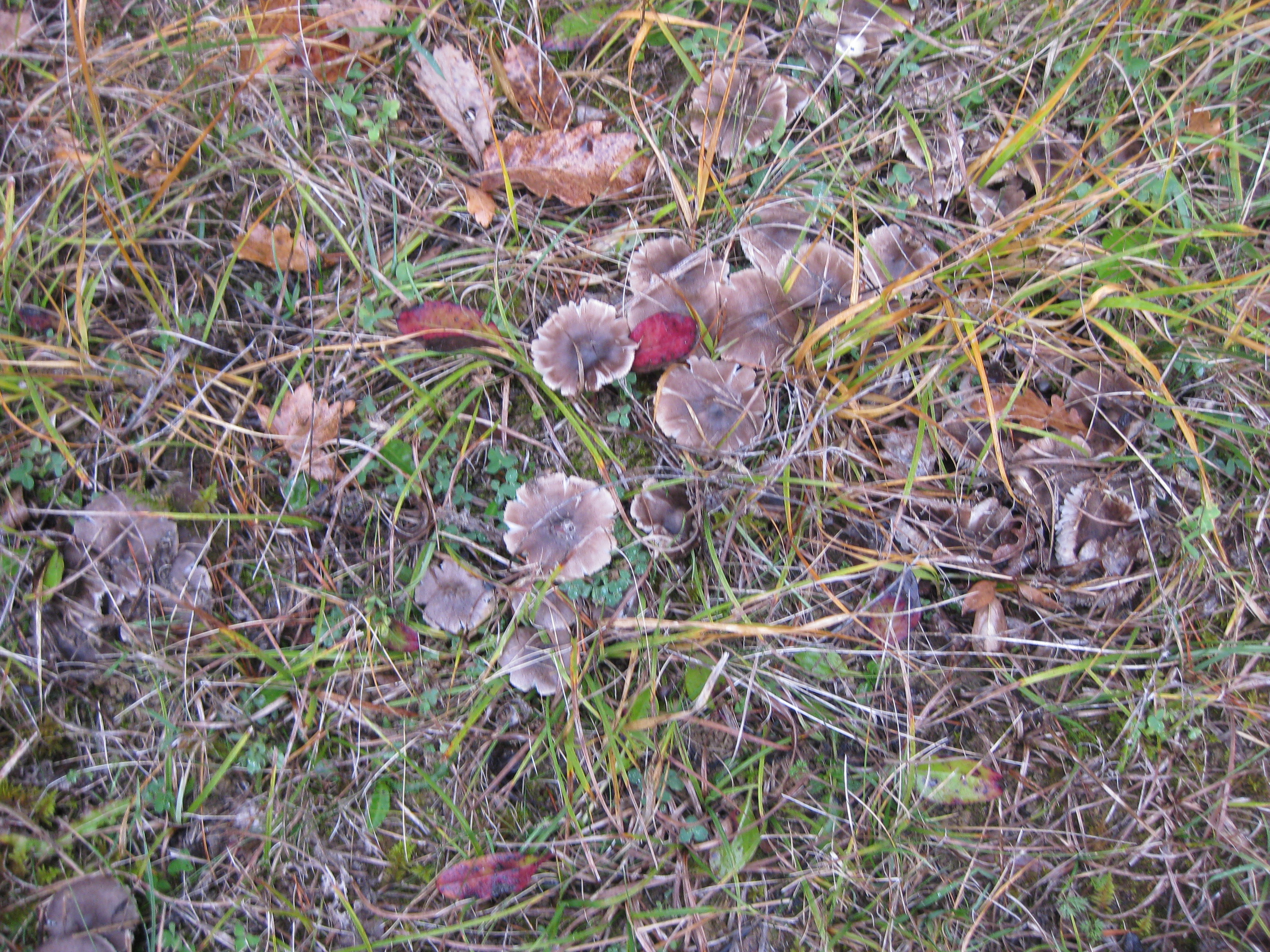
Waiting to be gathered....
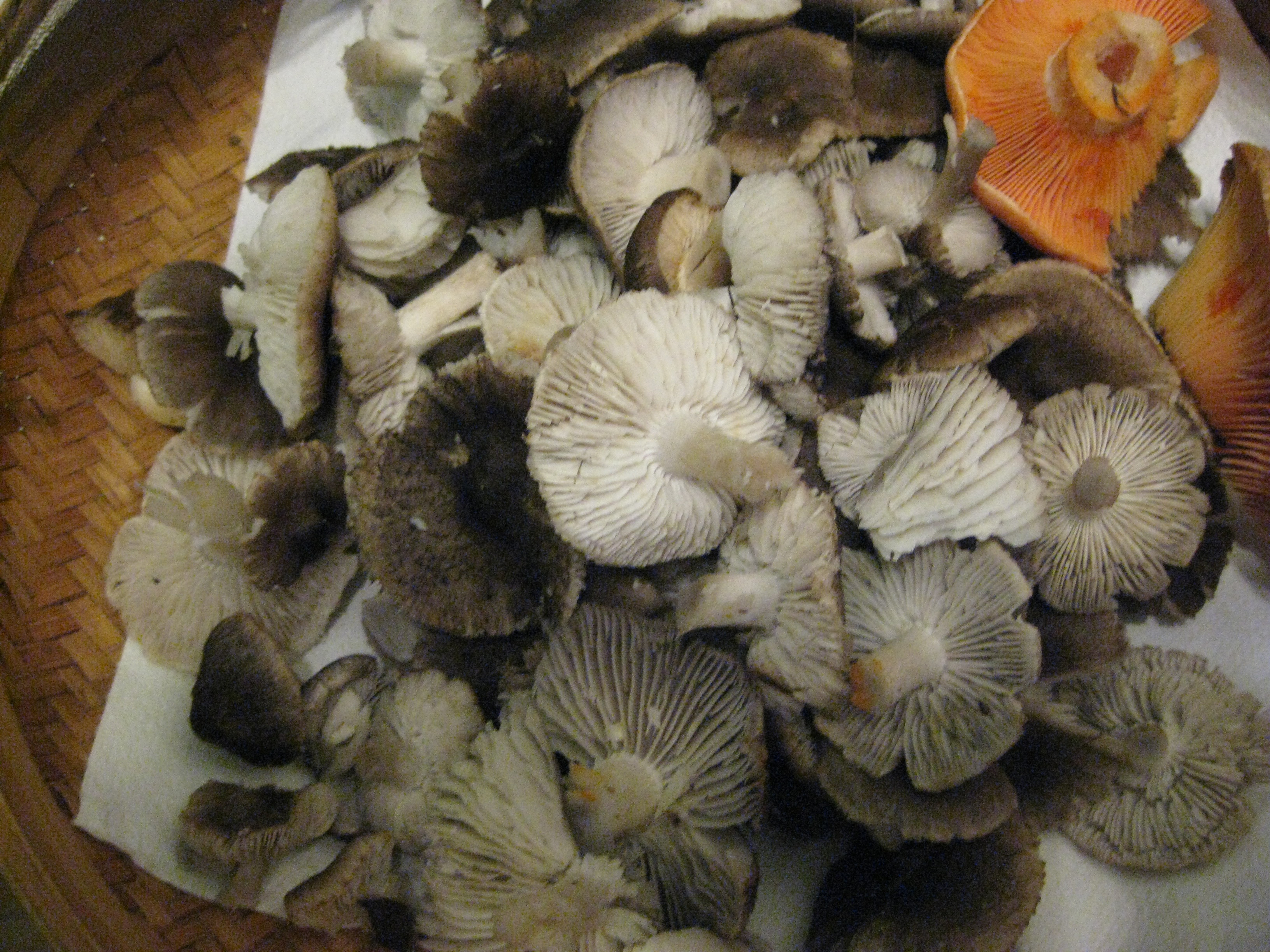
They returned, nearly 2 hours later, with a large bag of delicate ‘gris’, so fragile that they crumbled delicately as I excitedly unpacked them. So many! Thank goodness I remembered Kalba’s posting on her wonderful blog Slow Living in the French Pyrénées . She’d had a mushroom glut too, and wrote about duxelle, made by cooking down slowly a mixture of chopped mushrooms, shallots and herbs until there’s a small amount of a sort of paste that is quite simply, essence of mushroom. Slow cooking, but worth it.
Waiting for the pot.....
And Henri was prepared to share with Malcolm where he’d found those mushrooms? We MUST have arrived.
I’m not a big fan of Christmas, but ever since I was a very small girl, I’ve loved cooking for Christmas – cakes, puddings and mincemeat: those things that have to be done well ahead, and squirreled away in some cool dark spot to mature and develop complex sweet rich flavours.
First there’s the shopping and preparation. All the vine fruits in their cellophane packages; bright crystallised cherries; whole candied peel with crunchy sugary crusts; packets of ivory coloured almonds, and smaller quantities of other fruits to add interest – warming crystallised ginger, emerald green angelica, pale rounds of candied pineapple. Spices too – whole nutmegs and cloves, powdered cinnamon, allspice, mace and mixed spice. Fresh butter, lemons, eggs and flour. Make sure that there’s enough dark and light muscovado sugar in the house. Line the cake tins and grease the pudding basins. Hunt out clean jars for mincemeat.
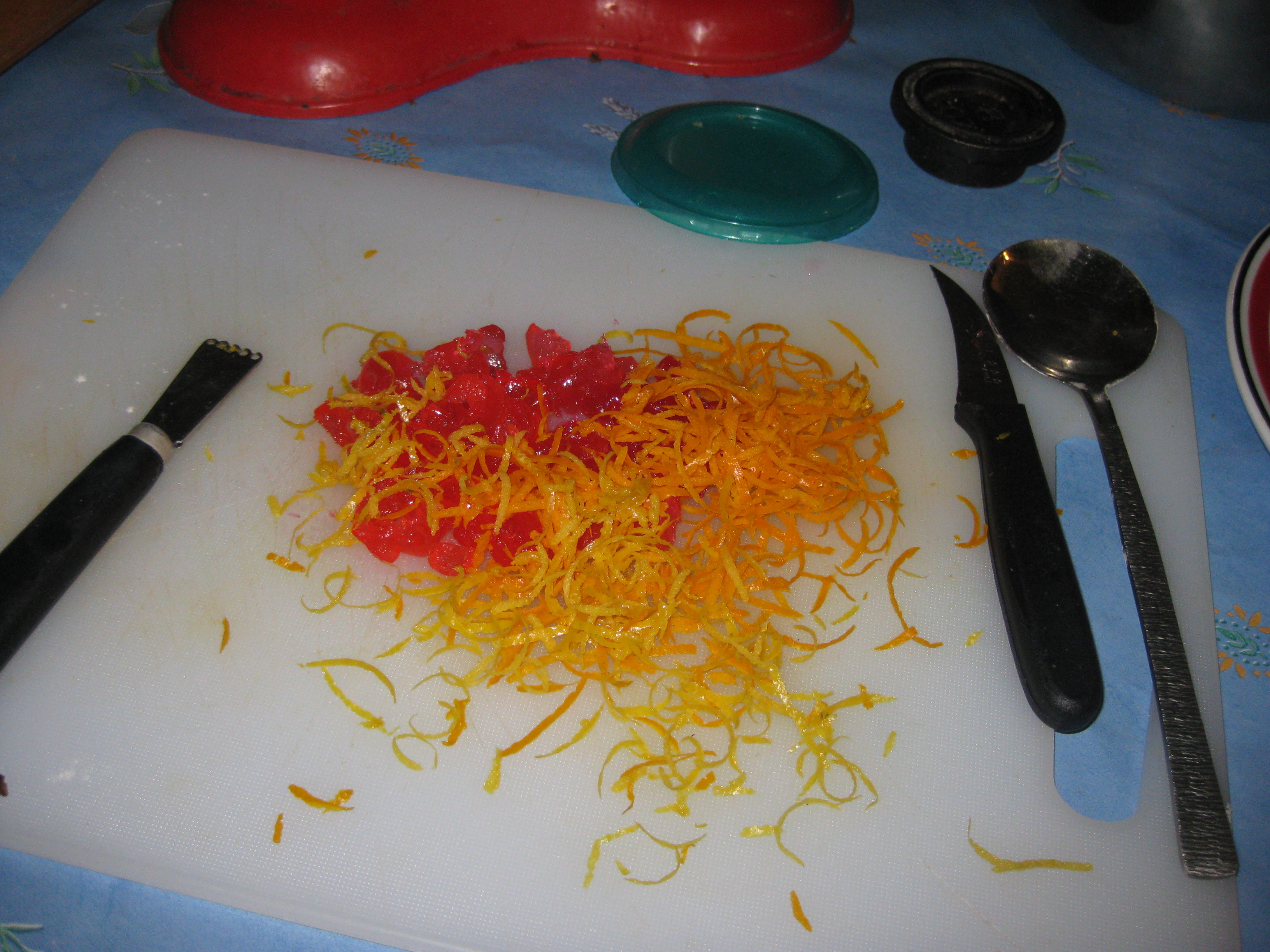
Cherries, lemon and orange zest ready for action
This year, I’ve rediscovered the pleasure in all this Christmas cooking by seeing it through the eyes of those French friends who’ve come and shared the job of making all these Christmas treats.
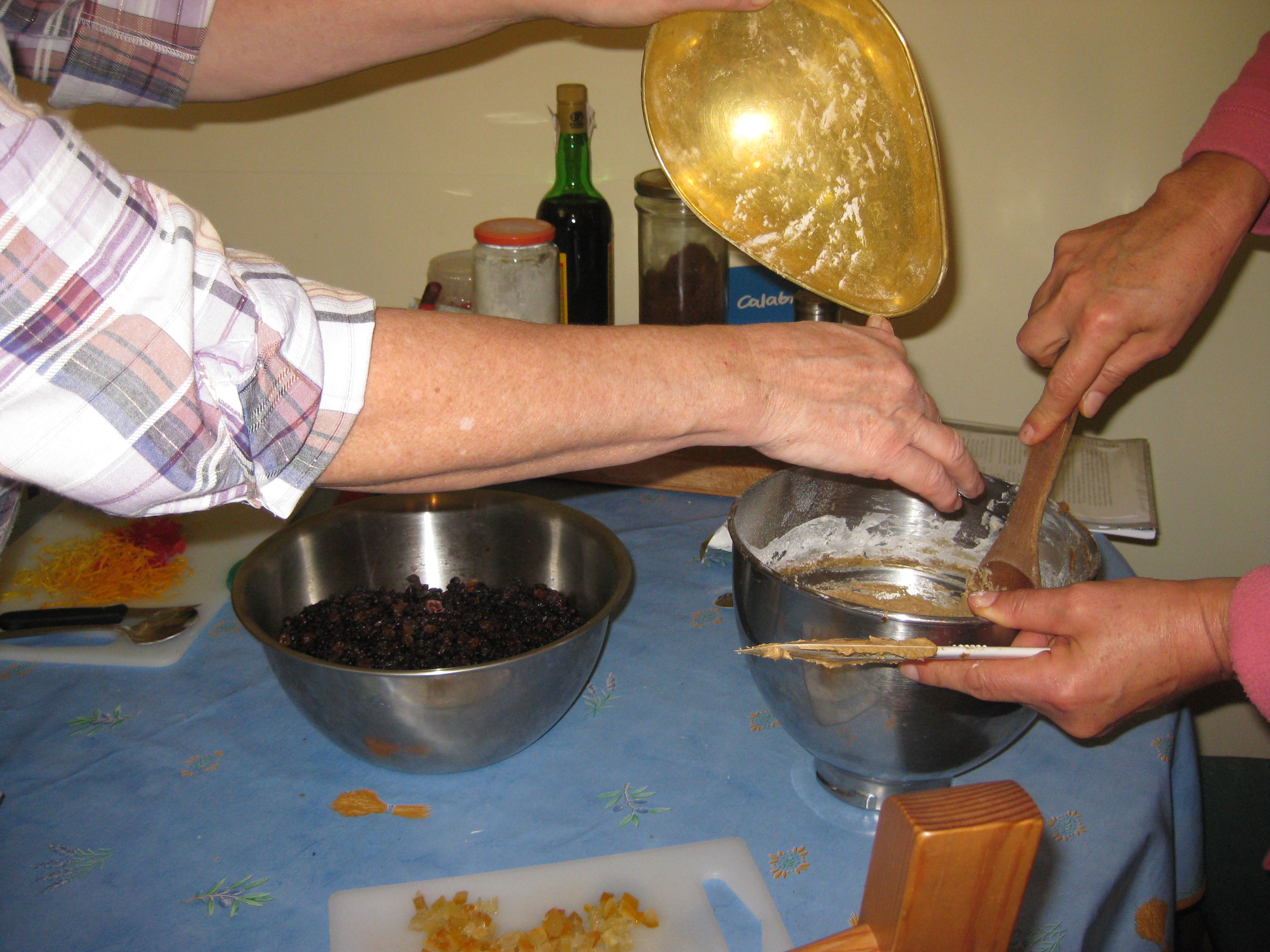
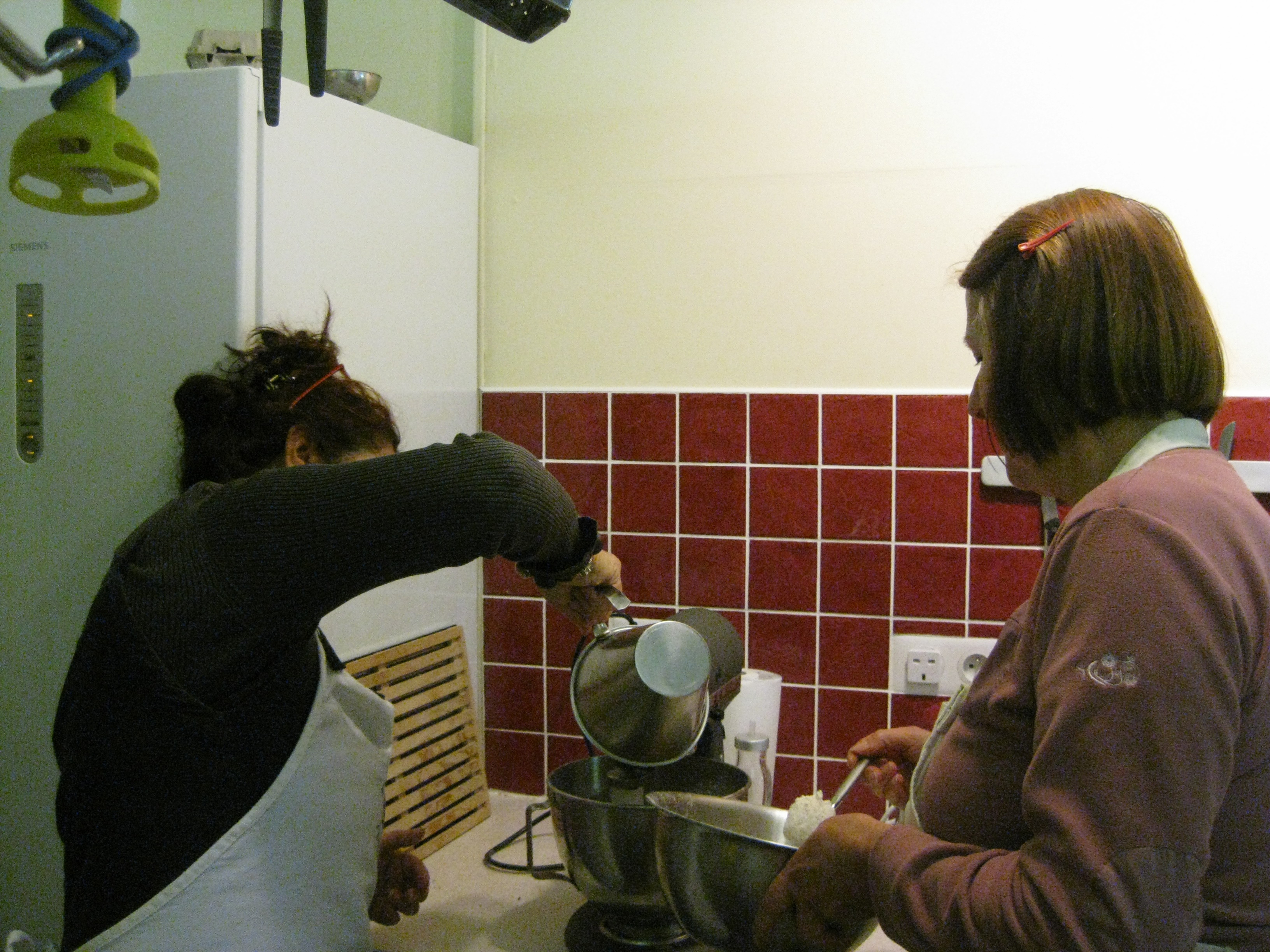
Sitting round the kitchen table with our pinnies on, we discussed the less familiar ingredients. Suet, muscovado sugar, treacle aren’t unknown here, but they’re not on every kitchen shelf. Cakes and puddings that need to be made well ahead, and fed with spoonsful of brandy in the weeks before Christmas – now that’s very different. I made my friends weigh everything out in pounds and ounces too – well, it’s what I do, and here are the pictures of how we all got on.
Many hands make light work?Brigitte and Léonce busily mixing
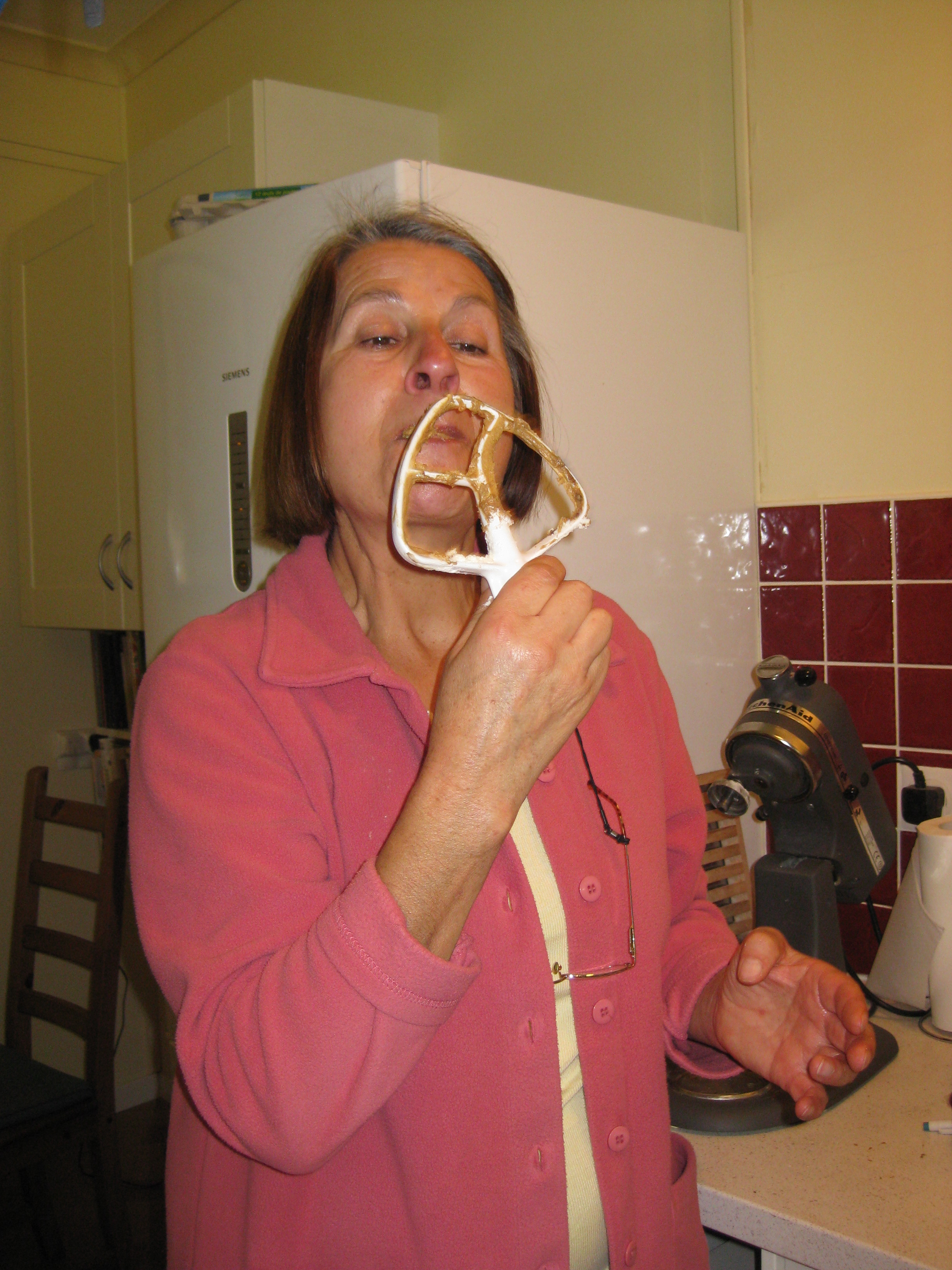
Léonce enjoys the best bit
Sadly, they weren’t any longer in the house when the cakes, cooking at low temperatures over several hours, started to give off their warming Christmassy aromas. Which is a pity, because it’s the best bit of all.
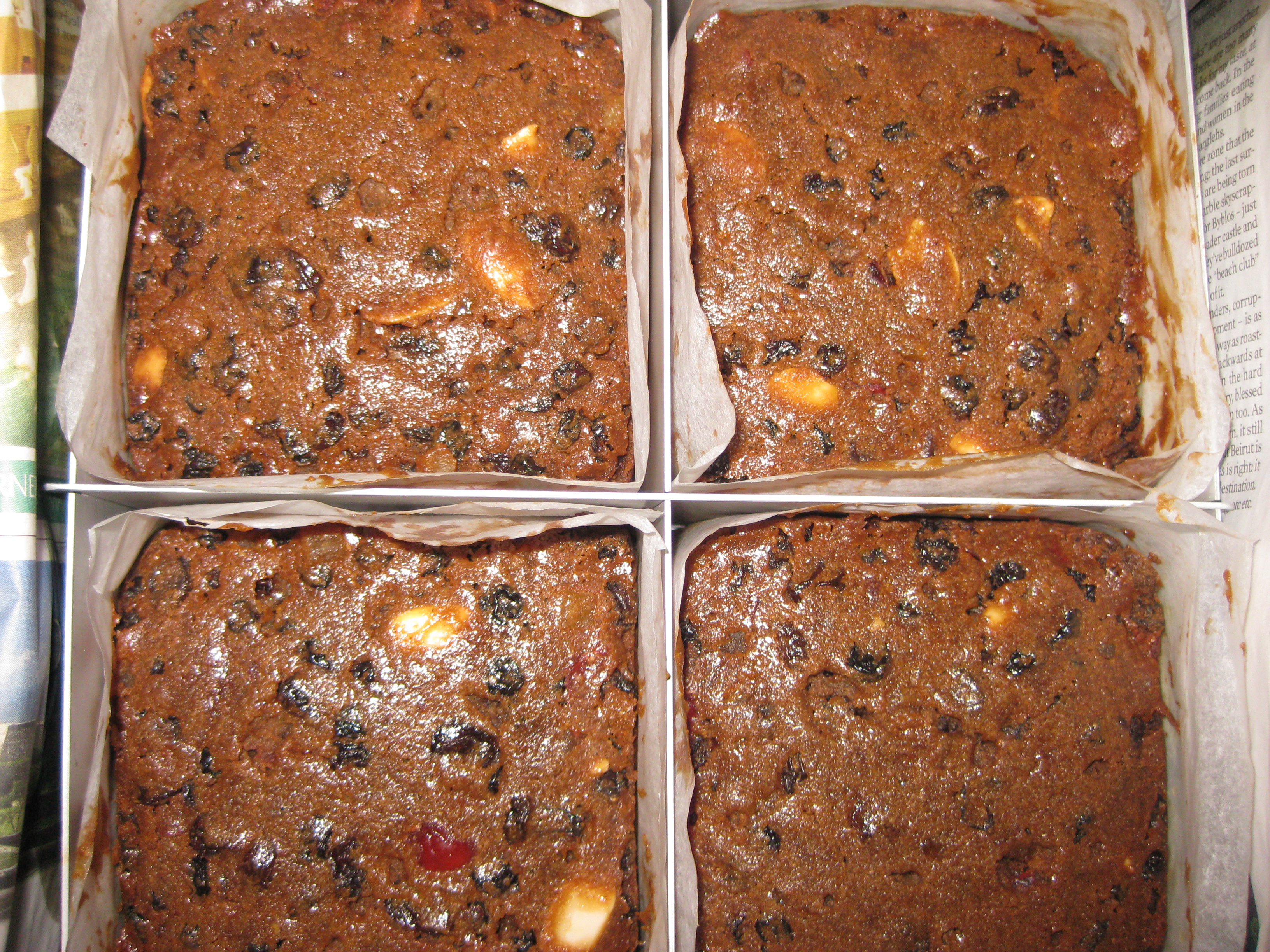
Baked and ready to be fed with spoonsful of brandy before Christmas
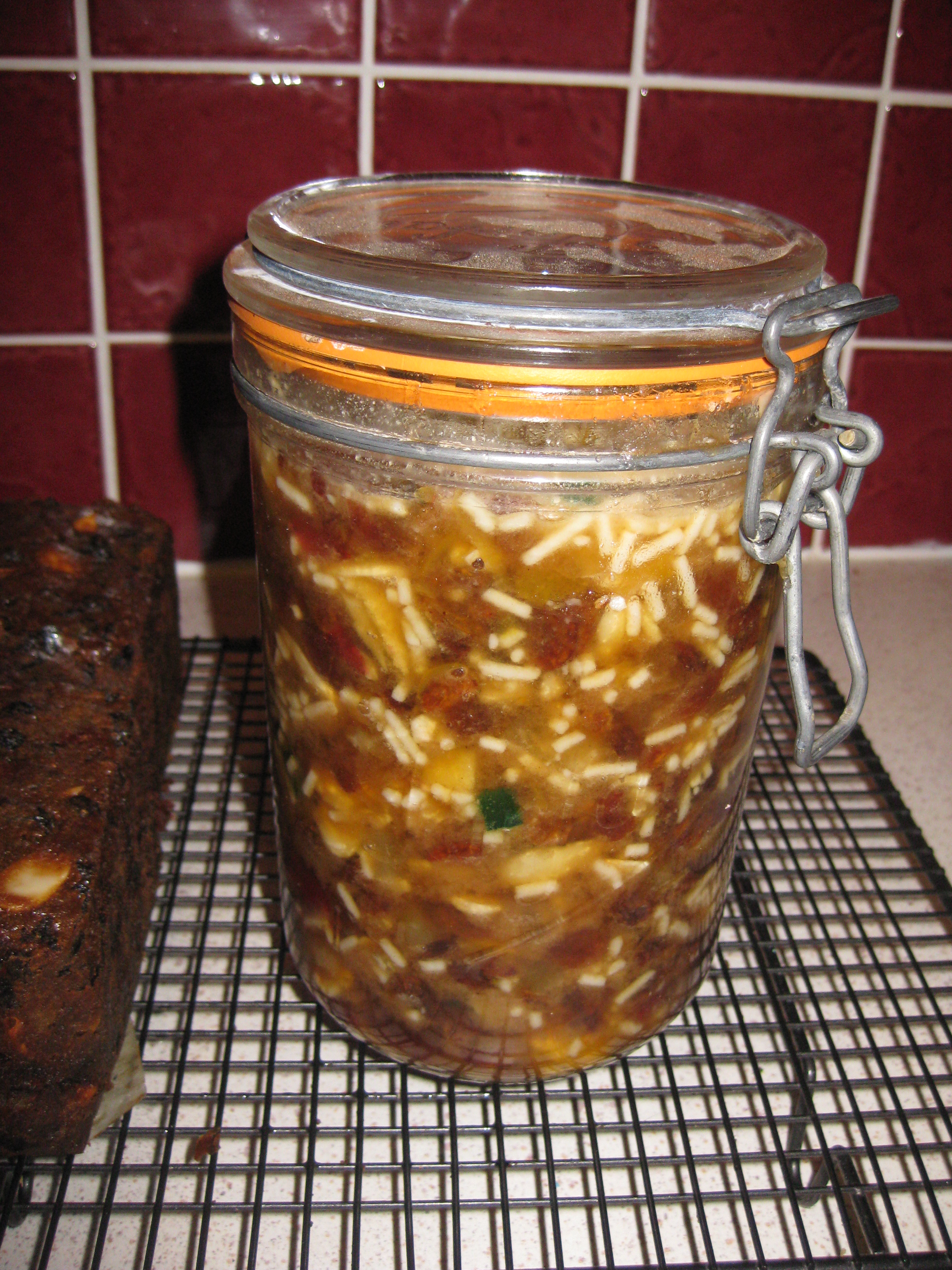
This is one of the mincemeats we made. It’s one my mother taught me, and our favourite, with its bright lemon flavour.
Lemon mincemeat
Ingredients
6 large lemons
450g (1 lb.) sultanas
¼ pint brandy
225 g (8 oz.) mixed crystallised fruits – I always use crystallised lemons and oranges, perhaps limes too (all bought in large pieces and hand cut), and often cherries, ginger, pineapple, angelica – but it’s up to you.
75 g (2oz.) blanched almonds
800g (1 ½ lb.) golden caster sugar
225g (8oz.) suet
½ level tsp. each ground mace, cloves, nutmeg
Method
Peel the lemons extremely thinly, so that you have the zest, rather than the pith.
Place the lemon peels in pan & cover with cold water, bring to boil.
Drain, re-cover with cold water, & repeat twice more.
Halve & squeeze juice from lemons.
Reserve juice.
Chop blanched lemon peel finely, and mix with the other finely chopped fruits.
Mix with sugar, suet, brandy.
And mince pies in our house always go down best when they’re made with the recipe my sister-in-law Fenella shared with me.
Pastry for mince pies
Ingredients
230 g (8 oz.) plain flour
40 g (1 ½ oz.) ground almonds
85 g. (3 oz.) icing sugar
170 g. (6 oz.) butter
1 medium egg yolk (you might need 2).
Method
Sift the flour, almonds and icing sugar into a warmed bowl, and rub in the butter. Stir in the egg yolk and work gently to form a soft dough. Knead lightly, cover and chill for 30 minutes.
You’ll need 230 – 340 g (8 – 12 oz.) mincemeat to make this pastry into about 12 tarts. Bake at Gas mark 4, 180 degrees C. for 15 – 20 minutes






 From Pyrenees to Pennines
You must be logged in to post a comment.