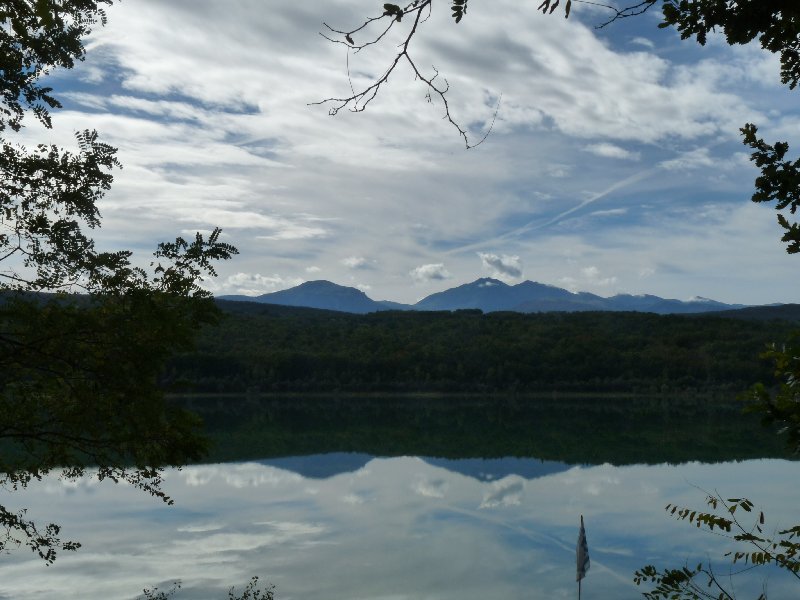
Our new friend Jenny-from-Bilbao came for a flying visit late last week, so we did a quick Cook’s Tour of some of our favourite spots. Roquefixade, of course, Montségur: and then on a bright Autumnal Saturday morning, we finished off by a quick look at our local lake, Montbel. It’s a man-made reservoir, actually, but it looks as though it’s been there forever, and fish, herons and humans all appreciate its cool expanse of water as a change from all those hills, mountains, rivers and streams.
Those herons
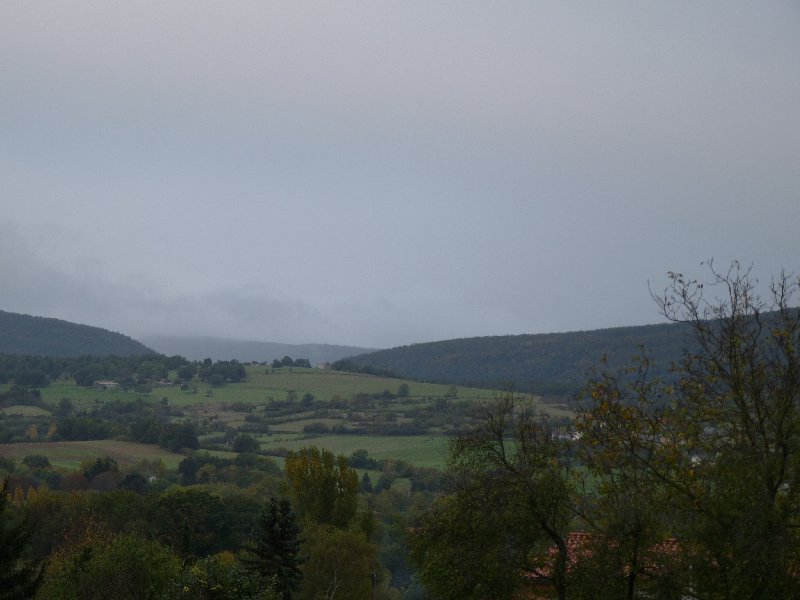
What a difference a day makes. Sunday sulked. It rained in the night, it rained in the morning, grudgingly cleared up, then spent the rest of the day teasing us with odd showers which never quite decided whether to go for a full-blown drenching, or merely hang around as damp atmosphere, cloaking the landscape with fog.
View down over Laroque
How did that get there?
Misty view over the Douctouyre valley
Copse along the ridge
Out of the woods once more
… but not for long.
This young lady welcomed us as we passed her farm
Autumn colours
And some more
Autumn leaves
Our misty wooded path
The view’s largely obscured now
Last lap. Civilisation approaches….
Almost home. This farm’s for sale. Any takers?
Tamed trees. The edge of Laroque
So our planned walk from Croquié, with its promise of stunning views as our reward for a stiff climb was abandoned. Instead we met at 1.00, we hardy types, and Jean-Charles proposed what I thought was little more than a walk round the block. ‘Just up to Tabre, along the ridge and back’ he said. Well, Tabre is the next village along, Mirepoix direction, so that sounded easy enough. So off we went, along a bosky path, through Tabre, up a hilly climb to great views back to Laroque. A long and often muddy forest track took us past further views, over the Douctouyre valley, and circled us over and past the next village along from Tabre, Aigues-Vives. Down we climbed again, and took paths through fields back to Laroque. A fabulous walk, all 15 km or so of it, and almost every step of it previously unknown to us. And we pride ourselves on having got to know our patch pretty well. Thank goodness for local friends who carry on helping us to discover even more.
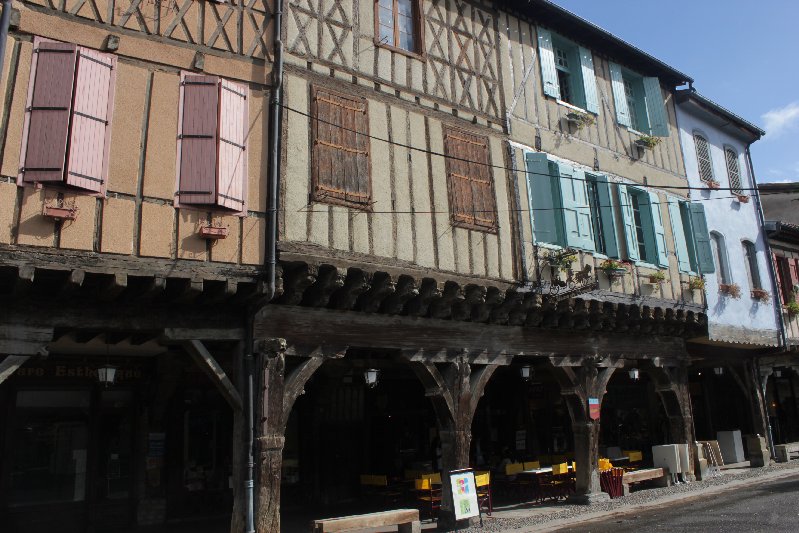
Along the road from us is Mirepoix: the pretty town, the one with the half-timbered houses set round a central square, where it’s good to sit outside with a nice cool beer of a summer evening surveying several centuries of history. A bit of a contrast with shabby old Laroque. It’s something of a Mecca for both locals and tourists, as it has a busy programme of festivals throughout the year, celebrating everything from Jazz and Swing to the apple harvest.
There was new one the other week, La Fête de la Gastronomie. We missed most of the talks, walks, demonstrations and foodie events, what with being in Bilbao. But we did get back just in time to catch the visit to a tiny church in the tiny nearby hamlet of Mazerettes. This was no church guided tour however. We’d come to hear Martine Rouche talk about the fresco there, depicting the feast of Herod during which the head of John the Baptist was dished up. No, it wasn’t an art history lecture either, nor a biblical exposition. Martine Rouche has researched this fresco – one of several recently restored in the church – to help us understand dining and feasting in this part of 16th century France.
The fresco is dated 1533, so Herod’s feast reflects the customs in use at that date. At that time, there was no special room designated for dining. The host had the table arranged wherever it suited him best, whether it was the main hall or a bed-chamber. In contrast with the fine elaborate costumes worn by the guests, the table itself is quite simply and starkly dressed. Not so many years before, food had been served on ‘tranchoirs‘, thick solid slices of bread. Now, simple round plates were provided.
There weren’t many glasses on the table either. These were expensive rare items still, so guests expected to share . Servants would hover, ready to refill glasses as required, and everyone would drink from the glass nearest them. Glasses didn’t come as a matching set: there were as many designs as there were drinking vessels.
Besides these, there were drageoires of crystal, designed to hold sugar and spices, which guests would nibble at throughout the meal. This fashion for having these expensive and elegant tit-bits spread from Italy through southern France and Lyon , eventually reaching this area.
A drageoire
There were knives. These were personal property. You’d take your own with you and use it both to cut food, and as a means of conveying it to your mouth: no forks yet. Then you’d take it home with you again.
And this curved implement is a furgeoir. You may not want to have one at table yourself. The pointed end is a toothpick, but you’d have used the spoon-like end to scoop out earwax when the fancy took you.
A furgeoir and a couple of plates
Under the table is a nef. Though this one isn’t, such containers were often in the shape of a nautilus shell. The principal guest at a banquet might have one as a sort of superior picnic hamper. He’d use it to keep his knife, his napkin, maybe some spices, and some anti-poison specifics. Later, the nef was replaced by the cadena, which might have several different compartments.
As to the food served, there are few clues here. Apart from the head of John the Baptist, which was not intended to be eaten, there were some sides of ham and other fairly unidentifiable items. More information comes from contemporary receipt books. Local grandee Phillippe de Lévis, who was responsible for commissioning the frescos in the church, also hired patissiers, who of course submitted detailed bills . These confirm what we already know: that the church calendar ruled. Periods of plenty (‘régimes gras’) were interspersed with simpler and restricted ‘régimes maigres‘. Every Friday, Lent and Advent among others were ‘maigres‘ . Meat and dairy products were avoided in favour of simpler, less rich foods. Fish was generally allowed, but for the wealthy, this was scarcely a privation. The River Hers was rich in salmon, and would be prepared with fine and not-at-all-simple spices: cinnamon, ginger, pepper, cloves – and sugar. Even certain water fowl, such as the moorhen – ‘poule d’eau’ – were considered honorary fish.
But outside those periods of abstinence, what feasting took place! A meal might begin with individual tarts, and go on to several courses of salads, fruits, boiled meats, roast meats, sauced meats. From our point of view, the courses differed little from one another. Our clear expectations of the kind of things that might appear as an entrée, a main course and a desert did not hold good back in the 16th century.
It all sounded pretty unappetising. What with sharing glasses, enduring course after course of rich and highly spiced food, it would probably have been a relief to go home . The men at least had opportunities with hunting and other manly pusuits to burn off a few calories. Not quite so easy for the women, I think.
And thank you, Martine Rouche, for a fascinating and entertaining afternoon.
… which are, being translated, sloes, rosehips and mushrooms. But it sounds rather more poetic in French, non? Even if you take into account that ‘gratte-cul‘ translates as ‘scratch-bum‘, because as every naughty school child knows, rosehips seeds are distressingly itchy when shoved down against the skin.
Chapelle Saint Roch
Anyway, I went off by myself for a walk the other day, starting by the ancient and slightly isolated Chapelle Saint Roch. There’s still a pilgrimage there every year, because he’s the patron saint of plague victims, and well, you never know, do you?
I’d got several ‘au casoù‘ bags, ‘just in case’ I found sloes, rosehips and mushrooms. It wasn’t ‘just in case’ really though. I know exactly where to look for the juiciest sloes, the thorniest rosehips, and even a decent clutch of field mushrooms. Finding mushrooms before the French get to them counts as a real achievement for me.
It pays to have tough clothes when you hunt among the scratchy brambles for the sloes and hips nearby
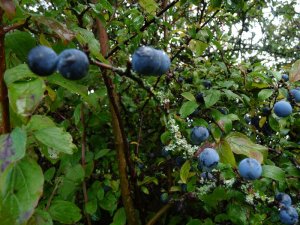
Here are my sloes, destined not for sloe gin this year: we seem to have such a lot left from the last few years. No, this year I’m making a richly flavoured jelly with the fruit I picked that morning and a few windfalls.
Sloes waiting to be picked
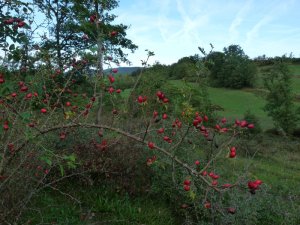
And here are the rosehips. It’s a syrup for those, I think.
Rosehips with thorns ready for the attack
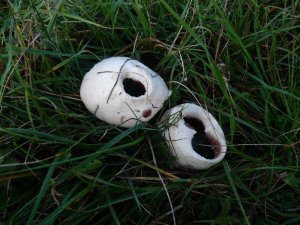
But the mushrooms…… Someone got there before me. And it wasn’t a Frenchman . Grrr.
We keep a mental list of the walks we’ve particularly enjoyed. Walks we’ve treasured for the views, the flowers, the butterflies, the skyscapes, the lunchspot – all sorts of reasons. The only problem is that the walk at the top of the list tends to be the one we did last. There’s no such thing as a duff hike round here.
But last Sunday’s walk is assured a place of honour on this list. It’s one we’ll want to share with you if you come to stay, and we’re keen to do it again ourselves, at every season of the year.
If you drive from here to Mirepoix, you’ll pass through a village called la Bastide de Bousignac. Just after that there’s a road off to the left, signposted to Saint Julien de Gras Capou. Take it. It’ll wind upwards between grassy pastures, home to sheep and cattle and not much else, and finally deposit you in the main street of the village – current population 62. Park near the church, lace up your walking boots, grab your rucksack with its all-important picnic, find the first yellow waymark – and set off.
The village is so-called because back in the 12th and 13th centuries, it had acquired a reputation as being the place where fine fat capons were raised to feed fine people: that’s the ‘gras capou’ bit. I don’t know where St. Julien comes into it. There are hens here still, and in so many ways, the village is perhaps little changed. It’s a peaceful, rather isolated place, despite being so near to Mirepoix and one of the main roads in the Ariège.
Our walk took us along farm and forest tracks, through fields and woodland still splashed with colour from flowers and late butterflies. It was an easy route, rising only gently, passing the tiny hamlet of Montcabirol towards the village of Besset. Shortly after that though, we found we did have a short sharp climb, through the woods, to reach the Pic d’Estelle.
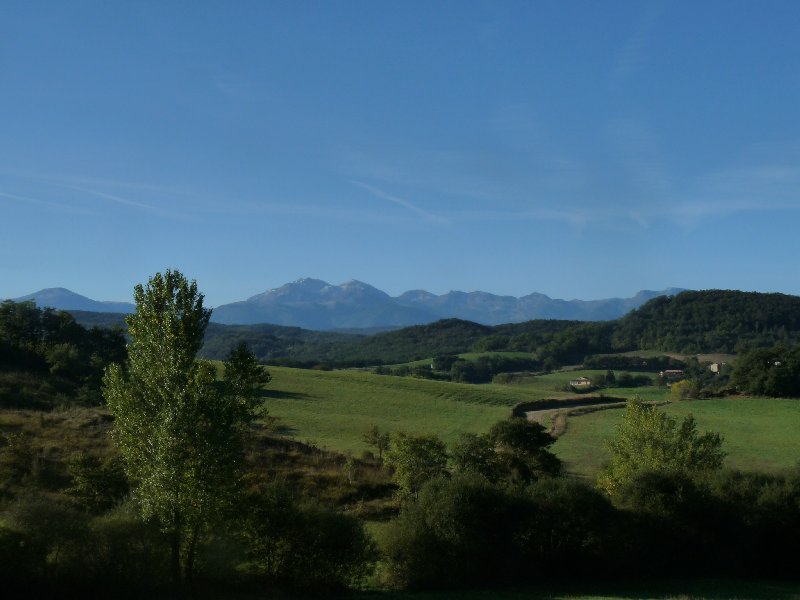
Wow. It was worth it. From here, we had a 360 degree panorama. The chain of the Pyrenees marched across our horizon, its peaks already dusted with snow, or even quite thickly covered in the case of the higher summits. As we turned in other directions, we could see Mirepoix, immediately recognisable from its distinctive cathedral spire, and the Montagne Noir beyond. There are foothills nearby too, across which pilgrims on the Chemin de Saint Jacques de Compostelle still travel: and other sights too – the ruined Château de Lagarde, and its near neighbour the Château de Sibra. We stayed a long time, simply relishing these views, the sky, the silence and peace at what seemed to us, at that moment, the top of the world.
When we finally shrugged on our rucksacks once more, we only had three or four more kilometres to go, along more unpeopled pathways. After negotiating the only obstacle of the afternoon, a group of cows supervised by a bull – we let them get well ahead of us – we were soon back at base. It was good, very good. I just wish my camera could do justice to those peaks. But we’ll be back, in winter, when they’re truly thick with snow
The walk begins
We passd a few fords: here’s a puddle
And here’s what we spotted at the isolated hamlet of Montcabirol
Just 4 km along the road from us is a village. If you’re passing through (and you won’t: it’s not on the main road to anywhere much) you’ll probably think it’s just another sleepy French backwater. A backwater called Léran.
But you’d be wrong. Over the last five or six years, Léran has reinvented itself.
Once upon a time, when this area was, for the time, quite industrialised, when Laroque and Lavelanet were churning out textiles to meet an apparently unending demand, Léran was the leather-working village. It must have been quite a smelly unappetising place with all those hides hung out to dry and cure. The river Touyre, flowing through the village, was dirty and polluted from the leather making processes. It would already have been pretty bad from flowing through Lavelanet and then Laroque when dyes from the textile trade were flushed into the waters. Friends of ours remember their parents being employed in the still-busy leather works in those days. Immigrant workers from Spain and Italy were much in demand to augment the local working population.
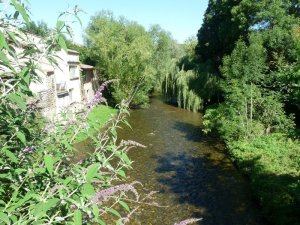
The Touyre today. Not dirty at all.
But times change, and as the textile mills declined, so did the leather works. Léran’s population fell as the young left to seek work elsewhere.
About perhaps twelve years ago, a few anglophones, scouting around for somewhere attractive to open chambres d’hôtes, found the village, noted its quiet agricultural setting, its château built by the local landowners, the Lévis- Mirepoix, and the stunning views towards the Pyrenees. They opened a couple of businesses. Guests, above all English, but other English-speakers too came to stay, liked what they saw, and some looked for properties to buy in the village. At that stage houses were cheap enough in this failing little community.
Slowly, the village came back to life. Marek and Shirley Woznica (yes, they are English) bought the run-down and almost decrepit little village bar and set about turning it into le Rendez-vous, the village hub for French and English alike. Quality meals, quiz nights in both French and English, open mic events soon became part of their regular programme.
Le Rendez-vous on a warm summer’s evening, while the market’s in full swing
At a village vide grenier (that’s ‘empty your attics’, the French answer to our car boot sale) some years ago, we remember French inhabitants telling us that the English were responsible for some revival in the village fortunes. ‘But it’s a shame they keep themselves to themselves and don’t mix with us’, they said regretfully.
Well, that might have been true then, but it’s no longer the case.
About five years ago, another English resident, Alan Simmonds, a fine musician, decided to begin a choir. Inevitably, people round here call it ‘the English choir’, but it’s truly cosmopolitan, with singers from several different countries of origin in Europe and beyond. It’s already got a name for itself, and is quite in demand.
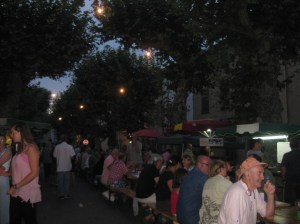
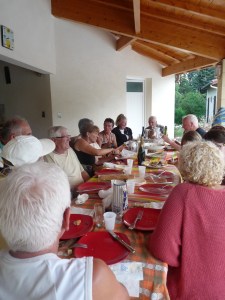
In summer, there are the Friday evening markets, when visitors and residents alike crowd into the village streets to buy their evening meals from an eclectic mix of food stalls, and sit down to share their meals at long ranks of tables laid out along the main street. This is Léran at its liveliest.
Evening market: crowds from the village and beyond sit down to eat together in the main street
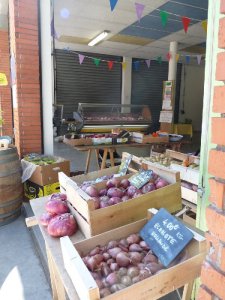
But it hasn’t been onwards and upwards without some struggles. The village shop closed, then the bakery. Léran no longer had any shop but a hairdressers. A now rejuvenated village council decided to act. They opened up a municipal storage building, named it ‘Les Halles’, and set about encouraging a mix of local traders to come on different mornings of the week to sell bread, meat, charcuterie, cheeses and vegetables to the villagers – it’s the only community round these parts that now has a daily market. So far it’s going well.
A stall at Les Halles
And this year, the village has developed yet another project: ‘Léran: le village qui chante’. In mid-June, St Cecilia’s Day, French communities everywhere throw themselves into a weekend of music-making of every kind. There are concerts in churches, bars, along the street. Anywhere. It’s a great weekend to be in France. But Léran wanted to do even better. With a tuneful choir, and some fine musicians living in the community, from opera singers to folk music, the villagers pulled together to put on a three day series of events. This is how they described it in their publicity:
Everything from popular operatic arias to foot-tappin’ jazz. Soulful solos to choral songs that rock the rafters.
World-class singers, a host of musicians, and the hugely popular Choeur de Léran.
All in a lively village with the Pyrenees as backdrop.
They weren’t wrong. Concerts in everywhere from the local hall, the village church and even local houses drew enthusiastic audiences from miles around. We loved the Baroque group, ‘L’ensemble de Montbel’, which we attended. No wonder le village qui chante now wants to make it an annual event.
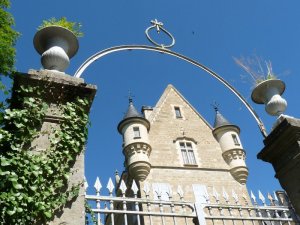
Peering through the main gate of the Château de Léran
More recently, there has been one very sad event. In July this year, that château I mentioned caught fire one afternoon. It had been fairly recently developed as rather elegant flats: now one of the turrets has been consumed by angry flames. It’s a sad loss for the community.
So there we are. A lively and vigorous village community which we’re delighted to have as neighbours. Do we ever wish we’d chosen to live there instead? Well, no. We like the English whom we’ve met there, but we’re glad that we don’t have the easy option of making our social circle an English one, which must be almost inevitable in a community of so many Anglophones. We’ll go on coming for a meal chez Marek and Shirley, we’ll look out for concerts and other events in the village, and then we’ll stroll over the hill back to Laroque.
Les Halles in full swing
Sreet view
Our favourite house on Rue de la Place: always cheery with flowers
Gosh. Was it really only five weeks ago that we were there? Was it only 5 weeks ago that we togged ourselves in skimpy sun gear, floppy hats and clodhopping sensible shoes to make our annual pilgrimage to Le Jardin Extraordinaire? If you’ve been following our story of our life in France you may remember the photos of this joyful, playful, meditative, exuberant, and quite lovely space which so many of us come to explore and relax in for the one weekend only, in very early September (follow the link above).
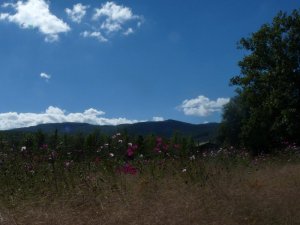
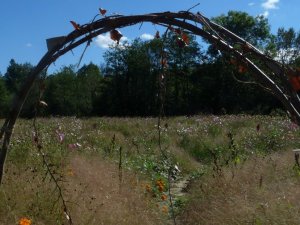
The meadow at the Jardin Extraordinaire today
Today we wanted a walk: it’s not high summer any more, but the sky was very blue, the sun was pretty hot, the morning mists had burnt off and who knows if tomorrow it may rain? We wanted to take bags and a bucket and see if there were a few late blackberries (there were), a few sloes (there weren’t) and a few early walnuts (there were) to make our sortie near Lieurac worthwhile.
That was the entrance, a few weeks ago.
Our path took us past the site of Le Jardin Extraordinaire. It’s not normally a public space, so we couldn’t wander down to the river, or scramble up the hillside. But we could walk by the meadow which had greeted us at our last visit, and we could see the tunnels and bowers of gourds. Autumn has struck. The bright fleshy stems and leaves of the gourds and sunflowers have changed into gnarled and bony twigs. The pumpkins which once peeped from beneath their leafy green sunhats are now exposed on bare earth, those leaves crisp and brown like curls of tobacco. The sunflowers still rear their tall heads over the scene, but they too are blackened and dry.
Dying sunflowers
Ripe pumpkin
Supervising sunflower
It’s still lovely though. This is no cemetery. The seed pods, the gourds, the berries are all ripe now, They’re ready for the next stage: marauding animals may eat them, humans too, or else they’ll seed themselves, so that early next year, the garden can begin to grow again, and be transformed by the creative artists and gardeners of Artchoum.
Rosehips along our walk
And we too marauded today. We came back after our walk with full bags, muddy shoes, and that feeling of well-being that comes from a peaceful and productive afternoon out in the countryside in the bright Autumn sunshine
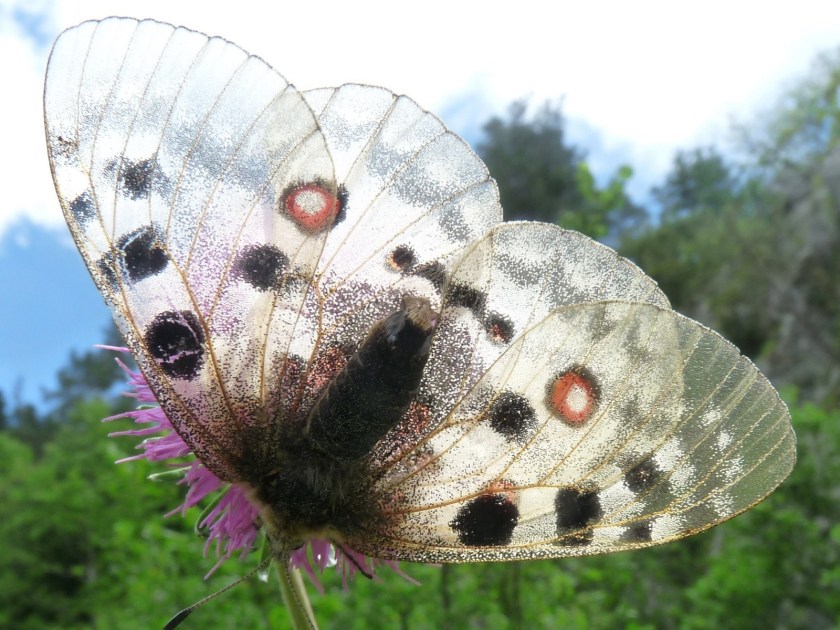
I just want to share a photo I took on our walk on Sunday, when we went to the Gorges de la Frau. This butterfly seduced us all with its distinctive spots and white grisaille wings. It turns out to be rare, a protected species, and known only in mountain regions, mainly in Southern Europe. The French know it as Apollon, and its Latin name is Parnassius Apollo. If your French is up to it, you can read about it here.
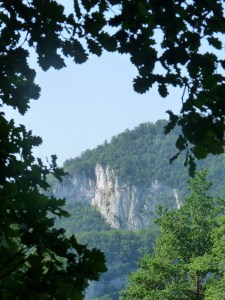
And here’s a small taste of the Gorges de la Frau, only a few miles from our house.
On Sundays we walk, with our friends from Laroque. This time though, Malcolm and I were cramming in something else too: an afternoon birthday party right at the other end of the Ariège.
This was the plan. Walking Party A (which included me) set off at 8.00 a.m. to do a walk from Lieurac to Roquefort-les-Cascades, where we were to meet Party B (including Malcolm) for lunch. Party B consisted of the temporarily halt and lame, as well as Marcel, whose bread hadn’t finished baking by the time we left. ETA for us all, 11.30. At which point M & I would have made our excuses and left for the birthday party.
We did fine, we keenies in Walking Party A. We walked past Rapy, Ilhat, Tanière, glad of the frequently wooded and well-signposted paths, and all went well till Bac d’en Haut. There was a choice of routes which we discussed at length as we studied the map and made our choice, though we agreed it was an obvious one.
View towards Rapy
In due course it became clear that it was not obvious at all. Instead of climbing up about 250m, then descending, we went on up…. and up… and up. We’d been due to meet Party B at about 11.30, but midday came and went, 12.20, 12.30, 12.40… and then we came out of the woods to be confronted by a sight just behind us to the right. Roquefixade, a beauty spot really rather a long way from Roquefort-les Cascades. Even if you’re a crow. But if you use the paths, or even worse the roads, it’s absolute miles (19 km. actually. It involves doing the two longer sides of a triangle). We rang every member of group B who had a mobile. Nobody responded. We concluded there was ‘pas de reseau’ but wondered why at least one of them didn’t get into a reception area and ring us.
My view from the back of the van.
In the end, one of our group rang her husband, and he came to take some to Laroque to collect a rescue car, and others of us on to Roquefort. He didn’t drive a comfortable family saloon. Oh no. Our walking companion Corinne had that. He had the bright yellow van he uses for hunting. Behind the front seats was a compartment prickly with fresh straw where he and his fellow-hunters accommodate any wild boar they succeed in catching. I was one of the ones who … er …. drew the short straw and travelled in the wild boar compartment.
By the time we climbed aboard it was…. 1.40. By the time we reached Roquefort, it was well after 2.00. By the time the rescue car arrived with the remaining walkers, it was well after 2.30.
Meanwhile I rang our hostess and warned her we might not be able to get to the party. It didn’t take too long for ‘might not’ to become ‘can’t’. Hot, sweaty, and with no time to go home for a shower, I don’t think we’d have been entirely welcome.
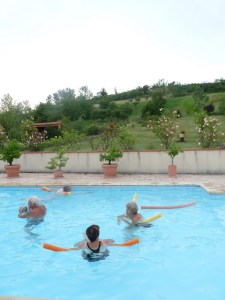
So we stayed with our friends from Laroque. A picnic lunch, then home for that shower, before going round to the home of Michel and Annick, who have a pool.
A refreshing swim, an ‘auberge espagnole’ (pot luck supper) and a glass or two of wine soon helped us reframe our day of not-very-brilliant navigating skills into a yarn that will no doubt go down in the annals of the group. It was just a shame about that party.
As you explore the site at Tabariane, this fellow expains much of its history.
Meadow flowers on the walk
The burial ground
Graves
Graves
An information board reveals some of the artefacts found at the site
View from the burial ground
And another
A local craftsman, Lamande, has made the seating that adds to the site’s interest and charm.
Continue to climb from the burial site, and this is the view….
…. and this …..
….. and this.
When I was at school (back in the Dark Ages), we learnt in history that the Romans came after the Greeks. They left us a legacy of Romance languages, our alphabet, Roman law, neo-Classical architecture, impossibly straight roads and under floor central heating. As the empire crumbled, so we were told, the continent descended into the Dark Ages. Barbarians, Vandals, and unpleasantly savage descendants of Asterix the Gaul ravaged Europe, raping, pillaging and generally leaving little time for culture and a settled everyday life.
I think we all knew it was a bit less straightforward than that. The Frankish Germanic tribes entering the late Roman empire had a very different culture from that developed by the Romans, and it’s been much harder to research systematically because there are few contemporary written records.
This week though, we went to visit a Merovingian site, Tabariane, recently excavated and interpreted near Teilhet, not far from Mirepoix. The Merovingians were an early Frankish dynasty established by Clovis, and they ruled an area roughly equivalent to much of France and Germany from the 5th to the 8th centuries, and are the kind of tribe that was dismissed as one of those from the very heart of the Dark Ages
It was a burial site we’d come to see. It has first been discovered in the very early 20th century by Captain Henri Maurel, and had been partly excavated according to the fairly invasive practices of the period. War and economic upheaval meant the site became first neglected, and then entirely forgotten about until recently.
Recent research lead by Nicolas Portet has meant that the burial ground, now carefully excavated, is now, as it almost certainly was then, a burial garden. It’s a large site, on a hillside overlooking the site of the now disappeared Merovingian settlement on the opposite side of the valley. The 166 tombs seem to have been arranged in ‘clans’: loose arrangements of extended families and friends, over a long period of time. It seems to have been a burial ground which held a place in the life of the community for many years, rather than being a cemetery developed as a result of tragedy – war or plague say. Most of the bodies were laid with their heads to the west, their feet to the east. Originally they were clothed, but little remained apart from metal objects: belt buckles, brooches, jewellery and, with some of the men, weapons.
This is where ideas have changed. Early 20th century archaeologists sent excavated objects to museums far and wide, even to America: modern practice which encourages an area’s ’patrimoine’ (heritage) to remain as far as possible intact did not then exist, but you can find examples of objects found here in the Museum at Mazères, and in Saint Raymond de Toulouse.
Now as then, the tombs are planted with local flowering plants: lavenders, marguerites, herbs. It’s thought that locals would have visited the grounds with their families, spent time there, as we might in a modern park. So it was important to both the living and the dead to make it a pleasant, calm place to be. The burial ground overlooked the village. The village overlooked the burial ground. Each had an interest in the other. Each could intercede for the other.
It’s a tranquil, special place, surrounded by meadows and hilly countryside. A circular walk of some two and a half kilometres , starting and ending in the village of Teilhet gives you a chance to spend a peaceful hour or two exploring scenery that may not be so very different from the way it was when the Merovingian villagers first laid out their burial ground, some 800 years ago. Excellent information boards will help you understand a little more about those Merovingian people who made their lives in this still rural area.
While you’re there, make time to enjoy the facade of the 14th century church at Teilhet. Here are some pictures to whet your appetite.
The village and church of Teilhet seen from above.
Thanks to Wikimedia Commons for the use of this image of the vhurch facade
Stained glass window from “largest stained glass window-manufacturing firm in the world” of the 19th century Louis Gesta
This visit, guided by Marina Salby, formed part of the summer programme of Pays d’art et d’histoire des Pyrénées Cathares. It will be repeated on 31st July and 21st August. Meet outside the church at Teilhet at 9.30 a.m. Cost: 2 euros.



















 From Pyrenees to Pennines
You must be logged in to post a comment.