Mufti *

Before I came to spend so much time in le fin fond de l’Ariège (‘back-end-of-beyond’ to you) I subscribed to the general British view that being well groomed and chic came naturally to the French.

Not so.  Frankly, looking as though you spend time studying the fashion pages forms no part of anyone’s life round here. Well, we’re a small country town here, so it’s scarcely surprising: but things don’t seem so very different in the bright lights of the department’s capital Foix (pop. 10,000), or the one Big City, Pamiers (pop. 19,000).

What’s surprised me though are the clothes worn by those people in service industries whose work brings them into contact with the general public.  In the UK, working for a bank, building society or even Marks & Spencer means that you’ll be fitted out with a uniform featuring a smart blouse or shirt at the least.  And men will be wearing ties.  School teachers don’t wear uniform of course, but their dress code requires them to be ‘smart-casual’ at the least, and yes, ties for the men.

Little of that applies here.  The only men I’ve ever seen wearing ties in France have been politicians or top businessmen making their mark on the TV evening news.  And the assistants in any pharmacy are as smart and carefully made up as the immaculately turned-out women who make me feel so inadequate as I pass the beauty counters in British department stores.  Neither of these groups represents the norm.

Calling into the electricity board recently we were greeted by a man whose T shirt indicated he might recently have been gardening.  Bank workers grab any old top and jeans before going into work.   The teacher who came with her class to the library the other day even had ripped jeans.  And of course her pupils were casually dressed too.

So it’s not surprising that when my friends call and spot the school photos of my grandsons, smart and smiling in their royal blue sweatshirts with neatly fastened ties beneath, they assume the boys frequent some rather posh private seat of learning.  ‘Nah’, I reply.  ‘Only the local school down the road’.  Opinions are divided then.  Some wish fervently that French children had to wear uniforms, to prevent the dreaded ‘designer-trainer syndrome’.  Others are aghast at the dreadful deprivation of liberty that forcing the children to dress alike represents.

I’m not bothered either way.  But it’s one of the things that we notice as we share our time between England and France.  Vive la difference!
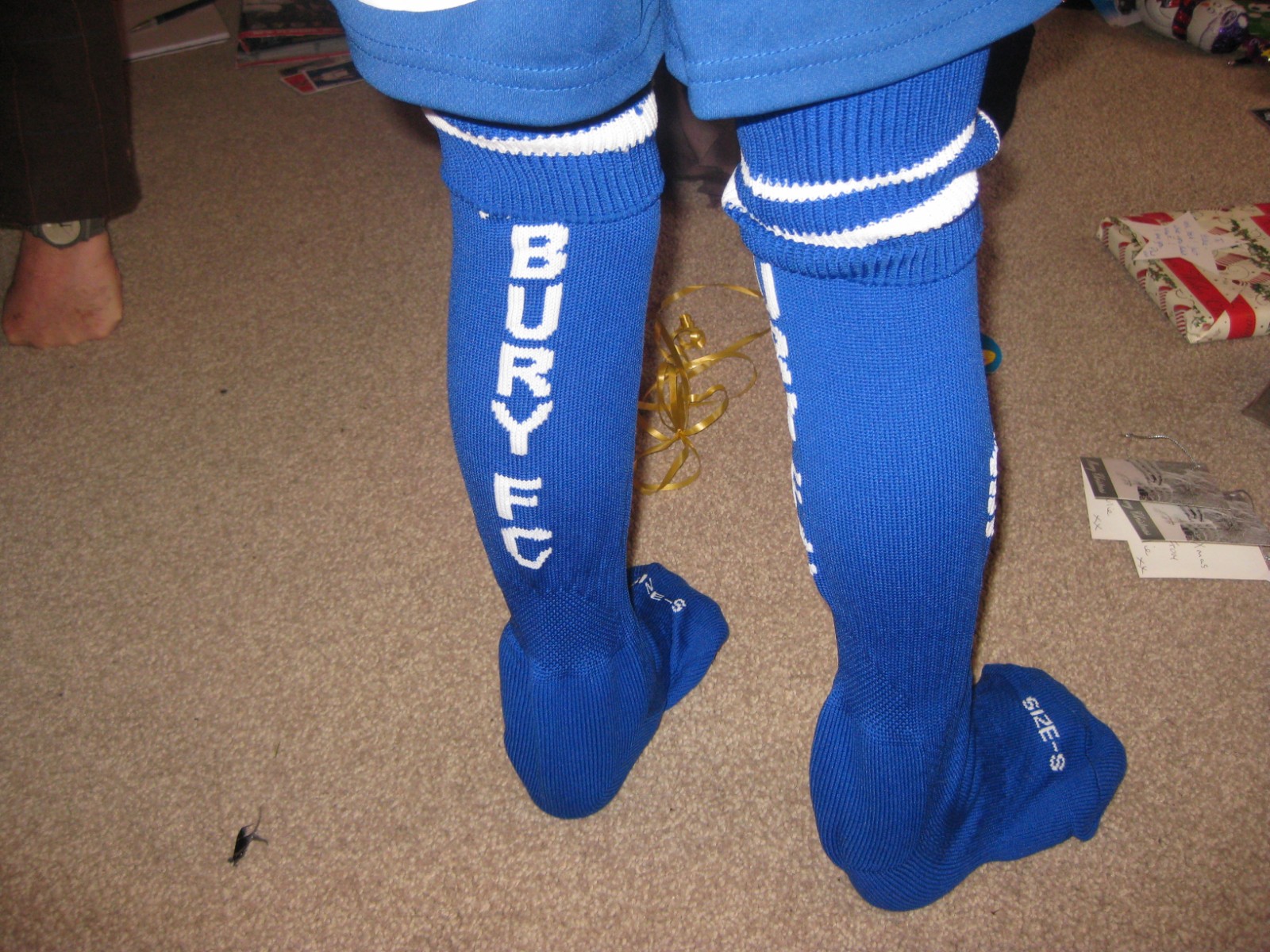
Uniform, but not as we know it. Grandson Ben's football socks may take a little growing into

* Mufti, refers to ordinary clothing, especially when worn by one who normally wears, or has long worn, a military or other uniform. 
Plateau de Sault calling

Down here in the foothills of the Pyrénées, nobody’s interested in how far you walk as you stride up the mountainside.  It’s all about the DNV (dénivelé, or number of metres you’ve climbed – and remember a hillside can go down as well as up: coming up again after a descent starts the DNV counter all over again).  On Thursday, we did 791 metres.  That’s 2959 feet in real money.  Our mileage was less impressive:  19 km. or 11.8 miles – in the circumstances pretty damn’ good.

But we didn’t know the statistics till we’d finished.  We were far too busy having a very special walk.

To reach our departure point, you leave Belésta via a switchback forested road, over the Col de la Croix des Morts, and emerge onto a high and slightly bleak plateau.  This is the Plateau de Sault, home of the region’s potato growers.  We stopped at an insignificant track signposted Langrail and parked the cars.  As we got our boots on, we met another walker on a brief holiday from his home in Durban for a good long solitary hike (‘Durban?  Where do you suppose he meant?  Durban-sur-Arize in the Ariège?  The one in the Aude? South Africa even?’).  He was the last person we met all day.

It was the 14th March.  There were large patches of snow all along our route.  Yet we wore tee shirts all day and became lightly bronzed in the hot sun as we crunched through that still hard-crusted snow.  Through the forests we could see the peaks of our more local mountains: Maguy, born and bred round here taught us how to recognise each one.

Then, quite unexpectedly, we emerged into a splendid expanse of pasture interspersed with areas of snow.  In every direction, there was a distant fringe of mountains: our day-to day familiar slopes, the more distant and higher peaks of the Hautes Pyrénées,and behind us, bereft of snow, those of the Aude and Pyrénées Orientales. It was a really special pleasure to tramp across this apparently unending pasture, enjoying views of our constant neighbour Montségur, as well as the towns and villages where we all live, and much further away, the Montagne Noir, with the sky clear and blue above us.

It kept us happy till lunchtime.  We’d arrived at a refuge by then, thoughtfully provided with a table and benches in the sunshine.  After the picnic, we left our rucksacks with Gilbert, the honorary man in the group and went off to investigate the Belvédère, the local viewpoint.  Craggily folded rocks plunged down deep towards the Gorges de la Frau and still we had our views of Montségur.  We were impressed.

Our route for the day was a simple there-and-back.  But the views were quite different, looking towards more eastern slopes so we didn’t feel at all short changed that we were repeating our route.  And most of the return was downwards too.  Which was helpful.  When you’ve climbed 2000 feet or more, it can get quite tiring as the day nears its end.  Lucky that there was cake and tea to look forward to.

This slideshow requires JavaScript.

Apricot jam

There’s been discontent in the house.  No jam to go with the  fresh bread and coffee at breakfast time.  At this time of year, you can’t expect either the hedgerows or the market place to produce any suitable ingredients, so what to do?  Then I remembered my mother’s solution to winter jam crises, and a good one too.  Dried apricot jam.

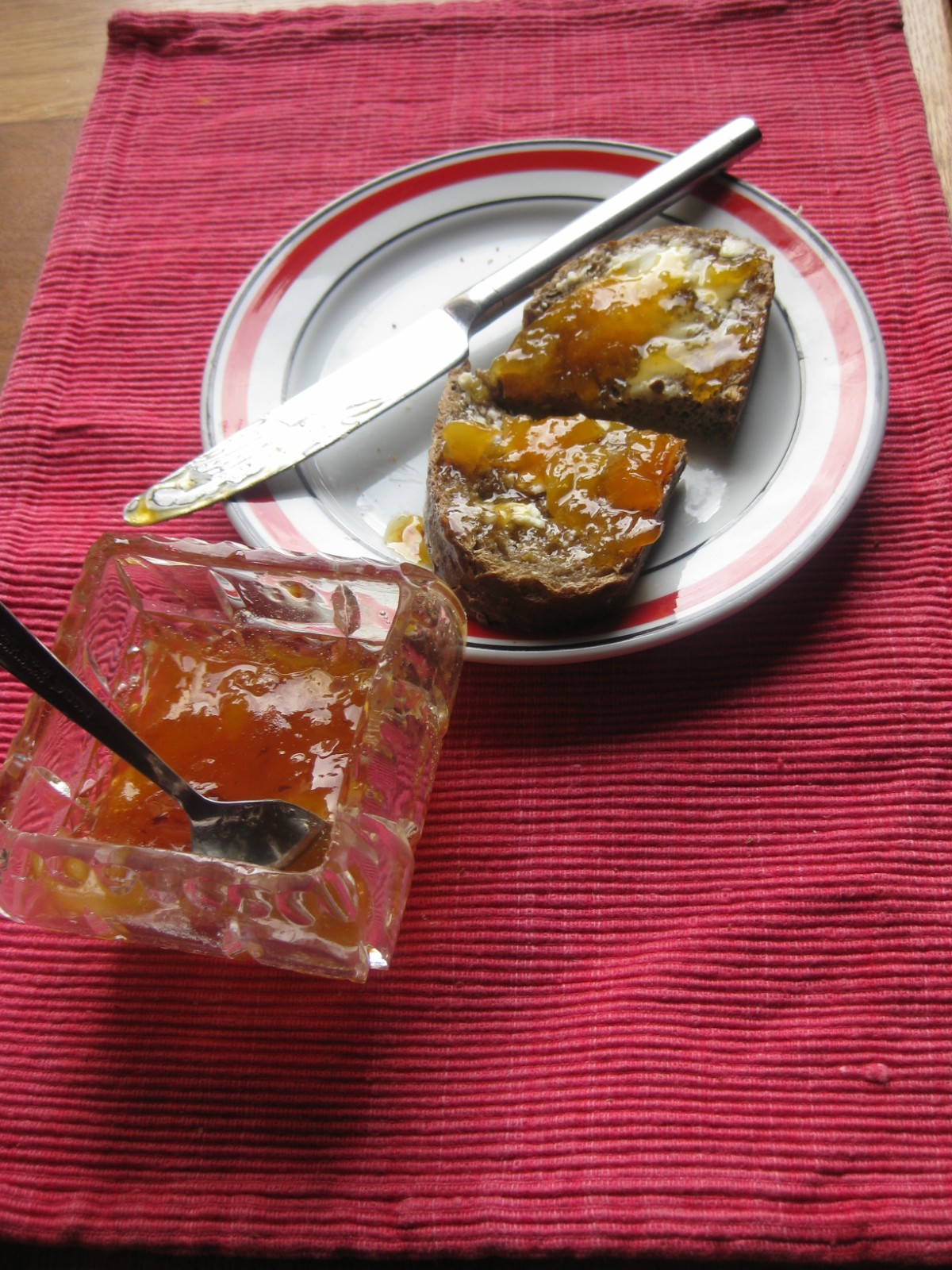
I remember that she used to use those dark, rich yet slightly tart and chewy fruits that needed long soaking and cooking to soften them, though I always used to prefer to eat them as they were.  Jam recipes recommend them still, but just you try buying them, even on Lavalanet market.  It’s all the plump pale soft style these days.  I was afraid these would deliver a slightly wishy-washy and anaemic jam so I added a few spices to the mix.  And here’s what I made:

Breakfast sorted.

Dried apricot jam

  • 500g dried apricots
  • 1 cinnamon stick
  • Seeds from 3 cardamom pods
  • A chunk of peeled fresh ginger
  • 500g caster sugar
  • A large lemon

Place apricots in a large bowl, cover with a litre of water and soak overnight.

Use a potato peeler to peel the zest thinly from the lemon: chop the zest into fine pieces.

Roughly chop the apricots, put them and the soaking liquid in a large pan with spices, bring to the boil, then reduce heat to low and simmer for 15 minutes. Add sugar and the juice from the lemon, and return mixture to a slow boil until jam setting point is reached (105 degrees C).  Remove the ginger chunk (I ate it).  Pour jam into about 3 sterilised jars.

Markets in Toulouse

We went to Toulouse yesterday, to visit the markets.  This wasn’t a trip to stock up the larder though.  This was a history lesson, as offered by Elyse Rivin, long term resident of Toulouse and great enthusiast for the city.  She is a full fledged official guide and art historian, and runs Toulouse Guided Walks.  We’d booked.

Minutes after we met, we found ourselves in front of Victor Hugo market.  You’ll go here for meat or fish, but also for all the other foodstuffs that markets do so well – fruit, vegetables, bread and patisseries, drinks.  At lunchtime you might pop up to the first floor to have a convivial meal at one of the several restaurants up there, all using fresh produce bought only an hour or two before from the stalls below.  This market, like every other in Toulouse bar one, is a concrete horror story.  Back in the late 1950’s and early 1960’s, they demolished the elegant iron and glass Victorian structures: they needed car parking space of course, and somehow contrived to squeeze car-parks-with-added-market onto those old sites.

Toulouse has had markets since way before the 12th century, and most had a speciality.  Victor Hugo’s (I’m guessing it wasn’t called that then) was wood.

We wandered along to the Capitole, the splendid central square of Toulouse.  Usually it’s an an elegant place, airy and inviting.  On Wednesdays it’s inviting for a different reason:  There’s a market: a big one.  Teeming with second-hand books, brocante of every kind, traders from every corner of the world……  And on other days, there’ll be organic food stalls instead.

I remember learning in history lessons how the streets of London were often taken over by particular trades – leather sellers, poulterers, bakers and so on.  So it was in Toulouse.  Many of these trade names have been lost, but there are still streets with the old Occitan names: the cauldron makers for instance.  And some trades hang on, in an unbroken line from the 12th century.  Rue Sainte Ursule for example, then as now, housed textile merchants.  These days that means clothes shops, textile wholesalers, even small scale manufacture.  This area is still named Quartier Bourse after the Bourse des Marchands (a trade association, an antecedent of the Chamber of Commerce).  In the 19th century a fine new neo-Classical building was built, and this is the Tribunal de Commerce, where trading disputes are resolved.

On to Esquirol.  Flour was measured here in a stone basin, by volume not weight, to prevent honest shoppers being short changed.  A beady eye was kept on those who attempted to ‘cut’ their flour with chaff, dustings of rye flour and so on.  Back in the middle ages, as now, white bread was prized.  No market here now, because back in the 19th century, several long straight roads – in this case Rue de Metz – were sliced through the city, laying waste anything in their tracks.  The market hall that was here has been rebuilt piece by piece at Lourdes, so you could go and see it if you liked, unlike all those other lost structures.

Next stop: a walk down down Rue des Filatiers.  I love this narrow street with its tall, elegant houses, many dating from the 16th century.  Take a look at the pictures.  And then we were at Carmes, originally home of the Carmelites.  The order eventually won a long battle with the city to be allowed to have a monastery in Toulouse.  What clinched it was when they assured the pope that their long ministry in the area of Mount Carmel gave them a unique possibility of converting the area’s small Jewish population.  The city fathers had to give in.

Carmes, like the other markets, is now a concrete box, instead of a complement to the smart 19th century character of this historic area.  But we were here to sample cheeses, guided by a local affineur, at a shop called Sena.  What this means is that the shop buys cheeses direct from the maker, and matures and ripens them to what it considers perfection.  Our guide for the occasion wanted to share three fairly local cheeses with us.  We had a young soft goat’s cheese ‘Cathare’, fresh and light, dusted with ash: this was 10 days old.  Our cow’s cheese, yielding, tasty and with a volcanic looking grey crust was 5 weeks old.  Best known was the Ossau-Iraty cheese, made from sheep’s milk from the Basque country and the Béarn, which had the most pronounced taste of all.  He paired these with fruits: raisins, candied kiwi, and almonds.  For tasting purposes, he explained, these are better than bread. We had a glass of the most local wine to Toulouse as well, Fronton.  This was a Négrette, low in tannin and acidity.

I talked to him about English cheeses.  He sells Blue Stilton, but I was alarmed to see, among all his hand-picked artisanal cheeses, a block of shrink-wrapped orange cheddar.  He told me that people bought it for barbecues, to put on cheeseburgers.  He had, he said, little incentive to stock English cheeses, which he knew could be very good, because the French would not buy.  Presented with shrink-wrapped cheddar, are you surprised?

Still, by now it was long past midday.  Back to Carmes to hunt for a lunch-stop, where we could discuss the morning over a leisurely plat du jour.

This slideshow requires JavaScript.

“Vaut mieux le vin d’ici que l’eau de là”

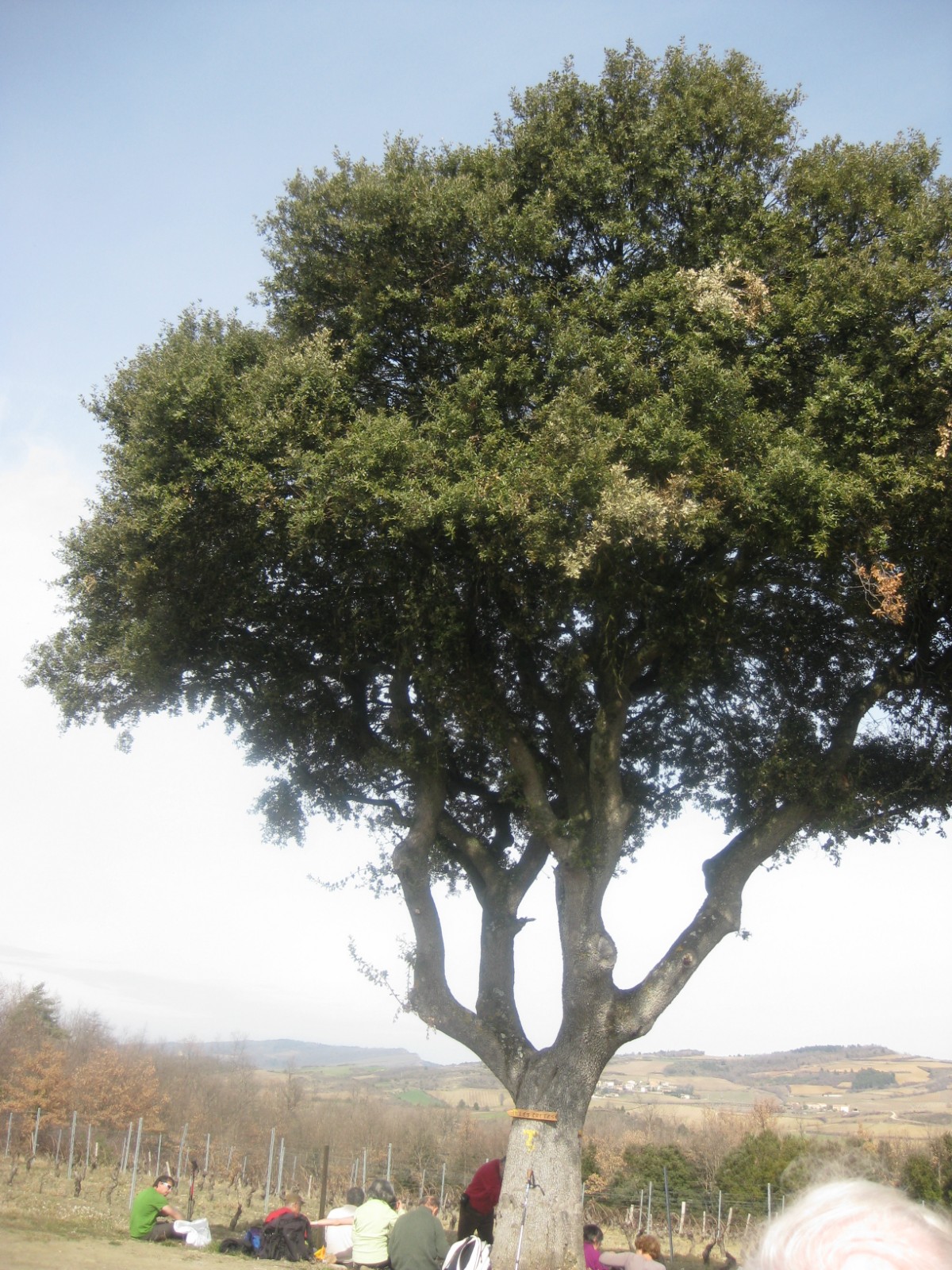
It was a walking day again yesterday – Malcolm too this time – this time with the new hiking group at Laroque.  The walk, again amongst vines, but in the more Spanish style garrigue around Esperaza, was relaxing and fun, but the highlight of the day was lunch.  We sat by a vineyard, either in the sun, or shaded by a shapely and statuesque holm oak tree, and unpacked our rucksacks.

Under the spreading holm oak tree we laid our picnics out.

For a picnic on a walk, most people put together a chunk or two of cheese and sausage, a bit of fruit, and stop at the boulangerie on the way to pick up some bread.  We all did that….but…. there was food to share too.

Phillippe, Sylvie and Jean-Charles opened wine.

Jean-Charles offered peanuts.

Michel produced home made charcuterie (dry cured sausage).

So did Phillippe and Sylvie (boudin blanc) – theirs was home made too.

They brought some of their daughter’s home made goats’ and sheeps’ milk cheese.

I made a drenched lemon cake.

Yvette made crisp chocolate biscuits.

Jean Charles brought an ‘artisanale’ fruit cake.

Then he came round with coffee.

And finally, Yvette offered plum eau de vie made by her grandfather in 1985. A little dripped onto a sugar lump and scrunched is the perfect end to a perfect picnic.

Then we all lay around in the sun for half an hour while we digested that little lot.

That’s the way to do it, eh?  And as everyone said, as we finally decided we ought to have a go at walking off all those calories, “Vaut mieux le vin d’ici que l’eau de là” : it’s better to have a drink among friends than to be no more for this world.

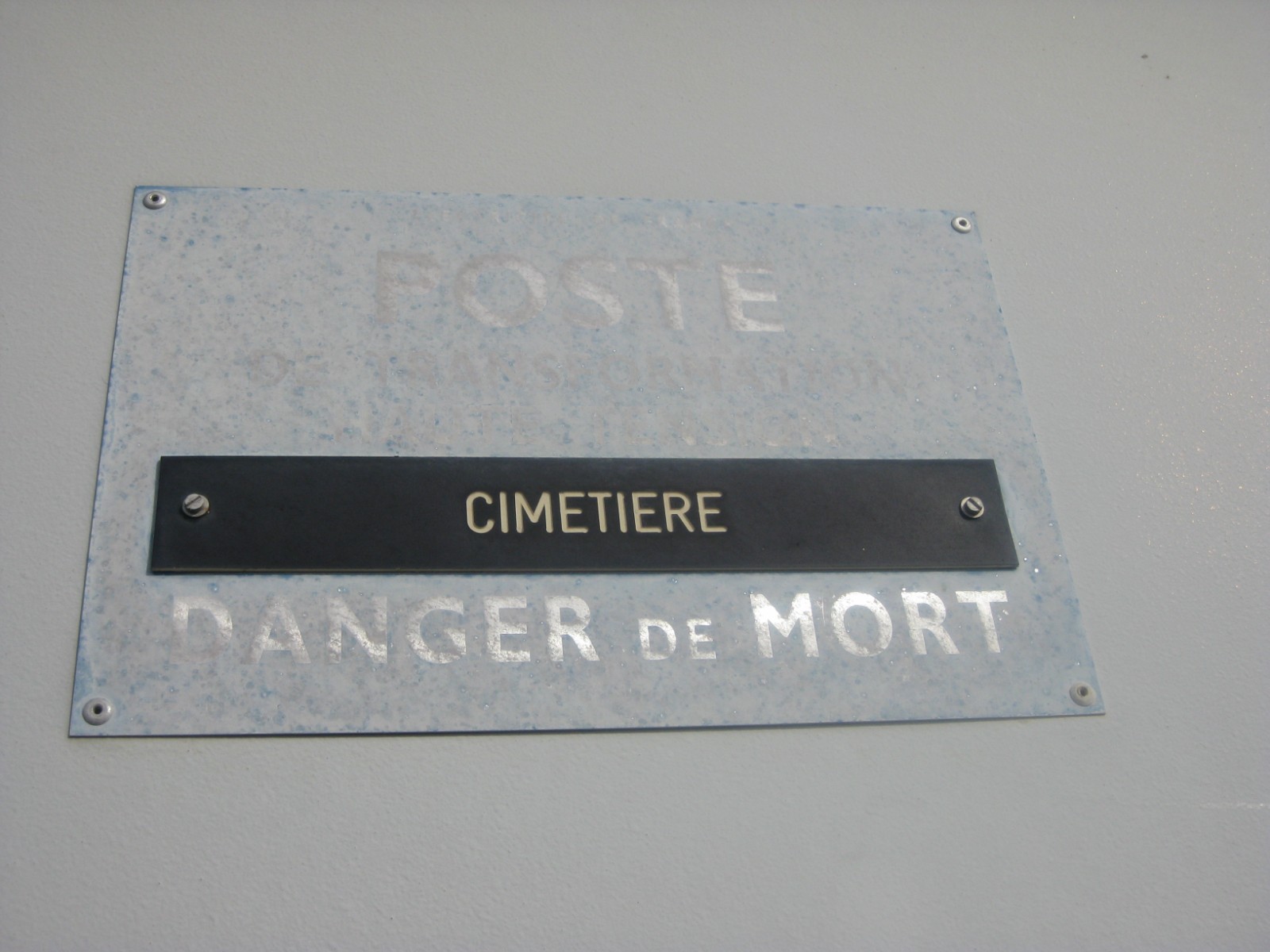
As we ended our walk, we found an electricity substation, handy for the graveyard, that reminded us that death is an ever-present threat.  Definitely a good thing to have shared that food and wine at lunchtime.

A walk from Cépie

Thursdays, I walk.  I do these days anyway.  A few weeks ago I was invited to join a small informal group from round these parts, went once, and had a great time.  Then The Great Snows came, and that was that for a while.

Yesterday, though, we went to Cépie, near Limoux.  Cépie is a village that Malcolm and I happened to be driving through several years ago in high summer, and where we spotted a fruit producer, selling peaches and nectarines.  Those peaches we saw that day have become the standard against which all others are measured.  Dripping with perfumed sweet juices, the tray we bought scented the car with its decadent fragrance, and all but intoxicated us as we drove home. So I was keen to go again, lack of peaches notwithstanding.

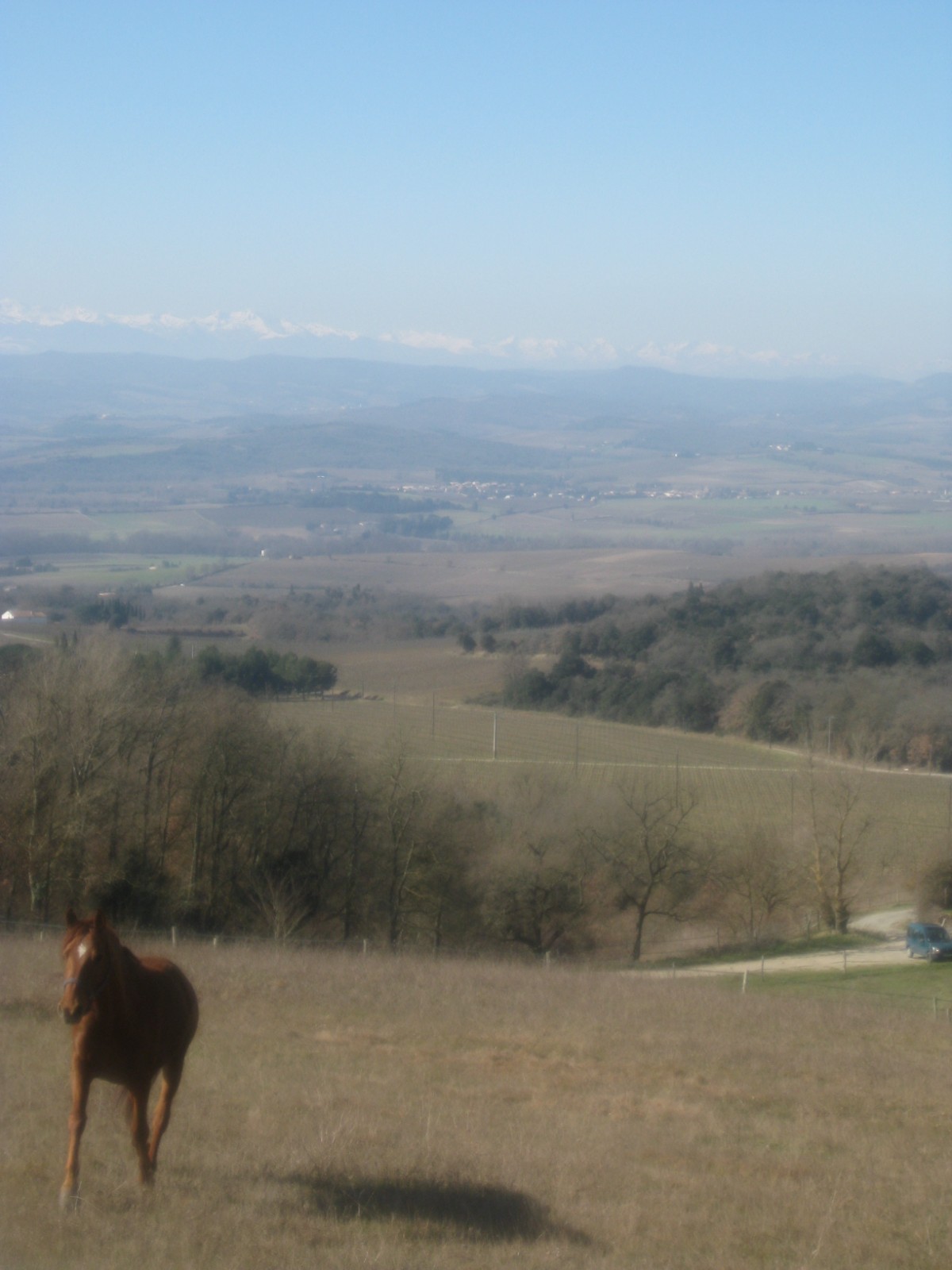
You'll struggle to see the snowy Pyrenees as the backdrop to this picture. They are there. Keep looking

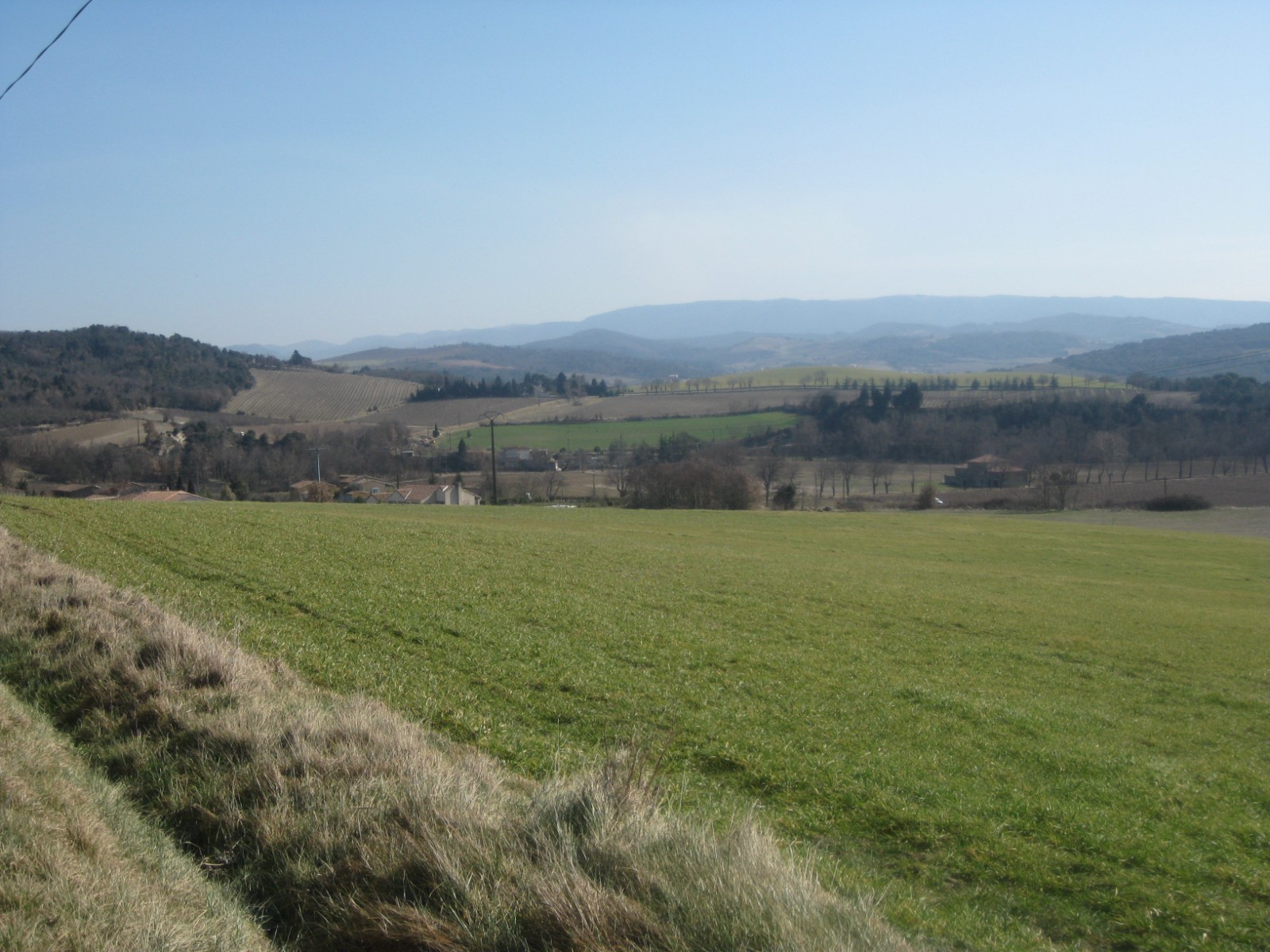
Instead of peaches, there were views.  The Pyrenees are more distant here, but that means we got horizon-filling views of the gleaming snowy mountains as they rise and sink in a line of angular peaks, marching right across the skyline from east to west.  Because of the haziness of the day, the photos give no idea of the panoramas which we quite simply had to stop and gaze at, time after time.

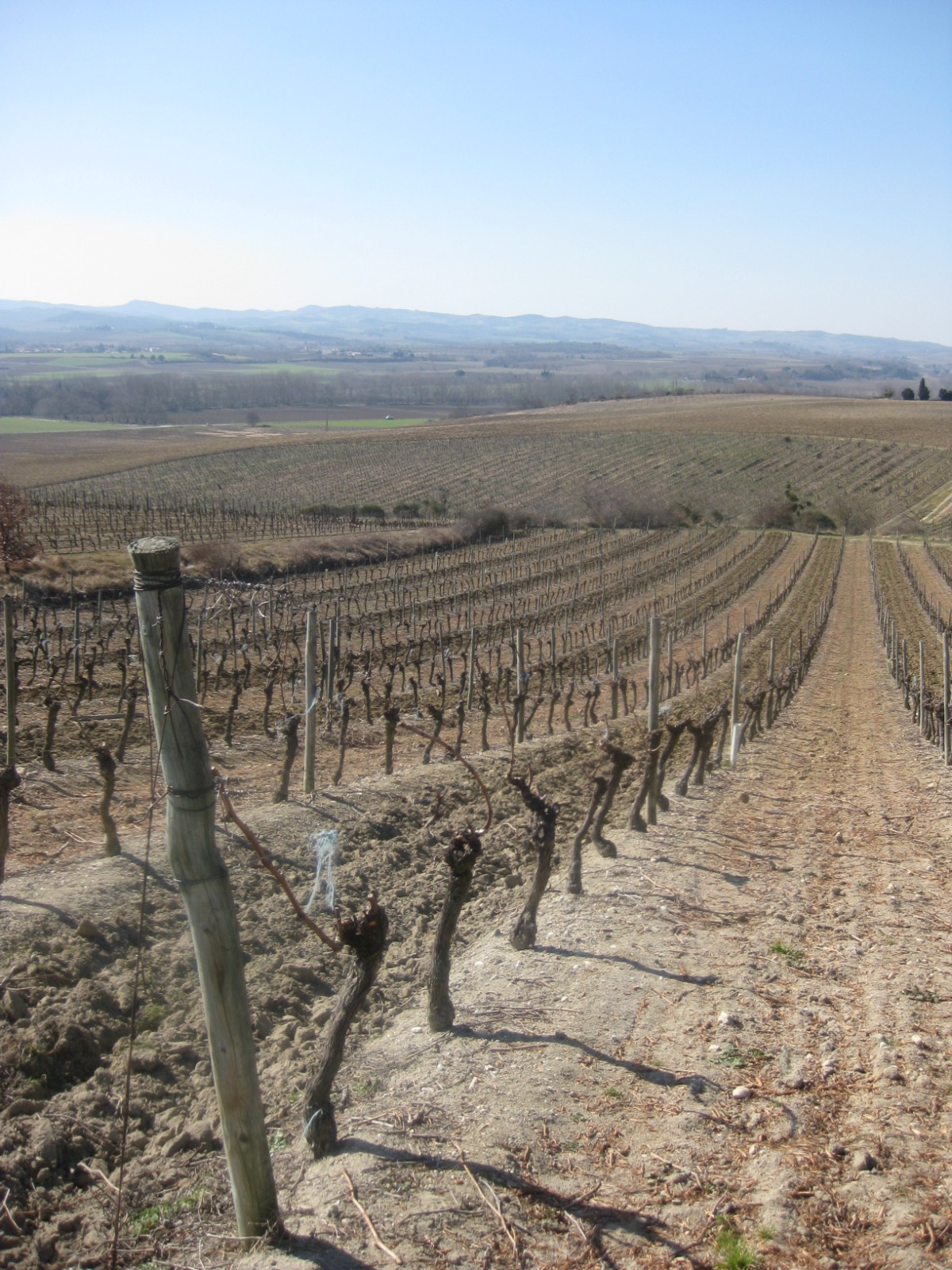
This area is Tuscan style Aude – rolling hills with distant domains and lines of cypresses, covered for acre after acre with mathematically precise lines of vines.  I used to find these vineyards rather dull in winter.

Notre Dame du Razès, protégez nous et protégez nos récoltes

Now, as the workers get busy in the fields, pruning away all the growth from the previous year to leave little more than a two or three foot high trunk, I enjoy the way these organised lines echo and follow the contours of the landscape.

Vineyards march across the landscape

Our walk took us in a figure of eight through sandy, stony wooded paths, passing near domaines and hamlets whose reason for being is those vineyards.  Towards the end, we paused in the tiny village of Saint Martin de Villereglan and enjoyed looking at the school-cum-town hall, the views down to the church, and generally pausing for breath before the final yomp up, then down the hill that divided us from Cépie.

A nice touch with these walks is that every week, one member of the group makes a special cake to share at the end of the day.  A lovely moment of sharing (in this case with a couple of passing villagers who got chatting), it gives a much needed calorie rush.  We’d only done about 16 km, but the local temperatures rose to more than 23 degrees, and we felt we deserved our gâteau aux noix.

The homeward stretch

The Great French Bake Off

I’ve just had The Best afternoon.

Over at Découverte Terres Lointaines, we realised that Fun was sometimes in short supply.  Often busy getting the next event together, with deadlines to meet and crises to overcome, we weren’t getting together and having time sharing our skills for the simple pleasure that brings.

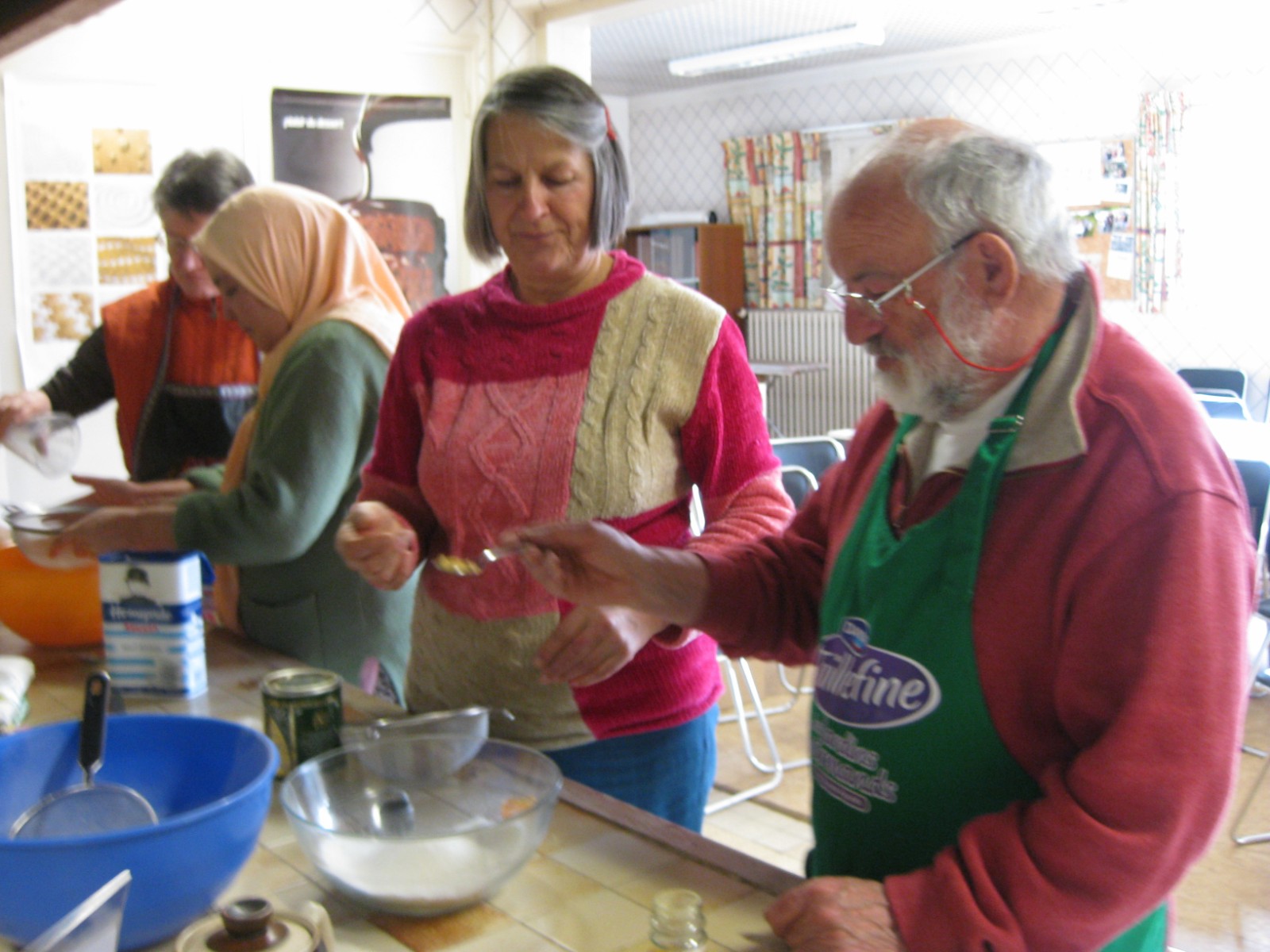
So this afternoon, we had our first atelier to do just that.  We did a little publicity and attracted five women and one brave man, who came along to the CAF (Social Services.  Sort of) with their pinnies to cook.

The work we’re doing this year is on England, Yorkshire in particular, so I was put in charge of the session: though Sylvia did the work of producing a recipe booklet for each participant. What to choose?  In the end I settled for scones, which are unknown here, and crunchy ginger nuts.  Both start with the same technique – rubbing flour and butter together- but end up quite different from each other.  Both are inexpensive and quick to prepare.

Getting stuck into ginger nuts
Everyone rolled up their sleeves, weighed, stirred, mixed, rolled out, organised what they’d made onto baking trays….and waited while the ovens did their work.

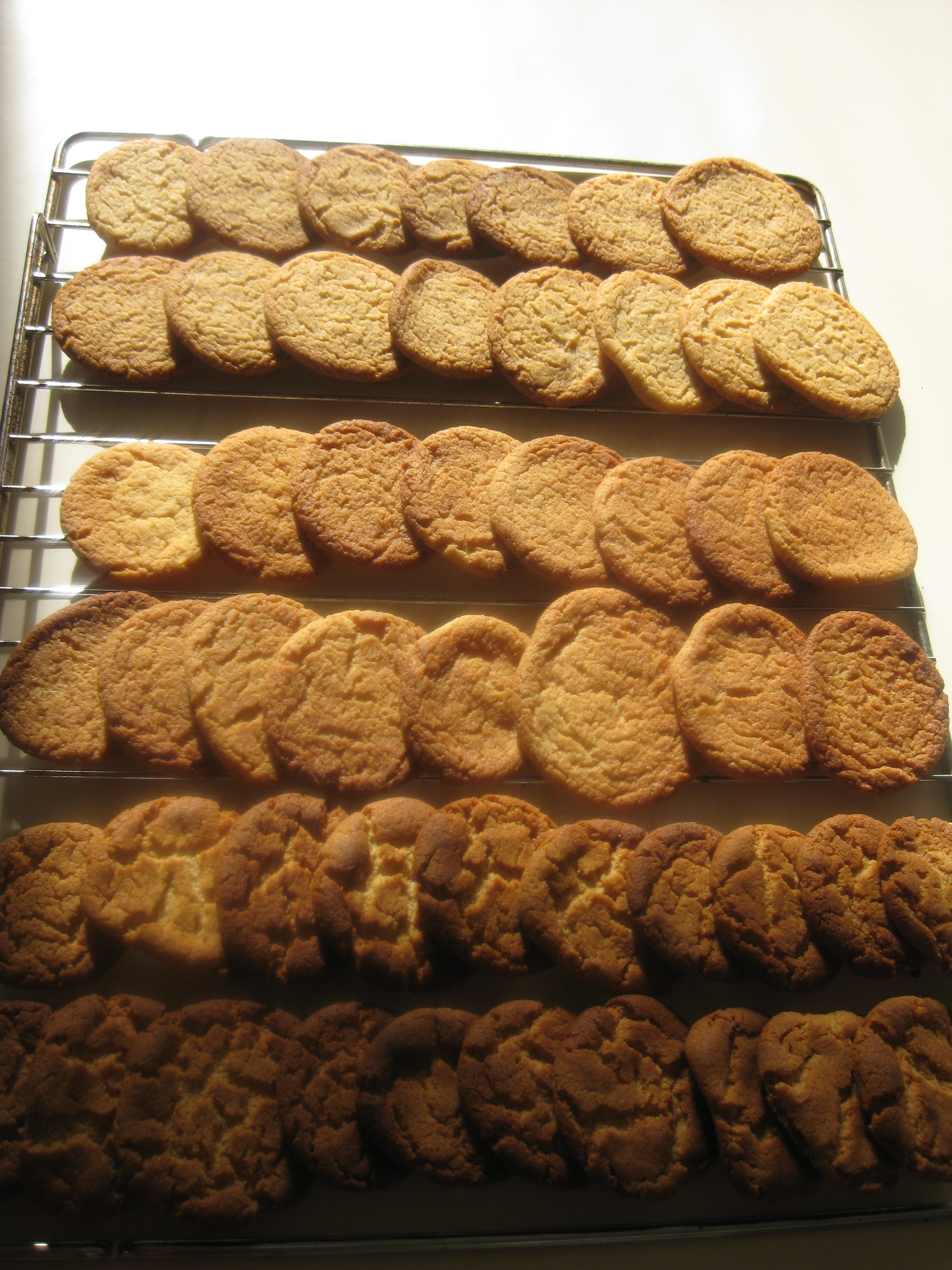
Astonishing to see how identical ingredients prepared identically by different hands, with different ovens varied so much.  Some ginger nuts had crunchy crackled crusts, others were smoother, crisper.  Some scones were domed, others, equally well-risen, were flatter on top.

3 cooking squads, 3 sets of biscuits

So we all had to try everybody else’s over – of course – a nice cup of tea. Lots of discussion and constructive criticism (‘Did you add salt to yours?  Which do you think is better?  With?  Without?’).  The scones were a hit, though not everyone chose to have either butter or jam.  The ginger nuts went down well too.

Everyone declared they’d had fun.  Plenty of time to cook, to share, to talk and laugh and eventually sit and eat what we’d made with new friends. We’ve all said we’d like to come and do it again.  Soon.

Puzzled by the title? It’s an allusion to a series which has apparently been popular back in the UK: The Great British Bake Off

Tongue-tied in Catalonia

The waitress gazed at us in bafflement. All she wanted to do was to take our order.  We became more and more frustrated and slightly hysterical at our inability to explain that we’d only given our order (‘café solo e café con leche’ – we could cope with that) about a minute ago to her colleague.  Sadly, he wasn’t in view, so we couldn’t point him out.

We were in Catalonia visiting our daughter for the weekend, and we couldn’t wait for her to join us in the bar.  When she arrived, she smoothly took over, explained the tapas menu to us, and gave our order to el patron.  He complimented her on her Spanish, but then spoilt it by wondering if she were Belgian.

She’s already had an interesting few months as a language assistant in a Catalan primary school.  She’s more likely to hear Catalan, but Spanish is common too, and this is the language she’s keen to learn.  The family she’s currently living with speaks Catalan, Spanish, German and English – even occasionally French – round the dinner table, but she claims this as a positive and helpful experience, probably because they all correct each other.

We found it difficult and frustrating being in Spain with only the most rudimentary language tools.  Any efforts on our part to communicate in Spanish or Catalan were greeted with friendliness and enthusiasm by the locals.  We battled to be understood, they battled to understand, and laughter at each other’s efforts broke down lots of barriers.  Still, we can’t go on like this.  We want to make an effort to learn a little more of the language before we visit Emily next.

How do people who come to live in Spain (or France come to that) cope if they don’t try to master the language?  We know of people who’ve been here ten years or more and can still hardly communicate.  If we found it hard booking a ten-journey train pass or telling the waitress we didn’t need her just then, how much worse would it have been if we’d been trying to contact a plumber, say, or the local town council?

And most of our best times here are spent sharing experiences – whether it’s a walk, an hour at the gym, or simply having a coffee together – with our French friends and neighbours.  Unable at the moment to replicate those free and easy exchanges when we go to Spain makes us feel we’re missing out.  Must Try Harder.

Comfort cooking: Snow 4

I’m getting a bad case of cabin fever at the moment.  The snow is turning to hard packed ice and/or slush and is not much fun to walk on.  We’re not getting out much. So I’ve turned to comfort cooking.

About a week ago, my favourite food blogger, David Lebovitz wrote about his take on that wonderfully decadent Italian treat, Panforte.  Two days after that, Kalba’s blog dropped into my in-box.  She’d been tweaking his recipe whilst hiding from the snow on her side of the Ariège.  Today it was my turn- and here’s my tweaked recipe

  • 40g unsweetened cocoa powder, plus extra for dusting the tin
  • 200g chopped toasted nuts- I used the hazelnuts I gathered with some friends early last Autumn, and the last of my walnuts
  • 100g chopped dried prunes
  • 110g flour
  • 200g chopped candied orange peel
  • 1 tablespoon ground cinnamon
  • 2 teaspoons ground ginger
  • 1 1/2 teaspoons freshly ground black pepper
  • 1/2 teaspoon ground red chilli
  • 1/2 teaspoon mixed spice 
  • A pinch of freshly grated nutmeg
  • 85g dark chocolate, chopped
  • 200g sugar
  • 210g clear honey

Preheat the oven to 165ºC.

Line the bottom of a 22cm springform tin with parchment paper. Dust the inside, including the sides, with cocoa powder.

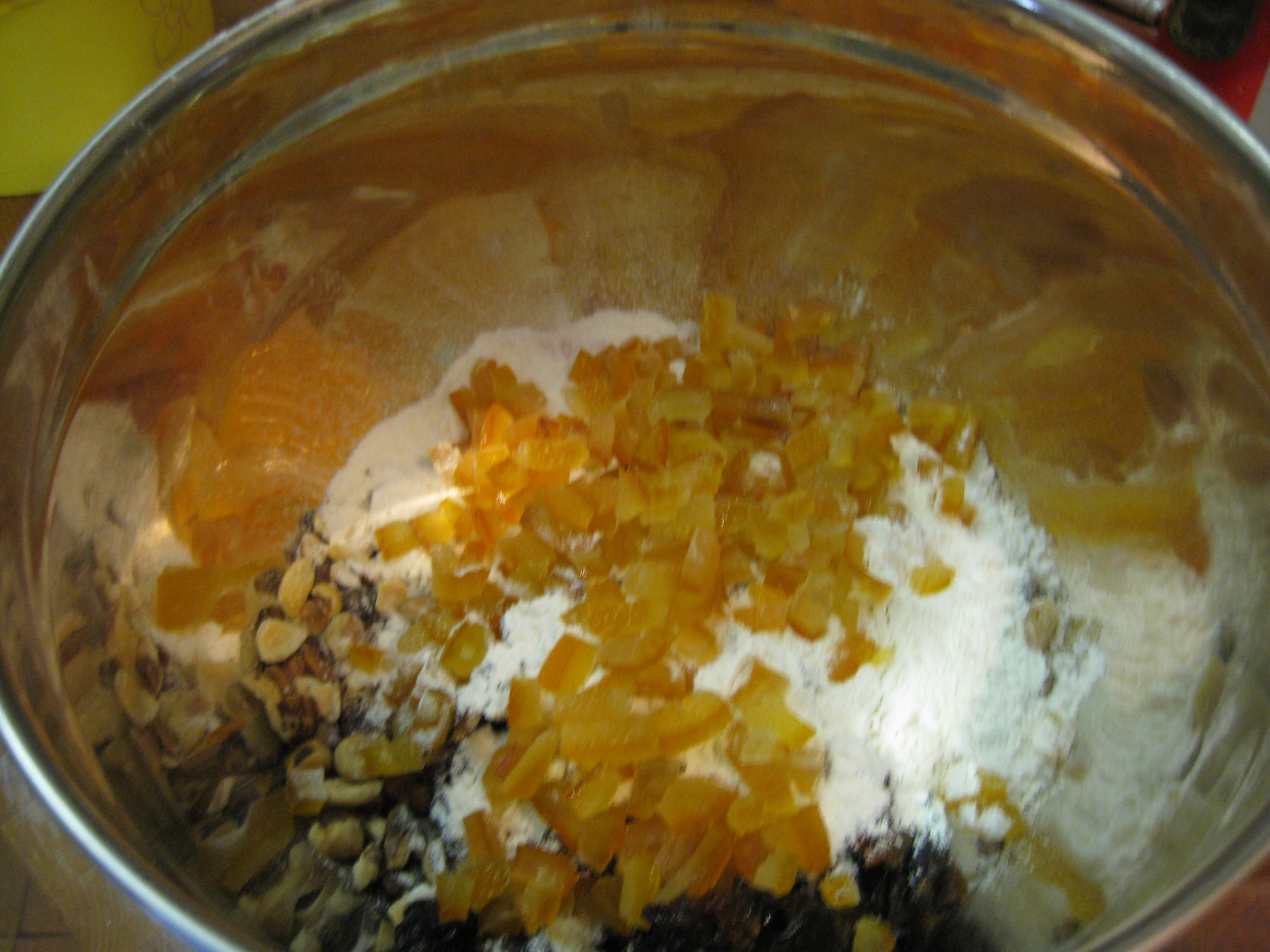
In a large bowl, mix together the cocoa powder, dried fruit, nuts, flour, candied peel, cinnamon, ginger, black pepper, mixed spice, and red chilli.

Melt the chocolate in a small bowl set over a pan of simmering water. Remove from heat and stir it into the nut mixture.

Gently heat the sugar and honey to 115ºC.

Pour the hot honey syrup over the nut mixture and immediately stir it all well to mix. Scrape the batter into the prepared pan and smooth the top.

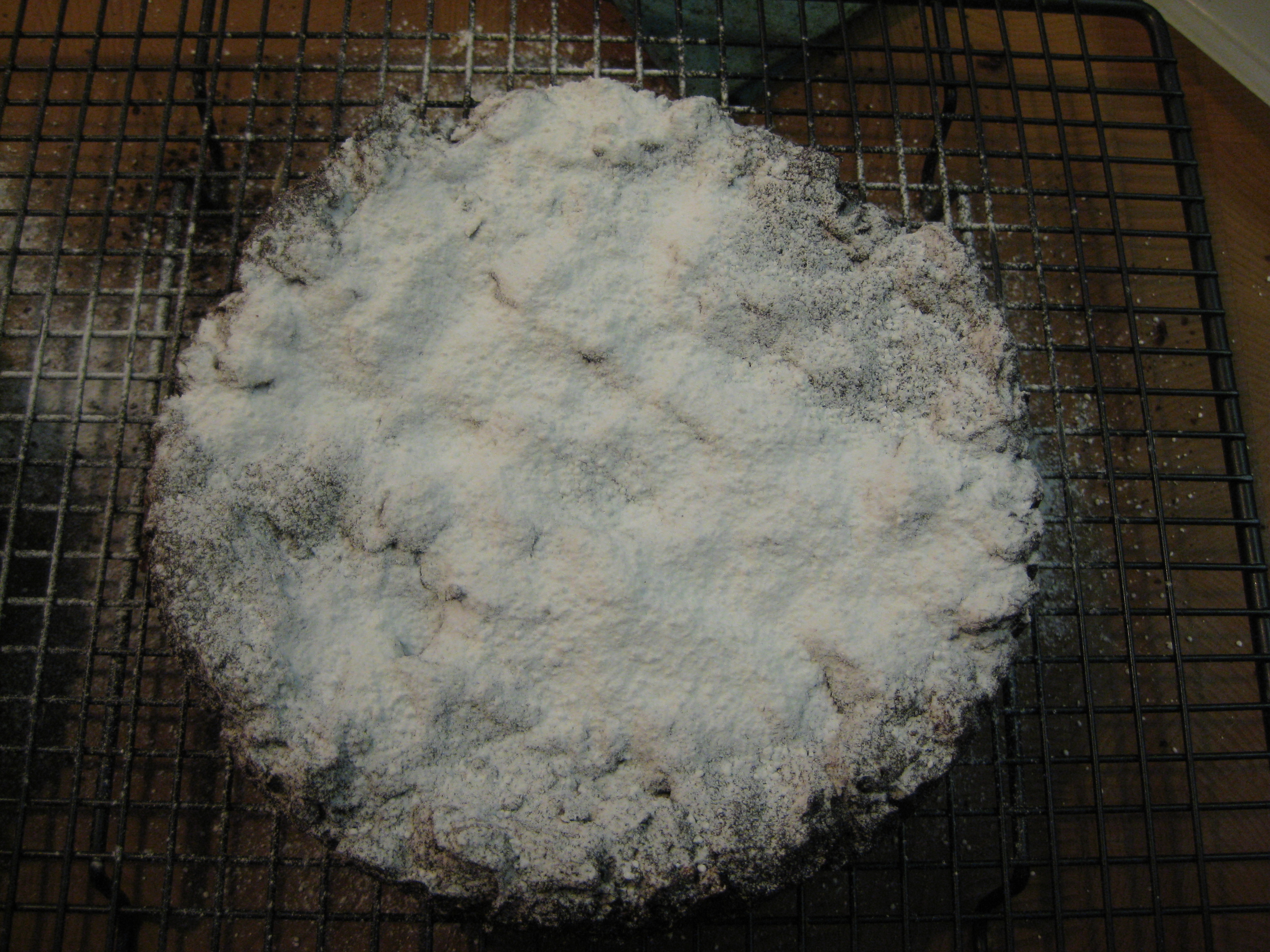
Bake the panforte for 30-35 minutes; the centre will feel soft, like just-baked custard, and if you touch it, your finger will come away clean when it’s done. Let it cool in the tin on a wire rack for 15 minutes, then run a knife around the edge to loosen it. Remove the springform carefully, let cool completely, and dust generously with icing sugar.

The panforte's on its way

So why have I changed things? For my usual reason of being short of an ingredient or two of course.  I’d run out of dried apricots.  Well, what’s wrong with prunes then? No candied lemon peel?  I used the last of the orange peel.

Entirely untypically, I decided I’d get in a muddle if I didn’t weigh out all the ingredients and put them neatly beside the mixing bowl in dinky little dishes ready for the off, in the manner of Delia Smith and TV cooks everywhere.  We both weighed, chopped, melted things and  mixed. The panforte safely in the oven, we started tidying up, and then I found….the dish of cocoa powder.

Unlike those TV chefs, I whipped the panforte out of the oven, dumped the mixture in a bowl with the cocoa, mixed it up, and shoved it back in the tin, and then into the oven again.  I think I got away with it…..

Can't eat it yet

The thing is, Malcolm’s always said he doesn’t care for panforte.  That’s why I made him a treat of his own this morning.  But this afternoon, we both squabbled over who could lick the scrapings from the bottom of the panforte bowl.  He liked it.  We both more than liked it.

We can’t try the finished article yet though. Several days waiting time for the flavours to marry together is recommended.  We’ll have to do our best to ignore the box sitting in the pantry.

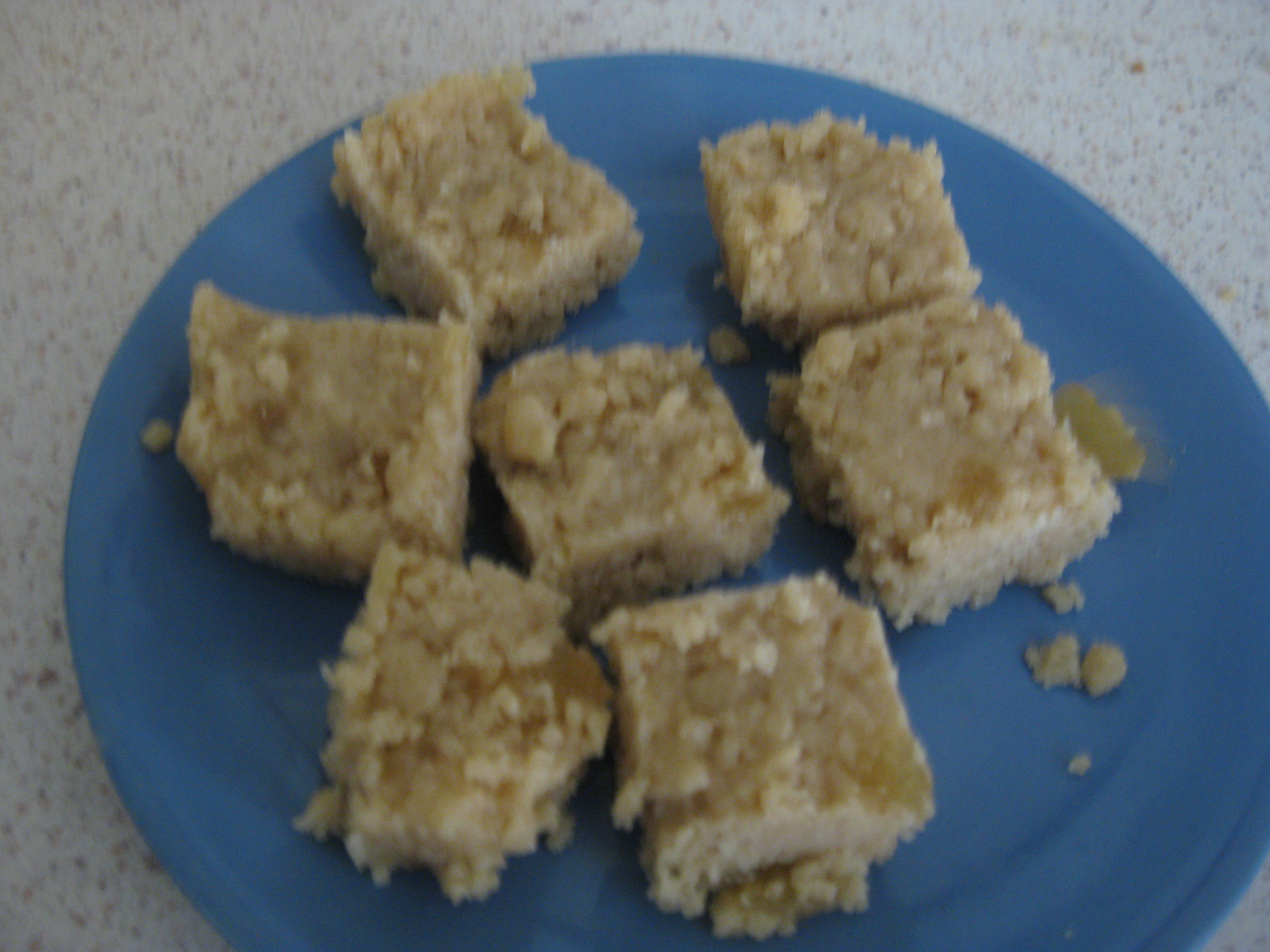
So what did I make for Malcolm?  Well, tidying up my recipe collection, I found Dan Lepard’s recipe for Sesame Ginger Halva.  Like the Panforte, it’s perfect with a shot of strong black coffee.  Unlike the panforte, you can eat it immediately, and it’s a comforting pick-me-up on a snowy day.

  • 250g tahini
  • 100g stem ginger, strained from its syrup
  • 200g caster sugar
  • 50ml water
  • 50g of the syrup

Spoon the tahini and the oil separated from it into a bowl and beat with an electric hand whisk until it is smooth and emulsified.

Chop the ginger into ½cm cubes. Line the base of a 2lb loaf tin or similar with a buttered sheet of foil.

A crumby photo of a crumbly treat

Place the sugar, water and 50g syrup from the stem ginger in a saucepan and bring to the boil. Simmer for 5-10 minutes until a drop of the toffee hardens when popped into a glass of cold water, and can be squeezed with the fingers into a soft ball.  This step’s tricky.  Because there’s so little syrup, the heat increases rapidly.  Just do your best: if it gets too hot, the halva will be crumbly rather than creamy, but who cares?

Next, add the ginger cubes and remove from the heat and add the tahini. Beat until the mixture thickens, then tip into the foil-lined tin. Cut into squares when warm.

Just one tip, while you’re reading this: do as the spellchecker does, and substitute ‘pianoforte’ for ‘panforte’ every time the word occurs.  It makes for interesting reading

Snow 3: The Market

We woke up to -11 degrees on Thursday (-13 for some on the outskirts). Market trader and greengrocer Patrice and his équipe, who live in Rouvenac, a fairly isolated village 18 miles from here, woke up to -14 degrees.  Thursday’s the day they come to sell in Laroque market. When it’s minus figures outside, who’d want to arrive before 8.00 a.m., set up a stall in an exposed market square, and stay there dispensing fruit, vegetables and bonhomie till about 12.30 p.m.?  Well, if that’s how you earn your livelihood, that’s what you do.  Your only other option is to stay at home and keep warm, earn no money, and watch your stock deteriorate.  Which is what about three quarters of the traders usually at Lavelanet market on Fridays unsurprisingly chose to do this week.

Market square closed for business

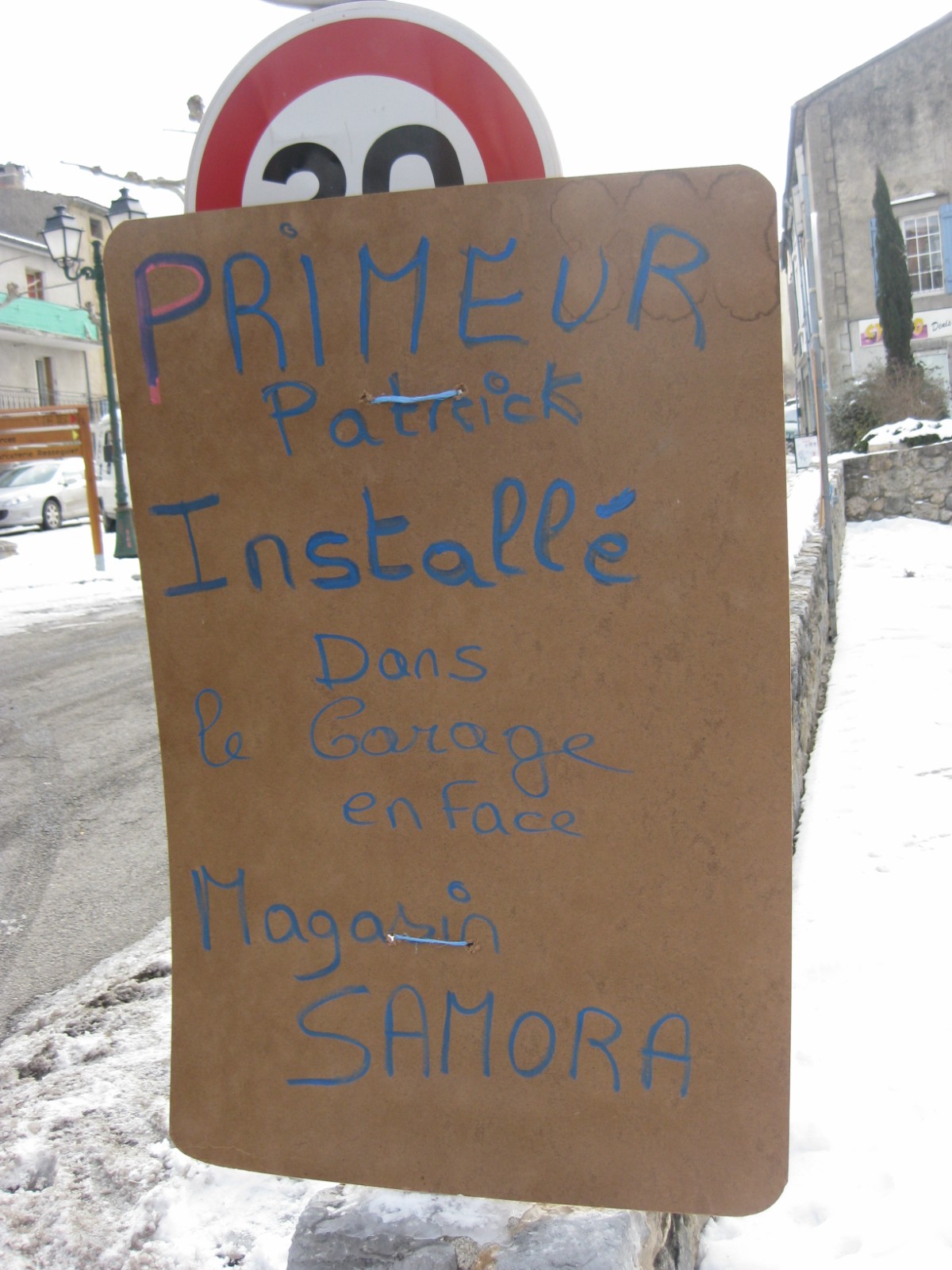
But Obé who runs the bar and restaurant up in Place de la Cabanette had other ideas.  He offered them his huge garage down in our street, big enough for 2 large vans and a car, and that became the market place for the day. It’s dark and perhaps a little cramped for several long runs of produce.  But we don’t get out much here in Laroque, especially in a week like this one, and we all found it quite exciting to crowd in together and do our shopping: it gave us something to talk about.  Patrice and co. took turns to warm their fingers at the rather antique heater Obé had dug out.  They needed to.  The temperature in that garage only just managed to crawl up to  -4.

On our way back home, we just had to stop and look at the river which normally tumbles and chatters busily on its way though town.  Here it is, almost frozen over.

An all-but frozen River Touyre