What to do with a Hallowe’en pumpkin

Hallowe’en.  Pumpkin season.  Every fruit and veg stall in the markets here will have  red kuri, ‘le butternut’, or acorn squash at the very least, and there are those dedicated to selling nothing but the rich variety of squash, pumpkin and gourd you can grow here.  Kalba gave me this butternut squash some 3 weeks ago, grown in their own garden.

The butternut makes a bid to take over the fridge

It weighs in at more than 7 kilos.  More than a stone!  We’ve been chomping our way through it, but see how much remains.  What’s worse: Malcolm has just owned up to not caring for pumpkin very much.  How could he not like it?  That comforting sweetness works so well with the saltiness of bacon, the heat and colour of chillies and oriental spices, or the fatty unctuousness of cheap cuts of meat and sausages.  Well, his loss.  Here are two of my current favourite dishes, both courtesy of Nigel Slater, from Tender, Volume 1, you may not be surprised to hear.

A recent BBC photo of Nigel Slater

Pumpkin laksa

Nigel says this is for a cold night.  Well, it is.  But it’s also a fine thing to dish up on a hot day after a gruelling few hours physical labour.  It looks complicated, but it isn’t.  Take a deep breath and read it slowly: tackle the pumpkin, then the spice paste; the rest just falls into place.

Ingredients

350g. pumpkin, unskinned

coriander and mint leaves to finish.

For the spice paste:

red bird’s eye chillies, 3-4

garlic- 2 cloves

ginger, a thumb sized lump

lemongrass, 2 plump stalks

coriander roots, 5 or 6 coriander leaves, a handful

sesame oil, 2 tablespoons

For the soup:

chicken or vegetable stock, 600ml

coconut milk, 400ml

nam pla (thai fish sauce), 2 tablespoons

tamari, 1-2 tablespoons, to taste

the juice of a lime

100g dried noodles, cooked as per packet and drained.

  • Peel and seed the pumpkin and cut the flesh into large chunks. Cook in a steamer or a metal colander balanced over a pan of boiling water until tender. remove from the heat.
  • For the spice paste, remove the stalks from the chillies, peel the garlic, peel and roughly chop the ginger and lemongrass. Put them all into a food processor with the coriander roots and leaves and sesame oil and blitz until you have a rough paste.
  • Get a large, deep pan hot and add the spice paste.  Fry for a minute, then stir in the stock and the coconut milk and bring to the boil.  Allow to simmer for seven to ten minutes, then stir in the nam pla, tamari, lime juice, pumpkin and the cooked and drained noodles.  Simmer briefly, add the coriander and mint noodles over the top, and serve in deep bowls.

And now for something completely different…..

Pumpkin and Apple fry-up:

either to accompany a meaty supper, or as a main dish in its own right.

Ingredients

a little butter

80g. fatty bacon

medium onion

650g. pumpkin flesh

400g. apples (Nigel says a desert variety.  Mine were very tart, and I thought all the better for it)

a lemon

caraway seeds, a pinch

  • Melt a slice of butter in a shallow pan, cut the bacon into short strips and let them colour lightly in the butter.
  • Peel and roughly chop the onion, add to the pan and allow to cook with the bacon until translucent but not browned.
  • Cut the pumpkin flesh into manageable pieces and add to the pan, turning from time to time till golden in patches and almost tender.
  • Core and roughly chop the apples, but don’t peel them. Stir them into the pan and leave to putter gently until they are on the verge of collapse. Avoid stirring too much, which is likely to mash the softening pumpkin.
  • Finely grate the zest from the lemon and add it to the pan with the juice, the caraway seeds and a little salt.

    But wait! Isn’t this what pumpkins are supposed to be for? My son obviously thinks so, and took this photo to prove it. Though he’s a dab hand at cooking too.

PS.  Some of you have been asking about Danger Mouse.  Well.  He’s not a mouse – too big, too cuddly.  He’s not a hamster, as we at one point thought.  Long tail.  He’s not a dormouse.  Wrong sort of tail.  And he’s not a rat.  Too small, too cuddly.  However, he’s continuing to be part of life here.  He rises at about 8.30 p.m. and organises his furniture behind the skirting boards, shoving stuff about quite noisily.  Then he knocks off and has a nap till we’ve gone to bed.  During the night he dismantles  the latest humane trap, and eats the bait.  In the small hours he may come and scurry round the floorboards under the bedroom.  Then he goes to bed until the next night.  If he ever goes, I think I shall miss him.

‘All is safely gathered in, ere the winter storms begin’ *

Autumn colours beginning means it’s harvest time for foragers

I’ve written before about the ‘au cas où’ bag: the carrier you always have with you on a walk, ‘just in case’ something tasty turns up and demands to be taken home and eaten.

Well, at this time of year, it isn’t really a case of ‘au cas où’ .  You’re bound to find something.  A fortnight ago, for instance, Mal and I went on a country stroll from Lieurac to Neylis.  We had with us a rucksack and two large bags, and we came home with just under 5 kilos of walnuts, scavenged from beneath the walnut trees along the path.  A walk through the hamlet of Bourlat just above Laroque produced a tidy haul of chestnuts too.

Yesterday, we Laroque walkers were among the vineyards of Belvèze-du-Razès.  The grapes had all been harvested in the weeks before, but luckily for us, some bunches remained on the endless rows of vines which lined the paths we walked along.  We felt no guilt as we gorged on this fruit all through the morning.  The grapes had either been missed at harvest-time, or hadn’t been sufficiently ripe.  They were unwanted – but not by us.

So many vines: there’ll be unharvested grapes there somewhere.

The walnuts we’re used to in the Ariège are replaced by almonds over in the Aude.  You have to be careful: non-grafted trees produce bitter almonds, not the sweet ones we wanted to find.  But most of us returned with a fine haul to inspect later.  Some of us found field mushrooms too.

Today, the destination of the Thursday walking group was the gently rising forested and pastoral country outside Foix known as la Barguillère.  It’s also known locally as an area richly provided with chestnut trees.  Any wild boar with any sense really ought to arrange to spend the autumn there, snuffling and truffling for the rich pickings.  We walked for 9 km or so, trying to resist the temptation to stop and gather under every tree we saw.  The ground beneath our feet felt nubbly and uneven as we trod our way over thousands of chestnuts, and the trees above threw further fruits down at us, popping and exploding as their prickly casings burst on the downward journey.

As our hike drew to an end, so did our supply of will-power.  We took our bags from our rucksacks and got stuck in.  So plentiful are the chestnuts here that you can be as picky as you like.  Only the very largest and choicest specimens needed to make it through our rigorous quality control.  I was restrained.  I gathered a mere 4 kilos.  Jacqueline and Martine probably each collected 3 times as much.  Some we’ll use, some we’ll give to lucky friends.

Now I’d better settle myself down with a dish of roasted chestnuts at my side, and browse through my collections of recipes to find uses for all this ‘Food for Free’.

I think these chestnuts represent Jacqueline, Martine and Maguy’s harvest.

* Two lines from an English hymn sung at Harvest Festival season: Come, ye thankful people, come’

The tragic and savage history of l’étang d’Izourt

The drive to the start of the walk was dramatic enough.  Forested and craggy, our narrow road out of Auzat switch-backed steeply up the slopes in a seemingly endless series of hairpin bends.

And our walk began, an 1800 foot climb, upwards through forest then out onto the stony, rocky path towards the man-made étang d’Izourt, one of the many reservoirs in the area maintained by EDF to provide power. Once, a helicopter flew over.  Since there are no roads up there,  it was delivering either men or supplies to a team we could see labouring on a more distant slope.

The walk changed for me as I learnt the story of what had happened back in 1939 when the reservoir was being built.  Most of the members of the construction team at that time were economic migrants, Italians from the Veneto, and whilst working there, they lived in huts on site.

The weather conditions had already been atrocious for days when on March 24th 1939, a fierce blizzard struck.  There was no option for the workers but to hole up in their huts.  The storm was so fierce that huts B and C were destroyed from the weight of snow above, and the roof from hut A blew off.  The desperate men sought both to escape and to try to help their work mates, many of whom had died or been gravely injured by the tumbling buildings.  A nearby avalanche brought down the cable car linking the site with the works below.  The only way up was on foot, and rescue attempts were pretty much futile, though bodies and the injured were recovered as management attempted to evacuate the entire area.  On 28th March, a team of army skiers managed to get through and working into the night, brought down the remaining bodies and wounded.  31 men, 29 Italians and 2 French, were buried at the cemetery in Vicdessos on 31st March.  There they remain, as the families in Italy were too poor to manage the expense of repatriating the corpses.  The memorials at the lakeside are still the site of pilgrimage, thanks to the efforts of the ‘Ricordate-Izourt’ Association: locals and Italians who honour the memory of those lost workers.

We ourselves had started our walk in bright sunlight.   Spots of rain began.  Then the wind.  By the time we reached the lake, there were times when the gusts felt almost horizontal, and we struggled to find protection from the rocks to eat our lunch.  The more modern huts now on site have their roofs held on by strong metal cables, and we could understand why.

The sky turned the colour of lead, and we rejected the idea of exploring the lake in favour of hurrying down the way we had come.  We knew we’d be OK, but we also know to treat the mountains seriously and with respect – conditions can change very quickly.  We were fine of course, but that fierce wind on a warm October day gave us the smallest hint of what things could be like if you were trapped there in much nastier conditions.  Even now, the most efficient way of supporting the workers still on site from time to time is to get them and their supplies there by helicopter.  A noisy chopper whirled up and down the mountainside several times as we walked down, our journey cheered by a rainbow linking our mountain with the one next door.  Though we were sorry the weather had chased us home, we were grateful  not to have been exposed to  the dangers the mountains can offer from time to time.

This slideshow requires JavaScript.

Danger Mouse: The Sequel

After my last post about Mr. Mouse, things went quiet.  Not quite quiet enough for Malcolm, who swore he could still hear scuttling in the wainscot.  I decided he was paranoid, as I’d gone on dusting surfaces with cornflour at night to track our intruder, and they’d remained undisturbed, just as the traps remained unbreached.

We’re getting a bit silly. Emily’s rat keeps popping up in odd places, because one of us has whisked it off there with the aim of making the other one jump.

Then this morning, two things happened.  A bag of walnut shells, bagged up and waiting to do duty as slug-deterrent on some outdoor pot plants, was found to be ripped and the contents spilled all over the kitchen.  Later, tidying the garage (which is next to the kitchen), I discovered a bag of foodstuffs I’d forgotten to unpack after a recent cooking atelier.  The lid of the baking powder container had been gnawed, and the bag and everything in it was coated with a thick dusting of powder.

That’s what Danger Mouse is capable of.

The other thing is…. we’ve both seen him.  And he’s not a mouse at all, but almost certainly a hamster.  Anyone lost one?

So while you’re thinking of what we should do next, why not watch an episode of that 1980’s children’s cartoon Danger Mouse (or Dare Dare Motus, if you’re French), the James Bond of the mouse kingdom ?  Just click the link.

Mouse in the house

Thanks, Hull City Council, for useful info and this photo.

We first noticed it about a month ago.  Scrabbling and scratching somewhere near the kitchen skirting boards, mainly at night.  Then, one night, we accidentally left out the insignificant remains of a tomato, chili and pepper pasta sauce.  The following morning, a greasy red trail led from those leftovers to the space just behind the cooker.  Out came the cooker; off came the kitchen unit kick-boards.  Lying on the floor underneath the units, we saw it all: the napkin that had gone missing, now neatly and minutely shredded, a small cob of bread; fragments of kitchen roll….. and mouse droppings.

We bought humane traps.  We baited them with peanut butter: so much tastier than cheese, apparently, if you’re a mouse.  But we didn’t set them for a few nights, as per instructions.  Set or unset, Mr. Mouse ignored them, or extracted the prize and ran safely away to eat it.

This is not a tube trap, but a spin-the-bottle model, on duty for the first time tonight. Let’s see….

Mal spent long hours on the net, watching excruciating amateur videos about making humane traps.  He picked out some of the ideas involving tubes, bait and deep buckets and set to.  Each night we left collections of baited tubes, unset, over the surfaces Mr. Mouse seemed to use, till one night, we set the trap.  Mr Mouse was to scuttle down the baited tube in quest of peanut butter and fall from the work surface into the deep bucket on the floor.  Theoretically.

At 11.30, Mal heard a crash in the kitchen, smiled at the thought of a job well done, turned over and went to sleep.

At 1.30, I woke up to the sound of Malcolm having a pee in the bathroom.  But wait!  Mal was snoring sweetly beside me.  I got up.  There was poor Mousie, almost drowned, swimming round the lavatory pan.  We have no idea at all how he got (a) upstairs and (b) clambered into the toilet.  Both awake now, and seeing that Mr. Mouse seemed almost dead, I’m truly ashamed to say we flushed him away.

Revealed: Mr. Mouse’s nest

So Mr. Mouse was no more.

The following morning saw us, despite our agonies of conscience, pulling off the skirting board and hoovering out Mr. Mouse’s flat, which was a mess, frankly, though undoubtedly cosy.

Peace at last.

Until the day before yesterday.  In the evening, we heard that familiar scrabbling in the kitchen. Round Two to Mr. Mouse.

Château de Lordat

This slideshow requires JavaScript.

Fourth of October.  The sun’s shining hot, but not too hot, high in an azure sky.  A small group of hikers stands outside a little church and gazes up a steep slope towards the ruins of the Château de Lordat.  And then sets off in the opposite direction.

It’s Anny who’s picked our route, and it’s designed to wind us up the hillside to the castle along chunks of country road, craggy uphill scrambles, dry-leaved woodland just thinking about exchanging green summer leaves for the ochre and russet tints of autumn, and the occasional tiny village – no more than a couple of streets encircling an ancient church.

Most of the time there are views upwards, towards the castle itself, or the cable-wagons serving the talc mines of nearby Luzenac, or across to the more distant mountains covered for the first time this season with bluish-white powdering of snow.  Or down, past thickly forested almost vertical slopes to craggy rust-stained rocky outcrops with occasional hamlets and villages scattered through the countryside. Near villages and farms, we pass walnut trees, and feel obliged to gather the recently ripened and fallen nuts – this is France after all.  We exchange recipe ideas.

Suddenly, we’re there. Lordat.  In high season, the village must be a tourist trap, but now we’re happy to saunter along the sunny empty streets, with their pastel-painted cottages and tubs of geraniums.  A final yomp and we’re at the castle walls.  It’s ruined and closed to the public at the moment, but the views in all directions make the climb worthwhile.

A meandering trek through the woods, trying hard not to kick over the delicately-stemmed autumn crocus, brings us to our lunch spot in Axiat, sitting outside its Romanesque church.  Mal and I are particularly taken by a notice on the door in French, English and Spanish. The English version reads: ‘Ladies and Gentlemen the visitors, we thank you for closing the door by going out’.

Afterwards, more craggy descents, sometimes through woods, at other times with more of those impressive views, along an ancient man-made winding path.  And back to the village we started from.  It’s a wonderful walk.  If you come to stay, make us take you.

From the Pyrenees to the Pennines: a Quiz

That exhibition, ‘From the Pyrenees to the Pennines’, about Yorkshire.  It’s over and I’m not sorry.  I loved working with the children in schools and in Centres de Loisirs, but the whole business of getting the exhibition for the general public up and running was stressful and exhausting.

Still, it’s good to remember why we did it.  We wanted to introduce Yorkshire, particularly North Yorkshire, to local people here.  We wanted to show how much these two areas have in common.

Both North Yorkshire and the Ariège are largely rural areas, where sheep have an important part to play.  In no small part, they contributed to the development of the textile industry.  Once the most significant part of the economy in the communities where the industry once thrived, now textiles have largely left Europe for the Far East.  Formerly prosperous areas such as Bradford and Lavelanet are now struggling to find a new role.  At the same time, immigrant textile workers have changed the face of these communities for ever: Spaniards in southern France, those from the Indian sub-continent in northern England.

Mining is similarly in decline. Coalmining in the north of England is the most obvious casualty, but industrial archaeologists in Yorkshire and the Ariège can point out many signs of a mining past – in disused and decaying workings of lead, alum, potash and talc.  Jet, the black gemstone popular in the 19th century was worked here too, and a local historian here in the Ariège has uncovered correspondence between manufacturers here and in Whitby.

Both areas owe much of their character to limestone scenery.  That’s why I’m going to give you a little quiz.  Have a look at these photos.  Where were they taken do you think?  Yorkshire?  Or the Ariège?  It’s not always easy….

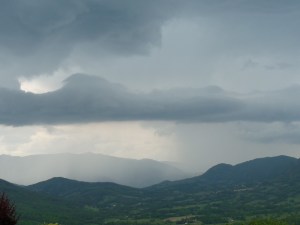
1. Limestone rocks.  But where?

2. And this?

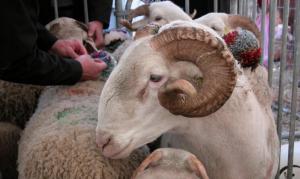
3. Does this sheep baa in English or French?

4. And these?

5. Where’s this?

6. And this?

7. More scenery.

9. And a typical market in, er….

10. And a bridge.

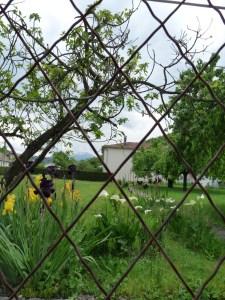
11. And a ruined house

12. Last one

13. Oh, an afterthought

Answers

1. Rocks near Marc, Ariège

2. Goredale Scar, Yorkshire

3. Herdwick sheep

4. Tarasconnaise sheep in Troye d’Ariège

5. Axat, Ariège

6. Bridge at Fountains Abbey, Yorkshire

7. Grassington

8. Cap de Carmil, Ariège

9. Otley Market

10. Bridge at Grassington

11. Le Taulat

12. Roquefixade

13. A Yorkshire terrier.   Often seen here in the Ariège.  I wonder how many owners know these little dogs were originally bred in the 19th century in Yorkshire to catch rats in the textile mills?

‘School dinners, school dinners….

…Iron Beans, iron beans

Sloppy Semolina, sloppy semolina

I feel sick, get a bowl quick.’*

Do you remember this cheery ditty from your days eating school dinners?  Only if you’re British, I suppose.  And most right-thinking French men women and children would be quite prepared to believe that all English food is just like that.

Not the mayor of Villeneuve d’Olmes, where Découverte de Terres Lointaines has taken its Yorkshire exhibition this week.  Back at the planning stage, he’d told us about their school caterer, M. Feliu, who uses almost entirely organic or local ingredients, and who likes to introduce the children to the cooking of other countries every time the excuse arises.

We met M. Feliu at La Freychède.  We worked together to produce a menu (Cheap. Tempting to the young French palate. Three courses that work with the kitchen facilities to hand.  Conforming to nutritional standards).

This is what we came up with:

Crudités with beetroot chutney

Macaroni cheese with green salad

Blackberry and apple Betty with custard.

Yesterday was the day.  I turned up at 10.00 with my English friend and colleague Susie to find the work almost done.  All we had left was to churn out batons of carrot, black radish and cucumber for the first course, which was not, let’s face it, Awfully British.  But it had to fit in with other considerations as above.

11.00: The prepared and cooked food was heaved into insulated containers, and transported by van to one of the local schools.

11.30. Ditto with van number 2.  This batch was sent off to Villeneuve d’Olmes, with me following.

12.00. Children arrived at the canteen.  One of the helpers, Pascale, spoke good English.  ‘What’s your name?’ she’d say to each child in English.  When she had her reply, they could go in, and sit down at one of the circular tables, tinies in one room, and juniors in another.  I joined a table of lively 7 year olds.

One of the staff told me the rules that the children expect to follow:

  • Take turns to serve the dishes of food to everyone at table.
  • Wait till everyone’s served before beginning to eat.
  • Try everything.
  • You can have the portion size you choose.  Once it’s on your plate though, you have to eat it.

Everyone accepts this and we all sat together, eating and chatting.  The children chomped their way through all the crudités, they even enjoyed the chutney, whose sweet and sour taste is not an automatic choice round here.

Once cleared away, bread appeared on the table – this is France after all.

Two more children served the macaroni cheese and the salad.  Most of us came back for seconds.

We sang ‘Happy Birthday’ – in English – to a birthday girl.

I gave an impromptu talk on the food on offer.

The blackberry and apple Betty was served.  Yum! How could it fail?  Gently cooked fruit with a crunchy crust of soft breadcrumbs crisped in golden syrup and butter, with obligatory custard, of course.

Then the children cleared their tables, stacking dirty plates and glasses neatly for washing up, before going off to play.

I was so impressed.  The children here learn that the midday meal is so much more than a pit- stop.  The expectations, reinforced daily, are that this is a moment to spend with friends, a time to share, to think about the needs of others, and to appreciate the food on offer.  The occasion lasted well over an hour.

* To the tune of Frère Jacques

This slideshow requires JavaScript.

England comes to Laroque d’Olmes

Yorkshire Dales: as interpreted by the children at the Centre de Loisirs, Laroque.

Yesterday afternoon was the best fun.  20 odd-children (that’s ‘about 20 children’, not ‘Twenty Odd Children’) here in Laroque spent the day in England, courtesy of  ‘Découverte Terres Lointaines’,  without setting foot outside town.

These children spend their Wednesdays, a no-school day, at the Centre de Loisirs.  Their parents are probably out at work, and here is somewhere they can spend the day having purposeful fun, without its costing their parents too much.

We turned up with bag full of groceries, and spent half the morning baking biscuits, basic English everyday crunchy biscuits.  It was great to see them, girls and boys alike carefully measuring out flour, sugar, butter and so on, stirring, mixing, watching a dough come together from these simple ingredients.

Let the baking begin.

A bag full of cutters and a rolling pin meant that they could transform the mixture into stars and circles, miniature gingerbread-style people, bells and flowers.

Upstairs, another group had been talking about the green moorlands of the Yorkshire Dales, then making a mural of a Daleside landscape, complete with Swaledale sheep, farm gates, and obligatory grey cloud (it’s England after all).

Lunch break.  Afterwards, the children came to see our long-prepared exhibition looking at North Yorkshire, which has so many features in common with the Ariège: mountains (OK, the best Yorkshire can manage is Whernside’s  736 metres.  Ariège’s Pic d’Estats is 3143m); textile and mining industries past their glory days; wide open spaces home only to sheep…. and so on.  They enjoyed an extract from Roald Dahl’s ‘George’s Marvellous Medicine’, and then it was back to the Centre de Loisirs.  Where we produced a long skipping rope with the idea of teaching them a couple of English skipping games…

‘I like coffee, I like tea

I’d like, er, Nadine, to jump with me’.

Getting started with skipping.

They loved it.  Unfortunately they couldn’t skip at all and tripped and fell all over the place, and all the adults mourned that it was a lost art. As in England (Is that so?  Not sure.) children don’t skip any more.

Back into the kitchen, it was time to decorate those biscuits.  They tinted their bowls of icing in lurid shades, and made free with all the sugary decorations we provided.  ‘Glorious Technicolor’ doesn’t begin to do it justice.  Once decorated, they ate the lot, and we sent them off to their parents for the evening crammed full of enough e-numbers to see them through the week.  One lad, as he set off home, was heard to say ‘I’ve had a great day’.  So had we.

Glorious Technicolor biscuits.

Château de Fiches

This weekend, as any fule kno (thank you, Nigel Molesworth.  That’s quite enough from you) are the European Heritage Days, when hosts of historic buildings not normally much open to the public, throw open their doors to curious locals.

So when Léonce proposed going to Château de Fiches, we were keen.  If you come home the back way from Pamiers, past villages with evocative names such as Seigneurix (Surely Asterix and Obelix can’t be far away?) and Parent, you’ll pass its fairly undistinguished drive-way: we’ve passed it dozens of times before, and it’s always been shut.

This gives some idea of the charmingly domestic scale of the operation

Not today.  This weekend, the team were keen to show the place off.  If you want a château complete with crenellated façade and turrets, you’ve come to the wrong place. This 16th century building is strictly domestic, more farmhouse than stately home.  It was built originally for a Toulousain Parliamentarian, and later passed into the hands of a lawyer from Pamiers, Joseph Fauré, whose family own it still.  It has unexpected treasures, most of which I wasn’t allowed to photograph.

Back in the 19th century, someone in the family went plant collecting, some 1600 specimens.  Nobody knows whether it was the plants themselves that were collected whilst travelling, or simply the seeds which were then raised back here in France.  Dried, mounted, thrust in dense piles deep into a cabinet, they’re only recently being catalogued by an English couple, Mavis and John Midgley, excited to use their expertise in this way.

I can show you photos of the kitchen.  Enjoy the mechanical mayonnaise maker, the coffee grinder, the charming and enormous hearth.

Churn round your egg yolks, oil and so on in here, and apparently mayonnaise will emerge
Here’s the coffee grinder
And here’s the hearth

I can share pictures of the library.

The library

What you can’t see is the bestiary.  This is such a shame.  Painted in the 16th century, a series of charming and vibrantly coloured animals enliven the beams of a ceiling on the upper floor.  The artist is unknown to us, just as elephants, camels, monkeys, satyrs and so on were unknown to him.  He got his information third, fourth or fifth hand, and made an efficient if imaginative job of visually describing the 40 or so beasts he illustrates.  On safer ground with rabbits and peacocks, he painted every single beast, known and unknown, with vitality and verve.  Another equally interesting ceiling is currently being revealed.  Part of this are painted more in the manner of blue and white Delft ware.  If you’re round this way, they’re worth a look.

It’s only a shame that all the various treasures of the Heritage Weekend are usually available For One Weekend Only.  So much to see, so little time.