I know I’ve mentioned them already, but this year’s crop of snowdrops has been quite astonishing. Maybe they weren’t quite such a feature of our local landscape in France. Maybe when we last lived in England, because we were in town, we saw them only tucked into quiet corners of suburban gardens, or on occasional weekend sorties. Perhaps snowdrops round here are always this special. But for us, this year has been a real treat.
Snowdrops have been almost the first thing we see as we set foot outside the house. They’ve been in dense groves in nearby woodland. They’ve been on sheltered verges. At first slender, pointing their sheathed leaves upwards in search of light, now they’ve opened their petals into blowsy bells and flattened their leaves gently towards the ground beneath. This is the sure signal that they’re on the way out. Gardens are displaying the first of the early crocus, and even daffodils are opening in more sheltered spots. I think snowdrops prefer to be the centre of attention, prepared to share the woodland only with occasional patches of aconites. Now that spring is really on its way, and the birds are honing their voices in preparation for their courtship rituals, the snowdrops are preparing to allow their flowers and leaves to wither and die, as the bulbs enjoy their long and nourishing hibernation below ground.
Until the early years of the twentieth century, there had been thousands of Greeks living in Turkey, and Turks living in Greece, preserving their own culture and ways of life over many centuries. But by the 1920s, both Turks and Greeks had been through a period of real upheaval, with a series of wars including the Greco-Turkish War of 1919-1922. Senior politicians in both countries could see problems ahead if largely Muslim Turks remained in Greece, and largely Orthodox Greeks remained in Turkey.
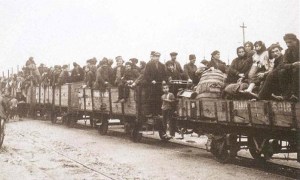
Their solution though, was a shocking one. Following the Treaty of Lausanne in 1923, thousands and thousands of Turks and Greeks were in effect deported from the lands where they and their ancestors had been living for centuries, back to their country of ethnic origin. They were given almost no time to prepare or to pack belongings: they were displaced refugees. Large Greek communities such as Smyrna were quite simply emptied of their citizens, to be stocked with Muslim Turks and re-named Izmir . The regional ethic mix which had prevailed for centuries ceased.
Greek refugees from Smyrna arriving at Thessaloniki 1923 (unknown source)
Though it’s hard to regard what happened then as anything better than ethnic cleansing, many Turks nowadays will say that now the dust has settled, and with the passage of time, both Greece and Turkey are the better for it. Greco-Turkish relations have often been poor, and with the two populations now separated, there’s one less thing to fight over.
It’s a hugely complex issue about which I know next to nothing. What I do know is that we spent the last morning of our Turkish holiday in Şirince, one of those villages that was forcibly de-populated, then re-populated, in this case by Turks moved out of Thessaloniki in Greece. It’s a charming place, set on a hillside amongst olive groves and orchards; a tourist trap for Turks and foreign tourists alike. But on a quiet warm morning in February, it was no hardship. We used the time to sample the fruit wines for which the village is noted: mulberry, peach, morello, quince (no, we didn’t try them ALL). We bought last-minute souvenirs: local olive oil, honey, pomegranate vinegar. It was easy to feel, strolling through the narrow streets, that we might be in Greece rather than Turkey, even though we didn’t hear, as promised, any of the older inhabitants speaking Greek.
A quiet street in Şirince.
Fruit wines waiting to be sampled.
A quiet bar: a good place to sample some of those fruit wines, or an apple tea.
Local textiles on sale.
Village life.
Bazaar in Şirince. Easy to see it’s part of Turkey now.
Retail opportunity outside the now disused church.
The church has seen better days.
A mosque has now replaced the church.
It was a peaceful way to end our holiday. We’ll be back, as independent travellers next time. And from now, it’ll be posts from misty moisty England. For a while at least.
The Republic of Turkey has only existed since 1923, and rapidly transformed itself under Kemal Atatürk from a failing Ottoman Empire with a glorious past, into a modern nation, looking towards Europe as it pushed through a programme of reforms. Then and now predominantly Muslim, it became an uncompromisingly secular state, in which religious symbols in schools and public buildings were forbidden, and women achieved universal suffrage by 1934. These days, you’ll see fewer veiled Turkish women than in the average British city centre.
Look below the surface, however, and Turkish life is centred round the extended family, as it has been for centuries.
When they’re 19, Turkish young men go off to do their National Service for two years. Those from the west serve in the east of the country, and those in the east go west. What they’re hoping for is a nice post as a jandarm (army police) in a quiet country town, though they’ll lie through their teeth and tell anyone who asks that they were posted to the borders with Syria, Iran or Iraq. No internet, no mobile phones, no wild social life: it’s not fun, and they count the days till their discharge, aged 22.
Back home, mother has no time to indulge in ’empty nest syndrome’. She has her son’s marriage to arrange. She trawls through likely candidates, looking for a young woman from the same caste, of good family, aged about 17 – 19. She’ll check out whether the girl can make a decent Turkish coffee and a good pilau rice, and even get the chance to appraise her naked body when they go to the Turkish baths together. Her son will almost certainly fall in with her choice, and the girl’s family too usually agrees.
Father’s role in all this is to foot the bill for the wedding, which is cripplingly expensive, so he’ll have been saving all his married life. Average wages in Turkey are low, and after regular bills have been met, don’t allow much slack for buying or building a home complete with fixtures, fittings and furniture, much less a new car. This is where the wedding comes in.
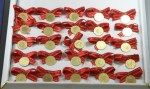
Wedding gold. (altinka.net)
The guest list for the ceremony will include about 2000 of the couple’s closest friends, of whom about 1,500 will actually come on the day. And they will bring gold, which they’ll pin to the couple’s clothes. Nobody will dare to offer a smaller amount than the person in front: social death. This gold will be transformed into a new home, a car and all the other things the young couple might need. Now their modest income will be enough for day-to-day life.
After the marriage, the young woman leaves her family behind. Her new life is with the extended family of her husband. They will all live together. We saw whole blocks of flats, maybe 4 storeys high, which our guide assured us were likely to belong to a single family. People buy from developers or build for themselves: renting is almost unknown. As are planning regulations. You can build what you like, where you like, on land that you already own or have acquired. Surveys of the land are unnecessary, so in this earthquake prone land, many buildings are destroyed by ‘quakes or landslip, or subsidence.
Earning a living is paramount for the men. While communities will be proud of those who make it into the professions, there’s no shame in, for instance, washing cars at a petrol station: it may in fact be more lucrative than say, teaching. Many families find ways to earn their living together, by running a shop or garage, or by working the land together. Almost every block of flats in Turkey has shops on the ground floor. You can be sure the business is being run by the family who lives above.
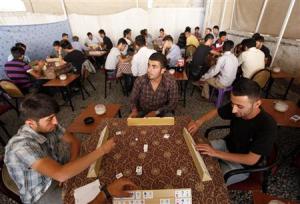
Traditional Turkish tea house: men only. (Reuters/Umit Bektas)
When not actually working, men retire for the day to a tea shop. The woman’s domain is the home, all day, and woe betide the man who reports home sick at 2.00 in the afternoon. The average family has about 5 children, and life expectancy is 61 for men, 67 for women. This is because health services are rudimentary and expensive. Most families are dependent on traditional remedies, or failing that, the pharmacy. A stay in hospital is an unthinkable expense for much of the population.
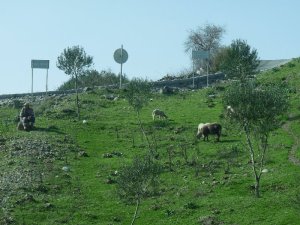
The family groupings apply to to the very many nomad familiies who still exist in Turkey. Some families are still entirely nomadic, whilst others have a nomad existence in summer, and return to a more low-lying village in the colder months. Most rear stock, especially sheep and goats.
A nomad tends his flock outside Bergama.
I’m sure Turkish life is changing. We certainly saw many Turkish women working outside the home. But walking about the streets in the evening, it was clear that home and family is still central to everyday life here.
A block of flats with solar heating captors and satellite dishes.
As in France, old village centres are neglected in favour of edge-of-town modern development.
Orange trees often line the streets, or offer shade in gardens.
Old Ayvalik.
Modern housing.
Much town development seems very high density, with little outside space.
A village scene in Didyma. Outside appearances aren’t important in Turkey.
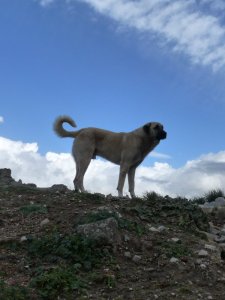
Efe took time out from his job as guardian of a group of nomads and their sheep wintering in the area, to accompany us on our visit to Miletus. He’s a kangal, and we all immediately took to this handsome, gentle and affectionate dog, one of a breed popular in Turkey for its qualities as a fine guardian of stock.
Like many Turkish dogs and cats, Efe has a home. But many others do not. There are hundreds and thousands of animals whose home is the street, and who are on the whole tolerated and even regarded as part of the community. Don’t imagine that these animals are mangy and sickly, with protruding ribs and rotting yellow teeth. They’re well fed and healthy.
Turks apparently, when planning a move to a new neighbourhood, will look and see how street dogs are treated. If they’re friendly and companionable, then that means the neighbourhood too is friendly. If the dogs are aggressive or fearful than it’s not a good area. Best not to buy.
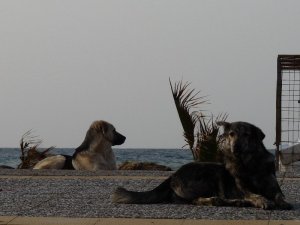
Street dogs by the sea at Ayvelik.
These days though, street dogs are a problem, simply by virtue of their huge numbers. So they are tagged, vaccinated and spayed or neutered to prevent the spread of rabies and other diseases, and to limit their population.
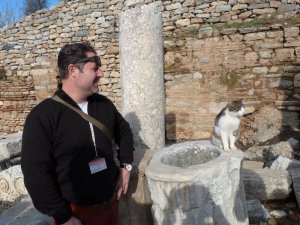
An Ephesus resident attempts to steal the show from our guide.
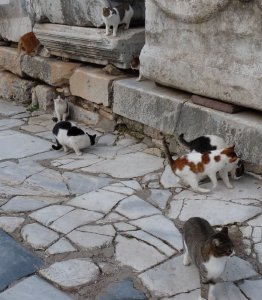
We saw cats too wherever we went. But never so many as at Ephesus, which is rather famous as an unofficial cat sanctuary. Looking round the site, we once saw 14 at a single glance, and they were quite at home as they lolled on marble pillars and lounged round the library.
Ephesus cats.
These photos of street dogs and cats are among the less expected souvenirs of our trip.
We’ve just come back from a short holiday in Turkey. We’ve just come back from our first organised tour. We’ll happily go back to Turkey. But we won’t be on a tour. There’s only one plus in this form of holiday, as far as I can see, though it’s quite a big one: a Turkish guide, born and bred, brings many insights into Turkey, its people, and their way of life. There’s a post or two coming about some of the things we learnt.
We were herded on long coach journeys from place to place, where after our official visit, we often had little time to linger, absorb, and just simply ‘be’ in ancient sites that have seen thousands and thousands of years of history. Large tourist hotels are comfortable but impersonal. The food they offer is perfectly tasty, but offers only a tiny glimpse of the country’s rich culinary tradition. And then the herding continues, as we’re compulsorily escorted into stores selling carpets, jewellery, leather. We longed for more free time. I snatched the chance late one afternoon to work out how to catch a bus into the nearest town, Ayvalik, and follow my nose for a few precious minutes. But I only had three-quarters of an hour before I needed to come back and re-enter the system.
However. In visiting Anatolia, we’ve seen glimpses of the most extraordinarily rich culture of the area, from pre-historic to post-Classical times. We’ve seen those places I’ve known about since childhood, when I first heard all those stories about Odysseus, Helen of Troy et al.
Here are some of the photos I took as souvenirs. Most of the places we visited have survived so well because they lost their reason for being busy, successful places. Originally on the sea, they are now several miles inland, since Anatolia’s western coastline has been silting up for millenia. One day it’ll link up with Greece, and who knows what ructions that will cause.
We visited Priene, already important by 300 BC. It made quite an impression on us to walk its ancient marble streets, built on a grid system, still intact, complete with gouged marks and notches to prevent slipping. Its drainage system is still visible, its bouleuterion (council chamber), its temple to Athena, and its theatre, designed to accommodate 6,500 people.
Steps up to the city of Priene.
A view of the theatre complete with marble throne.
Temple ruins
Miletus was next, a city that was a centre of Greek thought from as early as 1000 BC. It was fought over by Greeks, and Persians. Later Romans took over. Alexander the Great, St. Paul….. they’ve all been to Miletus. And the theatre here seats 15,000…….
First view of Miletus
The baths.
Spreading the weight through a series of arches.
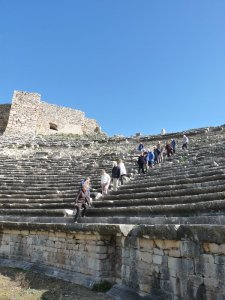
The theatre: the space between audience and arena indicates that animal fights were held here.
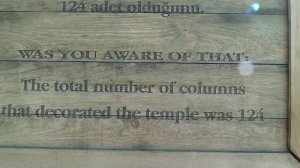
Didyma wasn’t a city, but what a temple! The Temple to Apollo here has 124 columns and used to have its very own oracle too. What impressed us was the height of those columns. How did those ancient builders do it?
Some of Didyma’s columns.
Medusa
A forest of columns.
Helpful tourist information.
And this was all on our first day……
Fast forward to Thursday and a visit to Troy. I ‘did’ Troy at school. I learned all about how it was occupied from the Bronze age until well into the 9th century , and how layer upon fantastic layer of history was preserved as each succeeding era built upon the remains of the last. The site there was ‘sliced’ through by archeologists, first of all by the archeologists’ Bad Boy Heinrich Schliemann, who destroyed by over-enthusiastic excavation almost as much as he preserved, and disposed of his finds to a variety of museums.
Walls of Troy.
The path to a palace.
The oldest known fired bricks, some 3000 years BC…..
…… now being attacked by solitary bees.
Sloping walls more successfully deflect enemy ammunition.
The remains of domestic housing.
Pergamum was perhaps my favourite. It’s the city that invented parchment – made from animal skin- when the Egyptians declined to let its citizens have papyrus. We reached the Acropolis, high above the modern city of Bergama by first a lift, and then a cable car: not an option in the city’s hey-day. It has a dizzyingly steep-raked theatre cut into the hillside with spectacular views which reminded me of parts of the Pyrenees. It has temples to a variety of Roman, Greek and Egyptian gods and emperors, and its library used to contain 20,000 volumes. We could have spent hours there exploring: but we got little more than one (we had longer at a carpet showroom).
Modern Bergama below, Pergamum above….
A glimpse of the aqueduct, far below…
The remains of domestic housing.
Then Ephesus at last. This is an extraordinary town which deserves several hours at least of anyone’s time. We got two hours. It was founded by immigrants from Athens in about 1000 BC, and because of its harbour, thrived under the Lydians, Persians, Greeks and Romans. It was already silting up by the 5th century AD, and that was that for Ephesus. Saint Paul wrote letters to the Ephesians, and more recently tourists have been sending postcards of the astonishing quantity and quality of its remains.
All human life is there, from latrines where statesmen would use the time to sit and discuss issues of the day, to brothels, to the 2nd century Library of Celcus, to a 24,000 seat theatre…. There are temples and terraced houses. These houses are fascinating for providing an almost unique chance to see the inside of such dwellings: the mosaic floors, the wall decorations, the ground plans, the bathrooms and plumbing.
Curetes Way: Ephesus’ main street
The Odeon: the debating chamber
The astonishing Library of Celsus.
A discreet entrance to the brothel.
Terraced housing: wallpaintings.
Terraced housing: walls with original downpipes.
Terraced housing: mosaic floor.
Our guide demonstrates the latrines.
Cats are quite at home at Ephesus.
We’ll have to go back. We haven’t seen the half of it.
I like my diary a lot. It’s big and bright and yellow and demands I remember to stuff it in my bag as I’m out and about and adding in appointments I shouldn’t forget. I like to leaf through its pages in idle moments, because on nearly every page, there’s a poem: an old one; a recent one; a classic; or one that’s, to me at least, unknown.
Here’s my diary
Here’s ‘After Africa’
And on another page, here’s the cover of a book I used to love in childhood
Here’s the poem I found this week. It speaks to me, though I’ve never been to Africa, and it’s very many years since I worked in Surbiton Library in Surrey. It touches me with its imagery of rich and different landscapes lost, at the same time as rediscovering the softly-washed colours of once more familiar territory. No-one would compare France with Africa. But they might recognise the bittersweet feelings of regret yet acceptance that accompany those of us who come home after some years in a very different culture.
After Africa
After Africa, Surbiton: An unheated house, and flagstone pavements; No colobus monkeys, no cheetahs scouring the plains. Verrucas and weeping blisters ravaged our feet.
An unheated house, and flagstone pavements, And snow falling through the halos of street lamps; Verrucas and weeping blisters ravaged our feet; But the shavings made by our carpenter, Chippy, were as soft as bougainvillea flowers
Or snow falling through the halos of street lamps. Everyone was pale, pale or gray, as pale or gray But the shavings made by our carpenter, Chippy, were as soft as bougainvillea flowers … Red, African dust spilled from the wheels of our toy trucks and cars.
Everyone was pale, pale or gray, as pale or gray As the faded carpet on which Red, African dust spilled from the wheels of our toy trucks and cars. Real traffic roared outside.
A faded carpet on which Everything seemed after Africa, Surbiton’s Real traffic roared outside – No colobus monkeys, no cheetahs scouring the plains.
Mark Ford.
You can listen to Mark Ford reading his poem by clicking here.
Mark Ford: Selected Poems was published by Coffee House Books in 2014: ISBN 978-1-56689-349-7
The days are short The sun a spark Hung thin between The dark and dark. John Updike, “January,”A Child’s Calendar
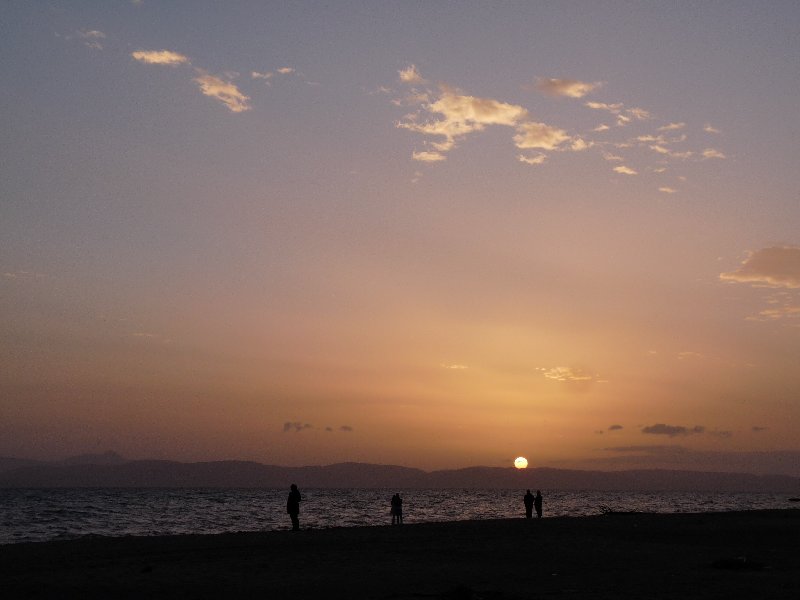
A bright winter’s afternoon. Just time, before the evening cold sets in, to get out for a couple of hours of brisk walking: 5 miles or so along familiar paths. So familiar that this time, I focus on the sky: changeable, unpredictable.
Sometimes it’s moody, sometimes cheerful, sometimes simply rather grey and colourless, at other times dramatic, particularly towards sunset. Come and walk with me to watch the clouds.
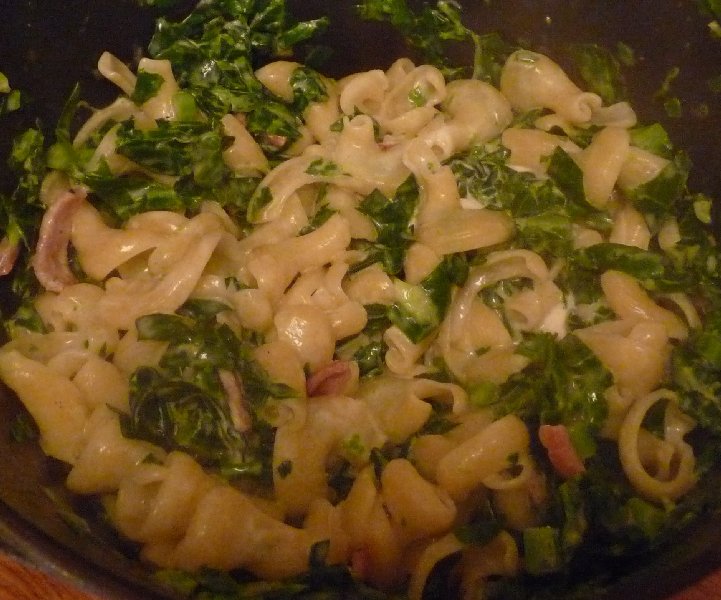
That was Malcolm, three-quarters of an hour ago, while we were just mopping up the last creamy, lemony, chilli-ish morsels from our pasta bowls.
It wasn’t a day when I’d given much thought to cooking. All sorts of domestic tasks, boring but necessary, followed by my currently – slightly obsessive – daily attention to learning Spanish. Our landlords popped round, and a couple of glasses of wine later, there we were, quarter to eight and nothing on the stove.
Except I’d remembered glancing at this recipe in some idle moment the other day, spotted on the BBC Good Food website
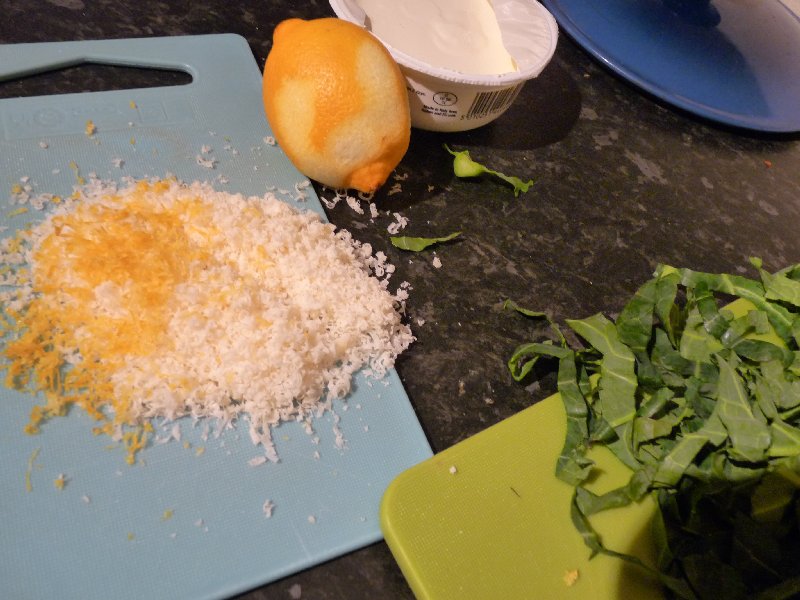
No kale? I have spring greens. No anchovies? I have bacon. And gran padano and mascarpone and lemons and nutmeg and chilli – and the all-important pasta. Twenty five minutes later, we were sitting down enjoying our meal.
Messy cook at work
And it’s a meal for when you don’t feel like a long session at the stove, but need something comforting yet with light and bright flavours. Oh, and dear veggie friends. You could easily leave out the bacon or anchovies.
I haven’t been on a ‘proper’ walk yet this year. First it was the ‘flu, and its aftermath. Then it was rain or snow on the days when I might have been free to get out for a blow in the breezy cold. And finally it’s the mud. Mud’s the one that gets me every time, despite having been given a wonderfully efficient pair of walking gaiters among my Christmas presents. I find it frustrating, pulling my boots from an oozing, slippery, sticky slick of mud only as a preparation for sliding into the next soupy puddle . It makes for slow walking on days when briskly striding out is what’s needed to combat the cold.
So today, keen to get out for at least an hour or so, and equally keen to avoid That Mud, I ended up on a star-shaped walk. I turned back down every path I started, and ended up doing a zig-zag circuit beyond the edges of the village.
Young kestrel feeding
I started off by looking for the young kestrel I’ve come across on a couple of days this week. I had first spotted him in a field near our house, dismembering and eating some small creature just 6 feet away from where I stood staring at him. He flapped off crossly to a nearby wall when he considered I’d got too close, and it was on this wall I saw him the next day too. Today he wasn’t there. I think there were too many dogs out walking their owners.
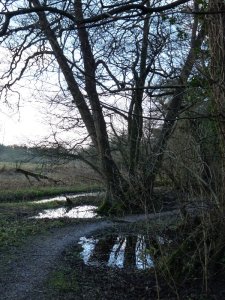
Beatswell Woods with extra water.
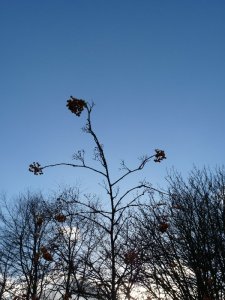
Then I went down into Beatswell Woods. I hoped for buds on the trees, or a few early flowers, but it was wet and wintry still. Then I walked to the fields, thinking I’d choose one of the paths there to take me in a big sweep round the edge of the village. No go. All the paths were muddy, and the horse I stopped to chat to had pretty filthy socks too. Though there was this rowan, with golden honey coloured berries instead of the more usual red.
Rowan berries against a chilly blue sky.
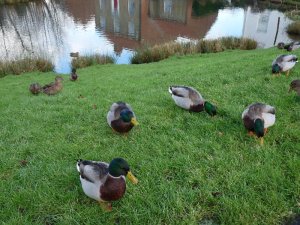
At the village ponds, the drakes and ducks ran fussily up to greet me, hoping for crusts. When they saw I had nothing, the drakes returned, like a bunch of fourth formers, to teasing and irritating the only couple of females in the group.
Drakes and ducks hoping for crusts.
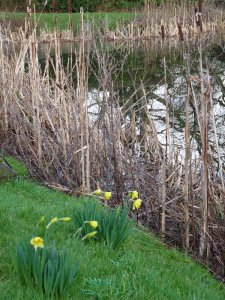
But it was near the ponds that I had my second sighting of daffodils this year, so very early. Surely they should wait until the crocuses have put themselves about? But the crocuses are only just poking the tips of their leaves above the soil, and don’t plan on coming out yet.
Daffodils by the pond.
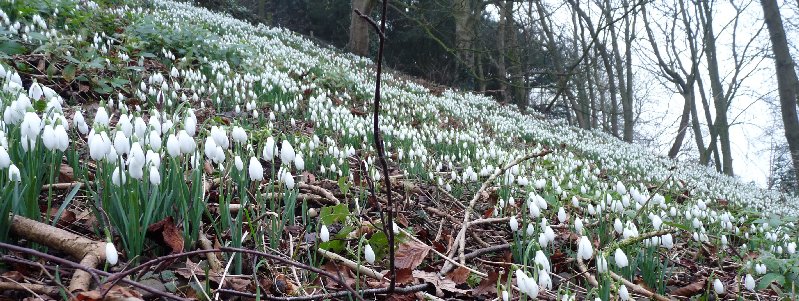
Returning to the woods, I saw the snowdrops. Isolated patches a couple of weeks ago, now they’re in magnificent great white drifts climbing the hillsides, nestling under trees, even risking everything by straggling across the (muddy) paths.
Drifts of snowdrops in the woods.
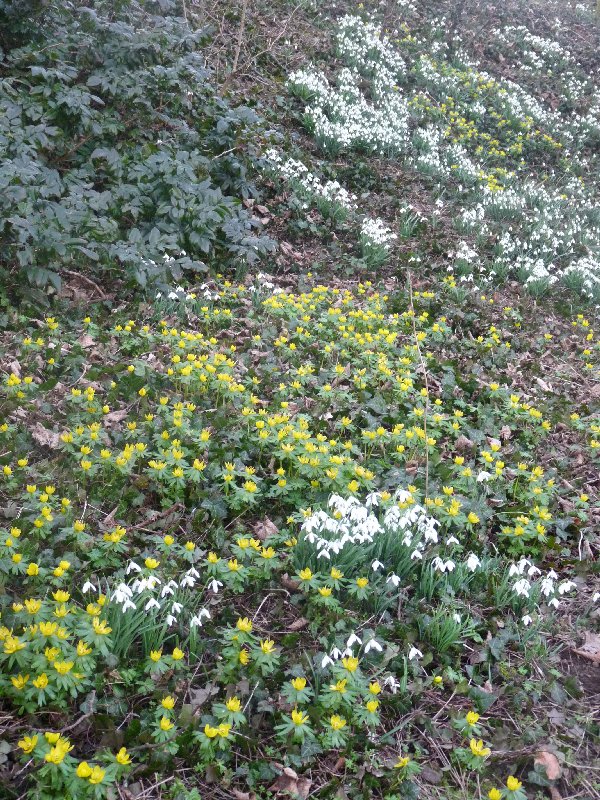
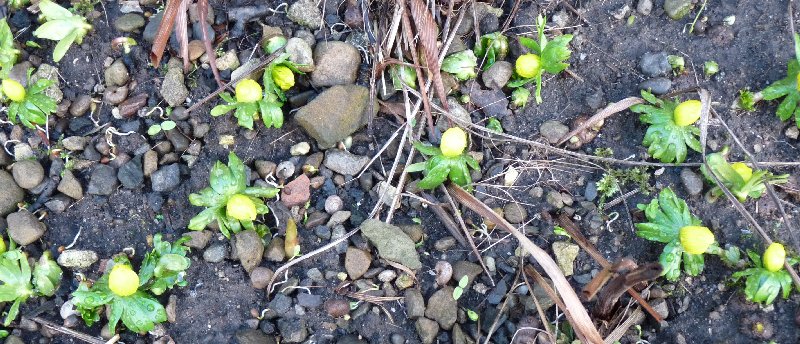
A bit of a curate’s egg of a walk then. A few frustrations, quite a few pleasures, but a healthy glow on my cheeks, and, just before I came into the house, another treat. All these aconites, pushing up their bright yellow faces through the soil, bringing with them hopes of Spring.
The view from the kitchen window in May: the copper beech behind the lilac.
The pond in front of the copper beech in May.
I took these photos of the garden last spring and summer. Centre-stage is the magnificent copper beech, which has dominated the spot for years and years, providing homes and recreation for generations of garden birds and squirrels. It’s the very first thing we see as we glance out of the kitchen window, a statuesque barometer to the changing seasons: from bare winter branches, though to tightly furled budding springtime leaves, to the vibrant coppery russet leaves of high summer, and the burnished and tawny tones of those same leaves as they dry and fall in the Autumn .
I took this photo yesterday morning.
The ruined copper beech with our house just behind.
Our copper beech has gone.
On Friday night, the house became surrounded by an eerie moaning, and then a rushing sound that became ever louder as the wind, gathering speed, surged helter-skelter alongside the house. Thin wiry branches of wisteria and ivy scrabbled urgently at the window panes. The wind clattered down the chimney, coughing clods of oily soot from a long-extinguished fire into the hearth. It was a noisy night. So noisy that despite all the disturbance, none of us heard the moment when the mighty copper beech lost a battle and fell to the ground.
In the morning, the kitchen was unaccountably light for such a gloomy day. We could see the sky where once our copper beech had stood. I rushed down into the garden. The tree could have lunged towards the house, at best breaking several windows. It could have tumbled into the walled garden, taking with it the lovely brick wall up which clematis and old-fashioned roses scramble throughout the summer. It could have crashed into the pond, shattering the ornamental statue in its centre, and unsettling rather a lot of fish and toads. It did none of those. Instead, it fell gracefully to the back of the lawn, avoiding other trees, and several flower beds. It stacked itself up neatly, just waiting for the next stage in its long career. Once it’s seasoned, our landlords, and their son and family will have enough fuel to keep their wood-burning stoves burning brightly for several winters to come. Is that a fitting end to its long life? I don’t know. But it certainly means that it will go on being appreciated for many years.


















 From Pyrenees to Pennines
You must be logged in to post a comment.