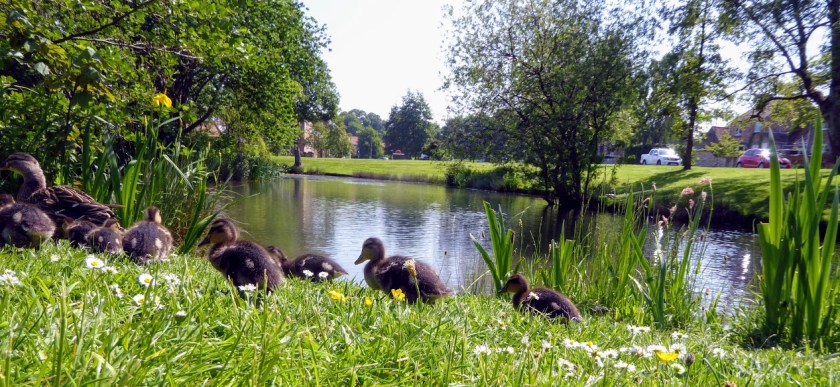
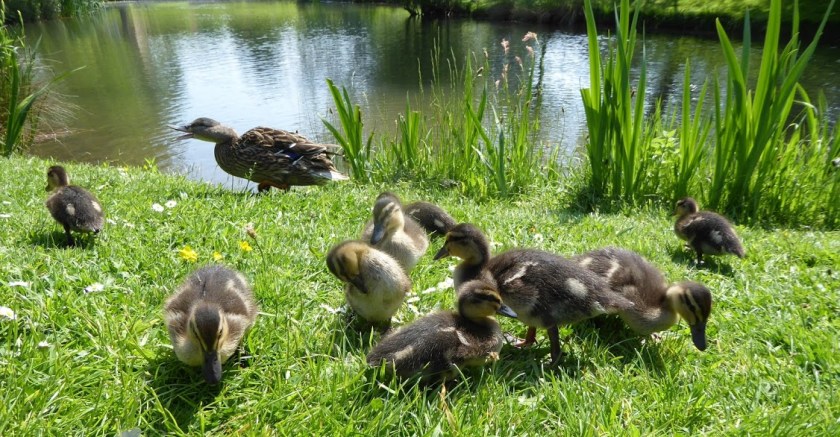
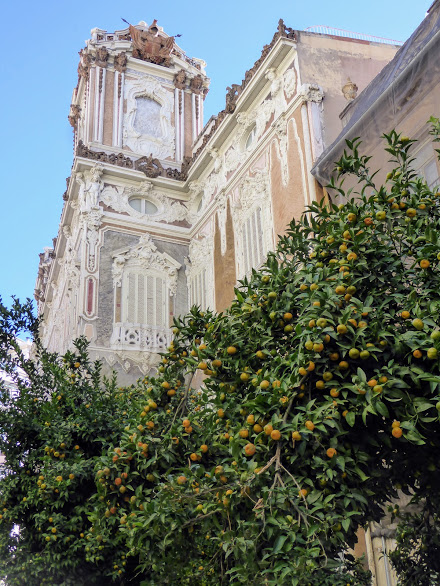
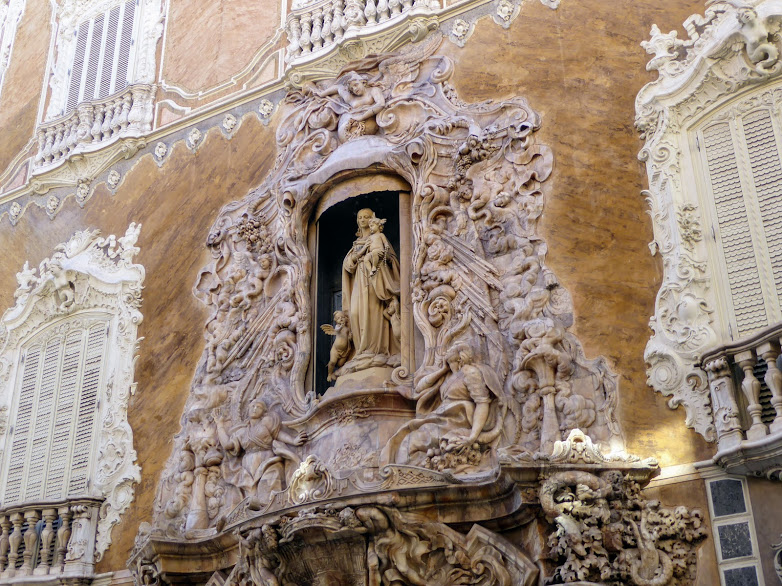
In response to this week’s WordPress Photo Challenge: Silence
Undiscovered Barcelona: the textile town of Sants
Plot the story of my life through the places I’ve lived, and you can see a theme. Textile towns.
I went to university in Manchester, sometimes known as Cottonopolis because of the cotton industry that thrived there throughout the 19th century.
One of the cities at the forefront of the cloth-making industrial revolution – wool and flax in this case – was Leeds. I’ve lived there too.
Then in France, we lived in Laroque d’Olmes, a town whose prosperity depended on the woollen textile trade, snatched from it in the twentieth century as wool lost out to more modern fibres which were in any case increasingly manufactured in Asia.
And last week, in Barcelona, we stayed in Sants. In the 19th century this area, like so many others in Catalonia, turned out the cotton-printed calicoes so popular in Paris at the time. It was a busy industrial town that only became part of Barcelona towards the end of the 19th century. Now much of its industrial past has been re-purposed or flattened. Here’s the Parc de l’España Industrial – once an enormous textile mill.
We loved being here. Though so near one of Barcelona’s main stations it’s assertively non-touristy. People live, work, shop and enjoy themselves without having to tussle for space with a whole lot of trippers rubbernecking their way along the crowded thoroughfares.

Our street had everything from a fish restaurant (choose your own fish from the marble slab), an alternative book shop, a handy mini-mart, a design studio to – inevitably – several bars.
Every morning we did as the Catalans do before they set off for office, market or shop and had breakfast in one of them. I developed a passion for wholewheat croissants, which are light, flaky and utterly delicious.

Neighbourhood restaurants made few concessions to Spaniards, let alone foreigners, displaying their menus in Catalan: this is a separatist area.
We shopped in the independent shops (the only surrender to globalisation that we could find in the entire area was a solitary Burger King: it was refreshingly under-populated) and sauntered round its two thriving markets. We’ll be back.
Click on any image to see it full size.
Mud, mud, glorious mud
Snapshot Saturday: Weathered by the sun in Alicante
Our Spanish holiday ended in Alicante, some 550 km from Barcelona, and was all to do with our flight home. Don’t ask.
My second impression of Alicante, and Malcolm’s first, was that it’s a lovely town. It’s suffered a bit in English eyes from its proximity to Benidorm, the British home of sun, sand, sangria and sex (and that’s probably a bit unfair too). Actually, it’s a fairly wealthy town, a historic Mediterranean port, and strolling round its historic centre, and along its seafront and esplanades was a pleasant experience.
I struggled to find much that was weathered, for this week’s WordPress Photo challenge, but here is a nicely picturesque house above the old town, and a slightly sun-battered detail from the Basilica de Santa Maria.
My other snapshots (click on any of them to see a slideshow) display a busy, prosperous town which we’ll happily return to. Especially if we can enjoy lunch outside in temperatures of 17 degrees in the middle of January.
The sea, the sea … in Barcelona
Another bright sunny day, so the seashore beckoned again – in Barcelona this time.
First though, we visited the Museu Marítim, located in the impressive Drassanes Reials, the mediaeval shipyard dating originally from the 13th century. It was remodelled time and again till the 18th century, when it fell out of use.
Our main memory of this engaging and beautifully curated museum is of the impressively reconstructed galley ship the Galera Reyal of 1568, and all the instruments, arms, ordnance and documents associated with such a warship.
What about this? Thirty oars each side, each manned by four slaves. These men toiled for hours and hours each day, shackled to the same spot for the entire voyage. They worked, ate and slept here, puddled in their own excrement. A ship such as theirs could never surprise the enemy. The smell preceded it by several knots. The exquisite ornamentation of this vessel, rich in symbolism, loses some of its allure against this background.
The whole of the dockyard area is rich in history. Here are just a few pictures, and from the more recently developed Port Vell.
Sitges: a day at the seaside
Top tourist tip. Visit Sitges, as we just have, on a bright day in January. You’ll have the place almost to yourself.
We last visited a few years ago, when Emily took us to see the Corpus Christi Flower Festival in June. We could barely move for other people doing exactly the same thing.
Today was different. We mooched round enjoying the narrow streets of the old town, the Modernista buildings, and the wide sunny beach. I even paddled. Malcolm didn’t.
A tasty tapas lunch was in a quiet bar in a quiet park. It was the perfect antidote to busy Barcelona, a mere half hour train journey away.
La Sagrada Familia
The last time we went to la Sagrada Familia was maybe twenty years ago. My abiding memory is of seeing a monstrous fork lift truck parked in one of the aisles, totally dwarfed by the Cathedral in which it incongruously found itself.
Today was different. The Cathedral which Gaudí began in March 1882 is due to be completed exactly 100 years after his death, in June 2026: so the fork lift trucks are long gone.
What is there new to say about this inspiring, spiritually uplifting and imaginative building? Even the selfie stick dependent visitors thronging through can’t destroy its power.
Imagine, as Gaudī wanted you to do, walking through an ancient forest, the sunlight filtering through the topmost branches, dappling the trunks and forest floor with dancing daylight. Imagine the changing colours of that forest as the chilly morning sun rises in the east, then finally sets, warm and vibrant, in the west. La Sagrada Familia captures all that. It celebrates nature in stone, glass, ironwork and mosaic tile. Here are just a few shots to try to capture that mood.
Bullfighting is dead. Long live retail therapy.
On the way to meet Emily and Miquel today, we spotted a large arena. Surely that must be a bullring? But bullfighting’s outlawed in Catalonia, so what could it be now?
It was the former bullring. Built at the turn of the twentieth century in Moorish style, with a capacity for sixteen thousand spectators, it never really earned its keep. Even before the sport was banned, Catalans didn’t enjoy bullfights, and the Arena saw its last fight in 1977.
The building stood empty and unused till 1999. Richard Rogers’ architectural practice was selected to design a state-of-the-art complex of shops, cinemas and restaurants which also preserved the historic red facade.
It’s wonderful. Shopping’s no fun as far as I’m concerned, but gazing at the massive girders which hold the current structure in place, or walking round the roof terrace (in the pouring rain) to have 360° views over Plaça d’Espanya and beyond was a fine way to spend a morning.
La fiesta de los Reyes: part two.
Today was why we came to Barcelona in early January. Emily’s partner’s family invited us to share in today’s traditional family gathering. How could we refuse?
We’ve just had the best of days, with about thirty members of Miquel’s wider family. We’ve muddled through in Spanish, in English, in French. We’ve watched with pride Emily’s integration into this loving and close family group.
Lots of eating, lots of drinking. Then everyone had to share in eating the traditional Three Kings cake, el roscón de Reyes. We’d all chucked five euros into the pot, and the person who found the little pottery king in their slice won the lot – all but five euros. Miquel won that, for finding a bean in his slice.
Then it was charades. Can you imagine? But this little detail made us laugh. If you need to indicate that the title you’re miming is in English, you drink from an imaginary cup of tea whilst crooking your little finger ….
A very good day has been had by all. Thank you, Miquel’s family, for making us so welcome.
Snapshot Saturday: You can never have too many snowdrops

On New Year’s Day, I excitedly posted a photo of the earliest snowdrops of the year, spotted that very morning. If I’d known that this week’s WordPress Photo Challenge was to be ‘Growth’, I might just have held back.
As it is, I now realise just how special those early hardy little shoots are. That little patch of snowdrops I showed you was alone, quite alone on a sea of bare earth, creeping ivy and a few shriveled Autumn leaves.
Let’s fast forward maybe four weeks. This is what the garden and surrounding woodlands will look like after all the hundreds and thousands of local snowdrops have grown, pushing themselves forth through the chilly frozen earth. Our annual miracle.
February 2017. All the local snowdrops have arrived.
Click on any image to view full size.


You must be logged in to post a comment.