Once upon a time there were five little hens. They lived in a little wooden hut in a wood. A nice family of humans had adopted them, made meals and cleaned for them. Every time the family cleaned the hut, they made sure there was a fresh copy of the Financial Times on the floor for the hens to read while they were resting at home.
Sometimes, the family went on holiday, and then they asked their neighbours Margaret and Malcolm to take over housekeeping duties. Every night at 8 o’clock, these servants-next-door popped round, made sure the hens were in bed, and shut the hut door firmly.
One night one of the hens, Little Bad Hen, decided not to go home. She was having such fun in the woods, grubbing for windfalls and worms: and besides, it was still light. Nobody had told her that Mr. Fox lived nearby, and had hungry cubs to feed. Luckily for her, nobody had told Mr. Fox that Little Bad Hen was out and about. She got away with it, and came scuttling back as soon as one of the servants-next-door appeared to serve breakfast the following morning.
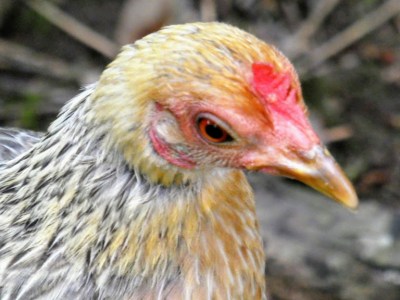
Little Bad Hen.
Little Bad Hen kept this up for four whole nights, clucking smugly to herself as she heard the servants-next-door scurrying about the woods, peering under logs and into hidey-holes searching for her. On the fifth evening, it rained. Little Bad Hen looked up at the sky. She considered the secret-but-chilly and damp shelter that she’d found, under little Felix’s toy wheelbarrow. Perhaps that wooden hut, where she could cuddle up to her friends and sisters was a better idea after all. She might even think about laying those servants-next-door an egg.
… so that’s why I chose it for Jude’s Photo Challenge this week, which is to focus on one colour, and one colour alone. But green of course, isn’t simply green…
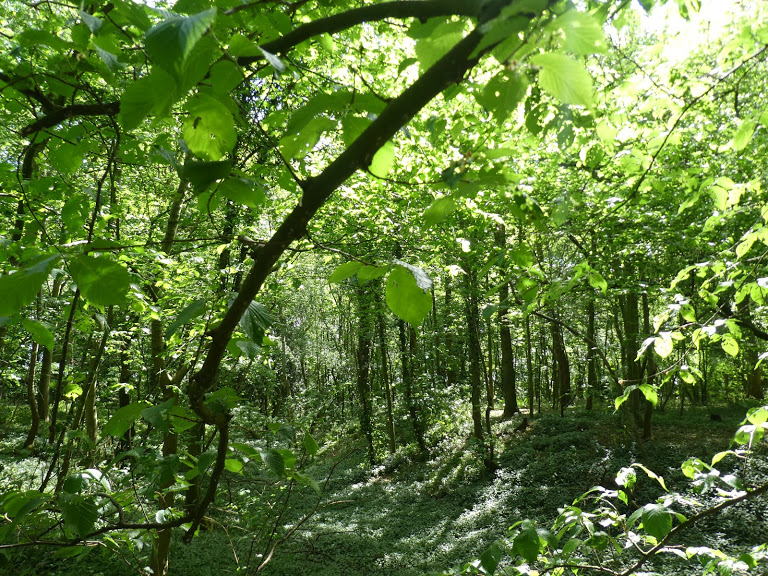
This wood was planted by the Victorians on the site of a Neolithic henge in nearby Nosterfield. I’ll tell the story one day.
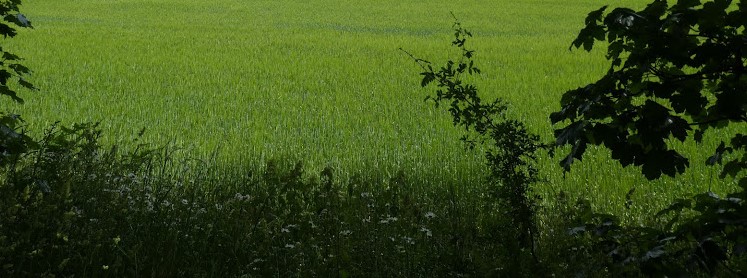
Spring crops.
A very rainy day on Harrogate Ringway.
William in a light box at the Horniman Museum. Also available in blue, red, purple, yellow …
A view in La Rioja, Spain.
Evening i the garden.
A meadow in Swaledale.
A dilapidated shed on a farm near North Stainley.
A young chestnut leaf.
A tempestuous gale in June.
The ill-named White Pond, Mickley.
Trees near Fountains Abbey.
The Leeds-Liverpool Canal.
Crops growing near West Tanfield, North YorkshireA view across the Yorkshire Dales.
*Pedro Calderon de la Barca (Spanish Dramatist 1600 – 1681)
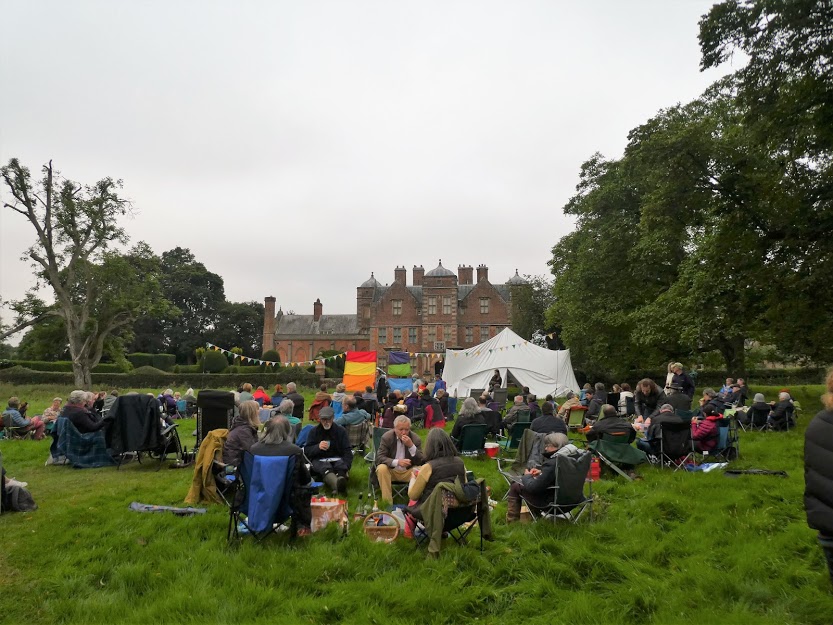
Kipling Hall. The audience enjoys a picnic ahead of the evening performance.
I’m a bit of a Handlebards groupie. Handlebards? Yes, the always effervescently inventive troupe (one male combo of four actors, one female combo of four actors) who cycle the country carrying all they need with them to one-night-only venues, in the grounds of stately homes, museums, city parks to present their season’s Shakespeare play in the open air, come rain, come shine.
I’ve been to five productions now, two male, two female, and one … well, we’ll come to that in a minute.
One night was so wet that players and audience alike took refuge in a castle keep. One evening was bright and sunny, as was another, if a little windy. Last year was fine until after the interval. Then the heavens opened. We were well-provided with rain gear but got utterly soaked anyway. The players, their hair plastered to their scalps and water streaming down their faces, their clothes sodden, dripping and rendered translucent by the unremitting downpour played on. What a team! We admired their grit, and retired home to peel off every item of sodden clothing (and that included underclothes) and take a hot shower. The actors camped out on a hard floor, got up the following morning and cycled to their next venue.
Covid 19 put a stop to this year’s plans. No male tour. No female tour. The actors didn’t sit around twiddling their thumbs though. The London-based ones set about organising deliveries of essentials to the vulnerable and shielded. Which was wonderful, but not acting.
Three of the Handlebards share a house: They’re their very own Social Bubble. So during the days of Lockdown they hatched a plot to tour a play during August and September, just the three of them: two men, one woman. They chose Romeo and Juliet. No problem. Aside from Romeo and Juliet themselves, they only have to play Mercutio, Benvolio, Capulet, Tybalt, Juliet’s nurse and her mother, Friar Laurence …
These kinds of difficulty never thwart the Handlebards. Hats and wigs temporarily stand in for characters whose actor is currently multi-tasking. Props are minimal. Bicycle pumps for weapons; an aerosol; a hand-painted sun and moon; a repurposed squash-up play tunnel becomes Juliet’s balcony; a couple of military jackets; a length of hessian to stand in for monkish robes; gauzy stuff for Juliet; lengths of red ribbon for blood and guts and they’re pretty much sorted.
Boy meets girl. Romeo and Juliet.
Juliet’s giddy and in love.
She disappears under her own balcony.
Here’s Friar Laurence.
Juliet’s nurse has just found Juliet … dead.
The actors change roles, sometimes almost mid sentence. A Liverpudlian becomes a Scot who becomes someone who has twubble with his ‘r’s. Romeo and Juliet themselves are played by a man and a woman respectively, but who knew that Juliet’s nurse sports a dapper beard, or her mother blue knee-socks?
We went along to Thursday evening’s performance. It was all tremendously rip-roaring fun, played against the backdrop of the lovely Jacobean Kiplin Hall. We took chairs, a picnic, and lots of warm clothes, because it was chilly. As ever, laughter and sheer delight kept us entirely in the moment, so we barely noticed that it started to drizzle, not long before the end. Thank you Handlebards. Live theatre is back.
Mont d’Olmes: local playground for skiers. You wouldn’t travel any great distance to spend a holiday here, but for locals, it’s the ideal winter sports spot. It’s a wonderful area for walkers too. We’ve only just begun to discover the wealth of footpaths, mainly across truly ‘sauvage’ slopes, with views downwards to Montségur, Roquefixade, and northwards almost, it seems, as far as Toulouse.
It’s alright waxing lyrical though. For many people living in the area many years past, and until the early years of the 20th century, these slopes were the places where they came for long hours each day, working both on the surface and by crawling through narrow airless tunnels, mining talc.
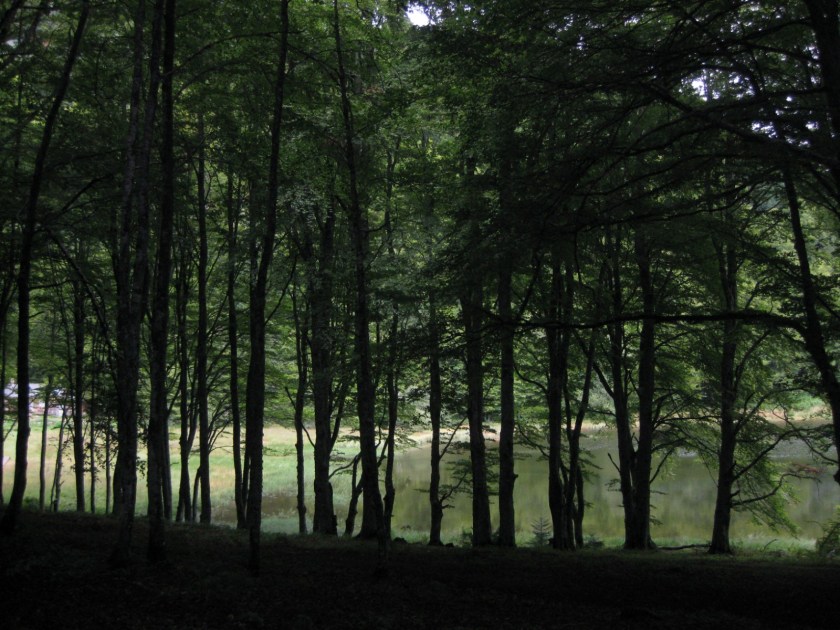
Le lac de Moulzonne glimpsed through the trees at 8.00 a.m.
The trucks that used to transport the talc from the mines.
The old mine workings. Can you spot several tunnel entrances?
Talc? Yes, that stuff you sprinkle on babies’ bottoms. That stuff those Olympic gymnasts plunge their hands into before taking to an overhead bar. That stuff that apparently still has many industrial uses, notably in the ceramics industry and for plastics paints and coatings. This soft soapstone was found here on Mont d’Olmes and is still mined in nearby Luzenac. Here though, all that is left are the gashes in the mountainside where the workings once were, and a few ancient trucks once used to transport the material down to civilisation.
Come and take the path we took last Sunday. We walked in more or less a straight line, up and down hill after hill, as the path became increasingly rocky and impassable.
Our path onwards and upwards.
So many paths! But you’ll never meet a soul.
Apparently this plant is carniverous, feeding on passing insect life.
Early morning mist burning off in the sun.
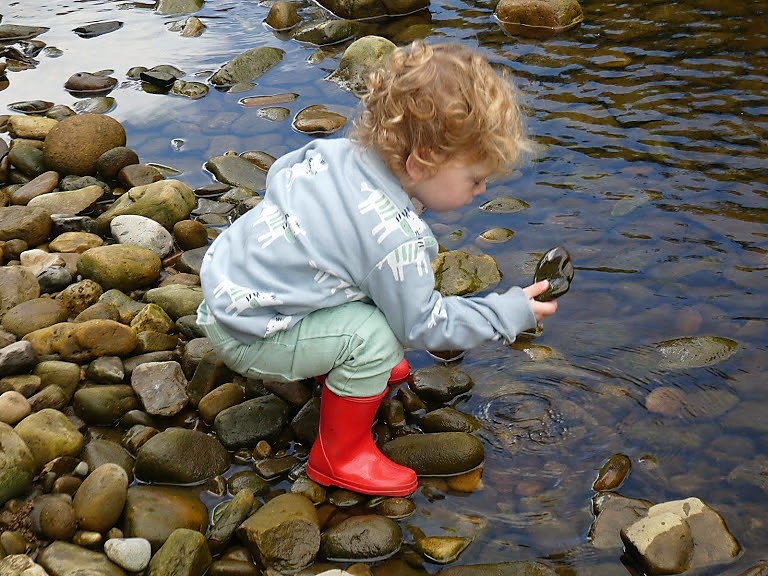
Our reward was the occasional handful of raspberries or bilberries, then a lunchtime picnic by l’étang des Druides. No, sorry, l’étang des Truites. Whatever. Nobody seems to know which name is correct. Some say the person making the first map of the area misheard and wrote ‘truite’ – trout – instead of ‘druide’. We saw no trout. We definitely saw no druids. But we had a jolly nice picnic. And I paddled.
Our first sight of L’étang des truites or druides.
Our picnic spot.
Told you I paddled!
More of the picnic spot.
And then I ruined a perfectly good day, in which morning chill and mist had given over to hot sunshine, by falling flat against the rocky path, cutting open my face and chipping three teeth. I hope the druids weren’t lining me up for some kind of sacrifice.
Our homeward path.
Lavelanet, then Laroque lie far below us.
People often hang these thistles on their doors to bring good luck. Maybe if we had too I wouldn’t have had my little accident.
August 2020, PS. Don’t worry. I’m fine. The chipped bits, which were only small, have smoothed down nicely.
August is traditionally Silly Season in the media. I’ll join in. I’ll pretend that it’s the two windows you can just about see that are the subject of this post. We all know it’s really the washing line. And its contents.
Disclaimer: this is not our washing.
These are Silly Season entries for both Monday Window and Jude’s Photo Challenge, which is this week about colour with a bit of zing.
It was Sandra who got me into this. I love her blog A Corner of Cornwall. She’s a big reader, and often joins in Six Degrees of Separation.
On the first Saturday of every month, a book is chosen as a starting point and linked to six other books to form a chain. Readers and bloggers are invited to join in by creating their own ‘chain’ leading from the selected book.
I’m a big reader too – less so during Lockdown, for some reason I can’t explain – but rarely blog about my reading choices. It got me thinking…
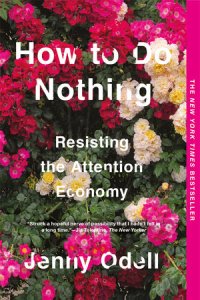
The given starting point this month is the only book I haven’t read: Jenny Odell’s How to do Nothing. I will read it, because according to the summary, it shows us a new way to connect with our environment and reveals all that we’ve been too distracted to see about our selves and our world.
It made me think of the first book I read when Lockdown began: Katherine May’s Wintering. This book, part memoir, part researched observation shows how winter can bring strength, and inspiration as we bring different ways of coping to this most demanding of seasons. May looks at the animal world (bees for instance), at different cultures who know a lot about winter (the Finns for example), and at her own experiences to show that winter can be far from negative. Instead, it can be one of healing, renewal, acceptance and a source of strength.
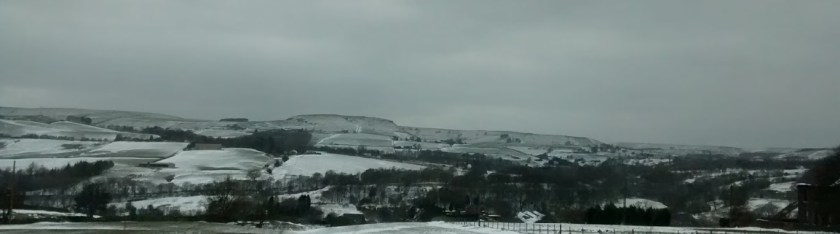
Near Pendle in Lancashire.
From wintering to winter. Elisa Shua Dusapin’s Winter in Sokcho takes us to South Korea, to the dreary life of a young woman living in a dreary seaside town on the border with North Korea. She meets a French comic book illustrator, a guest at the hotel where she works. We never get under the skin of the characters in this story. But this distance, this cold, this feeling of the characters being trapped in their self-appointed roles, these vivid descriptions of an unwelcoming chilly town, overshadowed by its proximity to North Korea is what gives this book its power.
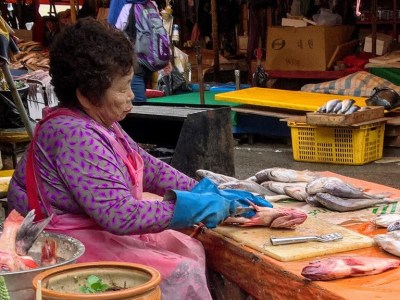
Our heroine’s mother worked in the fish market. Perhaps she looks like this woman, taken at Busan’s Jagalchi fish market.
And still in South Korea, we go from Sokcho to Busan, a city my daughter was lucky enough to call home for a year, and which we were lucky enough to visit. Pachinko, by Min Jin Lee is a family saga which takes us from early 20th century southern Korea, in a fishing village not far from Busan, to Japan in the late 1980s. This is a troubled period of Korean history, dominated by its difficult relationship with Japan. The book begins with the story of Sunja, who comes near to bringing shame on her family by becoming pregnant to a rich wheeler-dealer before marriage. It’s about resilience and emotional conflict passing down through the generations. It’s about well-drawn characters making their way in the world, sometimes with great success, but rarely able to escape from the shadow of their past. It’s a real page turner, from which I learnt much about this period of Korea’s history.
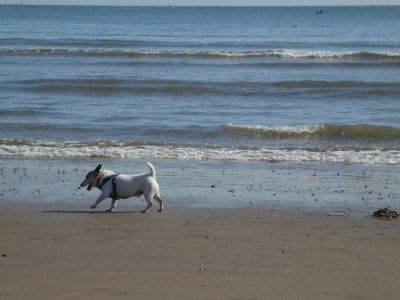
This is the coastal area of Busan. Now, as it probably was then when the story began.
From one family saga to another. Laura Cumming’s On Chapel Sands isn’t so much a family saga as a family mystery. Laura’s mother Betty was adopted, was briefly kidnapped, and set Laura sleuthing to uncover the whole story, never taking bald facts at their face value.
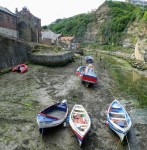
I’ve never been to Chapel Sands. But this stretch of Yorkshire coast isn’t so very far away from there.
Another mother takes centre stage in Maggie O’Farrell’s Hamnet. O’Farrell imagines the story of Shakespeare’s marriage to Agnes, and the devastating death of their eleven year old son Hamnet. Reading this book during the time of Covid 19 gives this story of love and loss a very particular immediacy.
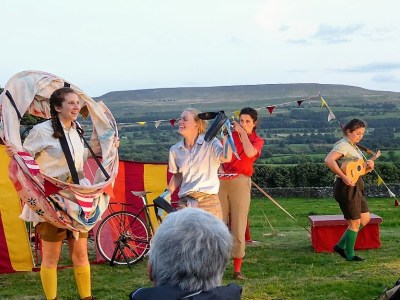
I think Shakespeare would have appreciated this production of Romeo and Juliet: in the open air in Wensleydale, just four players, all women, riding from venue to venue on a bicycle: the Handlebards.
We remain in a similar period for my last link: The Mirror and the Light, by Hilary Mantel. There is a denseness to this 875 page book, with its enormous cast of characters, some of whom merely have walk-on parts which gives this tale its richness. We all know the story. We all know what happens to Henry’s queens. We all know what happens to Thomas Cromwell. And still we want to turn the page.
Thomas Cromwell still had Henry VIII’s favour when Fountains Abbey was dissolved in 1539: its roof destroyed for the valuable lead, and to prevent the monks continuing to live and work there.
I’m looking forward to seeing where all the other chains lead – from the single starting point.
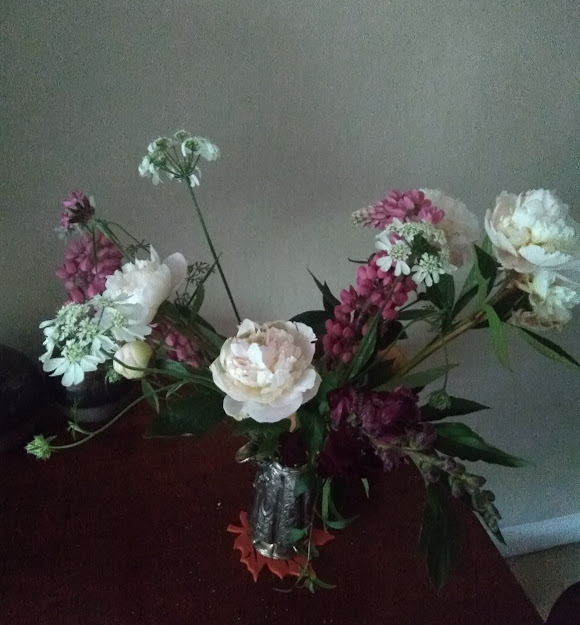
These flowers are for Becky, indefatigable host of Square Perspectives. She has encouraged us to look for an astonishing range of perspectives over the last month, and to share our findings with contributors in every continent. Thank you, Becky.
Normal service will be resumed in August. Whatever ‘normal’ means these days. The flowers will bash on regardless.

























 From Pyrenees to Pennines
You must be logged in to post a comment.