From Jervaulx to Jervaulx

Yesterday was the day when Malcolm was to have done his first ‘proper’ walk since his operation.  But life got in the way, and at the last minute, he had to wait in for a workman.  I went anyway, because I was ‘recce-ing’ the route ahead of leading the Ramblers on the same route in 10 days or so: and it’s a busy 10 days.

The route I was checking was a walk full of only charm and delight:

– because, unusually, I could get from door to door (not that walks have doors) courtesy of the bus that passes the end of the road.  There are only 3 buses a day, mind you, so some planning is necessary.

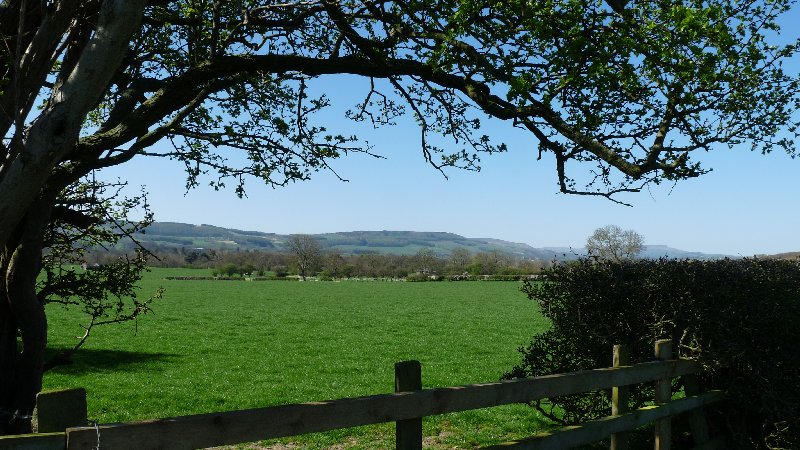
– because it follows paths in the gentle sweeping valley of Wensleydale: a tranquil, lush and gently wooded area.
P1190317

– because the walk begins and ends at one of Yorkshire’s ruined Cistercian abbeys – Jervaulx.  It’s even more ruined than Fountains and Rievaulx, but it’s a peaceful place to meander through; to sit quietly; or to explore for flowers clinging to ancient architraves, or topping off columns which no longer have any roof to support.

– because the path I took leads through English parkland which at this time of year is home not only to sheep, but to their young lambs, busily feeding, playing ‘I’m the king of the castle’, and having lamb-races, before cuddling up with mum for another little sleep.

– because Thornton Steward, a quarter of the way through the walk, is a picture postcard of a village.  There’s a green where you can rest for a while whilst looking beyond the cottages to Wensleydale beyond.  Even better, there is a village hall.  You won’t find anyone there, but the door is open.  The villagers encourage you to come in, make yourself a drink, help yourself to a biscuit,  and have a ‘comfort break’. Whilst relaxing, you could browse the books on display in two large bookcases.  Swap one of your own if you have one, or if not, make a donation and take a book away.
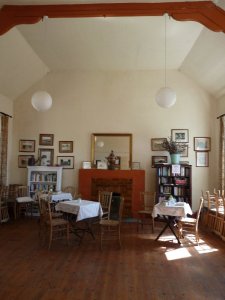
Thornton Steward Village Hall, all set to welcome weary walkers.

– because just outside Thornton Steward is the charming, tiny, isolated church of Saint Oswald.  Mainly Early English, it still has fragments – parts of the nave wall and the porch door – dating from before 1066.
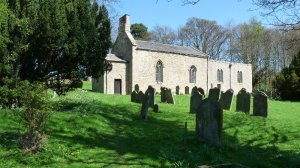
The church of St. Oswald.

– because at the edge of a field quite near the church, some lucky child’s dad, or granddad has made a very special tiny secret den from an ancient hollow tree.  Just look at this:
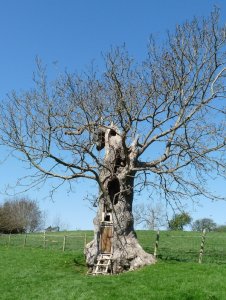
P1190332

– because I passed Danby Hall, as well, begun in the 15th century and finally finished in the 19th century. Danby Hall was once the home of the Scrope family, a Catholic family of some influence who hid priests, attended clandestine masses and somehow survived the turbulent times of Tudor-Elizabethan England.
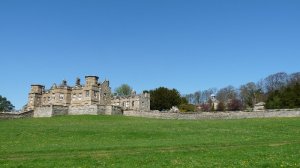
P1190344

– because most of the second half of the walk is along the River Ure.  On one side, it’s all woods, wild garlic and wood anemones.  On the other, open views across the river itself, and Wensleydale beyond.
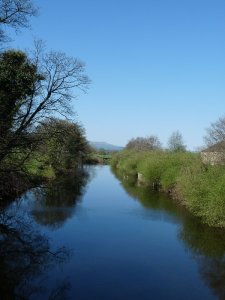
P1190309

– because the route was so well way-marked that I barely needed a map to find my way round.
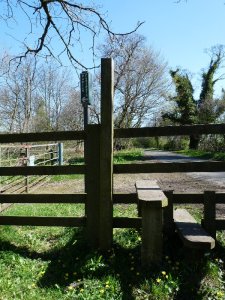
A style, a signpost, an easy route to find.

– and because of honesty boxes.  That’s how you know you’re not in the city.  Park at Jervaulx Abbey and there’s an honesty box so you can pay the parking charge.  Visit the Abbey itself, and there’s another one.  And at Thornton Steward they encourage you to make a donation for your refreshments: but no-one checks up: it’s up to you to do the right thing.
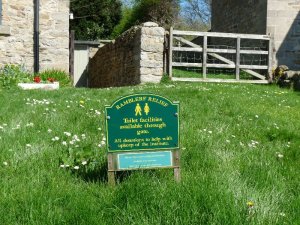
Thornton Steward advertises its'comfort break' facilities.
Thornton Steward advertises its ‘comfort break’ facilities.

On the walk, I thought of poor old Malcolm, stuck at home whilst I enjoyed one of the very first summer days, bright, fresh, and really rather hot.  I thought of one of my fellow bloggers, Sharon, whom – very exciting, this – we’re going to meet in a fortnight or so when she comes to visit Yorkshire: she might like this walk.  And I thought of another fellow blogger, Kerry, an American , who’d probably love to use the wool all those lambs and sheep are busily growing in one of her weaving projects, even though wool isn’t usually her chosen medium.
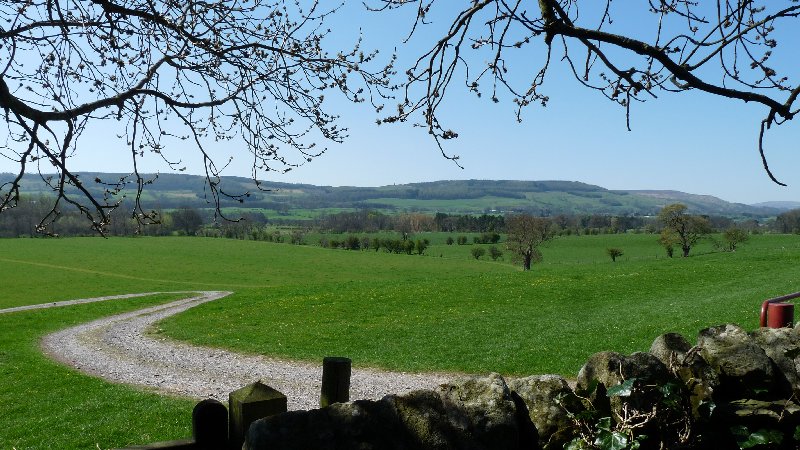
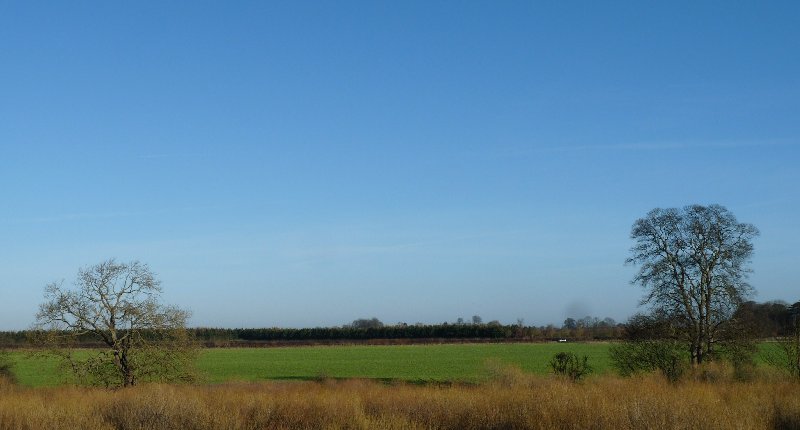
The path ahead, seen from the churchyard at St. Oswald's.
The path ahead, seen from the churchyard at St. Oswald’s.


Snowdrops and the promise of Spring

A bright January sky

Today, I rejoined the human race.  For the first time since before Christmas, I got up, got dressed, looked out of the window – and wanted to be out there, in the bright and frosty sunlight.  Malcolm’s recovery is a good day or two behind mine, but I hope that he too is on the way up.

I wasn’t up to a hike.  I wasn’t even up to a stroll to the village shop, only a mile and a half away in West Tanfield.  But I was up to a riverside amble, particularly when it meant coming upon little clumps of snowdrops on the woodland floor, already unsheathing their white faces to greet the winter sun.

Snowdrops push above the leaf mould

If the snowdrops are out and about, truly, all’s right with the world.


A walk by myself

Ever since our friend Micheline had a nasty fall on a walk, three and a half years ago, and had to be air-lifted to hospital, I’ve been slightly wary of walking alone in the countryside.

But sometimes, only solitary will do.  Never more than 4 miles from a village, always with a farm somewhere not too far away, I set off for a solo walk this morning, even before all the Grammar School pupils had got on their bus to whisk them off to school in Ripon.

From your point of view, as you look at these photos, you may feel it was all just a repeat of my Sunday morning stroll.  But it wasn’t at all, not for me.  My path drew me in a big eight mile circle to the west of our village.  It took me past a working quarry: always good to watch men at work.  It took me past ancient trees: our home patch is particularly good at oak trees which are very old indeed.  As I was passing through a wood, an anxious Wensleydale sheep cantered up to greet me.  I saw why she was worried.  There wasn’t another sheep like her in sight anywhere – she was lost.  But I never found anyone I could report her to.  I hope she’s alright.  There were fungi.  There were delicate and skeletal winter seed heads.  I saw a pint of milk delivered to someone’s gate, and took a picture of it.  Home milk delivery’s getting scarcer here now than it was in my childhood, but I’ve never seen milkmen in other countries I’ve visited.  I saw Autumn leaves still clinging to the trees, and plenty more in vibrantly coloured heaps at the base of trees.

Best of all – and I have no photo to prove it – shortly before the end of my walk, as I was climbing steeply through woods with the River Ure below me, three white-rumped deer leapt out of a clearing, and with three rapid yet elegant and beautifully choreographed bounds, disappeared from view, only to re-appear and disappear for good, moments later.

All in all, a pretty good use of a Friday morning, I thought.


‘One misty-moisty morning, when cloudy was the weather…..’

Today was indeed a misty morning.  Ripon has no fewer than three rivers in town, and a canal too, and one of those three rivers, the Ure, passes our back door.  So it’s no surprise that we do ‘misty-moisty’ mornings, evenings and nights on a regular basis.

But mistiness is no excuse not to walk the mile and a half along the Ure to visit the village shop at West Tanfield to buy a Sunday paper.  Here’s my journey:

This slideshow requires JavaScript.


This is how the old nursery rhyme goes:

One misty, moisty morning,

When cloudy was the weather,

I chanced to meet an old man clothed all in leather.

He began to compliment, and I began to grin,

How do you do, and how do you do?

And how do you do again?

Though I didn’t meet any old men clothed all in leather, I did meet quite a few dog-walkers.  And quite pleasant chats were had with nearly all of them

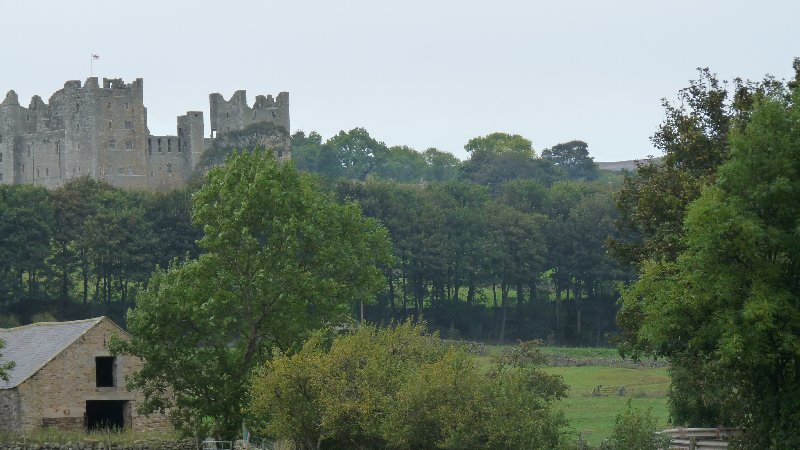
A castle fit for a captive queen.

We travelled the road to our last walk in thick white mist, fearing a dank and gloomy day.  But the higher we climbed, the more the mist fell away, and the brighter the sun shone.

Looking down over Wensleydale from Castle Bolton.

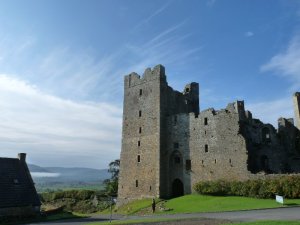
This was the scene as we arrived at Castle Bolton, the village where you’ll find Bolton Castle:

And as we began walking, Daphne shared some of the castle’s history with us.  It has belonged to the Scrope family since the time it was built in the 14th century, and has always been admired for its high walls.  It’s a proper castle, looking exactly like the ones you will have drawn when you were eight years old.

Bolton Castle
Bolton Castle

But that’s not why it secured its place in the history books.

Tudor history is largely about the constant religious and temporal battles between the Catholic  and the Protestant church, which Henry VIII had made the Established Church, with the king as its head: the Fidei Defensor – Defender of the Faith (unbelievably, Henry hung onto this title, awarded him in his pre-Protestant days by Pope Leo X, in recognition of his book  Assertio Septem Sactramentorum which defends the supremacy of the pope).  His son Edward briefly succeeded him, and then his daughter Elizabeth, and both were Protestants.

But Elizabeth’s rule was threatened by the Catholic Mary Queen of Scots, and she was held captive first at Carlisle Castle, then at Bolton.  Here she was attended by 51 knights, servants and ladies-in-waiting, not all of whom could be accommodated in the castle itself.  She also had cooks, grooms, a hairdresser, an embroiderer, an apothecary, a physician and a surgeon, while furnishings fit for a queen were borrowed from nearby Barnard Castle.  She went hunting, learnt English – for she spoke only French, Scots and Latin – and spent time with local Catholics.  She made an unsuccessful bid to escape from captivity.  It’s said she climbed from an upstairs window in the castle, and fled on horseback past the nearby market town of Leyburn.  It’s here she dropped her shawl and so was discovered and recaptured.  And that is why, so they say, the long escarpment above the town, nowadays a playground for walkers and sightseers, is still called ‘The Shawl’.

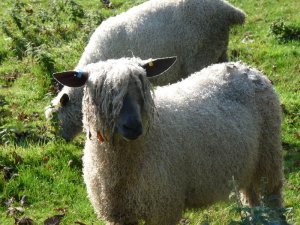
As we enjoyed our history lesson, we passed a field of Wensleydale sheep.  We very much admired their sultry fringes.

Wensleydale sheep
Wensleydale sheep

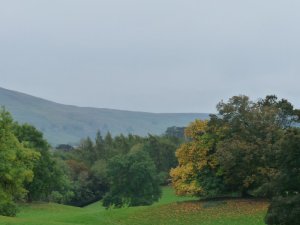
And onwards.  Autumn colours.P1160847

A completely pointless stile in the middle of a meadow.P1160853

Then Aysgarth Falls.  What a wonderful lunch spot.  The crashing waters made conversation quite impossible, but we sat enjoying the surging waters, the coppery leaves above our heads, and the all-encompassing percussion of the tumbling River Ure.

And then it was time to turn round and head back by a different route.  Another great day’s walking, with an added history lesson.

Journey's end in sight.
Journey’s end in sight.

A sheep is a sheep is a sheep…..

… or not.

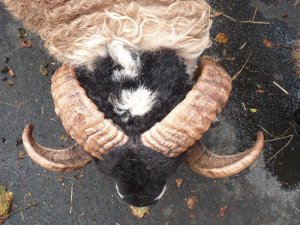
The splendid horns of a Swaledale sheep.

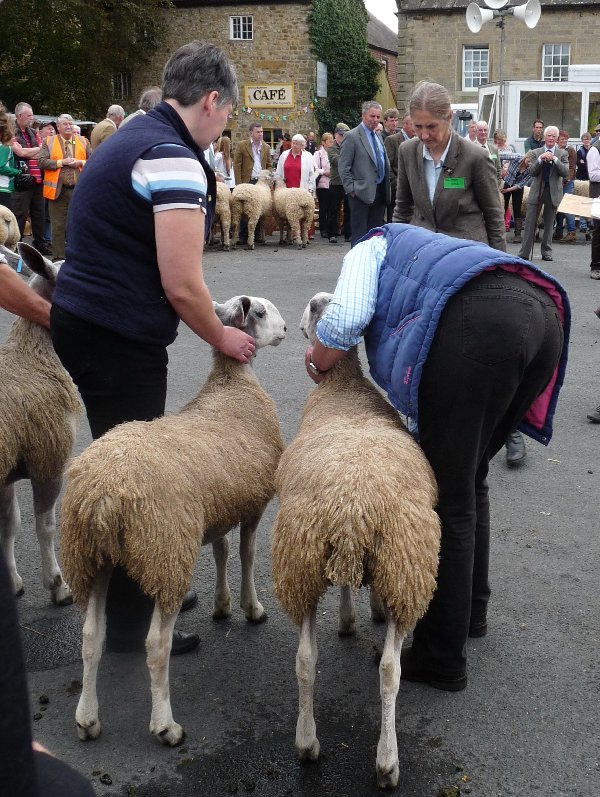
On Saturday we called in, far too briefly, at the annual Masham Sheep Fair. This is the place to go if you believe a sheep looks just like this.

549---Sheep

Saturday was the day a whole lot of sheep judging was going on in the market square.  Here are a few of the not-at-all identical candidates. And yet they are only a few of the many breeds in England, and in the world. There are 32 distinct breeds commonly seen in different parts of the UK, and many more half-breeds.  I was going to identify the ones I’m showing you, but have decided that with one or two exceptions (I know a Swaledale, a Blue-faced Leicester or a Jacobs when I see one), I’d get them wrong. So this is simply a Beauty Pageant for Masham and District sheep.

And if you thought wool was just wool, these pictures may be even more surprising.  Who knew that sheep are not simply…. just sheep?


Judgment day at Masham Sheep Fair

Misadventures in Nidderdale

The landscape glimpsed through the skeletons of summer's cow parsley.
The landscape glimpsed through the skeletons of summer’s cow parsley.

Yesterday’s outing was a gem.  We walked in bright late summer sunshine as the trees began changing colour for Autumn.  Great views over Nidderdale and a few interesting animal encounters added pleasure to the day.  And best of all was the chance to tease Our Leader For The Day – let’s call her Ms. X, to spare her blushes.  Within 10 minutes of starting, she’d taken us off-route.  A landowner called us off the steep hillside that she was already scaling.  ‘It’s private land – but in any case it doesn’t lead anywhere.’  That wasn’t surprising.  There was no path.

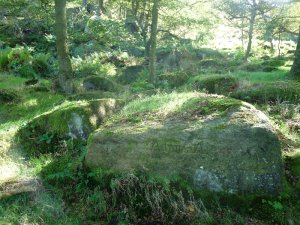
Never mind.  We were enjoying fine panoramas, and a path that led onwards and upwards into ancient woodlands where large rocky outcrops showed us we weren’t at all far from Brimham Rocks.  The paths round here were the stamping ground of lay brothers from Fountains Abbey who lived and worked in this area.  They would have appreciated the fresh water springs, one of which has a carved stone alongside: ‘Adam’s Ale’, it says.

Here's fresh water, aka Adam's ale
Here’s fresh water, aka Adam’s ale

The monks of Fountains Abbey had complete control of the Hartwith area from 1180 until the dissolution of the monasteries.  It was home for their sheep; a source of wood; and animal fodder; and stone from the glacially deposited millstone grit , which was used to make mill-stones (‘quern-stones’).  It was here too that the Abbot of Fountains Abbey had his own private hunting park.

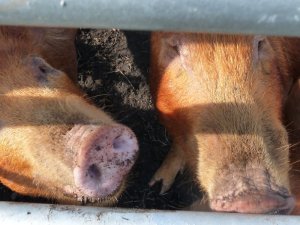
After that we were on National Trust land, and the outer-reaches of the Brimham Rocks estate.  Here, the landscape changes for a while to austere and fairly barren moorland.  But it was easy walking, and we were entertained by a fine herd of long-snouted ginger Tamworth pigs corralled on the edge of the moor.  They were vocal, curious, and keen to eat my gaiters.

Two nosey pigs.
Two nosey pigs.

Then we got lost again.  Ms. X led us through impenetrable bracken, at the edge of which she promised us a stile.  There wasn’t one.  We returned through the impenetrable bracken, and found the correct – and easy – path.  We passed the handsome Jacobean Brimham Lodge, built on the site of the Abbot’s Hunting Lodge.  Those Abbots knew how to choose a good view.

This was a day of many stiles.

Now we were onto areas of pasture-land.  These fields have been progressively cleared in the years since the Dissolution of the Monasteries by the landowners who took over monastic lands.  We picnicked in a field by a little-used track.  Two of us spread ourselves out on the little-used track.  We opened our sandwiches.  And a large tractor advanced on us – down the little-used track.

Throughout the afternoon, we passed several ponds, probably originally fish ponds for – yes, you’ll have guessed – Fountains Abbey.  Ducks escorted us along the roads, geese protested at our presence: it was all very bucolic.

At last, we reached ancient woodland – Old Spring Woods is known to have existed in prehistoric times.  Remains of stone enclosure suggest that at one time, the area was used for grazing stock, but later, hunting became more important.  And it was here that Ms. X led us astray for the last time.  At the bottom of a long descent she insisted she’d gone wrong.  Up the hill we trailed, and all of us had a go at re-interpreting the map in our own way.  By popular vote, we all traipsed down the hill again, and found the path we’d needed all along, just there, beyond the woodland gate.  And we were nearly home and dry.

But our day wasn’t over yet.  Ms. X suggested finishing off the afternoon at an ice cream parlour a couple of miles along the road.  It wasn’t her fault that the signs to it on the main road all read ‘Open’.  It wasn’t her fault that there was a long and bumpy farm drive down to the café .  And it wasn’t her fault that when we got there, the café turned out to be shut.  But we blamed her of course, just as we blamed her for every mishap along the way, even though we all had a hand in reading the map.

She knows we don’t mean it.  We’d had a Grand Day Out.  We’d had a good work-out, a scenic walk full of interest, a fine day out with friends, and a chance to tease Ms. X unmercifully.  Thank you, Ms X.

A view across Nidderdale near the end of our journey

Druids’ folly

It was all a bit competitive being a landowner in 18th and 19th century North Yorkshire.  You wanted the fine house.  You wanted the spacious and gracious gardens, landscaped to be ‘picturesque’: nature celebrated but tamed, rather than strictly-organised and geometric, as in much of the rest of Europe.  And you wanted the Folly.  You were looking for an extravagant yet  decorative building, that displayed to the world your appreciation of classical, Egyptian or Gothic architecture.  It was without purpose, it was eccentric, and it was a fake.

But that was entirely the point.  A folly was for fun.  It might complement the view.  It might make a destination for a stroll for your family and guests.  It might even be a picnic spot for a wider public looking then, as now, for something nice to do on a sunny Sunday afternoon.

Today, the ‘wider public’ was the Ripon U3A (University of the Third Age) walking group.  It was not however, a sunny Sunday, but a dank and drizzly Friday.  Our path took us through Colsterdale up the now dismantled track of the narrow-gauge railway built in 1902 to transport materials used in the construction of  nearby Leighton reservoir.  During WW1, the railway’s destination, Breary Banks, became a training ground for the volunteer soldiers of Leeds Pals.  We tramped up the hill as those soldiers-in-training must have done: more suitably clad, certainly, and just as capable of sending the sheep running for cover in the bracken.

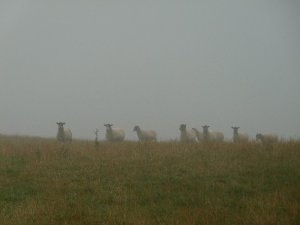
Sheep inspecting the troops.

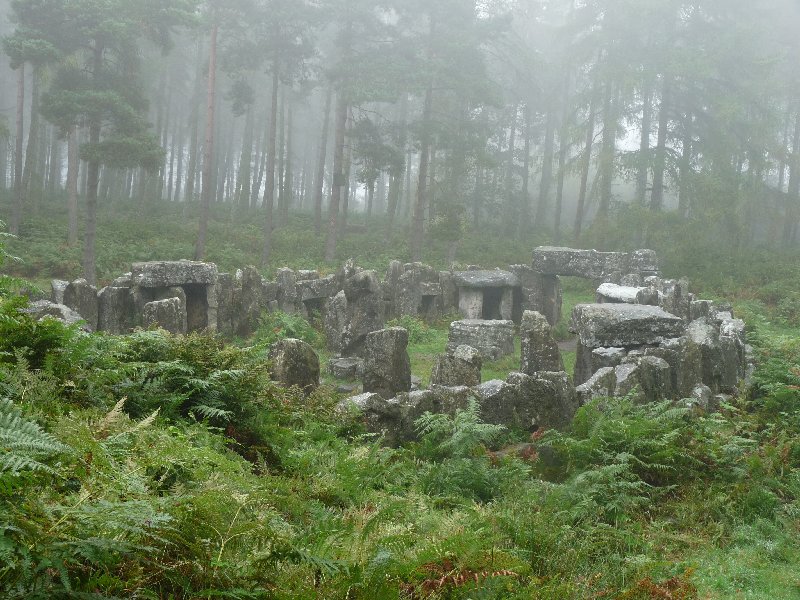
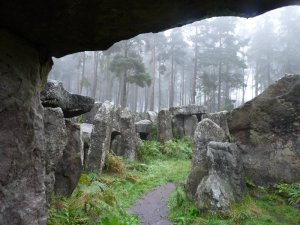
Then we were into woods, and along another path, and found ourselves…… in a clearing, with an oval of standing stones, some of them fashioned into doorways or caves, but all of them contributing to a sort of over-furnished Stonehenge.  It’s not North Yorkshire’s answer to Stonehenge however, but William Danby’s folly.  William Danby was the owner of the Swinton Estate, on whose lands we were standing.  That is, both William Senior, who lived in the latter half of the 18th century, and William Junior, his son.  Which of them built the folly is a bit of a mystery.  Both of them were probably intrigued by the Druids.  Poets and antiquarians at the time saw them as England’s earliest men of learning, the guardians of early belief-systems, and the first English patriots.  Some say too that this ‘ancient temple’ was devised as a means of providing employment for men returning from soldiering in the Napoleonic Wars.  There’s a story that there was a seven-year job on offer to anyone who would live as a hermit on the site.  It’s thought that nobody stayed the course.

Druids Temple
Druids Temple

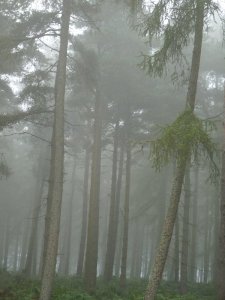
We explored the stones and caves, standing atmospherically on this slightly misty day at the edge of a suitably gloomy forest.

Another view from the temple.

And then we went for coffee and cake at the Bivouac, a marvellously isolated and quirky cafe on a site -with-yurts for serious glampers.  Definitely worth a detour.  Suitably fortified, we finished our circular walk, and were back at home in time for a late lunch.  A healthy walk, a couple of history lessons, a great coffee-stop.  What better way to start the weekend?

Here be druids.
Here be druids.

I should mention that these photos give quite the wrong impression of our not-at-all miserable day.  They were actually taken earlier this week, when the weather was really gloomy, and our French friends were still here.

Wensleydale bread

We love a good country show.  Farm animals on their best behaviour,  sheepdogs out to impress with their skills in rounding up sheep, horses in the ring neatly jumping a clear round, country crafts, tough-guy tractors, food to sample, all in some pretty slice of countryside with the sun (maybe) beating down.

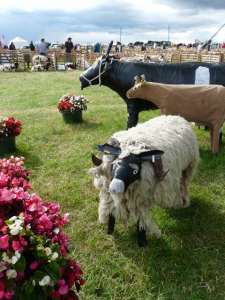
At Wensleydale Show, Leyburn Auction Mart went for animals made from  gaffer tape and oddments.  So much more biddable.
At Wensleydale Show, Leyburn Auction Mart went for animals made from gaffer tape and oddments. So much more biddable.


Since we got back to England, we’ve failed to go to the Great Yorkshire Show in Harrogate – too crowded, and the Ripley Show – way too wet.  Would it be third time lucky at the Wensleydale Agricultural Show?  Well, yes, we did make it there.  And just after we arrived (this was the 23rd August, remember) we found ourselves scurrying for cover to avoid a heavy hail storm, with sharp icy crystals slashing at our faces and battering at the marquees.

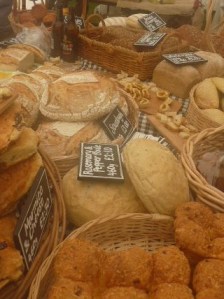
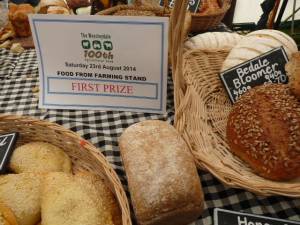
It didn’t matter.  The sun soon came out again, but in any case, we spent much of the day inside.  We were there to work.  Bedale Community Bakery, where we continue to enjoy volunteering every Wednesday, had a stall, and there was bread to sell.  Some of the team had worked through the night to get loaf after loaf mixed, kneaded, proved, baked and loaded up for the journey from Bedale to Leyburn and the show.  By the time Malcolm and I arrived, some of the team had been there several hours already.  And here’s what the stall looked like….

A tiny part of our stall.

We sliced and buttered loaves to provide samples for an eager public who wanted to talk to us and to try before they bought: sourdough; spicy chilli sourdough (soooooo good); cheese and onion bread; another cheesy loaf marbled with Marmite; harvester loaves; wholemeal loaves; bloomers; rosemary and pepper loaves; ‘seedtastic’ spelt; a loaf made using a locally brewed beer; a Mediterranean bread, all made the traditional way, proved long and slowly over several hours.  There were spicy vegetable pasties; tomato and onion focaccia; roasted vegetable focaccia; four different types of scone (Jamie and I had made quite a lot of those on Friday, and they were baked off in the small hours of Saturday morning).

Try before you buy.
Try before you buy.

It all paid off.  We were in the food marquee, surrounded by other small food businesses offering bread, pies, jams and curds, cakes and biscuits, chocolate, cured meats: all good stuff.  But we got first prize in the ‘Food from Farming’ category, for the quality of our products and (buzz word alert) our community engagement.

And here's the certificate
And here’s the certificate


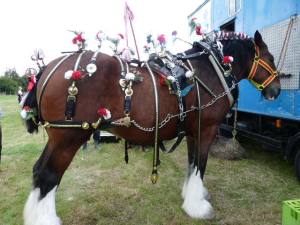
There was almost no time to get away and enjoy the show, but it hardly mattered.  Serving on the stall to an appreciative public was all good fun.  But here are a few shots from the times I did escape.  Here are shire horses, beautifully decorated in the manner traditional for the area.  Yorkshire horses, apparently, sport flowers, whereas Lancashire ones wear woollen decorations (very odd, as we had a  woollen industry in Yorkshire, whilst Lancashire did cotton).


A Yorkshire shire horse, her 80 year-old owner's pride and joy.
A Yorkshire shire horse, her 80 year-old owner’s pride and joy.


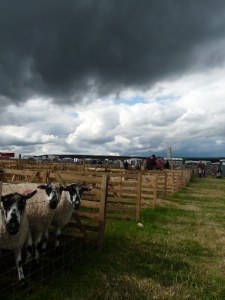
Here are sheep.

P1150966

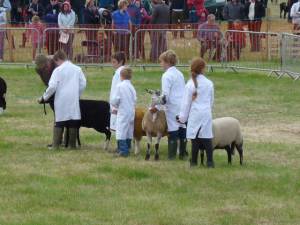
And here are children working sheep.  There seemed to be opportunities in every category for smartly-overalled and seriously skilled children to show off their prowess as animal managers: it’s clearly important to encourage the next generation of farmers.

P1150957

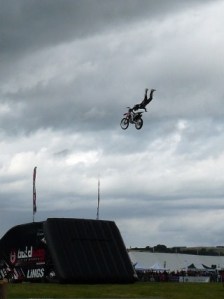
And here, oddly, are stunt bikers.  We saw them as we left somewhat before 5.00, every single loaf sold, as the show slowly started packing up for yet another year .P1150980

There are quite a few more shows left before the summer’s over.  We’ll get one into the diary.

Outside the showground: on our way home now.

Brimham Rocks

We’ve had quite a weekend.  Our vaguely organised daily lives, with plenty of chances to stand and stare, or at least sit down with a cup of coffee and the paper have been shot to pieces by the arrival, for two days only, of our twin nine-year old grandsons, Alex and Ben.

We had a busy Saturday, full of pancakes, playgrounds, and Ripon’s Prison and Police Museum (recommended).  But the highlight of the day was Brimham Rocks.P1150790

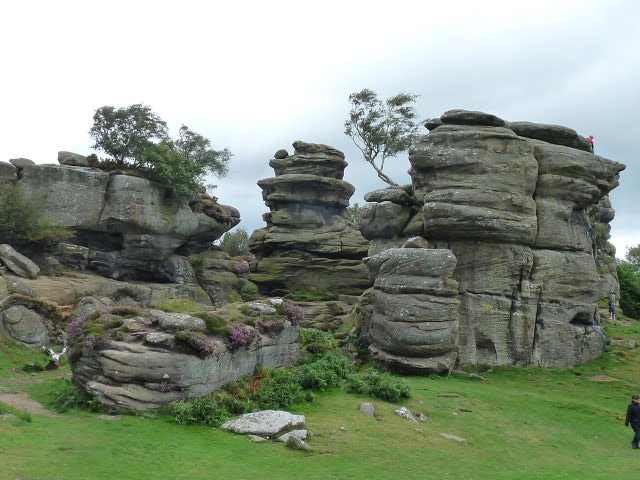
It’s an extraordinary place.  There, slap-bang in the middle of the rolling and verdant Yorkshire Dales, is a 30 acre fantastical landscape.  Dry-stone walled fields and charming villages are suddenly replaced by an odd collection of weird and wonderful shaped rocks.  Brimham Rocks.  These are formed from millstone grit: glaciation, wind and rain have eroded them into extraordinary formations, pierced by holes, balancing apparently precariously, or stacked into tottering towers.  Geologists study them, rock climbers scramble up them, but above all, families come to let their children become impromptu explorers, mountaineers and adventurers of every kind.

We’ve only chosen quiet times to visit here in the past, but with Alex and Ben, we had no choice,  We wanted to take them there, so a brisk and breezy Saturday slap-bang in the middle of the school holidays it was. The car park was overflowing .  Oh dear.

But it was fine.  The space is big enough to provide room for all.  And it was fun to be amongst children from the smallest toddler to the tallest and lankiest of teenagers, all having an equally good time: all exploring, all testing themselves physically, weaving their own adventures.

Alex and Ben take a pause at Brimham Rocks

And besides, we didn’t come home empty-handed.  August is bilberry season.  Alex and Ben, particularly Ben, rose to the challenge of stripping the small and rather hidden fruits, becoming ever more purple as time passed.  Teeth turned blue, hands indelibly stained, fingernails beyond help from any nailbrush: it was so good to see my grandchildren discovering the pleasures of food-for-free.  Bilberry pancakes for Sunday breakfast then…..