If you live near Studley Royal and its deer park, as we do, you’ll be used to deer. They’re very shy though, and unless you’re there very early, or when poor weather is keeping visitors away, you’ll only get distant views of them.
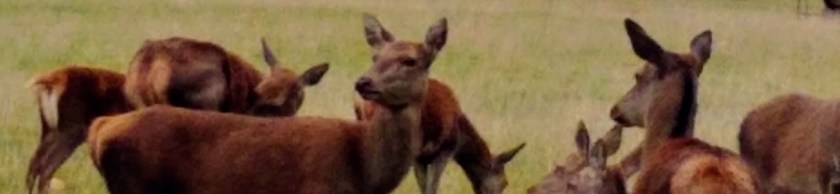
Yesterday though, we were having a walk, a long walk, just outside the park grounds. Our path had led us upwards, through woodland, and alongside the long stone wall which bounds the estate. And that’s when we noticed them. A stag with his harem of does – some twenty or thirty of them. We stuck our noses over the wall, and watched. The deer watched us, and concluded that since these faces apparently had no bodies attached, they posed no threat.
The stag – and there was only one – was striding around in an assertive manner, aiming to garner respect. The deer weren’t bothered either way, and there were no other males to impress. He realised he was wasting his time, and fell to grazing instead.
I’m still stuck without a camera, so these slightly fuzzy efforts will have to do as a record of a few magic moments shared with a parcel of deer we came across .
Did you know that ‘parcel‘ is a collective noun for deer? Me neither. Try these too.
Dovedale? Yes, it’s in the Peak District, a glorious area of England, part of its Pennine spine. There are old stone-built towns and villages with long histories of hard work in mining, textiles and farming. There are limestone and millstone grit uplands and escarpments, with distant forest and moorland views, and valleys and gorges cut deep into the limestone. There are ancient stone circles and enchanting landscapes. Forget modern life, put on your walking boots and explore.
We had four wonderful days, which for once, we didn’t have to organise. Here’s why.
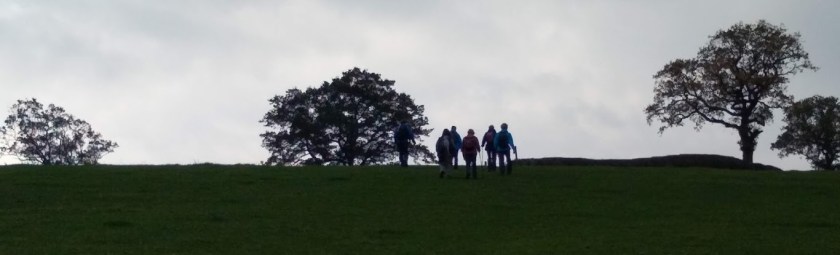
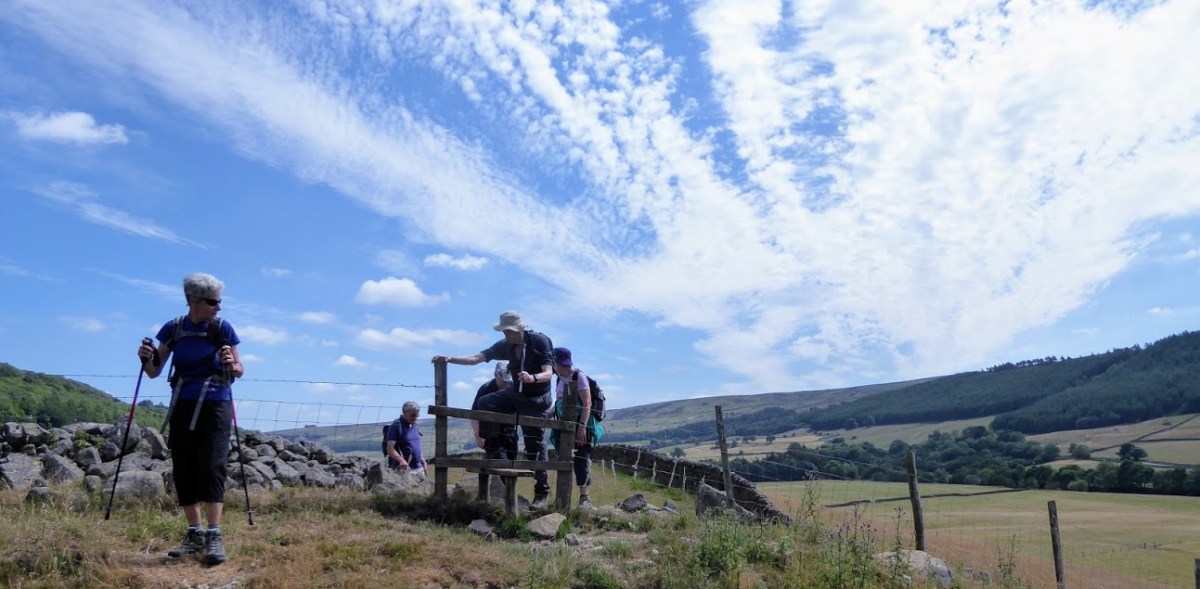
Walking with our group, as the afternoon sun cast our shadows against a drystone wall.
Autumn was begining to show its colours, but summer temperatures remained. We walked. I didn’t have a camera (Barcelona…..). I had a new mobile phone though. It isn’t the same, but I played with some of its gizmos. Here are my postcards from Dovedale.
Thorpe Cloud. It’s a tough triangular hill, formed of marine skeletons which haven’t easily eroded.
The Nine Ladies, a Bronze Age standing circle.
This fly agaric was an early victim of special effects on my phone.
Views from the heather moorland near the Nine Ladies. We’re by a Bronze Age cairn
Special FX again….
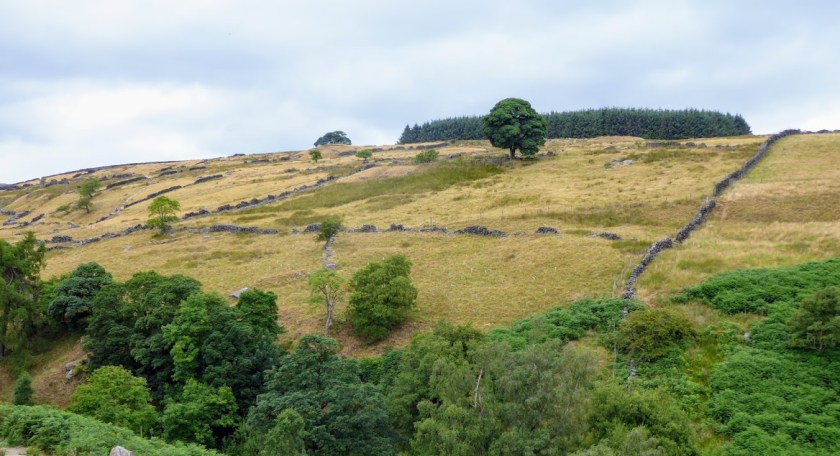
These drystone wall edged fields are reminiscent of the Yorkshire Dales.
The stepping stones across the river in Dovedale…..
… the needle-like crags…..
… the caves…
..the autumn colours near the riverside.
Autumn colour again
And a deliberately impressionistic take on the trees reflected in the water.
Regular readers know I’m a member of a walking group. Regular readers don’t know that one of the features of our summer programme is a series of evening pub walks: walks of only three or four miles, finishing up at a pub for a convivial meal or drink together. Usually about eight to twelve people come along. This time, it was my turn to lead the walk, which had been publicised round the area in a low-key kind of way.
I’d already been messaged by a Chinese woman who asked if, though they weren’t members of ‘rumbles’, a group of nine of them could come along. Three other new-to-us people got in touch, and on the night, two other ‘newbies’ were there. Then there were Emily and Miquel, over from Spain.
The group of nine proved after all to be eleven, and included two small children. They were an extended family, living in various places all over the north of England, who’d snatched a few precious days staying together at a local campsite.
The usual regulars turned up. I did a quick head count. Twenty nine people….
The walk begins……
Have you ever tried getting twenty nine people over several stiles, down narrow paths, along the lakeside, through the woods, across the fields, down the road and back through the Nature Reserve without losing anyone en route? Actually, because of the small children, the Chinese team left us at half time, but we had fun making new friends and promising to try out the restaurant that one branch of the family runs, many miles north from here.
Sunset over the lake at the Nature Reserve.
The pub coped admirably. In fact only twelve of us chose to eat there, though most of the others stayed for a drink. Here’s free publicity for The Freemason’s Arms, Nosterfield. Great home-cooked food (try the fish and chips if you dare. Massive), provided by a friendly, unflappable team.
Photo courtesy of Miquel, who was almost, but not quite, defeated by this plateful.
Haworth: a charming village on the top of a high and steep hill, in an area of high, bleak and steep hills; home to the Brontë sisters and the surrounding moorland countryside of Wuthering Heights.
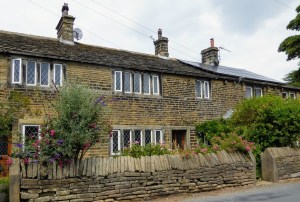
Cottages near Haworth. Cosy now: possibly less picturesque back in the Brontë’s time.
Everyone knows that you can expect ‘weather’ when you come here, whatever time of year you arrive. As you stumble along the church path to leave the village, slashing rain tumbling from sullen hostile skies needles your skin, slicks your hair to your face and saturates your clothes. As you set your face against the wild wind, your boots sink into the sodden peaty turf as you trudge onto the moor. If you dare to glance up, you see unending moorland before you: bleak, barren and bare, with sheep huddled against the dry stone walls which march across the landscape. This is Nature-in-the-Raw, and we expect no different.
I went there earlier this week. None of the above applied.
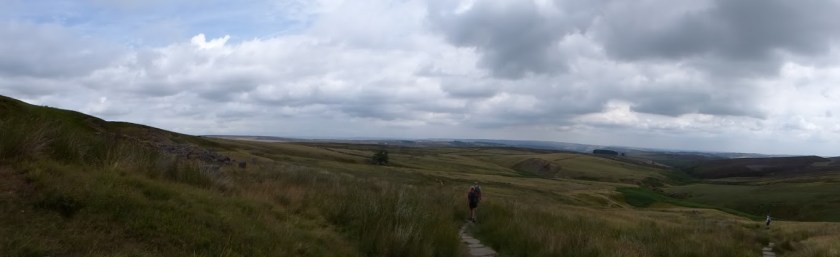
We are in Week Five of a heatwave. I doubt if either the Brontës or even Heathcliff himself had ever seen the like. Brittle coir matting now carpets the brooding moorland fells: and several weeks early, the heather is almost in flower, rich and purple. Yellowing grasses replace the dense green turf the sheep prefer, whispering and rustling in the light breeze.
Beyond Haworth, coir matting stands in for moorland turf.
There’s a little brook in the valley here. Angry peaty water jostling officiously along its path has been replaced by still, clear shallow pools.
The brook by Brontë bridge.
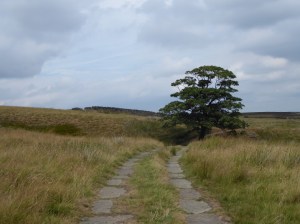
The Brontë sisters would cheerfully have paused here to rest, reflect and write a little. Then, like me, they would have slogged on, up the peat-and-stone pathway that leads upwards, ever upwards, towards Top Withens.
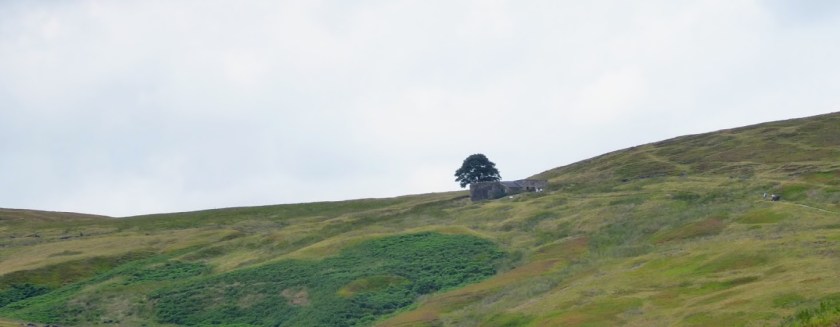
There’s Top Withens, up there. Beside that solitary tree.
Top Withens may have been the isolated upland farmhouse that Emily Brontë pictured Cathy Earnshaw and family living in when she wrote Wuthering Heights. It’s a ruin now, the roof torn off in a violent thunderstorm in the 1890s. Just as you’d expect.
It was the perfect picnic spot for me. The moorland stretched before me, its hillsides rhythmically rising and falling. The world was silent: not that silence in which there is no sound, but that of the living countryside: the low susuration of the swaying grasses; the humming of the wind in my ears; the occasional complaint of a bird sweeping overhead. Beyond the moorland, greener fields lay, chopped centuries ago into rough rectangles by drystone walls. Some held sheep, some cattle, others recently cut hay. The sun warmed my rocky seat, and I was perfectly content.
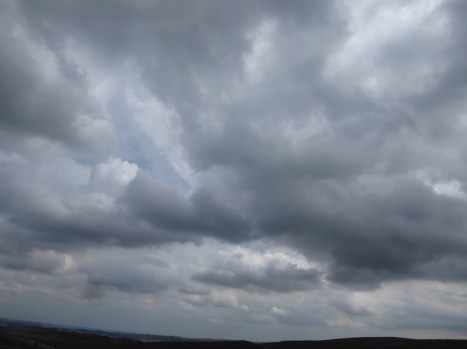
Except for the sky. The day was sultry, sweaty, but freshened by a soft breeze. I knew the sun might be chased away by gusty rain. Ash-grey clouds swelled and receded, revealing granite tones behind: and beyond that, cornflower blue once more. It was a signal. Haworth takes weather seriously. Never be tempted to climb these uplands without a very capable waterproof in your kit.
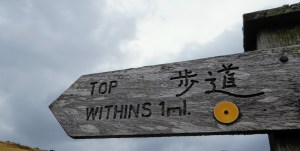
The moorland I saw this week was not the Brontë’s moorland. It’s been a little sanitised. There are helpful finger posts pointing the way at every junction, in English and … Japanese.
Top Withens or Top Withins? Take your pick. I don’t know which the Japanese choose.
The pathways the sisters trod are no longer springy peat tracks, or sticky muddy gullies. Instead, heavy slabs line the way, to prevent footfall damage to this fragile area from the hundreds of people who tramp these paths looking for the Real Brontë Experience.
My day was far too comfortable for that. I was not returning to a draughty parsonage with self-destructive brother Branwell to worry about. If you want to see the Brontë’s life through his eyes, read Robert Edric’s ‘Sanctuary’. You’ll be glad to get back to bustling tourist-destination Haworth for a nice cup of tea.
This post fits nicely into one of the Ragtag Daily Challenges this week: Travel. There’s no need to cross the ocean or even take your passport to discover sights worth experiencing.
I’ve had a black cloud sitting over my head for weeks. Brexit; the parlous state of British politics; the recent visit of a certain Head of State; the current hostile environment for immigrants – you name it. I’m not sure that there has ever been a time when external events over which I have little control have so got me down.
So thank goodness for white clouds: the ones that accompany long sunny days, blue skies and outdoor pursuits. Stratus, cumulus, cirrus, cumulonimbus …. the very names are rhythmic and poetic, and watching them as they drift, mass, diminish and dissolve is the perfect way to calm a troubled, anxious mind. Hooray for actual, rather than metaphorical clouds.
Clouds above Reeth, North Yorkshire on a walk last week.
We found ourselves tussling with the fag-end of Storm Hector on Thursday, as it exhausted itself gusting round the neighbourhood. It closed the market early as stallholders gave up the battle to keep their goods and stands in one place, and dumped leafy branches in the path of unwary motorists.
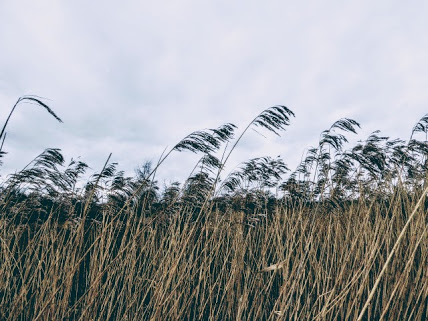
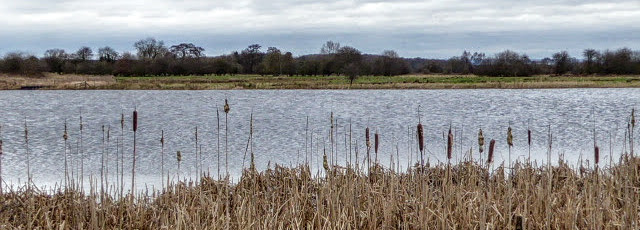
It reminded me of a more than breezy walk last February. Look! Here are the grasses edging the wetlands at Staveley Nature Reserve.
Here’s a telegraph pole, a battered shed door on a local farm and – it is a nature reserve after all – grasses and bullrushes standing (nearly) to attention.
In the absence of the popular WordPress Challenges, Cee Neuner has generously offered to compile and maintain lists of challenges and the bloggers who host them. You can find them here.
We don’t often go walking in the evening. But yesterday we did, and found ……. orchids – I only know the last one, the bee orchid, by name…..
…… trees stalking the skyline……
…… inquisitive young calves huddled together: they thought we were scary ..
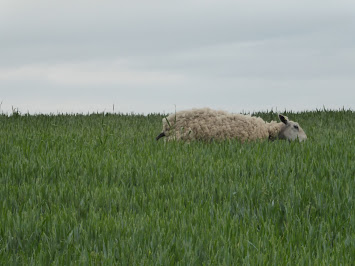
….. and best of all, this sheep. Naughty thing, she’d escaped from her field, and was having a high old time eating the contents of this wheat field. We told the farmer when we saw him later. Was he bothered? Not a lot.
I’ve always been a fair weather walker. I never see the point of trudging through mud as dripping waist-high grasses lash at my already sodden trousers. In heavy rain, my waterproof anorak proves powerless to stop rivulets of rainwater trickling down my neck. And since windscreen wipers for glasses have not yet been invented, I have no view of the path ahead, much less the landscape. Really, why bother?
Then last week, watching ‘Springwatch’, I saw the wonderfully evocative nature writer Melissa Harrison, encased head-to-toe in a black, heavy-duty oilskin. She was tramping across a rain-drenched landscape as she explained the peculiar pleasures of a wet walk, on camera.
So when Saturday arrived with murky skies, I stuffed my best all weather gear into my rucksack, and set forth with my friends on our planned walk. And the rains came. We strode through woodland, protected by all those newly-leafed trees canopied overhead. We relished the fresh sweet earthy smell of the rain as it reached our leaf-mould path. We remarked on the leaves, glistening with raindrops. Even the birds seemed happy and continued to trill and chatter above us.
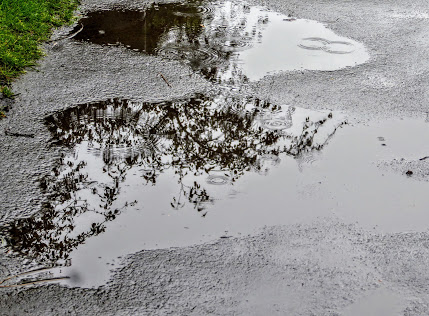
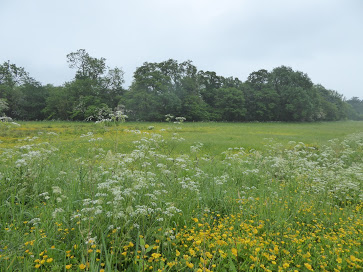
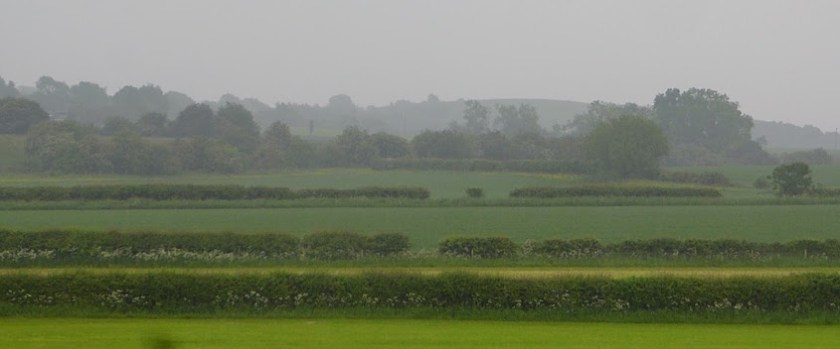
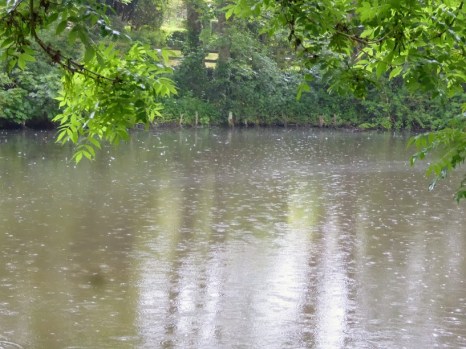
We hit meadowland. How subtle the tones of green and grey in the misty landscape! How muted the colours! Let’s watch the rain as it soothingly patterns the surface of that pond, a thousand concentric circles at a time! Yes, walking in the rain, we agreed, brought pleasures well worth seeking out.
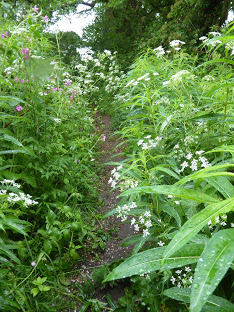
The rain continued. Our weather proof gear kept the rain out, but perspiration in. Our legs got soggy from walking down narrow paths marshalled by soaking nettles and grasses. Someone’s boots began to leak. Someone else commented we still had six or seven miles to go. Yet another of us was hungry, but didn’t fancy a squishy sandwich. The plastic-encased map revealed that in a mile or two, we could make our escape to the nearest bus route. Let’s do it! Heads down, we traipsed on, only wanting to get it over with now. Every now and then, one of us would get in touch with our inner four year old – ‘Are we nearly there yet?’
Finally, we were. We dripped onto the bus, at which point it (briefly) stopped raining.
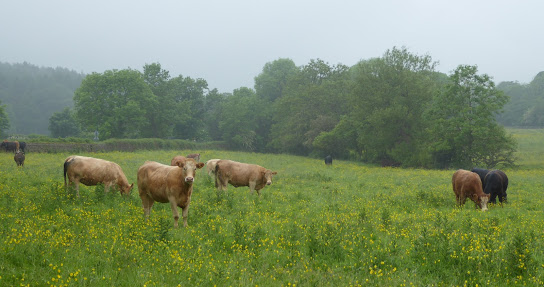
The cows thought we were barmy. By then, so did we.
*Alfred Wainwright MBE was a British fellwalker, guidebook author and illustrator and something of a National Treasure to keen walkers.
We’d never heard of Coniston Pie before. Best head over that way then, and find out all about it.
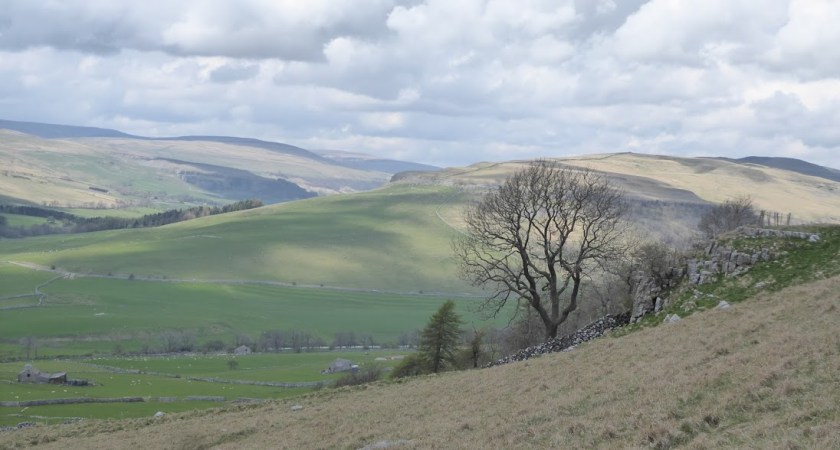
Coniston’s a tiny village in North Yorkshire, wedged into the glorious limestone scenery between Kettlewell and Grassington. We couldn’t go there without exploring a bit and working up an appetite for that pie.
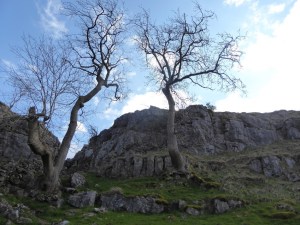
The rocky path lies between those two trees.
We began with a bit of a scramble, a bit of a climb before hitting a steadily climbing path leading us upwards between dry stone walls and statuesque and wind-shaped trees. Sheep were our constant companions as we continued to plod ever upwards, 1000 feet in all.
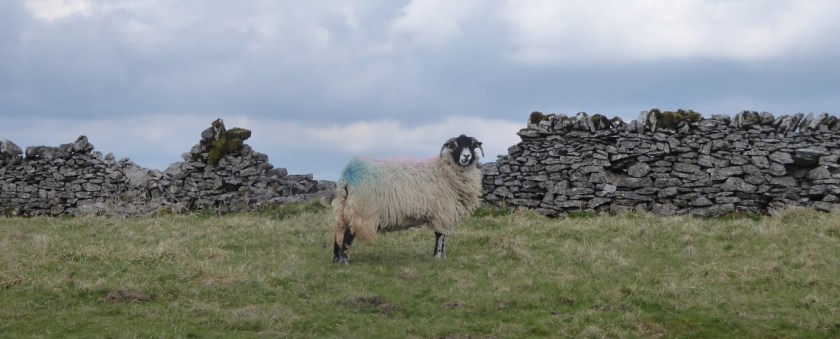
Wind-stunted trees tucked behind dry stone walls.Sheep. Always sheep.
We rested at the top. We had a snack (just a biscuit, no pie for us), before taking the winding turfy track downwards towards the valley bottom, then turning sharp left to join the Dales Way back to Coniston.
Our view as we trecked downwards.
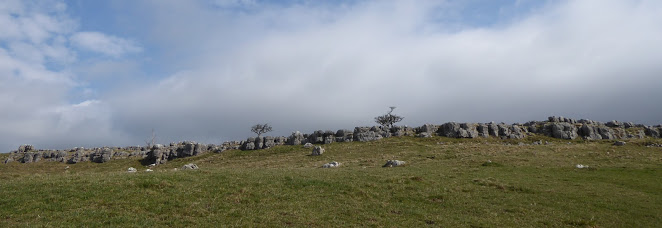
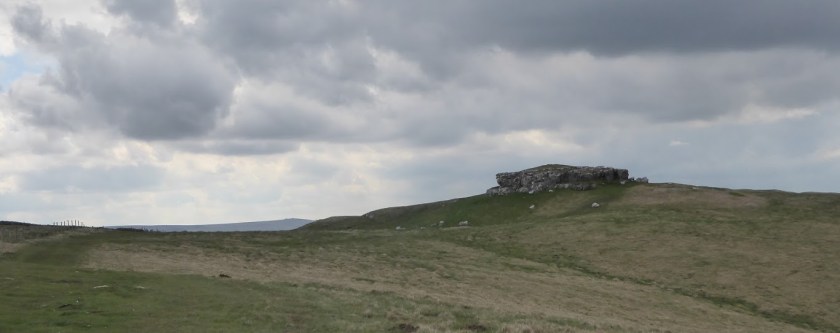
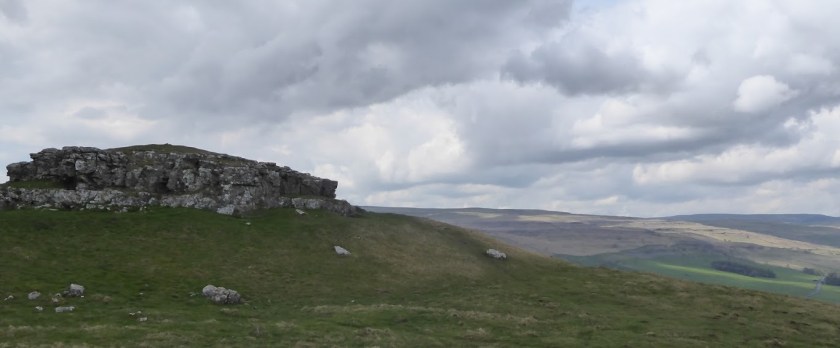
And that’s when we saw it. Coniston Pie. It’s not hearty fare to be tucked into after a hard day’s lambing apparently, but this: the view the shepherd sees as he does his daily round.
Coniston Pie.Coniston Pie.
Still, it does look exactly like a pie, filled with good things and topped off with a thick pastry crust, doesn’t it?
This week’s WordPress challenge asks us to post something unlikely.
This week’s WordPress Photo Challenge invites us to show images of where we’d rather be at the moment. Well, I’ll tell you where I’d rather not be, and that’s here, in North Yorkshire.
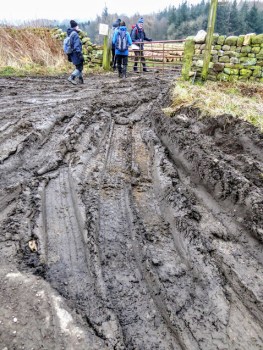
I love Yorkshire, and I’m happy to agree that it’s ‘God’s own country’. But frankly, life here is a little trying just now. Like most of England, we had The Beast from the East a couple of weeks ago bearing snow, blizzard and fierce wind. And much of the rest of the time it’s been raining. This photo was taken a couple of months ago: since then, things have only got worse.
This is what our country walks have become: Nutwith Common in January
So how about a little trip back to the Ariège, where we lived from 2007 to 2014? Here’s a selection of photos, all taken there in March or very early April. Down in the foothills of the Pyrenees where we lived, blossoms were out, and wild daffodils carpeted the more out-of-the-way hills. At the weekend we would head off for Montségur and higher land to enjoy the snow that was still thick there. We were never fans of snow-shoeing, but now I’d be more than happy to exchange their crisp deep snow for our thick deep mud.
 If you live near Studley Royal and its deer park, as we do, you’ll be used to deer. They’re very shy though, and unless you’re there very early, or when poor weather is keeping visitors away, you’ll only get distant views of them.




















 From Pyrenees to Pennines
You must be logged in to post a comment.