Fire in the Pyrénées

Smoke from a forest fire high in the mountains above l’Hospitalet

We’re back in France.  It’s hot.  Very hot.  Humid too. And yesterday we returned Emily to Barcelona, the city she now considers home.  Barcelona was very hot indeed, 38.5 degrees Centigrade actually, which is 101.3 Fahrenheit in old money.
To get to Spain we crossed the  Pyrénées where, for the past month or so, fires caused by the extreme dry conditions have been fairly out of control: mainly in Spanish Catalonia, but spreading through to the Catalan area of France too.

Now though, there are fires near L’Hospitalet-près-l’Andorre.  This little commune is by way of being a frontier settlement between France, Spain and Andorra.  It’s unaccustomed to being newsworthy outside the pages of tourist brochures aimed at those wanting mountain scenery and an energetic walking holiday.

We knew that so far, and thankfully, no human settlements are at risk from the fires.  We knew too that all the walkers’ footpaths have been closed and so have the refuges, which offer basic accommodation and food to roughie-toughie hikers miles from normal civilisation.  We’d heard that more than 25 tourists had been evacuated from deep in the area some days before.  We didn’t expect to see from the road evidence of these fires, which have burnt and ravaged over 400 hectares of the countryside.

A helicopter reconnoitres.

But as we approached the village, traffic slowed.  Bit by bit, we snaked up the mountain road which, as it turned out, had been reduced to a single carriageway. A lay-by outside l’Hospitalet has been commandeered and enlarged by the army and fire services to provide a heli-port.  The fires are in thickly forested areas some 2400 metres high, and inaccessible to land-based fire-fighters.  Trackers (air-borne fire-engines) have come from Carcassonne, and scoop some of the water they need to quench the flames from our nearby reservoir here at Montbel. Expertise and equipment have been borrowed from other areas of southern France, and both army and fire service are on duty 24 hours a day.

Seeing some helicopters temporarily at rest together with their crews, brought home to us the real dangers of fighting these fires: they obstinately refuse to submit to man’s control in isolated and largely unreachable forests.  It was only on our journey home that we noticed, high above us, several fires at altitude, burning the trees and vegetation.  It may be a long time before the fire-fighters can go home, certain in the knowledge that this round of drought-induced danger to man and wildlife is really over.  The rain promised this weekend should help.

Army helicopters ready for action

My photos, by the way, are pretty poor.  This is because they were taken from a moving car

‘East, west, home’s best’

When guests come to stay, Malcolm and I often pore over maps looking for some unexplored – by us – corner of our patch.  But in the end, what’s the point?  Our visitors aren’t sickly pale wraiths whose jaded walking appetites have to be tempted by novelty.  They’re happy with the solid day-to-day fare just a mile or two down the road. To them, in any case, everything is new.

We too are happy to revisit favourite walks.  They’re never the same.  The changing seasons bring different flowers, different cloud formations.   Mountains which perhaps were sparkling bluish-white last time we visited, turn green and purple towards summertime with just the odd small patch of snow near their summits.

Today, then, we went with Christine to visit our old friend Roquefixade, just a few miles away.  A steady climb through the juniper-scented woods and along a rocky ridge leads to a ruined château, once far above us, now somewhat below. Here it is.  Enjoy the views.  We did.

Capital Capitelles

The first capitelle on our walk

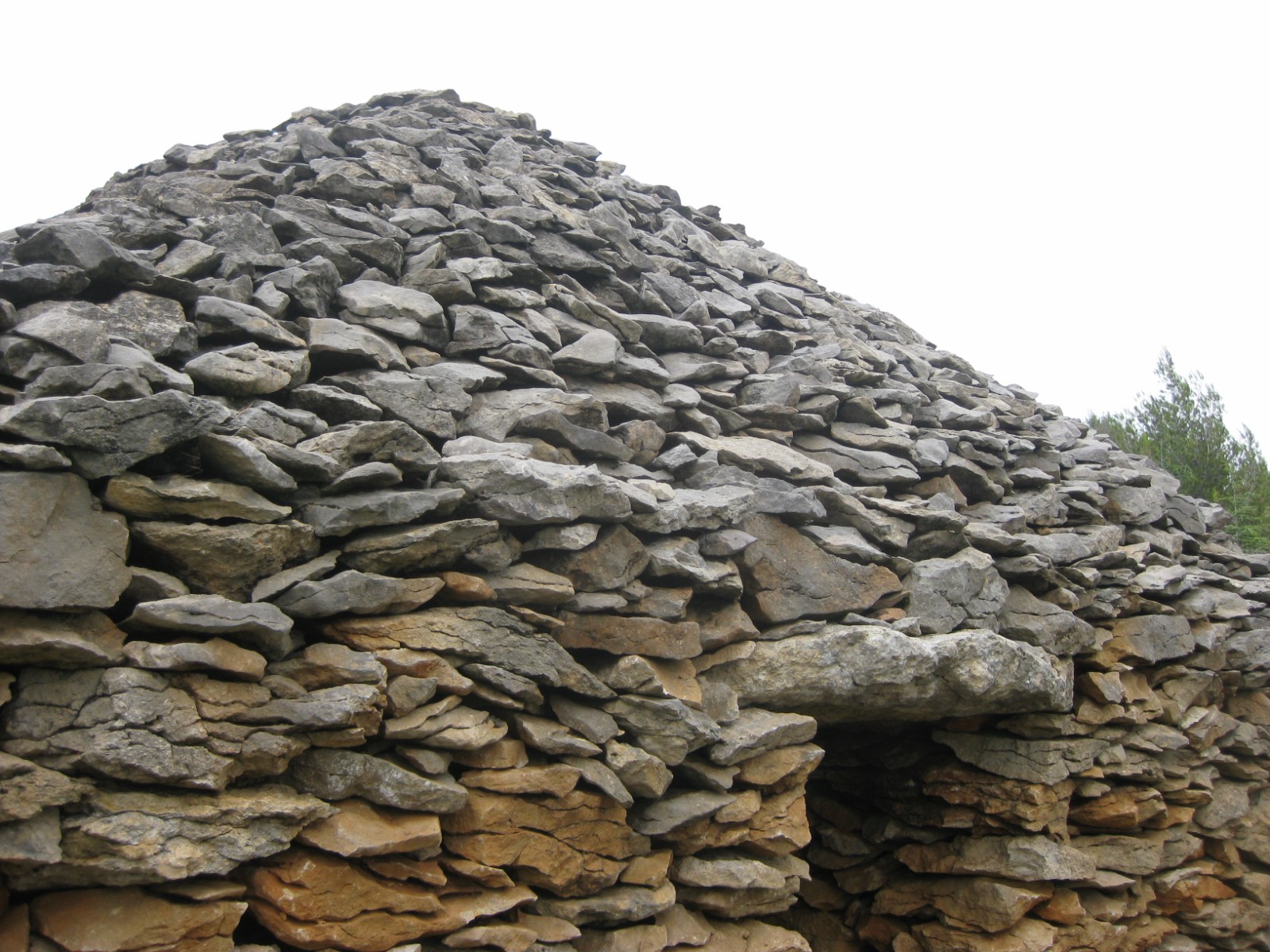
We’ve been walking north of Carcassonne today, with our friends Barbara and Tim, holidaying in the Aude from North Yorkshire.  When we decided to go and explore the curious stone huts called capitelles in the scrubby garrigue near Conques sur Orbiel, we assumed they were something like the orris of the Ariège.  These too are small sturdy dry stone wall huts: but orris were used by upland shepherds.

The dry stone walls of the capitelles

Capitelles are quite different.  Following the formation of France’s Second Republic in 1848, everyone wanted something to call their own.  Here in Conques, the poorest members of society looked beyond the village where they lived for some way of acquiring a bit of land  and earning some extra money. They realised that the dry impoverished soils of the garrigue were good for only one crop: vines.  As the peasants started to work the land to plant their vines, they dug up stones – hundreds of stones.  And they used them in the first place to make low stone walls marking the limit of their territory.

That south-facing door’s not very big

After that they built small huts to shelter from bad weather.  These round or square huts are in the form of a dry stone wall rising to a semi-circular vaulted roof also in stone: no mortar, no foundations, a bare earthed-floor and a single small door, always facing south.  They were all built by1880 or so, and the peasants who built the huts and worked the land here would have done so in any spare time left from their ‘day jobs’ as farm labourers.  And this continued till the Fist World War.  Men left to become soldiers, and at much the same time phylloxera struck.  This double blow meant the area returned to uncultivated garrigue, and only recently have the capitelles been restored.  They add interest to a stony landscape characterised by scrubby vegetation, low trees and shrubs and bright ground-hugging summer flowers.  I’d have said distant views of the Pyrenees too, but today was misty and overcast, so Barbara and Tim had to take our word for it.

Close up of a carefully constructed roof

Above us only skylarks

Every Thursday, Anny leads us on a walk. We might go eastwards to the Aude, south towards the higher  Pyrénées….or indeed travel in any direction, certain of a wonderful day’s walking.

Today we met just beyond Foix, and still in our cars, climbed…and climbed…and climbed,  steadily for 9 miles.  And at the highest point of the Col d’Uscla (1260 metres), we parked. Then we laced up our walking boots, slipped on our rucksacks, and climbed…and climbed…. and climbed.

It was steady rather than challenging, and several times, Malcolm and I remarked that if it were not for the  Pyrénées beyond, we could have been on the North York Moors, with added altitude and sunshine.  Endless expanses of bilberry plants added to the illusion. Each hill we climbed promised to be the last: but as we reached each summit, another hillside appeared in view.

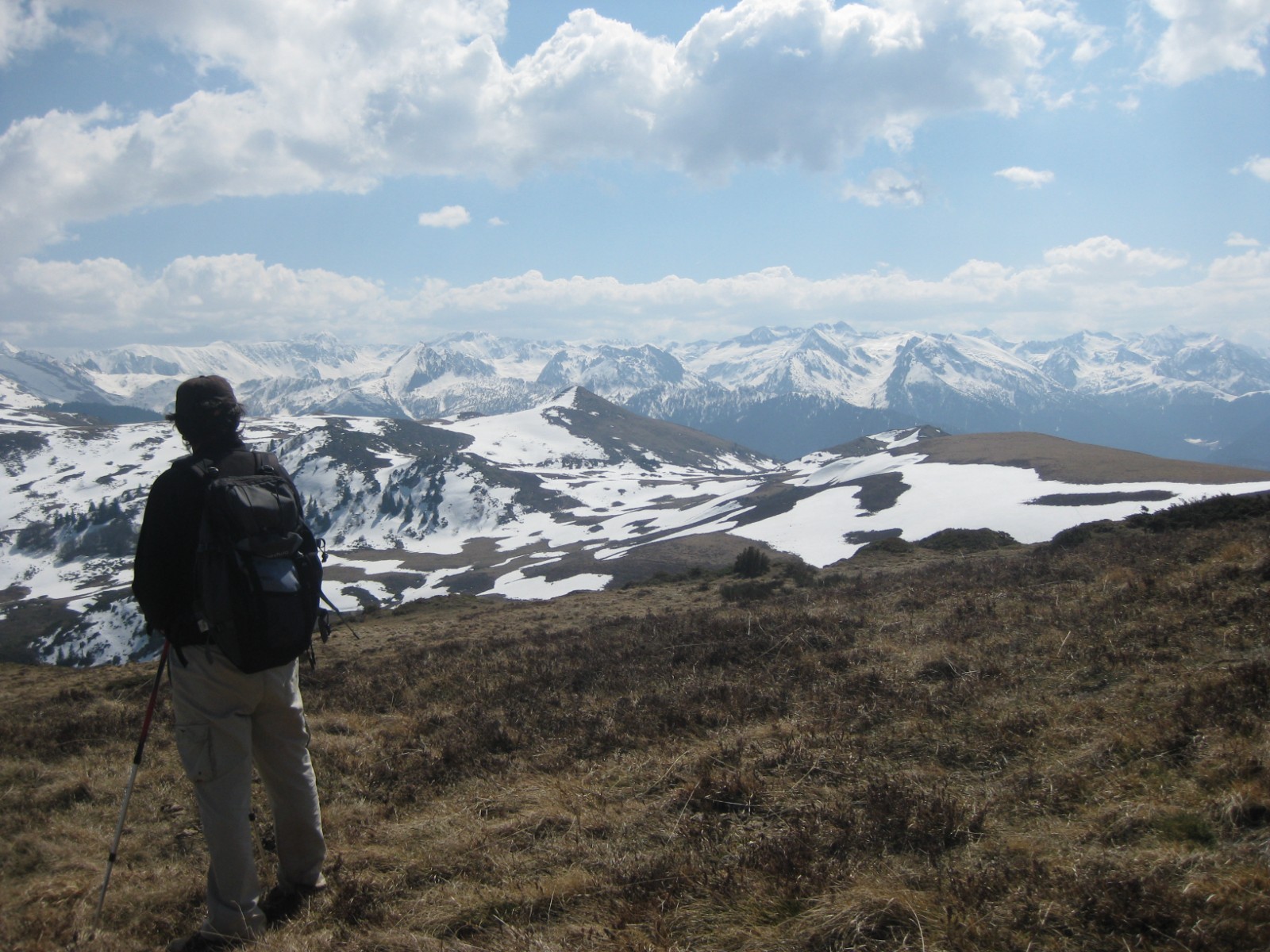
Our eventual reward was at the Cap-du-Carmil, at 1617 metres, with a 360 degree panorama of the  Pyrénées. It was quite, but not perfectly clear, yet we could probably see 50 miles or more in any direction. The only sounds were from the skylarks, joyfully singing way above our heads. I’ll let my pictures tell, slightly inadequately, the story.

Down through more wooded paths, there was the town of Massat below. Once the Ariège’s largest town, its isolated position and failing industrial life means it’s slightly forlorn now.  But not when you’re looking down on it, several hundred feet below.

A quick sortie to the Tour Lafont. This was built in the 1830’s, at a time when 12,000 French soldiers descended on the area to fight the ‘demoiselles’, local guerrillas disguised for some reason as women, determined to maintain their rights to collect wood for fuel, rather then allow it to be taken for the industrial economy slowly emerging throughout France. Despite their superior numbers, the soldiers lost the battles, and there are only odd reminders of their presence at the time in towers such as this one.

After lunch, on through the woods, until we rejoined once more our path with its open mountain views. Horses grazed the short grasses, and seemed only mildly curious about us.

And then it was over.  Boots and rucksacks off: cold juice, a moist and squidgy chocolate cake (thanks, Anny!), a final chat…. and back down that narrow uninhabited 9 mile road to civilisation , home and a cool shower.

A ruined castle above spring flowers

We ‘do’ ruined castles here in this part of France.  And last Sunday we Laroquais from the walking group ‘did’ one that was new to us.

We went off to the Aude, near Rennes-le-Château, for a long morning’s march and a final energetic upward scramble to Bézu and the few castle ruins that are left there.

I was going to tell their story.  But then I found another blog to do the job for me.  Follow the link!  Some of the research here has been fostered by the – to me – unaccountable interest in Dan Brown’s books, but the page on Bézu is mercifully free of his influence.

I’d sooner simply share some of the photos of the day, many of them of the flowers we saw.  May, as in much of Europe, is a glorious time for them.  The dry, thin soil of this part of the Aude nourishes small, bright ground hugging plants: they show themselves off perfectly against a backdrop of alternately red and rather white earth.

I’m going to go on being lazy today.  If you can name the flowers so I don’t have to, I’d love to hear from you.

This slideshow requires JavaScript.

On the path of Cathar shepherds

Montaillou

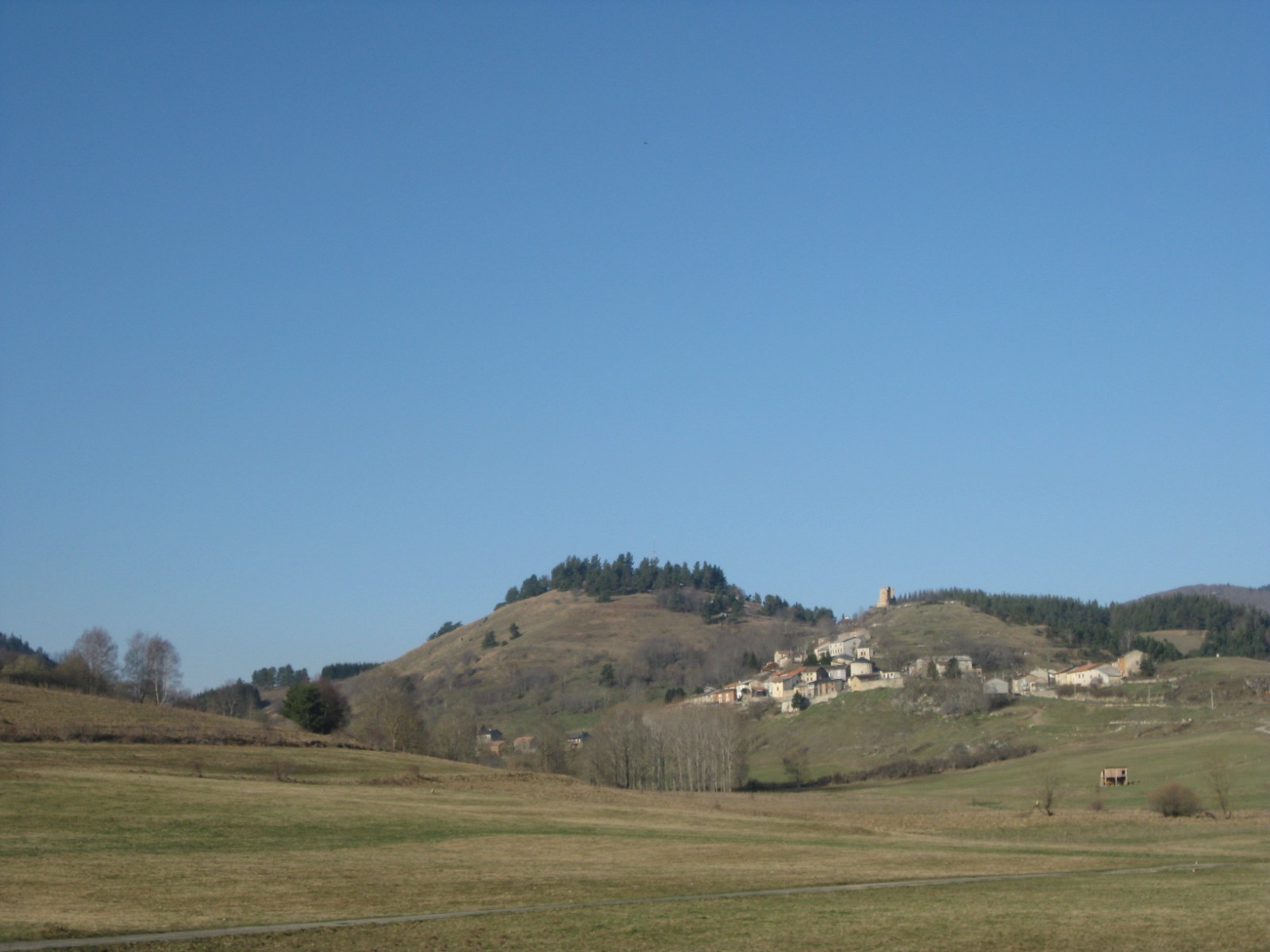
Yesterday we walked through Montaillou.  It might seem a tiny and unremarkable village now, but it’s the place that’s maybe done most to contribute to our understanding of turn-of-the-14th century village life in the Languedoc when religious strife between the Catholics and the Cathars was at its height.  This is a big subject: it deserves more than passing mention: a future blog maybe.

I’d read le Roy Ladurie’s book on Montaillou more than 30 years ago,and never dreamed that I might one day live in what the tourist offices are pleased to call ‘Cathar Country’.  So it was the shepherds of Montaillou I was thinking of as we began our Sunday walk.  They would come to the annual fair at Laroque d’Olmes, a good 40 km from where they lived.  They would drive their flocks long distances for good pasture, and as national boundaries meant little in these mountain zones, their fellow shepherds whom they met in their travels would sometimes be Spanish.

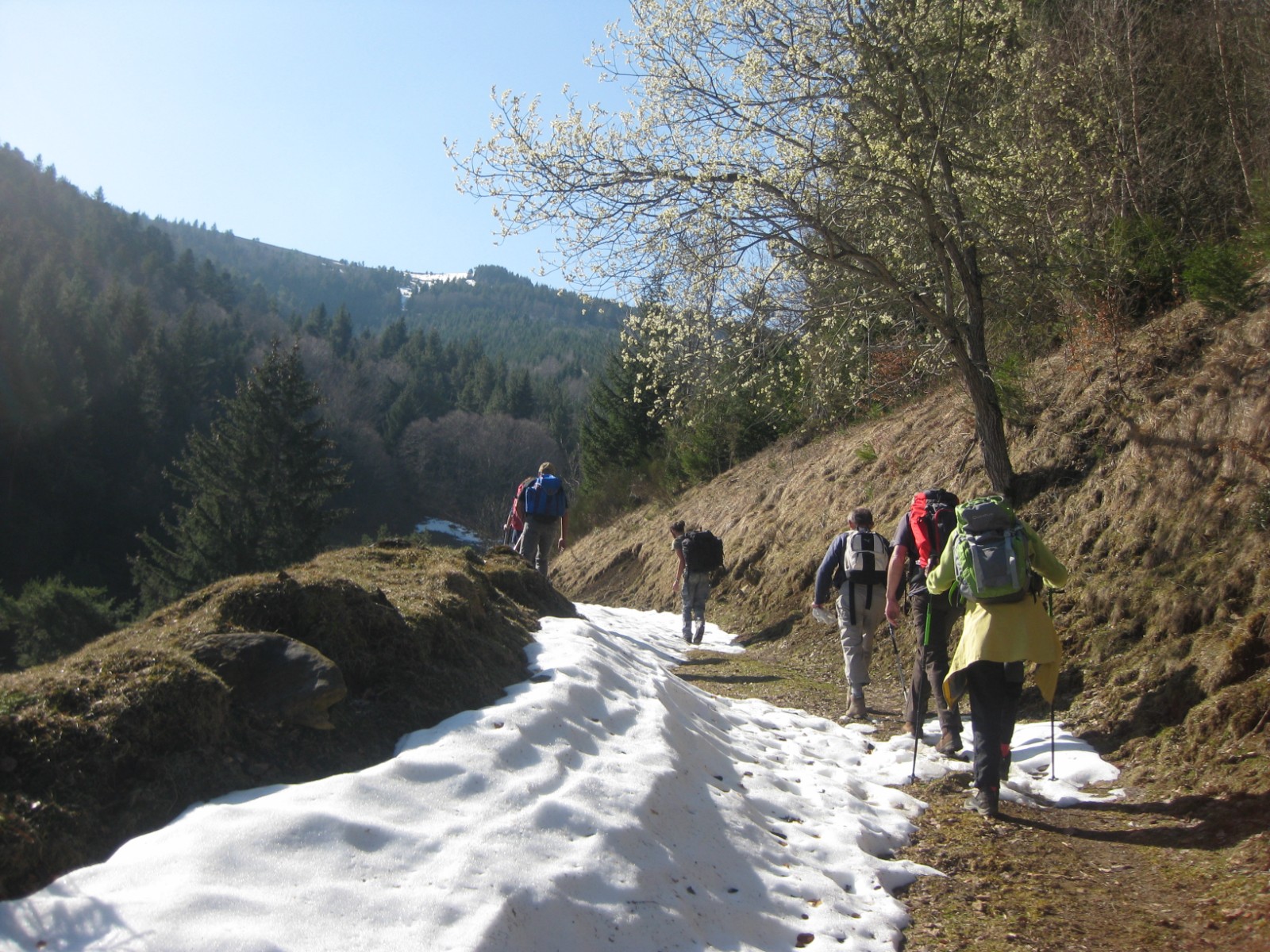
Blossom and snow

We too were climbing out of Montaillou.  The paths seemed unchanged through the centuries – short springy turf with early spring flowers pushing through. Pale pink and white blossoms busting open.  Narrow streams cutting deep channels through the turf.  Thick forest climbing the slopes.  Patches of snow made the going a bit tough from time to time.  It was warm and sunny, the slopes were steep and sometimes hard-going

Those peaks appear

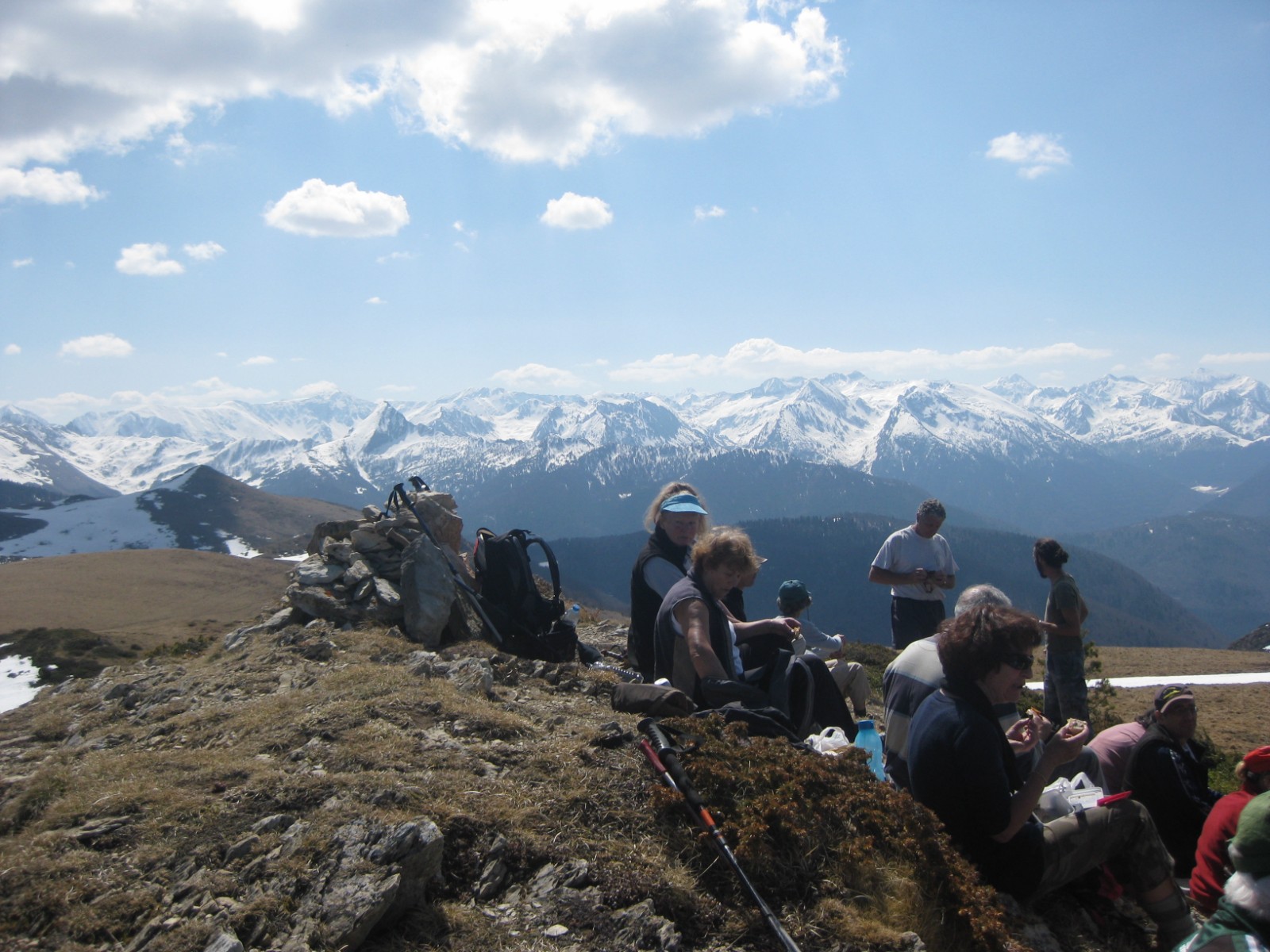
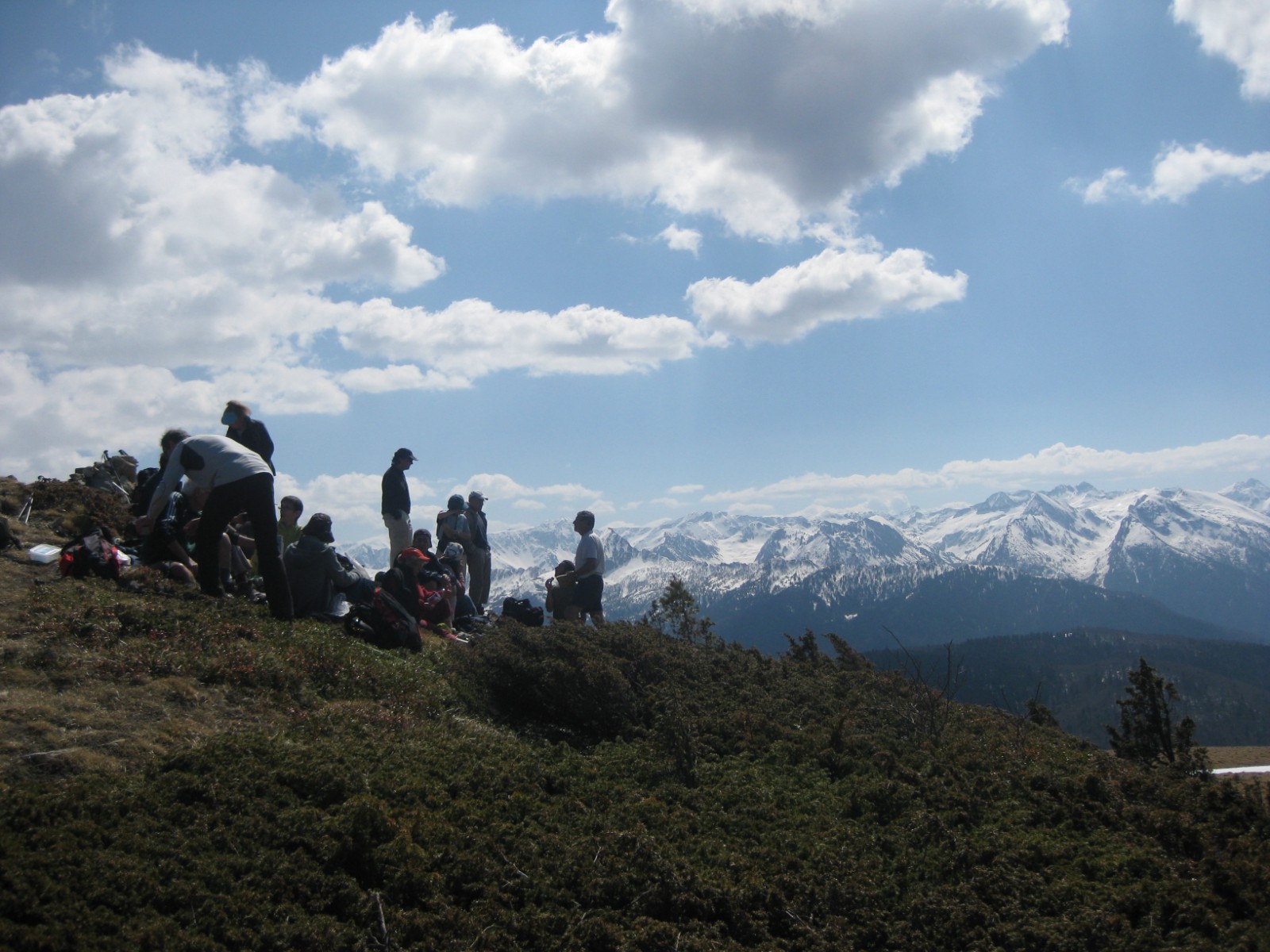
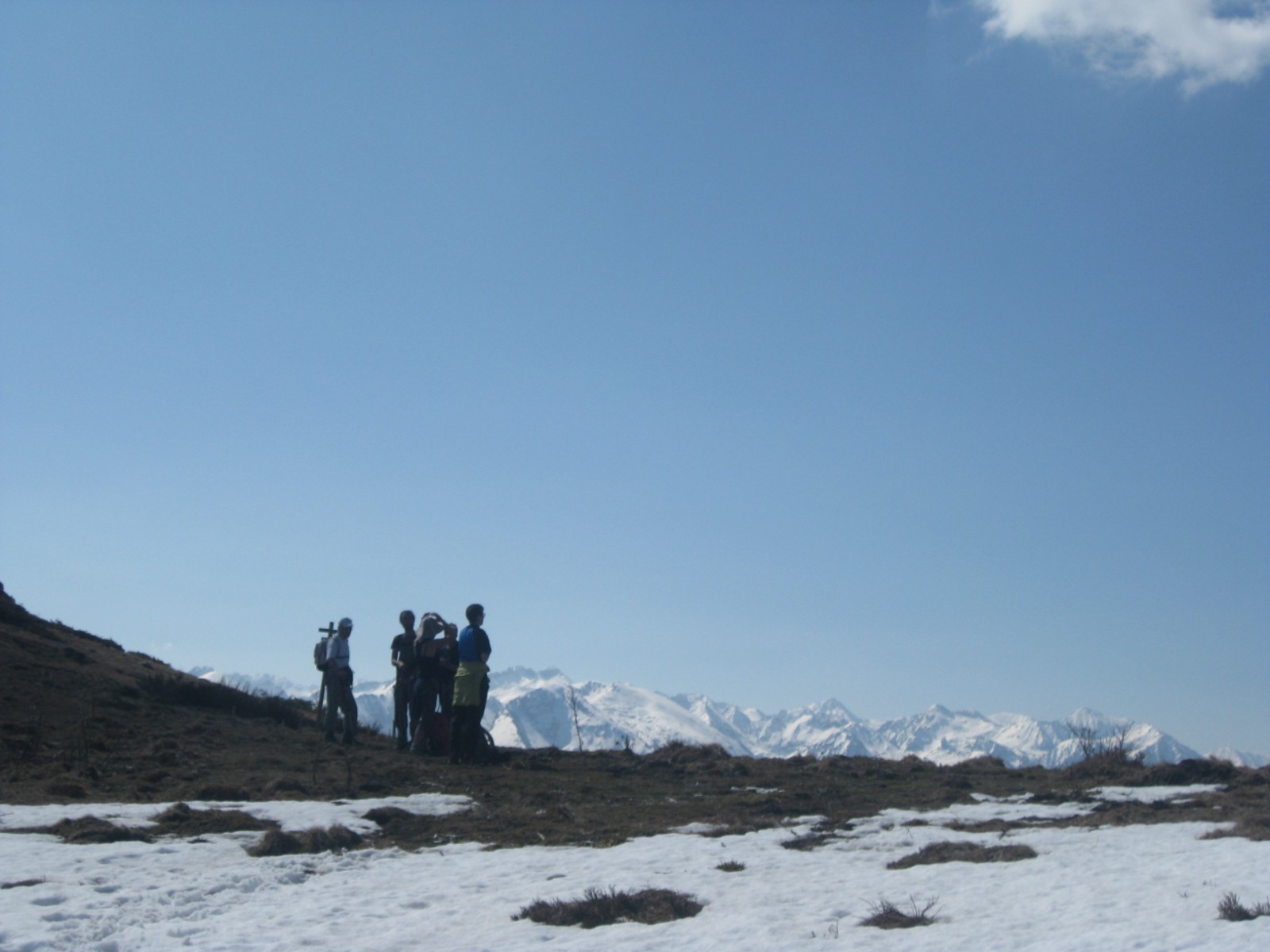
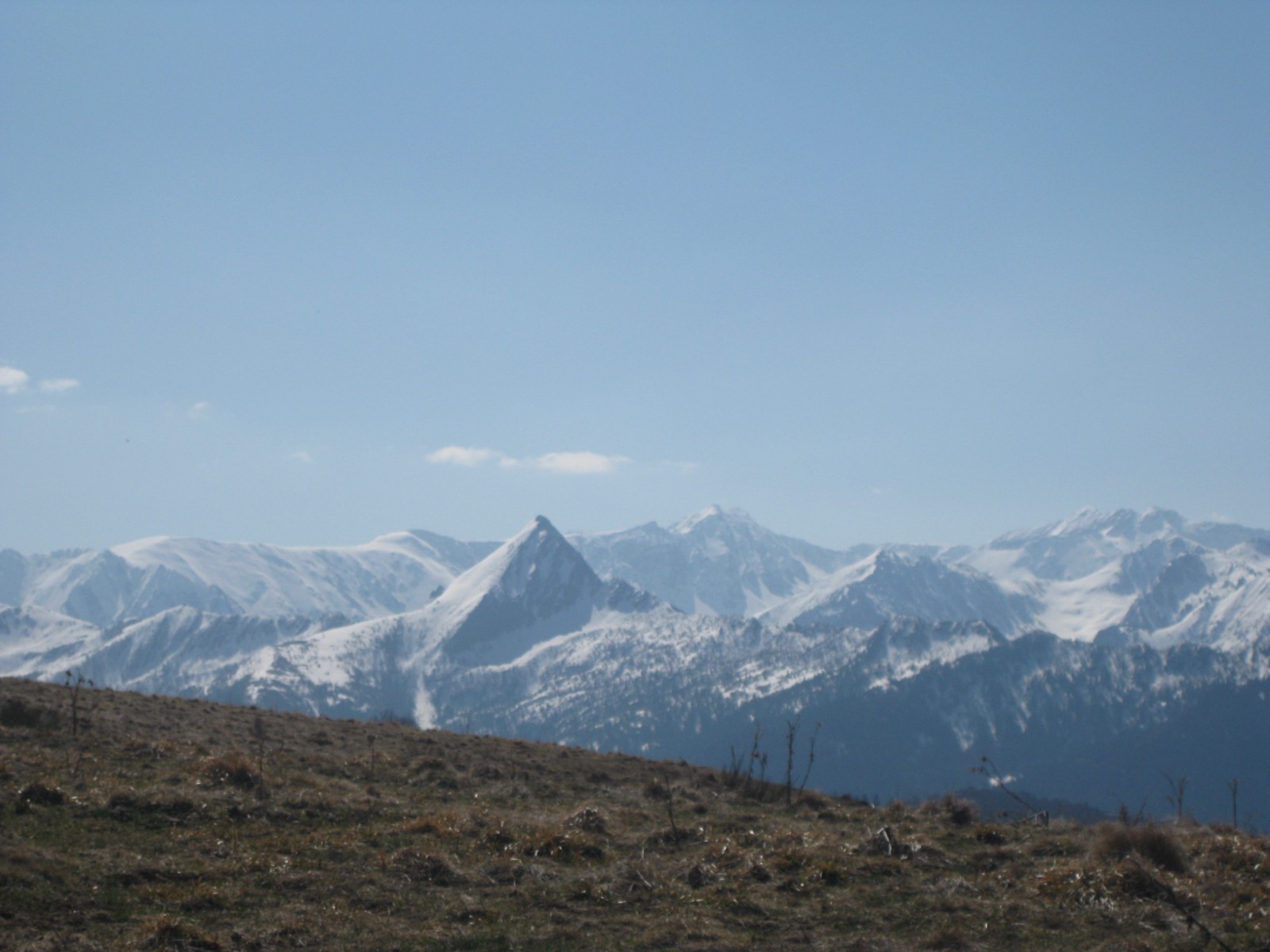
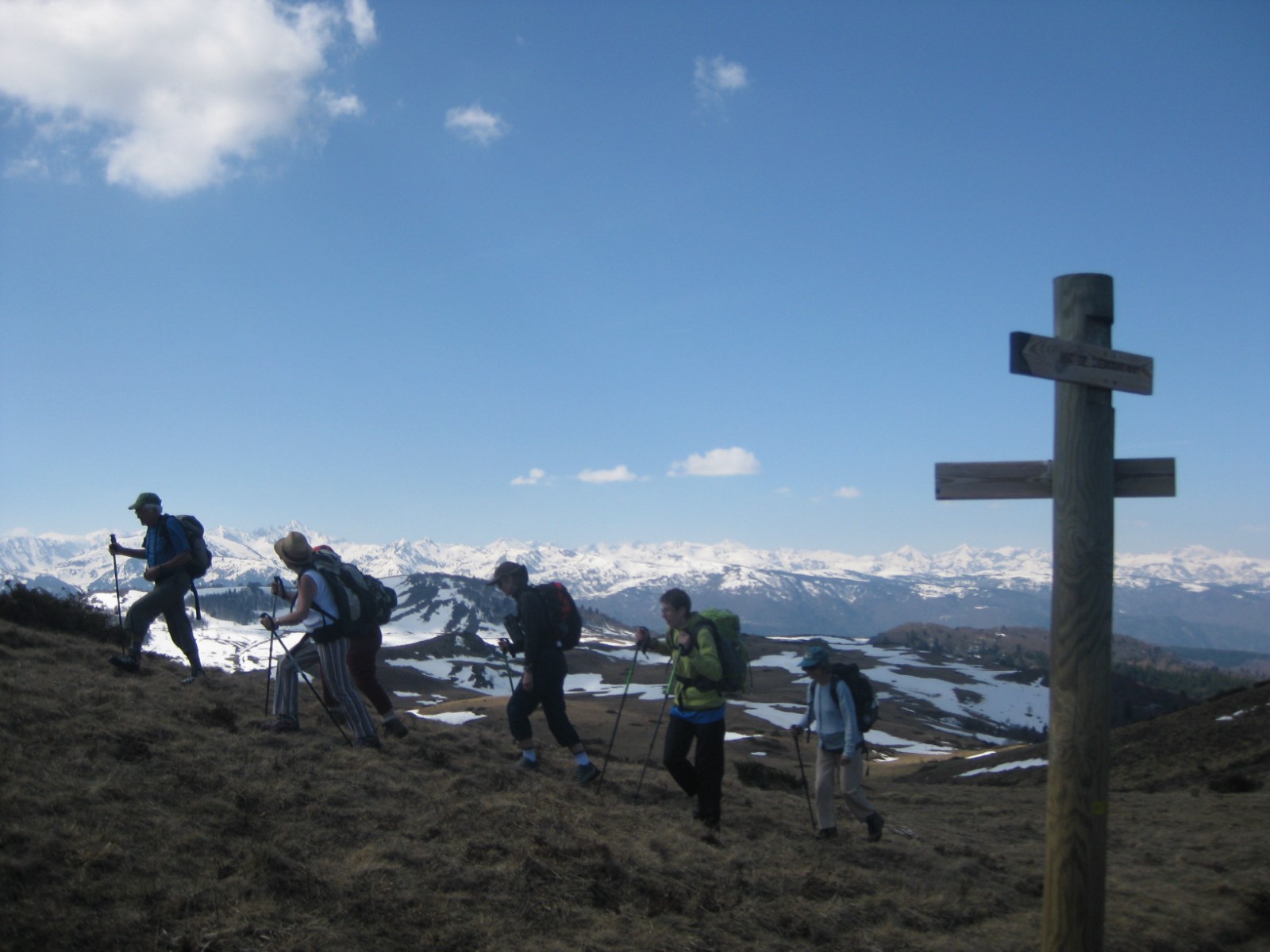
Then suddenly…suddenly, and so unexpectedly, we reached the top of our first climb.  Around us, to east, south and west were the snow-covered peaks of the Pyrenees, glistening white against the blue sky.  Above us, skylarks called and swooped.  Later, Danielle remarked that she felt as if at that moment she’d received a special gift: that perfect view, the clean clear air, the singing birds which were the only sounds.  She voiced, I think, what we all felt.

A few of those unending peaks
We keep walking
More distant peaks

We hadn’t reached our highest point: we climbed onwards, always with those snow capped mountains at our side.  And then we were on top: handy rocks provided seats and shelves and we unwrapped and shared our lunches, lingering in the sun, drinking in the views for well over an hour.

Picnic spot

The afternoon walk begins

Soon after lunch, we turned our back on the snowy mountains.  As we faced the hotter, drier Pyrénées Orientales, the equally high peaks there weren’t covered in white.  Our path was downwards now, and soon we had to pass the ski station above Camurac.  Built long after those years when snow could be relied upon throughout the winter, it was an area of scalped earth, snow machines and all-but-redundant chair lifts.  My Montaillou shepherds certainly wouldn’t have recognised it.

The walk draws to a close

But then it was forested paths again, open pasture and spring flowers.  We finished the walk passing a collection of horses, Thelwell style ponies, and appropriately for Palm Sunday, a couple of friendly donkeys.  A good day.

Pilgrims for a day

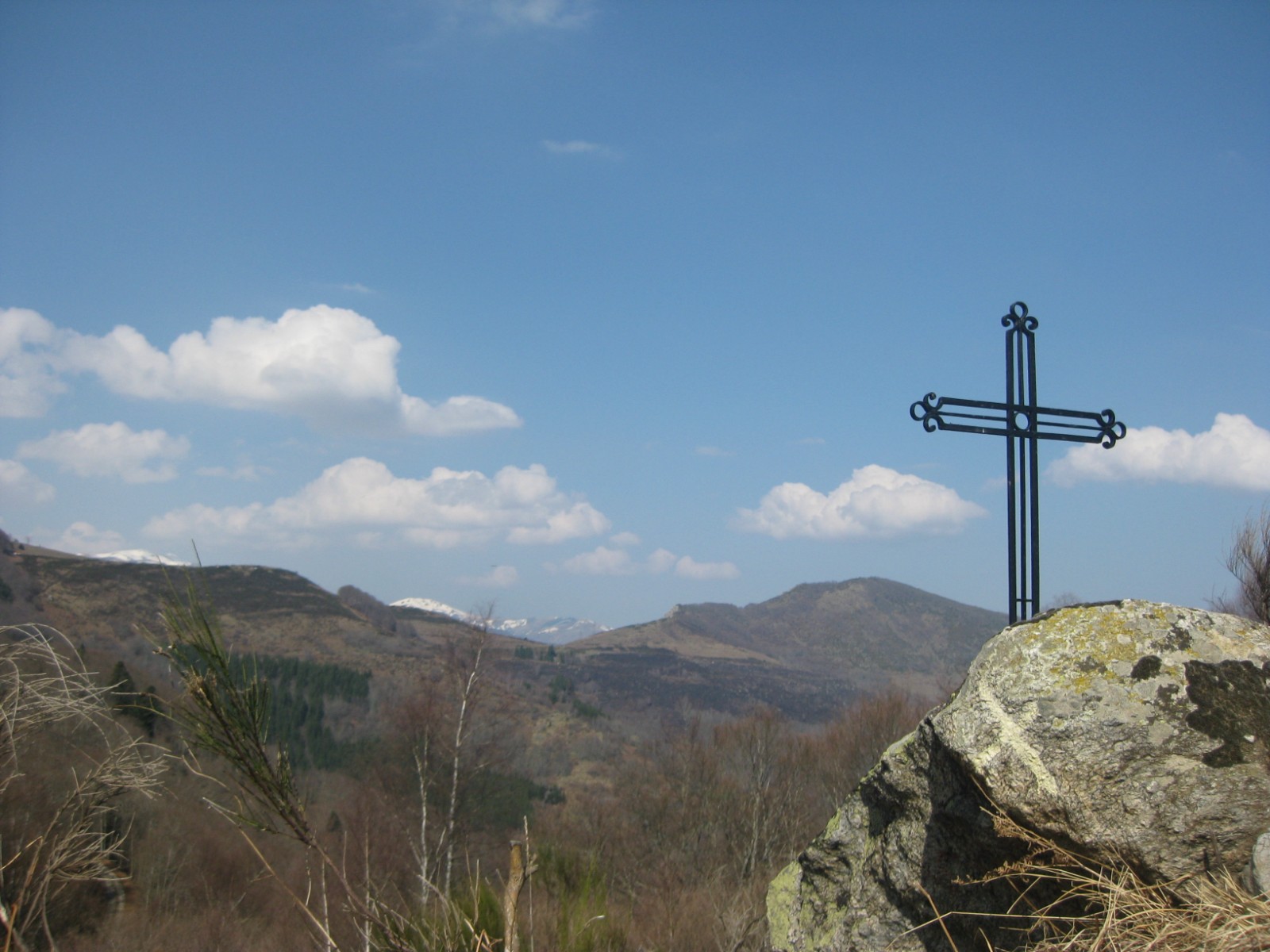
Such crosses - nearly all different - marked our route

Our walk today was to the Chapelle de Saint Barthélemy, high in the Vallée d’Ax, beyond Tarascon.  We quickly realised we were on a pilgrimage route – our path was marked by decorative iron crosses.  But none of us knew why.  Now I know, and it’s a grisly story.

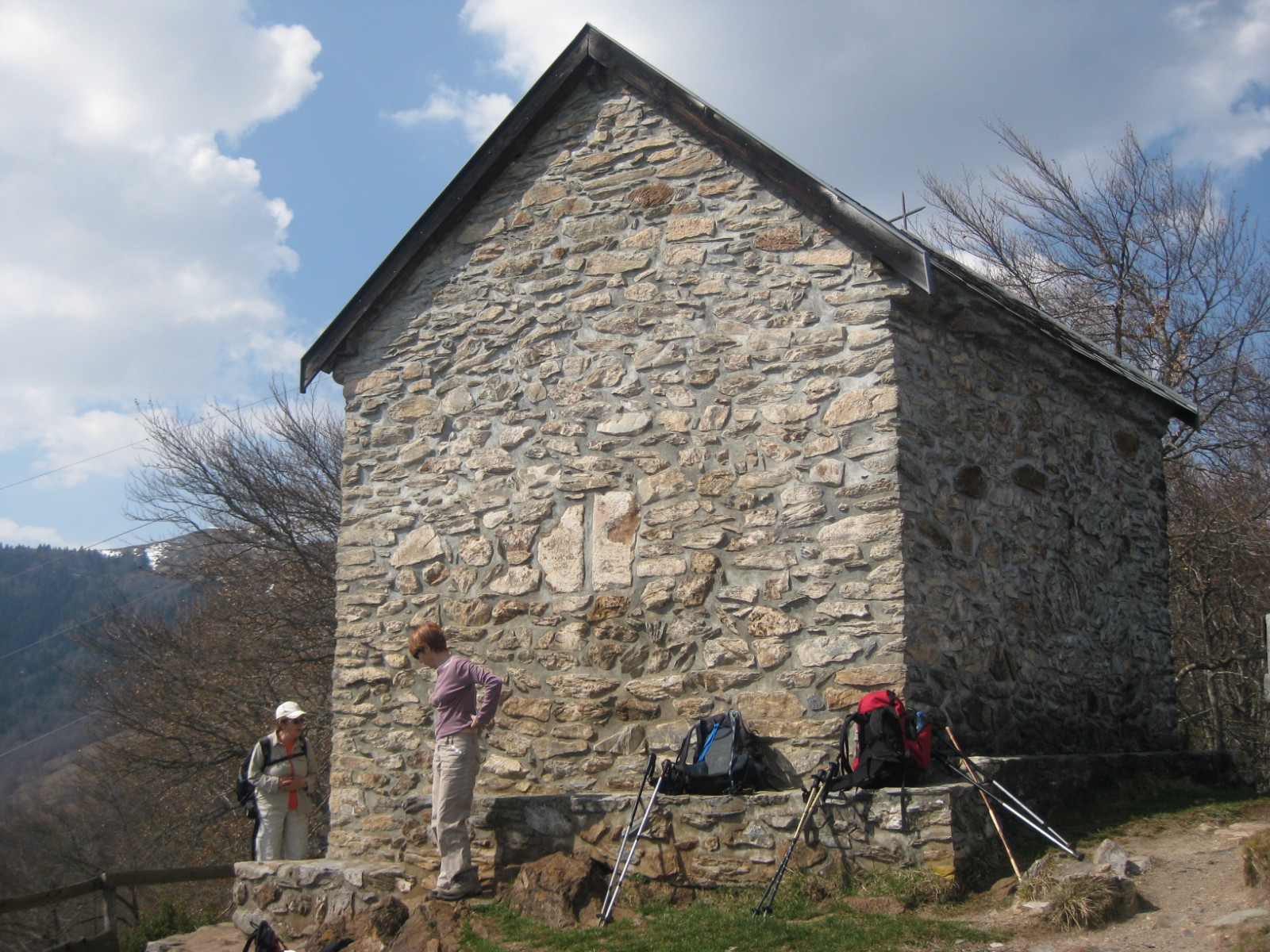
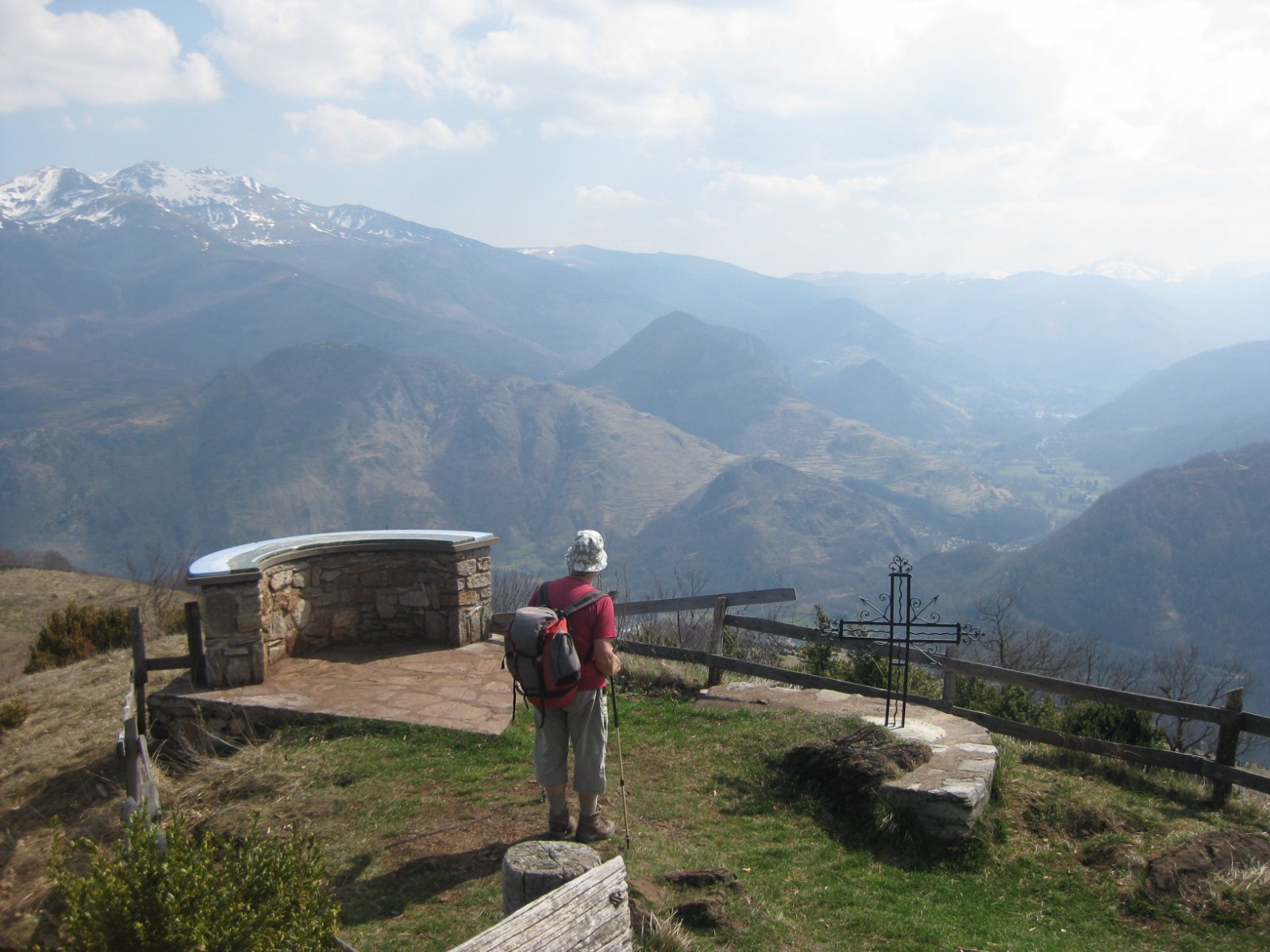
Back in 1854, cholera hit the area.  It’s hard to see how it spread in such a thinly populated region, where every settlement is surrounded by forest, fields and pasture.  Our drive up to the little village of Larnat, where we parked to begin our walk, was up and up a long single track road characterised by an unending series of hairpin bends – and no villages or farms on the way once we’d left the lower slopes.  The road to Larcat is up a similarly tortuous route. But despite this, cholera did arrive in the area, and when it struck, the people of Larcat didn’t hesitate to massacre the poor family responsible.  In time, the few survivors built a tiny chapel at the summit, dedicated to Saint Barthélemy, and promised an annual pilgrimage.  This chapel is a very simple windowless structure.  Some garden sheds are bigger.  It enjoys splendid views in every direction, and provided the perfect lunch-spot.

We arrive at the Chapelle de Saint Barthélemy
Cowslips en route

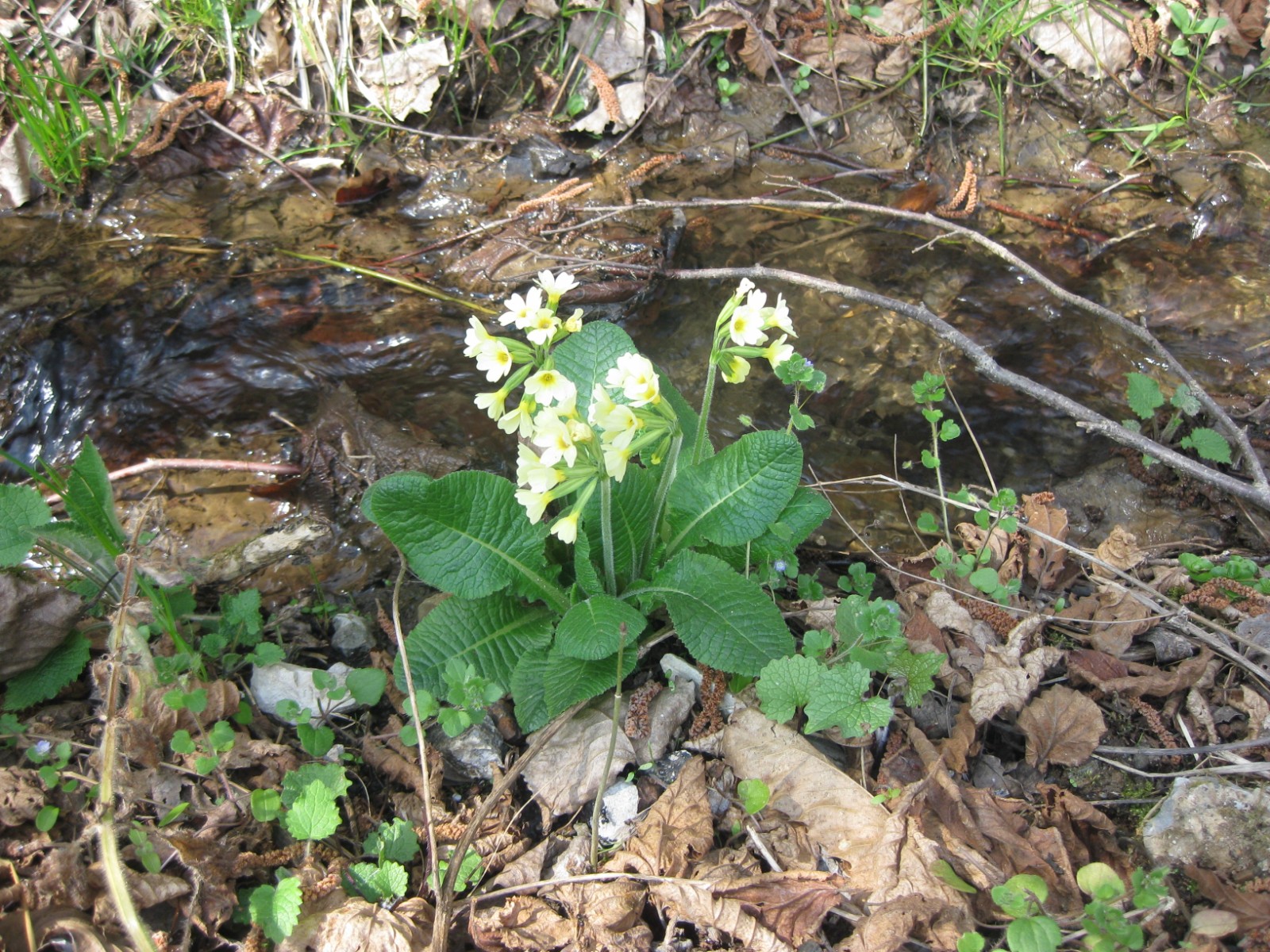
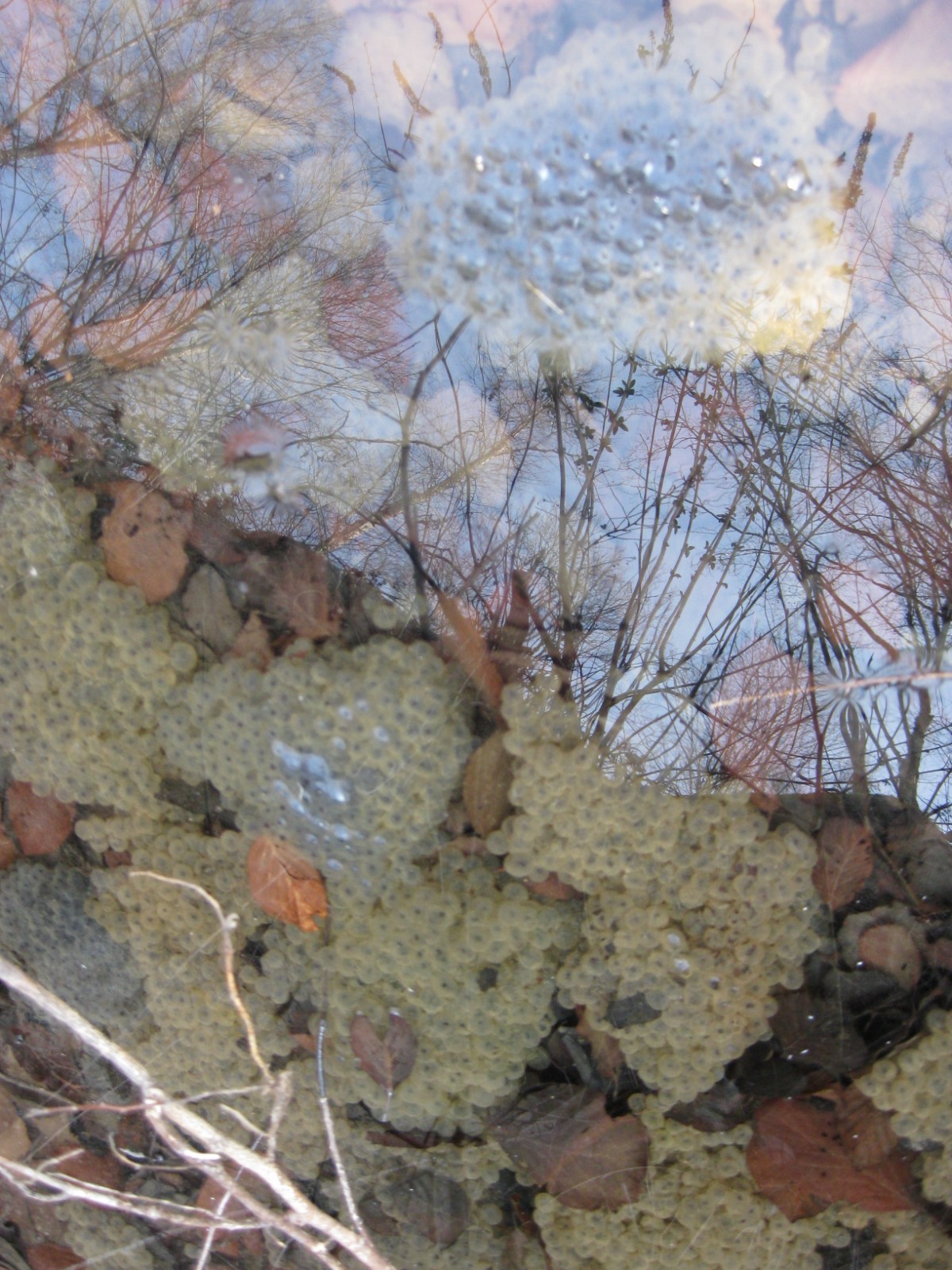
Ignorant of the bloody events that had caused the chapel to be built, we had a pretty easy feel-good walk.  The slope upwards was a gradual one, through forest tracks, emerging eventually onto an airy path commanding view of the mountains which surrounded us.  We had time to enjoy the emerging spring flowers –chiefly wood anemones and cowslips – and spotted several clumps of frogspawn.

Frogspawn en route

Did I know, Jean-Claude wondered, that when he was younger, it was quite common to see men staggering back from a country walk with hessian sacks stuffed not with the potatoes for which they were originally intended, but frogs destined for the market and then the dinner table?  I didn’t, and was glad to hear frogs are now protected and it’s illegal.  Apparently, though I’ve never seen them on the menu, frogs are still eaten.  Now however, they’re imported from China.

They certainly weren’t on offer today.  As usual, the day finished with tea and cake: much more welcome.

One of the views from the chapel

Plateau de Sault calling

Down here in the foothills of the Pyrénées, nobody’s interested in how far you walk as you stride up the mountainside.  It’s all about the DNV (dénivelé, or number of metres you’ve climbed – and remember a hillside can go down as well as up: coming up again after a descent starts the DNV counter all over again).  On Thursday, we did 791 metres.  That’s 2959 feet in real money.  Our mileage was less impressive:  19 km. or 11.8 miles – in the circumstances pretty damn’ good.

But we didn’t know the statistics till we’d finished.  We were far too busy having a very special walk.

To reach our departure point, you leave Belésta via a switchback forested road, over the Col de la Croix des Morts, and emerge onto a high and slightly bleak plateau.  This is the Plateau de Sault, home of the region’s potato growers.  We stopped at an insignificant track signposted Langrail and parked the cars.  As we got our boots on, we met another walker on a brief holiday from his home in Durban for a good long solitary hike (‘Durban?  Where do you suppose he meant?  Durban-sur-Arize in the Ariège?  The one in the Aude? South Africa even?’).  He was the last person we met all day.

It was the 14th March.  There were large patches of snow all along our route.  Yet we wore tee shirts all day and became lightly bronzed in the hot sun as we crunched through that still hard-crusted snow.  Through the forests we could see the peaks of our more local mountains: Maguy, born and bred round here taught us how to recognise each one.

Then, quite unexpectedly, we emerged into a splendid expanse of pasture interspersed with areas of snow.  In every direction, there was a distant fringe of mountains: our day-to day familiar slopes, the more distant and higher peaks of the Hautes Pyrénées,and behind us, bereft of snow, those of the Aude and Pyrénées Orientales. It was a really special pleasure to tramp across this apparently unending pasture, enjoying views of our constant neighbour Montségur, as well as the towns and villages where we all live, and much further away, the Montagne Noir, with the sky clear and blue above us.

It kept us happy till lunchtime.  We’d arrived at a refuge by then, thoughtfully provided with a table and benches in the sunshine.  After the picnic, we left our rucksacks with Gilbert, the honorary man in the group and went off to investigate the Belvédère, the local viewpoint.  Craggily folded rocks plunged down deep towards the Gorges de la Frau and still we had our views of Montségur.  We were impressed.

Our route for the day was a simple there-and-back.  But the views were quite different, looking towards more eastern slopes so we didn’t feel at all short changed that we were repeating our route.  And most of the return was downwards too.  Which was helpful.  When you’ve climbed 2000 feet or more, it can get quite tiring as the day nears its end.  Lucky that there was cake and tea to look forward to.

This slideshow requires JavaScript.

A walk from Cépie

Thursdays, I walk.  I do these days anyway.  A few weeks ago I was invited to join a small informal group from round these parts, went once, and had a great time.  Then The Great Snows came, and that was that for a while.

Yesterday, though, we went to Cépie, near Limoux.  Cépie is a village that Malcolm and I happened to be driving through several years ago in high summer, and where we spotted a fruit producer, selling peaches and nectarines.  Those peaches we saw that day have become the standard against which all others are measured.  Dripping with perfumed sweet juices, the tray we bought scented the car with its decadent fragrance, and all but intoxicated us as we drove home. So I was keen to go again, lack of peaches notwithstanding.

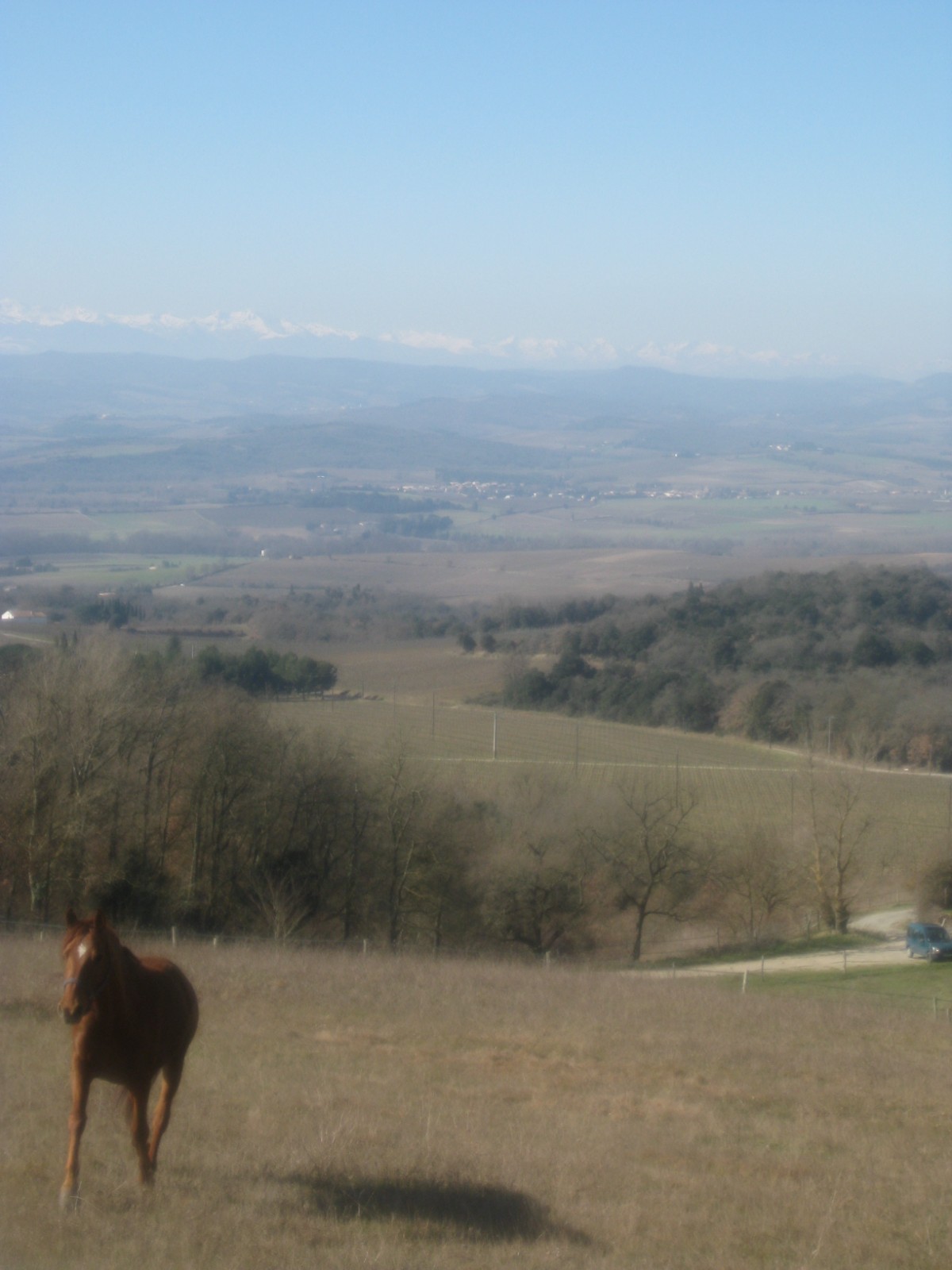
You'll struggle to see the snowy Pyrenees as the backdrop to this picture. They are there. Keep looking

Instead of peaches, there were views.  The Pyrenees are more distant here, but that means we got horizon-filling views of the gleaming snowy mountains as they rise and sink in a line of angular peaks, marching right across the skyline from east to west.  Because of the haziness of the day, the photos give no idea of the panoramas which we quite simply had to stop and gaze at, time after time.

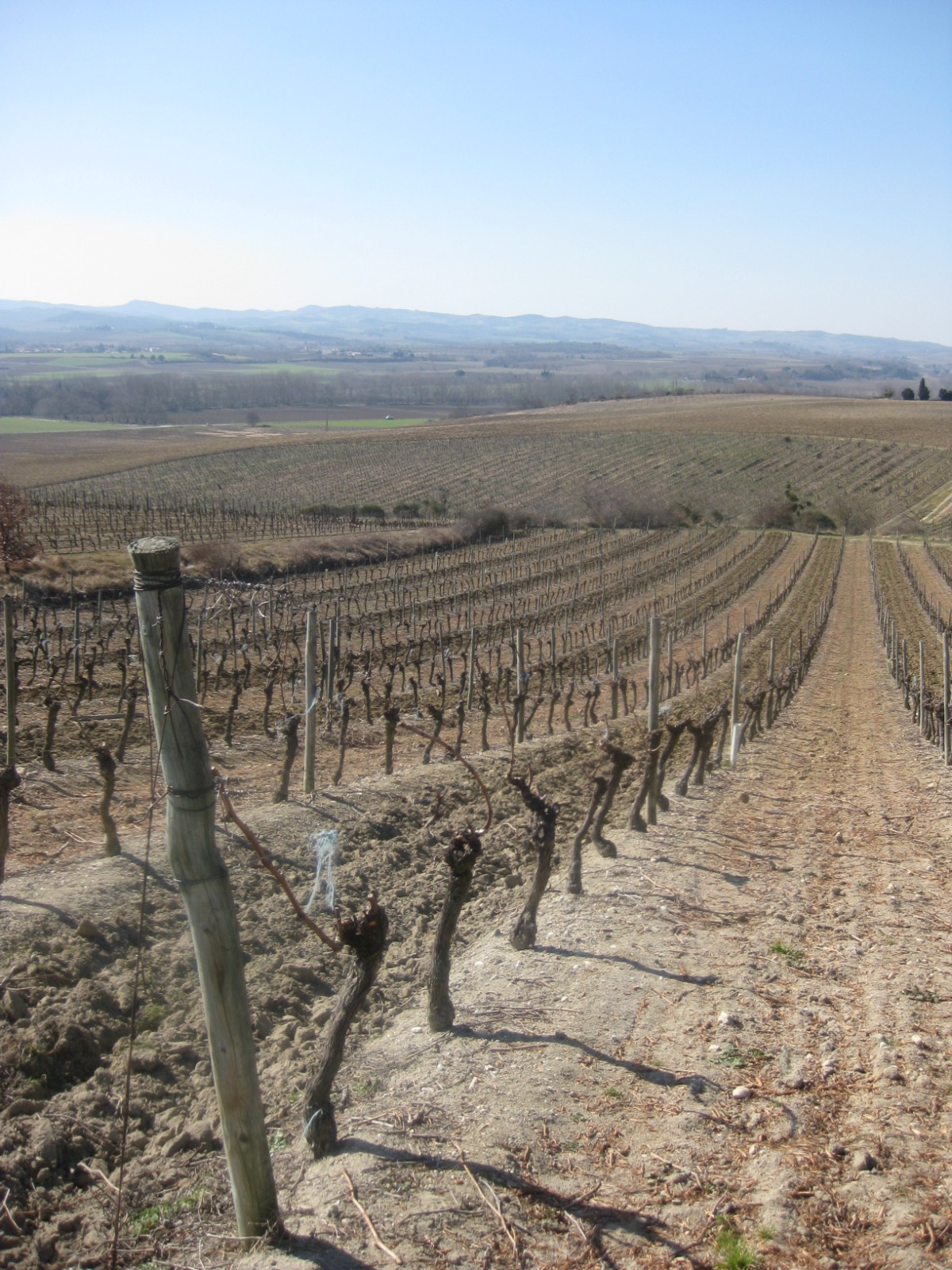
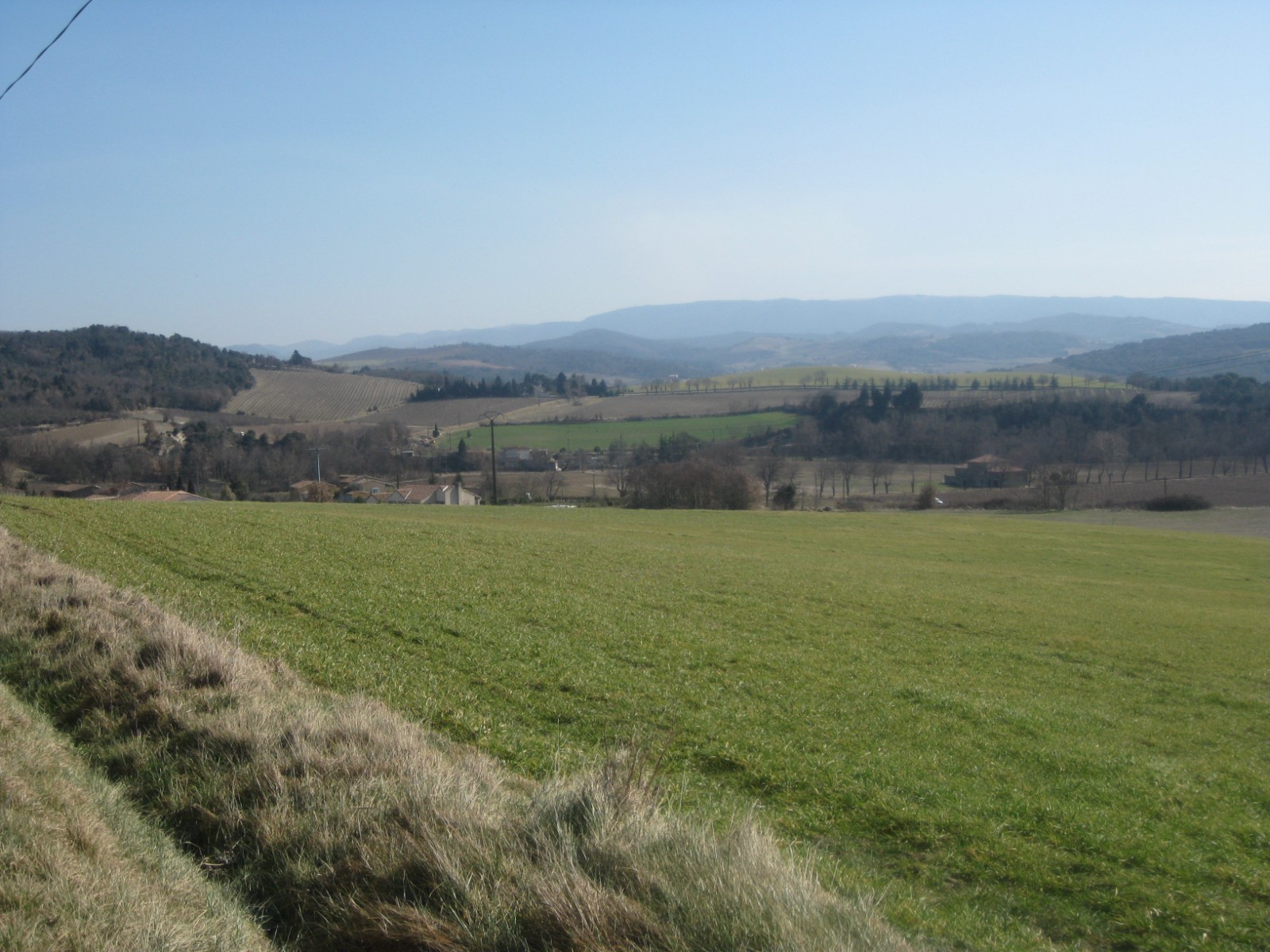
This area is Tuscan style Aude – rolling hills with distant domains and lines of cypresses, covered for acre after acre with mathematically precise lines of vines.  I used to find these vineyards rather dull in winter.

Notre Dame du Razès, protégez nous et protégez nos récoltes

Now, as the workers get busy in the fields, pruning away all the growth from the previous year to leave little more than a two or three foot high trunk, I enjoy the way these organised lines echo and follow the contours of the landscape.

Vineyards march across the landscape

Our walk took us in a figure of eight through sandy, stony wooded paths, passing near domaines and hamlets whose reason for being is those vineyards.  Towards the end, we paused in the tiny village of Saint Martin de Villereglan and enjoyed looking at the school-cum-town hall, the views down to the church, and generally pausing for breath before the final yomp up, then down the hill that divided us from Cépie.

A nice touch with these walks is that every week, one member of the group makes a special cake to share at the end of the day.  A lovely moment of sharing (in this case with a couple of passing villagers who got chatting), it gives a much needed calorie rush.  We’d only done about 16 km, but the local temperatures rose to more than 23 degrees, and we felt we deserved our gâteau aux noix.

The homeward stretch