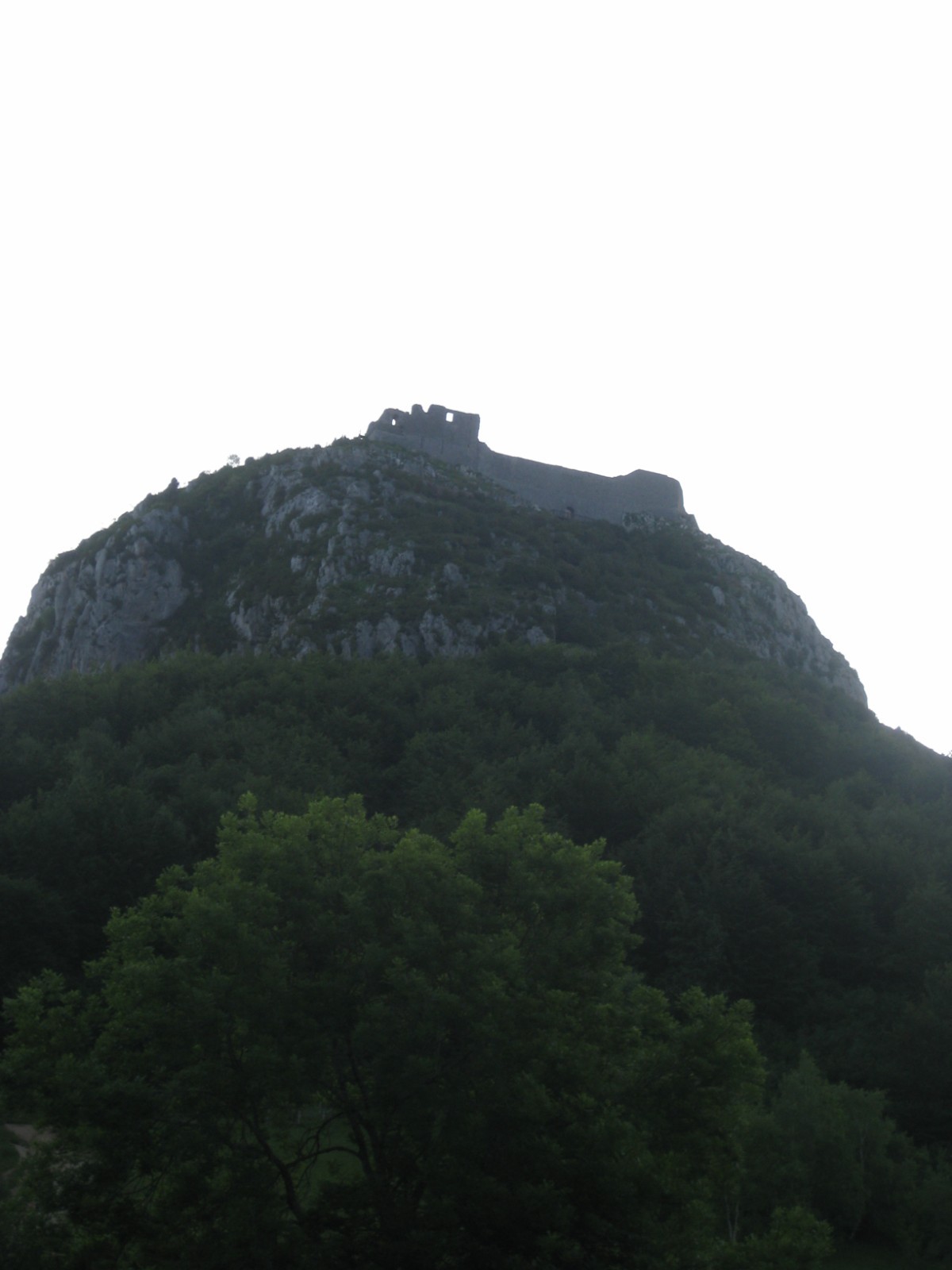
A walk from Cépie

Thursdays, I walk.  I do these days anyway.  A few weeks ago I was invited to join a small informal group from round these parts, went once, and had a great time.  Then The Great Snows came, and that was that for a while.

Yesterday, though, we went to Cépie, near Limoux.  Cépie is a village that Malcolm and I happened to be driving through several years ago in high summer, and where we spotted a fruit producer, selling peaches and nectarines.  Those peaches we saw that day have become the standard against which all others are measured.  Dripping with perfumed sweet juices, the tray we bought scented the car with its decadent fragrance, and all but intoxicated us as we drove home. So I was keen to go again, lack of peaches notwithstanding.
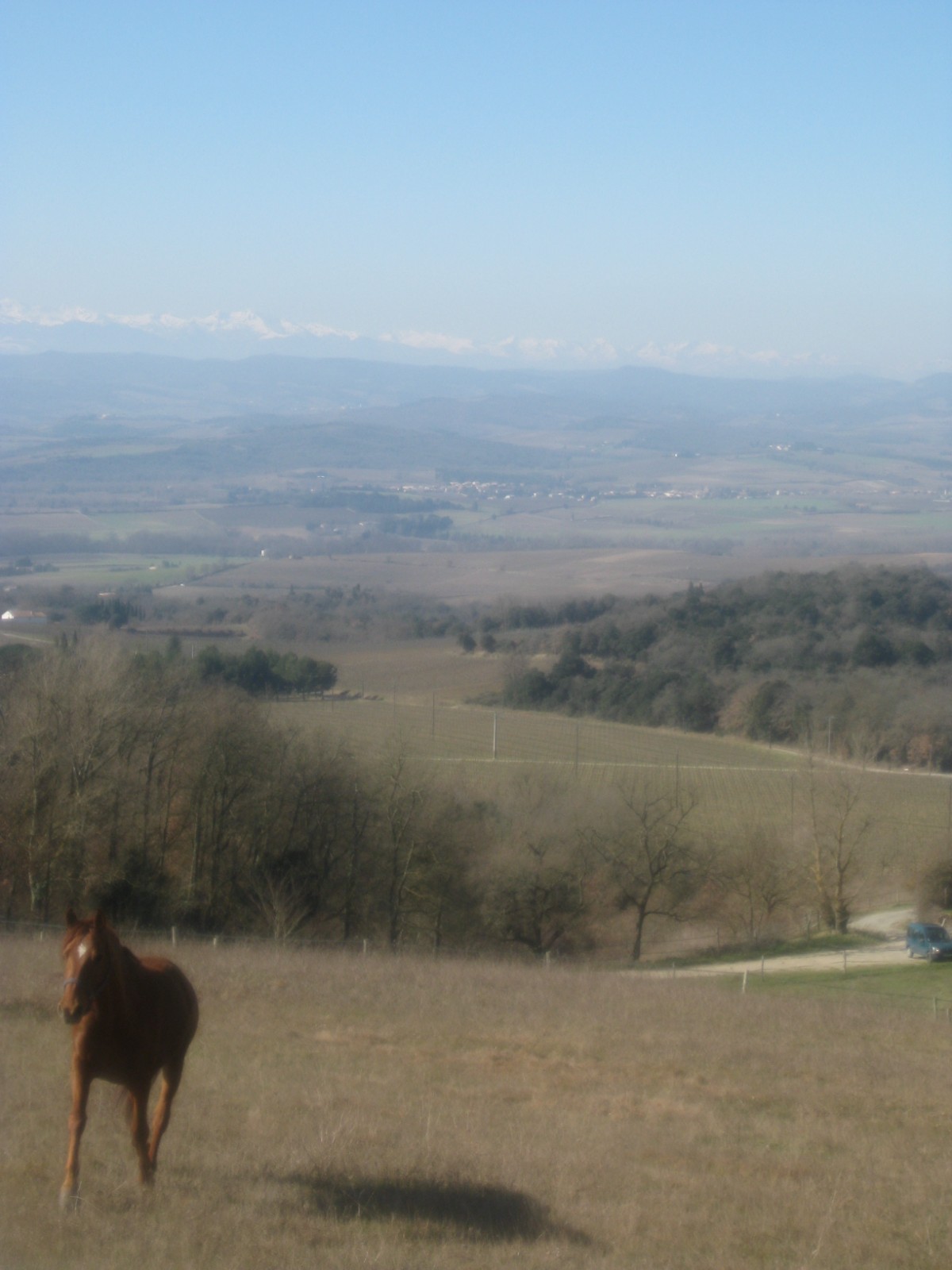
You'll struggle to see the snowy Pyrenees as the backdrop to this picture. They are there. Keep looking

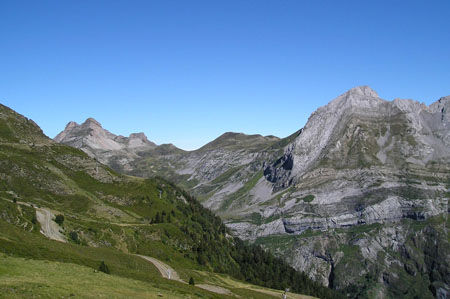
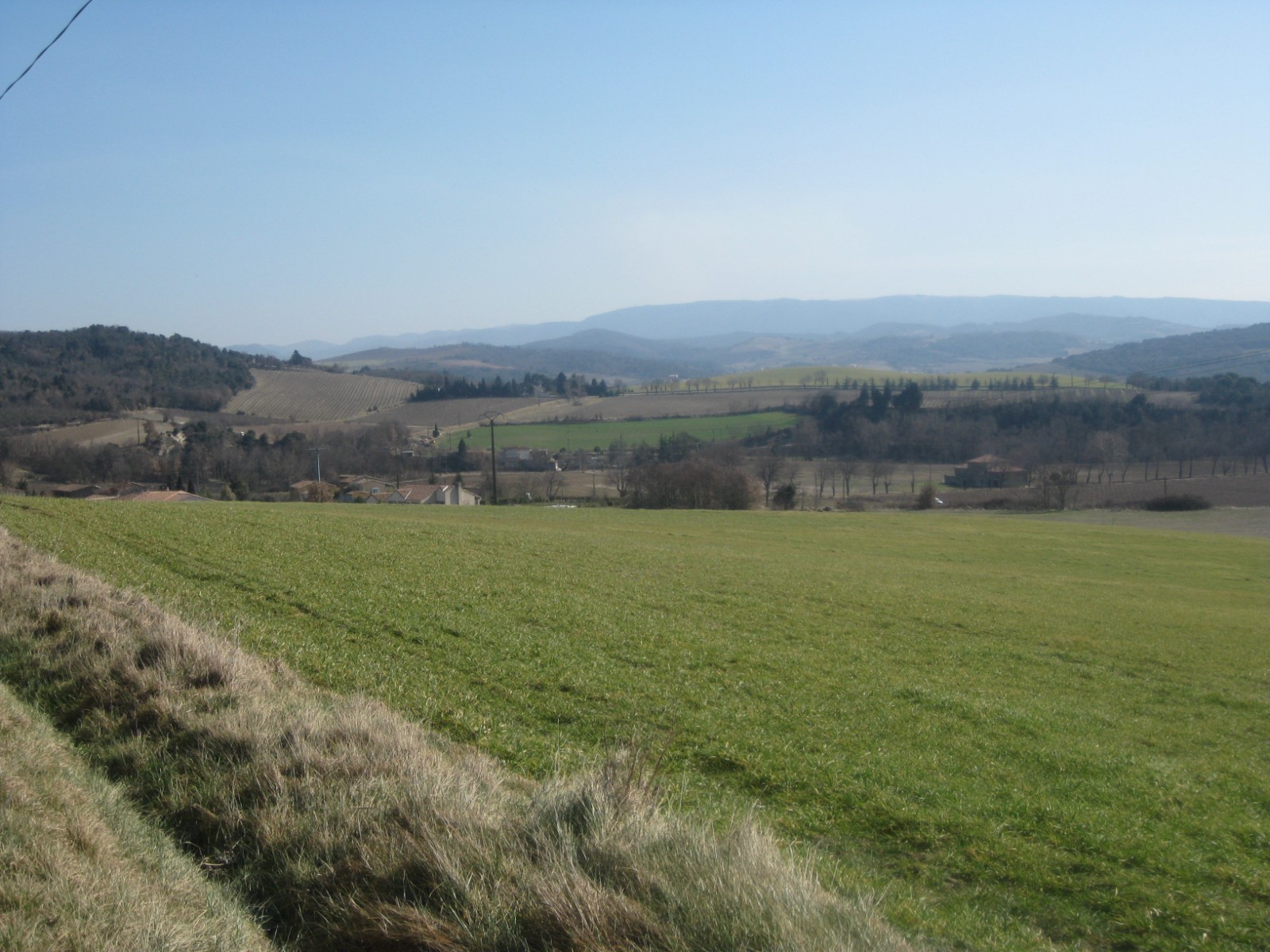
Instead of peaches, there were views.  The Pyrenees are more distant here, but that means we got horizon-filling views of the gleaming snowy mountains as they rise and sink in a line of angular peaks, marching right across the skyline from east to west.  Because of the haziness of the day, the photos give no idea of the panoramas which we quite simply had to stop and gaze at, time after time.

This area is Tuscan style Aude – rolling hills with distant domains and lines of cypresses, covered for acre after acre with mathematically precise lines of vines.  I used to find these vineyards rather dull in winter.

Notre Dame du Razès, protégez nous et protégez nos récoltes

Now, as the workers get busy in the fields, pruning away all the growth from the previous year to leave little more than a two or three foot high trunk, I enjoy the way these organised lines echo and follow the contours of the landscape.
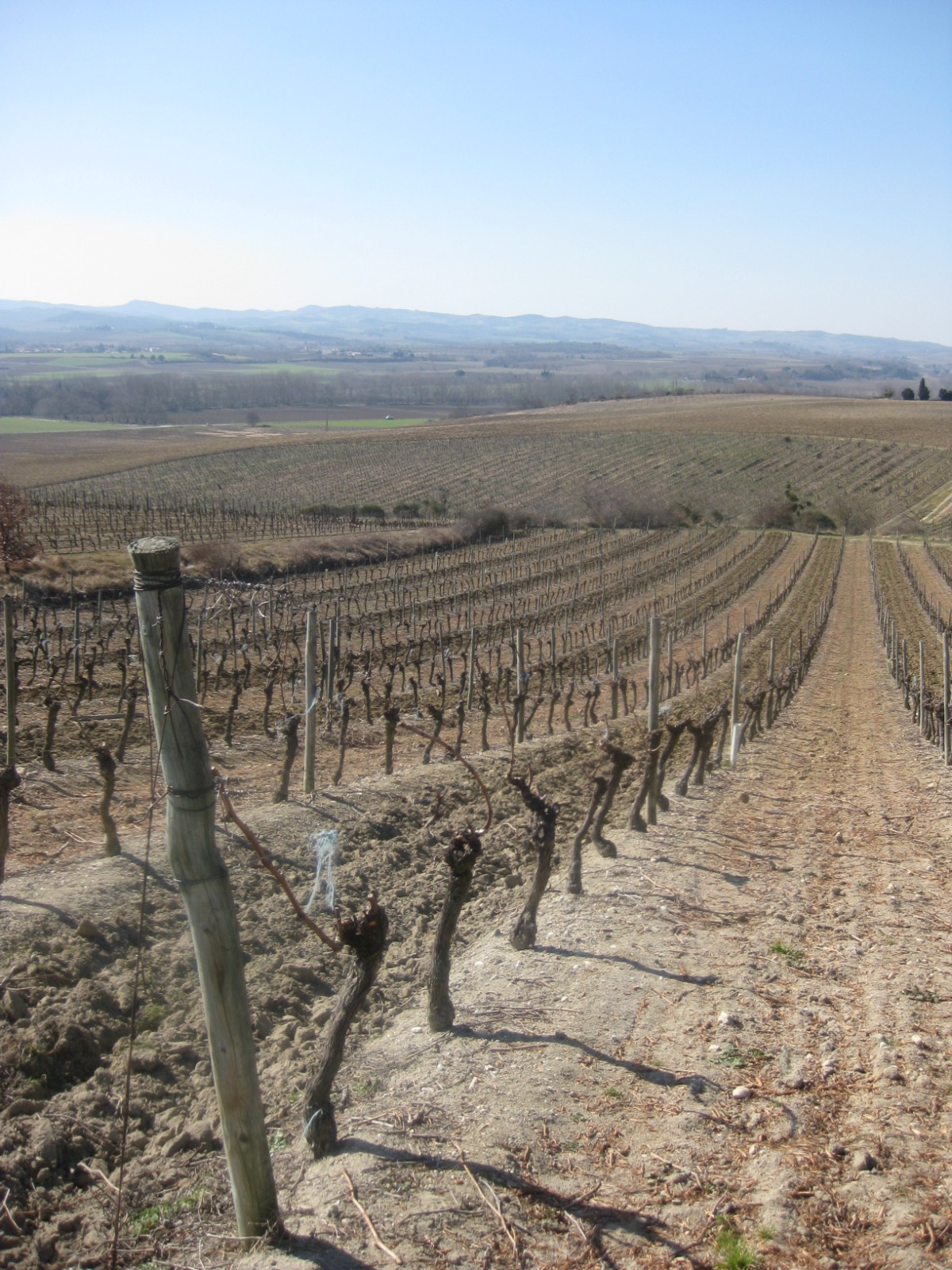
Vineyards march across the landscape

Our walk took us in a figure of eight through sandy, stony wooded paths, passing near domaines and hamlets whose reason for being is those vineyards.  Towards the end, we paused in the tiny village of Saint Martin de Villereglan and enjoyed looking at the school-cum-town hall, the views down to the church, and generally pausing for breath before the final yomp up, then down the hill that divided us from Cépie.

A nice touch with these walks is that every week, one member of the group makes a special cake to share at the end of the day.  A lovely moment of sharing (in this case with a couple of passing villagers who got chatting), it gives a much needed calorie rush.  We’d only done about 16 km, but the local temperatures rose to more than 23 degrees, and we felt we deserved our gâteau aux noix.
The homeward stretch

Le Chemin de la Liberté

Good to look at. Less easy to cross

My last post wasn’t entirely serious.  That walk in the Pyrennean mists was fun despite the weather.  We were well nourished (energy bars, abundant picnic food, and a delicious walnut cake that Michel shared).  Thanks to the miracle of Gore-Tex and microfibres, we were warm and dry, and after it was over, we knew we’d be driving back to our cosy homes and family life.

But if you’d asked most of us whether we’d want to submit ourselves to a walk even more gruelling, every day for 4 days, in constant fear for our lives, maybe in the depths of winter, we’d have been certain to answer ‘no’.

Not so the men and women who during the Second World War risked their lives across the Pyrenees along paths such as le Chemin de la Liberté.  On Monday, as part of its Remembrance season, the BBC broadcast its own tribute to those who trekked for 4 days up 4,750 metres of difficult, rocky terrain, in conditions that could change from mist to snow, to dazzling sun, to sleet several times in the course of a single day.  These people – more than a 1000 of them over the whole period – were Allied soldiers and airmen who’d found themselves in enemy territory, escaped POWs and Jewish refugees: and the French and Spanish who helped them across the mountains to Spain.

Escapees had little choice.  They were brave and resourceful from sheer necessity.  But those who sheltered them as they travelled south through occupied Europe, prepared for their journeys, who shared the little they had, who interpreted, forged documents, sourced warm clothing so servicemen could ditch their tell-tale uniforms, those ‘passeurs’ who guided them to the comparative safety of Spain took unimaginable risks.

Would I have been brave enough to put my life on the line for strangers?  Especially if in doing so, I risked the lives of my own family?  I’m glad I don’t have to ask myself this question.  More than a 100 ‘passeurs’ were caught and either executed or deported. 450 Ariègeois who assisted the escapees were deported – that’s one in 330 inhabitants of the region at the time.  And they’re only the ones who were caught.  Many others, somehow, weren’t.

A couple of years ago, a friend in the choir told me a story, a part of her family history.  It didn’t happen in the Ariège, and it’s nothing to do with the passeurs, but it has stayed with me as a telling example of the desperation and bravery often shown in this period.  Her family then lived in an isolated village in the Creuse, and they’d given shelter to a young Jewish girl for the duration.  If  searches were conducted – and they were – this child was inserted into one of those long bolsters the French used to favour, and arranged on the made-up bed.  She simply had to lie there, still as a corpse, till the search was over.  She survived.  They survived.

At least she didn’t have to flee with a miscellaneous band of other inexperienced escapees: soldiers, mothers, underfed and frightened people, led by a series of local guides over often treacherous mountain passes – no waymarks and well-trodden paths here.  At least her mother wasn’t asked to suffocate her because her pathetic cries might alert a German patrol.  These things happened. Those times are over: but the memories live on.

Present day travellers take le Chemin de la Liberté

Sunday Rando

7.00 a.m. Sunday.  22 Ariègeois radios were switched on for the day’s weather forecast.  ‘It’ll be an exceptionally sunny and hot day for the time of year, throughout France.  Temperatures in the south will reach 23 degrees in some places.’  22 satisfied listeners, members of the Rando del’Aubo, switched off their radios…. without bothering to listen to the end of the forecast.  Instead they turned to the more important business of packing their rucksacks for a rather heavy-duty walk an hour and a half’s drive from Mirepoix, la Forêt d’en Malo.

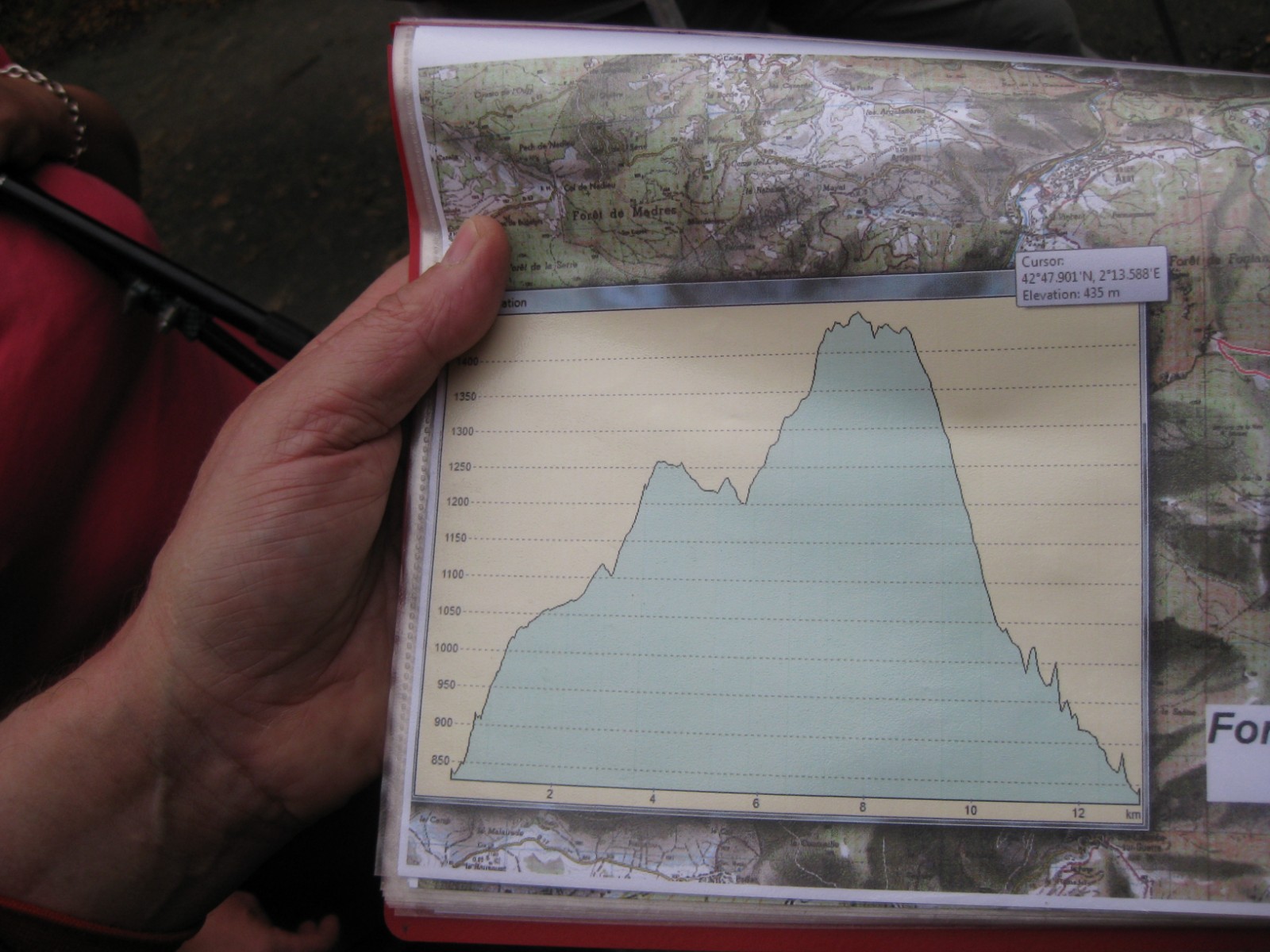
François talks us through the walk. This is it, in cross-section

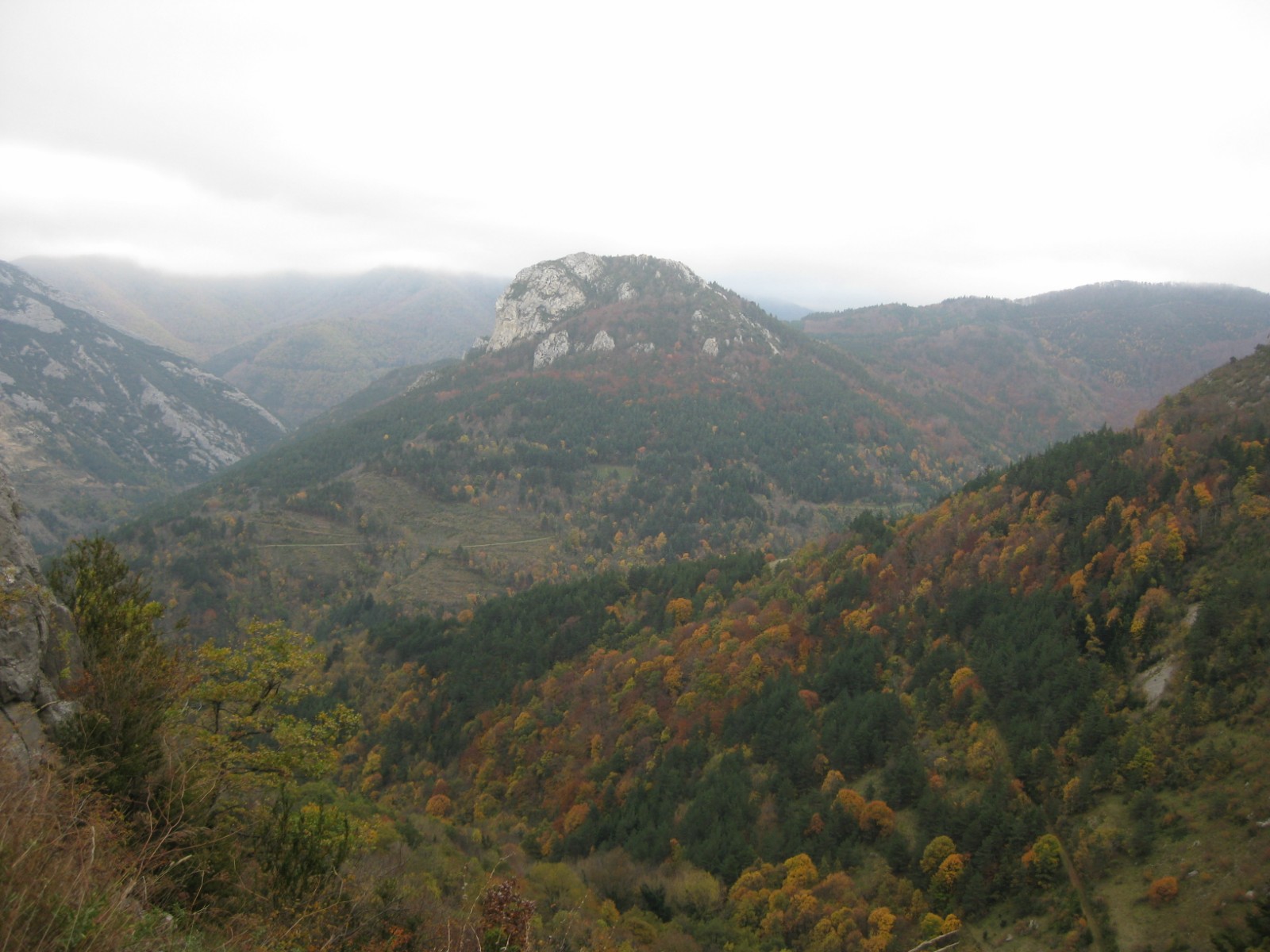
With a stiff climb of 700 metres in prospect, a 14 km. walk isn’t a stroll in the park.  But the payoff as you emerge from the forest is an extraordinary panorama of the Pyrénées, jagged teeth of rock emerging from the thickly forested mountainsides: especially lovely in autumn as the trees turn from yellow, through ochre, to magenta and crimson.

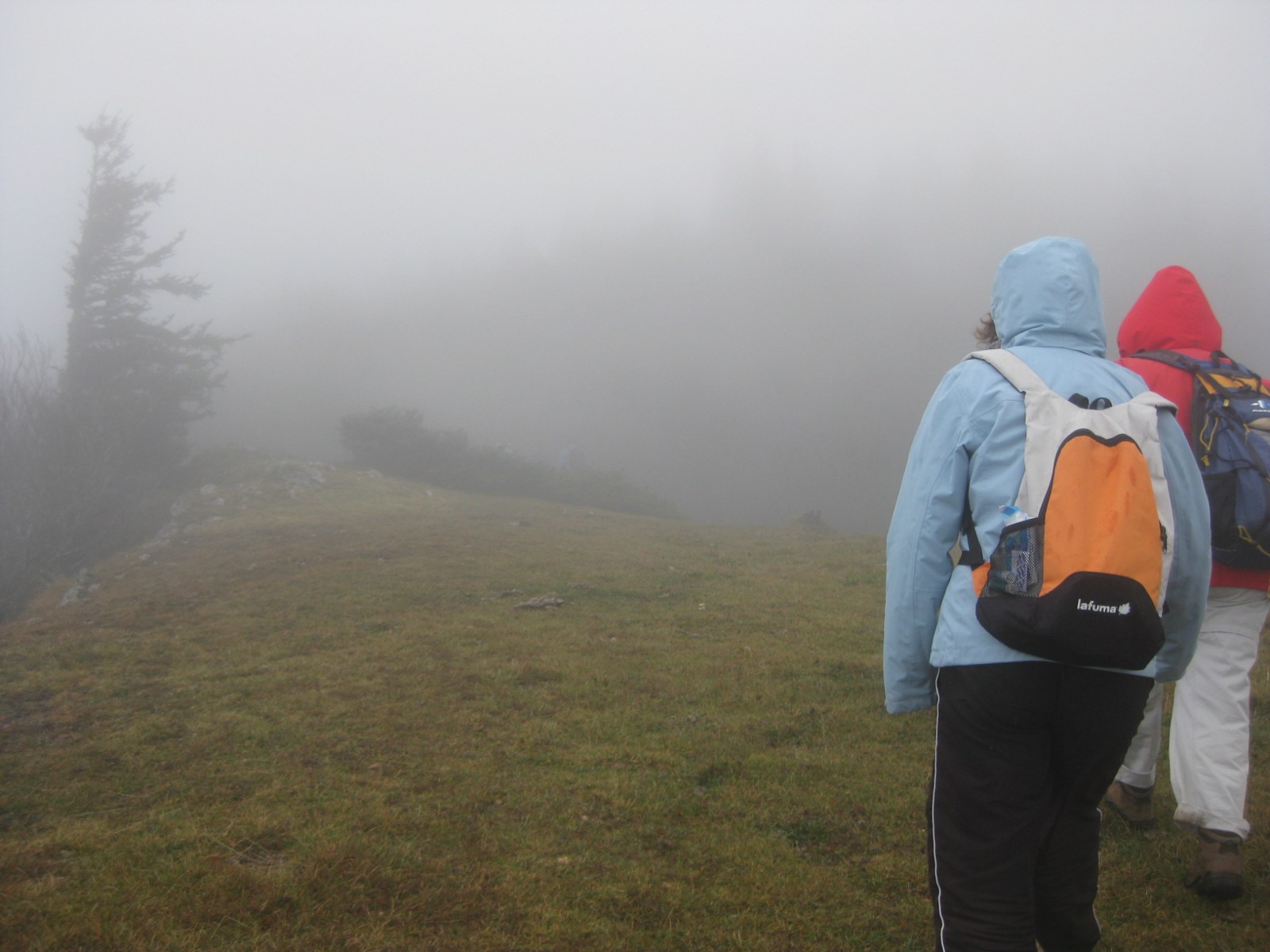
As we drove eastwards, the cloud and mist descended. We parked, we walked, we climbed, we scrambled and we struggled for three hours as the mists became ever damper and more clinging, and an unexpected cold wind whipped across the mountain side.  And at the top, this was our view.

We hadn’t listened to the end of the forecast you see.  What we should have known that our little patch of south eastern France was a little bad-weather cold spot.  There we were bang in the middle of it.

As we finished our walk, the weather lifted a bit, and gave us a small taste of what we should have enjoyed

Later, back at home, our smug families recounted how they’d spent the day in shorts and tee shirts.  Maybe they’d had a little bike ride, a gentle stroll in the sunshine, a drink on the terrace in the hot sun……

Postcards from Catalonia

We’ve just got back from our weekend on the other side of the Pyrénées, and I’ve decided to post these ‘postcards’ to show a few happy days in Sant Cugat del Vallès, the very attractive town where Emily is now working; the not-Hallowe’en-but- la Castañada festivities; and a relaxing weekend.

Eating and drinking were important.  Straight away, as we drove across the mist and rain shrouded Pyrénées from France, there was a decision to be made. Lunch on this side of the border?  You can’t get fed much later than 12.30 here.  Or wait till Spain?  Nothing there is open much before 2.00 p.m.

We arrived in Catalonia just in time for la Castañada. Instead of Hallowe’en, they commemorate All Souls’ Tide. Roasted chestnuts are sold wrapped in cones of newspaper with roasted sweet potatoes and peddled from impromptu stalls, or by excited groups of children.  Panellets are mashed potato, sugar syrup and ground almonds – maybe cocoa or dried fruits too, rolled in pine nuts and briefly baked till the nuts turn golden. It sounds odd, but they’re delicious accompanied by a shot of strong black coffee.

Coffee shops, with tables outside so you can enjoy the late October heat seem to be in every street, and we adjusted our bodies to Spain’s very different rhythms. Food generally seems cheaper in Spain.  A pleasant pause for breakfast, after taking the children to school, after shopping or work, or just because it’s a nice idea and the sun is shining is an affordable treat, and cafés don’t seem to struggle for custom.  Nor do lunch-stops.  As in France, the 3 course lunch with wine and coffee is on offer in most restaurants, but cheaper here.  And it’s a leisurely affair.  We found ourselves spending an hour or two every day that we were there over the lunch table, eating, talking and simply people-watching.

Shopping seems less anonymous too.  Whether in St. Cugat, or city-centre Barcelona, greengrocers and grocers, wine merchants and bakers – especially bakers – all seemed to be doing brisk business.  The out-of-town supermarkets are there alright, but so far, they don’t seem to have won.

So here are my postcards.  Have a glance at them over a lazy cup of coffee.

This slideshow requires JavaScript.

A day of solar energy and soldiers

We intrepid randonneurs from the Rando del’Aubo had our physical workout last Sunday- read all about it in my last post. But travelling to the Cerdagne last Saturday we were tourists, and slightly lazy ones at that.

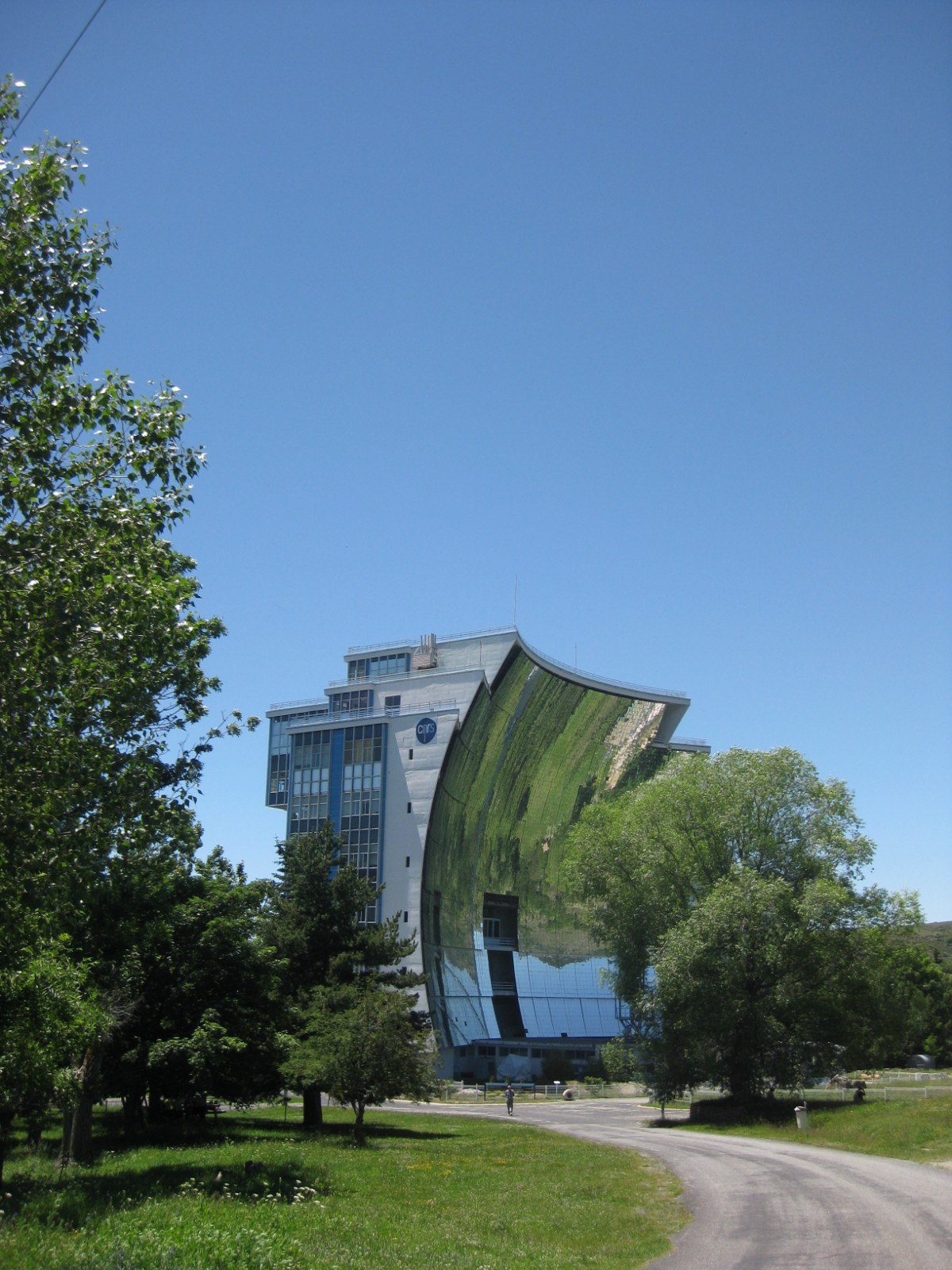
Building? Solar panel? Research centre?…
….or just an interesting view

I’m so used to Patrimoine (Heritage) and the-great-outdoors being the reason to get out of bed on holiday here that I was quite unprepared for Héliodyssée. Built in 1968, it’s a series of gigantic solar panels whose purpose is to enable study of the possible applications of solar power, generating temperatures of up to…..3, 500 degrees. At this stage, it’s the space industry rather than you and me who are likely to benefit from the research, but one day, who knows? We admired the upside-down landscape views reflected in the solar panels, but decided against a scholarly visit.

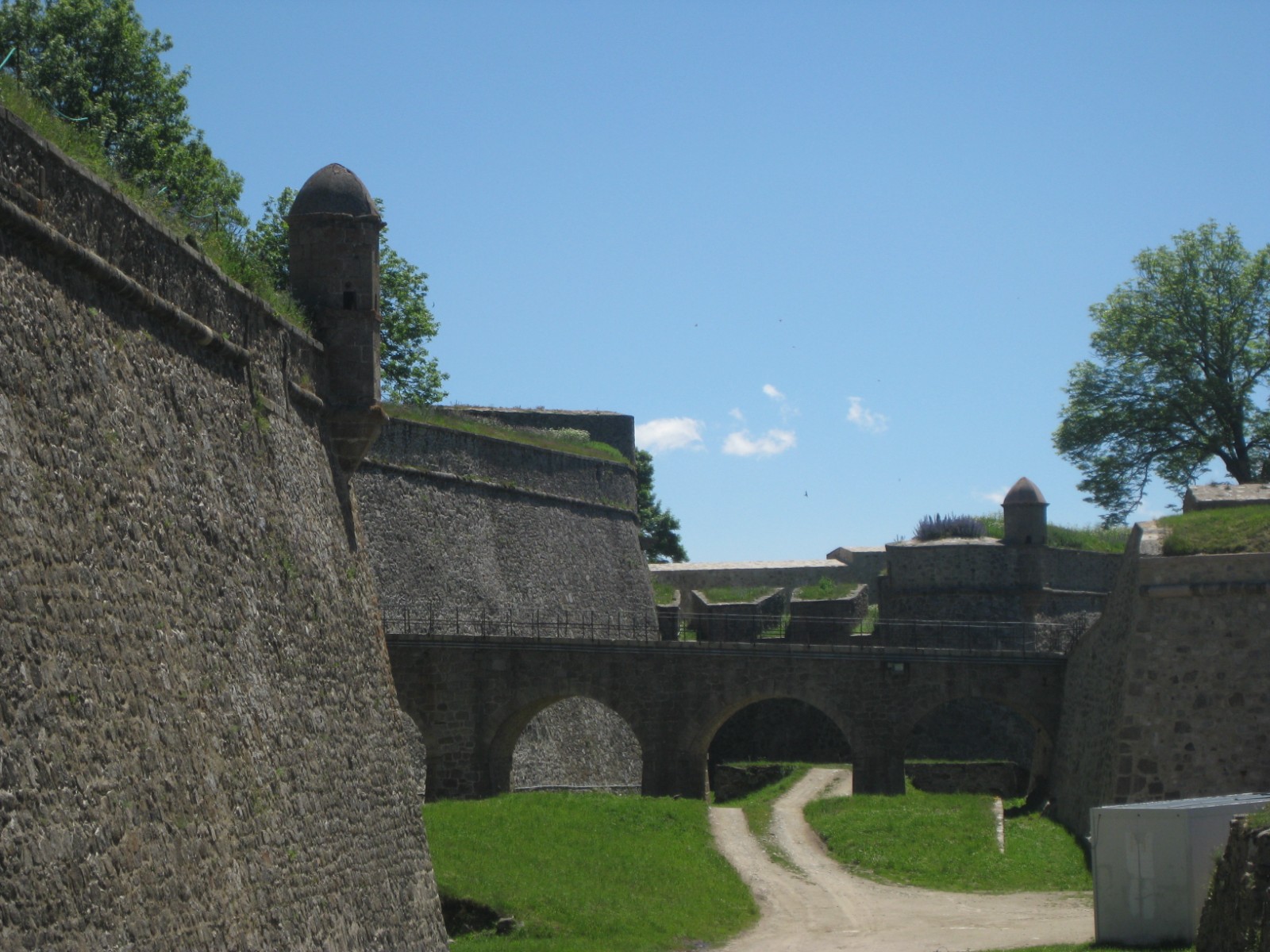
The ramparts at Mont Louis

Off to Mont Louis then, and back to a real dose of Patrimoine. This town was built from scratch for Louis XIV as a military settlement in 1679. Vauban was the man in charge: marquis, engineer, town planner, philosopher, man of letters…and also military architect. 12 of his fortifications, Mont Louis included, were listed as World Heritage sites by UNESCO in 1998, so his significance and importance is in no doubt. This fortress, the highest in France, was needed as a result of the Treaty of the Pyrénées of 1659, establishing the border between France and Spain, although the walls which surround it seem rather low to protect against possible invasion.

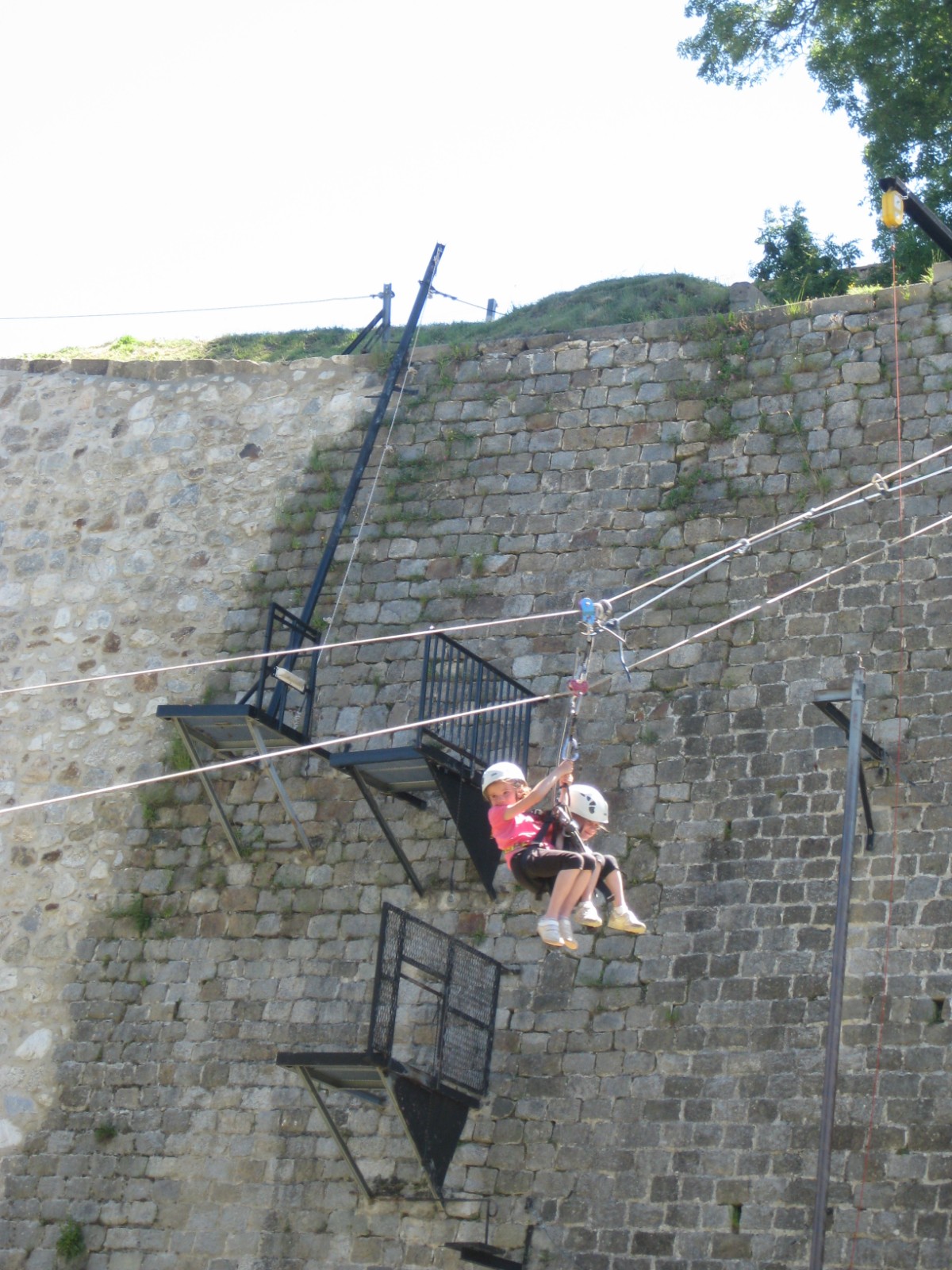
It seems as if these ramparts still have their uses

But it was these walls we circuited, enabling us to see from afar the world’s first Solar Oven (this area seems to be Solar Power Central). We watched children abseiling down from the ramparts, instructed by the soldiers who are still a real presence in the town, and enjoyed the contrast between the somewhat severe presence of the barracks, and the lush and mountainous countryside beyond. Many of the town and garrison’s historic buildings can only be visited by pre-booked visits, so we made do with a look in at the simple, rather dour little church which Vauban built for the townsfolk – there were other chapels up at the garrison. Then we retired to a bar for a drink.

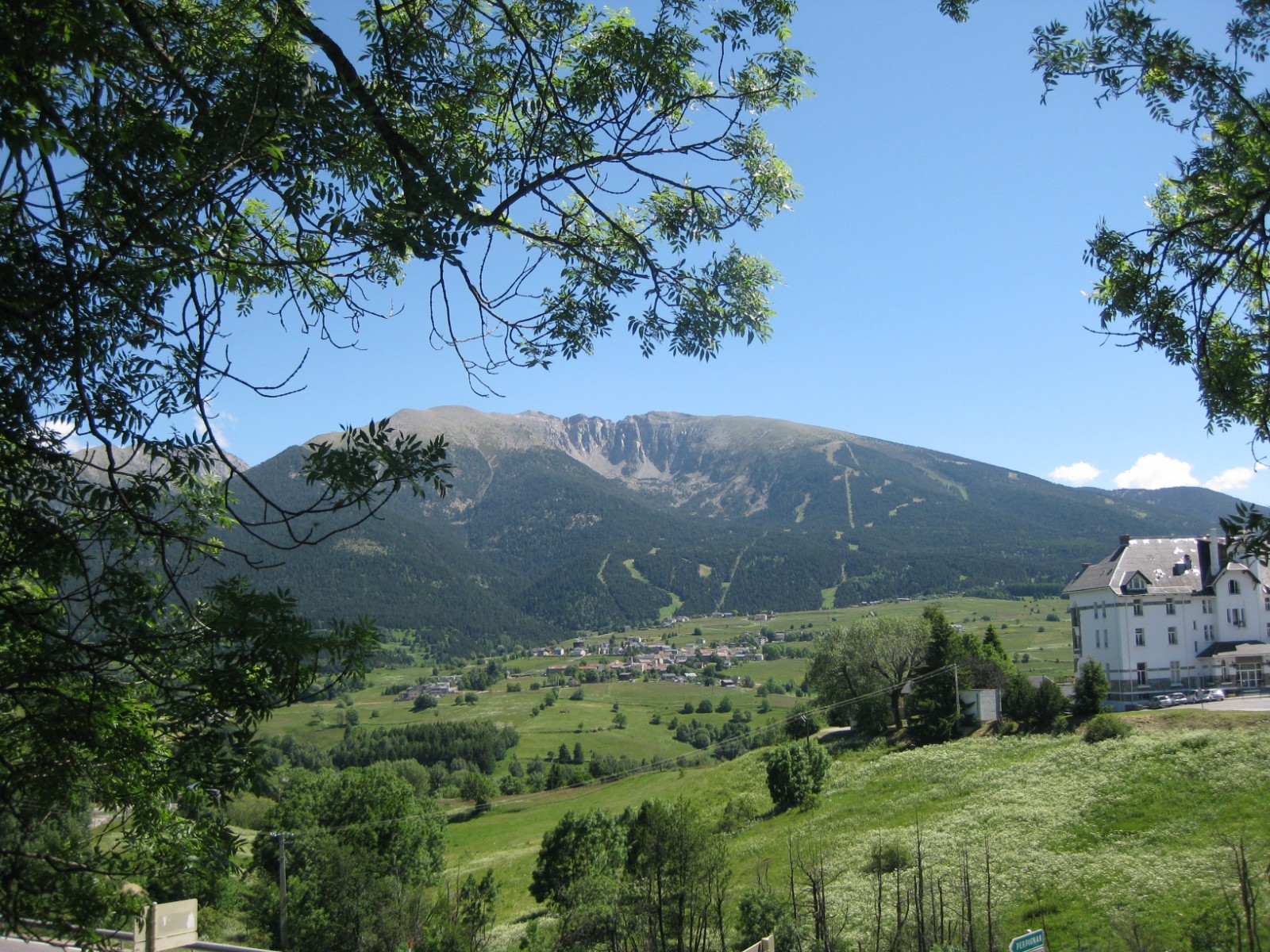
The view from Mont Louis
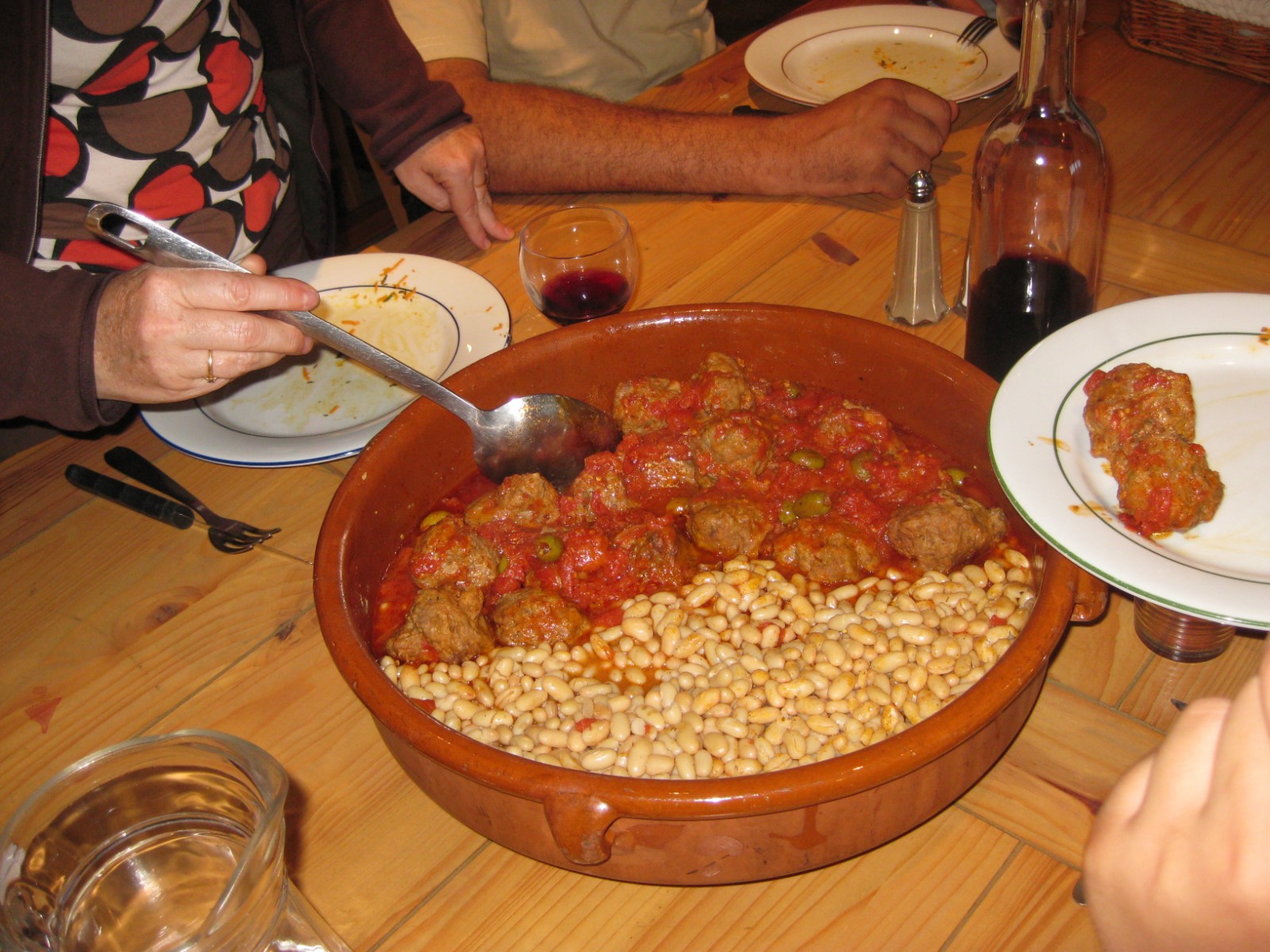
A Catalan take on meatballs, with tomatoes, olives and haricot beans

So then it was off to our lodgings for the night, les Ramiers in Bolquère. This area is popular all the year round – walkers in summer, skiers in winter. Les Ramiers supplies simple but comfortable accommodation to both. Our rooms were often quaint: Mal and I went direct into an en-suite shower room-come-study, and then climbed what amounted to a ladder to our attic bedroom. The welcome was cheerful, the views wonderful, and the food copious and tasty. We relaxed by taking a woodland walk most of the way to Font Romeu, enjoying that meal, and having a very early night. We knew we’d need all our energy at the Gorges next day.

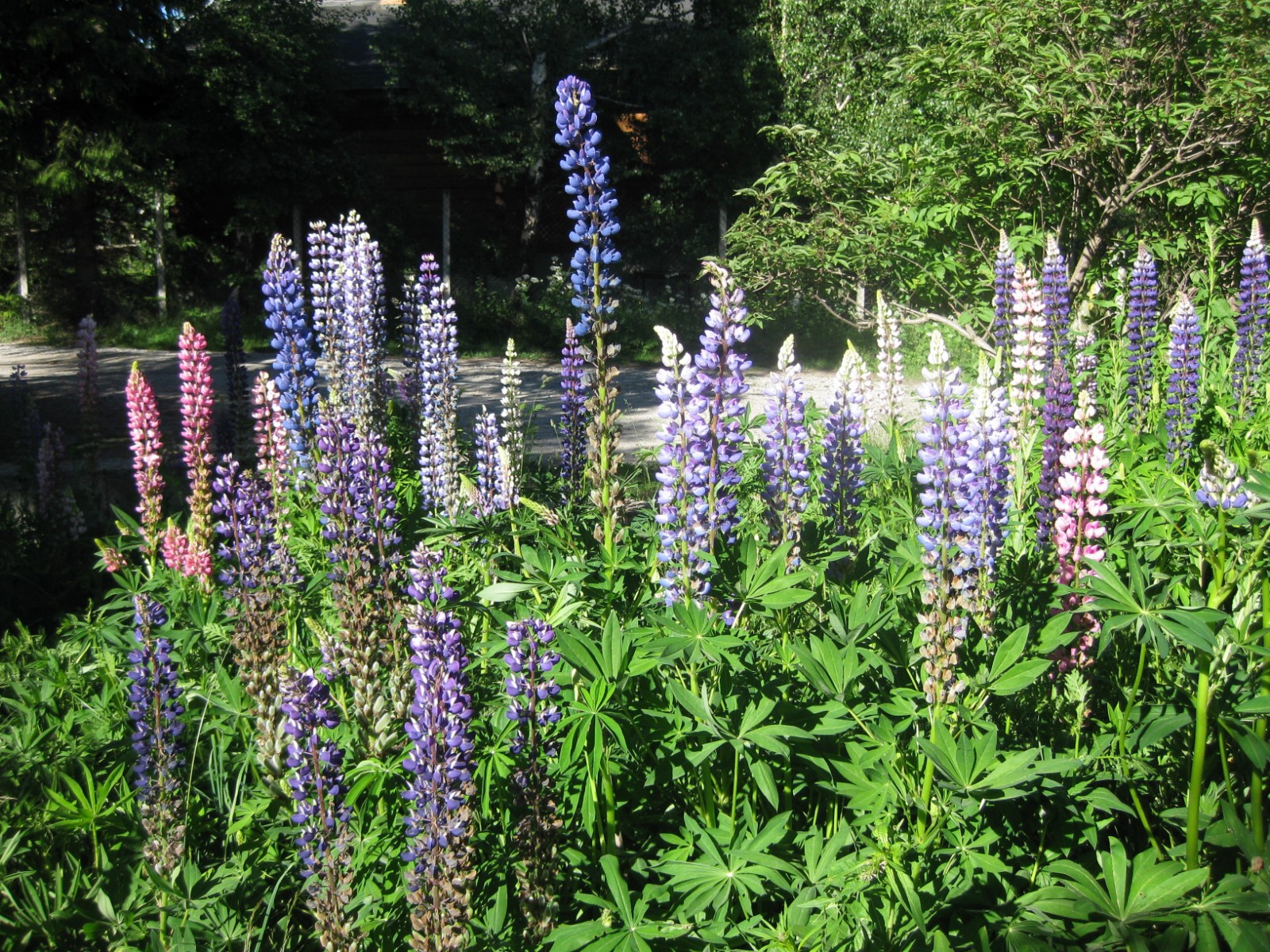
Lupins: these were growing wild everywhere

Les Gorges de la Carança

I’d half written this post in my head before we even set off for our weekend away.  It was going to be all about how, despite my pretty high-maintenance vertigo, I managed to defeat my terrors and have a day’s climbing up vertical ladders and swaying bridges, inching along narrow paths high above the vertical drop to the bottom of les Gorges de la Carança.

We went there, I did all of the above, and astonishingly, I was never once gripped up by that all-too-familiar fear which prevents me from peeking over the edge of any castle battlements or church towers I’m foolish enough to ascend.

It was the Rando del’Aubo who proposed this overnight trip, high up into the Cerdagne region of the Pyrénées Orientales.  It’s a gorgeous area of high steeply sloped and densely forested mountains and wide deep valleys, green and fertile.  This is Catalan France, with a strongly Spanish feel, where Catalan is written and spoken almost as much as French, and the cuisine is very different from our homely Ariègeois farmyard and hunter’s fare.

We were tourists on our first day – that’s for a later blog.  Sunday was the day of the gorges.  A spectacular drive from our overnight accommodation, a few decisions to take about how much clothing to wear (early in the day, it was already hot), and we were off.

I wish my pictures told a better story.  It’s hard to convey the grandeur of the scenery, to show how very vertical and high the gorge sides are, and therefore how nerve-wracking parts of the walk were.  We enjoyed our six hour day, but it’s possible to spend two days exploring the area.  We were merely amateurs.

We spent much of the morning scrambling up craggy paths alongside a tumultuously noisy stream: and then there were scary catwalks clinging to vertical rock faces; ladders and suspension bridges, high above the water, often almost enveloped in the trees.  It wasn’t till the afternoon that we walked the Cornice, the narrow walkway hacked into the (vertical, of course) rock face – with a 400 metre drop to the bottom of the gorge.  The rewards, if you don’t frighten yourself to death by looking down, are the views of the peaks; craggy, splintered rocks of grey, white and ochre; of stunted and deformed trees clinging and growing with unexpected vigour to tiny fissures in the rock; the plant life, similarly finding footholds in this very challenging environment, and the butterflies, fluttering in huge numbers everywhere we looked.

It was a wonderful experience:  for the views, for the physical challenge of the roughy-toughy climbs and descents, for the feeling of risks overcome.  Yesterday too, we felt very lucky to have spent the day there.  It was hot, but pleasantly so in this forested place at an altitude of not too far from 2000 metres.  As we drove homewards and the temperatures increased, we realised just how unbearably hot and sweaty we’d have felt if we’d just stayed at home and loafed around the garden.

This slideshow requires JavaScript.

Summer solstice, Montségur

All this time we’ve been here, we’ve not seen the sunrise over Montsegur.  Today, midsummer day, I decided to change all that.  Me and 99 others……

I arrived at the car park just after 5 o’clock,  at the same moment as a hare which had for at least two frantic minutes been trying to out-run me.  And realised I was not alone.  It was still dark, and quite a difficult business to trek up a steep, slippery rocky path.  Other more provident people had torches, and everybody helped one another.

The route to the top. Still pretty dark

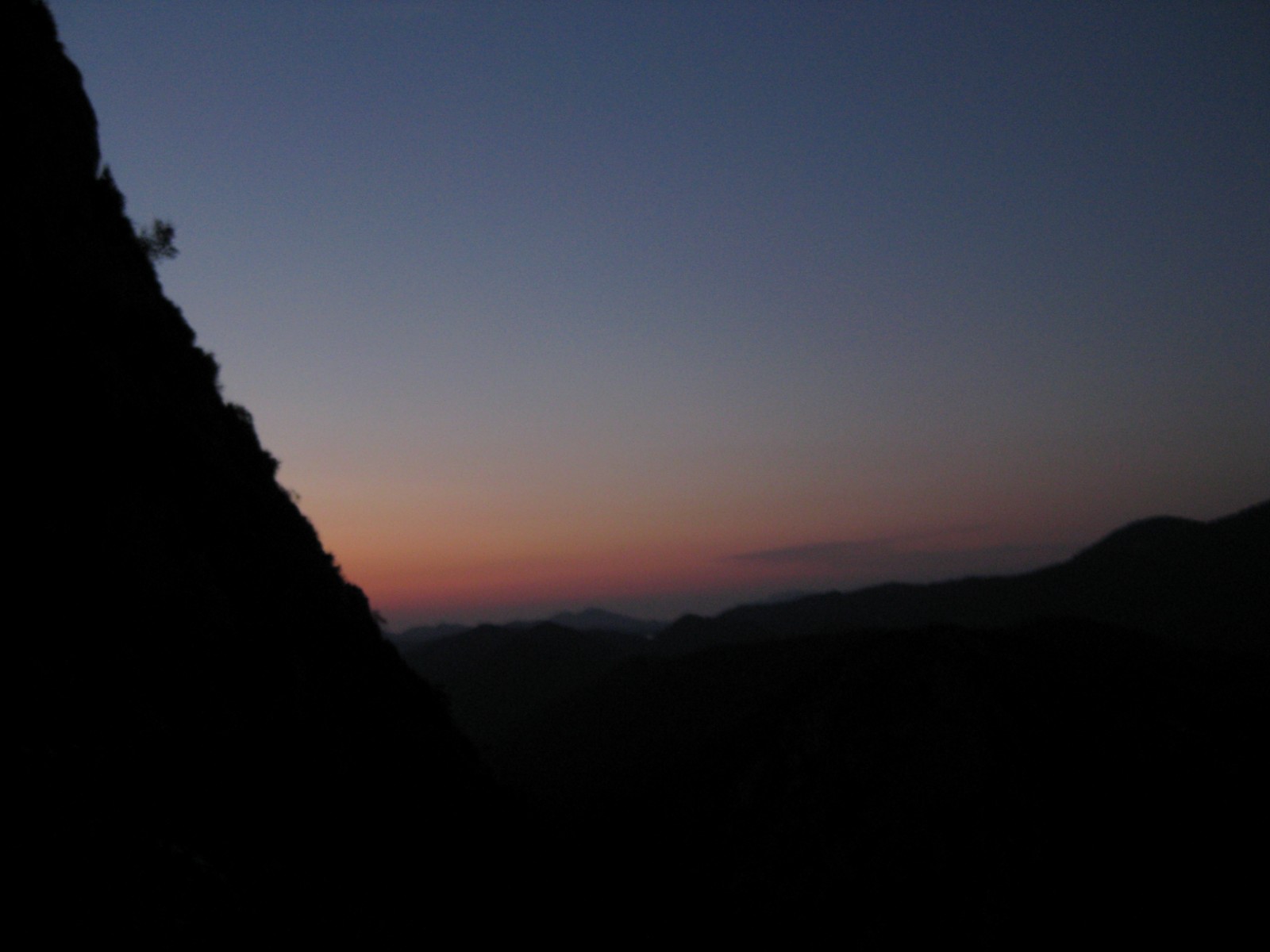
Towards the top, the night sky was slowly washed from inky blue to delicate blues, pinks and greens by the sun which was still well below the horizon.

The sun first appears. It’s just after 6 o’clock

I found a couple of friends there, and a vantage point relatively distant from the crowd crammed into the castle ruins.  They had come to see something special- the rays of the sun as they poured through the ruined windows.  I decided it was too packed with people to feel special in there.  I’ll come back another day soon, to see for myself.

And again, a very few minutes later

What I saw was quite wonderful enough: a rich copper disk slowly mounted above the line of mountains in the distance,  tinting the sky ochre, rusty-red, sugar-pink, finally emerging so fiery bright I could no longer look at it.  Some locals burst – quite beautifully – into song.   Occitan/Ariègeois stalwarts, ‘Quand lo Boièr ven de laurar…’ and,inevitably, ‘Se Canto’.

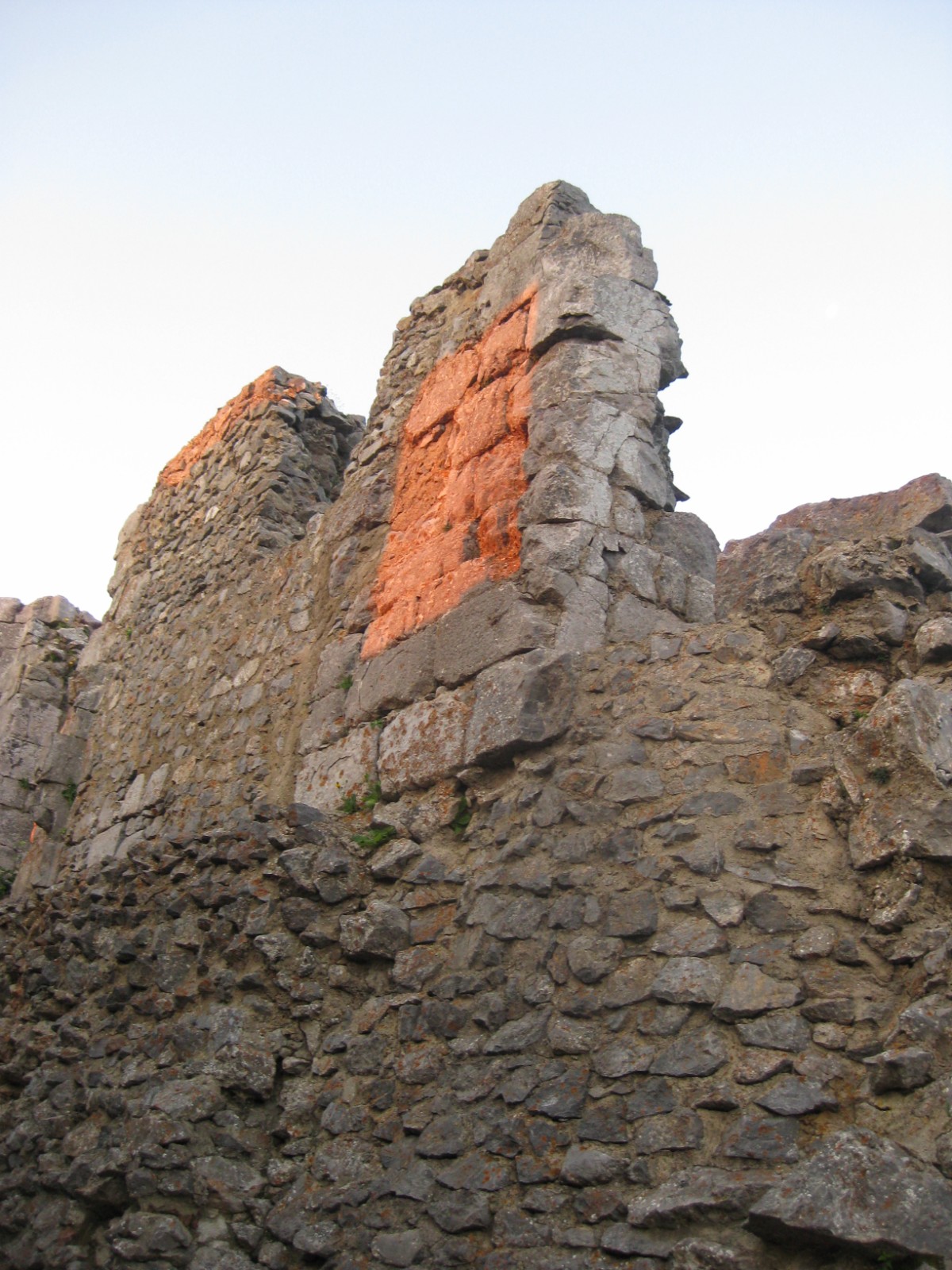
The rising sun, shining through a ruined window, casts an image on the castle wall

Gradually the whole sky lightened and brightened, turning the entire landscape crisply clear.  I strolled round the summit – it was surprisingly easy to get-away-from-it-all, before skidding and climbing my way down to the car park again….

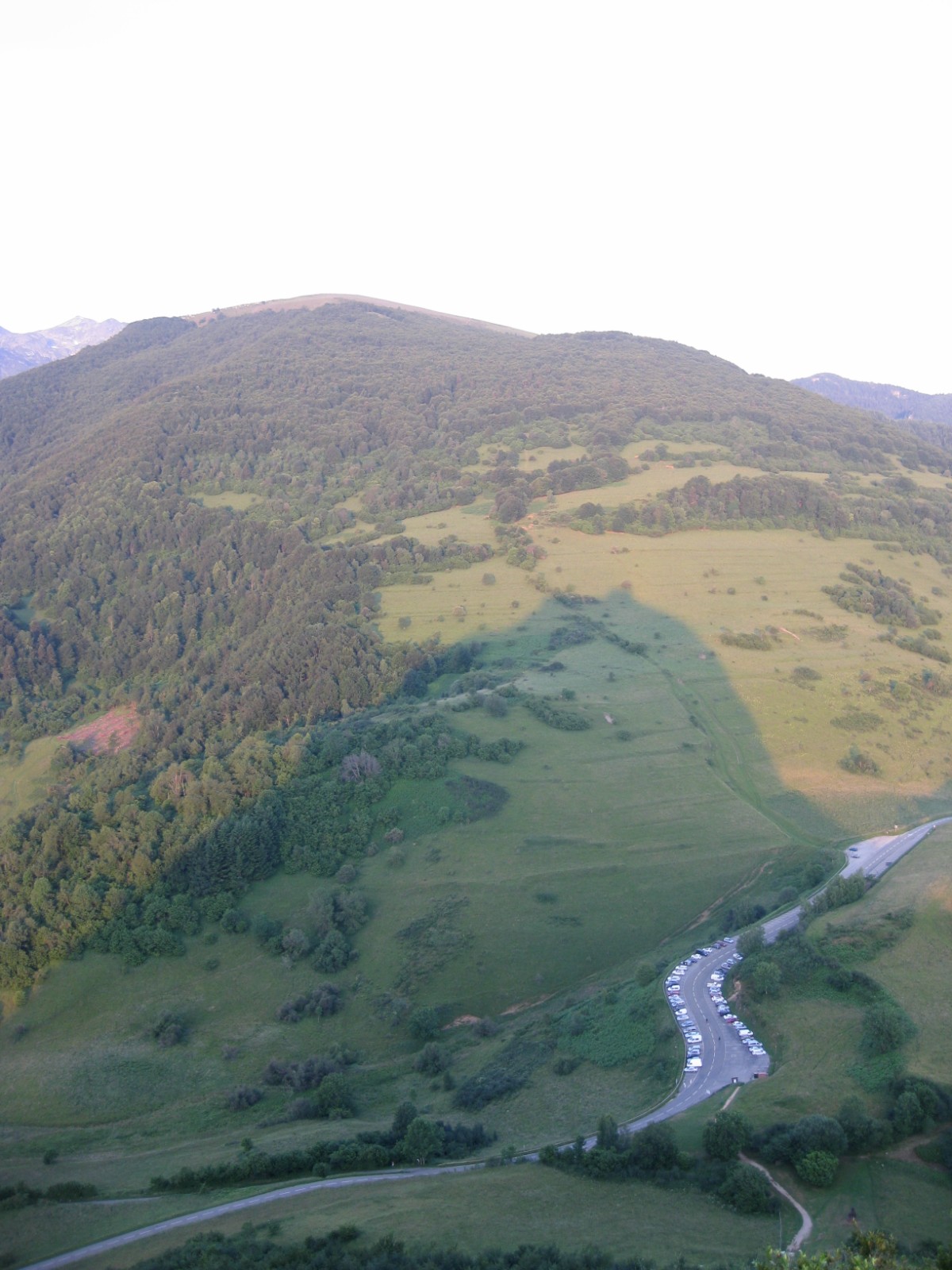
Montségur casts a shadow on the hillsides beyond. The car park’s still full.

….and there were my companions who’d provided torchlight.  They were hitching, because their car had failed to start.  We journeyed back to civilisation together, ready to resume normal service.  It was 7.30 a.m.

Almost deserted again, Montségur in the early morning light

Transhumance in the Haut Salat

Transhumance.  It’s that time of year where here near the Pyrénées, the cattle and sheep are moved from their winter quarters down on their lowland(ish) farms up to the lush summer pastures in the mountains.  They’ll stay there till Autumn, and then be brought down again.  And each time, it’s the excuse for a party.

On Saturday, we joined in, and went over to Seix to meet friends who live there.  The Transhumance celebrations in Haut Salat last three days, but we made do with Saturday morning.  We nearly arrived late – very late – because we found ourselves behind a herd of cattle making their steady way along the road.  Overtaking’s not an option: the cows commandeered this route hundreds of years ago.  But we managed to zip down a side road and make a detour.  A whole hour later, after coffee with our friends, the herd reached the edge of Seix and passed their door….

…and finished their long walk into town.  We went too, and arrived just as the last flocks of sheep were arriving, to be corralled like the cattle, at the edge of the town square.  For a while, and probably much to their relief, they were no longer centre stage.

Instead it was jollity of the traditional kind. There were processions of large solemn plaster effigies, local bands.  Dancers from Gascony, the Basque country, the Landes made sure we all had fun, and Malcolm and I even joined in some Basque dancing.  Stars of the show for us were the shepherds from the Landes.  Theirs is flat, marshy country, and they used to keep their eyes on their roving flocks by ranging round on stilts.  But this was a day for dancing, and that’s just what they did, up high on those stilts.  Have a look at the photos.

We went off for lunch at the end of the morning.  But there was more celebrating, more meals to be shared, particularly by those farmers and country people who over the centuries have welcomed the fellowship of Transhumance as a break from the routines of an often lonely life.

This slideshow requires JavaScript.

Euskal Herria meets the Yorkshire Dales

This week was a first for us, when we made a quick visit to the Basque country (Euskal Herria), way over to the west .  When we got there, there were no frontier posts, but we knew immediately that we’d arrived.  Suddenly, houses, instead of being colour-washed in creams and beiges and ochres, or not at all, were  all tidily painted white, every single one, with ox-blood coloured shutters and paintwork.  Place names were in French and Basque, and quite a lot of other signage too.

But the thing is, despite all that, we thought we’d arrived in Yorkshire, or Lancashire, or somewhere in England at any rate.  Softly rambling ranges of hills, so very green, and studded with sheep.  Roads which preferred to ramble gently round the contours instead of going straight in the French style.  Take away the Pyrénées in the background, their jagged peaks still white with fresh snow, add in a few drystone walls, and – voilà! – the Yorkshire Dales.

After all the hard work back at the house, we needed the peace of the countryside, so we’d chosen to stay at an Accueil Paysan farm. We knew that  meant that we’d be welcomed into simple comfortable accommodation at the farmer’s house, and share a family meal with them in the evening.  Always good value in all sorts of ways.

The welcoming committee in this case turned out to be six cheerily noisy pigs, a gang of chickens, and a sheep dog.  The humans were no less friendly, and we settled in by exploring the small farm with its 30 or so cattle, and about 300 sheep.  Sheep’s cheese is the big thing round here, and throughout the autumn and spring, when there’s plenty of milk, this family makes cheese every morning (far too early for us to be there, it turned out: all over by 7 o’clock) in their fine new cheese-production shed.

Our hosts are Basque speakers.  Their children only learnt French when they went to school.  Now that one of these children has a son of his own, he and his wife (who’s not a Basque speaker) have chosen to have the boy educated at one of the many Basque-medium schools, so that he will be among the 30% of Basques who are comfortable using their language.  It’s an impenetrable and complex one.  Its roots are a bit of a mystery, and certainly it’s not Indo-European.  With French, Italian and Latin at out disposal, we can make a good stab at understanding Occitan, the language of our region, but Basque remains impenetrable to anyone who hasn’t been immersed in it.

The next day, we explored St. Jean Pied de Port. From before the time of the Romans, it’s been a market town, an important jumping off point for Spain.  It’s been a garrison too, and an important stop-over for pilgrims on their way to Compostella.  Now it’s a tourist centre too, for walkers in the region.  It’s an attractive town, surrounded by ramparts.  We pottered around, enjoying views from the ramparts, pilgrim-spotting, ancient doorways, and watching the river, before setting off for a leisurely journey home.

And next time we stay, we’ll make it much longer than 36 hours.

This slideshow requires JavaScript.