When teachers bring parties of children to Fountains Abbey, we often tog them all up in monastic robes, and explore the site with them .We want them to get a feel of the day-to-day life of a mediaeval monk. What? Prayers eight times a day? No underclothes? No talking? No heating? They’re impressed, in a horrified kind of way.
Then they go away, with only brief notions of the story the Abbey itself has to tell. Or why the place is a roofless ruin.
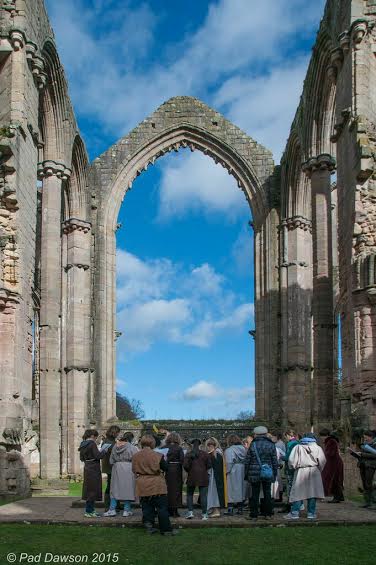
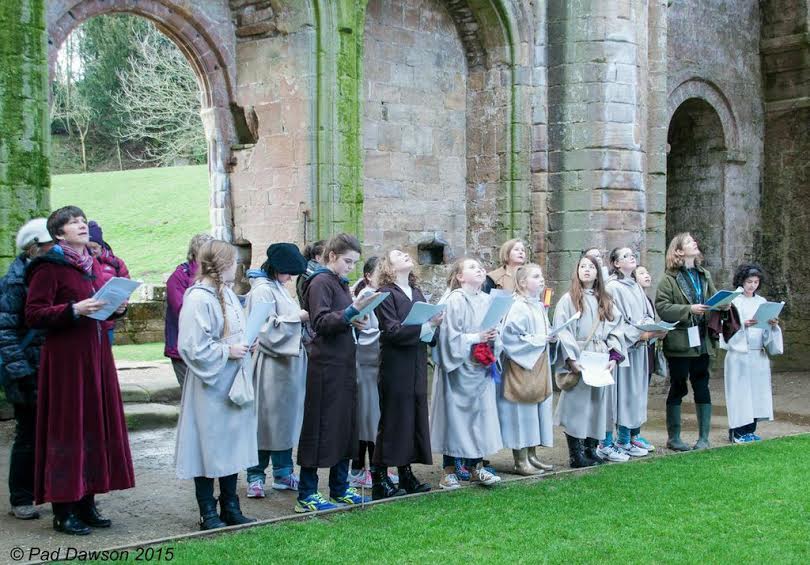
Until this year. Now they can come with their teachers and ‘Act the Facts’. They’re given props – perhaps a simple cape, a feathered cap, a woollen robe, a crown . These turn them into an early monk, a master mason, an Italian wool merchant, a dastardly baron, or even Henry VIII.
They have a script. It’s a melodramatic pastiche telling the Abbey’s turbulent history. Simple God-fearing beginnings, then powerful prosperity, then war, plague and corruption all leading to the final action. Henry VIII dissolves the monasteries.
The question at the beginning of the play is –
‘Who destroyed the Abbey?’
Acting it out, the children lose their places, stumble over words like ‘Cistercian’ and ‘lavatorium’, and forget which character they’re playing.
Honestly, what’s the point? It’s too complicated. They’re learning nothing.
Then they reach the end. We ask them to line themselves up. Twelfth century characters first, then thirteenth… and so on, through to those who bring the story to an end in 1540. We ask them which century was best.
And that’s when we realise how much they’ve learnt. They talk passionately about the simple piety of the early days set against the laxity of later centuries. They discuss austerity versus comfort. They talk feelingly about the plague, and the reasons for the Dissolution of the Monasteries.
And in telling the story of the Dissolution, they’ve solved the mystery of why Fountains Abbey is a roofless ruin.
Back at school, there’s so much for their teachers to build on. The ruin has brought history to life.
Come and see it for yourselves. We can’t promise you a feathered cap, or a cardboard crown, but you could join one of the regular tours. You’ll get a real taste of history as you soak up the special atmosphere of this special site.
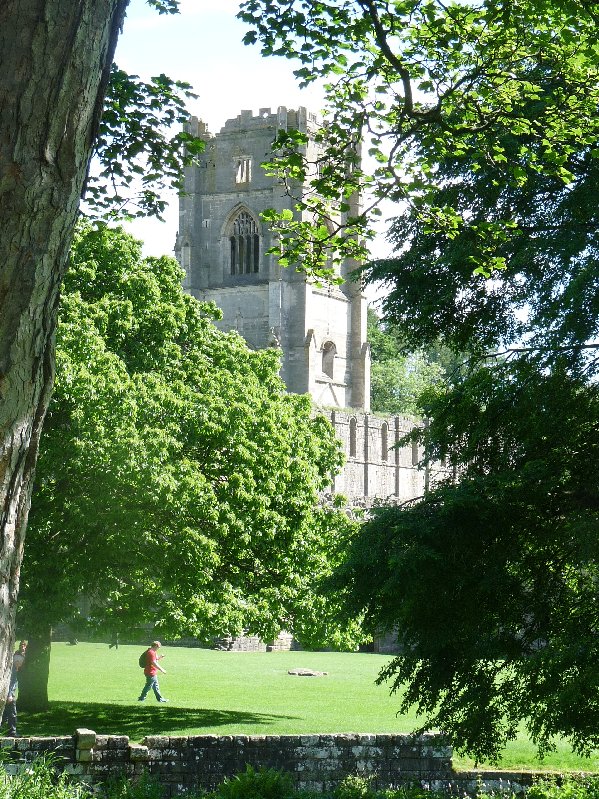
What if you and I were strolling through the grounds of Fountains Abbey, or some other national treasure, and I asked you what you most appreciate about the chance to visit to somewhere like this . What would you say? What about ‘I enjoy seeing…’, ‘It’s a chance to look at….’, ‘I like to watch….’? I know I would. That first sight of Huby’s Tower for instance, as I tramp down towards Fountains Abbey on a cold and frosty morning, or on a bright and promising summer day, or on a dusky day in late Autumn or Winter, never fails to stir my soul.
Huby’s tower glimpsed through the trees on a summer’s day.
But what if I couldn’t see it? What if I were one of the two million visually impaired people who live in the UK? Would that mean I’d simply have to count myself out of a family trip there, stay at home and go without that experience?
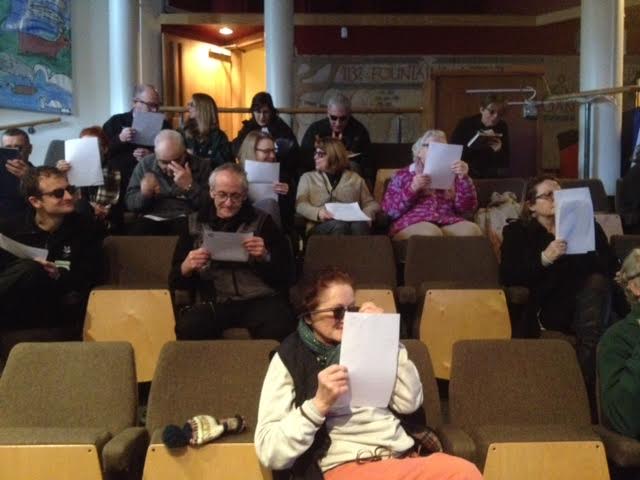
At Fountains Abbey and Studley Royal, we rather hope not. Last week, staff and volunteers alike crowded into the lecture hall to get a taste of what it’s like to live with visual impairment, and to begin to understand what kind of support this section of the population – only 4% of whom are fully blind – actually needs, in order to live rich and active lives. Afterwards about a dozen volunteers remained behind to begin a journey towards becoming Community Sighted Guides.
Struggling to overcome the visual impairment of special glasses mimicking various forms of visual impairment. (Photo courtesy of Emma Manners)
We thought about what ‘visual impairment’ means. To some, it means ‘seeing’ the world as if through thickly frosted glass. To others, it’s putting up with the limited view you would have if squinting down a drinking straw. Others find their view constantly defaced by blotches in their field of vision. And so on. We tried on special glasses which mimicked these effects, and experienced the frustration of never getting things quite in focus, or of not being able to get visual cues from conversations going on around us, of not being able to read the material there in front of us.
And then we thought about what we ourselves appreciate about visiting our own and other properties. We talked about listening to birdsong, to leaves and to gravel scrunching beneath our feet, to the River Skell tumbling and burbling past the monastic buildings. We remembered savouring the smells of the damp earth early in the day, the tang of wild garlic, the musky smell of dry Autumn leaves. We observed that we like to touch the ancient stones of the Abbey: to run our hands over tree bark, noticing how some trunks are smooth, some rough and knotted. We often sit down for a while on a rough wooden bench, a cold stone seat or the damp cool grass. So much to enjoy and appreciate, even without the use of our eyes. Yes, we’d like to come on a day out to Fountains Abbey, even without fully functioning sight, especially if we could put our trust in a volunteer sighted guide.
Then came the moment to put our trust in each other. We took it in turns to be blindfolded, and to be led by our partners through the carpeted Visitor Centre, along a tarmac-ed route, down a rather steep gravelled path, along a rather winding one, down some steps towards the Abbey. At first putting one foot safely in front of the other demanded all our attention. Gradually though, we came to appreciate our surroundings, and began to ask questions of our trainee guides, encouraging them to talk about the snowdrops in season, the trees we were passing, the other visitors who overtook us. As guides too we learnt to relax, and to offer simple companionship to our ‘visually impaired’ partner.
We’re a new team, so far untested. But we’re looking forward to gaining in confidence, and to having the opportunity to learn to share our appreciation of Fountains Abbey and Studley Royal with another different audience .
With thanks to Lorraine and Anne from Guide Dogs UK for their inspirational training, and to Emma Manners, Learning Officer, FASR who arranged this training.
If the National Trust property where you volunteer has an abbey on site, albeit a ruined one, that’s where a good few of the Christmas celebrations need to take place.It’s fair to say that there are many people locally who regard a chance to hear singing from a local choir at one of the ‘Music and Lights’ events, or at the carol service here, as one of the focal points of their pre-Christmas celebrations.
The Abbey hasn’t had a roof since Henry VIII’s men came and removed it. Only the cellarium, which the monks used for storage, specifically for vast quantities of valuable woollen fleeces, is still under cover. It’s a little draughty too, as the windows remain unglazed, but the acoustics are amazing. The monks who used to call the abbey home might be rather surprised to find that their storage facility is nowadays, from time to time, a concert hall.
Picture the scene before the service began. Here’s the cellarium at 1.30 p.m.
The cellarium, empty at 1.30 p.m.
For two hours after that, though, there was a batallion of volunteers, with a couple of members of staff cheerfully mucking in to transform the place. Some of us hauled ranks and ranks of folding chairs out from storage and arranged them neatly. Some protected scores of candles with little cardboard collars so nobody would be burnt by molten wax when the time came to light them during the service. Others uncoiled lengthy snakes of cable for the sound and lighting systems. And the largest team of all arranged the refreshments: coffee, tea, hot chocolate, mulled wine.
By 3 o’clock. members of the public were already choosing their seats, and the refreshment stand was very much in business. ‘One coffee, two teas and four mulled wines please!’ ‘Two hot chocolates, a mulled wine and a coffee’. On and on we worked. Suddenly, someone said she thought she could hear ‘Oh come all ye faithful’ in the distance. The service had long since begun, and we’d been too busy to notice.
The carol service continued, service of refreshments continued. By half past 4, things finally started to quieten down as the event drew to a close. Time for the team to snatch a refreshment break, and do a little accounting. We’d sold far more than £1000 worth of hot drinks, including 66 bottles-worth of mulled wine. Not bad for a couple of hours’ hard graft. And as the congregation proved willing to do a whole lot of chair shifting, clearing up didn’t take too long.
Even if we didn’t hear many carols, we felt we’d had a good start to the Christmas season. It hadn’t been very peaceful, but there had been plenty of cheerful good will from staff, volunteers and visitors alike.
And meanwhile, up at the entrance to Fountains Abbey & Studley Royal, two other volunteers had been busy. Here’s Sharon, Volunteer Elf, welcoming visitors to meet Father Christmas – a volunteer, of course.
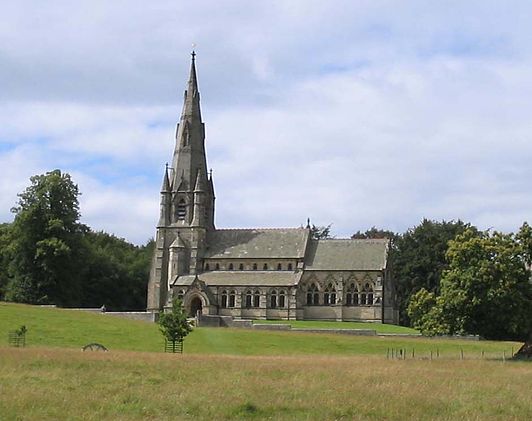
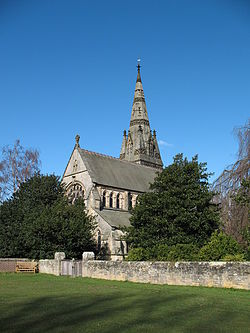
St. Mary’s Church, Studley Royal (Wikimedia Commons)
When I started out as a National Trust volunteer, when I began as an Information Assistant at St.Mary’s Church, Studley Royal, I didn’t expect to sort out a little mystery that’s continued to exercise my brain from time to time, ever since my first and only visit to India, 8 years ago.
Let’s begin there, back in 2007. It was my first day, all by myself, after a night flight into Bangalore. I was far too excited to sleep, and already over-stimulated by a city, busy since well before 6.00 a.m., alive with cows, horses, donkeys, sheep, chipmunks, dogs by the thousand, monkeys, parakeets, eagles …. and auto-rickshaws, always auto-rickshaws, and the unending sound of motorhorns constantly in use on every car and lorry. I’d already allowed an amiable rickshaw driver, who could doubtless see ‘arrived this morning’ tattooed across my forehead, to take me on a conducted tour of the city. We served each other’s purpose. I got a decent sit down and a running commentary in broken English on the city sights. He was probably paid over the odds by a very appreciative customer who knew a decent bargain when she saw one. When I left him, after a thoroughly entertaining morning, I found myself wandering towards London Road. And then Robinson Street. Robinson Street? Who could Mr. Robinson be? I finally found out ….. the other week. If only I’d wandered just a little further on that first day in Bangalore, I’d have been offered a clue. I’d have found ‘Ripon Street’.
My first friend in Bangalore: the rickshaw driver who took me on a tour of the city
Eagles fly above Bangalore
Bangalore street scene.
Fast forward to an early session at St. Mary’s Church, Studley Royal just a few months ago. My fellow-volunteer Frances was taking some visitors round. I tagged along, because Frances has an apparently bottomless fund of knowledge, and a way of engaging her willing listeners’ attention. She’d already told them that the church was the design of a noted exponent of Gothic Revival architecture, William Burges. She’d pointed out several examples of its inventive design, of its richly coloured decorative detail, of its religious symbolism.
Burges famously loved animals. There are 16 of thse parrots.
Starting outside the church…..
First glimpse of the richly coloured interior
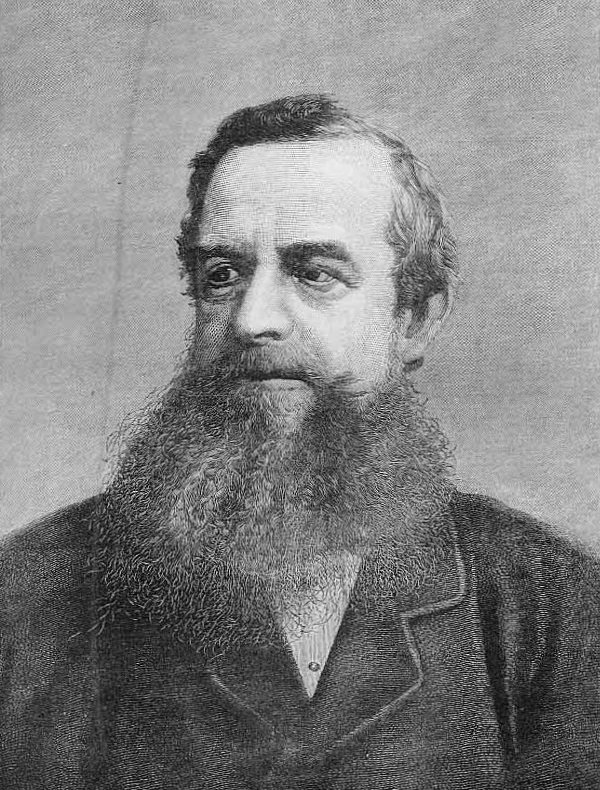
Now she was telling us that it was commissioned in 1870 by the deeply religious Marchioness of Ripon, and her husband, the Marquess. His full name and title was George Frederick Samuel Robinson, 1st Marquess of Ripon, 2nd Earl of Ripon. She thought we might like to know his story. She was right.
The Marquess of Ripon had an impeccable pedigree. He was born in No. 10 Downing Street, and as an adult, served as an MP in various northern constituencies. Shortly after succeeding to the title of Earl of Ripon in 1859, he became first Undersecretary to India, and later Secretary of State for India. From 1868 he was highly valuable in a variety of roles in William Gladstone’s government.
Then, in 1874, he converted to Roman Catholicism. His strong sense of duty prevented him from continuing to serve in government. The Church of England (the Established Church) and state are linked in the United Kingdom. He withdrew from public life.
However, in 1880, Gladstone persuaded him to take the post of Viceroy of India. The Indians grew to honour him: the British rather less so. Here’s why.
He expanded the powers of locally elected Indian governments, and liberalised internal administration. He lowered the salt tax. He gave local language newspapers the same freedoms as English ones, and enacted some improvements in labour conditions. He allowed Indian judges the same rights as European ones when handling European defendants. And he achieved all this in only four years. No wonder Indians felt the least they could do was name a few roads after him.
George Frederick Samuel Robinson, 1st Marquess of Ripon (Wikimedia Commons)
He went on to serve in other capacities before becoming leader of the Liberals in the House of Lords, and died in Ripon in 1909.
So – thank you St. Mary’s, Studley Royal. And thank you Frances, National Trust volunteer. An eight year old mystery is solved.
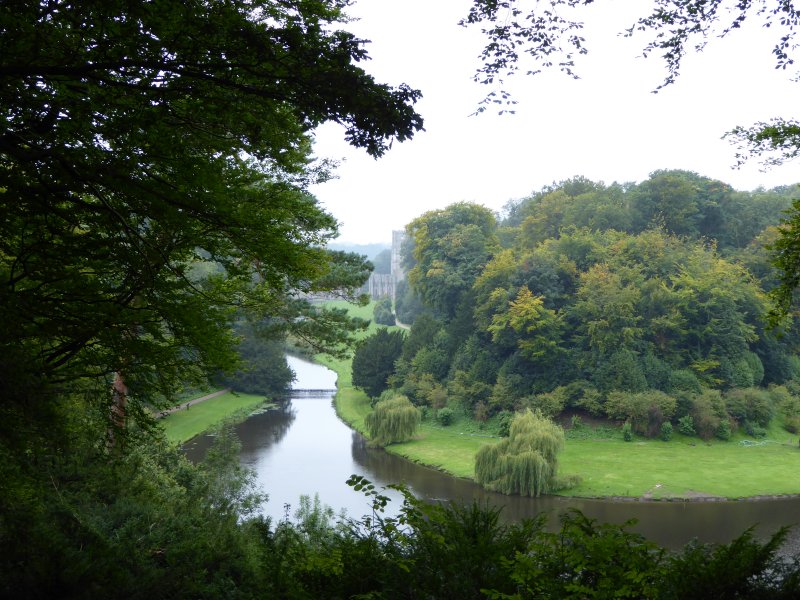
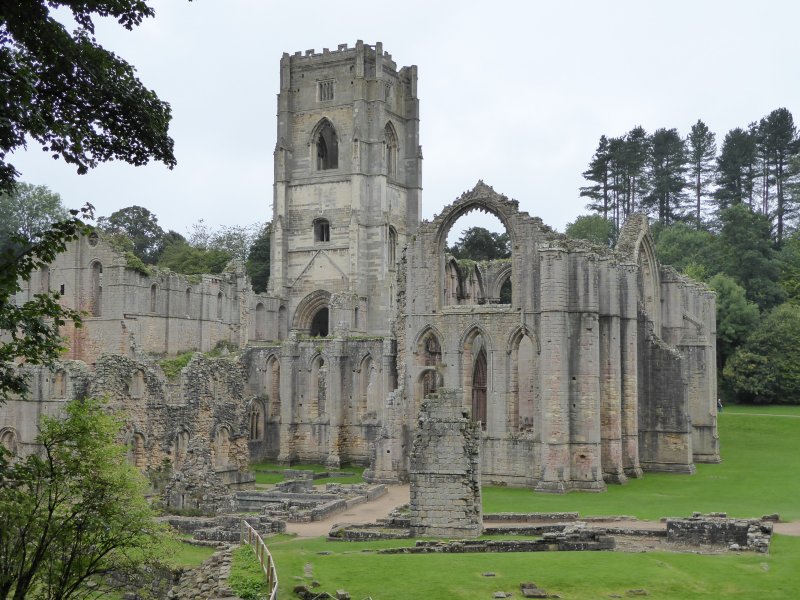
Walk round the grounds of Studley Royal, and this will be your first sighting of Fountains Abbey.
A few months ago, I got a job. Not for the pin-money, because I’m not paid a penny. But I’m richly rewarded. I signed up to be a volunteer for the National Trust, at the property nearest our home, Fountains Abbey and Studley Royal. Cistercian Abbey, Georgian water garden and mediaeval deer park…. no wonder it’s a UNESCO World Heritage Site.
Since we moved to Ripon, we’d loved spending time there, so I got to wondering….what would it be like to volunteer there? What could I do? What might be involved?
The answer turned out to be…almost anything you want There are dozens of different roles, from gardening to guiding. You could drive the mini-bus or form part of the archaeological monitoring team. You could work in the shop, or in the admissions areas. Badged up, you could wander the grounds, being alert to the needs of visitors who’d like a potted history lesson or to find their way to the toilets. You could work in the wildlife team, helping look after and monitor all those ancient trees, or the herds of deer. You could turn to when there’s a special event, and put out chairs. And you’re quite entitled, over the years, to change your mind and try something else.
I for instance, started out as a visitor assistant at the Victorian High Gothic Church of Saint Mary’s in Studley Royal Park. It’s a real masterpiece of Victorian architect William Burges, but it turned out not to be ‘me’. I admire the building hugely, but it doesn’t involve me at an emotional level as the ruined abbey does. So I quit. No hard feelings
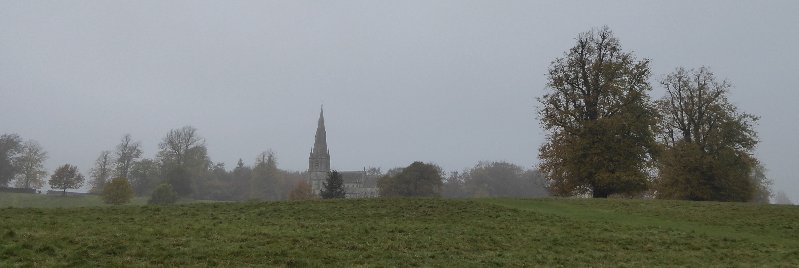
Looking across at St.Mary’s from the Deer Park.
But I shan’t be quitting the Learning Team. Our bread-and-butter is sharing a Day In the Life of a Monk with schoolchildren. The children dress up in monk-style habits, and tour the site getting in touch with the brothers’ silent and family-free routines, led by one of the team. We examine the roofless, windowless Abbey and try to picture the church back in its prime. We imagine the vast space, illuminated only by candles, as the monks worshipped there eight times a day, from 2.00 a.m. onwards. We visit the refectory where the monks dined, in silence, once a day. Did those monks eat meat? What about potatoes? No? Why not? We visit the Warming Room and imagine having just four baths a year, shaving our tonsures with oyster shells. We discuss bloodletting. We talk about all the daily routines. Maybe the children remember only a few of the facts later, But we hope they are moved by these atmospheric ruins, and return later with their families.
Fountains Abbey.
They might come though, to experience the natural environment of the grounds: they might go pond dipping, or on a walk where they try to use all their senses by listening, touching , seeing, smelling and so on. Or make mosaics based on what they’ve observed. Or go den-building in the woods. They’re as sure of a grand day out as are the volunteers in the team.
I’ve ended up doing all sorts of stuff I’d never have thought of attempting. Car park attendant on Bank Holidays? I didn’t think so. But it turns out to be fun togging up in a hi-viz jacket, barking out radio messages on the walkie-talkie system, getting in touch with your inner traffic cop, and generally being a welcome face to visitors as you help them manouevre themselves into the busy car park.
And some things are quite simply, a privilege. I wish you could have joined me on Sunday evening. After dark, the site was opened to less mobile visitors. For one night only, cars were welcome on site, to be driven s-l-o-w-l-y past the floodlit Abbey buildings. The evening was cold, misty, moody, atmospheric. Night birds swirled above the trees, dampness dripped from the trees, and monks could clearly be heard from within the abbey, chanting their plainsong (a recording, actually, but none the worse for that). I talked to some of the visitors, often very elderly, as their cars and drivers made their stately way through the grounds. Their appreciation of the staff and volunteers who were there helping the evening to go smoothly, though nice to hear, was quite unnecessary. I wouldn’t have missed this experience for anything. A special evening indeed.
And there are other perks. A couple of times a year there’s a ‘works outing’, when volunteers can take a trip to properties in other parts of the country. Here’s one. There are winter lectures for those who want them, to widen and deepen their knowledge of the history of the place There are times to socialise – a barbecue, a quiz night, meals. We’re very well supported, properly trained, and appreciated by the regular paid staff. I look forward to every single thing I do as a volunteer at Fountains Abbey and Studley Royal. I feel very lucky.
The days are getting shorter. The nights are getting longer. We grumble every time we notice another milestone passed, another hour in which it’s no longer possible to enjoy sun and light and – daytime. Ten o’clock. Nine o’clock. Eight o’clock. And now we’ve reached 7 o’clock. Winter’s on its way.
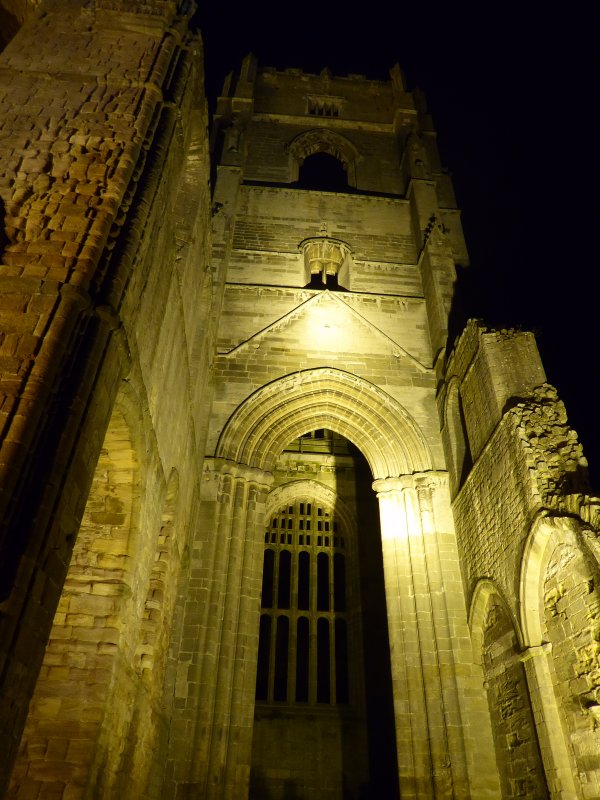
But there are consolations in that diminishing light. Yesterday for instance. As darkness started to blot Fountains Abbey from view, floodlighting blazed over the buildings, enhancing well-known silhouettes against the night sky. Places grown familiar to me over the past months presented themselves fresh and new. The structure and proportions of those arches! Those solid yet soaring columns, supporting unimaginable weight! That vaulting in the cellarium! No mediaeval monk would have had the least experience of the power of modern lighting to illuminate every corner of the abbey they knew so well from a lifetime spent within its confines. Yet last night, I felt closer to them, and to their spiritual concerns and way of life than I do as I enjoy the abbey site by day.
Glancing upwards to Huby’s Tower.
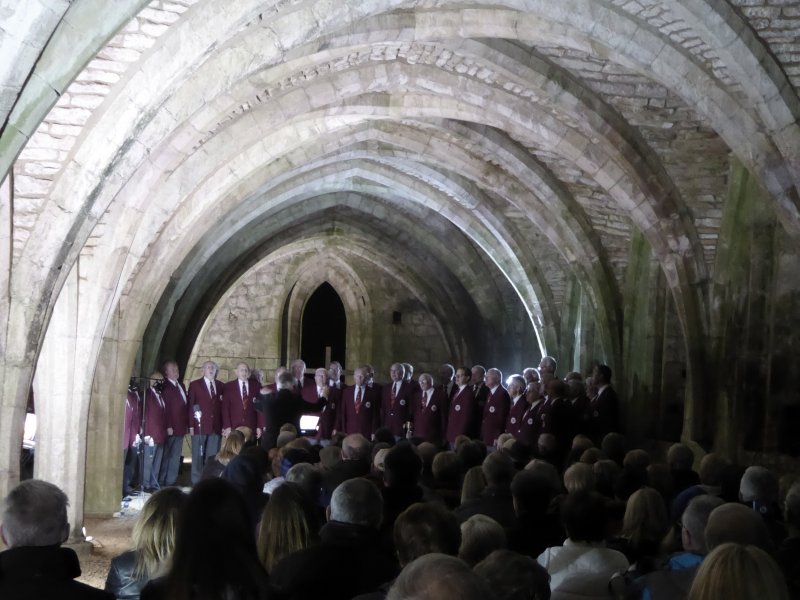
The place was busy though. I was there as one of my duties as a regular volunteer there*. Dressed as a monk, I first of all spent an hour or so with families, taking them round the site while talking about the daily routine of those silent choir monks, from their first act of worship at 2.00 a.m. to their eighth and final one at an early bedtime. And then I stayed dressed in those robes as night fell, the floodlighting came on, and Saddleworth Male Voice Choir assembled in the cellarium to perform in the gathering darkness. The acoustics of the place are exceptional, bringing a power and mystery to the voices of the singers, affecting listeners and performers alike: everyone present knew they were witnessing something special.
Performing in the cellarium
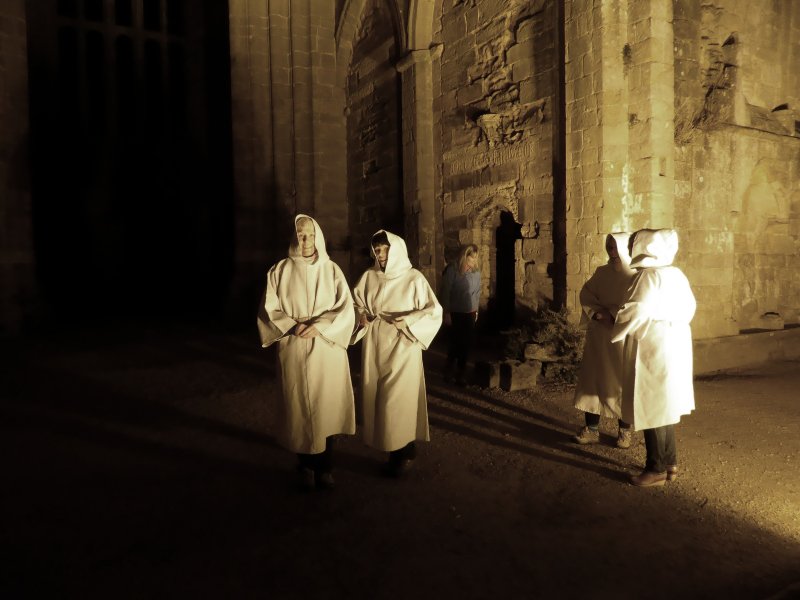
As for me and my fellow ‘monks’. Well, we answered questions, We tried to persuade children to join us at 2.00 a.m. Vigils (Did any of them come? I don’t know. I was asleep at the time). We were on call as local colour for all kinds of photo opportunities.
Monks by night.
As the music finished, we all walked up the hill, away from the Abbey, to street lights, a car journey back home, and 21st century life. It had been good, very good, to have an hour or two away from all that, in touch with life in simpler times.
Fountains Abbey by night,
*I keep promising to tell you more about life as a National Trust volunteer at Fountains Abbey and Studley Royal. And I will, I will.
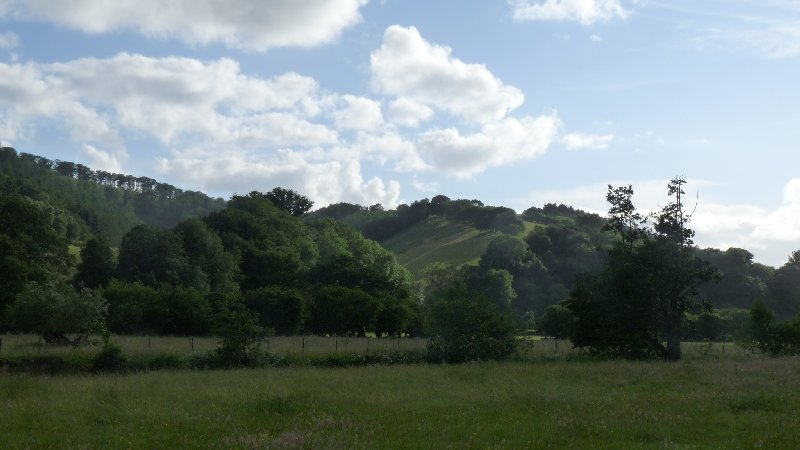
We’ve just come back from Herefordshire, where we’ve been helping our friend Hatti celebrate a Big Birthday. She and her family have a cottage there – it’s been in their family for decades now – in the back-end of nowhere, alongside the River Lugg. If you don’t like fishing, or walking the hills and vales, or mooching along woodland paths, best not go there. If you’re in a hurry, don’t go. You’ll only meet a tractor on a narrow single-track road and be forced to reverse all the way back to the last junction. There’s no nightlife, no shopping malls, no nearby towns, not much of any evidence of 21st century life – the family cottage doesn’t even have electricity, for goodness sake: gaslight in the evening is a reposing and rather nostalgic experience.
The cottage.
The River Lugg at the bottom of the garden.
The welcoming committee in the next field.
History, though. The area has history. It’s part of the Welsh Marches, that border territory between Wales and England that was fought and skirmished over pretty constantly from the time of the Romans, by Angles, Saxons, Normans and countless ancient tribes, right up to the time of the Tudors. Offa’s Dyke, that 8th century earthwork which largely defined the Welsh border for centuries can still be seen not too far from here. This was frontier territory, crammed with motte-and-bailey castles, and garrison towns such as Hereford and Shrewsbury. An area of gently undulating hills, deep and wooded secret valleys, it’s a territory that must have lent itself to scraps, battles and long-drawn-out tit-for-tat fighting between the area’s war lords.
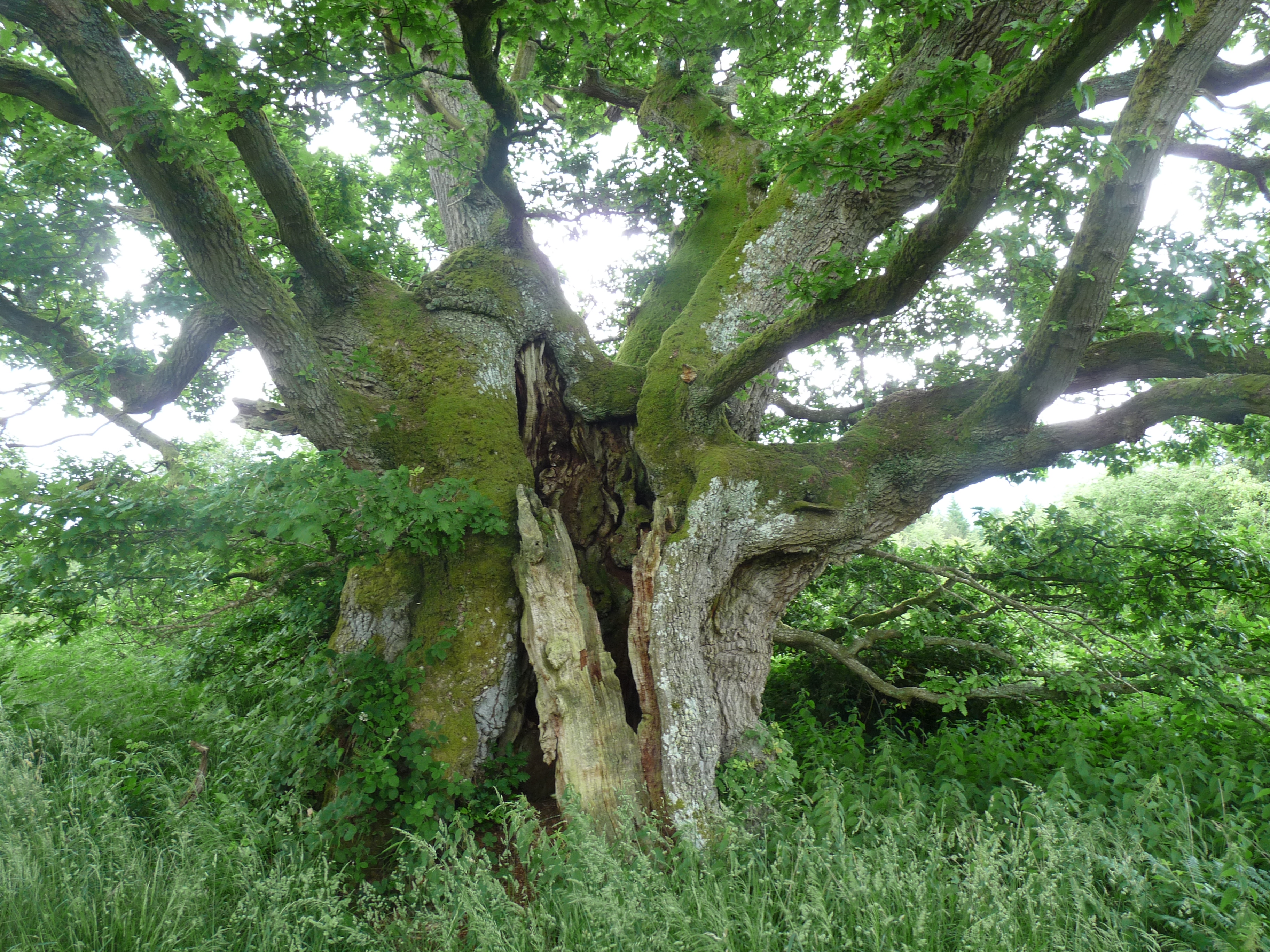
It’s hard to imagine now. Those hills and valleys are patchworked with fields where cattle and sheep browse the meadow grass, and where crops are maturing, ready for the summer harvest. The woods are still there though, and there are trees so old that they may have seen some of those ancient conflicts. There’s an interesting story surrounding the gnarled and twisted sweet chestnuts and oaks in the parkland of Croft Castle, just down the road from where we were staying. It’s said the sweet chestnuts trees were planted in 1588, in the formation of the Spanish Armada.
A Spanish sweet chestnut shows its age.
Oaks represented the English navy. Though some trees are even older. This oak tree is thought to be 1000 years old.
The 1000 year old Quarry Oak at Croft Castle.
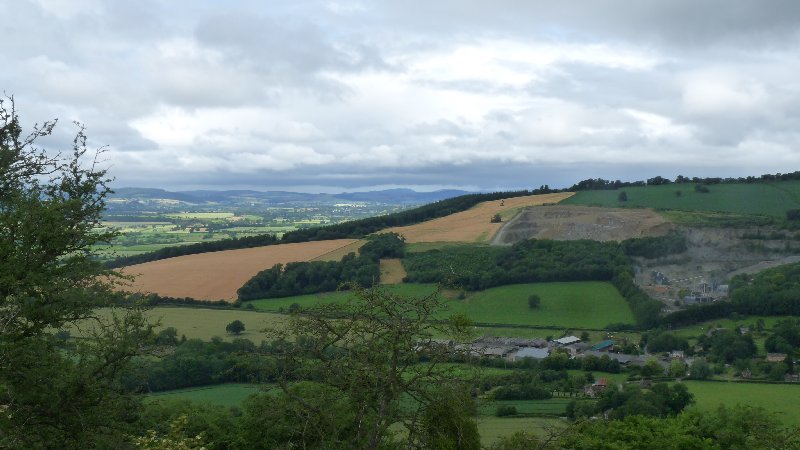
Carry on walking though, and you’ll climb upwards and find yourself on the site of an Iron Age hill fort. Recent excavations there have found evidence too of Romano-British fire ceremonies, animal sacrifice and feasting. Nowadays, it’s enough to marvel at the views across to England one way, Wales the other. It’s said you can see 14 counties on a clear day. We couldn’t, but that may say as much about our command of the local geography as anything else.
Commanding views of several counties, in England….. and Wales.
We had a wonderfully satisfying break: peaceful, lovely countryside to explore, with the added bonus of parkland, gardens, ancient churches. And while Herefordshire remains rather difficult to get at from just about anywhere else in England, it’ll probably go on being one of the country’s best kept secrets.
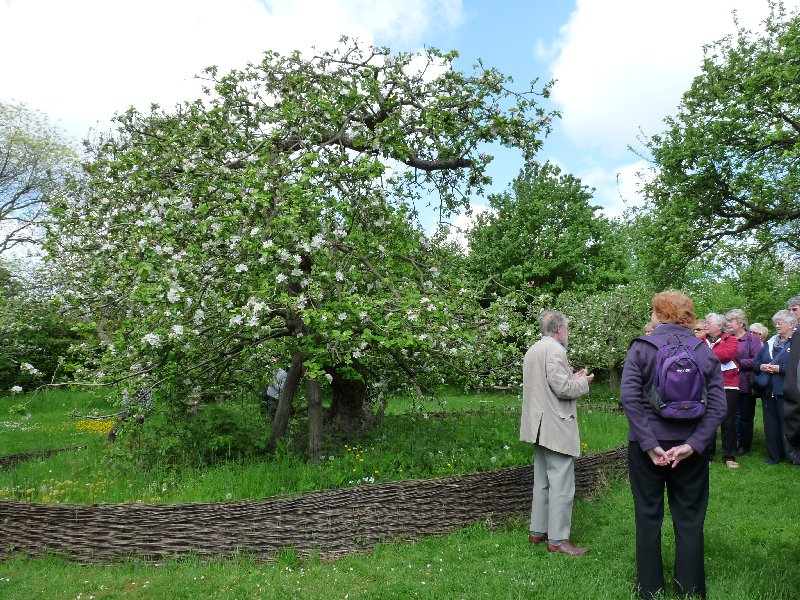
We gather round That Apple Tree to hear its story.
Isaac Newton, as every English school child knows, was sitting in the garden when an apple from the tree under which he was sitting dropped beside him.
He thought about it. And then he thought some more. Why do objects always fall vertically? Why not go sideways? Or upwards? Me, I’ve never even wondered about this. It’s just the way things are. But sitting under that apple tree, 350 years ago, Isaac Newton began to work on developing his best-known achievement: the theory of gravity.
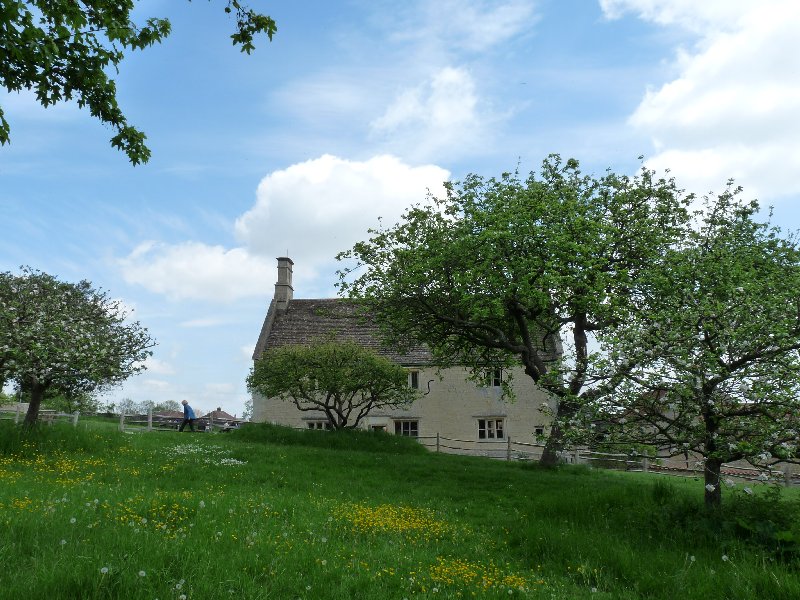
Yesterday, we visited the house where Isaac Newton used to live, and saw the apple tree which grew from the ruined trunk of the tree which he sat under. I’m a National Trust volunteer at Fountains Abbey and Studley Royal – more of that in my next post – and we were on a summer ‘works outing’, visiting a couple of properties in Lincolnshire.
And here we were at Woolsthorpe Manor. It’s the farmhouse where Newton was born in 1642, and where he grew up. Isaac was a reflective, head-in-the-clouds sort of child, and it was obvious that he’d never be a useful farmer. His teacher persuaded his mother to let him study at Cambridge University, where he paid his way for some of the time by working as a valet. But in 1665, Cambridge temporarily closed its doors, for fear of the plague.
It was during this time of ‘exile’ that Newton began many of his experiments in the field of optics, astronomy and the laws of motion. He developed the branch of mathematics we know as calculus. And then he left for Cambridge once more, and his career as academic, MP, and warden at the Royal Mint was launched.
Woolsthorpe Manor , as Newton seems to have discovered, is the place to come to be reflective. This is a seventeenth century yeoman farmer’s house, comfortable, unostentatious, and set among a jumble of outbuildings and an apple orchard where that famous tree still stands. In truth, it’s not quite the same apple tree. That was struck by lightning in its old age. But a shoot grew from its ruined trunk, and that’s the specimen we see today, propped, pruned, and generally cossetted to keep it going as long as possible. Other fragments have grown into other trees, as far away as a university in America. The orchard is filled with other ‘babies’ born of the original, against the day that almost-Newton’s-tree finally gives up. The orchard and grass are tended, but not too much, and sitting amongst the apple blossom, with the buttercups and meadow flowers moving gently in the breeze was a fine way to pass the late morning.
There’s the house to see too. A working kitchen, a living area focussed round an enormous hearth, bedrooms – this was a comfortable family home.
A comfortable living room.
A working kitchen.
A privy for two.
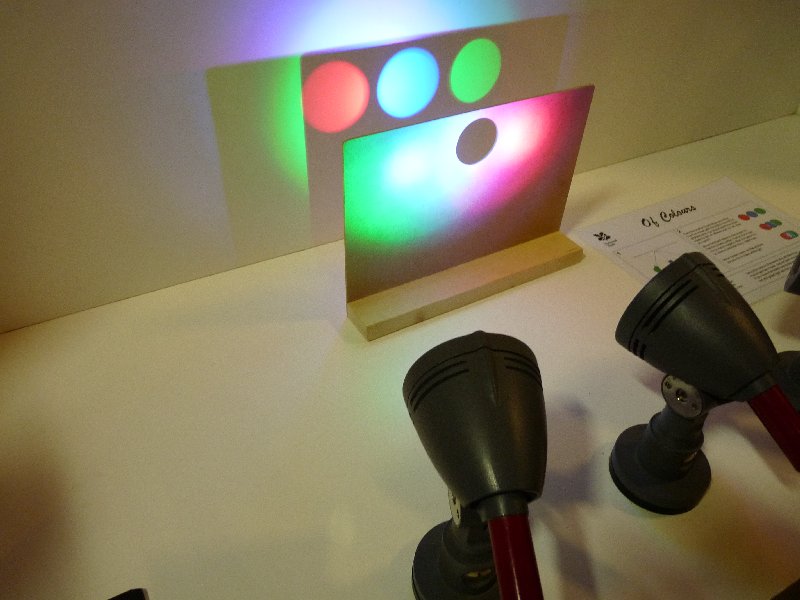
Then there’s the Science Discovery centre. Enjoy the chance to play with prisms, to break light up into all the colours of the rainbow before uniting them to white. Experiment with gravity, throwing weighted balls from the top of a tower… and so on. Get in touch with your inner child and learn a lot whilst you’re having fun.
Playing with light in the Science Discovery Centre.
And then go to the coffee shop there, treat yourself to a home-made cake and a nice cup of tea, and sit quietly in the courtyard there, reflecting on your good fortune at being in such a charming, relaxing, yet instructive place.
Christ the Consoler, Skelton-on-Ure. Wikimedia Commons
Here is a tale of a murder. A murder which led to the building of a very fine church not many miles from here.
In 1870, Frederick Vyner, son of the Marquess of Ripon and Lady Mary Vyner, travelled to Greece with a small band of English and Italian friends and servants. They were set upon by brigands who had probably been tipped off, and who demanded a huge ransom: £50,000. Women, children and servants in the party were regarded as useless bargaining tools by the brigands. They were released. But five men remained captive, including Frederick. The money was found to pay off the ransom, but before it could be delivered, the Greeks sent in the army, and in the resulting battle, soldiers, brigands and four of the hostages were killed, among them Frederick Vyner.
Vyner’s mother, Lady Mary, determined that she would build a church in her son’s memory on the Newby Hall estate which was their home. Her sister, Lady Ripon, was at the same time engaged in a project to build a church at Studley Royal, Fountains Abbey, Ripon. William Burges , noted Victorian architect, obtained the commissions for both churches in 1870.
I’m going to get to know St. Mary’s Church, and the work of William Burges very well over the weeks and months to come, as I have just been accepted as a volunteer for the National Trust at Fountains Abbey, where one of my duties will be as an Information Assistant at the church. Yesterday though, as part of our training, we were taken to see the church at Newby, which was until the 1990’s, the parish church of the village of Skelton-on-Ure.
It’s clearly Saint Mary’s sister church, yet more stolid, more weighty in appearance. Originally to have been called St. Michael and All Angels, the church has a unique dedication – to Christ the Consoler. Wander round the outside, and you’ll see over the door Christ the good shepherd with some of his ovine flock: a complement to the sheep in the field beyond, at the moment nursing their young lambs.
Christ’s flock above the church door.
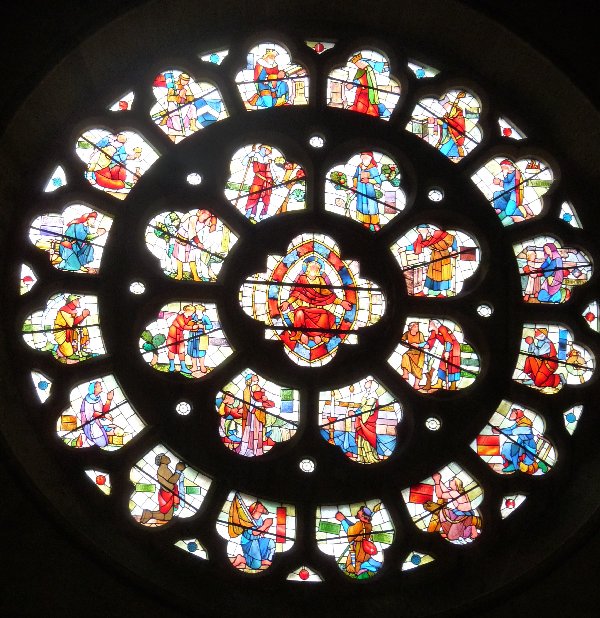
Within and outside the church Christ is omnipresent, perhaps most spectacularly in the rose window which portrays Him at its centre. The several ages of man are illustrated on an inner wheel of glass, and the various occupations and conditions of man on an outer wheel: noblemen at the top, working types below. Curiously, being ‘negro’, seems to be a job in itself. All turn their gaze upon the risen Christ the Consoler as they go about their business. It’s easy to imagine this spectacular window being a teaching aid to any cleric needing material for his sermon.
The rose window.
Christ the consoler
Infancy.
A fisherman and a hunter.
A negro.
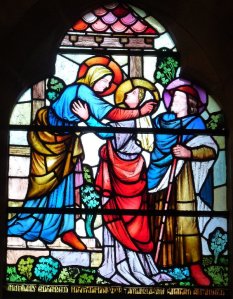
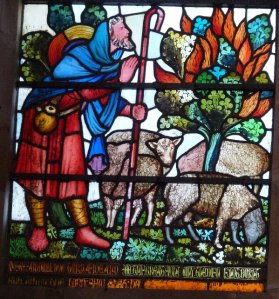
Walk down the nave and you’ll witness the miracles of Christ on one side, his parables on the other, each complemented by the event from the Old Testament which is traditionally held to be the precursor of that in the New Testament. This one was my particular favourite: the Annunciation, whose forerunner was the story of Moses and the burning bush.
The Annunciation.Moses and the Burning Bush.
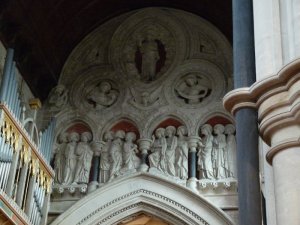
The dominating view as you enter the church is an almost overwhelming sculpture above the entrance to the chancel. Here is Christ’s Ascension with a crowd of 12 looking on. These are the disciples of course: but not Judas. His place is taken by Mary: a very mediaeval take on the event.
The Annunciation.
The chancel itself forms an intimate place for the Vyner family. Heraldic misericords record the arms of close and more distant branches of the family, all surrounding as if to embrace the memorial to the murdered young Frederick in a private and understated way. It’s decorated, as is St. Mary’s, with columns in Irish marble: dark green, plum red, greyish-white. More stained glass windows of Christ carrying his cross, then crucified, each with a number of Old Testament precursors.
Detail from the organ housing.
Angels rise above the chancel.
There’s more. There’s a glittering reredos with the Magi. There’s a spectacular organ casing set before the chancel. There’s detail to keep you happily busy and exploring for hours. Newby Hall and its gardens ought to be on your tourist map if you explore our area. Don’t leave the church out of your itinerary.
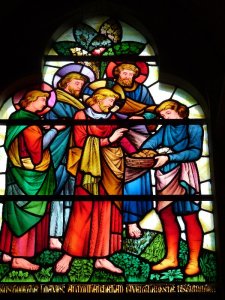
The miracle of the loaves and fishes.
As for William Burges, and the story of the two churches he built here near Ripon… well, there’s plenty here for another day
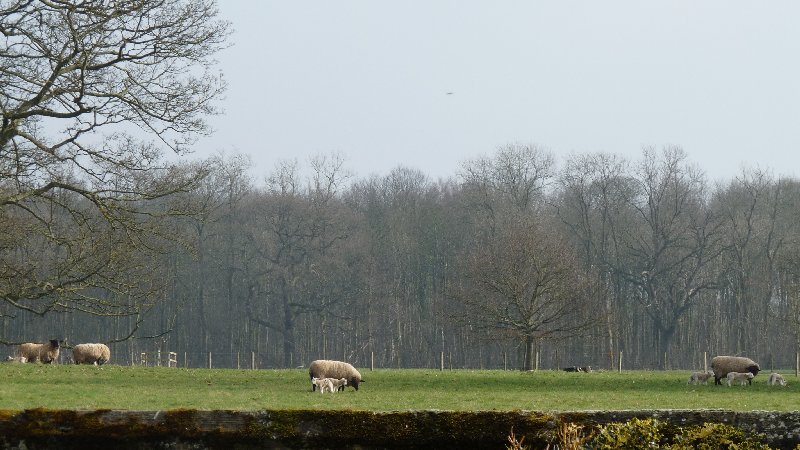
The sheep and lambs of Newby Hall, glimpsed from the churchyard.
















 From Pyrenees to Pennines
You must be logged in to post a comment.