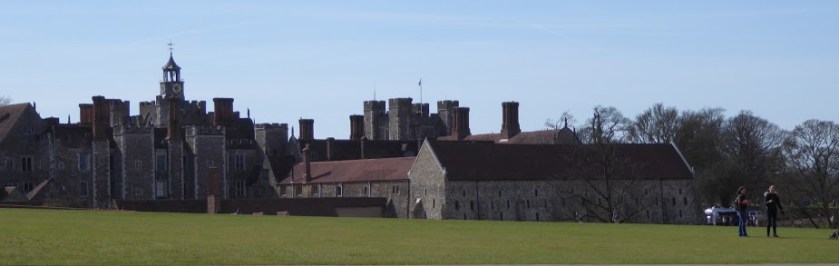
We went to Knole on Sunday: I was with Tom, Sarah and William. Here is a house with 500 years of history set into a mediaeval deer park of 1000 acres.
The house turned out to be off-limits. Only when we got home did we find out that with an over-booked Children’s Book Festival in full swing, other visitors were being urged to stay away.
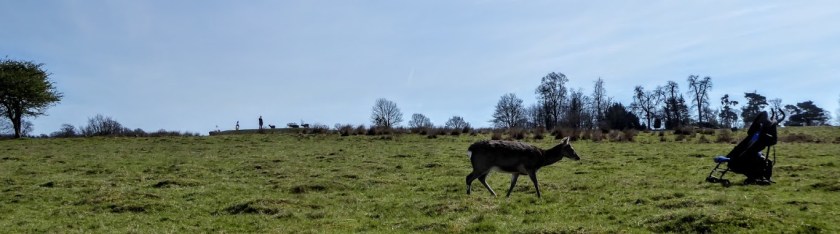
It didn’t matter. A 1000 acre deer park simply never gets crowded, and the weather was sunny and bright. William rushed about the unending open space and we all helped him spot distant deer.
What we didn’t expect was that the deer were rather more interested in spotting us, and not staying at a distance at all. They’d developed a formula which goes something like this: ‘people = rucksacks = picnics = free food’.
Deer on a food recce.
We knew it wasn’t a good idea. We know that deer are wild creatures, sometimes unpredictable and that they can host ticks and other unwelcome creepy-crawlies. It was a treat to be able to see them grazing nearby.
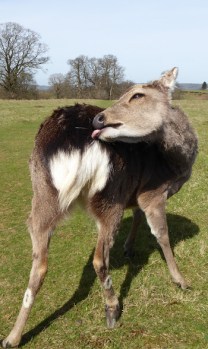
A spot of grooming.
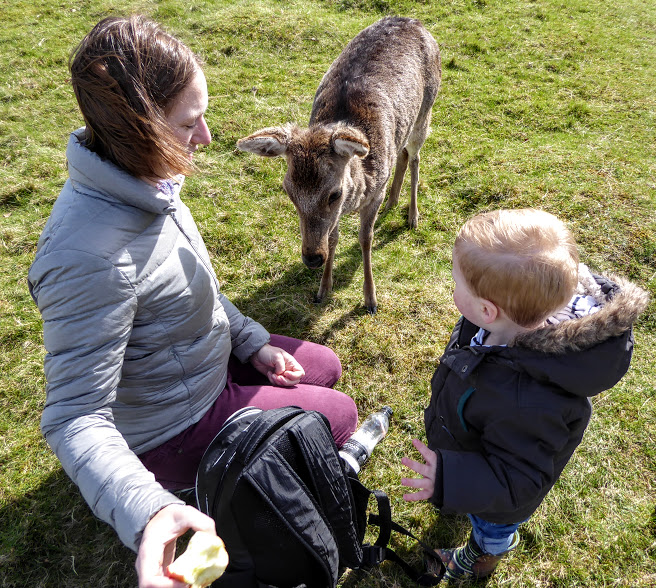
The deer had other ideas. They found a neighbouring toddler’s empty push chair and nuzzled around it for treats. Then they spotted William. He had an apple. The young sika deer thought that William’s apple might make a nice change from grazing for young grass.
Apple core thief.
It was treat for William of course, to get so close to these wild creatures. And it was a treat for us too. But we were wary, and did what we could to discourage our marauder. Once he ‘d snaffled the apple core, we made our excuses and left.
We’ll go back to Knole of course, to explore the house. But we may leave our picnic at home.
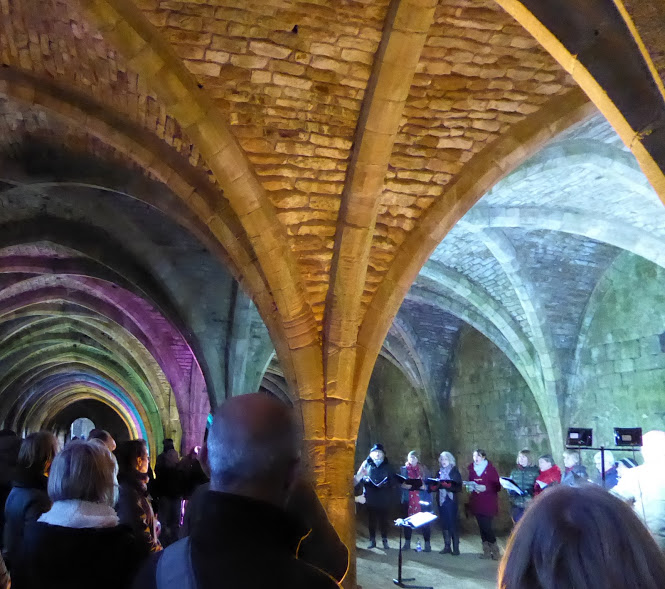
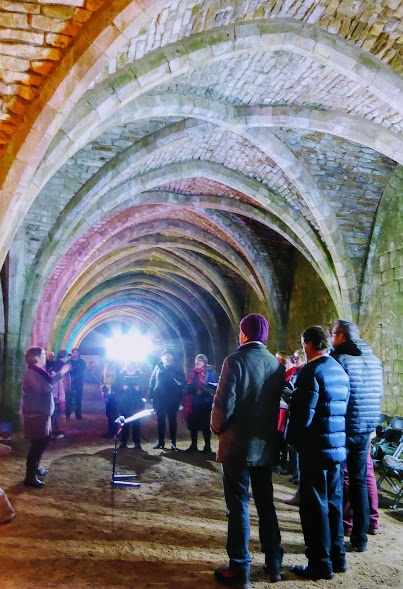
A coldish afternoon. Evening’s drawing in at Fountains Abbey, and our little choir is due to sing there. Not in the roofless ruined abbey, but in their former storage area, their cellarium, as vaulted as any church, and as atmospheric, with its wide colonnaded chamber and its vibrant acoustics. Local choirs vie for the privilege of a singing spot there around Christmas, knowing that audiences will be generously appreciative, and that the cellarium will give the very best account of the choir’s music making. Generally performers choose favourite Christmas carols that the audiences know and love.
Not us. Our director, Nicky, makes interesting choices. We sing early carols that the monks themselves might have known, such as the Coventry Carol and Ave Maris Stella. We sing music known to a secular mediaeval audience – the rousing songs of taverns, feasting and wassailing, such as Gaudete, The Boar’s Head Carol and the Gloucestershire Wassail.
Choir in winter woollies. It’s cold in the cellarium.
We sing winter songs from Lapland – a yoik to call the reindeer in, and a seal woman’s lament. A spiritual, a modern Hungarian take on Alleluia – the variety continues….. but we finish off with a traditional favourite – Ding dong merrily on high.
We’re delighted. We get through with no disasters, and we’re exhilarated at the way the acoustics of the cellarium enhance our music-making. The audience pays us pretty compliments. We want to come back again next year.
Happy New Year to you all. Let’s hope for a better 2017.
Photo challenge: ‘It’s not this time of year without…..’. It’s holidays and celebrations that WordPress seems to have in mind in setting this challenge, but this is November, and we don’t do Thanksgiving in England. We do dark nights that begin at four o’clock. We do gusting rain that snatches the remaining leaves from the trees. We do fog that rises from the river. Nothing much to celebrate at all. Except …. except that it can turn out differently.
Read on.
Sunshine after rain at Studley Royal
I was in a bad mood when I got up. My shoulder hurt – a lot. The sky was steel-grey, the temperature steel-cold, and I was supposed to be leading a walk. This was going to be No Fun At All, because although no rain was forecast, we’d had two days of full-on deluge. I just knew that virtually the entire circuit would be a mud-bath.
I trudged off to our rendez-vous with ill grace. Once there though, I started to cheer up. The prospect of good company for the day is always a positive start. We set off. The ground was unexpectedly firm, the clouds started to lift and the sun to shine. Soon we were making a coffee-stop outside 14th century Markenfield Hall.
Coffee stop in front of Markenfield Hall.
Then it was through woods and across open fields (still no mud) to find a lunch spot overlooking Fountains Abbey, still framed with russet Autumn leaves.
Sandwiches, sunshine and Fountains Abbey.
After lunch, a muddy farm, where we attracted the interest of the locals.
Calves closely inspected us as we squelched past. Yes, this farmyard was very muddy indeed.
And an uplifting final couple of miles, with grazing red deer, light-reflecting ponds and surrounded by a final burst of Autumn colour.
Here is the parkland of Studley Royal. Can you see the red deer in the distance?
If you’d found yourself in the Studley Royal estate in the early 1700s, just along from the ruined Fountains Abbey, you’d have had a rather wild and rugged country walk along the valley of the River Skell, surrounded by woodlands. You might have been able to glimpse the abbey in the distance.
This was John Aislabie‘s estate. He’d inherited it in 1693, but was at that point in his life busy realising his political ambitions – in 1718 he became Chancellor of the Exchequer. Only two years later he was mired in the financial scandal of the South Sea Bubble, which ruined so many and shook the national economy. He was disgraced and expelled from parliament.
He returned to Yorkshire, and devoted his considerable energy and wealth to creating the first water garden of its kind seen in England. It owed a lot to formal French gardens of the time, and balances formal design with wonderful vistas set in an apparently natural landscape.
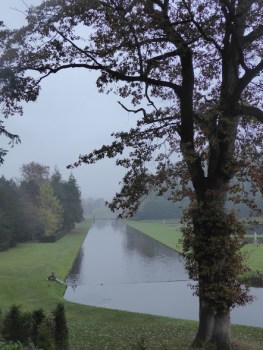
The canal at the centre of the water garden.
If you visit these days you’ll see a proper 18th century garden: the formal lakes, the temples and other follies, the carefully orchestrated views. Work continues year by year to rein the garden back to the detail of what those eighteenth century visitors would have seen. After all, trees grow taller and spawn saplings which grow in their turn. The river silts up. Land slips. Shrubs spread in an ungainly fashion. Unwanted invading plants make the place their home
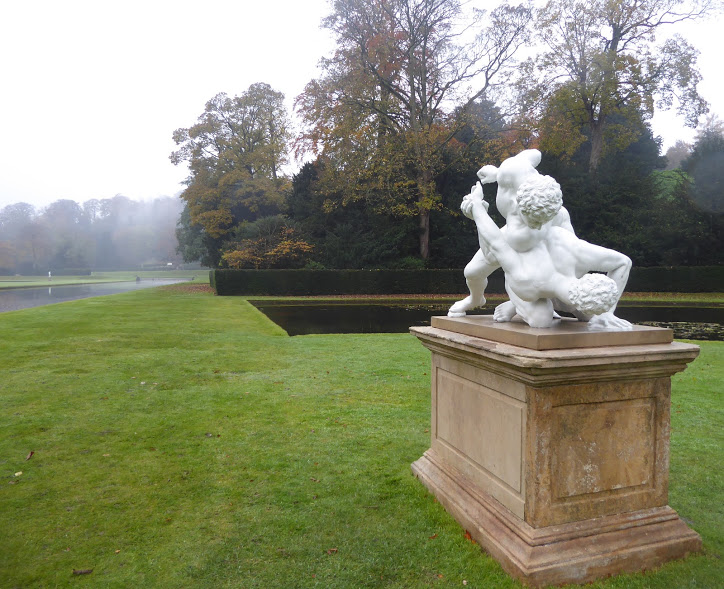
On Saturday, we went on a little tour to look at some recent work. The classical statues – wrestling gladiators and the like which have ornamented the gardens since the 18th century – are lead. Marble would have been nice, but lead’s cheaper, so when they were new, those statues would have been painted in marble-look-alike white.
Wrestling gladiators in front of the Moon Ponds
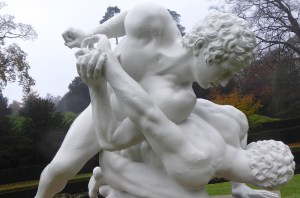
Now they’re white again. It wasn’t a question of slapping on the Dulux though. No, conservators hunted for evidence of the actual paints used by grubbing about in hidden groins and armpits for contemporary paint fragments, and experimented on discarded lead till they got the right shade, the right paint.
Wrestling gladiators newly painted white.
The formal ponds were once surrounded by planters and benches as well as statuary – contemporary paintings tell us that. These will be replaced, as well as a couple of statues sold in the 19th century when the estate fell on hard times.
Ungainly shrubberies will be knocked into shape and brought down to size. An informal garden will be planted with sweetly scented plants – roses, lavender and so on. Just the place to sit and view the Temple of Piety and the Moon ponds.
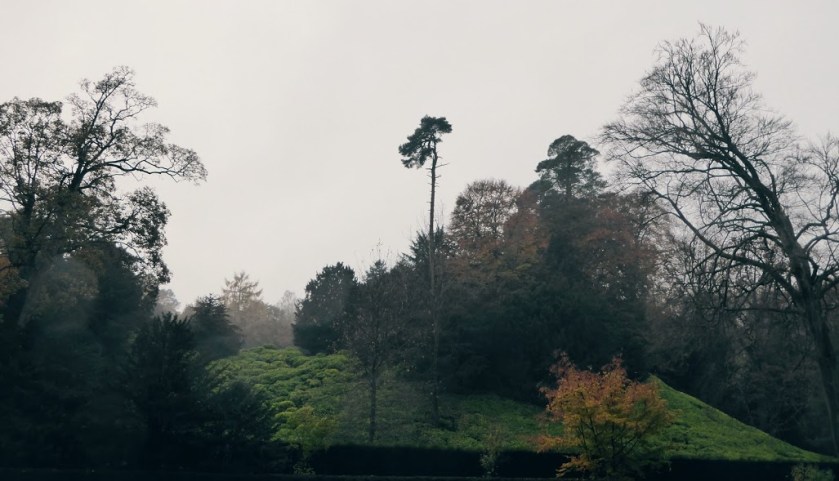
Tent Hill will live up to its name once more. The dense copse which covers it will be thinned out to make room for a tent something like an 18th century military campaign tent. Not for military campaigns of course, but to house entertainments of various kinds, just as it would have done back in the eighteenth century.
So much to do. But every piece of work brings Studley Royal even nearer to the intentions of John Aislabie, who first created this special place more than two ands a half centuries ago.
The Temple of Piety, Moon Ponds, and freshly painted statuary.
Once upon a time, before 1066 and all that became the most famous date in British history, William of Normandy wanted to get his local French barons interested in helping him conquer England. Land was the answer. Vanquish those Anglo-Saxons and English lands would be there for the taking.
A lord called de Courson was one of those who answered that call and came to England, perhaps for the Battle of Hastings, perhaps a little later. He was rewarded by being given many acres in Derbyshire. Over the years, the family name became de Curzun, then Curzon, and the lands at Kedleston which had certainly been claimed by about 1150 have remained with the descendants ever since.
Now it’s one of life’s pleasures to visit the splendid buildings of Kedleston Hall, a classical showcase of fine paintings, sculpture and furniture*, and to stroll round the grounds.
And what grounds! When we arrived there the other day, it was sunny, with rain promised later, so we set off to make a three mile circuit of the so called ‘Long’ or ‘Ladies’ walk’. How natural and timeless the landscape seemed. A charming rustic bridge crosses a serpentine lake. Woodland was just becoming autumnal. Spacious meadows spread before us with grazing sheep. Just as nature intended.
Except it’s all a massive con-trick perpetrated by Robert Adam in 1758. Away with the out-moded formal geometric garden of Charles Bridgeman! He’d been the Royal Gardener, and only dead 20 years, but his work by then seemed suddenly hopelessly out of fashion.
In with the naturalistic ‘picturesque’ style promoted by Capability Brown. Out with the public road along which the village straggled untidily, far too near the Queen Anne redbrick house which has itself been replaced. Village and road were moved. A brook was dammed and excavated to become a lake, a stream, gently splashing weirs. Adam had a ha-ha built – an unseen ditch across which unwanted livestock couldn’t pass: so much more natural-looking than a fence or wall. Temples and other follies were built or planned, pleasure grounds too. Sadly today only the hermitage is still around, and even this thatched hut is currently being restored.
If you wanted an afternoon alone with your thoughts, your sketchpad or your book, this thatched hermitage was just the place
Our three mile walk was crammed with pleasure. There were waterbirds on the lake, Autumn leaves to enjoy, views across the park and surrounding countryside. Where did the grounds end and open countryside begin? We didn’t know and didn’t care. And we hadn’t even seen the house yet. You can get a taster here.
*There’s even a magnificent bedroom which has never been slept in and is currently being restored: designed to be used if ever the king should come to call…
That’s where I spent my evening, near the Temple of Piety. Can’t complain at that. (geograph.org.uk)
I was volunteering at Fountains Abbey and Studley Royal yesterday evening. I wasn’t sure I wanted to be there. It was raining – and how – as I drove there, and the evening looked very unpromising.
A small team of us were there to make an evening’s Family Bike Ride round the Abbey and Studley Royal grounds run smoothly. Apparently I was going to be stuck near the Temple of Piety and Moon Ponds preventing riders from disappearing up into a woodland path, with only my two-way radio for company. I hadn’t even got an umbrella. Anyway, who would bother to turn out with their families, and all the family bikes, to trundle round Fountains Abbey in the rain?
Baby coot (Tim Felce: Airwolfhound)
I was wrong. Of course. The rain stopped. Families turned up, and lots of them. At first though, I had many minutes of peace to stand and absorb the views of the very special Georgian water garden. I spent time enjoying the company of a new family of coots: I suspect the three little spherical balls of fluff I saw with their solicitous parents had hatched that very day.
This was my view for much of the evening. Those coots are out there somewhere.
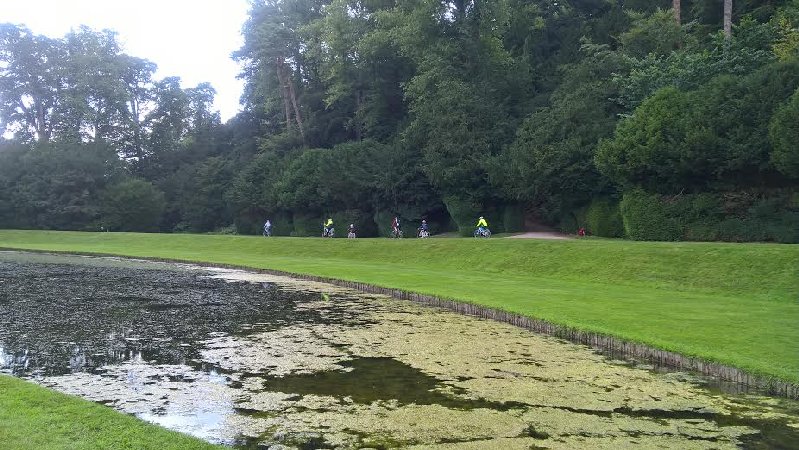
And then the bike riders came. There were confident teenagers relishing the chance to get up speed in this tranquil setting. There were primary-aged children enjoying family time with their parents. There were little ones, able to wobble along on their bikes, their parents confident that they were utterly safe from passing traffic. Open Country, a local charity working to help people with disabilities access the countryside had brought along a team and several tandems.
Some people went round the circuit once, some twice, a few as many as five times. I took lots of photos with lots of cameras for family souvenirs of the evening. Sadly, I hadn’t brought my own camera. These not-at-all impressive photos are taken with my camera phone.
I’ll volunteer again sometime for this event. But not next time. Next time I’ll want to be there with my own family, trundling around this very special site with my own grandchilden (first though, I’ll have to learn not to fall off a bike).
One of the last families of the evening finishes the last lap.
It was our Works Outing, our Grand Day Out, our Jolly. It was a day we volunteers at the National Trust’s Fountains Abbey and Studley Royal had been waiting for: our reward (though not entirely free) for good behaviour over the past few months. A coach would collect us and deliver us to spend time at two destinations well worth visiting over in East Yorkshire: Sledmere, and Burton Agnes.
Both places belong to – no, not a rival organisation: everyone concerned’s aim is to preserve and enhance our heritage for us, and for future generations – but a different one, the Historic Houses Association. Both places are visited as much for their gardens as the houses themselves.
Well, just look at this. This is the view from the coach window.
A very British view.
So much for the gardens then. A real shame. Sledmere‘s grounds are extensive, and offer cunningly tweaked panoramas of the surrounding countryside. They were developed in the late 18th century by Capability Brown, then at the height of his popularity. Apparently unending vistas of manicured countryside, easy on the eye, were what was required. The local village got in the way of the view? Easy. Move it and re-build it. The villagers will get used to it.
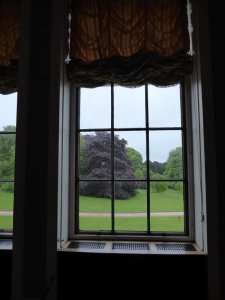
A quick glance at the grounds from the library.
We were able to admire the grounds from the protection of the house, but not so the planted areas, in particular the walled gardens. We favoured a nice cup of coffee and a home-made cake in the cafe instead. We’ll want to go back when the sun is shining.
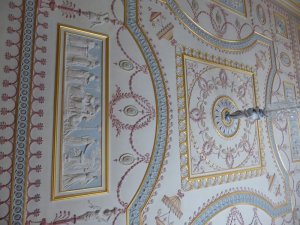
Sir Christopher busied himself in having his house as well as his garden improved. The plaster work designed by the celebrated Joseph Rose is said to be the finest in England.
Plasterwork ceiling.
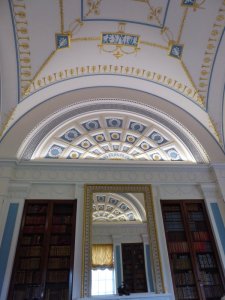
As is the Long Library, extending the length of the building, a long, light-filled and elegant space.
The library.
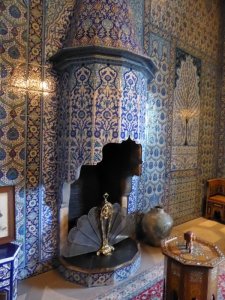
There are curiosities too, such as the Turkish room designed for Sir Mark, 6th Baronet in 1913. Every surface here is covered in specially designed Armenian tiles.
The Turkish room.
The house might have disappeared from view in 1911 though. A catastrophic fire broke out while the 5th Baronet, Sir Tatton Sykes, was dining. He insisted on staying to finish his pudding. But estate workers, farm hands, villagers, children from the local school, anyone and everyone else turned to and dragged out furnishings, pictures, statues, china, carpets, even doors and banisters. As muscular estate workers struggled out with the monstrously heavy copy of the Belvedere Apollo, the ceiling fell. And since then, thanks to the detailed plan which survived, the whole thing has been meticulously restored. You can read all about it here.
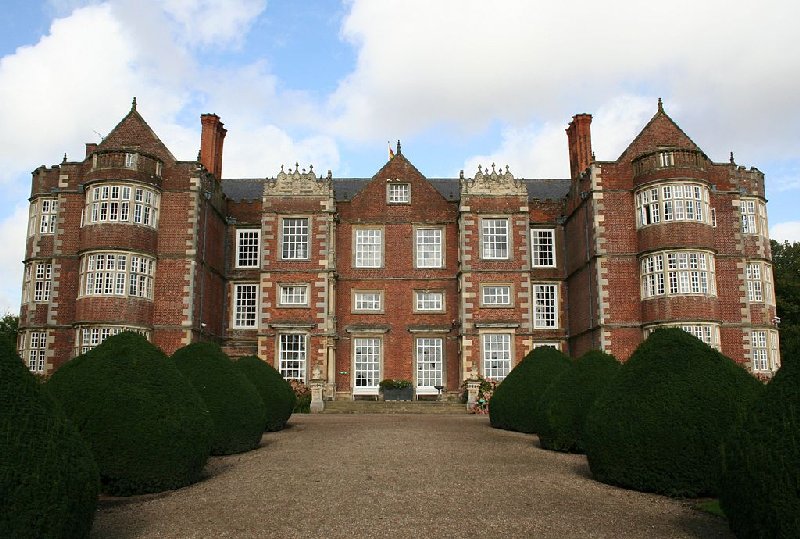
Off to Burton Agnes then. This Tudor Renaissance hall was built between 1590 and 1610, and has remained within the same family for more than 400 years: the original Manor house was built as long ago as 1173.
Burton Agnes (Wikimedia Commons)
It’s a family home, albeit a privileged one. It’s a home which has been filled with everything from magnificent Jacobean carvings, Impressionist paintings, and more recent artworks. This is a home that is lived in and loved. Here’s a quick glimpse of what the visitor can see. As to the award-winning walled garden, the woodland gardens … well, we didn’t visit those on this particularly soggy day. We might be British, but we’re not that daft. The house offered sufficient enjoyment, and the gardens will be there another day.
Wise and foolish virgins adorn a Jacobean hearth…..
…….and here are the wise virgins.
Carved wooden fire surround with music and dancing.
A view of the (also Jacobean) gatehouse from the Hall.
A glimpse at the gardens.
Bedroom.
Plasterwork.
Another glance at the garden, with willow-woven geese.
The twins have had it tough these last few days. It was the week of the infamous and widely criticised SATS, the final year tests for all British primary school children.
We thought we knew a place where they could see that compared with some, their lives weren’t too bad.
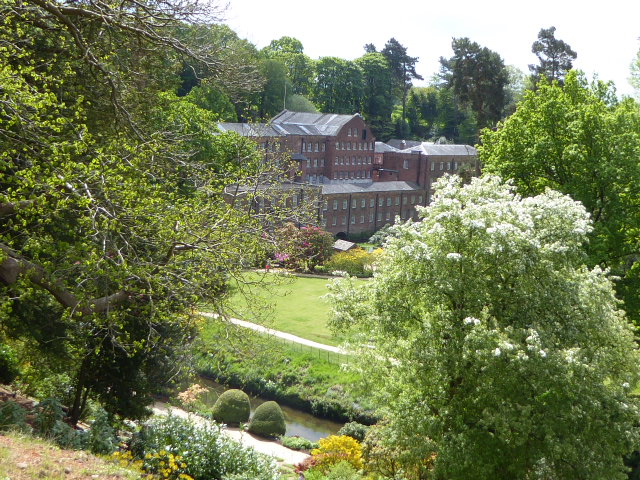
Quarry Bank Mill seen from the gardens.
Quarry Bank Mill in Cheshire is one of the best preserved textile mills of the Industrial Revolution in its day, a beacon of progress and enlightenment in 19th century Britain. It’s in a glorious wooded setting, just as its original owner and developer, Samuel Gregg, intended. There’s running water to drive the water wheels, and it was well-connected by road, and by the Bridgewater Canal, to have its products transported to the busy port of Liverpool.
Samuel Greg, and then his son Robert, were careful, paternalistic owners. They looked after their employees – very well, according to the standards of the time.
We went to the Apprentice House there to see what it was like to live there as one of his child apprentices. The house was in use from about 1790 to 1847, and children would be taken from the age of nine . They had often come straight from the harsh and bleak conditions of the workhouse – institutions that only the truly destitute would go to. Tough as life at Quarry Bank was, it must have seemed rather wonderful to anyone who’d come from this punishing regime.
We were taken round by the ‘housekeeper’, and we obeyed her every word, and were sure to remember to call her ‘ma’am’.
This chap’s being punished because his daughter’s left-handed.
She met us in the schoolroom. The young apprentices received an elementary education, though only on Sundays. All children learnt to read. The boys learned arithmetic too, and how to write – it was only necessary for girls to learn to sign their names. They had more important skills to learn: cooking, cleaning, making clothes for the inmates.
Here’s how their week went:
Monday to Saturday:
Rise at 5.30.
Go to the factory to be at work by 6.00 a.m.
At 8 o’clock, in the factory, they got a handful of stiff, solid porridge (it had to be solid, so the children could eat the stuff directly from their hands).
Work till midday – more porridge, but this time with maybe a few carrots or potatoes stirred through it. Unlike Oliver Twist, any child could always ask for more.
After the midday meal, the children would work again till 6.00 p.m.
Then they’d come back to the Apprentice House. And then there would be an hour of chores – perhaps for the boys, working in the garden tending the vegetables that were part of their diet, or scouring out chamber pots. Girls would be doing household chores, cooking or mending.
Their meal, served after 7 o’clock, would be substantial, plain fare – maybe boiled bacon and potatoes. No puddings. Sugar was expensive.
Then they were free … probably to fall asleep.
Sundays, there was no work at all. Just church, morning and early evening. But the church was two and a half miles away, and they walked there and back – twice. In the afternoon, they had their lessons. However, unusually for the time, they were never struck. Instead, as a punishment, they’d face the wall, holding small dumb-bell like weights in their out-stretched arms. This was good for muscle tone. You’d certainly be punished like this if you tried to write using your left hand. Until recently, left handedness has been frowned on
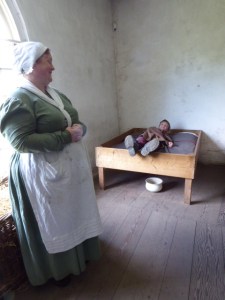
In their dormitories, they were two to a bed, sleeping on mattresses stuffed with straw, changed every year. They even had blankets. They had medical care when they needed it too.
Alex says this bed’s not at all bad. This was just before he was chosen to empty the chamber pots.
Work was hard. When we visited on Sunday, the huge, cavernous factory rooms were filled from floor to ceiling with machinery. There were machines for carding, machines for spinning, machines for weaving. Each room, in its heyday, might have had up to 60 machines. On Sunday, each room had no more than one machine working. The noise was deafening. We were urged to spend only a limited time there, and the volunteer machine operators all had effective ear-defenders. Imagine 60 machines, clattering and clanking away 12 hours a day. Men and women would have charge of small groups of machines, constantly refilling , re-threading, checking, checking. The children’s jobs included working as ‘scavengers’, crouched between the constantly moving machinery, clearing fluff and other obstructions: or running to re-stack piles of bobbins from a central point. Like everyone else, they’d constantly be inhaling cotton waste, and were prone to the risk of repiratory disease, and an early death.
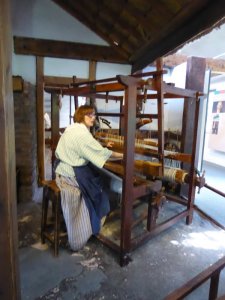
Here’s pre-industrial weaving. These looms were a big investment for a family, but offered year-round employment.
The extensive mill buildings.
Spinning the raw cotton yarn.
Banks of looms – the children crawled between them, keeping them functioning efficiently.
These days, Quarry Bank is a wonderful place to spend the day. We quite simply didn’t see it all. But we’ll be back. And if you get the chance, I suggest you go there too.
Easter holidays. Time to have those ten-years-old grandsons over. Time to keep them so busy they don’t have a chance to realise that ours is not a home stuffed with devices. Not a smart phone in sight.
Let’s get them back to the past straight away, even before we get them back to our house. Are they too old for an Easter Bunny hunt at Fountains Abbey? Apparently not. Not when there’s a chocolate bunny to eat at the end. Are they too cool for egg and spoon races and egg-rolling down the hill? Apparently not.
Egg-and-spoon race.
Egg rolling.
Would they like to visit ‘Forbidden Corner’? They agreed they would, even though we failed to provide a description of what to expect. We couldn’t. It’s been described as ‘The Strangest Place in the World’. Perhaps it is. It’s a folly. It’s a fantastical collection of follies. It’s woodlands, walled gardens, mazes, tunnels, grottoes, built in the manner of a topsy-turvy collection of fairy tale castles in enchanted grounds. Every stone putto is liable to pee on you as you walk past. Every passage is too narrow, too low, too dark, and may lead nowhere. You just want to try to get along it anyway, because at the end there may be another secret door, with halls of mirrors, or ever-changing fountains, or grotesque stone gremlins, or stepping-stones …. And beyond, in every direction, the glorious countryside of North Yorkshire.
Next day, off to Brimham Rocks. No child can resist the opportunity to climb and jump among these extraordinary tottering towers of balanced rock formations. A visit there is a regular fixture for Alex and Ben.
And finally – yet more rocks. Underground this time. Stump Cross Caverns: limestone caves set about with stalactites and stalagmites, tinted in all kinds of shades from the iron and lead seams that also penetrate the area. Gloomy, dark and mysterious, and guaranteed to fire the imagination. Photographs courtesy of Ben.
Down, down, deep into the earth.
In the evenings we sat round the kitchen table and played board games. The London Game brought out everybody’s inner mean streak as we blocked other players in, or despatched them to the end of the line at Wembley Central. Stone Soup gave us the opportunity to lie and lie again in an effort to get rid of all our cards. All very satisfactory. A good time was had by all.
But Granny and Grandad would quite like a rest now. Please.
Last Thursday, I learnt to weave. Not a splendid rug with intricate and richly coloured motifs. Not a cosy scarf in soft heathery colours in subtle, muted stripes. Not even a simple table mat, plain but serviceable.
No, I wove a ….. er, thing. A ‘thing’ I have yet to find a use for (Mobile phone mat? Drugget for a pet mouse?). But I thoroughly enjoyed myself. I rather resented the fact that because I was on a course, I was time-limited, and had to finish and tidy up just as I was getting into my stride.
This course, you might guess, was at Fountains Abbey, where I’ve volunteered to be part of a new project. The idea is to open up Swanley Grange, once an abbey farm (since 1358 in fact) but in more recent years the Education building.
The aim is to create the ‘feel’ of a monastic farm space as visitors enter the sheep-field/grange area and to help them make connections between the grange network and the abbey. Until now, there’s been little to highlight the importance of the wool trade to the expansion of the abbey.
Over winter, the building has been redeveloped inside, and outside there have been very exciting happenings. There’s a ‘mediaeval style’ vegetable garden, just waiting to be planted up with mediaeval-style vegetables (kale, beans, leeks, that sort of thing. Potatoes, courgettes and tomatoes need not apply). Traditional cleft fencing will enclose a flock of sheep, just like the old days, and there’ll be chickens, and bees in mediaeval-style skeps.
The volunteers will be keeping an eye on the animals, and with the help of the gardeners, maintaining the vegetable plots. Most of us who’ve volunteered feel quite comfortable with that. But most of us who’ve volunteered are less comfortable with mediaeval crafts.
Spinning with a distaff….
So the other day we learnt to spin wool, first of all using a distaff, then a spinning wheel. I don’t think I’ve found a new hobby. Teasing out the raw, though washed wool, keeping the distaff turning, turning, to twist the wool into a useable fine thread seemed frustrating and, frankly, dull. It was work that women did constantly, even when minding the children, walking, talking, working. But you can find blogs written by those who enjoy it, even now it’s no longer an economic necessity. The greater mechanisation of spinning seemed less tedious, but quite tricky, all the same.
… and with a spinning wheel.A spot of carding.
We did a spot of carding, combing out wool into parallel, useable fibres ready for that all important spinning. Even that was hard going, and we were glad to break for lunch.
And after lunch, there they were. A collection of small table looms, the warp already prepared so we could get busy with the weft. If you don’t know what I’m talking about, look here.
And we got busy. We learnt to like the rhythmic back-and-forth as we pushed our wool-laden shuttles through the warp threads. I felt the need to get above myself, and try something just a little more complex. Here it is.
A mini-masterpiece? Or an adequate first attempt ?
But if I could produce that in not much more than half an hour, who knows what weaving genius is within me, trying to get out?
This post is dedicated to blogging friend Kerry, writer of Love those ‘Hands at Home’, who inspires me with her love of textiles, of learning new things, and of life.


















 From Pyrenees to Pennines
You must be logged in to post a comment.