Charity (shopping) begins in Laroque

Charity shops.  Staple of the British High Street, and a really important source of revenue for many charities.  Some parts of English towns seem to have few other shops these days, and on my visits back to Harrogate and Ripon, that’s where you’ll find me,  stocking up on piles of second-hand books at bargain-basement prices.  And not just books.  I have a classic lovat green Loden coat, much admired by whoever sees it, current selling price anything up to £500, which I found in St. Michael’ Hospice Shop in Harrogate for £10.

So here in France, I miss charity shops.  Emmaüs, the international charity focussing on poverty and homelessness concentrates in its large, warehouse-like shops on quantities of furniture and household goods, and a bit of everything else too, but they’re often away from the town centre.  Our local one in Lavelanet is daunting in size, shabby and a little unappetising.

logo_secours_populaire.jpg 1Secours Populaire here in Laroque, as in many towns, provides a lifeline for families in difficulty. It sells donated clothes and other goods, but it doesn’t advertise itself, and is mainly appreciated by those whom it sets out directly to help.  The branch here is in an upstairs room, and is staffed for one afternoon a week only by a cheery team of volunteers who see no need to market the service they provide to a wider constituency, or to go in for careful artistic displays of the goods on offer.  It’s clearly not a shop in the ordinary everyday sense.

It was a bit of a shock then to realise a few months ago that the shop that was being refurbished up near the cross roads was going to be a Red Cross Charity Shop,  ‘Vestiboutique’.  It opened with a ceremony reported in the local press, and has been trading on 4 afternoons a week.
logo-croix-rougeIt’s a great place.  As in England, there’s a mixture of donated goods, and ends-of-line donated by clothing manufacturers.  As in England, the shop window and the stock within have been displayed with taste and care.  In the backroom, donations are mended, cleaned and pressed if necessary, before being put on sale.  Everything second-hand is either one or two euros, the ends-of-line goods very little more.  The day I first went, I found some cheerful trousers, an elegant high-quality pair of ankle boots probably worn only once by their first owner, and a new fleecy hat for winter walks: I parted with 7 euros.

The two members of staff were happy to talk. They’re not volunteers, though they’re not paid much.  They were excited to be part of this new development.  This shop is the only one in the region, and was sited in Laroque to provide a service in an area of economic difficulty.  Trade was brisk they said, and already the shop was much appreciated locally.  I told them about the huge variety of English charity shops, from international charities like theirs, to shops for charities seeking to combat disease or support animals, to hospice shops.  They were astonished, and couldn’t really imagine the picture I was trying to paint in their minds.  Though there are parts of France – Paris for instance – where you’ll find more shops like this, there are no streets like say, Commercial Street in Harrogate, where about a third of the shops now seem to be charity shops.  Vestiboutique, for the time being, is unique in the Pays d’Olmes.
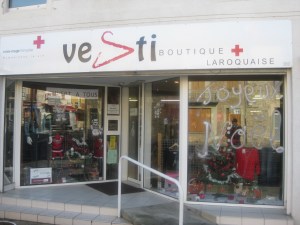
Vestiboutique just before Christmas.

Christmas on the High Street

Verzeille&decoDec2012 033It was 5 years ago when we were first in Laroque round about Christmas time.  There were no signs of its coming until well into December, and we thought it wonderful: no decorations, no adverts, merchandise or muzak,  just a bustle of festive activity from about two or three weeks beforehand.

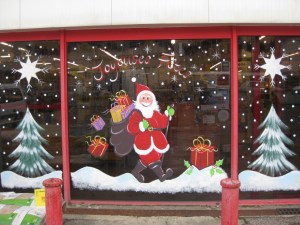
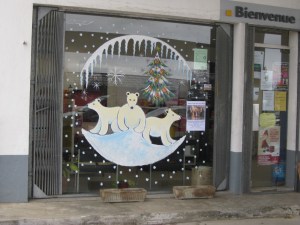
The first signs, as in England, were in the shops.  Unlike England however, most shopkeepers didn’t usually buy tinsel, baubles, and several packs of cotton wool to introduce a Christmas theme into their window display.  Instead they had a seasonal design applied directly to the window.  We once saw a scene-painter busily decorating a local window, and wondered what he did the rest of the year.  Shops in small town high streets like Laroque’s would all be unified by being the same but different.  The same folksy interpretations of Christmas motifs, the same limited palettes of white, red, greens and yellows.  Some would choose scenes of reindeer amongst the Christmas tree forests, others Father Christmas,  snowmen, or radiant candles.

Garage in Laroque
Garage in Laroque

Five years on, hardly any shopkeepers are keeping up this tradition.  They’re decorating their shops, but in their own way: dressing up their window display with baubles, snowflakes and Santa Claus figures.  They’re nicely done too, but I miss the particularly French idea, which I’ve seen nowhere else.

Here are the few traditional window scenes I’ve been able to find this year.  Maybe next year even these will be part of the past.

A baker's shop in Laroque
A baker’s shop in Laroque

England comes to Laroque d’Olmes

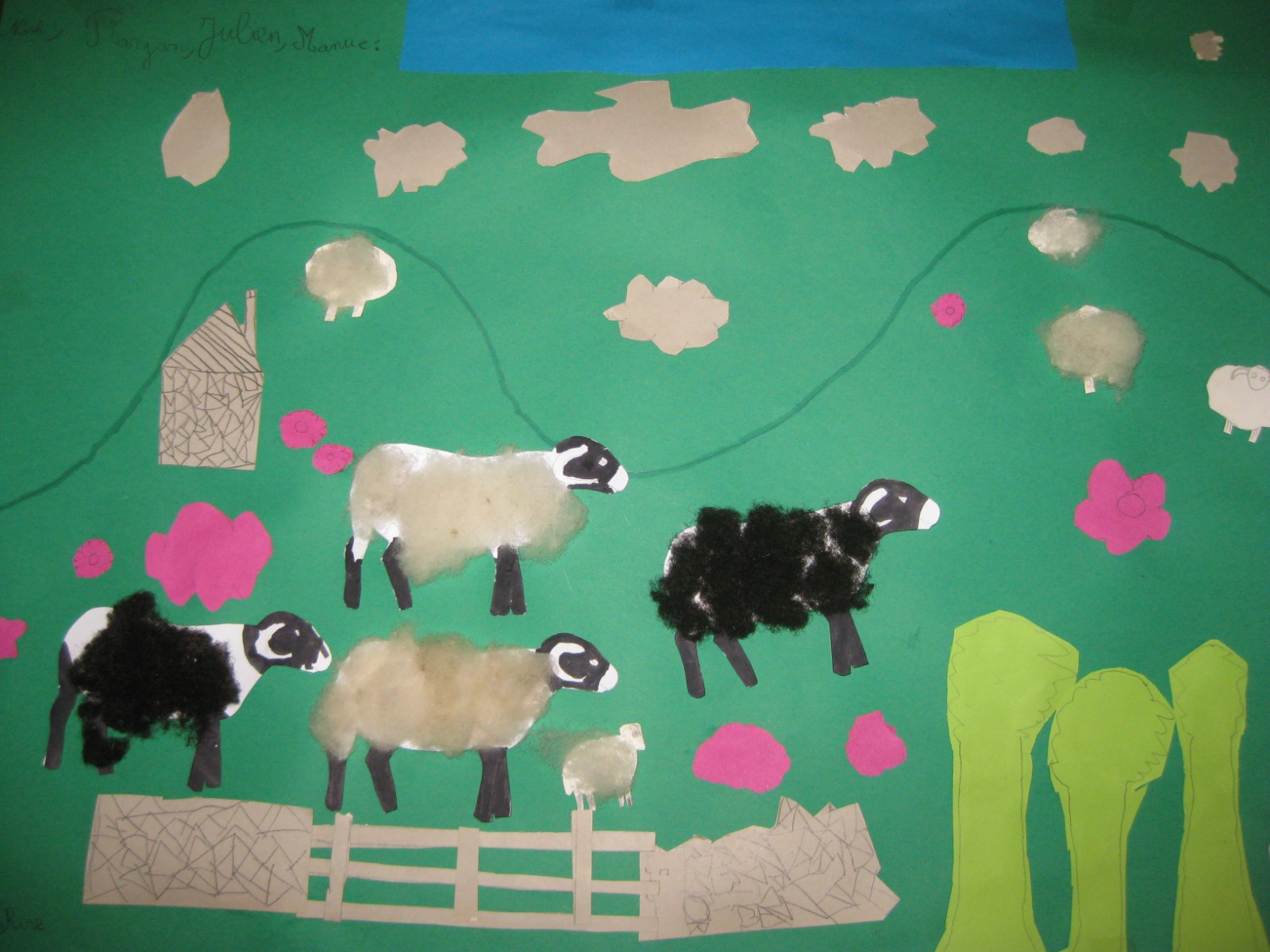
Yorkshire Dales: as interpreted by the children at the Centre de Loisirs, Laroque.

Yesterday afternoon was the best fun.  20 odd-children (that’s ‘about 20 children’, not ‘Twenty Odd Children’) here in Laroque spent the day in England, courtesy of  ‘Découverte Terres Lointaines’,  without setting foot outside town.

These children spend their Wednesdays, a no-school day, at the Centre de Loisirs.  Their parents are probably out at work, and here is somewhere they can spend the day having purposeful fun, without its costing their parents too much.

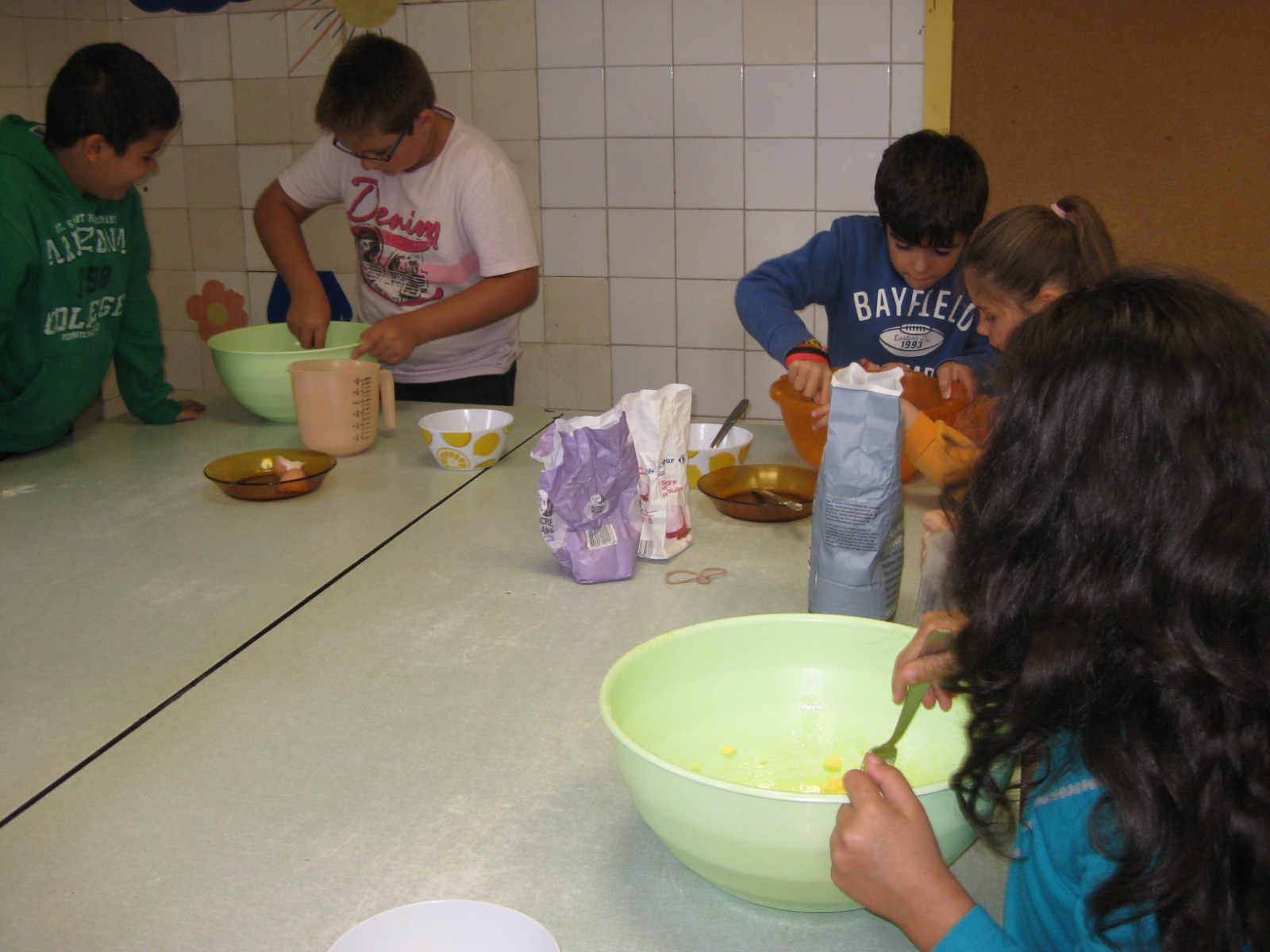
We turned up with bag full of groceries, and spent half the morning baking biscuits, basic English everyday crunchy biscuits.  It was great to see them, girls and boys alike carefully measuring out flour, sugar, butter and so on, stirring, mixing, watching a dough come together from these simple ingredients.

Let the baking begin.

A bag full of cutters and a rolling pin meant that they could transform the mixture into stars and circles, miniature gingerbread-style people, bells and flowers.

Upstairs, another group had been talking about the green moorlands of the Yorkshire Dales, then making a mural of a Daleside landscape, complete with Swaledale sheep, farm gates, and obligatory grey cloud (it’s England after all).

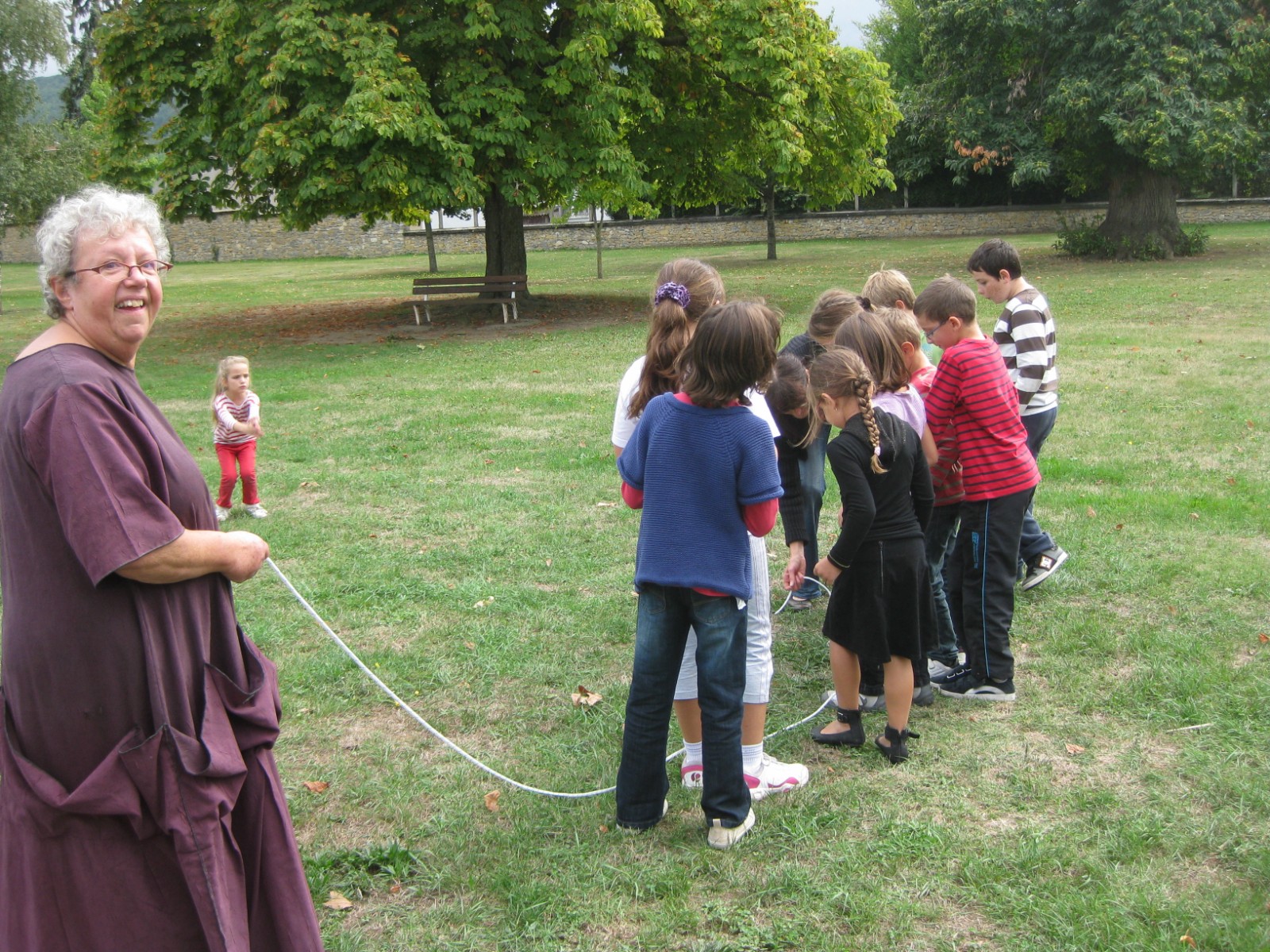
Lunch break.  Afterwards, the children came to see our long-prepared exhibition looking at North Yorkshire, which has so many features in common with the Ariège: mountains (OK, the best Yorkshire can manage is Whernside’s  736 metres.  Ariège’s Pic d’Estats is 3143m); textile and mining industries past their glory days; wide open spaces home only to sheep…. and so on.  They enjoyed an extract from Roald Dahl’s ‘George’s Marvellous Medicine’, and then it was back to the Centre de Loisirs.  Where we produced a long skipping rope with the idea of teaching them a couple of English skipping games…

‘I like coffee, I like tea

I’d like, er, Nadine, to jump with me’.

Getting started with skipping.

They loved it.  Unfortunately they couldn’t skip at all and tripped and fell all over the place, and all the adults mourned that it was a lost art. As in England (Is that so?  Not sure.) children don’t skip any more.

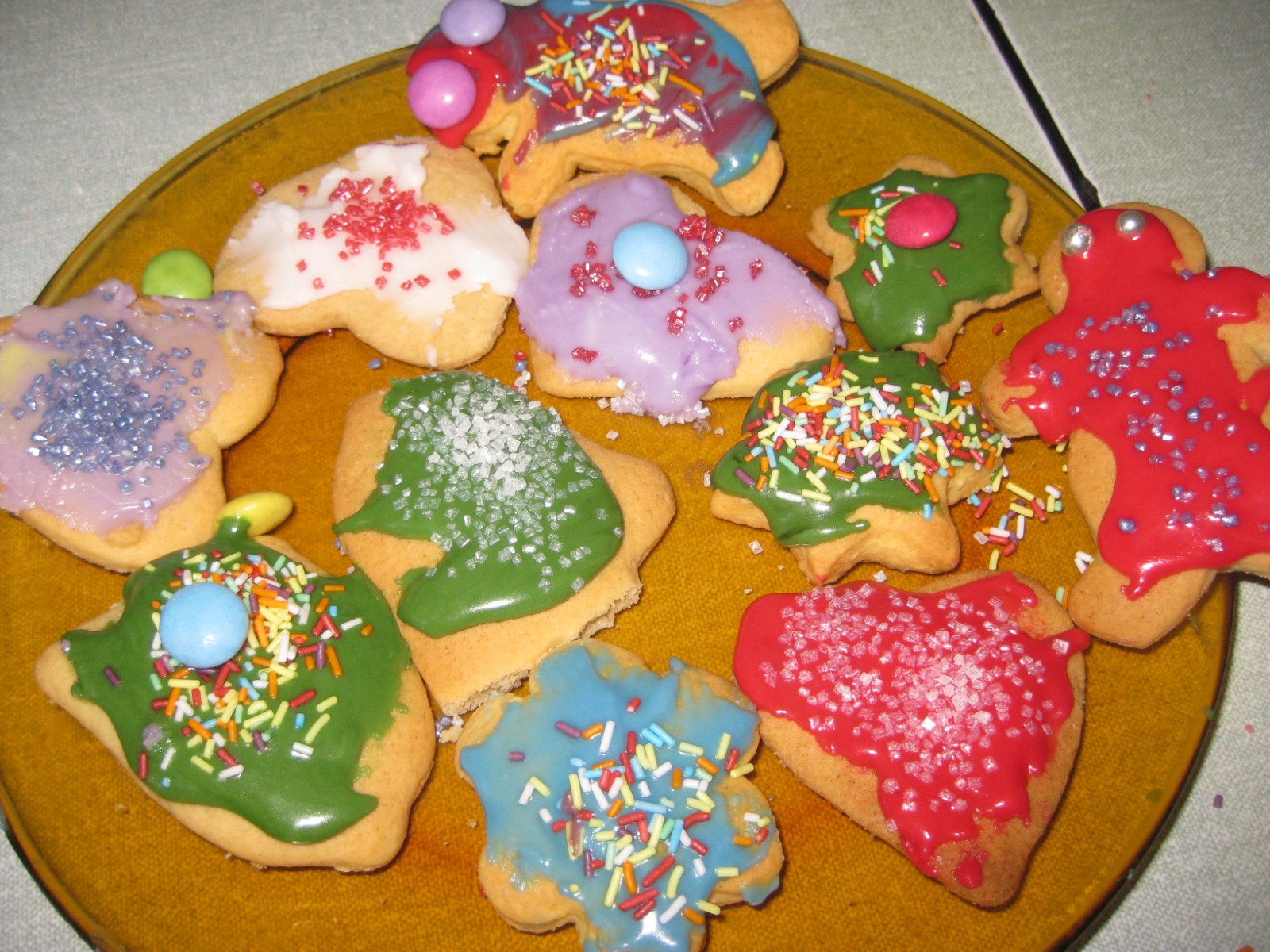
Back into the kitchen, it was time to decorate those biscuits.  They tinted their bowls of icing in lurid shades, and made free with all the sugary decorations we provided.  ‘Glorious Technicolor’ doesn’t begin to do it justice.  Once decorated, they ate the lot, and we sent them off to their parents for the evening crammed full of enough e-numbers to see them through the week.  One lad, as he set off home, was heard to say ‘I’ve had a great day’.  So had we.

Glorious Technicolor biscuits.

Gone but not forgotten – our local charcuterie.

Today is the first day of the rest of Marcel and Mercedes Resseguier’s lives.  Today (barring the odd holiday) is the first Tuesday for 28 years on which they haven’t opened their charcuterie (like most small-town shops, they didn’t open on a Monday).  At 60, Marcel’s retiring.

Their shop is a bit of an institution hereabouts.  Go to an event where food is served and discover that the plates of cold meats, pâtés and cured sausage are from the Resseguiers’ shop, and you’ll be piling your plate high with all that’s on offer.  Go to buy some sausages for an easy lunch, and you’ll join a queue of customers chatting away animatedly as they patiently wait their turn.  What will we do without them? They’re not trying to sell it on – no point.

Once upon a time, theirs was a busy shopping street.  Nowadays, it’s (oops, was) the only shop left.  Still 2 butchers remain in town here however.  Nearby Lavelanet, a town that’s more than twice as big as ours has only one, Marrotte.

When he was 14 ½, Marcel went to Limoux, apprenticed to a butcher’s where he learnt all he needed to learn about the butchery business.  And then he came back to the Ariège to work at the above mentioned Marotte’s. This shop sells not only fresh meat, but charcuterie too: in other words fresh sausage, cured sausage, hams both dried and cooked, and pâtés: mainly, but not exclusively, pork products.  Working here, Marcel realised that, for him, charcuterie was a lot more interesting than presenting fresh meat for sale, and he profited from his time there to learn all he could.

A little later, after his short spell in a general stores with a meat-counter in nearby Villeneuve d’Olmes, the charcuterie here in Laroque came up for sale.  A certain Monsieur Vié owned it.  His son Michel is a pillar of our town, involved in everything from singing in the local choir to supporting our local town-twinning operation.  He didn’t want to go into his father’s business, but like so many people round and about, he’s learnt many of the skills, and will often knock up some cured sausages or a bowl or two of pâté for a family celebration.

Well, Marcel, with his father’s help, bought the shop, together with the good-will and customer-base that came with it. The rest is history.  The charcuterie is hard to find, being tucked away in a side-street where it’s almost impossible to park.  But that didn’t stop it being a shopping destination.  Once there, apart from all the expected meats and sausages, you could buy his tins of jarret de porc or jars of pâté de foie, as well as wine or bottled vegetables.  His was a depot de pain too.  So he’ll be missed, as will Mercedes, his wife, who served the customers and balanced the books.  Happy retirement, Marcel.  Enjoy your new career Mercedes (that’s another story) …. and see you on the next Sunday walk with Laroque’s walking group.

A long day: Team UK (Laroque branch) support the Tour de France

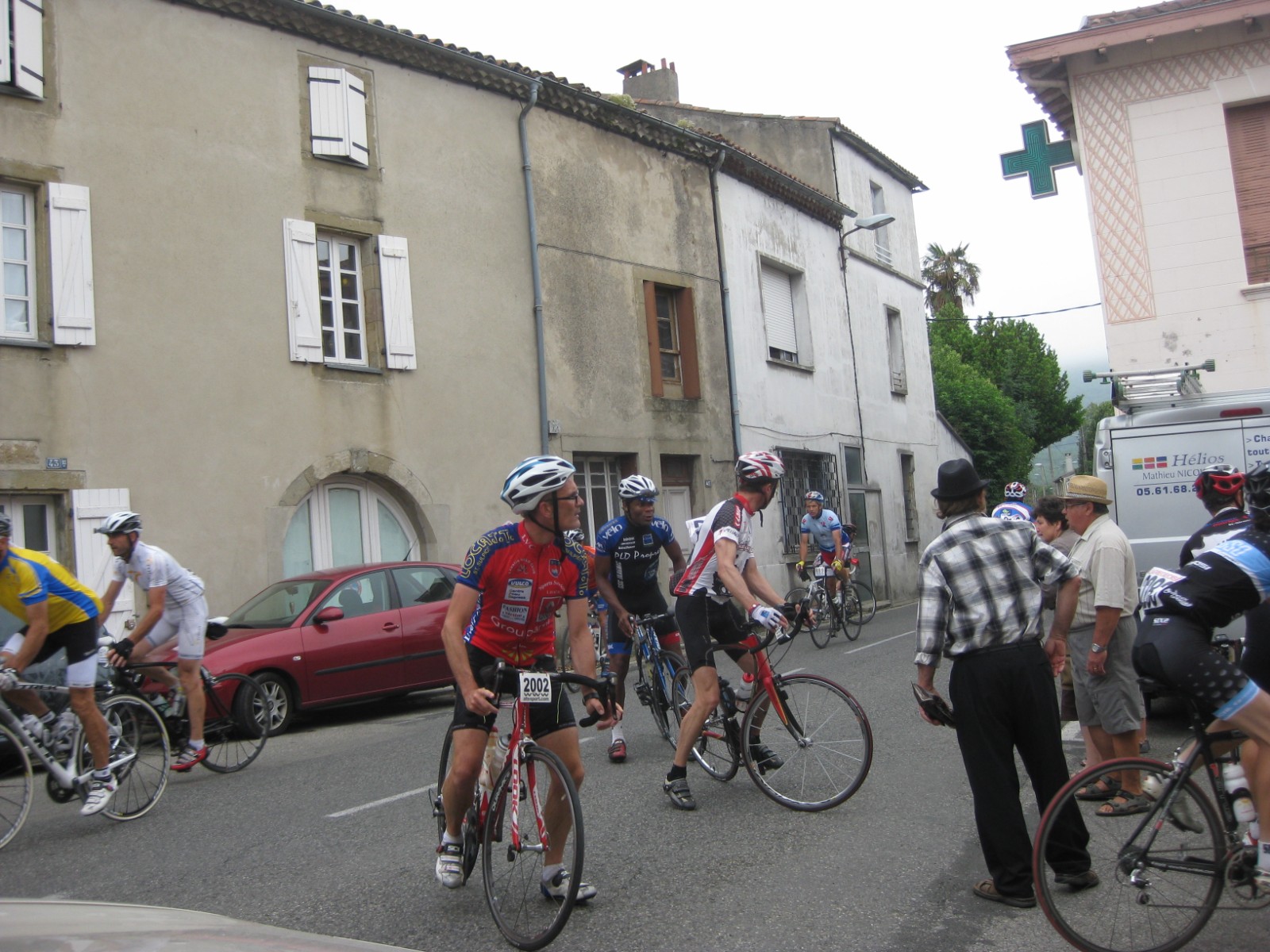
The Tour de France 2012 hit Laroque on the Limoux – Foix stage on Sunday 15th July. It was a long day…. and that was just for the supporters.

Thanks Sue, thanks Tom for the use of all your photos.

Entendre cordiale: Blue Lake again

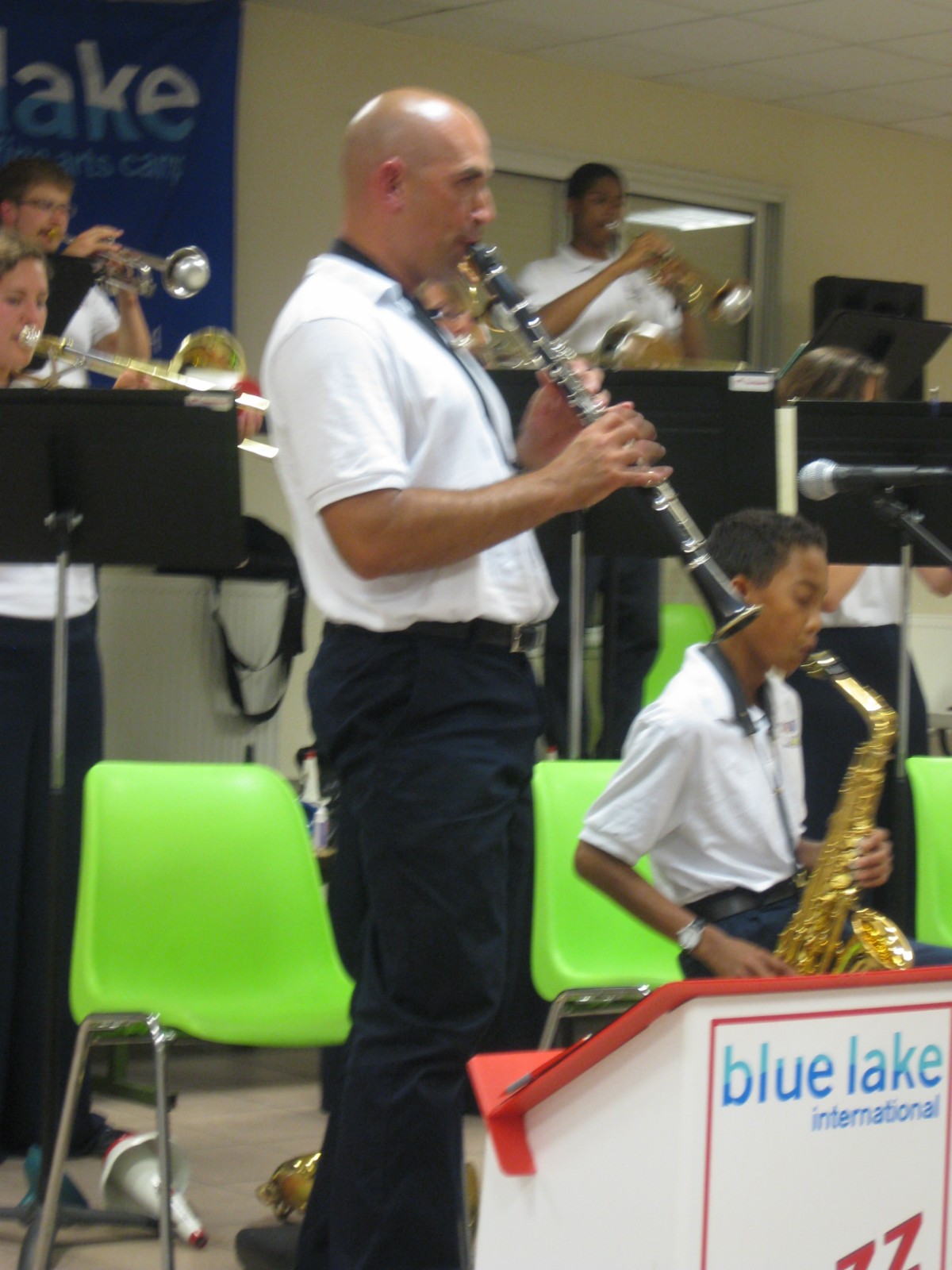
It’s been Blue Lake time again: that time of year when for 3 years now, we at Laroque have come to expect great entertainment from the musicians of the Blue Lake Fine Arts Camp in Michigan, USA, as well as some music from our own LDO Big Band.

This year, we welcomed a slightly different group from previous years – the International Jazz Band.  Mostly still in their teens, these players have been selected for the European tour not only because they’re good at what they do, but they’re hungry to become even better.  They want to seize the opportunity to spend time in cultures other than their own, and to perform in locations throughout parts of Europe, from prestigious concert halls and cathedrals, to smaller town venues like ours.

At the end of last night’s concert, the band’s conductor and group director Bill MacFarlin, spoke of how these chances for young Americans to travel and make music was a real opportunity to foster international friendship and understanding.

We’ve been watching that at work over the last 3 days.  The Blue Lake team, 17 of them, arrived in sunshine to a big welcome group in the Municipal Park.

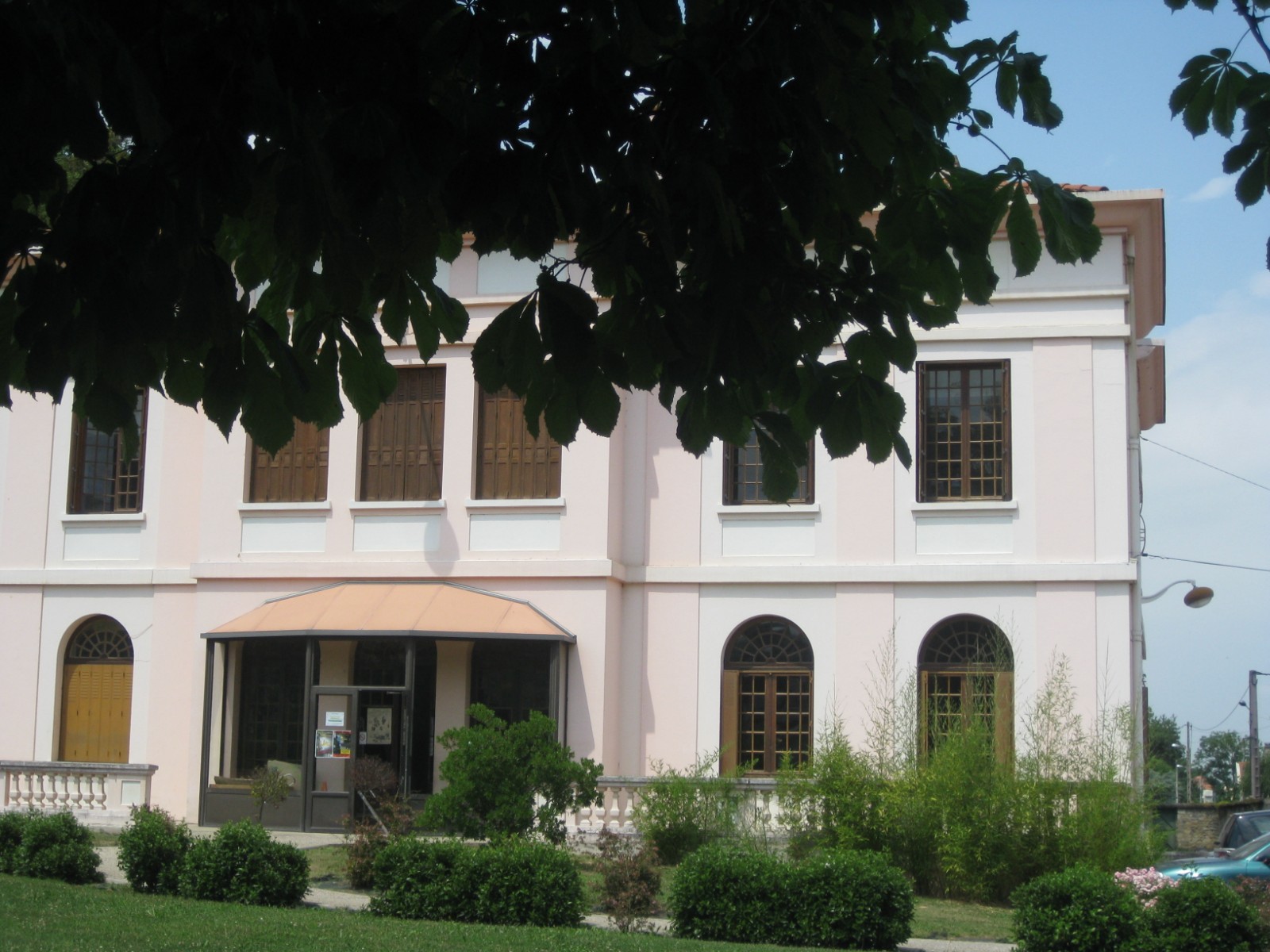
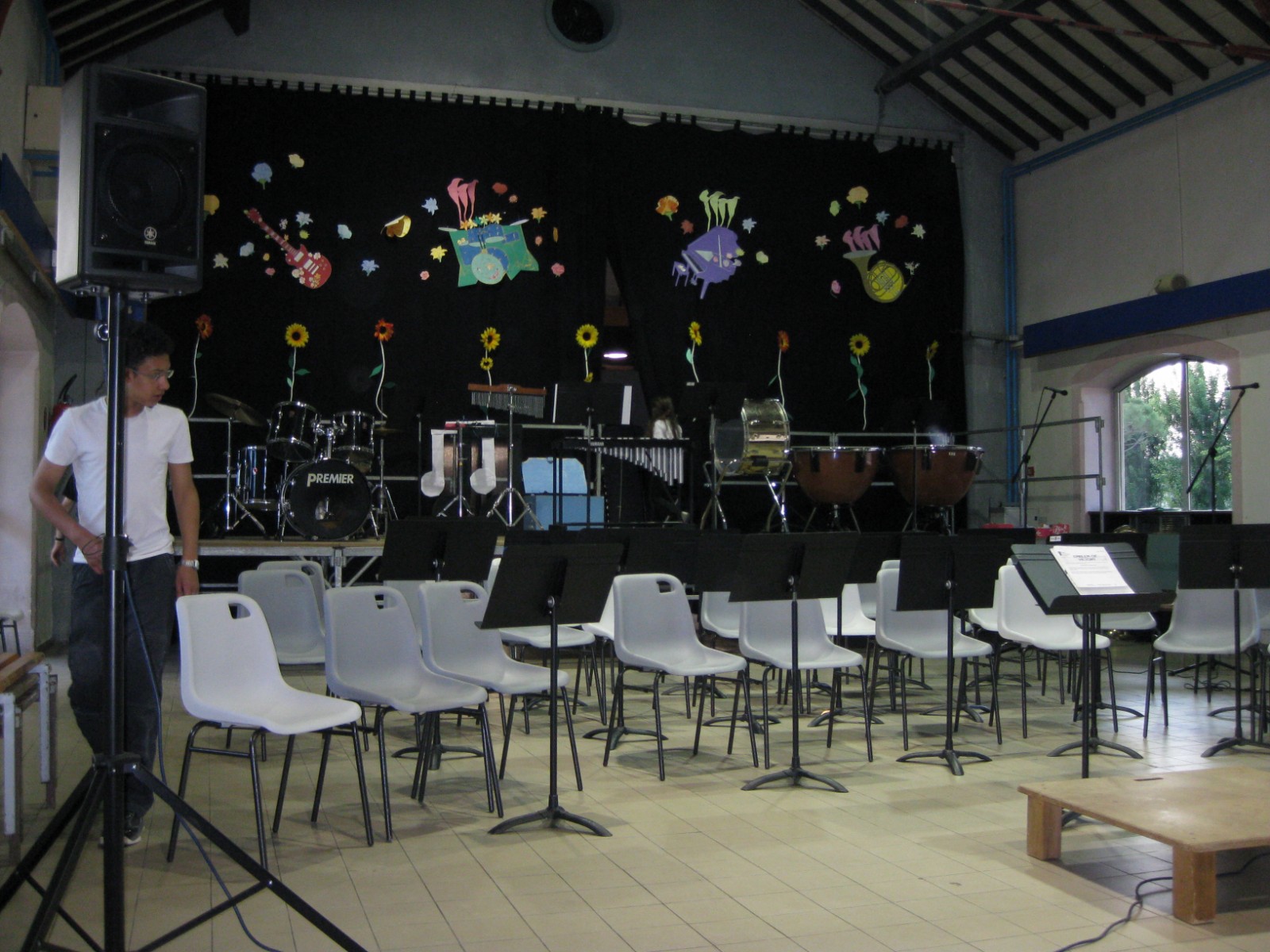
Our School of Music’s housed here in the château. I took this shot just before everyone arrived

The event went well, but it was easy to see the Americans and French weren’t mixing much – it was too hard to communicate: Malcolm’s and my interpreting skills were much in demand (Not that we’re much good.  I listened to our French head honcho, Michel Alvarez, and carefully interpreted it to Bill McFarlin.  Bill raised an eyebrow. ‘Do you realise’, he said ‘that you’ve just said all that entirely in French?’).

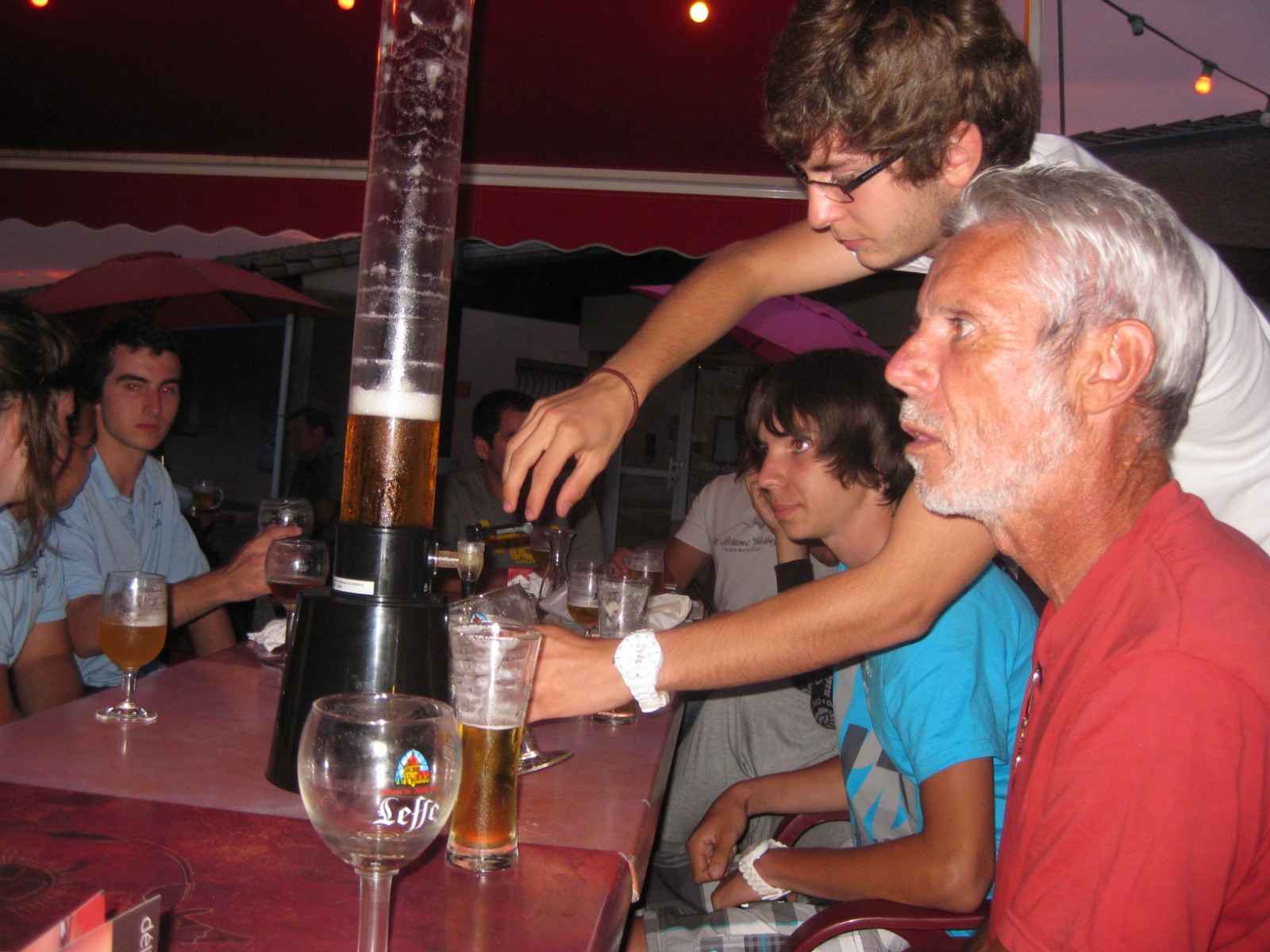
A giraffe of beer

Later, down at the bar with older students and members of LDO Big Band it got a lot easier.  The giraffe of beer may have helped.

Lucas Munce – with a clarinet this time

It was next day that real change took place. First of all, there was a Master Class, with Lucas Munce, acclaimed as a saxophonist back in the US (AND for his clarinet and flute  playing too), and Parker Grant, a young jazz pianist also gaining recognition.  After a slow start, the need to exchange musical knowledge overcame shyness and the language barrier.

Then after a shared meal it was time to rehearse.  Towards the end of the evening, members of the French and American bands sat together to practise the pieces they planned to play together to conclude Fridays’ concert.  It was wonderful to witness them, heads together as they pored over their shared scores, animatedly and enthusiastically discussing  their music.  Their mutual comprehension of each other’s tongues seemed to have moved up a gear, but above all they now had a shared language – music.

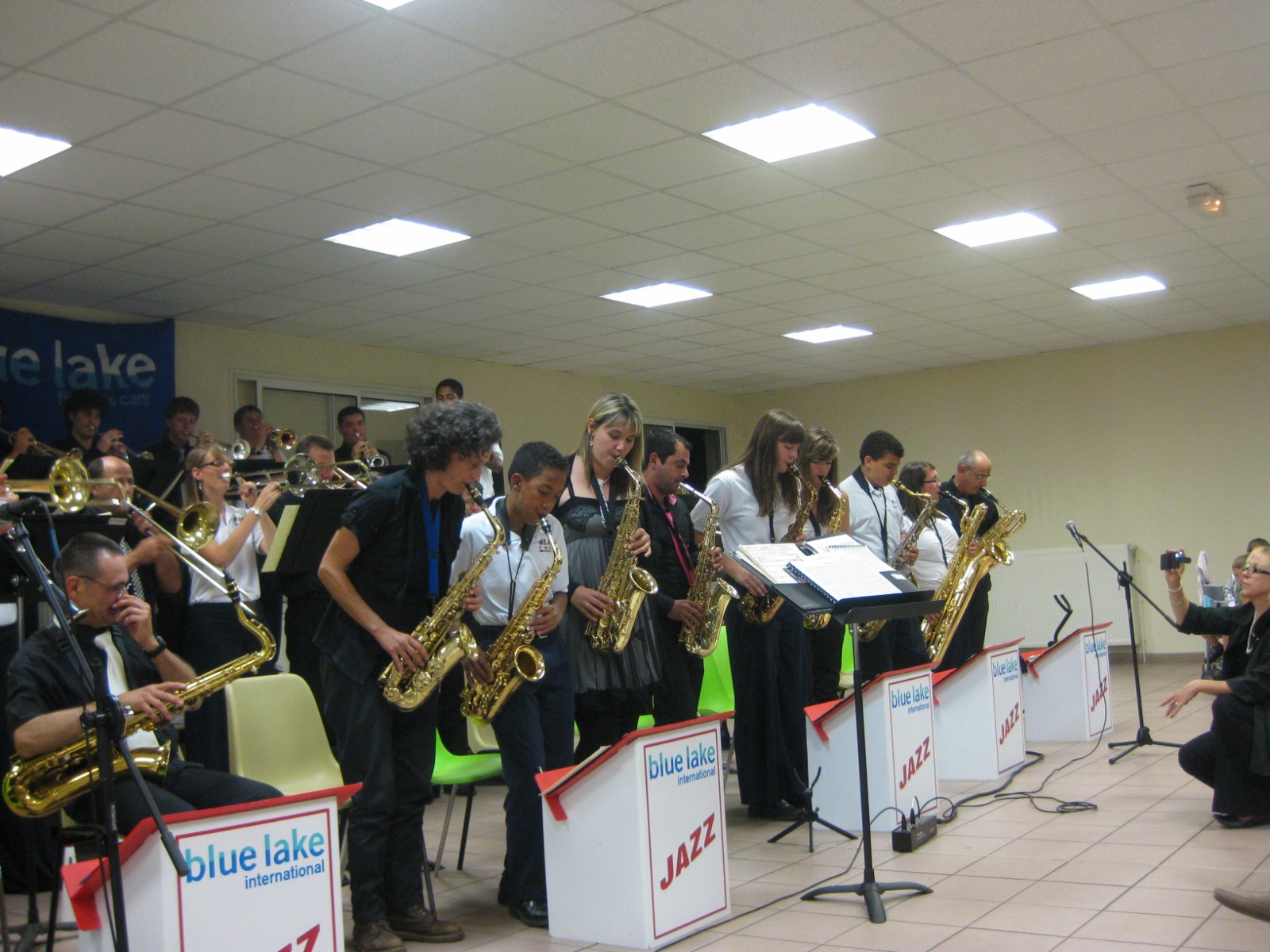
Blue lake International Jazz Band and LDO Big Band at rehearsal

By the time Friday’s concert came, these musicians were friends.  They greeted each other affectionately and settled down to listen to each other’s performances with relish.  When they had to squeeze themselves together for those final numbers, placing themselves alternately American/French, they were confident to give the music their all.  They loved it.  The audience loved it.

Blue Lake and LDO saxophonists share the moment at Friday’s concert

At the moment of parting, there were hugs and all round and quite a few sniffles too.  As ambassadors for their country, Blue Lake do a pretty fine job.

L’Ariégeoise & le Mountagnole: a very sticky moment

L’Ariégeoise comes to town

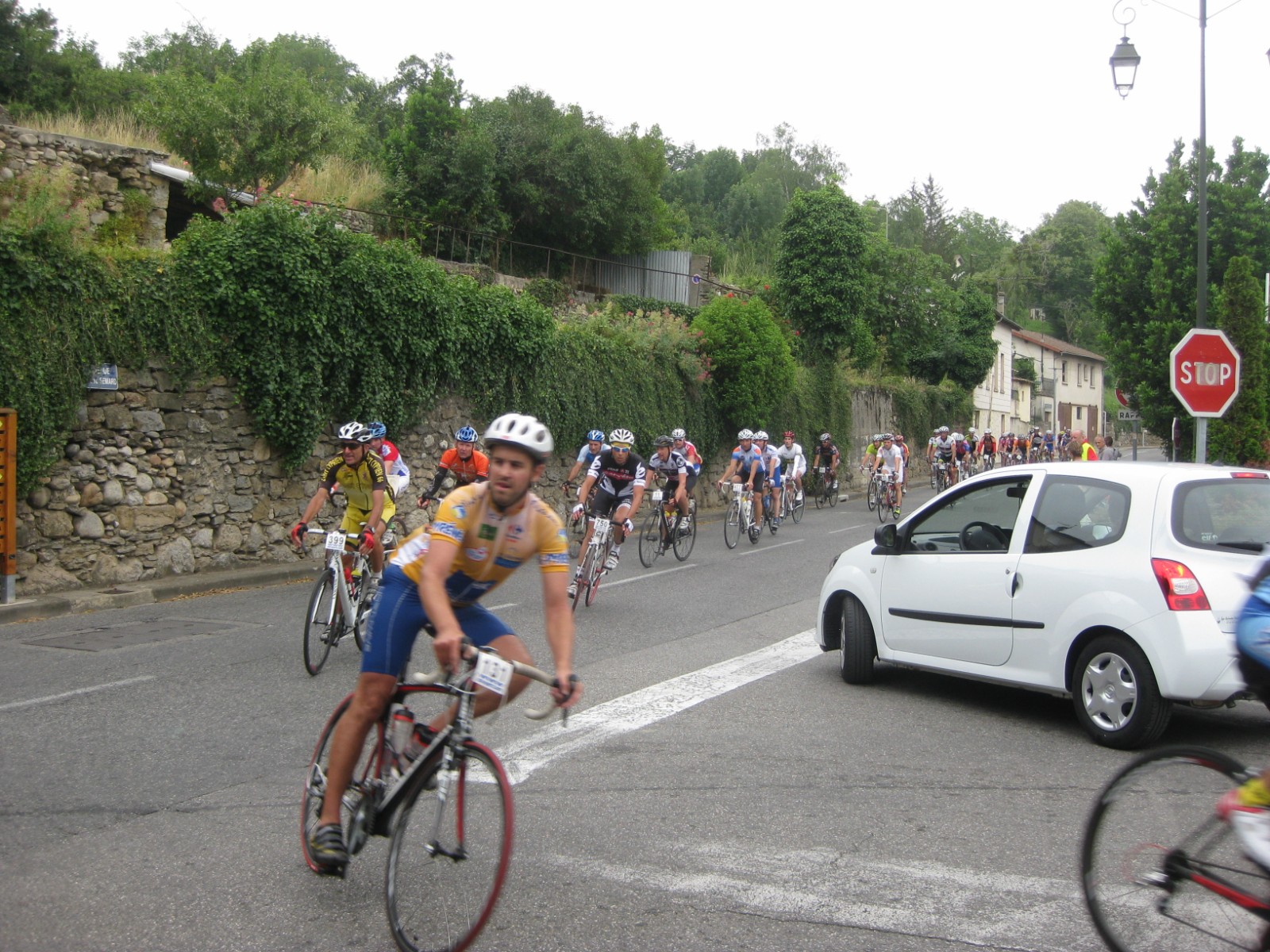
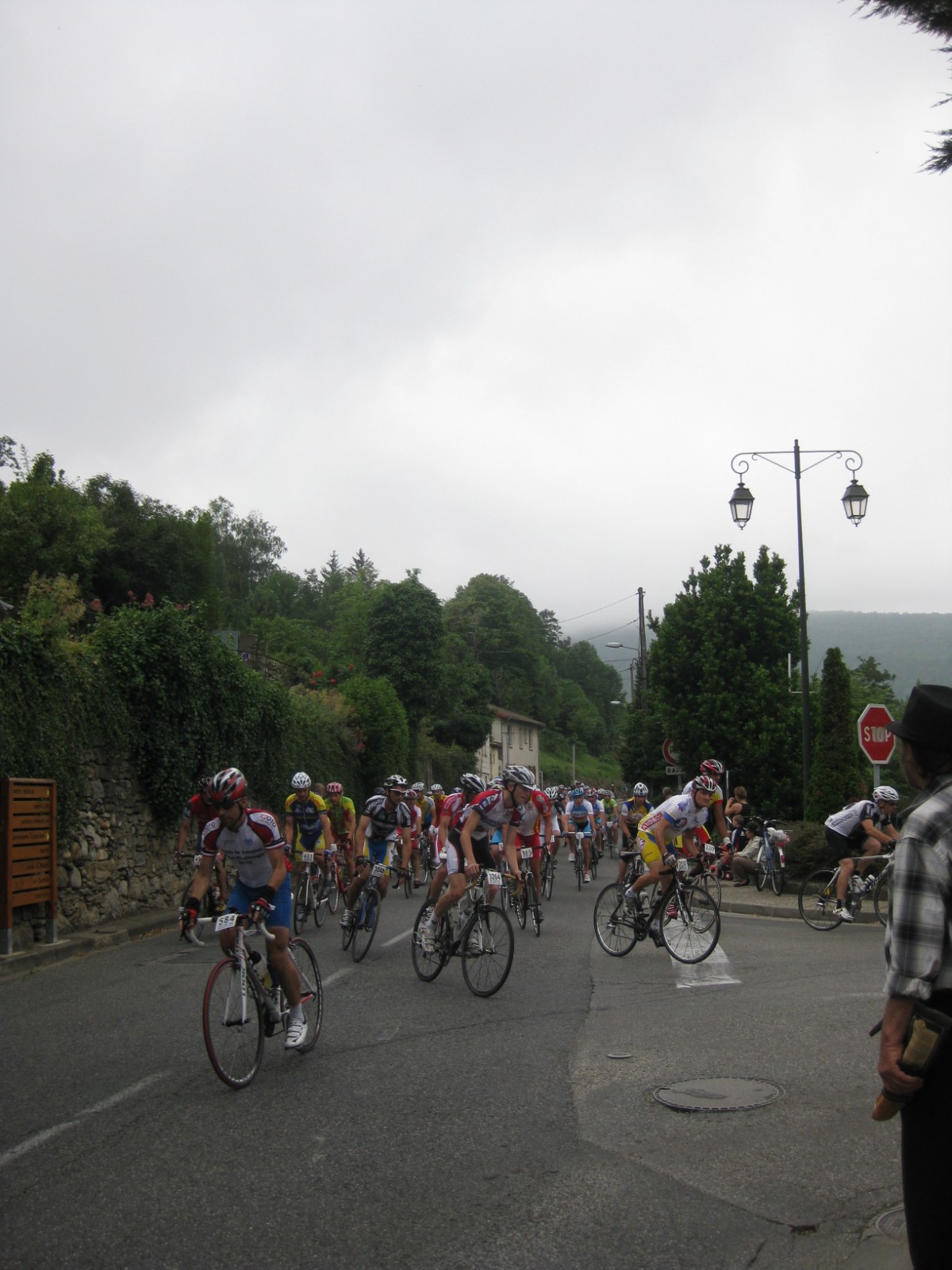
If you live in a small town like ours, you look for excitement where you can.  Today,  lAriégeoise passed our house.  This is a cycle race organised just before the Tour de France every year in our department.  Unlike the Tour itself, you can choose which of three races to join.  The truly serious do lAriégeoise itself: 160 km, with 3430 metres of climbing to do. The fairly serious do Le Mountagnole, 117.400 km, 2569m climb.  And the ones who are frankly playing at it do the Passejade, a mere 68.5 km, with a 745m. climb.

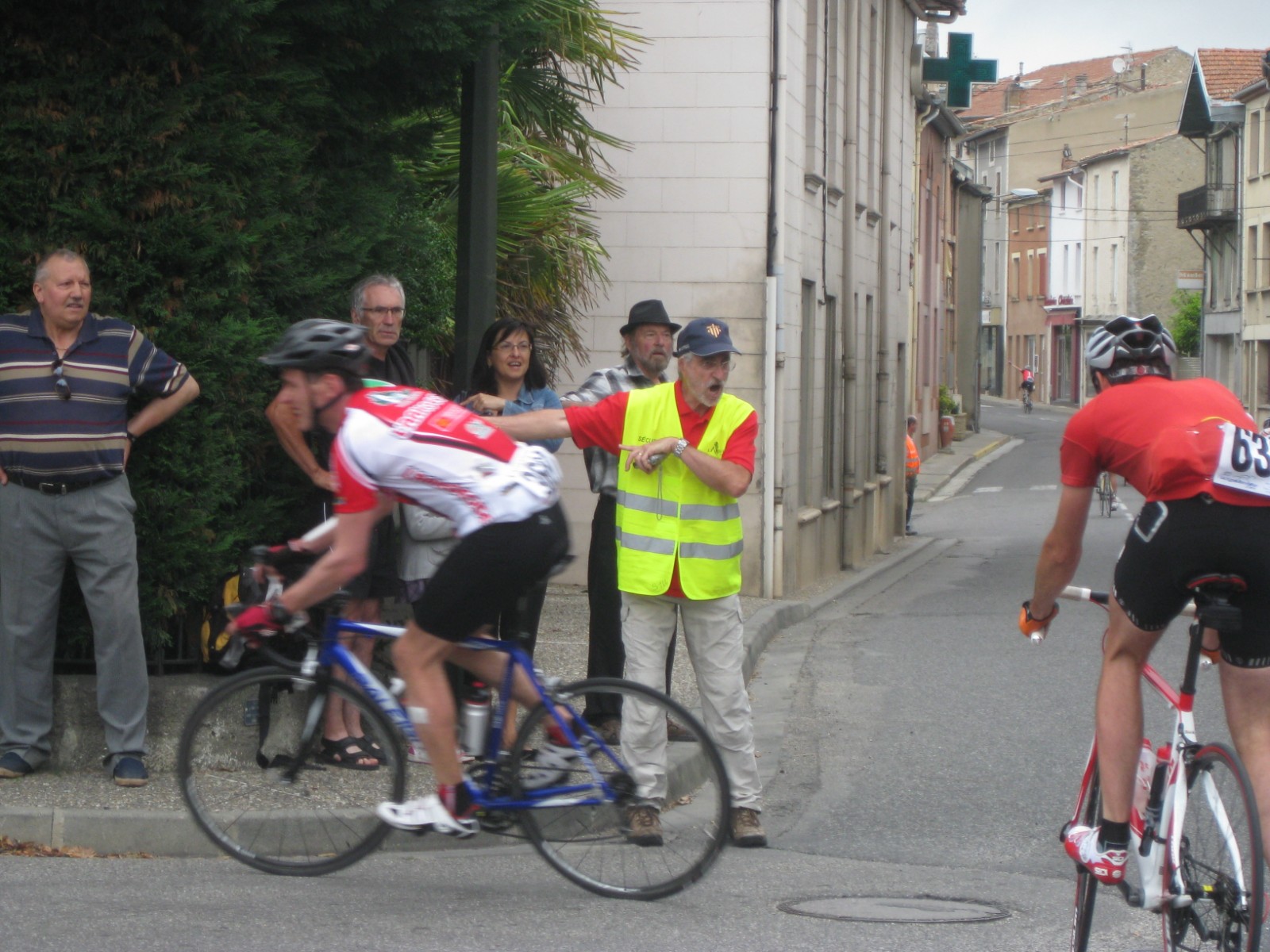
The two first groups were due to cycle through Laroque, and we locals were ready at 10 o’clock, lining the streets to cheer them on.  L’Ariégeoise marshals with Stop-Go batons in red and green strutted about importantly, directing the traffic, stopping and diverting cars as necessary.

The first cohort arrived, swished at speed past our house…and was gone.

Seconds later, some of them did a hasty U-turn and cycled back again, turned right across the bridge and picked up speed in a different direction.  What could be going on?

The parting of the ways

It turned out that l’Ariégeoises and the Mountagnoles, who until then had been sharing a route, parted company here.  The Mountagnoles had no special marshals, and when the time came, with heads down and intent only on completing their circuit in record time, they followed the l’Ariégeoise pack.  And some l’Ariégeoises followed the Mountagnoles pack.

Erm…..should we be here?

With nothing but their batons and booming voices to help them, l’Ariégeoise marshals tried to sort the sheep from the goats and send everyone on the correct path.  But it was hopeless.  More and more cyclists went wrong, and the area round the bridge became a clutter of wheeling tumbling bikes and their confused riders.  Some of them were amused.  Others not.  ‘Merde!’, ‘putain!’ and worse coloured the air as they saw their hard-won average speeds taking a turn for the worse.

A marshal tries to hold things together

I recorded some of the juicier moments and uploaded a short video to YouTube.  Why don’t you have a look?

Once upon a time there was a town…

We thought we knew Laroque. An afternoon’s walk round town with local historian Paul Garrigues as part of this weekend’s Journées du Patrimoine has convinced us otherwise.

The bridge near our house is modern and slightly re-sited. But we had no idea that the main road it’s on, leading to one the busiest roads in the Ariège, the D625 to Lavelanet, used not to exist. To go to Lavelanet, you used to go straight up the hill, and down back-street Rue des Pas Perdus.

To those in the know, evidence of the former town gates

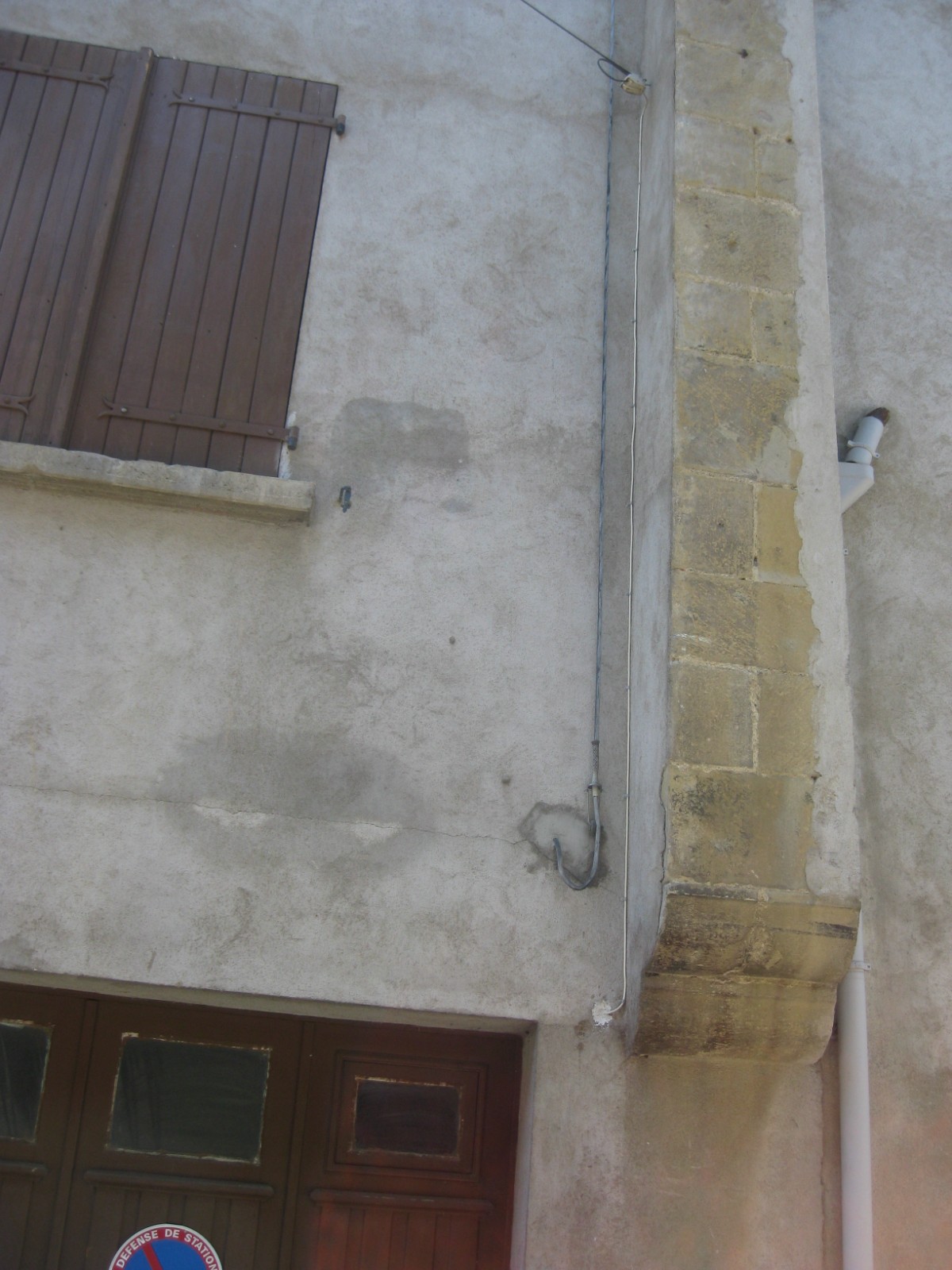
And here you’d go through one of the town gates. Using this path day after day to reach our garden, we’d never noticed the buttressing that indicated the former presence of these gates. Nor did we suspect that the narrow road and path which is now a way-marked walker’s route which passes past our garden, down to the River Touyre was once a busy thoroughfare. You follow the river to the former railway line, where you turn right and take a shady tree-lined route barred to anything more technical than a bicycle through the next village, Dreuilhe, and on into Lavelanet. Quite different from the lorry-van-and-busy-commuter route now in operation.

Once upon a time the main road to Lavelanet. Now the path past our garden.

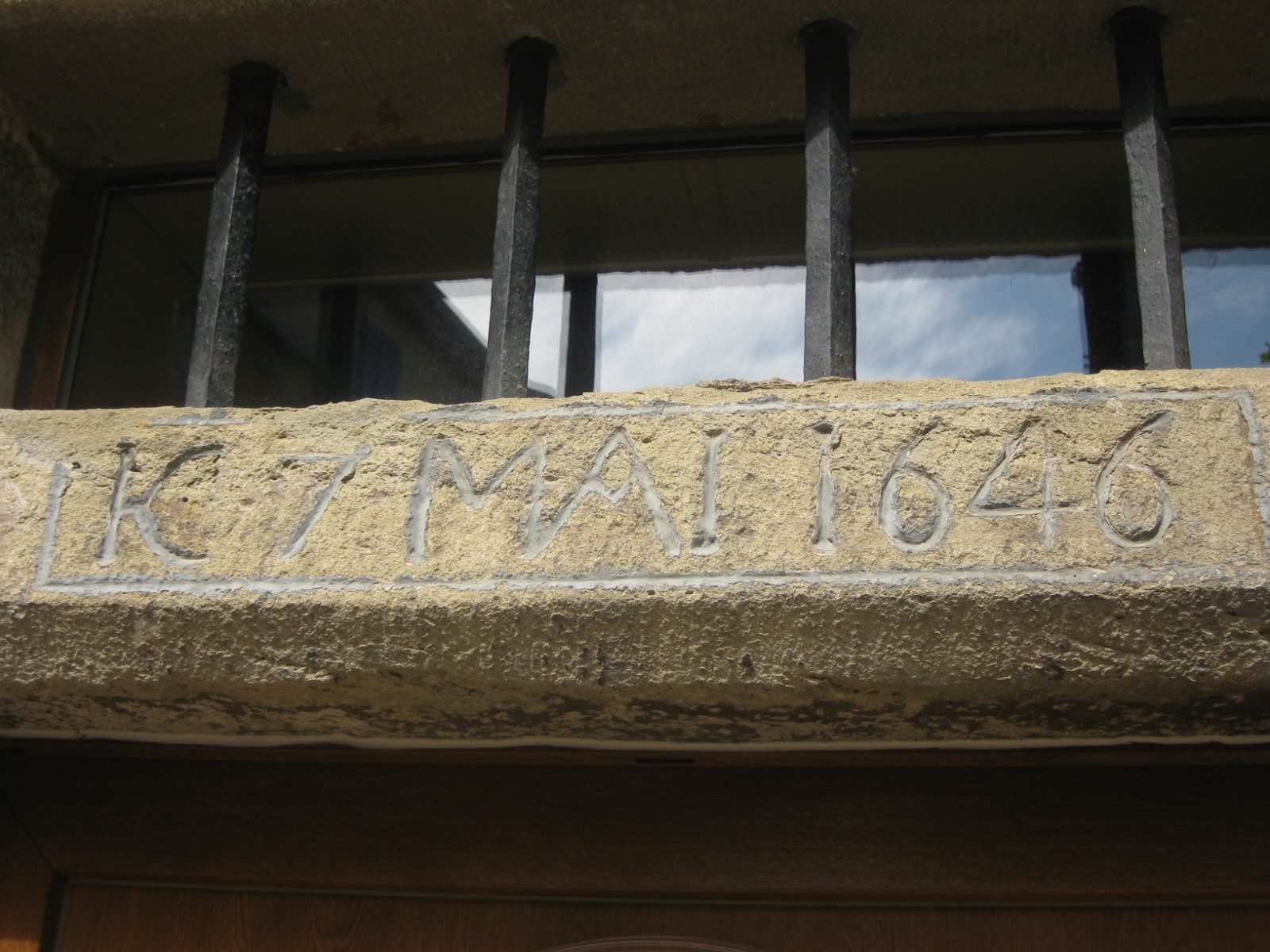
We knew our town is an old one. It’s not uncommon to pass houses whose door lintels are inscribed with a date from the 17th century.

A nearby house announces its d.o.b.

What we didn’t know was that in the old town itself, there are no buildings at all from before this time. This is because every single dwelling was destroyed during the French Wars of Religion (1562 – 1598). The crisis was so grave the King permitted the townspeople an amnesty from paying taxes for several years to give them a chance to rebuild.

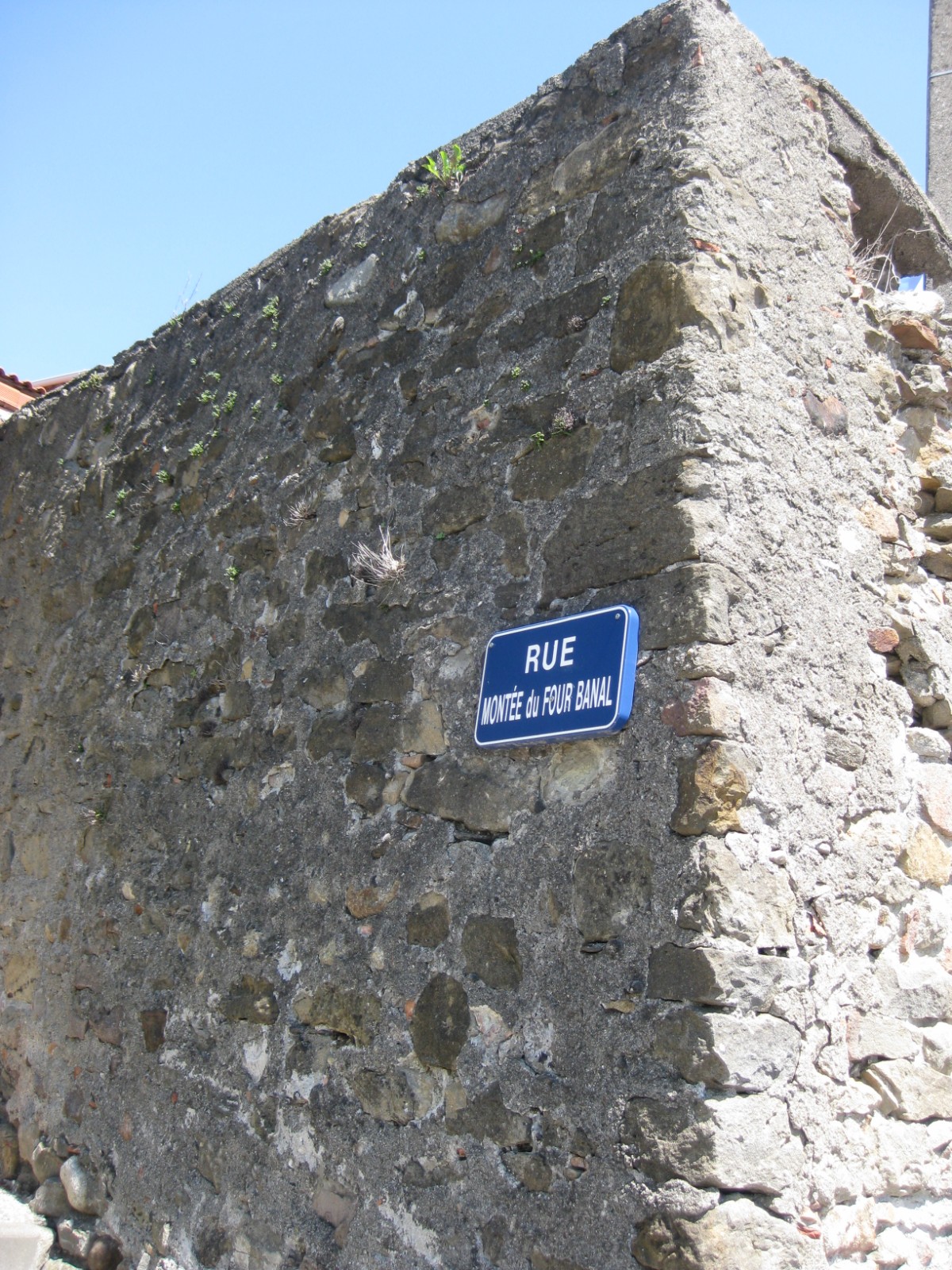
But before all that was …. the Women’s Revolt.  Back in the 16th century, the women of the town would bring their bread to be cooked at the Four Banal, the site of which lives on today as a street name.

Rue Montée du Four Banal: the sign’s fixed to remnants of the old town wall

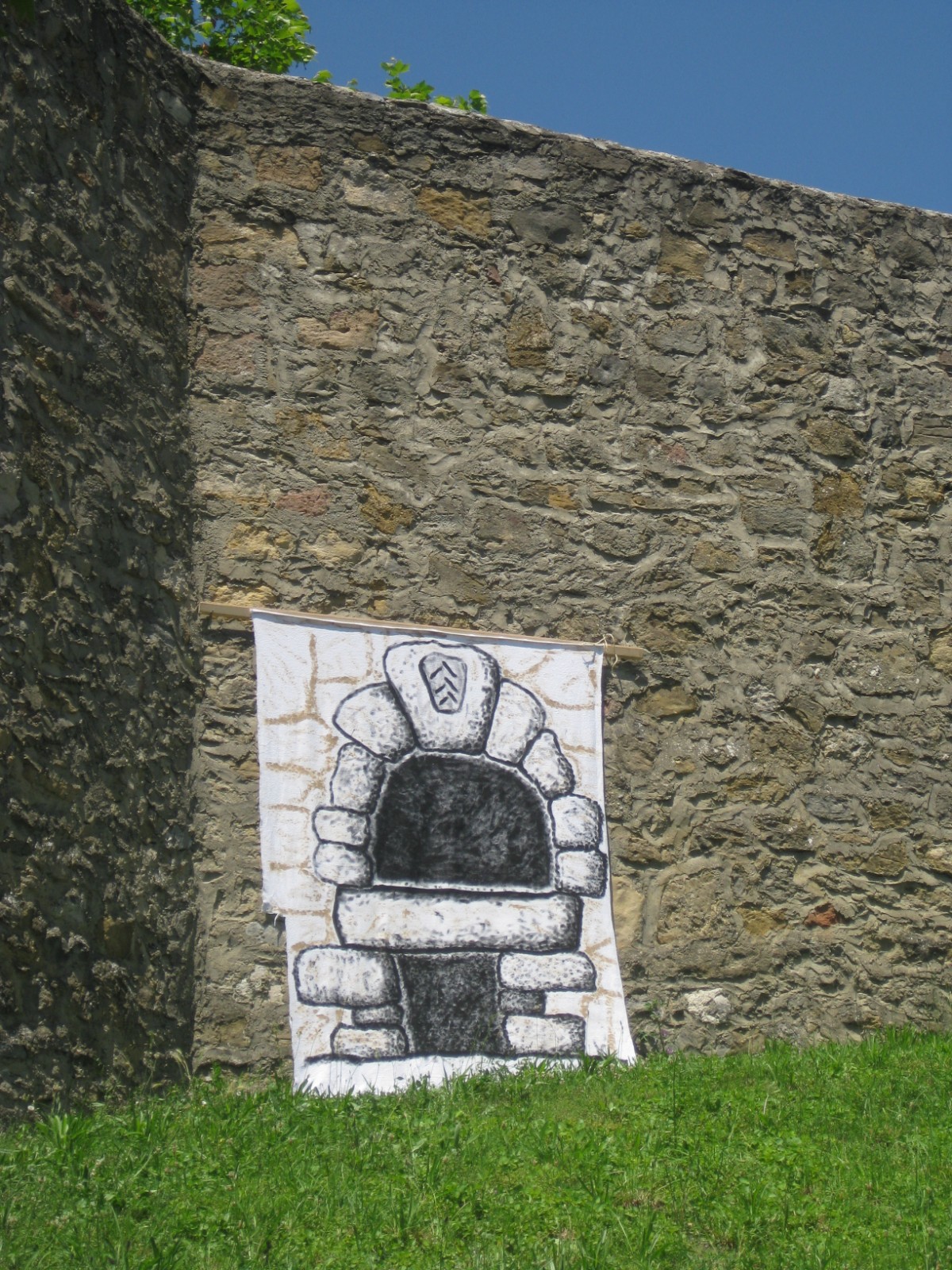
They paid the local lord to manage this service and the lord paid a baker. Who decided to exact his own charges too – one loaf in every 20. When the women’s angry protests were ignored, some 80 women held a somewhat violent demonstration, and followed up by taking their bread to nearby Esclagne and La Bastide to be baked. It all ended up in an enquiry directed from Carcassonne. Result? It was the baker himself who was found to be at fault: his taxes were illegal, but it was the lord who had to reimburse the women. For their part the women were forbidden to have their bread baked elsewhere. The Four Banal itself is by yet another former town gate, and traces of the old town wall still exist.

Perhaps the Four Banal looked like this?

It was during this period too that several streams ran through the town, forced into culverts between the houses, with little wooden bridges built over. They were useful to all the artisans involved in various aspects of the textile industry and other trades.  Can you imagine the smells you’d have had to endure if you were unlucky enough to live in the same street as the tanner?

More recently, in the late 19th and early 20th centuries, Laroque was a prosperous commercial centre for its then more than 4000 inhabitants (2000 now) and the workers who flocked from a wide area to work in the textile mills. There were three cafés in the market square alone, as well as an hotel. Three abattoirs too, to serve the needs of all the butchers – one was in what’s now our garage. And shops of every description in what are now entirely residential streets. Then as now there was a huge social mix. One fine house, now down on its luck, was built for a successful surgeon and his banker son.

Once a surgeon’s house: now increasingly shabby

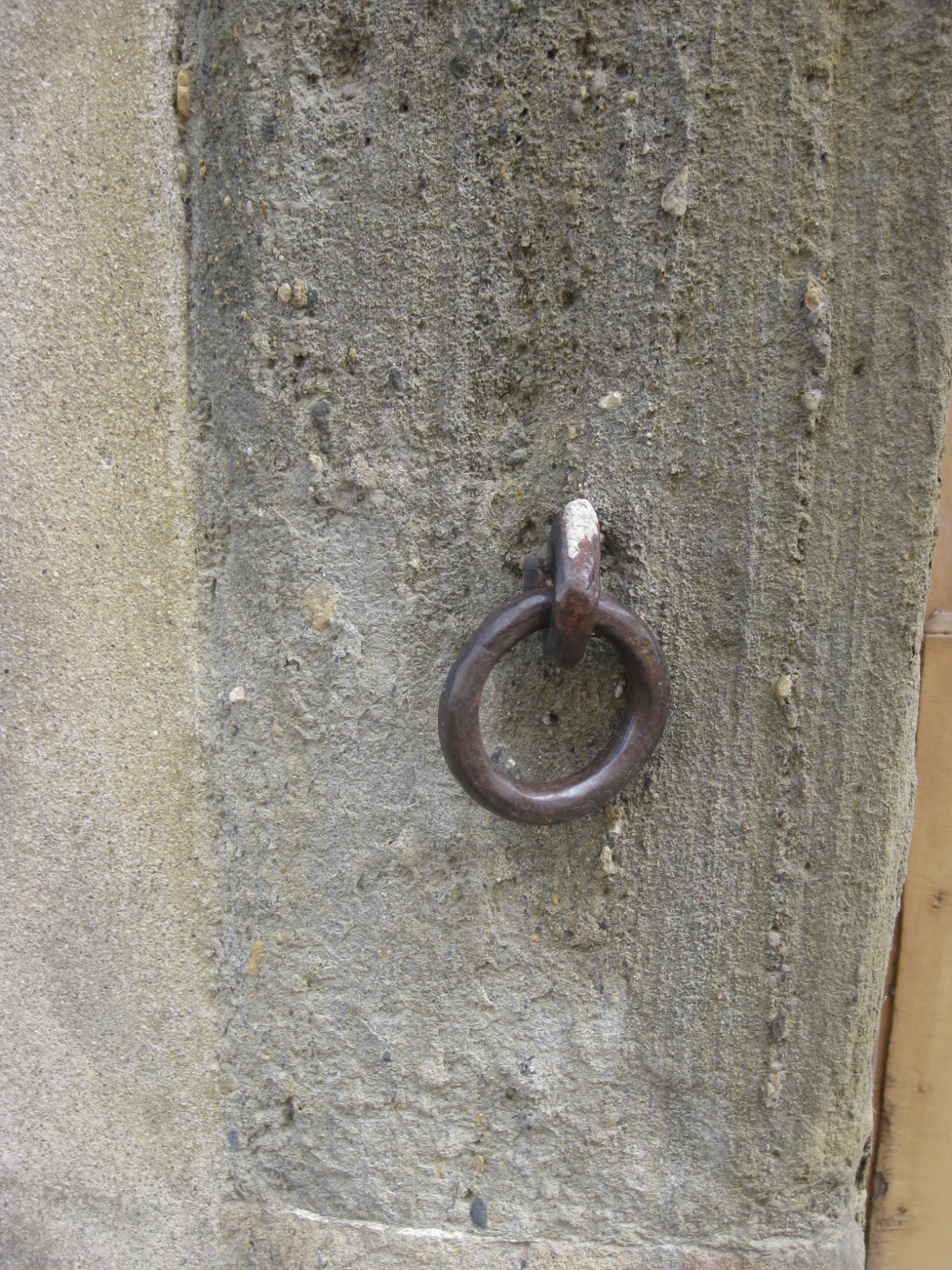
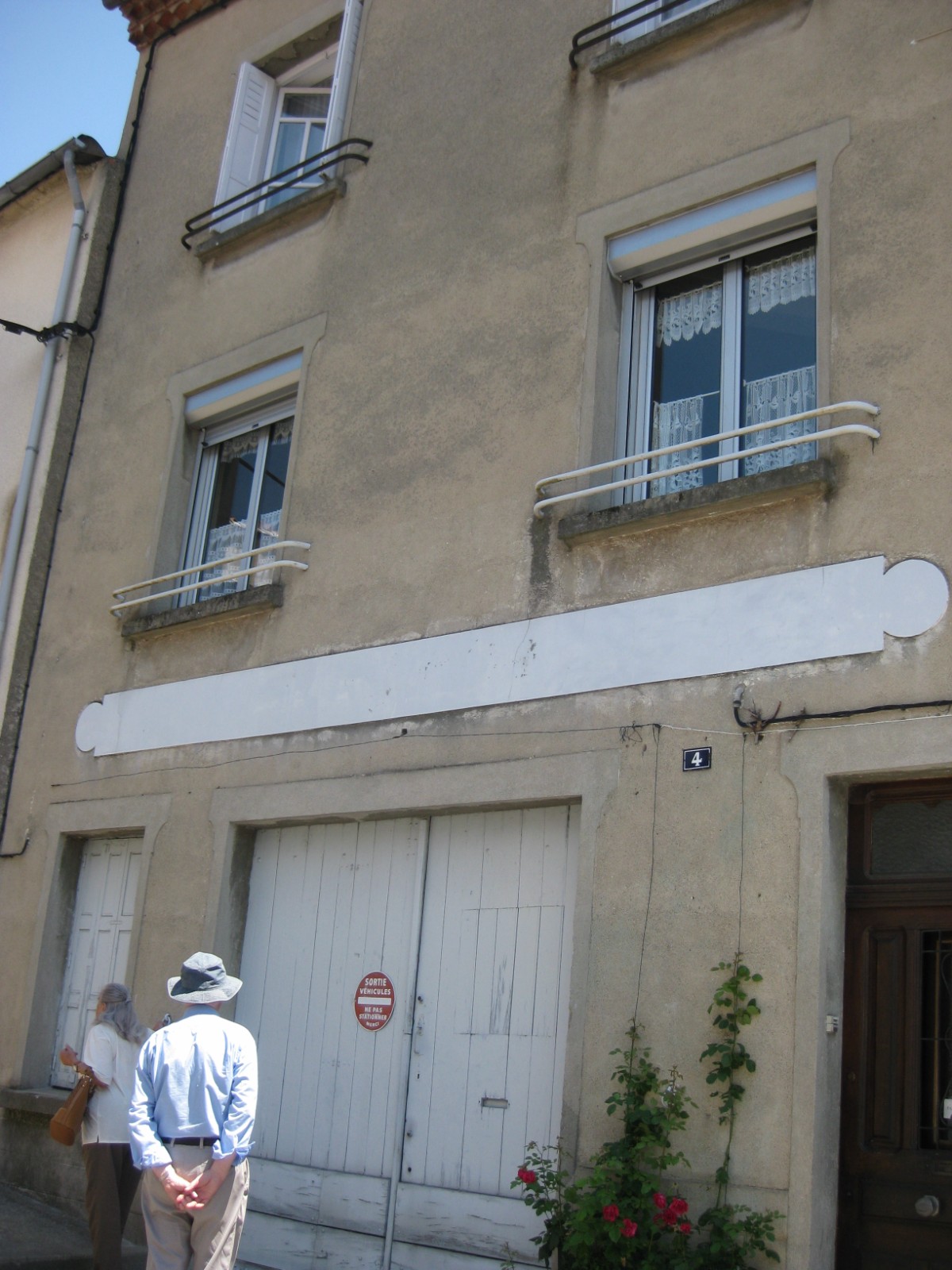
So now we’ll keep our eyes open, and perhaps notice those clues of former commercial activity: a ring set in a wall perhaps, for a trader delivering stock to tie up his horse or donkey, as well as the more obvious painted-over shop signs. I-Spy for residents.

I-Spy a delivery man’s tethering ring

I-Spy a shop front: one of the several vintners in town

Rencontre des chorales

Our Chorale at Laroque’s best friend is the Chorale at Mirepoix.  The Écoles de Musique in each town are best friends too, working together and running some joint classes and performances.

The chorales and other classes get together at least once every season to enjoy singing and playing for and with each other for an evening.  The public’s invited, and comes in encouragingly large numbers.

Those cannelés….

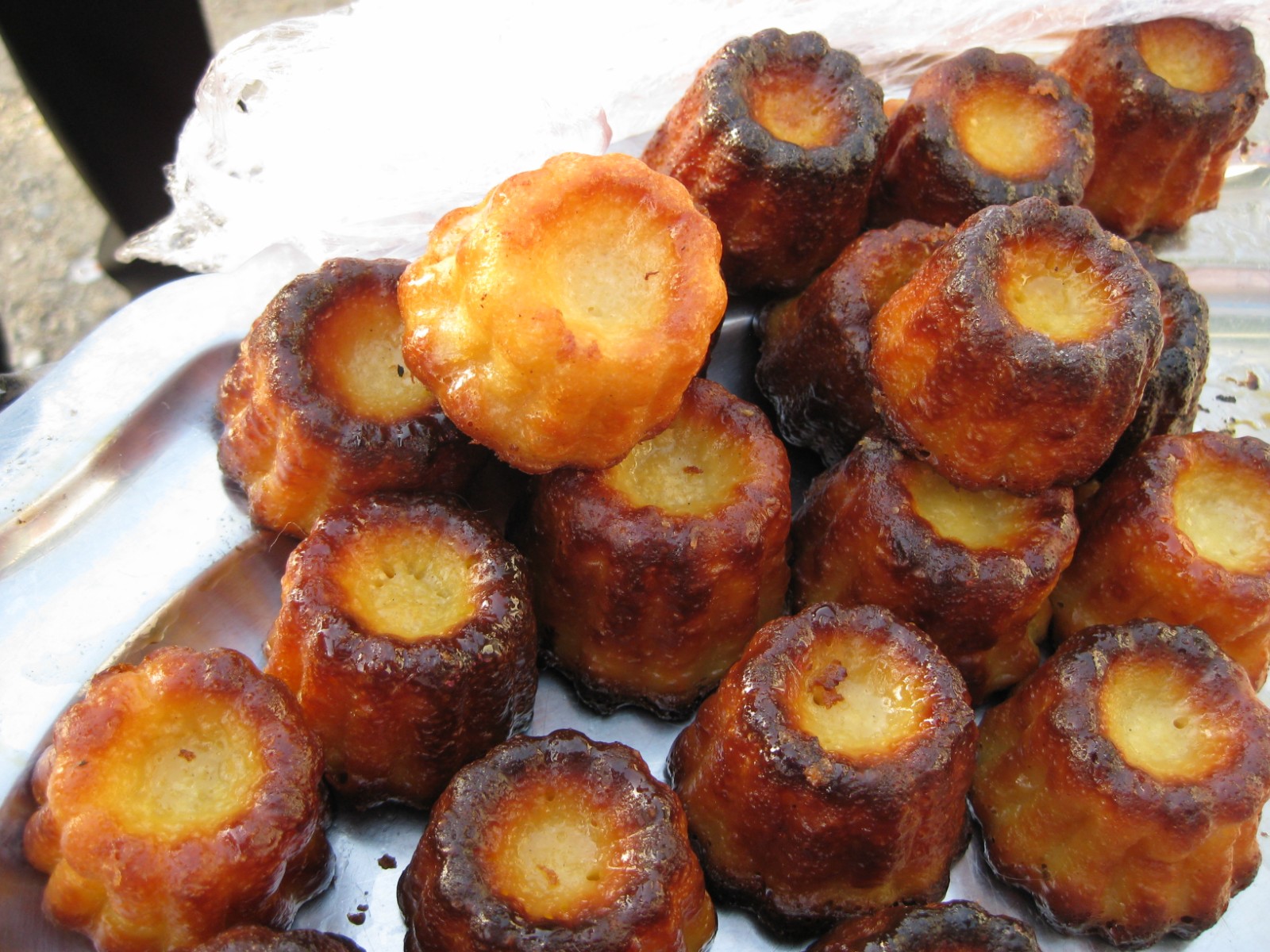
Last Friday, all the singers started wandering in shortly after 6, carrying carefully prepared dishes of buffet food.  The instructions were to bring no more than 6 portions, but nobody took any notice of that.  Robert from Laroque had made a pile of his deliciously chewy signature cannelés, Mirepoix’s William (yup, William’s a perfectly good French name) produced meringues, Mercedes’ plate was full of the cold meats and pâtés they make their charcuterie….and so on.

The rehearsal started, and was less a question of running through the songs than organising the logistics of moving around the dozens of us involved: Mirepoix’s orchestra, their children’s choir, the adult choirs from both towns.  It had to be done to a time-table, because nobody wanted to hurry over eating that buffet or sinking some wine.  ‘Don’t drink too much alcohol beforehand!’ urged Vanessa, our director ‘It’s bad for your singing voice’. I didn’t see anyone taking very much notice. ’Well really’, said Robert ‘How can you possibly eat cheese without a glass of wine to help it down?’

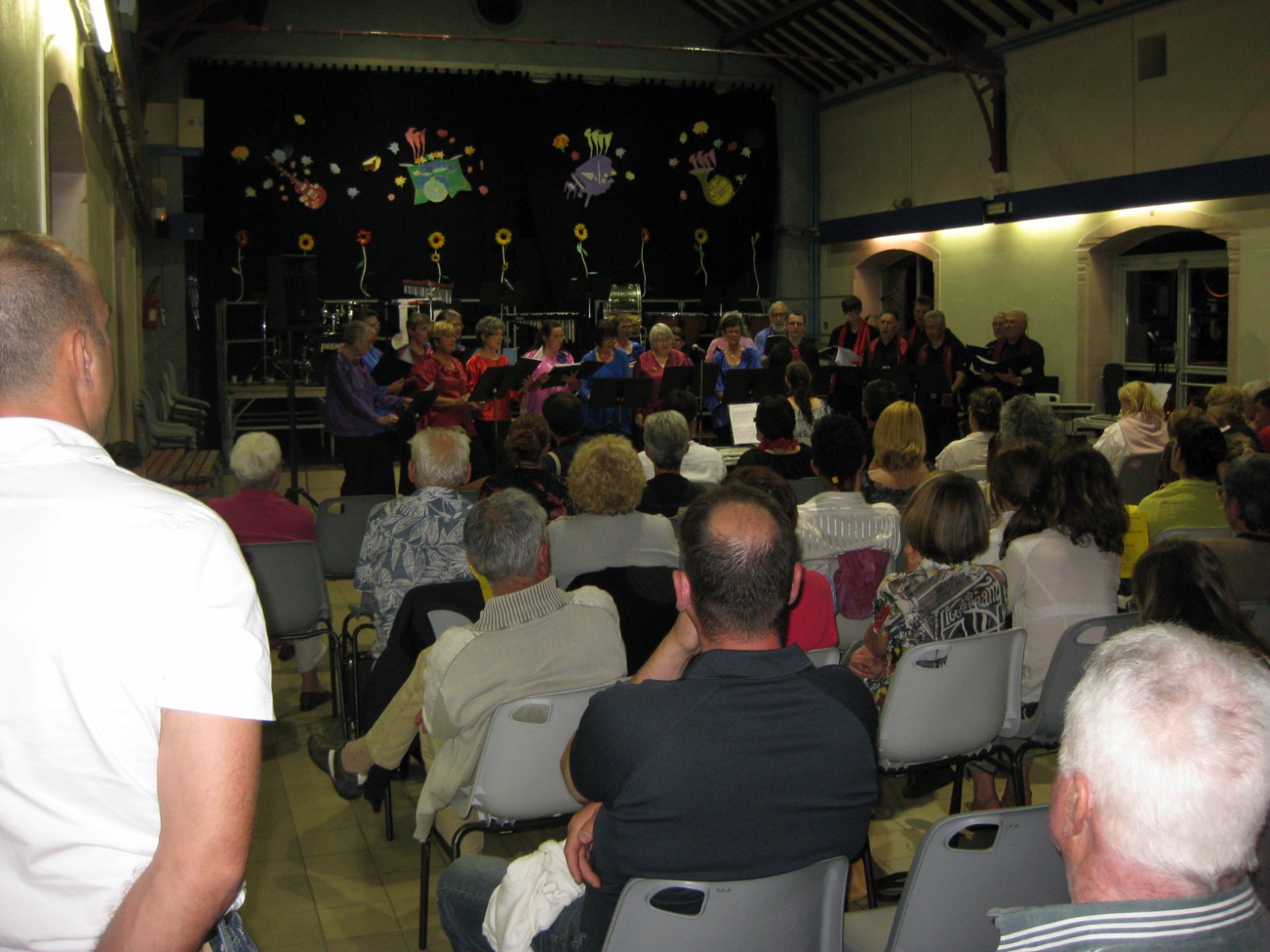
It had been more than 30 degrees for much of the day, so nobody wanted to come back indoors after the meal.  But we opened the windows, finished our preparations, and the audience drifted in for….oh, well before 9.10 for a 9.00 start.

Almost ready to start

The orchestra started things off.  Lots of percussion. All good stuff. I’m always a soft touch for children singing: these were well-rehearsed and sang with verve and enthusiasm.  Joined by the Mirepoix adult choir, they belted out numbers that were old favourites to the French audience and unknown to Malcolm and me.

And then it was our turn.  Our repertoire is a catholic one.  We sang everything from Henry VIII’s Pastime with Good Company (en français bien sûr) and Moon River (en français bien sûr) to old favourites (if you’re French that is) like Mon Amant de Saint Jean.

The Chorale de Laroque d’Olmes takes the stage

Nearly the end. Time for all the singers to join together for two final numbers.  A few weeks ago, Mireille had spent half an afternoon explaining one of them, Mistral Gagnant, to me.  It features a man singing to his daughter and the allusions to a host of sweets that form no part of my own youth – carambars, minthos and the mistrals gagnants themselves, had left me totally baffled, though not the rest of the audience.

In true French tradition, we couldn’t leave without doing an encore or two.  In true French tradition, we couldn’t leave – nobody could – without sharing the pot d’amitié.  A glass of something, a chance to meet and talk to friends: the perfect way to end a busy evening

The campaign for a President

During the British General Election we were in France, and kept up to date with the campaign via the French media, with particular thanks to British pundits and MPs with a command of the French language.

During this French Presidential campaign, we’ve been in England.  After the first round of voting last Sunday, a French friend helpfully sent me the results, as she feared statistics of this kind wouldn’t be considered newsworthy in dear old Blighty.

Actually, she needn’t have worried.  I’ve been surprised at how thoroughly the French elections have so far been covered.  The broadsheets, and both radio and television could be relied on to have some slant on the campaign every day.  Much of the discussion has revolved round how the Franco-German alliance would fare if Angela Merkel has to forge a relationship with Hollande rather than Sarkozy.  Other articled focussed on how, for many voters, it was perhaps more a question of who to vote against, rather than who to vote for.

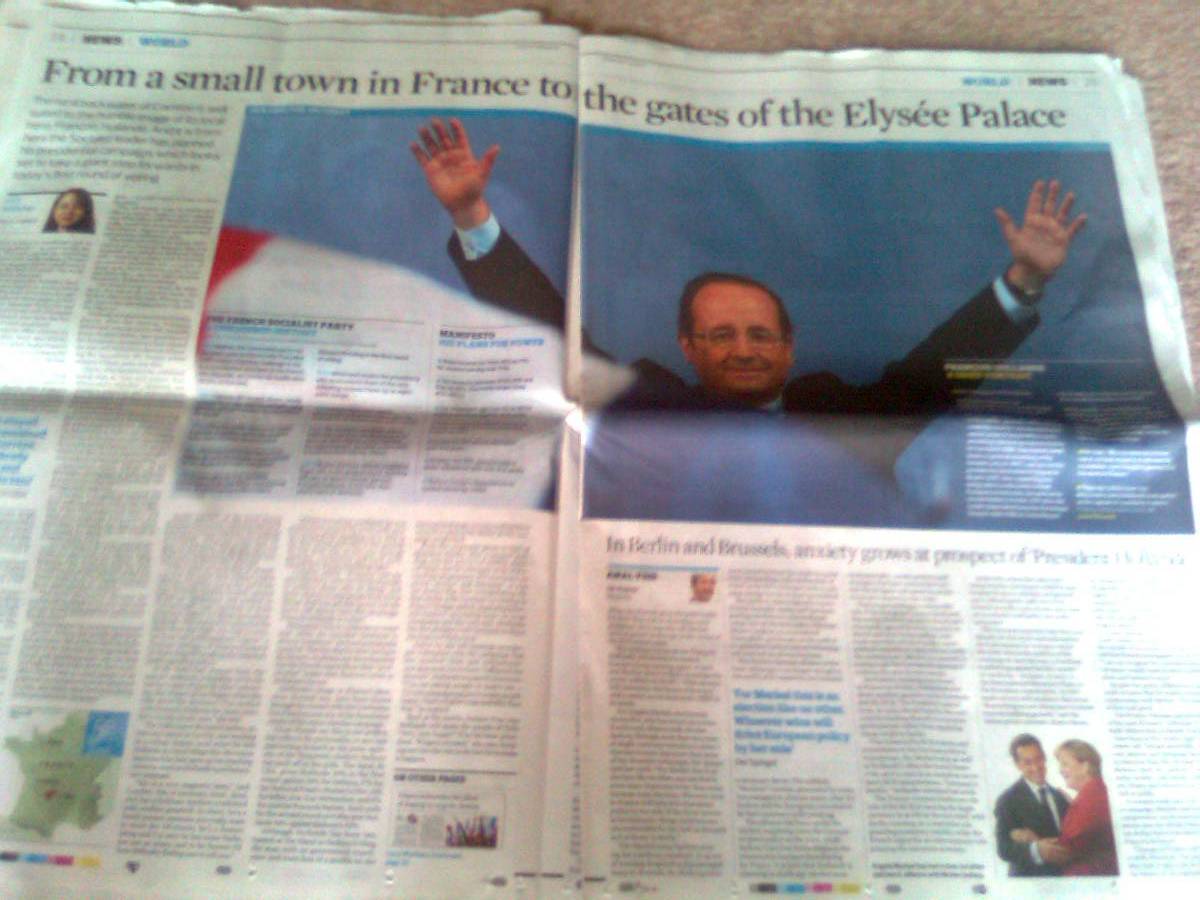
Since Sunday’s first-round vote, after which it became clear that the Front National under the leadership of Marine le Pen had mopped up getting on for a fifth of the vote, the spotlight has changed to the rise of the far right throughout Europe.  Le Pen herself has been the subject of examinations of her career to date, and Sunday’s Observer also carried a double-page spread on François Hollande, as he’s so far a pretty much unknown quantity here.

Hollande's double-page spread in Sunday's Observer

I’ve appreciated this coverage, as it’s been a little hard to get to grips with all the issues in France itself, as the media assumes a basic understanding of the major parties and alliances which we don’t necessarily have.  But we’ll be back there by the time of the second round of voting, and will have a first-hand view of France as it wakes up on May 7th either to a new Socialist president, or, as seems less likely, another dose of Sarkozy.  So far, in our left-leaning corner of France, we haven’t met anyone who’ll admit to ever having voted for him.  In fact the two main candidates of the left, socialist Hollande and far-left Mélenchon knocked Sarkozy into 3rd place in our own commune of Laroque d’Olmes

Sarko - on the way out?