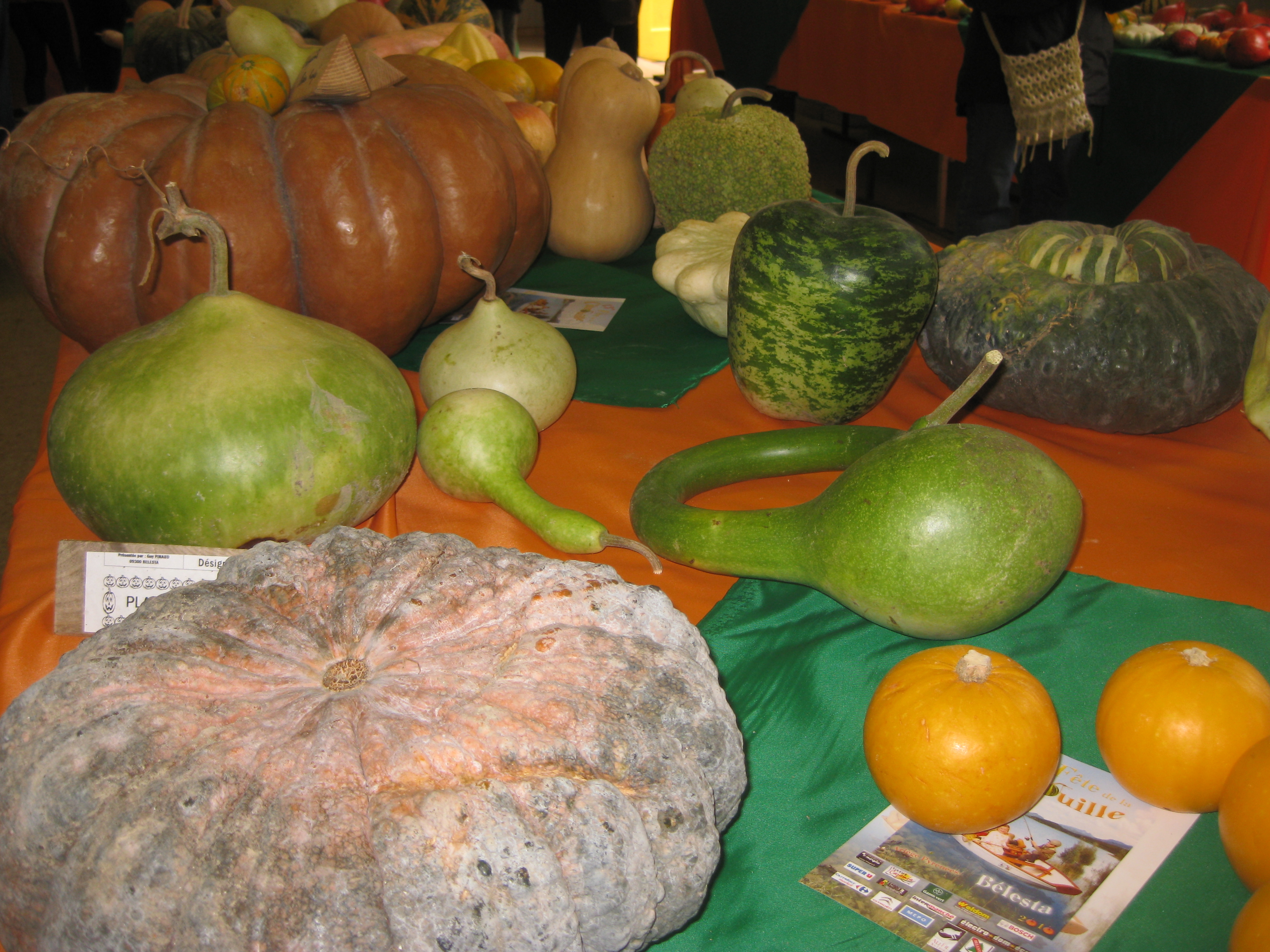
A few pumpkins on display last year at Belesta’s annual Fête de la Citrouille
Go to any veg. stall on a French market just now, and there’ll be at least one giant pumpkin. The stall holder will sell you a portion if you like, using a hefty cleaver to wrest a kilo or so of orange flesh from this magnificent vegetable. The market’s probably got at least one stall devoted to nothing but pumpkins: Turk’s head, musque de Provence, butternut, red kuri, rouge vif d’Etampes………
It’s not so very long ago in England that I’d be doing the rounds of all the supermarkets, the day after Hallowe’en, gathering up the last few Jack o’Lantern pumpkins at bargain-basement prices.
Jack o’Lantern dressed up for Hallowe’en
They’d been stocked for everyone to make their scarey Hallowe’en pumpkin faces with and that was all.
Hardly anybody used them to cook with (presumably not even the many Americans who live in Harrogate, with their apparent love of pumpkin pie), and Hallowe’en over, the unsold ones would be junked.
Hugh Fearnley-Whittingstall et al have put paid to that, and now the English love pumpkins as much as the French always have.
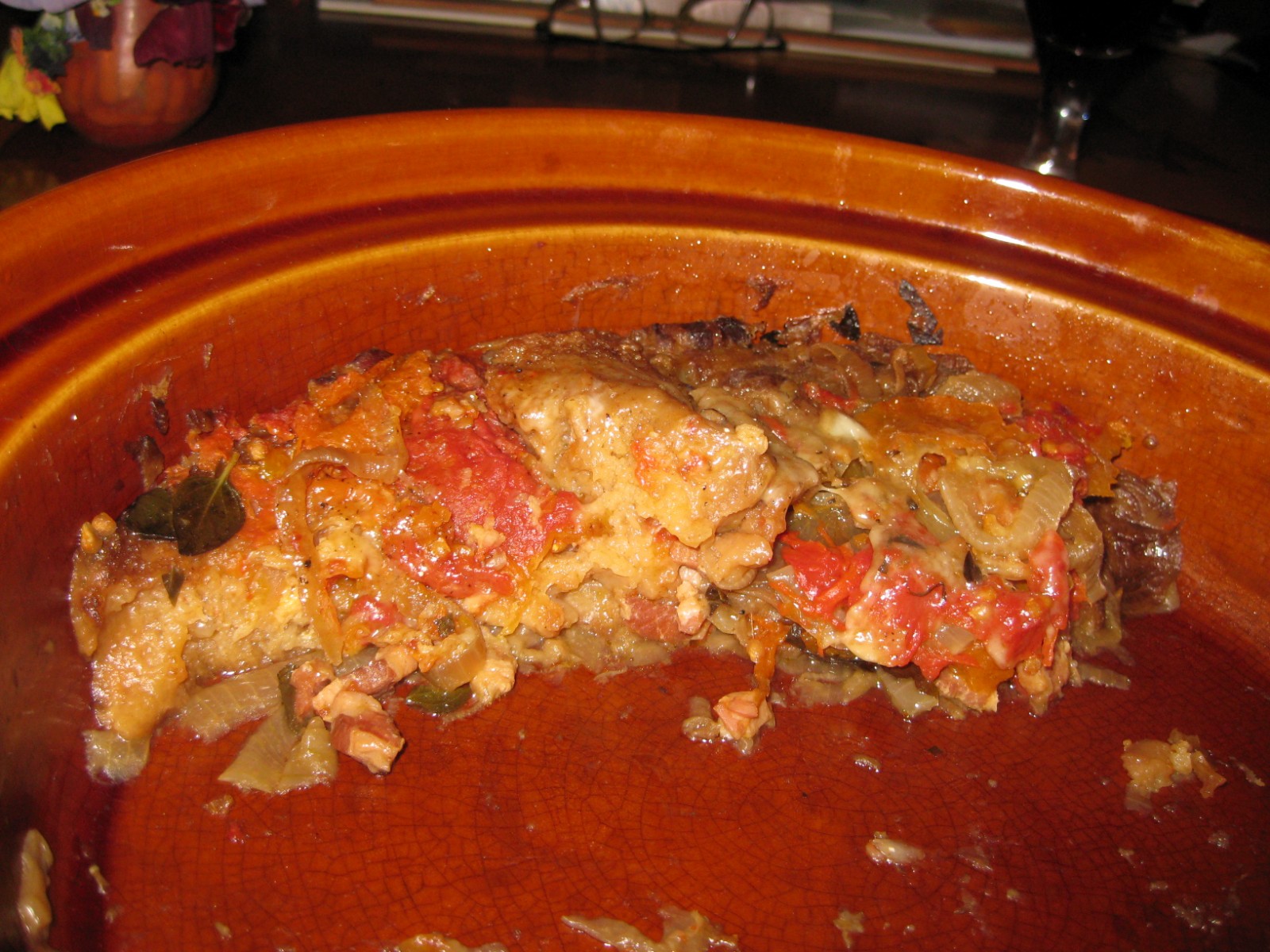
Here’s an easy and long-established soupy stew from round these parts (though I learned about it from Nigel Slater) to warm you up after a chilly day in the Great Winter Outdoors.
Hmm. We made short work of that.
When we first tasted it, we thought it nice enough, not earth-shattering though. It’s grown on us, and now we think it’s comfort food par excellence: especially those pillows of bread, soaked in scalding hot flavoursome juices.
Garbure Catalane
Toast thick slices of bread- preferably sourdough, and layer them up in a casserole or slow cooker with fried onions, garlic, marjoram, sliced skinned tomatoes, and thin slices of pumpkin. Top the dish up with seasoned water and olive oil and bake for an hour or two in a slow oven (or most of the day in a slow cooker). Take the lid off the dish for the last half hour or so and return to the oven with a crust of grated cheeses (parmesan is good to include in the mix, as it provides a welcome crispiness) for the last half hour or so. Or grill for a few minutes if you’ve been using a slow cooker.
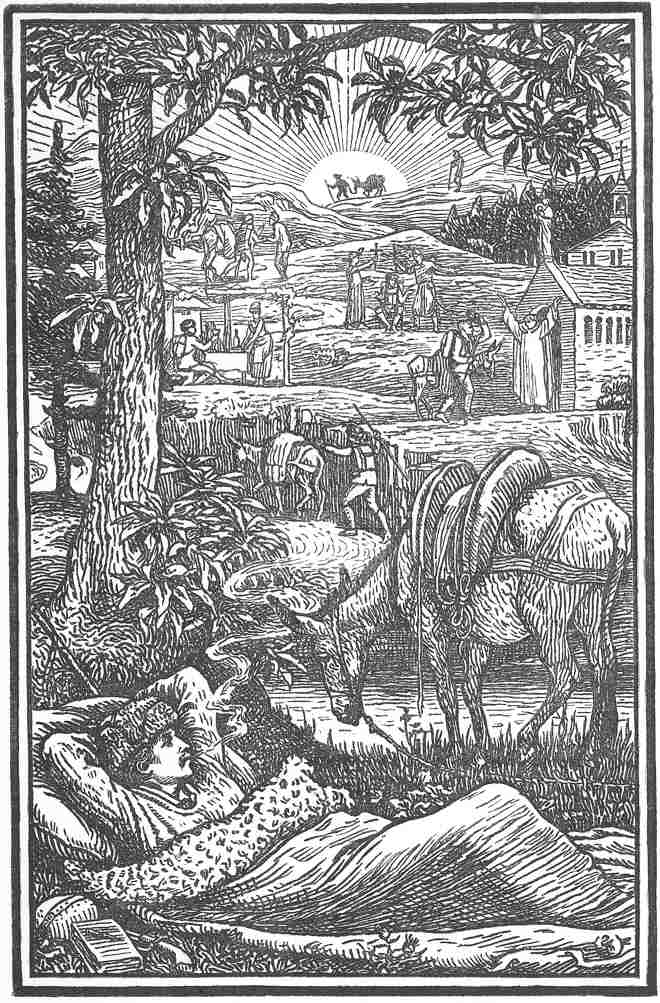
Robert Louis Stevenson knew a thing or two about travelling slowly – and hopefully – what with hiking round the Cevennes with only a donkey for company.
But yesterday, arriving back in Laroque rather quickly having left Bolton only a few hours before, I felt he’d got it right. Our usual way of travelling between England and France is by car. We can’t claim it’s particularly slow, not with maximum speeds of 130 k.p.h on motorways. But it does take the best part of 3 days to do the pretty-much-exactly 1000 miles between Laroque and Ripon, and that’s fine.
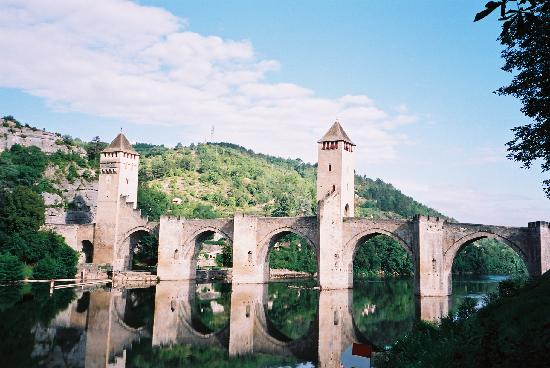
Cahors
We detour to take in delightful towns like Cahors or Vendôme, and make sure we have time to explore a little. Early morning starts may find us startling deer in the still misty fields, while at lunchtime we’ll be on the look out for a ‘menu ouvrier’, or a rural picnic spot to have a lengthy break. We’ll enjoy a night at a chambre d’hôtes, and usually have an interesting time chatting to the owners or a fellow guest. Breakfast with home made jams and maybe breads and cakes comes as standard. A trip on a channel ferry. A night in London with son-and daughter-in-law. And finally, back up north.
And all this time, we’ll be adjusting between a life in France and a life in England: watching the scenery gradually flatten as we drive north, then begin to undulate again as it passes through Normandy and the Pas de Calais, linking with the similarly gently rolling hills of Kent.
This trip to England though was by plane each way. It’s quicker and it’s cheaper too.
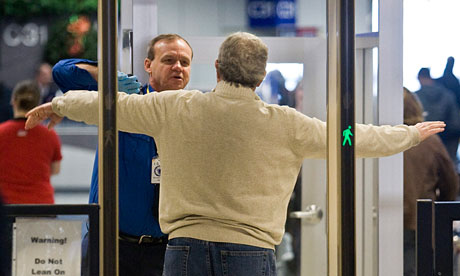
But the whole business of packing luggage into the required dimensions, checking the weight, hunting for a clear plastic bag for those creams and liquids: then at the airport emptying pockets, removing shoes, belts, is just a bit stressful.
Airport security: an image from the Guardian
And somehow it addles my brain. Three hours ago I was in a traffic jam on the outskirts of industrial Liverpool, and now we’re driving through vineyards in the Aude? The clothes which worked in the morning don’t do in the afternoon, and I’m having trouble adjusting the language coming out of my mouth. I’m all discombobulated.
We’re lucky we have the time to be more leisurely. I’m not against taking it even more slowly and walking some of the way down, maybe along one of the pilgrimage routes towards St. Jaques de Compostelle. Anyone want to come too? Barbara? Sue K?
Well, our French friends have been and gone. It was a busy week full of discovery for us all. Despite the almost unrelievedly awful weather, Yorkshire’s sights, both rural and urban, gave a good account of themselves. But here are one or two of the more unexpected discoveries our friends made.
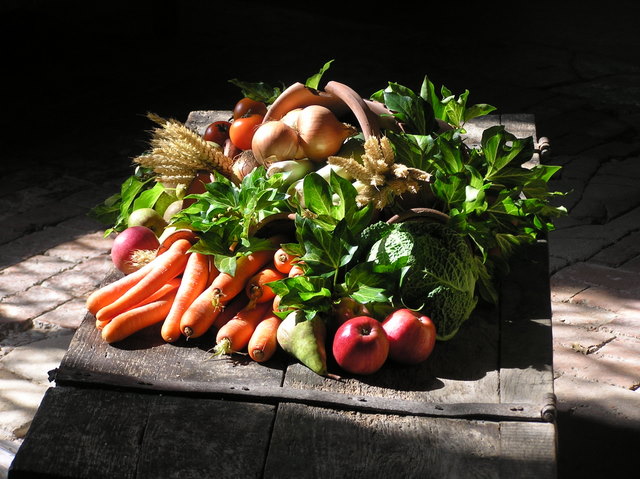
Harvest Festival. Saturday evening found us in church for a very special concert by the St. Paulinus Singers, a Ripon Chamber choir. As we entered, our friends were struck by the celebratory pile of pumpkins, cabbages, carrots and Autumn fruits assembled for harvest-time celebrations in church. They’d never heard of such a thing. Oh, and the concert began dead on time too. Another first for them.
Harvest Festival
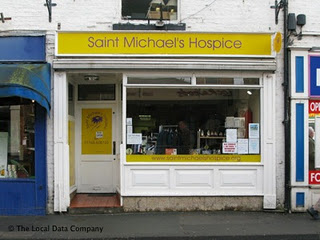
Charity shops. The French have little other than away-from-town-centre large warehouses given over to the sale of donated goods and run by Emmaus. The often carefully dressed shops we’re so accustomed to on the British high street are unknown to them.
St. Michael’s Hospice shop, Ripon
Closed for business: open for business. As we know, shops here tend to be open through the day. But what a surprise for our French friends to see them closing for the day at 5.30 p.m. rather than around 7.00 p.m! To find supermarkets open in some cases 24/7 was even more astonishing.
Closed at the moment
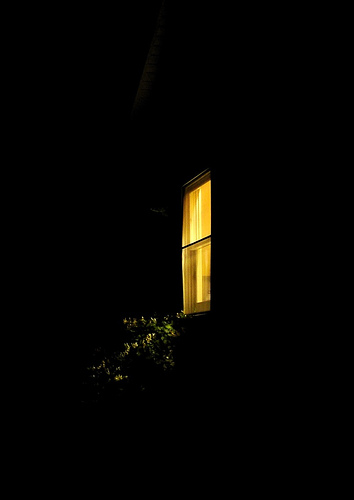
Houses without shutters. Evenings walking round town fascinated them. Instead of shutters there were curtains, which might or might not be drawn. How exciting to have glimpses of another set of lives! This is denied to them in France as shutters are usually firmly closed there as night falls.
A night-time window
Buttered bread. As born-and-bred Ariègeoises, our guests were unused to the idea of having butter AND cheese or ham or whatever on their bread. They rather felt it was gilding the lily. But they weren’t keen on the fact that bread is not produced routinely at the average British dinner table. It’s odd, we too have come to expect bread as part of a meal in France, but never in the UK
Milky coffee and tea. The default position for both in France is black (strong coffee, weak tea)
At the butcher’s. Of course our guests wanted to cook a slap-up meal for us. We all struggled a bit with this one, as French and English butchers cut their beasts up in different ways. As a recently-lapsed vegetarian, I’m re-learning slowly all I ever thought I knew, and starting at page 1 in French butcher’s shops.
A Friesian: until recently, these were the cows I most frequently saw in England
Voilà! The most useful word in the French language.
Here’s what happened at the baker’s this morning. Translations appear in brackets.
Me: Oh! Isn’t the pain bio ready yet?
Madame: Voilà! (Nope. Quite right)
Me: So if I call in after 9, you’ll have some? Could you please save me a loaf?
Madame: Voilà! (Yes, and yes). Would you like to pay now, then it’ll be all done and dusted?
Me: Voilà! (Makes sense. I’ll do that)
By the way, I was all grottily dressed in my oldest paint-spattered, holes-in-the-knee-ready-to-face-a-morning’s-tiling gear. This is Laroque after all: no shame in working clothes here.
Madame: You’re looking very chic today, if I may say so!
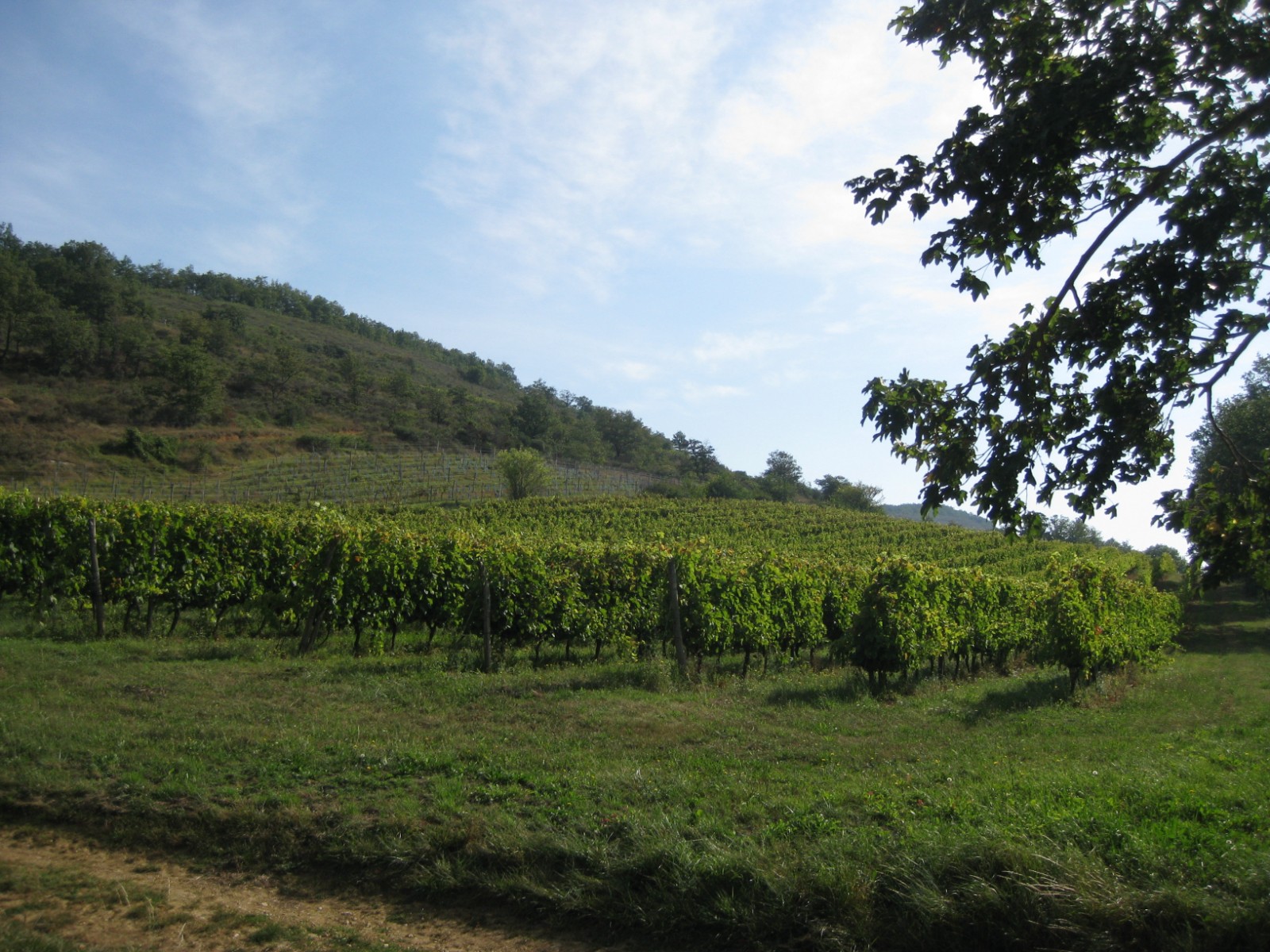
Last week, we had a morning at an organic vineyard, one of only 2 commercial vineyards in the whole of the Ariège. The vineyards at Coteaux d’Engraviès appeared on maps as long ago as 1310, and on later maps too, though eventually they disappeared. So the owner of the Domaine, Philippe Babin told us, anyway. He was the one who decided once again to cover the hillside in vines.
He introduced us to an Ariège from a time we couldn’t recognise. Now, we’re used to seeing fields of maize, sunflowers, food and fodder crops in addition to pastureland. Back in the Middle Ages, when Catharism was at its height, the area was covered in vines. Everyone produced wine for their own use. It wasn’t strong, maybe 5% or so, but it provided refreshment and nourishment for men, women and children alike. No neat rows here, the vines grew unsupported by trellising, higgledy piggledy. Over in Pamiers, from where any exportable wine was shipped, the notorious Bishop of Pamiers, later Pope, Jacques Fournier, received the taxes he imposed in the form of wine.
The Ariège was prosperous and, for the period, densely populated. Men made their living from mining and the forges, and their women and children reared stock in the high pastures. Only the Industrial Revolution, which arrived later in France than in the UK – just before the First World War in fact – put a stop to this, as the small scale of local operations were not suited to large-scale mechanisation. This, and the de-population that occurred when men failed to return from the trenches, began the Ariège’s descent into a less populated, often deprived area.
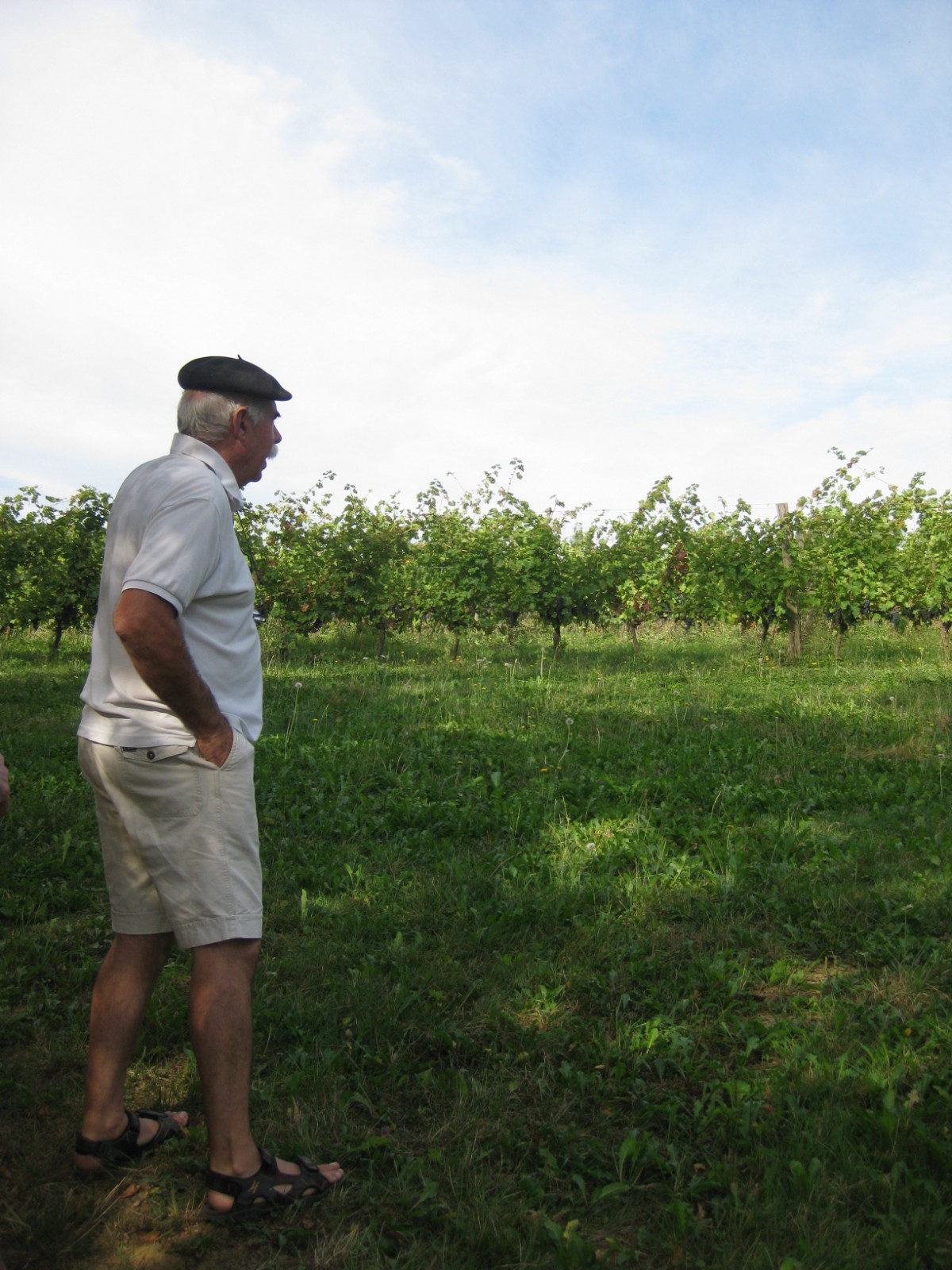
Philippe shares his expertise
Phylloxera saw the end of wine production in the Ariège. Vines, decimated in the 19th century throughout Europe, were gradually replaced elsewhere by resistant American varieties. The local domestic vines, most of which were fairly low quality, weren’t worth replacing, and people simply walked away from them, leaving them to die. Only within the last 30 years have a couple of producers recognised that parts of the area are suitable for developing once more a high-quality product, and with modern and traditional savoir-faire behind them, worked towards developing businesses of which they can be proud. Philippe Babin is one of these.
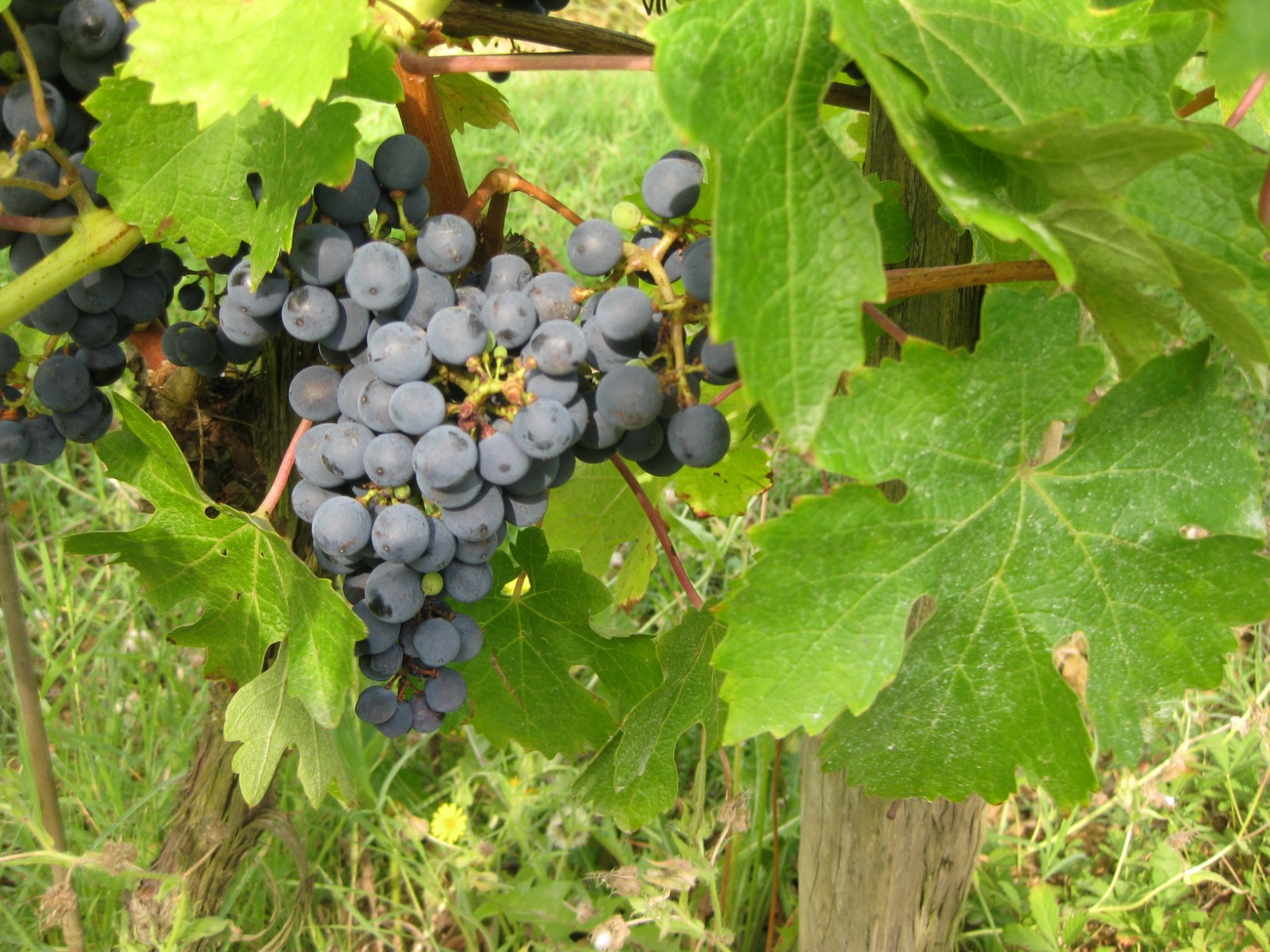
Philippe went on to tell us more about the vines themselves. They need rain, and they need sunshine for their leaves to absorb and enable the fruit to mature. Vines put roots deep down into the soil and rocky earth, particularly in the first 15 years of life. Philippe chooses to grow his vines organically, because he recognises that the particular composition of the soils and rocks beneath in the area – ‘terroir’ – inform the character of his vines: fertilisers and other products would change this balance. The vines themselves change as they mature, and those plants which are 80 – 100 years old (his are a long way from this) produce little, but what they do is very fine.
Pruning forces the vines to produce grapes, and therefore seeds. Unpruned, they grow hundreds of metres long, and see no need to seed themselves. Wild vines are therefore innocent of fruit.
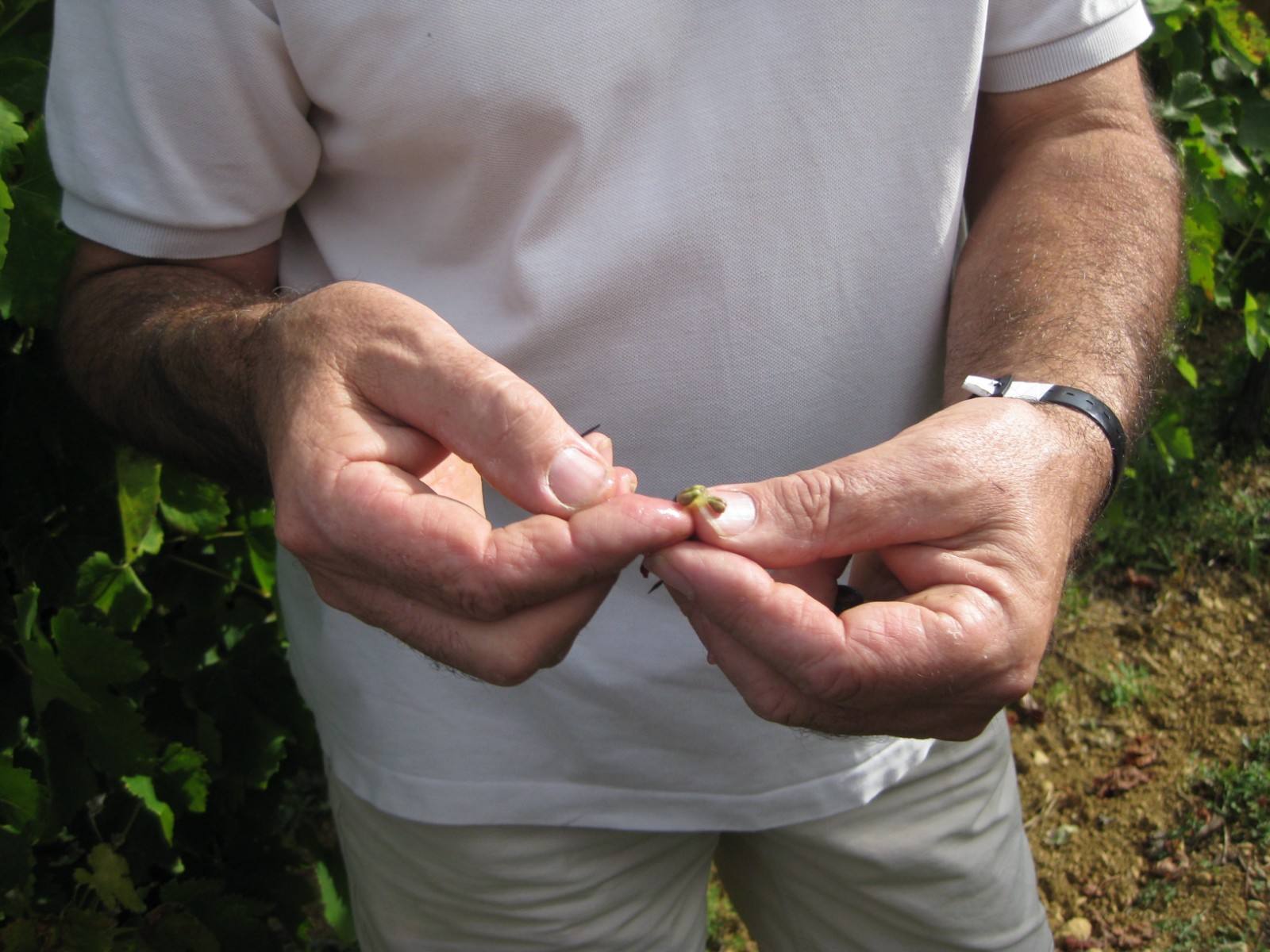
Examining grape pips for maturity
Then he showed us how to research a maturing grape. Does the skin peel easily from the fruit, and is it loosing its elasticity? If so, it’s ripening nicely. Have the seeds broken away from the ‘umbilical cord’ of the stalk and taken on a woodier appearance? Once that happens, the seeds are nearly ready to fall and have a go at germinating (they have a low germination rate). From now on, they’ll nourish themselves, like embryo chickens in an egg, from the flesh of the grape, which will wither as the seed digests it.
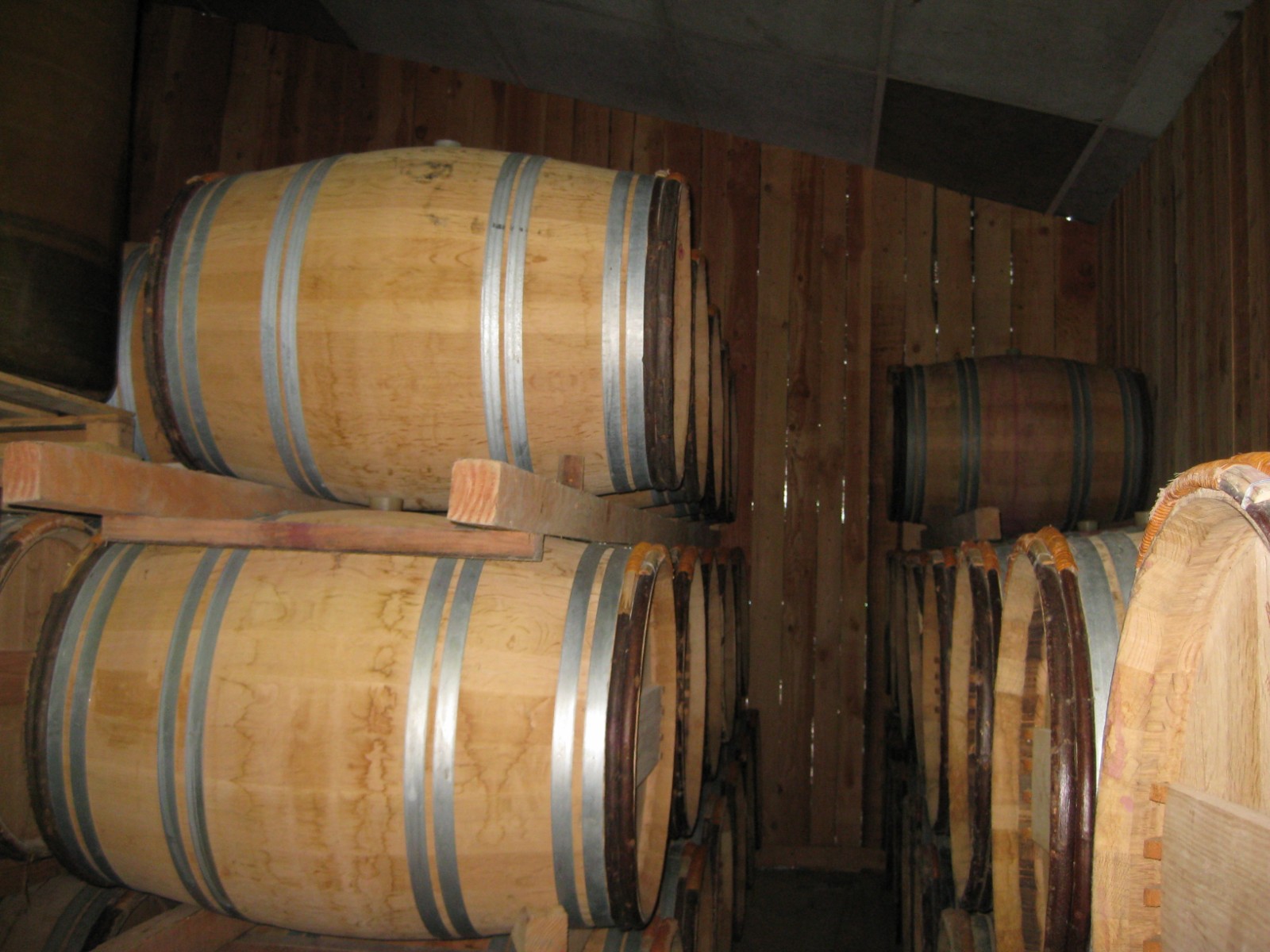
Barrels full of wine waiting to be bottled
Lesson over, we went back to the Cave. A small band of workers were working to bottle the last of the 2010 vintage to free up space for the harvest which will take place in maybe a fortnight or so. The barrels in which the wine matures must never be left empty, so this is a last minute job.
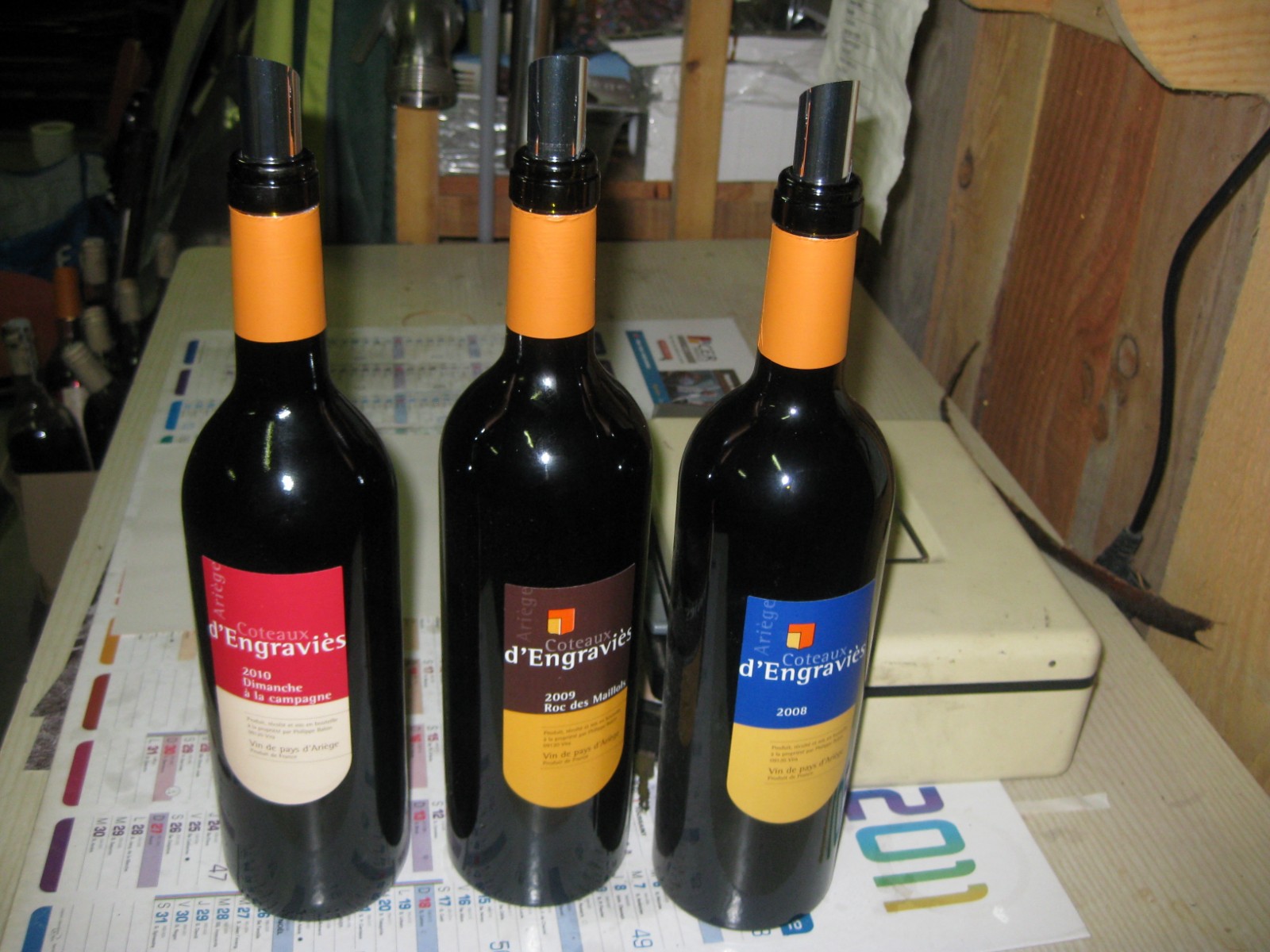
And finally….the tasting. An opportunity to compare three of the wines he produces. Every year his blends are slightly different, to arrive at a consistent product. Syrah, Merlot, Cabernet Sauvignon…all have their part to play in blending wines to make a perfect complement to an enjoyable meal, whether roasted, casseroled or preserved meats, or a plate of local cheeses.
Returning from England to France, there’s generally a bag or two of various kinds of flour in the luggage. ‘What?’ I hear you grumble. ‘That woman who’s always banging on about buying local? The one who’s got no time for the English abroad who can’t exist without their mug of builder’s tea and a custard cream?’ Yes. That’s me. Guilty as charged.
Melting Moments
But the thing is, when in France, I sometimes have a happy hour or two baking English goodies – Melting Moments, Gingernuts, Marmalade Loaf Cake, that sort of thing – with or for French friends. And as I discovered the other week, French flour is simply not right for the job. Not better, not worse, just different.
I’d run out of my own supplies, so I nipped out and got a bag of good quality baking flour (because even more than in England, it’s important to buy the right type of flour for the job). And my tried and trusted favourites turned out all wrong. Ginger biscuits, instead of being satisfyingly chewy, with a solid crunch between the teeth, were sandy and brittle. Marmalade loaf cake, though light, was close-textured and almost crumbly. It was so disappointing. The answer, it seems, lies in the gluten content. The average French flour is ‘softer’, and has a lower gluten content than the average English flour.
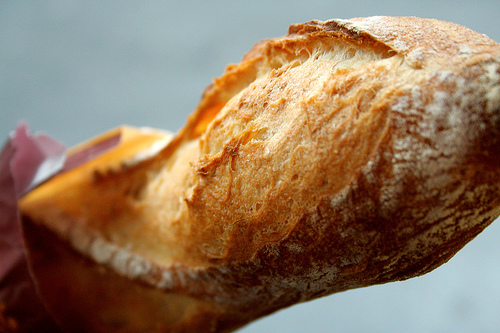
French baguette
So is it surprising that superior French bakers in England, such as Dumouchel, where my daughter used to work on Saturdays, send over to Normandy for supplies of authentic French flour? Or that the average French stick, bought from the average English baker, in no way resembles its chewy French antecedent, the baguette.
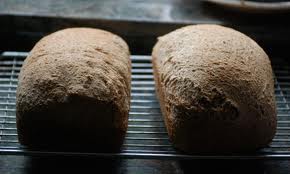
English wholemeal loaves, fresh out of the oven
On this visit to England, I’m appreciating the softer crust and slightly moister qualities of a well-made wholemeal loaf, just as over in France, I enjoy the the crustiness of crisply baked French bread. Best to accept, I think, that both countries produce fine bakers and cake makers. But neither could do a fine job using the flour preferred by the other.
If you want an introduction to some of the many flours on offer to the keen baker, Dan Lepard’s site is a good place to start
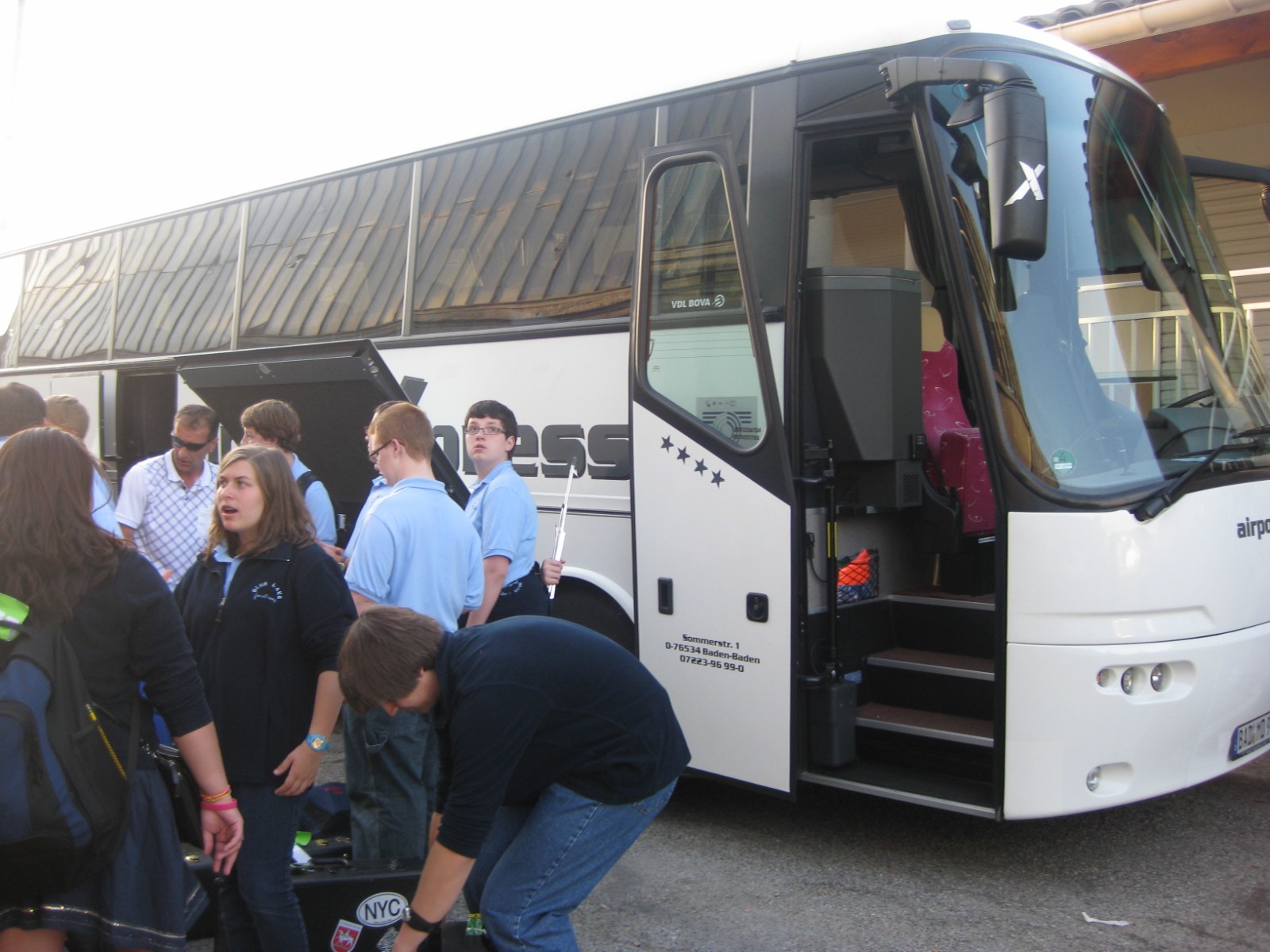
If you’re young, American, and living in Michigan, and if you like performing, you may be lucky enough to spend part of your summer at the Blue Lake Fine Arts Camp, a summer school of the arts located on a 1300 acre campus in the Manistee National Forest. If you’re really talented and work hard, you may one year be selected for one of the 8 or so ensembles that have been coming over for a European tour every year since 1969.
And if you live in Europe, you may be lucky enough to live in one of those towns that welcome these young people. Here at Laroque, we’re among those fortunate people.
The Blue Lake Jazz Ensemble first came here 2 years ago. Their director, David Jensen, and the leader of our own LDO Big Band, Michel Alvarez, hit it off. So when plans for this year were under way, both men were keen to see Laroque included in the itinerary.
But what an itinerary! The band landed in Paris on 17th June. From Elbeuf in Normandy, they passed through Belgium to reach Germany, Denmark, Germany again, then Austria. Then they travelled 1588 km to reach Laroque d’Olmes, a coach journey that took a whole 24 hours. After staying with us, they were due to travel overnight to Paris and the plane home on July 9th.
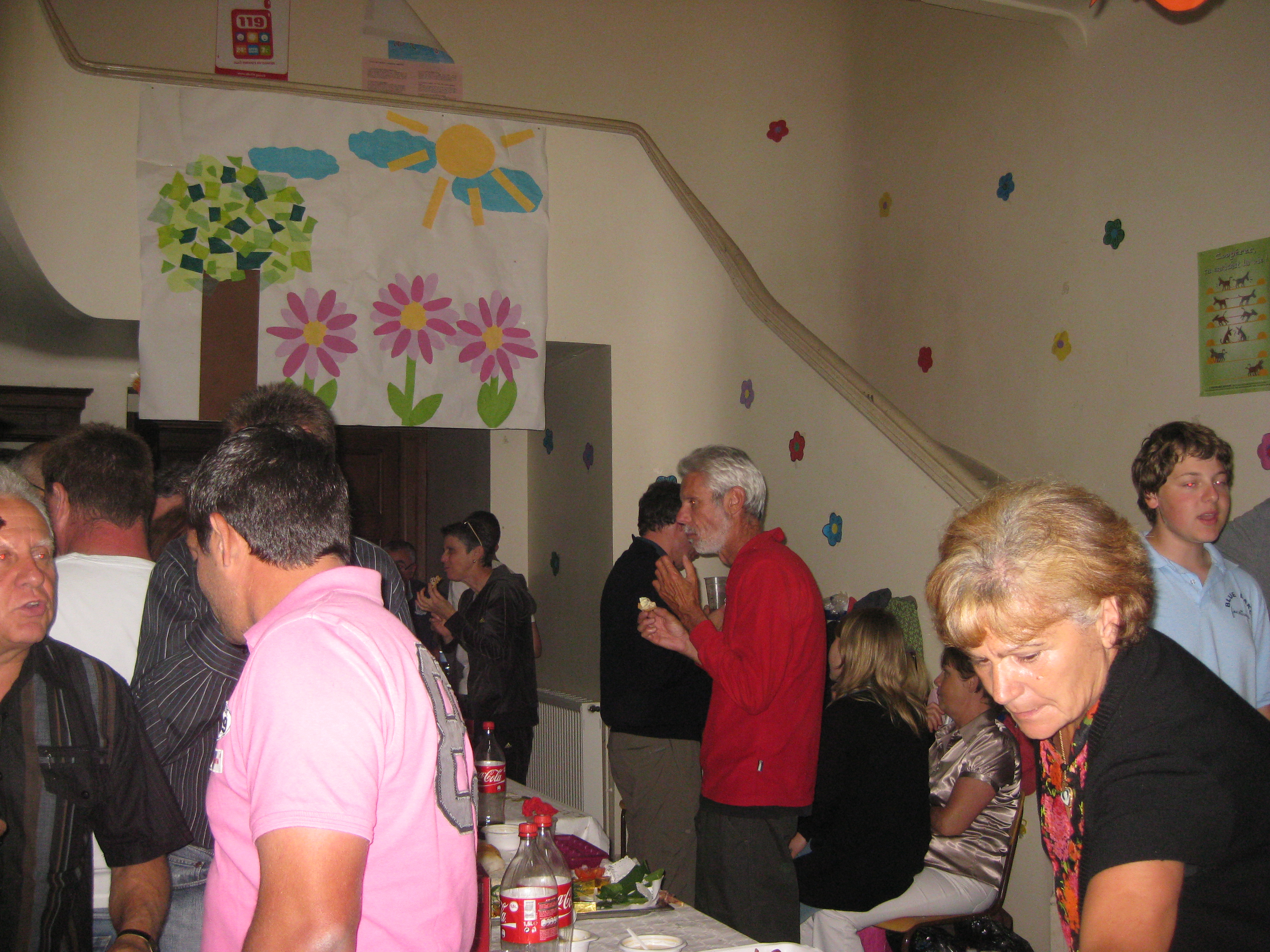
Party at the Château
They might have been tired, punch-drunk with cultural variety and new experiences, but they had to be welcomed with a party. It was here they met their host families. What would two 16 year old boys make of the fact that they got to stay with us instead of a French family? Pleased, as it happens. Grappling with unknown languages – French, German, Danish over 3 weeks or so takes its toll. At least we were a bit of a rest.
The concert on Thursday evening was what we were all looking forward to. Well, not me so much. Malcolm had provided translation and interpreting services last time, so this year, he thought it should be my turn.
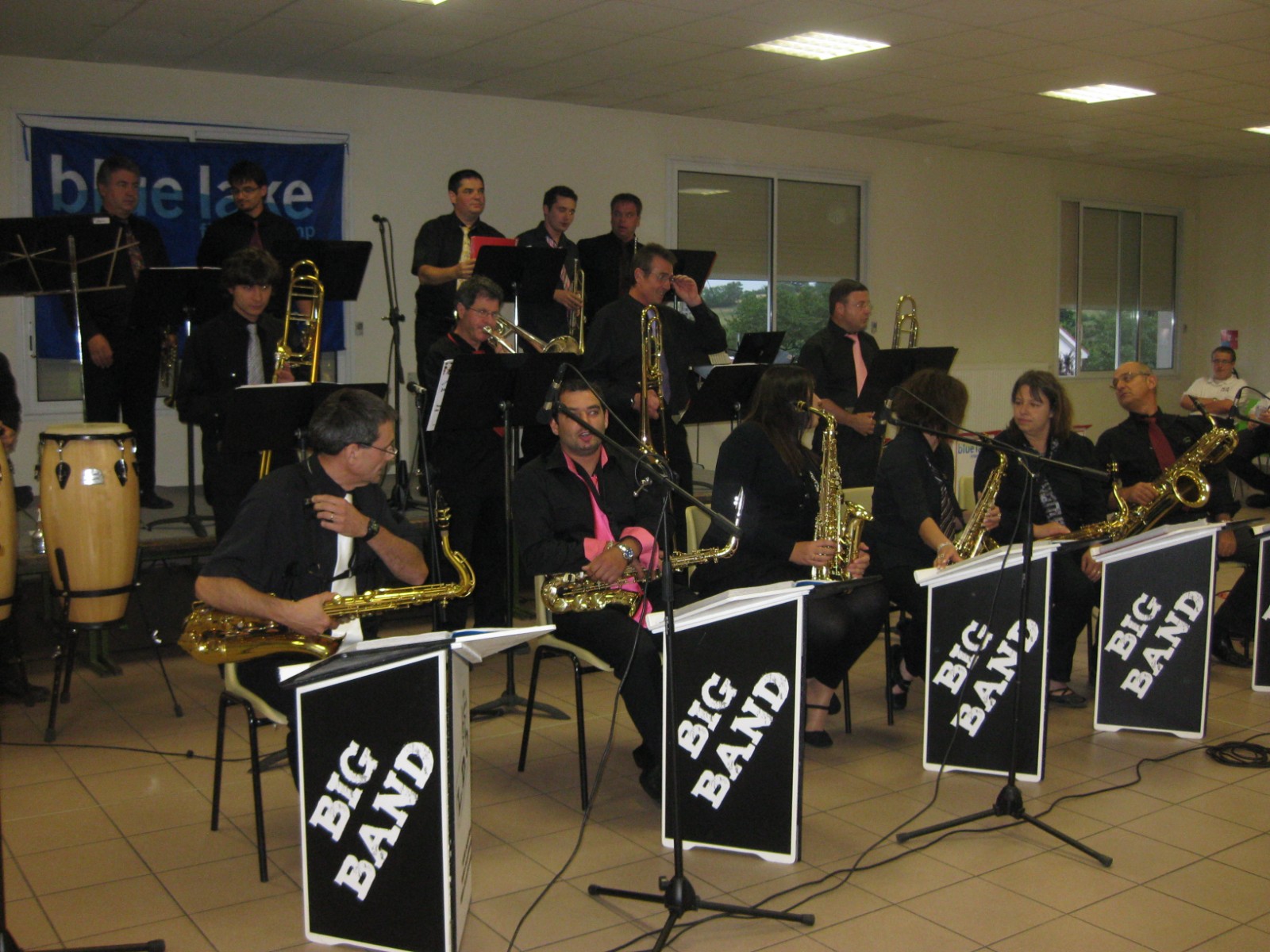
LDO Big Band get ready to playTranslation services in full swing
All went well at first: I’d seen Michel’s speech in advance, and David’s response contained no surprises. But when it came to introducing the pieces….well…what IS the French for ‘Dance of denial’? Or ‘Struttin’ with some barbecue’? We decided the titles didn’t matter; I bowed out, and then discovered the remaining repertoire was quite translatable, thank you.
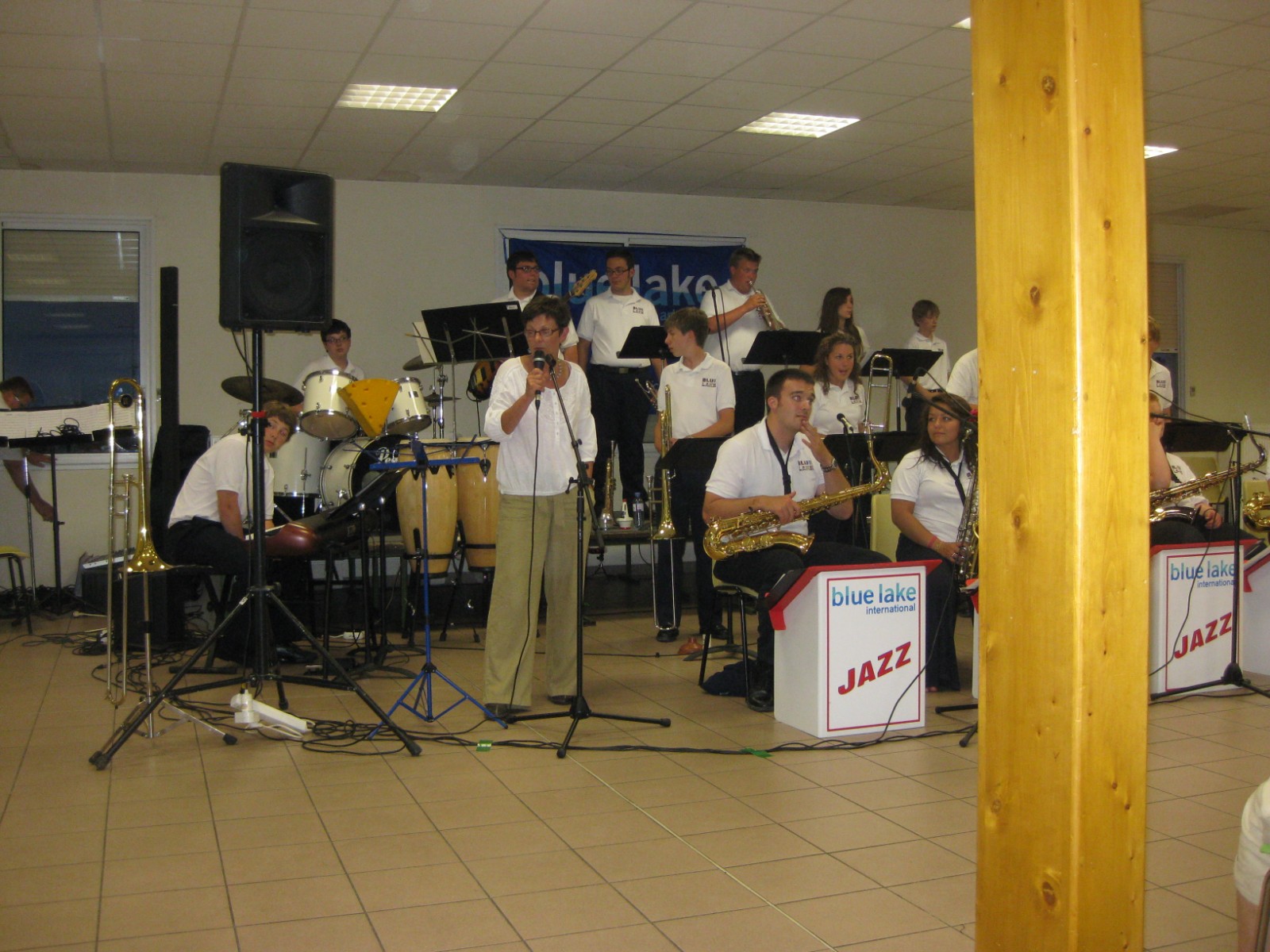
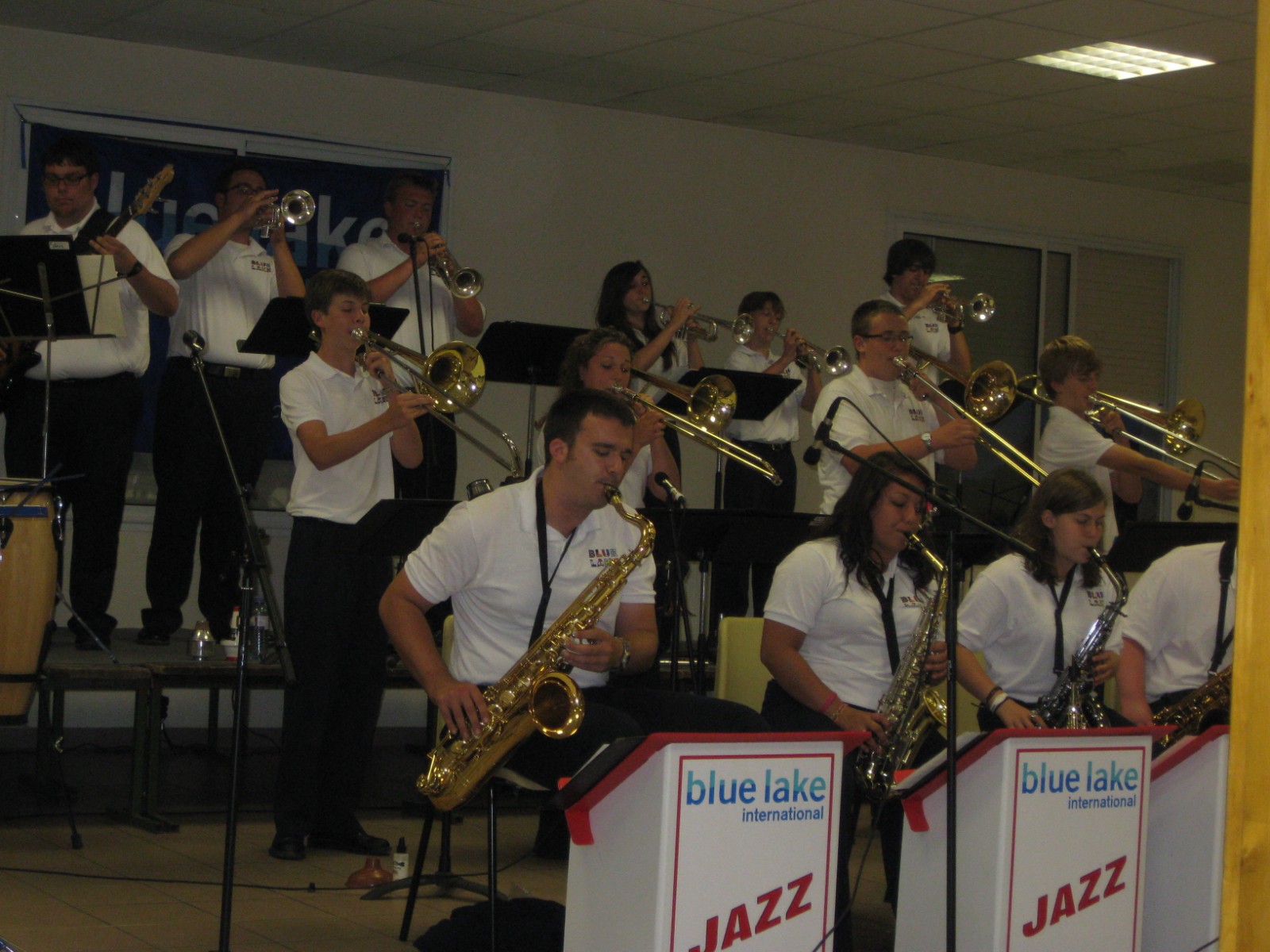
Blue Lake Jazz Band
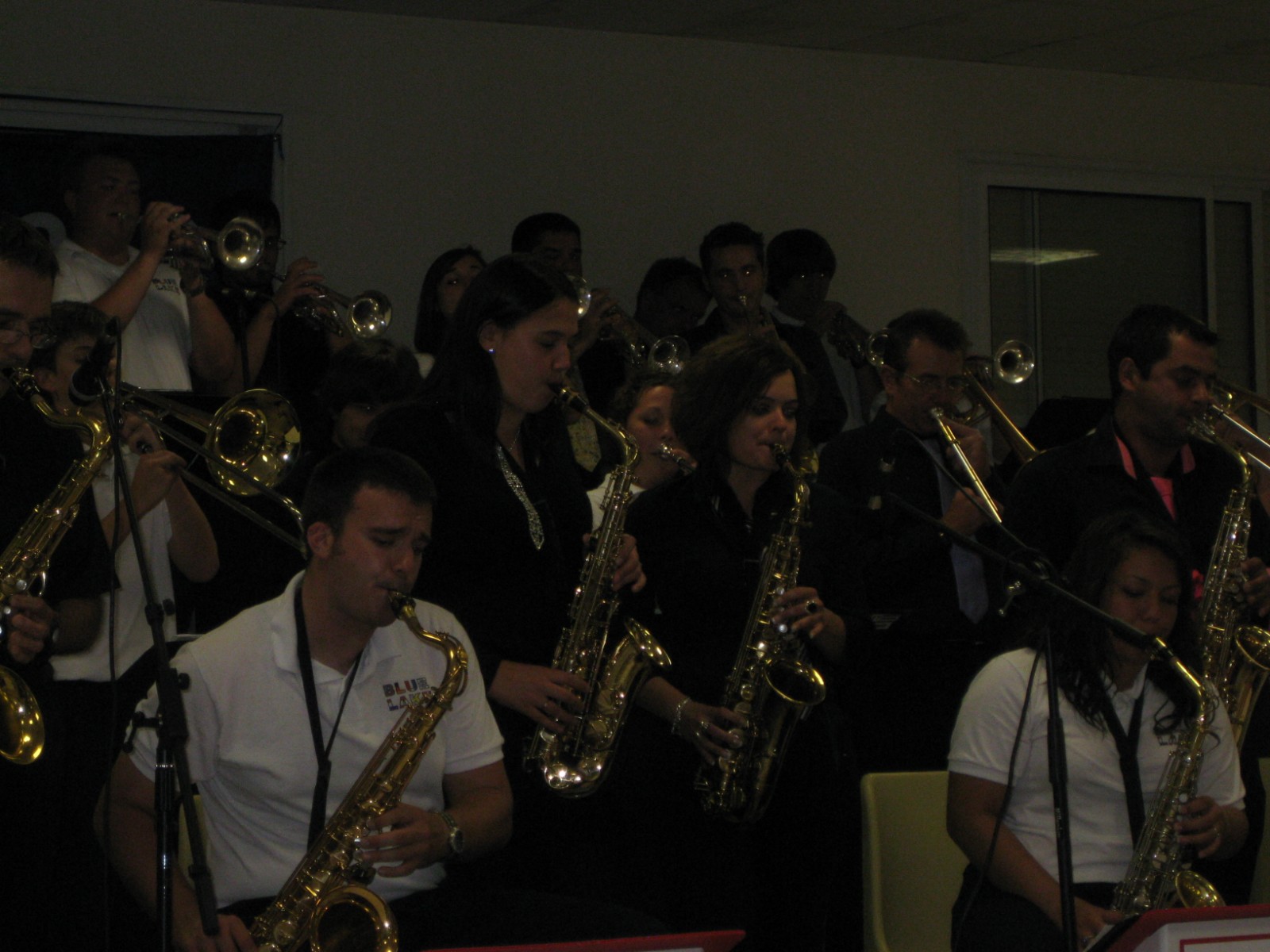
But those Americans! The performance they turned in was exciting, exhilarating, excellent, extraordinary. Impossible to believe that some of the group were only 13, and that few had left High School. They’re so professional. LDO Big Band was on form too, so the high spot of the evening was when the two bands came together to perform. Their pleasure and pride in working together communicated itself to an already delighted audience, and the evening ended on a high for us all.
The two bands squeeze together to play
This opportunity to play together is apparently what makes little old Laroque worth the detour for the Blue Lake musicians: it’s not something they do elsewhere. They’d like to send a different band our way next year, David’s year off. It seems Laroque is now firmly on the Michigan map.
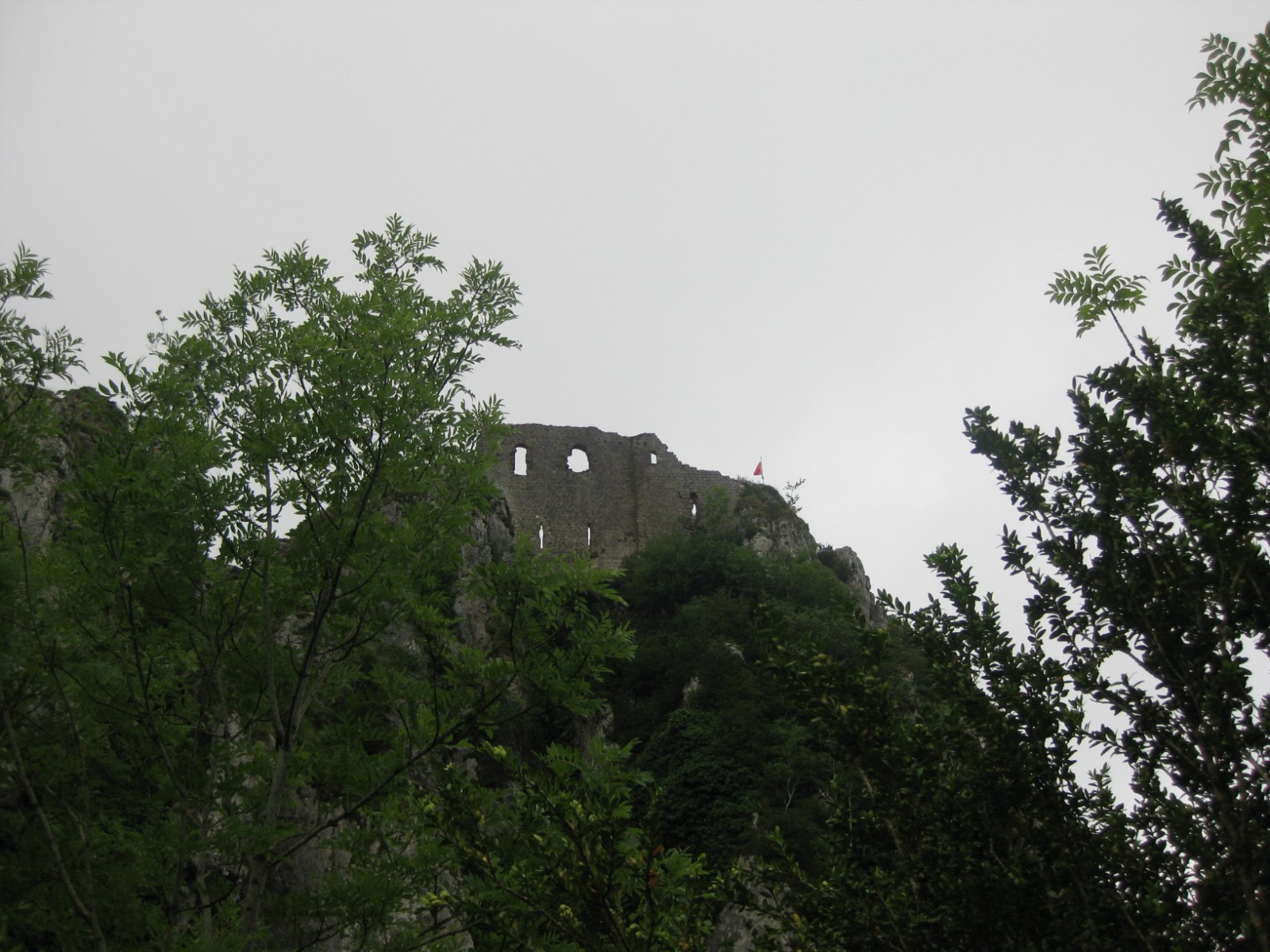
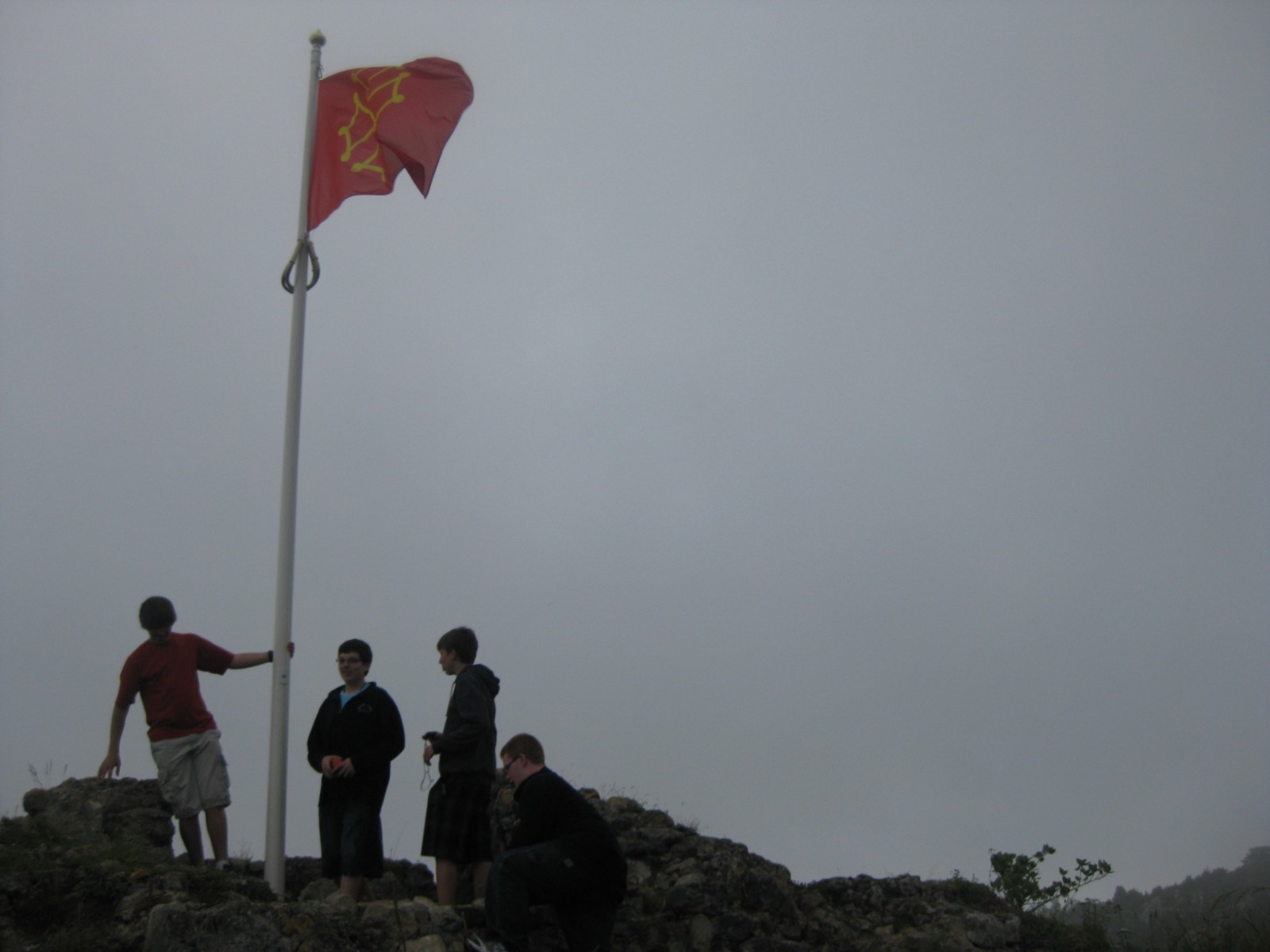
Roquefixade………. conquered by our American guests
The rest of the stay was given over to sleep, lots of it, and sightseeing, rather less of that. We climbed Roquefixade to see a ruined castle, and took in the medieval town of Mirepoix. Others had different days-of-yore experiences: Foix and Carcassonne.
The trip ended on a sad note though. One of the group had lost her passport, and despite every effort, it couldn’t be replaced in time. She’s still here.
This daft ditty came into my head as a sudden shower threatened to stop our concreting efforts in the yard – we’re nearly ready to show you the final result – watch this space. And I thought – ‘If you, dear English reader of my blog, had been here with us, whether you know that verse or not, you’d probably have come up with some doggerel of your own – a nursery rhyme perhaps’:
Doctor Foster went to Gloucester
In a shower of rain.
He stepped in a puddle
Right up to his middle,
And never went there again.
And then I realised that if instead you’d been with me, dear French reader, I wouldn’t have been talking about ‘just and unjust fellahs’ at all: lost in translation doesn’t even begin to cover it. I’m finding that more and more, I’m missing that shared cultural experience. By culture, I don’t mean the literature, the art and so on. To an extent you can mug up your Molière, get up to date with Gavalda.
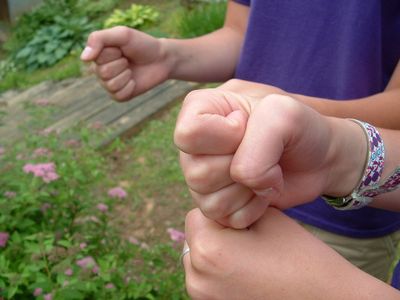
One potato, two potato, three potato, four….
I mean the shared heritage we all grow up with from childhood. In France I don’t know the equivalent of that whole children’s choosing routine that involves ‘one potato, two potato, three potato, four…..’, or ‘ip dip dip, my little ship, sailing on the water, like a cup and saucer…..’
I don’t know how to criticise someone’s persistently down-beat attitude other than by telling them not to be such a Tony Hancock. Or a Grumpy Old Man.
Anyone in the UK, I guess, would immediately understand ‘I speak English. I learn it from a book’. That’s Manuel in Fawlty Towers. Astonishingly, a French woman actually said that to me last week. How could I have explained, if I’d given in to the almost uncontainable urge to burst out laughing?
Then there are all those people we feel we almost know, but who are probably unknown abroad. Anne Widdecombe and other politicians like her have gone from Scourge of The Left to National Treasure in the blink of an eye. In France, who cares? People like me rely on the likes of Nigel Slater and Nigella Lawson to come up with new ideas for Thursday’s meal. Who does the job in France?
I’ve not heard programmes like ‘The News Quiz’ on French radio. It would be lost on me if I had. But then I can read ‘Private Eye’ with some enjoyment and comprehension. ‘Le Canard Enchainé’? Not a chance
Mine is the popular culture of an already bygone age. I know cream’s ‘naughty but nice’, and that ‘life’s too short to stuff a mushroom’ (it isn’t), but in the right company, I understand and am understood. Of course I’m not really complaining that I can’t go round France talking in clichés. What I do mind is that here, I don’t recognise the allusions that I do hear, and I certainly can’t make them myself. It’ll simply have to remain a closed book (or switched off TV).
I’d half written this post in my head before we even set off for our weekend away. It was going to be all about how, despite my pretty high-maintenance vertigo, I managed to defeat my terrors and have a day’s climbing up vertical ladders and swaying bridges, inching along narrow paths high above the vertical drop to the bottom of les Gorges de la Carança.
We went there, I did all of the above, and astonishingly, I was never once gripped up by that all-too-familiar fear which prevents me from peeking over the edge of any castle battlements or church towers I’m foolish enough to ascend.
It was the Rando del’Aubo who proposed this overnight trip, high up into the Cerdagne region of the Pyrénées Orientales. It’s a gorgeous area of high steeply sloped and densely forested mountains and wide deep valleys, green and fertile. This is Catalan France, with a strongly Spanish feel, where Catalan is written and spoken almost as much as French, and the cuisine is very different from our homely Ariègeois farmyard and hunter’s fare.
We were tourists on our first day – that’s for a later blog. Sunday was the day of the gorges. A spectacular drive from our overnight accommodation, a few decisions to take about how much clothing to wear (early in the day, it was already hot), and we were off.
I wish my pictures told a better story. It’s hard to convey the grandeur of the scenery, to show how very vertical and high the gorge sides are, and therefore how nerve-wracking parts of the walk were. We enjoyed our six hour day, but it’s possible to spend two days exploring the area. We were merely amateurs.
We spent much of the morning scrambling up craggy paths alongside a tumultuously noisy stream: and then there were scary catwalks clinging to vertical rock faces; ladders and suspension bridges, high above the water, often almost enveloped in the trees. It wasn’t till the afternoon that we walked the Cornice, the narrow walkway hacked into the (vertical, of course) rock face – with a 400 metre drop to the bottom of the gorge. The rewards, if you don’t frighten yourself to death by looking down, are the views of the peaks; craggy, splintered rocks of grey, white and ochre; of stunted and deformed trees clinging and growing with unexpected vigour to tiny fissures in the rock; the plant life, similarly finding footholds in this very challenging environment, and the butterflies, fluttering in huge numbers everywhere we looked.
It was a wonderful experience: for the views, for the physical challenge of the roughy-toughy climbs and descents, for the feeling of risks overcome. Yesterday too, we felt very lucky to have spent the day there. It was hot, but pleasantly so in this forested place at an altitude of not too far from 2000 metres. As we drove homewards and the temperatures increased, we realised just how unbearably hot and sweaty we’d have felt if we’d just stayed at home and loafed around the garden.
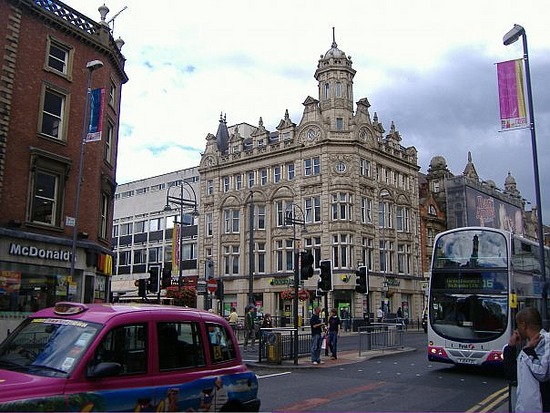
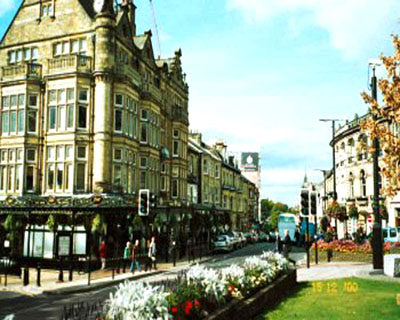
About 15 years ago, we moved from Leeds (pop. 716, 000)……. to Harrogate ( pop.72,000). How charming and manageable in size it seemed!Now we’ve moved to Ripon (pop. 16,000). Its cathedral gives it city status, though it’s so much smaller than Harrogate.And of course, we also live in Laroque d’Olmes (pop. 2, 600)Where next? A farmstead on a remote hillside?





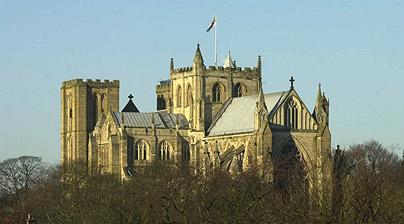

 From Pyrenees to Pennines
You must be logged in to post a comment.