Calendar Boys

The calendar....

Christmas is coming.  How do I know? Not from the Christmas decorations or shops full of Yuletide Cheer, although that’s beginning, a bit.  No, here the first sign of the impending end-of-year festivities is the appearance of The Calendar.

The other day in Laroque you’d have passed two volunteer sapeurs pompiers (Fire and Rescue service) in full uniform, trudging door-to-door with a pile of calendars.  They need us all to make a donation in exchange for one.  I wouldn’t dare not.

....and January.

They don’t expect very much money: the loose change in your purse is fine.  After all the calendars are entirely paid for by the adverts inside and all the rest is profit.  But you’ll get a receipt, your first Christmas card, and your first calendar, with each month illustrated by some thrilling event in the life of our local stations.  Photos of the local crew too.  Though not the sort of hunky photos you sometimes see in England, with Mr. Universe types stripped to the waist the better to display their tanned and rippling muscles.  These men and women are all the guys-next-door.

Anyway, don’t think that this purchase represents the end of calendar-buying for this year.  Any day now it’ll be the Majorettes, and after that….who knows?  But there will be others.  And we’ll have to buy from all of them.

Le Chemin de la Liberté

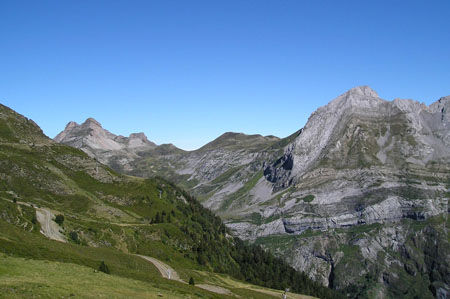
Good to look at. Less easy to cross

My last post wasn’t entirely serious.  That walk in the Pyrennean mists was fun despite the weather.  We were well nourished (energy bars, abundant picnic food, and a delicious walnut cake that Michel shared).  Thanks to the miracle of Gore-Tex and microfibres, we were warm and dry, and after it was over, we knew we’d be driving back to our cosy homes and family life.

But if you’d asked most of us whether we’d want to submit ourselves to a walk even more gruelling, every day for 4 days, in constant fear for our lives, maybe in the depths of winter, we’d have been certain to answer ‘no’.

Not so the men and women who during the Second World War risked their lives across the Pyrenees along paths such as le Chemin de la Liberté.  On Monday, as part of its Remembrance season, the BBC broadcast its own tribute to those who trekked for 4 days up 4,750 metres of difficult, rocky terrain, in conditions that could change from mist to snow, to dazzling sun, to sleet several times in the course of a single day.  These people – more than a 1000 of them over the whole period – were Allied soldiers and airmen who’d found themselves in enemy territory, escaped POWs and Jewish refugees: and the French and Spanish who helped them across the mountains to Spain.

Escapees had little choice.  They were brave and resourceful from sheer necessity.  But those who sheltered them as they travelled south through occupied Europe, prepared for their journeys, who shared the little they had, who interpreted, forged documents, sourced warm clothing so servicemen could ditch their tell-tale uniforms, those ‘passeurs’ who guided them to the comparative safety of Spain took unimaginable risks.

Would I have been brave enough to put my life on the line for strangers?  Especially if in doing so, I risked the lives of my own family?  I’m glad I don’t have to ask myself this question.  More than a 100 ‘passeurs’ were caught and either executed or deported. 450 Ariègeois who assisted the escapees were deported – that’s one in 330 inhabitants of the region at the time.  And they’re only the ones who were caught.  Many others, somehow, weren’t.

A couple of years ago, a friend in the choir told me a story, a part of her family history.  It didn’t happen in the Ariège, and it’s nothing to do with the passeurs, but it has stayed with me as a telling example of the desperation and bravery often shown in this period.  Her family then lived in an isolated village in the Creuse, and they’d given shelter to a young Jewish girl for the duration.  If  searches were conducted – and they were – this child was inserted into one of those long bolsters the French used to favour, and arranged on the made-up bed.  She simply had to lie there, still as a corpse, till the search was over.  She survived.  They survived.

At least she didn’t have to flee with a miscellaneous band of other inexperienced escapees: soldiers, mothers, underfed and frightened people, led by a series of local guides over often treacherous mountain passes – no waymarks and well-trodden paths here.  At least her mother wasn’t asked to suffocate her because her pathetic cries might alert a German patrol.  These things happened. Those times are over: but the memories live on.

Present day travellers take le Chemin de la Liberté

Laïcité? Or religious correctness?

France is a determinedly secular (laïque) society.  Those of us who weren’t in the country at the time probably became aware of this during the ‘foulard’ controversy of the 1990’s, during which there was a series of strikes and other actions both for and against the right of Muslim girls to be veiled. This culminated, in 2004, in a law banning the wearing of ‘conspicuous’ religious symbols: the reality was that it was the Muslim headscarf that seemed to be the target.

The law is widely seen as intended to discriminate against non-Christian faiths.  It’s hard not to agree.  Here in France, as in England, there are state schools and private schools.  But there’s a third category too. In some circumstances, private faith schools have access to state and local funding which means pupils attending them benefit from very low fees.  95% of such schools are Catholic.

It’s worth mentioning too that local authorities are responsible for the cost of maintaining places of worship built before 1905. It’s doubtful if any mosques fall into this category, and it’s certainly true that the burden of keeping often historic buildings in a state of good repair is a crippling burden for many small communes, and much resented by laïque members of that community.

And what about public holidays? Quite a few are holy days, and retain their Christian names: Ascension Day, Whit Monday, Assumption of the Virgin Mary, All Saints’ Day, Christmas Day….

Nevertheless, Laïcité cuts pretty deep.  I’m currently involved in helping the librarian in Lavelanet mount an exhibition and series of children’s events in early December about English Children’s Literature.  Because of the timing, there’ll be displays about a typical British Christmas, and Christmas-themed books will play their part.

Despite this, interpretations of the nativity story, by wonderful authors such as Geraldine McCaughrean, Jane Ray, Jan Pienkowski and Nicholas Allen (Not read ‘Round the Back!’?  You’ve missed a treat) will not be represented.  Why not?  Because telling the Christmas story might give offence.

Religious instruction is not part of the school curriculum, nor is any kind of act of worship – anything but.  This latter is, I think, not controversial.  It feels an increasingly uncomfortable and ignored part of the British school day.  But though I no longer count myself a believer, I’m very grateful that I and all my children had from school a good knowledge of the bible, and an understanding not only of Christianity, but all the major belief-systems of the world.  Without this grounding, so much literature, painting, sculpture and music remains only partly accessible.  Nobody has to proselytise.  If it’s OK to tell a good rollicking Greek myth, why not the stories from the Old and New Testaments, and even the Apocrypha?

I sat talking with friends about this the other day.  ‘Some of the English Christmas cards we’ve seen’ they said, ‘have religious imagery.  Wouldn’t that be offensive to non-believers?  And didn’t you say that lots of people, whether or not practising Christians, go to carol concerts and services and sing about the nativity?’  They found this astonishing.  Surprising too that one’s little daughter might come home from school proudly brandishing the cardboard angel she’d made for the top of the Christmas tree.

One friend, an ex-teacher, told me how she’d once done a piece of work with her students about the pagan origins of many Christian traditions.  She was hauled over the coals for promoting Catholicism.

Chartres by night?

This same friend told me that she would never send a postcard of a religious building to a friend unless she were sure that friend were a practising Christian.  It might give offence.  Well, let me tell you right now that if you  go to Chartres to visit what is among the most beautiful cathedrals in Europe, I shan’t be a bit happy if you send me one of those jokey wholly black cards that reads ‘The town by night’.

I’ve found myself as irritated by this apparent ‘religious correctness’ as I am by ‘political correctness’ in England.  I may well be missing something.  Can anybody put me right, please?

Postcards from Catalonia

We’ve just got back from our weekend on the other side of the Pyrénées, and I’ve decided to post these ‘postcards’ to show a few happy days in Sant Cugat del Vallès, the very attractive town where Emily is now working; the not-Hallowe’en-but- la Castañada festivities; and a relaxing weekend.

Eating and drinking were important.  Straight away, as we drove across the mist and rain shrouded Pyrénées from France, there was a decision to be made. Lunch on this side of the border?  You can’t get fed much later than 12.30 here.  Or wait till Spain?  Nothing there is open much before 2.00 p.m.

We arrived in Catalonia just in time for la Castañada. Instead of Hallowe’en, they commemorate All Souls’ Tide. Roasted chestnuts are sold wrapped in cones of newspaper with roasted sweet potatoes and peddled from impromptu stalls, or by excited groups of children.  Panellets are mashed potato, sugar syrup and ground almonds – maybe cocoa or dried fruits too, rolled in pine nuts and briefly baked till the nuts turn golden. It sounds odd, but they’re delicious accompanied by a shot of strong black coffee.

Coffee shops, with tables outside so you can enjoy the late October heat seem to be in every street, and we adjusted our bodies to Spain’s very different rhythms. Food generally seems cheaper in Spain.  A pleasant pause for breakfast, after taking the children to school, after shopping or work, or just because it’s a nice idea and the sun is shining is an affordable treat, and cafés don’t seem to struggle for custom.  Nor do lunch-stops.  As in France, the 3 course lunch with wine and coffee is on offer in most restaurants, but cheaper here.  And it’s a leisurely affair.  We found ourselves spending an hour or two every day that we were there over the lunch table, eating, talking and simply people-watching.

Shopping seems less anonymous too.  Whether in St. Cugat, or city-centre Barcelona, greengrocers and grocers, wine merchants and bakers – especially bakers – all seemed to be doing brisk business.  The out-of-town supermarkets are there alright, but so far, they don’t seem to have won.

So here are my postcards.  Have a glance at them over a lazy cup of coffee.

This slideshow requires JavaScript.

Season of pumpkins and mellow fruitfulness

A few pumpkins on display last year at Belesta’s annual Fête de la Citrouille

Go to any veg. stall on a French market just now, and there’ll be at least one giant pumpkin.  The stall holder will sell you a portion if you like, using a hefty cleaver to wrest a kilo or so of orange flesh from this magnificent vegetable.  The market’s probably got at least one stall devoted to nothing but pumpkins: Turk’s head, musque de Provence, butternut, red kuri, rouge vif d’Etampes………

It’s not so very long ago in England that I’d be doing the rounds of all the supermarkets, the day after Hallowe’en, gathering up the last few Jack o’Lantern pumpkins at bargain-basement prices.

Jack o’Lantern dressed up for Hallowe’en

They’d been stocked for everyone to make their scarey Hallowe’en pumpkin faces with and that was all.

Hardly anybody used them to cook with (presumably not even the many Americans who live in Harrogate, with their apparent love of pumpkin pie), and Hallowe’en over, the unsold ones would be junked.

Hugh Fearnley-Whittingstall et al have put paid to that, and now the English love pumpkins as much as the French always have.

Here’s an easy and long-established soupy stew from round these parts (though I learned about it from Nigel Slater) to warm you up after a chilly day in the Great Winter Outdoors.

Hmm. We made short work of that.

When we first tasted it, we thought it nice enough, not earth-shattering though. It’s grown on us, and now we think it’s comfort food par excellence: especially those pillows of bread, soaked in scalding hot flavoursome juices.

Garbure Catalane

Toast thick slices of bread- preferably sourdough, and layer them up in a casserole or slow cooker with fried onions, garlic, marjoram, sliced skinned tomatoes, and thin slices of pumpkin.  Top the dish up with seasoned water and olive oil and bake for an hour or two in a slow oven (or most of the day in a slow cooker).  Take the lid off the dish for the last half hour or so and return to the oven with a crust of grated cheeses (parmesan is good to include in the mix, as it provides a welcome crispiness) for the last half hour or so.  Or grill for a few minutes if you’ve been using a slow cooker.

To travel – slowly – is a better thing than to arrive – quickly…..

RL Stevenson: Travels with a donkey

Robert Louis Stevenson knew a thing or two about travelling slowly – and hopefully – what with hiking round the Cevennes with only a donkey for company.

But yesterday, arriving back in Laroque rather quickly having left Bolton only a few hours before, I felt he’d got it right. Our usual way of travelling between England and France is by car.  We can’t claim it’s particularly slow, not with maximum speeds of 130 k.p.h on motorways.  But it does take the best part of 3 days to do the pretty-much-exactly 1000 miles between Laroque and Ripon, and that’s fine.

Cahors

We detour to take in delightful towns like Cahors or Vendôme, and make sure we have time to explore a little.  Early morning starts may find us startling deer in the still misty fields, while at lunchtime we’ll be on the look out for a ‘menu ouvrier’, or a rural picnic spot to have a lengthy break.  We’ll enjoy a night at a chambre d’hôtes, and usually have an interesting time chatting to the owners or a fellow guest.  Breakfast with home made jams and maybe breads and cakes comes as standard. A trip on a channel ferry. A night in London with son-and daughter-in-law.  And finally, back up north.

And all this time, we’ll be adjusting between a life in France and a life in England: watching the scenery gradually flatten as we drive north, then begin to undulate again as it passes through Normandy and the Pas de Calais, linking with the similarly gently rolling hills of Kent.

This trip to England though was by plane each way.  It’s quicker and it’s cheaper too.

But the whole business of packing luggage into the required dimensions, checking the weight, hunting for a clear plastic bag for those creams and liquids: then at the airport emptying pockets, removing shoes, belts, is just a bit stressful.

Airport security: an image from the Guardian

And somehow it addles my brain. Three hours ago I was in a traffic jam on the outskirts of industrial Liverpool, and now we’re driving through vineyards in the Aude? The clothes which worked in the morning don’t do in the afternoon, and I’m having trouble adjusting the language coming out of my mouth.  I’m all discombobulated.

We’re lucky we have the time to be more leisurely.  I’m not against taking it even more slowly and walking some of the way down, maybe along one of the pilgrimage routes towards St. Jaques de Compostelle.  Anyone want to come too?  Barbara?  Sue K?

‘So British’. A French view of life in England.

Well, our French friends have been and gone.   It was a busy week full of discovery for us all.  Despite the almost unrelievedly awful weather,  Yorkshire’s sights, both rural and urban, gave a good account of themselves.  But here are one or two of the more unexpected discoveries our friends made.

Harvest Festival.  Saturday evening found us in church for a very special concert by the St. Paulinus Singers, a Ripon Chamber choir.  As we entered, our friends were struck by the celebratory pile of pumpkins, cabbages, carrots and Autumn fruits assembled for harvest-time celebrations in church.  They’d never heard of  such a thing.  Oh, and the concert began dead on time too.  Another first for them.

Harvest Festival

Charity shops.  The French have little other than away-from-town-centre large warehouses given over to the sale of donated goods and run by Emmaus.  The often carefully dressed shops we’re so accustomed to on the British high street are unknown to them.

St. Michael’s Hospice shop, Ripon

Closed for business: open for business.  As we know, shops here tend to be open through the day.  But what a surprise for our French friends to see them closing for the day at 5.30 p.m. rather than around 7.00 p.m! To find supermarkets open in some cases 24/7 was even more astonishing.

Closed at the moment

Houses without shutters.  Evenings walking round town fascinated them.  Instead of shutters there were curtains, which might or might not be drawn.  How exciting to have glimpses of another set of lives!  This is denied to them in France as shutters are usually firmly closed there as night falls.

A night-time window

Buttered bread.  As born-and-bred Ariègeoises, our guests were unused to the idea of having butter AND cheese or ham or whatever on their bread.  They rather felt it was gilding the lily.  But they weren’t keen on the fact that bread is not produced routinely at the average British dinner table.  It’s odd,  we too have come to expect bread as part of a meal in France, but never in the UK

Milky coffee and tea.  The default position for both in France is black (strong coffee, weak tea)

At the butcher’s. Of course our guests wanted to cook a slap-up meal for us.  We all struggled a bit with this one, as French and English butchers cut their beasts up in different ways.  As a recently-lapsed vegetarian, I’m re-learning slowly all I ever thought I knew, and starting at page 1 in French butcher’s shops.

A Friesian: until recently, these were the cows I most frequently saw in England

Voilà!

Voilà!  The most useful word in the French language.

Here’s what happened at the baker’s this morning.  Translations appear in brackets.

Me: Oh!  Isn’t the pain bio ready yet?

Madame: Voilà! (Nope.  Quite right)

Me: So if I call in after 9, you’ll have some?  Could you please save me a loaf?

Madame:  Voilà! (Yes, and yes).  Would you like to pay now, then it’ll be all done and dusted?

Me:  Voilà! (Makes sense.  I’ll do that)

By the way, I was all grottily dressed in my oldest paint-spattered, holes-in-the-knee-ready-to-face-a-morning’s-tiling gear.  This is Laroque after all: no shame in working clothes here.

Madame:  You’re looking very chic today, if I may say so!

Me:  Voilà!  (And don’t I know it).

Why bother to learn more French?  Voilà donc!

Coteaux d’Engraviès

Last week, we had a morning at an organic vineyard, one of only 2 commercial vineyards in the whole of the Ariège.  The vineyards at Coteaux d’Engraviès appeared on maps as long ago as 1310, and on later maps too, though eventually they disappeared.  So the owner of the Domaine, Philippe Babin told us, anyway.  He was the one who decided once again to cover the hillside in vines.

He introduced us to an Ariège from a time we couldn’t recognise.  Now, we’re used to seeing fields of maize, sunflowers, food and fodder crops  in addition to pastureland.  Back in the Middle Ages, when Catharism was at its height, the area was covered in vines.  Everyone produced wine for their own use.  It wasn’t strong, maybe 5% or so, but it provided refreshment and nourishment for men, women and children alike.  No neat rows here, the vines grew unsupported by trellising, higgledy piggledy.  Over in Pamiers, from where any exportable wine was shipped, the notorious Bishop of Pamiers, later Pope, Jacques Fournier, received the taxes he imposed in the form of wine.

The Ariège was prosperous and, for the period, densely populated.  Men made their living from mining and the forges, and their women and children reared stock in the high pastures.  Only the Industrial Revolution, which arrived later in France than in the UK – just before the First World War in fact – put a stop to this, as the small scale of local operations were not suited to large-scale mechanisation.  This, and the de-population that occurred when men failed to return from the trenches, began the Ariège’s descent into a less populated, often deprived area.

Philippe shares his expertise

Phylloxera saw the end of wine production in the Ariège.  Vines, decimated in the 19th century throughout Europe, were gradually replaced elsewhere by resistant American varieties.  The local domestic vines, most of which were fairly low quality, weren’t worth replacing, and people simply walked away from them, leaving them to die.  Only within the last 30 years have a couple of producers recognised that parts of the area are suitable for developing once more a high-quality product, and with modern and traditional savoir-faire behind them, worked towards developing businesses of which they can be proud.  Philippe Babin is one of these.

Philippe went on to tell us more about the vines themselves.  They need rain, and they need sunshine for their leaves to absorb and enable the fruit to mature.   Vines put roots deep down into the soil and rocky earth, particularly in the first 15 years of life. Philippe chooses to grow his vines organically, because he recognises that the particular composition of the soils and rocks beneath in the area – ‘terroir’ – inform the character of his vines: fertilisers and other products would change this balance.  The vines themselves change as they mature, and those plants which are 80 – 100 years old (his are a long way from this) produce little, but what they do is very fine.

Pruning forces the vines to produce grapes, and therefore seeds.  Unpruned, they grow hundreds of metres long, and see no need to seed themselves.  Wild vines are therefore innocent of fruit.

Examining grape pips for maturity

Then he showed us how to research a maturing grape.  Does the skin peel easily from the fruit, and is it loosing its elasticity?  If so, it’s ripening nicely.  Have the seeds broken away from the ‘umbilical cord’ of the stalk and taken on a woodier appearance?  Once that happens, the seeds are nearly ready to fall and have a go at germinating (they have a low germination rate).  From now on, they’ll nourish themselves, like embryo chickens in an egg, from the flesh of the grape, which will wither as the seed digests it.

Barrels full of wine waiting to be bottled

Lesson over, we went back to the Cave.  A small band of workers were working to bottle the last of the 2010 vintage to free up space for the harvest which will take place in maybe a fortnight or so.  The barrels in which the wine matures must never be left empty, so this is a last minute job.

And finally….the tasting.  An opportunity to compare three of the wines he produces.  Every year his blends are slightly different, to arrive at a consistent product.  Syrah, Merlot, Cabernet Sauvignon…all have their part to play in blending wines to make a perfect complement to an enjoyable meal, whether roasted, casseroled or preserved meats, or a plate of local cheeses.

Wine waiting to be tasted