Marmalade: the bitter facts

Forget politics.  Here in the UK, the news story that really means something to any right-thinking English man and woman is that marmalade sales are falling.  The reason though, according to most commentators, is that many of us prefer to make our own.  I do.

Over the last few years, I’ve been so glad to have come across Jane Grigson’s recipe, which gets me out of the whole business of hacking mounds of tough raw orange peel into marmalade sized chunks.  It delivers a tasty sweet and bitter marmalade which beats anything you’ll meet on the grocer’s shelf

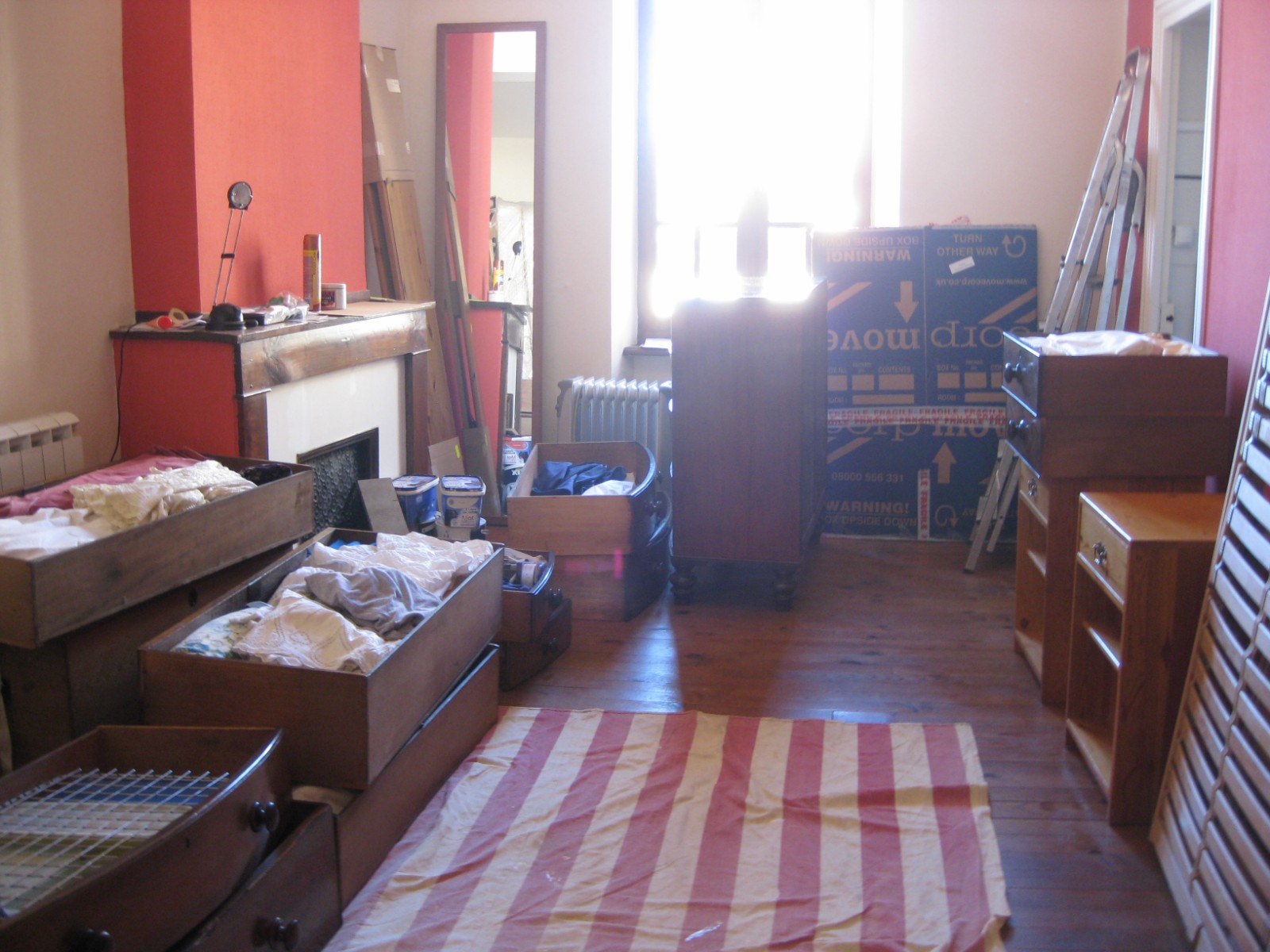
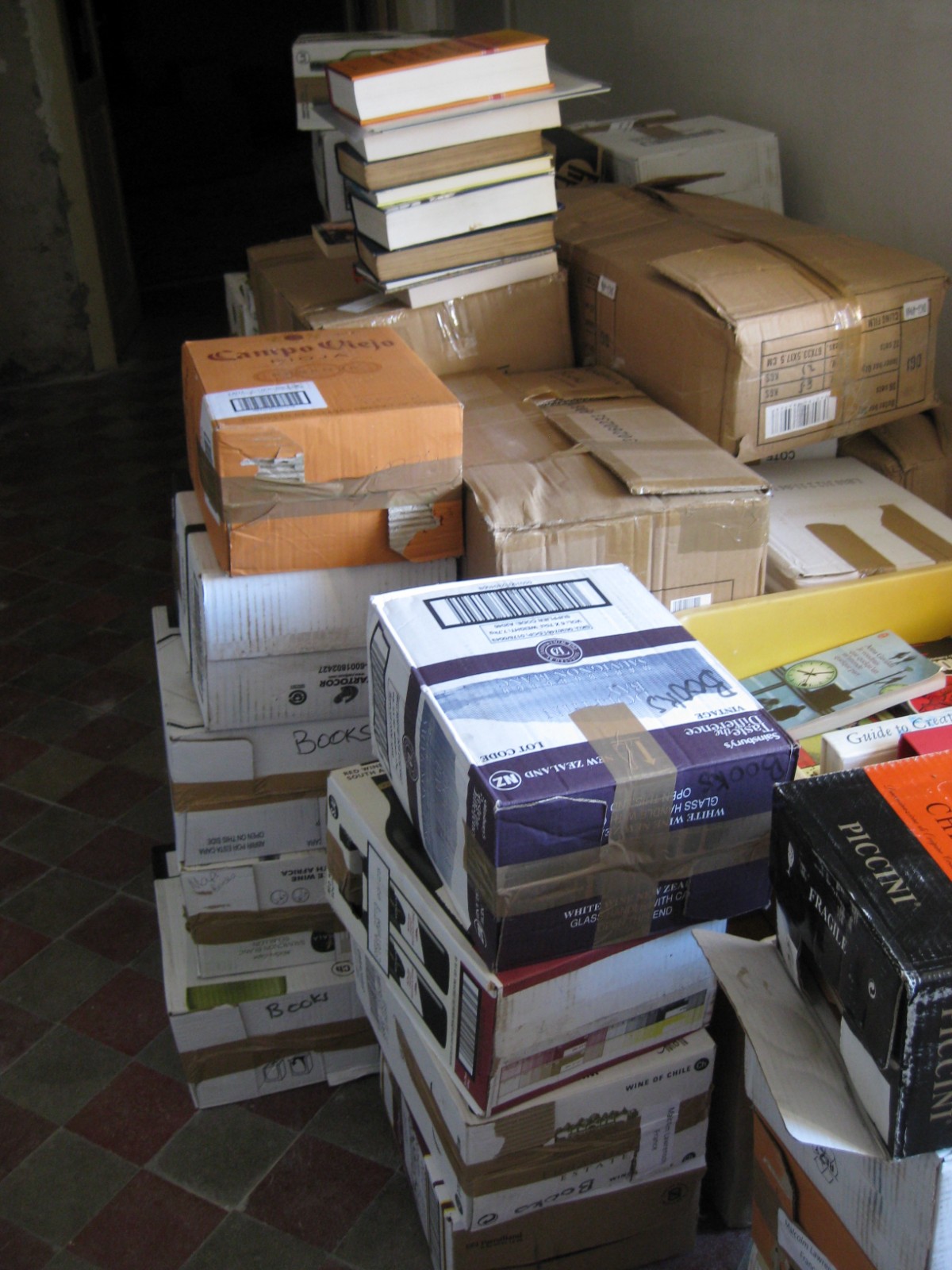
Our house, now a temple to magnolia paint and packing cases, is currently innocent of recipe books.  Somehow I contrived to find my preserving pan the other day, and make her marmalade, or something  jolly like it, from memory.  Impressive, huh?

I kg. seville oranges (about 10 fruits)

1 lemon

3.4 litres water

2 kg. granulated sugar, or half granulated, half light muscovado.

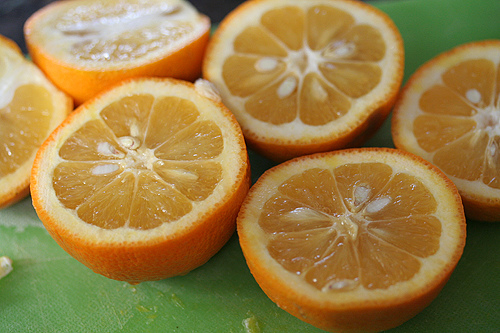
Scrub the seville oranges and the lemon, and place in a large pan with the water.  Bring to the boil and simmer till the fruit is soft – maybe an hour or so.  Allow to cool.  Cut the oranges in half, scoop out the flesh and pips and reserve in a large muslin square.  Chop the skin as thick or as thin as you chose – it’s so easy now the skin is soft.

Tie the muslin with its contents into a bag, and put it, with the orange peel, remaining water (about a third will have evaporated) and sugar, into a preserving pan.  Bring the mixture slowly to the boil, so that the sugar dissolves, then cook rapidly till setting point is reached (I can’t manage without my jam thermometer, but that’s pathetic.  Most people seem happy enough to test for the setting point by putting a spoonful of marmalade onto a cold saucer, and seeing if it crinkles as you push your finger through the cooled mixture).

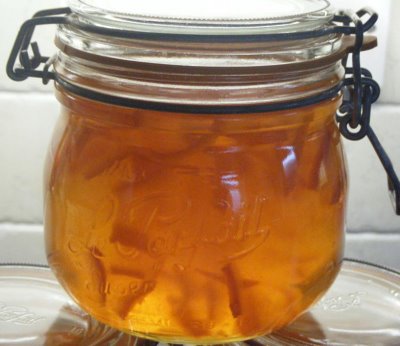
Allow the mixture to sit for about 15 minutes before pouring into sterilised jam jars.  Makes 6-7 jars

Getting in touch with our inner magnolia

Here we are, still in Harrogate.  We’ve given up trying to sell the house.  Perhaps we could rent it out instead?

The Letting Agent called round to give advice.  ‘Hmm.  You’ll find neutral colours are best on the walls’.  So this month is devoted to making the house not neutral, but bland.

Wedgwood blue, sunshine yellow, saffron orange, Moroccan red – all need to go, in favour of  – magnolia.  Well, we could have chosen barley white, walnut whip, almond blossom, Jersey cream…………, but they’re all much of a muchness, and magnolia was on offer when we went shopping for paint.

And what you need to know is that we can’t stand painting, neither of us.  Any dispacement activity will do.  Washing up?  Great! Cleaning the bathroom?  Wonderful!  When we do finally get started, we try so hard only to look at our watches once an hour….and then discover 10 minutes has passed.  We thoughtfully offer to make each other cups of tea at every opportunity, and consider it important to empty our bladders before there could be any possible discomfort.  We climb down ladders to go and inspect each other’s work, brush stroke by brush stroke, and really, it’s a miracle that we have in fact managed to paint 2 whole rooms since Wednesday.  That’s partly thanks to our friends in LETS.  You don’t know about LETS?  You will.  To be continued , perhaps not in my next, but some time in the near future

Down at the Greasy Spoon

No stay in England is complete without a visit to a Greasy Spoon.  Hot, crowded, cheerful,  and full of burly men stolidly chewing their way through mountainous piles of chips, bacon and sausage, the average transport caff is not the place for fine dining.  But the good ones are worth a visit, and today, we visited the Bridge Cafe at Apperley Bridge, on the way over to Bolton to see the boys.

It was only quarter to twelve, but we needed an early break after a hard morning shifting furniture, skidding up and down our impossibly icy street, lugging huge bags of books and discarded household items to the charity shop, visiting the Letting Agent, scouring Bradford’s Asian shops for essential supplies of Indian spices that are hard to get in France.  After that, what better than a hot plate of comfort food washed down with a huge mug of tea?

Yes, quarter to twelve.  But the place was already crowded with joiners, truckers, shoppers, pensioners.  Most were having the all-day breakfast.

This is what you get if you order the small one: £3.80

2 slices bacon, 1 sausage, 1 egg, beans, tomatoes, toast, fried bread, tea.

Some had gone for the Full Breakfast: 2 slices bacon, 2 sausages, 2 eggs, spam, black pudding, mushrooms, hash browns, beans, tomatoes, fried bread, toast and tea or coffee.

Nope, not a chance that we could cope with that: poached eggs on toast was more like it.

A quick flick through the daily papers provided – tabloids of course, broadsheets need not apply – a quick chat to the owners ( Italian?  Lithuanian? We couldn’t agree), and we were off, sustained for an afternoon of meeting 5 year old twins as they came out of school, to enjoy the rest of their action-packed day

Urban wildlife

When we left Laroque for Christmas and New Year in London and Harrogate, we thought we’d left most wildlife behind too.  Not so.  It seems as if wherever you are in South London, you’re only yards from a fox’s lair. Tom and Sarah refused to share our excitement at seeing so many.  ‘They’re on the station every night when we come home from work’, they yawned. ‘They’re quite mangy anyway’.  We didn’t think so.  We loved to see them trotting spiritedly along the street once darkness  had fallen, sniffing round the dustbins for Christmas turkey.

Back in Harrogate, the birds we thought would have abandoned our garden, now we aren’t there to feed them regularly, have quite simply moved in.  Chaffinches hunt for seed, blackbirds tug at worms, and all of them relish the garden pond for regular bathing sessions in the all-but-frozen water.  They’re obviously glad we’ve not been there to disturb them

The horror story that never was. Not for us, anyway.

Everyone worried about our journey back to the UK.  WE worried about our journey back to the UK.  The news in France, England and throughout Europe was of snow, delay, disruption. TV images showed exhausted families sleeping on luggage conveyor belts at airports, crammed train stations, lines  of immobile traffic on motorways.  And we were planning to drive back to England, the best part of 1000 miles away from Laroque.  Friends begged us to change our plans, or at least buy snow tyres.

But we decided the information on the internet was at variance with that provided on TV and radio bulletins, and far more positive.  Our planned route, as far as http://www.meteo services were concerned, was pretty much fine, apart from some snow as we neared Pas de Calais.

And so it proved.

Motorway - or lorry park?It did snow, mainly near Rouen.  And I wouldn’t have wanted to be a lorry driver.  Gendarmes on roundabouts rounded them up from Dreux onwards and sent them on different routes.  Just after Rouen, they closed the fast lane of the motorway, and forced all the truckers to park up there, mile after mile of lorries from France, Spain, Luxembourg, Portugal, the UK….  And there they all sat in their cabs, unfed, unwatered, puffing away at endless cigarettes, or occasionally jumping down to take a stroll along the not-so-fast-lane.  I hope they’re not still there.  For us, although driving was tricky for an hour or two, it was a chance to enjoy Winter Wonderland views across hills and forests, only animal tracks disturbing the perfect white landscape

The motorway snow petered out, and we picked up speed, and got to Calais just in time.  But the ferry was late.  It had become a refuge for those unable to fly, unable to travel Eurostar, but desperate to cross the Channel any way they could.  Hard to believe we’d had it so easy.  On the other side of the Channel, travelling through to London, we listened to Radio 4.  The BBC was full of sad stories of those unable to get home to their families for Christmas. Politicians held forth about how Britain’s handling of the situation was ‘the laughing stock of Europe’.  We don’t think so. Things were hardly better in France, to our certain knowledge, and Belgium and Germany weren’t having a good time either.  Perhaps it’s quite simply that we humans aren’t quite so in charge as we like to think.  Nature has her ways of humbling us after all, from time to time.

Christmas markets

Christmas markets always used to be a German thing.  They still are, I think: they do sound rather special.  It’s many years now that Leeds has had its own German Christmas Market, though I’ve always wondered what would bring German stall holders across the channel to pitch their stalls.  Just as I’ve wondered what the attraction is for the hundreds and hundreds of French market traders who regularly fetch up in the UK for the popular French markets, where the prices are inevitably sky high.

But Christmas markets, where you can look for all your presents, made by local craftspeople and artisans, or in sweatshops in China are everywhere.  The difference is that in the UK, they began in November and are now largely over.  Here they’re just beginning, and will go on in some cases, like Toulouse, until after Christmas.

Here’s our stall, Découverte Terres Lointaines, at the market at Lavelanet, on today and tomorrow

A nation of shopkeepers…or a small town with small shops

Depending on your point of view, it was either Napoleon or Adam Smith who first called England ‘a Nation of Shopkeepers’

But it was only after I came to settle here in France that I started to think of shopkeeping and market trading as  skilled occupations, and realised just what is involved in keeping the customer happy.

It’s probably because it’s just so much easier, where we live in England, to nip down to the supermarket.  There weren’t too many independent shops on our daily round:  so much for a nation of shopkeepers.  Mind you, we loved it when Emily was a Saturday girl at the French patissier who was then in Harrogate, Dumouchel. She would often be sent home with a couple of unsold petits gateaux for us to enjoy,  or some slowly-fermented sourdough bread.  It was small shop, and quite expensive, so she learnt quickly to value customers and to treat them well, so they’d come back.  She learnt too that while most of the people she served were friendly and appreciative, customers could be curmudgeonly too.

The baker’s – busy at lunchtime

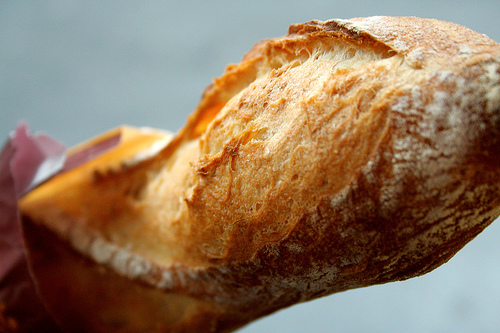
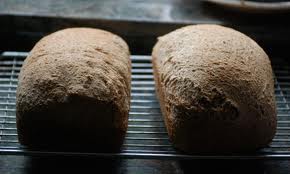
So who are the good commerçants here?  Well, down at the bakers, they’ll often put aside our much-loved pain noir without being asked if I’m not in bright and early, knowing we’d be disappointed if they sold out.

Buying cheese at the market

Today at the market, madame who runs the cheese and charcuterie stall had printed off some recipes specially for me, because she knew I might enjoy trying them out.

Down at Bobines et Fantaisies, she goes to Toulouse most weeks to seek out unusual scarves and accessories, so there’s always something new and worth trying at her tiny shop. ‘Let her try it on.  If she doesn’t like it, bring it back!’, she’ll insist, as you dither between a bracelet, a couple of scarves and a chic but cosy winter hat.  These shopkeepers remember us, our tastes, our whims and foibles. They welcome us, and chat cheerfully with us, even if we leave the shop empty-handed.

Madame at Bobines et Fantasies helps me choose a few presents

There’s just one shop here that doesn’t cut the mustard. ‘Il n’est pas commerçant’ we all grumble.  Those of us outside the select band are routinely ignored, and as we feel our custom isn’t valued, some of us now go elsewhere.

But not to the supermarket.  Oh no.  Yesterday we DID pop into one, but as the muzak system was belting out a schmaltzy version of ‘Auld lang syne’ in what passed for English, we very soon shot out again.  Small Shops Rule OK.

…..now Snow’s the Big Story

Everyone in Europe, it seems, has been battling with snow this week. Everyone that is, except us and anyone within easy driving distance of our part of the country.

Road clearing in Cherbourg, 2nd. Dec

Night after night the French news bulletins have been full of tales of woe, endurance, hardship, slipping and sliding and Dunkirk Spirit in Lyon, Orléans, Brittany, and Strasbourg.  Before passing on to the rest of the news, we’d then have a shot or two of traffic jams on a motorway outside Newcastle, or a firmly shut-for-business Gatwick Airport.  Neighbours and friends gleefully filled us in on how dire they’d heard things were in the UK.

Finally, yesterday morning, the snow arrived here too.  Frankly, we knew we weren’t going to get the news crews down here looking for a story.  It hardly settled, and then it began to disappear.  Still, I found excuses in the afternoon not to get on, but to sit next to the woodburner and do some jobs on the computer.  I got distracted. Somehow, although it’s not at all my newspaper of choice, I started to look at the readers’ photos on the Telegraph website.  They’re terrific. Gorgeous snowscapes from all over Britain; funnies, such as the rabbit tentatively sniffing at a snowman; curiosities such as the milk bottles out on the step whose contents had expanded to make  tall chimneys of frozen milk extrude from the top.  Sorry – my links won’t lead you to the exact photos, because the Telegraph’s organized them into galleries.  But have a look anyway.  You too may spend quite a while browsing through for your favourite.

Near Roquefixade

And now here are our snow photos, taken on the way to Pamiers, and home from Foix.  We were meant to be Christmas shopping.  Well, that didn’t last.  A cup of decadently rich smooth hot chocolate at a chocolatier in Pamiers, and we were off. The pretty way home, via Foix, seemed a much better idea.  My photos will impress nobody who’s been battling with the real stuff this last week.  But we like them anyway

On the road from Foix to Roquefixade

Découverte Terres Lointaines

Nobody could call our nearest town, Lavelanet, a hub of multi-culturalism. But neither is it an Ariegeois ghetto. Of course, as in most French towns, there’s a big Maghrébin presence: inhabitants of the former French colonies of Tunisia, Morocco and Algeria. There are significant numbers of people of Spanish origin: their families probably came over in the Spanish Civil War. Dunno how so many Portuguese got here, but in addition there are Swiss, Belgians, Roumanians, Brazilians, Vietnamese, Chinese, Argentinians, Australians, Germans, Dutch…..ooh, and a few English of course.

Recently, I got to know two local women, Sylvia and Noëlle. Some time ago they, together with another friend Nadia, had come up with the idea of bringing together women from some of these countries to share their cultural heritage, particularly through the medium of cooking. The idea got bigger. Over the last 18 months or so, they’ve developed themselves as an official voluntary group, ‘Association “Découverte Terres Lointaines”‘.  They and their ‘benevoles’ (volunteers) have animated cookery workshops in schools, old people’s homes, youth clubs, centres for people with various disabilities. They’ve raised money for these activities by selling foods from all over the world, which they’ve prepared,   at local festivals.  But why stop at recipes?  We all have a culture to share – children’s stories to tell, songs to sing, our daily lives ‘back home’ to compare, and all this too is included in the mix.  Recently, I’ve joined in some of their activities.

It’s got a bit more formalized now. There’s a bit of a special focus now on a particular country in any one year. This year it was Quebec (OK, it’s a province, not a country.   But it DOES have a very distinctive voice within Canada), and next year it’ll be Algeria.

Nadia makes the dough for her Algerian sweetmeats

Last week was a first though. We were invited to provide an International Buffet at a multi-services training day being laid on by the Mairie. At various points in the days leading up to it, we got together in the kitchen of the Family Centre (CAF), and helped each other cook.

Then Sylvia winds the dough strips into little 'birds nests'....

Nadia showed us how to prepare Algerian grivvech: thinly rolled dough cut into strips and wound into jumbled little nests before being deep fried and doused in honey and sesame seeds. There were Quebecois dishes, guacamole topped toasts, and treats from around the world.

...the deep fried, sticky, delicious result.

Best of all was the unlikely sounding tomato and banana soup from Brazil.  Do try it: recipe below.

What could I contribute as an English finger-food? I thought long about this, and came up with Scotch eggs (thanks, Kalba, again). You need to know that here in France, sticky tape, as in England, is known by a trade name. Not ‘Sellotape’, but ‘Scotch’. So Sylvia’s eyes darkened in puzzlement when I suggested these Scotch eggs. ‘Sellotape eggs? What on earth….?’

And what fun it all was.  I can and do open recipe books to try out dishes from any and every continent.  But it’s not half so exciting as working with women from Algeria, Brazil, Roumania, wherever, as they talk you through the techniques they’ve known for years and years, and stand over you and make you practice and redo things till you jolly well get it right.

I'm NEVER deep-frying 30 Scotch eggs again

Anyway, here are my photos of the preparations for a successful lunch. We could have taken any number of repeat bookings, but for the time being, the organisation will maintain its ‘benevole’ status, and not venture into the hard realities of developing a business.

Brazilian Tomato and banana soup

Soup just cooked and ready to go

Ingredients

I onion

I tbspn rapeseed oil

Large bottle of passata

5 ripe bananas

1.5 l. bouillon

Small carton cream

3 tsp. curry powder

1 tsp. cayenne

Gently cook the onion in the oil.  Meanwhile, remove the black central thread which you may never previously have noticed and any seeds from within the peeled bananas, and mash thoroughly.  Add the passata to the onion, together with the spices and cook gently .  Add the mashed banana and continue cooking.  Add cream, reheat gently, and serve

Himalayan Balsam: An Unlikely Enemy

If it hasn’t reached you yet, beware.  It will.  This invasive plant was introduced – from the Himalayas, obviously – as an attractive addition to the English garden in 1839, and now seems to be marching inexorably round the country, destroying all plants in its path – yes, ANY plant.  Even roughy-toughies like rosebay willow herb and brambles are powerless to stand against it.

The other day, I went with a friend on a favourite walk along the River Nidd.  It’s a gorgeous path, through typical English woodland, with the river rippling and tumbling  alongside.  Not any more, not where we were.  Himalayan balsam has invaded huge stretches of the walk – it prefers to be near water – and we found ourselves marching between shoulder-high sentinels of the wretched thing, unable any longer either to see the trees and undergrowth, nor enjoy either the riverside views or those of the meadows opposite.

And in town today, walking down a little ginnel where, when I was at work, I used to collect blackberries in my lunch hour to make into jellies and jams(how sad….but it made me happy) there was not a bramble bush in sight, just That Balsam.

If it’s planning an invasion near you, martial your forces.  This plant will fight, smother and strangle every bit of vegetation in its path, and conquer yard after yard of ground with every passing year. You must join battle against it the very first time you see some of its – quite attractive – pink flowers .  Or it will win the war and continue its despotic rule.