When we left Laroque for Christmas and New Year in London and Harrogate, we thought we’d left most wildlife behind too. Not so. It seems as if wherever you are in South London, you’re only yards from a fox’s lair. Tom and Sarah refused to share our excitement at seeing so many. ‘They’re on the station every night when we come home from work’, they yawned. ‘They’re quite mangy anyway’. We didn’t think so. We loved to see them trotting spiritedly along the street once darkness had fallen, sniffing round the dustbins for Christmas turkey.
Back in Harrogate, the birds we thought would have abandoned our garden, now we aren’t there to feed them regularly, have quite simply moved in. Chaffinches hunt for seed, blackbirds tug at worms, and all of them relish the garden pond for regular bathing sessions in the all-but-frozen water. They’re obviously glad we’ve not been there to disturb them
Everyone worried about our journey back to the UK. WE worried about our journey back to the UK. The news in France, England and throughout Europe was of snow, delay, disruption. TV images showed exhausted families sleeping on luggage conveyor belts at airports, crammed train stations, lines of immobile traffic on motorways. And we were planning to drive back to England, the best part of 1000 miles away from Laroque. Friends begged us to change our plans, or at least buy snow tyres.
But we decided the information on the internet was at variance with that provided on TV and radio bulletins, and far more positive. Our planned route, as far as http://www.meteo services were concerned, was pretty much fine, apart from some snow as we neared Pas de Calais.
And so it proved.
It did snow, mainly near Rouen. And I wouldn’t have wanted to be a lorry driver. Gendarmes on roundabouts rounded them up from Dreux onwards and sent them on different routes. Just after Rouen, they closed the fast lane of the motorway, and forced all the truckers to park up there, mile after mile of lorries from France, Spain, Luxembourg, Portugal, the UK…. And there they all sat in their cabs, unfed, unwatered, puffing away at endless cigarettes, or occasionally jumping down to take a stroll along the not-so-fast-lane. I hope they’re not still there. For us, although driving was tricky for an hour or two, it was a chance to enjoy Winter Wonderland views across hills and forests, only animal tracks disturbing the perfect white landscape
The motorway snow petered out, and we picked up speed, and got to Calais just in time. But the ferry was late. It had become a refuge for those unable to fly, unable to travel Eurostar, but desperate to cross the Channel any way they could. Hard to believe we’d had it so easy. On the other side of the Channel, travelling through to London, we listened to Radio 4. The BBC was full of sad stories of those unable to get home to their families for Christmas. Politicians held forth about how Britain’s handling of the situation was ‘the laughing stock of Europe’. We don’t think so. Things were hardly better in France, to our certain knowledge, and Belgium and Germany weren’t having a good time either. Perhaps it’s quite simply that we humans aren’t quite so in charge as we like to think. Nature has her ways of humbling us after all, from time to time.
Christmas markets always used to be a German thing. They still are, I think: they do sound rather special. It’s many years now that Leeds has had its own German Christmas Market, though I’ve always wondered what would bring German stall holders across the channel to pitch their stalls. Just as I’ve wondered what the attraction is for the hundreds and hundreds of French market traders who regularly fetch up in the UK for the popular French markets, where the prices are inevitably sky high.
But Christmas markets, where you can look for all your presents, made by local craftspeople and artisans, or in sweatshops in China are everywhere. The difference is that in the UK, they began in November and are now largely over. Here they’re just beginning, and will go on in some cases, like Toulouse, until after Christmas.
Depending on your point of view, it was either Napoleon or Adam Smith who first called England ‘a Nation of Shopkeepers’
But it was only after I came to settle here in France that I started to think of shopkeeping and market trading as skilled occupations, and realised just what is involved in keeping the customer happy.
It’s probably because it’s just so much easier, where we live in England, to nip down to the supermarket. There weren’t too many independent shops on our daily round: so much for a nation of shopkeepers. Mind you, we loved it when Emily was a Saturday girl at the French patissier who was then in Harrogate, Dumouchel. She would often be sent home with a couple of unsold petits gateaux for us to enjoy, or some slowly-fermented sourdough bread. It was small shop, and quite expensive, so she learnt quickly to value customers and to treat them well, so they’d come back. She learnt too that while most of the people she served were friendly and appreciative, customers could be curmudgeonly too.
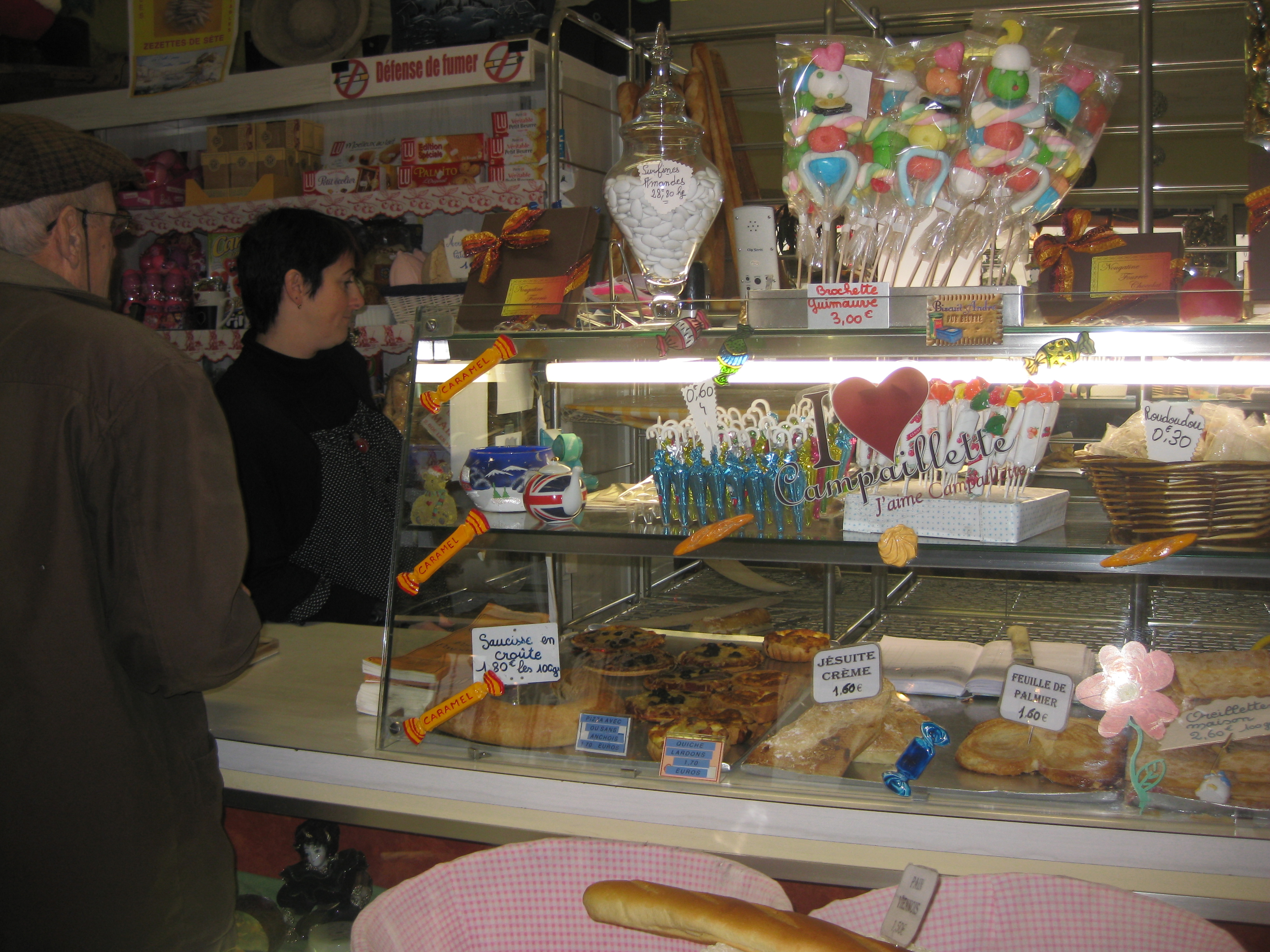
The baker’s – busy at lunchtime
So who are the good commerçants here? Well, down at the bakers, they’ll often put aside our much-loved pain noir without being asked if I’m not in bright and early, knowing we’d be disappointed if they sold out.
Buying cheese at the market
Today at the market, madame who runs the cheese and charcuterie stall had printed off some recipes specially for me, because she knew I might enjoy trying them out.
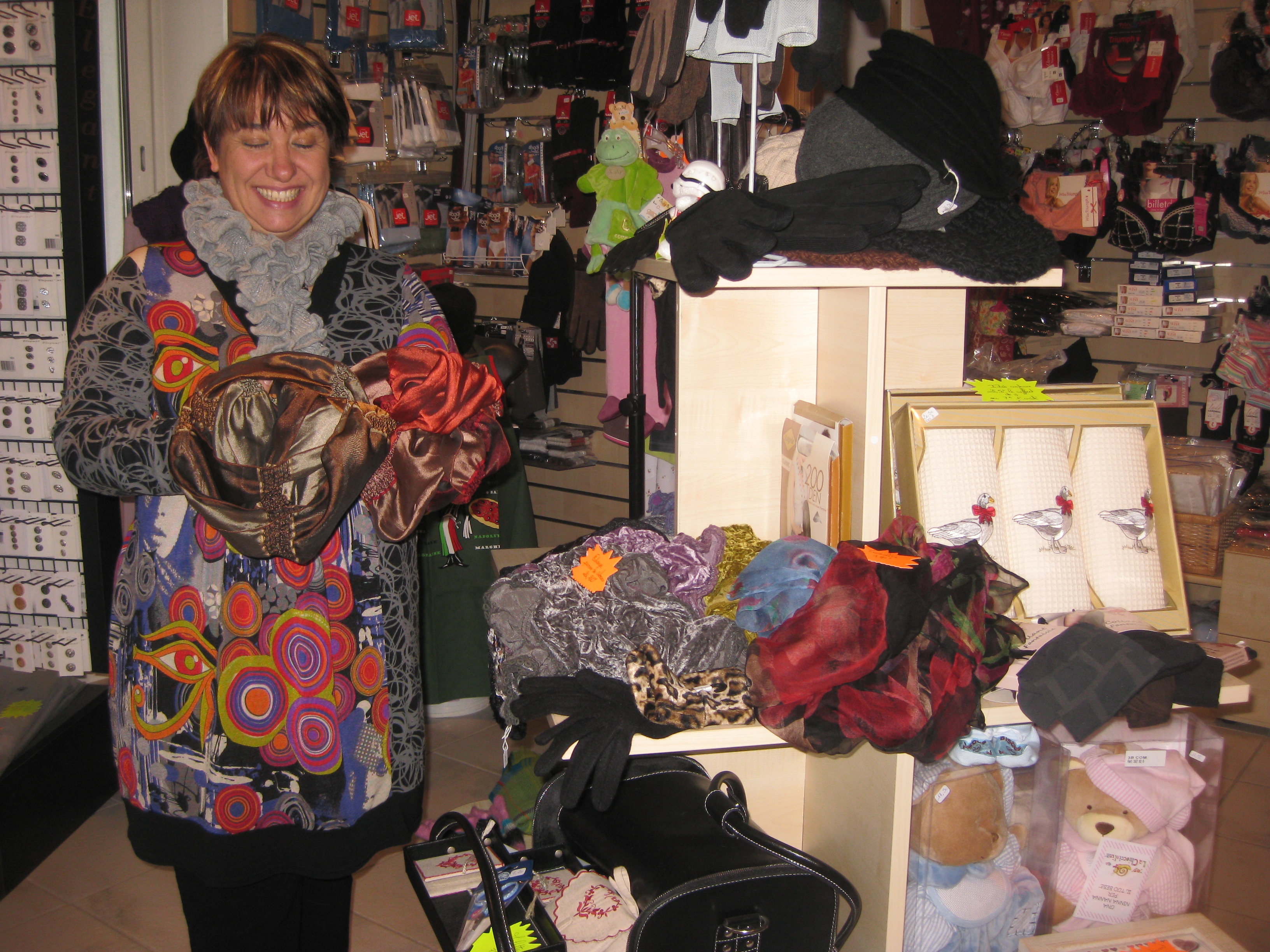
Down at Bobines et Fantaisies, she goes to Toulouse most weeks to seek out unusual scarves and accessories, so there’s always something new and worth trying at her tiny shop. ‘Let her try it on. If she doesn’t like it, bring it back!’, she’ll insist, as you dither between a bracelet, a couple of scarves and a chic but cosy winter hat. These shopkeepers remember us, our tastes, our whims and foibles. They welcome us, and chat cheerfully with us, even if we leave the shop empty-handed.
Madame at Bobines et Fantasies helps me choose a few presents
There’s just one shop here that doesn’t cut the mustard. ‘Il n’est pas commerçant’ we all grumble. Those of us outside the select band are routinely ignored, and as we feel our custom isn’t valued, some of us now go elsewhere.
But not to the supermarket. Oh no. Yesterday we DID pop into one, but as the muzak system was belting out a schmaltzy version of ‘Auld lang syne’ in what passed for English, we very soon shot out again. Small Shops Rule OK.
Everyone in Europe, it seems, has been battling with snow this week. Everyone that is, except us and anyone within easy driving distance of our part of the country.
Road clearing in Cherbourg, 2nd. Dec
Night after night the French news bulletins have been full of tales of woe, endurance, hardship, slipping and sliding and Dunkirk Spirit in Lyon, Orléans, Brittany, and Strasbourg. Before passing on to the rest of the news, we’d then have a shot or two of traffic jams on a motorway outside Newcastle, or a firmly shut-for-business Gatwick Airport. Neighbours and friends gleefully filled us in on how dire they’d heard things were in the UK.
Finally, yesterday morning, the snow arrived here too. Frankly, we knew we weren’t going to get the news crews down here looking for a story. It hardly settled, and then it began to disappear. Still, I found excuses in the afternoon not to get on, but to sit next to the woodburner and do some jobs on the computer. I got distracted. Somehow, although it’s not at all my newspaper of choice, I started to look at the readers’ photos on the Telegraph website. They’re terrific. Gorgeous snowscapes from all over Britain; funnies, such as the rabbit tentatively sniffing at a snowman; curiosities such as the milk bottles out on the step whose contents had expanded to make tall chimneys of frozen milk extrude from the top. Sorry – my links won’t lead you to the exact photos, because the Telegraph’s organized them into galleries. But have a look anyway. You too may spend quite a while browsing through for your favourite.
Near Roquefixade
And now here are our snow photos, taken on the way to Pamiers, and home from Foix. We were meant to be Christmas shopping. Well, that didn’t last. A cup of decadently rich smooth hot chocolate at a chocolatier in Pamiers, and we were off. The pretty way home, via Foix, seemed a much better idea. My photos will impress nobody who’s been battling with the real stuff this last week. But we like them anyway
Nobody could call our nearest town, Lavelanet, a hub of multi-culturalism. But neither is it an Ariegeois ghetto. Of course, as in most French towns, there’s a big Maghrébin presence: inhabitants of the former French colonies of Tunisia, Morocco and Algeria. There are significant numbers of people of Spanish origin: their families probably came over in the Spanish Civil War. Dunno how so many Portuguese got here, but in addition there are Swiss, Belgians, Roumanians, Brazilians, Vietnamese, Chinese, Argentinians, Australians, Germans, Dutch…..ooh, and a few English of course.
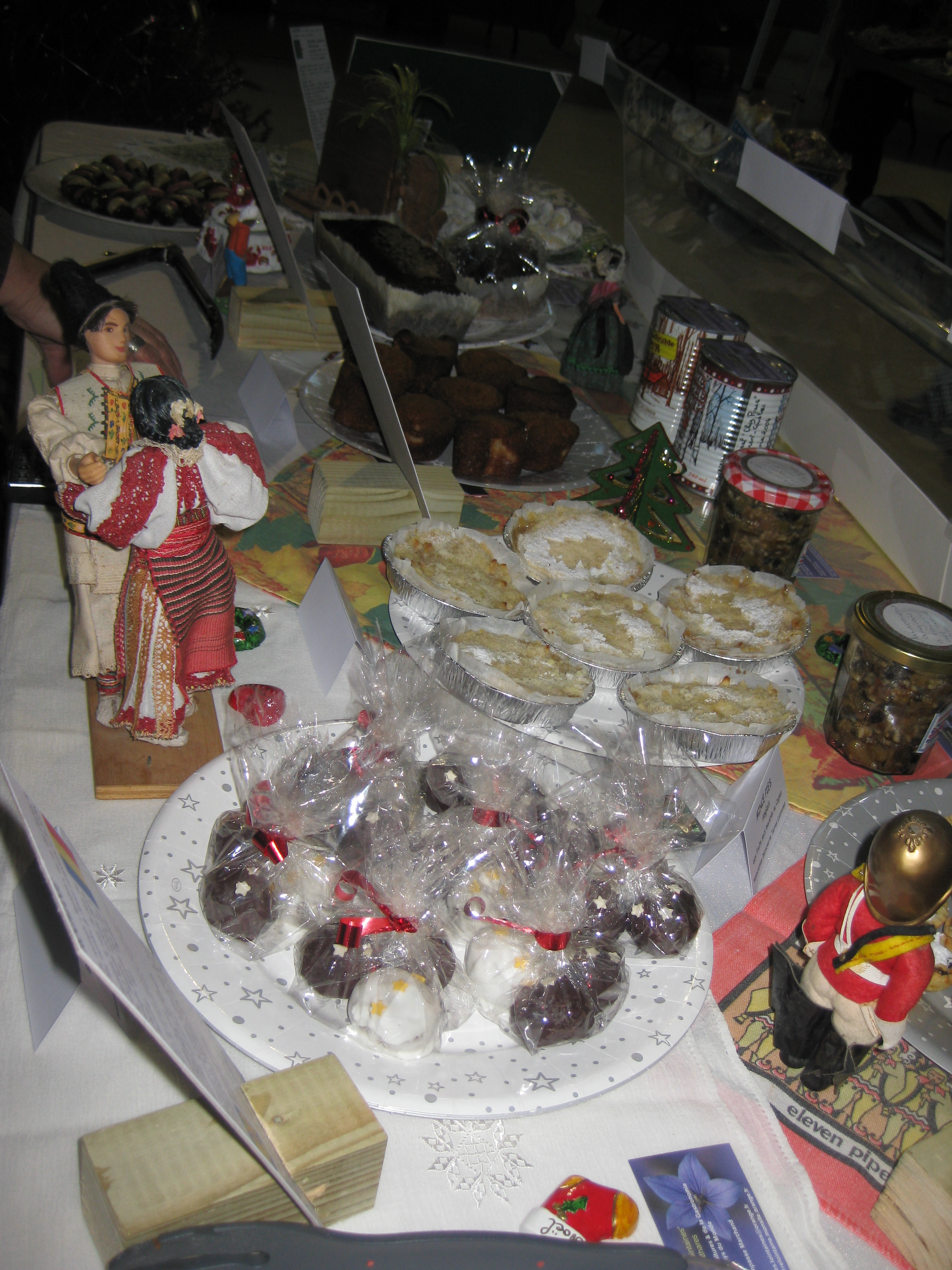
Recently, I got to know two local women, Sylvia and Noëlle. Some time ago they, together with another friend Nadia, had come up with the idea of bringing together women from some of these countries to share their cultural heritage, particularly through the medium of cooking. The idea got bigger. Over the last 18 months or so, they’ve developed themselves as an official voluntary group, ‘Association “Découverte Terres Lointaines”‘. They and their ‘benevoles’ (volunteers) have animated cookery workshops in schools, old people’s homes, youth clubs, centres for people with various disabilities. They’ve raised money for these activities by selling foods from all over the world, which they’ve prepared, at local festivals. But why stop at recipes? We all have a culture to share – children’s stories to tell, songs to sing, our daily lives ‘back home’ to compare, and all this too is included in the mix. Recently, I’ve joined in some of their activities.
It’s got a bit more formalized now. There’s a bit of a special focus now on a particular country in any one year. This year it was Quebec (OK, it’s a province, not a country. But it DOES have a very distinctive voice within Canada), and next year it’ll be Algeria.
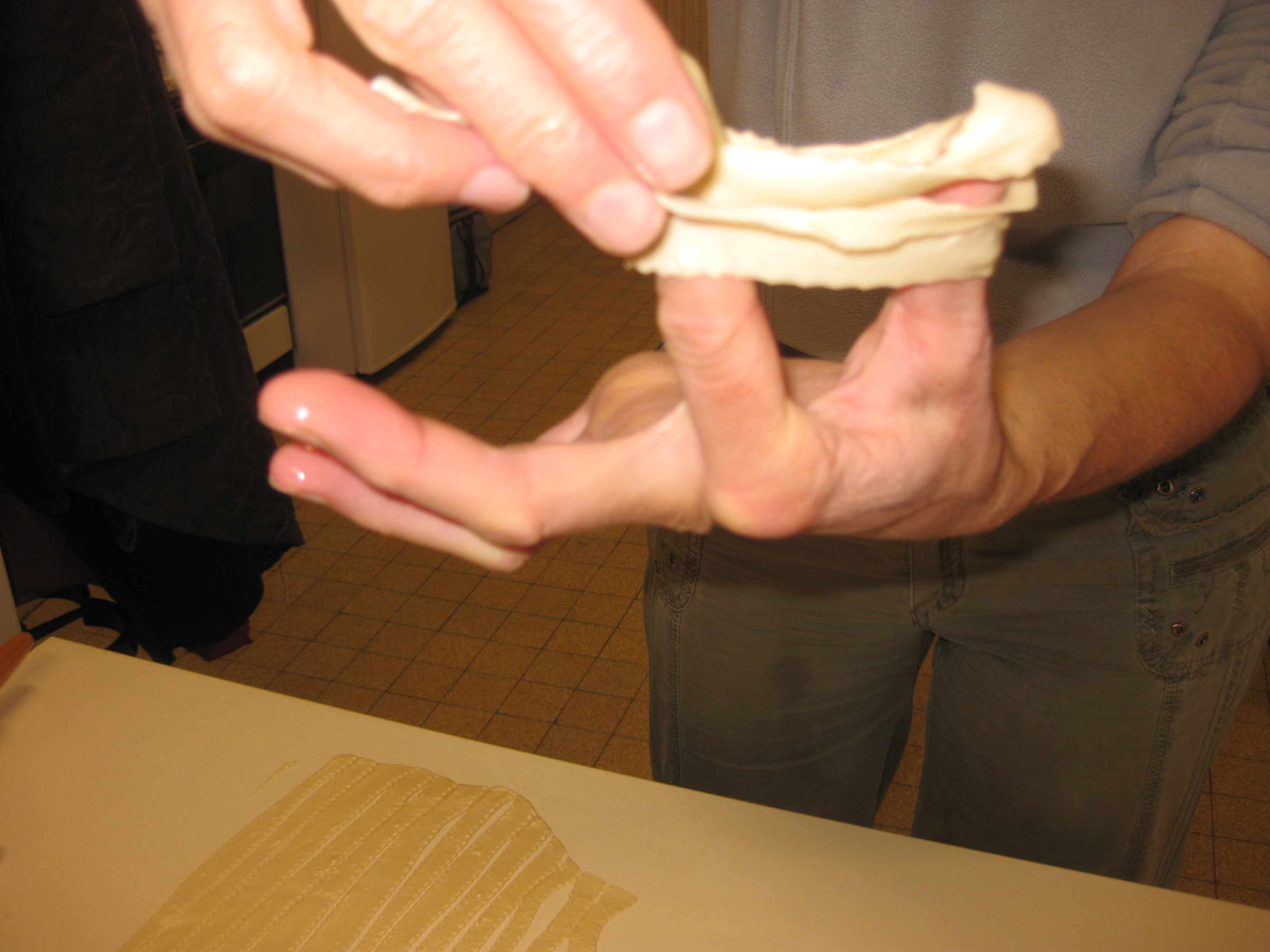
Nadia makes the dough for her Algerian sweetmeats
Last week was a first though. We were invited to provide an International Buffet at a multi-services training day being laid on by the Mairie. At various points in the days leading up to it, we got together in the kitchen of the Family Centre (CAF), and helped each other cook.
Then Sylvia winds the dough strips into little 'birds nests'....
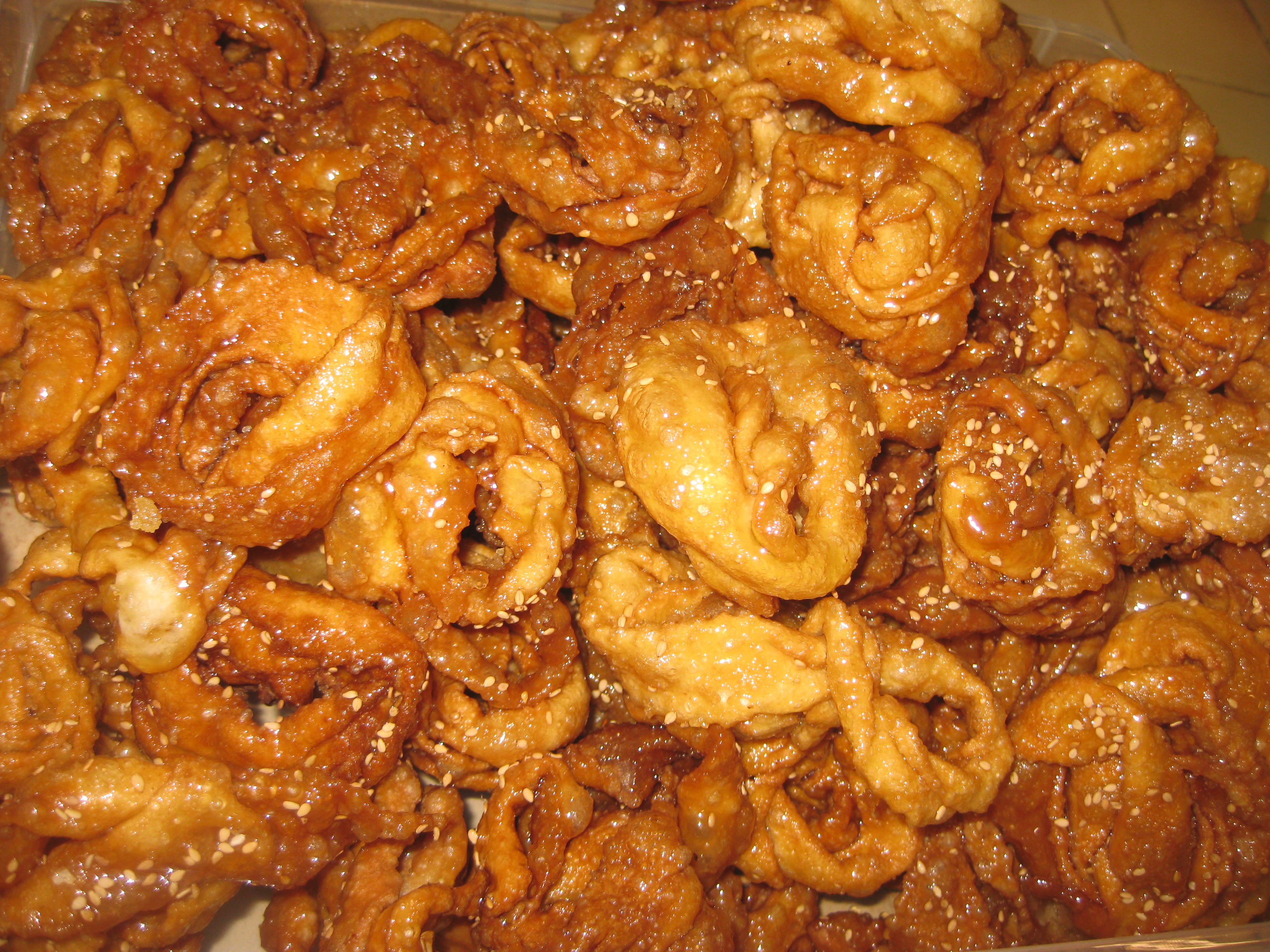
Nadia showed us how to prepare Algerian grivvech: thinly rolled dough cut into strips and wound into jumbled little nests before being deep fried and doused in honey and sesame seeds. There were Quebecois dishes, guacamole topped toasts, and treats from around the world.
...the deep fried, sticky, delicious result.
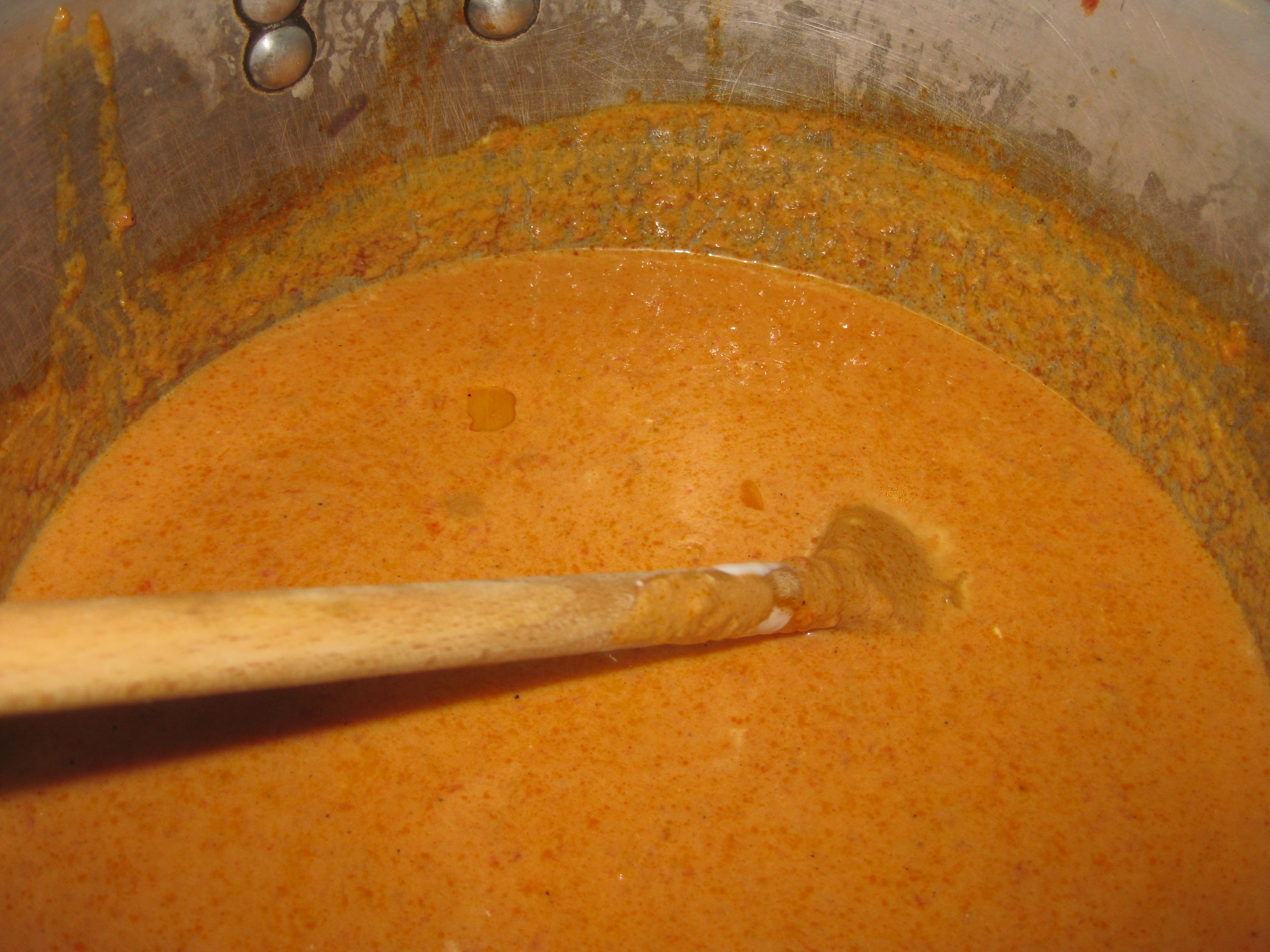
Best of all was the unlikely sounding tomato and banana soup from Brazil. Do try it: recipe below.
What could I contribute as an English finger-food? I thought long about this, and came up with Scotch eggs (thanks, Kalba, again). You need to know that here in France, sticky tape, as in England, is known by a trade name. Not ‘Sellotape’, but ‘Scotch’. So Sylvia’s eyes darkened in puzzlement when I suggested these Scotch eggs. ‘Sellotape eggs? What on earth….?’
And what fun it all was. I can and do open recipe books to try out dishes from any and every continent. But it’s not half so exciting as working with women from Algeria, Brazil, Roumania, wherever, as they talk you through the techniques they’ve known for years and years, and stand over you and make you practice and redo things till you jolly well get it right.
I'm NEVER deep-frying 30 Scotch eggs again
Anyway, here are my photos of the preparations for a successful lunch. We could have taken any number of repeat bookings, but for the time being, the organisation will maintain its ‘benevole’ status, and not venture into the hard realities of developing a business.
Brazilian Tomato and banana soup
Soup just cooked and ready to go
Ingredients
I onion
I tbspn rapeseed oil
Large bottle of passata
5 ripe bananas
1.5 l. bouillon
Small carton cream
3 tsp. curry powder
1 tsp. cayenne
Gently cook the onion in the oil. Meanwhile, remove the black central thread which you may never previously have noticed and any seeds from within the peeled bananas, and mash thoroughly. Add the passata to the onion, together with the spices and cook gently . Add the mashed banana and continue cooking. Add cream, reheat gently, and serve
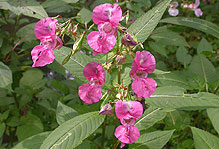
If it hasn’t reached you yet, beware. It will. This invasive plant was introduced – from the Himalayas, obviously – as an attractive addition to the English garden in 1839, and now seems to be marching inexorably round the country, destroying all plants in its path – yes, ANY plant. Even roughy-toughies like rosebay willow herb and brambles are powerless to stand against it.
The other day, I went with a friend on a favourite walk along the River Nidd. It’s a gorgeous path, through typical English woodland, with the river rippling and tumbling alongside. Not any more, not where we were. Himalayan balsam has invaded huge stretches of the walk – it prefers to be near water – and we found ourselves marching between shoulder-high sentinels of the wretched thing, unable any longer either to see the trees and undergrowth, nor enjoy either the riverside views or those of the meadows opposite.
And in town today, walking down a little ginnel where, when I was at work, I used to collect blackberries in my lunch hour to make into jellies and jams(how sad….but it made me happy) there was not a bramble bush in sight, just That Balsam.
If it’s planning an invasion near you, martial your forces. This plant will fight, smother and strangle every bit of vegetation in its path, and conquer yard after yard of ground with every passing year. You must join battle against it the very first time you see some of its – quite attractive – pink flowers . Or it will win the war and continue its despotic rule.
With a house to sell in England, we’re still here in the UK. So let’s make the most of it, particularly at mealtimes. Here’s how.
Apples:
With any luck, Discovery, the very first apples of the season will appear any day now. I love their bright red skin, their crisp white crunchy flesh. They’re hopeless keepers, but for just a very few weeks, their bright fresh flavour presents a real contrast to the departing soft summer fruits.
And when they’re over? Well, there are James Grieves, Laxton Supreme, Laxton Superb, Worcester Pearmain, Lord Lambourne, Cox’s Orange Pippin and so many others to look forward to…if you can find them. And of course Bramley Seedlings too, so wonderful to cook with.
I was brought up to anticipate and celebrate the heady variety of taste, texture and appearance of all our English apples. These days I mourn the uniformity of the standard few varieties that stock the supermarket shelves, year in, year out. Often as not, they’re imported from New Zealand, South Africa, the USA, and France, while our own traditional varieties have become heritage items whose very existence is protected by Reading University’s National Fruit Collection at Brogdale
Blackcurrants:
I KNOW they’re available in France, but when we got back this time, we discovered a small blackcurrant bush had been secretly prospering in a forgotten corner of the garden. And there it was, laden with big dark purple berries, over a kilo of them, just asking to picked and enjoyed
Gooseberries:
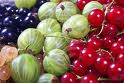
Gooseberries, white, red and blackcurrants
Hardly seen in France, I love their crisp sour flesh, and eat them any way I can. Gooseberry fool is best of all: gently stewed fruit folded in with equal portions of good custard and double cream.
Raspberries:
They DO exist in France, but can’t compete with the big, juicy, tasty berries we have here: the best ones come from the garden of our friends Richard and Jonet here in Harrogate (and the best jam too). The rest come from Scotland.
Repeated pleasures:
Back in southern France, broad beans are long over. Here they’re at their best, so I’ve had two goes this year at my almost-favourite vegetable. OK, not a fruit. But very good anyway.
Summer pudding:
Surely the quintessential English pud? Gently cooked quantities of soft summer fruits, spooned into a basin that’s been lined with pappy English sliced bread, left for the flavours to mingle before turning out and serving with cream doesn’t sound too exciting maybe. But it is. Summer in England really isn’t summer until you’ve had your first helping. And as many helpings as you can manage before the season’s over
Summer Pudding
Ingredients
1kg (2lb) mixed berries (use a combination
of raspberries, blackberries, blueberries, redcurrants or blackcurrants)
160g (5½oz) caster sugar
10 thin slices stale white bread, crusts removed
Method
Place the berries, sugar and 60ml (2fl oz) of water in a saucepan. Bring to a gentle simmer on a low heat and cook, stirring to dissolve the sugar, for 3-4 minutes, or until the fruit has softened and produced lots of juice. Set aside to cool.
Pour the juice into a flat dish, reserving the fruit.
Cut one slice of bread into a circle small enough to fit the base of a 1.5l (48 fl oz) pudding basin, and another large enough to fit the top. Cut the remaining slices into triangles. Dip both sides of the smaller circle of bread quickly into the juice and place it in the bottom of the pudding basin. Dip both sides of each triangle of bread into the juice, then line the inside of the basin with the juice-soaked bread, overlapping them slightly to make sure there are no gaps.
Fill the bread-lined basin with berries, drizzle with any remaining juice and top with the larger circle of bread, trimming it to fit if necessary.
Cover the top of the pudding with clingfilm, then place a saucer or small plate that just fits inside the rim of the basin on top. Press the plate in, then weigh it down with a heavy can or two. Place the basin in a shallow dish to catch any juice that might overflow, and refrigerate for at least 12 hours.
To serve, run a thin knife around the inside of the basin and invert the pudding on to a serving plate. Cut into wedges and serve accompanied with plenty of thick cream.
Readers in southern France might be astonished to learn that here in the UK, we have a university named after Simon de Montfort. Although back in13th century England he called the first directly elected parliament in medieval Europe; was Earl of Leicester and de facto ruler of the kingdom, in France, he was an all-round Bad Guy, a crucial part of the Albigensian Crusade against the Cathars, and responsible for the deaths of 1000s.
Emily
Our daughter Emily has just graduated from the university in Leicester that bears his name, De Montfort University. Here’s a record of her special day. For us, it was a chance to meet her friends, her friends’ parents, and to celebrate with them the award of their degrees after 3 years’ work.
Academic procession leaving the podium
Emily’s is one of the newer universities, and yet the ceremony was as traditional as those in the much older institutions attended by my other two children. Well, why not? Each graduand is part of a tradition of education stretching back to the early middle ages – well before the time of Simon de Montfort. Their colourful robes – and the even more splendid costumes of those with PhDs, reflect that long tradition. They’re rightly proud to wear them. And I’m so proud of all three of my children, and of what they’ve achieved.
I’m back home in Harrogate for a few days. It’s been quite a surprise. I left Carcassonne airport in bright hot sunshine, and arrived at Leeds/Bradford to….bright hot sunshine. And so it continued.
I spent a happy afternoon dealing with Weed Management and Invasive Plant issues. It was very satisying. Instead of grubbing about clearing a weed here, a weed there, I was able to sweep up vast armfuls of unwanted plants off into the compost bin, and create an instant impression that only the frogs, undisturbed for weeks now, failed to appreciate. If only I’d taken some ‘before’ and ‘after’ shots.
Most surprising of all has been the day light. I’d quite forgotten. Last night, I was still reading without having a light on at 10.00 p.m. 9.30 would have been more like it in Laroque. But it was this morning when I really realised I’d travelled north. The light was pouring through the bedroom window so brightly I sprang up to begin the day. And then realised it wasn’t even 4.30. Mornings here begin a full hour and a half earlier than in the south of France – though there is the hour change to take into account. I do sort of regret that I went back to bed, instead of taking an early morning stroll down to the Nidd Gorge. Maybe tomorrow.
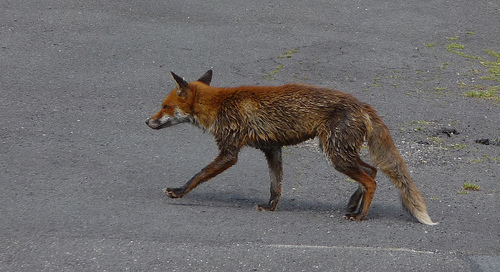 When we left Laroque for Christmas and New Year in London and Harrogate, we thought we’d left most wildlife behind too. Not so. It seems as if wherever you are in South London, you’re only yards from a fox’s lair. Tom and Sarah refused to share our excitement at seeing so many. ‘They’re on the station every night when we come home from work’, they yawned. ‘They’re quite mangy anyway’. We didn’t think so. We loved to see them trotting spiritedly along the street once darkness had fallen, sniffing round the dustbins for Christmas turkey.











 From Pyrenees to Pennines
You must be logged in to post a comment.