How to have a relaxing day of discovery in this most crowded of tourist venues:
1. Stay away from the city centre. Begin your day mooching around a neighbourhood market.
2. Stroll through the university zone and a peaceful park. Visit the serene and beautiful Monasterio de Pedralbes, and spend time in its ancient cloisters.
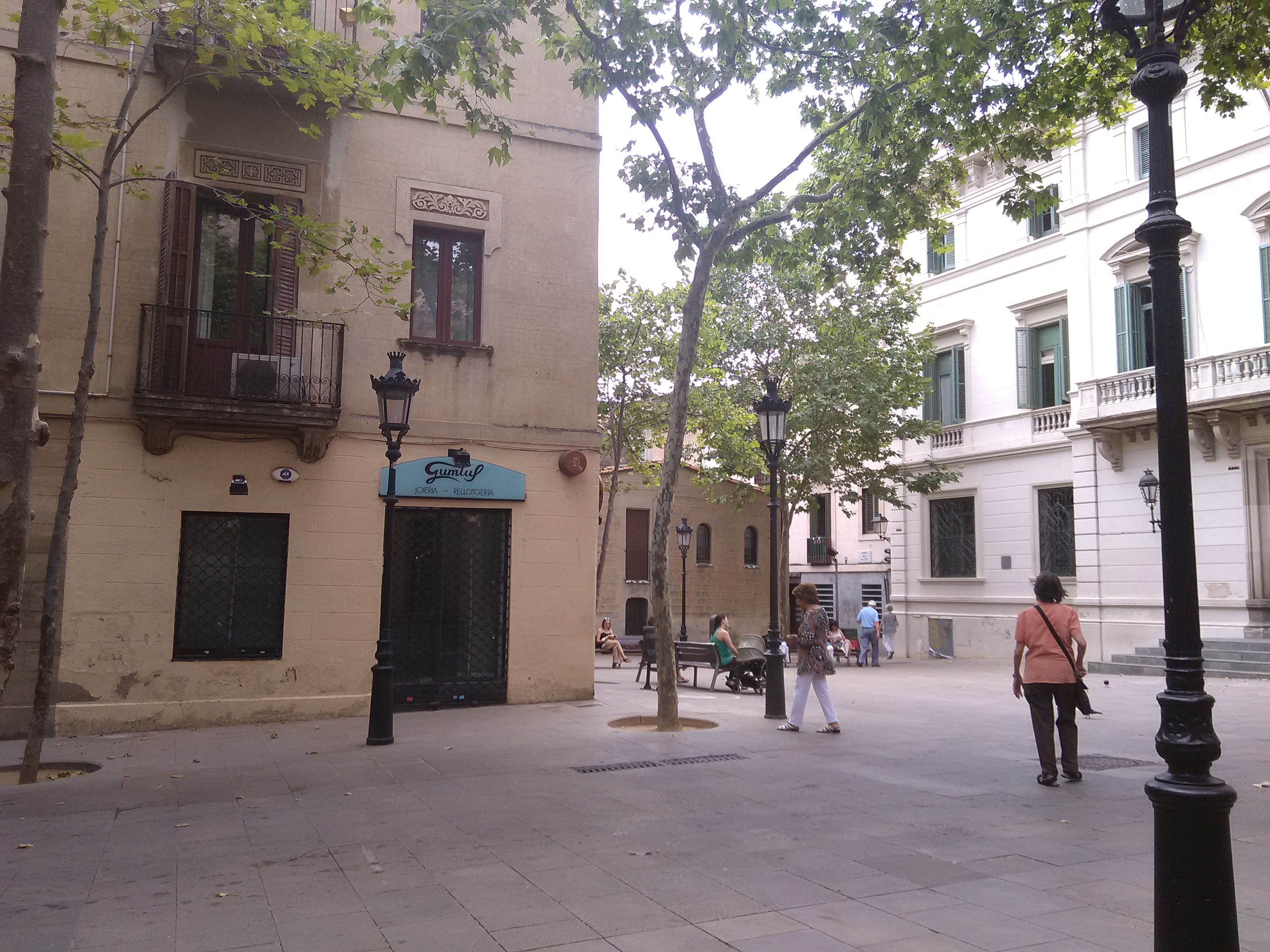
3. Afterwards, in the nearby well-heeled suburb of Sarrià , find a quiet square to linger over a restorative clara.
4. Later still, mooch round looking for a lunch spot where the locals eat: office workers, the granddad who’s collected his small charges from their hockey game, that sort of thing. Enjoy.
5. Later, much later, meet Emily and Miquel. Another meal, I think. Watch this space. It hasn’t happened yet.
We’ve just snuck over to Barcelona. Just for two and a bit days. Just to see Emily, because the last time we were together was in South Korea last autumn.
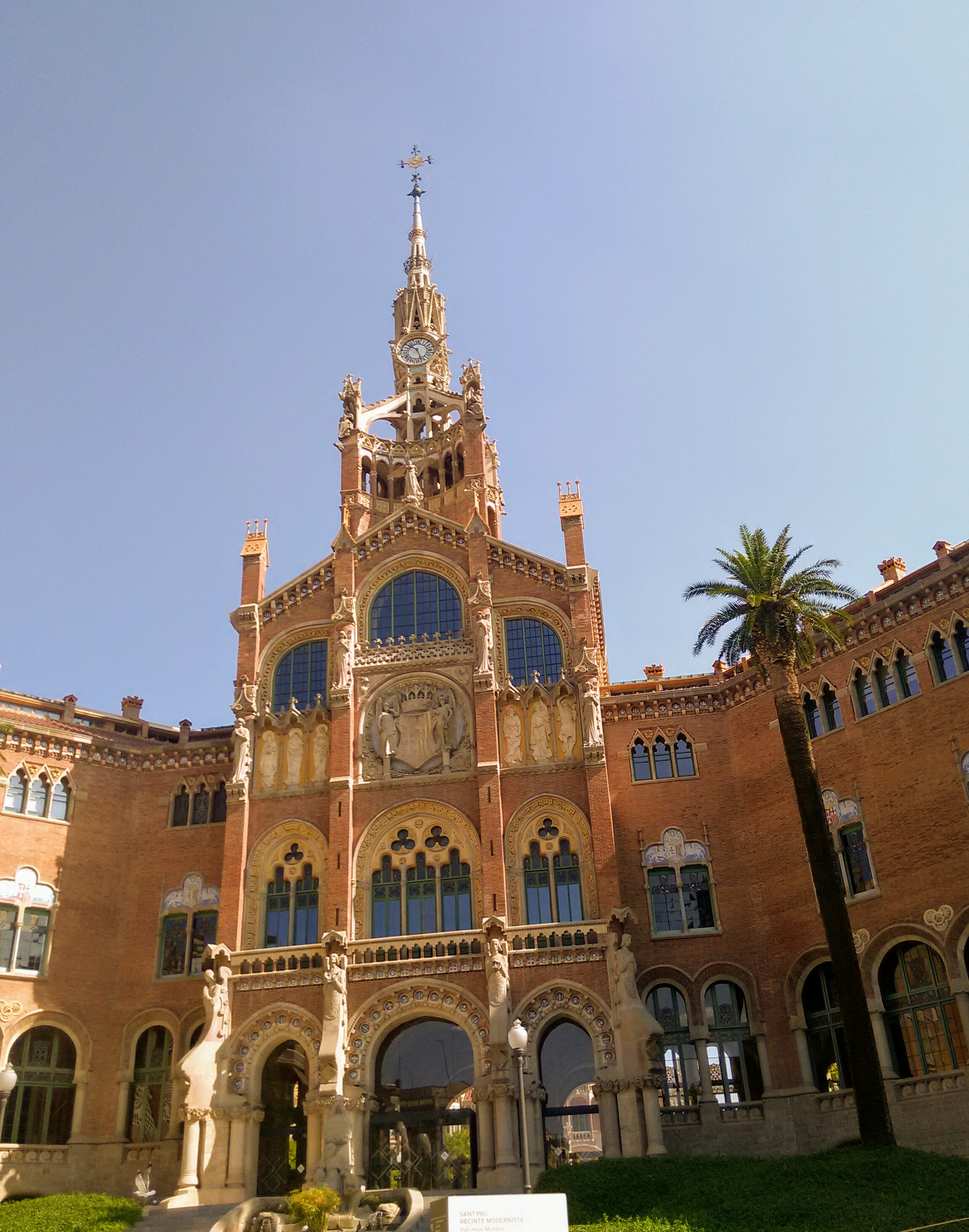
This morning was sightseeing. I’ll just show you a single photo of the Hospital de Sant Pau, a truly wonderful complex of modernist buildings, and a UNESCO World Heritage Site. You’ll get the full tour once we’re back home.
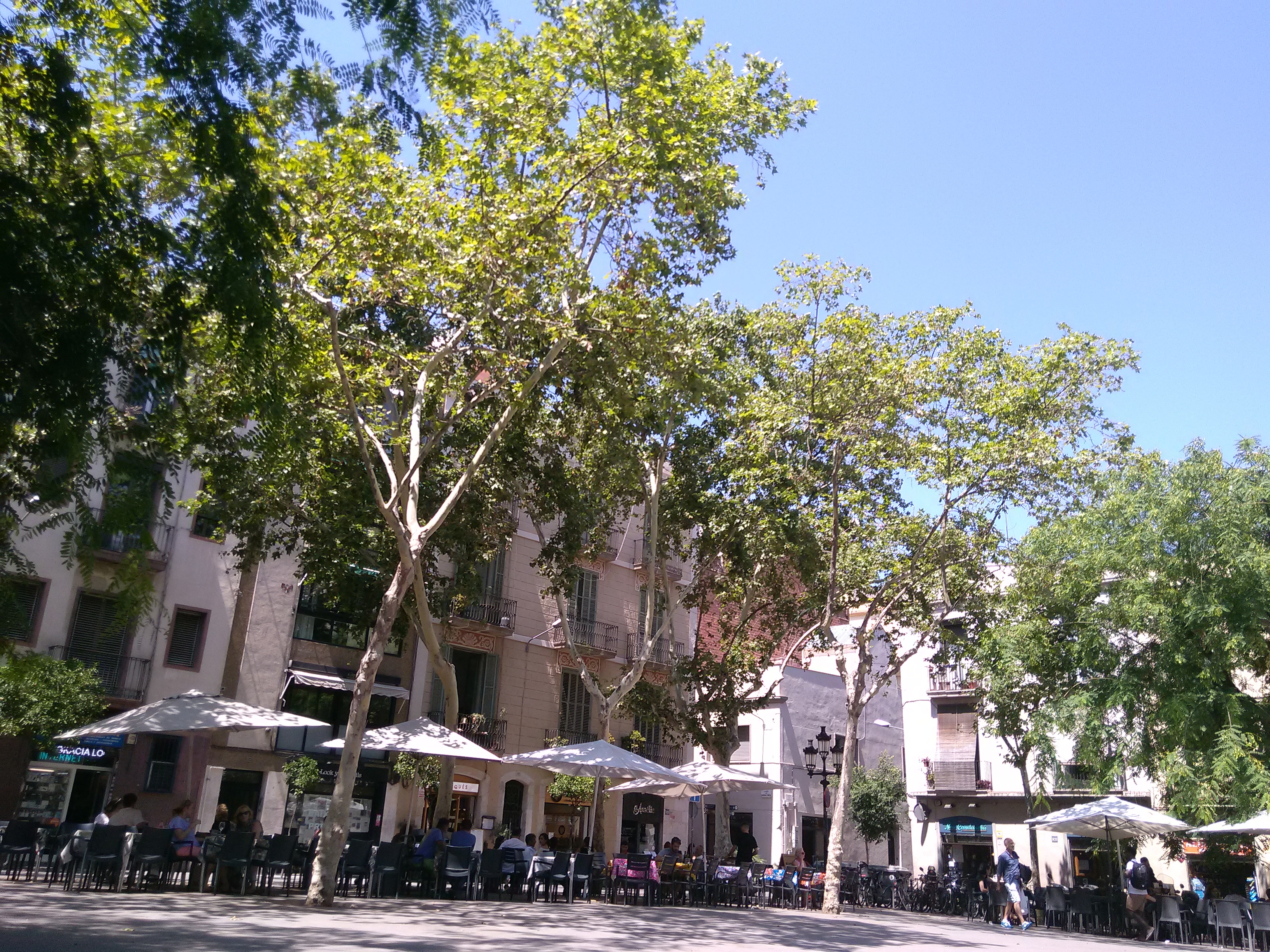
This afternoon was hot. No better way to spend it than catching up with Emily over a leisurely lunch sitting in a tree lined square. It’s what the Spanish do best.
We’re off to visit daughter Emily in Barcelona soon. And it’s about time we stopped being so dependant on her to be our mouth-piece when we’re there. It’s about time we stopped expecting her boyfriend to make all the effort of speaking in a less-than-familiar language. It’s about time we took a grip, and learned some Spanish.
Yes, I know. In Barcelona, Catalan is the preferred language. But if we want to travel more widely in Spain, given that everyone in Barcelona speaks Spanish too, Spanish it’s going to be.
I looked for Adult Education classes to help me. There was nothing for beginners here in Ripon, and I didn’t fancy a 35 mile round trip to Northallerton or Harrogate for a weekly session. The U3A here in Ripon has a class, but they’ve been going quite a while and are on book two of their chosen text-book. In any case, there’s not a native speaker in their midst to correct idiom or accent.
So I’ve looked to the internet. And being a tight-fisted sort, I’ve looked at what’s out there for free. There’s quite a lot. The advantage for me has been that the lessons these courses provide come in bite-sized packages, which encourages me to learn little and often. The big disadvantage is that I don’t really get to speak: and if I do, there’s nobody to correct me.
There’s Duolingo, which takes me through families of words, using simple sentence structures, and testing my ability to understand and to remember. I’m not likely to forget about that crab that drinks milk, or my brother (haven’t got a brother) who wears yellow trousers.
Then there’s Games for Language. American David, who has a Spanish dad, is travelling round Spain. Through ‘virtual’ card games and arcade-type games, I’ve learnt the Spanish I need to understand his travels.
FluentU is good. From Lesson 1 it uses short video clips from Spanish TV commercials, children’s broadcasts and so forth to teach Spanish…. as she is spoke: that is – fast and furious. I can tell you all you’ll ever need to know about Maradona eating at MacDonald’s.
And my latest discovery is Memrise: this offers you structured sentences and vocabulary, and makes you repeat them and repeat them till you jolly well get it right. And then, a few days later, it’ll be checking to see if you’ve forgotten.
You must think I spend my whole life slogging away at Spanish. I don’t. It’s 10 minutes here and there. But it IS every day. I’ll let you know whether it’s paid dividends when I’m back from Barcelona.
Twelfth Night is a bit of a grumpy day for me. Nothing festive happens. It’s just the day for dismantling the Christmas tree, packing baubles and Christmas wreaths away for another year, and reading through Christmas cards from old friends for the last time before they’re taken off to some recycling point. The house looks sparse and bare, and maybe in need of a spring-clean.
I think of Emily over in Barcelona. She’s not at work today because Twelfth Night is Epiphany. It’s the day on which Spanish children at last get their Christmas gifts, because the Day of the Three Kings is when legend has it that the Magi presented their gold, frankincense and myrrh to the infant Jesus. As Emily points out, the main downside to this late arrival of gifts is that this is the very last day of the holidays: school tomorrow, and no time to get to play with those new toys. Still, today is another chance to party and enjoy a family feast.
Our caganer is clockwork. He does back-flips.
It was Emily who may have been responsible for our finding ‘el caganer’ in our Christmas stocking this year. If your Catalan isn’t up to translating this, let me explain. It means, um, ‘the crapper’. El caganer is a little fellow in Catalan costume, squatting with his trousers down, and defecating. Why? Well, he’s a traditional part of Catalan nativity scenes. Maybe he’s a fertility symbol. Most people these days prefer the idea that it shows that great or small, we all have the same very basic needs.
Caganers on a market stall. Anybody you recognise here? (Wikimedia Commons)
So these days at any street market, you can buy caganer figures who represent the Pope, the Queen, Barack Obama, a whole range of footballers – any personality you can think of. And they’re just the same as us. Even if it’s Twelfth Night, I don’t think I’ll pack away our little ‘el caganer’ just yet.
Galette des rois, courtesy of Wikimedia CommonsA dusty miller. (Wikimedia Commons)
And when we lived in France, Epiphany was the start of the Galette des Rois season. As guests anywhere, you’ll be sure to be offered a slice of this almondy pastry confection. Part of you wants the good luck of being the person to find the ‘fève’ within your slice. This used to be a lucky bean, making you king for the day. Nowadays it’s a small china figurine, and maybe quite collectable. I’ve just been looking unsuccessfully for our little fireman ‘fève’: goodness knows where I’ve hidden him . The downside of finding the lucky bean though, is that it’s your turn to make the galette next time round.
Parts of Europe seem to be having fun. Ho hum. Here, it’s all too easy to be aware that there’s January to get through before we can think of the days lengthening and the arrival of Spring.
No sooner back from England, than we were making tracks for Barcelona.
Why? To help daughter Emily and her flat-mate move.
A trailer load Barcelona-bound
Saturday saw us leave Laroque with a large and unwieldy trailer load of cast-offs for Emily and her flat-mate’s new home. Two beds and mattresses, a table, a blanket box, a linen basket, a bike, ephemera from the kitchen, all kinds of detritus. We’d spent an afternoon on Friday packing the load, carefully, and with lots of thought and planning. Ten minutes after we set off on Saturday, it became unstable. We stopped and rejigged, went on a few miles… and more of the same. It started to rain, with quite high winds. We stopped a third time, bought more rope (OK, washing line. It’s all we could find), really had a good go at things, and finally, we had a steady load that got us all the way to Barcelona, in said wind and rain, as far as the frontier. Hooray! In Spain, the sun shone.
In Barcelona, we unloaded, unpacked, fetched and carried, and did our best to get the new flat …er … ship-shape. Sunday morning, while the girls played house, Malcolm and I were off duty. What to discover today? Well, look one way from the street outside her flat, and you’ll see far below you, the sea.
Yes, that’s the sea down there.
Look the other way, and you’ll see far above you…. bunkers.
Bunkers above
Those bunkers are among Barcelona’s lesser known secrets, and they looked intriguing. It’s a toughish climb up there, but stop for breath, and your reward is increasingly dramatic views of the city spread far below you.
View part way up.
At the top, there are battered concrete remains: the bunkers that were built by Spanish Republican forces in 1937 in their efforts to defend the city. Little could be done against the air power of the Nationalists. The Republicans were under-resourced, and their best hope was to use this high vantage point as both a look-out,and a place from which to launch protective curtains of artillery fire.
Once peace was restored, the bunkers came into use once more: a chronic housing shortage in the city meant that right up until the 1990’s, the site developed into a shanty town, housing up to 600 residents, though the council resisted providing services such as water and refuse disposal until well into the 1980’s. Remnants of this improvised town can still be seen in vestiges of tiled floors.
View of the city glimpsed through the morning glory
Another, glimpsed through the remains of a bunker.
Floor tiles from the former shanty-town.
Looking down the other way, away from the coast.
Now, you’re most likely to make the trek up here to get the very best views of the city: better than from Tibidabo. It’s not the view those Republican forces saw. From up here at La Rovira, you look down on a modern city: recent tower blocks dwarf the older buildings, though your attention will always be caught by the spires of la Sagrada Familia, still under construction. A highly-recommended excursion. Get yourselves there before everyone discovers it.
Climb down again: this is what you see.
Lovers’ padlocks , or bike locks on a bridge over the Onyar?
Looking along the river towards the Cathedral.
This is cheating. It’s Barcelona. Where we went – can you imagine? – for a vegetarian Indian meal. Jolly good too.
We had a mid-week break in Girona last week. Because I needed the dentist.
Despite the general all-round good quality of the French health system (though it’s not what it was), dentistry does not on the whole measure up. Ask anybody round here to recommend a dentist, and they’ll either say ‘not mine, definitely not mine’, or suggest someone miles and miles away with a weeks long waiting list.
So when my daughter over in Barcelona recommended her dentist in nearby Girona, it seemed too good a chance to miss. A quick holiday in a town on the ‘to-visit’ list, a chance to see Emily, and a pain-free set of teeth.
The dentist there sorted things out, but said he’d need to see me again. So we realised we didn’t need to dash round on some frenzied must-see-everything-double-quick self-imposed tour. We took our time. We wandered up and down the narrow stairways that make up the ancient Jewish quarter, walked the old city walls, and spent time in the cool shaded Jardins d’Alemanys. There was time for an early morning coffee, a relaxed meal, a cool beer in shady squares among the narrow back streets.
In its day Girona has been invaded by Romans, Muslims, Franks, enduring over 30 sieges in 800 years. As Robin Gauldie, travel writer says: ‘It’s like Barcelona in miniature, with all the history, heritage and great food but without the insane traffic’. We don’t need the excuse of a toothache to go back. There are churches to visit, museums to explore, gardens to relax in, meals to enjoy. There are riverside walks, and the countryside beyond. So much to do and see, but all within walking distance of the ancient city centre. Roll on my next dental appointment.
To view any of the pictures in a larger format, simply click on the image.
Christmas in Barcelona. A perfect way to celebrate. Son and daughter-in-law were there too, and we all stayed in Emily’s flat, since her flatmates had gone away. Perfect times for us don’t make for interesting reading for others: the balmy weather, meandering round the endlessly fascinating streets as desultory sight-seers, coffee stops at the outside tables of bars in picturesque squares, shopping at temptingly- stocked shops and market stalls in the cosmopolitan quarter which is Emily’s home, eating out or sharing tapas at simple neighbourhood restaurants…. Here’s the story in pictures.
The Sagrada Familia – always under construction
The camera can see details like this better than I can.
Barcelona by night: so many Christmas lights.
At the Christmas market, one of the magi spits sweets at us.
Street furniture, Barcelona style.
…. and some more
Tapas on the way: and look at the Seville oranges on that tree.
Spotted on one of our walks
An UNESCO World Heritage Site, the modernista Hospital de Sant Pau is one of Barcelona’s best kept secrets
… and here’s a detail from one of its entrances
Whimsical lobster at Port Vell.
And here’s Port Vell on the sunny afternoon of December 26th
This building near the waterfront took my eye
.. as did this one
A very modern Christmas.
So something had to come along and spoil it.
The car and Barcelona don’t go well together. Even driving in and out of the ill-signposted city is something we always dread. With a superb and cheap public transport system, we’d have liked to have left the car at home, but it was stuffed with extra bedding, presents, bits and bobs Emily needed from home, so when we arrived, we unloaded and then took it off to park elsewhere for the duration, since she lives on a square with little parking. She’d taken advice, and suggested a quiet nearby corner of town where a Spanish friend said it would be safe and out of the way. Once there, we checked, and checked again that there were no restrictions. One morning, we popped up and checked yet again. All was well, so we left it until we were packing to go….. walked to the street where we’d left it…… No car.
Stolen! Panic! What to do next? Contact our insurers, see if we could sort out one-way car hire between Spain and France? Would insurance pay? What about replacing the car, which we’d newly and expensively fitted out with snow tyres? How could we possibly afford that? Emily rang the police, who promised to call back once they’d made enquiries. After a couple of hours to-ing and fro-ing, we learnt that the car wasn’t stolen, but had been towed away because of parking infringements. There should have been a notice stuck on the road where the car had been, telling us what had happened: but there was nothing there. We’d need to go in person to the Police. There are three sorts here: those belonging to Barcelona itself, local Spanish police, and the national service. We went to see the Barcelona lot, a 20 minute walk away. Eventually they tracked our car down – thank goodness for Emily’s command of Spanish – to the Spanish police’s car pound at the last stop on the metro line. If we went with ID and 239 Euros, we could have out car back……
Walk to metro. Impatiently sit out long journey. Emily spends time texting Spanish friends. They’ve all had similar experiences: ‘It’s to try to fill the city’s empty coffers’, they explain. Track down car pound. Join disgruntled queue of fellow-sufferers. Pay up. No choice. Receive form on which to write our grounds for appeal. Try to make our way back to Emily’s from a completely unknown part of town – we get good at buying time by circling roundabouts twice. All the time fuming at the loss of precious hours with Tom and Sarah on our last day together.
Heigh ho. Even run-ins with the Police however, can’t take away our memories of a wonderful Christmas break.





 From Pyrenees to Pennines
You must be logged in to post a comment.