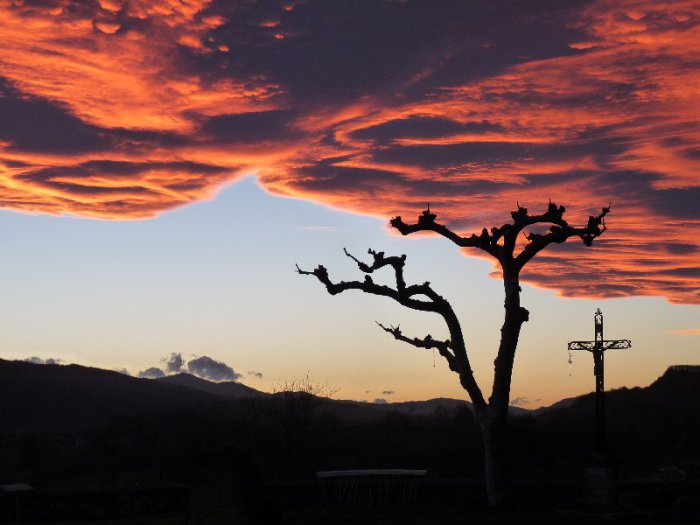
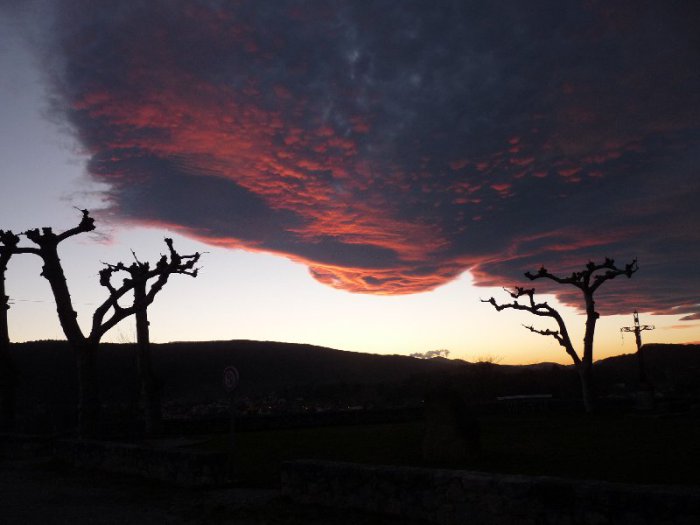
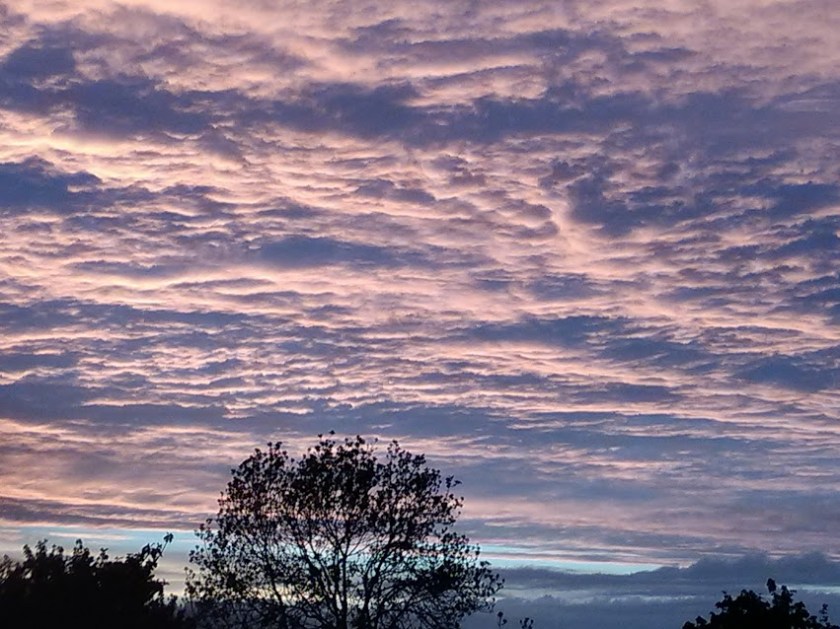
We had quite an arresting sunset the other night. As with all sunsets, it was evanescent: here at one moment and gone the next. I’ll show it to you at the end of the post, together with the rainbow that briefly accompanied it in a rainless sky.
That sunset though reminded me of another sunset, even more dramatic, which we experienced in France in February 2014. Evanescent it might have been. But it’s etched in my memory forever.
Sunset seen from the church at Laroque d’Olmes.
The moment is almost over.
Now then. Here’s our English sunset, from just a couple of weeks ago. Which do you prefer?
When we lived in France, the easiest way to persuade a French friend that you did not have their interests at heart was to produce a spiced dish, especially one with chillies in.
‘Oh, we love spicy food’, declared Henri and Brigitte when we broached the subject of cooking them a curry. All the same, we were careful. We dished up a korma so mild that it barely qualified as spiced at all. ‘Ouf!’ exclaimed Henri, after the first tentative mouthful – ‘are you trying to kill us?’
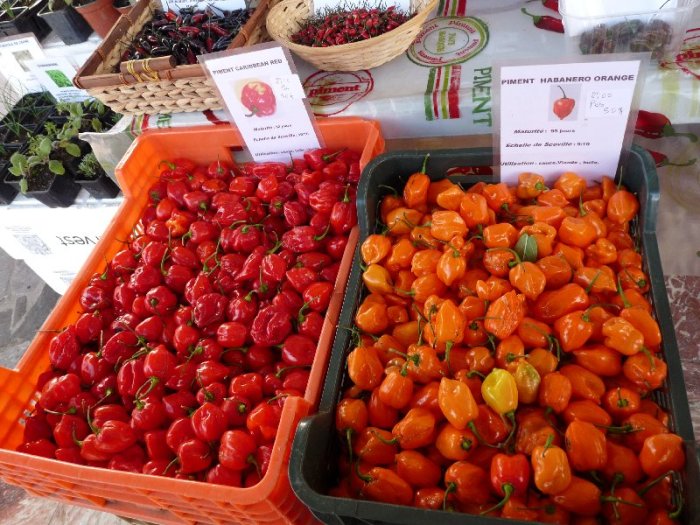
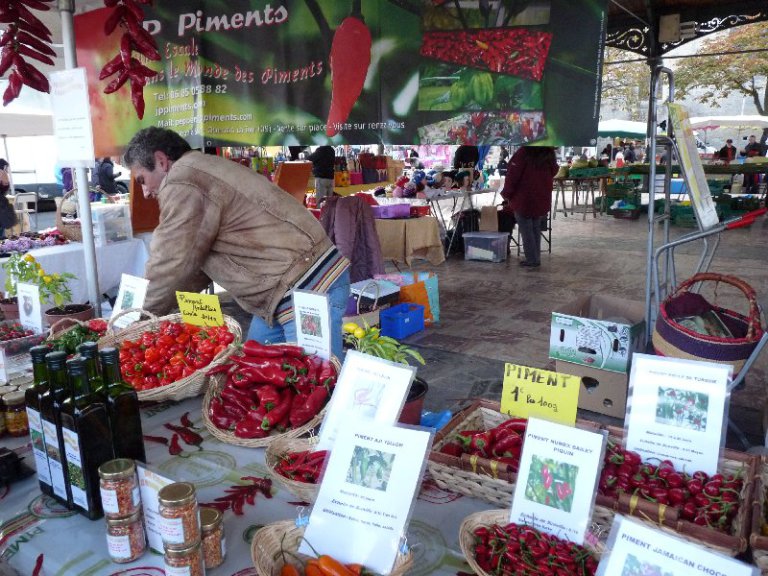
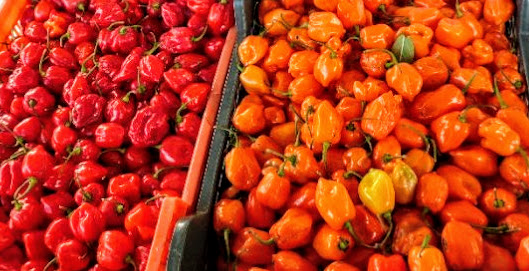
With this in mind, it was a huge surprise to us when one Friday in Lavelanet market, we came upon a man with a stall full of chillies. Orange chillies, yellow chillies, green chillies, purple chillies, fresh chillies, dried chillies. He had no customers at all. So he had time to chat to us, and explained that he’d come to love chillies, and to be passionate about seeking out new varieties, growing and using them. He was one of two such growers in France. We bought from him. He had other English customers. The French? Not so much.
Jean Philippe Turpin and his stall at Mirepoix market.
That was five years ago. After relying on northern Europeans to bail him out, slowly but surely he started to attract a few French customers too. He’s still in business. Perhaps, despite the danger represented by a Red Savina chilli rated 500,000 on the Scoville scale, he hasn’t managed to kill anybody off yet.
M. Chilli’s smallholding, devoted exclusively to chillies, chillies, and more chillies.
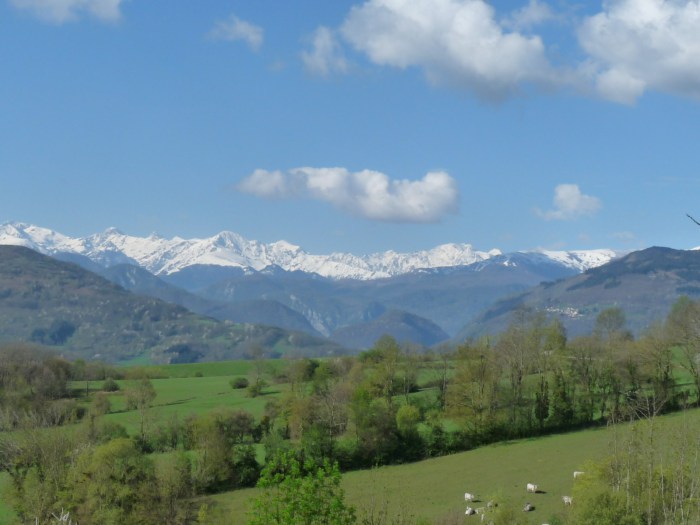
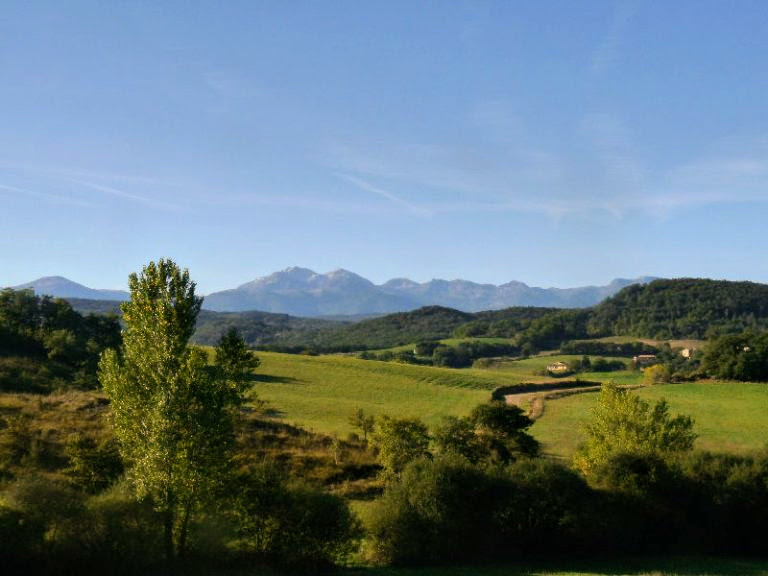
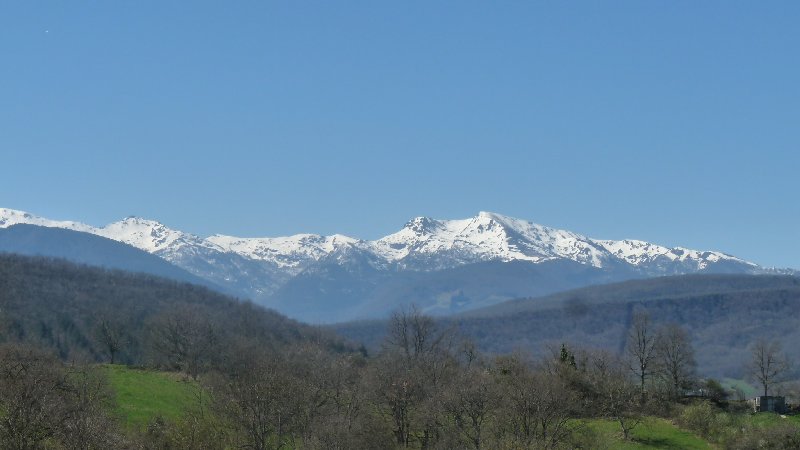
This is a bog-standard view of the Pyrenees as they looked near where we lived.
I can’t look at a picture of the Pyrenees without wishing I were there.
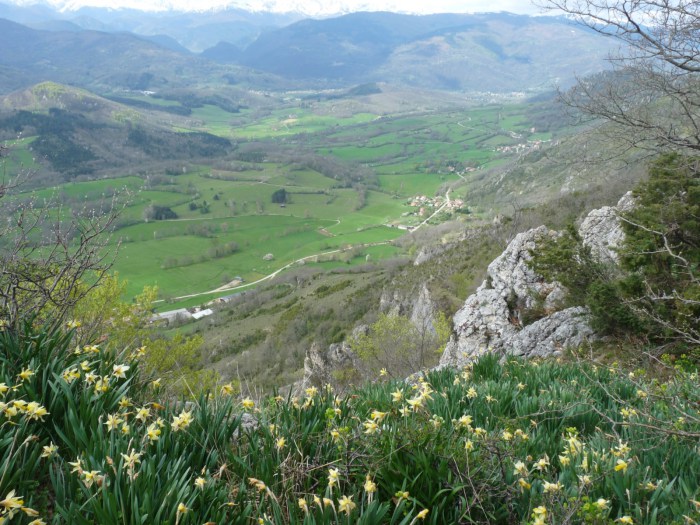
When we lived in France, these mountains were the constant backdrop to our lives. They were our playground, where we would enjoy flower-studded meadows in the spring, clear bright summer heat, autumn colours to rival those of New England, and glittering winter snowscapes. Winter and summer, we walked these mountains, climbing hundreds of feet to be rewarded over a leisurely lunch-time picnic by views of valleys, forests and dramatic rocks, before we had to descend to the foothills once more.
Caraybat, near Foix, at this time of year.
They were a natural boundary – often a barricade – between France and Spain, and the few roads linking these countries make wonderfully scenic journeys in their own right.
Travelling to our French town from England, we always knew we’d arrived ‘home’ when we caught sight of the Pyrenees once more – almost always as the sun was setting. The first glimpse of those jagged peaks, whose shapes and names we came to recognise so well always made me as emotional as if I’d just met once more a long-lost friend.
The Pyrenees in summer: near Saint Julien de Gras Capou.
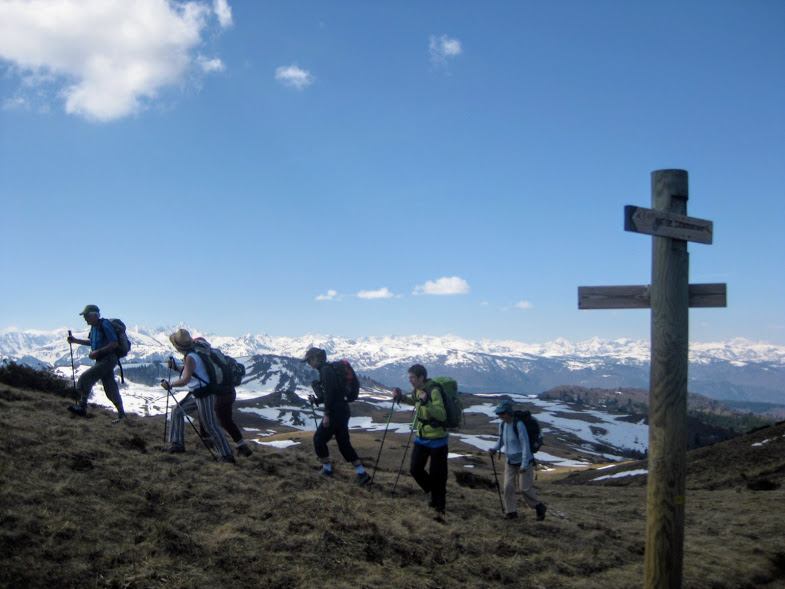
‘Wanderlust’, this week’s WordPress Photo Challenge, means a strong desire to wander, travel and explore. I know I’ve hardly begun to know the Pyrenees. They are where I want to travel, to wander, and above all to explore.
Intent on satisfying our wanderlust: hiking near Montaillou, French Pyrenees.
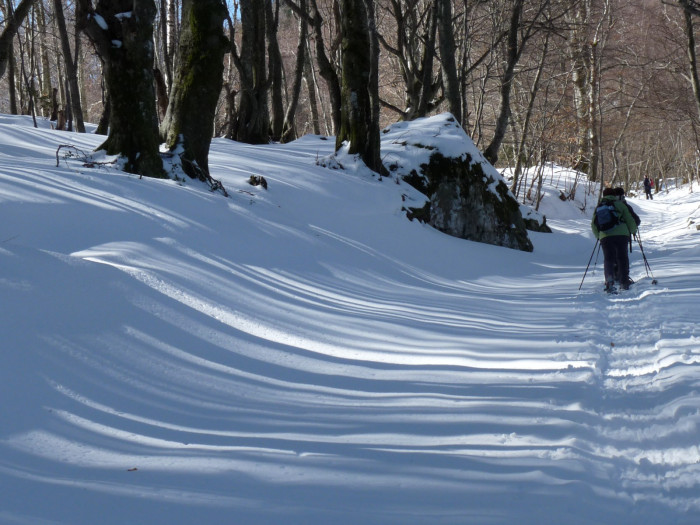
It’s easy to feel like the only person out in the landscape. But you’ll have come with a friend or two, if only to haul you upright when, inevitably you fall deep into a drift of snow.
Back in France, in the Ariège, the very best way of getting out into virgin snow and becoming at one with a pure, glittering white winter landscape was take yourself off to the nearest mountain, strap on your snowshoes and walk through the fresh crisp air as if you were the only person in that particular bit of world. It was hard work though, and after the first hour, I’d had enough.
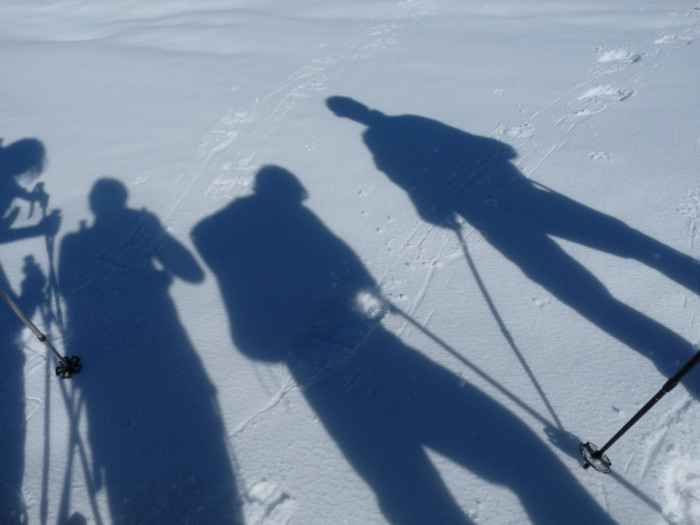
Three years on, and the memory of the pain, sweat and general exhaustion of the entire procedure has faded. I remember instead the vivid sunlit skies and startlingly white and unspoilt snow. And sometimes there were shadows: clear silhouettes mirroring, yet enhancing the world above the glistering mantle.
This week’s WordPress Photo challenge is ‘shadow’. The challenge is now issued on a Wednesday rather than a Friday. I think I’ll now usually respond on Saturday, not Sunday.
I felt stuck. In my head, I rummaged through my photo collection. I discarded foggy moody atmospheric mornings like this one. I rejected bright summer meadows and crisp snowy winter walks as not quite projecting the ambience I want to think about on this dismal January day.
Here’s what I’ve chosen. It’s an image that’s more than six years old now, but it sums up much of what we loved best about our years in France.
Our walking group had played its part in organising a walk for ramblers from all over the region. We’d arranged signage, helped sponsors set up their stall, marshalled the event, walked ourselves, and handed out certificates at the end before the visiting walkers departed. Now we could relax.
Here we are in the mediaeval town square in Mirepoix, unwinding over a good and copious meal with plenty of wine. The sun is shining. The afternoon stretches lazily ahead of us. We’re among friends. This is an ambiance chaleureuse at its finest.
We’re just back from France. Specifically, we’re just back from Laroque d’Olmes, the town which we left exactly a year ago, and which for six and a half years, we called home.
We felt anxious about this trip. What would we feel? Would we find we’d made a horrible mistake in leaving Laroque? Would our now rusted and un-exercised French measure up to a week or more of more-or-less constant use? Would people want to see us as much as we wanted to see them?
On a stroll near Laroque with Francis and Tine, we meet one man and his (five) dogs
What actually happened was that for the first few days, we barely had time to think at all. As soon as we got there, we were launched into A Social Diary. We’d have lunch here with one set of friends, our evening meal there with another. We’d slot other friends in for morning coffee, or afternoon tea. One morning we even commandeered the local bar and held court there, in order to catch up with people whom we couldn’t see in any other way. We started to flag. We simply couldn’t keep up the pace.
And luckily, we didn’t have to. Saturday was the day the walking group had suggested we set aside for them. The planned ‘rando’ had to be kicked into touch because of the promise of rain and wind. Instead, a dozen or so of us walked for a couple of hours whilst Jean-Charles, as clerk-of-works, organised a team to transform a roofed shelter outside the church in nearby Fajou into a banqueting hall. As ever, this turned into a magical occasion in which home-made tarts and pies, home-cured sausage, cheeses, bread, wine, more wine, cakes and puddings of every kind were crowded onto picnic tables for us all to feast upon as we gossiped and sang and reminisced, trying not to notice the cold and wind only inches away from us. It felt as if we’d never been away. Part of our time was spent making plans for the group to visit us here in Yorkshire. Watch this space!
Malcolm’s been lent an Ariegeois beret, and here we both are with our friend and hostess, Tine at the end of the feast.
It’s the south of France, it’s Easter Saturday, it’s freezing… but really, we ARE having fun.
The walk home afterwards. It’s suddenly got sunny.
After that, life became so much more leisurely. Lunch in Foix on Easter Sunday with friends, then a lazy Easter Monday with our hosts, getting sunburnt in the garden, cooking and eating the traditional Omelette de Pâques.
..and this was our view, as we cooked and ate our omelette de Pâques on the hillside above Francis and Tine’s house.
It’s memories of all those moments with friends that we bring home with us. Memories too of the much-loved scenery of the foothills of the Pyrenees. Would we return there to live? Not a chance. Laroque itself is going through very tough times, and it shows. The shop, the once-thriving music centre, children’s services – all are struggling. Some of our French friends commented that perhaps we could have made our lives easier by not getting ourselves involved in day-to-day life there, and they could have a point. We plugged into the local networks that talked and acted against corruption here, services closing there, money talking somewhere else, when instead we could have been sitting in our little bubble on a sun-dappled terrace drinking wine and sun-bathing. But by getting involved, we hope we made friends for life, and understood a little more about the society we briefly became part of. But never fully part of. Our very different background, our lack of real understanding of certain basics of French culture left us always feeling to some extent outsiders, however much we were accepted and made to feel at home. It feels as if this is the right time to be involved in life in England once more.
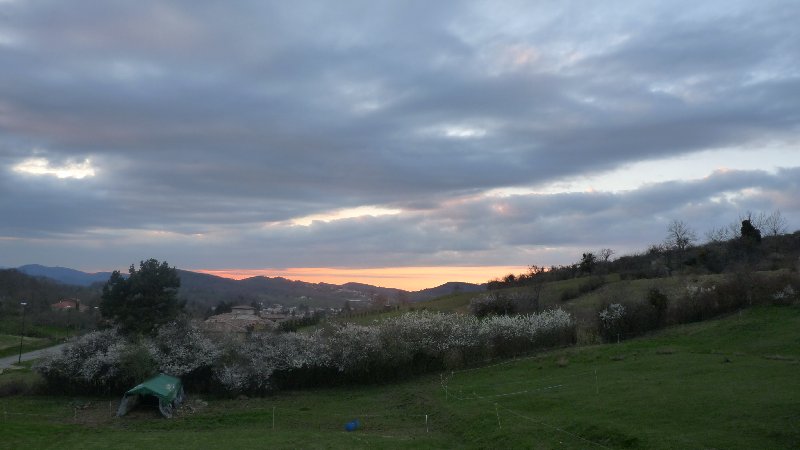
A moody sunset seen from the supper table chez Francis and Tine, with the sloe trees in full blossom.
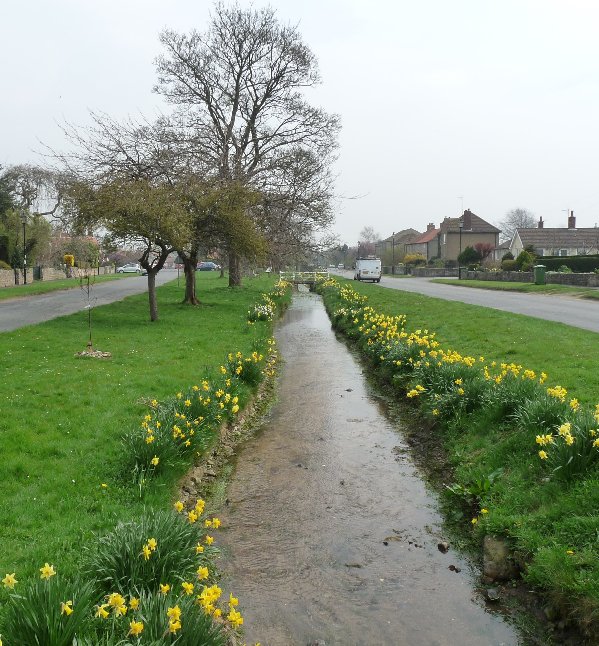
And anyway, who could bear to be anywhere else but here when the daffodils are in bloom?
I’ve just found the blog post I wrote at our very first Hallowe’en season in France, back in 2007. This particular celebration seems to have become more and more Americanised here in the UK, and now in France too. In fact, I understand that the Fête de la Citrouille in Belesta is no more. Exhibiting pumpkins has been exchanged for ‘trick or treating’: 0r as the French so snappily put it ‘Donnez-nous des bonbons ou nous vous jetons un mauvais sort’.
I thought I’d like to reminisce. Here’s that blog post from a day in our very first autumn in France.
Pumpkin stall: most of these were grown by just one man
‘In Harrogate, Hallowe’en seems to mean spending the evening of 31st October greeting a steady stream of cheerful young witches, wizards, ghosts and ghouls to the door threatening tricks if they don’t get their treats. Here in nearby Belesta, it’s something rather different, since the period round Hallowe’en is for them La Fête de la Citrouille – the Feast of the Pumpkin.
Well, just look at those pictures. If you could grow pumpkins like that, wouldn’t you want to celebrate? Yesterday, we had real fun looking round on the first day, which was also their Vide-Grenier day (Empty Your Attics). Pretty much like an English car boot sale really, except the stalls spread through the streets of the town. French attics and barns can turn out some splendidly puzzling tools and equipment, and as for the light fittings…… We enjoyed rooting around, and got ourselves quite a hoard of books at knock-down prices.
Pumpkins from an exhibition
And more pumpkins….
And even more pumpkins….
Of course the highlight of the day was yet another walk, a long ramble from Lesparrou, where we had dumped the car, along the wooded banks of l’Hers and through fairly isolated hamlets with picturesquely dilapidated (but still functional) barns, and productive potagers. Every day, the snow on the Pyrenees creeps just a little lower down the slopes, and we enjoy watching its progress. We ourselves celebrate the fact that the steeply wooded slopes which form part of nearly every walk become less strenuous as our fitness increases.’
It seems all such a distant memory now. Back in England, we don’t enjoy the huge variety of pumpkins, squash and gourds which are part of every autumn and winter market in France. Back in England, All Saints’ Day on November 1st goes unremarked. Our cemetries are not suddenly overwhelmed with pots – hundreds and hundreds of pots – of chrysanthemums, as the entire population make this annual pilgrimage to the graves of their relatives during the period of ‘la Toussaint’. Even though it’s half-term here too, our roads are not suddenly nose-to-tail with holiday makers as French families take this last opportunity to get away together before Christmas. In England, as shopkeepers clear away the pumpkins and Hallowee’en paraphernalia, they’ll fill their shelves with Christmas goods. That won’t happen in France, not until early December. Hallowe’en and Toussaint have a particular feel in France which is quite absent from the same period in England. I miss the pumpkins. But not the chrysanthemums.
Seasonal walnuts and chestnuts on a greengrocery stall
Sheepskin slippers for winter.
One of the bread stalls ar St. Girons.
A busy Saturday in St. Girons.
We’ve just come back from a Saturday morning strolling round Richmond market. It’s a pity for Richmond that our most recent Saturday-strolling-round-market experiences date from our days in the Ariège. The Saturday morning market in Saint Girons is an incomparable experience which Richmond couldn’t match.
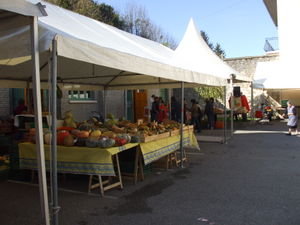
Saint Girons has fewer than 7000 residents, but it’s the administrative centre of the Couserans, and the centre of gravity not only for its own inhabitants, but for townspeople, villagers and farmers for miles around. Saturday is the day they come to stock up on fresh fruits and vegetables, charcuterie, cheeses, dried fruits, hardware and haberdashery, plants for the potager, and to link up with friends and neighbours over a coffee or a beer in a local bar. Saturday is a day when they might themselves be stallholders. Among the joys of the market is the pleasure of finding small stalls selling just a small selection of say, goats’ cheeses, produced that very week by a ‘petit producteur’, or asparagus picked no more than 24 hours before, and only available for a few short weeks in April or early May, or home-produced charcuterie, or mushrooms and fungi foraged from the woodlands and meadows round and about. There’ll usually be a crowd surrounding these specialised stalls, which may not be there every week, or in every season, because they can only put in an appearance when they have enough good things to sell. And the market sprawls between two squares, along the banks of the river, and up a couple of other streets. You won’t get away in a hurry.
Compare Richmond in Yorkshire. It too is the main town in its region, Richmondshire, and only a little larger than Saint Girons: it has somewhat more than 8000 inhabitants. But its market barely extends beyond the handsome market square. There are several good greengrocery stalls, an excellent fish stall, which is well-known throughout the region, others selling home-produced sausages and other prepared meat products, and plant stalls with herbs, bedding plants, bulbs and seeds. Best of all is the wonderful cheese van, ‘The Cheesey Grin’, whose knowledgeable, enthusiastic and cheerful owner has the best variety of cheeses from Britain and Europe, from small producers, brought out for sale when at its very best, that we’ve seen in quite a long time. But that’s all. You can be done and dusted in 15 minutes. I fear that markets, or at least the ones local to us, are in decline. Ripon too has noticeably fewer stalls of any kind than was the case only a very few years ago, and a smaller number of stalls selling well-produced or sourced local food. Still, small shops selling these things seem slowly to be on the way up, so perhaps we’re exchanging one kind of market for another. Perhaps it’s not a death knell. As a French friend of ours said recently, ‘I don’t hope so.’


















 From Pyrenees to Pennines
You must be logged in to post a comment.