Shot on location in the Ariège by Jacques, Malcolm & Margaret.
A Lawrenson-Hamilton-Clift Production MMX
‘Curiously, I had no feelings of fear or apprehension, perhaps because of what our friends had told us about Jacques, the pilot, and his machine – it’s his pride and joy, and he takes great care of it.
There was a sharp feeling of exposure after take-off – we were not in a cabin, there was no protection from wind, we were just vulnerable beings in a powered shell under a giant wing – it reminded me of riding pillion on a motorbike, but this was in the air.
The various destinations came up quickly – not like travelling on the ground, even though our speed was only about 80-85 kph.
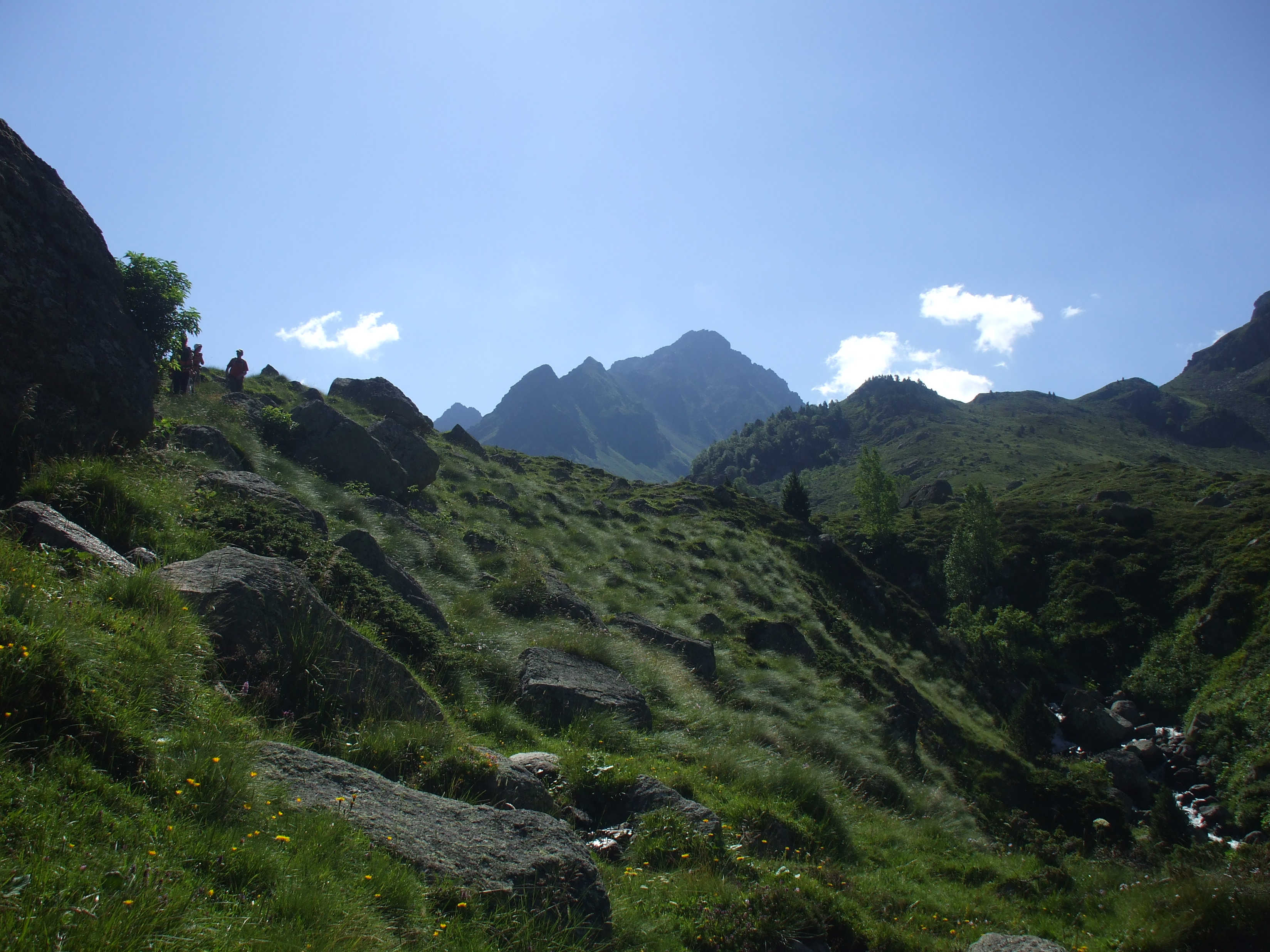
Over the mountain peaks, it was very cold – temperature had fallen from 13 or so on take-off to minus 1 over the snowfields and the flat white surfaces of isolated frozen lakes were still clearly to be seen. And suddenly, directly underneath, a herd of Pyrenean chamois, running and leaping, disturbed by the engine’s sudden sound in their snow-quiet world
A few minutes more and we were at 2600 metres, when the mountains seemed so empty and cold, even in the lovely morning sunlight. We could see long distances in the clear air at this altitude – 200 km away, we could see the Pic du Midi
The warmth after we left the mountains behind and lost altitude was welcome, and I could concentrate on the views of walks we had previously done, and which had sometimes seemed long and meandering, but were now clearly visible with their beginnings and ends.
Then back to the field and the short grass runway. As we flew over, I could see Margaret far below, waving. Then it was down, very smoothly, and a turn, and back to rest. What an experience! And how kind of my family to make this possible.’
Come to the Ariège on Easter Monday, and you won’t be too far from a community omelette. Communes and clubs all over the department seek out their biggest frying pan, get hold of dozens of eggs, sugar and rum, to make this sweet confection to round off, with any luck, the first barbecue of the season. Why? Nobody in our walking group could tell me, and Google wasn’t much help, but it does seem to be an ancient tradition dating back to….ooh, 1973 at least.
Anyway, the Rando del’Aubo have made this an annual event for some years now. For the last couple, it’s been rainy and cold. Not this year though. Down at the bottom of the page, you’ll find a few pictures of our walk between La Pène, an Audois hamlet on a delightful small lake, and Monthaut, which is a hill….higher up. It was a great way to work up an appetite.
Because the weather was warm, sunny and spring-like, we relaxed at the lakeside after our walk, chatting and enjoying those woodsmokey smells of a barbecue coming to life. Apéros first: Muscat, suze, pernod, whisky…all the usual French tipples, with nibbles to stem our hunger. Then grilled pork, grilled Toulouse sausage, bread (and wine of course), Coulommiers cheese, vanilla or chocolate pudding. And then we still had to find room for the all-important omelette.
Since the beginning of time, it’s been Marie-Therèse’s ‘job’ (good French word, that) to make the omelette, and of course it all ended in noisy recriminations because there were too many cooks all muscling in, breaking eggs, beating eggs, heating the pan, greasing the pan, measuring the rum. Half the raw egg mixture tipped out onto the grass, and Etienne and Danielle dashed off to every farm they could find to buy another….. 4 dozen.
Finally, it was done. Really, this omelette is scrambled egg with lots of sugar chucked in at the end, and flambéed with rum. Once a year is quite enough.
It wasn’t the end of the party though. Oh no. We couldn’t go before downing glasses of Blanquette de Limoux, an Alpine eau-de-vie, then cups of coffee (with madeleines, in case we were still hungry). And as a final touch, Easter eggs.
We came away suntanned and rather full, at the end of an Easter Monday that was one of the first really hot and sunny days of the year. A taste of things to come?
This is Mazerettes, one of the places you’d pass through on the Ariège leg of the pilgrimage route to St. Jacques de Compostelle, on a spring day last year.
And here are some other springtime moments in the Ariège….
Having had three children, I’m no stranger to school open days. City life meant they had access to any number of High Schools, so between the three of them, over the years I’ve been to Open Days at: Abbey Grange; City of Leeds; Granby; Harrogate Grammar; Intake; Lawnswood; Pudsey Grangefield; Pudsey Priesthorpe; Rossett; St. Aidan’s, and probably a few others as well. You’d think that would be enough. But no.
Today we had the chance to see the Lycée des Métiers J-M Jacquard in Lavelanet at work when it threw open its doors. We couldn’t resist.
It was like none of the above. I’ve not been to a school before where pupils trundled round a huge loading bay in forklift trucks, moving pallets of goods into a ‘shop’ area where they practiced using computerized stock control. They’re the Logistics students. In another department, white-coated teenagers in white rubber shoes conducted experiments into water purity, or calculated how much salt a particular water source would need to optimize dishwasher use. They’re destined for the Water Processing & Treatment Industry when they leave school. In an enormous modern factory type space, several boys and one lone girl were applying their new skills to the Maintenance of Industrial Equipment.
Somehow, I don’t think any of my three would have wanted to be there – though they might have enjoyed driving the forklift trucks.
Of course, all the usual core lessons go on too – though no music, art or drama, and Mal and I had fun in an English class (none of those students wanted to be there, either). Their teacher was showing them pictures of the sights of London, and she encouraged us to help her prise English words and phrases from their reluctant lips.
By English standards, it’s a small school – maybe some 500 students (and all aged over 14). You might guess that there are about twice as many boys as girls. About 100 are weekly boarders, coming from as far away as Albi, almost 200 km. away. We inspected small dormitories and games rooms, which seemed curiously impersonal spaces for teenagers who spend their evenings there. In fact the whole school was a bit like that. It was impressive – wonderfully equipped with every technological gizmo; polite, helpful and enthusiastic staff and students; views of the Pyrénées . The focus in this Lycée is preparing for the world of work, and there’s no room for the displays of pupils’ work, the pictures on the wall, the school Annual Production, that are typical of an English High School.
But it’s clearly a happy and successful school, and we’re glad to have had the chance of a glimpse through its open doors.
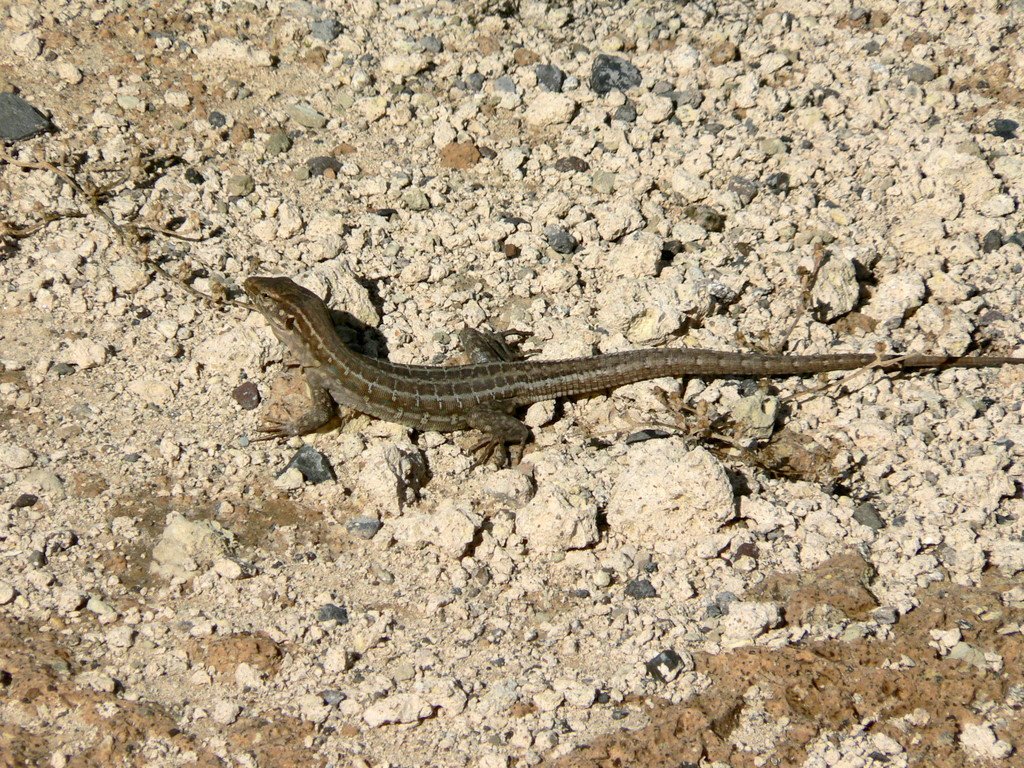
Sunday, March 7th. Malcolm and I go for a walk in the Aude, near Limoux. The day is full of the promise of spring, bright and sunny. The almond blossom is out. We spot baby lizards darting along stone walls, and enjoy watching more lizards sunning themselves on the rocky ledge where we have our midday picnic.
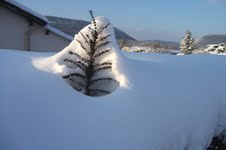
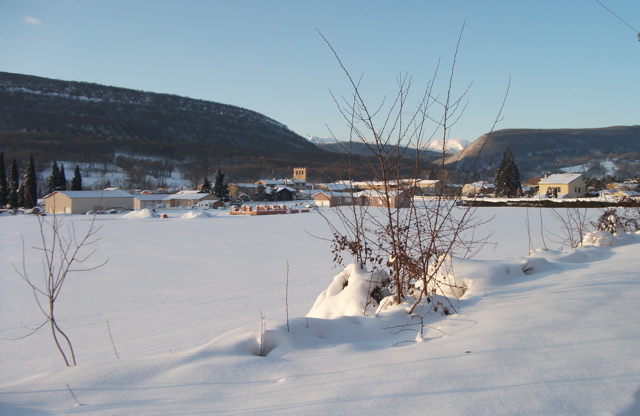
Monday, March 8th. We wake up to snow. And more snow. It was snowing as we got up, and it continues to snow, hour after hour. We watch the flowerpots in the yard as their hats of snow become taller and taller. By mid-afternoon, they’re 24 cm. high, and by 7 o’clock, as it begins to get dark, they’re about 28 cm. high. Up on the roof, the icicles become stouter and as long as the snow is deep. The trees stand stiff and silent under their heavy bonnets of snow. The snow continues to fall as we close the shutters at nightfall. TV news reminds us that we’ve has it easy – look at the deep drifts, and hundreds of stranded lorries backed up in the Pyrénées Orientales!
Today, Tuesday March 9th – no more snow falling- but it’s not ready to melt either. The wind snatches the snow from the trees, and when we leave the house, slaps our faces with flurries of flakes whipped from the rooftops. The birds are constantly busy at our ‘Resto du Coeur’, and we replenish their feeders several times. Gym? Cancelled. Choir? Cancelled
As I still haven’t got my camera, the snowy photos on this blog come to you courtesy of my friend Marianne, who’s been busy with her camera as she and Réglisse, her dog, slip and skate round the chilly streets of le Peyrat, just down the road from Laroque. Thanks, Marianne!
Suddenly, earlier today, I remembered this ditty the children and I used to chant when they were small:
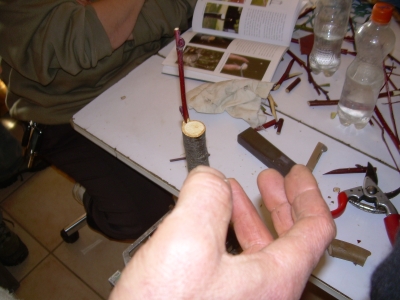
I love Atout Fruit. It’s a relatively small, but very effective local organisation that exists to protect and promote our heritage of local and ancient varieties of fruit trees. By being a member, I’ve learned such a lot at some of their monthly workshops. I’ve for instance practised grafting (as in:
‘a. To unite (a shoot or bud) with a growing plant by insertion or by placing in close contact.
Actually, what I learned about grafting, when I did it last year, was that it wasn’t my thing. It’s very steady meticulous work, demanding razor sharp knives and attention to detail, deeply unsuited to a slap-dash like me. My painstakingly grafted specimen died within weeks.
But there have been sessions on pruning, on traditional methods of gathering and preserving fruits, using those fruits in cooking….and so on. Later this month, the session on growing biodynamically will be held in our garden, and I just can’t wait.
I’m different from most other members. I don’t just mean that I’m English, though there’s that too. Most ‘adherents’ were born with more know-how than I will ever have about trees and crops, and practice their skills every day. Nearly all the rest have this background to their lives, even if they have themselves moved away from their ‘paysan’ origins. I hesitate to use the word ‘peasant’ in English, because of the somewhat negative picture it paints. Not here. Even University graduates who have returned to the land are proud to describe themselves as ‘paysan’. It’s been great for me that everyone is keen to help me and seems pleased that I want to learn: nobody patronises my amateurishness.
Sorting those saplings
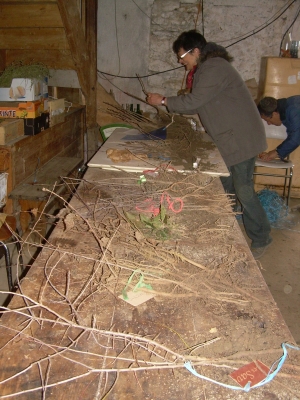
Once a year, Atout Fruit is given a range of tree seedlings to hand out free to members – mainly fruiting trees, but other indigenous and introduced species too. Members pore over the spread sheets of offerings and make their choices, and wait for the day when we can all go and collect. I felt greedy: I’d chosen 10, but later found that others, with larger pieces of land, had chosen 20, 40, even 100 saplings. This year I volunteered to help sort and distribute the trees, and drove to Claude’s place (which includes a wonderfully eco-efficient house of straw), high above lake Montbel, where it was all happening. My job was to help replace the battered identification labels with rather more legible ones, and make up orders with members as they arrived. Have you ever tried to distinguish an 18-inch high mulberry whip from a crabapple or a wild cherry? Best leave it to the experts….. Later, warmed by glasses of hot coffee, 4 of us made up the bundles of trees for the people who hadn’t been able to come to collect. Here’s a picture of some hard work in a chilly barn: merci, Claude!
Later that day, I planted my seedlings in pots, or direct in the garden. I had quite a time of it. But that’s another story….
Last Sunday, we went off as usual with our walking group, Rando de l’Aubo. We went a mere 20 km eastwards into the neighbouring Aude. What a difference a few miles makes. The rugged forests, with hillside pasture for cattle and sheep, fields of maize and feed crops in our own department are exchanged for an almost Tuscan landscape, with little hillside towns overlooking ranks and ranks of vineyards delineating the contours. Both departments are lovely, but we hicks from the Ariège tend to prefer our less manicured and somewhat wilder countryside.
Still, Sunday’s walk was quite a sentimental journey for Malcolm and for me, because we walked through the village, Ferran, that was our first introduction to this part of the world.
A few years ago, an old friend of Malcolm’s sent him an email. In his letter, he said that it was February, and he’d been sitting outside in his shirtsleeves, gazing out at his perennial view of the distant Pyrenees, at that time covered with bluish-white snow. Did we fancy a visit to him in Ferran? We did. We were of course seduced by those hillside towns, those vineyards, and especially by those views of the Pyrenees. Not too long after, we came over again, to house hunt, and of course didn’t find that elusive, perfect spot. Only after we’d returned home did our friend’s wife, who’s an estate agent, spot the possibility that we just might like the butcher’s house in Laroque where we now live.
It was crazy really. We bought it without really knowing the first thing about the area. But we’ve never regretted it. We’ll never finish exploring the hillside pathways, always deeply mulched with fallen oak and beech leaves, or the craggier routes up mountainsides, or the gently undulating lower paths through meadowlands, bright with orchids and other flowers, as well as butterflies, throughout the spring and summer.
Ferran
But that’s the Ariège. Ferran and the other villages we skirted last Sunday are typical of the Aude. Colour washed houses and farms in shades of barley, corn and almond perch high on the hillside, looking down over their vineyards, and beyond – one way to the Montagne Noire, the other to the Pyrenees. The hills roll away into the distance, not so blanketed by forest as our hills are, but at this time of year, green and lush. Though we only walked about 13 km, by the end we were exhausted, because throughout the day we’d been buffeted by the winds for which the Aude is known. But how lucky we are to have two such very different kinds of countryside within such easy reach of our homes.
St. Barthelemy seen from near Ferran
As I’m still camera-less, thanks to Jean-Noël, Michel and Anny for letting me use their photos from this walk, and a recent one near Donazac, also in the Aude
How could they? I mean, what ARE they playing at? All last week, and most of this, the baker’s shop down the road has been closed. Instead of rising at 2.00 a.m. to get busy making baguettes, flutes, ficelles, baguettes a l’ancienne, flutes tradition, pain noir, chocolatines, croissants and so on and so on, our bakers have chosen to lie in till – ooh, 7 o’clock perhaps – and then spend the day catching up with their families – the children are on half term.
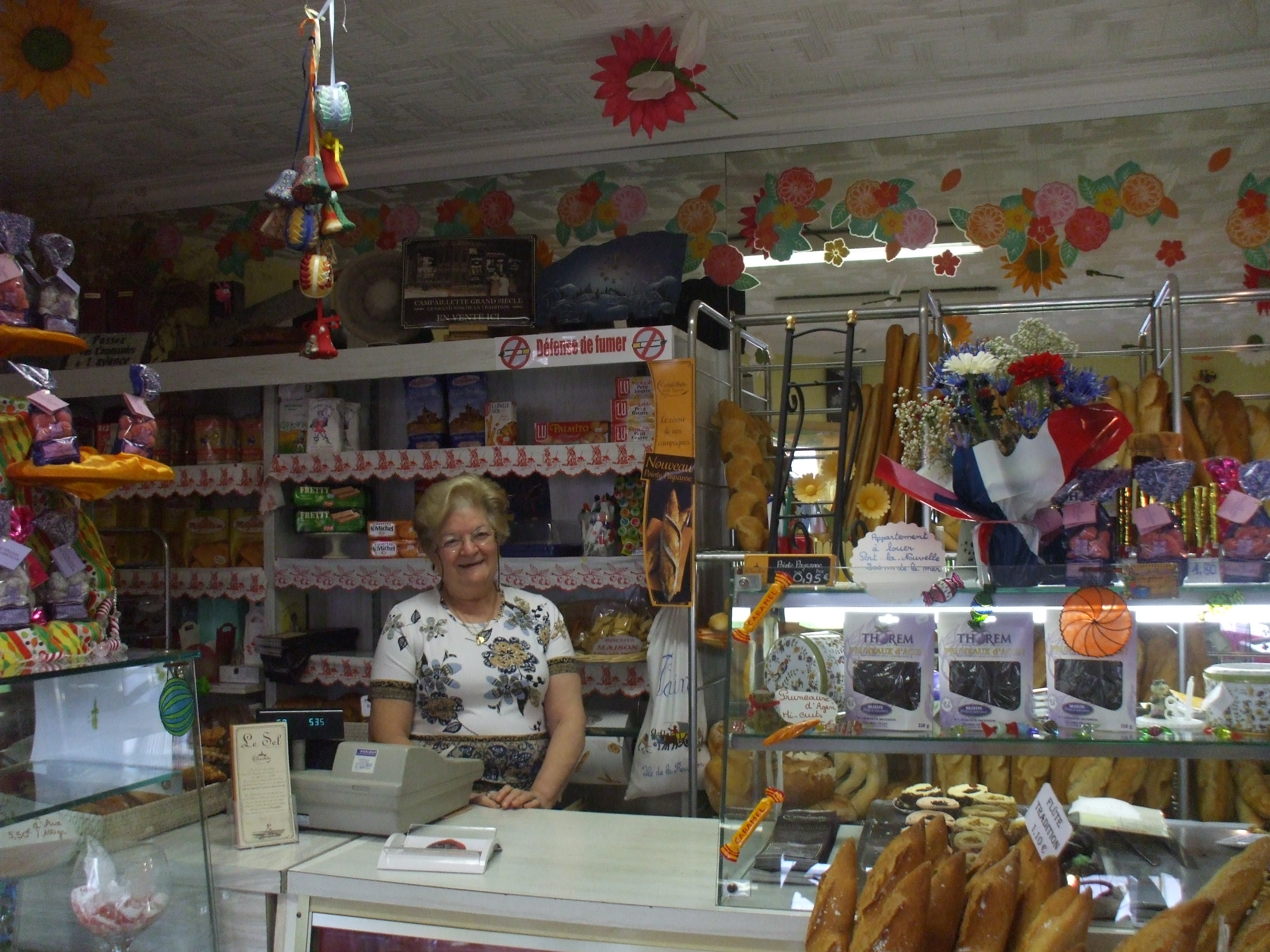
It’s a family business, our baker’s shop. M & Mme Fonquernie owned it, and now, although officially they’ve retired, they help out all the time .M. Fonquernie is the one who drives his little white van round the local villages which have no shops, selling bread. Their two sons have now taken over the day-to-day baking. One is responsible for all those loaves, while the other specialises in patisserie. Their wives divide the work of running the shop between them with Mme Fonquernie Senior’s help.
Mme. Fonquernie, Mater Familias
So our morning routine has been disrupted. First thing each day, one of us usually walks down the road to get our favourite pain noir, hot and crisp still from the oven. The other day, the baker forgot the salt. The bread wasn’t half so nice, but I rather liked this very human error. It proved that our loaves are still ‘artisanale’, rather than being churned out by some computer-assisted machine. There’s usually someone in the shop to chat to, or to walk back along the street with, and so neither of us looks on getting the bread in as a chore.
We’re lucky, I suppose, that there are three bakers in town. Last week, we went to the shops at Castellanes to the baker there. No pain noir at this shop, so we chose their unbleached white. The small one’s a slender baguette shape – an Ariegeoise – but buy the larger butch version, and you must ask for an Ariegeois.
But then what happened? A notice appeared in the shop: from Sunday, they too would be closed for a holiday. So for a few days this week, we have to patronise shop number three. Everybody moans ‘C’est pain industriel ça’. It’s true. It comes all the way from Lavelanet, from a bakery which has three shops. That’s mass production, and it shows. Roll on Thursday, when the Fonquernie family re-opens its shop doors
Once upon a time – though not very long ago, Laroque, population more or less 2000, had dozens of shops. You could live your life here without ever needing to leave town, and many people did just that.
Now we have three butchers, three bakers, and three – no, not candlestick makers – hairdressers. We have one épicerie left, 2 tabacs, a flower shop, and a new haberdashery store. There are six bars, restaurants and take-aways, and you can still buy paint, bikes, second-hand books, even a washing machine in town. Greater mobility and the rise of the supermarket have put paid to the habits of the old days, and we’re lucky to have as many shops as this left. But so many are no longer open for business, and our home is one of them.
From the early years of the 20th century until about 25 years ago, our house was Paul Vergé’s butcher’s shop, as well his family’s home – people here still refer to it as ‘l’ancienne boucherie’. Passers by, workmen who come to the house, delivery staff – all of whom remember coming to the shop as children, or working there as part time or weekend staff – have told us tales about the old shop, and the house itself is giving up some of its secrets…….
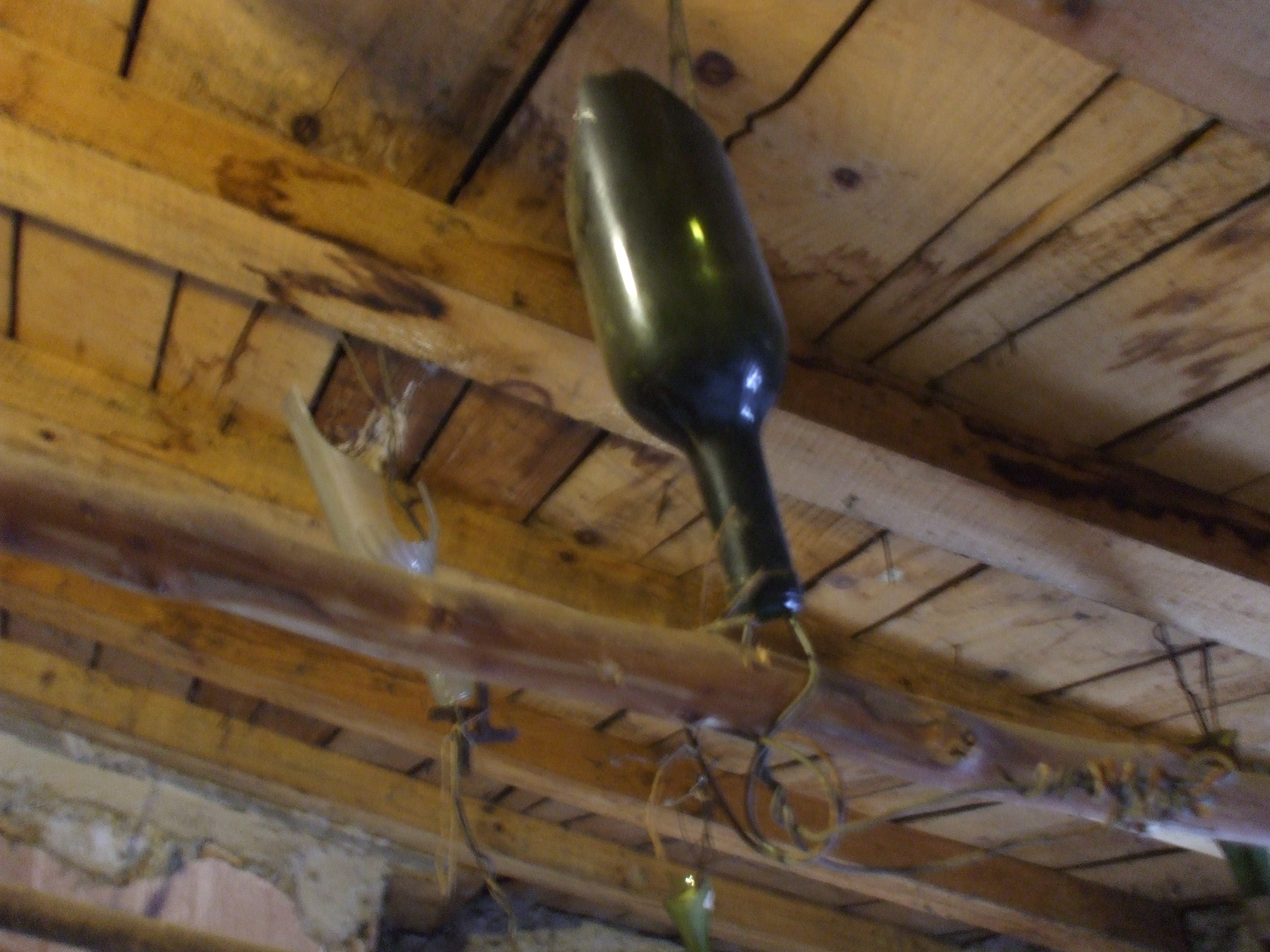
The butchery business must have been back-breakingly hard. After we’d moved in, we soon realised that carcasses were hauled up through the house to the top (or second) floor up a now filled-in shaft, where they hung from racks like clothes on an airer. We wondered why broken bottles were suspended above these rails, upside down. Answer: to prevent rats and mice running down onto the meat…
Anti-mice device
This floor of the house, without insulation, was bitingly cold in winter, but suffocatingly hot on summer days. People have told us that their memories of the shop include seeing these same carcasses, after they’d been hauled down again from the attic, hanging outside the shop door, crawling with flies, just waiting for customers to come and buy…..
The attic also has an area that was used as a smoke room for smoking cuts of meat. Hard to imagine that the pungent smells didn’t penetrate the rest of the house.
Our garage, next to what was originally the shop, has quite a few sturdy metal rings set into the walls. Animals were tied to these, prior to being shot and butchered by Mr. Vergé himself. Occasionally, a terrified beast would get away, and charge up the hill to Place de la Cabanette, where with any luck it would be rounded up by the sapeurs pompiers (fire and rescue service). An early job, when we moved here, was to line and paint the garage ceiling – to eliminate all the blood stains from this domestic abattoir.
We still have 2 enormous ex-cold rooms just off the shop. One of these is now a tool storage area, one a larder. We haven’t parted yet with the big old scales which were part of everyday life in the shop.
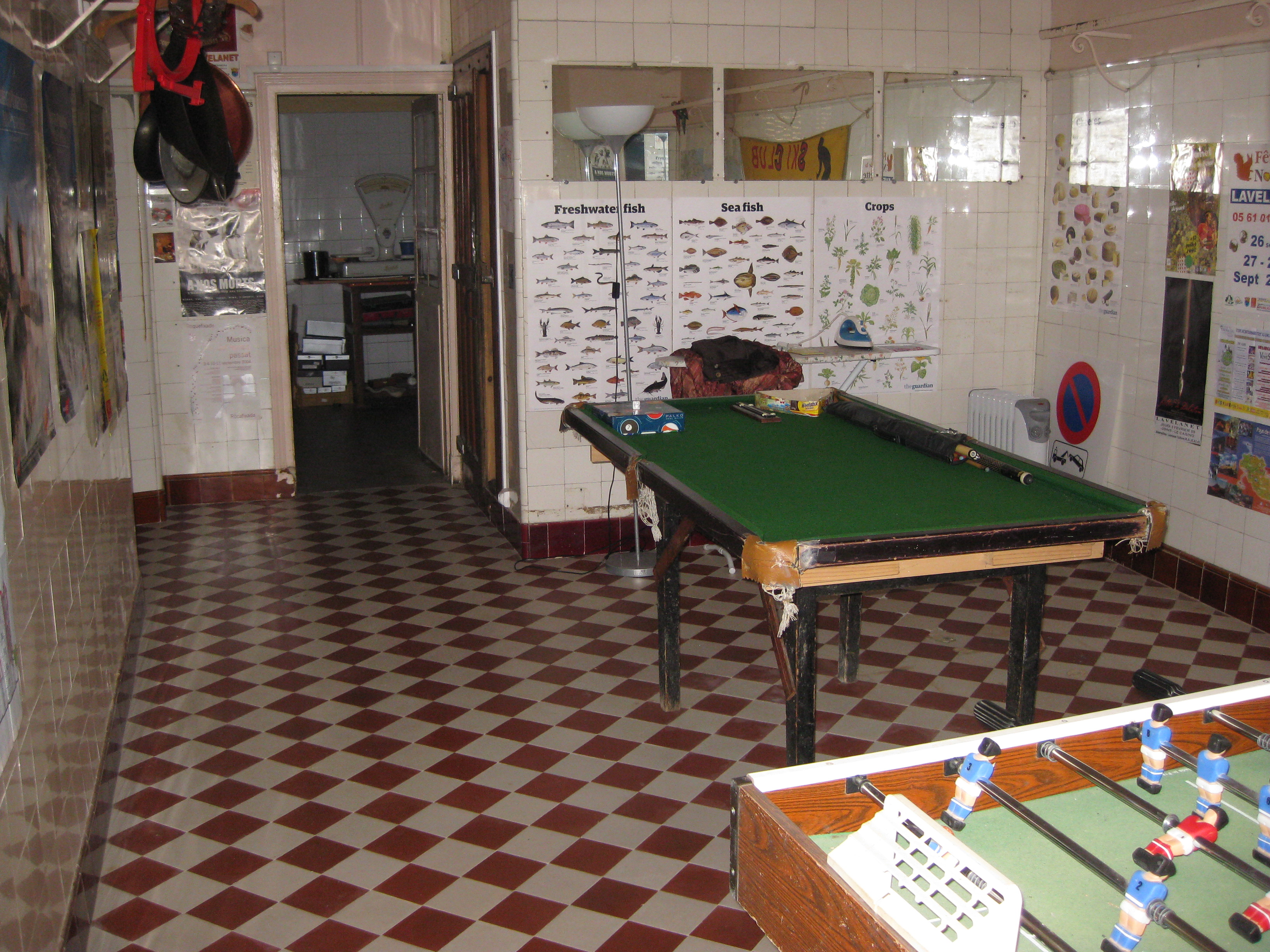
Then: butcher’s shop. Now: games room
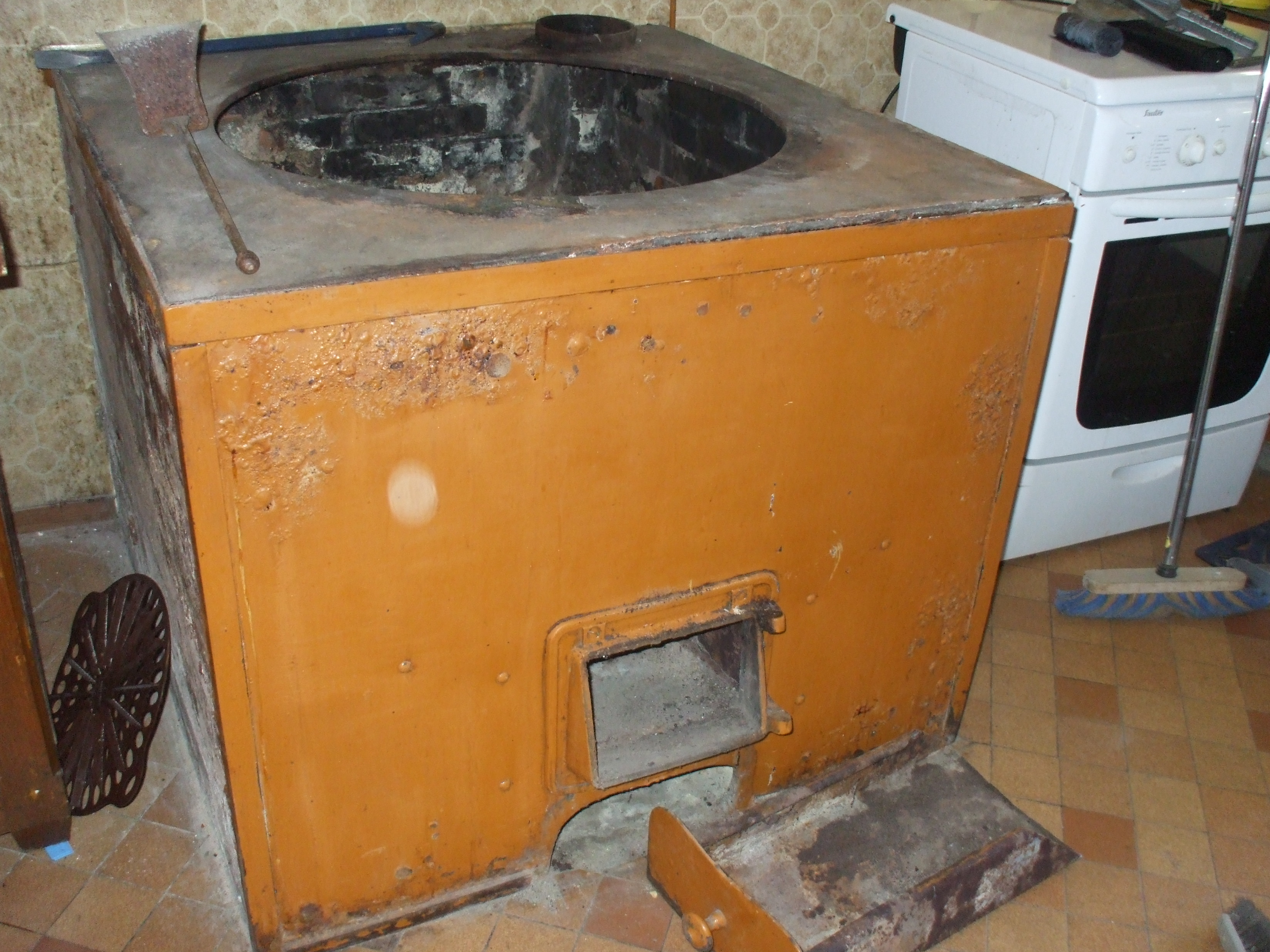
And then there’s the white-tiled shop, now a games room. The Vergés,in common with most shopkeepers, provided a few hard chairs for the comfort of those waiting or gossiping in the shop. Mr. Vergé was convivial, a lady’s man who enjoyed chatting to his female customers. Madame Vergé was busy in her little booth (remember those?) accepting payments and keeping the books. Her responsibilities didn’t end there. In the immense boiler in the kitchen, she made and canned patés of pork, duck and goose liver, rabbit, game; cassoulets; jarret de porc, for sale in the shop, day after day after day. We still have boxes of unused labels lurking in boxes in the workshop.
Mme. Vergé’s big old meat boiler: now defunct
Besides all this, they found time to look after the garden, 2 minutes walk from our house. Just as they did, I grow vegetables: like them, I use the cherries, plums, apricots, figs, grapes from the trees there. Unlike them, I can take my time to enjoy digging, planting, harvesting, bottling, preserving, cooking. Frankly, I’m playing at it. For them, the hard work of looking after a plot so much larger than a couple of allotments was something that had to be fitted in after they’d slaved away at the butchery business. And they had a family….







 From Pyrenees to Pennines
You must be logged in to post a comment.