The Garden of Earthy Delights

At this time of year, with spring nudging the crocuses, violets and celandine into flower, and encouraging buds on trees to fatten and swell  before bursting into flower, it’s time to be busy outside.

My single patch of white violets among all the purple

Our garden’s a minute or two’s walk from the house, and out of sight can mean out of mind.  So once there (‘I’ll only be 10 minutes’….), I’ll find all kind of things to do.  The grass needs strimming already.  The vegetable patch is a disgrace.  The fruit trees need attention: they suffered horribly in last May’s heavy snow, and they should really have had careful pruning much earlier this month. The compost heap needs a bit of TLC.  Time passes while I prune our ‘vineyard’ – 6 vines. (‘Oh, sorry, have I really been two hours?’)
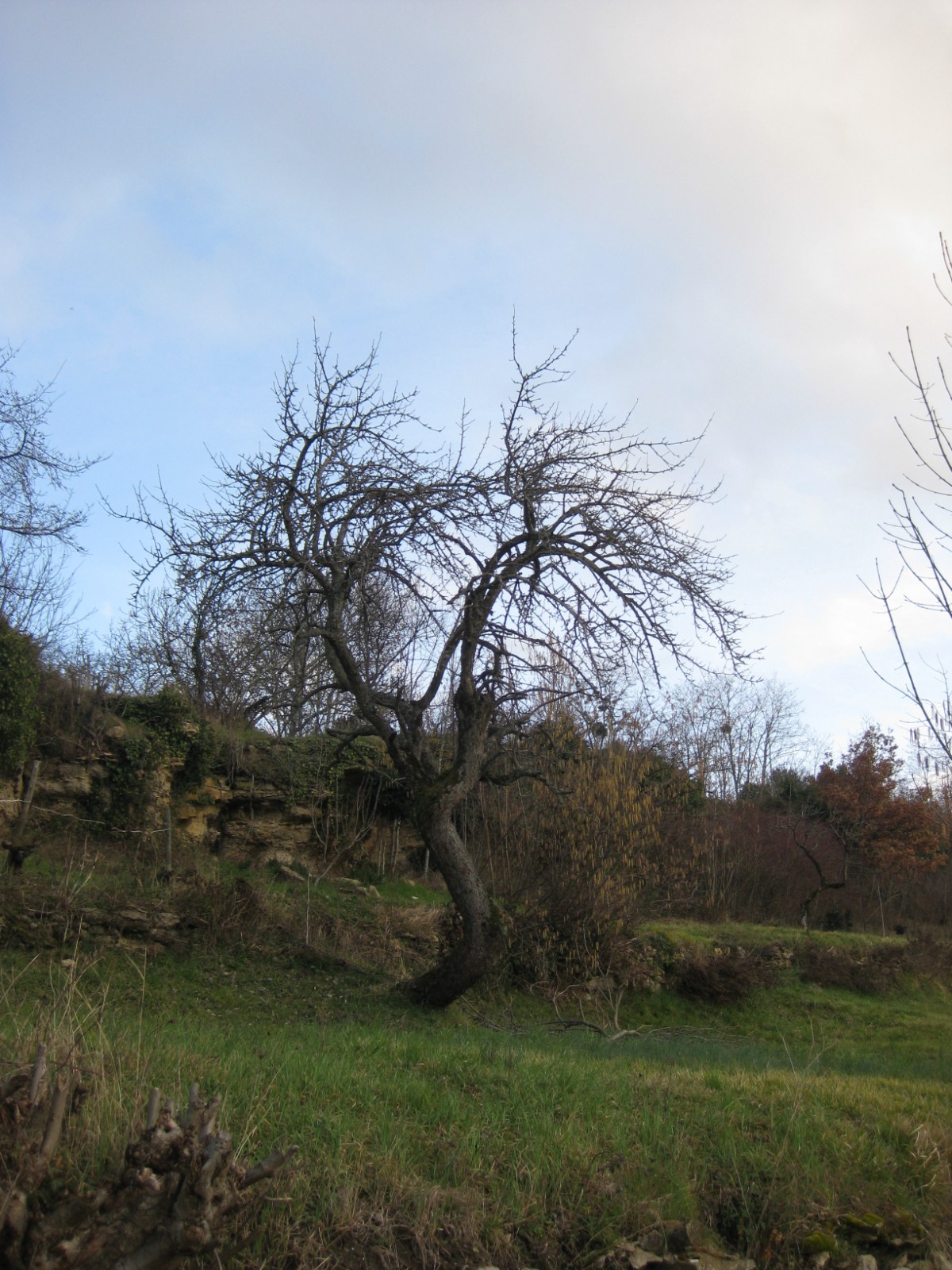
The pear tree: lots of character, not many pears

So I’ve taken a big decision.  No vegetable patch this year.  That way, the trees may get the extra attention they need:  the ivy and brambles may not get the upper hand quite so readily, though I wouldn’t bet on it.

I’m not going to do it on my own though.  From Easter, we’re planning new recruits to the garden: a gang of hens, whose job it will be to peck away at all the grubs, and keep the grass trimmed, whilst offering the occasional egg for breakfast.
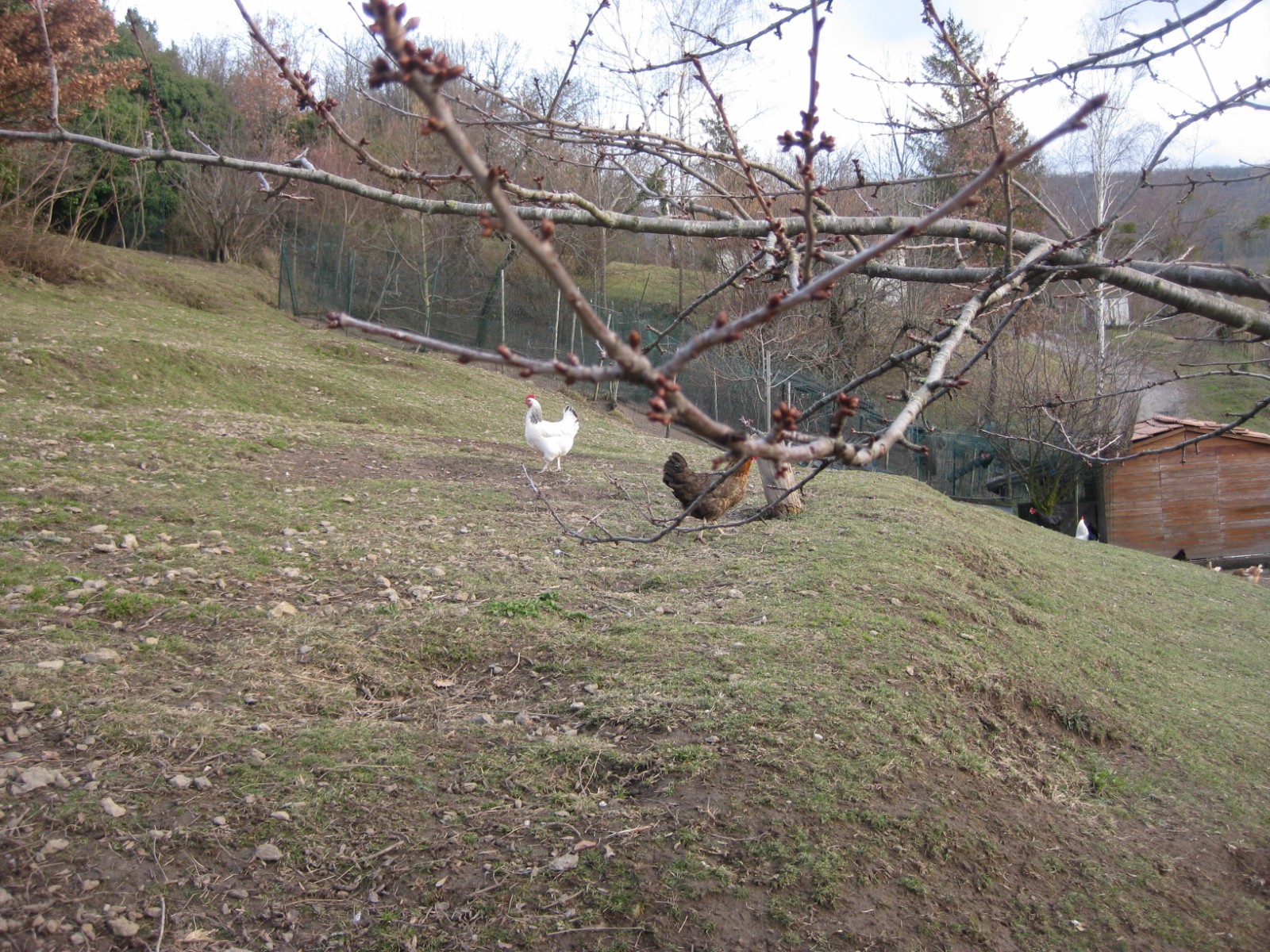
The hens next door running free

Quite a few friends in England have re-homed ex-battery hens, and I’d love to do this too.  I’ve written emails, joined internet discussions, asked around, but it doesn’t look as if I’m going to be able to find any here in France.  But the search goes on as we plan the next project: build a hen house.

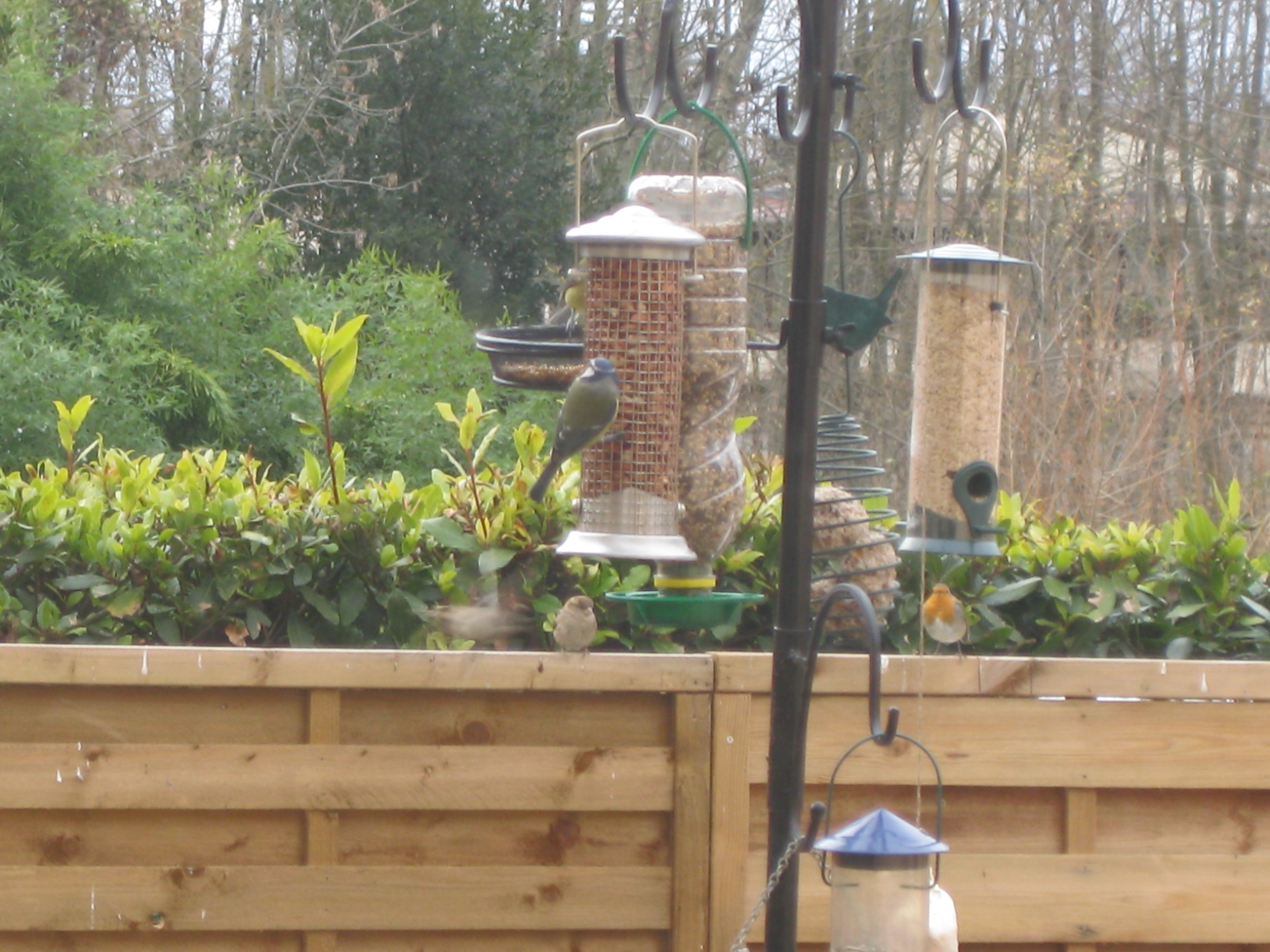
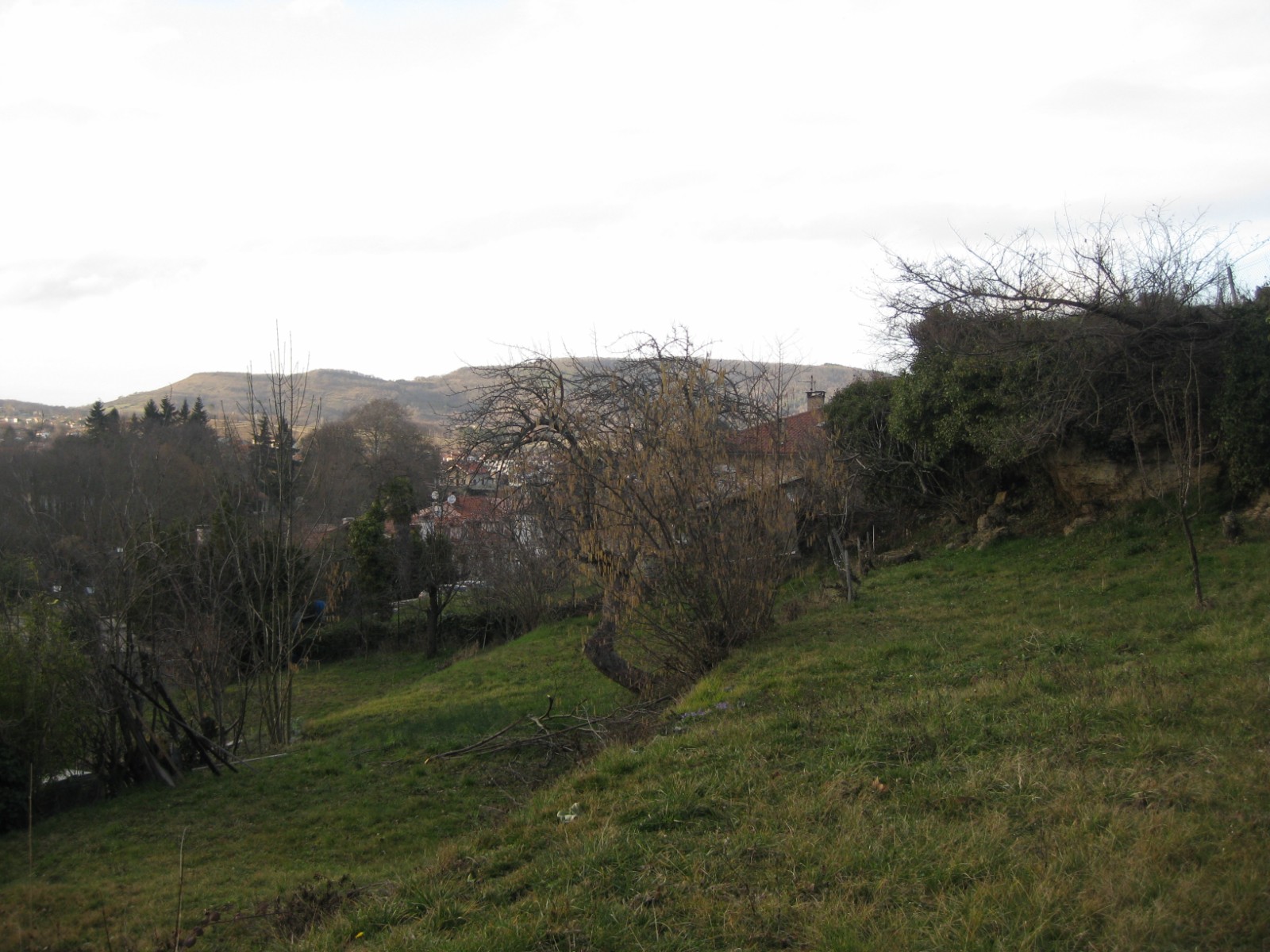
Although it’s often a lot of hard work, this garden’s a really special place for me  (and I do mean me.  Malcolm’s excused gardening duties so long as I’m excused DIY duties).  From it, I can see Montségur, the thickly wooded long chain of hills called the Plantaurel, and the snowy peaks of the Pyrénées behind .  So near to town, and away from the house, it’s where I come to get away from it all, and have a healthy workout as I dig, hack, uproot and generally try to keep Nature at bay.By the way:  greenfinch update.  Enough already!  They’ve shown themselves to be belligerent, selfish dogs-in-the-manger, who dive-bomb, use their wings to beat off the opposition, peck, bamboozle – anything to keep any other bird away, even ones who are eating their least favourite thing on the feeding station.
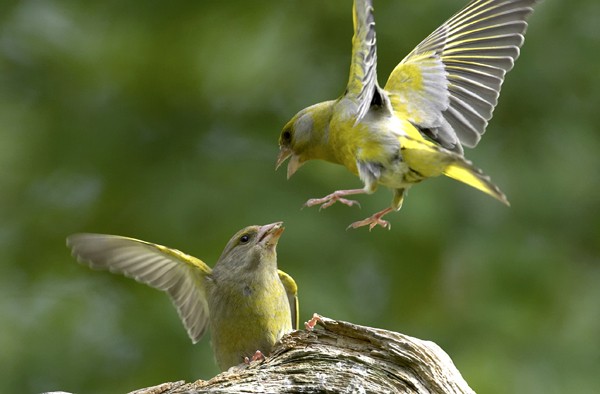
Greenfinch fighting

They’re also extremely messy.  I’ve told them.  I’m not replenishing the feeder till they’ve eaten every scrap of the food mountain they’ve dumped on the ground beneath.

Oh, and as our lunch guests pointed out,  it was a goldfinch, not greenfinch onslaught we had two years ago.  We’ve seen none since.  They’re all 4 miles up the road at my friend’s house in le Peyrat.
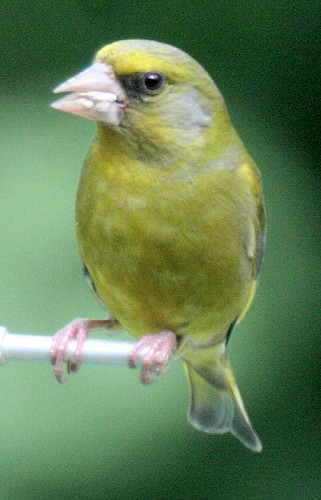
Greenfinch Day

Female greenfinch

Two years ago, on Valentine’s Day, we had friends over to lunch.  We spent much of the meal glued to the sight of a huge flock of greenfinch which had suddenly, and seemingly out of nowhere, descended to the garden, and specifically the bird table.  It was food they were after, and they swooped, squabbled, jostled for position, selected seeds, came back for more, and generally monopolised the garden to the astonishment of the regular tits, wagtails, blackbirds, sparrows and robin.

On 15th February, we got up, eager for a repeat performance.  But they’d gone.  And they never came back.

Male greenfinch

Until today.

We only realised they were here when over breakfast we heard ‘Bang!’ followed by ‘Bang!’ against the window.  Two finches, one after the other, had hurtled – hard -against the glass, and we found them lying inert on the ground.  We tiptoed round, knowing we had to leave them be, and hoped for the best.  After ten minutes, one of them suddenly shook her head in surprise, ruffled her feathers, and flew off.  The other never recovered.

The other greenfinches didn’t seem to care.  All day they’ve been wheeling around, careering from sunflower seed feeder to peanut net, to grain dispenser, always feeding, feeding, dropping discarded shells and tiny crumbs onto the ground beneath, where all the birds, whether finches or regular residents, continued to scavenge all day.

I wonder if they’ll be there tomorrow?

Feeding time

“No sky in all France is more blue than that of Collioure”: Henri Matisse. Not this week……

Because of our 6 weeks’ hard labour, because the weather here is so unseasonably gorgeous, and most of all, because it was Mal’s birthday yesterday, we decided on a Mid-Week Break.  A friend had just posted some photos of the sea at Collioure, radiant in the early spring sunshine, and we thought we’d like an off-season visit too.  The Pyrénées Orientales are nearly always sunny, with high temperatures and blue skies, even if we’re shivering over here, so we never bothered to check the forecast.  Big mistake.

Half way through our journey to the coast, the mist descended.  The sky turned pale, then grey.  The temperature fell.  Sea mist, we thought.  It’ll burn off.  It didn’t.

So our afternoon consisted in making the best of a bad job.  Which worked.  Rather than stop for lunch first at Collioure, which we feared might be closed for business, winter, mid-week, we went on to Port-Vendre.  This is still a busy fishing port, with tuna and sardine canning factories, so we had the idea that we’d be lunching with fishermen in oilskins.  Well, not at all actually, but fishy menus are centre stage, and we ate well – very well.

Then we came back to Collioure.  As we’d thought, nearly everything was closed, and without the sun to add sparkle and joie de vivre, we contented ourselves with an invigorating walk along the front before moving on: this is a region with plenty to offer.

This is Catalan France. It’s been ruled by Spain, by France, back and forth over the centuries, and many of its current inhabitants fled from Spain during the Franco regime, so it does have a very Spanish feel.  The frequent change of rule means that many bloody battles have taken place here too, and back in the 13th century, the fortified town of Elne suffered cruelly.  Under Catalan rule at the time, the troops of French king Philip the Hardy laid waste the town.  The townspeople fled to the traditional sanctuary of the church.  There the soldiers killed the menfolk, raped the women before the altar, and flung small children against the walls before burning the church, which still bears scorch marks on the main doorway.  It was this church, Sainte-Eulalie and its cloister we’d come to see. The church itself is a strikingly simple Romanesque building, beautifully lit and inviting quiet contemplation. It’s a little reminiscent of Durham Cathedral, but on a more domestic scale.  The cloisters are really special.  Partly Romanesque, partly Gothic, the capitals and pillars have been immaculately carved with foliage, animals and biblical scenes still in crisp and fresh condition.  It’s a lovely, quiet place.

We stayed the night at a traditional Catalan 19th century farmhouse, Mas Bazan.  After a night in our elegantly simple room, we enjoyed a ‘bio’ breakfast of home made cake and jams, newly baked bread, and the company of our stimulating and cheery hostess.  It was she who planned our day for us, suggesting things we might enjoy.

The misty weather limited our choices to some degree, but we had two highlights.  As we left the coast, we climbed upwards into the scrubby, shrubby Mediterranean hillside which we now know is called ‘maquis’, rather than ‘garrigue’, because the soils are different in each.  And we spotted in the distance our first destination, Castelnou,  not destined to be twinned with Newcastle.  A mediaeval castle and village appeared through the mist, with beyond, tantalizing glimpses of the massif of the Canigou.  As we wandered round the village, a few minutes later, we wondered who would choose to live in such a picturesque museum, overrun with tourists in summer, its several restaurants and craft showrooms overflowing, while in winter nothing, apparently, happens.

We had lunch in Ille-sur-Têt, which also has medieval streets, but ordinary small town life goes on there: it’s no tourist showpiece.  We’d come to see Les Orgues, north of the town.  These take the form of an amphitheatre of cliffs which the elements have eroded, and continue to erode, into extraordinary columns and pillars.  It’s arid, quite desert like, and quite ephemeral in that it’s constantly changing as the sand from which these structures are formed wears away and is re-deposited.  The photos I took record them as they are at the moment.  In a few years they’ll be different again.

And then we wound our way home, on a series of snaking backroads through the maquis.  The nearer to the Ariège we got, the hotter the sun became, the bluer the sky.  It’s not supposed to work like that.

This slideshow requires JavaScript.

On the day before Christmas, my true love showed to me….

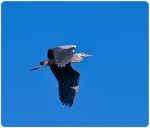
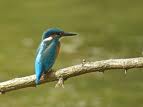
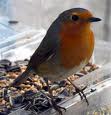
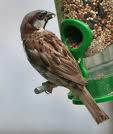
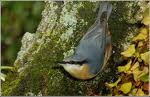
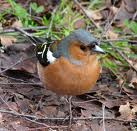
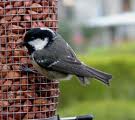
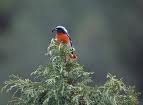
…1 flying heron..2 bright kingfishers3 Christmas robins4 mighty buzzards5 shy pied wagtails6 cheeky sparrows7 busy nuthatches8 chaffinches feeding9 active coal tits10 cheery redstarts11 hungry blue tits…..and 12 busy birds round our birdfeederHappy Christmas, everyone.

I chose these birds because, apart from the nuthatch, they can all be seen from the house.  In fact the heron cruises past down onto the river to feed once, maybe twice, every day.  We still get quite excited every time it happens.

But in most cases, not so very different from England, eh?

Christmas markets

Christmas markets always used to be a German thing.  They still are, I think: they do sound rather special.  It’s many years now that Leeds has had its own German Christmas Market, though I’ve always wondered what would bring German stall holders across the channel to pitch their stalls.  Just as I’ve wondered what the attraction is for the hundreds and hundreds of French market traders who regularly fetch up in the UK for the popular French markets, where the prices are inevitably sky high.

But Christmas markets, where you can look for all your presents, made by local craftspeople and artisans, or in sweatshops in China are everywhere.  The difference is that in the UK, they began in November and are now largely over.  Here they’re just beginning, and will go on in some cases, like Toulouse, until after Christmas.

Here’s our stall, Découverte Terres Lointaines, at the market at Lavelanet, on today and tomorrow

A nation of shopkeepers…or a small town with small shops

Depending on your point of view, it was either Napoleon or Adam Smith who first called England ‘a Nation of Shopkeepers’

But it was only after I came to settle here in France that I started to think of shopkeeping and market trading as  skilled occupations, and realised just what is involved in keeping the customer happy.

It’s probably because it’s just so much easier, where we live in England, to nip down to the supermarket.  There weren’t too many independent shops on our daily round:  so much for a nation of shopkeepers.  Mind you, we loved it when Emily was a Saturday girl at the French patissier who was then in Harrogate, Dumouchel. She would often be sent home with a couple of unsold petits gateaux for us to enjoy,  or some slowly-fermented sourdough bread.  It was small shop, and quite expensive, so she learnt quickly to value customers and to treat them well, so they’d come back.  She learnt too that while most of the people she served were friendly and appreciative, customers could be curmudgeonly too.

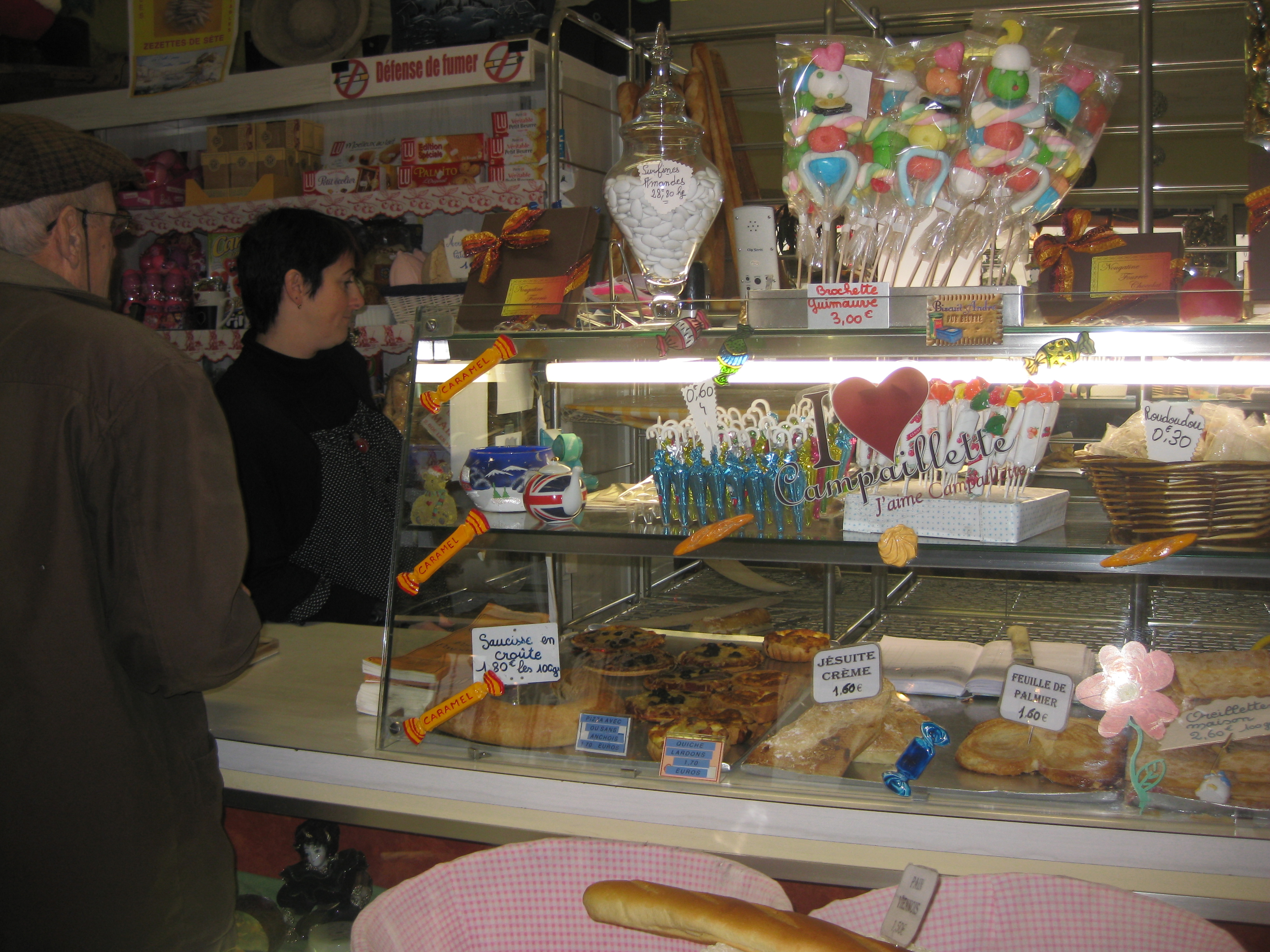
The baker’s – busy at lunchtime

So who are the good commerçants here?  Well, down at the bakers, they’ll often put aside our much-loved pain noir without being asked if I’m not in bright and early, knowing we’d be disappointed if they sold out.

Buying cheese at the market

Today at the market, madame who runs the cheese and charcuterie stall had printed off some recipes specially for me, because she knew I might enjoy trying them out.

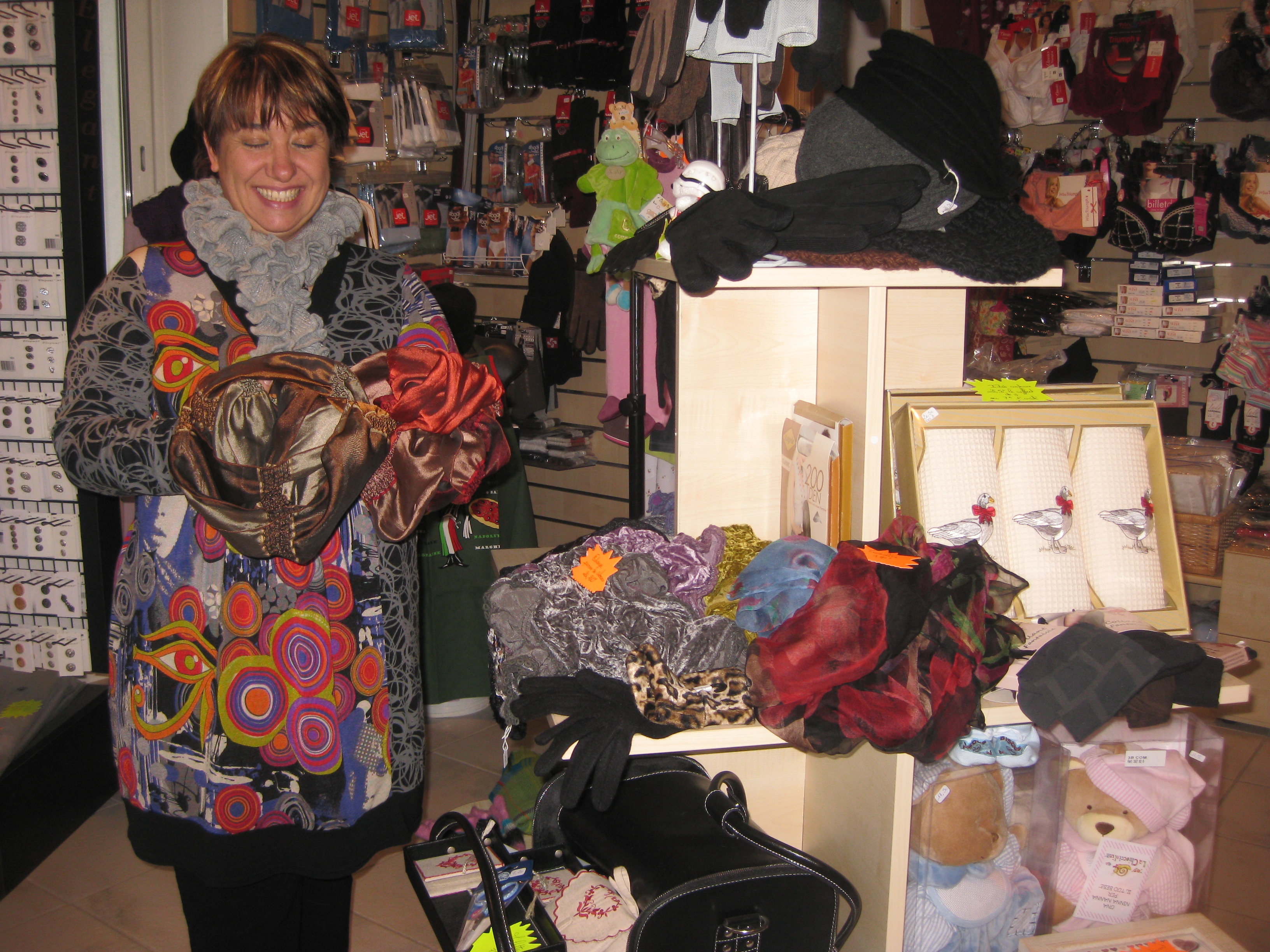
Down at Bobines et Fantaisies, she goes to Toulouse most weeks to seek out unusual scarves and accessories, so there’s always something new and worth trying at her tiny shop. ‘Let her try it on.  If she doesn’t like it, bring it back!’, she’ll insist, as you dither between a bracelet, a couple of scarves and a chic but cosy winter hat.  These shopkeepers remember us, our tastes, our whims and foibles. They welcome us, and chat cheerfully with us, even if we leave the shop empty-handed.

Madame at Bobines et Fantasies helps me choose a few presents

There’s just one shop here that doesn’t cut the mustard. ‘Il n’est pas commerçant’ we all grumble.  Those of us outside the select band are routinely ignored, and as we feel our custom isn’t valued, some of us now go elsewhere.

But not to the supermarket.  Oh no.  Yesterday we DID pop into one, but as the muzak system was belting out a schmaltzy version of ‘Auld lang syne’ in what passed for English, we very soon shot out again.  Small Shops Rule OK.

…..now Snow’s the Big Story

Everyone in Europe, it seems, has been battling with snow this week. Everyone that is, except us and anyone within easy driving distance of our part of the country.

Road clearing in Cherbourg, 2nd. Dec

Night after night the French news bulletins have been full of tales of woe, endurance, hardship, slipping and sliding and Dunkirk Spirit in Lyon, Orléans, Brittany, and Strasbourg.  Before passing on to the rest of the news, we’d then have a shot or two of traffic jams on a motorway outside Newcastle, or a firmly shut-for-business Gatwick Airport.  Neighbours and friends gleefully filled us in on how dire they’d heard things were in the UK.

Finally, yesterday morning, the snow arrived here too.  Frankly, we knew we weren’t going to get the news crews down here looking for a story.  It hardly settled, and then it began to disappear.  Still, I found excuses in the afternoon not to get on, but to sit next to the woodburner and do some jobs on the computer.  I got distracted. Somehow, although it’s not at all my newspaper of choice, I started to look at the readers’ photos on the Telegraph website.  They’re terrific. Gorgeous snowscapes from all over Britain; funnies, such as the rabbit tentatively sniffing at a snowman; curiosities such as the milk bottles out on the step whose contents had expanded to make  tall chimneys of frozen milk extrude from the top.  Sorry – my links won’t lead you to the exact photos, because the Telegraph’s organized them into galleries.  But have a look anyway.  You too may spend quite a while browsing through for your favourite.

Near Roquefixade

And now here are our snow photos, taken on the way to Pamiers, and home from Foix.  We were meant to be Christmas shopping.  Well, that didn’t last.  A cup of decadently rich smooth hot chocolate at a chocolatier in Pamiers, and we were off. The pretty way home, via Foix, seemed a much better idea.  My photos will impress nobody who’s been battling with the real stuff this last week.  But we like them anyway

On the road from Foix to Roquefixade

Découverte Terres Lointaines

Nobody could call our nearest town, Lavelanet, a hub of multi-culturalism. But neither is it an Ariegeois ghetto. Of course, as in most French towns, there’s a big Maghrébin presence: inhabitants of the former French colonies of Tunisia, Morocco and Algeria. There are significant numbers of people of Spanish origin: their families probably came over in the Spanish Civil War. Dunno how so many Portuguese got here, but in addition there are Swiss, Belgians, Roumanians, Brazilians, Vietnamese, Chinese, Argentinians, Australians, Germans, Dutch…..ooh, and a few English of course.

Recently, I got to know two local women, Sylvia and Noëlle. Some time ago they, together with another friend Nadia, had come up with the idea of bringing together women from some of these countries to share their cultural heritage, particularly through the medium of cooking. The idea got bigger. Over the last 18 months or so, they’ve developed themselves as an official voluntary group, ‘Association “Découverte Terres Lointaines”‘.  They and their ‘benevoles’ (volunteers) have animated cookery workshops in schools, old people’s homes, youth clubs, centres for people with various disabilities. They’ve raised money for these activities by selling foods from all over the world, which they’ve prepared,   at local festivals.  But why stop at recipes?  We all have a culture to share – children’s stories to tell, songs to sing, our daily lives ‘back home’ to compare, and all this too is included in the mix.  Recently, I’ve joined in some of their activities.

It’s got a bit more formalized now. There’s a bit of a special focus now on a particular country in any one year. This year it was Quebec (OK, it’s a province, not a country.   But it DOES have a very distinctive voice within Canada), and next year it’ll be Algeria.

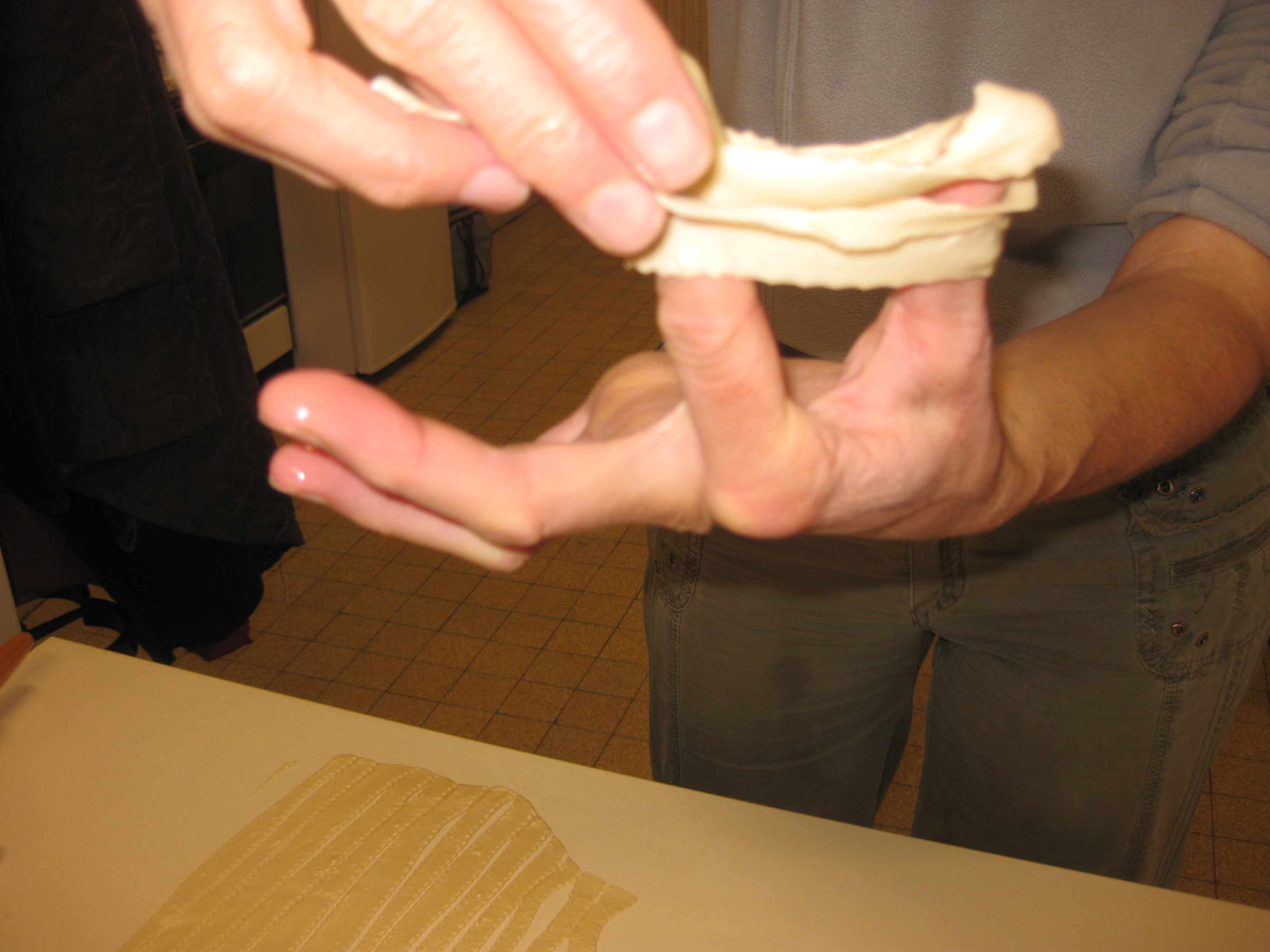
Nadia makes the dough for her Algerian sweetmeats

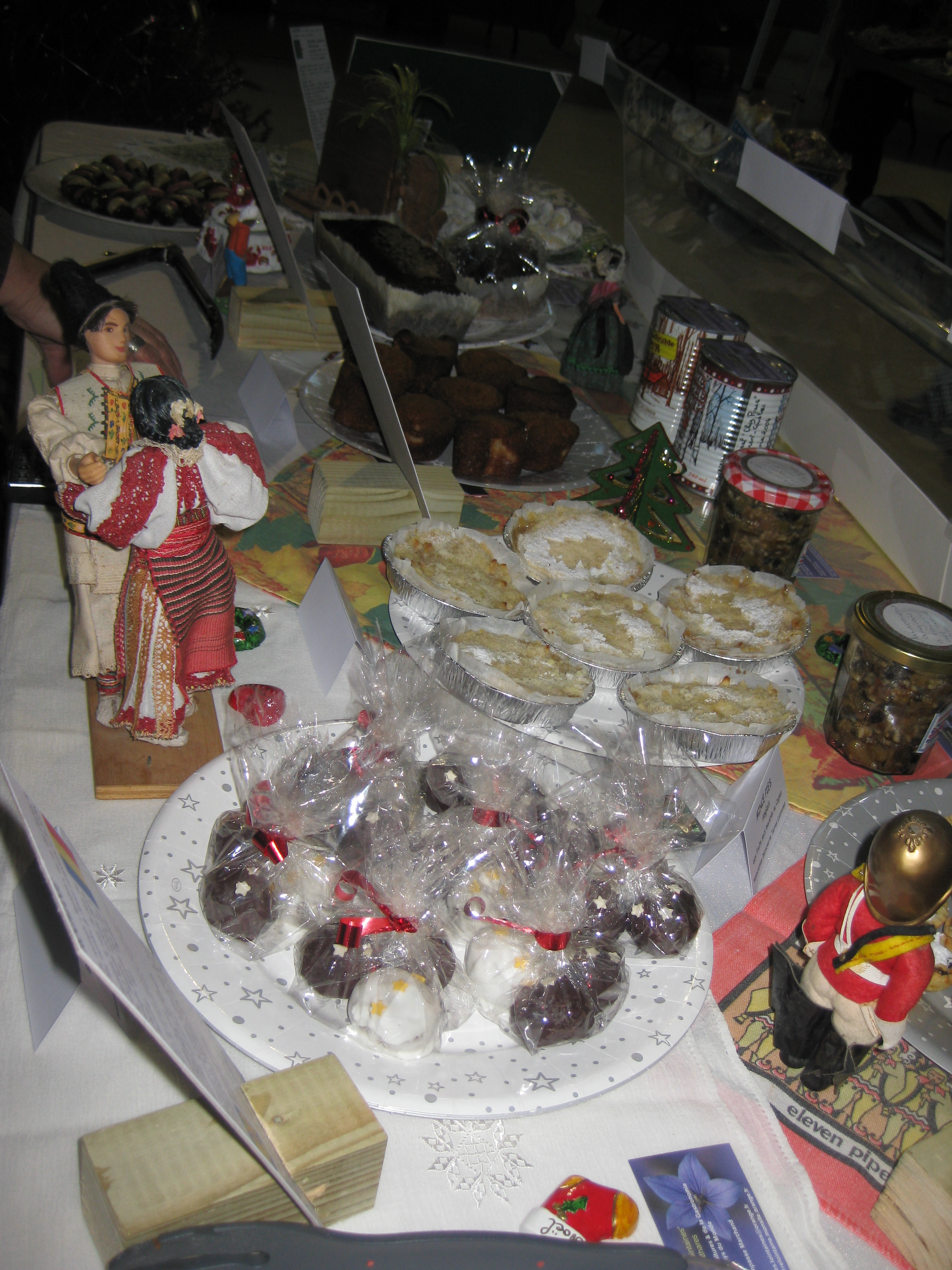
Last week was a first though. We were invited to provide an International Buffet at a multi-services training day being laid on by the Mairie. At various points in the days leading up to it, we got together in the kitchen of the Family Centre (CAF), and helped each other cook.

Then Sylvia winds the dough strips into little 'birds nests'....

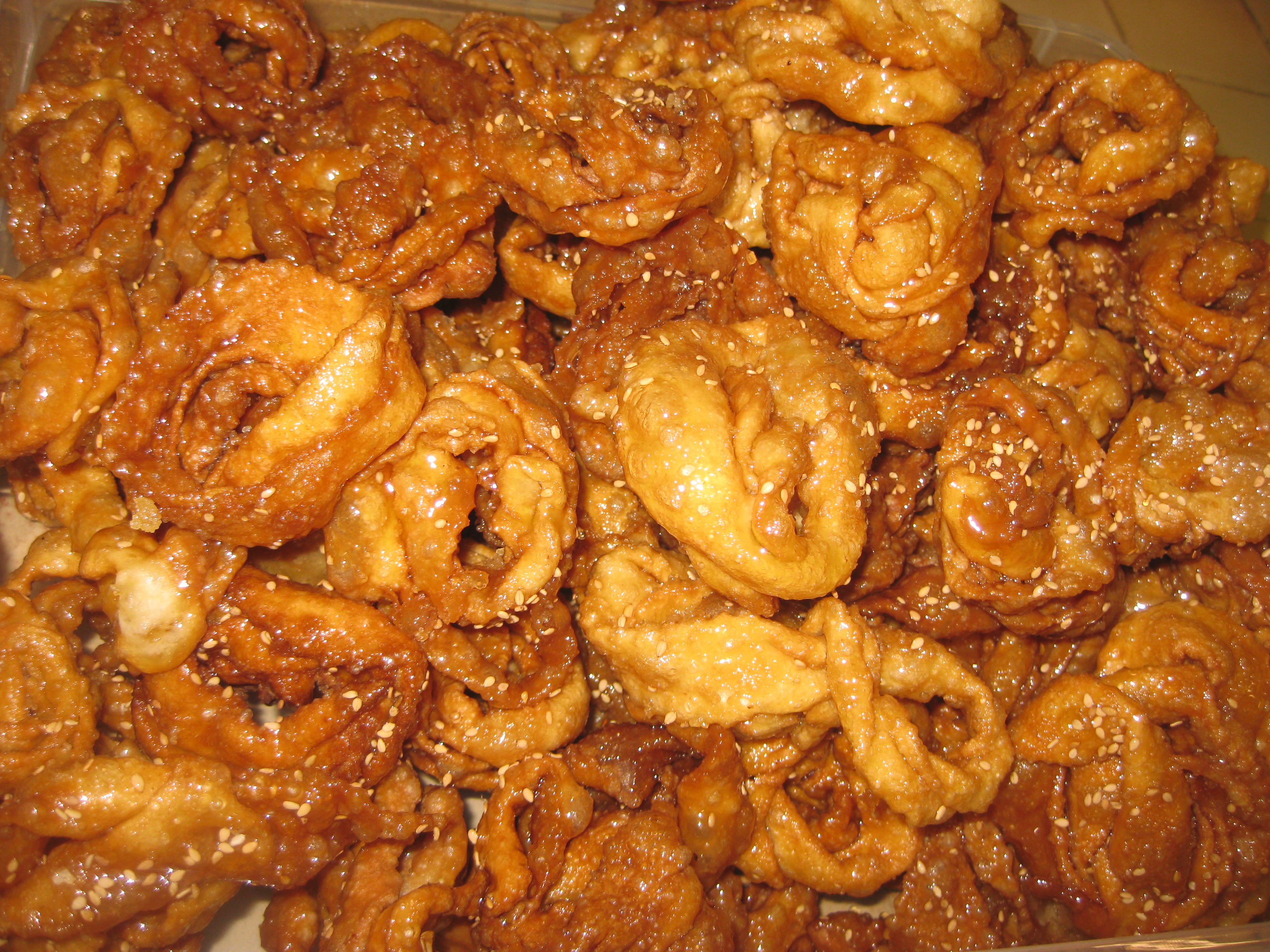
Nadia showed us how to prepare Algerian grivvech: thinly rolled dough cut into strips and wound into jumbled little nests before being deep fried and doused in honey and sesame seeds. There were Quebecois dishes, guacamole topped toasts, and treats from around the world.

...the deep fried, sticky, delicious result.

Best of all was the unlikely sounding tomato and banana soup from Brazil.  Do try it: recipe below.

What could I contribute as an English finger-food? I thought long about this, and came up with Scotch eggs (thanks, Kalba, again). You need to know that here in France, sticky tape, as in England, is known by a trade name. Not ‘Sellotape’, but ‘Scotch’. So Sylvia’s eyes darkened in puzzlement when I suggested these Scotch eggs. ‘Sellotape eggs? What on earth….?’

And what fun it all was.  I can and do open recipe books to try out dishes from any and every continent.  But it’s not half so exciting as working with women from Algeria, Brazil, Roumania, wherever, as they talk you through the techniques they’ve known for years and years, and stand over you and make you practice and redo things till you jolly well get it right.

I'm NEVER deep-frying 30 Scotch eggs again

Anyway, here are my photos of the preparations for a successful lunch. We could have taken any number of repeat bookings, but for the time being, the organisation will maintain its ‘benevole’ status, and not venture into the hard realities of developing a business.

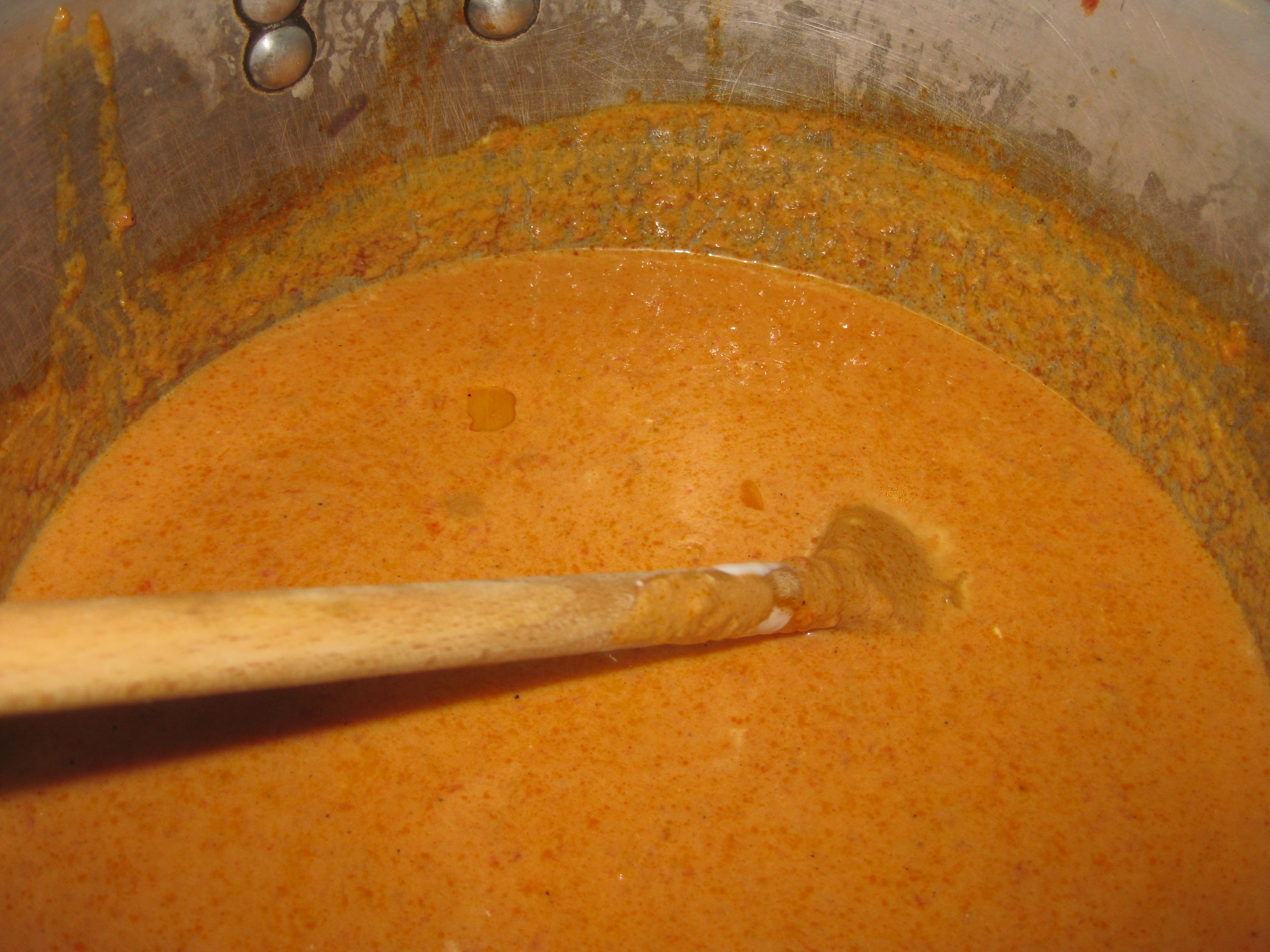
Brazilian Tomato and banana soup

Soup just cooked and ready to go

Ingredients

I onion

I tbspn rapeseed oil

Large bottle of passata

5 ripe bananas

1.5 l. bouillon

Small carton cream

3 tsp. curry powder

1 tsp. cayenne

Gently cook the onion in the oil.  Meanwhile, remove the black central thread which you may never previously have noticed and any seeds from within the peeled bananas, and mash thoroughly.  Add the passata to the onion, together with the spices and cook gently .  Add the mashed banana and continue cooking.  Add cream, reheat gently, and serve

Ça y est – we have wood!

….as you can see.  And it all had to be moved today, off the street, through the house, and into the woodstore.  Using a calculation from an American site, it seems we have probably moved in excess of 10,000 lb. of weathered oak.  ‘We’ being me, Malcolm-the-convalescent, and our lovely friend Martine, who dropped in to say ‘hello’, saw what we were doing, and rushed straight home to change into grot gear and come back to help.

But we’re happy.  2 ‘piles’ of oak- 8 cubic metres – should keep us cosy through all of this winter, and the next one too.  And in case you’re wondering, this wood came courtesy of a farmer in Ventenac, about 8 miles from here, via le bon coin.  So we peasants DID need the internet, after all

The Peasants of Silicon Valley

Over the past months you may have sighed indulgently – or with irritation – as I’ve described our attempts to get to grips with our peasant lifestyle.  I’ve smugly talked about our efforts to get a 52 weeks a year veg. patch going, about going equipped on every walk, prepared to carry loot home: a bagful of walnuts, chestnuts to roast, windfall apples and pears, a log or two for the fire.  We enjoy what we do and it matters to us, but frankly, if we don’t get these things right….well, there’s always the market, or someone around who can sell us what we need.

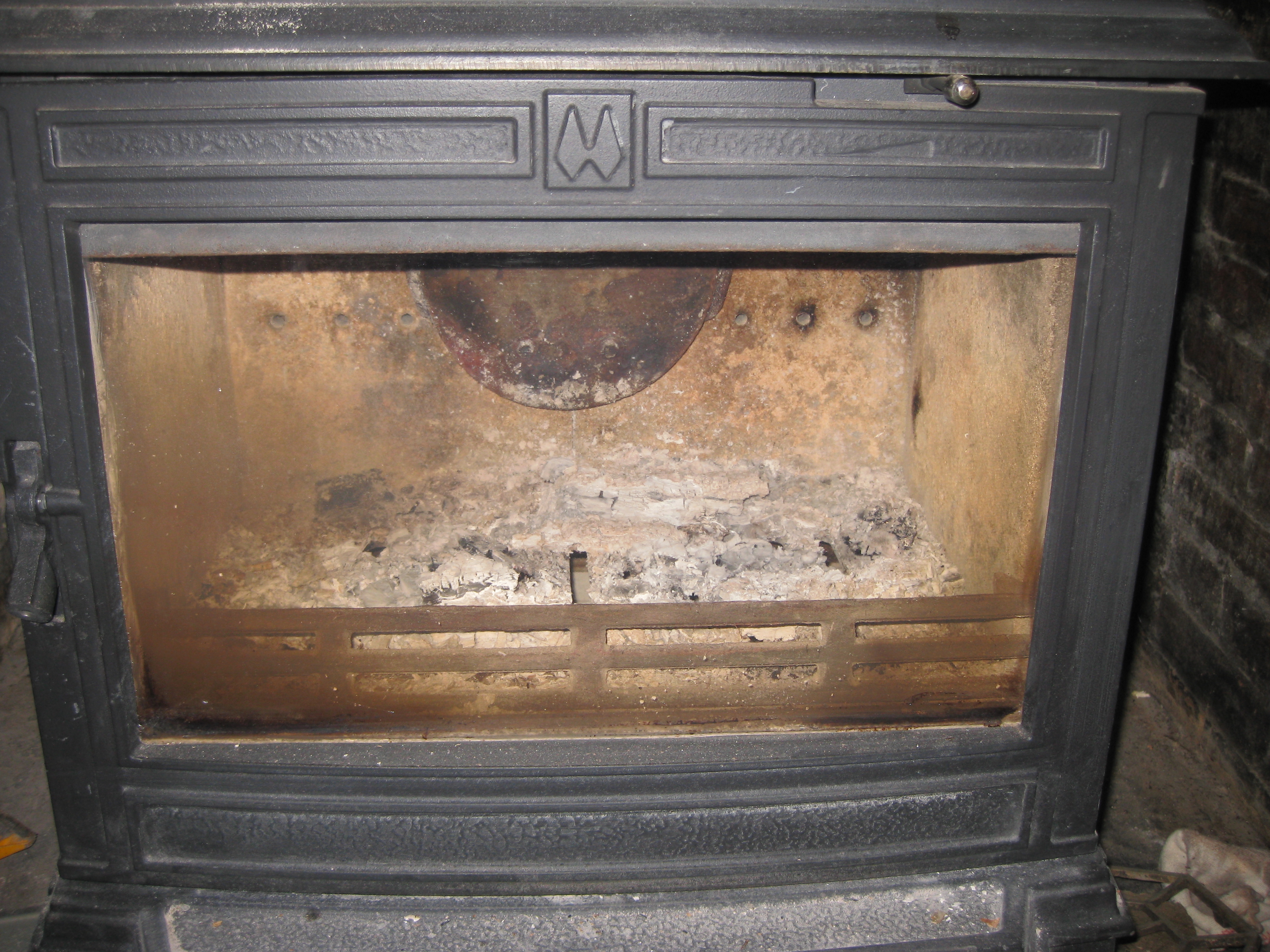
Until now.  Now we’re in crisis.  We’ve no firewood for the wood-burning stove.  Well, not much anyway.  A friend’s cousin was supposed to supply us with our wood for the winter, and he did.  But it won’t do for this winter, and probably not next either.  We need wood that’s had all its natural moisture weathered out of it, leaving it dry and combustible.  What we got was freshly-hewn logs.  They sit in the grate and spit and sulk. We’ve been busily lugging them to the open first floor of our atelier, and stacking them where the air will get at them and dry them out.

Wood for the stove....going....gone

So now, half way through November, we’re asking anyone who’ll listen where we can buy seasoned wood.  And the answer is, we can’t, it’s too late. It’s all sold.  Like real peasants, we face the prospect of a winter without our beloved wood-burning stove.  Unlike those peasants, we do have a few radiators, but they don’t glow cheerily at us after a chilly day playing at being self-sufficient in the great outdoors.

And unlike those peasants, we’ve had another, peculiarly 21st century crisis. Our computer became terminally ill.  Its death in the night seemed certain.  We were distraught.  How to keep in contact with friend in 3 continents?  How to pay bills, organise our banking, buy tickets to England for Christmas?  Hearing of our distress, friends and family phoned, diagnosed, offered treatments, and somewhere in among all this, a remedy appeared.  It might turn out to be merely patching the wound, but it’s working so far.  It’s reminded us though that we’re not quite the horny-handed sons-and-daughters-of-toil that we like to see ourselves as.  We have some way to go before we achieve The Good Life

A rural scene a few miles from our house. This farm's ready for winter