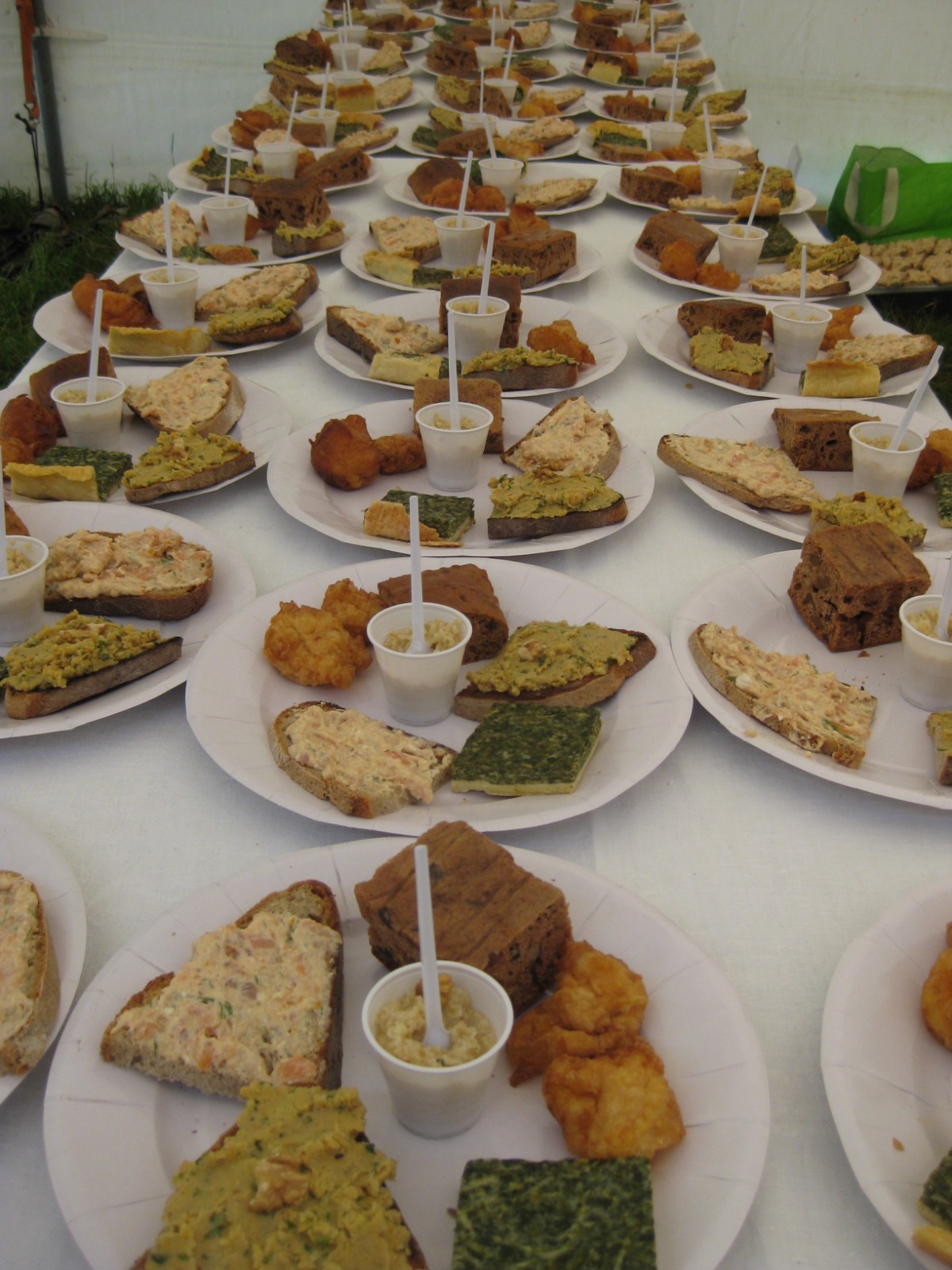
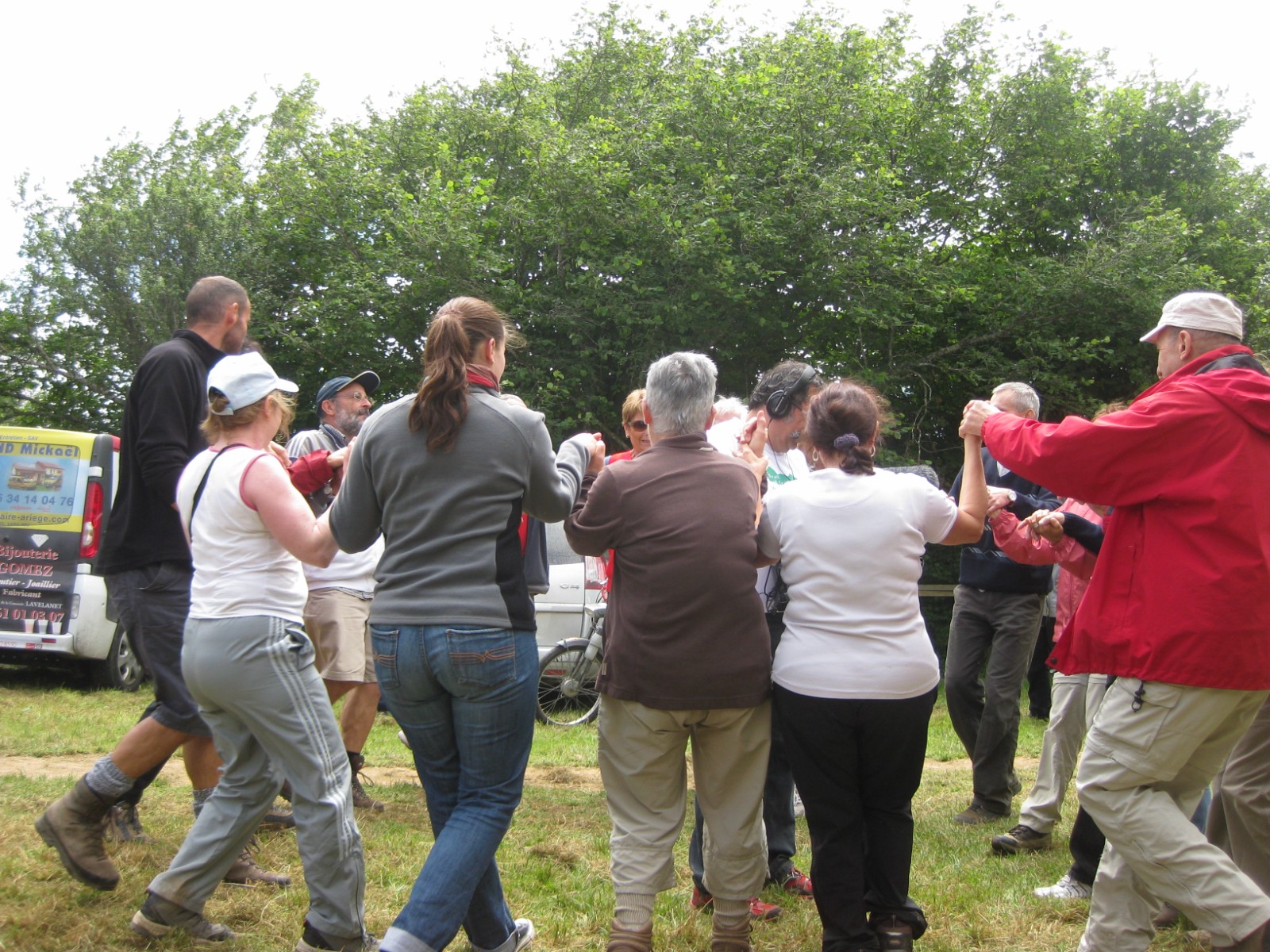
Voilà!

Voilà!  The most useful word in the French language.

Here’s what happened at the baker’s this morning.  Translations appear in brackets.

Me: Oh!  Isn’t the pain bio ready yet?

Madame: Voilà! (Nope.  Quite right)

Me: So if I call in after 9, you’ll have some?  Could you please save me a loaf?

Madame:  Voilà! (Yes, and yes).  Would you like to pay now, then it’ll be all done and dusted?

Me:  Voilà! (Makes sense.  I’ll do that)

By the way, I was all grottily dressed in my oldest paint-spattered, holes-in-the-knee-ready-to-face-a-morning’s-tiling gear.  This is Laroque after all: no shame in working clothes here.

Madame:  You’re looking very chic today, if I may say so!

Me:  Voilà!  (And don’t I know it).

Why bother to learn more French?  Voilà donc!

Coteaux d’Engraviès

Last week, we had a morning at an organic vineyard, one of only 2 commercial vineyards in the whole of the Ariège.  The vineyards at Coteaux d’Engraviès appeared on maps as long ago as 1310, and on later maps too, though eventually they disappeared.  So the owner of the Domaine, Philippe Babin told us, anyway.  He was the one who decided once again to cover the hillside in vines.

He introduced us to an Ariège from a time we couldn’t recognise.  Now, we’re used to seeing fields of maize, sunflowers, food and fodder crops  in addition to pastureland.  Back in the Middle Ages, when Catharism was at its height, the area was covered in vines.  Everyone produced wine for their own use.  It wasn’t strong, maybe 5% or so, but it provided refreshment and nourishment for men, women and children alike.  No neat rows here, the vines grew unsupported by trellising, higgledy piggledy.  Over in Pamiers, from where any exportable wine was shipped, the notorious Bishop of Pamiers, later Pope, Jacques Fournier, received the taxes he imposed in the form of wine.

The Ariège was prosperous and, for the period, densely populated.  Men made their living from mining and the forges, and their women and children reared stock in the high pastures.  Only the Industrial Revolution, which arrived later in France than in the UK – just before the First World War in fact – put a stop to this, as the small scale of local operations were not suited to large-scale mechanisation.  This, and the de-population that occurred when men failed to return from the trenches, began the Ariège’s descent into a less populated, often deprived area.

Philippe shares his expertise

Phylloxera saw the end of wine production in the Ariège.  Vines, decimated in the 19th century throughout Europe, were gradually replaced elsewhere by resistant American varieties.  The local domestic vines, most of which were fairly low quality, weren’t worth replacing, and people simply walked away from them, leaving them to die.  Only within the last 30 years have a couple of producers recognised that parts of the area are suitable for developing once more a high-quality product, and with modern and traditional savoir-faire behind them, worked towards developing businesses of which they can be proud.  Philippe Babin is one of these.

Philippe went on to tell us more about the vines themselves.  They need rain, and they need sunshine for their leaves to absorb and enable the fruit to mature.   Vines put roots deep down into the soil and rocky earth, particularly in the first 15 years of life. Philippe chooses to grow his vines organically, because he recognises that the particular composition of the soils and rocks beneath in the area – ‘terroir’ – inform the character of his vines: fertilisers and other products would change this balance.  The vines themselves change as they mature, and those plants which are 80 – 100 years old (his are a long way from this) produce little, but what they do is very fine.

Pruning forces the vines to produce grapes, and therefore seeds.  Unpruned, they grow hundreds of metres long, and see no need to seed themselves.  Wild vines are therefore innocent of fruit.

Examining grape pips for maturity

Then he showed us how to research a maturing grape.  Does the skin peel easily from the fruit, and is it loosing its elasticity?  If so, it’s ripening nicely.  Have the seeds broken away from the ‘umbilical cord’ of the stalk and taken on a woodier appearance?  Once that happens, the seeds are nearly ready to fall and have a go at germinating (they have a low germination rate).  From now on, they’ll nourish themselves, like embryo chickens in an egg, from the flesh of the grape, which will wither as the seed digests it.

Barrels full of wine waiting to be bottled

Lesson over, we went back to the Cave.  A small band of workers were working to bottle the last of the 2010 vintage to free up space for the harvest which will take place in maybe a fortnight or so.  The barrels in which the wine matures must never be left empty, so this is a last minute job.

And finally….the tasting.  An opportunity to compare three of the wines he produces.  Every year his blends are slightly different, to arrive at a consistent product.  Syrah, Merlot, Cabernet Sauvignon…all have their part to play in blending wines to make a perfect complement to an enjoyable meal, whether roasted, casseroled or preserved meats, or a plate of local cheeses.

Wine waiting to be tasted

The concentration camp at le Vernet

Yesterday, we visited one of the Ariège’s best kept – and most shameful – secrets, the museum commemorating the concentration camp at Le Vernet.

ID shots of some internees

Starting in 1939, after the defeat of the Spanish Republic, the concentration camp at Le Vernet, near Pamiers, was used to detain the 12,000 Spanish combatants from the Durruti Division. At the declaration of war, ‘undesirable’ foreigners, anti-fascist intellectuals and members of the International Brigades were interned at Le Vernet under terrible conditions, described by the writer Arthur Koestler (himself interned there) in ‘Scum of the Earth’. In 1940 it became a repressive camp for interning all foreigners considered suspect or dangerous to the public order.  At the time, it was known as ‘The French Dachau’.

Model showing part of the camp

From 1942 it served also as a transit camp for Jews arrested in the region. In June 1944, the last internees were evacuated and deported to Dachau in the ‘Ghost Train.’ In total about 40,000 people of 58 nationalities were interned in the camp.

We were shown round by the Mayor of  le Vernet.  He has a passion for sharing this dreadful part of French history which only someone whose family has suffered its consequences could have.  He showed us the models of a vast camp, now totally obliterated, and the cramped dormitories.

Model of a camp dormitory

He described the harsh conditions, when inadequately clothed and severely underfed men would have to stand outside, immobile, 4 times a day, during the extremely hard winters, for roll-call.

As a tiny baby, he was interned with his mother, a Spanish refugee, at a women’s and children’s camp, flimsily built and harshly managed, on the coast (Le Vernet was for men only).  The women begged for clothing – their own was so flea-ridden it had to be burnt – and more food.  The response was that they could return to Spain if they wanted.  Some did, but many stayed.

As an adult, with a French wife and children, he wanted to take French nationality himself.  ‘How did you arrive in France?’  ‘Via the concentration camp in Argelès.’  ‘There were no concentration camps in France, only accommodation centres.’  Such denial existed till quite recently – hence the total destruction of the site of this camp, the most repressive in France.  Now however, largely because of people such as this mayor, the history of these camps, run and organized not by the Nazis, but by the French themselves, is at last being told.

From the display about health

Six weeks: a souvenir

Dear reader, perhaps you are feeling quite short-changed.  You subscribe to a blog called ‘Life in Laroque’, and for the last 6 weeks or so, have had nothing but news from England: Yorkshire, to be exact.

Well, we’re back in Laroque, where in our absence they’ve had bitter cold, driving rain lasting for days, and astonishing heatwaves in which the thermometer has topped 40 degrees.

But just before we abandon postings about England, here is a souvenir slideshow of our time there.  It’s a reminder for me really, so if dear reader, you decide to skip it on this occasion, I quite understand.

Normal service will be resumed in my next post.

This slideshow requires JavaScript.

Here we go round the blackberry bush…

I’m so chuffed to be in England for the blackberry season.  Ariègeois blackberries baked in the hot sun are sweet, characterless and make a rather dull jam.  But then who goes to southern France to go blackberrying?

So yesterday I went out, meandered down a few nearby lanes, and came back with a bowl filled with large glossy, juicy, sweet and yet tart berries, a stained T shirt and fingers stuffed with tiny spines and tingling from nettle stings.  I was very happy.

I set my berries to simmer down with the early apples from Jonet and Richard’s tree, and then…. only then, remembered I had neither a  jelly bag nor a cache of jam jars ready waiting for the next stage.  Oddly, I do have a preserving pan.

So it’s been the moment for a little ingenuity.  An old clean T shirt ripped up made a jelly bag, and this morning we’ve been piling our toast with a week’s ration of marmalade, decanting apricot jam into a bowl, and scraping clean an almost-finished jar of honey.  So far so good.  But what happens when I need to make the next lot?

Flour power

Returning from England to France, there’s generally a bag or two of various kinds of flour in the luggage.  ‘What?’ I hear you grumble.  ‘That woman who’s always banging on about buying local? The one who’s got no time for the English abroad who can’t exist without their mug of builder’s tea and a custard cream?’  Yes.  That’s me.  Guilty as charged.

Melting Moments

But the thing is, when in France, I sometimes have a happy hour or two baking English goodies – Melting Moments, Gingernuts, Marmalade Loaf Cake, that sort of thing – with or for French friends.  And as I discovered the other week, French flour is simply not right for the job.  Not better, not worse, just different.

I’d run out of my own supplies, so I nipped out and got a bag of good quality baking flour (because even more than in England, it’s important to buy the right type of flour for the job).  And my tried and trusted favourites turned out all wrong. Ginger biscuits, instead of being satisfyingly chewy, with a solid crunch between the teeth, were sandy and brittle.  Marmalade loaf cake, though light, was close-textured and almost crumbly.  It was so disappointing.  The answer, it seems, lies in the gluten content.  The average French flour is ‘softer’, and has a lower gluten content than the average English flour.

French baguette

So is it surprising that superior French bakers in England, such as Dumouchel, where my daughter used to work on Saturdays, send over to Normandy for supplies of authentic French flour?  Or that the average French stick, bought from the average English baker, in no way resembles its chewy French antecedent, the baguette.

English wholemeal loaves, fresh out of the oven

On this visit to England, I’m appreciating the softer crust and slightly moister qualities of a well-made wholemeal loaf, just as over in France, I enjoy the the crustiness of crisply baked French bread.  Best to accept, I think, that both countries produce fine bakers and cake makers.  But neither could do a fine job using the flour preferred by the other.

If you want an introduction to some of the many flours on offer to the keen baker, Dan Lepard’s site is a good place to start

Wood for our yard. We visit the woodyard

For months now, back in our thickly forested département, we’ve been looking for wood.  Not to burn this time, nor for the workaday laths and planks which are the stuff of the average d-i-y project.  No, we needed thick, dense lengths, something like the impressive beams you see in houses and barns throughout  France. And given what a common sight these are, they’ve proved incredibly difficult to source.  Kalba had the best idea.  ‘Had you thought of Montcru?’.  Well, no, it was so far away, beyond la Bastide de Serou, that we hadn’t even heard of it.

View from the woodyard

But it was worth a journey.  We’ve never been to such a place.  Miles from anywhere much except lovely Seronais scenery, Robert and his wife run an idyllic looking B&B with woodyard attached.

Buying wood here involves a detailed discussion of your needs.

Robert trundles off with his large pick-up to select likely-looking logs while you stay and play with the cheerfully energetic dogs. Then he hoists the wood into his wonderfully large cutting machine which he somehow manoeuvred over himself from Poland, measures everything you your exact specification, cuts, trims….and hoists it onto your trailer or whatever.

The chosen log is hoisted ready to be cut
Let cutting commence!
Loading our trailer as the horses supervise

Two hours, a cup of coffee together as Robert worked out the bill, and we were off.

If you haven’t eaten chips cooked in duck fat, you haven’t lived. No, really

Time for lunch then though.  L’Enso de Marichott.  If the idea of eating in a shack in a car park doesn’t attract you, you’ve not been to l’Aire du Ségalas , near Castelnau-Durban.  It’s a wooden chalet open only during the summer months, and almost the whole menu is based round duck – the ducks that the owners José and Jean-Luc raise themselves.  In fact they grow much of what you eat, and almost all the rest is local, and organic at that.  We had a quiet lunch, but weekend evenings are the time to go and party there, we’re told. Definitely worth a detour.

L'Enso de Marichott
L’Enso de Marichott

Then we drove home, v-e-r-y carefully.

Back home: no grabs and cranes here….. Just us

‘Except ye Lord keep ye cittie ye wakeman waketh in vain’

Ripon Town Hall

That’s the  verse from the Psalms, inscribed above the town hall in Ripon, where we’re spending the next few weeks to avoid the cold and rain of the south of France (no, really, they’ve got the heating on over there).  It reminds us that every evening – EVERY evening – for well over a thousand years, the Ripon Wakeman has sounded his horn to the 4 corners of the city to announce that all is well.

I had to go and check it out yesterday evening.

George Pickles, Wakeman, on duty

Promptly at 9, a smartly dressed individual in buff coloured hunting coat, tricorn hat and white gloves took his place before the obelisk on the Market Square and sounded his horn 4 times, once at each corner of the obelisk – one long mournful note each time.

Then he grinned at us, a small crowd of 20.  ”Want to hear a bit of history?’  Well, of course we did.  He made us introduce ourselves, and we found we too came from, well, about 3 corners of the world: Catalonia, Italy, Australia, even South Shields and Merton.  And here’s some of what he told us:

In 886, Alfred the Great, 37 year-old warrior king, was travelling his kingdom to defeat the Vikings, and to drum up support .  Arriving at the small settlement of Ripon, he liked what he saw and granted a Royal Charter.  He lacked the wherewithal to produce an appropriate document, and so gave a horn which is still safely locked in the town hall.

‘You need to be more vigilant, there are Vikings about’. Alfred warned.  So the people appointed a wakeman to guard the settlement through hours of darkness, and he put that horn to use by sounding it at the 4 corners of the Market Cross to announce that all was well as he began his watch.  The town’s now on its 4th horn.

If you want to know more, our current Wakeman, George Pickles,  has written the whole tale for the BBC website.  It’s a good yarn.  Read it when you have a moment

This is the obelisk the Wakeman visits each evening. It was erected by the then MP, William Aislabie in the 19th century, to commemorate his ….60 years as an MP

Back yard makeover: part 2

Even if you don’t normally click on links, please look at this one:  It shows our house and yard both back in the Bad Old Days, and up until about a year ago.  We think things have moved on again.  Take a look.Over on the left is pretty much where we got up to last year.


Then we added another seating area, and wood to cover the ghastly concrete that we couldn’t dig up near the house.  Have you spotted that gravel from Raissac yet?

There it all is, seen from our bedroom window.  There’s just one major job to do.  And that’s to top off the two raised beds with large lengths of wood, so we can use them to sit on as we admire our peaceful outside space.  Our day out to collect that wood is yet another story.