A walk gone wrong

This slideshow requires JavaScript.

Yesterday was gorgeous.  Hot and sunny until long into the evening.  We ate outside and stayed on the roof terrace till 10 o’clock.  Today seemed to promise more of the same.  We should know better.  This year, getting even two days on the trot where the weather is hot and clear all day is asking a bit much.

And so it proved.  Today, our walking group met to share lifts to where our walk was to begin.  We set off in the sunshine, watching our in-car thermometers climb steadily to 27 degrees as we drove ever upwards, beyond Villeneuve d’Olmes, beyond Montferrier, up a road which became narrower and less well maintained, to Frémis, a tiny hamlet.  We parked there, in a flower-spangled meadow offered by a local farmer.  We peeled off our fleeces, applied suncream and set off towards the peak, Coulobre. Sometimes the upward-going was tough and quite a scramble, but we were encouraged by looking across to the still snow-capped tops, and the thought that we’d be having our picnic at the top there,  the Ariège spread below us with views, views and more views.  We met a herd of black Mérens horses sheltering in a copse from the already-hot sun.   A donkey befriended us.  And still we climbed.

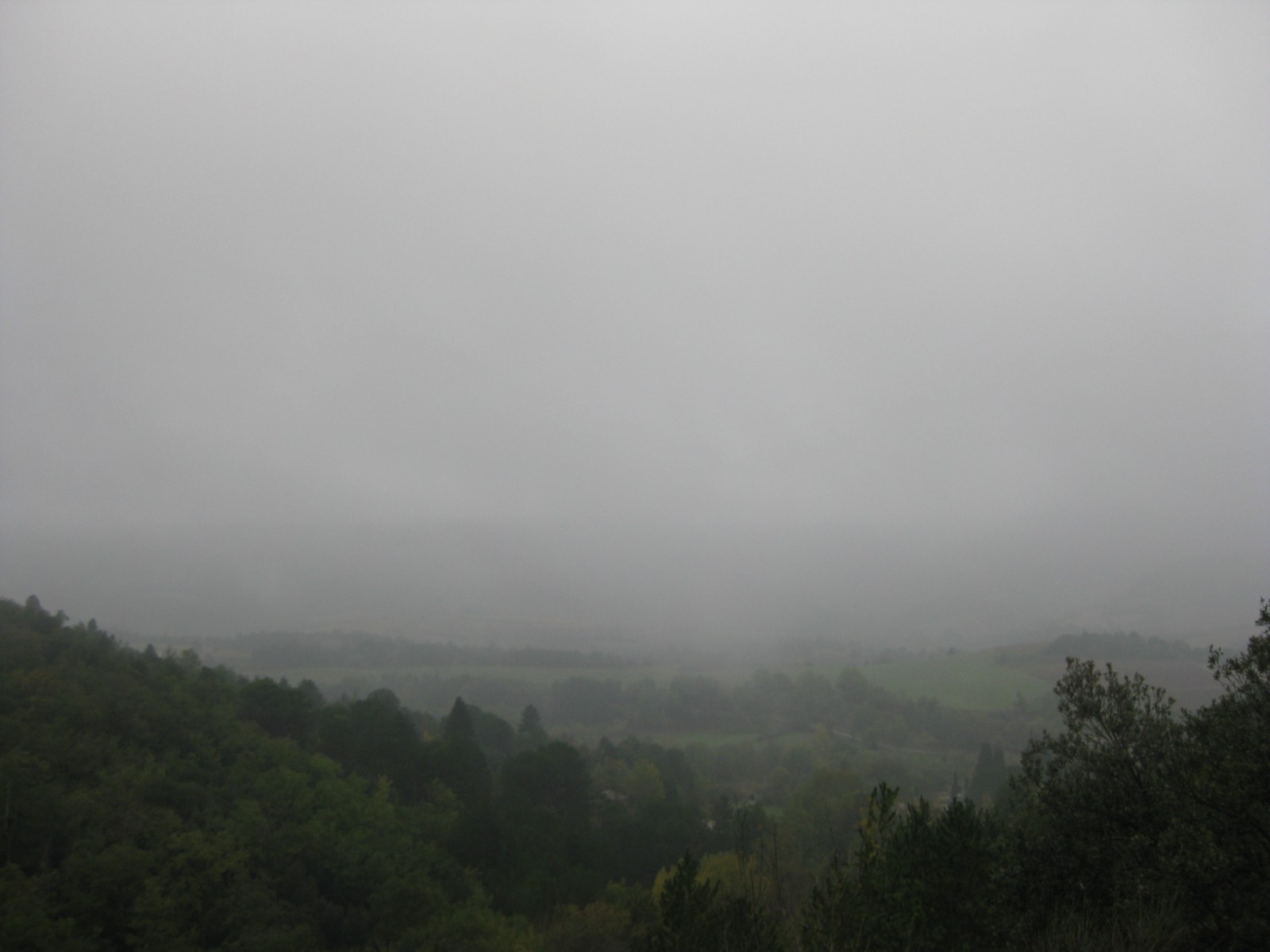
Towards midday, walking through the forest, we suddenly realised things were changing.  Didn’t it suddenly feel cooler?  And weren’t those little scraps of mist swirling round those peaks?  Apparently yes.  The mist descended.  The ‘cool’ became ‘chilly’.  With 20 minutes to go to arrive at our lunch spot, Micheline, who had developed a gammy knee, announced she could go no further.  It didn’t take much for us to decide that it was not only friendly to remain with her and have our lunch, it made sense.  The mist was swirling around us, the views up there wouldn’t be up to much, and it was obvious that rain or worse was on its way.

We found logs to sit on, got our fleeces out again, ate our lunch with little ceremony, and scuttled down.  The climb up had taken nearly three hours. Scurrying down took not much more than an hour.  And as we reached Frémis, the rain started.  It’s not stopped since.  And those in-car thermometers on the way home? 15 degrees.

Les demoiselles de Caraybat, daffodils and gentians

Once upon a time long ago in Caraybat, when times were hard, the men of this small village had to look far afield for work.  And they went to Spain, for the hay-making season.  Hawkers came to the village, and peddlers.  They found a village with no men.  They took advantage.  So did the women.

When the hay-making season was over, the men returned, and the women spied them returning over the distant mountains.  Suddenly ashamed and frightened, they fled to the hills.  God, in vengeful and Old Testament mood, was displeased.  As the women reached the summit, he turned each one of them to stone.  And there they are to this day, les demoiselles de Caraybat, a petrified reminder of a summer of sin.

A few of those demoiselles hide themselves behind the woodland trees

We remembered this legend yesterday when I took our Laroquais walking friends to Caraybat and the dolomies to discover those daffodils I’d been shown on Thursday.  I was quite chuffed that not a single one of them had previously known this special spot, and we had a pleasant hour up on the rocks, picnicking and enjoying the last days of the daffodil season.

We followed the walk I’d learnt about on Thursday, and then we finished our day by going to the plateau above Roquefixade to see the gentians there.

Gentians above Roquefixade

Sadly, it was by then rather cold and windy, and most of the gentians had sensibly folded their indigo skirts about their faces and tucked themselves away to wait for a sunny day.  We’ll wait too.  And when the sun comes out properly, we’ll be back.

Daffodils in the Dolomies

Yesterday, we walked in Les Dolomies, which you could confuse with the Dolomites with its craggy pillars and rocky outcrops: though actually it’s a small area between Lavelanet and Foix, just along from Roquefixade.  After a few days of hot sun and blue skies, it was disappointing to have the threat of rain, but the slight mistiness brought its own beauty to the landscape, softening the distant views, and enhancing the vibrant greens of the springtime meadows. Everywhere, blossom and flowers.

We walked upwards through the woods.  Anny and Maguy had a surprise for us.  And quite suddenly, there they were.  Daffodils.  Thousands and thousands of them, extending upwards over the hillside, tumbling over rocks, leaving not an inch of path for us to walk along.  The weather cleared. The sun came out.  We were entirely happy.

Come and share the walk with us, along blossom-laden paths, through the daffodil woods, and then down into the valley, looking across at those still snow-covered peaks.

To view any of these photos  full-size, click on the image.

Snowshoes III: The very last episode

I’m not doing raquettes (snowshoes) ever again.  Never.  If I ever show signs of changing my mind, lead me into a darkened room, talk kindly to me, and sit with me till the feeling passes.

I have no idea how I got through yesterday.  I must have done though, because every move I make causes some protesting and unhappy muscle to complain vigorously at the pain it endured on our expedition, and is still enduring now.  Five hours walking, with half an hour off for lunch.  Something over 600 metres up, 600 metres down – that’s nearly 1900 feet each way in old money.

I said last week’s sortie was tough.  Compared with yesterday’s, it was a stroll in the park.  I said last week’s was ‘an upward slog: unremitting, tough’.  Yesterday’s was a vertical slog: unending, unforgiving.  Last week, the snow had been deep and crisp and even, and easy to walk on.  We had crunched satisfyingly upwards through the forest, and our descent had been a brisk and easy downward march.

Yesterday, following a warm and sunny week, the snow was soft and our snowshoes sank deep.  Bad enough on the upward route march, but coming down, we all skidded, slipped and lost grip of our poles as they plunged into unseen cavities.  I made landing smack on my back and descending bumpily downwards, legs waving helplessly in the air my personal speciality.

Still, it was good to see Montségur, looming above us at our starting point, providing points of reference throughout the day.  Soon after we started, we were level with the castle at its summit, then it was below us, and disappeared for a while as we plodded upwards through a stretch of forest.  At lunchtime it was impossibly far below.  As we ate, we enjoyed plotting the landscape for other landmarks: Lavelanet and Laroque of course, the lac de Montbel, and far north of us, the Montagne Noire.

Best of all were the cloudscapes: massed plump white cushions of cumulus with wispy brushes of cirrus above, turning a more characterful and moody grey in the afternoon, foreshadowing the evening’s expected rain.  We were just back at the cars when the rain arrived a little ahead of schedule, with a brief hailstorm of pencil-point-sharp hailstones to encourage us on our way.  We didn’t need telling twice.  Home comforts have never seemed more inviting.

Snow Shoes II, The Sequel

We walkers of Laroque got our snowshoes out again today (well, in my case, I borrowed some), and went for a much more local sortie, just above Montferrier and en route for the local skiers’ playground, Mont d’Olmes.

How different from our last walk.  Instead of wide open snowfields with distant views, we had woodland walking and bright sunlight casting blue shadows across our path.

Instead of gentle slopes rising and falling before us, we had an upward slog; unremitting, tough.  Micheline and I, discouraged and tired, failed to reach the top, and missed the prize: a frozen lake with snow-clad views in every direction.  Most of the party stayed with us and kept us company.  Though our views were less exciting than those of the intrepid climbers, our picnic was the better one.  We low-achievers had wine, home-made cakes and hot coffee with us to supplement our bread and cheese.

And the journey down was completed in record time.  We arrived home as our gardens were gently baking in the last of the hot afternoon sun.  More of the same is forecast for several days: there won’t be much snow left this time next week.

Vines at Villelongue & the martyrs of the mudslick

A winter walk near Villelongue d’Aude.  It’s vineyard country, and the vines are stark and bare just now, the countryside colours muted.  I’ll only tell two stories about the day, because the photos can do the rest.  One is about Sainte Barbe, whose chapel we visited at the end of the day.  The other is about how she failed to protect us when we were in the precincts of her chapel.

Sainte Barbe lived round about the 8th century.  Her father Dioscore, a local dignitary, seems to have been a somewhat strict and unbending man.  He had a tower built to imprison his daughter, to protect her from the advances of handsome young suitors. Once, he went away, and she took advantage of his absence to make a third window in her prison tower, to commemorate the Holy Trinity.  Well, that’s the story.

Her father returned, and in a fury, denounced her to the local prefect.  Then he tortured her and decapitated her with his own hands.  But as he returned home, he got his come-uppance.  He was struck by lightning and carbonised.

Barbe was canonised and is ready to protect you, if you ask her, from flames and lightning strikes.  Nowadays she’s a patron saint too – of fire-fighters, miners, and bomb disposal experts.  And she has this chapel near Villelongue where we made our own pilgrimage.

Well, despite the fine weather the other day, the ground there is still waterlogged.  As Anny discovered when she came to try to drive off as we left the chapel.  Her wheels stuck.  They spun dizzily round.  They embedded themselves deeper and deeper into the mud.  We all gathered vine clippings to give the mud-slathered wheels better purchase.  We pushed.  Malcolm got caught by a pulsing stream of mud ejected by the spinning wheels.  We pushed some more, and eventually, had success.  We grumbled a great deal at Sainte Barbe, because she didn’t help us at all.  I think she was a little unfair.  If we’d been stuck there much longer, I think we’d have called out the fire brigade, and then, surely, she’d have to have helped.

Rain, rain…….

The banner headline on this morning’s regional paper, La Dépêche du Midi, told us what we already knew.  There’s been twice as much rain this month as is usual.  Of snow, we’ve seen hardly a flake.

Driving back from Foix yesterday, we saw meadows that have become mini- lakes.  Even more fields glistened with water as the water table has risen to the very surface of the soil. It’s made the month a somewhat gloomy one, even though the days have been pretty mild.  The mountain peaks are snow-capped, as expected, but the white stuff barely creeps down the mountainside and with all the low cloud and zilch visibility, it’s sometimes hard to know where the Pyrenees have disappeared off to.

Our regular yomps into the countryside have been a bit curtailed.  Walk after walk has been rained off, and when we do go, we choose our routes with care.  If we don’t, we’ll be lugging kilos and kilos of glutinous heavy clay with us as it clings to our boots and the bottom of our trousers.
 

Boots - with added mud
Boots – with added mud

Roll on the 2nd of February, Chandeleur (Candlemas), the day when Winter decides whether to stick around or push off.  Last year, it was icily cold, and Winter stayed and made his presence felt with several weeks of constant snow, ice and bitter cold.  This year, he‘s looking much more half-hearted about it all.  We blame ourselves. We invested in snow-tyres and snow chains for the car.  We clothed our olive tree and a few other plants in white dresses of horticultural fleece.

Our olive tree all wrapped up for winter

So Winter laughed in our face.  We daren’t change the tyres or undress the tree though.  We all know what will happen if we do.

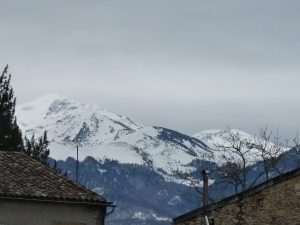
There's snow on them there 'ills: but not a lot.  As seen from our roof terrace
There’s snow on them there ‘ills: but not a lot. As seen from our roof terrace

Bugarach: ‘Doomsday Destination’

Cold.  Pale thin fog baffles the contours of the hillsides, and those of the distant castle at Coustassa.  Glimmering frost bristles the short maquis grass beneath our feet.  A watered lemony sun high above us attempts to burn winter away, and eventually does so.

That’s when we have our first view of Bugarach, the imposing thick-set mountain which dominates this part of the Aude, because it stands alone, rather than as part of a range, and today is pretty much thatched in snow.

Bugarach has been in the news for a while.  Here’s BBC’s ‘From our Own correspondent’ back in July 2011:

‘According to an ancient Mayan calendar, at some point towards the end of 2012, the world will come to an end.

It is not clear how that will happen, but apparently humanity does not stand a chance – except for those who seek shelter in the area surrounding Bugarach.

Just 200 people live there all year round, but doomsday believers and spiritual groups are convinced the village has magical powers, thanks to the local mountain – the Pic de Bugarach.

For years, rumours have circulated on the internet that extra-terrestrials live in the mountain, and come the apocalypse, the top will open and they will emerge with spaceships, and rescue the local inhabitants.’

Although it’s quite hard to entertain the idea that the mountain might be some sort of underground UFO car park, there are plenty of people who have done so, and with great fervour.  Here’s today’s Daily Mail, which has been talking to Jean-Pierre Delord, Mayor of the tiny village of Bugarach (pop. 176).

‘On Wednesday, he will close the village for five days to anyone who doesn’t live here or isn’t already booked to stay, and draft in hundreds of police, military, firemen and Red Cross to ban any gatherings, shut off the mountain and arrest anyone silly enough to try flying over it.

‘What if tens of thousands of people turn up?’ he says, throwing his arms up in the air. ‘I have no way of knowing what will happen. I have no crystal ball! I don’t care if people want to chant naked or talk to the trees, but I have to protect my villagers. I am responsible for them.’’

He’s not over-reacting.  Local house-owners have been able to rent out their homes for the period in question for astronomical prices, and even camping spots are going for 400 euros a night.  For most locals though, the whole thing is at best a nuisance, at worst a real headache.  The nearer we get to December 21st, the more people descend on the area, and the police and army are already involved in keeping order.

We enjoyed our views of Bugarach, as ever.  We spent time pretending to look for UFOs and generally mocking the New-Agers who are so convinced by the end of the world as we know it.  Then we got on with the business of enjoying our walk in the here-and-now.  Here are some photos of our day.

A very English Sunday walk

If you go on a walk near Limoux in the Aude at this time of year, you’re entitled to scenery like this:

Vineyards near Villar -St-Anselme

In our walking group here in Laroque we all take turns to organise the weekly outings.  And this week, it was the two of us, the only English, who were in charge. We decided on an autumn walk among the vines round Saint Polycarpe, near Limoux.  The weather forecast wasn’t great, but the rain promised to hold off till 3 o’clock.  But no.  English leaders, English weather. Think of us plodding through the mud as the rain increased in intensity, long long before 3 o’clock arrived.  Everyone blamed us, of course.  They think this is the only kind of weather we know, back in England.

It all began so well….

Above Saint Polycarpe, 10.00 this morning.

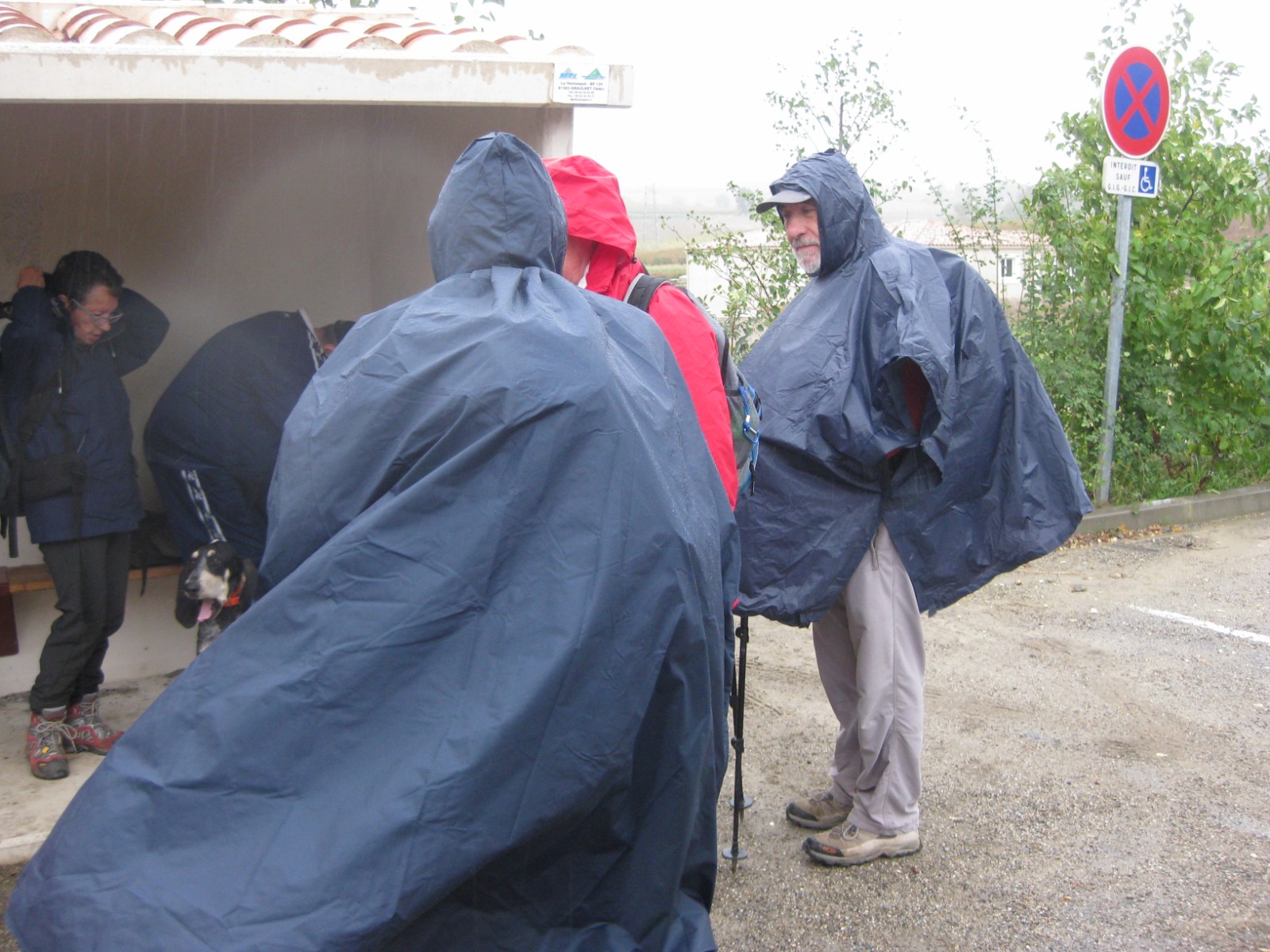
Lunch was early, at Gardie, but we didn’t beat the rain.  We had our break in the bus shelter, for goodness sake, and got togged up like this immediately after.

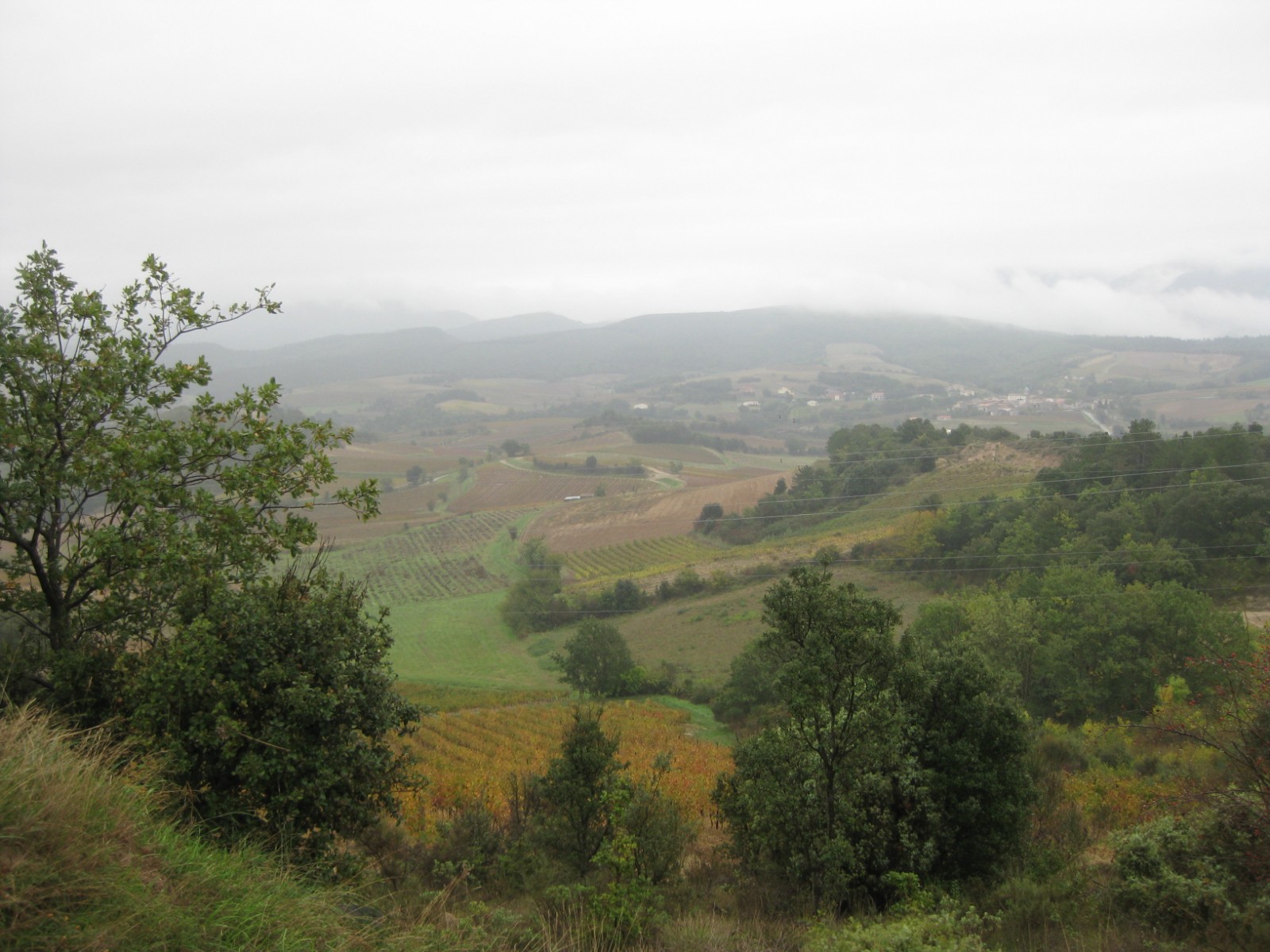
The clouds descend…..

And the gloom.

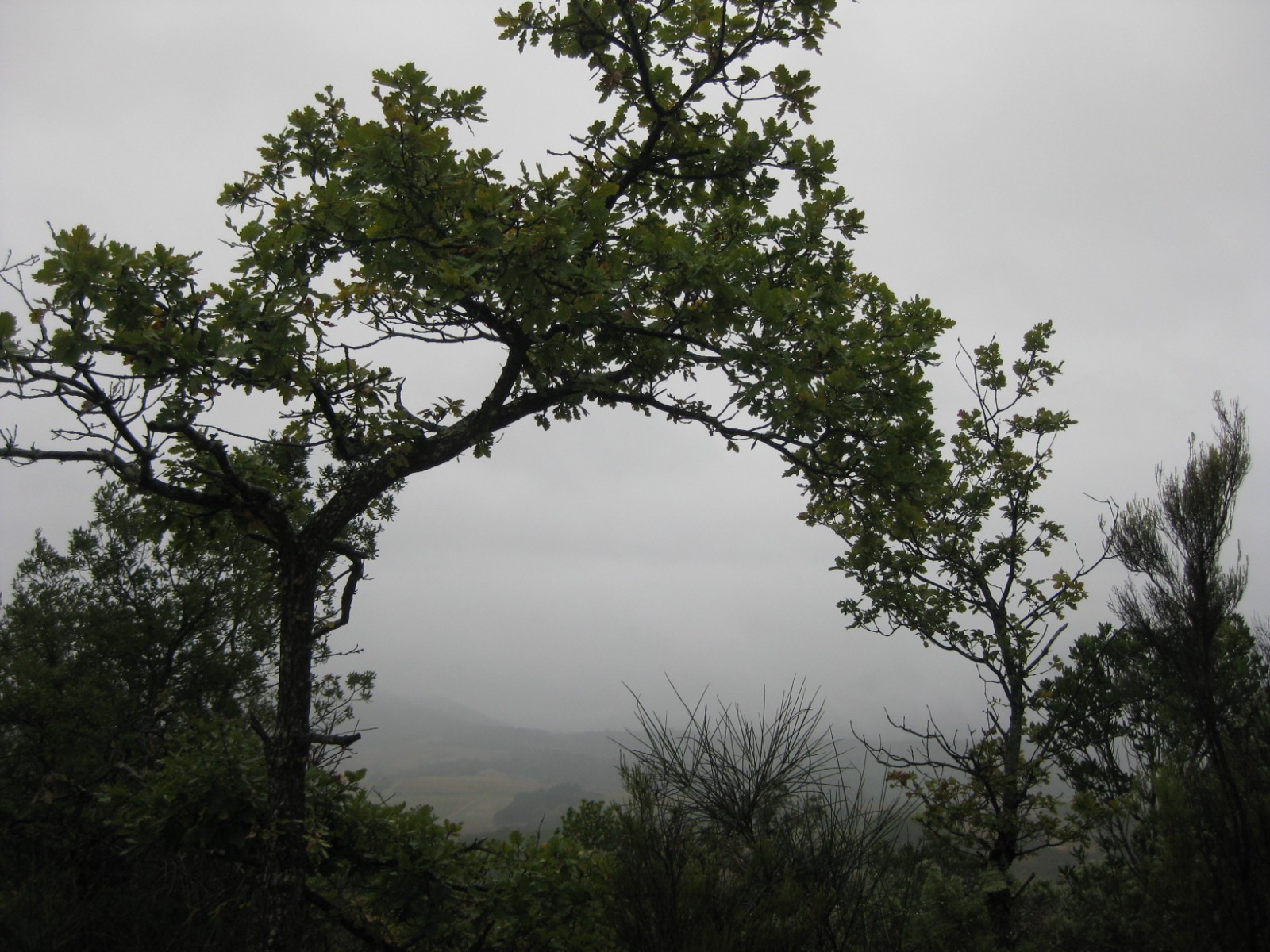
Can’t see much.

Saint Polycarpe’s down there somewhere…

Still, nobody complained.  We got our fresh air and exercise, and our friends had a thoroughly good time holding us responsible for the rain and mud.

PS.  Dangermouse update.  We caught him last week.  He is no more.  He was a rat.  Eurghhhhh.

‘All is safely gathered in, ere the winter storms begin’ *

Autumn colours beginning means it’s harvest time for foragers

I’ve written before about the ‘au cas où’ bag: the carrier you always have with you on a walk, ‘just in case’ something tasty turns up and demands to be taken home and eaten.

Well, at this time of year, it isn’t really a case of ‘au cas où’ .  You’re bound to find something.  A fortnight ago, for instance, Mal and I went on a country stroll from Lieurac to Neylis.  We had with us a rucksack and two large bags, and we came home with just under 5 kilos of walnuts, scavenged from beneath the walnut trees along the path.  A walk through the hamlet of Bourlat just above Laroque produced a tidy haul of chestnuts too.

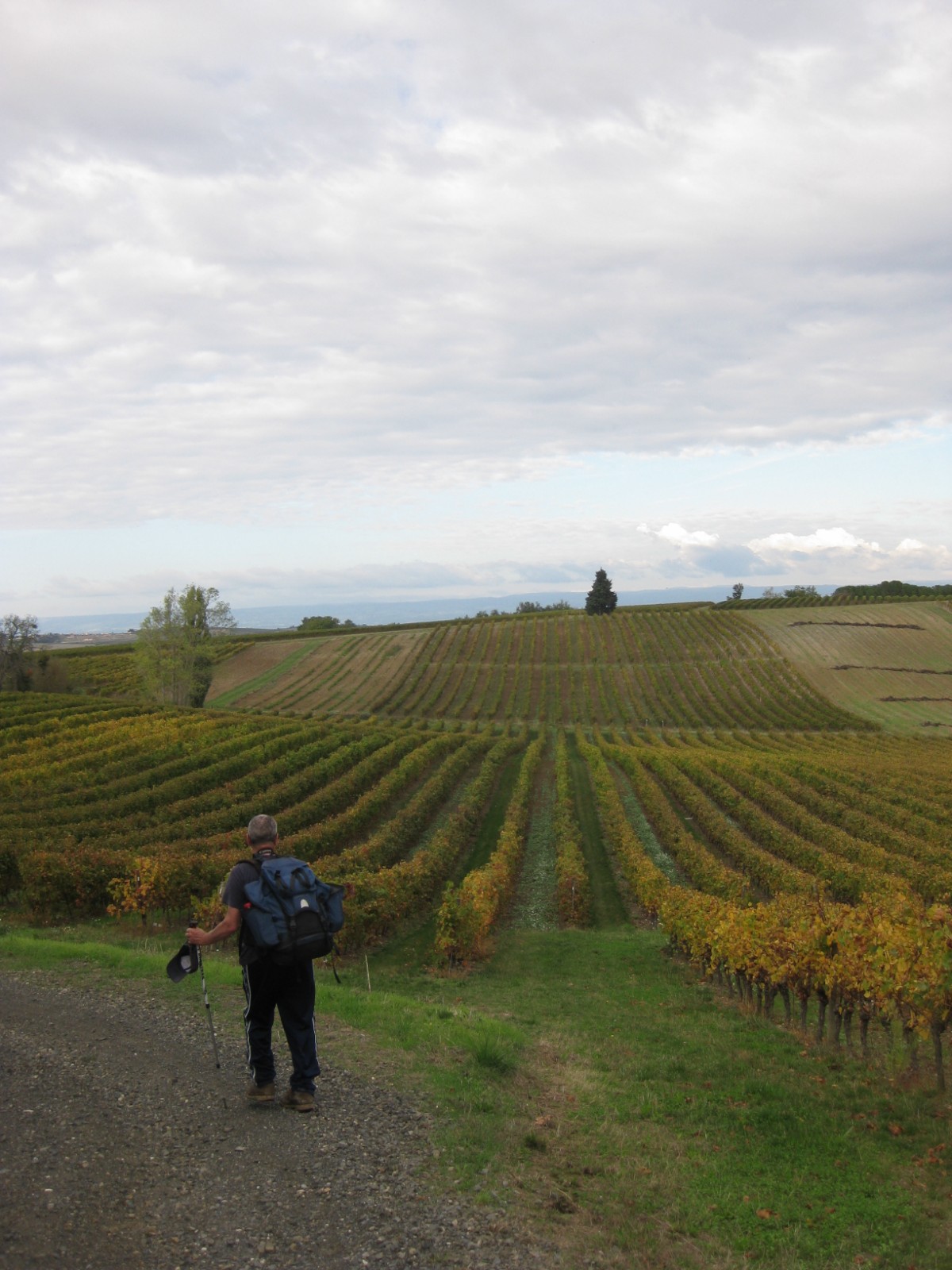
Yesterday, we Laroque walkers were among the vineyards of Belvèze-du-Razès.  The grapes had all been harvested in the weeks before, but luckily for us, some bunches remained on the endless rows of vines which lined the paths we walked along.  We felt no guilt as we gorged on this fruit all through the morning.  The grapes had either been missed at harvest-time, or hadn’t been sufficiently ripe.  They were unwanted – but not by us.

So many vines: there’ll be unharvested grapes there somewhere.

The walnuts we’re used to in the Ariège are replaced by almonds over in the Aude.  You have to be careful: non-grafted trees produce bitter almonds, not the sweet ones we wanted to find.  But most of us returned with a fine haul to inspect later.  Some of us found field mushrooms too.

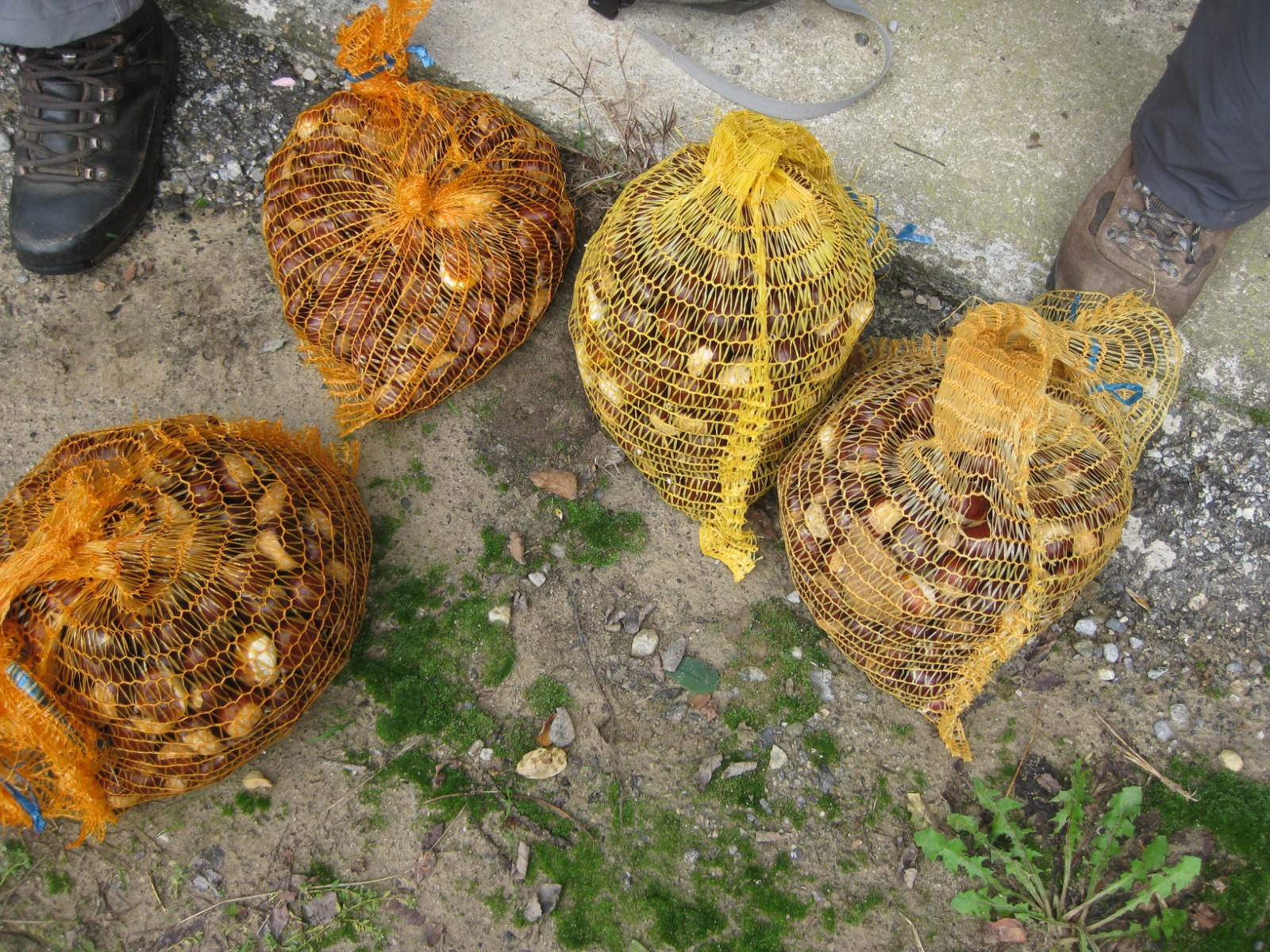
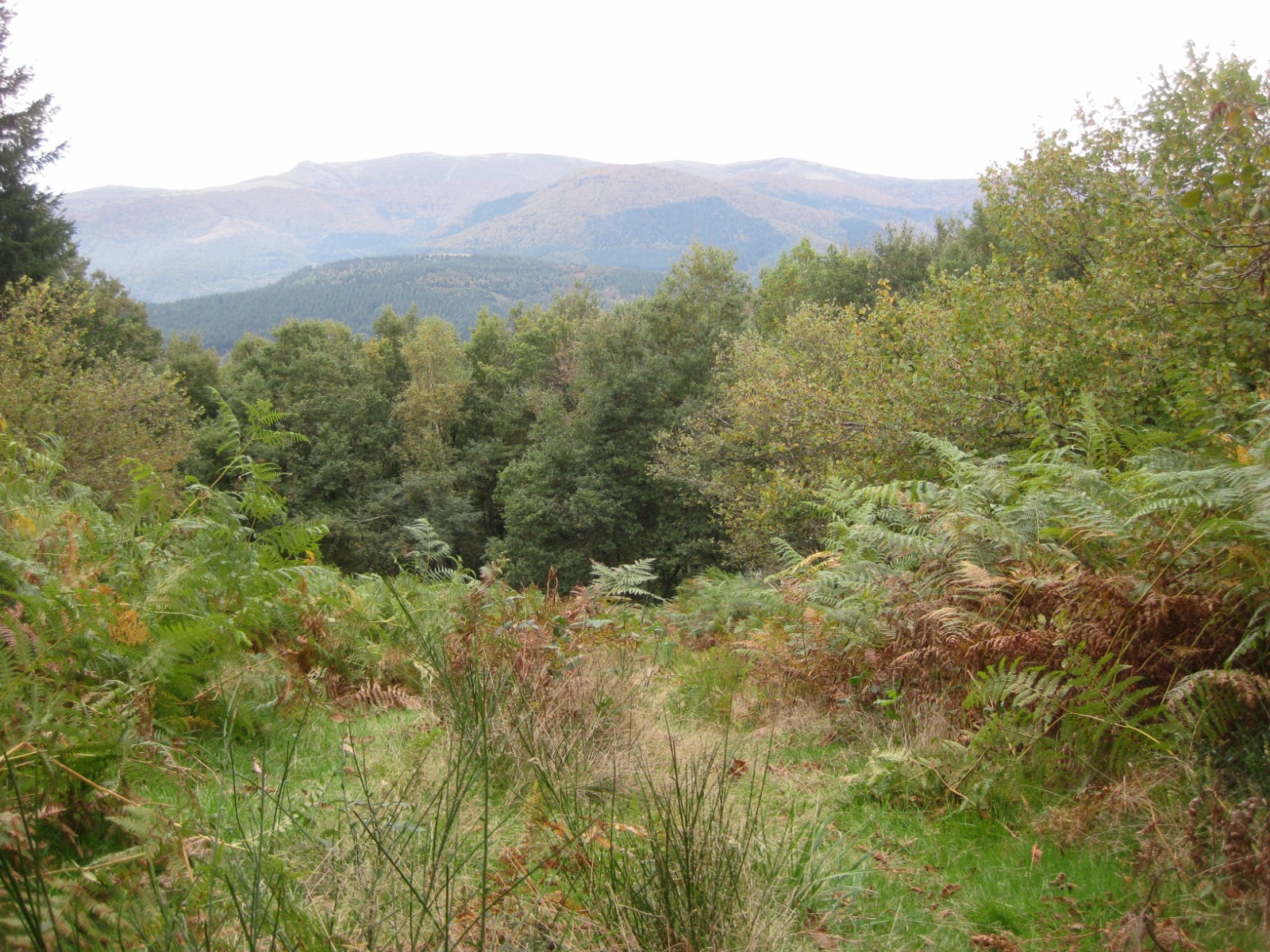
Today, the destination of the Thursday walking group was the gently rising forested and pastoral country outside Foix known as la Barguillère.  It’s also known locally as an area richly provided with chestnut trees.  Any wild boar with any sense really ought to arrange to spend the autumn there, snuffling and truffling for the rich pickings.  We walked for 9 km or so, trying to resist the temptation to stop and gather under every tree we saw.  The ground beneath our feet felt nubbly and uneven as we trod our way over thousands of chestnuts, and the trees above threw further fruits down at us, popping and exploding as their prickly casings burst on the downward journey.

As our hike drew to an end, so did our supply of will-power.  We took our bags from our rucksacks and got stuck in.  So plentiful are the chestnuts here that you can be as picky as you like.  Only the very largest and choicest specimens needed to make it through our rigorous quality control.  I was restrained.  I gathered a mere 4 kilos.  Jacqueline and Martine probably each collected 3 times as much.  Some we’ll use, some we’ll give to lucky friends.
Now I’d better settle myself down with a dish of roasted chestnuts at my side, and browse through my collections of recipes to find uses for all this ‘Food for Free’.

I think these chestnuts represent Jacqueline, Martine and Maguy’s harvest.

* Two lines from an English hymn sung at Harvest Festival season: Come, ye thankful people, come’